JOURNAL OF A COMPULSIVE READER
By Charles Matthews
Showing posts with label Pablo Picasso. Show all posts

Friday, July 8, 2011

5. Modigliani: A Life, by Meryle Secrest, pp. 144-192

Chapter 8: "What I Am Searching For"; Chapter 9: Maldoror

Paul Alexandre remained Modigliani's benefactor, and the two were in close contact until the start of the war in 1914. In 1913, the city finally took over Alexandre's villa on the rue de Delta, so his new apartment at 10 Place Dancourt, next to the Théâtre de Montmartre, became the location of the salon. Modigliani even took over the interior decoration of the apartment: To emphasize its high ceilings, he had the legs of tables and chairs shortened. Alexandre recalled, "Right up high, on a level with the chandelier, we hung Modigliani's large red figures" -- works that have never been identified.

Modigliani, Picasso, and André Salmon at the Café Rotonde, 1916
Artistic life still centered on cafés, particularly the two at the corners of the boulevards de Montparnasse and Raspail, the Dome and the Rotonde. Americans flocked to the former, but the artists, including Picasso, Diego Rivera, Ilya Ehrenburg, Ortiz de Zarate, Max Jacob, Apollinaire, and of course Modigliani, preferred the Rotonde.

Picasso had become the dominant artistic figure of the day, and his success enabled him to move into an elegant apartment at 242 boulevard Raspail. Modigliani venerated Picasso, but he once told Louis Latourette that the only other painter he admired was Henri Rousseau, who at sixty-five had become the "Grand Old Man of art." Rousseau's The Wedding Party made a profound impression on Modigliani when he saw it with Alexandre.
Henri Rousseau, The Wedding Party, 1905 (Source)
In 1910 Rousseau completed his most famous painting, The Dream, and in March exhibited it at the Salon des Indépendants. Unfortunately, Rousseau was hospitalized that summer after an accident and died on September 2. The Dream had a profound affect on numerous artists, for "with his direct line to the unconscious, [he] seemed to have discovered intuitively what the Surrealists ... would have to puzzle out painfully in the years to come."
Henri Rousseau, The Dream, 1910 (Source)
During the four years, from 1910 through 1913, that Modigliani devoted himself to sculpture, he met a Portuguese artist, Amedeo de Souza Cardoso, who not only shared a name with him but whose style also resembled his, though it was more highly colored. Cardoso came from a well-to-do family, and "in 1911 the two Amedeos decided to hold their own show. Cardoso's paintings and drawings were hung beside Modigliani's caryatids, and seven of Modigliani's heads were placed, with great care, around the room. It was a bold, even clever move. Friends came to admire but did not stay to buy. The critics ignored the exhibition. Nothing sold." Modigliani did not sell a sculpture until 1913, when Augustus John and his wife visited his studio and bought two of them for a few hundred francs.
Amedeo de Souza Cardoso, Saut de lapin, 1911 (Source)
 The café scene was one source of income for Modigliani, who "joined the legions of 'café artists' who made the rounds in the hope of finding willing sitters." He would carry his portfolio and make his way among the tables, sizing up customers susceptible to flattery, and if lucky would sketch a portrait to sell, or just a sketch in exchange for a drink.

He also did portraits of his friends, including Jean Cocteau, who called the painting of him by Modigliani "diabolical," and although he paid "the derisory sum of five francs" for it, tried to leave it with a friend who finally gave it to the proprietor of the Rotonde in payment of a debt. It hung in the café for several years and then passed from hand to hand until an American couple bought it for several million francs, to Cocteau's irritation.
Amedeo Modigliani, Portrait of Jean Cocteau, 1916 (Source)
Modigliani also befriended Maurice Utrillo at a time when, like Modigliani, he was having no success selling his work, and was even made sport of because of his outrageous behavior when he was drunk. "Curiously, no paintings or drawings of Utrillo by Modigliani have come down to us, although the artist memorialized almost everyone he knew, sometimes repeatedly."
Maurice Utrillo, Le Lapin Agile, date unknown (Source)
One artist whose portrait Modigliani painted several times was Chaim Soutine. He resided in the complex designed for artists by Alfred Boucher, a sculptor and philanthropist. Boucher bought up one of the pavilions designed by Gustave Eiffel for the international exhibition of 1900 and had it moved to the southern edge of Montparnasse. He called this honeycomb of studios La Ruche, "the Beehive." In addition to Soutine, its residents included Léger, Chagall, and Archipenko. It had a disadvantage in that it was next to the slaughterhouses and their attendant sounds and smells, though Soutine turned it into an advantage by painting a series of flayed carcasses.
Chaim Soutine, Carcass of Beef, c. 1926 (Source)
Modigliani acted as a kind of mentor to Soutine, who had grown up abused and neglected until he was rescued by a rabbi who recognized his artistic talent and sent him to art school. Modigliani tutored him in French and helped him develop self-confidence.
The manner in which Modigliani painted hands is often meant as a clue to the initiated. In one portrait of Soutine Modigliani seems to be emulating the model set by Cézanne some years before. In his portrait La femme à la Cafetière, Cézanne depicts a lady, stolid, mannish, all in blue, hands limply placed in her lap. She looks formidable, but then one notices that her sleeves stop short to reveal her oddly vulnerable wrists.
Paul Cézanne, Woman With a Coffee Pot, c. 1895 (Source)
Modigliani used this device to the same effect in one of his portraits of Soutine, then in his early twenties but looking more like a forlorn adolescent. 
Amedeo Modigliani, Portrait of Chaim Soutine, 1916 (Source)
In another portrait painted the same year (1916), Soutine's right hand, resting on a knee, is oddly placed with a gap between the third and fourth finger. This was meant, Marc Restellini wrote in L'Ange au Visage Grave, to signify the Jewish priestly blessing. If so, it was a subtle reference to the heritage they shared that many would not recognize.
Amedeo Modigliani, Portrait of Chaim Soutine, 1916 (Source)
Having grown up in a household with its own set of superstitions, Modigliani carried many of them into his adult life and developed his own metaphysics where art was concerned. He remained interested in the occult, and was fascinated by the prophesies of Nostradamus. But he was also caught up in the intellectual currents that would produce Surrealism. In a 1907 sketchbook he wrote:
What I am searching for is neither the real nor the unreal,
But the Subconscious, the mystery of what is Instinctive in the Race.
This was ten years before Apollinaire coined the term Surrealism, and seventeen years before the first of André Breton's manifestos. "His goal in plumbing what Jung has called the collective unconscious was to search for spiritual insights, 'the secret truth of the profound being in which he had the originality to believe.' Restellini wrote, 'Behind the legend of the sole artiste maudit of the twentieth century stands a visionary artist with an extremely radical philosophical conception of his art."

In 1911, Paul Alexandre's mother died of tuberculosis, and Jean Alexandre would follow in 1913. During the winter of 1912-13, Constantin Brancusi discovered Modigliani unconscious in his studio, and sometime in the same winter he collapsed again. When Ortiz de Zarate found him in a faint on the floor, he started a collection to send Modigliani back to Livorno to recuperate.

In the summer of 1913, Modigliani was back in Livorno, with his head shaved, perhaps after a hospital stay in which he may have been treated for, among other things, head lice. Emanuele remembered the shock at his appearance when he returned. "Naturally he was nursed, well fed, and brought back to a sane health," Emanuele wrote.

When he came back to Paris later that summer, he had apparently given up sculpture. Perhaps the work of stonecutting was too hard for him, and the dust affected his lungs, or he decided that painting was more likely to produce an income than sculpture. But 1913 was also the year of the Armory Show, the great exhibition in New York that introduced modern art to the United States. Modigliani was not included in the Armory Show, either as painter or sculptor, but European sculpture was in general poorly represented in the show, which may have suggested to Modigliani that the path to success was through painting. Only twenty-seven of Modigliani's sculptures survive, with the result that they are much sought-after: One of them sold at Christie's in London for $52.8 million in June 2010.

Although the Cubism of Picasso and Braque had not been well represented at the Armory Show, it had become the dominant movement of the day. Modigliani, however, was content to leave it to them. Pierre Daix, an expert on Picasso's work, detects the influence of Picasso's "masklike stylization and geometrical emphasis" in such paintings by Modigliani as The Amazon and Woman's Head With Beauty Spot.
Amedeo Modigliani, Woman's Head With Beauty Spot, c. 1906 (Source)
Amedeo Modigliani, Portrait of Pablo Picasso, 1915. Secrest: "It is a curious picture. The paint is almost scrawled across the canvas in a furious fashion, unlike Modigliani's carefully developing style. The subject's penetrating stare is masked, the mouth is small and set, and the expression is secretive, almost cunning. The word "savoir," knowledge, learning, or "to know" has been appended. Restellini suggests that this perhaps refers to ... Picasso as a visionary. Was that really meant as a compliment or, as Billy Klüver believed, 'an ironic comment about the guy who knows it all'?"  (Image source)
"When asked to what 'ism' he belonged and in what manner he painted, he would always reply, 'Modigliani.'" If there was a real tension between Picasso and Modigliani, it may have been "that Modigliani, ever alert to signs of anti-Semitism, had overheard a certain unkind remark from Picasso" regarding the repayment of a debt Picasso owed Modigliani. And once, in 1917, when Picasso was unable to sleep, he decided to paint something and used the surface, not the back, of a painting he had acquired from Modigliani. "He evidently felt the urge to obliterate the work of someone with whom he was, obscurely or otherwise, in competition."

Some date the return to Paris from Livorno in 1913 as the start of Modigliani's self-destructive period: "It is axiomatic that Modigliani was a brilliant young artist who ruined his health and died prematurely from drugs and drink. Even authors who are aware that he had tuberculosis take the same similarly dismissive attitude; the addiction showed the extent of his self-destructiveness." But Secrest argues that this attitude is based on an experience of tuberculosis as a curable disease. In Modigliani's day, it was not only a death sentence, but bore the stigma that AIDS has carried in our time -- or perhaps worse, for tuberculosis was more easily transmitted than HIV.

Only a few people knew that Modigliani had tuberculosis, Secrest observes. His use of alcohol certainly increased after 1913, but one reason may have been that alcohol was the readiest way to handle the coughing and spitting that are symptoms of tuberculosis. "The consumptive took a small sip here, another sip there, whenever he or she felt a cough coming.... Friends attest to the fact that the moment Modigliani arrived at a café he wanted a drink. Nobody mentions spitting or coughing, which indicates a secret successfully kept." The natural consequence was drunkenness to the point of making a nuisance of yourself except to forgiving friends.
Here was no shambling drunk but a man on a desperate mission, running out of time and calculating what he had to do in order to keep on working and concealing his secret for however long remained. He was gambling, and willing to take the consequences. It must have been a courageous and lonely masquerade. At the same time he was launching himself on the most successful and productive period of his career. 
Amedeo Modigliani, Portrait of Guillaume Chéron, 1915 (Source)
Modigliani finally found a dealer, Guillaume Chéron, a former wine merchant who decided to switch to art after he married the daughter of a dealer. He provided Modigliani with ten francs a day, plus a studio, materials, a model, "and the necessary bottle of brandy." The arrangement didn't last long, but when Modigliani split from Chéron, his friend Max Jacob introduced him to a better dealer, Paul Guillaume.
Amedeo Modigliani, Portrait of Max Jacob, 1916 (Source)
Amedeo Modigliani, Portrait of Paul Guillaume, 1916 (Source)
After Modigliani's death, Guillaume defended his client against charges that he was a boorish drunk. Modigliani "was shy and refined," and he resented being treated like a charity case. Jacob too recalled that Modigliani could be delightful -- "a charming companion," "naturally erudite, a good debater on art and philosophy, amiable and courteous" -- when he wasn't drunk. "That was his real nature, but nevertheless he was just as often crazily irritable, sensitive, and annoyed for some reason he didn't know himself." Again, covering up the secret of his disease led to misunderstandings about his true character.

Secrest finds one of the keys to Modigliani in a book called Les Chants de Maldoror, by Isidore Ducasse, who called himself the Comte de Lautréamont. "Part Gothic fantasy, part serial novel and horror story, Les Chants de Maldoror is not a song or even a poem but a kind of interior monologue." Modigliani first read it about 1910 and found it "a life-changing experience," as did André Gide. The book also had a profound influence on the Surrealists, particularly André Breton and Salvador Dalì. Like Modigliani, Ducasse also had tuberculosis, and died of it a year after the book was published, in 1870, age twenty-four. Modigliani memorized large parts of the book, and in 1913, when he gave a drawing of one of his caryatids to a friend, he inscribed it "Maldoror to Madame."

Wednesday, July 6, 2011

3. Modigliani: A Life, by Meryle Secrest, pp. 72-120

Chapter 5: The Perfect Line; Chapter 6: La Vie de Bohème

As a grown man, Modigliani was only five foot three, although this was closer to the average height than it is today. He was involved in a continuous succession of love affairs, apparently only with women, although when he was a student he refused to join the others on their visits to brothels. "Somewhat later, it is said, it was a point of pride for Modigliani to talk about how many brothels he had visited." He was also a bit of a dandy, especially while his uncle Amédée was paying the bills.

In the spring of 1901, he and his mother returned to Livorno, but he then persuaded his uncle to pay his expenses to study in Florence and then to spend the winter in Rome. When he returned to Florence in early 1902, he came down with scarlet fever, and after being nursed through the illness by his mother, spent some time convalescing in the Austrian Alps. In the spring of 1903, he went to study in Venice, where he became acquainted with the painter and sculptor Umberto Boccioni, as well as the artists Fabio Mauroner, Mario Crepet, Cesare Mainella, Guido Marussi, Ardengo Soffici, and Guido Cadarin.
Tino di Camaino, Carità, 1321 (Source)

It was the Chilean artist Manuel Ortiz de Zarate who filled him with the idea of going to the center of the art world, Paris. Ortiz was not particularly impressed with Modigliani's painting at the time, but that may have been because Modigliani wanted to become a sculptor. Jeanne Modigliani, Amedeo's daughter, later wrote that her father had been inspired to become a sculptor by his visits to churches in Naples, and by the work of the fourteenth-century sculptor Tino di Camaino in Siena and Florence. Modigliani went to the marble quarries in Carrara, but gave up marble for the less expensive stone, producing several sculpted heads before he decided to turn to painting again.

Fabio Mauroner recalled that in Venice Modigliani "would spend the evenings, and stay late into the night, in the remotest brothels where, he said, he learned more than in any academy." In his work, Mauroner says, Modigliani was looking to simplify the line, "which he saw as having a spiritual value ... as a solution to his search for the essential meaning of life. But while he was in Venice this ambition was hardly more than a vague abstract idea in his mind." Others recall how in conversation with Modigliani "a discussion of the practical problems of technique and composition would take a sudden turn and start examining the riddle of existence."

Early in 1905, Amédée Garsin, Modigliani's benefactor, died, leaving him a small inheritance that supported him for the next three years. In January 1906, according to Jeanne Modigliani, he made the move to Paris, arriving, Secrest says, "in style, as witnessed by numbers of his friends, who thought he had been left a fortune by a rich uncle." Others, however, claim that he didn't move to Paris until the fall of that year.
The Paris Modigliani found during the Third Republic was a city in dynamic flux, one of boundless opportunity.... As part of their transforming revolution the Impressionist -- Manet, Monet, Caillebotte, Cézanne, Degas, Morisot, Renoir, and Sisley -- brought a new sense of daily life, real people in real situations. The year of Modigliani's arrival Cézanne had just died -- of hypothermia, after being caught in a storm at age sixty-seven -- painters like Bonnard and Vuillard were developing their theories about flat planes of color, and an even more radical group, Matisse, Derain, Vlaminck, and Rouault, had introduced their own movement at the Salon d'Automne in 1905. Their resulting canvases quickly earned them the name of "Les Fauves" -- "Wild Beasts." Picasso and his Cubistic conundrums were just around the corner.
Modigliani enrolled in classes at the Académie Colarossi, where Rodin, Whistler, and Gauguin had studied, as well as Ortiz de Zarate, "who no doubt recommended it to Modigliani." Ludwig Meidner, a friend from the time, remembered him "painting very small portraits on rough canvas or smooth card with thin colors," some of which he "covered with ten coats of varnish and, with their transparent golden appearance, recalled the Old Masters." Some were put on display in a gallery in December 1906, but none of them sold. Meidner remembered that Modigliani was constantly drawing and that he developed his own technique:
"He drew from life on thin paper, but before it was finished he placed another white sheet beneath it and a piece of graphite paper between the two; then he traced the drawing, greatly simplifying the lines.... Whereas in later years he developed his own style of painting, his drawing remained essentially unchanged. Once he set to it, he could produce dozens of portraits in this way."
Modigliani also made a friend of the artist Anselmo Bucci, who saw the portraits in the gallery and sought him out. Bucci recalled Modigliani claiming that the only good painter in Italy was Oscar Ghiglia, and that he singled out Matisse and Picasso in France -- and almost added himself. Meidner recalled that Modigliani was interested in the works of Gauguin and Whistler, and that in addition to Matisse and Picasso, "He also admired Ensor and Munch, who wee almost unknown in Paris," as well as "some of the young Hungarian Expressionists who were just coming into favor." Another friend, Gino Severini, wrote about their discussions, "Impressionism no longer satisfied [us]; Picasso was too much of an intellectual.... Modi never agreed with anyone. And in particular, he didn't agree with Futurism. Futurism was based on color relationships, on a certain impressionism. Modigliani didn't give a damn about all that. He was interested in the Genovese primitivdes, in Negro art, in the Venetians."

In the winter of 1906, Modigliani moved into the center of the artists' quarter in Montmartre, in what the poet Louis Latourette recalled as a "shanty ... in a state of wild disorder." He also rented a studio that Meidner called "a tumbledown shake on a treeless, ugly scrap of ground, and although it was furnished in the most spartan manner, oppressive and neglected like a beggar's hovel, one was always glad to go there for one found an artistic atmosphere in which one was never bored."

But the center of the bohemian life was a café called the Lapin Agile.
Au Lapin Agile, 1880-1890 (Source: Wikipedia)
What was once a cottage on the north side of Montmartre had become a tavern. It had been bought in 1903 by Aristide Bruant, a cabaret singer for whom Toulouse-Lautrec had painted several posters.
Henri de Toulouse-Lautrec, poster, 1892 (Source: Wikipedia)
Gill's rabbit (Source)
Bruant had commissioned the artist André Gill to come up with a sign for his café, and Gill produced a rabbit with a wine bottle jumping out of a saucepan. It became known as "Gill's rabbit" or the "lapin à Gill," and hence, Lapin Agile. Bruant was a celebrity, and his place drew a crowd:
Along with the small-time criminals who had frequented Les Assassins [the name of the club under its previous owner], there were poets like Guillaume Apollinaire and Max Jacob, writers like Francis Carco and André Salmon, and, most of all, artists: Picasso, Braque, Derain, Vlaminck, Valadon, Utrillo, Gris, and so many others. With his usual perspicacity Modigliani at once attached himself to the list.
Secrest: "Modigliani made himself a part of the new crowd with ease. He had the rare gift of being perfectly delighted in any company. One sees this in a series of candid camera photographs taken by Cocteau during World War I.... Modigiliani is all eager attentiveness as Picasso explains a joke to André Salmon to which, no doubt, he is about to add an irresistible coda." (Image source)
Ilya Ehrenburg recalled Modigliani's "rare combination of childlikeness and wisdom ... by childlikeness I mean freshness of perception, immediacy, inner purity." Gino Severini said, "Everyone loved Modigliani." He also began to dress like an artist, in "a suit of chocolate-brown corduroy with a matching vest, an open-necked shirt, and a red kerchief." His sense of style pleased Picasso, who said, "There's only one man in Paris who knows how to dress and that is Modigliani." Jean Cocteau called him "our aristocrat."


Almost everyone of artistic prominence, with the exception of Matisse and Vlaminck, lived in Montmartre. Picasso, Juan Gris, and Kees van Dongen resided in a former piano factory called the Bateau Lavoir, a "squalid tenement" with rent that even an artist could afford, which is why Modigliani eventually moved in too.
Picasso's biographer John Richardson described the Bateau Lavoir as "so jerry-built that the walls oozed moisture ... hence a prevailing smell of mildew, cat piss and drains.... On a basement landing was the one and only toilet, a dark and filthy hole with an unlockable door ... and next to it, the one and only tap." (Image source)
The move seemed to have come in 1907, when Modigliani struck up a conversation with André Utter, an amateur painter who was working on a picture on a street in Montmartre. Modigliani said he had just returned from London and couldn't pay the bill at the hotel he was staying at. The proprietor had confiscated his paintings until he paid up. Modigliani was never penniless, because he received money from his mother and from his brother Emanuele, but Secrest comments that he had "the Garsin predilection for taking advantage of good times and drowning in debut in lean ones."


He could also rely on the generosity of Rosalie Tobia, who had once been a nude model but was now "completely shapeless." She ran a small restaurant, Chez Rosalie, and was sympathetic to starving artists. Modigliani was one of her special favorites, though they also had frequent fights over his inability to pay the bills. He sometimes paid her in drawings, as did other artists. "The legend, probably true, is that she kept them, covered with grease, in a kitchen cupboard, the rats gnawed away at them, and when she thought of cashing them in it was too late." On her walls were paintings by Modigliani, Picasso, and Utrillo, and Modigliani once painted a fresco on one of her walls that she disliked and had it whitewashed over.


Modigliani was also "thinking of giving up painting and going back to sculpture." He would "court the masons working on new buildings over a bottle of wine and then make off with a block of stone." But he was not yet ready to give up painting. In 1907 he exhibited seven works at the Salon d'Automne, but sold none of them. The same exhibition also featured forty-eight paintings by Cézanne, who had died the year before, and Modigliani was dazzled by them. He carried in his pocket a reproduction of one of Cézanne's several paintings of a boy in a red vest. In the same year, he saw the pioneering Cubist painting Les Demoiselles d'Avignon in Picasso's studio, a work that even Picasso's contemporaries failed to appreciate at first sight. "Modigliani admired Picasso without reservation. 'How great he is,' he once remarked. 'He's always ten years ahead of the rest of us.'"
Pablo Picasso, Les Demoiselles d'Avignon, 1907 (Source)
Although his paintings were not selling, in 1907 Modigliani met one of the first collectors of his work, Dr Paul Alexandre, who had moved into a twelve-room house that the city was planning to demolish. Alexandre persuaded the city to give him a lease on it and made it into a place for artists to meet. Modigliani began visiting there in November 1907, and after finding a studio space nearby was a frequent visitor.
Amedeo Modigliani, Portrait of Paul Alexandre, 1909 (Source)
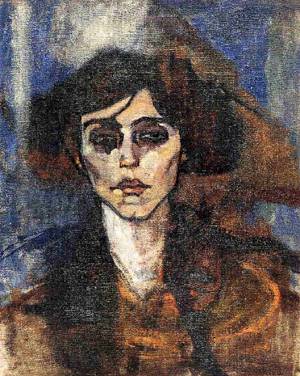
On his first visit to Alexandre, he was accompanied by an American woman, Maud Abrantes, about whom little is known, except that he "made several studies of her and painted her portrait in grayed-off pastels.
Secrest: "Her features, well marked and handsome, are notable for the eyes, which are disproportionately large, and smudged with blotches of paint as if to indicate mute suffering." (Image source)
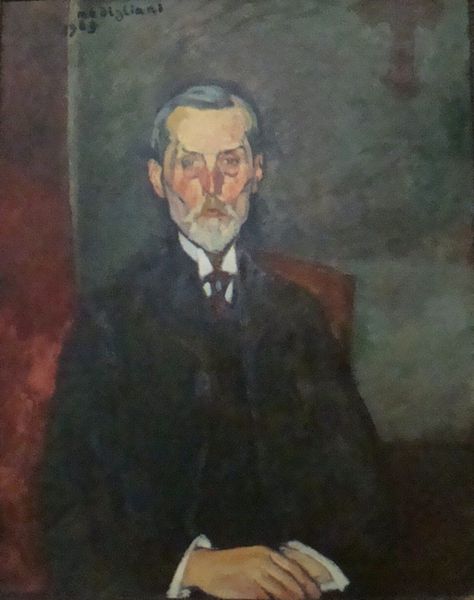
One of Alexandre's first commissions to Modigliani was a portrait of his father, Jean-Baptiste Alexandre.
Secrest: "The old man confronts the viewer with grave distinction, his white beard precisely trimmed to reveal a pink bottom lip, his eyes tired but calm. He has a natural authority and so does his son, who strikingly resembles him." (Image source)
Paul Alexandre was impressed by Modigliani, and in him the artist "had found someone with an eighteenth-century concept of the patron who recognizes, and nurtures, a rara avis. He was twenty-six; Modigliani was twenty-three." Alexandre was struck by Modigliani's perfectionism, and by the way he would make countless sketches of a subject until he found the precise line he wanted. "Anything less than perfection would be tossed on the floor. This is where Alexandre made, perhaps, his ultimate gift to posterity: he picked them up."

There was much drinking and drug-taking at the Alexandre salon, but many witnesses assert that Modigliani did not drink excessively, and although he participated in the experimentation with drugs, especially hashish, he "seldom drew while taking hashish, preferring to recall his visions in sobriety with the aim of  reproducing the heightened effect."

Constantin Brancusi, 1905 (Source)
Alexandre also acted as a patron to Constantin Brancusi, who would become a friend of Modigliani's.
[Herbert Read wrote,] "Brancusi strove to find the irreducible organic form, the shape that signified the subject's mode of being, its essential reality." Searching for the reality behind appearances: this, in Modigliani's case, was wedded to his belief in art as a magical force offering the path to exorcism and transfiguration.
Modigliani had become the prototypical bohemian, careless with money, given to reckless behavior, but enduring despite the sometimes self-imposed hardships. For "the belief that art was still a noble cause, in stark contrast to the grubby, money-focused goals of the bourgeoisie, when to the heart of the Bohemian creed.... It did not seem to matter to Modigliani that he was hounded by debts, sleeping on the run, with no money for good and no buyers for his drawings. He was surviving somehow."


Friday, April 15, 2011

2. The Modern Tradition, edited by Richard Ellmann and Charles Feidelson Jr., pp. 17-33

Symbolism: Imagination and Nature; The Revolt Against Nature (Oscar Wilde, Rainer Maria Rilke, Pablo Picasso, André Malraux)
_____
Oscar Wilde: The Priority of Art

In this excerpt from the dialogue "The Decay of Lying," Cyril and Vivian discuss the relationship between Art and Nature.

Anyone can come up with paradoxes, but Wilde is one of the few who can make them not only clever but also wise. Vivian rattles them off here in a run of seemingly glib antitheses:
the more we study Art, the less we care for Nature
...
Art is our spirited protest, our gallant attempt to teach Nature her proper place.
...
The ancient historians gave us delightful fiction in the form of fact; the modern novelist presents us with dull facts under the guise of fiction.
...
Many a young man starts in life with a natural gift for exaggeration which, if nurtured in congenial and sympathetic surroundings, or by the imitation of the best models, might grow into something really great and wonderful. But, as a rule, he comes to nothing.... He either falls into careless habits of accuracy, or takes to frequenting the society of the aged and the well-informed.
...
[He] often ends by writing novels which are so life-like that no one can possibly believe in their probability.
...
Wordsworth ... found in stones the sermons he had already hidden there. 

And finally:
Life imitates Art far more than Art imitates Life.
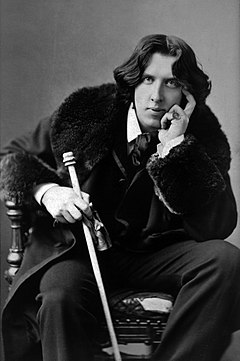
Oscar Wilde in 1882
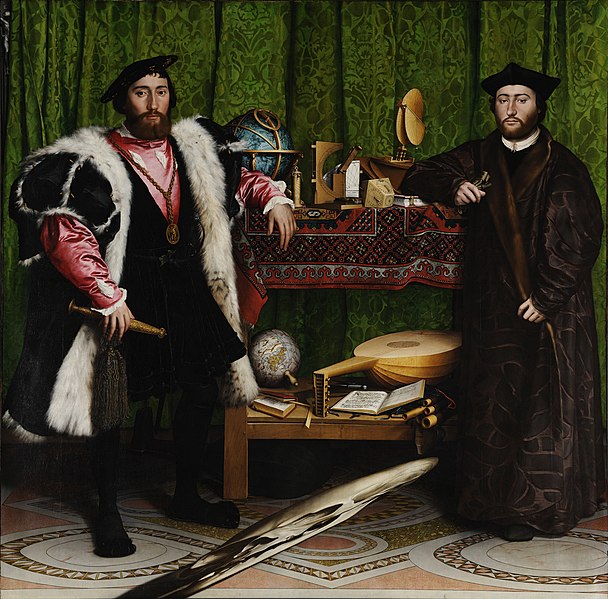
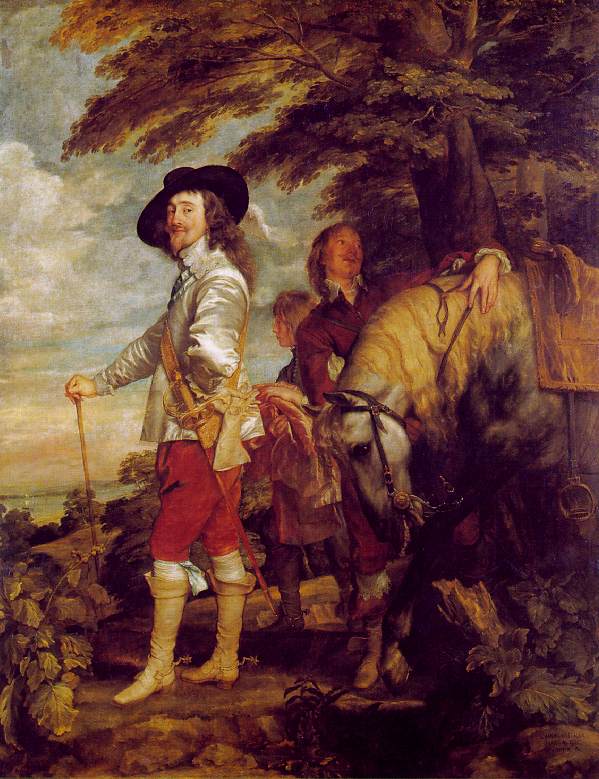
Dazzling and witty, yes. But also the basis of an entirely serious aesthetic, as Vivian/Wilde goes on to demonstrate. By inverting the traditional image of Art holding a mirror up to Nature, insisting instead that Art "is a veil, rather than a mirror," Wilde examines the role of the imagination, especially as it manifests itself in artistic creation. And he concludes that Art is the organizing principle that brings a unity, or perhaps one should say a Gestalt, to our potentially chaotic experience of the external world. "Neither Holbein nor Vandyck found in England what they have given us," Vivian asserts. "They brought their types with them, and Life with her keen imitative faculty set herself to supply the master with models."
Hans Holbein the Younger, The Ambassadors, 1533

Anthony Van Dyck, Charles I of England, c. 1635
Literature exhibits the same phenomenon: "Schopenhauer has analysed the pessimism that characterises modern thought, but Hamlet invented it. The world has become sad because a puppet was once melancholy." In short, "Things are because we see them, and what we see, and how we see it, depends on the Arts that have influenced us.... At present, people see fogs, not because there are fogs, but because poets and painters have taught them the mysterious loveliness of such effects."
James McNeill Whistler, Nocturne: Blue and Gold - Old Battersea Bridge, c 1872-75
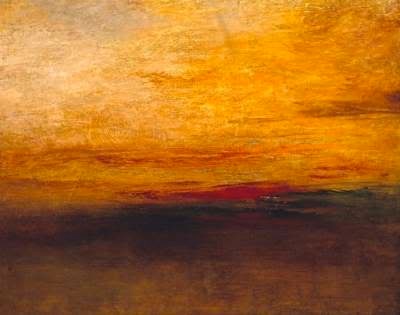
Called once to admire a sunset, Vivian claims that "It was simply a very second-rate Turner, a Turner of a bad period, with all the painter's worst faults exaggerated and over-emphasized."
J.M.W. Turner, Sunset, 1830-35
But for all Wilde's tongue-in-cheekery and seemingly outrageous claims, there is a core of seriousness in his doctrine, which he has Vivian sum up in four major points:
  • "Art never expresses anything but itself."
  • "All bad art comes from returning to Life and Nature, and elevating them into ideals.... The moment Art surrenders its imaginative medium it surrenders everything.... Life goes faster than Realism, but Romanticism is always in front of Life."
  • "Life imitates Art far more than Art imitates Life." 
  • "Lying, the telling of beautiful untrue things, is the proper aim of Art."
As we'll see, others have made the same claims, though perhaps with less wit and more evident earnestness.


Rainer Maria Rilke: The Unnatural Will to Art
Rainer Maria Rilke, c. 1900

This excerpt is from a letter written by Rilke in 1920 to his lover, Baladine Klossowska, whom he called "Merline." He speaks in it of his "struggle towards concentration," his attempt to touch his "center of production" and to find the "purest impulse" and to "recreate [the] first innocence" at which "the Angel discovered you when he brought you the first binding message." In short, to become open to the traditional moment of inspiration. But what is less traditional is essentially a paraphrase of what Wilde asserted above. Rilke puts it this way: "Art, as I conceive it, is a movement contrary to nature."

And to go against nature is of necessity a struggle. We artists, he asserts, must "throw ourselves into the abyss of our being." This is a form of self-immolation: "If the meaning of sacrifice is that the moment of greatest danger coincides with that when one is saved, then certainly nothing resembles sacrifice more than this terrible will to Art." Most humans try to forget things to survive, but artists "are always bent on discovering, on magnifying even" the things that others strive to forget: "it is we who are the real awakeners of our monsters, to which we are not hostile enough to become their conquerors; for in a certain sense we are at one with them" -- they supply the strength that the artist needs. It's not a question of conquest at all: "it is not for us to consider ourselves the tamers of our internal lions. But suddenly we feel ourselves walking beside them, as in a Triumph, without being able to remember the exact moment when this inconceivable reconciliation took place (bridge barely curved that connects the terrible with the tender ... )"

That ravishing parenthetical phrase and the artist's role as creator ex nihilo brings to mind one of Rilke's Sonnets to Orpheus:
O dieses ist das Tier, das es nicht giebt. 
     O this is the animal that does not exist.
Sie wußtens nicht und habens jeden Falls 
     But they didn't know that, and, in any case, 
-- sein Wandeln, seine Haltung, seinen Hals, 
     they loved it -- loved its gait, its stance, 
bis in des stillen Blickes Licht -- geliebt. 
     its neck, loved the light in its quiet gaze. 

Zwar war es nicht. Doch weil sie's liebten, ward 
    It never was. But since they loved it,  
ein reines Tier. Sie ließen immer Raum. 
     a pure animal became. They always left space. 
Und in dem Raume, klar und ausgespart, 
     And in that space, unoccupied and bright, 
erhob es leicht sein Haupt und brauchte kaum 
     it calmly raised its head and scarcely needed 

zu sein. Sie nährten es mit keinem Korn, 
     to be. They fed it not with grain, --  
nur immer mit der Möglichkeit, es sei. 
    only with the promise of its being. 
Und die gab solche Stärke an das Tier, 
    And this gave the animal such power, 

daß es aus sich ein Stirnhorn trieb. Ein Horn. 
     that a horn sprouted from its brow. One horn. 
Zu einer Jungfrau kam es weiß herbei -- 
    White, it strode up to a virgin -- and was
und war im Silber-Spiegel und in ihr. 
      in the mirror's silver and in her. 
Translation by Edward Snow


Pablo Picasso: Art as Individual Idea
Pablo Picasso, date unknown

In this essay from 1923, Picasso aligns himself with the Romantic idea of spontaneity, and with art as a serendipitous pursuit: "When I paint my object is to show what I have found and not what I am looking for.... What one does is what counts and not what one had the intention of doing." And he, too, makes statements that sound like paraphrases of Wilde: "Art is a lie that makes us realize truth, at least the truth that is given us to understand." And: "Nature and art, being two different things, cannot be the same thing. Through art we express our conception of what nature is not." But he also warns against overambitiousness, the "attempt to paint the invisible and, therefore, the unpaintable."

Art is not a representation of external things, but of the artist's ideas about them. Both Velasquez and Rubens, he notes, painted portraits of Philip IV, but they seem to be two different people.
Diego Velasquez, Philip IV at Fraga, 1644
Peter Paul Rubens, Philip IV, 1628-29
"We believe in the one painted by Velasquez," Picasso asserts, "for he convinces us by his right of might." But even in the work of painters who claim to be "painting nature as it is, art has always been art and not nature." What artists aim for is "more or less convincing lies."

Moreover, art exists independently of history: "there is no past or future in art.... The art of the Greeks, of the Egyptians, of the great painters who lived in other times, is not an art of the past; perhaps it is more alive today than it ever was." (The point could be extended, of course, to literature, to Homer, Virgil, Dante, Chaucer, and Shakespeare.) Nor does an artist, he claims, "evolve": "The several manners I have used in my art must not be considered as an evolution, or steps toward an unknown ideal of painting." On the other hand, there "are periods in which there are better artists than in others." (The difficulty here, is that Picasso supplies no solid criteria by which we can judge this.)

And so he rejects the idea that a movement such as Cubism should be regarded as "a seed or a foetus," a stage in the development toward something else. Cubism is "an art dealing primarily with forms, and when a form is realized, it is there to live its own life." Critics who approached Cubism through analogies to "Mathematics, trigonometry, chemistry, psychoanalysis, music, and whatnot" have missed the point. Their comments are "pure literature, not to say nonsense, ... blinding people with theories." And finally he disarms all criticism: "But of what use is it to say what we do when everybody can see it if he wants to?


André Malraux: Art as the Modern Absolute
André Malraux, 1935

In this selection from The Voices of Silence (1951), Malraux observes that "the art museum is by way of becoming a shrine" to "a vague deity known as Art." The trend started with the Romantics, who elevated the artist to a kind of priest, and as a consequence changed the artist's concept of his role: "Such men as Velazquez and Leonardo who painted only when commissioned were very different from Cézanne for whom painting was a vocation." And so artists began to claim for themselves a special aim: "to dominate appearances and build anew the world that had vanished from Europe, a world that had known and venerated supreme values" -- i.e., those supposedly proclaimed by God. And so "modern art ... does not sponsor any makeshift absolute" such as those proclaimed by religion "but, at least in the artist's eyes, has stepped into its -- the absolute's -- place. It is not a religion, but a faith. Not a sacrament, but the negation of a tainted world."

Even when the artist is a believer, his art stands apart from his belief: "If Cézanne, the good Catholic, had painted Crucifixions, they would have been Cézannesque, and that is doubtless whey he painted none."
Sacred art and religious art can exist only in a community, a social group swayed by the same belief, and if that group dies out or is dispersed, these arts are forced to undergo a metamorphosis. The only 'community' available to the artist consists of those who more or less are of his own kind.
Art in the past took its role and purpose from religion: "Michelangelo, Titian, Rubens and Rembrandt linked men up with the universe; as did even Goya, flinging them his gifts of darkness." With the decline of the universal Christian belief that animated the work of these artists, that gave them patrons and subject matter, the nature and purpose of art was forced to change. "As for the art of today -- does it not tend to bring to men only that scission of the consciousness, whence it took its rise?"

Our culture is now founded on the "spirit of enquiry," on what Malraux sees as "the alarming power" of science. "Our art, too, is becoming an uneasy questioning of the scheme of things." It is the uneasiness that Malraux feels most intensely: "The great Christian art did not die because all possible forms had been used up; it died because faith was being transformed into piety." That is, from an intensely internalized view of one's role in the universe into an external show, a pretense of belief lacking an an essential core. But the "spirit of questioning" that now prevails is "usually anxious and perplexed." In this respect, modern art departs in character from the art of previous ages: "Despite the insatiable questioning basic to Greek thought, the impression Greek art made on the world for many centuries was one of a triumphant affirmation."

The replacement of religion with science has produced "a culture that is not categorical but explorative."
It is quite possible that the successor of the art we call 'modern'will be still more individualist; and it is not impossible that it will assume, to begin with, the form of a resuscitation before developing into a new art, vaster in scope and deeper, born of this resuscitation.
Malraux's "possible" future hasn't come to pass yet. Postmodernism is certainly neither vast in scope nor deep.

Thursday, April 14, 2011

1. The Modern Tradition, edited by Richard Ellmann and Charles Feidelson Jr., pp. v-ix, 7-16

Preface; Symbolism: Introduction
_____
If we're postmodern, then what is it that we're post? When Ellmann and Feidelson published their anthology in the mid-1960s, their aim was to provide the material to define "modern" as it applies to the arts and literature, to give clarity and precision to a word that then denoted "a blur of book titles, a mood of impatience with anachronisms, a diffuse feeling of difference." Modern, they noted, was a label for "a distinctive kind of imagination," and  "works we call modern ... claim modernity; they profess modernism." But the vagueness persists, even now that "the great age of the [twentieth] century's literature, the age of Yeats, Joyce, Eliot, and Lawrence, of Proust, Valéry, and Gide, of Mann, Rilke, and Kafka, has already passed into history." And the word denotes more than literature; rather, it encompasses "a large spiritual enterprise including philosophic, social, and scientific thought, and aesthetic and literary theories and manifestoes, as well as poems, novels, dramas."

If we can postulate a modern tradition, we must add that it is a paradoxically untraditional tradition. Modernism strongly implies some sort of historical discontinuity, either a liberation from inherited patterns or, at another extreme, deprivation and disinheritance.... [M]odern literature has elevated individual existence over social man, unconscious feeling over self-conscious perception, passion and will over intellection and systematic morals, dynamic vision over the static image, dense actuality over practical reality.
At the same time that modern artists and writers have embraced the future eagerly, they have also been haunted by "a sense of loss, alienation, and despair. These are the two faces, positive and negative, of the modern as the anti-traditional: freedom and deprivation, a living present and a dead past."

But giving the modern a starting point is not easy. Did we become "modern" at "the end of Victorianism, the beginning of romanticism, the mid-seventeenth century, the end of the Middle Ages"? Stephen Spender observed that the modern is characterized by a confrontation with the past and an inclusion of this confrontation "within itself as part of a single total experience," in what Spender called "the vision of a whole situation." Writers who valued originality and an attempt to free themselves from established models, media and genres, nevertheless "have been classicists, custodians of language, communicators, traditionalists in their fashion."

Ellmann and Feidelson say that their anthology is an attempt to provide materials toward an understanding of modernism, not "to argue a general theory of modernism." The selections in the anthology are from the "discursive statements by writers, artists, philosophers, and scientists" -- not the works themselves, but the essays, letters, prefaces, and other writings in which they discuss their works or the ideas that give rise to them.

The book has been divided into nine sections, each of them a topic "around which modern thinking whirls or clings." they are:
  • Symbolism: "the concept of imagination, the autonomy of the work of art, formalism, the creative process, and the heroic role of the artist.
  • Realism: "art as a function of environment," historic or social, "the pressures of experience and the responsibility of truthfulness."
  • Nature: theories "of organic harmony, of biological struggle, of mechanistic force, and of human or scientific experiment."
  • Cultural History: the "patterns -- dialectical, repetitive, symbolic, or religious -- by which the historical process has been shaped."
  • The Unconscious: "Freudian ... and post-Freudian programs for the liberation of impulse."
  • Myth: "anthropological and Jungian versions of the myth-making mind, along with more properly literary doctrines of mythic imagination." 
  • Self-Consciousness: "self-realization, the situation and process of consciousness, the inner divisions of the self, and the pursuit of personal freedom."
  • Existence: "The existentialist analysis of ... selfhood."
  • Faith: religion "in the decline of Christianity."
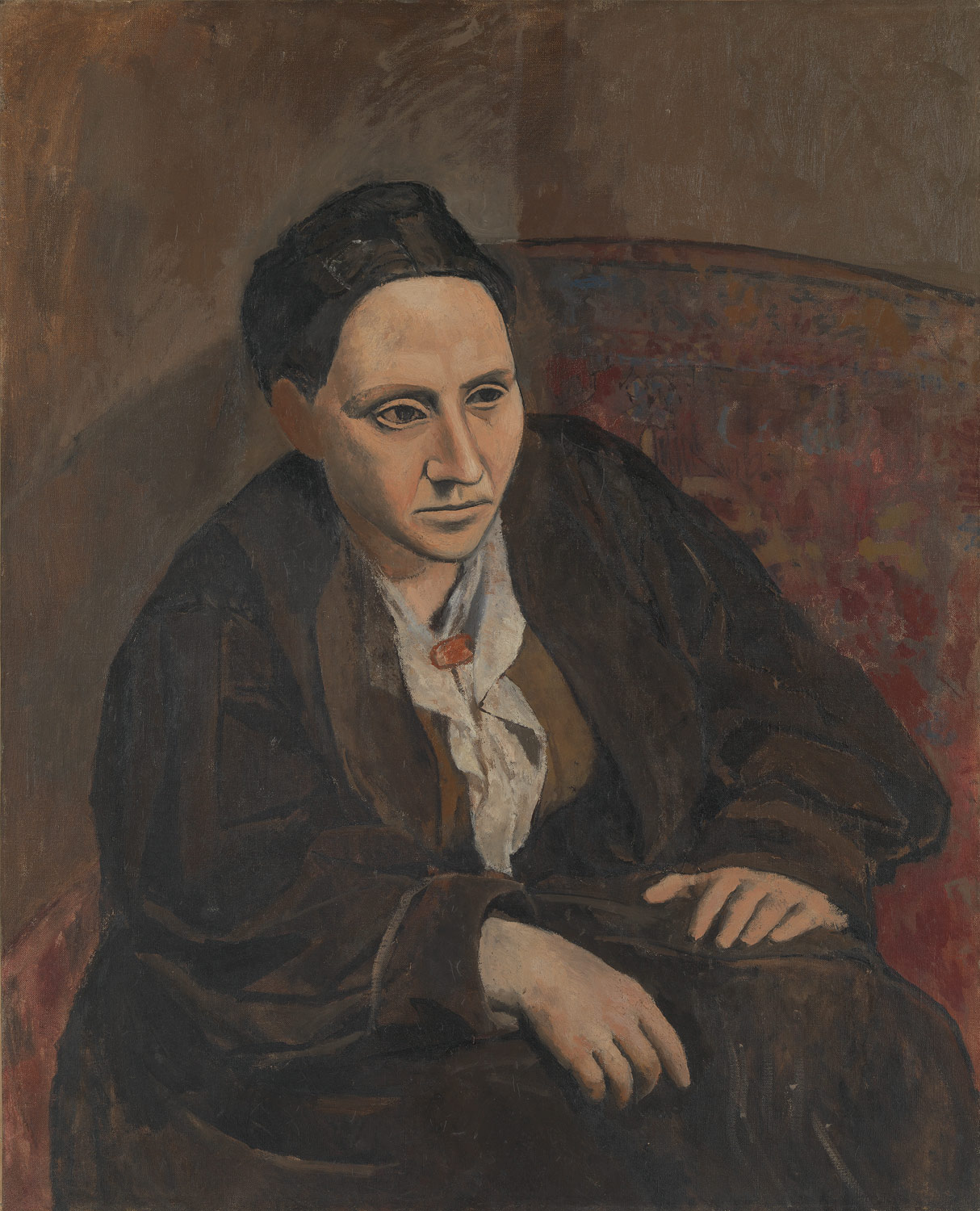
The first topic, symbolism, focuses on the nature and function of the imagination and its role in the life and work of the artist. It valorizes imagination as a unifying force, and views the artist as heroic in his or her creative role, and tends to disparage logic and reason. It also often elevates the human over the natural, and the fabrications of the artist over the phenomena of the external world. Rilke sees the artist as "uncovering a hidden reality that nature, especially our own human nature, urges us to ignore." Art is to be judged not by its fidelity to nature but by its own coherence, and hence has a way of reeducating the viewer (or reader, listener, etc.). "When people objected to his portrait of Gertrude Stein as on the grounds that it did not resemble her, Picasso replied, 'It will.'"
Pablo Picasso, "Gertrude Stein," 1905-06
"The world of aesthetic ideas, the products of genius, is like a second nature built out of the first.... It has the ideal quality of intellectual forms and the intuitive, untranslatable immediacy of sensory perception." Coleridge saw imagination as "an activity or function that lies between" nature and the human, "a union and reconcilement of" the two.

Symbolism also stresses the open-endedness of art, asserting that "art is perhaps most effective when imperfectly understood. For Flaubert, "not to conclude is a characteristic of the creative mind," an affirmation of what Keats called "'negative capability,' meaning he acceptance of uncertainties, mysteries and doubts, without any compulsion to resolve them in rational terms or to weigh them by factual probability." I.A. Richards asserts that poetry makes what he called "pseudo-statements," which are "not to be judged by truth or falsity, but only by their effect in releasing or organizing many impulses and attitudes." Not surprisingly, didacticism is shunned in this view of art. Walter Pater's dictum that "All the arts aspire to the condition of music," emphasizes the premise that literature and the visual arts should give immediacy priority over description. Poetry advances beyond prose by attempting to evoke that which is beyond speech. Paintings should not be given titles that suggest they are "about" something but should be considered as things in themselves.

As for the artist, he or she should disappear into the work. "Though art does not reproduce the objective world, the work itself must be objective, not subjective." The medium in which the artist works is more important than the artist: It "takes control, leaving [the artist], as [T.S.] Eliot once wrote ..., no more than a catalytic agent." Eisenstein, writing about the effect of montage in film, notes that "splicing heterogeneous images together [achieves] an effect not paraphrasable or in any other way attainable."

The power of the artist to create makes him or her a heroic figure, one who "takes risks and suffers in order to create," becoming "an exemplar for human behavior.... On this principle, life itself may come to be a kind of artifact," and the creations of the artist may serve as guides to life, especially with the waning of the role of religion in people's lives.