JOURNAL OF A COMPULSIVE READER
By Charles Matthews
Showing posts with label Emanuele Modigliani. Show all posts

Monday, July 11, 2011

8. Modigliani: A Life, by Meryle Secrest, pp. 310-350

Chapter 14: The Cult of the Secret; Epilogue

Secrest analyzes one of the last portraits of Jeanne Hébuterne:
She is sitting on a stool in front of a door in a corner of the room. Her swollen stomach is hidden under an opaque black skirt and a kind of scarf or stole is wrapped around her shoulders. The theme is heavily red, from the vivid crimson of the bodice to the vermilion wall paint and door to the reddish browns of the wooden stool and blackish browns of the floor. Her skin tones, which are pinkish in earlier paintings, have been drained into a sallow, uniform yellow. The boldly stressed silhouette, annotated in black, gives a feeling of foreboding, even menace, to what should have been an occasion to be celebrated by the father-to-be. However, if one theorizes that perhaps Modigliani is making a reference to the idea of alchemical transformation the painting, far from being an anomaly, takes on an interesting new dimension. It can be read as a clue to unlock the mystery of Jeanne Hébuterne's death. In alchemical transformation the colors red and black signify stages in the process of transfiguration.
Amedeo Modigliani, Portrait of Jeanne Hébuterne, 1919 (Source)
Modigliani came from a family interested in the occult, and Beatrice Hastings was into Theosophy, among other things. As for alchemy, he once worked alchemical symbols into a statement he appended to a drawing, so he was certainly familiar with the subject. But can the painting really "be read as a clue to unlock the mystery of Jeanne Hébuterne's death"?  Secrest comments, "It is tempting to think that Modigliani had convinced Jeanne that death was as easy as walking through a door and that it would lead to their reunion in a higher sphere."

Secrest also points to four watercolors by Jeanne that were found in the apartment after her death. One depicts the interior of a room that "Restellini believes ... describes the Hébuterne apartment at the moment when Jeanne and Modigliani met." It includes a picture of her brother, André, who had left for the war, and a clock painted black, though the other colors in the painting are "pretty pastels." The next seems to be a memory of their stay in Nice and features Modigliani and Jeanne seated at a table with her mother, Eudoxie. "Modigliani's jacket and tie are black and the sockets of his eyes are painted black. Her hand is placed protectively over his and to the right of her plate is a black knife. Restellini believes that "death is making its presence felt."

In the third painting a naked girl with long tresses is asleep in a single bed. Her features have been left unpainted but the reference is clear enough, as is the figure all in black that stands at the open doorway. It could represent Maldoror or perhaps a priest, or simply a personification of Death. The themes of black and red, in the visitor's clothing, the mat on the floor, and the crimson towel hanging over the door, make the meaning clear.
Jeanne Hébuterne, watercolor, 1919 (Source)
In the fourth and final frame, the heroine, on her red bed and white sheets, having thrust a dagger into her heart, lies head downward, her russet hair streaming behind her. The dripping dagger, the scarlet skirt, the vermilion blood, even her necklace and bracelet, repeat the overwhelming theme. Only the skirt that covers her unborn child retains its traces of green, hemmed around in black. Her intentions could not be more specific. The only issue left was exactly how and when.
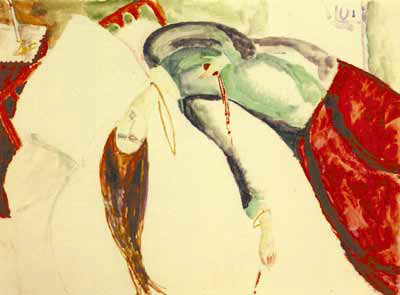
Jeanne Hébuterne, watercolor, 1919 (Source)
Jeanne took her life, and that of the child she was carrying, at three a.m. on January 25, the day after Modigliani's death; she jumped from the sixth-floor window of the apartment where she was staying with her parents. It doesn't take any alchemical speculations about transformation or meeting into the afterlife to solve the "mystery" of Jeanne's death: She had just lost the most important person in her life, and she was about to give birth to a child that she didn't want -- she had already rejected the first child from their relationship. Stress and hormones alone can explain why she killed herself. Moreover, her family had disapproved of her way of life, and she was facing a future in their custody.

She was not initially buried with Modigliani. The famly took her body to another cemetery, and the funeral was as private at they could make it. The fact of her suicide was somehow covered up from the authorities to allow her to be buried in consecrated ground.

The Hébuternes did not want to take responsibility for their daughter's surviving child, who was now thirteen months old, but the Modiglianis did. Emanuele and his wife, who were childless, adopted Jeanne as soon as they could, given that paperwork involving two countries was a problem, and by June 1920, Jeanne Modigliani was living with them in Florence. In March 1923, she was declared legitimate based on the statement signed by Modigliani in 1919 that he intended to marry her mother.

Grave of Modigliani and Jeanne in Père Lachaise. (Source)
Eugénie Modigliani wanted Jeanne Hébuterne's body to be moved to Père Lachaise, and set about persuading the Hébuternes to allow it. She prevailed, especially after the death of Jeanne's father, Achille, the most devout of the Hébuternes, and Jeanne was interred with Modigliani in February 1927.

Modigliani's son by Simone Thiroux, Gérard, had been put up for adoption, and lived in an orphanage until he was adopted by a family named Carlinot in 1931. But the Carlinots divorced and the father took Gérard with him to Indochina, where the boy was unhappy and stowed away on a boat back to France. He reunited with his birth mother, and disappeared until a reporter discovered him in 1981, age sixty-four and the curé of a church in Milly-la-Forêt. 

Emanuele and Vera Modigliani had been forced into exile in Paris in 1926, after Mussolini's rise to power. Jeanne Modigliani initially did not live with them, but with her grandmother, Eugénie, and then after her death with her aunt, Modigliani's sister Marguerite, who was a bit of tyrant and who detested Jeanne's father. In 1939, when Jeanne was twenty, she joined Emanuele and Vera in Paris, but the outbreak of war forced them to escape to Switzerland. Jeanne stayed behind in France, and married an Italian economist and journalist, Mario Cesare Silvio Levi. She also became a devout communist and took an active role in the Résistance.

She became involved with another Résistance fighter, Valdimar "Valdi" Nechtschein, who also used the alias Victor Leduc. He was her senior by eight years and was married, which she found no obstacle. She wrote, "Our union, begun in a moment of common danger, lasted for thirty years." She was imprisoned for several months in late 1943, but some forged documents obtained her release.

After the war ended, she divorced Levi, but Valdi had returned to his wife. In May 1946, Jeanne gave birth to a daughter she named Anne, whose father was Valdi. In the same month, Valdi's wife, Hélène, gave birth to his other daughter, Olga. Finally, Valdi began spending the weekdays with Jeanne and the weekends with Hélène. One reason for the arrangement was that at sixteen months Anne suffered a cerebral hemorrhage that resulted in paralysis and brain damage which would require years of therapy and several operations. After ten years of this arrangement, Valdi divorced Hélène and married Jeanne. Their second daughter, Laure, was born in 1951.

One reason that the Modiglianis were eager to have Jeanne's status legitimized was that according to the arrangement with Zborowski, one-fifth of the proceeds of any sale of Modigliani's work went to the artist or to his heirs. And after his death, the value of his works skyrocketed. "Emanuele could not have known how quickly Modigiliani's works would become valuable but he was concerned enough to safeguard Jeanne's legal right to royalties and percentages if any were to be had."

And as the value of Modigliani's work increased, so did the number of fakes. "Modigliani's style simplifies facial features and does not articulate anatomical details, such as cheekbones, shoulders, and rib cages," and the seeming simplicity of his style proved very attractive to forgers. As a result he "is one of the ten most faked artists in the world." As Modigliani's heir, Jeanne possessed the "droit morale" over his work, and had the power to certify a piece's authenticity. One dealer says, "Jeanne Modigliani was impossible because she signed authentication certificates in a very subjective way, without doing serious research." As a result some of the works she "authenticated" have since been discovered to be fakes. "Nowadays certificates from Jeanne Modigliani have been thoroughly discredited."
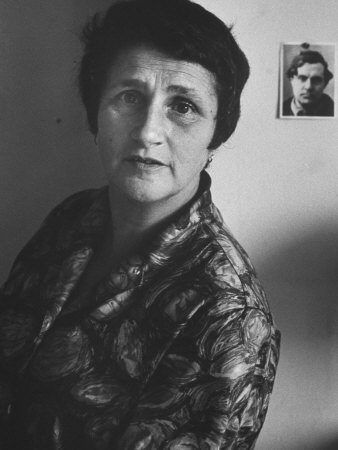
Jeanne Modigliani, c. 1964

In 1956, when Nikita Khrushchev took power in the Soviet Union and denounced Stalin, Jeanne was shattered. "It was a betrayal of her dearest hopes, one more way that life had let her down. She abandoned politics to concentrate on her art. She had been painting for several years and won a scholarship to work on a study of Vincent van Gogh." She remained estranged from her mother's family, whose "anger, no longer directed at Jeanne Hébuterne, had turned itself on her baby. That was in keeping with the popular view that if there was one thing worse than having an illegitimate child, it was being one." She and Valdi divorced in 1980, and she began drinking heavily. She died in July 1984.

Modigliani holds an odd position in art history: "In Modern Art, Meyer Schapiro's seminal work on art of the nineteenth and twentieth centuries, Modigliani's name does not appear.... Kenneth Clark's monumental study The Nude makes no reference to Modigliani's masterful studies of the female form despite the fact that the author clearly admired him at an early age." Marc Restellini observes, "The universities where Picasso or Matisse are much studied deem Modigliani a facile painter devoid of innovation." It may be because of the proliferation of forgeries, which suggests to some that his work is over-simple, or because he is not easily classified into any of the movements -- "Fauvism, Cubism, Surrealism, Futurism" -- with which he was contemporary. Nor is he regarded as influential on subsequent generations.

Friday, July 8, 2011

4. Modigliani: A Life, by Meryle Secrest, pp. 121-143

Chapter 7: The Serpent's Skin

Modigliani had plenty of friends in those early years in Paris. What he didn't have was a dealer or any sales on his own. And when Paul Alexandre left for Vienna in early 1909 to do research in his medical specialty, dermatology, Modigliani was left for a while without someone to watch over him. Alexandre asked his brother Jean to assume the task, "But Jean lacked his brother's rueful awareness that with Modigliani, whatever could go wrong, would." Jean saw him often, accompanying him to exhibitions, and even tried to find a paying job for him with a weekly magazine that published satirical caricatures of politicians, but the prospect of that kind of work appalled the artist.

And like Paul, Jean commissioned portraits from Modigliani, including one of himself and another of his girlfriend, the Baroness Marguerite de Hasse de Villers.
Amedeo Modigliani, Portrait of Jean Alexandre, 1909 (Source)
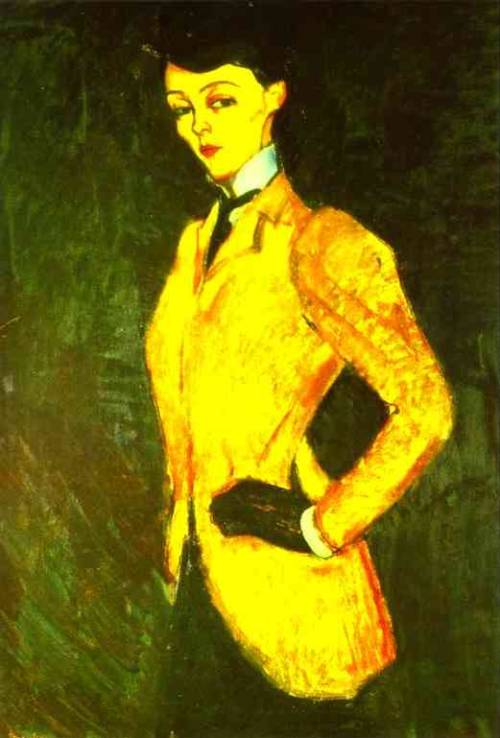
Amedeo Modigliani, Portrait of a Woman in a Yellow Jacket (The Amazon), 1909 (Source)
Although Modigliani struggled with the portrait [of Jean] the implication, from Jean Alexandre's letters, is that the one of Marguerite, The Amazon, gave him even more trouble.... The sitter, obliged to pose for hours ... was becoming mutinous.... She finally gave Modi an ultimatum. She was leaving in a week's time and he had to finish. So he complied. The resulting portrait of her, hand on hip, has bold conviction but is not sympathetic. Perhaps the artist saw her as men of his age would have done, that is, too independent minded for comfort.

Modigliani also painted another of Paul Alexandre's circle, Maurice Drouard.
Amedeo Modigliani, Portrait of Maurice Drouard, 1909. Secrest: "His compelling study in blacks and strong background blues heightens the effect of Drouard's almost hypnotically blue-eyed stare." (Source)
Amedeo Modigliani, Portrait of Joseph Levi, 1910. Secrest: "Levi, a painter and picture restorer in Montmartre ... often lent Modigliani money, and the artist reciprocated with a forceful portrait of almost tactile strength and immediacy, in slashes of scarlet, ocher, and black. The blunt brushstrokes suggest a brief experiment with Fauvism, probably after a close study of Matisse and Derain." (Source)
Amedeo Modigliani, The Beggar of Leghorn, 1909. Secrest: "The influence of ... Cézanne [can be seen] in The Beggar of Leghorn. The unpromising subject has been transformed by a virtuoso display of color: high blues and grayed-off greens." (Source)

Amedeo Modigliani, Beggar Woman, 1909. Secrest: "Perhaps the most fully realized of his portraits at this period is Beggar Woman, an example of the 'cool purposefulness' and economy of means that Modigliani was beginning to display. The lowere eyes, droop of the head, and particular set of the mouth speak volumes about the misery and pride of this anonymous daughter of the people." (Source)
Paul Alexandre decided to cut his stay in Vienna short after only three months. About this time, Modigliani began to develop an interest in African art, a fascination he shared with Picasso and Matisse. He also went with Paul Alexandre to an exhibition of sculpture from Angkor Wat at the Trocadéro. Alexandre wrote that Modigliani found in primitive sculpture a simplicity and purity, "a search for the irreducible organic form. He also examined the collection of African sculpture owned by Frank Burty Haviland, a friend of Picasso's. "The masklike heads with their locked expressions were silent witnesses to Modigliani's most secret concerns, the mysteries of life, death, and rebirth.

He began to devote himself to sculpture, starting with sketches and then trying to recreate the image in stone that he hauled from building sites in a wheelbarrow.
Amedeo Modigliani, Woman's Head, 1912 (Source)
Almost all of the twenty or so known sculptures are carved in a limestone known as "Pierre d'Euville," quarried near a small town in eastern France, which is softer and easier to carve than marble. A few were in wood, also scavenged (or so it is said) from the railroad ties being stockpiled for a nearby Métro station at Barbes-Rochechouart. And almost all are heads.... Given Modigliani's chronic dissatisfaction with his work, the fact that he was constantly on the move and that sculptures are heavy, the wonder is that any survived.

He attracted attention from his fellow sculptors, including Jacques Lipchitz, who visited Modigliani in his studio and reported that "Modigliani, like some others at the time, was very taken with the notion that sculpture was sick, that it had become very sick with Rodin and his influence. There was too much modeling in clay, too much 'mud.' The only way to save sculpture was to start carving again, direct carving in stone." Jacob Epstein spent time with Modigliani looking for sheds where they could do their work together in open air. Epstein remarked, "All Bohemian Paris knew him. His geniality and esprit were proverbial." His fellow artists "were the first to recognize that Modigliani was doing important work." Augustus John recalled that he was so affected by Modigliani's heads that he kept seeing people in the street who resembled them.

Modigliani made several trips back to Livorno during this time, though the family was becoming impatient with the burden he placed on their finances. One acquaintance recalled that Emanuele said of his brother, "He's a drunkard and his drawings make me laugh." While in Livorno, he continued to work on his sculptures, and one acquaintance said that when some of Modigliani's boyhood friends made fun of "a stone head with a long nose," Modigliani tossed it into a canal. Others said that he dumped a wheelbarrow full of them in the canal. "The accounts varied, but the point of the story was how ridiculous the work was and how its creator had been shamed into destroying it."

Even while he was sculpting, Modigliani continued to paint, and one canvas in particular attracted attention when it was included in the Salon des Indépendants in 1910.
Amedeo Modigliani, The Cellist, 1909. Secrest: "Some powerful preparatory sketches ... show that the composition was diagonal from an early stage, the details simplified to their essences, an idea which continues to the finished work, which Modigliani painted in two slightly different versions. The artist's focus is on the communion of artist with his instrument,  and the background, the addition of a fireplace, mirror, wallpaper, and bed, is subordinate.... The influence of Cézanne is clear enough, but ... it is an influence more transmuted than direct and already on the wane." (Source)
Modigliani exhibited five other paintings, including The Beggar of Leghorn and Beggar Woman, at that salon, but sold nothing.

In the spring of 1910, Modigliani met the Russian poet Anna Akhmatova. They were fascinated with each other, Akhmatova commenting that "all that was divine in Modigliani only sparkled through a sort of gloom." When they met, she was on her honeymoon, but her husband, the poet Nicolay Gumilyov, spent a lot of time at lectures and conferences, leaving her on her own with Modigliani. When she returned in the summer of 1911 they were together constantly. They would meet in the Luxembourg Gardens, and talk of poetry. "Modigliani loved Laforge, Mallarmé, and Baudelaire and would recite them by the hour, although not Dante, she thought out of consideration for her, since she knew no Italian." He was enthusiastic about Cubism, though he didn't attempt the style himself, and they went to the Department of Egyptian Antiquities in the Louvre, after which he drew her as an Egyptian queen. "He drew her repeatedly. At one time she owned sixteen of his drawings.... They were lost when [her] house was ransacked during the Russian Revolution."
Amedeo Modigliani, Sketch of Anna Akhmatova, 1911 (Source)
 Akhmatova returned to Russia after two months in Paris; they never met again.

For two or three years, from 1911 through 1913, Modigliani concentrated on a series of drawings, watercolors, and oils that depicted female figures. They are known as the caryatids.
Amedeo Modigliani, Caryatid, tempera and pencil, c. 1913 (Source)
Amedeo Modigliani, Caryatid, pastel, 1911 (Source)
Amedeo Modigliani, Caryatid, pencil, c. 1912 (Source)
Amedeo Modigliani, Caryatid, watercolor, pencil, 1913 (Source)
Amedeo Modigliani, Caryatid, oil, c. 1912 (Source)
Amedeo Modigliani, Caryatid, tempera, pencil, c. 1913 (Source)
The figures seem to be designed to hold something up. "The woman as prop and buttress: this was now Modigliani's repetitive image, now standing, now crouching, now bent under the weight or lightly poised beneath it." He and Constantin Brancusi were working together now, and both were designing temples. Brancusi was actually commissioned by an Indian maharajah to create one in the 1930s, but it was never built.

Modigliani may have influenced Brancusi in another way:
As early as 1911 Modigliani was using a curious motif, a column decorated with geometric designs, seen in a portrait of Paul Alexandre. A symbol of the quest for the infinite, the Endless Column is an idea Brancusi took up six or seven years later. In his work it became a sculptural Tree of Life, the pillar supporting the firmament and the axis mundi on which the world turned.
Amedeo Modigliani, Portrait of Paul Alexandre, c. 1912 (Source)
Constantin Brancusi, Endless Column, 1938


Tuesday, July 5, 2011

2. Modigliani: A Life, by Meryle Secrest, pp. 31-71

Chapter 3: "Dedo"; Chapter 4: The Blood-Red Banner

To support the family after Flaminio's bankruptcy, Eugénie started teaching French, along with her sisters, Laure and Gabrielle, who came to live with them, as did their father, Isaaco. They were so successful as teachers that they started a language school, employing other teachers.

By the age of five, Amedeo, called "Dedo," "could read and write and was probably bilingual." His grandfather, Isaaco, who lived with them from 1886 until his death ten years later, was an erudite man who "was an important influence on Dedo's intellectual development until he was twelve. Another influential figure was his uncle, Amédée Garsin, who "was rich, except for all the times when he was not." Amédée saw to it that Dedo's brother Emanuele got his law degree at the University of Pisa and his brother Umberto studied engineering at the University of Liège. But he was also careless with money, which he considered an "aristocratic" trait. "A talent for acting; the cultivation of seigneurial indifference to money -- such lessons were not lost on Dedo."

Eugénie was also a major influence on her youngest son. Among her friends was Rodolfo Mondolfi, "a well known teacher at a Livornese high school," who helped the boys with homework and whose son Uberto was Dedo's best friend. Eugénie was unusually independent for a woman in Italy of that time, and her intellectual achievements included translations of the poems of Gabriele d'Annunzio into French and writing novels and stories under a pen name. An American professor bought her essays on Italian literature and then published them as his own.
Modigliani's birthplace in Livorno, now a museum (Source)

"The young Amedeo was being brought up in an atmosphere of genteel poverty." As a child he loved books, and although some biographers claim that he showed no interest in art until he was fourteen, his brother Umberto recalled that he loved to draw when he was a small child, and was he was eleven Eugénie wrote "Perhaps an artist?" when speculating what he might turn out to be. In that same year, 1895, he suffered his first major illness, a respiratory attack that was diagnosed as pleurisy. By the next year, his mother wrote, "He already sees himself as an artist." He had stopped studying and was doing poorly in school.

Amedeo's brother Emanuele, meantime, was developing a political conscience. He joined the Socialist Party, "and his life would be devoted to liberal causes, his belief in the dignity of manual labor and votes for women, while his political stance was anticolonialist, pacifist, and dedicated to change from within." In 1898, when he was twenty-six, he became the editor of a progressive newspaper in Piacenza, which because Tuscany was under martial law, led to his arrest and a sentence of six months in prison. 

A month after his brother was sentenced, Amedeo suffered an attack of typhoid, and was in serious condition, "hovering between life and death and delirious for more than a month." In a memoir of her son that she dictated to her daughter, Margherita, in 1924, Eugénie claimed that the delirious Amedeo "said he wanted to study painting. He had never before spoken of this and probably believed it was an impossible dream that could never be realized." She claims that she promised to get him a drawing master when he recovered. This belies not only the notes made earlier in her diaries about seeing himself as an artist, but also the fact that she had recorded in her diary on August 1, 1898, shortly before he fell ill, that Amedeo had started drawing lessons and was interested in painting. As Secrest observes, the later anecdote "sounds like a fallible recollection made thirty years after the event."

Guglielmo Micheli, self-portrait, date unknown (Source)
In December 1898, Emanuele was released from prison, and Amedeo, fully recovered, began his studies with the artist Guglielmo Micheli, who had been a pupil of the artist Giovanni Fattori. "Micheli and Fattori encouraged students to seek their inspiration in the contemporary scene," and were associated with a group of artists known as the Macchiaoli: "They applied their colors in short brushstrokes and dots of paint; 'macchia' means stain or blot, and these were the 'makers of patches.'" Like the French Impressionists, they preferred to work out of doors. "But unlike the Impressionists the Macchiaoli took their cue from the muted, earth-toned palettes of Millet, Corot, and others of the Barbizon school." Fattori often visited Micheli's classroom, and on one occasion praised a charcoal sketch that Amedeo was working on.
Giovanni Fattori, self-portrait, 1894 (Source)

Modigliani's classmates recalled him as "introverted and shy," and as sickly-looking, but also recalled his temper when something made him angry. He was also given to quoting d'Annunzio and Baudelaire, Nietzsche and Henri Bergson. He disliked painting nature, but loved going through museums to study the Italian Renaissance masters, although he admired the work of Fattori and of the Pre-Raphaelites as well.

Samples of Modigliani's student work are rare, and the authentications of them are controversial at best. Secrest believes, however, that "A pencil self-portrait is evidence of a rapidly maturing talent at a moment when Modigliani was aged about twelve or thirteen." She was working in the G.E. Modigliani archives in Rome in 2008 when she came across a box of photographs. One of them was of a boy, "perhaps aged eight or ten, with cropped hair and in a fashionable sailor jacket, perhaps a slightly younger version of the boy in the self-portrait. Written in a laborious hand on the reverse was, 'Al mio caro, A...'" Giuseppe Emanuele had kept it all his life.

As Amedeo became more involved with his art, he also began to adopt the bohemian lifestyle that the rest of the family disapproved of as "shiftless and idle. But his classmates saw him as "distinguished, disciplined and studious." And Eugénie remarked in her diary in 1899, "Dedo has completely given up his studies and does nothing but paint, but he does it all day and every day with an unflagging ardor that amazes and enchants me." At fifteen, he moved into a studio in Livorno that had been given to Micheli for the use of his students. Its previous owner had died of tuberculosis, and in September 1900, Modigliani came down with it, too. The fact of the studio owner's death from the disease is probably coincidental; he was probably already infected with it. He first developed pleurisy, and was not diagnosed with tuberculosis till he was sixteen.

There are no accounts of how Modigliani was treated for the disease. "He would certainly have been given antispasmodics such as morphine and heroin which were, in any case, freely available. Other remedies guaranteed to soothe the cough and stop the diarrhea included whiskey, brandy, and laudanum (opium dissolved in alcohol)." The two other students who shared the studio with Modigliani also came down with the disease. Both of them died. It is possible that Modigliani underwent a surgical collapse of one lung, which was a painful process because of the lack of full anesthesia, but there is no record of that fact in any of the family memoirs. "All we know is that, as an adult, he was terrified of doctors," and that he was the only one from the studio who survived.

When he was well enough, Eugénie took him to spend the fall and winter in Naples, a trip financed by his uncle Amédée.
Modigliani's infection -- with luck, tuberculosis went into a lengthy remission -- declined relatively rapidly. One of the great factors ws his mother's selfless care. The other was the right diet. The third may have been psychological; Uncle Amédée had thoughtfully provided a studio as well. He began sketching again remarkably soon.... He started visiting museums, always accompanied by his mother, who slept in the same room. He was gaining weight and, as he entered his seventeenth year, began to grow a light, curly beard.
After wintering in Capri, they traveled to Rome, which thrilled him with its museums. In letters to his friend Oscar Ghiglia, a classmate who was eight years his senior and was beginning to make a name for himself, he expressed a kind of "giddy optimism" about his future, "tempered by the very real possibility that he did not have long to live." He had imbibed Nietzsche's ideas about the Übermensch, and wrote to Ghiglia, "People like us ... have different rights, different values than do normal, ordinary people because we have different needs which put us -- it has to be said and you must believe it - above their moral standards." Secrest comments, "In his mind, fatalism and idealism, creativity and death, seemed intertwined."