JOURNAL OF A COMPULSIVE READER
By Charles Matthews
Showing posts with label Nevil Maskelyne. Show all posts

Thursday, September 30, 2010

7. The Age of Wonder, by Richard Holmes, pp. 182-210

The Age of Wonder: The Romantic Generation and the Discovery of the Beauty and Terror of Science (Vintage)Herschel Among the Stars, 2-6
_____
In 1788, Herschel married Mary Pitt, a wealthy widow, causing something of a rift with Caroline, who found her role in the household suddenly shrunken. Caroline moved out of The Grove into an apartment above the stables, next to the observatory. She refused an offer of a quarterly salary of £10, but she still had the more generous stipend from the queen. Interestingly, she also destroyed her personal journals for the next decade, during which she moved out of the apartment and into the village of Slough. Whatever Caroline's feelings were about her brother's marriage, she continued to be his assistant and to do her own observations as well, discovering a second comet in December 1788. She also began a regular correspondence with the Royal Astronomer, Nevil Maskelyne.

The 40-foot telescope
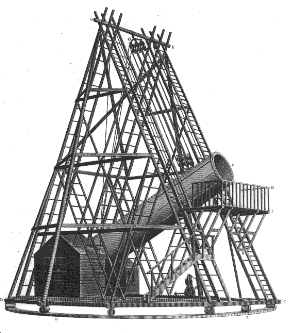
In spring 1789, the great forty-foot telescope was finally completed. With it, Herschel discovered the tiny moon of Saturn called Mimas, which is only 250 miles in diameter and has a huge crater eighty feet across and six miles deep. (When the crater was photographed by Voyager in 1980, it was named Herschel.) The telescope became a major tourist attraction and was hailed as one of the wonders of the world. The visiting Oliver Wendell Holmes described it as looking like "a piece of ordinance such as the revolted Angels battered the wall of Heaven with." But it was something of a dud: hard to maneuver and far more subject to weather than the smaller telescopes. The mirrors weighed a ton, and had to be repolished annually. Removing them was not only difficult but dangerous -- Herschel was nearly killed in 1807 when a mirror slipped from its harness while being removed. In the five years from 1788 to 1793, Herschel recorded only seventeen nights of optimal observing conditions. It was also more useful for observations within the solar system than into deep space: Herschel added two more moons to the five that Saturn was already known to have.

Herschel began to do more revolutionary theoretical work. In 1789 he published a paper that expanded on his earlier "On the Construction of the Heavens," suggesting that the whole universe was in a state of change, being worked on by the force of gravity. He likened the skies to a garden in which we can "witness the germination, blooming, foliage, fecundity, fading, withering and corruption of a plant." The same process was at work in the stars.
In this paper, astronomy changed decisively from a mathematical science concerned primarily (for practical purposes) with navigation, to a cosmological science concerned with the evolution of the stars and the origins of the universe.

The Herschels were also experiencing personal changes: In 1792, Mary gave birth to their only child, a boy they named John. And Caroline had entered on a new phase of her career as an astronomer. She found her third and fourth comets in 1790, a fifth in 1791, and a sixth in 1793. She began a new Star Catalogue which would be published by the Royal Society and eventually replace the standard reference published by John Flamsteed in 1776. When she found a seventh comet in 1797, she was so excited she did something completely uncharacteristic: She rode a horse by herself from Slough to London, a distance of twenty-some miles, to tell Maskelyne the news personally. She also wrote to Joseph Banks, noting that the day was a historic one because she had never ridden more than two miles outside of Slough before. This excursion was followed by her move out of the apartment and into lodgings in Slough.

In 1791, William published a paper about nebulae in which he reported on a star that was surrounded by a cloud of gas. This had caused him to reconsider his assumption "that gas clouds were simply star clusters too far beyond our galaxy to be 'resolved' by his telescopes." Now he began to question whether nebulae were gas clouds within the Milky Way, and whether there really were galaxies outside our own. "It was a decisive retreat from his most radical thinking about the size and origin of the cosmos." It may have been prompted by a conservative reaction against the atheism of the French Revolution after the declaration of war against France. Herschel's friend, the French astronomer Jérôme Lalande, had become an atheist, and in 1807 wrote, "I have searched through the heavens, and nowhere have I found a trace of God." Pierre Laplace, another atheist, used Herschel's own theory that nebulae were stars forming out of clouds of gas to posit a theory of creation that made divine intervention unnecessary. When Napoleon once told Laplace that he found no mention of God in his books, Laplace replied "I have no need of that hypothesis."

However, Herschel maintained his freedom to speculate, sometimes wildly, as when he posited that the interior of the sun was cool and inhabited by intelligent beings. He also continued to believe that the moon was inhabited and "his disapproved of God-hunting within the galaxy," rejecting the notion that the fire of the sun was in fact that of the biblical hell. Other scientists suffered from the reaction against atheism, such as Joseph Priestley, whose library was destroyed by a Birmingham mob in 1794. Some even found visiting Herschel's observatory a religious experience, such as Joseph Haydn, who credited a visit to Herschel with inspiring his oratorio The Creation

Herschel's interest in the sun produced not only wild speculation, but also a significant discovery. In 1800 he did series of experiments with thermometers that demonstrated higher temperatures outside the visible spectrum, in short, he had "discovered the presence of infra-red light." Joseph Banks predicted that this would be a more important discovery than that of the planet Uranus. It also attracted the attention of the young Humphry Davy.
This marked a decisive advance on Newton's famous optical experiments with the prism, and implied a hitherto wholly unsuspected power in nature. It would also eventually lead to a decisive breakthrough in stellar astronomy in the twentieth century. 
During wartime Herschel was commissioned to produce a spy telescope to be mounted on Walmer Castle in Kent to watch for a French invasion fleet. But in July 1802, during the Peace of Amiens, he and his wife visited Paris where they met Napoleon, with whom he had a rather awkward conversation during which the future emperor proclaimed that astronomy "gave proof of an Almighty Wisdom." Knowing that Laplace, Napoleon's chief scientific adviser, was an atheist, Herschel thought Napoleon was a hypocrite. 

Ten-year-old John Herschel, who had accompanied his parents to France, fell ill on the way back. He was nursed back to health by his Aunt Caroline, to whom he became close -- "it was she, as much as his father, who inspired in him an early passion for science and astronomy." He had been sent to Eton when he was eight, but Caroline saw how unhappy he was there and was delighted when Mary saw her son knocked down in a boxing match with an older boy and decided to bring him home to be privately tutored.

In a paper in 1802, William began to speculate on the relationship between space and time, noting that "A telescope with a power of penetrating into space, like my 40  foot one, has also, as it may be called, a power of penetrating into time past." Other observations were equally unsettling to the layman, such as the notion that sunspots, because they had an effect on the Earth's temperature, "could be related to the price of wheat," and therefore have political consequences. Or that not only did the planets revolve around the sun, but the solar system was orbiting around the center of the Milky Way, which was itself moving through space. He also continued to develop the idea that the universe itself was evolving, and that the reason the nebulae he had observed were different shapes was that they were in different stages of development.
These shapes, Herschel argued, were not different because they had been created differently, like different species. They were different simply because their stages of development in what he called "sidereal time" (meaning stellar time) had reached different points. He was suggesting the inescapable idea of evolutionary youth and age in the universe. 
Copernicus had dethroned the Earth from the center of the universe. Now Herschel had gone so far as to remove even the Milky Way from the center.

Herschel's ideas and discoveries were picked up by the younger generation of Romantic poets. Byron visited him in 1811 and was astonished "when I viewed the Moon and Stars through Herschel's telescope, and saw that they were worlds." Keats used Herschel's discovery of Uranus as a central trope in his sonnet, "On  First Looking Into Chapman's Homer": 
Then felt I like some watcher of the skies
When a new planet swims into his ken 
It's a depiction of the moment of discovery as "a moment of revelation into the idea of the unbounded, the infinite. In the case of Herschel's sighting of Uranus, Keats's word 'swims' is brilliantly evocative, because of its sensse of new life and movement." Keats described a "Eureka moment," which Herschel's meticulous observation hadn't really been, though Herschel would later describe it that way. "Herschel in the end may have remembered that night exactly as Keats imagined it." In 1813, Thomas Campbell encountered the seventy-four-year-old Herschel  on vacation in Brighton.
Herschel completely perplexed the poet by remarking that many distant stars had probably "ceased to exist" millions of years ago, and that looking up into the night sky we were seeing a stellar landscape that was not really there at all. The sky was full of ghosts. "The light did travel after the body was gone." After leaving Herschel, Campbell walked onto the shingle of Brighton beach, gazing out to sea, feeling "elated and overcome." He was reminded of Newton's observation that he was just a child picking up shells on the seashore, while the great ocean of truth lay all before him.

Tuesday, September 28, 2010

4. The Age of Wonder, by Richard Holmes, pp. 76-113

The Age of Wonder: The Romantic Generation and the Discovery of the Beauty and Terror of Science (Vintage)Herschel on the Moon, 5-7
_____
In 1766 Herschel moved to Bath, where he was not only organist in the Octagon
Chapel but also played in the orchestra in the Pump Room. He got into an argument with the impresario of the orchestra, James Linley, over orchestral arrangements, and set up a rival orchestra for a season, but finally made up with Linley and combined forces with him. When Linley decided to move to London, Herschel became the sole director of the concerts. He also composed and gave music lessons.

In February 1766 he had begun his first Astronomical Observation Journal, while also reading books on astronomy and attending lectures by the astronomer James Ferguson in the Pump Room. He began collecting telescopes and studying their construction. He found that refractor telescopes -- the straight kind with lenses at each end of the tube -- were insufficient for observing the stars, and turned his attention toward the reflector telescope invented by Newton. The concave mirrors in reflector telescopes gather and concentrate more light and produce less distortion than refractors.

Before Herschel, astronomers treated the night sky as if it were "the interior surface of a decorated dome, inlaid with constellations.... But Herschel began to conceive of deep space. He began to imagine a telescope which might plunge deep down into the sky and explore it like a great unplumbed ocean of stars." But the kind of mirror he would need for a reflector telescope capable of the exploration Herschel envisioned was too expensive. So he decided he would make them himself, out of metal, not glass.

Herschel's brothers, Jacob, Dietrich, and Alexander, came to visit him in Bath, and in 1770 Alexander came to stay with William in a house he rented at 7 New King Street where he gave music and singing lessons. William was concerned about Caroline, who was now twenty-one, but her mother was reluctant to give up her free housemaid until he went to Hanover and promised to pay her for a maid to replace Caroline. She returned to England with him in August 1772. He began to give her lessons in English as well as singing and the harpsichord.

As in Hanover, Caroline found herself playing housekeeper, but with the addition of music lessons, English lessons, reading aloud from English novels, and talking about astronomy. "It took time for the full emotional rapport to renew itself between the tall, handsome thirty-four-year-old bachelor brother, driven and ambitious, and the shy, tiny, awkward twenty-two-year-old sister, who ... was bursting with unfulfilled dreams and longings."
For Caroline, William was initially the great  liberator who had taken her out of the German house of bondage. But later their roles would subtly change. As William would observe to Nevil Maskelyne, it was not always self-evident which was the planet and which was the moon. 
Herschel began work on the mirrors for his telescope, getting the tools he needed for grinding and polishing the metal from John Michel, a fellow astronomer in Bath who, like Herschel, had some unconventional ideas, "such as the existence of 'black holes' in space from which light itself could not escape."

The moulds for casting metal mirrors were formed from horse-dung, and after the molten metal was poured and cooled it had to be ground down into a concave shape. It then had to be polished continually for hours without stopping; otherwise the metal would harden and become useless. In addition, there was the danger that the furnace might explode. The house at 7 New King Street became "a pungent, chaotic workshop." Caroline would read aloud to William while he polished the mirrors: "Don Quixote, the Arabian Nights, Sterne's Tristram Shandy -- all tales of fantastic adventures or eccentric heroes." Sometimes she even had to feed him by hand while he worked as long as sixteen hours without a break.
A Victorian illustrator portrayed the collaboration of William and Caroline Herschel as "a comfortable domestic scene ... in an elegant drawing room.... In fact these epic polishing sessions took place [in] the unheated, stone-flagged basement [where they] were surrounded by tools and chemicals, and the distinct, pungent smell of the horse-dung moulds. It was dirty, monotonous and exhausting work."
Herschel's first five-foot reflector telescope, finished in 1774, had a six-inch diameter mirror and was mounted in "a beautiful octagonal case of gleaming mahogany." He used it to study the moon and the then-mysterious nebulae. "Even at this early stage Herschel has the notion of a changing universe, and that nebulae might hold some clue to this mystery." When he began studying nebulae, just under a hundred had been cataloged by the French astronomer Charles Messier. "Within a decade, by the mid-1780s, Herschel would have increased this tenfold, to over a thousand nebulae.... Herschel suspected that they were star clusters at immense distances, whose composition might hold a clue to an entirely new kind of universe."

Meanwhile, to assuage the uneasiness of Jacob and Anna about Caroline's living in England, he reported that she had a small millinery business that she was running successfully, as well as continuing her music lessons. She had begun to perform as a singer in his concerts at the Pump Room. In 1779, Jacob cut back on the number of music students he was teaching, and began to work on a project to compile a catalog of double stars. He had already discovered that the Pole Star, "the key to navigation, and the poet's traditional emblem of steadiness and singularity, for centuries," was in fact two stars. By facilitating the measurement of parallax, double stars, he thought, "might provide a method of gauging the earth's distance from the rest of the Milky Way."

Conventional ideas about the cosmos at the time was not only that it was only a few thousand years old, but that the universe was only a few million miles in extent. The "fixed stars" were thought to be in an unchanging pattern and their brightness to be "a function of their size, rather than their distance.... One of Herschel's most simple and radical ideas was to assume exactly the opposite." But people had begun to speculate that the universe was much larger and that there was a high probability of extraterrestrial life.

The interest in extraterrestrial life underlay Herschel's fascination with the moon, which he was studying when, in December 1779, William Watson Jr. came upon him looking through his telescope."This was Herschel's first really important scientific contact in England, one not made until he was forty-one. Watson was only thirty-three." They became friends quickly, and Caroline later recalled that Watson came home with Herschel that night and talked until the next morning. Watson arranged Herschel's election to the Bath Philosophical Society as "optical instrument maker and mathematician," and helped him with his mirror-making. He encouraged Herschel to submit thirty-one papers to the society. Some of them were so speculative that they would now be considered "thought experiments." Among the more outlandish of them featured Herschel's idea that the craters on the moon might be man-made and designed to provide solar power to the cities and towns contained within them.

In 1781, Caroline closed her millinery shop, but it took her some time to sell off the stock, so that she was away from the house at 19 New King Street when William made a momentous discovery. On March 13 he observed "a new and unidentified disc-like object moving through the constellation of Gemini. This discovery would change his entire career, and become one of the legends of Romantic science." In a footnote, Holmes makes this observation:
Romanticism introduced three important themes into science biography. First, the "Newton syndrome," the notion of "scientific genius," in which science is largely advanced by a small number of preternaturally gifted (and usually isolated) individuals. Second, the existence of the "Eureka moment," in which great discoveries are made without warning (or much preparation) in a sudden, blazing instant of revelation and synthesis. Third, the "Frankenstein nightmare," in which all scientific progress is really a disguised form of destruction.
But the sighting of the "disc-like object" was hardly a "Eureka moment." Herschel thought he had found a new comet, and the record in his observation book contains "no expression of excitement or anticipation." Gradually, however, he began to devote his attention to the object, first to prove that it was definitely in motion and therefore not a fixed star, and then to figure out whether it was really a comet, since comets typically had "a slightly blurred, fiery outline and a distinct tail or 'coma.'" This object had neither.

Even by April 6, he was still calling it a comet in his observation book, though "the sharp, round definition and the lack of any tail could only mean one thing: a new 'wanderer,' or planet. What in fact he had observed was the seventh planet in the solar system, beyond Jupiter and Saturn, and the first new planet to be discovered for over a thousand years (since Ptolemy)." When he finally decided it was a planet, he called it "Georgium Sidus" ("George's Star") after George III. It did not finally receive the name Uranus until the middle of the nineteenth century.

Herschel told William Watson about his "comet" on March 22, and Watson passed the word on to Nevil Maskelyne and Joseph Banks. Maskelyne still thought that Herschel was something of a crackpot, but he checked it out and reported to Watson that he thought it was a comet or a planet.
The Astronomer Royal was in a dilemma. He had no reason to accept Herschel as a reliable astronomer, and to declare a new planet prematurely might bring himself and the Royal Society into disrepute, and even ridicule. On the other hand, to reject what might be the greatest British astronomical find of the century, especially if the predatory French astronomers accepted it first (and even named it), would be even more damaging.... King George III was particularly fascinated by stars, and particularly keen to outdo the French.
Finally, Maskelyne wrote directly to Herschel on April 23, and called it a planet in his letter. Herschel responded with a paper called "An Account of a Comet" in which he outlined the process of his discovery, and made it clear that he, too, thought it must be a planet, though he didn't actually say so -- probably under Watson's advice.

In his report to Banks, Maskelyne referred to Herschel as "the musician of Bath" and as "lucky" for having "accidentally" discovered the planet. "This suggestion that the discovery had been 'accidental,' and that he had been 'lucky,' was to grow increasingly disturbing to Herschel," who knew that his patient and meticulous survey and careful measuring and recording had enabled him to identify the planet. Fortunately, the rivalry with the French played in Herschel's favor when Charles Messier wrote to congratulate him on his discovery and give "his opinion that this was very likely to be the seventh planet in the solar system.... As Maskelyne and Banks were only too aware, Messier's congratulations would soon carry the weight of the entire French Académie des Sciences." And astronomers in Germany, Italy , Sweden and Russia joined in confirming and praising Herschel's discovery.

In May, Watson took Herschel to London to meet his father and Maskelyne, and Banks "claimed it as a decisive British victory over French astronomy," and announced that Herschel was to be elected to the Royal Society and receive the Copley Gold Medal -- though it took another six months for the bureaucracy to process both honors. Banks also urged Herschel to name the planet "or our nimble neighbours, the French, will certainly save us the trouble of Baptizing it." It was then that Herschel proposed naming it after the king.

Herschel was, however, still irritated by the "continuing murmurs in some quarters of the Royal Society that his discovery had been in some sense 'accidental.'" He reiterated his contention that it was the result of "a regular review of the sky" in letters to European astronomers, and as late as 1809 he was insisting that it was no accident. But he also began to romanticize the discovery, claiming that it took place in a single night instead of being the result of "the critical nights of measuring between 21 March and 6 April 1781. The effect of this account was to present and engagingly romantic image of science at work; the solitary man of genius pursuing the mysterious moment of revelation."

The discovery sparked a new popular enthusiasm for astronomy, reflected by the bestseller of 1786, Introduction to Astronomy in Letters to His Pupil by John Bonnycastle, who pointed out the challenge that astronomers were making to the biblical chronology of the creation, and wrote:
"Astronomy has enlarged the sphere of our conceptions, and opened to us a a universe without bounds, where the human Imagination is lost. Surrounded by infinite space, and swallowed up in an immensity of being, man seems but as a drop of water in the ocean, mixed and confounded with the general mass. But from this situation, perplexing as it is, he endeavours to extricate himself; and by looking abroad into Nature, employs the powers she has bestowed upon him in investigating her works." 
Though the discovery of Uranus "became a symbol of the new, pioneering discoveries of Romantic science," and was even celebrated in verse by Erasmus Darwin in his poem The Botanic Garden, there were still skeptics about Herschel and his telescopes. So Herschel packed up his telescope and brought it to Greenwich, where Maskelyne was duly impressed by the quality and clarity of Herschel's mirrors and acknowledged that "they were far more powerful than any of the official observatory telescopes, and probably than any other telescope in Europe."

In May 1782 Herschel was presented to the king and appointed the King's Personal Astronomer at Windsor with a salary of £200 per year. William, Caroline and Alexander moved to Datchet, a village near Windsor, in July 1782. He brought his telescope to Windsor for a demonstration to the royal family. The teenage princesses, Charlotte, Augusta and Elizabeth, were particularly impressed by the astronomer, especially after, on a cloudy night, he rigged up cardboard models of Jupiter and Saturn, illuminated them with candles, and placed them on a distant wall, then focused down the seven-foot telescope so they could view them.

Stargazing became a pastime that especially impressed the young Coleridge, who never forgot that when he was eight, he was taken out into the fields by his father to look at the night sky. "His Romantic sensibility -- even at the age of eight -- already inhabited the infinite and the inexplicable." Keats remembered a time at school when "the boys whirled round the playground in a huge choreographed dance, trying to imitate the entire solar system, including all the known moons (to which Herschel had by then added considerably) ... a gloriously chaotic 'human orrery.'" Keats was awarded Bonnycastle's Introduction to Astronomy as a school prize in 1811. "Reading of Herschel, he enshrined the discovery of Uranus five years later in his great sonnet of 1816, 'On First Looking into Chapman's Homer.'"

Sunday, September 26, 2010

3. The Age of Wonder, by Richard Holmes, pp. 46-76

The Age of Wonder: The Romantic Generation and the Discovery of the Beauty and Terror of Science (Vintage)Joseph Banks in Paradise, 9-10; Herschel on the Moon, 1-4
_____
Banks tried to join Cook's next Pacific expedition in the summer of 1772, enlisting such eminent figures as the chemist Joseph Priestley, the painter Johann Zoffany, and the young physician James Lind, who later taught Shelley at Eton. Cook welcomed them, and had the Resolution outfitted to accommodate them, but the Admiralty not only objected but even had the equipment that Banks had already loaded on the ship dumped on the quayside. It made it clear that it was not interested in another scientific voyage, so Banks underwrote his own, commissioning the Sir Lawrence for an expedition to the Hebrides, Fingal's Cave, and Iceland, but made no significant discoveries.

Back home, he and Solander assembled their collection into "a complete museum of Pacific culture, combining natural history with ethnology and human artefacts in a quite new way." He joined the major scientific societies in London, and became the "unofficial director" of King George's gardens at Kew. He took a mistress, Sarah Wells, whom he set up in an apartment on Chapel Street where "he would meet Solander and his other friends, give noisy dinner parties and have plenty of talk of science and adventure. This ménage seemed an extension of his Tahitian liberties." There were rumors that he and Sarah had a child together, but this is unconfirmed.

In 1774 a member of Cook's fleet returned to England with "a tall and strikingly handsome Tahitian man, who was soon to become known in England as 'Mai' or 'Omai.'" He became a celebrity in England after Banks took him in "partly as an honoured guest, and partly as an exotic specimen.... [Banks] also caused something of a scandal by absolutely refusing to teach Omai to read, or to have him instructed in any form of Christian religion."
"An imposing portrait of Omai, standing formally alongside Banks and Solander, was painted by William Parry, and displayed at the Royal Academy in 1777." 
Omai, by Joshua Reynolds
Omai returned to the South Pacific in 1777 when Cook left on his third voyage. He became a merchant, selling Western goods to the Tahitians, as well as "doing Banks's job in reverse, explaining European culture to the sceptical Tahitians, ... but [he] never fully reintegrated into Tahitian society."

Banks's open relationship with Sarah Wells "suggests that he too had been permanently affected by his Tahitian experience." He shrugged off the scandal because he "genuinely believed that British society was often cruelly restrictive toward women, although he told the author Mrs Ann Radcliffe that he thought women themselves were often responsible" because the way they treated "the smallest deviation of a Female character from the Rigid paths of Virtue is more severe than Death & more afflicting than the tortures of the Dungeon."

The news of Cook's murder by natives in Hawaii in February 1779 didn't reach England until the following year. Some of Cook's officers thought he had become too aggressive in his approach to the islanders, using "heavily armed beach landing-parties, and ... seizing native hostages upon arrival." In England Cook was celebrated as a kind of martyr, but "Cook's violent death, and Omai's strange, alienated return to Tahiti ... were premonitions of the colonial tragedy that was eventually to follow."

Somerset House in 1836
Banks never took another voyage of exploration, and after he was elected president of the Royal Society in 1778, when he was only thirty-five, he seemed to decide to settle down. In March 1779 he married a wealthy heiress, Dorothea Hugessen, after an amicable parting with Sarah Wells. "Banks settled down to a position at the heart of the British scientific establishment for the next forty-one years." He oversaw the move of the Royal Society to Somerset House on the Strand, overlooking the Thames, where it became "a palace of science." Banks was knighted in 1781 for his work on the Royal Botanic Gardens at Kew, which became one of the world's greatest botanical collections.

Solander's death in 1782 "fatally delayed any further work on Banks's great Endeavour travel book." In 1787, only forty-four, Banks suffered a disabling case of gout, which eventually incapacitated him, but didn't stem his enthusiasm for scientific discovery.
He revealed himself as a talent-spotter of genius, encouraging expeditions to Australia, Africa, China, and South America; supporting projects as diverse as telescope-building, ballooning, merino sheep-farming and weather forecasting; helping to found museums of botany, anthropology, comparative anatomy; and above all maintaining through a huge network of correspondence and personal meetings the idea of science as a truly shared and international endeavour, even in a time of war, and even in relentless (if well-mannered) competition with the French. 
But he never finished his own account of the Endeavour voyage, which the French naturalist Georges Cuvier referred to as "forming 'an epoch in the history of science.'"
Banks's Endeavour Voyage may count as one of the great unfinished masterpieces of Romanticism, as mysterious in its own way as Coleridge's "Kubla Khan," with which it bears some curious similarities, as an account of a sacred place which has been partly lost, and to which there is no return.... His great Endeavour voyage had launched an Age of Wonder. 

William Herschel, by Lemuel Francis Abbott, 1785
One of the talents that Banks spotted, shortly after becoming president of the Royal Society, was William Herschel. William Watson, secretary of the Royal Society, had heard from his son about an amateur astronomer in Bath whose homemade telescope had an unusually high resolution. The younger Watson had met the man, who spoke with a German accent, on a back street in Bath one night where he was observing the moon. Herschel was at that time the organist at the Bath Octagon Chapel and gave music lessons. After visiting him at his home, which was full of astronomical equipment, and meeting Herschel's sister, Caroline, who was his housekeeper and "astronomical assistant," Watson invited him to join the Bath Philosophical Society. Herschel also began submitting papers to the society, the best of which Watson forwarded on to his father at the Royal Society.

Herschel's papers were "strange ventures into speculative cosmology and the philosophy of science." In one of them, Herschel said that with his home-made telescopes he had seen "forests" on the moon, and he was convinced that the moon was inhabited. When this paper was published in the Royal Society's Philosophical Transactions in 1780, the Astronomer Royal, Nevil Maskelyne, was outraged, having demonstrated in his own writings that the moon had no atmosphere capable of supporting life. Maskelyne wrote to Watson in Bath challenging Herschel's assertions.

Watson advised Herschel to revise his findings in the light of Maskelyne's criticisms, and Herschel wrote to the Astronomer Royal saying that he had shown "a certain Enthusiasm" in his paper that was the result of his being "young in the Science of Astronomy." But he stuck to his belief that "the moon was 'beyond doubt' inhabited by life 'of some sort or other.'" And he made the teasing suggestion "Perhaps -- and not unlikely -- the Moon is the planet and the Earth the satellite" and expressed the sentiment, "For my part, were I to choose between the Earth and the Moon, I should not hesitate a moment to fix upon the Moon for my habitation!" Maskelyne paid a visit to Herschel in Bath, and, although "the visit seems to have been somewhat stormy," he was impressed by Herschel's home-made telescopes. He also met Caroline, who recorded the visit in her journal, including her brother's exclamation, when Maskelyne left, "That is a devil of a fellow!"

Maskelyne's conclusion was that Herschel and his sister "were provincials, émigrés, and poor self-taught enthusiasts" who were unlikely to contribute anything of potential significance to astronomy. "Less than a year later, in March 1781, Banks was amazed to hear that William Herschel was about to revolutionise the entire world of Western astronomy.... Herschel had discovered what was perhaps a new planet." The Herschels' observations "would change not only the public conception of the solar system, but of the whole Milky Way galaxy and the structure and meaning of the universe itself." 

Herschel was born in Hanover in 1738, and his sister Caroline was twelve years younger. He was in his thirties before he began to devote himself to astronomy. His father, Isaac Herschel, was a musician, a military bandsman with the Hanover Foot Guards. Because the king of England was also Elector of Hanover, the Hanoverian military was integral to the British military. Isaac and his wife, Anna, had ten children, but only six survived infancy. Anna Herschel favored her first-born, Jacob, and her eldest daughter, Sophie. "With the remaining children she was more severe, especially with her youngest and least promising daughter, Caroline."

At fourteen, William joined the Hanover regimental band to which his father and Jacob already belonged. He mastered instruments ranging from the oboe to the organ, and also turned to composing. (Some of Herschel's musical compositions are available on recordings.) He was also interested in philosophy, and Caroline remembered heated arguments between the brothers on philosophical questions. In the spring of 1756, the Hanover Foot Guards were sent to England at the outbreak of the Seven Years War, and Isaac, Jacob, and William went with them. "William fell in love with the country, began to learn the language, and made a small circle of English friends." They returned in December 1756 to fight the French, and though Jacob obtained a discharge from the army, Isaac and William fought in the battle of Hastenbeck in July 1757. The family decided to get William out of harm's way, too, and he and Jacob went to England. They supported themselves by giving music lessons and as freelance musicians, but in 1759 Jacob decided to return to Hanover.

William, now twenty-one, was alone in England. His father had been taken prisoner, making the spoiled and bullying Jacob head of the household, to Caroline's distress. When Isaac was released in 1760, his health had been ruined and he let Anna and Jacob run things, though he did manage to obtain for the AWOL William a formal discharge from the army in 1762. Caroline was in poor health, having come down with smallpox when she was five and typhus when she was eleven. Her growth had been stunted -- she was only about five feet tall -- and her face had been scarred by the smallpox. Considered unmarriageable, she became the family housekeeper and maidservant. She was delighted, then, when William, the only member of the family who had ever treated her well, returned to Hanover in the summer of 1764.

William had supported himself as a musician and music teacher in the north of England, while pursuing his literary, mechanical, and philosophical interests as well. He wrote fluently in French as well as German and English. His speculations on the nature of God had led him to describe the deity "memorably, in German, as 'the unknowable, must-exist Being.' With this formula he was able to set aside, for the time being at least, the problem of a personal Creator." He also composed an oratorio based on Paradise Lost, the score of which has been lost.

He had begun reading widely in astronomy, too, and "began to be preoccupied with various cosmological problems: what was the relation between music, mathematics and star patterns? Was there life on the moon? What was the structure and composition of the sun? How far away were the nearest stars? What was the true size and shape of the Milky Way?" He was "a tall, commanding figure, with a high, intellectual forehead, and very striking dark eyes." He made friends easily, and when he met the philosopher David Hume by accident, Hume invited him to dinner.

William's return to Hanover was brief, only two weeks, and he left on the day of Caroline's first communion, so she didn't even get to see him off. He stayed away for eight more years, and didn't return for his father's funeral in 1767.

Friday, September 24, 2010

1. The Age of Wonder, by Richard Holmes, pp. i-13

The Age of Wonder: The Romantic Generation and the Discovery of the Beauty and Terror of Science (Vintage)Prologue; Joseph Banks in Paradise, 1-3
_____
In his introduction, Holmes refers to his book as "a relay race of scientific stories, and they link together to explore a larger historical narrative" -- that of "the second scientific revolution, which swept through Britain at the end of the eighteenth century, and produced a new vision which has rightly been called Romantic science." The first revolution was that of Newton, Locke and Descartes; Coleridge, in 1819, was probably the first to recognize a second, "inspired primarily by a sudden series of breakthroughs in the fields of astronomy and chemistry."

This second revolution was, in Holmes's view, bracketed by two voyages of exploration: that of Capt. James Cook in 1768, and that of Charles Darwin in the Beagle in 1831. "Romantic science" gave us "the dazzling idea of the solitary scientific 'genius,'" often inspired by a "Eureka moment." It "would seek to identify such moments of singular, almost mystical vision in its own history." It would also look back to identify them in the careers of earlier scientists: e.g., Newton in his apple orchard.
There was, too, a subtle reaction against the idea of a purely mechanistic universe, the mathematical world of Newtonian physics, the hard material world of objects and impacts. These doubts, expressed especially in Germany, favoured a softer "dynamic" science of invisible powers and mysterious energies, of fluidity and transformations, of growth and organic change. This is one of the reasons that the study of electricity (and chemistry in general) became the signature science of the period, though astronomy itself, once the exemplary science of the Enlightenment, would also be changed by Romantic cosmology.
The movement was away from the elitism and specialization of seventeenth century science toward "a new commitment to explain, to educate, to communicate to a general public. Science began to be taught to children. The word "wonder" began to be associated with science and its discoveries.

The book, Holmes tells us, is centered on the astronomer William Herschel and the chemist Humphry Davy, but their stories are backdropped by that of "the botanist, diplomat and éminence grise Sir Joseph Banks, who sailed with Cook on the Endeavour.

Banks was twenty-six when, in April 1769, the Endeavour arrived in Tahiti. He was "tall and well-built, with an appealing bramble of dark curls." He recorded in his journal that Tahiti "was the truest picture of an Arcadia of which we were going to be Kings," though the Endeavour was hardly the first European ship to visit the island: the Spanish had been there in the sixteenth century and claimed it for Spain, the English ship the Dolphin had been there and claimed it for England in 1767, and Louis-Antoine de Bougainville claimed it for France the following year. "The French had racily christened Tahiti 'La Nouvelle Cythère," the New Island of Love," because the Tahitians seemed to be unfettered by European sexual morality.

The Endeavour was there to observe a transit of Venus on June 3, 1769, the last opportunity to see Venus cross the face of the sun until 1874 and thereby "to establish the solar parallax, and hence the distance of the sun from the earth." The observation was threatened when the expedition's quadrant was stolen a few nights before the event. Banks had already figured out that the Tahitians had "some quite different notions of property," and he led the team that negotiated the recovery of the quadrant, earning praise from Capt. Cook for being "always very alert upon all occasions wherein the Natives are concerned." Banks had, in Holmes's words, a "natural openness and enthusiasm, which easily won friends."

Banks had been educated at Harrow, Eton, and Christ Church, Oxford, but he preferred science to the Latin and Greek that those institutions primarily taught. At fourteen, when he was at Eton, he was returning from a swim in the Thames when he came across a "mass of wildflowers along the hedgerows vividly illuminated in the slanting, golden light." It was a characteristic Romantic epiphany that turned him in the direction of botany, and away from the Greek and Latin that his father wanted him to excel in: "it seems that to the young Banks botany implied a kind of Romantic rebellion against his father, as well as against the standard school curriculum of classics."

He became a collector of specimens and a devotee of Carl Linnaeus, "the leading Enlightenment botanist of Europe." When he got to Oxford and discovered there was "no Linnaean lecturer in botany" at the university, he rode over to Cambridge and asked their professor of botany, John Martyn, to recommend one. "He came back triumphantly with a gifted young Jewish botanist, Israel Lyons, who had agreed to teach the subject to Banks and a group of like-minded undergraduates at Oxford." He paid Lyons's salary out of his own pocket.

In 1761, Banks's father died, leaving him very wealthy at the age of eighteen. When he was twenty-two he bought passage on a seven-month expedition to Labrador and Newfoundland. "He wrote witty, faintly scurrilous letters to his sister Sophia, and also kept the first of his great journals, most notable for their racy style, appalling spelling and non-existent punctuation." In 1766, when he was twenty-three, he was elected a Fellow of the Royal Society. Two years later, he joined Cook's round-the-world expedition on the Endeavour.
It had four main objectives: first, the observing of the Transit of Venus on Tahiti; second, charting and exploring the Polynesian islands west of Cape Horn; third, exploring the landmasses known to lie between the 30th and 40th parallels -- New Zealand (possibly the tip of a continent) and Van Diemen's Land (Tasmania), possibly part of Australia; and fourth, collecting botanical and zoological specimens from anywhere in the southern hemisphere. It also had a medical aim, to reduce the fatal outbreaks of shipboard scurvy by the use of sauerkraut and citrus fruits.
Banks proposed that he become the expedition's official botanist, just as William Green, the assistant to the Astronomer Royal, Nevil Maskelyne, was the expedition's official astronomer.

Banks was skeptical, as was Cook, about one of the expedition's secret aims: the discovery of a great southern continent of which New Zealand was thought to be the northern tip. "The Admiralty seems to have been unaware of Antarctica." Banks was also "fully aware of how little was known about the Pacific Islands in general, and of the perils of circumnavigation, especially between Tahiti and Indonesia. It had nearly destroyed Bougainville's entire crew the year before."

Encouraging Banks's participation in the expedition was James Lee, who owned the Vineyard Nurseries in Hammersmith, who advised Banks on his collection. One of Lee's assistants was Sydney Parkinson, an eighteen-year-old Quaker who accompanied Banks as a botanical artist on the Endeavour. Another of Lee's assistants was his ward, Harriet Blosset, who wanted to go on the expedition, but women were not allowed on board. Banks was fond of Harriet, but he was reluctant to marry at this stage of his career.

The typical journey for a young man of means at this time was the Grand Tour, "the object of which as Dr Johnson said was to visit the classical civilisations along the shores of the Mediterranean." When he was asked why he was taking such a perilous voyage instead, Banks replied, "Every blockhead does that; my Grand Tour shall be one round the whole Globe."

Friday, September 10, 2010

23. Mason & Dixon, by Thomas Pynchon, pp. 733-773

Mason & Dixon: A NovelThree: Last Transit, 75-78
_____
Mason writes Dixon to tell him, "I am coming North a Mountain of suitable Gravity to seek, whose presum'd Influence might deflect a Plumb-line clearly enough to be measur'd without Ambiguity," adding a little dig about Maskelyne's "difficult History with Plumb-lines." He asks Dixon to recommend an inn, but Dixon insists that Mason stay with him.

"Mason finds Dixon still gloomy about the death of his Mother back in January," but they begin to reminisce. Mason tells him about how Maskelyne kept him on in Ulster longer than necessary and then brought him home on "a meat-ship" -- a vessel loaded with sheep carcasses. Eventually there comes a moment of unaccustomed tenderness between the old companions:
"Gave thee a rough time, didn't I, Friend." Reaching to rest his hand for a moment upon Dixon's Shoulder, before removing it again.
"Oh," Dixon nodding away at an Angle from any direct view of his Partner's Face, "as rough times go, ... the French were worse ...? The five Years of Mosquitoes, of course ..." The old Astronomers sit for a while in what might be called an Embrace, but that they forbear to touch. 
Dixon launches into an account of his stay at the North Cape of Norway, where he caught only glimpses of the transit. And then proceeds into a tall tale about his travels even further north, but to the inside of the world, where one of the inhabitants observes that people on the outside of the globe, "wherever you may stand, given the Convextity, each of you is slightly pointed away from everybody else, all the time, out into that Void that most of you seldom notice. Here in the Earth Concave, everyone is pointed at everyone else, -- ev'rybody's axes converge, -- forc'd at least thus to acknowledge one another, -- an entirely different set of rules for how to behave." Mason has his usual bemused reaction to Dixon's fabulations.

As they part, Mason asks, "If they don't kill and eat me up there, shall we do this again." Dixon replies, "We must count upon becoming old Geezers together." "They are looking directly at each other for the first time since either can remember."

In Scotland, in August 1773, Mason meets up with Samuel Johnson and James Boswell, who are "upon their famous Trip to the Hebrides," or so Cherrycoke claims, though Ives doubts that they passed within a hundred miles of each other. "'I had my Boswell, once,' Mason tells Boswell, 'Dixon and I. We had a joint Boswell. Preacher nam'd Cherrycoke. Scribbling ev'rything down, just like you, Sir.'" On his expedition, Mason locates the mountain called Schiehallion, but he declines to return to the mountain to make the measurements needed, so Maskelyne gets the credit for determining the mass of the Earth.

When Mason and Dixon meet again, Dixon is crippled by gout and Mason has rediscovered his old melancholy. They spend their time together fishing. Mason meets Dixon's mistress, Margaret Bland, whom he has always planned to marry "just before we go to America." They have two daughters, but "America now would never be more real than his Remembrance, which he must now take possession of, in whatever broken incompleteness, or lose forever." Mason tells Dixon that he has remarried and they have had a child, Charles Jr., and are expecting another.

While they are fishing one night, they're approached by a dog, a Norfolk terrier, who looks like the Learnèd Dog, though that was many years ago and this dog is "scarcely a year old." The dog follows them home, but never speaks. Margaret Bland asks what his name is. "'Fang,' says Mason. 'Learnèd,' says Dixon." Then one night, both of them have the same dream: The dog whispers to them, "I am a British Dog, and belong to no one, if not to the two of you. The next time you are together, so shall I be, with you." They take it as a sign that they'll see the dog when they get together next year.

But it is Mason, not Dixon, who emigrates to America, where Benjamin Franklin visits him on his deathbed. "His illness at the end was never stipulated. Yet 'tis possible, after all, down here, to die of Melancholy." Though he had five more boys and a girl, "he never put Rebekah to Earth." And he never really reconciled with his father, who claimed that Mason's son Doctor Isaac "was named after the Doctor who lost" Rebekah. Willy Mason tells his brother, "You are nam'd for Newton, whom Dad admires greatly," but Doctor Isaac remains unsure.

"When news reach'd Mason that Dixon had died, he went about for the rest of the Day as if himself stricken." He tells his sons stories about Dixon, and when he mentions Dixon's two daughters, Willy and Doc suspect him of matchmaking: "'Two Sons.... Two Daughters. And a Father wishing, as Fathers do, to be a Grand-Father." With Doc, Mason visits Dixon's grave, where "Mason beseech'd what dismally little he knew of God, to help Dixon through." When he is suddenly overcome, "'It's your Mate,' Doctor Isaac assur'd him, 'It's what happens when your Mate dies.'"

On his deathbed, Mason says to Franklin, "Sir, you have encounter'd Deists before, and know that our Bible is Nature, wherein the Pentateuch, is the Sky. I have found there, written ev'ry Night, in Astral Gematria, Messages of Great Urgency to ourTime, and to your Continent, Sir."

After Mason's death, "Mary would return to England with the younger Children, -- William and Dr. Isaac, Rebekah's Sons, would stay, and be Americans."

Thursday, September 9, 2010

22. Mason & Dixon, by Thomas Pynchon, pp. 687-732

Mason & Dixon: A NovelTwo: America, 71-73; Three: Last Transit, 74
_____
The surveying done, they turn to putting things on paper, including the map-making, which is Dixon's job. When he's done with that, "Mason eagerly rushes to inspect the Map of the Boundaries, almost instantly boggling, for there bold as a Pirate's Flag is an eight-pointed Star, surmounted by a Fleur-de-Lis," the symbol of, as Mason puts it, "England's most inveterately hated Rival ... France." But Dixon explains that "A Surveyor's North-Point, ... by long Tradition, is his own, which he may draw, and embellish, in any way he pleases, so it point where North by." This is his own, "his Hall-Mark," "an ancient Shape." Mason is concerned that "some, finding it upon a new Map, might also take it as a reassertion of French claims to Ohio." And though they bicker as usual for a while,
Mason is able to inspect the long Map, fragrant, elegantly cartouch'd with Indians and Instruments, at last. Ev'ry place they ran it, ev'ry House pass'd by, Road cross'd, the Ridge-lines and Creeks, Forests and Glades, Water ev'rywhere, and the Dragon nearly visible.... "This is beauteous Work. Emerson was right, Jeremiah. You were flying all the time."


But they still have some survey work to do in "the cheerless Bogs of Delaware," which takes them almost another year. Zhang still hangs around complaining about sha. And at one point Dixon reflects on what all their travels together have in common: "Slaves. Ev'ry day at the Cape, we lived with Slavery in our faces, -- more of it at St. Helena, -- and now here we are again, in another Colony, this time having drawn them a Line between their Slave-Keepers, and their Wage-Payers, as if doom'd to re-encounter thro' the World this public secret, this shameful Core."

At the end of June, when they finish their measuring, they go south to Baltimore, "and the moment when Dixon will accost the Slave-Driver in the Street, and originate the family story whose material Focus, for years among the bric-a-brac in Hull, will be the Driver's Lash, that Uncle Jeremiah took away from the Scoundrel." It is an act that earns Mason's often-withheld admiration. And it brings into focus another theme of the novel:
Having acknowledg'd at the Warpath the Justice of the Indians' Desires, after the two deaths, Mason and Dixon understand as well that the Line is exactly what Capt. Zhang and a number of others have been styling it all along -- a conduit for Evil. 
One night, as he is walking along the Visto, Mason sees Rebekah's ghost, urging him to "come back to our Vale.... You must leave Mr. Dixon to his Fate, and attend your own.... You ... must go back inside the House of your Duty. When you come out again, he will no longer be there, and the Dark will be falling." On Sept. 11, 1768, they sail for England.

There follows a fantasy about Mason and Dixon journeying together, westward beyond the Ohio. "Betwixt themselves, neither feels British enough anymore, nor quite American, for either Side of the Ocean. They are content to reside like Ferrymen or Bridge-keepers, ever in a Ubiquity of Flow, before a ceaseless Spectacle of Transition."

But in fact, they return to England and a meeting of the Royal Society Council in December 1768. The next transit of Venus is ahead, and the records of the meeting show that Dixon says he's "willing to go to the North Cape or Cherry Island; Mr Mason rather declined going; but added, that if he was wanted, he should be ready to go." As they leave the meeting, they are pursued by "Some horrible Boswell," who points out, "neither of you has been voted to membership in the Royal Society. Mr. Mason, we've heard you're the one here who's unhappy with that, whilst Mr. Dixon takes the more philosophickal View." Dixon replies, "Only the long view, Lad."

The truth is that Mason is feeling guilty about leaving his family, and especially about his father's criticism. "So he declines the North Cape, and another posting together, symmetrically as ever, to that end of the world lying opposite their first end of the World. 'Someone must break this damn'd Symmetry,' Mason mutters." He goes to observe the transit in South Ulster instead, but sees only "the ingress of Venus upon the Disk of the Sun, but not her departure." Ireland reminds him of America, "frontier Country," and he has a bad dream of Rebekah.

He returns with his report to Maskelyne, who annoys him with the alterations he has made to the office that used to belong to Mason's patron, Bradley, and his flaunting of his relationship to Clive of India. Maskelyne is also suspected of having used his position as Royal Astronomer to have his method of measuring longitude accepted over the more accurate method using John Harrison's chronometer. Cherrycoke comments to his audience, however, that Maskelyne "did what he could to support Mason's claim to Prize money from the Board of Longitude for his Refinements to Mayer's Lunar Tables, whilst seeking none for himself."  In the end, Mason accepts a commission from Maskelyne to go to Scotland, and to visit Dixon along the way. 

Wednesday, September 1, 2010

14. Mason & Dixon, by Thomas Pynchon, pp. 422-459

Mason & Dixon: A NovelTwo: America; 42-46
_____
Unfortunately, the gambling didn't go well for Mason. Not only did he lose twenty pounds, but he also suffered the indignity of seeing Lord Lepton, "this runny-nos'd, titl'd Savage, tossing their Expeditionary Funds as airy Gratuities to the Slaves." Dixon proposes that they "take something worth twenty pounds" and decides on "a giant Bathing-tub with Feet, Bear Feet in fact, cast at the Lepton Foundry from local Iron." When Mason protests that the thing must weigh half a ton, Dixon reveals that "William Emerson taught things no one else in England knows. Secret techniques of mechanickal Art, rescued from the Library at Alexandria, circa 390 A.D." And to Mason's astonishment, "Dixon seems scarcely to touch the pond'rous Fixture" before one end levitates and the tub is standing "precariously balanced upon a sort of lip or Flange at its other end."

Dixon leaves Mason with the tub while he goes to "reconnoitre," but  soon Mason hears Dixon talking to Lady Lepton in the corridor. "Sighs. Fabric tearing. A merry Squeal." And then music, Handel's "O Ruddier than the Cherry," issuing from "the infamous Musickal Bodice, devis'd by an instrument-maker of London, wherein Quills sewn into its fastening, when this is pull'd apart," play a tune. Mason stands there fuming with the tub while Dixon and the Lady proceed with their dalliance.

But soon someone else appears, fascinated by the tub, which he says is a "quite astonishing Magnet" and "damn' nearly Earth's third Pole." He introduces himself as "Professor Voam, Philosophical Operator, just at present scampering from the King's Authorities." Voam is in possession of a "Torpedo" -- an electric eel, which electrocuted a man in Philadelphia who disregarded warnings not to touch it. Mason is irritated when Voam recognizes him as one of "The Astronomers! Dixon and Mason!" He tries to correct the order of billing, but Voam talks on, pointing out that the tub would be "just the Article to keep Felípe in," Felípe being the Torpedo.

Dixon returns, "emerging coprophagously a-grin from some false Panel in a Wall," and the three of them exit with the tub. In a corridor, Mason is confronted by the slave woman whom Dixon encountered the night before. He recognizes her, but can't believe his eyes. She tells him she was abducted by Malays and sold to the Jesuits, who sent her to a nunnery. "Whence, after my Novitiate, kind Captain D. and I came to our Rapprochement." He admits that he knows who she is -- although the name Austra is not yet mentioned -- but she disappears around a corner.

They enter a room where they find a rifle suspended over the fireplace, and where Wade LeSpark has been resting on a couch. They talk about the rifle, which has an inverted silver five-pointed star on its stock that Mason has seen before, in Lancaster, "upon the Sign of the Dutch Rifle," a tavern. Dixon says they could have taken the rifle instead of the tub, but Mason protests that the silver pentacle means the rifle is cursed. And LeSpark counsels that "taking the Rifle will be far more dangerous, than taking the Tub."

Finally they get the tub outside "where they transfer Tub and Torpedo to a Conestoga Waggon but lately unloaded, with fresh Horses hitch'd up." Only then does Mason ask Dixon, "Did it seem like Austra to you?" And they agree that it couldn't have been. And Voam begins to tell them about the Torpedo, which he says is not an eel but a ray or a skate, native to Surinam, and is also known as "El Peligroso." The professor has been doing a traveling show with the Torpedo, and when they stop at an inn for one, he quickly attracts an audience. He demonstrates the eel's electrical powers by lighting a cigar from the giant spark it produces, but it has a peculiar effect on Mason, who looks directly into the spark and sees "at the heart of the Electrick Fire, beyond color, beyond even Shape, an Aperture into another Dispensation of Space, yea and Time, than what Astronomers and Surveyors are us'd to working with.... Throughout, the Creature in the Tank regarded me with a personal stare, as of a Stranger claiming to know me from some distant, no longer accessible Shore."
Abandoning the Tub, the Professor builds a larger circular Tank, and mounts it upon wheels, so that daily it may be situated directly upon the Line. Felípe then slowly rotates until his head is pointing north. Presently, he has become the camp Compass, as often consulted as the Thermometer or the Clock.
At the end of February they are in Newark when word comes that Maskelyne has been made Astronomer Royal. Mason tries to put on a good face at the news, though for Dixon, "Mason attempting to be chirpy is less easy to bear than Mason in blackest Melancholy." He soon admits that Maskelyne "is unworthy, damn him! to succeed James Bradley." Mason's own aspirations for the post become obvious, and Dixon suggests, "Were I thee, I should make him feel guilty ev'ry change I got. Perhaps he doubts his own Worthiness." Which amuses Mason: "Why bless me, Sir, -- you are a Jesuit, after all. Sinister Alfonso, move aside, -- sheathe that Stiletto, wicked Giuseppe, -- here is the true Italian Art."

In April they begin the West Line and bid farewell to the Harland farm that has been their base of operations. Before they leave, they encounter a stranger named Jonas Everybeet who is fascinated by "the chunk of Rose Quartz where cross the Latitude of the south Edge of Philadelphia, and the Longitude of the Post Mark'd West, -- the single Point to which all work upon the West Line (and its eastward Protraction to the Delaware Short) will finally refer." Everybeet gazes into the crystal and when Mason looks into it he sees a face with "Huge, dark Eyes." Everybeet joins the party as a specialist in magnetic fields, anomalies in which he can discover.

Mason and Dixon are also dogged by a "Body-jobber" named O'Rooty, who specializes in finding workers for the crew, including some Swedish axmen, and a "'Developer,' or Projector of Land-Schemes," whom Dixon suggests they kill. The first day of surveying the West Line is April 5, and in less than a week they have found that the line runs through the house of a Rhys Price, who is away but whose wife has them survey right through the house while she marks the boundary between Pennsylvania and Maryland within it. When her husband shows up, she announces to him that they were married in Pennsylvania, "So from now on, when I am upon this side of the House, I am in Maryland, legally not ;your wife, and no longer subject to your Authority." Advised that he will have to pay taxes to both Pennsylvania and Maryland, Price decides to put; the house on rollers and move it into one state or the other. And since Maryland is downhill and they will no longer be married there, he chooses Maryland.

Now the mechanical duck makes a return, showing up when Mason makes a disparaging remark about it as a "French toy." The duck steals his hat and is persuaded to return it only when Allègre, who seems to have joined the expedition, persuades it. We also have a glimpse of the crew, including Moses Barnes, the overseer of the axmen, and Nathanael McClean, a handsome young man working during his summer break from college in Williamsburg.

Tuesday, August 24, 2010

6. Mason & Dixon, by Thomas Pynchon, pp. 158-182

Mason & Dixon: A NovelOne: Latitudes and Departures; 15-17
_____
Maskelyne now insists that he and Mason must move to the other side of the island, which is exposed "to an unremitting and much-warn'd-against Wind," because he needs to correlate readings from that side with the one from the leeward side. And in fact the windy side is so bleak that the soldiers stationed on it set up "various Suicide-Banks and Madness-Pools," and "the Post-Surgeon ... tries never to stir too far from the deepest rooms of the Fort, where the Wind may oppress him least, and is careful to include it in each daily Prayer, as if 'twere a Deity in itself, infinitely in Need, ever demanding." Maskelyne encounters there a German soldier named Dieter who "Enlisted in ignorance that anyplace like this could exist" and desperately wants to leave. Dieter, having learned that Maskelyne is Clive of India's brother-in-law, begs his help in making his escape. But Maskelyne says he can't prevail upon Clive in the matter and offers to pay the twenty pounds Dieter needs to buy his way out of his contract.

Things go badly for Mason, too: He begins seeing the ghost of his dead wife. He's afraid to tell Maskelyne who, he fears, might use it against him someday. But he's sure that once Dixon arrives, he'll tell him the whole story. He'll tell Dixon how he met Rebekah on May Day at "the annual cheese-rolling," when the Gloucester cheeses are "blessed and ritually rolled thrice 'roud the churchyard, and thence down a Hill." Except that this year someone has taken it upon himself to create a giant cheese, an "Octuple Gloucester, ... but actually octupled in all dimensions, making it more like a 512-fold or Quincentenariduodecuple Gloucester, -- running to nearly four tons in weight when green and even after shrinkage towering ten feet high." It is loaded onto a sturdy wagon for transport.

Mason has come to Randwick Church, the site of the cheese-blessing, hoping to see Susannah Peach, daughter of Samuel Peach, "a silk merchant of some repute, and a growing power within the East India Company." His infatuation is such that he has gone to her house when she wasn't there and "knelt by her Bed and press'd his face to the Counterpane of Silk to inhale what he could of her Scent." But while he is waiting, the wagon carrying the cheese breaks down and the great orange wheel starts rolling toward where Mason is standing: "The Victim of a Cheese malevolent, being his last thought before abrupt Rescue by way of a stout shove, preceded by an energetick Rustling of Taffeta. It is Rebekah, and "If she was not, like Susannah, a Classick English Rose, neither was she any rugged Blossom of the Heath."

Here Cherrycoke's audience interrupts, or rather Uncle Ives does: "There are no records of her in Gloucestershire.... Mason was baptiz'd at Sapperton Church, as were his children, -- yet he and Rebekah were not married there. So mayn't they have met elsewhere as well, even a Greenwich?"

Cherrycoke resumes his narrative, with another appearance by Rebekah's ghost to Mason in the wind. After she disappears, he is unable to sleep. Maskelyne finally awakens in the middle of the day to ask him if he had come into the tent about dawn. Mason, not willing to talk to him about his visions, denies it. But Maskelyne asks, "Might it've been Dieter, d'ye think?" And then confusingly asks Mason to forget about Dieter, so that Mason "is abruptly certain that Dieter is a Ghost as well." He realizes that he has to get away from both the wind and Maskelyne for the sake of his sanity, so he builds a bonfire to signal a ship to pick him up.

The fishing boat carries him to a port two or three miles from James's Town, where the absence of the wind "stuns him." Walking toward the town, he spots a sign advertising "the Jenkin's Ear Museum, dedicated to the eponymous Organ whose timely Display brought England in against Spain in the War of '39." Mason decides to visit the museum, but discovers it is surrounded by a wall whose only entrance seems to be through "a tiny Portico and Gate, no more than three feet high." He enters "a sort of Ramp-way leading downward, with just enough height to crawl" and finds himself in a room carved out of the volcanic rock. He is greeted by the museum's proprietor, Nick Mournival, who proclaims, "Helen of Troy's face may've launch'd a thousand ships, -- this is but one Ear, yet in its Time, it sent navies into combat 'round the Globe." He recognizes Mournival as a friend of Florinda, whom he met in a tavern. He endures Mournival's spiel until he finally shows the Ear, which Mason is startled to perceive is listening. Mournival explains that Ear "can't get enough of human speech ... 'tis Ear's great Hunger, that never abates."
"Ear?"
"Oh? What would you call her? 'Nose?'" 
Encouraged by Mournival to whisper his fondest wish into Ear, Mason decides against wishing for Rebekah's return to life and asks, "A speedy and safe passage for Mr. Dixon, back to this place. For his personal sake, of course, but for my Sanity as well." Then, having paid Mournival, he escapes from the museum, though he later can't remember how, "Unless the real Mason is yet there captive in that exitless Patch, and I but my Representative."

Dixon finally hears this tale when they are "a few days out in their Passage back to England." And he tells Mason, "as near as I can calculate, at exactly the instant you spoke into this Object, I heard, as out of a speaking-trumpet, your message." But Mason quickly realizes Dixon is teasing: "Ahrr! You almost persuaded me, -- why can you never just let it be? -- you had the hook right in my Mouth, Sir."

They speculate on why Maskelyne stays on St. Helena, and decide that he may be hoping for some astronomical breakthrough.
They would rather discuss Maskelyne's Affairs, than what waits in England, in their own Futurity. Through his Correspondence, Maskelyne has heard of one Possibility, tho' 'tis far from a Reduction to Certainty. Following the Chancery decision the year before, as to the Boundaries between the American Provinces of Pennsylvania and Maryland, both Proprietors have petition'd the Astronomer Royal for assistance, using the most modern means available, in marking these out, -- one of them being a Parallel of Latitude, five degrees, an Hundred Leagues, of Wilderness East to West.
Mason suggests that Maskelyne would "rather see us permanently abroad," but he doubts, when Dixon suggests it, that they would send them again as a team.

Monday, August 23, 2010

5. Mason & Dixon, by Thomas Pynchon, pp. 125-157

Mason & Dixon: A NovelOne: Latitudes and Departures; 13-14
_____
Returning from seeing Dixon off, Mason encounters Maskelyne, and they fall into conversation. Mason asks, "if someone wish'd to disappear for a while, yet remain upon the Island," where would they go, and observes from Maskelyne's answer that he has "certainly thought this out." Maskelyne demurs: "No need for me to disappear. Oh, Dear, the Royal Soc's quite forgotten about old N.M., Esq. Lounging his life away waiting at the King's Expense for the Home Planet to move along." His assistant on St. Helena, Robert Waddington, had left as soon as he could after the transit took place, saying that further observations weren't in his contract. Mason agrees to help, though as Maskelyne observes, St. Helena is "not ev'ryone's Brochette of Curried Albacore, is it?" And Maskelyne's manner leaves Mason "sweating heavily, thinking, Dixon has left me alone with a dangerously insane person. And why did Waddington really have to leave so quickly?"

They go together to a tavern whose proprietor, Mr. Blackmer, is one of those people who pride themselves on knowing everything about everyone on an island where "anyone newly arriv'd is feasted upon with an eagerness match'd only in certain rivers of South America." Blackmer is, of course, delighted to point out Maskelyne as "Clive of India's brother-in-law." This celebrity allows Maskelyne "to run up a Tab, already legendary even in a hard-drinking port like this, that might finance a small War."

Then they go to the Upper Observatory, where Mason tries to get a look at the plumb-line suspension that Dixon noted was defective. But aware that Maskelyne remains touchy about his failure to observe the transit -- a cloud had appeared just before it began -- Mason tries not to irritate him. Maskelyne makes envious remarks about how Mason and Dixon had been "chosen for the Cape" -- even though it was second choice after the original Sumatran posting -- and "had the Pearl of the Lot" of places assigned for observing the transit. And he goes on about "being confin'd upon the Summit of a living Volcanoe whose History includes violent Explosion, hey? which might indeed re-awaken at any moment, with nought to escape to in that lively Event, but thousands of Leagues of Ocean, empty in ev'ry direction."

One day they visit the last orange grove left standing on the island, and Maskelyne speculates that St. Helena may have been the Earthly Paradise that St. Brendan claimed to have discovered, and that the Serpent dwells within the volcano. They talk a bit about how astronomy is confused with astrology, and Maskelyne confesses to have drawn people's charts at Cambridge for sixpence. Mason replies, "You got sixpence? I never did better than three." Maskelyne quotes Kepler as saying "that Astrology is Astronomy's wanton little sister, who goes out and sells herself that Astronomy may keep her Virtue." He offers to do Mason's chart if Mason will do his. "Mason blinks. Is it the Altitude? Hardly do to get into a Kick-up with Clive of India's brother-in-law, he supposes." And anyway, "what else is there to do in this miserable Place, but smoke Pipes and discuss God, -- as newly met guests at some Assembly might discuss a common Acquaintance but lately withdrawn?"

Maskelyne tells him that despite his relationship to Clive he rarely sees him. "He's not yet ready to make use of me, that's all. Someday he must ... I've been paid for ... it shan't cost him anything." Mason recalls how Maskelyne had written to Bradley, the astronomer royal whose assistant Mason was, and how confusing the letter was. Bradley and his wife, Susannah Peach, had only one child, a girl, though he wanted a son. And Mason recalls how "craz'd had he been after Susannah Peach." And Mason casts Maskelyne's horoscope, telling him, "Refrain from struggle, allow your Life to convey it to you when it will, and as in all else, Bob's your Uncle. Or in this case, Brother-in-Law."

Meanwhile, back in Cape Town, Dixon finds himself being shot at by Cornelius Vroom, "as if the Dutchman has decided to accept him as a fair substitute for Mason," there having been some gossip about Johanna's pursuit of Mason. They adjourn to a tavern where Cornelius recounds "the Vrooms' domestic Sadness." They then go to a brothel, where Dixon is surprised to see "Austra, in a black velvet Gown and a leather collar, being leash-led by a tiny, expressionless Malay Sylph." Cornelius refers to it as "our Garden of Amusement." One room is where "the town Madmen are kept."
Sometimes for their amusement the Herren will escort a particularly disobedient employee to a Madman's cell, push her inside, and lock the door. Next to each cell is a Viewing Room where the gentlemen may observe, through a wall of Glass disguis'd as a great Mirror, the often quite unviewable Rencontre
Another room is rumored to be "nine by seven feet and five inches, being with Dutch parsimony reduc'd to a quarter-size replica of the cell at Fort William, Calcutta, in which 146 Europeans were oblig'd to spend the night of 20-21 June 1756 ... the sex Entrepreneurs reasoning that the combination of Equatorial heat, sweat, and the flesh of strangers in enforc'd intimacy might be Pleasurable."

Apropos of this erotic re-creation of the Black Hole of Calcutta, Cherrycoke quotes from his journal:
 The British in India encourage the teeming populations they rule to teem as much as they like, whilst taking their land for themselves, and then restricting the parts of it the People will be permitted to teem upon. Yet hear the Cry, O Lord, when even a small Metaphor of this continental Coercion is practis'd in Reverse, as 'twas in the old B.H. of C.  "Metaphor!" you cry, -- "Sir, an hundred twenty lives were lost!" I reply, "British lives. What think you the overnight Harvest of Death is, in Calcutta alone, in Indian lives?"
When Cornelius leaves for a room he fancies, Dixon wanders about in search of Austra, but encounters only former police agent Bonk, who has resigned his position and is joining the trek to the interior. At dawn, he carries home "an equally, tho' perhaps not likewise, exhausted Cornelius." The daughters emerge to greet them, and Dixon remarks on their superstitious character.
One by one the girls have grown up believing the Vroom Clock, a long-case heirloom brought from Holland, to be a living Creature, conscious of itself, and of them, too, with its hooded Face, its heartbeat, the bearing of a solemn Messenger.... When Mason and Dixon arrived with the Ellicott Clock, the Girls assum'd it was a Traveling Companion of the Englishmen.
Now Greet warns him that since he's brought a new clock, "They think Charles and you've something to do with the Longitude" and that the clock may arouse suspicion that they have "a British State Secret." But Greet is also putting the moves on Dixon, ripping open her bodice. Dixon backs off, and she says, "Mr. Mason was never so cold." "Mason is naturally affectionate," he replies. "Tho' he appears not to to know one end of a Woman from another, yet 'tis all he thinks about, when he has a moment to think." He asks if she is going to betray him to the "Company Castle" -- i.e, the Dutch authorities. She just tells him to "Go carefully."

And in fact, Dixon is under suspicion for being "'connected dangerously,' allowing him to go on as ever at the Cape, running before any wind of Sensory delight, as the Church-Faithful carouse, Slaves conspire their Freedom, and Functionaries flee the Castle, and head for open Country." 

Sunday, August 22, 2010

4. Mason & Dixon, by Thomas Pynchon, pp. 94-124

Mason & Dixon: A NovelOne: Latitudes and Departures; 10-12
_____
Pliny suggests that they set up the orrery so Cherrycoke can demonstrate the transit of Venus, and Pitt gets out the candle that represents the sun. Their sister Tenebrae, meanwhile, indulges in some mild flirtation with Cousin Ethelmer. The orrery includes the new "Georgian" planet, which would later be named Uranus, because its creator, "Dr. Nessel, the renown'd German Engineer," had traveled to Philadelphia to update, free of charge, the orreries he had built in America. He has even given some surface features to the new planet, which inspired the children to write "a Book, History of the New Planet, the Twins providing the Wars, and Brae the scientifick Inventions and Useful Crafts."

Cherrycoke explains why numerous observations of the transit are necessary to determine "the value of the Solar Parallax." That is, we want to determine the size of the Earth, and the observations of the transit allow us to calculate it as if one were standing on the surface of the sun. DePugh, "the son of Ives LeSpark, like Ethelmer home on a Visit from School, in this case from Cambridge," refers to the sought-after calculation as "A Vector of Desire," a Pynchonian joke on a Lacanian phrase. Cherrycoke calls this "the phrase exact."

We return to the scene in Cape Town where "odd behavior like it, is going on all over the World all day long that fifth and sixth of June, in Latin, in Chinese, in Polish, in Silence, -- upon Roof-Tops and Mountain Peaks, out of Bed-chamber windows, close together in the naked sunlight whilst the Wife minds the Beats of the Clock." They need to record "four instances of perfect Tangency":  the moments when the planet first touches the outer edge of the sun and when it is fully within the circumference, and the corresponding moments as it leaves the solar disk. But it is cloudy on the days leading up to the event. Mason and Dixon are nevertheless calm but they notice that "the Zeemans and the Vrooms speed about in unaccustom'd Bustle," which causes Mason to remark, "Dutch Ado about nothing." (Pynchon leaves no opportunity unpunned.)

The day comes, and the sky is clear enough for observation. They observe carefully, but "Whatever the cause, the times [Dixon] records are two to four seconds ahead of Mason's." And then comes anticlimax.
As before the Transit the month of May crept unnaturally, so, after it, will June, July, August, and September hasten by miraculously, -- till early in October, when Capt. Harrold, of the Mercury, finds a lapse in the Weather workable enough to embark the Astronomores, and take them to St. Helena in.... After the Transit, Astronomers and Hosts walk about for Days in deep Stupor, like Rakes and Doxies after some great Catastrophe of the Passions.
The pursuit of Mason by the Vroom women ends when some young men arrive at the Cape, "a Heaven-sent Source of White Blood.... Johanna can almost see those Babies now, up on the Block, adorable enough to sell themselves, kicking their feet in the air and squealing." Idled, Mason inquires of Dixon about the Quaker practice of sitting quietly until one feels the presence of the spirit, but Mason is too eager for the experience and "keeps jumping up, to run and interrupt Dixon, who is trying to do the same, with news of his Progress, '' 'Jere! I think it almost happen'd! D'ye get a kind of rum sensation here,' -- touching the center of his Forehead, -- 'is that it?'" But they finally give it up after "Mason, in his Chair, falling asleep, topples with a great Crash, or Dixon decides he'll step out after all, nip down to The World's End, and see what the Cape Outlawry may be up to." Finally, they sail away from the Cape, with "no one ... there at the Quay to say good-bye but Bonk, the police official who earlier greeted them."

Cherrycoke's audience is joined by Aunt Ephrenia, "careering into the room with her Oboe and an armload of sheet-music," and as she carves a reed from her oboe we learn that she was once abducted by Barbary pirates and kept in a sultan's harem. Cherrycoke continues with "a part of the Tale that I miss'd," which is the experiences of Mason and Dixon in St. Helena, where they met up with the astronomer royal, Nevil Maskelyne. Uncle Ives asks how they are to know what happened there, but Cherrycoke continues with the story nevertheless. St. Helena, he says, is "an infamous Port of Call, quite alone in the mid-Atlantic, a Town left to shift as it may, dedicated to nought but the pleasures of Sailors, -- which is to say, ev'ry species of Misbehavior, speakable or not."

Maskelyne is there to observe Sirius, "the Island's Zenith-Star." But it's hardly a pleasant place to be.
The Town has begun to climb into the Ravine behind it, and thus, averaged overall, to tilt toward the sea. After Rain-Storms, the water rushes downhill, in Eagres and Riffles and Cataracts, thro' the town, rooftop to rooftop, in and out of Windows, leaving behind a shiv'ring Dog from uphill, taking away the Coffee Pot, till leaving it in its turn somewhere else, for a Foot-Stool, thus bartering its way out to sea. 
The residents of the island "make up a mix'd flock":
Convicts being transported to the South Seas for unladylike crimes in England, with St. Helena one of the steps in their Purgatory, -- young Wives on their way out to India to join husbands in the Army and Navy, a-tremble with tales, haunting the Day like a shadow from just beneath the Horizon ahead, of the Black Hole of Calcutta, -- and Company Perpetuals, headed out, headed home, such shuttles on the loom of Trade as Mrs. Rollright, late of Portland, who keeps opium in her patch-box and commutes frequently enough upon the India run to've had four duels fought over her already, though she has yet to see her twenties out. 
And Mason encounters an old acquaintance, Florinda, whom he met after the death of his wife, when he followed "some of Lust's less-frequented footpaths." He had met her at the hangings at Tyburn, particularly at "the much-heralded Hanging of Lord Ferrers for the murder of Johnson, his Steward."

Mason and Dixon meet with Maskelyne at The Moon, "a punch house on Cock Hill," but Dixon and Maskelyne don't get along particularly well after Dixon, learning that Maskelyne was at Pembroke College, Cambridge, is indiscreet enough to ask him about Christopher Smart, notorious for his insanity. The proprietor of the punch house also can't resist a pun about how Maskelyne is there on "Sirius Business." And Maskelyne is further annoyed by having his birthday celebrated with a cake, reminding him that he has just turned twenty-nine.

Dixon is preparing to return to the Cape, and when Maskelyne steps out, Mason reveals that the instrument Maskelyne is using to measure the position of Sirius doesn't work. Dixon thinks he can fix it, but Mason warns him not to bring up the subject of the instrument with Maskelyne because he has so much invested in it. Dixon is returning to the Cape with the Shelton Clock, and there is a section of dialogue between it and the Ellicott Clock about Dutch clocks, whose mechanisms don't give a warning -- the sound of the mechanism preparing -- before they strike. Mason and Dixon were both annoyed by the surprise striking of the clocks.