JOURNAL OF A COMPULSIVE READER
By Charles Matthews
Showing posts with label Edmond de Goncourt. Show all posts

Thursday, April 28, 2011

14. The Modern Tradition, edited by Richard Ellmann and Charles Feidelson Jr., pp. 289-309

Realism: Naturalistic Determinism (August Strindberg, Edmond and Jules de Goncourt). Melioristic Realism (Leo Tolstoy)
_____

August Strindberg: A Naturalistic Manifesto

Not so sweeping or strident as Zola's manifesto, Strindberg's is a preface to his 1888 play Miss Julie, which deals with the sexual encounter of an unconventional young woman with her father's manservant. The preface concentrates largely on Strindberg's ideas about the role of the theater in the "scientific" age and his attempts "to modernize the form" of drama. It reflects the influence of Darwin: "Life is not so mathematically idiotic as only to permit the big to eat the small; it happens just as often that the bee kills the lion or at least drives it mad."

Edvard Munch, Portrait of August Strindberg, 1892
Strindberg calls for dispensing "with those inferior, unreliable instruments of thought called feelings, which become harmful and superfluous as reasoning develops. The fact that my heroine rouses pity is solely due to weakness; we cannot resist fear of the same fate overtaking us." He dismisses complaints that his plays are depressing: "That my tragedy depresses many people is their own fault.... My tragedy 'The Father' was recently criticized for being too sad -- as if one wants cheerful tragedies!" He claims to take delight in witnessing human beings in difficulties: "I my self find the joy of life in its strong and cruel struggles, and my pleasure in learning, in adding to my knowledge."

Strindberg argues for greater complexity in the characters presented in drama: "the summary judgments of authors -- this man is stupid, that one brutal, this jealous, that stingy, and so forth -- should be challenged by the Naturalists who know the richness of the soul-complex and realize that vice has a reverse side much like virtue."
My souls (characters) are conglomerations of past and present stages of civilization, bits from books and newspapers, scraps of humanity, rag and tatters of fine clothing, patched together as is the human soul. And I have added a little evolutionary history by making the weaker steal and repeat the words of the stronger, and by making the characters borrow ideas or "suggestions" from one another. Miss Julie is a modern character, not that the half-woman, the man-hater, has not existed always, but because now that she has been discovered she has stepped to the front and begun to make a noise. 
His dialogue is naturalistic in that he lets "people's minds work irregularly, as they do in real life where, during a conversation, no topic is drained to the dregs, and one mind finds in another a chance cog to engage in." He contains the action in a single setting, to heighten the realism of the scenery, and eliminates footlights. And he chafes at the conventions of stage acting:
I have few illusions about getting the actors to play to the audience instead of with it, although this is what I want. That I shall see an actor's back throughout a critical scene is beyond my dreams, but I do wish crucial scenes could be played, not in front of the prompter's box, like duets expecting applause, but in the place required by the action. So, no revolutions, but just some small modifications, for to make the stage into a real room with the fourth wall missing would be too upsetting altogether.
He admits there are too many conventions and traditions to bring about the naturalistic theater he desires, but he goes on writing plays for that wished-for theater: "While waiting for such a theatre we may was well go on writing so as to stock that repertory of the future."


Edmond and Jules de Goncourt: The Fad of Naturalism

The Goncourts were anything but dogmatic about naturalism, and in their journals they admitted more of the role of the unconscious and the imaginative than Zola might have allowed. But in reading Poe they found something that pointed toward "the literature of the twentieth century," including "analytic fantasy" and "the basis of the novel transferred from the heart to the head, from the passion to the idea, from the drama to the denouement." Their own fiction they saw as reflecting "the passion for the study of living reality.... We are like a man accustomed to drawing from a wax dummy who has suddenly been presented with a living model, or rather life itself with its entrails warm and active, its guts palpitating."

Where they part from Zola is putting more emphasis on the ethical effect of literature, to depicting "the moral emotion." Zola himself admitted to them that his theoretical writing was, as they put it, "rather flamboyant humbug," and that he considered "the word Naturalism as ridiculous as you do, but I shall go on repeating it over and over again, because you have to give things new names for the public to think that they are new.... I took a nail and with a blow of the hammer I drove it one inch into the public's brain; then with a second blow I drove it two inches in.... Well, that hammer of mine is the journalism I write myself around my novels."

At a farewell dinner for Turgenev before he returned to Russia, the talk turned to love, which Zola believed was a popular topic only because of "the prospect of copulation." Only Turgenev insisted "that love was a feeling with a special colour of its own." The Goncourts speculate that their view stemmed from the fact "that neither Flaubert, for all his bragging about such matters, nor Zola, nor I have ever been seriously in love and that we are all incapable of describing love. Only Turgenev could do it, but he lacks precisely that critical judgement that we could bring to the task if we had been in love as he has."

They continued to insist that their Germinie Lacerteux was the prototypical naturalist novel, "and [Zola's] L'Assommoir was written from beginning to end on the lines laid down in that book." Later, they would "abandon naturalism for what the young writers are now using to fill its place -- dreams, symbolism, satanism, etc., etc."


Leo Tolstoy: Art as Ethical Communication

Leo Tolstoy, c. 1897
Tolstoy's notoriously against-the-grain essay "What Is Art?" (1898), with its denunciations of classical Greek art, Beethoven, Wagner, and Shakespeare, among other touchstones of Western civilization, will always be something of a stumbling-block for admirers of his fiction. It represents his idiosyncratic turn toward a kind of Christian populism, and some have dismissed it as an aging man's disillusionment with the way the world has turned out. It is nevertheless a challenge to theorists of aesthetics.

He begins by excluding "beauty' from consideration, because it "confuses the whole matter." Pleasure, he asserts, is not the end of art. Communication, the transmission of feelings from one person to another, is. "If only the spectators or auditors are infected by the feelings which the author has felt, it is art."
Art is not, as the metaphysicians say, the manifestation of some mysterious Idea of beauty or God; it is not, as the aesthetic physiologists say, a game in which man lets off his excess of stored-up energy; it is not the expression of man's emotions by external signs; it is not the production of pleasing objects; and, above all, it is not pleasure; but it is a means of union among men joining them together in the same feelings, and indispensable for the life and progress towards well-being of individuals and humanity.
And most of all, it is not to be restricted to what we might call high culture -- "what we hear and see in theatres, concerts, and exhibitions; together with buildings, statues, poems, and novels" -- but is found everywhere, in "cradle-song, jest, mimicry, the ornamentation of houses, dress, and utensils," and so on. Some people, including Plato, have feared art because of "its power to infect people against their wills" and have called for it to be banished from the commonwealth. On the other hand, there are those who "only fear lest they should be deprived of any enjoyment art can afford, and they patronize any art." Tolstoy thinks the latter group are more mistaken than the first and that the consequences of its way of thinking "are far more harmful."

He then dissects the familiar trinity of the Good, the True, and the Beautiful, arguing that because "beauty is nothing but what pleases us," it can't be identified with the other two, "for the good most often coincides with victory over the passions while beauty is at the root of our passions." He observes that "Socrates and Pascal ... considered that learning the truth about unnecessary things does not accord with goodness," and asserts that "With beauty, truth has not even anything in common, but for the most part is in contradiction with it, for truth generally exposes the deception and destroys the illusion which is a chief condition of beauty." (It should be pointed out that Tolstoy is slippery about defining his terms, with the result that a lot of his argument here is an exercise in question-begging. As a philosopher he was a great novelist.)

His test for the value of art comes down finally to communication: "I can only conclude that art becoming ever more and more exclusive, has become more and more incomprehensible to an ever-increasing number of people." In narrowing its audience, as we have seen the symbolists argue that it should do, Tolstoy would say that it has become "perverted."
The assertion that art may be good art and at the same time incomprehensible to a great number, is extremely unjust, and its consequences are ruinous to art itself; but at the same time it is so common and has so eaten into our conceptions, that it is impossible to make sufficiently clear its whole absurdity.... The majority always have understood and still understand what we also recognize as being the very best art: the epic of Genesis, the Gospel parables, folk-legends, fairy-tales, and folk-songs, are understood by all.
He rejects the argument that one must learn to appreciate art that is not immediately accessible, that requires some habituation to its form or effects, regarding it as "the truest indication that what we are asked to understand by such a method is either very bad, exclusive art, or is not art at all.... if the aim of works of art is to infect people with the emotion the artist has experienced, how can one talk about not understanding?" This is simplistic in the extreme, but it's not so far from the arguments advanced by Hans Arp, for example, whose "concrete art" was meant to be immediate in its effect. Tolstoy superadds the idea that art must communicate "the emotion the artist has experienced," but many symbolists not only reject that premise, but assert its impossibility. Tolstoy also omits to provide any means of verifying whether the audience's experience of the work actually communicates what the artist intended.
There is one indubitable sign distinguishing real art from its counterfeit -- namely, the infectiousness of art. If a man without exercising effort and without altering his standpoint, on reading, hearing, or seeing another man's work experiences a mental condition which unites him with that man and with others who are also affected by that work, then the object evoking that condition is a work of art.
Again, who is to say that the viewer/reader/hearer in this case is truly "united" with the creator or with his or her fellow audience members? And Tolstoy goes on to modify his original premise: the feeling elicited by the work must be one "of joy and of spiritual union with another." And a further modification: "The stronger the infection the better is the art."
And the degree of the infectiousness of art depends on three conditions: --
(1) On the greater or lesser individuality of the feeling transmitted; (2) on the greater or lesser clearness with which the feeling is transmitted; (3) on the sincerity of the artist, that is, on the greater or lesser force with which the artist himself feels the emotion he transmits.
So much for the artist removing himself from the creation, like God from the universe. We are left once again with the difficulty of proving so slippery a thing as "sincerity," though this now becomes the sine qua non of Tolstoy's theory, as he insists that "the artist should be impelled by an inner need to express his feeling." He claims that "peasant art" is always sincere, and that "our upper-class art" is always lacking sincerity because it "is continually produced by artists actuated by personal aims of covetousness and vanity." (Tolstoy's criteria may linger today in some music criticism, which seems to gauge the value of an artist's work on whether he or she has "sold out." There was something Tolstoyan, for example, in the horrified reaction of folkies when Bob Dylan went electric.)

"Art, all art, has this characteristic, that it unites people," Tolstoy claims, after doing his best to craft a theory that is, if anything, divisive. And here he brings in his idiosyncratic brand of Christianity:
Christian art is such only as tends to unite all without exception, either by evoking in them the perception that each man and all men stand in a like relation towards God and towards their neighbour, or by evoking in them identical feelings, which may even be the very simplest, provided that they are not repugnant to Christianity and are natural to every one without exception. 
That's a pretty large proviso, of course. He goes on to refine the point: "Christian art, that is, the art of our time, should be catholic in the original meaning of the word, that is, universal, and therefore it should unite all men." Tolstoy here blinds himself to the disunity of Christianity, and to the fragmentation of belief itself that has been a feature of Western civilization since the end of the Middle Ages. Tolstoy's Christian art can take two forms: "art transmitting feelings flowing from a religious perception of man's position in the world in relation to God and to his neighbour" and "art transmitting the simplest feelings of common life, but such always as are accessible to all men in the whole world." The second would seem to be problematic in a world that is not universally Christian, but Tolstoy forges ahead: "Only these two kinds of art can be considered good art in our time."

13. The Modern Tradition, edited by Richard Ellmann and Charles Feidelson Jr., pp. 268-289

Realism: Naturalistic Determinism (Theodore Dreiser, Edmond and Jules de Goncourt, Émile Zola)

_____

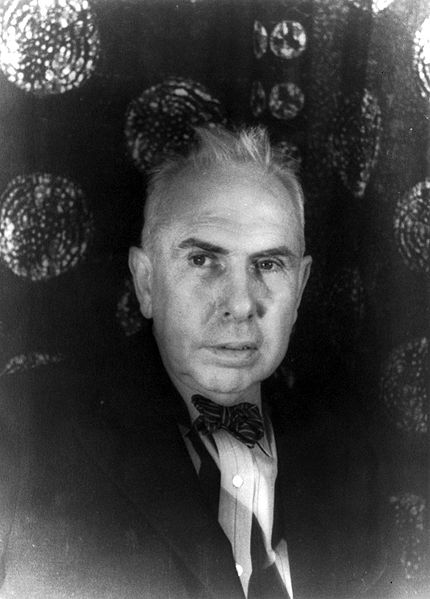
Theodore Dreiser: Man as Natural Mechanism

In his autobiographical Newspaper Days or a Book About Myself (1922), Dreiser recalls the process by which he turned away from Roman Catholicism toward an acceptance of a scientific view of humankind: 
Theodore Dreiser in 1933
Of one's ideals, struggles, deprivations, sorrows and joys, it could only be said that they were chemic compounds, something which for some inexplicable but unimportant reason responded to and resulted from the hope of pleasure and the fear of pain. Man was a mechanism, undevised and uncreated, and a badly and carelessly driven one at that.
His newspaper work only tended to confirm this pessimistic view of humanity, sending him into the most sordid parts of Chicago and St. Louis. "With a gloomy eye I began to watch how the chemical -- and their children, the mechanical -- forces operated through man and outside him, and this under my very eyes." (A great prose stylist, Dreiser wasn't.) Nor did his encounter with the editors, who represented the rich and the powerful, tend to alleviate his gloom. "All I could think of was that since nature would not or could not do anything for man, he must, if he could, do something for himself; and of this I saw no prospect, he being a product of these self-same accidental, indifferent and bitterly cruel forces."


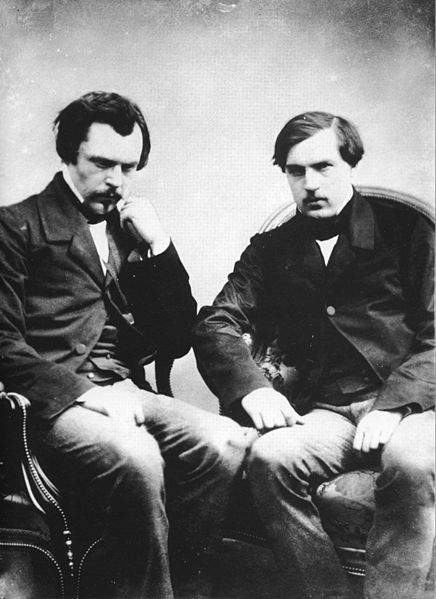
Edmond and Jules de Goncourt: Clinical Realism 

Edmond (left) and Jules de Goncourt, date unknown
The Goncourt brothers are more famous for their journal than for their novels, but the preface to Germinie Lacerteux (1864) provides an explanation of their approach to fiction, the product of their association with virtually every French writer of prominence in the mid-nineteenth century. They defend their novel -- most realists spent a lot of time defending their work -- not on the grounds of its scientific significance, as Zola would, or on the grounds of the privileged autonomy of art, as Flaubert might, but because of its social utility. 

The novel, they say, "is beginning to be the serious, impassioned, living form of literary study and social investigation" and "the true History of contemporary morals," a role that Taine might have proposed for it. Hence, it deserves "its liberty and freedom of speech." Moreover, it serves a charitable purpose, by illuminating "the visible, palpitating human suffering that teaches charity." It serves in "the practice of that religion which the last century called by the vast and far-reaching name, Humanity" and therefore "needs no other warrant than the consciousness that that is its right."


Émile Zola: The Novel as Social Science 

Edouard Manet, Portrait of Émile Zola, 1868
Nothing takes us further from "art for art's sake," from the assertions of the purity and autonomy of art, from the Wildean claim that art is useless, than Zola's 1880 essay, "The Experimental Novel." Zola proclaims a particular function for the novel: an experimental one. 

Basing the essay on his reading of a treatise on experimental medicine by Claude Bernard, Zola develops a theory of the utility of fiction as a kind of laboratory for human behavior. 
The end of all experimental method, the boundary of all scientific research, is ... identical for living and for inanimate bodies; it consists in finding the relations which unite a phenomenon of any kind to its nearest cause, or, in other words, in determining the conditions necessary for the manifestation of this phenomenon. Experimental science has no necessity to worry itself about the "why" of things; it simply explains the "how." 
Would it were that simple, but let's give Zola a little room to make his case. 

So the question is: "Is experiment possible in literature, in which up to the present time observations alone has been employed?" Zola defines "experiment" as "provoked observation," and presents the novelist as "equally an observer and an experimentalist." 
The observer in him gives the facts as he has observed them, suggests the point of departure, displays the solid earth on which his characters are to tread and the phenomena to develop. Then the experimentalist appears and introduces an experiment, that is to say, sets his characters going in a certain story so as to show that the succession of facts will be such as the requirements of the phenomena under examination call for. 
Zola follows with an example from Balzac's Cousine Bette, and asserts, "If we bear in mind this definition, that 'observation indicates and experiment teaches,' we can even now claim for our books this great lesson of experiment." So Zola in effect claims as a function of the novel something that the symbolists unanimously rejected: didacticism. 
Paul Cézanne, Paul Alexis Reading a Manuscript to Zola, 1869-70
For "naturalistic novelists," he says, "all their work is the offspring of the doubt which seizes them in the presence of truths little known and phenomena unexplained, until an experimental idea rudely awakens their genius some day, and urges them to make an experiment, to analyze facts, and to master them." And thus, he asserts, "purely imaginary novels" have begun to replace "novels of observation and experiment." 

Like Tolstoy, Zola is a determinist. "All that can be said is that there is an absolute determinism for all human phenomena." But unlike Tolstoy, Zola is not content to let this rest as an unknowable mystery: "now that we possess the tool, the experimental method, our goal is very plain -- to know the determinism of phenomena and to make ourselves master of these phenomena." He goes so far as to claim that eventually we will understand "the mechanism of the thoughts and passions; we shall know how the individual machinery of each man works; how he thinks, how he loves, how he goes from reason to passion and folly." 

But he is also aware that the individual is worked on by larger forces: "Man is not alone; he lives in society, in a social condition; and consequently, for us novelists, this social condition unceasingly modifies the phenomena." This throws him into a bit of a muddle -- "We are not yet able to prove that the social condition is also physical and chemical" -- but he remains confident that scientific progress will be able to sort it out. 
And this is what constitutes the experimental novel: to possess a knowledge of the mechanism of the phenomena inherent in man, to show the machinery of his intellectual and sensory manifestations, under the influences of heredity and environment, such as physiology shall give them to us, and then finally to exhibit man living in social conditions produced by himself, which he modifies daily, and in the heart of which he himself experiences a continual transformation.
The main thing, Zola says, citing Bernard as his authority, is to concentrate on the "how" and forget about the "why" of things. Stick with the observable and forget about the metaphysical. This will be the goal of "the literature of our scientific age, as the classical and romantic literature corresponded to a scholastic and theological age." 

The ultimate purpose of science (and by extension literature in a scientific age) is mastery of nature: "We shall enter upon a century in which man, grown more powerful, will make use of nature and will utilize its laws to produce upon the earth the greatest possible amount of justice and freedom." (That century obviously was not the twentieth, and certainly doesn't look like it's going to be the twenty-first.) To attain this is "the practical utility and high morality of our naturalistic  works." 
To be the master of good and evil, to regulate life, to regulate society, to solve in time all the problems of socialism, above all, to give justice a solid foundation by solving through experiment the questions of criminality -- is not this being the most useful and the most moral workers in the human workshop?
And so he sets the naturalist writer against "idealistic" writers, those "who cast aside observation and experiment, and base their works on the supernatural and the irrational, who admit, in a word, the power of mysterious forces outside of the determinism of the phenomena." The naturalist must be willing to get down in the muck of existence, as Bernard says the physiological researcher must: "You will never reach really fruitful and luminous generalizations on the phenomena of life until you have experimented yourself and stirred up in the hospital, the amphitheater, and the laboratory the fetid or palpitating sources of life." 

He joins Bernard in distinguishing between determinism and fatalism: "the moment that we can act, and that we do act, on the determining cause of phenomena -- by modifying their surroundings, for example -- we cease to be fatalists." And the experimental novelist has no need to draw conclusions from the events in his novels, to point toward some sort of moral lesson: "our works carry their conclusion with them. An experimentalist has no need to conclude, because, in truth, experiment concludes for him." Because the experimental writer is working toward the great goal of conquering nature and increasing human power over it, he is superior to "the idealistic writers, who rely upon the irrational and the supernatural, and whose every flight upward is followed by a deeper fall into metaphysical chaos. We are the ones who possess strength and morality." 

It follows, then, that Zola rejects poetry. "If you are content to ... enjoy your own feelings without finding any basis for it in reason or any verification in experiment, you are a poet; you venture upon hypotheses which you cannot prove; you are struggling vainly in a painful indeterminism, and in a way that is often injurious." 
Our age of lyricism, our romantic disease, was alone capable of measuring a man's genius by the quantity of nonsense and folly which he put into circulation. I conclude by saying that in our scientific century experiment must prove genius.... There is neither nobility, nor dignity, nor beauty, nor morality in not knowing, in lying, in pretending that you are greater according as you advance in error and confusion. The only great and moral works are those of truth.
Naturalism is, he proclaims, "the intellectual movement of the century." But Zola doesn't entirely reject philosophy, quoting Bernard: "From a scientific point of view, philosophy represents the eternal desire of the human reason after knowledge of the unknown." And therefore it inspires and validates the scientific quest. (Zola characterizes Bernard's view of the role of the philosophers as that of "musicians who play a sort of Marseillaise made up of hypotheses, and swell the heart of the savants as they rush to attack the unknown.") But Zola thinks that it's time for the philosophers to stand aside and recognize "that their hypotheses are pure poetry." 
The poets also put too much emphasis on "form" and "style." But Zola asserts that the best style is the one that communicates truth: "We are actually rotten with lyricism; we are very much mistaken when we think that the characteristic of a good style is a sublime confusion with just a dash of madness added; in reality, the excellence of a style depends upon its logic and clearness." And he insists that "the thought of a great savant who knows how to write is much more interesting than that of a poet." 

He parts company with Barnard on his assertion that "In arts and letters personality dominates everything." He must be thinking of "lyrical poetry," Zola says, "for he never could have written that phrase had he understood the experimental novel as shown in the works of Balzac and Stendhal.... Our field is the same as the physiologist, only that it is greater." And he rejects Barnard's definition of an artist as "a man who realizes in a work of art an idea or a sentiment which is personal to him." Zola insists "that the personal feeling of the artist is always subject to the higher law of truth and nature." 

As for the prophetic role of the artist, he wants it "understood that these prophets rely neither upon the irrational nor the supernatural.... In our scientific age it is a very delicate thing to be a prophet, as we no longer believe in the truths of revelation, and in order to be able to foresee the unknown we must begin by studying the known." 

Finally, Zola makes a nod to the hallowed concept of "beauty," agreeing that the Iliad ("Achilles' Anger") and the Aeneid ("Dido's Love") "will last forever on account of their beauty; but to-day we feel the necessity of analyzing anger and love, of discovering exactly how such passions work in the human being."