JOURNAL OF A COMPULSIVE READER
By Charles Matthews
Showing posts with label George Eliot. Show all posts

Tuesday, April 26, 2011

11. The Modern Tradition, edited by Richard Ellmann and Charles Feidelson Jr., pp. 229-245

Realism: Introduction. Objectivity. (George Eliot, George Bernard Shaw, Gustave Flaubert, Anton Chekhov)
_____
The shift from Symbolism to Realism is not such an about-face as it might seem, especially when you have a figure like Flaubert who participates in both camps. The chief distinction seems to be in the approach to an audience:
Opposing symbolist predilections for an esoteric subject-matter, for perfection of form, and for an elite audience, the realist offers his work as a means of communication among men, dealing with large subjects in a comprehensible way, form subordinated to content. 
But even here, we'll see, there are different kinds of audiences. The mob still remains somewhat out of the artist's consideration, and realists seem as compelled as symbolists to explain what they're about.


George Eliot: A Realism of Love
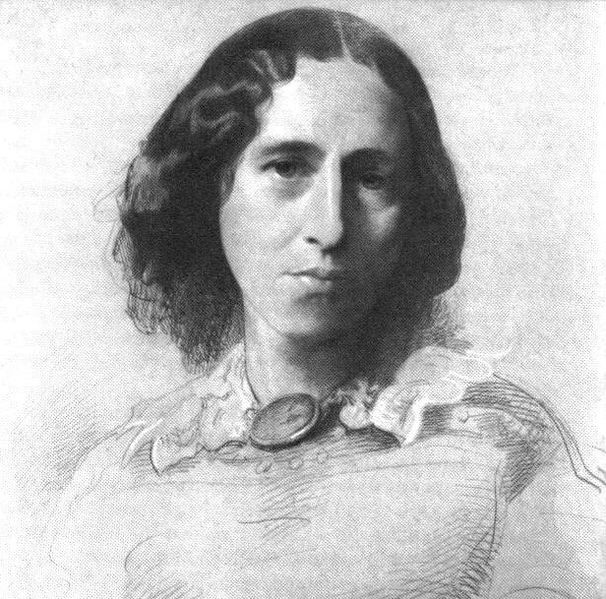
Samuel Laurence, Portrait of George Eliot, c. 1860
Never shy about breaking into her novels to explain things, Eliot interrupts the story (or as her chapter title suggests, pauses it a little) to anticipate objections. Specifically the objection that the minister in Adam Bede is too worldly. She pleads that she can only represent things "as they have mirrored themselves in my mind," and suggests that her own mirror "is doubtless defective." She then asks the read if he or she hasn't know people who aren't wholly good or wholly evil.
These fellow-mortals, every one, must be accepted as they are: you can neither straighten their noses, nor brighten their wit, nor rectify their dispositions; and it is these people -- amongst whom your life is passed -- that it is needful you should tolerate, pity, and love: it is these more or less ugly, stupid, inconsistent people, whose movements of goodness you should be able to admire -- for whom you should cherish all possible hopes, all possible patience.
But what does this have to do with art? they might ask. And Eliot's response would be that art shouldn't lie to you. Moreover, sentimentalizing and simplifying human character is a cop-out: "Falsehood is so easy, truth so difficult." It's easier, she points out, to draw a fantastic creature like a griffin than to make a convincing picture of a real lion.
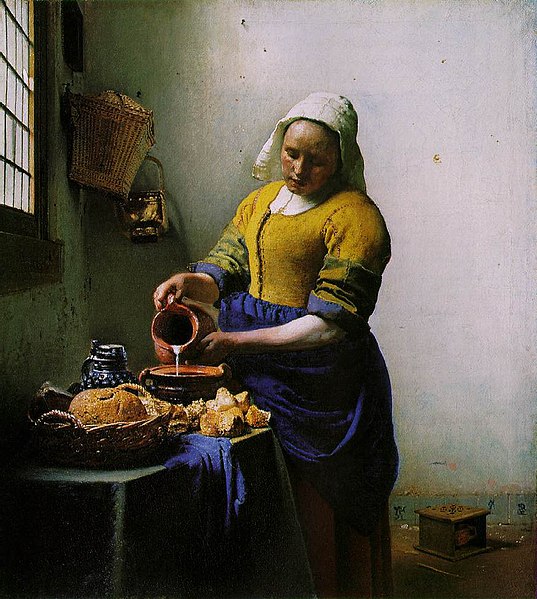
Johannes Vermeer, The Milkmaid, c. 1660
Adriaen van Ostade, Peasants in an Interior, 1661
Her analogy for what she's trying to do in Adam Bede is the painting of the Dutch realists. "I find a source of delicious sympathy in these faithful pictures of a monotonous homely existence, which has been the fate of so many more among my fellow-mortals than a life of pomp or of absolute indigence, of tragic suffering or world-stirring action."  The key word here is "sympathy," which carries with it its own kind of beauty: "human feeling is like the mighty rivers that bless the earth: it does not wait for beauty -- it flows with restless force and brings beauty with it." She appeals to artists "to give the loving pains of a life to the faithful representing of commonplace things."


George Bernard Shaw: False Ideals Exposed

In 1890, Shaw, at the peak of his enthusiasm for Ibsen, writes savagely about the fake idealism that masks hypocrisy. And his remarks have remained pertinent to this day, when "family-values" politicians are constantly being revealed as adulterers, and those who purport to be "saving marriage" turn out to be closeted homosexuals. And fiction has too often played along with them: "In our novels and romances especially we see the most beautiful of all the masks: those devised to disguise the brutalities of the sexual instinct in the earlier stages of its development, and to soften the rigorous aspect of the iron laws by which Society regulates its gratification." In the idealizing of marriage, "men try to graft pleasure on necessity by desperately pretending that the institution forced upon them is a congenial one."

He imagines "a community of a thousand persons," 700 of whom are comfortable with the institution of marriage, and 299 of whom "find it a failure, but must put up with it since they are in a minority." Because they don't want to admit their failure, this minority becomes the loudest in proclaiming that "the family is a beautiful and holy natural institution. For the fox not only declares that the grapes he cannot get are sour: he also insists that the sloes he can get are sweet.... Our 299 domestic failures are therefore become idealists as to marriage; and in proclaiming the ideal in fiction, poetry, pulpit and platform oratory, and serious private conversations, they will far outdo the 700 who comfortably accept marriage as a matter of course, never dreaming of calling it an 'institution,' much less a holy and beautiful one." So in this community there are 299 idealists and 700 Philistines.

But there's one person left over. He sees that marriage is not in itself either holy or beautiful, and that it often fails, so he thinks it "insufferable that two human beings, having entered into relations which only warm affection can render tolerable, should be forced to maintain them after such affections have ceased to exist, or in spite of the fact that they have never arisen. The alleged natural attractions and repulsions upon which the family ideal is based do not exists; and it is historically false that the family was founded for the purpose of satisfying them." But he'll get no support from the 700 Philistines, who are so complacently settled in their situations that they'll "simply think him mad." And the 299 idealists are so terrified at being revealed as failures and hypocrites, that they'll denounce him. "They will crucify him, burn him, violate their own ideals of family affection by taking his children away from him, ostracize him, brand him as immoral, profligate, filthy, and appeal against him to the despised Philistines, specially idealized for the occasion as Society."

Shaw calls on Shelley as an example: "The idealists ... called him a fiend until they invented a new illusion to enable them to enjoy the beauty of his lyrics, this illusion being nothing less than the pretence that since he was at bottom an idealist himself, his ideals must be identical with those of Tennyson and Longfellow, neither of whom ever wrote a line in which some highly respectable ideal was not implicit." So Shaw tackles the problem of the word "idealist," because it's necessary "to distinguish pioneers like Shelley and Ibsen as realists from the idealists of my imaginary community of one thousand."

In Shaw's definition of "realist," he means someone who sees that fake ideals have been concocted as "something to blind us, something to numb us, something to murder self in us, something whereby, instead of resisting death, we can disarm it by committing suicide. The idealist, who has taken refuge with the ideals because he hates himself and is ashamed of himself, thinks that all this is so much the better."
The realist declares that when a man abnegates the will to live and be free in a world of the living and free, seeking only to conform to ideals for the sake of being, not himself, but 'a good man,' then he is morally dead and rotten, and must be left unheeded to abide his resurrection, if that by good luck arrive before his bodily death.


Gustave Flaubert: Heroic Honesty

In 1856, as Madame Bovary was being serialized in La Revue de Paris, Flaubert responded to the critique of its co-editor, Laurence Pichat, that he was as disgusted by some of the details in it too: "I hold the everyday life in detestation.... But aesthetically I wanted this time, and only this time, to exhaust it thoroughly. So I took the thing in an heroic fashion, I mean a minute one, accepting everything, saying everything, depicting everything -- an ambitious statement!" And it took a lot out of him, he wrote to his friend, poet and playwright Louis Bouilhet. His meticulousness and perfectionism was "an insane way of working," and his mother asserted, "The mania for phrases has dried up your heart."


Anton Chekhov: Dunghills as Artistic Material
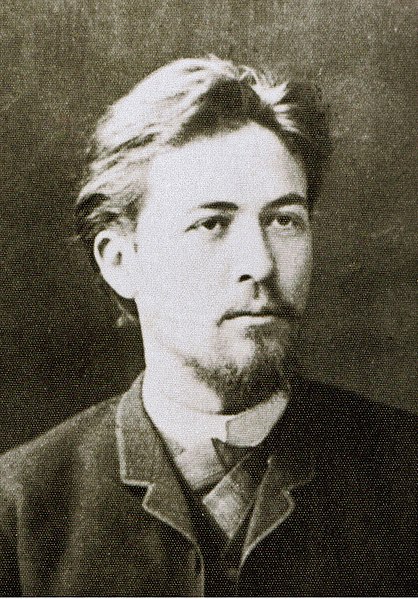
Anton Chekhov in 1889
Chekhov's friend Mariya Kiselev objected to some of the sordid material in his stories "On the Road" and "Mire," and in this 1887 letter he responds. "I do not know who is right: Homer, Shakespeare, Lope de Vega, the ancients generally who did not fear to grub in the 'dung-hill,' but who were more stable in their moral relations than we; or the modern writers, fastidious on paper, but coldly cynical in soul and in their manner of life?" He proceeds to reject the idea that literature should only "gather the pure grain from the muck heap." The artist "is not a confectioner, not a dealer in cosmetics, not an entertainer; he is a man bound, under compulsion, by the realization of his duty, and by his conscience." We wouldn't want a journalist to whitewash the facts, and we shouldn't expect the writer to do so either. Like the reporter, the writer must strive for objectivity: "he must know that dung-heaps play a very respectable part in a landscape, and that evil passions are as inherent in life as good ones."

He chafes against censorship because "The fate of literature would be woeful ... if you left it to the will of individuals.... there is no police which we can consider competent in literary matters.... you cannot find a better police for literature than criticism and the author's own conscience."

And like George Eliot, he defends the choice of lower class figures as artistic material:
To be condescending toward humble people because of their humbleness does not do honor to the human heart. In literature, the lower ranks are as necessary as in the army, -- so says the mind, and the heart ought to confirm this most thoroughly.

Thursday, March 24, 2011

8. As You Like It, by William Shakespeare. The Arden Third Series edition, continued.

As You Like It (Arden Shakespeare: Third Series)Introduction by Juliet Dusinberre, pp. 36-142
_____
Agnes Latham's introduction discussed the various theories about the premier performance of As You Like It, but Dusinberre argues for "a new and specific date for the play, of Shrove Tuesday, 20 February 1599. The Chamberlain's Men are recorded as having performed a play at Richmond Palace on that date, and an epilogue that refers to the presence of the queen and to the fact that it is Shrove Tuesday has been found in the commonplace book of Henry Stanford. It may have been used only for that performance and the epilogue published in the First Folio substituted later. A Shrove Tuesday performance would explain Touchstone's reference to pancakes and mustard in Act I, scene 2, because pancakes -- then a form of meat pie -- were traditionally eaten on that day.
Shrove Tuesday 1599 would have marked the final celebratory performance for the fortieth year of the queen's reign before the theatres closed the next day for Lent. Without being in any specific sense an "occasional" piece, As You Like It is geared to Elizabethan court taste. It boasts, in a pastoral drama full of music and witty word-play, a uniquely powerful heroine posing as a shepherd, Elizabeth's favourite image for her own rule.
As for the identification of Jaques's "All the world's a stage" speech with the motto of the Globe Theater, which opened in the fall of 1599, the lease for that theater was signed on February 21, so the allusion could have been a kind of advertisement for the coming venture. The Shrove Tuesday date would also call into question the assumption that Touchstone's part was written for Robert Armin, who didn't join the company until the end of 1599. "In February 1599 the part of Touchstone would have been taken by Will Kemp."

Dusinberre also explores in greater depth the play's principal setting, the Forest of Arden: "Just as the binaries of the heterosexual and the homosexual, masculine and feminine are refracted and melt into each other within the figure of Rosalind, so in the Forest the polarity of real and ideal ceases to be illuminating." The Forest is not just a place for escape, it's also a place in which people work and hunt.The play maintains a certain ambivalence about the latter pursuit.  "Elizabeth was a keen huntswoman who was still hunting in September 1600, when she was 67." As You Like It "demonstrates dubiousness abut hunting," especially in the account of Jaques mourning the wounded deer, but it also celebrates it in the hunting song in 4.2, although the tone of that celebration depends entirely on the production in which it appears. It's also notable that "When Orlando interrupts the Duke at supper, he is offered fruit." And there is a parallel between the hunting of deer in the Forest and the hunting of men at court: "Oliver's hounding of Orlando, Duke Frederick's hounding of Oliver and banishment of Rosalind, not to mention the usurpation of his own brother's dukedom."

The explicit link of the Forest exiles with Robin Hood and his merry men is also significant:
The social subversion of those stories -- the attacks on civil and ecclesiastical authority, the flouting of convention by a cross-dressed Maid Marian ... are in evidence in Shakespeare's comedy in its cross-dressed heroine, its questioning of primogeniture and its ribaldry against a representative of the clergy, Sir Oliver Mar-text.... In As You Like It Orlando's revolt against his brother is given the backing of the play's moral authority.... Interestingly that authority is chiefly vested in a servant, Adam.
The Forest setting challenges directors not to get too literal or too abstract with stage design. "As You Like It, like Henry V, requires the audience's imagination to work vigorously. The two plays were conceived at much the same time in the dramatist's mind, and they both require active input from the audience." 

Thematically, the play has spoken to many different ages with many different experiences of exile. The 1936 film with Laurence Olivier was directed by Paul Czinner and starred his wife, Elisabeth Bergner, both of whom were Austrian Jews taking refuge in London. But the play originated at a time when talk of usurpation and exile was rife and "the precarious fortunes of the Earl of Essex had begun to overshadow courtly festivity.... As You Like It deals in a more poetic way with the displacement of individuals and the breaking of apparently insuperable barriers."
Essex's role as a patron of drama, music and fencing -- all of which are reflected in As You Like It -- and his wayward and flamboyant courtship of the queen to whom he was both vassal and incipient rival, were part of a pattern in the 1590s which made him the lodestar of the Court.... In this atmosphere of mistrust and discontent the Chamberlain's Men may have first performed As You Like It to queen and court, a play of incomparable geniality and good humour, in which the claims of courtly pleasure are pitted against the rival, and in the end ascendant, claims of rustic contentment.
For modern audiences and the actors trying to please them, the role of Touchstone is a special challenge. "The best Touchstones ... have always had a kind of music-hall rapport with the audience." Elizabethan audiences would have immediately found the humor in "the confrontation of the clown (countryman) with another clown (the jester) ... whereas a modern audience sits gaping, trying to work out where to laugh." Even in 1599 the actual role of court jester, or licensed fool, was beginning to die out, "as Malvolio's hostility to Feste in Twelfth Night accurately records." The Elizabethan audience would have recognized a shepherd like Corin as a type, "a man known for his silence, his self-sufficiency, the security of his function," and have relished the clash with another type, the jester, "for whom words are a livelihood, and whose insecurities are manifold, for he must always please or his livelihood is gone, where the shepherd rests content if his sheep are so." Today the types are forgotten, just as we are beginning to forget the humorous conflict of types such as the country bumpkin and the city slicker that were the basis of American humor as recently as The Beverly Hillbillies.

We also have lost the significance of pastoral, which for the Elizabethans had "political ramifications" and hinted at "'greater matters' behind a rustic disguise.... In an age of censorship the pastoral mode provided a way of saying one's dangerous piece with relative safety.... Satire is intrinsic to pastoral." The satiric voice in As You Like It belongs to Jaques, but his bitter wit is countered by the foolery of Touchstone.
The two parts are weighed in a balance: on the one side is folly, and on the other, wisdom. Just as Jaques [laughs] for an hour at a lamenting Touchstone, thus reversing their roles, so the paradox of which character wears the fool's motley, and which the mantle of sage, lies, in the true fashion of Erasmus's Praise of Folly, at the centre of Shakespeare's comedy....The audience can see all too clearly that Jaques's longing for a motley coat and the licence of a fool comes from a firm belief in his own wisdom punctured by the clown, who responds to his counsel by singing and dancing.... Shakespeare allows his pose of false wisdom to be tried by the touchstone of true folly.
But Jaques's point of view is essential to the play. "Without Jaques's edge of cynicism, the Forest of Arden is too sweet. Its honey is improved by a dash of gall." Dusinberre also notes that Jaques goes unmated at the end of the play, despite George Sand's desire to marry him off to Celia. In the play he directs his attentions solely to men: "Touchstone, the young Ganymede who repulses him unceremoniously, and even Orlando, to whom his incivility can be played as a kind of courtship." (When Orlando bests him in a game of wits, with the riposte of seeking the fool in the brook, Jaques begins to take him seriously.) "The melancholy satirist's indifference to women and his marked preference for the company of men is one element in the multiple sexualities which the play evokes and celebrates."

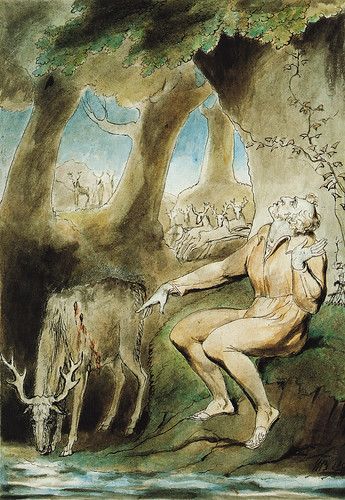
William Blake, Jaques and the Wounded Stag, 186
While As You Like It is undeniably effective on the stage, there is much to be said in favor of it as a play to be read. "Where The Comedy of Errors, or The Two Gentlemen of Verona, or even Much Ado About Nothing demand performance, the imaginative world of As You Like It is sometimes sold short in the theatre." The success of the First Folio was dependent on the desire of people to read Shakespeare's plays, and after the closing of the theaters in 1642, reading was the only way the plays could be experienced for the next eighteen years. "The traditional assumption has been that Shakespeare was not interested in plays as reading material, but only as text for the theatre," but several scholars have challenged this assumption, arguing "that Shakespeare may have deliberately envisaged readers for his plays and that the 'plays work well on the page because they are in certain ways designed for readers.'"

In As You Like It there are entire episodes that are not depicted onstage but only by a character describing them, such as Jaques's encounter with the wounded deer and Orlando's rescue of Oliver from the snake and the lioness. These scenes exist only in the mind, and are therefore as effective for the reader as for the person watching the play. The description of Jaques and the stag also inspired William Blake to illustrate it. Some of the wordplay in As You Like It also suggests that Shakespeare was as interested in the reader as in the listener. "In the theatre these effects pass too quickly to be noticed, but in private reading they add an extra witty dimension to the language of the play."

The play also had a great appeal to novelists, such as George Eliot, whose citing of the relationship between Rosalind and Celia has already been noted. "But in her later fiction Eliot seems to have taken against Rosalind as a woman whose attractiveness guaranteed successful courtship." Dusinberre cites Gwendolen Harleth's "flirting with the role of Rosalind" in Daniel Deronda as implying "her creator's conviction that modeling oneself on a Shakespearean woman creates more problems than it solves." She might have also observed that Eliot's most notorious example of "a woman whose attractiveness guaranteed successful courtship" is Rosamond Vincy in Middlemarch, whose name is perilously close to Rosalind.

One key issue in the history of the play on which Dusinberre differs from Latham concerns the "staying order" of 1600: "The idea that the staying order represented a copyright claim by the Chamberlain's Men to prevent unauthorized publication is not credited by recent scholars.... It is no longer believed, moreover, that the publication of a play would detract from its popularity with an audience and must therefore be delayed till that play was off the stage." One scholar suggests that As You Like It was not published before its appearance in the First Folio because The Merchant of Venice, Much Ado About Nothing, A Midsummer Night's Dream and The Merry Wives of Windsor were all in print in 1600 and there was no demand for another comedy.

But As You Like It  may also have run into trouble with the censors. The satiric jibes of Jaques may have made the censors take a hard line on the play: In June 1599, the Archbishop of Canterbury and the Bishop of London cracked down on satire, partly in response to the trouble stirred up by Essex and by Sir John Harington's imitation of Rabelais, The Metamorphosis of Ajax, a scatological satire whose title contains the pun on the name Ajax = "a jakes." (The same pun is directed at the character Ajax in Troilus and Cressida.) The name Jaques would therefore have "lavatorial/Harington associations."
The acceleration of events after August 1600, which led to Essex's aborted rebellion at the end of January 1601 and his execution in the following month, might have made As You Like It, with its depiction of an alternative court in the Forest of Arden, seem politically sensitive.