JOURNAL OF A COMPULSIVE READER
By Charles Matthews
Showing posts with label Young Smallweed. Show all posts

Sunday, June 19, 2011

10. Bleak House, by Charles Dickens, pp. 332-366

Chapter 21: The Smallweed Family through Chapter 22: Mr Bucket

Now it's time to introduce a whole lot of new characters. We've met Young Smallweed, whose name, it turns out, is Bartholomew, or Bart. Now we learn that he has a twin, Judith, and that they live with their grandparents. The grandmother is in "a childish state," which is unusual in the Smallweed family, in which even the children are never treated as children -- i.e., given toys or told stories or fairy tales. "With such infantine graces as a total want of observation, memory, understanding and interest, and an eternal disposition to fall asleep over the fire and into it, Mr Smallweed's grandmother has undoubtedly brightened the family."

It's probably worth remarking on the peculiar ways in which childhood and adulthood are tumbled about in Bleak House. We have childish adults (Skimpole, Grandmother Smallweed) and children deprived of childhood (Jo, Charley Neckett, even Esther Summerson). We have neglected children (the Jellybys) and exploited children (the Pardiggles). And we have childless adults (the Dedlocks, John Jarndyce, Tulkinghorn, Miss Flite, et al.). Given that one of the central mysteries of the novel centers on Esther's parentage, and that the question of inheritance (i.e., the passing down of property from one generation to another) is what makes Chancery the tangled morass it is, it's not surprising that parenting or its absence is so prominent a theme in the book.

Grandfather Smallweed, to continue, retains his wits, but is physically impaired. So he and his wife, confined to their chairs by the fireplace, face off against each other in a kind of ongoing Punch-and-Judy routine. He is provided with "a spare cushion ... in order that he may have something to throw at" her "whenever she makes an allusion to money -- a subject on which he is particularly sensitive." But when he flings the cushion, he not only knocks her over in her chair, but he also slumps down in his, so that he has to be "shaken up like a great bottle, and poked and punched like a great bolster" to get him upright again.

The person tasked with the shaking and poking and punching is their granddaughter, Judy. All of the Smallweeds "have been observed to bear a likeness to old monkeys with something depressing on their minds." Judy has "never owned a doll, never heard of Cinderella, never played at any game.... It is very doubtful whether Judy knows how to laugh. She has so rarely seen the thing done." Her twin, Bart, at least goes out in the world, where he keeps company with Mr Guppy. Judy does have help, and it turns out to be Charley Neckett, the orphaned daughter of Skimpole's old nemesis he called "Coavinses." So the Smallweeds have another tie to the novel's central characters.

Young Smallweed -- Bart -- arrives home, and we learn that he never knew his father, who died "fifteen years ago." (We learned earlier that Bart is not quite fifteen.) But he lives in the grandfather's memory as "a good accountant" and as his former partner.The twins' mother, whom the grandfather describes as "as dry as a chip," died not long after they were born. Bart is, as we know, apprenticed in a law office, and Judy, we now learn, "apprenticed to the art and mystery of artificial flower-making." 
Hablot Knight Browne (Phiz), The Smallweed Family (Source: David Perdue's Charles Dickens Page)
A knock is heard at the door, and Charley returns to inform them that it's Mr George.
He is a swarthy browned man of fifty; well made, and good-looking; with crisp dark hair, bright eyes, and a broad chest. His sinewy and powerful hands, as sunburnt as his face, have evidently been used to a pretty rough life.... His step too is measured and heavy, and would go well with a weighty clash and jingle of spurs. He is close-shaved now, but his mouth is set as if his upper lip had been for years familiar with a great moustache; and his manner of occasionally laying the open palm of his broad brown hand upon it, is to the same effect. Altogether, one might guess Mr George to have been a trooper once upon a time.
The appearance of such a substantial, somewhat realistically drawn character at this point raises suspicions that he's more than just another comic foil, like Chadband or the Bayham Badgers. Dickens even stresses the point by comparing Mr George to the Smallweeds: "His developed figure, and their stunted forms; his large manner, filling any amount of room; and their little narrow pinched ways; his sounding voice, and their sharp spare tones; are in the strongest and the strangest opposition."

Mr George has evidently come to repay a loan from Old Smallweed: "Here's the new bill, and here's the two months' interest-money, and a devil-and-all of a scrape it is to get it together in my business." When George remarks that Smallweed will "sell me up at last I suppose, when I am a day in arrear," the old man assures him, "Never! Never, my dear friend! But my friend in the city that I got to lend you the money -- he might!" George mutters, just below the old man's hearing, "The name of your friend in the city begins with a D." (I.e., the Devil.) Meanwhile, Grandmother Smallweed starts to chatter, "Twenty thousand pounds, twenty twenty-pound notes in a money box, twenty guineas, twenty million twenty per cent, twenty --" before her husband can fling the cushion at her and denounce her as "a brimstone idiot. You're a scorpion -- a brimstone scorpion! Your a sweltering toad. You're a chattering clattering broomstick witch, that ought to be burnt!" He calls on George to shake him up in his chair again, which George is glad enough to do, "agitating him violently enugh to make his head roll like a harlequin's."

When the old man recovers from his shaking-up, he asks George if he has any relatives who could vouch for him so "I could persuade my friend in the city to make you a further advance." But George indicates that he is "a vagabond, who has wasted the best time of his life," and that he is reluctant "to go back then to decent people that he never was a credit to, and live upon them.... The best kind of amends then, for having gone away, is to keep away, in my opinion."

And then Smallweed observes, "If you could have traced out the Captain, Mr George, it would have been the making of you. If, when you first came here, in consequence of our advertisements in the newspapers -- when I say 'our,' I'm alluding to the advertisements of my friend in the city, and one or two others who embark their capital in the same way, and are so friendly towards me as sometimes to give me a lift with my little pittance -- if, at that time, you could have helped us, Mr George, it would have been the making of you."

So we understand from this that Smallweed was in search of a certain Captain, whom George was unable to locate. He had responded to an advertisement asserting "that Mr Hawdon (Captain Hawdon, if you hold to the saying, Once a captain always a captain) was to hear of something to his advantage." George, a former trooper, had known this Captain Hawdon at one time, having"been at his right hand many a day, when he was charging upon ruin full gallop." And it was this that brought George into the money-lending orbit of Smallweed. The ad had been a ruse to ensnare the Captain, who "owed us immense sums, all round," Smallweed admits.

George had known the Captain "when he was sick and well, rich and poor. I laid this hand upon him, after he had run through everything and broken down everything beneath him -- when he held a pistol to his head." He should have fired it, Smallweed says, "and blow his head into as many pieces as he owed pounds!" George says, "he had been young, hopeful, and handsome in the days gone by; and I am glad I never found him." He is convinced that the Captain "was drowned long before.... He went over a ship's side. Whether intentionally or accidentally, I don't know."

As he takes his leave, he asks again, "So you think your friend in the city will be hard upon me, if I fail in a payment?" Old Smallweed says, "My dear friend, I am afraid he will." And so "Mr George strides through the streets with a massive kind of swagger and a grave-enough face." He stops in at Astley's Theatre, the home of the circus in London, and watches the performers.
Astley's in 1808 (Source: Wikipedia)
And then he makes his way to his home and place of business, "a great brick building, composed of bare walls, floor, roof-rafters, and skylights; on the front of which, if it can be said to have any front, is painted GEORGE'S SHOOTING GALLERY, &C." He is joined there by his custodian, a small man named Phil, who seems "to have been blown up, in the way of business, at some odd time or times." (We will later learn that Phil's last name is Squod.)

In Lincoln's Inn Fields, Tulkinghorn is sharing a very old port with Mr Snagsby, who is telling him the story of Jo's encounter with the veiled lady/servant. Suddenly, Snagsby realizes that he and Tulkinghorn are not alone: "at a little distance from the table, a person with a hat and stick in his hand who was not there when he himself came in, and has not since entered by the door or by either of the windows." Tulkinghorn reassures Snagsby, "This is only Mr Bucket." The unobtrusive Mr Bucket "is a stoutly-built, steady-looking, sharp-eyed man in black, of about the middle age." He was modeled on Charles Frederick Field, a Scotland Yard detective and later private investigator, whose exploits Dickens also wrote about in several essays. When Snagsby begins to show reluctance to talk about Jo, Bucket assures him, "Don't you be afraid of hurting the boy."

After Snagsby concludes his story, Bucket says, "as far as I can understand it, there seems to be a doubt whether this dead person wasn't entitled to a little property, and whether this female hasn't been up to some games respecting that property, don't you see!" Snagsby doesn't see, but he is persuaded by Bucket to accompany him to Tom-all-Alone's in search of Jo.

It turns out to be a harrowing journey for Snagsby, through filth and poverty and vice, and he "sickens in body and mind, and feels as if he were going, every moment deeper down, into the infernal gulf." Along the way they encounter a body being carried, and Snagsby learns that people there are dying from "the fever," as Bucket puts it, "like sheep with the rot." They finally get a lead that Jo might be known by the name of "Toughy, or the Tough Subject," and in their search they come upon two drunk men who have passed out and the two women with them, one of whom has a baby." The men, they learn, are brickmakers from Hertfordshire who have come to London in search of work but haven't found it. And when we learn that one of the women had a baby who died, we realize that these are the people who were the object of Mrs Pardiggle's "charity," and of Esther and Ada's subsequent attentions.

Then they come across Jo, "trembling to think that he has offended against the law in not having moved on far enough." He has come to deliver some medicine for the baby, and having delivered it agrees to go to Tulkinghorn's office to tell him the story of the veiled woman.

When they enter Tulkinghorn's chambers, however, Jo cries out, "There she is!" "A female figure, closely veiled, stands in the middle of the room, where the light falls upon it. It is quite still, and silent." When Bucket prompts him, Jo says he recognizes the veil and the bonnet and the gown that the figure is wearing. He is certain of it. Then Bucket asks him about the rings that the woman wore, and the figure takes off her glove and shows him her hand. "Jo shakes his head. 'Not rings a bit like them. Not a hand like that.... Hand was a deal whiter, a deal delicater and a deal smaller." Would Jo remember the lady's voice? He thinks he would.
The figure speaks. "Was it at all like this. I will speak as long as you like if you are not sure. Was it this voice, or at all like this voice?"

Jo looks aghast at Mr Bucket. "Not a bit!" 
So what, Bucket asks, made him think it was the lady?  It was the veil, the bonnet and the gown, he says, but it isn't her hand or her rings or her voice. So Bucket gives Jo five shillings and sends him on his way, leaving an uncomfortable Snagsby alone with the woman. But they are joined by Tulkinghorn, and the woman raises her veil, revealing Lady Dedlock's former maid, Hortense. "I will give you no further trouble regarding this little wager," Tulkinghorn tells her, but before she leaves she reminds him that she is now unemployed and needs him "to confer upon me the favour of your distinguished recommendation." He assures her he will.

Bucket confirms what Tulkinghorn already knows: "There an't a doubt that it was the other one with this one's dress on." That is, Lady Dedlock in Hortense's clothes. Snagsby is then sent home, "doubtful of his being awake and out -- doubtful of the reality of the streets through which he goes -- doubtful of the reality of the moon that shines above him." He is soon, however, confronted with "the unchallengeable reality of Mrs Snagsby, sitting up with her head in a perfect beehive of curl-papers and nightcap."
_____
The 2005 BBC/Masterpiece Theatre dramatization features  Sean McGinley as Snagsby, Charles Dance as Tulkinghorn, Alun Armstrong as Inspector Bucket, Charlie Brooks as Jenny, Harry Eden as Jo, Lilo Baur as Hortense, Patrick Kennedy as Richard Carstone, Carey Mulligan as Ada Clare, Denis Lawson as John Jarndyce, Anna Maxwell Martin as Esther Summerson.


Friday, June 17, 2011

9. Bleak House, by Charles Dickens, pp. 281-331

Chapter 18: Lady Dedlock through Chapter 20: A New Lodger


Richard is so indecisive that it takes several weeks for him finally to settle on an "experimental course" in the law at Kenge and Carboy. Meanwhile, Ada, Esther and Jarndyce return to Bleak House, Jarndyce having located lodgings for Richard in London. Richard "immediately began to spend all the money he had, in buying the oddest little ornaments and luxuries for this lodging." He also continues with his odd habit of believing that if he has saved money on one thing, that allows him to spend the amount he has saved on something else, making "out that to spend anything less on something else was to save the difference."

He has postponed his decision so long, that he is unable to accompany the others to Lincolnshire for their visit to Boythorn. But Skimpole takes his place -- in more ways than one. For here Dickens makes clear the resemblance of Richard to Skimpole, by placing Richard's curious confusion about money in close proximity to Skimpole's absolute indifference to it. Skimpole has leased some furniture that is being repossessed, causing Jarndyce, who stood security for the lease, to have to pay for them. Skimpole is not in the least embarrassed by that fact, and the others continue to humor him in his "childishness."

Boythorn meets them at an inn near his house and explains, "I am obliged to conduct you nearly two miles out of the way. But, our direct road lies through Sir Leicester Dedlock's park; and, in that fellow's property, I have sworn never to set foot of mine." He tells them that "Sir Arrogant Numskull" -- his name for Sir Leicester -- is in residence and that Lady Dedlock is expected to return soon: "Whatever can have induced that transcendent woman to marry that effigy and figure-head of a baronet, is one of the most impenetrable mysteries that ever baffled human inquiry."

Esther gets her first glimpse of Chesney Wold -- "a picturesque old house, in a fine park richly wooded" -- as they drive past on the road. In the village, at the Dedlock Arms, Boythorn greets Watt Rouncewell, and tells them that Watt is the son of the housekeeper at Chesney Wold and in love with "a pretty girl up at the House" -- i.e., Rosa. Boythorn's own house is sunny and pleasant, and "everything about the place wore an aspect of maturity and abundance." It's one of those Dickensian Gardens of Eden, with its own snake -- the hostility between Boythorn and Dedlock, so that the side of the house that borders Dedlock property is guarded by "a sentry in a smock-frock, day and night, whose duty was supposed to be, in case of aggression, immediately to ring a large bell hung up there for the purpose, to unchain a great bull-dog established in a kennel as his ally, and generally to deal destruction on the enemy."

On Sunday morning they attend services at a little church, where Esther gets her first glimpse of the Dedlocks and their household, including Mrs Rouncewell, Rosa, and Hortense: "One face, and not an agreeable one, though it was handsome, seemed maliciously watchful of this pretty girl, and indeed of everyone and everything there. It was a Frenchwoman's."
Hablot Knight Browne (Phiz), The Little Church in the Park (Source: David Perdue's Charles Dickens Page)
But it is the arrival of Sir Leicester and Lady Dedlock that has the most powerful and peculiar effect on Esther:
Shall I ever forget the rapid beating at my heart, occasioned by the look I met, as I stood up! Shall I ever forget the manner in which those handsome proud eyes seemed to spring out of their languor, and to hold mine! It was only a moment before I cast mine down -- released again, if I may say so -- on my book; but, I knew the beautiful face quite well, in that short space of time. And, very strangely, there was something quickened within me, associated with the lonely days at my godmother's ... although I had never seen this lady's face before in all my life -- I was quite sure of it -- absolutely certain.
For Esther, Lady Dedlock's face is, "in a confused way, like a broken glass to me, in which I saw scraps of old remembrances." As this characteristic Victorian recognition scene continues, Esther tries to decide if Lady Dedlock somehow resembles her godmother/aunt, "but, the expression was so different, and the stern decision which had worn into my godmother's face, like weather into rocks, was so completely wanting in the face before me."
And yet I -- I, little Esther Summerson, the child who lived a life apart, and on whose birthday there was no rejoicing -- seemed to arise before my own eyes, evoked out of the past by some power in this fashionable lady, whom I not only entertained no fancy that I had ever seen, but whom I perfectly well know I had never seen until that hour.
We have pages and pages to go before this particular mystery is finally solved, and perhaps it is because so much narrative is yet to come that Dickens lays it on so thick in this scene.

Meanwhile, Boythorn and Skimpole have one of their skirmishes of Duty vs. Irresponsibility, ending with Skimpole asserting that though "the Slaves on American plantations ... are worked hard" and "don't altogether like it" and "theirs is an unpleasant experience on the whole; but, they people the landscape for me, they give it a poetry for me, and perhaps that is one of the pleasanter objects of their existence." Dickens, ardently anti-slavery, is here giving a strong hint that Skimpole may yet prove to be a villain in the novel. But on the other hand, Skimpole's sentimentalized, "picturesque" attitude toward slavery in the antebellum United States would persist for another century in novels and movies.

The following Saturday, Jarndyce, Ada and Esther are out for a walk when a storm comes up, with lightning and thunder. They take refuge in a keeper's lodge on the Dedlock property. As they are waiting in the doorway, watching the storm, someone asks, "Is it not dangerous to sit in so exposed a place?" Ada thinks Esther has spoken, but it's Lady Dedlock, who has also "taken shelter in the lodge, before our arrival there, and had come out of the gloom within." Esther has also reacted to the surprise voice, but in a different way from Ada: "The beating at my heart came back again. I had never heard the voice, as I had never seen the face, but it affected me in the same strange way. Again, in a moment, there arose before my mind innumerable pictures of myself."

It turns out that Lady Dedlock and Jarndyce have met, a long time before. She mentions the letter he had written to Sir Leicester requesting his aid in helping Richard, and asks to be introduced first to Ada and then to Esther. Learning that Esther is his ward, she asks, "Has Miss Summerson lost both her parents?" He says that she has. Lady Dedlock and Esther look at each other, and then Lady Dedlock turns away "with a hasty air, almost expressive of displeasure or dislike." She and Jarndyce, we learn, had met when they were "abroad," and she observes that Jarndyce had been better acquainted with her sister, with whom she had become estranged: "'We went our several ways,' said Lady Dedlock, 'and had little in common even before we agreed to differ. It is to be regretted, I suppose, but it could not be helped.'"
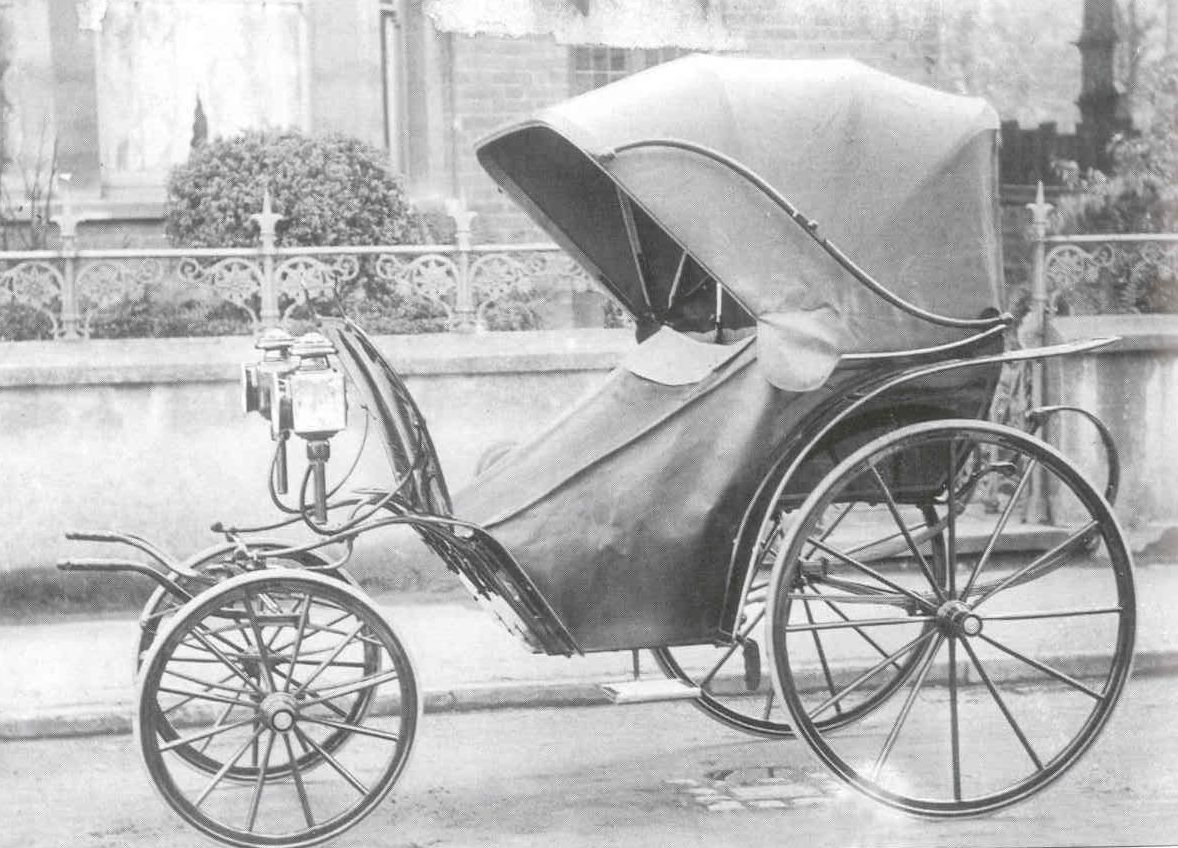
Pony phaeton (Source)

Then "a little pony phaeton" carrying Hortense and Rosa arrives. Lady Dedlock had sent for it, asking her maid to come -- meaning Rosa, though Hortense had apparently insisted that she was the one sent for.  "The Frenchwoman stood unnoticed, looking on with her lips tightly set," as Lady Dedlock offers to send the carriage back for Ada and Esther. Jarndyce declines, and Lady Dedlock "took a graceful leave of Ada -- none of me," Esther notes, and bids Rosa get into the carriage with her. As for Hortense,
She remained perfectly still until the carriage had turned into the drive, and then, without the least discomposure of countenance, slipped off her shoes, left them on the ground, and walked deliberately in the same direction, through the wettest of the wet grass.
"'Is that young woman mad?' said my guardian." The keeper says that she's just "mortal high and passionate -- powerful high and passionate; and what with having notice to leave, and having others put above her, she don't take kindly to it." And as Jarndyce, Ada and Esther return home, they see Hortense still striding through the wet grass.

In London, the omniscient narrator tells us, the courts have shut down for the long vacation, leaving all of the clerks idle, as well as the businesses that support the law, such as Mr Snagsby, the stationer. He and Mrs Snagsby are entertaining the Chadbands. Mr Chadband is a minister "attached to no particular denomination," who includes among his followers Mrs Snagsby. "'My little woman,' says Mr Snagsby to the sparrows in Staple Inn, 'like to have her religion rather sharp, you see!'"
Mr Chadband is a large yellow man, with a fat smile, and a general appearance of having a good deal of train oil in his system. Mrs Chadband is a stern, severe-looking, silent woman. Mr Chadband moves softly and cumbrously, not unlike a bear who has been taught to walk upright. He is very much embarrassed about the arms, as if they were inconvenient to him, and he wanted to grovel; is very much in a perspiration about the head; and never speaks without first putting up his great hand, as delivering a token to his hearers that he is going to edify them.
Chadband's "edification," however, typically consists of platitudes delivered in the most pompous and verbose manner possible. Still, as the narrator observes, "the Chadband style of oratory is widely received and much admired."

As the Snagsbys are entertaining the Chadbands, however, the servant, Guster, informs Mr Snagsby that he is wanted in the shop downstairs, where he finds a constable with Jo in his custody. The constable has ordered Jo to "move on," and Jo insists that there's nowhere for him to move on to. Jo has apparently indicated to the constable that Mr Snagsby can vouch for him, and although Mrs Snagsby has appeared at the top of the stairs to proclaim that he doesn't know the boy, Snagsby admits that he does.

Then Mr Guppy appears, and confirms Snagsby's acquaintance with Jo. The constable is still convinced that Jo is up to no good, partly because he lives in Tom-all-Alone's.  Moreover, Jo has money upon him, which is enough to convince the constable that Jo has been stealing. So Jo tells the story of being approached "by a lady in a wale" (i.e., veil) who gave him a sovereign to show her where Nemo lived, died, and was buried. The constable agrees to leave Snagsby in charge of Jo's moving on -- over Mrs Snagsby's protests -- and departs.

Intrigued by Jo's story of the veiled lady, Guppy begins asking questions, raising the curiosity of the others, so that Guppy and Jo are ushered upstairs to continue the interrogation. Guppy opines that "there is something out of the common here that beats anything that ever came into my way at Kenge and Carboy's," which is enough to have Mrs Chadband eager to hear more: She happens to be acquainted with Kenge and Carboy's. Before she married the Rev. Mr Chadband, she says, she "was left in charge of a child named Esther Summerson, who was put out in life by Messrs Kenge and Carboy's."

It's Guppy's turn to be astonished, though when he gasps, "Miss Summerson, ma'am!" he is rebuked by Mrs Chadband, who is apparently the Mrs Rachael who was servant to Esther's godmother/aunt. "'I call her Esther Summerson,' says Mrs Chadband, with austerity. 'There was no Miss-ing of the girl in my time. It was Esther. "Esther, do this! Esther, do that!" and she was made to do it.'"


The Rev. Chadband seizes upon this moment of astonishment to take the floor and sermonize on the topic of ... Jo, who is bewildered by everything that's going on, and "whose immediate object seems to be to get away on any terms." Guppy gives him a penny and Mr Snagsby loads him up with some of the table leftovers, and off he goes into the night.

Guppy, of course, is not going to let all these revelations go. He has been vexed by the arrival in the offices of Kenge and Carboy of Richard Carstone, but gratified "to find the new comer constantly poring over the papers in Jarndyce and Jarndyce; for he well knows that nothing but confusion and failure can come of that." So he gathers his friends, fellow law-clerks Young Smallweed and Tony Jobling, and invites them to dine with him.
Hablot Knight Browne (Phiz), Mr Guppy's Entertainment (Source: David Perdue's Charles Dickens Page)
After much Dickensian business about these swaggering striplings, during which we learn that Jobling was the one who accompanied Guppy to Chesney Wold, Guppy announces "a plan I have lately thought of proposing." It may, he stammers, "have some reference to a subject, which may -- or may not -- have cast its shadow on my existence" -- that is, of course, his failed proposal to Esther. He tells Jobling that in his duties at Kenge and Carboy's he has been delivering a weekly allowance to Miss Flite at Krook's, and that Krook has a room to let. Krook "must be precious old, you know, and he has not a soul about him, and he is reported to be immensely rich; and whether he is a smuggler, or a receiver, or an unlicensed pawnbroker, or a money-lender -- all of which I have thought likely at different times -- it might pay you to knock up a sort of knowledge of him."

Jobling is game, even when he learns that the room is where Krook's last lodger died. So they proceed to Krook's, where he is dead drunk. They manage to get him awake, and after treating him to a better quality of gin than he is used to, "Mr Guppy presents his friend under the impromptu name of Mr Weevle, and states the object of their visit." The result is that Jobling/Weevle is installed in the second-floor room, which he adorns with "copper-plate impressions from that truly national work, The Divinities of Albion, or Galaxy Gallery of British Beauty, representing ladies of title and fashion in every variety of smirk that art, combined with capital, is capable of producing." And in time the neighbor ladies are gossiping, "don't you be surprised Lord bless you, if that young man comes in at last for old Krook's money!"
_____

The 2005 BBC/Masterpiece Theatre dramatization features Burn Gorman as Guppy, Patrick Kennedy as Richard Carstone, Denis Lawson as John Jarndyce, Anna Maxwell Martin as Esther Summerson, Sally Leonard as Polly, Warren Clarke as Boythorn, Timothy West as Sir Leicester Dedlock, Gillian Anderson as Lady Dedlock, Nathaniel Parker as Harold Skimpole, Carey Mulligan as Ada Clare, Emma Williams as Rosa, Lilo Baur as Hortense, Sean McGinley as Snagsby, Robert Pugh as Mr Chadband, Catherine Tate as Mrs Chadband, Michelle Tate as Guster, Harry Eden as Jo, Dominic Coleman as Policeman, Johnny Vegas as Krook, Charles Dance as Tulkinghorn, Tom Georgeson as Clamb.