JOURNAL OF A COMPULSIVE READER
By Charles Matthews
Showing posts with label Gustave Flaubert. Show all posts

Saturday, April 30, 2011

15. The Modern Tradition, edited by Richard Ellmann and Charles Feidelson Jr., pp. 309-328

Realism: Melioristic Realism (F.M. Dostoevsky, George Sand and Gustave Flaubert, H.G. Wells and Henry James)
_____

F.M. Dostoevsky: Prophetic Realism

In his letters, Dostoevsky explained that his novel The Idiot was an attempt to represent "a truly perfect and noble man," a task he didn't underestimate: "All writers ... who have sought to represent Absolute Beauty, where unequal to the task, for it is an infinitely difficult one." Like Tolstoy, he bases his ideas about the novel in Christianity, but only insofar as the image of Christ -- the "one figure of absolute beauty" -- gives him an ideal to strive for.
Vasily Perov, Portrait of F.M. Dostoevsky, 1872

Dostoevsky's choice of the noblest figures in Christian literature are comic ones: Don Quixote and the members of Dickens's Pickwick club. "The reader feels sympathy and compassion with the Beautiful, derided and unconscious of its own worth. The secret of humour consists precisely in this art of wakening the reader's sympathy."

Dostoevsky's realism was of a different order from Zola's: 
I have my own idea about art, and it is this: What most people regard as fantastic and lacking in universality, I hold to be the inmost essence of truth. Arid observation of everyday trivialities I have long ceased to regard as realism -- it is quite the reverse. In any newspaper one takes up, one comes across reports of wholly authentic facts, which nevertheless strike one as extraordinary. Our writers regard them as fantastic, and take no account of them; and yet they are the truth, for they are facts.
He proposed to concentrate on the spiritual development in Russia, even though "all the realists would shriek that it was pure fantasy! ... It is the one true, deep realism; theirs is altogether too superficial."


George Sand and Gustave Flaubert: The Counter-Religions of Humanity and Art

George Sand in 1864
In their correspondence in the mid-1870s, Sand seems determined to cheer Flaubert up: "You love literature too much; it will destroy you and you will not destroy the imbecility of the human race." Though they both agreed that humanity was messed up, she viewed it, she says, "with maternal eyes: for it is a childhood and all childhood is sacred. What hatred you have devoted to it! what warfare you wage on it!"

She urges him to remember that "there is something above art: namely, wisdom, of which art at its apogee is only the expression." She insists on optimism: "to perceive the continual gravitation of all tangible and intangible things towards the necessity of the decent, the good, the true, the beautiful." She admits that "the general aspect is for the moment poor and ugly," but refuses to let go of her expectations for improvement. And she wants him to recognize that he is "about to enter gradually upon the happiest and most favorable time of life: old age. It is then that art reveals itself in its sweetness; as long as one is young, it manifests itself with anguish."

She advises him to make the aim of his books clearer:
L'Éducation sentimentale has been a misunderstood book ... because people did not understand that you wanted precisely to depict a deplorable state of society that encourages these bad instincts and ruins noble efforts; when people do not understand us it is always our fault. What the reader wants, first of all, is to penetrate into our thought, and that is what you deny him, arrogantly.... You say that it ought to be like that, and that M. Flaubert will violate the rules of good taste if he shows his thought and the aim of his literary enterprise.
She expresses disbelief in his claim that he "writes for twenty intelligent people and does not care a fig for the rest. It is not true, since the lack of success irritates you and troubles you." She asserts a more sensible version of Tolstoy's view of art: "Whatever you do, your tale is a conversation between you and the reader." By hiding himself from the reader, by insisting on the autonomy of the work, he misses this essential connection. "Keep your cult for form; but pay more attention to the substance. Do not take true virtue for a commonplace in literature. Give it its representative, make honest and strong men pass among the fools and the imbeciles that you love to ridicule.... in short, abandon the convention of the realist and return to the true reality, which is a mingling of the beautiful and the ugly, the dull and the brilliant."

Flaubert calls her advice "affectionate and motherly," which he presumably meant kindly but which sounds condescending. But he rejects her advice with an insistence that he can do no other: "I write according to the dictates of my heart. The rest is beyond my control." And he continues to insist that art should conceal the artist:
I burst with suppressed anger and indignation. But my ideal of Art demands that the artist show none of this, and that he appear in his work no more than God in nature. The man is nothing, the work is everything!
Nor does he intend to compromise on his view of human nature: "No monsters, no heroes!" As for style, it remains a primary concern: "Goncourt is very happy when he has picked up in the street some word that he can stick into a book; I am very satisfied when I have written a page without assonances or repetitions.... I try to think well in order to write well. But my aim is to write well -- I have never said it was anything else."


H.G. Wells and Henry James: The Counter-Claims of Content and Form

H.G. Wells, date unknown
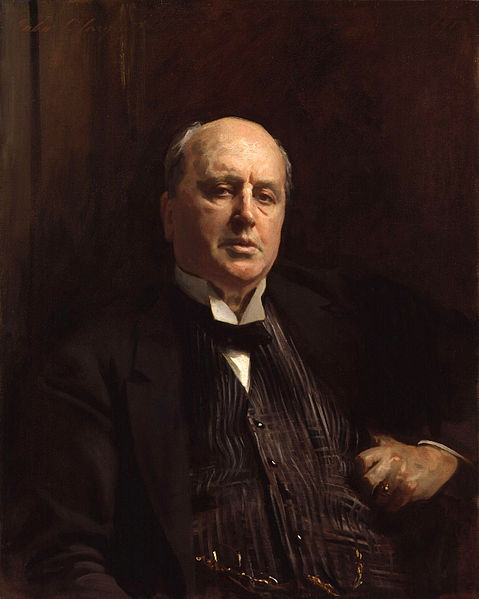
John Singer Sargent, Portrait of Henry James, 1913
Virginia Woolf was not the only writer to have problems with the fiction of H.G. Wells and Arnold Bennett. In an article, "The Younger Generation," in the Times Literary Supplement in 1914, James trained his exquisite sensibilities on both writers and found them somewhat wanting. Bennett and Wells, he wrote "squeeze out to the utmost the plump and more or less juicy orange of a particular acquainted state and let this affirmation of energy, however directed or undirected, constitute for them the 'treatment' of the theme." They mass details for us, as Bennett does in his novel Clayhanger, recording "in dense unconfused array, every fact required to make the life of the Five Towns press upon us and make our sense of it, so full fed, content us." But then it occurs to the reader (or at least to James) to ask: "Yes, yes; but is this all?" We see the details, but not why they're being presented to us: "where is the interest itself, where and what is its centre and how are we to measure it in relation to that?"

He takes Tolstoy "as the great illustrative master-hand on all this ground of disconnexion of method from matter." His "epic genius," however, makes him a bad model: "from no other projector of the human image and the human idea is so much truth to be extracted under an equal leakage of its value." James sees Bennett and Wells as deriving, "by multiplied if diluted transmissions, from the great Russian." Descriptive detail in Bennett's novels gives the reader such a sense of "the solidity of every appearance that it may be said to represent our whole relation to the work and completely to exhaust or reaction upon it."

In Wells's case, he "affects us as taking all knowledge for his province and as inspiring in us to the very highest degree the confidence enjoyed by himself.... The more he knows and knows, or at any rate learns and learns -- the more, in other words, he establishes his saturation -- the greater is our impression of his holding it good enough for us, such as we are, that he shall but turn out his mind and its contents upon us by any free familiar gesture and as from a high window forever open." His books are a kind of brain dump. But James finds him a careless artist, who gives us only the outlines of the experience of his characters.

In Wells's 1934 Experiment in Autobiography, he recalled his acquaintance with James, who "liked me and ... found my work respectable enough to be greatly distressed about it." Where they most disagreed, he says, was that James "had no idea of the possible use of the novel as a help to conduct." James, Wells says, believed in "The Novel ... as an Art Form and ... novelists as artists of a very special and exalted type.... I was disposed to regard a novel as about as much an art form as a market place our a boulevard. It had not even necessarily to get anywhere. You went by it on your various occasions."

James had focused on Wells's novel Marriage in his TLS article, and criticized it because the characters seemed to talk to the reader more than they did to each other. Wells responds,
If the Novel was properly a presentation of real people as real people, in absolutely natural reaction in a story, then my characters were not simply sketchy, they were eked out by wires and pads of non-living matter and they stood condemned.... And the only point upon which I might have argued ... was this, that the Novel was not necessarily, as he assumed, this real through and through and absolutely true treatment of people more living than life. It might be more and less than that and still be a novel.... The important point ... was that the novel of completely consistent characterization arranged beautifully in a story and painted deep and round and solid, no more exhausts the possibilities of the novel, than the art of Velazquez exhausts the possibilities of the painted picture. 
Wells concludes by questioning whether "The Novel, a great and stately addendum to reality," has ever "been realized -- or can it ever been realized?"

But this autobiographical retort, some twenty years later, was not Wells's first response to James's critique. In 1915, he published a satire called Boon, in which the characters discuss James's fiction.
"He wants a novel to be simply and completely done. He wants it to have a unity, he demands homogeneity.... Why should a book have that? For a picture it's reasonable, because you have to see it all at once. But there's no need to see a book all at once. It's like wanting to have a whole country done in one style and period of architecture." 
One character suggests that James should "have gone into philosophy and been greater even than his wonderful brother," and argues that "if the novel is to follow life it must be various and discursive. Life is diversity and entertainment, not completeness and satisfaction." James's characters have no "opinions," in them there are "no people with defined political opinions, no people with religious opinions, none with clear partisanships or with lusts or whims, none definitely up to any specifically impersonal thing.... James's denatured people are only the equivalent in fiction of those egg-faced, black-haired ladies, who sit and sit, in the Japanese colour-prints, the unresisting stuff for an arrangement of blacks."

And then comes the often-quoted simile, likening a James novel to "a church lit but without a congregation to distract you, with every light and line focused on the high altar. And on the altar, very reverently placed, intensely there, is a dead kitten, an egg-shell, a bit of string." And the effect of the novel is that of a hippopotamus trying to pick up a pea.

James was not happy with what he called "the bad manners of Boon," and wrote to Wells arguing that "the extension of life ... is the novel's best gift," and asserting, "It is art that makes life, makes interest, makes importance, ... and I know of no substitute for the force and beauty of its process." But it was posterity who gave James the last word, keeping his novels alive while James's, except for the science fiction, are forgotten. 

Tuesday, April 26, 2011

12. The Modern Tradition, edited by Richard Ellmann and Charles Feidelson Jr., pp. 246-267

Realism: Historical Determinism (Honoré de Balzac, Hippolyte Taine, Gustave Flaubert, Leo Tolstoy)
_____


Honoré de Balzac: Society as Historical Organism

In the 1842 Preface in which he discusses the character of The Human Comedy, essentially the corpus of his fiction, Balzac observes that the animal man exhibits more intraspecies variety than the other animals, largely owing to the influence of society:  
Honoré de Balzac in 1842
The differences between a soldier, an artisan, a man of business, a lawyer, an idler, a student, a statesman, a merchant, a sailor, a poet, a beggar, a priest, are as great, though not so easy to define, as those between the wolf, the lion, the ass, the crow, the shark, the seal, the sheep, etc.
Moreover, among the various human types, "the dress, the manners, the speech, the dwelling ... are absolutely unlike, and change with every phase of civilisation."

He credits Walter Scott with raising "to the dignity of the philosophy of History the literature which, from age to age, sets perennial gems in the poetic crown of every nation where letters are cultivated." But even Scott "never thought of connecting his  compositions in such a way as to form a complete history of which each chapter was a novel, and each novel the picture of a period."

This is precisely Balzac's goal: to write a history of manners, though he downplays his part a bit. "French society would be the real author; I should only be the secretary." But as secretary he reserves the right to edit a bit, in line with his Catholic and monarchical beliefs. "Man is neither good nor bad; he is born with instincts and capabilities; society, far from depraving him, as Rousseau asserts, improves him, makes him better; but self-interest also develops his evil tendencies." So he comes down on the side of society, as long as it is the right kind of society: "Christianity created modern nationalities, and it will preserve them. Hence, no doubt, the necessity for the monarchical principle. Catholicism and Royalty are twin principles.... I write under the light of two eternal truths -- Religion and Monarchy."

Which of course does not mean that he lets his beliefs get in the way of telling the truth about fallible human beings, and consequently he gets in trouble for what he writes: "If you are truthful in your pictures; if by dint of daily and nightly toil you succeed in writing the most difficult language in the world, the word immoral is flung in your teeth. Socrates was immoral; Jesus Christ was immoral; they both were persecuted in the name of the society they overset or reformed." As a consequence of Balzac's honest portrayal of society as it is, "the critics at once raised the cry of immorality, without pointing out the morality of another portion intended to be a perfect contrast." And here Balzac claims his Catholicism as a strength, especially when it comes to portraying women: "In Protestantism there is no possible future for the woman who has sinned; while in the Catholic Church, the hope of forgiveness makes her sublime."


Hippolyte Taine: Art as Historical Product

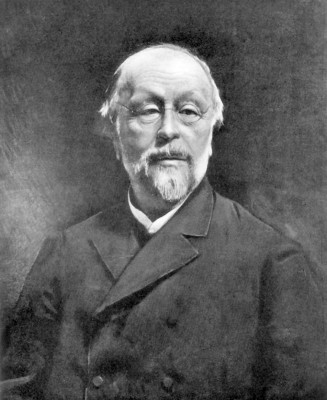
Hippolyte Taine, from a portrait by Léon Bonnat, date unknown
The introduction to Taine's 1864 History of English Literature outlines his theory that each work of art is the product of a particular race, environment and epoch, and is there for "a transcript of contemporary manners and customs and the sign of a particular state of intellect."
True history begins when the historian has discerned beyond the mists of ages the living, active man, endowed with passions, furnished with habits, special in voice, feature, gesture, and costume, distinctive and complete, like anybody that you have just encountered in the street.
It is a mistake to treat human beings out of the context of history: "the moral organization of a people or an age is as special and distinct as the physical structure of a family of plants or an order of animals."

Taine is big, therefore, on the idea of "national character." Germany he characterizes by "its genius, so pliant, so broad, so prompt in transformations, so fitted for the reproduction of the remotest and strangest states of human thought." England is "matter-of-fact" and "suited to grappling with moral problems, to making them clear by figures, weights, and measures, by geography and statistics, by texts and common sense." France gets credited with "unceasing analysis of characters and of works" and "ever ready irony at detecting weaknesses," products of "its Parisian culture and drawing-room habits," as well as with "skilled finesse in discriminating shades of thought."

But none of these glittering generalities quite prepares us for Taine's concept of race, and especially for its assertion that
the Aryan people, scattered from the Ganges to the Hebrides, established under all climates, ranged along every degree of civilization, transformed by thirty centuries of revolutions, shows nevertheless in its languages, in its religions, in its literatures, and in its philosophies, the community of blood and intellect which still to-day binds together all its offshoots.
This is nineteenth-century racism in flower, though he modifies it by admitting environment to the mix, so that he can observe of "the history of Aryan nations" that there is a "profound difference ... between the Germanic races on the one hand, and the Hellenic and Latin races on the other." You get the sense of the theory growing more wobbly as he admits to subdivisions within "race," but the stereotyping persists. And then he adds the historical moment, the epoch, or the milieu to the mix, inviting us to compare the differences between "French tragedy under Corneille and under Voltaire, and Greek drama under Aeschylus and under Euripedes, Latin poetry under Lucretius and under Claudian, and Italian painting under Da Vinci and under Guido."

Few of us, except experts in the field, would be able to do that on our own, of course, but Taine is being theoretical here -- we can assume that there are significant differences between each of the "two moments," but his point is also that "the first work has determined the second. In this respect, it is with a people as with a plant; the same sap at the same temperature and in the same soil produces, at different stages of its successive elaborations, different developments, buds, flowers, fruits, and seeds, in such a way that the condition of the following is always that of the preceding and is born of its death."

And sometimes these "fundamental forces ... combine to neutralize each other," producing fallow periods for a nation's art. In Taine's view this happened in the seventeenth century when "the blunt, isolated genius of England awkwardly tried to don the new polish of urbanity." The result, he says, is "the literary incompleteness, the licentious plays, the abortive drama of Dryden and Wycherly." Others would value Dryden's All for Love and Wycherley's The Country Wife as anything but "abortive," and Taine's overlooking the poetry of their contemporary, John Milton, suggests that his tastes lay elsewhere. But he credits a more fortuitous combination of race, environment, and epoch with "painting in Flanders and Holland in the seventeenth century, ... poetry in England in the sixteenth century, [and] music in Germany in the eighteenth century."

Taine credits others with exploring these historical influences on art before him, including Montesquieu and Stendhal, who "was the first to point out fundamental causes such as nationalities, climates and temperaments," but their times were not ripe for a recognition of such theories. Taine is sure they are now, however, and that "among the documents which bring before our eyes the sentiments of preceding generations, a literature and especially a great literature, is incomparably the best.... It is mainly in studying literature that we are able to produce moral history, and arrive at some knowledge of the psychological laws on which events depend."


Gustave Flaubert: Shortcomings of Taine's Theory

A few words are sometimes the best, and in a letter to his frequent correspondent Edma Roger des Genettes, Flaubert expends very few asserting, "There is something more in Art than the surroundings in which it is produced and the psychological antecedents of the artist." Taine underestimates talent, and can't explain by his theory "the individuality, the specific quality which makes one what one is.... In the old days it was believed that literature was an entirely individual matter, and that books dropped like thunderbolts from the skies. Now we have come to deny all will and all absolutes. The truth, I think, lies in the middle." But that Flaubert was provoked to comment suggests how influential Taine was.


Leo Tolstoy: Man as the Creature of History

Leo Tolstoy in the 1850s
Tolstoy's theory of history is that long and often-skipped section at the end of War and Peace (1865-69), analyzing the history of Napoleon's campaign in Russia. In the once-popular debate over whether men create history or history creates men, he comes down on the side of the latter, invoking a kind of mystical view of history as a force in itself: "The more we try to explain such events in history reasonably, the more unreasonable and incomprehensible do they become to us."  The individual human being, he asserts, "is an unconscious instrument in the attainment of the historic, universal, aims of humanity." Even those who appear to take a major role in historical events are subject to its forces: "History, that is, the unconscious, general, hive life of mankind, uses every moment of the life of kings as a tool for its own purposes." Napoleon was persuaded that he was in control of history but "he had never been so much in the grip of inevitable laws, which compelled him, while thinking that he was acting on his own volition, to perform for the hive life -- that is to say, for history -- whatever had to be performed."

So searching for causality in history is futile: "Nothing is the cause." Instead there is only "the coincidence of conditions."
In historic events, the so-called great men are labels giving names to events, and like labels they have but the smallest connection with the event itself. Every act of their, which appears to them an act of their own will, is in an historical sense involuntary and is related to the whole course of history and predestined from eternity.

11. The Modern Tradition, edited by Richard Ellmann and Charles Feidelson Jr., pp. 229-245

Realism: Introduction. Objectivity. (George Eliot, George Bernard Shaw, Gustave Flaubert, Anton Chekhov)
_____
The shift from Symbolism to Realism is not such an about-face as it might seem, especially when you have a figure like Flaubert who participates in both camps. The chief distinction seems to be in the approach to an audience:
Opposing symbolist predilections for an esoteric subject-matter, for perfection of form, and for an elite audience, the realist offers his work as a means of communication among men, dealing with large subjects in a comprehensible way, form subordinated to content. 
But even here, we'll see, there are different kinds of audiences. The mob still remains somewhat out of the artist's consideration, and realists seem as compelled as symbolists to explain what they're about.


George Eliot: A Realism of Love

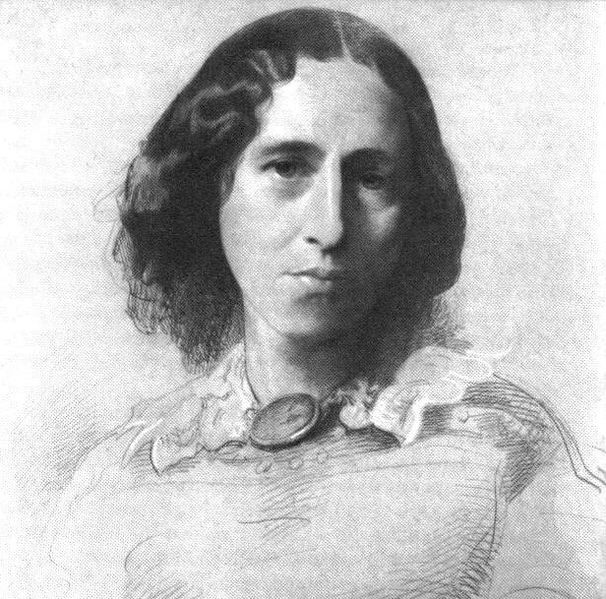
Samuel Laurence, Portrait of George Eliot, c. 1860
Never shy about breaking into her novels to explain things, Eliot interrupts the story (or as her chapter title suggests, pauses it a little) to anticipate objections. Specifically the objection that the minister in Adam Bede is too worldly. She pleads that she can only represent things "as they have mirrored themselves in my mind," and suggests that her own mirror "is doubtless defective." She then asks the read if he or she hasn't know people who aren't wholly good or wholly evil.
These fellow-mortals, every one, must be accepted as they are: you can neither straighten their noses, nor brighten their wit, nor rectify their dispositions; and it is these people -- amongst whom your life is passed -- that it is needful you should tolerate, pity, and love: it is these more or less ugly, stupid, inconsistent people, whose movements of goodness you should be able to admire -- for whom you should cherish all possible hopes, all possible patience.
But what does this have to do with art? they might ask. And Eliot's response would be that art shouldn't lie to you. Moreover, sentimentalizing and simplifying human character is a cop-out: "Falsehood is so easy, truth so difficult." It's easier, she points out, to draw a fantastic creature like a griffin than to make a convincing picture of a real lion.

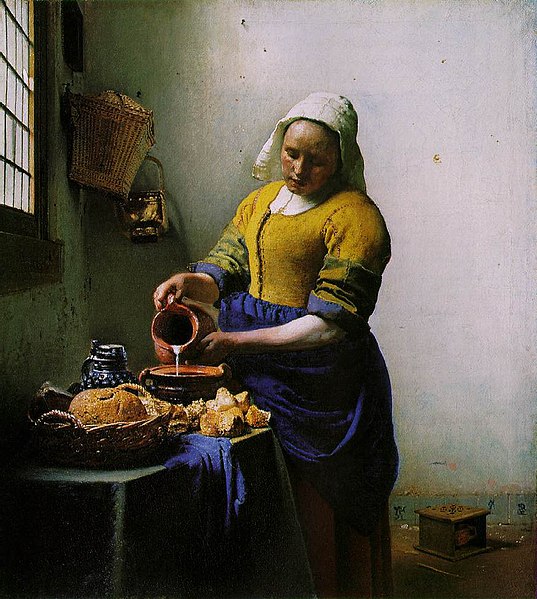
Johannes Vermeer, The Milkmaid, c. 1660
Adriaen van Ostade, Peasants in an Interior, 1661
Her analogy for what she's trying to do in Adam Bede is the painting of the Dutch realists. "I find a source of delicious sympathy in these faithful pictures of a monotonous homely existence, which has been the fate of so many more among my fellow-mortals than a life of pomp or of absolute indigence, of tragic suffering or world-stirring action."  The key word here is "sympathy," which carries with it its own kind of beauty: "human feeling is like the mighty rivers that bless the earth: it does not wait for beauty -- it flows with restless force and brings beauty with it." She appeals to artists "to give the loving pains of a life to the faithful representing of commonplace things."


George Bernard Shaw: False Ideals Exposed

In 1890, Shaw, at the peak of his enthusiasm for Ibsen, writes savagely about the fake idealism that masks hypocrisy. And his remarks have remained pertinent to this day, when "family-values" politicians are constantly being revealed as adulterers, and those who purport to be "saving marriage" turn out to be closeted homosexuals. And fiction has too often played along with them: "In our novels and romances especially we see the most beautiful of all the masks: those devised to disguise the brutalities of the sexual instinct in the earlier stages of its development, and to soften the rigorous aspect of the iron laws by which Society regulates its gratification." In the idealizing of marriage, "men try to graft pleasure on necessity by desperately pretending that the institution forced upon them is a congenial one."

He imagines "a community of a thousand persons," 700 of whom are comfortable with the institution of marriage, and 299 of whom "find it a failure, but must put up with it since they are in a minority." Because they don't want to admit their failure, this minority becomes the loudest in proclaiming that "the family is a beautiful and holy natural institution. For the fox not only declares that the grapes he cannot get are sour: he also insists that the sloes he can get are sweet.... Our 299 domestic failures are therefore become idealists as to marriage; and in proclaiming the ideal in fiction, poetry, pulpit and platform oratory, and serious private conversations, they will far outdo the 700 who comfortably accept marriage as a matter of course, never dreaming of calling it an 'institution,' much less a holy and beautiful one." So in this community there are 299 idealists and 700 Philistines.

But there's one person left over. He sees that marriage is not in itself either holy or beautiful, and that it often fails, so he thinks it "insufferable that two human beings, having entered into relations which only warm affection can render tolerable, should be forced to maintain them after such affections have ceased to exist, or in spite of the fact that they have never arisen. The alleged natural attractions and repulsions upon which the family ideal is based do not exists; and it is historically false that the family was founded for the purpose of satisfying them." But he'll get no support from the 700 Philistines, who are so complacently settled in their situations that they'll "simply think him mad." And the 299 idealists are so terrified at being revealed as failures and hypocrites, that they'll denounce him. "They will crucify him, burn him, violate their own ideals of family affection by taking his children away from him, ostracize him, brand him as immoral, profligate, filthy, and appeal against him to the despised Philistines, specially idealized for the occasion as Society."

Shaw calls on Shelley as an example: "The idealists ... called him a fiend until they invented a new illusion to enable them to enjoy the beauty of his lyrics, this illusion being nothing less than the pretence that since he was at bottom an idealist himself, his ideals must be identical with those of Tennyson and Longfellow, neither of whom ever wrote a line in which some highly respectable ideal was not implicit." So Shaw tackles the problem of the word "idealist," because it's necessary "to distinguish pioneers like Shelley and Ibsen as realists from the idealists of my imaginary community of one thousand."

In Shaw's definition of "realist," he means someone who sees that fake ideals have been concocted as "something to blind us, something to numb us, something to murder self in us, something whereby, instead of resisting death, we can disarm it by committing suicide. The idealist, who has taken refuge with the ideals because he hates himself and is ashamed of himself, thinks that all this is so much the better."
The realist declares that when a man abnegates the will to live and be free in a world of the living and free, seeking only to conform to ideals for the sake of being, not himself, but 'a good man,' then he is morally dead and rotten, and must be left unheeded to abide his resurrection, if that by good luck arrive before his bodily death.


Gustave Flaubert: Heroic Honesty

In 1856, as Madame Bovary was being serialized in La Revue de Paris, Flaubert responded to the critique of its co-editor, Laurence Pichat, that he was as disgusted by some of the details in it too: "I hold the everyday life in detestation.... But aesthetically I wanted this time, and only this time, to exhaust it thoroughly. So I took the thing in an heroic fashion, I mean a minute one, accepting everything, saying everything, depicting everything -- an ambitious statement!" And it took a lot out of him, he wrote to his friend, poet and playwright Louis Bouilhet. His meticulousness and perfectionism was "an insane way of working," and his mother asserted, "The mania for phrases has dried up your heart."


Anton Chekhov: Dunghills as Artistic Material

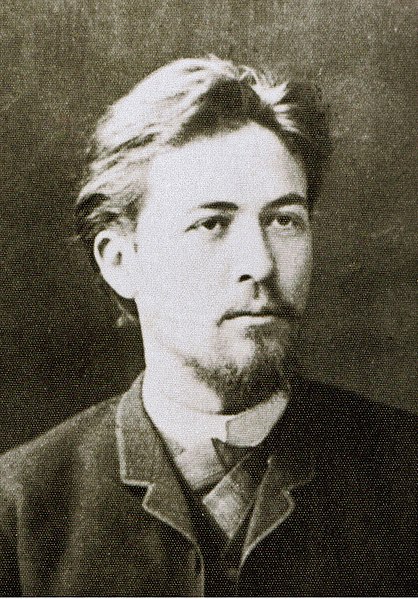
Anton Chekhov in 1889
Chekhov's friend Mariya Kiselev objected to some of the sordid material in his stories "On the Road" and "Mire," and in this 1887 letter he responds. "I do not know who is right: Homer, Shakespeare, Lope de Vega, the ancients generally who did not fear to grub in the 'dung-hill,' but who were more stable in their moral relations than we; or the modern writers, fastidious on paper, but coldly cynical in soul and in their manner of life?" He proceeds to reject the idea that literature should only "gather the pure grain from the muck heap." The artist "is not a confectioner, not a dealer in cosmetics, not an entertainer; he is a man bound, under compulsion, by the realization of his duty, and by his conscience." We wouldn't want a journalist to whitewash the facts, and we shouldn't expect the writer to do so either. Like the reporter, the writer must strive for objectivity: "he must know that dung-heaps play a very respectable part in a landscape, and that evil passions are as inherent in life as good ones."

He chafes against censorship because "The fate of literature would be woeful ... if you left it to the will of individuals.... there is no police which we can consider competent in literary matters.... you cannot find a better police for literature than criticism and the author's own conscience."

And like George Eliot, he defends the choice of lower class figures as artistic material:
To be condescending toward humble people because of their humbleness does not do honor to the human heart. In literature, the lower ranks are as necessary as in the army, -- so says the mind, and the heart ought to confirm this most thoroughly.

Monday, April 25, 2011

10. The Modern Tradition, edited by Richard Ellmann and Charles Feidelson Jr., pp. 193-225

Symbolism: The Artist-Hero; The Artist and Society (Gustave Flaubert, E.M. Forster, Arthur Rimbaud, Stéphane Mallarmé, W.H. Auden, Wallace Stevens)
_____
 
Gustave Flaubert: An Aesthetic Mysticism

In letters from various years to Guy de Maupassant, writer and photographer Maxime du Camp, Louise Colet and George Sand, Flaubert returned to the subject of the artist's character and role. To Maupassant he proclaimed that the artist must "sacrifice everything to Art. Life for him must be no more than a means to an end, and the last person he must consider is himself." To du Camp he insisted that he had no interest in being famous, which "can only be entirely satisfying to those with a poor conceit of themselves.... I am aiming at something better, at pleasing myself." Of course, pleasing himself was sometimes difficult: "I would sooner die like a dog than hurry my sentence by so much as a second before it is ripe," even though if he were "much more facile" he "could draw larger profits for much less work. But I can see no remedy."

On the question of the artist's lifestyle, he told Colet, "one should live like a bourgeois and think like a demi-god. Physical and intellectual gratifications have nothing in common. If they happen to coincide, hold fast to them." But the art must take priority: "If you seek happiness and beauty simultaneously, you will attain neither one nor the other, for the price of beauty is self-denial."
Let us therefore seek only tranquillity; let us ask of life only an armchair, not a throne; only water to quench our thirst, not drunkenness. Passion is not compatible with the long patience that is a requisite of our calling. Art is vast enough to take complete possession of a man.
And so art takes on the nature of a religion, or rather "a kind of aesthetic mysticism." He takes aim at "the world's socialists, with their eternal materialistic prophesies." He makes prophesies of his own: "At present man's soul is asleep, drugged by the words she has heard; but she will have a frenzied awakening, and give herself over to the joys of liberty; for she will have no restraints left to hold her back, no government, no religion, no principles of any sort. Republicans of all complexions are to me the cruellest pedagogues in the world, with their dreams of organisation, legislation, and a monastically rigid society." As for the future of art, "Poetry ... will not die, but where poetry will come into things in future I can hardly see.... Perhaps beauty will become useless quality to humanity, and Art will be something halfway between algebra and music."

He feels acutely his alienation from the mass of humanity, which "hates us; we do not minister to it and we hate it because it wounds us. Therefore, we must love one another in Art, as the mystics love one another in God, and everything must grow pale before that love." As his alienation from his fellow men widens, he says, "my sensitivity towards all that I find sympathetic continually increases, as a result of this very withdrawal." To George Sand he insisted, "Art ought to be simple. Art, really, is whatever one can make it. We are not free to choose. Each man, willy-nilly, follows his natural course."


E.M. Forster: Art as Evidence of Order

E.M. Forster, date unknown
In a 1949 essay, Forster renews the by-then-faded credo, "Art for art's sake," but not as an affectation or a pose. We may read a work such as Macbeth for what it tells us about the author, about the times in which Shakespeare lived, about its view of human nature, and analyze the techniques employed in its creation. "But Macbeth is furthermore a world of its own, created by Shakespeare and existing in virtue of its own poetry. It is in this aspect Macbeth for Macbeth's sake, and that is what I intend by the phrase 'art for art's sake.' A work of art -- whatever else it may be -- is a self-contained entity, with a life of its own imposed on it by its creator. It has internal order. It may have external form. That is how we recognise it."

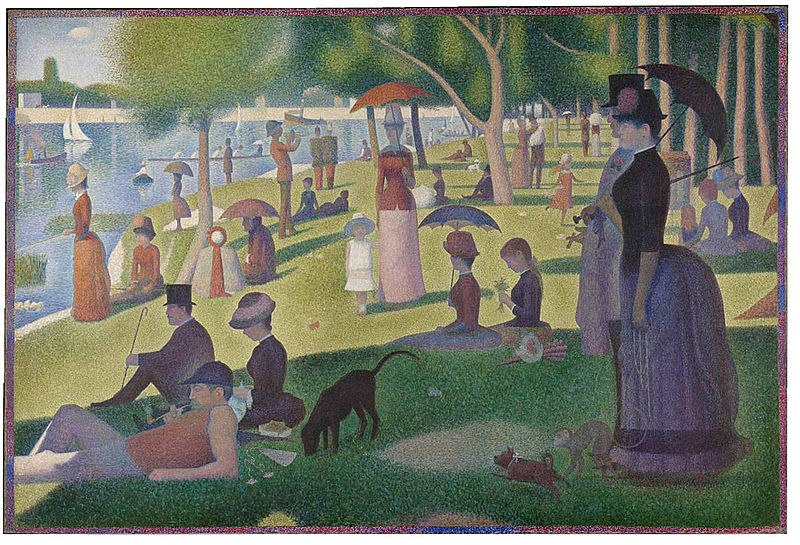
For another example of this premise, he considers Seurat's "La Grande Jatte."
Georges Seurat, Un dimanche après-midi à l'Île de la Grande Jatte, 1884-86
Seurat's painting, he observes, "forms a world of its own, ... it has internal order and internal life."
Order, I suggest, is something evolved from within, not something imposed from without; it is an internal stability, a vital harmony, and in the social and political category, it has never existed except for the convenience of historians.
We can't achieve a permanent social and political order, he posits, because "we continue to make scientific discoveries and to apply them, and thus to destroy the arrangements which were based on more elementary discoveries." If science were pursued for its own sake, and if its discoveries were never turned into applications, "if, in other words, men were more interested in knowledge than in power -- mankind would be in a far safer position, the stability statesmen talk about would be a possibility, there could be a new order based on vital harmony, and the earthly millennium might approach." But it's not going to happen.

So our experience of order seems to Forster to be limited two only possible sources. One of them is "the divine order, the mystic harmony, which according to all religions is available for those who can contemplate it." But Forster admits that he's not one of that elect. The remaining one is "the aesthetic category ... the order which an artist can create in his own work." It stands outside the social order: "Ancient Athens made a mess -- but the Antigone stands up. Renaissance Rome made a mess -- but the ceiling of the Sistine got painted. James I made a mess -- but there was Macbeth. Louis XIV -- but there was Phèdre." Art, in short, "is the one orderly product which our muddling race has produced."

Because of this, the artist has always been an outsider, "and ... the nineteenth century conception of him as a Bohemian was not inaccurate."
If our present society should disintegrate -- and who dare prophesy that it won't? -- this old-fashioned and démodé figure will become clearer: the Bohemian, the outsider, the parasite, the rat -- one of those figures which have at present no function either in a warring or a peaceful world.... Works of art, in my opinion, are the only objects in the material universe to possess internal order, and that is why, though I don't believe that only art matters, I do believe in Art for Art's Sake. 


Arthur Rimbaud: The Poet as Revolutionary Seer

Arthur Rimbaud in 1871
If the poet is a creator of order, as Forster suggests, then Rimbaud, in these letters written in 1871 to his teacher Georges Izambard and the poet Paul Demeny, believes that the poet must first confront disorder. And certainly Rimbaud has become the figure par excellence of the rebellious poet. "The point is," he told Izambard, "to arrive at the unknown by the disordering of all the senses."

In both letters, Rimbaud makes the famous statement "I is someone else," which is no more or less grammatical in the French "Je est un autre." The poet is not born but made, just as the musical instrument is formed out of raw materials: To Izambard he says, "So much the worse for the wood if it find itself a violin," and to Demeny, "If brass wakes up a trumpet, it is not its fault." Making the poet responsible for his poem is an error: "The Romantics ... proved so clearly that the song is very seldom the work, that is to say, the idea sung and intended by the singer."
The poet makes himself a seer by a long, prodigious, and rational disordering of all the senses. Every form of love, of suffering, of madness; he searches himself, he consumes all the poisons in him, and keeps only the quintessences.
Like Shelley, he sees the poet as Prometheus: "the poet really is the thief of fire." And in his role as seer and rebel, he brings in "the new -- in ideas and in forms."


Stéphane Mallarmé: Art as Aristocratic Mystery

As the essay "Art for All" (1862) demonstrates, the young Mallarmé (he was barely 20) is not at all concerned about art becoming elitist. "Art has its own mysteries," he proclaims, and exemplifies this by music, whose system of notation -- "those macabre processions of rigid, chaste, and undeciphered signs" -- is a barrier to the uninitiated. But poetry "faces hypocritical curiosity without mystery, blasphemy without terror, and suffers the smiles and grimaces of the ignorant and hostile," being made up of words that even the barely literate can approach without difficulty. "Poetry, like all things of perfect beauty, is perforce admired. But the admiration is distant, vague -- a stupid admiration since it is the mob's." It gets taught in the schools, "explained to all alike, democratically."

The visual arts also share this accessibility by the mob, to the "citizen [who] strides through our museums with a careless freedom and an absent-minded frigidity which he would not dare exhibit even in a church." But "music, painting, and sculpture are .. left to 'those who are in the business,' whereas people learn poetry because they want to appear educated." He backs off from sneering at the "mob" a bit, quoting with approval Baudelaire's statement, "To insult the mob is to degrade oneself." The poet is simply of a different order from the masses: "Let us remember that the poet (whether he rhymes, sings, paints, or sculptures) is not on a level beneath which other men crawl; the mob is a level and the poet flies above it. Seriously, has the Bible ever told us that angels mock man because he has no wings?"

Art, he argues, should remain "a mystery accessible only to the very few." Popularity should not be a test for the artist. It should even be regarded as a stigma.
You may say: "What of Corneille, Molière, and Racine? They are popular and glorious." No, they are not popular. Their names are popular, perhaps; but their poetry is not. The mob has read them once, that is true; and without understanding them. But who rereads them? Only artists. 
And so, in the face of universal education, he argues against letting the arts become too popular: "If there is a popularization, let us make sure that it is a popularization of the good, not of the beautiful.... Let the masses read works on moral conduct; but please don't let them ruin our poetry."


W.H. Auden: Poetry as a Game of Knowledge

W.H. Auden, date unknown
"Squares and Oblongs" (1948) is a collection of aphoristic observances, very much in the mode of Wilde, and it's difficult to resist quoting them all. But the opening one -- "A poet is, before anything else, a person who is passionately in love with language" -- seems to be the keynote. Language, after all, is what Auden does best, because he likes "hanging around words listening to what they say," which he observes is a sign of one who promises to be a poet.

Sometimes he unpacks his aphorisms for us: "The poet is the father who begets the poem which the language bears." He explains that poet and language are husband and wife, and it is the poet, "not the language, who is responsible for the success of their marriage, which differs from natural marriage in that in this relationship there is no loveless lovemaking, no accidental pregnancies."

Among the theories of poetry that he dislikes is "Poetry as a magical means for inducing desirable emotions and repelling undesirable emotions in oneself and others." The Greeks, he says, held this view, because they "confused art with religion." But despite this, they produced great art because "they were frivolous people who took nothing seriously. Their religion was just a camp." More worrisome are those in our own day who take things too seriously and try to make art serve their ends, creating "dishonest and insufferably earnest and boring Agit-Prop for Christianity, Communism, Free Enterprise or what have you."

Auden prefers the theory of "Poetry as a game of knowledge, a bringing to consciousness, by naming them, of emotions and their hidden relationships." In the spirit of "How can I know what I think till I see what I say?" the poet tries out words in various combinations and permutations until he or she finds what works. And because poetry stumbles when it becomes involved in too serious matters of daily life, it needs to distance itself from events too large for words:
There are events which arouse such simple and obvious emotions that an AP cable or a photograph in Life magazine are enough and poetic comment is impossible. If one reads through the mass of versified trash inspired, for instance, by the Lidice Massacre, one cannot avoid the conclusion that what was really bothering the versifiers was a feeling of guilt at not feeling horrorstruck enough. Could a good poem have been written on such a subject? Possibly. One that revealed this lack of feeling, that told how when he read the news, the poet, like you and I, dear reader, went on thinking about his fame or his lunch, and how glad he was that he was not one of the victims. 
In fact, Auden wrote such a poem, and is perhaps too modest to mention it here, so I will:
Musée des Beaux Arts

About suffering they were never wrong, 
The Old Masters: how well they understood 
Its human position; how it takes place 
While someone else is eating or opening a window or just walking dully along; 
How, when the aged are reverently, passionately waiting 
For the miraculous birth, there always must be 
Children who did not specially want it to happen, skating 
On a pond at the edge of the wood: 
They never forgot 
That even the dreadful martyrdom must run its course 
Anyhow in a corner, some untidy spot 
Where the dogs go on with their doggy life and the torturer's horse 
Scratches its innocent behind on a tree. 

In Brueghel's Icarus, for instance: how everything turns away 
Quite leisurely from the disaster; the ploughman may 
Have heard the splash, the forsaken cry, 
But for him it was not an important failure; the sun shone 
As it had to on the white legs disappearing into the green 
Water; and the expensive delicate ship that must have seen 
Something amazing, a boy falling out of the sky, 
Had somewhere to get to and sailed calmly on. 

(A commentary on this poem, and some other poets' responses to it, can be found here.) The detachment of the poet from the ostensible subject of his poem is essential: "The girl whose boy-friend starts writing her love poems should be on her guard. Perhaps he really does love her, but one thing is certain: while he was writing his poems he was not thinking of her but of his own feelings about her, and that is suspicious."

He takes Shelley to task for "the silliest remark ever made about poets, 'the unacknowledged legislators of the world.' ... Sounds more like the secret police to me." But his admitted dislike of Shelley's poetry may have betrayed him into misreading the statement. And like Mallarmé, he mistrusts what he doesn't call "the mob," but clearly means pretty much what Mallarmé meant by the phrase, lamenting that, on the evidence of a favorite-poem feature in the Sunday Times, "millions in their bereavements, heartbreaks, agonies, depressions, have been comforted and perhaps saved from despair by appalling trash while poetry stood helplessly and incompetently by." 

Most of all, he rejects extravagant claims for poetry: 
A society which really was like a poem and embodied all the esthetic values of beauty, order, economy, subordination of detail to the whole effect, would be a nightmare of horror, based on selective breeding, extermination of the physically or mentally unfit, absolute obedience to its Director, and a large slave class kept out of sight in cellars.
E.M. Forster couldn't have said it better (and didn't). 
And like Rimbaud, he recognizes the need for the poet to experience the disorderly life, with a wonderfully perceptive comment about the two most famous tellings of the Faust legend: "Marlowe was not as intelligent as Goethe but he had more common sense. At least he knew that Faust went to hell. Faust is damned, not because he has sinned, but because he made a pact with the Devil, that is, like a poet he planned a life of sin beforehand.


W.H. Auden: Poetry as Rite 

"Making, Knowing, and Judging" (1956) gives us a more sober, less aphoristic Auden. It acknowledges that poetry demands a special orderliness to serve its function: 
A poem is a rite; hence its formal and ritualistic character. Its use of language is deliberately and ostentatiously different from talk. Even when it employs the diction and rhythms of conversation, it employs them as a deliberate informality, presupposing the norm with which they are intended to contrast.
Again, the focus is on language, but on using language to pay homage to the poet's experience of the world. "In poetry the rite is verbal; it pays homage by naming." 

Artistic style, he observes, reflects the changes in society's imagining of "the frontier between the sacred and the profane.... the Baroque architect did not aim, as a modern architect aims when designing a government office in which the king could govern as easily and efficiently as possible; he was trying to make a home fit for God's earthly representative to inhabit.... Even today few people find a functionally furnished living-room beautiful because, to most of us, a sitting-room is not merely a place to sit in; it is also a shrine for father's chair."
So "every poem is rooted in imaginative awe.... but there is only one thing that all poetry must do; it must praise all it can for being as for happening." 


Wallace Stevens: Art as Establisher of Value 

Wallace Stevens, date unknown
No poet that I know of has more explicitly taken the imagination itself as the subject of his or her poetry. Coleridge, Shelley and Keats theorized about the imagination, but in their poems they addressed its function through metaphor: the construction of a stately pleasure-dome, the blowing of the west wind, the contemplation of a Grecian urn. Stevens has his metaphors too: a blue guitar, blackbirds, a jar on a hill in Tennessee, and so on. But he is consistently open about the fact that his great subject is the function of the imagination. So his prose disquisitions on the topic might be supererogatory, but we welcome them anyway because the prose is so, well, Stevensesque.

The poet's role, Stevens says, is "to supply the satisfactions of belief" in an age without belief. We have suffered a sense of loss with the fading of religious belief, even though "To see the gods dispelled in mid-air and dissolve like clouds is one of the great human experiences." The desire for the colossal presences of the gods remains, in part because "Their fundamental glory is the fundamental glory of men and women, who being in need of it create it, elevate it, without too much searching of its identity." Man created God in his own image: "The people, not the priests, made the gods." 
Let us stop now and restate the ideas which we are considering in relation to one another. The first is that the style of a poem and the poem itself are one; the second is that the style of the gods and the gods themselves are one; the third is that in an age of disbelief, when the gods have come to an end, when we think of them as the aesthetic projections of a time that has passed, men turn to a fundamental glory of their own and from that create a style of bearing themselves in reality. They create a new style of a new bearing in a new reality.
Poetry's role in this comes from its nature as "an interdependence of the imagination and reality as equals." But the poet must not consider that he or she holds any obligation to society or to morality: "the all-commanding subject-matter of poetry is life, the never-ceasing source." And that emancipates the poet from any social or political role: "No politician can command the imagination, directing it to do this or that. Stalin might grind his teeth the whole of a Russian winter and yet all the poets in the Soviets might remain silent the following spring. He might excite their imaginations by something he said or did. He would not command them."

The poet's role with regard to his or her audience "is to make his imagination theirs and ... he fulfills himself only as he sees his imagination become the light in the mind of others." But Stevens concurs with Mallarmé in observing that "There is not a poet whom we prize living today that does not address himself to an élite." And he seconds I.A. Richards in proclaiming the poet's "role is to help people to live their lives. He has had immensely to do with giving life whatever savor it possesses. He has had to do with whatever the imagination and the senses have made of the world." And like Klee, he argues that the artist "has to discover the possible work of art in the real world, then to extract it, when he does not himself compose it entirely; ... art sets out to express the human soul; and ... everything like a firm grasp of reality is eliminated from the aesthetic field." 

And like everyone who has read Wilde, he realizes that nature imitates art: "what makes the poet the potent figure that he is, or was, or ought to be, is that he creates the world to which we turn incessantly and without knowing it and that he gives to life the supreme fictions without which we are unable to conceive of it." But they are and remain fictions: "A poet's words are of things that do not exist without the words.... It is not only that the imagination adheres to reality, but, also, that reality adheres to the imagination and that the interdependence is essential." So in this regard, poetry is "at least the equal of philosophy." 

Essentially, "the imagination is the power that enables us to perceive the normal in the abnormal, the opposite of chaos in chaos."
The exploits of Rimbaud in poetry, if Rimbaud can any longer be called modern, and of Kafka in prose are deliberate exploits of the abnormal. It is natural for us to identify the imagination with those that extend its abnormality. It is like identifying liberty with those that abuse it.... The truth seems to be that we live in concepts of the imagination before the reason has established them. If this is true, then reason is simply the methodizer of the imagination.
To some this sounds frivolous, an avoidance of the harshness of reality, of "the solitude and misery and terror of the world.... But when we speak of perceiving the normal we have in mind the instinctive integrations which are the reason for living. Of what value is anything to the solitary and those that live in misery and terror, except the imagination?"


Saturday, April 23, 2011

9. The Modern Tradition, edited by Richard Ellmann and Charles Feidelson Jr., pp. 170-192

Symbolism: The Artist-Hero; The Morality of the Artist (W.B. Yeats, Gustave Flaubert, Rainer Maria Rilke, Paul Valéry). The Art of Life (Walter Pater, Joris-Karl Huysmans, André Gide, W.B. Yeats, Rainer Maria Rilke)
_____

W.B. Yeats: The Courage of the Artist

In a 1907 speech, referring to the late poet and critic Lionel Johnson, Yeats asserts, "A poet is by the very nature of things a man who lives with entire sincerity, or rather, the better his poetry the more sincere his life." I'm a little unsure how one lives sincerely. One expresses sincerity, of course, and that may be what Yeats means. "Above all it is necessary that the lyric poet's life should be known, that we should understand that his poetry is no rootless flower but the speech of a man." Yeats, who was very much a public figure in his day, would of course advocate this kind of openness. "Why should we honor those that die upon the field of battle, a man may show as reckless a courage in entering into the abyss of himself."


Gustave Flaubert: Art as Ascetic Religion

Writing to Louise Colet in 1857, Flaubert claims to have written twenty-five pages of Madame Bovary in six weeks and to be sustained in this snail's pace of composition "only by a kind of permanent rage, which sometimes makes me weep tears of impotence but which never abates." He is definitely not sustained by the indifference and hostility of the society in which he lives:
If everything around us, instead of permanently conspiring to drown us in a slough of mud, contributed rather to keep our spirits healthy, who can tell whether we might not be able to do for aesthetics what stoicism did for morals? Greek art was not an art; it was the very constitution of an entire people, of an entire race, of the country itself.
Humankind, he claims, has no use for beauty at this time. "The more Art develops, the more scientific it will be, just as science will become artistic." The result is, even when he is pleased with his work, he feels "great despair and emptiness -- doubts that taunt me at my moments of naïvest satisfaction. And yet I would not exchange all this for anything, because my conscience tells me that I am fulfilling my duty, obeying a decree of fate -- that I am doing what is Good, that I am in the Right."


Rainer Maria Rilke: The Mission of the Artist

Writing to the novelist Ludwig Ganghofer in 1897, the 21-year-old Rilke chafes against the philistinism of his relatives, whose view is that "Art is something one just cultivates on the side in free hours." Instead, for Rilke,
Whoever does not consecrate himself wholly to art with all his wishes and values can never reach the highest goal. He is not an artist at all.... I feel myself to be an artist, weak and wavering in strength and boldness, yet aware of bright goals, and hence to me every creative activity is serious, glorious, and true. Not as martyrdom do I regard art -- but as a battle the chosen one has to wage with himself and his environment in order to go forward.... But that needs a whole man! Not a few weary leisure hours.
Many 21-year-olds have made such proclamations. Few of them became Rilke.


Paul Valéry: The Artist as Universal Man

For this long philosophical disquisition, centered on Leonardo da Vinci, from 1895, I need to turn again to the introduction by Ellmann and Feidelson for guidance.
Artistic heroism is epitomized by Paul Valéry in his figure of Leonardo da Vinci, a type of the artist as universal man. Exploring the night of consciousness, the artist discovers the reality to which we are accustomed is but one solution out of many possible ones. He is able to divest objects of their peculiarities and, at the same time, to sense what consciousness is apart from its objects, to reach "the deep note of existence itself." Such a man is interested in everything, yet always seems to be thinking of something else, for his mental life is double, a drama of mental images proceeding concurrently with an awareness of the movements of thought itself. He takes responsibility for his perceptions in a way that others do not, and he is concerned not with results but with the exercise of creative power. 
Once again, music is the touchstone for creativity: "the elusive art of music unites the liberties of sleep with the development and consistency of extreme attention" -- the mind is free in dreams, but only with wakeful attention can the things discovered in our dreams become whole and consistent. This "synthesis of intimate things" is impermanent, however. The products of the imagination are varied, and "The wonder is not that such things should be; it is that there should be such things and not such other things." We come "to suspect all accustomed reality of being only one solution amongst many others of universal problems."

So "the perfected consciousness ... has to begin by denying an infinite number of faiths, an infinite number of elements.... It reminds one absurdly of an audience invisible in the darkness of a theater which cannot see itself, which can see only the spectacle before it, and which, yet, all the time, invincibly feels itself the center of a breathlessly interesting evening." Consciousness is "an inexhaustible activity," compounded of "our most intimate feelings" as well as "exterior objects and events." Consciousness chooses what is important to it: "All things are replaceable by all things -- may not this be the definition of things?"
Is there anything that resists the lure of the senses, the dissipation of ideas, the fading of memories, the slow variation in the organism, the incessant and multiform activities of the universe? There is only this consciousness, and this consciousness only at its most abstract. Our personality itself, which, stupidly, we take to be our most intimate and deepest possession, our sovereign good, is only a thing, and mutable and accidental.
The achievement of identity comes from isolating a "substantial permanence from the strife of everyday truths." The ego that results from this effort "is no more sensitive, no less real than the center of gravity of a planetary system or ring, but ... is a result of the whole, whatever that whole may be."

In Leonardo, Valéry finds "a man whose activities seem so distant from each other that if I can find a unifying idea of them it may well seem more comprehensive than all other ideas.... Everything interests him.... He leaves behind him churches and fortresses; he fashions ornaments -- full of sweetness and strength -- and a thousand machines; and he makes calculation along many unsurveyed lines."

Artists, he observes, participate in a "coquetry of silence ... as to the origins of their work." They claim an autonomy for their creations. And "certain works of science, and mathematics in particular, show such clarity in their construction that one would say they were not the work of any one person at all. There is something unhuman about them. And this quality has had the effect of making people suppose so great a difference between certain studies, as, for instance, between the sciences and the arts, that, owing to it, opinion has also assumed a separation between the results of their labors."

But artists and scientists alike reach their results through a power to decide among the possibilities. The process at work is so insusceptible to analysis that "one invokes gods, genius and inspiration." We profess to believe "that something has created itself -- for man adores mystery and the marvelous.... One treats what is logical as if it were a miracle. But the 'inspired' author has been ready to perform his task a year before it was done, had been ripe, had been thinking of it always, perhaps without being conscious of the fact.... The consciousness of the operations of thought, the unrecognized logic of which I have spoken, exists but rarely, even in the most powerful minds."

The task is to maintain the mental flexibility necessary for creation, for "a thought that has become fixed takes on the characteristics of hypnosis and becomes, in the language of logic, an idol; in the domain of poetic construction and art, a sterile monotony." Liberation from that which is fixed, and the ability of "the mind to foresee its own activities, to imagine the structure of what has to be imagined in detail as a whole, and the effect of the sequence thus calculated, this sense is the condition of all generalization. It is that which in certain individuals appears as a veritable passion, and with an energy that is remarkable."
The universal man begins ... by simple contemplation, but he always returns to be impregnated by what he sees, returns to the intoxication of the particular instinct and to the emotion which the least of things real arouses if one keeps in mind the two, thing and instinct, in every way separate from each other and yet combining, in so many ways, so many different qualities.


Walter Pater: The Intensity of the Moment

Walter Pater, date unknown
Pater's Studies in the History of the Renaissance (1873) and his novel Marius the Epicurean (1885) became central texts for many fin de siècle intellectuals, and his prose influenced writers as various as Proust and Joyce, Pound and Wallace Stevens. He also drew fire from conservatives, who accused him of misleading his young followers. The word "exquisite," which appears early in these selections, is characteristic.

He, too, is aware that consciousness is a fragmentary and impermanent thing, that "That clear, perpetual outline of face and limb is but an image of ours," that life is "flame-like" in "that it is but the concurrence, renewed from moment, of forces parting sooner or later on their ways." (Compare Apollinaire's flame image in his discourse on painting.) So the trick is not to be swept away in the "flood of external objects, pressing upon us with a sharp and importunate reality, calling us out of ourselves in a thousand forms of action."

The result is "that continual vanishing away, that strange, perpetual weaving and unweaving of ourselves," and the challenge is to "be present always at the focus where the greatest number of vital forces unite in their purest energy." (An objection has been lodged against this image: that the point at which forces unite is the point at which they cancel one another out.) Pater argues for intensity of experience: "Not the fruit of experience, but experience itself, is the end." And instead of being swept away with the flood, "To burn always with this hard, gemlike flame, to maintain this ecstasy, is success in life."
While all melts under our feet, we may well grasp at any exquisite passion, or any contribution to knowledge that seems by a lifted horizon to set the spirit free for a moment, or any stirring of the senses, strange dyes, strange colours, and curious odours, or work of the artist's hands, or the face of one's friend.
Notice here the absence of hierarchy of experience, that art is but one of the media through which experience may be channeled. It may be something as content-free as a strange smell, or as content-rich as a "contribution to knowledge." It's this lack of value judgment that most troubled Pater's critics. Similarly, Pater, who had given up on Christianity, argues for a kind of perpetual agnosticism: "What we have to do is to be for ever curiously testing new opinions and courting new impressions, never acquiescing in a facile orthodoxy of Comte, or of Hegel, or of our own." 

Finally, however, he comes around to valorizing art:
Great passions may give us this quickened sense of life, ecstasy and sorrow of love, the various forms of enthusiastic activity, disinterested or otherwise, which come naturally to many of us. Only be sure it is passion -- that it does yield you this fruit of a quickened, multiplied consciousness. Of such wisdom, the poetic passion, the desire of beauty, the love of art for its own sake, has most. For art comes to you proposing frankly to give nothing but the highest quality to your moments as they pass, and simply for those moments' sake.
In Marius, set in the second century C.E., Pater does come around to the question of religion, but typically it is regarded as only one avenue of experience:
the products of the imagination must themselves be held to present the most perfect forms of life -- spirit and matter alike under their purest and most perfect conditions -- the most strictly appropriate objects of that impassioned contemplation, which, in the world of intellectual discipline, as in the highest forms of morality and religion, must be held to be the essential function of the "perfect." Such manner of life might come even to seem a kind of religion -- an inward, visionary, mystic piety, or religion.


Joris-Karl Huysmans: Artificial Sensation

Joris-Karl Huysmans, c. 1895
Huysmans's À rebours, the title of which is translated here Against Nature, but has also been translated Against the Grain, is an 1884 novel about the ultimate aesthete, des Esseintes. If Pater is interested in the experiential possibilities of "strange dyes, strange colours, and curious odours," he has nothing on des Esseintes.

In the excerpt, des Esseintes has devised elaborate ways of recreating the experience of sea travel without the tedious necessity of actually going to sea, because the pleasure of such an experience "exists only in recollection of the past and hardly ever in experience of the present," and he could enjoy this pleasure "in full and in comfort, without fatigue or worry.... Travel, indeed, struck him as a waste of time, since he believed that the imagination could provide a more-than-adequate substitute for the vulgar reality of actual experience."

Arthur Zaidenberg, illustration for À rebours, 1931
In fact, the character of des Esseintes is the logical extension of all of the arguments that art is superior to nature -- "artifice was considered by Des Esseintes to be the distinctive mark of human genius. Nature, he used to say, has had her day." Moreover, if all arts aspire to the condition of music, then des Esseintes has found a unique way of having the musical experience and ... drinking it too, with his "mouth organ," providing drops of liqueurs that evoke the sounds of various musical instruments.

These over-the-top excerpts from À rebours suggest that Huysmans was having sly fun, but the book was taken quite seriously. It is generally thought to be the "poisonous French novel" referred to in Wilde's The Picture of Dorian Gray.


André Gide: The Reflexive Image

These excerpts from Gide's journals for January 1892 find the 22-year-old writer setting out on his career in some confusion. He has met Oscar Wilde and felt overwhelmed by the force of his personality and intellect: "In his company I had lost the habit of thinking.... A few thoughts from time to time, but my clumsiness in handling them made me give them up." He is longing to find a direction for his life: "I am anxious to know what I shall be.... I am aware of a thousand possibilities in me, but I cannot resign myself to want to be only one of them."

André Gide in 1893
Moreover, he has achieved the self-consciousness of the artist before he has truly figured out what course his art will take: "A man's life is his image," he proclaims, and he hasn't decided what that image is. An encounter with Wilde, the master image-maker, must surely have provoked this dilemma. He is also in the early stages of discovering and exploring his sexual orientation, which may be what provokes his reflections on morality and sincerity:
Morality consists in substituting for the natural creature (the old Adam) a fiction that you prefer. But then you are no longer sincere. The old Adam is the sincere man.

This occurs to me: the old Adam is the poet. The new man, whom you prefer, is the artist. The artist must take the place of the poet. From the struggle between the two is born the work of art.


W.B. Yeats: The Completed Image

If, as Gide asserted, "A man's life is his image," Yeats, in a letter written not long before his death to Lady Elizabeth Pelham, a friend with whom he had considered traveling to India, seems content with his.
It seems to me that I have found what I wanted. When I try to put all into a phrase I say, "Man can embody truth but he cannot know it. "I must embody it in the completion of my life. The abstract is not life and everywhere draws out its contradictions.


Rainer Maria Rilke: The Aesthetic Transformation of the Earth

Writing in 1925 to Witold von Hulewicz, his Polish translator, about the Duino Elegies, Rilke balks at an explanation: "They reach out infinitely beyond me." The poet, he says, becomes part of a collective experience of the world. "We of the here and now are not for a moment hedged in the time-world, nor confined within it; we are incessantly flowing over and over to those who preceded us, to our origins and to those who seemingly come after us." In the Elegies, he says the world of immediate experience, "the beloved visible and tangible" is being converted "into the invisible vibrations and excitation of our own nature, which introduces new vibration-frequencies into the vibration-spheres of the universe... The earth has no way out other than to become invisible: in us who with a part of our natures partake of the invisible, have (at least) stock in it, and can increase our holdings in the invisible during our sojourn here."

The angel in the poems is not the angels of Christianity, but more like the angels in Islam: "that creature in whom the transformation of the visible into the invisible, which we are accomplishing, appears already consummated.... All the worlds of the universe are plunging into the invisible as into their next deepest reality."

Friday, April 22, 2011

7. The Modern Tradition, edited by Richard Ellmann and Charles Feidelson Jr., pp. 121-142

Symbolism: The Autonomy of Art; The Purification of Fiction (Virginia Woolf, Gustave Flaubert, André Gide. The Objective Artifact (Gustave Flaubert, Rainer Maria Rilke, James Joyce)
_____

Virginia Woolf: The Novel of Consciousness

In the essay "Modern Fiction" (1919), Woolf takes on the most celebrated novelists of the Edwardian era, H.G. Wells, Arnold Bennett, and John Galsworthy, and leaves them in tatters. None of them seems to have recovered from the attack: Wells is known today mostly for his science fiction and Galsworthy for the TV adaptation of The Forsyte Saga (and for a Nobel Prize in Literature, an award that eluded such figures as Proust, Joyce, Tolstoy and Henry James, not to mention Virginia Woolf). Bennett, after a long period of neglect, has received some serious consideration in recent years, including a biography by Margaret Drabble, but of the three he remains probably the least-known by the general reading public.
Virginia Woolf, date unknown

Woolf's criticism comes after one of those assertions modern artists were fond of making: "It is doubtful whether in the course of the centuries, though we have learnt much about making machines, we have learnt anything about making literature." And Wells, Galsworthy, and Bennett are her proof, because the three celebrated writers "are materialists. It is because they are concerned not with the spirit but with the body that they have disappointed us, and left us with the feeling that the sooner English fiction turns its back upon them ... the better for its soul."

She singles out Bennett for the kind of faint praise that damns: "he is by far the best workman" of the three. "He can make a book so well constructed and solid in its craftsmanship that it is difficult for the most exacting of critics to see through what chink or crevice decay can creep in. There is not so much a draught between the frames of the windows, or a chink in the boards. And yet -- if life should refuse to live there?"

It may be that today we value craftsmanship more than the innovative writers of Woolf's day did, but for her, to call a writer a "workman" and to praise his craftsmanship was to say that he wasn't an artist. Bennett, Galsworthy and Wells, she proclaims, "write of unimportant things" and "spend immense skill and immense industry making the trivial and the transitory appear the true and the enduring." We have seen writers and elsewhere in this book suggesting that an ability to find the "enduring" in the "transitory" is exactly what the artist should possess, but Woolf doesn't think that's enough -- at least for fiction. Bennett, she suggests, has caught "life just an inch or two on the wrong side." This choosing of right and wrong sides is rather impressionistic and vague, but she goes on to elaborate in a famous passage that bears repeating almost in full:
Examine for a moment an ordinary mind on an ordinary day. The mind receives a myriad impressions -- trivial, fantastic, evanescent, or engraved with the sharpness of steel. From all sides they come, an incessant shower of innumerable atoms; and as they fall, as they shape themselves into the life of Monday or Tuesday, the accent falls differently from of old; the moment of importance came not here but there; so that, if a writer were a free man and not a slave, if he could write what he chose, not what he must, if he could base his work upon his own feeling and not upon convention, there would be no plot, no comedy, no tragedy, no love interest or catastrophe in the accepted style, and perhaps not a single button sewn on as the Bond Street tailors would have it.
That's such a barrage of ideas and images that, even though we're only at the midpoint of this celebrated paragraph, it's probably a good idea to stop and parse a bit of what she's saying. The emphasis here is on the freedom of the artist from convention, from the traditional way of reporting what occurs to "an ordinary mind on an ordinary day." Convention demands that the writer impose a plot on it, choose whether to regard it as comic or tragic, to dress it up neatly "in the accepted style." She continues:
Life is not a series of gig lamps symmetrically arranged; life is a luminous halo, a semi-transparent envelope surrounding us from the beginning of consciousness to the end. Is it not the task of the novelist to convey this varying, this unknown and uncircumscribed spirit, whatever aberration or complexity it may display, with as little mixture of the alien and external as possible? We are not pleading merely for courage and sincerity; we are suggesting that the proper stuff of fiction is a little other than custom would have us belief it.
Gig lamps
"Gig lamps" are carriage lamps, and we can think of them as headlights. But because they were "symmetrically arranged" on either side of the carriage the phrase also became slang for eyeglasses. So Woolf is thinking of lights or spectacles peering through the dark, and singling out objects in the viewer's path. But this is to circumscribe existence, and Woolf prefers to see life, or existence, or experience as something that surrounds one and is spiritual -- intangible, ineffable -- rather than the materialistic singling out of objects in one's path.
Let us record the atoms as they fall upon the mind in the order in which they fall, let us trace the pattern, however disconnected and incoherent in appearance, which each sight or incident scores upon the consciousness. Let us not take it for granted that life exists more fully in what is commonly thought big than in what is commonly thought small. 
But wait: Didn't she just criticize Bennett for his emphasis on the "trivial and transitory"?  Yes, she did. But what she said was that he made "the trivial and the transitory appear the true and the enduring." (Italics added.) I think the point is that Bennett overemphasizes things, sentimentalizes them, claims for them a significance that they don't really possess. He doesn't "trace the pattern ... upon the consciousness." He gives individual sights and incidents connection and coherence. He imposes an order rather than discovers it.

And so to James Joyce, who had published The Portrait of the Artist as a Young Man and was beginning to serialize Ulysses, which Woolf thinks "promises to be a far more interesting work." He comes closer to what Woolf hopes fiction will accomplish:
In contrast with those whom we have called materialists, Mr. Joyce is spiritual; he is concerned at all costs to reveal the flickerings of that innermost flame which flashes its messages through the brain, and in order to preserve it he disregards with complete courage whatever seems to him adventitious, whether it be probability, or coherence, or any other of these signposts which for generations have served to support the imagination of a reader when called upon to imagine what he can neither touch nor see.
She has read the cemetery chapter from Ulysses, and comments, "If we want life itself, here surely we have it." But does Joyce measure up to Conrad or Hardy? No, "because of the comparative poverty of the writer's mind" which gives her the "sense of being in a bright yet narrow room, confined and shut in, rather than enlarged and set free." She's also a little shocked by Joyce: "Does the emphasis laid, perhaps didactically, upon indecency, contribute to the effect of something angular and isolated?"

The comparative merits and faults of James Joyce and Virginia Woolf are not up for debate here, so I'll just say that Woolf's reading of Joyce seems to me to have elements of envy tainting it, as well as a theoretical bias. Woolf would go on to try to trace the patterns and evoke the semi-transparent envelope in her own novels, and if Mrs. Dalloway and To the Lighthouse have faults, it may be that they are too theoretical at basis.

She turns away from Joyce to consider the Russians: "If we want understanding of the soul and heart where else shall we find it of comparable profundity. If we are sick of our own materialism the least considerable of their novelists has by right of birth a natural reverence for the human spirit." The problem with Russian writers, however, is "the inconclusiveness of the Russian mind" and "the sense that there is no answer" to the questions life raises," which "fills us with a deep, and finally it may be with a resentful, despair." One of the virtues of the English novel is its capacity for humor: "English fiction from Sterne to Meredith bears witness to our natural delight in humour and comedy, in the beauty of earth, in the activities of the intellect, and in the splendour of the body."


Gustave Flaubert: Style as Absolute

Edmond and Jules Goncourt recorded in their journal in 1861 that Flaubert claimed to be unconcerned with plot and character: "In Madame Bovary, all I wanted to do was to render a grey color, the mouldy color of a wood-louse's existence." His initial concept of Madame Bovary was "a chaste and devout old maid," and he didn't change his mind until he started writing.

However much we may suspect that Flaubert was pulling the Goncourts' legs, he also claimed, in an 1852 letter to Louise Colet, who is often thought to be the model for Emma Bovary, that he wanted to write "a book about nothing, a book dependent on nothing external, which would be held together by the strength of its style, just as the earth, suspended in the void, depends on nothing external for its support; a book which would have almost no subject, or at least in which the subject would be almost invisible, if such a thing is possible.... I believe that the future of Art lies in this direction." (Perhaps he was only viewing the future of the sitcom: "Seinfeld," the show about nothing.)
It is for this reason that there are no noble subjects or ignoble subjects; from the standpoint of pure Art one might almost establish the axiom that there is no such thing as subject, style in itself being an absolute manner of seeing things.


André Gide: The Pure Novel 

André Gide, date unknown
Flaubert never pulled off his novel about nothing, but the idea was still lingering in 1925 when Gide published The Counterfeiters. In the journal about its composition, published a year later, Gide proclaimed:
I should like to strip the novel of every element that does not specifically belong to the novel. Just as photography in the past freed painting from its concern for a certain sort of accuracy, so the phonograph will eventually no doubt rid the novel of the kind of dialogue which is drawn from the life and which realists take so much pride in. Outward events, accidents, traumatisms, belong to the cinema. The novel should leave them to it. 
(Movies, of course, were then silent, so Gide gave the phonograph the task of removing dialogue from the novel. A few years later, the cinema would serve the purpose as well.) The point, as we have seen poets and painters also insist, was the "purity" of the work: "purity is the only thing I care about," Gide proclaims.

In the novel, Edouard is the novelist trying to liberate the genre from alien elements, and his ideas meet with derision from his friends. He wants the novel to exhibit a "deliberate avoidance of life," to be as artificial as "the works of the Greek dramatists, for instance, or ... the tragedies of the French XVIIth century" which "don't pride themselves on appearing ... real." He tells them, "I should like a novel which should be at the same time as true and as far from reality, as particular and at the same time as general, as human and as fictitious as Athalie, or Tartuffe or Cinna." (Plays by, respectively, Racine, Molière, and Corneille.) The central character of the novel would be the novelist struggling "between what reality offers him and what he himself desires to make of it." And he proposes to keep a notebook, "a running criticism of my novel" that would be "more interesting than the work itself." 

When one of his friends asks if he isn't afraid of  "making a novel about ideas instead of about human beings," Edouard retorts that "ideas, I must confess, interest me more than men -- interest me more than anything." And he isn't afraid of writing a novel of ideas just because others have tried and made a botch of it. He's even thinking of trying to write a novel that would be like a fugue: "I can't see why what was possible in music should be impossible in literature." Bernard, who knows the title of Edouard's book, says that the title itself seemed to promise a novel with a story: The Counterfeiters.


Gustave Flaubert: The Impersonality of Art

In another 1857 letter to Marie-Sophie Leroyer de Chantepie, Flaubert announces that he is "going to write a novel whose action will take place three centuries before Christ" -- it became Salammbô -- because "I feel the need of taking leave of the modern world: my pen has been steeped in it too long, and I am as weary of portraying it as I am disgusted by the sight of it." He also denies that Madame Bovary is based on any actual incident or in any way on his own life:
The illusion of truth (if there is one) comes ... from the book's impersonality. It is one of my principles that a writer should not be his own theme. An artist must be in his work like God in creation, invisible and all-powerful; he should be everywhere felt, but nowhere seen.
He also argues that art should be endowed "with the exactness of the physical sciences." The naturalism of Zola would follow this principle to the letter. The goal of the scientist is the impersonal approach to the truth, but in art, he admits, impersonality is a hard thing to maintain: "Feeling does not make poetry; and the more personal you are, the poorer you will be. That has always been my sin; I have always put myself into everything I have done.... The less one feels a thing, the more fit one is to express it in its true nature.... But one must have the faculty for making oneself feel."


Rainer Maria Rilke: Artistic Objectivity

Rilke writes in 1907 to his wife, the sculptor Clara Westhoff, about his favorite painter, Paul Cézanne, whose "integrity reduced the existent to its color content that it began, beyond color, a new existence, without earlier memories." While this treatment of color was accepted in his still lifes, some viewers found it harder to accept in landscapes or portraits.
They apprehend, without realizing, that he was reproducing apples, onions, and oranges with sheer color ... , but when they come to landscape, they miss interpretation, judgment, superiority, and where portraiture is concerned, why, the rumor of intellectual conception has been passed on even to the most bourgeois, and so successfully that something of the kind is already noticeable even in Sunday photographs of engaged couples and families. And here Cézanne seems to them quite inadequate and not worth discussing at all.
Paul Cézanne, Apples, peaches, pears, and grapes, c. 1870
Paul Cézanne, Mont Sainte-Victoire, c. 1902-05
Paul Cézanne, Madame Cézanne in a Yellow Chair, c. 1888-90


T.S. Eliot: The Objective Correlative

Eliot's 1919 essay on Hamlet is probably his most famous, not only for the somewhat maddening concept of the "objective correlative," but also because Shakespeare's play was at the time venerated as the pinnacle of the playwright's art, and Eliot's cheeky judgment that it was a failure shocked many of the conventional-minded.

The objective correlative is "a set of objects, a situation, a chain of events which shall be the formula of that particular emotion; such that when the external facts, which must terminate in sensory experience, are given, the emotion is immediately evoked." Hamlet's emotion, Eliot claims, "is in excess of the facts as they appear." He seems, to Eliot at least, to be overreacting to his father's death, his uncle's role in it, and his mother's infidelity. "Hamlet is up against the difficulty that his disgust is occasioned by his mother, but that his mother is not an adequate equivalent for it; his disgust envelops and exceeds her."

It's a tricky claim, because it treats the play as a text to be read and not as one to be acted. Who's to say that skillful performers and directors can't provide in the performance the detail and nuance that would make Hamlet's emotion convincing? And to some of us, the very eccentricity of Hamlet is what's so eternally fascinating about the play.


James Joyce: Stasis and Objective Form

James Joyce, 1915
Stephen Hero (1904-06) is the abandoned first draft of A Portrait of the Artist as a Young Man (1916). It gives us Joyce's first concise definition of an epiphany as "a sudden spiritual manifestation, whether in the vulgarity of speech or of gesture or in a memorable phase of the mind itself" and as "the gropings of a spiritual eye which seeks to adjust its vision to an exact form. The moment the focus is reached the object is epiphanised."

In the Portrait, Stephen Dedalus lays out his aesthetic for his coarse friend Lynch during a walk through Dublin, mixing Aristotle with Aquinas in a superbly callow but brilliant fashion. He begins with a parsing of Aristotle's "pity and terror," the elements of tragedy:
--Pity is the feeling which arrests the mind in the presence of whatsoever is grave and constant in human sufferings and unites it with the human sufferer. Terror is the feeling which arrests the mind in the presence of whatsoever is grave and constant in human sufferings and unites it with the secret cause.
Pity, in Stephen's terms, is virtually synonymous with empathy. Terror is harder to define, but it seems to denote a kind of identification of the viewer with the tragic victim. The key word for Stephen, though, is arrest, a momentary halt in the flux of existence: "the tragic emotion is static." True art produces this stasis, this epiphanic moment of suspension in time, whereas "improper art" urges one to do something, it is kinetic. Pornography stirs desire, and is therefore not true art. Lynch, of course, makes a joke out of this, but Stephen soldiers on:
Beauty expressed by the artist cannot awaken in us an emotion which is kinetic or a sensation which is purely physical. It awakens, or ought to awaken, or induces, or ought to induce, an esthetic stasis, an ideal pity or an ideal terror, a stasis called forth, prolonged and at last dissolved by what I call the rhythm of beauty... the first formal esthetic relation of part to part in any esthetic whole or of an esthetic whole to its part or parts or of any part to the esthetic whole of which is its a part.
Yeats remarked on the role of rhythm as a form of hypnosis, similarly leading to a kind of stasis.

Stephen then ventures into Scholasticism and Aquinas to examine the nature of beauty, whose elements, as defined by Aquinas are "wholeness, harmony, and radiance." And he examines some aesthetic conundrums, including:
--If a man hacking in fury at a block of wood ... make there an image of a cow, is that image a work of art? If not, why not?
He doesn't stay for an answer, however, but proceeds to the familiar withdrawal of the artist from the work he has created: "The personality of the artist, at first a cry or a cadence or a mood and then a fluid and lambent narrative, finally refines itself out of existence, so to speak.... The artist, like the God of the creation, remains within or behind or beyond or above his handiwork, invisible, refined out of existence, indifferent, paring his fingernails." We are back to Flaubert's assertion: "An artist must be in his work like God in creation, invisible and all-powerful; he should be everywhere felt, but nowhere seen."