JOURNAL OF A COMPULSIVE READER
By Charles Matthews
Showing posts with label James Joyce. Show all posts

Saturday, April 23, 2011

8. The Modern Tradition, edited by Richard Ellmann and Charles Feidelson Jr., pp. 142-169

Symbolism: The Autonomy of Art; The Objective Artifact (F.S. Flint, Ezra Pound, Jean Dubuffet). Alogical Structure (Rainer Maria Rilke, James Joyce, Dylan Thomas, Hart Crane, Max Ernst, Sergei Eisenstein)
_____

F.S. Flint and Ezra Pound: Imagism

F.S. Flint, date unknown
Less well-known today than Pound, Flint was also an Imagist poet. The two joined in an explanation of the Imagist credo in a 1913 issue of Poetry. Flint enumerates the three "rules" of Imagism:
  1. Direct treatment of the "thing," whether subjective or objective. 
  2. To use absolutely no word that did not contribute to the presentation. 
  3. As regarding rhythm: to compose in sequence of the musical phrase, not in sequence of a metronome. 
He also asserts that Imagists "consider that Art is all science, all religion, philosophy and metaphysic."

Ezra Pound in 1913
Pound picks up on the familiar idea that all arts aspire to the purity of music, and adds his own twist: You have to learn an instrument and practice to become a musician; similar development of knowledge and technique should be expected of poets. "Don't imagine that the art of poetry is any simpler than the art of music, or that you can please the expert before you have spent at least as much effort on the art of verse as the average piano teacher spends on the art of music." The aspiring Imagist should also concentrate on rhythm, "fill his mind with the finest cadences he can discover, preferably in a foreign language so that the meaning of the words may be less likely to divert his attention from the movement."

Despite the name, Imagism is not to be confused with mere description. Leave describing things to painters, who "can describe a language much better than you can" because they have "to know a deal more about it." The poet can go beyond the descriptive with metaphor: "When Shakespeare talks of the 'Dawn in russet mantle clad' he presents something which the painter does not present. There is in this line of his nothing that one can call description; he presents."

In contrast to Robert Frost's assertion that poetry is what's lost in translation, Pound says, "That part of your poetry which strikes upon the imaginative eye of the reader will lose nothing by translation into a foreign tongue; that which appeals to the ear can reach only those who take it in the original." He exalts Dante as a model, because of his "definiteness," over Milton, who was rhetorical. "Read as much of Wordsworth as does not seem too unutterably dull," he advises, and sends the aspiring Imagist to "Sappho, Catullus, Villon, Heine when he is in the vein, Gautier when he is not too frigid; or, if you have not the tongues, seek out the leisurely Chaucer."


Ezra Pound: Vorticism

By 1916, Pound had joined up with Wyndham Lewis and was expanding his Imagist credo to other arts, particularly painting. And once again, the purity of music was held up as a norm. In his essay on Vorticism, Pound's attempts to connect Imagism to this larger movement, called Vorticism, and to distinguish it from futurism and all the other artistic -isms of the day, are a bit strained. He once again presents Dante as an exemplar of Imagism and dismisses Milton as "a wind-bag" because "The 'image' is the furthest remove from rhetoric," which he defines as "the art of dressing up some unimportant matter so as to fool the audience for the time being." He also reiterates the three "tenets of the Imagiste faith" that Flint outlined above.

Ultimately, the success of a work under Pound's criteria depends on its full use of the medium in which it is created:
The Victory of Samothrace, c. 190 BCE
The work of art which is most "worth while" is the work which would need a hundred works of any other kind of art to explain it. A fine statue is the core of a hundred poems. A fine poem is a score of symphonies. There is music which would need a hundred paintings to express it. There is no synonym for the Victory of Samothrace or for Mr. Epstein's flenites. There is no painting of Villon's Frères Humains. Such works are what we call works of the "first intensity."
Jacob Epstein, Female Figure in Flenite, 1913
Pound attempts to define Imagism (or Imagisme, since he seems to have resorted to the French spelling by this time) by what it is not. It isn't, for example, "symbolism," by which he means allusive or allegorical: "One can be grossly 'symbolic,' for example, by using the term 'cross' to mean 'trial.'" But mostly he objects "because symbolism has usually been associated with mushy technique." And Imagism(e) isn't Impressionism, though he admits that "the impressionist method of presentation" (whatever that is) has influenced it.

But he admits that he is defining by negation, so he tries the direct approach: "The painters realise that what matters is form and colour.... The Image is the poet's pigment." And to keep art pure is the aim: "in writing poems, the author must use his image because he sees it and feels it, not because he thinks he can use it to back up some creed or some system of ethics or economics. An image, in our sense, is real because we know it directly." And then he gives us the genesis of one of his most famous poems:
Three years ago in Paris, I got out of a "metro" train at La Concorde, and saw suddenly a beautiful face, and then another and another, and then a beautiful child's face, and then another beautiful woman, and I tried all that day to find words for what this had meant to me, and I could not find any words that seemed to me worthy, or as lovely as that sudden emotion.
He realized that if he had been a painter he might have been able to express that emotion in his art: "I might found a new school of painting, of 'non-representative' painting, a painting that would speak only by arrangements in colour." And that the emotion could also have been expressed in music or in sculpture. But it was the emotion, and not the particular details of his encounter in the Metro, that demanded expression. "All poetic language is the language of exploration. Since the beginning of bad writing, writers have used images as ornaments. The point of Imagisme is that it does not use images as ornaments. The image itself is the speech. The image is the word beyond formulated language."

So in his attempt to express the emotion in the simplest and purest form, he thought of the Japanese hokku (or as it's now usually spelled, haiku).
I found it useful in getting out of the impasse in which I had been left by my metro emotion. I wrote a thirty-line poem, and destroyed it because it was what we call work "of second intensity." Six months later I made a poem half that length; a year later I made the following hokku-like sentence:--
The apparition of these faces in the crowd:
Petals, on a wet, black bough.
... In a poem of this sort one is trying to record the precise instant when a thing outward and objective transforms itself, or darts into a thing inward and subjective.
(I have commented on this poem elsewhere.)

He now observes that there is a conflict between two schools that seem to the casual observer to be doing very similar things. Vorticism "is, roughly speaking, expressionism, neo-cubism, and imagism gathered into one camp and futurism in the other. Futurism is descended from impressionism. It is, in so far as it is an art movement, a kind of accelerated impressionism. It is a spreading, or surface art, as opposed to vorticism, which is intensive." The quarrel between Vorticists and Futurists now seems piffling in the larger context of modern art, however. More to the point is Pound's insistence that "Vorticism is an intensive art." So why is it called Vorticism?
The image is not an idea. It is a radiant node or cluster; it is what I can, and must perforce, call a VORTEX, from which, and through which, and into which ideas are constantly rushing.... On the other hand, no artist can possibly get a vortex into every poem or picture he does. One would like to do so, but it is beyond one.


Jean Dubuffet: The Value of Materials

Jean Dubuffet, date unknown
Dubuffet, unlike most of the artists covered so far, was born in the twentieth century -- just barely, 1901 -- and lived until 1985, but his remarks on the materials of his painting and sculpture cohere with those of the older artists in the anthology. For him the materials are identical with the subject of of his art: "I see no great difference (metaphysically, that is) between the paste I spread and a cat, a trout or a bull." (By "paste" he means the impasto in which he frequently worked, a mixture of oil paint with thickeners such as sand or straw, which gave the surfaces of his works texture.) And there a connection not only between the materials and the subject, but also between the artist and his medium: "My connection with the material I use is like the bond of the dancer with his partner, the rider with his horse, the fortune teller with her cards.

With his materials, Dubuffet created a body of work that has been celebrated (and criticized) for its strangeness -- a word that he fully accepts:
I must say my feeling is -- always has been -- very strong that the key to things must not be as we imagine it, but that the world must be ruled by strange systems of which we have not the slightest inkling. This is why I rush toward strange things. I am quite convinced that truth is strange; it is at the far end of strangeness that one has a change to find the key to things.
Among his subjects, inevitably, is the female body, and his treatment of it, as in The Tree of Fluids, is characteristically shocking:
Jean Dubuffet, The Tree of Fluids, 1950
It is a protest against "a very specious notion of beauty (inherited from the Greeks and cultivated by the magazine covers).... Surely I aim for a beauty, but not that one. The idea that there are beautiful objects and ugly objects, people endowed with beauty and others who cannot claim it, has surely no other foundation than convention -- old poppycock -- and I declare that convention unhealthy.... The beauty of an object depends on how we look at it and not at all on its proper proportions."

As for his own reputation, "I would like people to look at my work as an enterprise for the rehabilitation of scorned values, and, in any case, make no mistake, a work of ardent celebration."


Rainer Maria Rilke: Language Within Language

The one thing about art in the twentieth century that troubles many today is that it became defiantly elitist, even to the extent of scorning the approval of all but the cognoscenti. It retreated into obscurity, putting up a wall of difficulty between art and audience. Which is not to say that the audience didn't eventually adapt, so that even some of the most cryptic works of the modernists now seem comfortable and even banal to the once-scorned bourgeoisie.

Some artists even claimed that their role as artists made them destructive to the ordinary means of communication, as Rilke seems to assert in this 1926 letter to the rather wonderfully named Countess Margot Sizzo-Norris-Crouy (whose relationship to Rilke I have yet to identify):
the material of the other arts is removed as a matter of course from daily use, while the poet's task is increased by the strange obligation to set apart his word from the words of everyday life and communication thoroughly and fundamentally. No word in the poem (I mean here every "and" or "the") is identical with the same-sounding word in common use and conversation; the purer conformity with the law, the great relationship, the constellation it occupies in verse or artistic prose, changes it to the core of its nature, renders it useless, unserviceable for mere everyday use, untouchable and permanent
No doubt Rilke is playing with an idea here, exaggerating the germ of truth that things are not said the same way in verse as they are in poetry, and expressing a bit of the frustration that writers have always felt with finding le mot juste.


James Joyce: Plastic Language

No one, of course, took greater liberties with language than Joyce in Finnegans Wake, an excerpt from which he sends to Harriet Shaw Weaver, editor of The Egoist, and the courageous publisher of his work. He adds a glossary of the macaronic puns and thrice-buried allusions in the few sentences. And he signs the letter "Jeems Joker," which leaves one to ask if this is playful seriousness or serious play.


Dylan Thomas: A Battle of Images

Dylan Thomas, date unknown
Thomas's poems have always seemed to me more sound-driven than image-driven, but here, in a 1956 letter to the poet and critic Henry Treece, he concentrates on the images in his work: "A poem by myself needs a host of images, because its centre is a host of images." This center seeds the poem with other images, so that "the life in any poem of mine cannot move concentrically round a central image; the life must come out of the centre; an image must be born and die in another; and any sequence of my images must be a sequence of creations, recreations, destructions, contradictions." As Thomas says, all this is "necessarily vague to me." And to me.


Hart Crane: The Dynamics of Metaphor

Hart Crane, photographed by Walker Evans in 1930
No poet took greater liberties with language than Crane, and Harriet Monroe, the editor of Poetry, felt compelled to call him on some of his excesses. Their exchange of letters was published in Poetry in 1926. Monroe is frank about the difficulties she found in his poem "At Melville's Tomb":
Take me for a hard-boiled unimaginative unpoetic reader, and tell me how dice can bequeath an embassy (or anything else); and how a calyx (of death's bounty or anything else) can give back a scattered chapter, livid hieroglyph; and how, if it does such a portent can be wound in corridors (of shells or anything else).

And so on. I find your image of frosted eyes lifting altars difficult to visualize. Nor do compass, quadrant and sextant contrive tides, they merely record them, I believe.

All this may seem impertinent, but is not so intended. Your ideas and rhythms interest me, and I am wondering by what process of reasoning you would justify this poem's succession of champion mixed metaphors, of which you must be conscious.
Crane's reply is surprisingly gracious, and his explanation of the images and mixed metaphors that so troubled Monroe is equally surprisingly cogent. He asserts that "as a poet I may very possibly be more interested in the so-called illogical impingements of the connotations of words on the consciousness (and their combinations and interplay in metaphor on this basis) than I am interested in the preservation of their logically rigid significations." Fair enough. He goes on to cite I.A. Richards's then-recently published essay about "pseudo-statements" in defense of his attempt at "other faculties of recognition than the pure rationalistic associations." Again, art is set against science: "emotional dynamics are not to be confused with any absolute order of rationalized definitions; ergo, in poetry the rationale of metaphor belongs to another order of experience than science."

And as for whether the poet writes for himself or for the audience, "as long as poetry is written, an audience, however small, is implied, and there remains the question of an active or an inactive imagination as its characteristic."

Monroe, however, as a member of that small audience for Crane's kind of poetry, gets the last word: "You find me testing metaphors, and poetic concept in general, too much by logic, whereas I find you pushing logic to the limit in a painfully intellectual search for emotion, for poetic motive. Your poem reeks with brains -- it is thought out, worked out, sweated out. And the beauty which it seems entitled to is tortured and lost."


Max Ernst: Multiple Vision

Max Ernst, date unknown
In Beyond Painting (1948), Ernst writes of his discovery in 1919 of "an illustrated catalogue showing objects designed for anthropologic, microscopic, psychologic, mineralogic, and paleontologic demonstration." The hardware of other professions fascinated him, and the images combined themselves in his mind "with the persistence and rapidity which are peculiar to love memories and visions of half-sleep."

He began to modify these images with additions from his own imagining, "a color, a pencil mark, a landscape foreign to the represented objects, the desert, a tempest, a geological cross-section, a floor, a single straight line signifying the horizon ... thus I obtained a faithful fixed image of my hallucination."

Max Ernst, Stratified Rocks, Nature's Gift of Gneiss Lava Iceland Moss..., 1920


Sergei Eisenstein: The Image in Process
Sergei Eisenstein, date unknown

The most modern of the modern arts is, of course, cinema. Its commercial origins, however, made artists in the traditional media, especially those arguing that art should exist for its own sake, uncomfortable with embracing it. But then the Russian director Eisenstein gave it intellectual underpinnings with The Film Sense in 1938, aligning film with the established arts. Here he focuses on montage, the ability to edit separate shots together in a way that the result "resembles not so much a simple sum of one shot plus another shot -- as it does a creation."

The individual shots, when juxtaposed, reveal "that general quality in which each detail has participated and ... binds together all the details into a whole, namely into that generalized image, wherein the creator, followed by the spectator, experiences the theme." He proceeds by making a distinction between "representation" and "image." He has us imagine a white circular disc, divided into sixty equal parts, with numbers from 1 through 12 arranged at equal distances around its circumference, and two rods, one equal to the radius and the other shorter, fixed at the center but free to rotate around the surface of the disc. It doesn't take long for the reader to realize that he's talking about a clock face, and that the disc "is now not simply a representation, it is an image of time."

He quotes from Anna Karenina a passage in which Vronsky looks at his watch but because he is so preoccupied he doesn't actually notice what time it is. In this case, the watch is "perceived as no more than a simple geometrical figure." It needs a participating viewer to become an image of time.
A given order of hands on the dial of a clock invokes a host of representations associated with the time that corresponds to the given order. Suppose, for example, the given figure be five. Our imagination is trained to respond to this figure by calling to mind pictures of all sorts of events that occur at that hour. Perhaps tea, the end of the day's work, the beginning of rush our on the subway, perhaps shops closing, or the peculiar late afternoon light.... In any case we will automatically recall a series of pictures (representations) of what happens at five o'clock.

The image of five o'clock is compounded of all these individual pictures.
Eisenstein then observes that the way such images are formed in actual life "turn out to be the prototype of the method of creating images in art." He found it hard to remember street names in New York City because they are for the most part numbers, whereas streets designated with names are easier to recall. But when he began to associate specific buildings, theaters, restaurants, and so on with a street the task became easier: Then, "at the mention of the street's 'number,' there still arose this whole host of its separate elements, but now not as a chain, but as something single -- as a whole characterization of the street, as its whole image."
A work of art, understood dynamically, is just this process of arranging images in the feelings and mind of the spectator. It is this that constitutes the peculiarity of a truly vital work of art and distinguishes it from a lifeless one, in which the spectator receives the represented result of a given consummated process of creation.
Eisenstein then invokes something like Eliot's "objective correlative": "the task that confronts [the artist] is to transform this image into a few basic partial representations which, in their combination and juxtaposition, shall evoke in the consciousness and feelings of the spectator, reader, or auditor, that same initial general image which originally hovered before the creative artist." This is also what Pound was aiming for in his haiku-like poem meant to evoke his feelings at the Métro station.

But film is different from poetry and painting. "The strength of montage resides in this, that it includes in the creative process the emotions and mind of the spectator." In fact, "the spectator is drawn into a creative act in which his individuality is not subordinated to the author's individuality, but is opened up through the process of fusion with the author's intention."


Friday, April 22, 2011

7. The Modern Tradition, edited by Richard Ellmann and Charles Feidelson Jr., pp. 121-142

Symbolism: The Autonomy of Art; The Purification of Fiction (Virginia Woolf, Gustave Flaubert, André Gide. The Objective Artifact (Gustave Flaubert, Rainer Maria Rilke, James Joyce)
_____

Virginia Woolf: The Novel of Consciousness

In the essay "Modern Fiction" (1919), Woolf takes on the most celebrated novelists of the Edwardian era, H.G. Wells, Arnold Bennett, and John Galsworthy, and leaves them in tatters. None of them seems to have recovered from the attack: Wells is known today mostly for his science fiction and Galsworthy for the TV adaptation of The Forsyte Saga (and for a Nobel Prize in Literature, an award that eluded such figures as Proust, Joyce, Tolstoy and Henry James, not to mention Virginia Woolf). Bennett, after a long period of neglect, has received some serious consideration in recent years, including a biography by Margaret Drabble, but of the three he remains probably the least-known by the general reading public.
Virginia Woolf, date unknown

Woolf's criticism comes after one of those assertions modern artists were fond of making: "It is doubtful whether in the course of the centuries, though we have learnt much about making machines, we have learnt anything about making literature." And Wells, Galsworthy, and Bennett are her proof, because the three celebrated writers "are materialists. It is because they are concerned not with the spirit but with the body that they have disappointed us, and left us with the feeling that the sooner English fiction turns its back upon them ... the better for its soul."

She singles out Bennett for the kind of faint praise that damns: "he is by far the best workman" of the three. "He can make a book so well constructed and solid in its craftsmanship that it is difficult for the most exacting of critics to see through what chink or crevice decay can creep in. There is not so much a draught between the frames of the windows, or a chink in the boards. And yet -- if life should refuse to live there?"

It may be that today we value craftsmanship more than the innovative writers of Woolf's day did, but for her, to call a writer a "workman" and to praise his craftsmanship was to say that he wasn't an artist. Bennett, Galsworthy and Wells, she proclaims, "write of unimportant things" and "spend immense skill and immense industry making the trivial and the transitory appear the true and the enduring." We have seen writers and elsewhere in this book suggesting that an ability to find the "enduring" in the "transitory" is exactly what the artist should possess, but Woolf doesn't think that's enough -- at least for fiction. Bennett, she suggests, has caught "life just an inch or two on the wrong side." This choosing of right and wrong sides is rather impressionistic and vague, but she goes on to elaborate in a famous passage that bears repeating almost in full:
Examine for a moment an ordinary mind on an ordinary day. The mind receives a myriad impressions -- trivial, fantastic, evanescent, or engraved with the sharpness of steel. From all sides they come, an incessant shower of innumerable atoms; and as they fall, as they shape themselves into the life of Monday or Tuesday, the accent falls differently from of old; the moment of importance came not here but there; so that, if a writer were a free man and not a slave, if he could write what he chose, not what he must, if he could base his work upon his own feeling and not upon convention, there would be no plot, no comedy, no tragedy, no love interest or catastrophe in the accepted style, and perhaps not a single button sewn on as the Bond Street tailors would have it.
That's such a barrage of ideas and images that, even though we're only at the midpoint of this celebrated paragraph, it's probably a good idea to stop and parse a bit of what she's saying. The emphasis here is on the freedom of the artist from convention, from the traditional way of reporting what occurs to "an ordinary mind on an ordinary day." Convention demands that the writer impose a plot on it, choose whether to regard it as comic or tragic, to dress it up neatly "in the accepted style." She continues:
Life is not a series of gig lamps symmetrically arranged; life is a luminous halo, a semi-transparent envelope surrounding us from the beginning of consciousness to the end. Is it not the task of the novelist to convey this varying, this unknown and uncircumscribed spirit, whatever aberration or complexity it may display, with as little mixture of the alien and external as possible? We are not pleading merely for courage and sincerity; we are suggesting that the proper stuff of fiction is a little other than custom would have us belief it.
Gig lamps
"Gig lamps" are carriage lamps, and we can think of them as headlights. But because they were "symmetrically arranged" on either side of the carriage the phrase also became slang for eyeglasses. So Woolf is thinking of lights or spectacles peering through the dark, and singling out objects in the viewer's path. But this is to circumscribe existence, and Woolf prefers to see life, or existence, or experience as something that surrounds one and is spiritual -- intangible, ineffable -- rather than the materialistic singling out of objects in one's path.
Let us record the atoms as they fall upon the mind in the order in which they fall, let us trace the pattern, however disconnected and incoherent in appearance, which each sight or incident scores upon the consciousness. Let us not take it for granted that life exists more fully in what is commonly thought big than in what is commonly thought small. 
But wait: Didn't she just criticize Bennett for his emphasis on the "trivial and transitory"?  Yes, she did. But what she said was that he made "the trivial and the transitory appear the true and the enduring." (Italics added.) I think the point is that Bennett overemphasizes things, sentimentalizes them, claims for them a significance that they don't really possess. He doesn't "trace the pattern ... upon the consciousness." He gives individual sights and incidents connection and coherence. He imposes an order rather than discovers it.

And so to James Joyce, who had published The Portrait of the Artist as a Young Man and was beginning to serialize Ulysses, which Woolf thinks "promises to be a far more interesting work." He comes closer to what Woolf hopes fiction will accomplish:
In contrast with those whom we have called materialists, Mr. Joyce is spiritual; he is concerned at all costs to reveal the flickerings of that innermost flame which flashes its messages through the brain, and in order to preserve it he disregards with complete courage whatever seems to him adventitious, whether it be probability, or coherence, or any other of these signposts which for generations have served to support the imagination of a reader when called upon to imagine what he can neither touch nor see.
She has read the cemetery chapter from Ulysses, and comments, "If we want life itself, here surely we have it." But does Joyce measure up to Conrad or Hardy? No, "because of the comparative poverty of the writer's mind" which gives her the "sense of being in a bright yet narrow room, confined and shut in, rather than enlarged and set free." She's also a little shocked by Joyce: "Does the emphasis laid, perhaps didactically, upon indecency, contribute to the effect of something angular and isolated?"

The comparative merits and faults of James Joyce and Virginia Woolf are not up for debate here, so I'll just say that Woolf's reading of Joyce seems to me to have elements of envy tainting it, as well as a theoretical bias. Woolf would go on to try to trace the patterns and evoke the semi-transparent envelope in her own novels, and if Mrs. Dalloway and To the Lighthouse have faults, it may be that they are too theoretical at basis.

She turns away from Joyce to consider the Russians: "If we want understanding of the soul and heart where else shall we find it of comparable profundity. If we are sick of our own materialism the least considerable of their novelists has by right of birth a natural reverence for the human spirit." The problem with Russian writers, however, is "the inconclusiveness of the Russian mind" and "the sense that there is no answer" to the questions life raises," which "fills us with a deep, and finally it may be with a resentful, despair." One of the virtues of the English novel is its capacity for humor: "English fiction from Sterne to Meredith bears witness to our natural delight in humour and comedy, in the beauty of earth, in the activities of the intellect, and in the splendour of the body."


Gustave Flaubert: Style as Absolute

Edmond and Jules Goncourt recorded in their journal in 1861 that Flaubert claimed to be unconcerned with plot and character: "In Madame Bovary, all I wanted to do was to render a grey color, the mouldy color of a wood-louse's existence." His initial concept of Madame Bovary was "a chaste and devout old maid," and he didn't change his mind until he started writing.

However much we may suspect that Flaubert was pulling the Goncourts' legs, he also claimed, in an 1852 letter to Louise Colet, who is often thought to be the model for Emma Bovary, that he wanted to write "a book about nothing, a book dependent on nothing external, which would be held together by the strength of its style, just as the earth, suspended in the void, depends on nothing external for its support; a book which would have almost no subject, or at least in which the subject would be almost invisible, if such a thing is possible.... I believe that the future of Art lies in this direction." (Perhaps he was only viewing the future of the sitcom: "Seinfeld," the show about nothing.)
It is for this reason that there are no noble subjects or ignoble subjects; from the standpoint of pure Art one might almost establish the axiom that there is no such thing as subject, style in itself being an absolute manner of seeing things.


André Gide: The Pure Novel 

André Gide, date unknown
Flaubert never pulled off his novel about nothing, but the idea was still lingering in 1925 when Gide published The Counterfeiters. In the journal about its composition, published a year later, Gide proclaimed:
I should like to strip the novel of every element that does not specifically belong to the novel. Just as photography in the past freed painting from its concern for a certain sort of accuracy, so the phonograph will eventually no doubt rid the novel of the kind of dialogue which is drawn from the life and which realists take so much pride in. Outward events, accidents, traumatisms, belong to the cinema. The novel should leave them to it. 
(Movies, of course, were then silent, so Gide gave the phonograph the task of removing dialogue from the novel. A few years later, the cinema would serve the purpose as well.) The point, as we have seen poets and painters also insist, was the "purity" of the work: "purity is the only thing I care about," Gide proclaims.

In the novel, Edouard is the novelist trying to liberate the genre from alien elements, and his ideas meet with derision from his friends. He wants the novel to exhibit a "deliberate avoidance of life," to be as artificial as "the works of the Greek dramatists, for instance, or ... the tragedies of the French XVIIth century" which "don't pride themselves on appearing ... real." He tells them, "I should like a novel which should be at the same time as true and as far from reality, as particular and at the same time as general, as human and as fictitious as Athalie, or Tartuffe or Cinna." (Plays by, respectively, Racine, Molière, and Corneille.) The central character of the novel would be the novelist struggling "between what reality offers him and what he himself desires to make of it." And he proposes to keep a notebook, "a running criticism of my novel" that would be "more interesting than the work itself." 

When one of his friends asks if he isn't afraid of  "making a novel about ideas instead of about human beings," Edouard retorts that "ideas, I must confess, interest me more than men -- interest me more than anything." And he isn't afraid of writing a novel of ideas just because others have tried and made a botch of it. He's even thinking of trying to write a novel that would be like a fugue: "I can't see why what was possible in music should be impossible in literature." Bernard, who knows the title of Edouard's book, says that the title itself seemed to promise a novel with a story: The Counterfeiters.


Gustave Flaubert: The Impersonality of Art

In another 1857 letter to Marie-Sophie Leroyer de Chantepie, Flaubert announces that he is "going to write a novel whose action will take place three centuries before Christ" -- it became Salammbô -- because "I feel the need of taking leave of the modern world: my pen has been steeped in it too long, and I am as weary of portraying it as I am disgusted by the sight of it." He also denies that Madame Bovary is based on any actual incident or in any way on his own life:
The illusion of truth (if there is one) comes ... from the book's impersonality. It is one of my principles that a writer should not be his own theme. An artist must be in his work like God in creation, invisible and all-powerful; he should be everywhere felt, but nowhere seen.
He also argues that art should be endowed "with the exactness of the physical sciences." The naturalism of Zola would follow this principle to the letter. The goal of the scientist is the impersonal approach to the truth, but in art, he admits, impersonality is a hard thing to maintain: "Feeling does not make poetry; and the more personal you are, the poorer you will be. That has always been my sin; I have always put myself into everything I have done.... The less one feels a thing, the more fit one is to express it in its true nature.... But one must have the faculty for making oneself feel."


Rainer Maria Rilke: Artistic Objectivity

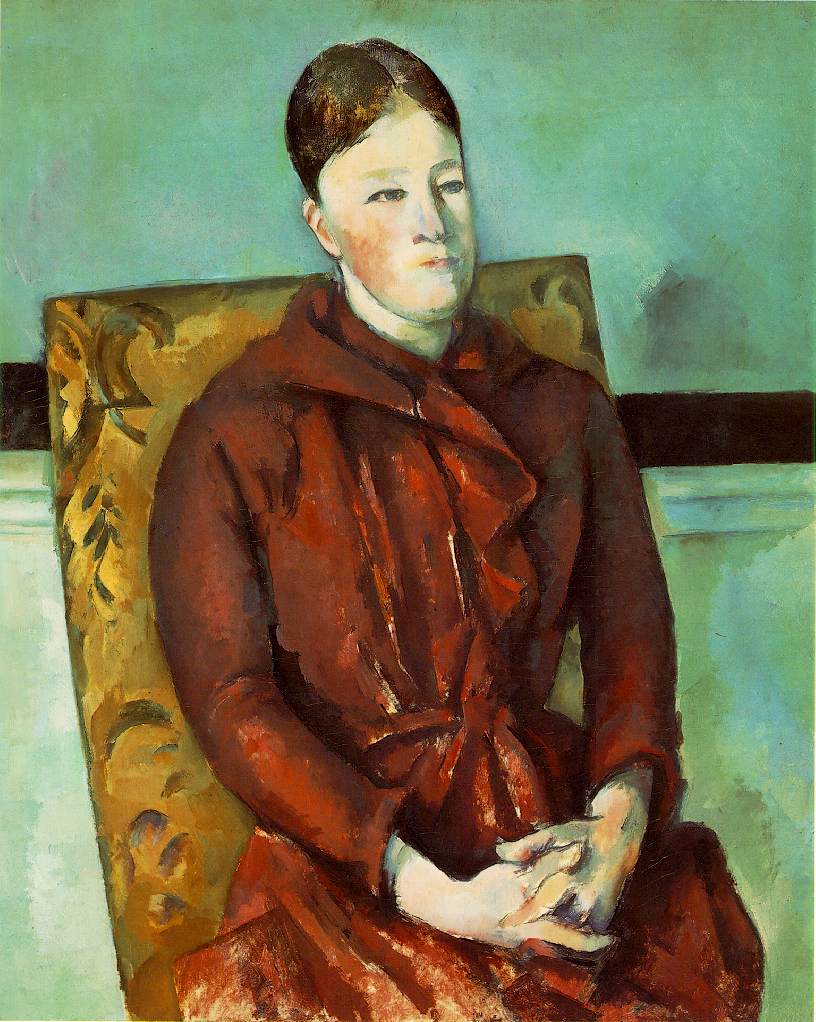
Rilke writes in 1907 to his wife, the sculptor Clara Westhoff, about his favorite painter, Paul Cézanne, whose "integrity reduced the existent to its color content that it began, beyond color, a new existence, without earlier memories." While this treatment of color was accepted in his still lifes, some viewers found it harder to accept in landscapes or portraits.
They apprehend, without realizing, that he was reproducing apples, onions, and oranges with sheer color ... , but when they come to landscape, they miss interpretation, judgment, superiority, and where portraiture is concerned, why, the rumor of intellectual conception has been passed on even to the most bourgeois, and so successfully that something of the kind is already noticeable even in Sunday photographs of engaged couples and families. And here Cézanne seems to them quite inadequate and not worth discussing at all.
Paul Cézanne, Apples, peaches, pears, and grapes, c. 1870
Paul Cézanne, Mont Sainte-Victoire, c. 1902-05
Paul Cézanne, Madame Cézanne in a Yellow Chair, c. 1888-90


T.S. Eliot: The Objective Correlative

Eliot's 1919 essay on Hamlet is probably his most famous, not only for the somewhat maddening concept of the "objective correlative," but also because Shakespeare's play was at the time venerated as the pinnacle of the playwright's art, and Eliot's cheeky judgment that it was a failure shocked many of the conventional-minded.

The objective correlative is "a set of objects, a situation, a chain of events which shall be the formula of that particular emotion; such that when the external facts, which must terminate in sensory experience, are given, the emotion is immediately evoked." Hamlet's emotion, Eliot claims, "is in excess of the facts as they appear." He seems, to Eliot at least, to be overreacting to his father's death, his uncle's role in it, and his mother's infidelity. "Hamlet is up against the difficulty that his disgust is occasioned by his mother, but that his mother is not an adequate equivalent for it; his disgust envelops and exceeds her."

It's a tricky claim, because it treats the play as a text to be read and not as one to be acted. Who's to say that skillful performers and directors can't provide in the performance the detail and nuance that would make Hamlet's emotion convincing? And to some of us, the very eccentricity of Hamlet is what's so eternally fascinating about the play.


James Joyce: Stasis and Objective Form

James Joyce, 1915
Stephen Hero (1904-06) is the abandoned first draft of A Portrait of the Artist as a Young Man (1916). It gives us Joyce's first concise definition of an epiphany as "a sudden spiritual manifestation, whether in the vulgarity of speech or of gesture or in a memorable phase of the mind itself" and as "the gropings of a spiritual eye which seeks to adjust its vision to an exact form. The moment the focus is reached the object is epiphanised."

In the Portrait, Stephen Dedalus lays out his aesthetic for his coarse friend Lynch during a walk through Dublin, mixing Aristotle with Aquinas in a superbly callow but brilliant fashion. He begins with a parsing of Aristotle's "pity and terror," the elements of tragedy:
--Pity is the feeling which arrests the mind in the presence of whatsoever is grave and constant in human sufferings and unites it with the human sufferer. Terror is the feeling which arrests the mind in the presence of whatsoever is grave and constant in human sufferings and unites it with the secret cause.
Pity, in Stephen's terms, is virtually synonymous with empathy. Terror is harder to define, but it seems to denote a kind of identification of the viewer with the tragic victim. The key word for Stephen, though, is arrest, a momentary halt in the flux of existence: "the tragic emotion is static." True art produces this stasis, this epiphanic moment of suspension in time, whereas "improper art" urges one to do something, it is kinetic. Pornography stirs desire, and is therefore not true art. Lynch, of course, makes a joke out of this, but Stephen soldiers on:
Beauty expressed by the artist cannot awaken in us an emotion which is kinetic or a sensation which is purely physical. It awakens, or ought to awaken, or induces, or ought to induce, an esthetic stasis, an ideal pity or an ideal terror, a stasis called forth, prolonged and at last dissolved by what I call the rhythm of beauty... the first formal esthetic relation of part to part in any esthetic whole or of an esthetic whole to its part or parts or of any part to the esthetic whole of which is its a part.
Yeats remarked on the role of rhythm as a form of hypnosis, similarly leading to a kind of stasis.

Stephen then ventures into Scholasticism and Aquinas to examine the nature of beauty, whose elements, as defined by Aquinas are "wholeness, harmony, and radiance." And he examines some aesthetic conundrums, including:
--If a man hacking in fury at a block of wood ... make there an image of a cow, is that image a work of art? If not, why not?
He doesn't stay for an answer, however, but proceeds to the familiar withdrawal of the artist from the work he has created: "The personality of the artist, at first a cry or a cadence or a mood and then a fluid and lambent narrative, finally refines itself out of existence, so to speak.... The artist, like the God of the creation, remains within or behind or beyond or above his handiwork, invisible, refined out of existence, indifferent, paring his fingernails." We are back to Flaubert's assertion: "An artist must be in his work like God in creation, invisible and all-powerful; he should be everywhere felt, but nowhere seen."

Thursday, April 14, 2011

1. The Modern Tradition, edited by Richard Ellmann and Charles Feidelson Jr., pp. v-ix, 7-16

Preface; Symbolism: Introduction
_____
If we're postmodern, then what is it that we're post? When Ellmann and Feidelson published their anthology in the mid-1960s, their aim was to provide the material to define "modern" as it applies to the arts and literature, to give clarity and precision to a word that then denoted "a blur of book titles, a mood of impatience with anachronisms, a diffuse feeling of difference." Modern, they noted, was a label for "a distinctive kind of imagination," and  "works we call modern ... claim modernity; they profess modernism." But the vagueness persists, even now that "the great age of the [twentieth] century's literature, the age of Yeats, Joyce, Eliot, and Lawrence, of Proust, Valéry, and Gide, of Mann, Rilke, and Kafka, has already passed into history." And the word denotes more than literature; rather, it encompasses "a large spiritual enterprise including philosophic, social, and scientific thought, and aesthetic and literary theories and manifestoes, as well as poems, novels, dramas."

If we can postulate a modern tradition, we must add that it is a paradoxically untraditional tradition. Modernism strongly implies some sort of historical discontinuity, either a liberation from inherited patterns or, at another extreme, deprivation and disinheritance.... [M]odern literature has elevated individual existence over social man, unconscious feeling over self-conscious perception, passion and will over intellection and systematic morals, dynamic vision over the static image, dense actuality over practical reality.
At the same time that modern artists and writers have embraced the future eagerly, they have also been haunted by "a sense of loss, alienation, and despair. These are the two faces, positive and negative, of the modern as the anti-traditional: freedom and deprivation, a living present and a dead past."

But giving the modern a starting point is not easy. Did we become "modern" at "the end of Victorianism, the beginning of romanticism, the mid-seventeenth century, the end of the Middle Ages"? Stephen Spender observed that the modern is characterized by a confrontation with the past and an inclusion of this confrontation "within itself as part of a single total experience," in what Spender called "the vision of a whole situation." Writers who valued originality and an attempt to free themselves from established models, media and genres, nevertheless "have been classicists, custodians of language, communicators, traditionalists in their fashion."

Ellmann and Feidelson say that their anthology is an attempt to provide materials toward an understanding of modernism, not "to argue a general theory of modernism." The selections in the anthology are from the "discursive statements by writers, artists, philosophers, and scientists" -- not the works themselves, but the essays, letters, prefaces, and other writings in which they discuss their works or the ideas that give rise to them.

The book has been divided into nine sections, each of them a topic "around which modern thinking whirls or clings." they are:
  • Symbolism: "the concept of imagination, the autonomy of the work of art, formalism, the creative process, and the heroic role of the artist.
  • Realism: "art as a function of environment," historic or social, "the pressures of experience and the responsibility of truthfulness."
  • Nature: theories "of organic harmony, of biological struggle, of mechanistic force, and of human or scientific experiment."
  • Cultural History: the "patterns -- dialectical, repetitive, symbolic, or religious -- by which the historical process has been shaped."
  • The Unconscious: "Freudian ... and post-Freudian programs for the liberation of impulse."
  • Myth: "anthropological and Jungian versions of the myth-making mind, along with more properly literary doctrines of mythic imagination." 
  • Self-Consciousness: "self-realization, the situation and process of consciousness, the inner divisions of the self, and the pursuit of personal freedom."
  • Existence: "The existentialist analysis of ... selfhood."
  • Faith: religion "in the decline of Christianity."
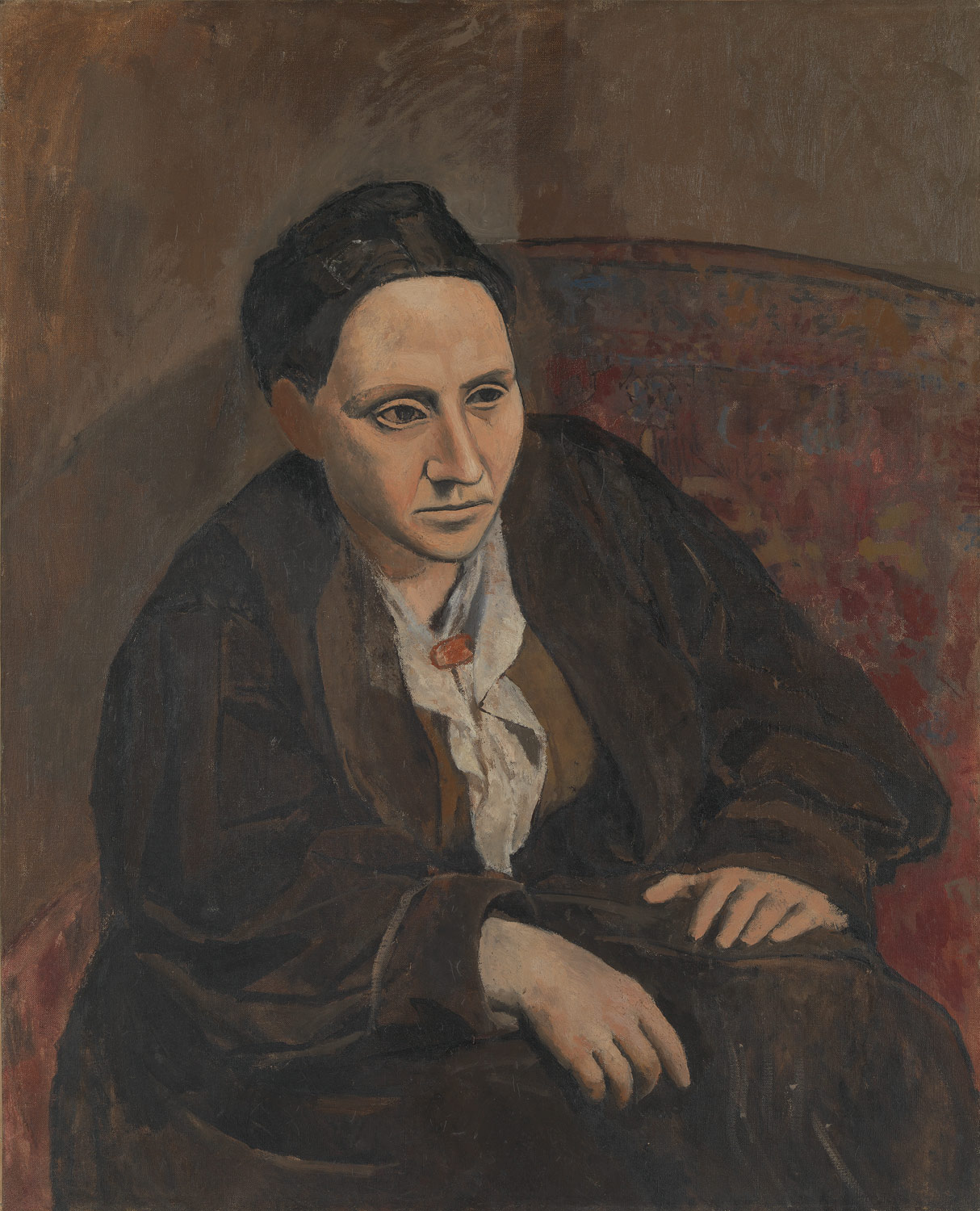
The first topic, symbolism, focuses on the nature and function of the imagination and its role in the life and work of the artist. It valorizes imagination as a unifying force, and views the artist as heroic in his or her creative role, and tends to disparage logic and reason. It also often elevates the human over the natural, and the fabrications of the artist over the phenomena of the external world. Rilke sees the artist as "uncovering a hidden reality that nature, especially our own human nature, urges us to ignore." Art is to be judged not by its fidelity to nature but by its own coherence, and hence has a way of reeducating the viewer (or reader, listener, etc.). "When people objected to his portrait of Gertrude Stein as on the grounds that it did not resemble her, Picasso replied, 'It will.'"
Pablo Picasso, "Gertrude Stein," 1905-06
"The world of aesthetic ideas, the products of genius, is like a second nature built out of the first.... It has the ideal quality of intellectual forms and the intuitive, untranslatable immediacy of sensory perception." Coleridge saw imagination as "an activity or function that lies between" nature and the human, "a union and reconcilement of" the two.

Symbolism also stresses the open-endedness of art, asserting that "art is perhaps most effective when imperfectly understood. For Flaubert, "not to conclude is a characteristic of the creative mind," an affirmation of what Keats called "'negative capability,' meaning he acceptance of uncertainties, mysteries and doubts, without any compulsion to resolve them in rational terms or to weigh them by factual probability." I.A. Richards asserts that poetry makes what he called "pseudo-statements," which are "not to be judged by truth or falsity, but only by their effect in releasing or organizing many impulses and attitudes." Not surprisingly, didacticism is shunned in this view of art. Walter Pater's dictum that "All the arts aspire to the condition of music," emphasizes the premise that literature and the visual arts should give immediacy priority over description. Poetry advances beyond prose by attempting to evoke that which is beyond speech. Paintings should not be given titles that suggest they are "about" something but should be considered as things in themselves.

As for the artist, he or she should disappear into the work. "Though art does not reproduce the objective world, the work itself must be objective, not subjective." The medium in which the artist works is more important than the artist: It "takes control, leaving [the artist], as [T.S.] Eliot once wrote ..., no more than a catalytic agent." Eisenstein, writing about the effect of montage in film, notes that "splicing heterogeneous images together [achieves] an effect not paraphrasable or in any other way attainable."

The power of the artist to create makes him or her a heroic figure, one who "takes risks and suffers in order to create," becoming "an exemplar for human behavior.... On this principle, life itself may come to be a kind of artifact," and the creations of the artist may serve as guides to life, especially with the waning of the role of religion in people's lives.