JOURNAL OF A COMPULSIVE READER
By Charles Matthews
Showing posts with label Oscar Wilde. Show all posts

Wednesday, April 20, 2011

6. The Modern Tradition, edited by Richard Ellmann and Charles Feidelson Jr., pp. 98-120

Symbolism: Imagination and Thought; The State of Affirmation (Friedrich Nietzsche, W.B. Yeats). Symbolism: The Autonomy of Art; The Doctrine of Purity (Charles Baudelaire, Oscar Wilde, Richard Wagner, Stéphane Mallarmé, Guillaume Apollinaire, Marcel Duchamp)
_____

Friedrich Nietzsche: The Acceptance of Untruth

For help with these excerpts from The Joyful Wisdom and The Antichrist, I need to turn to Ellmann and Feidelson's introduction again:
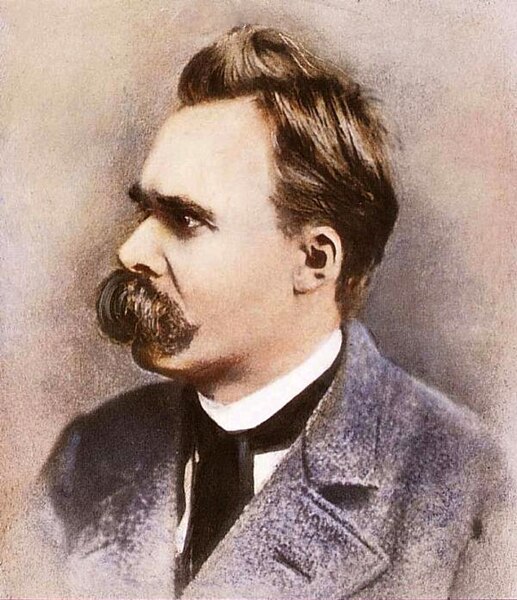
Friedrich Nietzsche, date unknown
Another face of poetic inconclusiveness and non-assertion is poetic affirmation, which is equally indifferent to objective tests of truth [as Richards's "pseudo-statements"]. Nietzsche finds that "untruth" is a condition of life; opinions, ideas, and beliefs are unavoidably false, yet they are necessary to gauge reality against imagined standards without which life would be arid. Affirmations, however fictional, are life-furthering because they extend man's sway over things and also provide necessary food for the passions, which crave attachments. Consequently skeptics, including Zarathustra himself, employ convictions as expressive material. 
In Nietzsche's view, we have art to thank for making us used to untrue things, otherwise "the insight into the general untruth and falsity of things now given us by science -- an insight into delusion and error as conditions of intelligent and sentient existence -- would be quite unendurable." Existence itself has now become "an aesthetic phenomenon," and we should relish the fact that we are all fools content with illusions: "we must now and then be joyful in our folly, that we may continue to be joyful in our wisdom!" Art gives us this joy: "we need all arrogant, soaring, dancing, mocking, childish and blessed Art, in order not to lose the free dominion over things which our ideal demands of us."

We should also celebrate our liberation from dogma. "Strength, freedom which is born of the strength and overstrength of the spirit, proves itself by skepticism.... Convictions are prisons.... Freedom from all kinds of convictions, to be able to see freely, is part of strength."


W.B. Yeats: The Conquest of Scepticism

Skepticism can only take us so far, Yeats argued in his journal in 1929. He cites Ezra Pound's contention "that we know nothing but sequences. 'If I touch the button the electric lamp will light up -- all our knowledge is like that.'" Yeats argues that this may be scientifically accurate, but philosophically false. Skepticism "is mere acknowledgement of a limit." To affirm something that may be verifiably untrue from the skeptical point of view may nevertheless prove useful: "I have felt when re-writing every poem ... that by assuming a self of past years, as remote from that of today as some dramatic creation, I touched a stronger passion, a greater confidence than I possess, or ever did possess." Pound, he says, does the same thing when he writes his imitations of Propertius or the Chinese poets: he "escapes his scepticism." It's not that we believe when we imagine things, it's that we put ourselves in the same state of mind as if we believed, with the same result. We accept the power of tradition when we do so. "The 'modern man' is a term invented by modern poetry to dignify our scepticism."


Charles Baudelaire: The Didactic Heresy

It was Théophile Gautier who took for his slogan the phrase "l'art pour l'art," which we know as "art for art's sake" (or as the MGM slogan Ars gratia artis, coined by some studio publicist with a smattering of Latin). And the Baudelaire selection is from his 1861 essay on Gautier, a defense of that poet's doctrine. Naturally, the corollary to the premise that art is an end in itself is that art must not sacrifice its integrity for the sake of teaching or preaching. So Baudelaire insists, "Poetry ... has no object but itself: it can have no other, and no poem will be so great, so noble, so truly worthy of the name of poem as that which has been written solely for the pleasure of writing a poem." There is a wee bit of a desire to shock in the statement, and both its message and the tone in which it is delivered clearly influenced Oscar Wilde's pronouncements on the same topic. When Baudelaire says, "I say that if the poet has pursued a moral end, he has diminished his poetical power," he's saying the same thing we've already seen Wilde say (except that Wilde said it more wittily).


Oscar Wilde: The Improvidence of Art

And Wilde says it again in the preface to The Picture of Dorian Gray thirty years after Baudelaire's essay on Gautier. He continues to try to shock, when he claims, "No artist has ethical sympathies. An ethical sympathy in an artist is an unpardonable mannerism of style." Well, obviously artists do have "ethical sympathies," but the point is that they shouldn't let them show -- at least not blatantly."

The central point in Wilde's preface, I think, the one that links him with so many others in this section of the anthology, is, "From the point of view of form, the type of all the arts is the art of the musician." In music, form and content are the same thing, which is the ideal toward which Wilde and his contemporaries repeatedly claimed to strive. But Wilde also adds, "From the point of view of feeling, the actor's craft is the type." The actor may or may not actually feel what the character he plays is feeling, but he is judged only by how successfully he makes the audience believe that he does. Sincerity is not in question, or as the cynical saying goes, "If you can fake that, you've got it made."

And then there's this knotty sequence of epigrams:
All art is at once surface and symbol. 
Those who go beneath the surface do so at their peril. 
Those who read the symbol do so at their peril. 
It is the spectator, and not life, that art really mirrors. 
If we equate "surface" with "form," and "symbol" with "content," we oversimplify what Wilde is saying, but it may help us get closer to his meaning. It is really an echo of the two statements made earlier in the preface:
The nineteenth century dislike of Realism is the rage of Caliban seeing his own face in a glass.
The nineteenth century dislike of Romanticism is the rage of Caliban not seeing his own face in a glass. 
For Caliban, the untutored savage, read "bourgeois philistine," who chafes at both the realistic artist's candor and the romantic artist's idealizations.

And finally: "All art is quite useless." Which only means that art that can be used to point a moral, adorn a tale, elect a candidate, promote a dogma, and so on, isn't really art.


Richard Wagner: Literature as Music-Drama

Richard Wagner, c. 1862
No one believed more whole-heartedly than Wagner that music was the highest of all the arts, which is why he argued for the assimilation of the other arts into the Gesamtkunstwerk, that untranslatable Germanism that means something like "total work of art," or "synthesis of the arts," or "all-encompassing art form," and so on. It was "The Music of the Future," he proclaimed in this 1860 essay.

He begins with some nationalistic reflections on the "peculiar significance of German efforts in art," which are characteristic of Wagner but nevertheless a little embarrassing today. But he finally settles down to the aesthetics of the matter, the pre-eminence of "music, that language intelligible to all men." He asserts that "the special, separately developed branches of art, however much their capabilities of expression might finally be brought out and heightened by great geniuses, nevertheless, without falling into unnaturalness and decided error, could never aim to supply in any way that all-powerful work of art which was only possible through a union of their forces."

Each artistic medium, he asserts, runs the risk of developing itself to its limits, "and that it cannot pass these limits without the danger of losing itself in the unintelligible and absolutely fantastic -- even in the absurd." (Some would say that literature passed these limits with Finnegans Wake, or painting with the exhibition of perfectly white canvases, or even music, with John Cage's 4'33" -- four minutes and thirty-three seconds of silence.) Wagner's solution to the problem of limits is for the media to join forces. And particularly for poetry and music to collaborate. He began "to see in the opera an ideal branch of art."
The poet seeks, in his language, to make the abstract, conventional meaning of words subordinate to their original, sensible one; and to secure, by rhythmic order, as well as by the almost musical dressing of words in versification, an effect for his phraseology which shall gain possession of and influence the feelings as though by enchantment.

In this course of the poet, so necessary to his very nature, we see him finally come to the limits of his branch of art, where it already seems to touch music, and thus the most successful work of the poet must be, for us, that which should be, in its perfection, entirely musical.
For Wagner, Beethoven is chief among his predecessors for having, through the symphony, achieved a kind of drama, "a language of which no one in any preceding age had any knowledge, inasmuch as the pure musical expression in it enchains the hearer with a lasting effect hitherto unknown." He speculates that human language "developed from a purely sensuous, subjectively-felt signification of words, into a more abstract sense" that eventually robbed words of feeling "and made their very connection and construction entirely dependent on certain rules that could be learned." (Very few language experts would agree.) So he sees only two paths open for the development of poetry: either into pure abstraction as a vehicle for philosophy, or "it must become intimately bound up with music, and with such music as that whose endless power is revealed to us by the symphony of Beethoven."

And for the poet, "no poetic form is fitted for his use but that in which the poet no longer describes, but brings his subject into actual representation, that is convincing to the senses; -- and this form is nothing but -- the drama," which "awakens in the spectator real participation in the action presented to him."


Stéphane Mallarmé: Poetry as Incantation
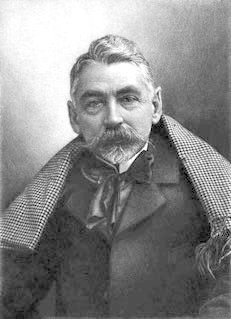
Stéphane Mallarmé, 1896
The title of Mallarmé's essay, "Crisis in Poetry" (1886-95), suggests a certain ambivalence about the "new freedom" won by poets in their liberation from the academic rules and forms -- such as the "artificial metronomes" of the alexandrine, the twelve-syllable line. And he resorts to the familiar analogy to music to describe this freedom: "for the first time in the literary history of any nation, ... any poet with an individual technique and ear can build his own instrument, so long as his fluting, bowing, or drumming are accomplished."

But language is not music:
I am disappointed when I consider how impossible it is for language to express things by means of certain keys which would reproduce their brilliance and aura.... When compared to the opacity of the word ombre, the word ténèbres does not seem very dark; and how frustrating the perverseness and contradiction which lend dark tones to jour, bright tones to nuit! We dream of words brilliant at once in meaning and sound, or darkening in meaning and so in sound, luminously and elementally self-succeeding. But, let us remember that if our dream were fulfilled, verse would not exist -- verse which, in all its wisdom, atones for the sins of languages, comes nobly to their aid.
It's that old duality of sound and sense again. So he welcomes Wagner's Gesamtkunstwerk: "We now hear undeniable rays of light, like arrows gilding and piercing the meanderings of son. I mean that, since Wagner appeared, Music and Verse have combined to form Poetry."

The one thing that poets must now begin to avoid in their verse is description, "that erroneous esthetic ... which would have the poet fill the delicate pages of his book with the actual and palpable wood of trees, rather than with the forest's shuddering or the silent scattering of thunder through the foliage." Instead of description the poet should rely on "evocation, allusion, suggestion." Poetry that too directly confronts reality risks didacticism and loses its special role: "Speech is no more than a commercial approach to realisty. In literature, allusion is sufficient: essences are distilled and then embodied in Idea."

In Wilde's preface to The Picture of Dorian Gray, he asserted, "To reveal art and conceal the artist is art's aim." Mallarmé makes a similar assertion: "If the poem is to be pure, the poet's voice must be stilled and the initiative taken by the words themselves, which will be set in motion as they meet unequally in collision." Pure poetry is the aim, as in Mallarmé's own poem, "Le tombeau d'Edgar Poe," which lauds the attempt to "purify the words of the tribe":  "Donner un sens plus pur aux mots de la tribu."

Where Wagner would give priority to music, Mallarmé would substitute language. "For, undeniably, the true source of Music must not be the elemental sound of brasses, strings, or wood winds, but the intellectual and written word in all its glory -- Music of perfect fulness and clarity, the totality of universal relationships." Like Richards, Mallarmé distinguishes between something like statements and pseudo-statements, dividing words "into two different categories: first, for vulgar or immediate, second, for essential purposes. The first is for narrative, instruction, or description.... Language, in the hands of the mob, leads to the same facility and directness as does money. But, in the Poet's hands, it is turned, above all, to dream and song."


Guillaume Apollinaire: Pure Painting
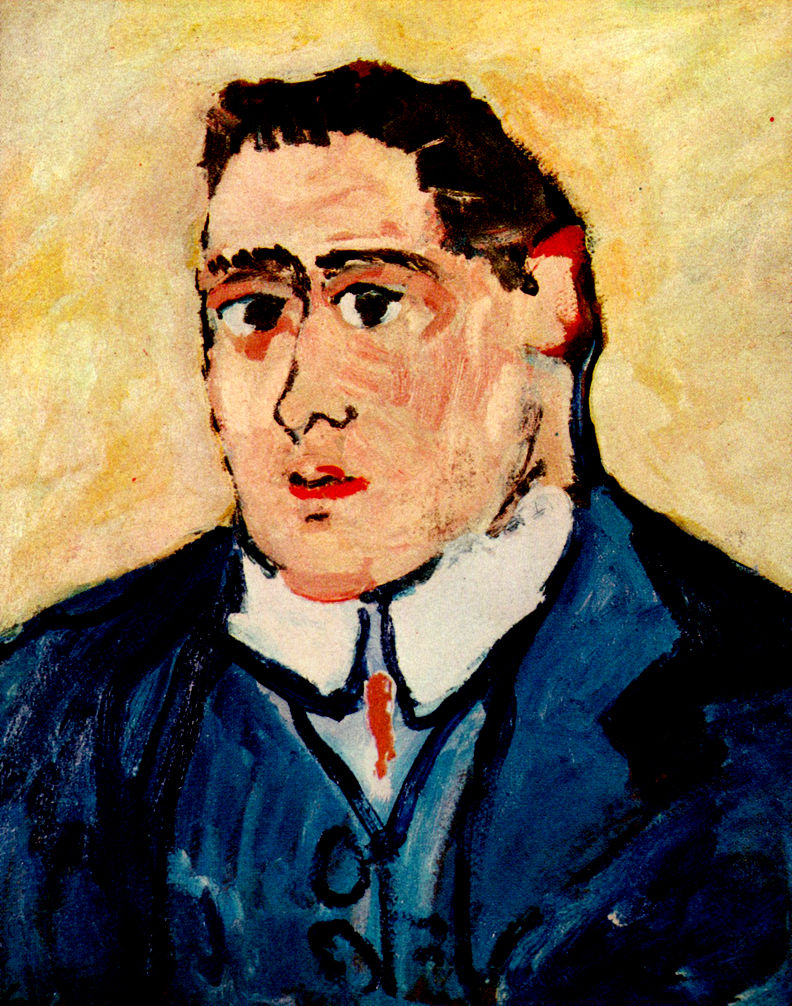
Maurice Vlaminck, Guillaume Apollinaire, 1903
Apollinaire's manifesto appeared in 1913, and like Mallarmé, he abhors the descriptive: "too many painters still adore plants, stones, the sea, or men." He finds a persuasive image for his conception of painting:
Flame is the symbol of painting, and the three plastic virtues burn with radiance. 

Flame has a purity which tolerates nothing alien, and cruelly transforms in its image whatever it touches.

Flame has a magical unity; if it is divided, each fork will be like the single flame.

Finally it has the sublime and incontestable truth of its own light. 
He argues that the more a painting exists on its own terms, insists on its own integrity, the more it participates in the eternal: "We will not go astray in the unknown future, which, severed from eternity, is but a word fated to tempt man. We will not waste our strength on the too fugitive present; the fashionable, for the artist, can only be the mask of death." And of course, the artist must resemble God the Creator: "Each god creates in his own image, and so do painters. Only photographers manufacture duplicates of nature." (Howls of protest from photographers.)

Like Mallarmé, he rejects the descriptive, or in painterly terms, the representational: "Real resemblance no longer has any importance, since everything is sacrificed by the artist to truth, to the necessities of a higher nature whose existence he assumes but does not lay bare. The subject has little or no importance any more.... While the goal of painting is today, as always, the pleasure of the eye, the art-lover is henceforth asked to expect delights other than those which looking at natural objects can easily provide."

Once again, music is the norm: "we are moving towards an entirely new art which will stand, with respect to painting ... as music stands to literature. It will be pure painting, just as music is pure literature." At the basis of pure painting is mathematics: "geometry is to the plastic arts what grammar is to the art of the writer." Unlike the Greeks, who "took man as the measure of perfection, ... the art of the new painters takes the infinite universe as its ideal."

Once again, we are told, essentially, that Nature imitates Art: "It is the social function of great poets and artists to renew continually the appearance nature has for the eyes of men. Without poets, without artists, men would soon weary of nature's monotony... The order which we find in nature, and which is only an effect of art, would at once vanish. Everything would break up in chaos."
Pablo Picasso, Houses on the Hill, Hora de Ebro, 1909

He turns to a particular school of painting, Cubism, which he says is "a name first applied to it in the fall of 1908 in a spirit of derision by Henri Matisse, who had just seen a picture of some houses, whose cube-like appearance had greatly struck him." (Perhaps the Picasso painting above, dated a year later.) "Cubism differs from the old schools of painting in that it aims, not at an art of imitation, but at an art of conception, which tends to rise to the height of creation." Apollinaire distinguishes several subsets of Cubism, and concludes, "I love the art of today because above all else I love the light, for man loves light more than anything; it was he who invented fire."


Marcel Duchamp: The Non-Picture
Marcel Duchamp 1950. © Jacqueline Matisse Monnier

Duchamp's suggestion that we substitute the word "delay" for "painting" or "picture" is not merely the great surrealist's whimsy. It in fact acknowledges the independence of the work itself, that its significance exists in the encounter with a viewer, who is "delayed" by his or her contemplation of the work. It acknowledges all of the themes we have been covering: the independence of the artwork from intellectual correlatives, its purity, its existence in time and outside of it.

Duchamp, of course, is famous for teasing the viewer into contemplation of what is or isn't a work of art. Is a urinal labeled "A Fountain" a work of art or a silly joke? Is Mona Lisa with a mustache (and an obscene pun for a title) a work of art or a desecration of a masterpiece? Discuss.
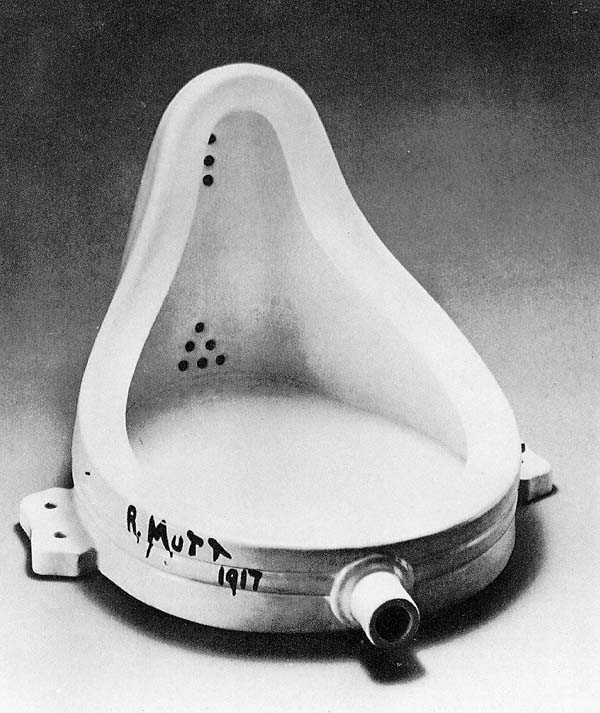
Marcel Duchamp, Fountain, 1917


Marcel Duchamp, L.H.O.O.Q., 1919

Friday, April 15, 2011

2. The Modern Tradition, edited by Richard Ellmann and Charles Feidelson Jr., pp. 17-33

Symbolism: Imagination and Nature; The Revolt Against Nature (Oscar Wilde, Rainer Maria Rilke, Pablo Picasso, André Malraux)
_____
Oscar Wilde: The Priority of Art

In this excerpt from the dialogue "The Decay of Lying," Cyril and Vivian discuss the relationship between Art and Nature.

Anyone can come up with paradoxes, but Wilde is one of the few who can make them not only clever but also wise. Vivian rattles them off here in a run of seemingly glib antitheses:
the more we study Art, the less we care for Nature
...
Art is our spirited protest, our gallant attempt to teach Nature her proper place.
...
The ancient historians gave us delightful fiction in the form of fact; the modern novelist presents us with dull facts under the guise of fiction.
...
Many a young man starts in life with a natural gift for exaggeration which, if nurtured in congenial and sympathetic surroundings, or by the imitation of the best models, might grow into something really great and wonderful. But, as a rule, he comes to nothing.... He either falls into careless habits of accuracy, or takes to frequenting the society of the aged and the well-informed.
...
[He] often ends by writing novels which are so life-like that no one can possibly believe in their probability.
...
Wordsworth ... found in stones the sermons he had already hidden there. 

And finally:
Life imitates Art far more than Art imitates Life.
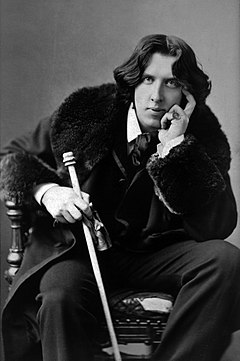
Oscar Wilde in 1882
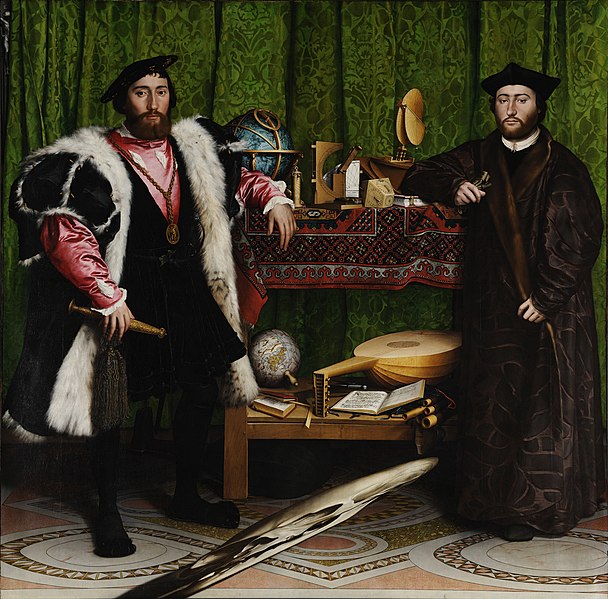
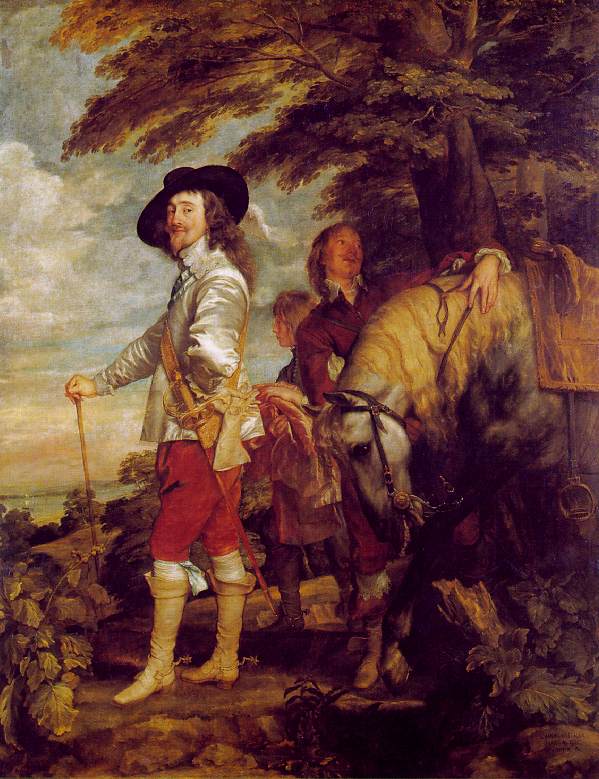
Dazzling and witty, yes. But also the basis of an entirely serious aesthetic, as Vivian/Wilde goes on to demonstrate. By inverting the traditional image of Art holding a mirror up to Nature, insisting instead that Art "is a veil, rather than a mirror," Wilde examines the role of the imagination, especially as it manifests itself in artistic creation. And he concludes that Art is the organizing principle that brings a unity, or perhaps one should say a Gestalt, to our potentially chaotic experience of the external world. "Neither Holbein nor Vandyck found in England what they have given us," Vivian asserts. "They brought their types with them, and Life with her keen imitative faculty set herself to supply the master with models."
Hans Holbein the Younger, The Ambassadors, 1533

Anthony Van Dyck, Charles I of England, c. 1635
Literature exhibits the same phenomenon: "Schopenhauer has analysed the pessimism that characterises modern thought, but Hamlet invented it. The world has become sad because a puppet was once melancholy." In short, "Things are because we see them, and what we see, and how we see it, depends on the Arts that have influenced us.... At present, people see fogs, not because there are fogs, but because poets and painters have taught them the mysterious loveliness of such effects."
James McNeill Whistler, Nocturne: Blue and Gold - Old Battersea Bridge, c 1872-75
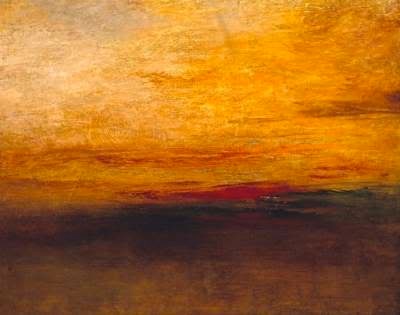
Called once to admire a sunset, Vivian claims that "It was simply a very second-rate Turner, a Turner of a bad period, with all the painter's worst faults exaggerated and over-emphasized."
J.M.W. Turner, Sunset, 1830-35
But for all Wilde's tongue-in-cheekery and seemingly outrageous claims, there is a core of seriousness in his doctrine, which he has Vivian sum up in four major points:
  • "Art never expresses anything but itself."
  • "All bad art comes from returning to Life and Nature, and elevating them into ideals.... The moment Art surrenders its imaginative medium it surrenders everything.... Life goes faster than Realism, but Romanticism is always in front of Life."
  • "Life imitates Art far more than Art imitates Life." 
  • "Lying, the telling of beautiful untrue things, is the proper aim of Art."
As we'll see, others have made the same claims, though perhaps with less wit and more evident earnestness.


Rainer Maria Rilke: The Unnatural Will to Art
Rainer Maria Rilke, c. 1900

This excerpt is from a letter written by Rilke in 1920 to his lover, Baladine Klossowska, whom he called "Merline." He speaks in it of his "struggle towards concentration," his attempt to touch his "center of production" and to find the "purest impulse" and to "recreate [the] first innocence" at which "the Angel discovered you when he brought you the first binding message." In short, to become open to the traditional moment of inspiration. But what is less traditional is essentially a paraphrase of what Wilde asserted above. Rilke puts it this way: "Art, as I conceive it, is a movement contrary to nature."

And to go against nature is of necessity a struggle. We artists, he asserts, must "throw ourselves into the abyss of our being." This is a form of self-immolation: "If the meaning of sacrifice is that the moment of greatest danger coincides with that when one is saved, then certainly nothing resembles sacrifice more than this terrible will to Art." Most humans try to forget things to survive, but artists "are always bent on discovering, on magnifying even" the things that others strive to forget: "it is we who are the real awakeners of our monsters, to which we are not hostile enough to become their conquerors; for in a certain sense we are at one with them" -- they supply the strength that the artist needs. It's not a question of conquest at all: "it is not for us to consider ourselves the tamers of our internal lions. But suddenly we feel ourselves walking beside them, as in a Triumph, without being able to remember the exact moment when this inconceivable reconciliation took place (bridge barely curved that connects the terrible with the tender ... )"

That ravishing parenthetical phrase and the artist's role as creator ex nihilo brings to mind one of Rilke's Sonnets to Orpheus:
O dieses ist das Tier, das es nicht giebt. 
     O this is the animal that does not exist.
Sie wußtens nicht und habens jeden Falls 
     But they didn't know that, and, in any case, 
-- sein Wandeln, seine Haltung, seinen Hals, 
     they loved it -- loved its gait, its stance, 
bis in des stillen Blickes Licht -- geliebt. 
     its neck, loved the light in its quiet gaze. 

Zwar war es nicht. Doch weil sie's liebten, ward 
    It never was. But since they loved it,  
ein reines Tier. Sie ließen immer Raum. 
     a pure animal became. They always left space. 
Und in dem Raume, klar und ausgespart, 
     And in that space, unoccupied and bright, 
erhob es leicht sein Haupt und brauchte kaum 
     it calmly raised its head and scarcely needed 

zu sein. Sie nährten es mit keinem Korn, 
     to be. They fed it not with grain, --  
nur immer mit der Möglichkeit, es sei. 
    only with the promise of its being. 
Und die gab solche Stärke an das Tier, 
    And this gave the animal such power, 

daß es aus sich ein Stirnhorn trieb. Ein Horn. 
     that a horn sprouted from its brow. One horn. 
Zu einer Jungfrau kam es weiß herbei -- 
    White, it strode up to a virgin -- and was
und war im Silber-Spiegel und in ihr. 
      in the mirror's silver and in her. 
Translation by Edward Snow


Pablo Picasso: Art as Individual Idea
Pablo Picasso, date unknown

In this essay from 1923, Picasso aligns himself with the Romantic idea of spontaneity, and with art as a serendipitous pursuit: "When I paint my object is to show what I have found and not what I am looking for.... What one does is what counts and not what one had the intention of doing." And he, too, makes statements that sound like paraphrases of Wilde: "Art is a lie that makes us realize truth, at least the truth that is given us to understand." And: "Nature and art, being two different things, cannot be the same thing. Through art we express our conception of what nature is not." But he also warns against overambitiousness, the "attempt to paint the invisible and, therefore, the unpaintable."

Art is not a representation of external things, but of the artist's ideas about them. Both Velasquez and Rubens, he notes, painted portraits of Philip IV, but they seem to be two different people.
Diego Velasquez, Philip IV at Fraga, 1644
Peter Paul Rubens, Philip IV, 1628-29
"We believe in the one painted by Velasquez," Picasso asserts, "for he convinces us by his right of might." But even in the work of painters who claim to be "painting nature as it is, art has always been art and not nature." What artists aim for is "more or less convincing lies."

Moreover, art exists independently of history: "there is no past or future in art.... The art of the Greeks, of the Egyptians, of the great painters who lived in other times, is not an art of the past; perhaps it is more alive today than it ever was." (The point could be extended, of course, to literature, to Homer, Virgil, Dante, Chaucer, and Shakespeare.) Nor does an artist, he claims, "evolve": "The several manners I have used in my art must not be considered as an evolution, or steps toward an unknown ideal of painting." On the other hand, there "are periods in which there are better artists than in others." (The difficulty here, is that Picasso supplies no solid criteria by which we can judge this.)

And so he rejects the idea that a movement such as Cubism should be regarded as "a seed or a foetus," a stage in the development toward something else. Cubism is "an art dealing primarily with forms, and when a form is realized, it is there to live its own life." Critics who approached Cubism through analogies to "Mathematics, trigonometry, chemistry, psychoanalysis, music, and whatnot" have missed the point. Their comments are "pure literature, not to say nonsense, ... blinding people with theories." And finally he disarms all criticism: "But of what use is it to say what we do when everybody can see it if he wants to?


André Malraux: Art as the Modern Absolute
André Malraux, 1935

In this selection from The Voices of Silence (1951), Malraux observes that "the art museum is by way of becoming a shrine" to "a vague deity known as Art." The trend started with the Romantics, who elevated the artist to a kind of priest, and as a consequence changed the artist's concept of his role: "Such men as Velazquez and Leonardo who painted only when commissioned were very different from Cézanne for whom painting was a vocation." And so artists began to claim for themselves a special aim: "to dominate appearances and build anew the world that had vanished from Europe, a world that had known and venerated supreme values" -- i.e., those supposedly proclaimed by God. And so "modern art ... does not sponsor any makeshift absolute" such as those proclaimed by religion "but, at least in the artist's eyes, has stepped into its -- the absolute's -- place. It is not a religion, but a faith. Not a sacrament, but the negation of a tainted world."

Even when the artist is a believer, his art stands apart from his belief: "If Cézanne, the good Catholic, had painted Crucifixions, they would have been Cézannesque, and that is doubtless whey he painted none."
Sacred art and religious art can exist only in a community, a social group swayed by the same belief, and if that group dies out or is dispersed, these arts are forced to undergo a metamorphosis. The only 'community' available to the artist consists of those who more or less are of his own kind.
Art in the past took its role and purpose from religion: "Michelangelo, Titian, Rubens and Rembrandt linked men up with the universe; as did even Goya, flinging them his gifts of darkness." With the decline of the universal Christian belief that animated the work of these artists, that gave them patrons and subject matter, the nature and purpose of art was forced to change. "As for the art of today -- does it not tend to bring to men only that scission of the consciousness, whence it took its rise?"

Our culture is now founded on the "spirit of enquiry," on what Malraux sees as "the alarming power" of science. "Our art, too, is becoming an uneasy questioning of the scheme of things." It is the uneasiness that Malraux feels most intensely: "The great Christian art did not die because all possible forms had been used up; it died because faith was being transformed into piety." That is, from an intensely internalized view of one's role in the universe into an external show, a pretense of belief lacking an an essential core. But the "spirit of questioning" that now prevails is "usually anxious and perplexed." In this respect, modern art departs in character from the art of previous ages: "Despite the insatiable questioning basic to Greek thought, the impression Greek art made on the world for many centuries was one of a triumphant affirmation."

The replacement of religion with science has produced "a culture that is not categorical but explorative."
It is quite possible that the successor of the art we call 'modern'will be still more individualist; and it is not impossible that it will assume, to begin with, the form of a resuscitation before developing into a new art, vaster in scope and deeper, born of this resuscitation.
Malraux's "possible" future hasn't come to pass yet. Postmodernism is certainly neither vast in scope nor deep.

Sunday, July 11, 2010

2. Marcel Proust: A Life, by Edmund White, pp. 33-56

III. His education; philosophical novelist; literary tastes; military service; homosexuality. IV. Involvement in society; literary pastiches; encounter with Bergson; snobbery
_____
Proust's favorite professor at the Lycée Condorcet was Alphonse Darlu, "who believed in spirituality but not Christianity." Darlu's brand of idealism influenced him greatly.
Proust rejected André Gide's more ordinary form of realism, his method of building up a character or situation through the accretion of small details, by saying that he, Proust, could be interested only in those details that pointed towards a general truth or that expressed poetic enchantment. Every page of Proust's masterpiece piles up several "general truths"and adds to the elevated philosophical tone.
White calls Proust "the great philosophical novelist," and puts him in the company of George Eliot, Thomas Mann, Hermann Broch, and Robert Musil.

He struggled with his homosexuality when he was seventeen, and cultivated an infatuation with forty-year-old Laure Hayman, who was his uncle's mistress (and, he would later find out, his father's). Laure, like Odette, had a house on the rue de La Pérouse, rode in the Bois de Boulogne and loved chrysanthemums. He shunned the "decadent" writers of his day and modeled his style, including his long sentences, on the classics. When he was in his early twenties, his favorite writers were Pierre Loti and Anatole France, whose style fitted his taste for classicism. Later, John Ruskin "would influence him to abandon France's materialism for a more congenial brand of spiritualism."

On November 11, 1889, after graduating, he signed up for a year of military service, which he would remember nostalgically as "a paradise," though "at the time he complained bitterly." The nostalgic view of his service is depicted in The Guermantes Way, when the narrator visits Saint-Loup at Doncières, which is modeled on Orléans, where he was stationed.

In September 1890, he visited Cabourg, a resort on the coast of Normandy that became Balbec in the novels. And that fall he started reading law in Paris and entered the École libre des sciences politiques ("Sciences-Po") to study politics. His legal and political studies gave him a grounding in those subjects, which makes it possible for him to create pictures of the diplomatic corps in his novels. He was inspired by Balzac, who moves with ease in various sections of society. And these studies also gave him, "more important for a writer, to their vocabularies, including their sophisticated strategies of evasion." He took a course in diplomacy from Albert Sorel, who is the model for M. de Norpois, "the ultimate slippery statesman."

In 1891 he met Oscar Wilde and invited him to dine with his parents, but the perhaps apocryphal story has it that Wilde was offended by the Prousts' "heavy, dark furniture" and left after saying, "How ugly everything is here." In Sodom and Gomorrah, Proust alludes unsympathetically to Wilde's fall. A scandal involving Prince Philip von Eulenberg in 1906 also alerted Proust to the uneasy position of gay men in contemporary society. At the same time, however, he was becoming friends with Robert de Flers and Lucien Daudet, and his mother was alarmed by a photograph he had taken with them in 1892, touching off a quarrel with his parents that he depicted in Jean Santeuil. Although he continued to seek out the company of other gay men, he tried not to be identified as gay himself:
Years later he would tell André Gide that one could write about homosexuality even at great length, so long as one did not ascribe it to oneself.
He began his rise in society and cultivated his gift for imitating the mannerisms of the people he met. White notes that this talent for mimickry "would come in handy later when he would begin to create his cast of great Dickensian eccentrics: the baron de Charlus, Madame Verdurin, the duc de Guermantes, the maid Françoise, all of whom have a distinctive, not to say preposterous, way of speaking." He also loved to write pastiches of famous writers, and said that he did it to purge his own style of imitation: "to become original again afterwards and not produce involuntary pastiches the rest of one's life." He also used it as an analytical tool, examining other writers' style by attempting to reproduce it. He includes a pastiche of the Goncourts' journal in the Search. He attracted the attention of eminent writers like Anatole France and Maurice Barrès, and became a regular at the salon of Princess Mathilde, Napoleon's niece, who appears under her own name in In the Shadow of Young Girls in Flower.

He also met Henri Bergson, but White dismisses him as a serious influence on Proust's thought, except for a conversation on the nature of sleep that they had after World War I, which is reflected in Sodom and Gomorrah. "Bergson seems to have dismissed Proust as someone interested only in high society (le monde)," White says. And he notes that Proust developed a reputation as a snob. Jean Cocteau wrote of Proust that he "doesn't hesitate to judge society people and accuse them of stupidity. He finds them stupid but superior, which is the very definition of snobbism." White notes that the young Proust was attracted to aristocrats because he saw them as "living, breathing, walking, talking history, a modern incarnation of a medieval legend." The Duchesse de Guermantes, whom the narrator first sees in the church at Combray in the chapel of her ancestor Gilbert the Bad, becomes the narrative embodiment of this attitude. But as White observes, "he ended up as the most penetrating critic of snobbism who ever lived." His contemporaries in society were shocked by his portraits of them in the Search, and the Comtesse de Chévigné, "one of the models for the duchesse de Guermantes," burned his letters. But others were impressed by "his elaborate politeness."
He knew all the secrets of the aristocracy and spent thirty years learning their rituals, feuds, genealogies, and vanities, but he was also distanced from this world by the fact he was half-Jewish, untitled, gay, and an invalid.