JOURNAL OF A COMPULSIVE READER
By Charles Matthews
Showing posts with label William Blake. Show all posts

Friday, May 27, 2011

41. The Modern Tradition, edited by Richard Ellmann and Charles Feidelson Jr., pp. 890-912

Faith: Christianity and Christendom (F.M. Dostoevsky); Deified Man (William Blake, Friedrich Nietzsche) 
_____


F.M. Dostoevsky: Christ and the Grand Inquisitor


This great parable, interpolated into The Brothers Karamazov (1880), sets forth alternatives delineated in the introduction: "spiritual freedom or enslavement to the things of this world, religion or the disappearance of religion in a specious substitute." 


Christ has returned to Earth in the fifteenth century and has appeared "in Spain, in Seville, in the most terrible time of the Inquisition. So the Grand Inquisitor, "almost ninety, with a withered face and sunken eyes, in which there is still a gleam of light," has him arrested and goes to his cell to interrogate him. The Inquisitor accused Christ of returning "to hinder us," and assures him that he will be burned at the stake for doing so. Among other concerns of the Inquisitor is that by returning, Christ will be adding to the scriptural teachings, which challenges the authority of the Church. As Ivan, who is telling the story, explains to Alyosha, "it is the most fundamental feature of Roman Catholicism, in my opinion at least," that "'All has been given by Thee to the Pope ... and all, therefore, is still in the Pope's hands, and there is no need for Thee to come now at all.'" 


But most of all, by returning, Christ threatens to remind humankind of its freedom. It is the Church's desire to keep them faithful, to prevent them from challenging its authority. As the Inquisitor puts it, "For fifteen centuries we have been wrestling with Thy freedom, but now it is ended and over for good.... to-day, people are more persuaded than ever that they have perfect freedom, yet they have brought their freedom to us and laid it humbly at our feet." 


The Inquisitor goes on to remind Christ of the three temptations offered him by Satan in the wilderness, "For in those three questions the whole subsequent history of mankind is, as it were, brought together into one whole, and foretold, and in them are united all the unsolved historical contradictions of human nature." 


The first temptation was for Christ to earn the undying loyalty of all humankind by turning stones into bread, thereby causing humanity to give up the "promise of freedom which men in their simplicity and their natural unruliness cannot even understand, which they fear and dread -- for nothing has ever been more insupportable for a man and a human society than freedom." But because Christ refused this temptation, the Church was able to step in: 
Thou didst promise them the bread of Heaven, but, I repeat again, can it compare with earthly bread in the eyes of the weak, ever-sinful and ignoble race of man? ... No, we care for the weak, too. They are sinful and rebellious, but in the end they too will become obedient. They will marvel at us and look on us as gods, because we are ready to endure the freedom which they have found so dreadful and to rule over them.... We shall deceive them again, for we will not let Thee come to us again. That deception will be our suffering, for we shall be forced to lie.
Humankind, says the Inquisitor, wants to worship something: "so long as man remains free he strives for nothing so incessantly and so painfully as to find someone to worship. But man seeks to worship what is established beyond dispute, so that all men would agree at once to worship it." This craving for a common object of worship for all humankind is the cause of a deadly discontent: "For the sake of common worship they've slain each other with the sword." 


So by rejecting the first temptation, Christ gave up the opportunity to unite humanity. "For the secret of man's being is not only to live but to have something to live for. Without a stable conception of the object of life, man would not consent to go on living, and would rather destroy himself than remain on earth, though he had bread in abundance." Christ's choice has caused humanity to suffer, the Inquisitor argues. 


The second temptation was to demonstrate his divinity by leaping from the high place and being rescued by the angels. As the Inquisitor points out, "There are three powers, three powers alone, able to conquer and hold captive for ever the conscience of these impotent rebels for their happiness -- those forces are miracle, mystery and authority." Of course, the Inquisitor observes, Christ knew if he had yielded to the temptation, "in taking one step, in making one movement to cast Thyself down, Thou wouldst be tempting God and have lost all Thy faith in Him, and would have been dashed to pieces against that earth which Thou didst come to save." 


So Satan was pretty tricky in offering this temptation, not only because he knew Christ couldn't yield to it, but also because he knew that "man seeks not so much God as the miraculous. And as man cannot bear to be without the miraculous, he will create new miracles of his own for himself, and will worship deeds of sorcery and witchcraft." 


Then the Inquisitor appeals to Christ's awareness of the failure of his teachings: "fifteen centuries have passed" and "man is weaker and baser by nature than Thou hast believed him!... by showing him so much respect, Thou didst, as it were, cease to feel for him, for Thou didst ask far too much from him." And so the Church has stepped in to correct Christ's mistake: "we have corrected Thy work and have founded it upon miracle, mystery and authority. And men rejoiced that they were again led like sheep, and that the terrible gift that had brought them such suffering was, at last, lifted from their hearts." 


And then the Inquisitor reveals what has been implicit all along: that the Church has been working with Satan, having accepted the third temptation -- worldly power -- that Christ rejected.
Perhaps it is Thy will to hear it from my lips. Listen, then. We are not working with Thee but with him -- that is our mystery. It's long -- eight centuries -- since we have been on his side and not on Thine. Just eight centuries ago we to from him what Thou didst reject with scorn, that last gift he offered thee, showing Thee all the kingdoms of the earth. We took from him Rome and the sword of Caesar, and proclaimed ourselves sole rulers of the earth, though hitherto we have not been able to complete our work.
The Inquisitor is astonished that Christ rejected the offer: "Thou wouldst have accomplished all that man seeks on earth -- that is, someone to worship, someone to keep his conscience, and some means of uniting all in one unanimous and harmonious ant-heat, for the craving for universal unity is the third and last anguish of men." He foresees the reaction to the challenges of post-Enlightenment modernity: 
Freedom, free thought and science will lead them into such straits and will bring them face to face with such marvels and insoluble mysteries, that some of them, the fierce and rebellious, will destroy themselves; others, rebellious but weak, will destroy one another, while the rest, weak and unhappy, will crawl fawning to our feet and white to us: "Yes, you were right, you alone possess His mystery, and we come back to you, save us from ourselves!"
Cynically, the Inquisitor observes that the Church "will save them from the great anxiety and terrible agony they endure at present in making a free decision for themselves" and that "they will die, peacefully they will expire in Thy name, and beyond the grave they will find nothing but death. But we shall keep the secret, and for their happiness we shall allure them with the reward of heaven and eternity." 


Alyosha is shocked by the implications of Ivan's story, but Ivan insists that the Inquisitor had followed the teachings of Christ "and made frenzied efforts to subdue his flesh to make himself free and perfect." But it was his love of humanity, Ivan says, that opened the Inquisitor's eyes, "and he saw that it is no great moral blessedness to attain perfection and freedom, if at the same time one gains the conviction that millions of God's creatures have been created as a mockery, that they will never be capable of using their freedom." 


"Your inquisitor does not believe in God, that's his secret!" Alyosha retorts. And Ivan admits the point. But that, he explains, is the Inquisitor's tragedy. Having recognized it, the Inquisitor chooses "the guarding of the mystery ... from the weak and the unhappy, so as to make them happy." 


And so he ends his parable with Christ, who has been silent through all the Inquisitor's harangue, kissing the Inquisitor "on his bloodless aged lips." The Inquisitor lets his prisoner go, and "The kiss glows in his heart, but the old man adheres to his idea." 
_____


William Blake: God in Man


In these selections from "There Is No Natural Religion" (1788), "All Religions Are One" (1788) and "The Marriage of Heaven and Hell" (1790-93), Blake elevates imagination, as manifested in poetry and visionary prophecy, both of which were his forte, as divine revelation, setting imagination against science and reason. E.g., "If it were not for the Poetic or Prophetic character the Philosophic & Experimental would soon be at the ratio of all things, & stand still, unable to do other than repeat the same dull round over again." 


Nature in itself is not a path to revelation, for humankind is bound by the limitations of its senses. Only imagination allows us to glimpse infinity, and "He who sees the Infinite in all things, sees God. He who sees the Ratio only, sees himself only." As for the pathway to revelation, "All deities reside in the human breast." Christ himself, Blake contends, was human, for he mocked the limitations on human freedom set down in Hebraic law: "did he not mock at the sabbath, and so mock the sabbath's God? ... turn away the law from the woman taken in adultery?" He insists, "no virtue can exist without breaking these ten commandments. Jesus was all virtue, and acted from impulse, not from rules." 
_____


Friedrich Nietzsche: The Death of God and the Antichrist  


Not content to be merely anti-clerical, in The Gay Science (1883) and The Antichrist (1895), Nietzsche explicitly rejected Christianity for its encouragement of human weakness. God is dead, proclaims Nietzsche's "madman" and the churches are God's "tombs and sepulchres." Zarathustra proclaims that this death prepares the way for the Superman, toward whom humankind will evolve if not fettered by a preoccupation with divinity: "everything shall be transformed into the humanly-conceivable, the humanly-evident, the humanly-palpable! You should follow your own senses to the end!" 


Humankind can't be "at home" in "the incomprehensible" or "the irrational," and should cease the "evil and misanthropic ... teaching about the one and the perfect and the unmoved and the sufficient and the intransitory." Instead, "the best images and parables should speak of time and becoming: they should be a eulogy and a justification of all transitoriness." The "creative will" should prevail, for "Creation ... is the great redemption from suffering, and life's easement." Belief in the gods frustrates creation -- "for what would there be to create if gods -- existed!"


Above all, humankind must reject weakness, and embrace "Everything that heightens the feeling of power in man, the will to power, power itself." And that means rejecting Christianity as "more harmful than any vice."
Christianity has sided with all that is weak and base, with all failures; it has made an ideal of whatever contradicts the instinct of the strong life to preserve itself; it has corrupted the reason even of those strongest in spirit by teaching men to consider the supreme values of the spirit as something sinful, as something that leads into error -- as temptations.
Christian "pity" is nihilistic. It "negates life and renders it more deserving of negation." The Christian world view is a "world of pure fiction" that "is vastly inferior to the world of dreams insofar as the latter mirrors reality, whereas the former falsifies, devalues, and negates reality" by setting up nature as the opposite of or antagonistic to "God." 


To imagine god as good is "contrary to everything desirable. The evil god is needed no less than the good god: after all, we do not owe our own existence to tolerance and humanitarianism." The Judeo-Christian god is born of oppression: 
To be sure, when a people is perishing, when it feels how its faith in the future and its hope of freedom are waning irrevocably, when submission begins to appear to it as the prime necessity and it becomes aware of the virtues of the subjugated as the conditions of self-preservation, then its god has to change too. Now he becomes a sneak, timid and modest; he counsels "peace of soul," hate-no-more, forbearance, even "love" of friend and enemy.... Formerly, he represented a people, the strength of a people, everything aggressive and power-thirsty in the soul of a people; now he is merely the good god.
In Nietzsche's view, this reflects a decline in "the will to power" and therefore decadence. 
The Christian conception of God -- God as god of the sick, God as a spider, God as spirit -- is one of the most corrupt conceptions of the divine ever attained on earth. It may even represent the low-water mark in the descending development of divine types.... God as the declaration of war against life, against nature, against the will to live! God -- the formula for every slander against "this world," for every lie about the "beyond"! God -- the deification of nothingness, the will to nothingness pronounced holy! 

Thursday, May 26, 2011

40. The Modern Tradition, edited by Richard Ellmann and Charles Feidelson Jr., pp. 868-890

Existence: Value in Existence (Jean-Paul Sartre, Martin Buber, Karl Jaspers, Martin Heidegger). Faith: Christianity and Christendom (William Blake, Søren Kierkegaard)
_____

Jean-Paul Sartre: The Common Condition of Man 
In Existentialism and Humanism (1946) Sartre takes "the Cartesian cogito" -- "I think, therefore I am" -- as a "point of departure": "the absolute truth of consciousness as it attains to itself." Anything outside of the individual consciousness is "no more than probable." 


But in fact, "I cannot obtain any truth whatsoever about myself, except through the mediation of another." Sartre calls this "inter-subjectivity." Through our experience with others, we arrive at "a human universality of condition. It is not by chance that the thinkers of today are so much more ready to speak of the condition than of the nature of man." This condition consists of "all the limitations which a priori define man's fundamental situation in the universe." These include the unvarying "necessities of being in the world, of having to labor and die there." Nevertheless, we "attempt either to surpass these limitations, or to widen them, or else to deny or to accommodate oneself to them."
What is at the very heart and center of existentialism, is the absolute character of the free commitment, by which every man realizes himself in realizing a type of humanity -- a commitment always understandable, to no matter whom in no matter what epoch -- and its bearing upon the relativity of the cultural pattern which may result from such absolute commitment.
It is the particular nature of the commitment that makes us part of a given culture: i.e., French, American, Chinese, modern, ancient, medieval, etc. "There is no other universe except the human universe, the universe of human subjectivity," which is why we recognize other commitments, other cultures, as still human. This "existential humanism" is the recognition that "man is not shut up in himself but forever present in a human universe." Thus "it is not by turning back upon himself, but always by seeking, beyond himself, that man can realize himself as truly human." 
_____
Martin Buber: The Primary Words 


Martin Buber, date unknown
Like Sartre, in I and Thou (1923) Buber also recognizes relatedness as a key function in the human condition. The "Thou" of Buber's thought is the German du, the second-person pronoun that has no equivalent in modern English other than "you"; it presumes a familiarity between the speaker and the person addressed -- e.g., an adult and a child, members of the same family, lovers, close friends, etc. 


Buber contends that in all relatedness between subject and object there are what he calls "primary words": "the combination I-Thou" and "the combination I-It; wherein ... one of the words He and She can replace It." 
Primary words are spoken from the being. If Thou is said, the I of the combination I-Thou is said along with it. If It is said, the I of the combination I-It is said along with it. The primary word I-Thou can only be said with the whole being. The primary word I-It can never be spoken with the whole being. 
Buber is not making a linguistic statement here, but rather a statement about the role of subject and object in human existence. To "experience" the world is to hold it in an I-It relationship. "The world has no part in the experience. It permits itself to be experienced, but has no concern in the matter." 


The I-Thou arises when a relationship, a mutuality, has been established. We can have an I-Thou relationship with nature, though it is a vague and tenuous one. In our relationship with other humans, however, "the relation is open and in the form of speech. We can give and accept the Thou." And then there's what Buber calls "our life with intelligible forms," which is the role of the imagination: "we feel we are addressed and we answer -- forming, thinking, acting." 
In every sphere in its own way, through each process of becoming that is present to us as we look out toward the fringe of the eternal Thou; in each we are aware of a breath from the eternal Thou; in each Thou we address the eternal Thou
In each case we perceive relatedness, but when we reduce this relationship to experience, when we attempt to objectify, the Thou becomes an It
This is the eternal source of art: a man is faced by a form which desires to be made through him into a work. this form is no offspring of his soul, but is an appearance which steps up to it and demands of it the effective power. The man is concerned with an act of his being. If he carries it through, if he speaks the primary word out of his being to the form which appears, then the effective power streams out, and the work arises. 
Love is a manifestation of I-Thou. Hate is a rejection of it. "Hate is by nature blind. Only a part of a being can be hated. He who sees a whole being and is compelled to reject it is no longer in the kingdom of hate, but is in that of human restriction of the power to say Thou.... Yet the man who straightforwardly hates is nearer to relation than the man without hate and love."


Eventually, "every Thou in our world must become an It." The relation terminates, if not because of separation or disaffection, eventually because of death. Even "love cannot persist in direct relation." But Thou is essential for the liberation of humanity from the sense of inevitability, of fate: "He who goes out to it with concentrated being and risen power to enter into relation becomes aware of freedom. And to be freed from belief that there is no freedom is indeed to be free." 
_____

Karl Jaspers: The Encompassing 


In Reason and Existenz (1935) and "On My Philosophy" (1941), Jaspers examines the context of existence, the Encompassing. "We always live and think within a horizon. But the very fact that it is a horizon indicates something further which again surrounds the given horizon." It is "the medium or condition under which all Being appears as Being for us." We sense it as "the most extreme, self-supporting ground of Being." It urges us, "Do not lose yourself in what is merely known! Do not let yourself become separated from Transcendence!" In this sense, Jaspers is echoing Buber's encouragement not to remain in the I-It but to strive for the I-Thou. 


"In the world man alone is the reality which is accessible to me. Here is presence, nearness, fullness, life.... To fail to be human would mean to be to slip into nothingness." But is there more beyond the human? 
In every form of his being man is related to something other than himself: as a being to his world, as consciousness to objects, as spirit to the idea of whatever constitutes totality, as Existenz to Transcendence.
Jaspers rejects the positivism of the nineteenth century that resulted from scientific discovery. Humankind must continue to strive "more decisively than ever for a certainty that he lacks, for the certainty that there is that which is eternal, that there is a Being through which alone he himself is. If the Deity is, then all hope is possible." But this "Deity, if it exists, is only as it appears to us in the world, as it speaks to us in the language of man and the world." 
_____


Martin Heidegger: Recollection of Being


In "The Way Back Into the Ground of Metaphysics" (1949), Heidegger also seeks the transcendent, the Encompassing, to overcome "the barrier which keeps man from the original involvement of Being in human nature." We have confused "beings" with Being, Heidegger says, and need "a different kind of thinking which is brought to pass by Being itself and, therefore, responsive to Being.


Which is a segue into the final section of the book: Faith. 
_____


William Blake: The Lord's Prayer Modernized


The introduction to this section observes, "The declining authority of the Christian churches, with the decline of individual Christian faith, is a cultural fact that weighs heavily upon the modern consciousness.... There have been attempts to turn the discrediting of public Christian institutions into a renascence of personal Christian belief; there have been reinterpretations of Christian doctrine and of the meaning of religion in general; and there have been embattled declarations of orthodoxy." 


Blake is one of those severe critics of institutionalized Christianity and of "the conventional believer [who] clings to his church in proportion to his own lack of real faith and his secret commitment to an irreligious secular world." His "modernization" of the Lord's Prayer (1827) is addressed to "Our Father Augustus Caesar" and is the prayer of a Tory for worldly success. 
_____


Søren Kierkegaard: A Hypocritical Generation


Kierkegaard's "Attack Upon 'Christendom'" (1854-55) is a sardonic look at ecclesiastical materialism, which is "playing Christianity" by substituting the outward observances of faith for the actual practice of it. Preachers in their churches as "Artists in dramatic costumes [who] make their appearance in artistic buildings." They are "tradesmen-priests," and the "official Christianity" of Sundays "is much worse than ... weekday worldliness, it is hypocrisy, it is blood-guilt."
The Christianity of the New Testament was truth. But man shrewdly and knavishly invented a new   kind of Christianity which builds the sepulchers of the prophets and garnishes the tombs of the righteous, and says, "If we had been in the days of our fathers." And this is what Christ calls blood-guilt.
For Kierkegaard, Christianity is predicated on suffering, which is precisely what today's Christians prefer to avoid. If Christ were to return, he would turn his anger on the hypocrisy of the ministers for leading the faithful astray "and likely as of yore He would make a whip of small cords and drive them out of the temple." In "the Sunday twaddle" of the church services, "Christ ... becomes a languishing figure, the impersonation of insipid human kindness," instead of the figure who turned his wrath upon the hypocrites.  

Monday, May 16, 2011

30. The Modern Tradition, edited by Richard Ellmann and Charles Feidelson Jr., pp. 660-672

Myth: Myth and Literature (Friedrich Schlegel, Victor Hugo, Richard Wagner, William Blake, Nicolas Berdyaev)
_____

Friedrich Schlegel: Modern Mythology

Before the anthropologists and psychoanalysts revived an interest in myth, the impetus for its study came from Romantics like Schlegel, whose "Dialogue on Poetry" (1800) was a plea for reviving the mythic impulse as a defense against materialism and rationalism. Schlegel goes so far as to define a contemporary literary malaise:
Friedrich Schlegel, date unknown
It is my contention that our poetry lacks a center, such as mythology was for the ancients, and the essential shortcomings of modern poetry may be summed up in these words: we have no mythology.
But since we don't, he continues, we have to make one, "fashioned out of the profoundest depths of the spirit; it must be the most artificial of all works of art, for it is to encompass all others, it is to be a new course or a vessel for the ancient, eternal fountainhead of poetry and itself the everlasting Poem which contains within itself the seeds of all other poems."

For Schlegel, a working myth is a cultural sine qua non, and he hopes to find impetus for it "in the great phenomenon of the age - in idealism! -- a very significant hint and a notable manifestation of what we are seeking." If we fail to do so, he argues, the results could be catastrophic: "mankind is struggling with all its might to find its center. Mankind must, as matters stand, go under or rejuvenate itself." But he is optimistic, because, he says, this is "an age of rejuvenation."

Nature, for a Romantic like Schlegel, is the source of this new mythology, which will be "a hieroglyphic expression of surrounding nature in a transfiguration of imagination and love." We must "suspend the course and laws of logically reasoning thought," in order to be transported "back to the fine confusion of the imagination, the original chaos of human nature" -- in other words, listen to what the unconscious is telling us.
All thought is divination, but man is only just beginning to become aware of his powers of divination. What immeasurable expansions will men yet experience, and even at this very time! In my estimation, whoever understands the epoch, which is to say the great process of general rejuvenation and the principles of perpetual revolution, should be able to grasp both poles of humanity, to understand the deeds of the earliest men and to know the character of the golden age that is yet to come.


Victor Hugo: Imaginative Types

Victor Hugo, date unknown
Hugo's Romanticism was long-lived, and he was continuing to cling to it in his book, William Shakespeare, in 1864, which is less about Shakespeare and more about the nature of literary genius. He asserts that all great poets wear a "human mask" through which their souls "[shine] through the mysterious aperture of the eyes" and change the mask to the various characters they create. Hugo cites characters not only from Shakespeare but also from the Bible, Homer, the Greek dramatists, Plautus, Terence, Corneille, Cervantes, Rabelais, Molière, Beaumarchais and Byron. "From the direct divine creation proceeds Adam, the prototype. From the indirect divine creation -- that is to say, from the human creation -- proceed other Adams, the types."

Shylock, whom Hugo erroneously calls "that fierce merchant of Venice" (the merchant of the play's title is Antonio), "is the embodiment of Jewishness; he is also Judaism." That is, he's the individuation of a type. Repellent as this kind of stereotyping is to us today, it coheres with Hugo's theory that literature proceeds from prototype to individual, and that the individual figure in literature succeeds in large part because he encompasses all other individuations of the type: "that is to say, [Shylock's] whole nation, the high as well as the low, faith as well as fraud; and it is because he sums up a whole race, such as oppression has made it, that Shylock is great. The Jews are, however, right in saying that none of them -- not even the medieval Jew -- is Shylock." He uses as analogy an orange tree: A leaf from the tree doesn't taste like the fruit, "yet there is a deep affinity, an identity of roots, a sap rising from the same source, a sharing of the same subterranean shadow before life. The Fruit contains the mystery of the tree, and the type contains the mystery of the man. Hence the strange vitality of the type."

If the type were "but an abstraction, men would not recognize it, and would allow this shadow to go away." Although Hugo doesn't mean by "shadow" the same thing Jung does, he is verging on something Jungian, a theory of archetypes, here. "Types are cases foreseen of God; genius realizes them.... God creates the phenomenon, genius gives it a name; God creates the miser only, genius forms Harpagon; God creates the traitor only, genius makes Iago," and so on. And literature in turn creates types, just as God created Adam: "The man of Homer, Achilles, is an Adam: from him comes the species of the slayers; the man of Aeschylus, Prometheus, is an Adam: from him comes the race of the wrestlers; the man of Shakespeare, Hamlet, is an Adam: to him belongs the family of the dreamers."


Richard Wagner: The Folk and the Myth

Hitler co-opted Wagner, as well as the concept of das Volk, literally, "the people," but with racial (not to say racist) overtones. These two excerpts, one from "The Art-Work of the Future" (1849), the other from "Opera and Drama" (1875), are muddled a little by having two different translators, each of whom fiddles uneasily with finding the right word to translate das Volk. The first excerpt, in fact, makes things more confusing by sometimes translating the word "the Folk," and sometimes "the People." (A quick check of the original shows that Wagner used das Volk in both instances.) In any case, Wagner observes, the word "has acquired an ineradicable moral" meaning -- long before Hitler proclaimed "ein Volk, ein Reich, ein Führer."

But to get to Wagner himself, he asserts, "The 'Folk' is the epitome of all those men who feel a common and collective Want," some ultimate unfulfilled need toward which they are driven. He is working here toward a version of the Jungian collective unconscious. First "the human poetic faculty" comes up with gods, which he posits as a kind of nature-myth, in which "man represents to himself the essence of natural manifestations as derived from a Cause." And the gods naturally take human form: "he must present his God not only in a shape most suitable to be apprehended by his purely human intuition but also outwardly the most intelligible."
All understanding comes to us from Love; and the natural impulse of man is toward the being of his own species. Just as the human from is to him the most intelligible, so also will the qualities of natural manifestations -- which he does not yet know in their reality -- be rendered most intelligible to him by being reduced to human shape.
In other words, humankind creates God in its own image. It anthropomorphizes nature. Thus arises myth and,  through it, art, "for these shapes must necessarily win artistic form and content, if, as is their peculiarity, they really spring from man's longing that the representation of manifestations should be thoroughly intelligible."
Art, by the very meaning of the term, is nothing else than fulfillment of the desire to recognise oneself in an admired or beloved object, to find oneself again in the manifestations of the outer world, as controlled by their representation.... Thus Greek tragedy is nothing but the artistic fufillment of the Myth itself; just as the Myth had been the poetic expression of that life-view common to all.


William Blake: Visionary History

Blake's "A Descriptive Catalogue of Pictures" is a guide to the works he exhibited in 1809, many of which were on historical themes, including the now lost "The Ancient Britons," which depicted a battle between King Arthur and the Romans. In this excerpt, Blake discusses the personifications of Strength, Beauty and Ugliness:
The Strong Man represents the human sublime. The Beautiful Man represents the human pathetic, which was in the wars of Eden divided into male and female. The Ugly Man represents the human reason. They were originally one man, who was fourfold; he was self-divided, and his real humanity slain on the stems of generation, and the form of the fourth was like the Son of God.
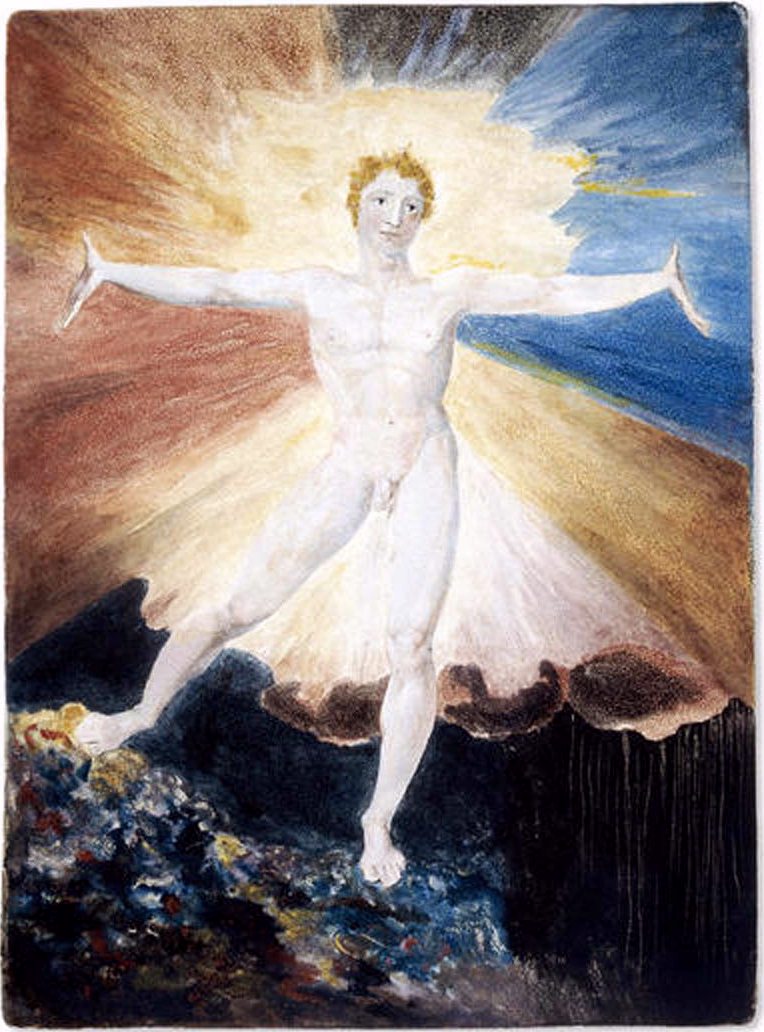
Blake is working toward a myth of history here, and as a Briton he naturally gravitates toward the myth of King Arthur, who is a kind of avatar of Blake's Albion:
William Blake, Albion Rose, 1794-95
The giant Albion, was Patriarch of the the Atlantic; he is the Atlas of the Greeks, one of those the Greeks called Titans. The stories of Arthur are the acts of Albion, applied to a Prince of the fifth century, who conquered Europe, and held the Empire of the world in the dark age, which the Romans never again recovered.
Blake's mythology is, frankly, as mind-numbing to follow as Yeats's theory of history with its gyres and cones. But here what he's proclaiming is a connection with the historical past that has been lost in part because of the emergence of rationalism. "The antiquities of every Nation under Heaven, is no less sacred than that of the Jews," he asserts.
The reasoning historian, turner and twister of causes and consequences, such as Hume, Gibbon, and Voltaire, cannot with all their artifice turn or twist one fact or disarrange self evident action and reality. Reasons and opinions concerning acts are not history. Acts themselves alone are history, and these are neither the exclusive property of Hume, Gibbon, nor Voltaire.... All that is not action is not worth reading.... His opinions, who does not see spiritual agency, is not worth any man's reading; he who rejects a fact because it is improbable, must reject all History and retain doubts only.


Nicolas Berdyaev: Myth as Memory

"Myth is no fiction, but a reality," Berdyaev says in The Meaning of History (1923). "All great historical epochs, even those of modern history with their tendency to discredit mythology, give rise to myths." The individual human being is "a sort of microcosm in which the whole world of reality and all the great historical epochs combine and coexist." And in order to maintain some integrity of personality, of self-awareness, the individual must come to terms with this fact. Berdyaev, too, verges on the Jungian:
Only deep down in his own self can man really discover the secrets of time; for these, far from being something superficial and alien, something imposed and forced upon him from without, represent on the contrary the deepest and most mysterious strata implicit in himself. A narrow consciousness would either disregard these strata or relegate them to a secondary plane.
Like Blake, Berdyaev finds the rationalist, analytical approach to history wanting: "The divorce of the subject from object as the result of enlightened criticism may provide material for historical knowledge, but in so far as it destroys the myth and dissociates the depths of time from those of man, it only serves to divorce man from history." But unlike Blake, he is willing to grant it some value, as long as it makes room for the social function of tradition and for the role of religion:
Tradition is synonymous with the knowledge of historical life; for its symbolism reveals the inner life and the profound organic union of historical reality with that which man discovers his own spiritual self-knowledge.... I am therefore inclined to believe that the mysteries of the divine as well as of the human and world life, with all their complexity of historical destiny, admit of solution only through concrete mythology. The knowledge of the divine life is not attainable by means of abstract philosophical thought based upon the principles of formalist or rationalistic logic, but only by means of a concrete myth which conceives the divine life as a passionate destiny of concrete and active persons....
For Berdyaev, the myth, which includes the "drama of love and freedom" of Christianity, is the only way to comprehend "the destinies of both man and the world."

Tuesday, May 10, 2011

25. The Modern Tradition, edited by Richard Ellmann and Charles Feidelson Jr., pp. 539-558

The Unconscious: Introduction; Unreason and Reason (Johann Wolfgang von Goethe, William Blake, Arthur Schopenhauer, Friedrich Nietzsche)
_____

Johann Wolfgang von Goethe: The Demoniac

As the editors' introduction says, in the movement of thought leading up to Freud's creation of psychoanalysis, "The traditional primacy of ideas over feeling, purpose over instinct, reason over energy, is ... questioned and often repudiated." In this selection from Truth and Fiction Relating to My Life (a very clunky translation of the title Aus meinem Leben: Dichtung und Wahrheit, 1811-1822), Goethe examines the sense of something in nature that "was not godlike, for it seemed unreasonable; not human, for it had no understanding; nor devilish, for it was beneficent; nor angelic, for it often betrayed a malicious pleasure." He calls it the "Demoniac, after the example of the ancients," and notes that he has observed it in certain individuals who seem to possess "a tremendous energy"and to "exercise a wonderful power over all creatures."
Seldom if ever do the great men of an age find their equals among their contemporaries, and they are to be overcome by nothing but by the universe itself; and it is from observaton of this fact, that the strange but most striking proverb must have risen, Nemo contra Deum nisi Deus ipse.
No one can oppose a god if he isn't a god himself.


William Blake: Energy and Reason


Blake's "The Marriage of Heaven and Hell" (1793) accepts what Goethe calls the Demoniac as an essential creative principle, and anticipates Nietzsche's dualism of Apollonian and Dionysian. Hell is energy, and Heaven is reason, to oversimplify. And as Blake asserts, "Religion is an endeavour to reconcile the two." 


Arthur Schopenhauer: Will and Knowledge

In The World as Will and Idea (1818), Schopenhauer represents the traditional view as an assertion that human beings possess a soul that is primarily a vehicle for knowledge, and that from this knowledge humans learn that certain things are good. They then apply the secondary power of will to seek that which is good. This is, he says, "a reversal of the true relation." The will is the primary force: "Will is first and original; knowledge is merely added to it as an instrument belonging to the phenomenon of will."
What the man really and in general wills, the striving of his inmost nature, and the end he pursues in accordance with it, this we can never change by influence upon him from without by instruction, otherwise we could transform him.
The best we can do through moral instruction is to "teach the will that it erred in the means it employed and can therefore bring it about that the end after which it strives ... shall be pursued on an entirely different path and in an entirely different object from what has hitherto been the case. But it can never bring about that the will shall will something actually different from what it has hitherto willed."

The individual human is a finite being "in infinite space and time, and consequently ... a vanishing quantity compared with them." We exist "only in the present, whose unchecked flight into the past is a constant transition into death, a constant dying." In physical terms, just as "walking is ... merely a constantly prevented falling," bodily existence "is only a constantly prevented dying." And mental activity "is a constantly deferred ennui."
We pursue our life, however, with great interest and much solicitude as long as possible, as we blow out a soap-bubble as long and as large as possible, although we know that it will burst.
Because frustration of the will produces pain, and "too easy satisfaction" of what it desires produces only "a terrible void and ennui," life is a continual oscillation "between pain and ennui." The religious portrayal of hell as a place of constant pain, therefore, leaves "nothing over for heaven but ennui."

The body itself "is nothing but the objectified will to live." And the human being "stands upon the earth ... uncertain about everything except his own need and misery." For the mass of humanity, life is a constant struggle for existence, "with the certainty of losing it at last. But what enables them to endure this wearisome battle is not so much the love of life as the fear of death, which yet stands in the background as inevitable, and may come upon them at any moment."


Friedrich Nietzsche: Dionysos and Apollo

In The Birth of Tragedy (1872), Nietzsche posits a duality of the Apollonian and the Dionysiac -- roughly a dichotomy of reason and order vs. passion and chaos -- that, like Blake's Heaven and Hell, marry and beget "Attic tragedy, which exhibits the salient features of both parents." He compares the states of "dream and intoxication, two physiological phenomena standing toward one another in much the same relationship as the Apollonian and Dionysiac."
The person who is responsive to the stimuli of art behaves toward the reality of dream much the way the philosopher behaves toward the reality of existence: he observes exactly and enjoys his observations, for it is by these images that he interprets life, by these processes that he rehearses it. Nor is it by pleasant images alone that such plausible connections are made: the who divine comedy of life, including its somber aspects, its sudden balkings, impish accidents, anxious expectations, moves past him, not quite like a shadow play -- yet never without giving a fleeting sense of illusion.
Apollo was both the god of light and the soothsayer, and as the bearer of truths represents both the dream state and art, which are closely related. Apollo's "looks and gestures radiate the full delight, wisdom, and beauty of 'illusion.'"

The Dionysiac "rapture, whose closest analogy is furnished by physical intoxication," brings about the bond between individual human beings and between humanity and nature.
If one were to convert Beethoven's "Paean to Joy" into a painting, and refuse to curb the imagination when that multitude prostrates itself reverently in the dust, one might form some apprehension of the Dionysiac ritual. Now the slave emerges as a freeman; all the rigid, hostile walls which either necessity or despotism has erected between men are shattered.... He feels himself to be godlike and strides with the same elation and ecstasy as the gods he has seen in his dreams.
Nietzsche goes on to interpret the choral finale of Beethoven's Ninth as an expression of Dionysiac rapture, quoting the line from the Schiller poem set by Beethoven: "Do you fall on your knees, multitudes, do you divine your creator?" (Ihr stürzt nieder, Millionen? Ahnest du den Schöpfer, Welt?)

Nietzsche asserts that the cult of Dionysus was prevalent elsewhere in the ancient world but was held in check in Greece by "the proud, imposing image of Apollo, who in holding up the head of the Gorgon to those brutal and grotesque Dionysiac forces subdued them. Doric art has immortalized Apollo's majestic rejection of all license."
Apollo's music was a Doric architecture of sound -- of barely hinted sounds such as are proper to the cithara. Those very elements which characterize Dionysiac music and, after it, music quite generally: the heart-shaking power of tone, the uniform stream of melody, the incomparable resources of harmony -- all these elements had been carefully kept at a distance as being inconsistent with the Apollonian norm.
Do I need to interject here that classical scholars dismiss Nietzsche's account of Greek art and religion as pure fantasy? But Nietzsche was not really interested in presenting a factual account of ancient history, any more than Blake was describing a literal marriage of Heaven and Hell. Apollo represents for him the Olympian attitude, with Dionysos as an expression of Goethe's Demoniac force. "The same drive that found its most complete representation in Apollo generated the whole Olympian world, and in this sense we may consider Apollo the father of that world.... Nothing in these deities reminds us of asceticism, high intellect, or duty: we are confronted by luxuriant, triumphant existence, which deifies the good and the bad indifferently."

He tells the story of King Midas, who asked Silenus, the companion and (in one version of the myth) the tutor of Dionysos, "what he considered man's greatest good." Silenus responded:
"Ephemeral wretch, begotten by accident and toil, why do you force me to tell you what it would be your greatest boon not to hear? What would be best for you is quite beyond your reach: not to have been born, not to be, to be nothing. But the second best is to die soon."
That makes Schopenhauer sound cheerful. Nietzsche sees the Olympian gods as a projection of human beings, "keenly aware of the terrors and horrors of existence; in order to be able to live at all they had to place before them the shining fantasy of the Olympians." The same religion-as-fantasy impulse also gave rise to art "as a completion and consummation of existence." As for the gods, they "justified human life by living it themselves -- the only satisfactory theodicy ever invented." (The same impetus to project human existence into divinity also gives rise to the Christian idea of the Incarnation, of God become Man.) 

With the example of the immortal gods before them, "Now it became possible to stand the wisdom of Silenus on its head and proclaim that it was the worst evil for man to die soon, and second worst for him to die at all." Thus human heroes, a little bit lower than the gods, appeared in the poetry of Homer.
It should have become apparent by now that the harmony with nature which we late-comers regard with such nostalgia, and for which Schiller has coined the cant term naïve, is by no means a simple and inevitable condition to be found at the gateway to every culture, a kind of paradise.... The naïveté of Homer must be viewed as a complete victory of Apollonian illusion.... In the case of the Greeks it was the will wishing to behold itself in the transcendence of genius; but in order so to behold itself its creatures had to view themselves as glorious, to transpose themselves to a higher sphere, without having that sphere of pure contemplation either challenge them or upbraid them with insufficiency. It was in that sphere of beauty that the Greeks saw the Olympians as their mirror images; it was by means of that esthetic mirror that the Greek will opposed suffering and the somber wisdom of suffering which always accompanies artistic talent.
Humans have "an intense longing for illusion" and our dreams "appear to us as illusions of illusions, hence as a still higher form of satisfaction of the original desire for illusion." Nietzsche turns here to a later artist, Raphael, and his painting of the Transfiguration.
He finds in it "that reduction of illusion to further illusion which is the original act of the naïve artist and at the same time of all Apollonian culture." In the lower half of the painting we have confusion ("the helpless, terrified disciples")  and pain ("the possessed boy") -- "íllusion' here is a reflection of eternal contradiction, begetter of all things. From this illusion there arises, like the fragrance of ambrosia, a new illusory world, invisible to those enmeshed in the first; a radiant vision of pure delight, a rapt seeing through wide-open eyes. Here we have, in a great symbol of art, both the fair world of Apollo and its substratum, the terrible wisdom of Silenus, and we can comprehend intuitively how they mutually require one another."

The Apollonian attitude "demands self-control" and produces maxims like "Know thyself" and "Nothing too much." Consequently, "the Dionysiac spirit struck the Apollonian Greeks as titanic and barbaric." But antithetical forces must coexist. And out of their coexistence comes the tragic vision, producing "the sublime and much lauded achievement of the dramatic dithyramb and Attic tragedy, as the common goal of both urges; whose mysterious marriage, after long discord, ennobled itself with such a child, at once Antigone and Cassandra."

In Beyond Good and Evil (1886), Nietzsche returned to the Apollonian and Dionysian, but in a more prophetic, less explanatory vein, reporting the conversation of a devotee with Dionysus:
Once, for example, he said "I love mankind under certain conditions" (alluding to Ariadne who was there at the time), "man seems to me to be a pleasant, courageous, inventive animal who has not his likes on earth; he can find his way around any labyrinth. I wish him well; I often contemplate how I might advance him, how I might make him stronger, more evil, and deeper than he is." "Stronger, more evil, and deeper?" I asked, shocked. "Yes," he said once more, "stronger, more evil, deeper, and also -- more beautiful!" -- and saying this he smiled his halcyon smile, this Tempter-God, as though he had delivered himself of an endearing courtesy. One sees at once that it is not only modesty which this divinity lacks.... There are good reasons, in fact, for supposing that all the gods could learn from us men in several respects. We man are more -- humane....

Monday, April 18, 2011

4. The Modern Tradition, edited by Richard Ellmann and Charles Feidelson Jr., pp. 54-73

Symbolism: Imagination and Nature; Symbolic Nature (William Blake, William Wordsworth, Charles Baudelaire, W.B. Yeats, Paul Klee). Symbolism: Imagination and Thought; The State of Doubt (Johann Wolfgang von Goethe, John Keats, Gustave Flaubert)
_____

William Blake: The Eternal World of Vision

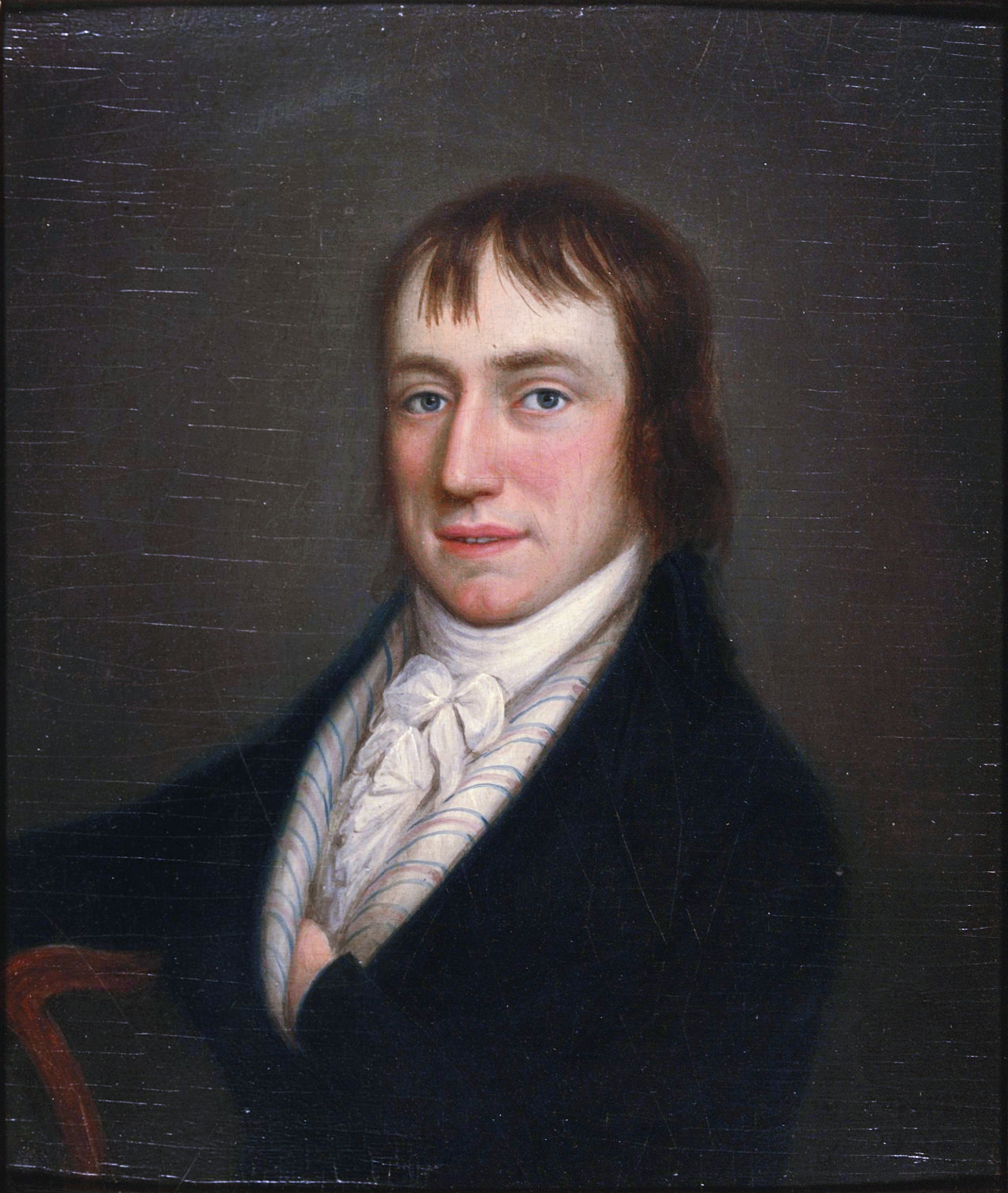
Thomas Phillips, William Blake, 1802
In the first selection, a 1799 letter to a clergyman, the Rev. Dr. Trusler, Blake asserts,
This World Is a World of Imagination & Vision. I see Every thing I paint In This World, but Every body does not see alike. To the Eyes of a Miser a Guinea is far more beautiful than the Sun, & a bag worn with the use of Money has more beautiful proportions than a Vine filled with Grapes.... But to the Eyes of the Man of Imagination, Nature is Imagination itself. 
Blake champions the imagination because it gives him an entree to the significance of the external world: "To Me This World is all One continued Vision of Fancy or Imagination," and for the great poets -- he cites Homer, Virgil and Milton in particular -- Imagination is the vehicle for "Spiritual Sensation." As for his own works of visual art, he is particularly pleased that "Children ... have taken a greater delight in contemplating my Pictures than I even hoped." Not that there is anything inherently more receptive about children: "Some Children are Fools & so are some Old Men. But There is a vast Majority on the side of Imagination or Spiritual Sensation."
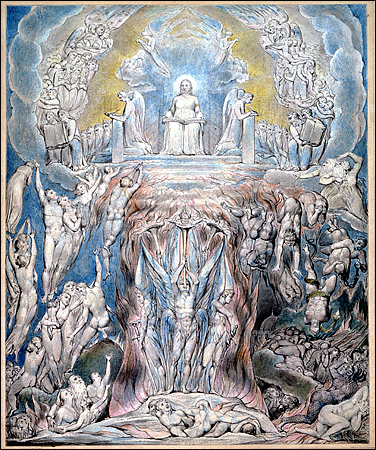
William Blake, A Vision of the Last Judgment, pen and watercolor, 1808
William Blake, watercolor illustration for Robert Blair's The Grave, 1805
Blake's painting of the Last Judgment was to be part of an exhibit in 1810, but the exhibit was canceled and the work was subsequently lost. The watercolor versions shown above follow the plan Blake outlined for the painting. In the second excerpt in this section of The Modern Tradition, written in 1810 for the catalog of the canceled exhibition, Blake discusses the work, insisting that it is "not Fable or Allegory but Vision. Fable or Allegory are a totally distinct & inferior kind of Poetry. Vision or Imagination is a Representation of what Eternally Exists, Really & Unchangeably.... The Hebrew Bible & the Gospel of Jesus are not Allegory, but Eternal Vision or Imagination of All that Exists."

For Blake, art is a rejection of mutability, of the impermanence of existence: "This world of Imagination is the world of Eternity; it is the divine bosom into which we shall all go after the death of the Vegetated body." It is also a rejection of materialism, "of Bad Art & Science. Mental Things are alone Real; what is call'd Corporeal, Nobody Knows of its Dwelling Place: it is in Fallacy, & its Existence is an Imposture." The material world is illusory, and Blake the visionary sees through it: The sun is not "a round disk of fire somewhat like a Guinea" to Blake. Instead it is "an innumerable company of the Heavenly host crying, 'Holy, Holy, Holy is the Lord God Almighty.'" The trick is to see through nature to the eternity behind it: "I question not my Corporeal or Vegetative Eye any more than I would Question a Window concerning a Sight. I look thro' it & not with it."


William Wordsworth: Natural Apocalypse

William Wordsworth in 1789
The selection from The Prelude reprinted here is a considerably tamer version of Blake's nature mysticism. Wordsworth regards an event -- or rather the recognition of an event -- as an epiphany, or what he would elsewhere call a "spot of time." The event in itself has no grand significance in material terms: The party he is traveling with has crossed the Alps. But the awareness that they have done so is "translated by our feelings" into something greater, and
Imagination -- here the Power so called
Through sad incompetence of human speech,
That awful Power rose from the mind's abyss
Like an unfathered vapour that enwraps,
At once, some lonely traveleler. 
Imagination produces "a flash that has revealed / The invisible world." And so, at least for a time, the natural phenomena they encounter -- waterfalls, winds, rocks, crags, clouds, darkness and light -- become symbols of something beyond the material world, they
Were all like workings of one mind, the features
Of the same face, blossoms upon one tree;
Characters of the great Apocalypse,
The types and symbols of Eternity,
Of first, and last, and midst, and without end. 
It's probably worth noting here that "apocalypse" has come to denote the events attendant on the end of the world, when the word's Greek origins meant "uncovering" or "revelation." An apocalypse is a revelation of truths, and not the truths themselves. So what Wordsworth means here is not a vision of the end of the world, but simply the unveiling of the meaning behind the surface phenomena of existence. He senses, but can't articulate, something eternal, which is precisely what Blake was getting at when he asserted that the imagination gives one visions of eternity.


Charles Baudelaire: The Temple of Nature

Charles Baudelaire, c. 1863
Baudelaire's poem "Correspondances" (1857) posits that nature is a temple, and by extrapolation we might suggest that the artist is its  priest, translating the "babel of words" uttered by the temple's "living pillars." The senses receive the sights, the colors, the sounds and scents as finite manifestations of infinite things. In the poem, Baudelaire lays particular emphasis on the sense of smell, which is the most intimate and subjective of the senses, taking in "perfumes" that are "fresh and cool," "mellow," "green," "perverse, rich, and triumphant." And in turn, these odors evoke the tactile ("the bodies of children"), the auditory ("oboes"), and the visual ("fields"), as well as such moral qualities as perversity, richness and triumph.


W.B. Yeats: Symbol as Revelation

John Butler Yeats, William Butler Yeats, 1900
Everybody likes to complain about journalists, and in this essay, "The Symbolism of Poetry" (1900), Yeats is out to disabuse the readers of the notion, apparently foisted upon them by journalists, that artists proceed without any higher aim or theoretical purpose. And here, of course, he proceeds to enunciate his own.

He cites several lines of verse in which metaphor takes on a larger symbolic role, beginning with Robert Burns's
The white moon is setting behind the white wave,
And Time is setting with me, O!
He says, quite correctly, "Take from them the whiteness of the moon and of the wave, whose relation to the setting of Time is too subtle for the intellect, and you take from them their beauty." And he's right: an 18th-century critic might object that neither the moon nor the wave is, strictly speaking, white. But we only have to go to Melville's great discourse on "The Whiteness of the Whale" to observe the symbolic power of the adjective. As Yeats puts it, "All sounds, all colours, all forms, either because of their pre-ordained energies or because of long association, evoke indefinable and yet precise emotions." The italics in that quotation are mine, to emphasize the seeming oxymoron: If precise, then why indefinable? But that's the point: Symbols evoke precise emotions, but if they were definable, we wouldn't need symbols to evoke them.

The function of the symbol in art, as Yeats sees it, is to bring unity out of multiplicity: "when sound, and colour, and form are in a musical relation, a beautiful relation to one another, they become as it were one sound, one colour, one form, and evoke an emotion that is made out of their distinct evocations and yet is one emotion." And it is the artist who, by perceiving the power of the symbol, translates that power to the rest of the world: "I am certainly never certain, when I hear of some war, or of some religious excitement or of some new manufacture, or of anything else that fills the ear of the world, that it has not happened because of something that a boy piped in Thessaly." Okay, that's a bit extravagant. But try this one on for truth: "I doubt ... that love itself would be more than an animal hunger but for the poet and his shadow the priest." (That subordination of the religious to the artistic is quite lovely.)

Poets and musicians achieve their effects by species of hypnotism, Yeats asserts:
The purpose of rhythm, it has always seemed to me, is to prolong the moment of contemplation, the moment when we are both asleep and awake, which is the one moment of creation, by hushing us with an alluring monotony, while it holds us waking by variety, to keep us in that state of perhaps real trance, in which the mind liberated from the pressure of the will is unfolded in symbols. If certain sensitive persons listen persistently to the ticking of a watch, or gaze persistently on the monotonous flashing of a light, they fall into the hypnotic trance; and rhythm is but the ticking of a watch made softer, that one must needs listen, and various, that one may not be swept beyond memory or grow weary of listening; while the patterns of the artist are but the monotonous flash woven to take the eyes in a subtler enchantment.
And "enchantment" is the aim, or at least as long as it is in service of something of value. The emptying out of religious belief has, in Yeats's view, crippled the world turning it toward the materialistic. "How can the arts overcome the slow dying of men's hearts that we call the progress of the world, and lay their hands upon men's heartstrings again, without becoming the garment of religion as in old times?"  If the piping of a Thessalian boy can cause people to go to war, then artists need to be conscious of the ends toward which their work can move people. Artists need to avoid the didactic, the moralizing, the anecdotal, and "that brooding over scientific opinion that so often extinguished the central flame in Tennyson." They need to discover the symbolic force of the world around them, to "return to imagination" and to understand "that the laws of art, which are the hidden laws of this world, can alone bind the imagination."

To return to the topic of rhythm, Yeats "would cast out of serious poetry those energetic rhythms, as of a man running, which are the invention of the will with its eyes always on something to be done or undone; and we would seek out those wavering, meditative, organic rhythms, which are the embodiment of the imagination, that neither desires nor hates, because it has done with time, and only wishes to gaze upon some reality, some beauty."


Paul Klee: Eternal Genesis

Paul Klee, date unknown
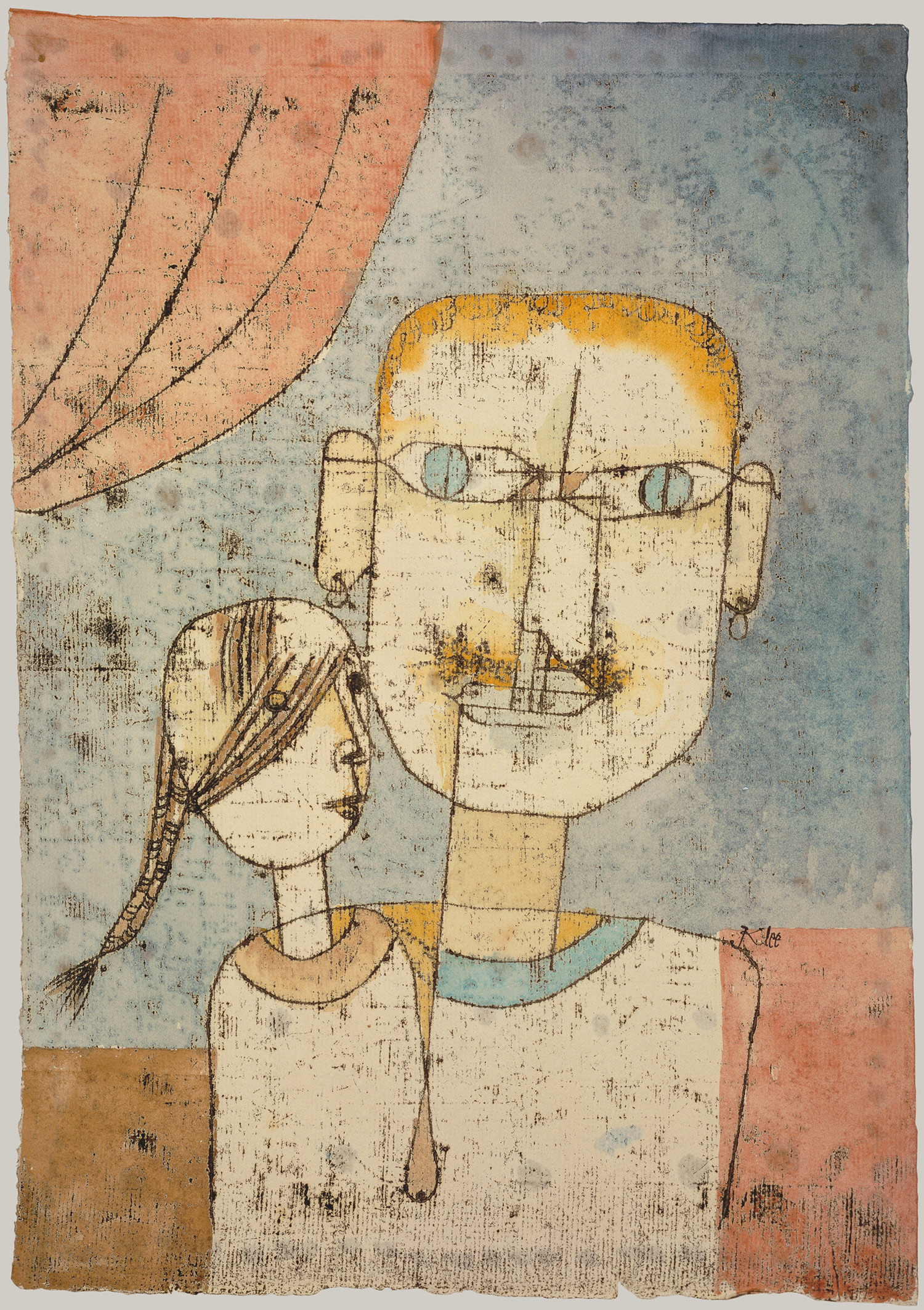
The excerpts are from Klee's On Modern Art (posthumously published in 1945), and are a series of brief, epigrammatic paragraphs. Klee asserts that the artist's role is defined by the word "creation" and that art is perpetually generative, creating a new nature as it were.
The deeper he looks, the more readily he can extend his view from the present to the past, the more deeply he is impressed by the one essential image of creation itself, of Genesis, rather than by the image of nature, the finished product. 
We are back here to the distinction between natura naturata ("the finished product") and natura naturans ("creation itself'" or the act of creating). Klee looks to the artist to create new things, not to reproduce the things already created.
Paul Klee, Flower Myth, 1918

The artist's role is "not to provide a scientific check on the truth of nature" but to demand "freedom," defined as "the right to develop, as great Nature herself develops." The source of it all is, of course, imagination, and "What springs from this source, whatever it may be called, dream, idea or phantasy -- must be taken seriously only if it unites with the proper creative means to form a work of art." He retorts to the critics of his own work, who have called it "childish," that the label "most have originated from those linear compositions of mine in which I tried to combine a concrete image, say that of a man, with the pure representation of the linear element.
Had I wished to present the man "as he is," then I  should have had to use such a bewildering confusion of line that pure elementary representation would have been our of the question. The result would have been vagueness beyond recognition.

And anyway, I do not wish to represent the man as he is, but only as he might be.
Paul Klee, Miraculous Landing, or the "112!"  1920
Paul Klee, Adam and Little Eve, 1921


Johann Wolfgang von Goethe: Escape From Ideas

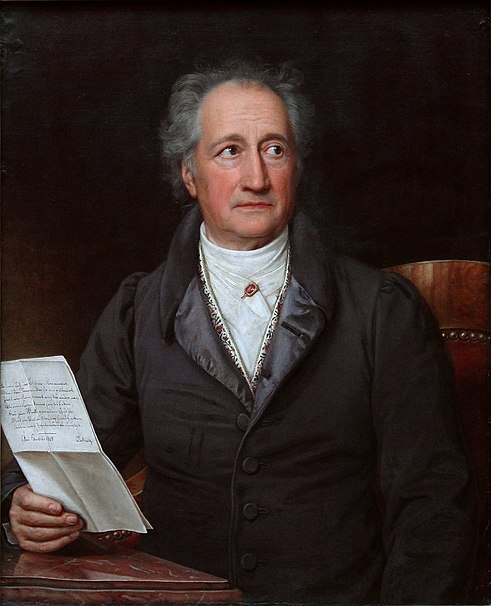
Joseph Karl Stieler, Goethe age 69, 1828
Artists are always irritated by being asked, "What are you trying to say?" and Goethe, to judge from this excerpt from J.P. Eckermann's Conversations of Goethe (1836), was no exception.
"It was ... not in my line, as a poet, to strive to embody anything abstract. I received in my mind impressions, and those of a sensual, animated, charming, varied, hundredfold kind, just as a lively imagination presented them; and I had, as a poet, nothing more to do than artistically to round off and elaborate such views and impressions, and by means of a lively representation so to bring them forward that others might receive the same impression in hearing or reading my  representation of them."
This is the artist as medium between the universe and the observer. But the role doesn't come with any responsibility to make the message simple and comprehensible: "I am rather of the opinion, that the more incommensurable, and the more incomprehensible to the understanding, a poetic production is, so much the better it is." (So much for anyone who has tried to find a simple message in Faust.)

As for the role of religion in art, "'Religion,' said Goethe, 'stands in the same relation to art as any other of the higher interests in life." What predominates for the artist is not dogma but the human element: "Art must address itself to those organs with which we apprehend it; otherwise it misses its effect. A religious material may be a good subject for art, on only in so far as it possesses general human interest." That's why portraits of the Madonna and Child have always been popular.


John Keats: Negative Capability

William Hilton, John Keats, date unknown
This famous excerpt from Keats's letter to his brothers George and Thomas has a phrase in it that I think is often mispronounced, and therefore misunderstood: "negative capability." I think the word isn't NEGative but neGAtive -- i.e., the function of negating. And we shouldn't lose the context in which Keats came up with this powerful concept: He had been to a dinner with some friends "who say things which make one start, without making one feel." Their conversation "only served to convince me how superior humour is to wit." The priority given to feeling over intellect here is characteristic, and it feeds into his though about Shakespeare's "Negative Capability, that is, when a man is capable of being in uncertainties, mysteries, doubts, without any irritable reaching after fact and reason." Keats isn't against fact and reason, he just wants to put it in its place, and its place isn't in literature.


Gustave Flaubert: Art Without Conclusions

Gustave Flaubert, date unknown
In this 1857 letter to Marie-Sophie Leroyer de Chantepie, with whom Flaubert carried on an extended correspondence, he rejects the idea that human beings can ever "attain to absolute knowledge of truth and goodness." In fact, the only road to happiness is to avoid the delusion that certainty is possible. "Life is such a hideous business that the only method of bearing it is to avoid it. And one does avoid it by living in Art, in the ceaseless quest for Truth presented by Beauty." (The kinship with Keats's conclusion, "Beauty is truth, truth Beauty, -- that is all / Ye know on earth, and all ye need to know," is evident, except that Keats's formulation of that dictum is loaded with irony.)
Superficial, limited creatures, rash, feather-brained souls, demand a conclusion from everything; they want to know the purpose of life and the dimensions of the infinite. Picking up a handful of sand in their poor, puny grasp, they say to the Ocean: "I shall now count the grains on your shores." but when the sand slips through their fingers and the sum proves long, they stamp and burst into tears. Do you know what we should do on that shore? Either kneel down or walk. You must walk. 
The advice is not to cease from questioning, but to cease from hoping for a definitive answer. Strive, but don't overreach. "No great genius has come to final conclusions; no great book ever does so, because humanity itself is forever on the march and can arrive at no goal. Homer comes to no conclusions, nor does Shakespeare, nor Goethe, nor even the Bible." Thus Flaubert rejects not only religion but also politics, believing instead in "the perpetual evolution of humanity and in its ever-changing forms, and consequently I abominate all those frames which men try to cram it into by main force, all the formulas by which they define it, and all the plans they devise for it.... it seems idiotic to me to seek the best religion or the best government. For me, the one on its deathbed is the best, since it is then making way for another."