JOURNAL OF A COMPULSIVE READER
By Charles Matthews
Showing posts with label Satan. Show all posts

Thursday, March 10, 2011

10. Paradise Lost, by John Milton, pp. 235-265

PARADISE LOST by John Milton, edited by Merritt Y. HughesBook X
_____
As Samuel Johnson said of Paradise Lost, "None ever wished it longer than it is." And when you've reached the Fall, a lot of what remains is anticlimax.

The "Angelic Guards" depart from Eden, and are greeted with sadness in Heaven, although Milton hastens to add that it "violated not thir bliss." Apparently it takes a lot to get an angel down. God smooths things over a bit by saying "I told you so": He had said Satan would succeed in seducing humankind, but that's the way free will works. Meanwhile, he notes that Adam and Eve are puzzling over the fact that they haven't been struck dead yet, so to keep them from assuming that they aren't being punished he commissions the Son to go down and explain it all to them. The throng of angels follows the Son to the gates of Heaven to see him off.
Francis Hayman, 1749
Gustave Doré, 1866

Adam and Eve hear "the voice of God ... Now walking in the Garden" and try to hide, but they come out when he calls for Adam. Eve follows, though "more loath" to do so. "Love was not in thir looks, either to God / Or to each other, but apparent guilt, / And shame, and perturbation, and despair, / Anger, and obstinacy, and hate, and guile." Adam's excuse is that he was naked, which elicits the obvious question: "that thou art naked, who / Hath told thee? hast thou eaten of the Tree / Whereof I gave thee charge thou shouldst not eat?" Adam is reluctant to blame Eve, but he does, referring to her as "This Woman whom thou mad'st to be my help."

The retort is a sharp one: "Was shee thy God, that her thou didst obey / Before his voice"? But the followup is typically sexist: "Thou didst resign thy Manhood, and the Place / Wherein God set thee above her made of thee." Eve, too, tries to pass the buck: "The Serpent me beguil'd and I did eat." God then directs his attention to the serpent in ways that seem to me unfair: the poor snake was just lying there asleep when Satan took over its body. Nevertheless, it gets cursed to grovel on its belly and eat dust.
Between Thee and the Woman I will put
Enmity, and between thine and her Seed:
Her Seed shall bruise thy head, thou bruise his heel.
   So Spake this Oracle, then verifi'd
When Jesus son of Mary second Eve,
Say Satan fall like Lightning down from Heav'n
Though here Milton is getting ahead of his story. Getting back to the first Eve, God tells her, "Children thou shalt bring / In sorrow forth, and to thy Husband's will / Thine shall submit, hee over thee shall rule." (He's had a little bit of trouble making that last one stick, so maybe the reporters got it wrong.) As for Adam, he'll have to work for a living, and it won't be so easy tending a garden because God plans to invent weeds. And since he was created out of the ground, he'll return to it after death, which isn't going to happen right away, as they had feared. But he takes pity on them for being so ashamed of their nakedness and provides them with clothes made from "Skins of Beasts." Milton isn't sure whether God skinned the beasts right then and there or made them shed their skins and put on new ones, like "the Snake with youthful Coat repaid. And then he goes back to Heaven.

Meanwhile, Sin and Death have been at work building a kind of causeway through Chaos, from Hell to the universe. And Death has smelled his "prey innumerable" in the fallen world. Satan is delighted to find that his children have been so productive.
Hee, after Eve seduc't, unminded slunk
Into the Wood fast by, and changing shape
To observe the sequel, saw his guileful act
By Eve, though all unweeting, seconded
Upon her Husband, saw thir shame that sought
Vain covertures; but when he saw descend
The Son of God to judge them, terrifi'd he fled
Now he encounters Sin and Death, and Sin gives him credit for his "magnific deeds."
Thine now is all this World, thy virtue hath won
What thy hands builded not, thy Wisdom gain'd
With odds what War hath lost, and fully aveng'd
Our foil in Heav'n
Satan tells them to go ahead and take over the Earth, "Dominion exercise and in the Air, / Chiefly on Man, sole Lord of all declar'd, / Him first make sure your thrall, and lastly kill." Meanwhile, he's going back to Hell to boast about what he's done.
The fallen angels await Satan's return, by Gustave Doré, 1866

He disguises himself as a "Plebeian Angel militant / Of lowest order," enters Pandaemonium, and invisibly takes his place on the throne, making a surprise entrance when "At last as from a Cloud his fulgent head / And shape Star-bright appear'd, or brighter, clad / With what permissive glory since his fall / Was left him, or false glitter." He addresses his minions with a speech about his glorious deeds, though he fudges some of the details. For example, he claims that "Night and Chaos wild ... fiercely oppos'd / My journey strange," when in fact they helped him. As for Adam, "Him by fraud I have seduc'd / From his Creator, and the more to increase / Your wonder, with an Apple." And he got away without being punished, he claims: Instead, God punished "the brute Serpent in whose shape / Man I deceiv'd."
                                            I am to bruise his heel;
His Seed, when is not set, shall bruise my head:
A World who would not purchase with a bruise,
Or much more grievous pain?  Ye have th' account
Of my performance: What remains, ye Gods,
But up and enter now into full bliss.
   So having said, a while he stood, expecting
Thir universal shout and high applause
To fill his ear, when contrary he hears,
On all sides, from innumerable tongues,
A dismal universal hiss, the sound
Of public scorn
Gustave Doré, 1866

He and his followers have all been turned into snakes, and Milton does a nice job of imagining the metamorphosis: "His Visage drawn he felt to sharp and spare, / His Arms clung to his Ribs, his Legs entwining / Each other, till supplanted down he fell / A monstrous Serpent on his Belly prone." The crowd outside the council hall is surprised to see a writhing mass of snakes emerge from it, and they too are transformed. Then they see a grove of fruit trees that resemble the fatal tree in the Garden, but when they taste the fruit it turns to ashes in their mouths. Eventually they resume their former shapes, but Milton says that they have  to undergo this "humbling" annually "To dash thir prid, and joy for Man seduc't."
Sin and Death arrive on Earth, by Gustave Doré, 1866

Sin and Death arrive on Earth, but Death is disappointed that there are so few creatures to feed on. Sin tells him to start with the plants and the animals until there are enough human beings. She'll spend her time infecting humanity "And season him thy last and sweetest prey." In Heaven, God assures the angels that the ravishment of Paradise will not last forever, but eventually "Heav'n and Earth renew'd shall be made pure / To sanctity that shall receive no stain: / Till then the Curse pronounc't on both precedes." The angels sing a Halleluiah.

Meanwhile, there are some cosmic details to take care of, such as shifting the angle of the Sun to create seasons of extreme cold and extreme heat, and arranging it so the planets and constellations have their zodiacal effect on things.
Some say he bid his Angels turn askance
The Poles of Earth twice ten degrees and more
From the Sun's Axle; they with labor push'd
Oblique the Centric Globe: Some say the Sun
Was bid turn Reins from th' Equinoctial Road 
In other words, either the Earth was moved or the Sun was -- again Milton waffles on the geocentric or heliocentric issue. 

The arrival of Sin and Death also introduces "Discord" and "fierce antipathy: / Beast now with Beast gan war, and Fowl with Fowl, / And Fish with Fish; to graze the Herb all leaving, / Devour'd each other." (Before the fall, all the animals were herbivorous.)  The whole thing depresses Adam, who wishes he'd never been created:
                                                     O fleeting joys
Of Paradise, dear bought with lasting woes!
Did I request thee, Maker, from my Clay
To mould me Man, did I solicit thee
From darkness to promote me, or here place
In this delicious Garden? 
He wants to die as soon as possible. But then he thinks that death might be worse: "in the Grave, / Or in some other dismal place, who knows / But I shall die a living Death?" It's the same fear that deters Hamlet from killing himself. And he realizes that he has also condemned his children to the same fate: "Ah, why should all mankind / For one man's fault thus guiltless be condemn'd, / If guiltless?" He frets about future generations blaming him, though his guilt is shared with "that bad Woman."
Adam rejects Eve's comfort, by William Strang, 1896

Eve tries to comfort him with "Soft words," but he orders her "Out of my sight, thou Serpent, that name best / Befits thee with him leagu'd, thyself as false and hateful." He would still be happy "had not thy pride / And wand'ring vanity, when least was safe, / Rejected my forewarning." Why did God create "this fair defect / Of Nature, and not fill the World at once / With Men as Angels without Feminine, / Or find some other way to generate Mankind?" He then imagines how hard it will be for future men to find mates: They'll want some woman who won't want them, or who will be forbidden to marry them by her parents, or they'll meet someone who is already married, and so on. It's a catalog of unhappy love affairs.

Eve begs him to forgive her and to realize that she needs his help, "Thy counsel in this uttermost distress, / My only strength and stay." They may not have long to live, she says, so "Between us two let there be peace, both joining, / As join'd in injuries, one enmity / Against a Foe by doom express assign'd us, / That cruel Serpent." They both have sinned, she admits, "but thou / Against God only, I against God and thee." She begs God to punish her, not him. She is "sole cause to thee of all this woe, / Mee mee only just object of his ire." 

Adam is moved by her selflessness and says he should bear the brunt of punishment -- after all, he's the man and she, well, she's just a woman.
                                                          If Prayers
Could alter high Decrees, I to that place
Would speed before thee, and be louder heard,
That on my head all might be visited,
Thy frailty and infirmer Sex forgiv'n,
To me committed and by me expos'd.
But rise, let us no more contend, nor blame
Each other, blam'd enough elsewhere, but strive
In offices of Love, how we may light'n
Each other's burden in our share of woe;
Since this day's Death denounc't, if aught I see,
Will prove no sudden, but a slow-pac't evil,
A long day's dying to augment our plain,
And to our Seed (O hapless Seed!) deriv'd. 
Eve also realizes the consequences of their having children, and suggests that either they abstain from sex or kill themselves, "So Death / Shall be deceiv'd his glut, and with us two / Be forc'd to satisfy his Rav'nous Maw." Adam is impressed that her "contempt of life and pleasure seems / To argue in thee something more sublime / And excellent than what thy mind contemns," but he's certain that God won't let them take the easy way out. He wants to have his revenge on Satan, and they won't get that opportunity if they kill themselves or don't have children to carry on their vengeance. So no more talk of suicide or sexual abstinence: "That cuts us off from hope, and savors only / Rancor and pride, impatience and despite." After all, the curse on them isn't all bad: The pain of child-bearing will be rewarded "with joy, / Fruit of thy Womb." (Easy for him to say.) And for having to work for his living, so what? "Idleness had been worse." He proposes that they ask God for guidance on how to deal with the changes in the weather, and how to use fire.

So they go to where they had received the punishment from the Son and confess their faults and pray for guidance.

Wednesday, March 9, 2011

9. Paradise Lost, by John Milton, pp. 202-234

PARADISE LOST by John Milton, edited by Merritt Y. HughesBook IX
_____
Milton winds up for the punch by telling us the story is about to turn "Tragic: foul distrust, and breach / Disloyal on the part of Man, revolt, / And disobedience." It's a "Sad task" he has before him, but he insists that the story is "more Heroic" than those of Homer and Virgil or those of "long and tedious havoc" of "fabl'd Knights / In Battles feign'd." His story has a "higher Argument," and he hopes that Urania will help him to "answerable style" and inspire his "unpremeditated Verse."
Satan finds his way into Eden, by Gustave Doré, 1866

Satan is back, having lurked in darkness for a week. He finds his way into Eden via a passage made by the Tigris as it flows out of Paradise, and turns himself into a mist as he "Consider'd every Creature, which of all / Most opportune might serve his Wiles, and found / The Serpent subtlest Beast of all the Field." And he launches into a soliloquy, expressing his admiration of Earth, but also his self-pity because he can't enjoy its delights: "all good to me becomes / Bane." And therefore he has to destroy it, "For only in destroying I find ease / To my relentless thoughts." He even lies to himself: "I in one Night freed / From servitude inglorious well nigh half / Th' Angelic Name." First of all, it took him three days, he lost the battle, his followers are imprisoned, and earlier estimates put his followers as more like a third than half of the angelic host. And now he finds God
Determin'd to advance into our room
A Creature form'd of Earth, and him endow,
Exalted from so base original,
With Heavn'ly spoils, our spoils
And to do his dirty work he has to disguise himself as "a Beast, and mixt with bestial slime, / This essence to incarnate and imbrute, / That to the highth of Deity aspir'd." So he goes in search of a serpent and squeezes into its mouth without disturbing its sleep, waiting until morning comes.
Satan in Eden, by Gustave Doré, 1866
Satan finds a snake to inhabit, by Gustave Doré, 1866

When Adam and Eve wake up, Eve has a bright idea: division of labor. Working together, she says, they sometimes get distracted: "Looks intervene and smiles, or object new / Casual discourse draw on, which intermits / Our day's work." Adam praises her -- condescendingly -- for coming up with the idea, "for nothing lovelier can be found / In Woman, than to study household good , / And good works in her Husband to promote." But he points out that the work isn't so hard and God doesn't seem to care if they take an occasional break for "this sweet intercourse / Of looks and smiles, for smiles from Reason flow, / To brute deni'd, and are of Love the food, / Love not the lowest end of human life." And he also worries "lest harm / Befell thee sever'd from me." Having heard about the fallen angels, he's aware of the danger.

Eve tells him that she heard that they had such an enemy -- she was standing nearby in "a shady nook" when Raphael told him about it. And she feels hurt that Adam doesn't trust her: "But that thou shouldst my firmness therefore doubt / To God or thee, because we have a foe / May tempt it, I expected not to hear."

Adam backpedals "with healing words," though he's still concerned about how powerful Satan must be: "Subtle he needs must be, who could seduce / Angels." Eve points out,
If this be our condition, thus to dwell
In narrow circuit strait'n'd by a Foe,
Subtle or violent, we not endu'd
Single with like defense, wherever met,
How are we happy, still in fear of harm?
Good point, and not unlike the one made in Areopagitica about "fugitive and cloistered virtue." Of course, in that treatise on censorship, Milton was writing about the fallen world. Adam is trying to keep the world from falling, but even so, Eve has put her finger on the problem: a troubled paradise isn't really paradise. Adam is getting a little exasperated with her: He addresses Eve as "O Woman," instead of some of his earlier blandishments, but after lecturing her on reason and free will, he finally gives in: "Go in thy native innocence, rely / On what thou hast of virtue, summon all, / For God towards thee hath done his part, do thine." Milton is not happy:
O much deceiv'd, much failing, hapless Eve,
Of thy presum'd return! event perverse!
Thou never from that hour in Paradise
Found'st either sweet repast, or sound repose;
Such ambush hid among sweet Flow'rs and Shades
Waited with hellish rancor imminent
To intercept thy way, or send thee back
Despoil'd of Innocence, of Faith, of Bliss. 
Satan finds his prey, by Gustave Doré, 1866

For sure enough, Satan discovers her, in one of the last truly lyric passages in the poem, one that echoes the earlier passage about Proserpina:
Beyond his hope, Eve separate he spies,
Veil'd in a Cloud of Fragrance, where she stood,
Half spi'd, so thick the Roses bushing round
About her glow'd, oft stooping to support
Each Flow'r of slender stalk, whose head though gay
Carnation, Purple, Azure, or speckt with Gold,
Hung drooping unsustain'd, them she upstahys
Gently with Myrtle band, mindless the while,
Herself, though fairest unsupported Flow'r,
From her best prop so far, and storm so nigh.
Satan is smitten with both the garden and Eve, like "one who long in populous City pent, / Where Houses thick and Sewers annoy the Air," venturing forth into the fresh air of the countryside. (Hell is a city much like Milton's London.)  He's so stunned by her beauty that he "abstracted stood / From his own evil, and for the time remain'd / Stupidly good, of enmity disarm'd, / Of guile, of hate, of envy, of revenge." But if Satan is for a moment "good," it's because he's in a passive state, not because he's capable of being actively good. And it doesn't take him long to come to his evil senses: "Fierce hate he recollects." He gloats that he has found Eve alone, without Adam, "Whose higher intellectual more I shun."

And so he sidles up to her, not slithering on his belly because prelapsarian snakes apparently had a way of getting around on a "Circular base of rising folds." And he begins to sweet-talk her as "A Goddess among Gods, ador'd and serv'd / by Angels numberless." She's surprised that he can talk. So he tells her he learned how after eating the fruit of a particular tree. Naturally, she wants to see this tree, and he gleefully leads her there. "So glister'd the dire Snake, and into fraud / Led Eve or credulous Mother, to the Tree / Of prohibition, root of all our woe."

Naturally, she's disappointed: "Serpent, we might have spar'd our coming hither," she tells him. She explains about the prohibition, whereupon he puts on a "show of Zeal and Love / To Man, and indignation at his wrong." He begins to pooh-pooh the prohibition. He tells her he feels the power of this "Sacred, Wise, and Wisdom-giving Plant" and assures her that she won't die if she eats some of it. After all, he didn't. In fact, he's better off because he did: He can talk. "Shall that be shut to Man, which to the Beast / Is open?" Even if God forbade it, it's just "a petty Trespass." God won't really be angry, in fact he'll probably "praise / Rather your dauntless virtue, whom the pain / Of Death denounc't, whatever thing Death be." It's true that threatening Adam and Eve with death and not explaining exactly what it involves is a bit of a problem, but then we've seen the inconsistencies in this whole "knowledge of good and evil" thing before. Satan continues to make the point: What exactly is wrong with "knowledge of Good and Evil"? Wouldn't it be better to know what evil is so you can avoid it?

And finally he appeals to her pride: The prohibition was put in place "to keep ye low and ignorant." If they eat the fruit "ye shall be as Gods, / Knowing both Good and Evil as they know." After all, if a snake can become like a man by eating the fruit, won't a man become like a god?
William Blake, 1808

The whole thing sounds reasonable to Eve, and besides, it's almost noon and she's hungry. The fruit is "Fair to the Eye, inviting to the Taste, / Of virtue to make wise." So "she pluck'd, she eat." And the snake beats a retreat as "Earth felt the wound, and Nature from her seat / Sighing through all her Works gave signs of woe, / That all was lost." Eve gorges on the fruit until she is drunk with it, and begins to worship the tree itself. She even thinks she may have gotten away with it, that "other care perhaps / May have diverted from continual watch / Our great Forbidder, safe with all his Spies / About him." She thinks about keeping it secret from Adam and "keep the odds of Knowledge in my power / Without Copartner." She would become "perhaps, A thing not undesirable, sometime / Superior: for inferior who is free?" (Precisely Satan's argument for rebelling against God.) But then if death is in the bargain, she might die and Adam would marry somebody else. So she decides she has to get him to share the fruit: "So dear I love him, that with him all deaths / I could endure, without him live no life."
Satan slithers away, by Gustave Doré, 1866

She bows to the tree, which has become her god. The allegory is obvious: She now prefers Knowledge to God. And then she's off to the bower, but Adam, who has woven a garland of flowers for her, meets her halfway, "in her hand / A bough of fairest fruit that downy smil'd, / New gather'd, and ambrosial smell diffus'd." She tells him how much she has missed him, when she really hasn't given him much thought until she realized she might die and he might marry someone else. And then she comes out with it: She's eaten the forbidden fruit, and feels great. And she did it all for him, she lies.
Francis Hayman, 1749

"Thus Eve with Count'nance blithe her story told," and Adam is horrified. "From his slack hand the Garland wreath'd for Eve  / Down dropp'd, and all the faded Roses shed." He sees her as "Defac't, deflow'r'd, and now to Death devote," and realizes that he can't live without her, that he can't "forgo / Thy sweet Converse and Love so dearly join'd / To live again in these wild Woods forlorn." Even if God created another mate, "Flesh of Flesh, / Bone of my Bone thou art, and from thy State / Mine never shall be parted, bliss or woe."
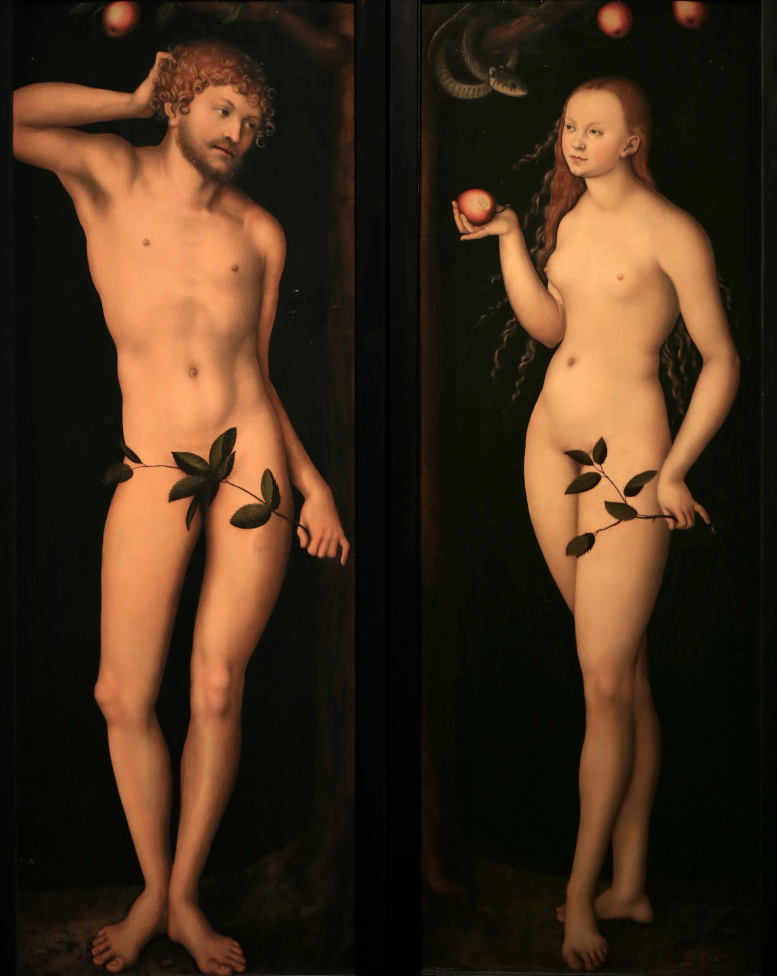
Lucas Cranach, 1528

What's done is done, he decides, and maybe it won't be so bad. Perhaps God won't "in earnest so destroy / Us his prime Creatures, dignifi'd so high, / Set over all his Works, which in our Fall, / For us created, needs with us must fail." So he decides to join her in the fatal act: "Our State cannot be sever'd, we are one, / One Flesh; to lose thee were to lose myself."

Eve rejoices: "O glorious trial of exceeding Love." And she proclaims, "I feel / Far otherwise th' event, not Death, but Life / Augmented, op'n'd Eyes, new Hopes, new Joys." This is as operatic as Tristan und Isolde, and ends with her urging, "On my experience, Adam, freely taste, / And fear of Death deliver to the Winds." So "he scrupl'd not to eat / Against his better knowledge, not deceiv'd, / But fondly overcome with Female charm." This is supposed to be a moment of horror, but long exposure to romantic excess makes it read like an apotheosis.

Adam gorges himself, "Nature gave a second groan," and a storm brews as the "intoxicated" lovers fall to it:
Carnal desire inflaming, hee on Eve
Began to cast lascivious Eyes, she him
As wantonly repaid; in Lust they burn 
He leads her "nothing loath" to a secluded spot where "they thir fill of Love and Love's disport / Took largely."
After the fall, by Gustave Doré, 1866

After "grosser sleep / Bred of unkindly fumes, with conscious dreams / Encumber'd," they wake to humankind's first hangover, "destitute and bare / Of all thir virtue." He berates her for giving "ear / To that false Worm" and bemoans the fact that he can't "behold the face / Henceforth of God or Angel, erst with joy / And rapture so oft beheld." They go to find something "to hide / The Parts of each from other, that seem most / To shame obnoxious, and unseemliest seen." Milton decides that the fig leaves they sewed together must be those of the banyan tree: "Such of late / Columbus found th' American so girt." In the seventeenth-century imagination this denotes that Adam and Eve have become "savages."

They start to argue, and Adam says he shouldn't have listened to her when she wanted to go off by herself: "I know not whence possess'd thee; we had then / Remain'd still happy, not as now, despoil'd / Of all our good, sham'd, naked, miserable." She retorts that he would have been persuaded by the serpent, too, and anyway,
Was I to have never parted from thy side?
As good have grown there still a lifeless Rib.
Being as I am, why didst not thou the Head
Command me absolutely not to go,
Going into such danger as thou said'st?
And so forth, berating each other but neither willing to accept blame. "And of thir vain contest appear'd no end."

Sunday, March 6, 2011

7. Paradise Lost, by John Milton, pp. 138-163

PARADISE LOST by John Milton, edited by Merritt Y. HughesBook VI
_____
Raphael continues to tell Adam and Eve about Satan's rebellion and the war in Heaven. Abdiel, having defied the rebel angels, returns to tell God what has happened and is applauded for his obedience. He now joins in the effort
                                                                 to subdue
By force, who reason for thir Law refuse,
Right reason for thir Law, and for thir King
Messiah, who by right of merit reigns.
"Right reason," like "Christian humanism," is one of those phrases that have an oxymoronic ring to modern ears, but it goes back to Plato and the Stoics and is the basis of the concept of natural law. "Right" is the operative word: Reason alone is not a moral concept.  Of course, for Adam and Eve, who are supposedly not yet aware of the distinction between good and evil, Raphael is getting a little bit ahead of himself in the lesson.

Milton was a pacifist, and the very concept of war was anathema to him, so he depicts it as anarchy and chaos brought on by the false heroics of Satan, who arrives with his hordes in a vainglorious display:
                                     exalted as a God
Th' Apostate in his Sun-bright Chariot sat
Idol of Majesty divine, enclos'd
With Flaming Cherubim, and golden Shields
The war begins with a verbal contest, just as it does in Homer and Virgil. Abdiel comes forth to denounce Satan as a fool for thinking that God wouldn't meet his challenge. Satan in response taunts the faithful angels for giving up their "Liberty" in serving God, accusing them of servility and sloth, and as "Minist'ring Spirits, train'd up in Feast and Song," not proud warriors. Abdiel counters that Satan "deprav's it with the name / Of Servitude to serve whom God ordains, / Or Nature: God and Nature bid the same, / When he who rules is worthiest, and excels / Them whom he governs." And having said this, "a noble stroke he lifted high ... On the proud Crest of Satan." It rocks Satan back "ten paces huge," amazing Satan's troops. The battle begins.
Abdiel smites Satan, by Gustave Doré, 1866
The battle begins, by Gustave Doré, 1866
The wounded Satan, by Gustave Doré, 1866

Satan and Michael have words in the midst of battle, with Michael promising to send Satan "to the place of evil, Hell," and Satan retorting that "we mean to wind, / Or turn this Heav'n itself into the Hell / Thou fabl'st." And Michael deals Satan a blow that "deep ent'ring shear'd / All his right side; then Satan first knew pain ... but th' Ethereal substance clos'd / Not long divvisible, and from the gash / A stream of Nectarous humor issuing flow'd / Sanguine, such as Celestial Spirits may bleed." He is borne away by his troops
Back to his Chariot, where it stood retir'd
From off the files of war: there they him laid
Gnashing for anguish and despite and shame
To find himself not matchless, and his pride
Humbl'd by such rebuke, so far beneath
His confidence to equal God in power.
Yet soon he heal'd; for Spirits that live throughout
Vital in every part, not as frail man
In Entrails, Heart or Head, Liver or Reins,
Cannot but by annihilating die
It's nice that Raphael explains all this, except that it once again raises the issue of his audience: How could Adam and Eve understand the concepts of things they haven't experienced, like pain and death? In fact, as Milton reminds us, these concepts were new to the angels as well, especially the rebels, "to such evil brought / By sin of disobedience, till that hour / Not liable to fear or flight or pain."
Night comes on after the first day of battle, by Gustave Doré, 1866
Michael and the other angels keep watch, by Gustave Doré, 1866

Night comes on and the armies return to their camps, where Satan suggests that "perhaps more valid Arms, / Weapons more violent, when next we meet, / May serve to better us, and worse our foes." And so he urges them to create the first weapons of mass destruction from materials found
Deep under ground, materials dark and crude,
Of spiritous and fiery spume, till toucht
With Heav'n's ray, and temper'd they shoot forth
So beauteous, op'ning to the ambient light.
These in thir dark Nativity the Deep
Shall yield us, pregnant with infernal flame,
Which into hollow Engines long and round
Thick ramm'd, at th' other bore with touch of fire
Dilated and infuriate shall send forth
From far with thund'ring noise among our foes
Such implements of mischief as shall dash
To pieces, and o'erwhelm whatever stands
Adverse, that they shall fear we have disarm'd
The Thunderer of his only dreaded bolt. 
He even foresees the possibility that in the future, if they triumph, "Some one intent on mischief, or inspir'd / With dev'lish machination might devise / Like instrument to plague the Sons of men / For sin, on war ad mutual slaughter bent."

So the next day they wheel out their cannons and blast the unsuspecting angels: "down they fell / By thousands, Angel on Arch-Angel roll'd." Satan mocks them by commenting that it looked like "they would dance, yet for a dance they seem'd / Somewaht extravagant and wild." But as the rebel angels "Stood scoffing, highth'n'd in thir thoughts beyond / All doubt and victory," God's troops
           pluckt the seated Hills with all thir load,
Rocks, Waters, Woods, and by the shaggy tops
Uplifting bore them in thir hands: Amaze,
Be sure, and terror seiz'd the rebel Host,
When coming towards them so dread they saw
The bottom of the Mountains upward turn'd
So the rebels start flinging mountains back, "and now all Heav'n / Had gone to wrack, with ruin overspread," except that God had foreseen all this and let it take place in order "To honor his Anointed Son aveng'd / Upon his enemies, and to declare / All power on him transferr'd." The whole two days of war, it seems, was just to set the stage for the Son's triumph on the third day -- a pattern to be repeated in the crucifixion and resurrection.

So on the third morning, the Son rides forth in a chariot "Flashing thick flames, Wheel within Wheel," accompanied
By four Cherubic shapes, four Faces each
Had wondrous, as with Stars thir bodies all
And Wings were set with Eyes, with Eyes the Wheels
Of Beryl, and careering Fires between;
Over thir heads a crystal Firmament,
Whereon a Sapphire Throne, inlaid with pure
Amber, and colors of the show'ry Arch. 
The destroyed landscape is restored "At his command ... And with fresh Flow'rets Hill and Valley smil'd." Telling the assembled angels to stand aside, the Son bears down on the enemy, and "under his burning Wheels / The steadfast Empyrean shook throughout, / All but the Throne itself of God." (Satan had boasted in Book I that he shook that throne.) The rebel angels retreat,
                                                     for he meant
Not to destroy, but root them out of Heav'n:
The overthrown he rais'd, and as a Herd
Of Goats or timorous flock together throng'd
Drove them before him Thunder-struck, pursu'd
With terrors and with furies to the bounds
And Crystal wall of Heav'n, which op'ning wide,
Roll'd inward, and a spacious Gap isclos'd
Into the wasteful Deep
(Samuel Johnson observed that the flock shouldn't have been described as "timorous" by Raphael before the Fall, but as we've seen, consistency has long been absent from the narrative.) Hell opens up and "Yawning receiv'd them whole, and on them clos'd." And the Son rides in triumph back to "the Courts / And Temple of his mighty Father Thron'd / On high."
Engraving by Francis Hayman, 1749
William Blake, 1808
Gustave Doré, 1866

And Raphael ends his narrative by pointing the moral:
        let it profit thee to have heard
By terrible Example the reward
Of disobedience; firm they might have stood,
Yet fell; remember, and fear to transgress. 

Saturday, March 5, 2011

6. Paradise Lost, by John Milton, pp. 113-137

PARADISE LOST by John Milton, edited by Merritt Y. HughesBook V
_____
Morning arrives, and Adam addresses a kind of aubade to Eve. But she's had a troubling dream, presumably caused by Satan's whispering in her ear last night. In it, she heard a voice she thought at first to be Adam's, urging her to go walking in the night. She went to the "Tree / Of interdicted Knowledge," where an angelic figure argued that she should taste of its fruit, and sampled some himself. Though "mee damp horror chill'd / At such bold words voucht with a deed so bold," eventually she yielded to the invitation and "Forthwith up to the Clouds / With him I flew." But she assures Adam that she was "glad ... To find this but a dream!" Adam tells her the "uncouth dream" was "of evil sprung I fear."
Engraving by Francis Hayman, 1749
Adam awakens Eve, by Gustave Doré, 1866

Okay, how does Adam know anything about evil? Isn't the whole point of the Tree of Knowledge that it awakens Adam and Eve to the concept of evil? Yet here we have Adam recognizing it right off, and Eve feeling something like guilt -- a consequence of the ability to know evil when you see it. In Eve's case, the reaction can be likened to a child's fear of the unknown, but Adam specifically identifies the dream as "evil," and questions where it could have come from: "Yet evil whence? in thee can harbor none, / Created pure." He decides that it's a product of "Fancy":
Evil into the mind of God or Man
May come and go, so unapprov'd, and leave
No spot or blame behind: Which gives me hope
That what in sleep thou didst abhor to dream,
Waking thou never wilt consent to do. 
He cheers her up, but nevertheless she weeps "a gentle tear ... From either eye," which he kisses as "the gracious signs of sweet remorse / And pious awe." "So all was clear'd," Milton assures us, though what isn't cleared is the fact that prelapsarian Adam and Eve seem to have a far more sophisticated knowledge of good and evil than they are supposed to have, including a concept of "remorse." How can you have that without the knowledge that you are supposed to feel remorseful for doing something wrong? 

Anyway, they set off to work after their morning prayers, which are "In various style, for neither various style / Nor holy rapture wanted they to praise / Thir Maker" -- in other words, they don't have a liturgy to follow by rote, but their praise of the maker flows out of untrained and spontaneous awe, unlike the scripted prayers of the established church. And in the conclusion of their prayers, the problematic note of awareness of evil arises once again:
                                            and if the night
Have gather'd aught of evil or conceal'd,
Disperse it, as now light dispels the dark.
Adam and Eve see Raphael approaching, by Gustave Doré, 1866

Meanwhile, God summons Raphael, "the sociable spirit," and sends him to "Converse with Adam." Milton follows Raphael's flight until he finds Adam sitting at the door of the bower while Eve prepares their dinner. Finding that they have a guest, Adam sends Eve off to get some more food and set another plate, which she does without complaint. This idealized domesticity does get a little heavy-handed, especially when Milton observes, "A while discourse they hold; / No fear lest Dinner cool."
Adam, Eve, and Raphael, by William Blake, 1808
Raphael lectures on cosmology, by Gustave Doré, 1866
Eve, Raphael, and Adam, by William Strang, 1896

Raphael goes on a while about the way all nature nourishes itself, and when Adam observes that Raphael seems to enjoy earthly food even though it must not be comparable to "Heav'n's high feasts," Raphael replies with a lecture on cosmology. All things, he says, proceed from "one first matter," which grows increasingly "more refin'd, more spiritous, and pure" as one ascends the great chain of being. Milton's concept of the chain is dynamic: The universe is a process of perpetual becoming:
                                                         So from the root
Springs lighter the green stalk, from thence the leaves
More aery, last the bright consummate flow'r
Spirits odorous breathes
Matter constantly passes into spirit, which is, Douglas Bush observed,  a kind of "optimistic monism."
And from these corporal nutriments perhaps
Your bodies may at last turn all to spirit,
Improv'd by tract of time, and wing'd ascend
Ethereal, as wee
Adam thanks him for the lesson, but he's bothered -- rightly -- by the command of obedience. Raphael explains that
God made thee perfet, not immutable; 
And good he made thee, but to persevere 
He left it in thy power, ordain'd thy will 
By nature free, not  over-rul'd by Fate 
Inextricable, or strict necessity; 
Our voluntary service he requires, 
Not our necessitated....
....
... freely we serve, 
Because we freely love, as in our will 
To love or not; in this we stand or fall: 
And some are fall'n, to disobedience fall'n, 
And so from Heav'n to deepest Hell; O fall
From what high state of bliss into what woe!
Again, this is knowledge of good and evil. What more can they learn from the fruit of the Tree?

Adam wants to know more, and points out that they have a lot of time for the story, as it's only midday. So Raphael launches into the story of the war in Heaven, though he points out that it was a spiritual conflict, not a physical ones, and that he's only describing it in physical terms because Adam wouldn't understand it otherwise:
                                 yet for thy good
This is dispens't, and what surmounts the reach
Of human sense, I shall delineate so,
By lik'ning spiritual to corporal forms. 
So he tells Adam about the day when God summoned all the "Angels, Progeny of Light, / Thrones, Dominations, Princedoms, Virtues, Powers," to tell them that he has begotten a Son and put him in charge of all of them. There was much jubilation, including a
Mystical dance, which yonder starry Sphere
Of Planets and of fixt in all her Wheels
Resembles nearest, mazes intricate,
Eccentric, intervolv'd, yet regular
Then most, when most irregular they seem:
And in thir motions harmony Divine
So smooths her charming tones, that God's own ear
Listens delighted. 
A dance to the music of the spheres, which is about as mystical as you get. But not everybody was dancing, especially "Satan, so call him now, his former name / Is heard no more in Heav'n." He who must not be named is usually identified as Lucifer, the light-bearer, who was "of the first, / If not the first Arch-Angel, great in Power, / In favor and preëminence, yet fraught with envy against the Son of God." (Again, Raphael is tipping Adam and Eve off about evil: the sin of envy, which presumably they have had no experience of.)

So Satan assembles his followers, which constituted "the third part of Heav'n's Host," to foment rebellion. God warns the Son about the uprising, and the Son assures his Father that he has things under control. In "The Palace of great Lucifer," Satan charges the Son with a power grab, and urges his followers to "cast off this Yoke." The speech goes over well with everyone except the seraph Abdiel (a character invented by Milton, using a biblical name that means "servant of God"), who accuses Satan of blasphemy. God, he says, "made / Thee what thou art, and form'd the Pow'rs of Heav'n / Such as he pleas'd, and circumscrib'd thir being," and who is Satan to challenge that? "Cease this impious rage," he orders, "but his zeal / None seconded." So he departs, "through hostile scorn, which he sustain'd / Superior":
Among the faithless, faithful only hee;
Among innumerable false, unmov'd,
Unshak'n, unseduc'd, unterrifi'd
His Loyalty he kept, his Love, his Zeal.
It's a heroic moment equal or superior to Satan's more familiar heroic moments.

Friday, March 4, 2011

5. Paradise Lost, by John Milton, pp. 83-112

PARADISE LOST by John Milton, edited by Merritt Y. HughesBook IV
_____
Milton opens with a lament that no one raised a warning of Satan's approach to Eden, but as it turns out, Satan is having his own misgivings, a wee touch of conscience spurred by "the bitter memory / Of what he was, what is, and what must be / Worse." His soliloquy gives him a tragic dimension -- sympathy for the devil. Things weren't really so bad "In that bright eminence" of Heaven -- a deliberate echo of the "bad eminence" to which his merit has raised him in Hell -- because God "with his good / Upbraided none; nor was his service hard." It hasn't been so long since he was proclaiming it better to reign in Hell than serve in Heaven, but now he's wishing that God had made him "some inferior Angel. I had stood / Then happy; no unbounded hope had rais'd / Ambition." But now there's no escaping what he is:
Which way I fly is Hell; myself am Hell;
And the lowest deep a lower deep
Still threat'ning to devour me opens wide,
To which the Hell I suffer seems a Heav'n.
Satan struggles with his conscience, by Gustave Doré, 1866

This is a long way from the claim that the mind can create a Heaven of Hell. And now he is even tempted to repent, except that he chokes on the very word "submission" and moreover is afraid of losing face: "my dread of shame / Among the Spirits beneath." He's also afraid that he wouldn't be able to maintain a vow of repentance, that the "wounds of deadly hate have pierc'd so deep: / Which would but lead me to a worse relapse, / And heavier fall."

And so he commits another deadly sin: sloth, or acedia, which is the spiritual version of sloth, the unwillingness to rouse oneself to the effort of betterment.
So farewell Hope, and with Hope farewell Fear,
Farewell Remorse: all Good to me is lost;
Evil be thou my Good; by thee at least
Divided Empire with Heav'n's King I hold
By thee, and more than half perhaps will reign;
As Man ere long, and this new World shall know.
During his soliloquy, Uriel has been watching as "ire, envy and despair ... marr'd his borrow'd visage," i.e., he no longer looks like the "stripling Cherub" he had disguised himself as.
Satan looks down on Eden, by Gustave Doré, 1866

So he reaches Eden, and it's a touch of Miltonic irony that we see the earthly paradise first through Satan's eyes. Its pleasures are so great that they are "able to drive / All sadness but despair," and Satan's chief mood at the moment is despair. He makes it easily over the walls of the garden, and "So clomb this first grand Thief into God's Fold," a line whose thudding monosyllables contrast with the mellifluousness of the description of the garden itself. He turns into a cormorant and perches on top of the Tree of Life for a good view. "Our Death the Tree of Knowledge grew fast by, / Knowledge of Good bought dear by knowing ill."
"A happy rural seat of various view," by Gustave Doré, 1866

Milton's description of the garden has been criticized by some for a lack of sensory detail, for over-general descriptions such as "Lawns, or level Downs, and Flocks grazing the tender herb." It's true that there is much conventional pastoral imagery throughout, but to my ear the lines are musical and flowing. And finally we get to the famous description by negative, the passage in which Milton tells us that Eden surpassed all the great gardens of classical myth:
                                             Not that fair field
Of Enna, where Proserpin gath'ring flow'rs
Herself a fairer Flow'r by gloomy Dis
Was gather'd, which cost Ceres all that pain
To seek her through the world; nor that sweet Grove
Of Daphne by Orontes, and th' inspir'd
Castalian Spring might with this Paradise
Of Eden strive; nor that Nyseian Isle
Girt with the River Triton, where old Cham,
Whom Gentiles Ammon call and Lybian Jove,
Hid Amalthea and her florid Son,
Young Bacchus, from his Stepdame Rhea's eye;
Nor where Abassin Kings thir issue Guard,
Mount Amara, though this by some suppos'd
True Paradise under the Ethiop Line
By Nilus head, enclos'd with shining Rock,
A whole day's journey high, but wide remote
From this Assyrian Garden, where the Fiend
Saw undelighted all delight, all kind
Of living Creatures new to sight and strange:
 Milton alludes to classical legends that his readers would know, reaping the benefits of allusion by claiming that his garden is the superior to all these. The story of Proserpina carried off to the underworld also foreshadows the story of Eve. And the introduction of Satan, the fiend who sees all delight but is undelighted by it, is a smart dramatic trick that puts an end to the extended passage about Eden.
Adam and Eve in the Garden, by Gustave Doré, 1866
Adam and Eve, by William Strang, 1896

And here we get our first glimpse of Adam and Eve, as well as our first irritating reference to Eve's inferiority to Adam:
Whence true autority in men; though both
Not equal, as thir sex not equal seem'd;
For contemplation hee and valor form'd,
For softness shee and sweet attractive Grace,
Hee for God only, shee for God in him
St. Paul's sexism is much to blame here, even in the fact that Adam's hair "manly hung / Clust'ring, but not beneath his shoulders broad" -- Paul asserted that long hair was a "shame unto" a man but "a glory unto" a woman. Of course, if God had created the sexes equal, then he wouldn't have provided Satan with such a nice target in Eve. But I doubt that all but the most orthodox Christians can read the lines about Eve today without feeling at best a twinge of annoyance.

Nor is it possible to read the lines about these naked gardeners strolling "hand in hand" (a motif for the two that persists even to the very end of the poem) without feeling that one has strolled into some kind of hippie commune and traveling circus, as the animals gather around to entertain them, though there is still some charm lingering in "th' unwieldy Elephant / To make them mirth us'd all his might and wreath'd / His Lithe Proboscis." Milton swiftly undercuts this bit of humor by introducing "the Serpent sly / Insinuating," though he hasn't yet been put to ill use by Satan.

Satan is, of course, upset by the scene, though his first words, "O Hell!" have a comic effect that Milton didn't intend. Adam and Eve are so attractive that even he "could love" the "gentle pair" and "could pity" them because he knows he's about to spoil everything for them. But he swiftly descends into sarcasm about the home he has prepared for them:
                                 my dwelling may not please
Like this fair Paradise, your sense, yet such
Accept your Maker's work; he gave it me,
Which I as freely give; Hell shall unfold,
To entertain you two, her widest Gates,
And send forth all her Kings; there will be room,
Not like these narrow limits, to receive
Your numerous offspring
But don't thank him for the lodgings: "Thank him who puts me loath to this revenge / On you who wrong me not for him who wrong'd." It's all God's fault. (He does have a point, you know. For an omnipotent, loving God, He sure does complicate things.) Satan views himself as a conquistador, "Honor and Empire with revenge enlarg'd, / By conquering this new World."
Satan eavesdrops on Adam and Eve, engraving by Francis Hayman, 1749
William Blake, 1808

So now he disguises himself as various animals to get closer to Adam and Eve and overhear Adam going on (and on) to Eve about how great God is for giving them this lovely place, and asking nothing more than that they prune a few shrubs and sweep up a few fallen petals and branches. And of course blabbermouth that he is, Adam also has to tell Eve something that she probably already knew: that they are forbidden "to taste that only Tree / Of Knowledge, planted by the Tree of Life, / So near grows Death to Life, whate'er Death is, / Some dreadful thing no doubt." Charming as that last phrase is, you do have to wonder why the word "dreadful" is even in the vocabulary of these pampered babies.

Eve responds to Adam's speech by praising him, though not without echoing a little Pauline misogyny:
                                             O thou for whom
And from whom I was form'd flesh of thy flesh,
And without whom am to no end, my Guide
And Head, what thou hast said is just and right.
But then she talks mostly about herself, and how, on the day when she was created she looked into a pool and saw her own reflection: "I started back, / It started back, but pleas'd I soon return'd, / Pleas'd it return'd as soon with answering looks / Of sympathy and love." Fortunately, a "voice" tells her to stop with the narcissism and leads her to Adam, to whom she will "bear / Multitudes like thyself." And under a plane tree she finds him, "and from that time see / How beauty is excell'd by manly grace / And wisdom, which alone is truly fair."

Satan is annoyed by all this lovey-doveyness, not because it does get a bit too cloying, but because there's nothing like it in Hell, "Where neither joy nor love, but fierce desire, / Among our other torments not the least, / Still unfulfil'd with pain of longing pines." But he has managed to overhear the crucial part about the Tree of Knowledge, and it puzzles him (perhaps as it puzzles us):
                                      Knowledge forbidd'n?
Suspicious, reasonless. Why should thir Lord
Envy them that? can it be sin to know,
Can it be death? and do they only stand
By Ignorance, is that thir happy state,
The proof of thir obedience and thir faith? 
It's a real conundrum, but unfortunately he also recognizes the opportunity: "O fair fundation laid whereon to build / Thir ruin!" He'll tell them it's a plot to keep them in their place.
Uriel warns Gabriel, by Gustave Doré, 1866

As night comes on, Uriel reports to Gabriel what he has seen -- someone sinister in disguise -- and Gabriel promises to keep an eye out. And with that Uriel rides down a sunbeam below the horizon, "whither the prime Orb, / Incredible how swift, had thither roll'd / Diurnal, or this less volubil Earth / By shorter flight to th' East." Once again, Milton hedges his bets on whether the universe is heliocentric or geocentric.

Meanwhile, Adam is off on another lecture about how "Man hath his daily work of body or mind / Appointed, which declares his Dignity." And Eve says, okay, whatever you say: "God is thy Law, thou mind: to know no more / Is woman's happiest knowledge and her praise." But after talking about how wonderful everything is, she has a question about the stars: "But wherefore all night long shine these, for whom this glorious sight, when sleep hath shut all eyes?" Eve is the questioner, the seeker after knowledge. Adam plays the know-it-all again, explaining that the stars are there to keep Night from regaining "Her old possession, and extinguish life," and that anyway "Millions of spiritual Creatures walk the Earth / Unseen, both when we wake and when we sleep." So they retire to their bower and indulge in "the Rites / Mysterious of connubial Love," which Milton, the author of a pamphlet on divorce, now celebrates somewhat defensively.
Ithuriel and Zephon go to check on Adam and Eve in the bower, by Gustave Doré, 1866

Ithuriel and Zephon discover Satan as a toad, whispering to Eve, William Blake, 1808

Meanwhile, Gabriel is commissioning some angels, Uzziel, Ithuriel, and Zephon, to look out for this suspicious master of disguise. And sure enough, the last two find him "Squat like a Toad, close at the ear of Eve." Ithuriel touches the toad lightly with his spear and it explodes instantly into the figure of Satan. (Milton exhibits a cinematic imagination here, likening Satan's transformation to the "sudden blaze" of "a heap of nitrous Powder" touched by a spark.) Ithuriel and Zephon conduct him to Gabriel. Satan is a bit abashed by the fact that in comparison to these angels his own "lustre" is "visibly impaired," but he bluffs it out anyway. When Gabriel asks him why he's here, Satan treats it as a stupid question:
To whom thus Satan, with contemptuous brow,
Gabriel, thou hadst in Heav'n th' esteem of wise,
And such I held thee; but this question askt
Puts me in doubt. Lives there who loves his apin?
Who would not, finding way, break loose from Hell,
Though thither doom'd?
Gabriel is unfazed, and points out that Satan got caught and is in danger of having his pains increased "Sevenfold." And anyway, why did he come alone: "wherefore with thee / Came not all Hell broke loose?" Satan sasses back that if Gabriel knew anything about real leadership he'd know that you don't send an army on a mission that you haven't first reconnoitered. To which Gabriel retorts that first Satan claimed to be fleeing from pain and then to be a spy, which "Argues no Leader, but a liar trac't." If he shows up here again, Gabriel says, "Back to th' infernal pit I drag thee chain'd, / And Seal thee so, as henceforth not to scorn / The facile gates of hell too slightly barr'd."

Everybody bristles now, and it looks like a standoff that might result in the destruction of Paradise if it explodes again into war. But God "Hung forth in Heav'n the golden Scales" and "in these he put two wights / The sequel each of parting and of fight; / The latter quick up flew, and kickt the beam." Gabriel points out that the odds are against Satan, so he "fled / Murmuring, and with him fled the shades of night."  
Satan flees murmuring, by Gustave Doré, 1866

Thursday, March 3, 2011

4. Paradise Lost, by John Milton, pp. 60-83

PARADISE LOST by John Milton, edited by Merritt Y. HughesBook III
_____
One reason why so many think Milton was on Satan's side is that once he's off-stage and the Father and the Son start discussing theology, things slow way down. (Dante had the same problem: A lot more people read the Inferno than the Paradiso.)

Book III starts rather magnificently, however, with Milton's invocation to Light and the poignant acknowledgment that he can no longer perceive it: "thou / Revisit'st not these eyes, that roll in vain / To find thy piercing ray, and find no dawn." Even in the invocation, there's a recognition that the origins of light are unknown: Was it "offspring of Heavn'n first-born" -- i.e. the first thing God created -- or is it the essence of God and therefore "Coeternal" with him, "Bright effluence of bright essence increate"? Perhaps the question is unanswerable: "pure Ethereal stream / Whose Fountain who should tell?" Did it exist before Creation, "before the Sun, / Before the Heavens"? 

In any case, he welcomes the opportunity to escape "the Stygian pool" of hell, and prays for a compensatory inward light because his blindness prevents direct experience of external light:
                                              Thus with the Year
Seasons return, but not to me returns
Day, or the sweet approach of Ev'n or Morn,
Or sight of vernal bloom, or Summer's Rose,
Or flock, or herds, or human face divine;
But cloud instead, and ever-during dark
Surrounds me, from the cheerful ways of men
Cut off, and for the Book of knowledge fair
Presented with a Universal blanc
Of Nature's works to me expung'd and ras'd,
And wisdom at one entrance quite shut out.
So much the rather thou Celestial Light
Shine inward, and the mind through all her powers
Irradiate, there plant eyes, all mist from thence
Purge and disperse, that I may see and tell
Of things invisible to mortal sight. 
So we ascend to Heaven and a scene that corresponds to the one that just took place in Hell. God is seated on his throne, addressing the angels as Satan addressed the devils, and with the Son as his right-hand man, just as Satan had Beëlzebub. Of course, God has an advantage over Satan in that he not only sees what's going on -- i.e., Adam and Eve "in the happy Garden plac't, / Reaping immortal fruits of joy and love," as well as Satan making his way upward from hell -- but also knows what's going to happen next. Milton's choice to make God a speaking character in the narrative has been rightly criticized, especially because in the first things he says he sounds rather peevish, especially with regard to Satan:
                                                     So will fall
Hee and his faithless Progeny: whose fault?
Whose but his own? ingrate, he had of mee
All he could have; I made him just and right,
Sufficient to have stood, though free to fall.
The repudiation of Calvinist predestination is also a little overdone here, too. He admits that he knew Satan was going to rebel and fail, but "if I foreknew, / Foreknowledge had no influence on their fault."

For many modern readers, the elaborate superstructure of Christian theology is a wearisome imposition, but Milton feels compelled to have Father and Son discuss it, because the Son is bothered by what he knows is about to happen, that Satan is going to tempt humankind into disobedience:
                                         wilt thou thyself
Abolish thy Creation, and unmake,
For him, what for thy glory thou hast made?
So should thy goodness and thy greatness both
Be question'd and blasphem'd without defense. 
In short, why bother creating Paradise if you already know it's going to be lost? It seems like a bad PR move, if nothing else. But God reassures him that "Man shall not quite be lost" and that he has already chosen some "of peculiar grace / Elect above the rest," and that the others will have to work for their salvation. What he really needs is for someone to volunteer to atone for their sins, "Some other able, and as willing, pay / The rigid satisfaction, death for death." And he calls on the "Heavn'ly Powers" for a volunteer. (The scene, of course, parallels the one in which Satan describes the task of going out to check on the world God has created and volunteers himself.)

"He ask'd, but all the Heavn'ly Choir stood mute." Anyone? Anyone? Okay, I'll do it, says the Son.
Behold mee then, mee for him, life for life
I offer, on mee let thine anger fall;
Account mee man; I for his sake will leave
Thy bosom, and this glory next to thee
Freely put off, and for him lastly die
Well pleas'd, on me let Death wreck all his rage;
Under his gloomy power I shall not long
Lie vanquisht
It is, of course, a truly heroic act, unlike Satan's blustering posture of heroism. The problem is that it doesn't have the heroic ring that Milton was able to give Satan's defiance. And this dramatic weakness in the narrative is the poem's central literary defect. We have to remember, however, that Milton wasn't thinking literarily here, but rather religiously. He couldn't have known that the kind of Christian orthodoxy he was dramatizing would fade into irrelevance for many of his future readers.
The Son agrees to atone for humankind's sins, by William Blake, 1808

And so God commissions him to become both human and divine: "Be thou in Adam's room / The Head of all mankind, though Adam's Son." Everything will turn out fine, God assures the assembled angels, who then burst out in cheers and music, accompanying themselves on the harps that have become a cartoon accessory for angels ever since.
The angels rejoice at the Son's decision, by Gustave Doré, 1866

But while they are spending "Thir happy hours in joy and hymning," Satan is steadily making his way to the new world, alighting like a vulture on the outermost sphere of the new universe.where Milton has located a "Paradise of Fools," a kind of limbo for "all things vain, and all who in vain things / Built thir fond hopes of Glory or lasting fame, / Or happiness in this or th' other life." These will eventually include the builders of the tower of Babel, suicides like Empedocles and Cleombrotus who take their lives with the expectation of achieving divinity, and of course a whole host of "Eremites and Friars / White, Black and Grey, with all thir trumpery," especially the Dominicans and the Franciscans, particular targets of the Protestants.
A violent cross wind from either Coast
Blows them transverse ten thousand Leagues awry
Into the devious Air; then might ye see
Cowls, Hoods and Habits with thir wearers tost
And flutter'd into Rags, then Reliques, Beads,
Indulgences, Dispenses, Pardons, Bulls,
The sport of Winds
The Paradise of Fools, by Gustave Doré, 1866
 
Now he sees the stairway to Heaven, which is sometimes drawn up like a ladder, and "Looks down with wonder at the sudden view / Of all this World at once." So he begins his flight down to the Earth at its center -- or perhaps near it: Milton waffles about whether this universe is geocentric or heliocentric. Along the way he passes "other Worlds, / Or other Worlds they seem'd" -- Milton isn't over-concerned about whether these worlds are populated, and neither is Satan: "who dwelt happy there / He stay'd not to enquire." He sees the sun, but it's "hard to tell" whether it's at the center of this universe or not. And he finds a spot to land "like which perhaps / Astronomer in the Sun's lucent Orb / Through his glaz'd Optic Tube yet never saw" -- as the note tells us, Galileo had used his telescope in 1609 to discover sun spots.
Satan in disguise tricks Uriel into pointing the way to Paradise, engraving by Simon Francois Ravenet after Francis Hayman, 1749

There "he soon / Saw within ken a glorious Angel stand," and recognizes the archangel Uriel, whose back is turned, giving Satan time to put on a disguise as "a stripling Cherub." (We think of cherubs, or cherubim, as chubby little baby angels, but those are putti, merely decorative figures in Renaissance and Baroque art; the cherubim of Judeo-Christian tradition are the second order of angels, after the seraphim.) In this disguise, Satan is able to trick Uriel into giving him directions to the Earthly Paradise, "For neither Man nor Angel can discern / Hypocrisy, the only evil that walks / Invisible, except to God alone, / By his permissive will, through Heav'n and Earth." (God seems to permit the oddest things, while banning others that seem less consequential.)
Satan on his way to Earth, by Gustave Doré, 1866

And so Satan makes his fatal way to the top of Mount Niphates.