JOURNAL OF A COMPULSIVE READER
By Charles Matthews
Showing posts with label Robert Devereux (Essex). Show all posts

Thursday, March 24, 2011

8. As You Like It, by William Shakespeare. The Arden Third Series edition, continued.

As You Like It (Arden Shakespeare: Third Series)Introduction by Juliet Dusinberre, pp. 36-142
_____
Agnes Latham's introduction discussed the various theories about the premier performance of As You Like It, but Dusinberre argues for "a new and specific date for the play, of Shrove Tuesday, 20 February 1599. The Chamberlain's Men are recorded as having performed a play at Richmond Palace on that date, and an epilogue that refers to the presence of the queen and to the fact that it is Shrove Tuesday has been found in the commonplace book of Henry Stanford. It may have been used only for that performance and the epilogue published in the First Folio substituted later. A Shrove Tuesday performance would explain Touchstone's reference to pancakes and mustard in Act I, scene 2, because pancakes -- then a form of meat pie -- were traditionally eaten on that day.
Shrove Tuesday 1599 would have marked the final celebratory performance for the fortieth year of the queen's reign before the theatres closed the next day for Lent. Without being in any specific sense an "occasional" piece, As You Like It is geared to Elizabethan court taste. It boasts, in a pastoral drama full of music and witty word-play, a uniquely powerful heroine posing as a shepherd, Elizabeth's favourite image for her own rule.
As for the identification of Jaques's "All the world's a stage" speech with the motto of the Globe Theater, which opened in the fall of 1599, the lease for that theater was signed on February 21, so the allusion could have been a kind of advertisement for the coming venture. The Shrove Tuesday date would also call into question the assumption that Touchstone's part was written for Robert Armin, who didn't join the company until the end of 1599. "In February 1599 the part of Touchstone would have been taken by Will Kemp."

Dusinberre also explores in greater depth the play's principal setting, the Forest of Arden: "Just as the binaries of the heterosexual and the homosexual, masculine and feminine are refracted and melt into each other within the figure of Rosalind, so in the Forest the polarity of real and ideal ceases to be illuminating." The Forest is not just a place for escape, it's also a place in which people work and hunt.The play maintains a certain ambivalence about the latter pursuit.  "Elizabeth was a keen huntswoman who was still hunting in September 1600, when she was 67." As You Like It "demonstrates dubiousness abut hunting," especially in the account of Jaques mourning the wounded deer, but it also celebrates it in the hunting song in 4.2, although the tone of that celebration depends entirely on the production in which it appears. It's also notable that "When Orlando interrupts the Duke at supper, he is offered fruit." And there is a parallel between the hunting of deer in the Forest and the hunting of men at court: "Oliver's hounding of Orlando, Duke Frederick's hounding of Oliver and banishment of Rosalind, not to mention the usurpation of his own brother's dukedom."

The explicit link of the Forest exiles with Robin Hood and his merry men is also significant:
The social subversion of those stories -- the attacks on civil and ecclesiastical authority, the flouting of convention by a cross-dressed Maid Marian ... are in evidence in Shakespeare's comedy in its cross-dressed heroine, its questioning of primogeniture and its ribaldry against a representative of the clergy, Sir Oliver Mar-text.... In As You Like It Orlando's revolt against his brother is given the backing of the play's moral authority.... Interestingly that authority is chiefly vested in a servant, Adam.
The Forest setting challenges directors not to get too literal or too abstract with stage design. "As You Like It, like Henry V, requires the audience's imagination to work vigorously. The two plays were conceived at much the same time in the dramatist's mind, and they both require active input from the audience." 

Thematically, the play has spoken to many different ages with many different experiences of exile. The 1936 film with Laurence Olivier was directed by Paul Czinner and starred his wife, Elisabeth Bergner, both of whom were Austrian Jews taking refuge in London. But the play originated at a time when talk of usurpation and exile was rife and "the precarious fortunes of the Earl of Essex had begun to overshadow courtly festivity.... As You Like It deals in a more poetic way with the displacement of individuals and the breaking of apparently insuperable barriers."
Essex's role as a patron of drama, music and fencing -- all of which are reflected in As You Like It -- and his wayward and flamboyant courtship of the queen to whom he was both vassal and incipient rival, were part of a pattern in the 1590s which made him the lodestar of the Court.... In this atmosphere of mistrust and discontent the Chamberlain's Men may have first performed As You Like It to queen and court, a play of incomparable geniality and good humour, in which the claims of courtly pleasure are pitted against the rival, and in the end ascendant, claims of rustic contentment.
For modern audiences and the actors trying to please them, the role of Touchstone is a special challenge. "The best Touchstones ... have always had a kind of music-hall rapport with the audience." Elizabethan audiences would have immediately found the humor in "the confrontation of the clown (countryman) with another clown (the jester) ... whereas a modern audience sits gaping, trying to work out where to laugh." Even in 1599 the actual role of court jester, or licensed fool, was beginning to die out, "as Malvolio's hostility to Feste in Twelfth Night accurately records." The Elizabethan audience would have recognized a shepherd like Corin as a type, "a man known for his silence, his self-sufficiency, the security of his function," and have relished the clash with another type, the jester, "for whom words are a livelihood, and whose insecurities are manifold, for he must always please or his livelihood is gone, where the shepherd rests content if his sheep are so." Today the types are forgotten, just as we are beginning to forget the humorous conflict of types such as the country bumpkin and the city slicker that were the basis of American humor as recently as The Beverly Hillbillies.

We also have lost the significance of pastoral, which for the Elizabethans had "political ramifications" and hinted at "'greater matters' behind a rustic disguise.... In an age of censorship the pastoral mode provided a way of saying one's dangerous piece with relative safety.... Satire is intrinsic to pastoral." The satiric voice in As You Like It belongs to Jaques, but his bitter wit is countered by the foolery of Touchstone.
The two parts are weighed in a balance: on the one side is folly, and on the other, wisdom. Just as Jaques [laughs] for an hour at a lamenting Touchstone, thus reversing their roles, so the paradox of which character wears the fool's motley, and which the mantle of sage, lies, in the true fashion of Erasmus's Praise of Folly, at the centre of Shakespeare's comedy....The audience can see all too clearly that Jaques's longing for a motley coat and the licence of a fool comes from a firm belief in his own wisdom punctured by the clown, who responds to his counsel by singing and dancing.... Shakespeare allows his pose of false wisdom to be tried by the touchstone of true folly.
But Jaques's point of view is essential to the play. "Without Jaques's edge of cynicism, the Forest of Arden is too sweet. Its honey is improved by a dash of gall." Dusinberre also notes that Jaques goes unmated at the end of the play, despite George Sand's desire to marry him off to Celia. In the play he directs his attentions solely to men: "Touchstone, the young Ganymede who repulses him unceremoniously, and even Orlando, to whom his incivility can be played as a kind of courtship." (When Orlando bests him in a game of wits, with the riposte of seeking the fool in the brook, Jaques begins to take him seriously.) "The melancholy satirist's indifference to women and his marked preference for the company of men is one element in the multiple sexualities which the play evokes and celebrates."
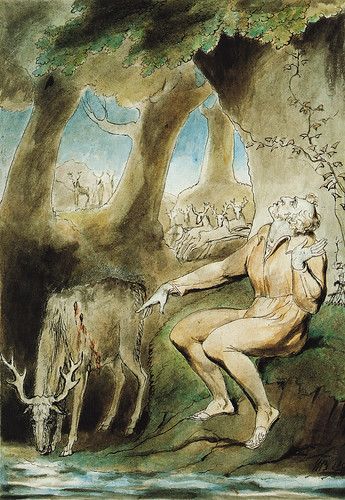
William Blake, Jaques and the Wounded Stag, 186
While As You Like It is undeniably effective on the stage, there is much to be said in favor of it as a play to be read. "Where The Comedy of Errors, or The Two Gentlemen of Verona, or even Much Ado About Nothing demand performance, the imaginative world of As You Like It is sometimes sold short in the theatre." The success of the First Folio was dependent on the desire of people to read Shakespeare's plays, and after the closing of the theaters in 1642, reading was the only way the plays could be experienced for the next eighteen years. "The traditional assumption has been that Shakespeare was not interested in plays as reading material, but only as text for the theatre," but several scholars have challenged this assumption, arguing "that Shakespeare may have deliberately envisaged readers for his plays and that the 'plays work well on the page because they are in certain ways designed for readers.'"

In As You Like It there are entire episodes that are not depicted onstage but only by a character describing them, such as Jaques's encounter with the wounded deer and Orlando's rescue of Oliver from the snake and the lioness. These scenes exist only in the mind, and are therefore as effective for the reader as for the person watching the play. The description of Jaques and the stag also inspired William Blake to illustrate it. Some of the wordplay in As You Like It also suggests that Shakespeare was as interested in the reader as in the listener. "In the theatre these effects pass too quickly to be noticed, but in private reading they add an extra witty dimension to the language of the play."

The play also had a great appeal to novelists, such as George Eliot, whose citing of the relationship between Rosalind and Celia has already been noted. "But in her later fiction Eliot seems to have taken against Rosalind as a woman whose attractiveness guaranteed successful courtship." Dusinberre cites Gwendolen Harleth's "flirting with the role of Rosalind" in Daniel Deronda as implying "her creator's conviction that modeling oneself on a Shakespearean woman creates more problems than it solves." She might have also observed that Eliot's most notorious example of "a woman whose attractiveness guaranteed successful courtship" is Rosamond Vincy in Middlemarch, whose name is perilously close to Rosalind.

One key issue in the history of the play on which Dusinberre differs from Latham concerns the "staying order" of 1600: "The idea that the staying order represented a copyright claim by the Chamberlain's Men to prevent unauthorized publication is not credited by recent scholars.... It is no longer believed, moreover, that the publication of a play would detract from its popularity with an audience and must therefore be delayed till that play was off the stage." One scholar suggests that As You Like It was not published before its appearance in the First Folio because The Merchant of Venice, Much Ado About Nothing, A Midsummer Night's Dream and The Merry Wives of Windsor were all in print in 1600 and there was no demand for another comedy.

But As You Like It  may also have run into trouble with the censors. The satiric jibes of Jaques may have made the censors take a hard line on the play: In June 1599, the Archbishop of Canterbury and the Bishop of London cracked down on satire, partly in response to the trouble stirred up by Essex and by Sir John Harington's imitation of Rabelais, The Metamorphosis of Ajax, a scatological satire whose title contains the pun on the name Ajax = "a jakes." (The same pun is directed at the character Ajax in Troilus and Cressida.) The name Jaques would therefore have "lavatorial/Harington associations."
The acceleration of events after August 1600, which led to Essex's aborted rebellion at the end of January 1601 and his execution in the following month, might have made As You Like It, with its depiction of an alternative court in the Forest of Arden, seem politically sensitive.

Friday, November 26, 2010

10. Soul of the Age, by Jonathan Bate, pp. 268-318

Soul of the Age: A Biography of the Mind of William ShakespeareFourth Age: Soldier, Chapter 15, The Clash of Civilizations; Chapter 16, Shakespeare and Jacobean Geopolitics; Fifth Age: Justice, Chapter 17, At Clement's Inn; Chapter 18, After Machiavelli
_____
In 1600, the conflict with Spain brought to London representatives from the northern African region known as Barbary, which included modern-day Morocco, seeking an alliance. The presence of such exotic figures in Elizabethan London would certainly have come to Shakespeare's notice, and since the Lord Chamberlain's Men performed before the queen during their visit, Shakespeare may have seen them in person.
Abd-el-Oahed ben Massaood
The ambassador himself, Abd-el-Oahed ben Massaood, sat -- or rather stood -- for his portrait. The very image of a noble Moor, berobed and wearing a magnificent sword: as many critics have recognized, the figure of ben Massaood must have been in the hinterland of Shakespeare's imagining of Othello a few years later. An ambassador in London transformed into a general in Venice. 
The Mediterranean was then divided between Spain and the Ottoman empire. Spain dominated the northern shore of the western section, from Cádiz to Naples to Messina. "The southern shore, from Alcazar to Algiers to Tunis, was a place of uncertainty, ruled by a wild mix of client regimes and wayward corsairs."  Much of the conflict in the region centered on the islands of Sicily, Cyprus, and Rhodes. For Shakespeare, Bate conjectures, islands may have held a particular interest "because they constitute a special enclosed space within the larger environment of geopolitics, perhaps a little like the enclosed space of the theater within the larger environment of the city." [And maybe because he lived on one: the island known as Britain.] 

Christopher Marlowe may have recognized the efficacy of setting a play on an island, too. After Tamburlaine "name-checked the whole of known Asia and Africa," Marlowe may have recognized, "that Tamburlaine's dramatic weakness was its episodic structure, the inevitable consequence of the Scythian shepherd's long-distance marches," so in his next play, The Jew of Malta, "he invented a story that focused the contest between Christianity and Islam on a single pressure point, the island of Malta." He gave Barabas's henchman Ithamore a complex "alien" background: his "name suggests 'Moor,' though he is described as a Turk. Since a specific point is made of his having been born in Thrace, he may have originated as a Christian child abducted from the Balkans and forcibly converted to Islam. To complicate matters further, his name seems to derive from the Jewish Ithamar, one of the sons of Aaron in the Bible." In Titus Andronicus, Shakespeare names his Moorish villain Aaron. The character is "clearly influenced by that of Ithamore ... so Shakespeare wittily calls him after Ithamar's father!"

Shakespeare also inverted things when it came to Othello, The Moor of Venice. The Jew of Malta was so popular that someone going to a play called The Moor of Venice would expect "that this Moor too would be a Barabas or an Aaron, a barbarian who puts Venice in peril." He made many significant changes to his source, a story in Giovanni Battista Giraldi Cinthio's Gli Hecatommithi. He enriched the atmosphere of the story, which is pretty much all plot and dialogue, with details that gave it "local texture -- Venetian, Cypriot, and Moorish," probably drawn from recently published books about the region. He adds the conflict with the Turks, representing "Cyprus as an island embattled in the Ottoman sea," a detail that recalls the Malta of Marlowe's play.
To Shakespeare and his contemporaries, Turk, Arab, and Moor all represented the Islamic "other," but they were not necessarily homogenized into a single image of generic "barbarianism." Arabic culture was frequently associated with learning and civilization, in contrast to the prevailing images of Turk and Saracen.... How you judged the Islam "other" depended not only on ideological stereotype but also on the particularities of diplomatic liaison and changing allegiance in a world of superpower rivalry.
To the original audience of Othello, the word "Moor" meant Muslim, and "was frequently used as a general term for 'not one of us,' non-Christian." But Shakespeare's Othello is a Christian convert, so one of the marks of Iago's villainy for the audience would have been that he "re-converts Othello from Christianity.... In this sense, it is fitting that Iago appeals to a 'Divinity of hell' and that Othello acknowledges at the end of the play that he himself is bound for damnation." To the Elizabethans, "Moor" also meant a native of Mauretania, which encompassed parts of today's Morocco and Algeria. "Given that the Spanish empire was England's great enemy, there would have been a certain ambivalence toward the Moors -- they may have overthrown Christianity, but at least it was Spanish Catholic Christianity." There may also be some significance in the fact that the villain in Othello has "a Spanish name, reminiscent of St. Iago of Compostela, who was known as Matamoros, the Moor killer."

The Winter's Tale also has some unexpected twists that seem to be the product of Jacobean diplomacy. In the source for the play, Robert Greene's Pandosto, it is the king of Bohemia who accuses his wife of being unfaithful with the king of Sicilia. Shakespeare turns it around: "The jealous fit falls upon Sicilia instead of Bohemia." It's an odd change, since the original places "the chilly court of Leontes in snowy middle Europe and the summer shepherding in sunny Sicily, which was, besides, the reputed birthplace of Theocritus, father of the pastoral genre." Moreover, Shakespeare's change results in one of his most famous gaffes: a stage direction indicating a seacoast in landlocked Bohemia. Bate notes that Stephen Orgel argues that Shakespeare made the change to remove "the action from the world of literal geographical space as it is removed from historical time."

But Bate argues that even the romances are not without geopolitical concerns: "The Tempest is very interested in statecraft and dynastic liaison, while Cymbeline is one of Shakespeare's two extended meditations on what political historians call the British Question." He thinks the switch may have been made because "Sicilia -- or more exactly the kingdom of the two Sicilies, one consisting of the island and the other of southern Italy (otherwise known as the kingdom of Naples) -- was at the heart of the Mediterranean empire of Philip II of Spain, while Bohemia (the western two thirds of what is now the Czech Republic) became the core of the Holy Roman Empire." Moreover, Sicily was Catholic, whereas Bohemia had been the site of the Hussite rising of 1419-20, one of the first Reformation movements. "There were strong links between the courts of James in England and Rudolf [II] in Prague."

Bate thinks it "eminently plausible" that "Shakespeare thought it would be politic to make the monarch with Spanish associations the one who is irrational, cruel, and blasphemous" and that "tact was required in the invocation of the names of European kingdoms." That Shakespeare knew of Sicily's ties to Spain is evident in his other play set in Sicily, Much Ado About Nothing, in which "the Messina of Don Pedro is manifestly in Spanish hands."

The Tempest also reflects some of the animosity toward Spain. "In the imaginary afterlife of the play's plot, Ferdinand, son of Alonso, will one day be both king of Naples and duke of Milan. In the historical reality of early modern Italy, both Milan and Naples were under the dominion of the Spanish crown." Moreover, the names of both Ferdinand and Alonso echo those the Spanish rulers of Naples: "Alfonso V, the first Iberian king of Naples was succeeded by his illegitimate son Ferdinand." And his son, another Alfonso, abdicated to a son named Ferdinand. "Prospero is ... likely to have been regarded as the victim of intrigue that had Spanish villainy behind it." But the play as written has no actual historical references. "The evacuation of historical specificity from The Tempest is a conjuring trick that creates the illusion that Shakespeare prophesied the subsequent history of British imperialism. This made possible the manner in which the play was most frequently read in the post-Vietnam, postcolonial portion of the twentieth-century Cold War."
Othello is located on the east-west frontier between Christianity and Islam, with Othello himself functioning as the tertium quid that veers between the world's two dominant religions. The Winter's Tale plays off the Catholic south and the Protestant north. The Tempest returns to Marlowe's strategy in The Jew of Malta of compression all the world onto the stage of a single island. But with a difference. Shakespeare could have grounded his play in the Balearics, made Caliban a renegade, Prospero an exile from Spanish power, Stephano and Trinculo English privateers. He did not. He replaced Malta with a darkened version of Utopia, rendering the island a pure conceptual space -- or rather a purely theatrical space, for it is here that our sense of the resemblance between an island and a theater is strongest. 

Shakespeare's "lost years," the seven-year period between the christening of his twins Hamnet and Judith in February 1585 and the disparaging reference to him by Robert Greene in autumn 1592, are a challenge to biographers. But in fact he didn't completely disappear: His name appears in a legal document in 1588 pertaining to a suit brought by his father, John Shakespeare, in which William is named as a party to the suit. "The case might just be the missing link between Shakespeare and London."

In Henry IV Part 2, we meet Justice Shallow and Justice Silence, "the justices of the peace in the Gloucestershire scenes, [who] are embodiments of the process whereby the Tudor regime sought to unify the administration of the nation through a network of local officials." They are "mildly corrupt officials who are all too often sentimentalized on the stage." In the scene in which Shallow and Silence meet, Shallow refers to "before I came to Clement's Inn," which Silence observes was "fifty-five years ago." Clement's Inn was one of the Inns of Chancery, where attorneys began their training. "Shakespeare was the only dramatist, indeed the only literary author, of the period ever to mention Clement's Inn by name. So how did he know about it?"

In 1588 John Shakespeare filed suit against John Lambert for £20 that Lambert owed him, naming William as partner in the suit. Their attorney was John Harborne, who had begun his legal studies at Clement's Inn. It is possible that 24-year-old William was the one who went to London to confer with Harborne on the case, which "provides as good an explanation as any as to why Clement's is repeatedly mentioned in the reminiscences of legal training in Henry IV Part 2." It also suggests that Shakespeare was in London "in the Armada year of 1588, when the drama was beginning to flourish, above all in the plays of Marlowe. Could this have been the moment when he decided to stay in town and try his fortunes on a larger stage than that of the small provincial town where his father was still struggling?"

Shakespeare's plays are full of knowledge of the law and lawyers, but "It is thin in comparison with that to be found in the dramas of many of his contemporaries, such as fellow Warwickshire man John Marston, who trained at the Middle Temple.... But we cannot rule out the possibility that Shakespeare underwent some kind of rudimentary legal training in the 1580s." Justice Shallow refers to "my cousin William" who is at Oxford and who "must then to the Inns of Court shortly," repeating the fact that Shallow himself "was once of Clement's Inn." John Shakespeare could not afford to send his son William to Oxford, but "it is not beyond the bounds of possibility that this snatch of dialogue contains the trace of a plan for Shakespeare to follow the road taken by Harborne." The grammar school education he had received "was undertaken with an eye as much on the law as on the church."

While he was in London conferring with Harborne, he may have begun his writing career. Marlowe's The Jew of Malta was probably performed early in 1589, and it certainly made its impression on him: "His Aaron in Titus Andronicus is a part written in response to Marlowe's Ithamore, and his Shylock in The Merchant of Venice is his answer to Barabas the Jew, with the play's resolution achieved through a courtroom instead of a boiling cauldron and a bloodbath."

Marlowe's play begins with a prologue spoken by Niccolò Macchiavelli, the name "anglicized to 'Machevil,' creating a suggestion of 'much evil.'" [Or "make evil."] The speech advances some subversive ideas:
Religion as an illusion; the idea that human knowledge does not require divine sanction; the notion that it is "might" not "right" that decides who rules; the proposition that the most effective laws are those based not on justice but on the severity exemplified by the ancient Greek lawgiver Draco (from whose name we get the word draconian). French and English thinkers of Shakespeare's time demonized Machiavelli for holding these views, but for Marlowe the act of thinking the unthinkable made Machiavelli a model for his own overreaching heroes.
Shakespeare has his own Machiavels: Aaron, Richard III, Iago, Edmund in Lear. But his put the emphasis on "not so much the subversive politics as the stage panache of the unapologetic villain." The character of Richard III is what makes the play about him "a better play than the three parts of Henry VI that precede it." He is the first Shakespearean "figure with the compelling stage presence of a Falstaff or an Iago." Marlowe had to introduce Machiavelli himself to establish Barabas as a villain in his mold. Shakespeare does it by beginning the play with Richard's "Now is the winter of our discontent" speech. "Where Marlowe had cast Barabas in the role of the Machiavel by means of a pointed structural device, Shakespeare's Richard casts himself."

Unlike Marlowe, Shakespeare was careful, even conservative; he "never wrote plays that put him on the wrong side of the law." His "reputation for being able to handle potentially explosive material with equanimity" made him the man to call on when Henry Chettle was having trouble with his play Sir Thomas More. The master of the revels objected particularly to a scene in which More addresses a rioting crowd. In the speech, More judiciously balances the "old idea that sovereignty derives from God" with "the (much more modern-sounding) idea that the maintenance of law depends on a social contract, which is best understood by means of imaginative empathy." The argument advanced by Shakespeare is very much like that found in Richard Hooker's Laws of Ecclesiastical Polity. [This edition of Bate's book misprints Polity as "Policy."] (There is no evidence otherwise that Shakespeare read Hooker.) 

Shakespeare's plays are full of usurpers who are "usually self-serving Machiavels. But this does not make Shakespeare an uncritical apologist for the divine right of kings: when a Richard II or a Henry VI fails to fulfill the responsibilities of sovereignty, the state totters." In Henry V the king himself, the son of a usurper, grapples with the question of sovereignty and the king's responsibility to his subjects on the eve of Agincourt, when he goes out disguised and talks to his soldiers. He even "confronts the possibility that the whole edifice of sovereignty is nothing more than a quasi-theatrical performance.... The notion that the 'ceremony' on which kingship depends may be a device for the creation of  'awe and fear in other men' is deeply Machiavellian. Shakespeare's deep political cunning manifests itself in the decision to put this thought not into the mouth of Machiavelli, as Marlowe did, but into that of his most heroic king."
This complex scene on the eve of Agincourt reveals that for Shakespeare politics was a matter for serious debate. And debate is premised on the notion of opposing points of view each having an element of validity. Shakespeare does not impose his own political views. He leaves a space for his audience to make up their own minds, and that is inherently a way of giving the power of free thought to the people.
Even Shakespeare couldn't save Sir Thomas More: "the script languished in manuscript until the nineteenth century, when a scholar realized for the first time that here were a few precious pages in Shakespeare's fluent, barely punctuated hand. He had succeeded much earlier in his career with his handling of the Jack Cade rebellion in Henry VI Part 2, where he undercut Cade's radical ideas by demonstrating that "Cade does not really want representative government. He wants to be king himself." He returned to this trick in The Tempest, in which Gonzalo's utopianism is undercut by the observation that he advocates "No sovereignty. / Yet he would be king on't."
Shakespeare's political beliefs are as elusive as his religion, his sexuality, and just about everything else about him that matters. Precisely because he was not an apologist for any single position, it has been possible for the plays to be effectively reinterpreted in the light of each successive age. In the four centuries since his death, he has been made the apologist for all sorts of diametrically opposed ideologies, many of them anachronistic -- we should not forget that he was writing before the time when toleration and liberal democracy became totemic values.
But just as we reinterpret Shakespeare's plays in the light of our own concerns, so he rewrote history to suit his time. He took the concerns of Roman history, early Britain in King Lear and Cymbeline, and the Wars of the Roses and afterward "and mapped them onto his own time and state with fascinating effect."

He had to do some backpedaling after the Essex affair. One of the supporters of Essex who was killed by a sniper on the day the plot was put down was Owen Salusbury. His brother, John Salusbury, was on the other side and was knighted by the queen for his loyalty. A volume of poems called Love's Martyr was published on the occasion, and contributions were sought from all the major poets. "Shakespeare, who ... did not usually undertake such commissions, contributed his own brilliant little vignette of the mystical marriage of the phoenix and the turtle[dove], the Virgin Queen and her loyal courtier. It was a very good way of aligning himself with the loyal Salusbury rather than the disloyal one.

"Troilus and Cressida, written soon after the dramatic events of 1601 may have been another subtle repositioning on Shakespeare's part." George Chapman had dedicated his translation of the Iliad to Essex, describing him as "the modern Achillles -- an obvious analogy, in the light of Essex's espousal of the cult of chivalry and military honor." But Shakespeare turns the Homeric heroics upside down: "In its love plot the play is an antiromance, while in its martial plot it is an antiepic. In his antiheroic representation of the exemplary heroes of the Trojan War, Shakespeare undermines both the style and the attitudes of Chapman's recent translation." Hector is killed in the midst of an act of vanity, when he takes off his armor to put on the golden armor of a slain warrior. Ajax is "a singularly unheroic blockhead." And Achilles "has withdrawn from the battle and is camping around in his tent with his gay lover, Patroclus."
Again and again Troilus and Cressida reveals the discrepancy between the polished surface that is projected by a value system, whether the heroic code or courtly love, and the tawdry reality beneath. At a philosophical level, the effect of this is deeply troubling: it is to question whether there can be such a thing as an absolute moral value.

Wednesday, November 24, 2010

9. Soul of the Age, by Jonathan Bate, pp. 223-267

Soul of the Age: A Biography of the Mind of William ShakespeareFourth Age: Soldier, Chapter 13, The Famous Victory of Queen Elizabeth; Chapter 14, Essex Man? A Political Tragedy in Five Acts
_____
War was a constant in Shakespeare's age: "He began  his career in the wake of the Spanish Armada. As he wrote through the last decade of the old queen's reign, England was overshadowed by military campaigns in the Netherlands and Ireland." As far as we know he was never a soldier himself, but he seems to have been acquainted with them.

The defeat of the Armada was also a central event of his age, reinforcing the "enduring myth of the English underdog" that had a revival in Churchill's World War II speeches. Like Churchill, Elizabeth I gave a famous speech in 1588 at Tilbury to encourage the troops to "a famous victory over these enemies of my God and of my kingdom." It was a speech that might have been written for the stage.
The leading theater company of the 1580s was a group under the patronage of Elizabeth herself: the Queen's Men. One of their most popular plays was entitled The Famous Victories of Henry the Fifth. Possibly the earliest history play in the professional stage repertoire, it tells the story of King Harry's growth from rebellious youth in the company of "Ned" and "Sir John Oldcastle" to triumphant victor against the odds in the battle of Agincourt. The material was so good that a decade later William Shakespeare would develop it into three whole plays.
After Elizabeth's death, Thomas Heywood wrote a two-part play about her, in the second part of which the defeat of  the Armada is the climax. "The path from The Famous Victories of Henry the Fifth in the repertoire of the Queen's Men to the 'famous victory' speech at Tilbury to Shakespeare's Henry V to a dramatization of the queen's speech in Heywood's play beautifully reveals the symbiotic relationship between the theater and history in the late Elizabethan era."

But the interaction between theater and politics also involved risk to the playwrights. Shakespeare seems to have narrowly escaped that risk during the downfall of Robert Devereux, second earl of Essex. In the afternoon of February 7, 1601, a group of noblemen associated with Essex attended a performance at the Globe Theatre. One of them, Sir Gelly Meyrick, the earl's steward, later told interrogators that the play "was of King Harry the fourth and of the killing of King Richard the second, played by the Lord Chamberlain's players."

Essex and his followers had planned "to march on the court, protect the queen's person, arrest his enemies, and commit them to trial. They never got near the court.... The rebellion was over almost before it was begun." Eleven days later, Essex and Henry Wriothesley, third earl of Southampton, were tried for high treason and found guilty. Essex was executed, as were four more of his followers. Southampton was reprieved and sent to the Tower.

Meyrick, who told the interrogators about attending the play, was hanged, drawn and quartered. The case against him included the fact that he had arranged for the performance of "the play of deposing King Richard the Second ... and when it was told him by one of the players that the play was old, and they should have loss in playing it, because few would come to it, there were forty shillings extraordinary given for it, and so it was played." Bate observes that "The case of Sir Gelly Meyrick is the first instance on record of a person being executed for commissioning the performance of a Shakespeare play."

Shakespeare apparently was not interrogated and was never in real danger, but that may have been because the plot itself was so inept and so easily foiled. The intent was not in fact to depose Elizabeth but merely to weaken Essex's enemies at court. If it had been more serious, however, it might have been pointed out that Shakespeare had dedicated his poems to Southampton. And Henry Brooke, Lord Cobham, a leader of the anti-Essex faction, might have held a grudge against Shakespeare because he "had written a so-called stage history full of gross insult toward his revered ancestor, the Lollard martyr Sir John Oldcastle. Shakespeare had been forced to change the name to Falstaff."
Imagine this: Shakespeare's career coming to an ignominious end in February 1601. Not only would Measure for Measure, Othello, Lear, Macbeth, Antony and Cleopatra, The Tempest, and the other later plays never have been written, but John Hemings and Henry Condell would not have hung around to create a collected Folio of the plays that had been. The only survivals would have been a few quarto editions: the narrative poems, half a dozen history plays (some in garbled texts), four comedies, and two tragedies. No Hamlet or Twelfth Night, no Julius Caesar or As You Like It. The whole course of English literature, indeed of Western culture, would have been different.
The performance of Richard II seems to have been the idea of Charles Percy, not the unfortunate Meyrick. He and his brother, Sir Joscelyn Percy, had gone to the players at the Globe to request the performance, according to the company manager, Augustine Phillips. The play was first performed in 1595 or 1596, published in quarto in 1597 and reprinted twice in 1598. Those printed versions do not include about 160 lines in which Richard formally hands over the crown that were added in the 1608 reprinting of the play and appear in the 1623 Folio. "Arguably, the sequence in which King Richard says 'With mine own tears I wash away my balm, / With mine own hands I give away the crown' makes the play less subversive, turning a deposition into an abdication." It's possible that the Essex affair led Shakespeare to add these lines.

Charles Percy was a younger son of Henry Percy, eighth earl of Northumberland, and a close friend of Essex, having served under him during the siege of Rouen and been knighted for his valor. He had also fought during Essex's campaign in Ireland. Percy was also an admirer of Shakespeare's history plays, alluding to characters from them in his private correspondence. "The references to Justice Shallow, Justice Silence, and Gloucestershire are those of a spectator (or reader) who has greatly enjoyed Henry IV Part 2. His pleasure in these plays is hardly surprising, given the central role they give to his own family, the Percys. A real-life soldiering Percy would have every reason to count his ancestor Harry Hotspur as his favorite dramatic character." Both Sir Charles and Sir Joscelyn were imprisoned for several months in the Tower and fined £500 each for their parts in the Essex affair.

In fact, Shakespeare's play attracted less attention from the authorities than did Sir John Hayward's The First Part of the Life and Reign of King Henry IV, a book published in 1599. The book was suppressed and Hayward was imprisoned in the Tower as a result of Essex's plot. Hayward and his publisher, John Wolfe, made the mistake of dedicating the book to Essex. The dedication "was written in Latin, but translated into English it reads, 'great thou art in hope, greater in the expectation of future time,' a phrase easily (mis)interpreted as implying that Essex would one day be king." When the book was first published Essex's enemies took note of the dedication, so it was cut out of subsequent copies in the print run. But the authorities still weren't satisfied, and the bishop of London had every copy of the second edition burned. "Wolfe got fourteen days in prison and was also obliged to bear without remuneration the heavy cost of the paper and other production expenses of both editions."

Essex's enemies had been trying to make a case for treason against him even before the events of February 1601. In the previous summer they had put together an "Analytical abstract of the evidence in support of the charge of treason against the Earl of Essex," which included not only mention of the Hayward book, but also a reference to "the Earl himself being so often present at the playing thereof, and with great applause giving countenance to it." Some scholars have taken this to mean that there had been a dramatized version of Hayward's book, but Bate says that the reference to "the playing thereof" means "almost certainly that the ear of Essex was often present at a play that told the same story as Hayward. The fascinating inference would then be that Robert Devereux, earl of Essex, more than once witnessed Shakespeare's Richard II and made a point of loudly applauding it."

Essex was a representative of the old baronial order that was constantly in conflict with the monarchy, and had manifested its insistence on limiting the monarch's power in 1569 when the northern earls, including the Percy family, had rebelled against Queen Elizabeth. 
Again and again, Shakespeare's history plays enact the progress from the old code of honor to the new politics of pragmatic statecraft. Looked at from one point of view, the ruinous civil war that makes England bleed through the whole sequence of plays, only to be brought to an end with the marriage of red rose and white as Henry VII emerges as savior at the end of Richard III, suggests that the plays fall in with the Tudor myth of the emergence of a modern, unified nation..... But looked at from another point of view, there was plenty to applaud in these plays if you were Essex or one of his men with a nostalgic taste for the martial code.... Shakespeare brilliantly kept both sides happy, offering a Talbot and a Hotspur for those of an Essexian disposition, but Falstaff's great deconstruction of the code of honor for those who were pragmatic Cecilites.
In Richard II, he paints a heroic picture of Bullingbrook triumphantly riding through London, hailed by the people, "to establish a contrast with the deposed Richard, who follows after with no man crying 'God save him,' and dust and rubbish being thrown out of the windows on his head." But the Bullingbrook of the Henry IV plays is no longer a popular figure, sulking and brooking in the palace, racked with guilt for his usurpation. "The horseman and populist is his son Hal, who goes on to become Henry V, leading his men to triumph in battle." In the fifth act of Henry V, performed in the summer of 1599, "Shakespeare chose to make the boldest, most specific topical allusion in his entire work," referring to the campaign in Ireland led by Essex and the applause that may greet him if he succeeds, and echoing not only the acclaim for Henry V after Agincourt, but also the image of the heroic Bullingbrook of Richard II.
Regardless of Shakespeare's semiconcealed political intentions in making the allusion -- one gets the sense that he is only a little over halfway to being an Essex man -- it is easy to see how the two remarkably similar passages in Richard II and Henry V could have been perceived as pro-Essex. If I am right that Bullingbrook on his noble steed being cheered through the city at the end of Richard II was one of the images that led Essex to give "great applause" whenever he saw the play, it is possible that Shakespeare did influence the events of February 8, 1601.
In any case, although Hayward's book and Shakespeare's play became linked in the prosecutors' mind, it was Hayward who underwent scrutiny. His defense was that he was only following the chronicles that were his sources, and "he would not have admitted under interrogation that his sources included something so vulgar and fictive as a play book." But Bate finds plenty of evidence -- verbal parallels and the like -- that Hayward was familiar with and borrowed from Shakespeare in writing his book. But Hayward "effectively took the rap on Shakespeare's behalf, leaving the dramatist free to write more plays. For that, much thanks.... On the eve of Essex's execution, the Lord Chamberlain's Men were back performing a play before the queen and the court at Whitehall."

One footnote to the story remains. In August 1601, William Lambarde, the keeper of the rolls and records in the Tower, has an audience with the queen and presents her with his Pandecta Rotulorum, "a digest of rolls, bundles, parchments, and parcels of historical documentation." The queen reads aloud from it, and when she comes upon Richard II, says to Lambarde, "I am Richard II. Know ye not that?" Lambarde, catching the allusion to Essex, replies, "Such a wicked imagination was determined and attempted by a most unkind Gent, the most adorned creature that ever your Majesty made." She says, "He that will forget God will also forget his benefactors; this tragedy was played forty times in open streets and houses."
Many commentators unquestioningly assume that Lambarde and Queen Elizabeth must have been referring to the Essex faction's commissioning of the performance of Richard II on the eve of rebellion, even though that took place in a paying theater, not an open street or house. The trouble is, we do not know for sure that the encounter ever took place. And even if it did, there are good grounds for doubting the veracity of the dialogue.
Bate goes on to ask all the right questions about the origins of the story, the manuscript on which it was based, and the details recorded in it, and concludes that there are good reasons to doubt both that the conversation happened as recorded or that if it did, the queen is necessarily referring to Shakespeare's play; "It seems to me that she is more likely to be talking about the fickleness of everyday life -- court life especially, given the Essex connection -- than alluding to some otherwise series of forty or more extratheatrical performances of Shakespeare or Hayward.... could the 'tragedy' played in the 'open street' have been a reference to Essex's march through the city on Sunday, February 8, 1601? And could it have been made with the implication that Essex as engaged in a piece of real-life street theater?"