JOURNAL OF A COMPULSIVE READER
By Charles Matthews
Showing posts with label Jeanne Hébuterne. Show all posts

Monday, July 11, 2011

8. Modigliani: A Life, by Meryle Secrest, pp. 310-350

Chapter 14: The Cult of the Secret; Epilogue

Secrest analyzes one of the last portraits of Jeanne Hébuterne:
She is sitting on a stool in front of a door in a corner of the room. Her swollen stomach is hidden under an opaque black skirt and a kind of scarf or stole is wrapped around her shoulders. The theme is heavily red, from the vivid crimson of the bodice to the vermilion wall paint and door to the reddish browns of the wooden stool and blackish browns of the floor. Her skin tones, which are pinkish in earlier paintings, have been drained into a sallow, uniform yellow. The boldly stressed silhouette, annotated in black, gives a feeling of foreboding, even menace, to what should have been an occasion to be celebrated by the father-to-be. However, if one theorizes that perhaps Modigliani is making a reference to the idea of alchemical transformation the painting, far from being an anomaly, takes on an interesting new dimension. It can be read as a clue to unlock the mystery of Jeanne Hébuterne's death. In alchemical transformation the colors red and black signify stages in the process of transfiguration.
Amedeo Modigliani, Portrait of Jeanne Hébuterne, 1919 (Source)
Modigliani came from a family interested in the occult, and Beatrice Hastings was into Theosophy, among other things. As for alchemy, he once worked alchemical symbols into a statement he appended to a drawing, so he was certainly familiar with the subject. But can the painting really "be read as a clue to unlock the mystery of Jeanne Hébuterne's death"?  Secrest comments, "It is tempting to think that Modigliani had convinced Jeanne that death was as easy as walking through a door and that it would lead to their reunion in a higher sphere."

Secrest also points to four watercolors by Jeanne that were found in the apartment after her death. One depicts the interior of a room that "Restellini believes ... describes the Hébuterne apartment at the moment when Jeanne and Modigliani met." It includes a picture of her brother, André, who had left for the war, and a clock painted black, though the other colors in the painting are "pretty pastels." The next seems to be a memory of their stay in Nice and features Modigliani and Jeanne seated at a table with her mother, Eudoxie. "Modigliani's jacket and tie are black and the sockets of his eyes are painted black. Her hand is placed protectively over his and to the right of her plate is a black knife. Restellini believes that "death is making its presence felt."

In the third painting a naked girl with long tresses is asleep in a single bed. Her features have been left unpainted but the reference is clear enough, as is the figure all in black that stands at the open doorway. It could represent Maldoror or perhaps a priest, or simply a personification of Death. The themes of black and red, in the visitor's clothing, the mat on the floor, and the crimson towel hanging over the door, make the meaning clear.
Jeanne Hébuterne, watercolor, 1919 (Source)
In the fourth and final frame, the heroine, on her red bed and white sheets, having thrust a dagger into her heart, lies head downward, her russet hair streaming behind her. The dripping dagger, the scarlet skirt, the vermilion blood, even her necklace and bracelet, repeat the overwhelming theme. Only the skirt that covers her unborn child retains its traces of green, hemmed around in black. Her intentions could not be more specific. The only issue left was exactly how and when.
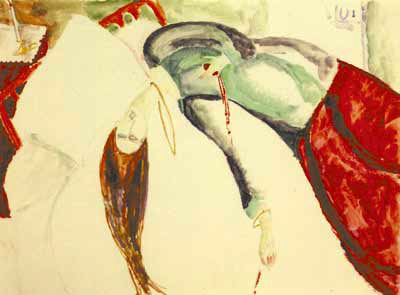
Jeanne Hébuterne, watercolor, 1919 (Source)
Jeanne took her life, and that of the child she was carrying, at three a.m. on January 25, the day after Modigliani's death; she jumped from the sixth-floor window of the apartment where she was staying with her parents. It doesn't take any alchemical speculations about transformation or meeting into the afterlife to solve the "mystery" of Jeanne's death: She had just lost the most important person in her life, and she was about to give birth to a child that she didn't want -- she had already rejected the first child from their relationship. Stress and hormones alone can explain why she killed herself. Moreover, her family had disapproved of her way of life, and she was facing a future in their custody.

She was not initially buried with Modigliani. The famly took her body to another cemetery, and the funeral was as private at they could make it. The fact of her suicide was somehow covered up from the authorities to allow her to be buried in consecrated ground.

The Hébuternes did not want to take responsibility for their daughter's surviving child, who was now thirteen months old, but the Modiglianis did. Emanuele and his wife, who were childless, adopted Jeanne as soon as they could, given that paperwork involving two countries was a problem, and by June 1920, Jeanne Modigliani was living with them in Florence. In March 1923, she was declared legitimate based on the statement signed by Modigliani in 1919 that he intended to marry her mother.

Grave of Modigliani and Jeanne in Père Lachaise. (Source)
Eugénie Modigliani wanted Jeanne Hébuterne's body to be moved to Père Lachaise, and set about persuading the Hébuternes to allow it. She prevailed, especially after the death of Jeanne's father, Achille, the most devout of the Hébuternes, and Jeanne was interred with Modigliani in February 1927.

Modigliani's son by Simone Thiroux, Gérard, had been put up for adoption, and lived in an orphanage until he was adopted by a family named Carlinot in 1931. But the Carlinots divorced and the father took Gérard with him to Indochina, where the boy was unhappy and stowed away on a boat back to France. He reunited with his birth mother, and disappeared until a reporter discovered him in 1981, age sixty-four and the curé of a church in Milly-la-Forêt. 

Emanuele and Vera Modigliani had been forced into exile in Paris in 1926, after Mussolini's rise to power. Jeanne Modigliani initially did not live with them, but with her grandmother, Eugénie, and then after her death with her aunt, Modigliani's sister Marguerite, who was a bit of tyrant and who detested Jeanne's father. In 1939, when Jeanne was twenty, she joined Emanuele and Vera in Paris, but the outbreak of war forced them to escape to Switzerland. Jeanne stayed behind in France, and married an Italian economist and journalist, Mario Cesare Silvio Levi. She also became a devout communist and took an active role in the Résistance.

She became involved with another Résistance fighter, Valdimar "Valdi" Nechtschein, who also used the alias Victor Leduc. He was her senior by eight years and was married, which she found no obstacle. She wrote, "Our union, begun in a moment of common danger, lasted for thirty years." She was imprisoned for several months in late 1943, but some forged documents obtained her release.

After the war ended, she divorced Levi, but Valdi had returned to his wife. In May 1946, Jeanne gave birth to a daughter she named Anne, whose father was Valdi. In the same month, Valdi's wife, Hélène, gave birth to his other daughter, Olga. Finally, Valdi began spending the weekdays with Jeanne and the weekends with Hélène. One reason for the arrangement was that at sixteen months Anne suffered a cerebral hemorrhage that resulted in paralysis and brain damage which would require years of therapy and several operations. After ten years of this arrangement, Valdi divorced Hélène and married Jeanne. Their second daughter, Laure, was born in 1951.

One reason that the Modiglianis were eager to have Jeanne's status legitimized was that according to the arrangement with Zborowski, one-fifth of the proceeds of any sale of Modigliani's work went to the artist or to his heirs. And after his death, the value of his works skyrocketed. "Emanuele could not have known how quickly Modigiliani's works would become valuable but he was concerned enough to safeguard Jeanne's legal right to royalties and percentages if any were to be had."

And as the value of Modigliani's work increased, so did the number of fakes. "Modigliani's style simplifies facial features and does not articulate anatomical details, such as cheekbones, shoulders, and rib cages," and the seeming simplicity of his style proved very attractive to forgers. As a result he "is one of the ten most faked artists in the world." As Modigliani's heir, Jeanne possessed the "droit morale" over his work, and had the power to certify a piece's authenticity. One dealer says, "Jeanne Modigliani was impossible because she signed authentication certificates in a very subjective way, without doing serious research." As a result some of the works she "authenticated" have since been discovered to be fakes. "Nowadays certificates from Jeanne Modigliani have been thoroughly discredited."
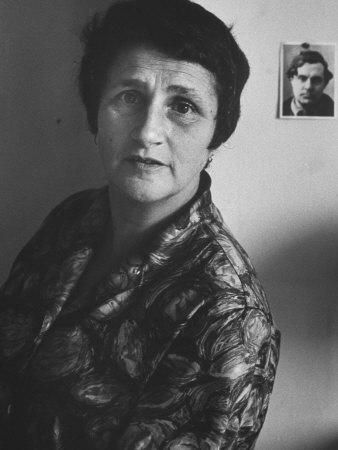
Jeanne Modigliani, c. 1964

In 1956, when Nikita Khrushchev took power in the Soviet Union and denounced Stalin, Jeanne was shattered. "It was a betrayal of her dearest hopes, one more way that life had let her down. She abandoned politics to concentrate on her art. She had been painting for several years and won a scholarship to work on a study of Vincent van Gogh." She remained estranged from her mother's family, whose "anger, no longer directed at Jeanne Hébuterne, had turned itself on her baby. That was in keeping with the popular view that if there was one thing worse than having an illegitimate child, it was being one." She and Valdi divorced in 1980, and she began drinking heavily. She died in July 1984.

Modigliani holds an odd position in art history: "In Modern Art, Meyer Schapiro's seminal work on art of the nineteenth and twentieth centuries, Modigliani's name does not appear.... Kenneth Clark's monumental study The Nude makes no reference to Modigliani's masterful studies of the female form despite the fact that the author clearly admired him at an early age." Marc Restellini observes, "The universities where Picasso or Matisse are much studied deem Modigliani a facile painter devoid of innovation." It may be because of the proliferation of forgeries, which suggests to some that his work is over-simple, or because he is not easily classified into any of the movements -- "Fauvism, Cubism, Surrealism, Futurism" -- with which he was contemporary. Nor is he regarded as influential on subsequent generations.

7. Modigliani: A Life, by Meryle Secrest, pp. 251-309

Chapter 12: "Nenette"; Chapter 13: "Life Is a Gift"

The breakup with Beatrice Hastings left Modigliani in some danger: He had collapsed so often that he needed someone to look after him. His affair with Simone Thiroux was short-lasting, but at the end of 1916 he met Jeannette, or Jeanne, Hébuterne, an art student.
Jeanne Hébuterne (Source)

Jeanne's family was from the countryside near Meaux. Her parents had moved to Paris, where her father, Achille, was an executive with a perfume company. Her mother, Eudoxie, was interested in the arts, and had a romantic notion of the lives of artists. Otherwise she might not have given her daughter such a free rein in Montmartre. Jeanne's brother, André, was three years her senior and had begun his own career as an artist. 

In May 1917, Jeanne and Modigliani began their affair. She was nineteen and he was thirty-two, but she had some skills he lacked: She was "able to manage a household, go on errands, and balance the budget, concealing, behind her self-effacing manner, a quiet dependability." She managed to keep their relationship a secret from her parents for a year. "Her mother finally guessed the truth in the spring of 1918 when Jeanne could no longer deny that she was pregnant."

Modigliani had been typically irresponsible in getting her pregnant. "His behavior was the height of recklessness as he went from one woman to another, exposing her to tuberculosis and also unprotected sex, that led all too often to the predictable results." He may have impregnated Maud Abrantes, as well as both Beatrice Hastings and Simone Thiroux; the latter  gave birth to a boy she named Serge, in May 1917. He denied paternity, "even though his friends saw a startling resemblance in the two-year-old Serge."

In July 1917, Modigliani and Jeanne moved into a two-room studio. "There was, of course, no kitchen, bathroom or toilet, running water, or central heat. But given the hovels he had inhabited this third-floor walk-up was almost luxurious." It was made possible in part by a change of art dealers, when Léopold Zborowski replaced Paul Guillaume. Modigliani negotiated a deal with Zborowski that included fifteen francs per day plus materials and models, as well as a studio in Zborowski's own apartment.

Zborowski wanted Modigliani to start painting nudes: "This made the best possible business sense. It was all very well to paint portraits, but if the subjects did not buy them the chances of encountering someone else who would were small.... Nudes were bound to make people stop and look." They are still among the best-known of Modigliani's paintings: In 2010 his Nude Seated on a Sofa sold at Sotheby's in New York for $68.9 million, setting a record for a work by Modigliani sold at auction.
Amedeo Modigliani, Nude Seated on a Sofa, 1917 (Source)
Poster for Modigliani's first one-man show (Source)
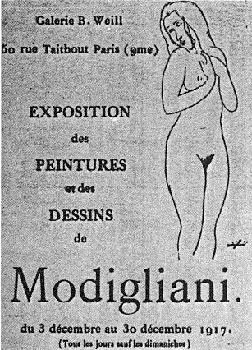
Zborowski was right in thinking that Modigliani's nudes would attract attention, and he was effective in making sure they got it. For the artist's first one-man show at the Galerie B. Weill in December 1917, there was a rather provocative poster, for which Jeanne Hébuterne was the model. Berthe Weill, the gallery owner, also placed several nudes in the window. The gallery was across the street from a police station, and the display attracted such crowds that a policeman asked Weill to remove the nudes from the window. When she refused she was hauled into the station, where the chief constable proclaimed the exhibition "an offense against public morals." Weill finally got the policeman to explain what was so offensive about the nudes: They had pubic hair.

The sensation the show caused did not, however, spur sales:  only two drawings were sold, at thirty francs each. Weill, however, bought five paintings, if only to raise Modigliani's morale. He returned for a while to painting portraits, and when he went back to nudes he mostly used the conventional methods of concealment: drapery, or a strategically placed hand. "Five years later one of his forbidden nudes was sold at the Salle Drouout in Paris for twenty-two thousand francs."
Amedeo Modigliani, Nude With Necklace, 1917 (Source)
Zborowski was successful in connecting Modigliani with several collectors, including Jones Netter and Roger Dutilleul. "Between 1918 and 1925, thirty-four of Modigliani's paintings and twenty-one of his drawings went through Dutilleul's hands." Zborowski suggested that Modigliani paint Dutilleul's portrait, but when Modigliani arrived for the sitting, Dutilleul recalled, "As he stood looking at my canvasses by Picasso and Braque, he was agonized. He said, 'I am ten years behind them,' and I had a lot of trouble convincing him this was not so." Dutilleul also recalled that he paid Zborowski five hundred francs for the painting, of which only one hundred went to Modigliani.
Amedeo Modigliani, Portrait of Roger Dutilleul, 1919 (Source)
Meanwhile, Jeanne herself continued to paint, and in recent years her work has sold well. Two of her drawings, one a self-portrait and the other of Modigliani with a pipe, sold at Christie's in Paris in 2009 for more than $17,000.
Jeanne Hébuterne, Self-portrait, date unknown (Source)
Jeanne Hébuterne, Modigliani With a Pipe, date unknown (Source)
In March 1918 a new German offensive, including the shelling of the city by the giant cannon known as Big Bertha, as well as the outbreak of influenza that became a worldwide pandemic, caused many to leave Paris. According to Marco Restellini, it was Jones Netter who paid for Modigliani and Jeanne, among others, to leave the city for Nice and Cannes. They would be gone from Paris for a years. Modigliani's health continued to deteriorate and he came down with the flu that summer. He continued to paint, but not as often, though the quality of his work was high.
Amedeo Modigliani, Portrait of Léopold Zborowski, 1918 (Source)
Amedeo Modigliani, Portrait of Jeanne Hébuterne, 1918 (Source)
Amedeo Modigliani, A Zouave, 1918 (Source)
The military threat to Paris ended, and by November the war was over. Meanwhile, Jeanne was about to give birth to their daughter. It seems that Jeanne and her mother remained in Nice, but it is not clear when Modigliani returned to Paris. The address on the baby's birth certificate is in Nice, and she was born at the end of November. But whether Modigliani was present for the birth is unknown, and the subject of many stories. He was, however, delighted with the child, who was named Jeanne. Her mother wasn't, however, and Modigliani himself took on the task of locating a suitable nurse for the child.

In May 1919, he was back in Paris, leaving Jeanne in Nice, and began working again in preparation for a show in London. In June, Jeanne sent Modigliani a telegram through Zborowski, asking for train fare to Paris. She was pregnant again, and in July Modigliani signed a note promising to marry Jeanne "as soon as the documents arrive" -- which presumably refers to some Italian citizenship papers.

The show in London, at the Mansard Gallery, was to be "the most important exhibition of French art in Lodon in almost a decade." It featured thirty-nine artists, including Dufy, Léger, Matisse, and Picasso, but Modigliani had more works than any of them in the show: fifty-nine pieces. The British critics had discovered him: He was praised by the influential Roger Fry, and the novelist Arnold Bennett, who had written the catalog for the exhibition, said, "I am determined to say that the four figure subjects of Modigliani seem to me to have a suspicious resemblance to masterpieces." Bennett bought a nude and a portrait of Lunia Czechowska, The show had been organized by Osbert and Sacheverell Sitwell, in collaboration with Zborowski, who offered them any picture from the exhibition at a bargain price. They chose one of Modigliani's identified as "Peasant Girl," for which they paid four pounds at a time when the going price for one of his paintings was between thirty and a hundred pounds.

The painting The Little Peasant caught the eye of the sixteen-year-old Kenneth Clark, who had been given a hundred pounds by his parents and told to buy a painting. He paid sixty pounds, but when he got home he realized that he could never hang it among his parents' "gilt-framed Barbizon paintings." So it was sold instead to the artist and collector Hugh Blaker, who eventually sold it to the Tate.
Amedeo Modigliani, The Little Peasant, 1918 (Source)
Modigliani was too ill to travel to London for the exhibition. He had come down with another case of influenza. Paul Guillaume, who owned most of the paintings in the show, told Zborowski to put all sales on hold until Modigliani recovered -- he "knew the prices would double and triple if and when Modigliani died." This time, however, Modigliani didn't cooperate, but the end was only months away.

He thought that it was the influenza that made his health so poor that fall and winter, but it is likely that the tuberculosis had spread to his brain, leading to meningitis, the course of which is described as "going from headaches, general apathy, irritability, fever, and loss of appetite to delirium and coma." He was, however, exhilarated by the praise from London, and continued to work toward the Salon d'Automne, which would take place in November. But his behavior became more erratic, and when Marie Vassilieff met him on the street one day, she recalled, "I couldn't believe the change in him. He had lost his teeth; his hair was flat, straight; he had lost all beauty. 'I'm for it, Marie,' he said,"

One of his last subjects was Paulette Jourdain, a fourteen-year-old live-in maid at Zborowski's. She eventually became Zborowski's mistress and gave birth to his child, which Zborowski and his companion, Hanka, raised as their own. Paulette later became an art dealer, and collected Modigliani memorabilia.
Amedeo Modigliani, Portrait of Paulette Jourdain, 1919 (Source)
Another of his last models was Thora Klincköwstrom, a Swedish girl who came to Paris to study sculpture. On one of the sketches he made of her, he wrote a quotation from d'Annunzio:
La Vita e un Dono; 
dai pochi ai molti: 
di Coloro che Sanno e che hanno 
a Coloro che non Sanno e non hanno.
Life is a gift from the few to the many, from those who know and have to those who don't know and don't have.
She recalled that while she posed for him, Modigliani coughed a lot and would occasionally stop for a drink of rum. Jeanne Hébuterne entered once during the sitting, and "Modigliani explained that Jeanne was expecting their second child and that their baby was staying with a nurse in the countryside outside Orléans."
Amedeo Modigliani, Portrait of Thora Klincköwstrom, 1919 (Source)
Although Modigliani told Thora that baby Jeanne was in Orléans, she seems to have been in the care of Lunia Czechowska for much of the time they were in Paris. Jeanne Hébuterne visited her daughter once a week. Sometime that fall Lunia decided to move to the south of France, and there are suggestions that Modigliani wanted to go with her. But Jeanne's pregnancy made her reluctant to travel or to be left alone in Paris. Marc Restellini thinks that there was much tension between Jeanne and Modigliani in the last months, and that he wanted the motherly attention that Lunia gave him. The late paintings of Jeanne are also unflattering.
Amedeo Modigliani, Portrait of Jeanne Hébuterne With Her Left Arm Behind Her Head, 1919 (Source)
He also did only the second self-portrait that we know of:
His expression is indecipherable -- the art historian Sara Harrison likened it to a mask -- and his eyes are narrowed, their sockets blanked out with gray. The autumnal colors of fawns, ochres, and reddish browns, the grayish-blue scarf tied around his neck, provide the elegiac proof, if such were needed, that Modigliani knew how little time was left.
Amedeo Modigliani, Self-portrait, 1919 (Source)
Kenneth Silver notes that it is in the tilt of the head "that we strongly sense Modigliani's predilection for the Italian Renaissance and especially for the art of Botticelli, for whom the tilted head is a sign of spiritual buoyancy .... Italianate too ... are both the attenuated linear style and the idealization of the form, which is at the crux of Modigliani's art."
Sandro Botticelli, Primavera, 1478 (Source)
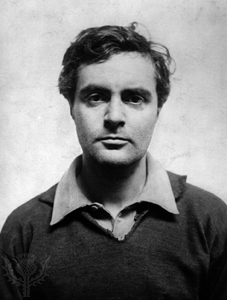
Amedeo Modigliani, 1919 (Source)
The last known photograph of Modigliani, taken in 191, shows eyes full of a painful awareness.... The received wisdom was that he drank himself to death. The reverse is the case; alcohol and drugs were the means by which he could somehow keep functioning, the necessary anesthetic, as well as hide the great secret that must be kept at all costs. 
It is possible, Secrest says, that the secret of Modigliani's tuberculosis did get out in the final days, and that it provides "the most plausible explanation for what happened when he was dying and for days left alone." But even then, when a doctor was sent for, his illness was misdiagnosed as a kidney infection. Only when he lapsed into a coma was he finally taken to a hospital, where he died on January 24, 1920. He left an unfinished portrait on his easel, of the Greek composer Mario Varvogli, with whom he had gone out drinking on New Year's Eve.
Amedeo Modigliani, Portrait of Mario Varvogli, 1919 (Source)
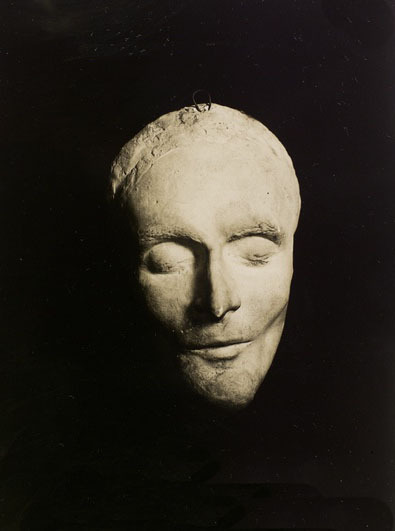
Modigliani's death mask (Source)
A death mask was taken, though it was somewhat botched because the plaster was not allowed to set long enough; Jacques Lipchitz was called in to restore it and make bronze castings. The sunken cheeks suggest both the emaciation and the loss of teeth that he suffered in the final year.

When the family was contacted, Emanuele sent word to spare no expense in the funeral, and that he would cover the expenses. The decision was made to bury Modigliani in Père Lachaise, the cemetery known for the famous artists who are interred there. The funeral procession attracted a crowd. "It is said that, as the numbers grew, speculators in art ran up and down the ranks, offering to buy for thousands of francs what no one would pay fifty for while he was alive."

Monday, July 4, 2011

1. Modigliani: A Life, by Meryle Secrest, pp. xv-30

Preface and Acknowledgments; Chapter 1: The Problem; Chapter 2: The Clues

Books don't usually begin with acknowledgments, but Secrest obviously owes a debt of gratitude to Marc Restellini, whose enthusiasm for Modigliani and whose curatorial efforts in mounting exhibitions of his work inspired her. "Restellini by most accounts has become the leading authority on the work of Amedeo Modigliani," she writes, and he began helping her with an introduction "to a pivotal figure, Luc Prunet, the great-nephew of Jeanne Hébuterne, Modigliani's last love, who committed suicide within days of his death in 1920. This event, Restellini thought, had done most to fix in people's minds the idea of a dissolute Bohemian, doomed to destroy everything and everyone he touched."
Marc Restellini (Source: The Independent)

Restillini's resistance to this conventional idea about Modigliani also shaped the direction of Secrest's biography, and for a time they considered co-authorship.

Secrest had earlier written a biography of the American expatriate artist Romaine Brooks, a contemporary of Modigliani whose "success in 1910 was immediate," whereas "Modigliani's achievements took decades to be appreciated." Today, it is Brooks who is largely unknown to the general public, while "Modigliani's reputation continues to soar, to judge from the prices paid for his paintings."
Chester Dale (Source)
Maud Dale (Source)

In the National Gallery in Washington, Secrest happened upon a room containing eight Modigliani paintings and one of his sculptures, from the collection of Chester and Maud Dale who had bought them "in the early 1920s, when they could almost be had in job lots."

The first painting over which Secrest lingered was Modigliani's portrait of Monsieur Deleu, from 1916:
"The expression, at first glance a caricature, was in fact full of dexterously applied details, such as a touch of light in the left eye, a shadow under an eyebrow, and the play of volumes around the mouth and chin.... The sense of enigmatic intent extended to the dappled light and shade on the sitter's jacket and the close attention given to what is usually least considered, i.e., the background. Each stroke of the brush seemed to have been placed with a feeling of finality, even inevitability." --Secrest (Image source)
 Next to it was Madame Amédée (Woman With a Cigarette), which was painted two years later, a "depiction of a heavyset woman in a black dress, hand on hip and a cigarette dangling between her fingers."
"That air of disdain, those raised brows, the puckered mouth -- could there be a hint of self-doubt in her pose? The impression is reinforced by the artist's sloping floor and the realization that his model is not actually sitting on her chair but floating above it. Hauteur, insouciance, pretense -- all this melts before the penetrating gaze of the artist, who has made his feelings known with such delicate irony." --Secrest (Image source)
Gypsy Woman With Baby was painted in 1919, shortly after Modigliani had become a father.
"Fragile grays, going from blue to green, are harmoniously intertwined within outlines that have been softened and blurred, the paint broken up into thumb-like patches of color. The mother, hardly more than a girl, with her high coloring, skewed nose, pretty mouth, and sweet, lost look, presses her baby against her as if clinging to a life raft.... As a final, masterful touch, the artist has added, in his subject's otherwise neat coiffure, a single escaping wisp of hair." --Secrest (Image source: Wikipedia)
"Modigliani ... painted [Chaim Soutine's] portrait a number of times. Here he is [in 1917], staring out of the frame, a seated figue with tumbling hair and ill-matched clothes, his hands placed awkwardly in his lap, his eyes half closed and peasant nose spreading across his expressionless face. He is ugly, and yet." --Secrest (Image source)
Modigliani's "chef d'oeuvre, Nude on a Blue Cushion, one of the painter's series of grand horizontals, [was] painted three years before his death."
"This is a girl who wants to be liked and is not at all sure of the reception, as is suggested by fastidious painterly details, such as the light and shade around the forehead, a touch of pink beside the nose, and the hint of a line under one eye. At close range, one discovers ... the smidgen of blue on a wrist which picks up the color of the cushion, the patch of pink on a knee, the dot at the corner of an eye, and the same judiciously considered background." --Secrest (Image source)
 A "single piece of sculpture, a limestone head of a woman, [stands] on a pedestal in one corner of the room."
"The head, carved from a rectangular piece of stone, was consequently elongated, its nose radically long, mouth barely indicated, eyes enigmatic and impassive. One thought, as Bernard Dorival wrote, of the religious power found in Khmer and Chinese sculptures. Monumentality -- other-worldliness -- the transcendental -- such thoughts rose to the surface and whirled around in my head." --Secrest (Image source)
The legend of Modigliani as a self-destructive artist began to develop not long after his death. "In 1926 André Salmon, poet and journalist, published a seeming celebration of Modigliani's art that made frequent references to the artist's apparent addiction to drugs and society," and this fed an image of the "artist at odds with society," analogous to others such as Gauguin and Van Gogh.
He was a visionary, a poet and philosopher, even a mystic. Or he was a minor character, whose romantic life story had led some to place more importance on his work than it deserved. His nickname was Modi, which Salmon was the first to transmute into "maudit," i.e., accursed.
Amedeo Modigliani (Source)
Among the facts about his life were that he was "the youngest of four children from an educated but impoverished Italian Jewish family," and that he "came to Paris in 1906 at the age of twenty-two to make his fortune." He was also "strikingly good-looking." But his painting failed to gain critical notice. There were "no reviews at all for his [one-man show] in 1917, and few mentions in the French press during his lifetime." He died at thirty-five, and his lover, Jeanne Hébuterne, killed herself and their unborn child two days later. They left a two-year-old daughter.

The tragic story inevitably attracted fiction writers, and in 1958 a French movie based on his life, Montparnasse 19 (in America, Modigliani of Montparnasse), was made, starring Gérard Philipe as Modigliani. The Russian poet Anna Akhmatova, who had had an affair with Modigliani, called it "extremely vulgar."
Poster for the 1957 film based on Modigliani's life (Source)

Missing from many of these accounts were some key facts, such as the two "life-threatening" illnesses that he had suffered before reaching the age of seventeen, and his "lifelong battle with tuberculosis" and "the toll it exacted: physical, emotional, and social." In many of the biographies and fictions there is, Secrest asserts, a "clear goal of capitalizing on the tragic circumstances of his life and almost simultaneous deaths of himself and his mistress in 1920."

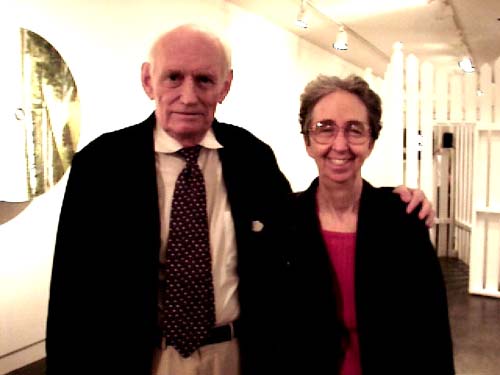
Billy Klüver and Julie Martin (Source)
Setting out on her quest for the truth about Modigliani, Secrest made contact with Julie Martin and Billy Klüver, experts on the "complicated interrelationships among the artists, sculptors, poets, writers and musicians in Paris" in the early twentieth century. They agreed with Secrest's premise that Modigliani "was a remarkable man who had been dismissed as a clownish figure who just happened to have painted some unforgettable canvases." Martin and Klüver introduced her to numerous important sources, including Restellini, and told her of the interviews conducted by Pierre Sichel in 1963-64 with many of the people who had known Modigliani. After writing a biography of Modigliani, Sichel had given the interviews to Boston University.

Julie Martin also directed Secrest to the manuscript of the family history written by Modigliani's mother, Eugénie Garsin-Modigliani. It had been a source for Modigliani's daughter Jeanne's biography of her father, but Secrest discovered that Jeanne had made little use of the material in it. The Garsins were "Sephardic Jews who had lived on the Mediterranean coastline for centuries," and claimed to be descended from the philosopher Spinoza. They were "a family much more apt to take pride in intellectual prowess than financial dealings" and who "moved with ease between cultures and social groups." Eugénie, one of seven children of Isaaco and Regina Garsin, grew up in Marseille.

In 1870, when Eugénie was fifteen, the family, which "had constantly shuttled between Marseille and Livorno, turned back toward Italy," in large part because of the Franco-Prussian War. Her father and grandfather also decided that it would be a good time to make plans to marry Eugénie to "a member of a prominent Livornese family."
Physically the Garsins were small and dark with "alert, expressive, changeable faces," Eugénie wrote. They were subject to illnesses: liver disease (which suggests alcoholism), tuberculosis, and psychological disorders, as well. The Modiglianis were taller and well built, held themselves well, were of "phlegmatic temperaments," were robustly healthy, and lived into old age. Whereas the Modiglianis were "more inclined to enjoy life than strain their intellects," Eugénie wrote with her usual acerbity, the Garsins were almost fanatically well-read, eager scholars.
Also unlike the Garsins, "the culturally illiterate Modiglianis ... had a genius for business." The family fortune was based on minerals: the mining of lead and zinc in Sardinia and Lombardy.
Eugénie and Flaminio Modigliani (Source)

Flaminio Modigliani was thirteen years older than Eugénie; he co-managed the family's mine and thirty-thousand acres of land in Sardinia. They married in January 1872, but Eugénie saw her husband only "ten days every Easter and fifteen days every summer; for the remainder of the year she lived alone." Their first child, Emanuele, was born in the winter of 1872. Eugénie's mother came to visit, but she was already suffering from the tuberculosis from which she would die in May 1873. The Garsins were also experiencing financial trouble, and the combination of that with his wife's death caused Eugénie's father to have a nervous breakdown.

The Modiglianis also went through a financial crisis when the price of metals began to drop in 1881, and in 1883 they declared bankruptcy. By 1884, "Flaminio and Eugénie had three children: Giuseppe Emanuele, Margherita, and Umberto," and she was pregnant with Amedeo. The house they were living in was in liquidation, but "the Modiglianis discovered an obscure Italian law that prevented the authorities from removing the bed on which a pregnant woman was about to give birth. One imagines the jewels, silver, clothes, laces, silks, curtains, bedspreads, blankets, linens, pillows, draperies, cushions, objets d'art, rugs and much else piled upon the very large bed on which the mother-to-be presumably lay." But in fact, Amedeo was born on "an enormous kitchen table with a black marble top" on July 12, 1884.