JOURNAL OF A COMPULSIVE READER
By Charles Matthews
Showing posts with label Charles Baudelaire. Show all posts

Wednesday, April 20, 2011

6. The Modern Tradition, edited by Richard Ellmann and Charles Feidelson Jr., pp. 98-120

Symbolism: Imagination and Thought; The State of Affirmation (Friedrich Nietzsche, W.B. Yeats). Symbolism: The Autonomy of Art; The Doctrine of Purity (Charles Baudelaire, Oscar Wilde, Richard Wagner, Stéphane Mallarmé, Guillaume Apollinaire, Marcel Duchamp)
_____

Friedrich Nietzsche: The Acceptance of Untruth

For help with these excerpts from The Joyful Wisdom and The Antichrist, I need to turn to Ellmann and Feidelson's introduction again:
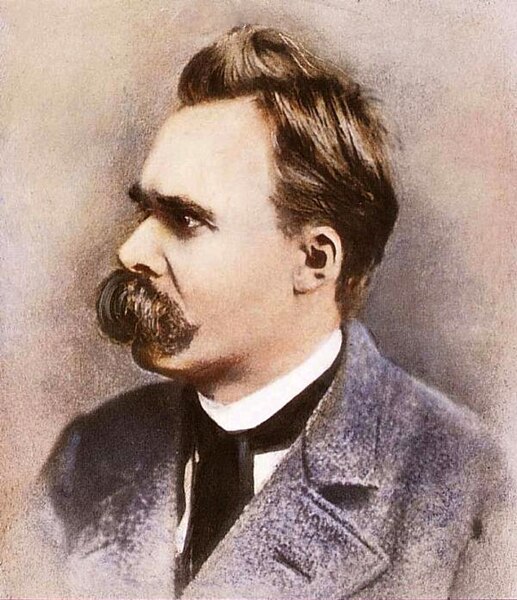
Friedrich Nietzsche, date unknown
Another face of poetic inconclusiveness and non-assertion is poetic affirmation, which is equally indifferent to objective tests of truth [as Richards's "pseudo-statements"]. Nietzsche finds that "untruth" is a condition of life; opinions, ideas, and beliefs are unavoidably false, yet they are necessary to gauge reality against imagined standards without which life would be arid. Affirmations, however fictional, are life-furthering because they extend man's sway over things and also provide necessary food for the passions, which crave attachments. Consequently skeptics, including Zarathustra himself, employ convictions as expressive material. 
In Nietzsche's view, we have art to thank for making us used to untrue things, otherwise "the insight into the general untruth and falsity of things now given us by science -- an insight into delusion and error as conditions of intelligent and sentient existence -- would be quite unendurable." Existence itself has now become "an aesthetic phenomenon," and we should relish the fact that we are all fools content with illusions: "we must now and then be joyful in our folly, that we may continue to be joyful in our wisdom!" Art gives us this joy: "we need all arrogant, soaring, dancing, mocking, childish and blessed Art, in order not to lose the free dominion over things which our ideal demands of us."

We should also celebrate our liberation from dogma. "Strength, freedom which is born of the strength and overstrength of the spirit, proves itself by skepticism.... Convictions are prisons.... Freedom from all kinds of convictions, to be able to see freely, is part of strength."


W.B. Yeats: The Conquest of Scepticism

Skepticism can only take us so far, Yeats argued in his journal in 1929. He cites Ezra Pound's contention "that we know nothing but sequences. 'If I touch the button the electric lamp will light up -- all our knowledge is like that.'" Yeats argues that this may be scientifically accurate, but philosophically false. Skepticism "is mere acknowledgement of a limit." To affirm something that may be verifiably untrue from the skeptical point of view may nevertheless prove useful: "I have felt when re-writing every poem ... that by assuming a self of past years, as remote from that of today as some dramatic creation, I touched a stronger passion, a greater confidence than I possess, or ever did possess." Pound, he says, does the same thing when he writes his imitations of Propertius or the Chinese poets: he "escapes his scepticism." It's not that we believe when we imagine things, it's that we put ourselves in the same state of mind as if we believed, with the same result. We accept the power of tradition when we do so. "The 'modern man' is a term invented by modern poetry to dignify our scepticism."


Charles Baudelaire: The Didactic Heresy

It was Théophile Gautier who took for his slogan the phrase "l'art pour l'art," which we know as "art for art's sake" (or as the MGM slogan Ars gratia artis, coined by some studio publicist with a smattering of Latin). And the Baudelaire selection is from his 1861 essay on Gautier, a defense of that poet's doctrine. Naturally, the corollary to the premise that art is an end in itself is that art must not sacrifice its integrity for the sake of teaching or preaching. So Baudelaire insists, "Poetry ... has no object but itself: it can have no other, and no poem will be so great, so noble, so truly worthy of the name of poem as that which has been written solely for the pleasure of writing a poem." There is a wee bit of a desire to shock in the statement, and both its message and the tone in which it is delivered clearly influenced Oscar Wilde's pronouncements on the same topic. When Baudelaire says, "I say that if the poet has pursued a moral end, he has diminished his poetical power," he's saying the same thing we've already seen Wilde say (except that Wilde said it more wittily).


Oscar Wilde: The Improvidence of Art

And Wilde says it again in the preface to The Picture of Dorian Gray thirty years after Baudelaire's essay on Gautier. He continues to try to shock, when he claims, "No artist has ethical sympathies. An ethical sympathy in an artist is an unpardonable mannerism of style." Well, obviously artists do have "ethical sympathies," but the point is that they shouldn't let them show -- at least not blatantly."

The central point in Wilde's preface, I think, the one that links him with so many others in this section of the anthology, is, "From the point of view of form, the type of all the arts is the art of the musician." In music, form and content are the same thing, which is the ideal toward which Wilde and his contemporaries repeatedly claimed to strive. But Wilde also adds, "From the point of view of feeling, the actor's craft is the type." The actor may or may not actually feel what the character he plays is feeling, but he is judged only by how successfully he makes the audience believe that he does. Sincerity is not in question, or as the cynical saying goes, "If you can fake that, you've got it made."

And then there's this knotty sequence of epigrams:
All art is at once surface and symbol. 
Those who go beneath the surface do so at their peril. 
Those who read the symbol do so at their peril. 
It is the spectator, and not life, that art really mirrors. 
If we equate "surface" with "form," and "symbol" with "content," we oversimplify what Wilde is saying, but it may help us get closer to his meaning. It is really an echo of the two statements made earlier in the preface:
The nineteenth century dislike of Realism is the rage of Caliban seeing his own face in a glass.
The nineteenth century dislike of Romanticism is the rage of Caliban not seeing his own face in a glass. 
For Caliban, the untutored savage, read "bourgeois philistine," who chafes at both the realistic artist's candor and the romantic artist's idealizations.

And finally: "All art is quite useless." Which only means that art that can be used to point a moral, adorn a tale, elect a candidate, promote a dogma, and so on, isn't really art.


Richard Wagner: Literature as Music-Drama

Richard Wagner, c. 1862
No one believed more whole-heartedly than Wagner that music was the highest of all the arts, which is why he argued for the assimilation of the other arts into the Gesamtkunstwerk, that untranslatable Germanism that means something like "total work of art," or "synthesis of the arts," or "all-encompassing art form," and so on. It was "The Music of the Future," he proclaimed in this 1860 essay.

He begins with some nationalistic reflections on the "peculiar significance of German efforts in art," which are characteristic of Wagner but nevertheless a little embarrassing today. But he finally settles down to the aesthetics of the matter, the pre-eminence of "music, that language intelligible to all men." He asserts that "the special, separately developed branches of art, however much their capabilities of expression might finally be brought out and heightened by great geniuses, nevertheless, without falling into unnaturalness and decided error, could never aim to supply in any way that all-powerful work of art which was only possible through a union of their forces."

Each artistic medium, he asserts, runs the risk of developing itself to its limits, "and that it cannot pass these limits without the danger of losing itself in the unintelligible and absolutely fantastic -- even in the absurd." (Some would say that literature passed these limits with Finnegans Wake, or painting with the exhibition of perfectly white canvases, or even music, with John Cage's 4'33" -- four minutes and thirty-three seconds of silence.) Wagner's solution to the problem of limits is for the media to join forces. And particularly for poetry and music to collaborate. He began "to see in the opera an ideal branch of art."
The poet seeks, in his language, to make the abstract, conventional meaning of words subordinate to their original, sensible one; and to secure, by rhythmic order, as well as by the almost musical dressing of words in versification, an effect for his phraseology which shall gain possession of and influence the feelings as though by enchantment.

In this course of the poet, so necessary to his very nature, we see him finally come to the limits of his branch of art, where it already seems to touch music, and thus the most successful work of the poet must be, for us, that which should be, in its perfection, entirely musical.
For Wagner, Beethoven is chief among his predecessors for having, through the symphony, achieved a kind of drama, "a language of which no one in any preceding age had any knowledge, inasmuch as the pure musical expression in it enchains the hearer with a lasting effect hitherto unknown." He speculates that human language "developed from a purely sensuous, subjectively-felt signification of words, into a more abstract sense" that eventually robbed words of feeling "and made their very connection and construction entirely dependent on certain rules that could be learned." (Very few language experts would agree.) So he sees only two paths open for the development of poetry: either into pure abstraction as a vehicle for philosophy, or "it must become intimately bound up with music, and with such music as that whose endless power is revealed to us by the symphony of Beethoven."

And for the poet, "no poetic form is fitted for his use but that in which the poet no longer describes, but brings his subject into actual representation, that is convincing to the senses; -- and this form is nothing but -- the drama," which "awakens in the spectator real participation in the action presented to him."


Stéphane Mallarmé: Poetry as Incantation
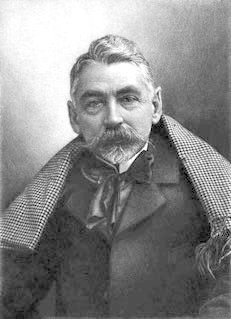
Stéphane Mallarmé, 1896
The title of Mallarmé's essay, "Crisis in Poetry" (1886-95), suggests a certain ambivalence about the "new freedom" won by poets in their liberation from the academic rules and forms -- such as the "artificial metronomes" of the alexandrine, the twelve-syllable line. And he resorts to the familiar analogy to music to describe this freedom: "for the first time in the literary history of any nation, ... any poet with an individual technique and ear can build his own instrument, so long as his fluting, bowing, or drumming are accomplished."

But language is not music:
I am disappointed when I consider how impossible it is for language to express things by means of certain keys which would reproduce their brilliance and aura.... When compared to the opacity of the word ombre, the word ténèbres does not seem very dark; and how frustrating the perverseness and contradiction which lend dark tones to jour, bright tones to nuit! We dream of words brilliant at once in meaning and sound, or darkening in meaning and so in sound, luminously and elementally self-succeeding. But, let us remember that if our dream were fulfilled, verse would not exist -- verse which, in all its wisdom, atones for the sins of languages, comes nobly to their aid.
It's that old duality of sound and sense again. So he welcomes Wagner's Gesamtkunstwerk: "We now hear undeniable rays of light, like arrows gilding and piercing the meanderings of son. I mean that, since Wagner appeared, Music and Verse have combined to form Poetry."

The one thing that poets must now begin to avoid in their verse is description, "that erroneous esthetic ... which would have the poet fill the delicate pages of his book with the actual and palpable wood of trees, rather than with the forest's shuddering or the silent scattering of thunder through the foliage." Instead of description the poet should rely on "evocation, allusion, suggestion." Poetry that too directly confronts reality risks didacticism and loses its special role: "Speech is no more than a commercial approach to realisty. In literature, allusion is sufficient: essences are distilled and then embodied in Idea."

In Wilde's preface to The Picture of Dorian Gray, he asserted, "To reveal art and conceal the artist is art's aim." Mallarmé makes a similar assertion: "If the poem is to be pure, the poet's voice must be stilled and the initiative taken by the words themselves, which will be set in motion as they meet unequally in collision." Pure poetry is the aim, as in Mallarmé's own poem, "Le tombeau d'Edgar Poe," which lauds the attempt to "purify the words of the tribe":  "Donner un sens plus pur aux mots de la tribu."

Where Wagner would give priority to music, Mallarmé would substitute language. "For, undeniably, the true source of Music must not be the elemental sound of brasses, strings, or wood winds, but the intellectual and written word in all its glory -- Music of perfect fulness and clarity, the totality of universal relationships." Like Richards, Mallarmé distinguishes between something like statements and pseudo-statements, dividing words "into two different categories: first, for vulgar or immediate, second, for essential purposes. The first is for narrative, instruction, or description.... Language, in the hands of the mob, leads to the same facility and directness as does money. But, in the Poet's hands, it is turned, above all, to dream and song."


Guillaume Apollinaire: Pure Painting
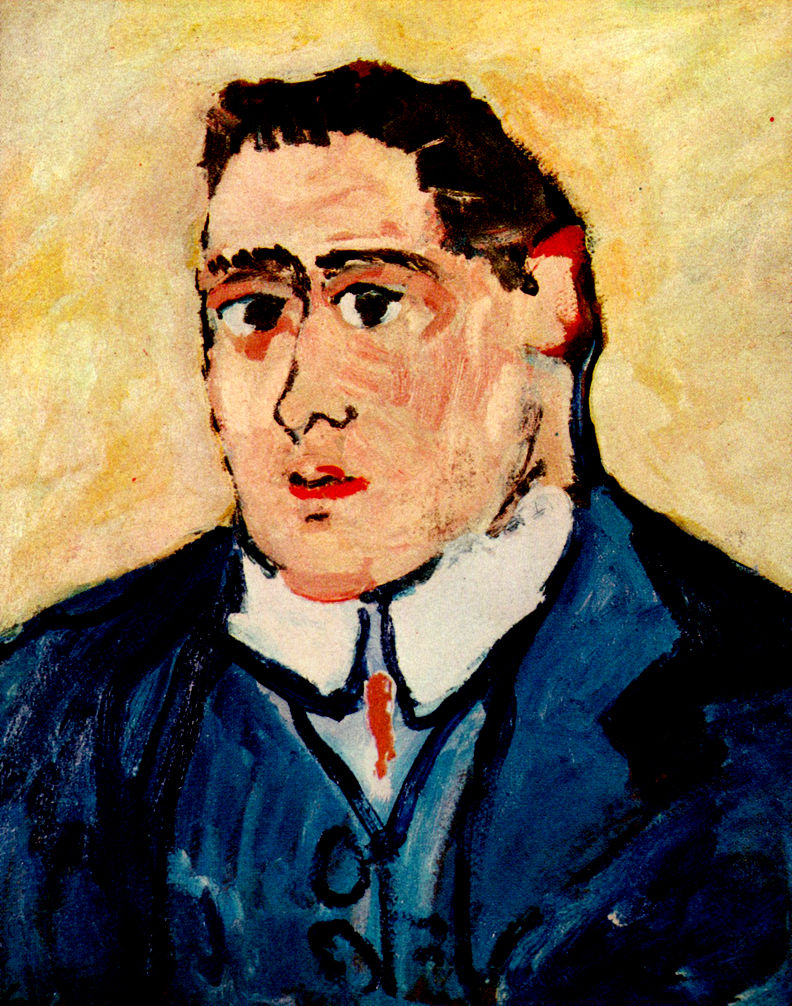
Maurice Vlaminck, Guillaume Apollinaire, 1903
Apollinaire's manifesto appeared in 1913, and like Mallarmé, he abhors the descriptive: "too many painters still adore plants, stones, the sea, or men." He finds a persuasive image for his conception of painting:
Flame is the symbol of painting, and the three plastic virtues burn with radiance. 

Flame has a purity which tolerates nothing alien, and cruelly transforms in its image whatever it touches.

Flame has a magical unity; if it is divided, each fork will be like the single flame.

Finally it has the sublime and incontestable truth of its own light. 
He argues that the more a painting exists on its own terms, insists on its own integrity, the more it participates in the eternal: "We will not go astray in the unknown future, which, severed from eternity, is but a word fated to tempt man. We will not waste our strength on the too fugitive present; the fashionable, for the artist, can only be the mask of death." And of course, the artist must resemble God the Creator: "Each god creates in his own image, and so do painters. Only photographers manufacture duplicates of nature." (Howls of protest from photographers.)

Like Mallarmé, he rejects the descriptive, or in painterly terms, the representational: "Real resemblance no longer has any importance, since everything is sacrificed by the artist to truth, to the necessities of a higher nature whose existence he assumes but does not lay bare. The subject has little or no importance any more.... While the goal of painting is today, as always, the pleasure of the eye, the art-lover is henceforth asked to expect delights other than those which looking at natural objects can easily provide."

Once again, music is the norm: "we are moving towards an entirely new art which will stand, with respect to painting ... as music stands to literature. It will be pure painting, just as music is pure literature." At the basis of pure painting is mathematics: "geometry is to the plastic arts what grammar is to the art of the writer." Unlike the Greeks, who "took man as the measure of perfection, ... the art of the new painters takes the infinite universe as its ideal."

Once again, we are told, essentially, that Nature imitates Art: "It is the social function of great poets and artists to renew continually the appearance nature has for the eyes of men. Without poets, without artists, men would soon weary of nature's monotony... The order which we find in nature, and which is only an effect of art, would at once vanish. Everything would break up in chaos."
Pablo Picasso, Houses on the Hill, Hora de Ebro, 1909

He turns to a particular school of painting, Cubism, which he says is "a name first applied to it in the fall of 1908 in a spirit of derision by Henri Matisse, who had just seen a picture of some houses, whose cube-like appearance had greatly struck him." (Perhaps the Picasso painting above, dated a year later.) "Cubism differs from the old schools of painting in that it aims, not at an art of imitation, but at an art of conception, which tends to rise to the height of creation." Apollinaire distinguishes several subsets of Cubism, and concludes, "I love the art of today because above all else I love the light, for man loves light more than anything; it was he who invented fire."


Marcel Duchamp: The Non-Picture
Marcel Duchamp 1950. © Jacqueline Matisse Monnier

Duchamp's suggestion that we substitute the word "delay" for "painting" or "picture" is not merely the great surrealist's whimsy. It in fact acknowledges the independence of the work itself, that its significance exists in the encounter with a viewer, who is "delayed" by his or her contemplation of the work. It acknowledges all of the themes we have been covering: the independence of the artwork from intellectual correlatives, its purity, its existence in time and outside of it.

Duchamp, of course, is famous for teasing the viewer into contemplation of what is or isn't a work of art. Is a urinal labeled "A Fountain" a work of art or a silly joke? Is Mona Lisa with a mustache (and an obscene pun for a title) a work of art or a desecration of a masterpiece? Discuss.
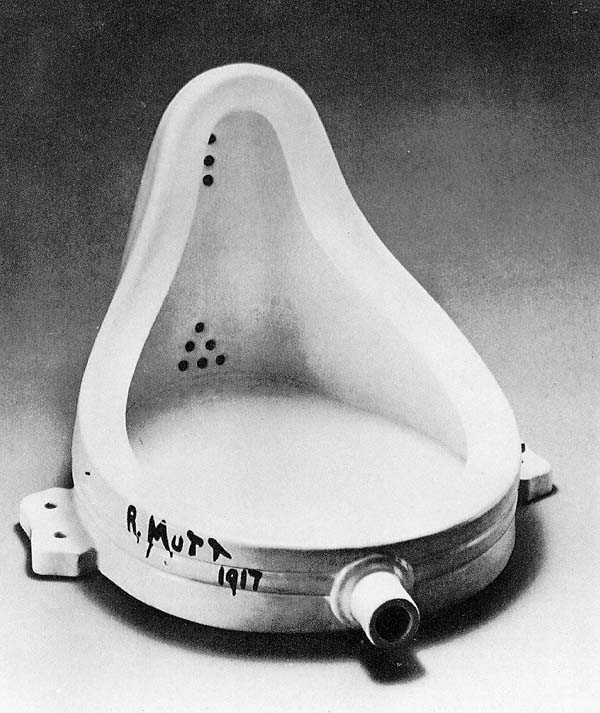
Marcel Duchamp, Fountain, 1917


Marcel Duchamp, L.H.O.O.Q., 1919

Monday, April 18, 2011

4. The Modern Tradition, edited by Richard Ellmann and Charles Feidelson Jr., pp. 54-73

Symbolism: Imagination and Nature; Symbolic Nature (William Blake, William Wordsworth, Charles Baudelaire, W.B. Yeats, Paul Klee). Symbolism: Imagination and Thought; The State of Doubt (Johann Wolfgang von Goethe, John Keats, Gustave Flaubert)
_____

William Blake: The Eternal World of Vision

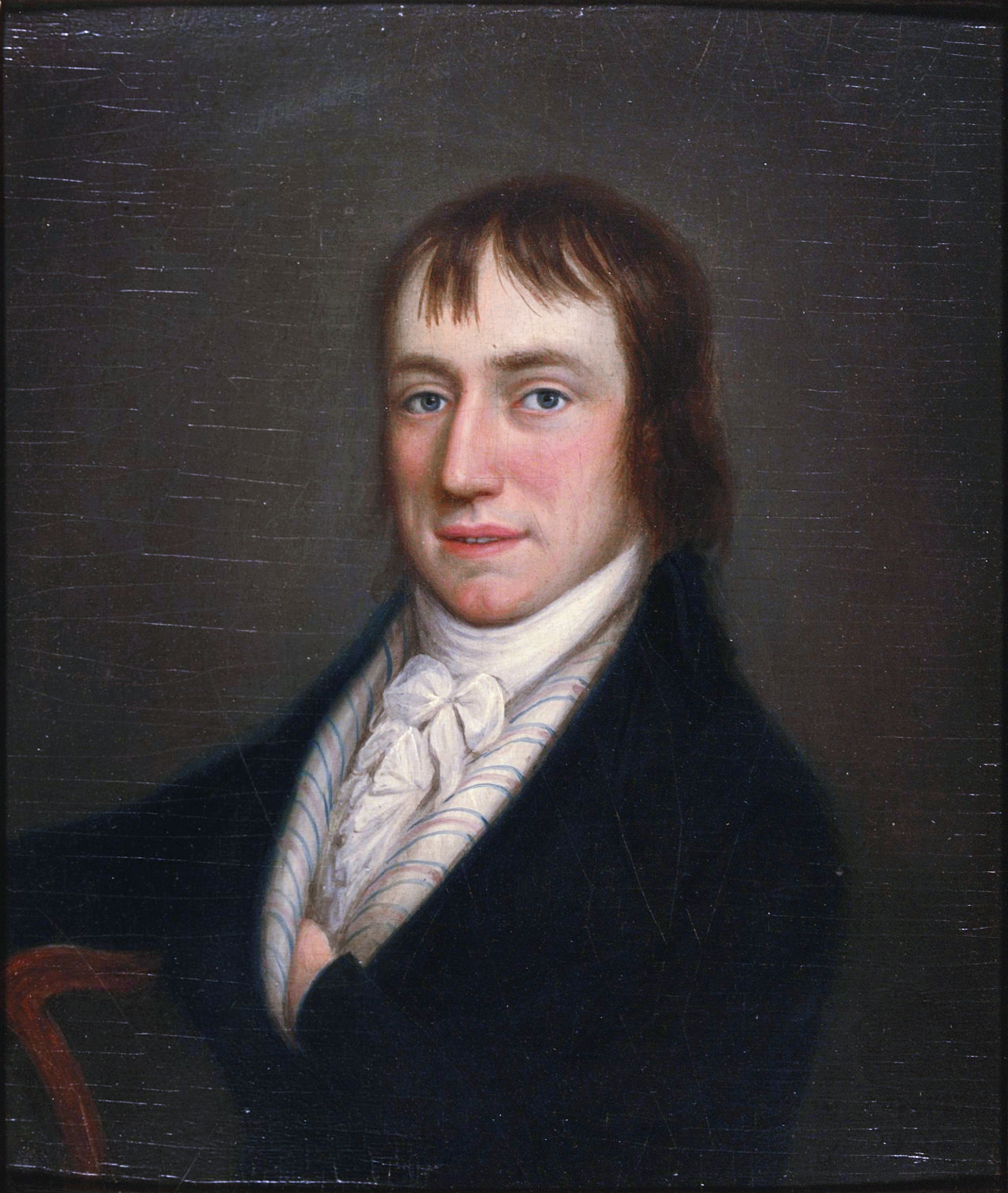
Thomas Phillips, William Blake, 1802
In the first selection, a 1799 letter to a clergyman, the Rev. Dr. Trusler, Blake asserts,
This World Is a World of Imagination & Vision. I see Every thing I paint In This World, but Every body does not see alike. To the Eyes of a Miser a Guinea is far more beautiful than the Sun, & a bag worn with the use of Money has more beautiful proportions than a Vine filled with Grapes.... But to the Eyes of the Man of Imagination, Nature is Imagination itself. 
Blake champions the imagination because it gives him an entree to the significance of the external world: "To Me This World is all One continued Vision of Fancy or Imagination," and for the great poets -- he cites Homer, Virgil and Milton in particular -- Imagination is the vehicle for "Spiritual Sensation." As for his own works of visual art, he is particularly pleased that "Children ... have taken a greater delight in contemplating my Pictures than I even hoped." Not that there is anything inherently more receptive about children: "Some Children are Fools & so are some Old Men. But There is a vast Majority on the side of Imagination or Spiritual Sensation."
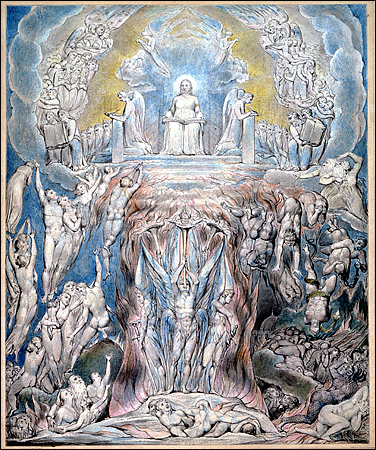
William Blake, A Vision of the Last Judgment, pen and watercolor, 1808
William Blake, watercolor illustration for Robert Blair's The Grave, 1805
Blake's painting of the Last Judgment was to be part of an exhibit in 1810, but the exhibit was canceled and the work was subsequently lost. The watercolor versions shown above follow the plan Blake outlined for the painting. In the second excerpt in this section of The Modern Tradition, written in 1810 for the catalog of the canceled exhibition, Blake discusses the work, insisting that it is "not Fable or Allegory but Vision. Fable or Allegory are a totally distinct & inferior kind of Poetry. Vision or Imagination is a Representation of what Eternally Exists, Really & Unchangeably.... The Hebrew Bible & the Gospel of Jesus are not Allegory, but Eternal Vision or Imagination of All that Exists."

For Blake, art is a rejection of mutability, of the impermanence of existence: "This world of Imagination is the world of Eternity; it is the divine bosom into which we shall all go after the death of the Vegetated body." It is also a rejection of materialism, "of Bad Art & Science. Mental Things are alone Real; what is call'd Corporeal, Nobody Knows of its Dwelling Place: it is in Fallacy, & its Existence is an Imposture." The material world is illusory, and Blake the visionary sees through it: The sun is not "a round disk of fire somewhat like a Guinea" to Blake. Instead it is "an innumerable company of the Heavenly host crying, 'Holy, Holy, Holy is the Lord God Almighty.'" The trick is to see through nature to the eternity behind it: "I question not my Corporeal or Vegetative Eye any more than I would Question a Window concerning a Sight. I look thro' it & not with it."


William Wordsworth: Natural Apocalypse

William Wordsworth in 1789
The selection from The Prelude reprinted here is a considerably tamer version of Blake's nature mysticism. Wordsworth regards an event -- or rather the recognition of an event -- as an epiphany, or what he would elsewhere call a "spot of time." The event in itself has no grand significance in material terms: The party he is traveling with has crossed the Alps. But the awareness that they have done so is "translated by our feelings" into something greater, and
Imagination -- here the Power so called
Through sad incompetence of human speech,
That awful Power rose from the mind's abyss
Like an unfathered vapour that enwraps,
At once, some lonely traveleler. 
Imagination produces "a flash that has revealed / The invisible world." And so, at least for a time, the natural phenomena they encounter -- waterfalls, winds, rocks, crags, clouds, darkness and light -- become symbols of something beyond the material world, they
Were all like workings of one mind, the features
Of the same face, blossoms upon one tree;
Characters of the great Apocalypse,
The types and symbols of Eternity,
Of first, and last, and midst, and without end. 
It's probably worth noting here that "apocalypse" has come to denote the events attendant on the end of the world, when the word's Greek origins meant "uncovering" or "revelation." An apocalypse is a revelation of truths, and not the truths themselves. So what Wordsworth means here is not a vision of the end of the world, but simply the unveiling of the meaning behind the surface phenomena of existence. He senses, but can't articulate, something eternal, which is precisely what Blake was getting at when he asserted that the imagination gives one visions of eternity.


Charles Baudelaire: The Temple of Nature

Charles Baudelaire, c. 1863
Baudelaire's poem "Correspondances" (1857) posits that nature is a temple, and by extrapolation we might suggest that the artist is its  priest, translating the "babel of words" uttered by the temple's "living pillars." The senses receive the sights, the colors, the sounds and scents as finite manifestations of infinite things. In the poem, Baudelaire lays particular emphasis on the sense of smell, which is the most intimate and subjective of the senses, taking in "perfumes" that are "fresh and cool," "mellow," "green," "perverse, rich, and triumphant." And in turn, these odors evoke the tactile ("the bodies of children"), the auditory ("oboes"), and the visual ("fields"), as well as such moral qualities as perversity, richness and triumph.


W.B. Yeats: Symbol as Revelation

John Butler Yeats, William Butler Yeats, 1900
Everybody likes to complain about journalists, and in this essay, "The Symbolism of Poetry" (1900), Yeats is out to disabuse the readers of the notion, apparently foisted upon them by journalists, that artists proceed without any higher aim or theoretical purpose. And here, of course, he proceeds to enunciate his own.

He cites several lines of verse in which metaphor takes on a larger symbolic role, beginning with Robert Burns's
The white moon is setting behind the white wave,
And Time is setting with me, O!
He says, quite correctly, "Take from them the whiteness of the moon and of the wave, whose relation to the setting of Time is too subtle for the intellect, and you take from them their beauty." And he's right: an 18th-century critic might object that neither the moon nor the wave is, strictly speaking, white. But we only have to go to Melville's great discourse on "The Whiteness of the Whale" to observe the symbolic power of the adjective. As Yeats puts it, "All sounds, all colours, all forms, either because of their pre-ordained energies or because of long association, evoke indefinable and yet precise emotions." The italics in that quotation are mine, to emphasize the seeming oxymoron: If precise, then why indefinable? But that's the point: Symbols evoke precise emotions, but if they were definable, we wouldn't need symbols to evoke them.

The function of the symbol in art, as Yeats sees it, is to bring unity out of multiplicity: "when sound, and colour, and form are in a musical relation, a beautiful relation to one another, they become as it were one sound, one colour, one form, and evoke an emotion that is made out of their distinct evocations and yet is one emotion." And it is the artist who, by perceiving the power of the symbol, translates that power to the rest of the world: "I am certainly never certain, when I hear of some war, or of some religious excitement or of some new manufacture, or of anything else that fills the ear of the world, that it has not happened because of something that a boy piped in Thessaly." Okay, that's a bit extravagant. But try this one on for truth: "I doubt ... that love itself would be more than an animal hunger but for the poet and his shadow the priest." (That subordination of the religious to the artistic is quite lovely.)

Poets and musicians achieve their effects by species of hypnotism, Yeats asserts:
The purpose of rhythm, it has always seemed to me, is to prolong the moment of contemplation, the moment when we are both asleep and awake, which is the one moment of creation, by hushing us with an alluring monotony, while it holds us waking by variety, to keep us in that state of perhaps real trance, in which the mind liberated from the pressure of the will is unfolded in symbols. If certain sensitive persons listen persistently to the ticking of a watch, or gaze persistently on the monotonous flashing of a light, they fall into the hypnotic trance; and rhythm is but the ticking of a watch made softer, that one must needs listen, and various, that one may not be swept beyond memory or grow weary of listening; while the patterns of the artist are but the monotonous flash woven to take the eyes in a subtler enchantment.
And "enchantment" is the aim, or at least as long as it is in service of something of value. The emptying out of religious belief has, in Yeats's view, crippled the world turning it toward the materialistic. "How can the arts overcome the slow dying of men's hearts that we call the progress of the world, and lay their hands upon men's heartstrings again, without becoming the garment of religion as in old times?"  If the piping of a Thessalian boy can cause people to go to war, then artists need to be conscious of the ends toward which their work can move people. Artists need to avoid the didactic, the moralizing, the anecdotal, and "that brooding over scientific opinion that so often extinguished the central flame in Tennyson." They need to discover the symbolic force of the world around them, to "return to imagination" and to understand "that the laws of art, which are the hidden laws of this world, can alone bind the imagination."

To return to the topic of rhythm, Yeats "would cast out of serious poetry those energetic rhythms, as of a man running, which are the invention of the will with its eyes always on something to be done or undone; and we would seek out those wavering, meditative, organic rhythms, which are the embodiment of the imagination, that neither desires nor hates, because it has done with time, and only wishes to gaze upon some reality, some beauty."


Paul Klee: Eternal Genesis

Paul Klee, date unknown
The excerpts are from Klee's On Modern Art (posthumously published in 1945), and are a series of brief, epigrammatic paragraphs. Klee asserts that the artist's role is defined by the word "creation" and that art is perpetually generative, creating a new nature as it were.
The deeper he looks, the more readily he can extend his view from the present to the past, the more deeply he is impressed by the one essential image of creation itself, of Genesis, rather than by the image of nature, the finished product. 
We are back here to the distinction between natura naturata ("the finished product") and natura naturans ("creation itself'" or the act of creating). Klee looks to the artist to create new things, not to reproduce the things already created.
Paul Klee, Flower Myth, 1918

The artist's role is "not to provide a scientific check on the truth of nature" but to demand "freedom," defined as "the right to develop, as great Nature herself develops." The source of it all is, of course, imagination, and "What springs from this source, whatever it may be called, dream, idea or phantasy -- must be taken seriously only if it unites with the proper creative means to form a work of art." He retorts to the critics of his own work, who have called it "childish," that the label "most have originated from those linear compositions of mine in which I tried to combine a concrete image, say that of a man, with the pure representation of the linear element.
Had I wished to present the man "as he is," then I  should have had to use such a bewildering confusion of line that pure elementary representation would have been our of the question. The result would have been vagueness beyond recognition.

And anyway, I do not wish to represent the man as he is, but only as he might be.
Paul Klee, Miraculous Landing, or the "112!"  1920
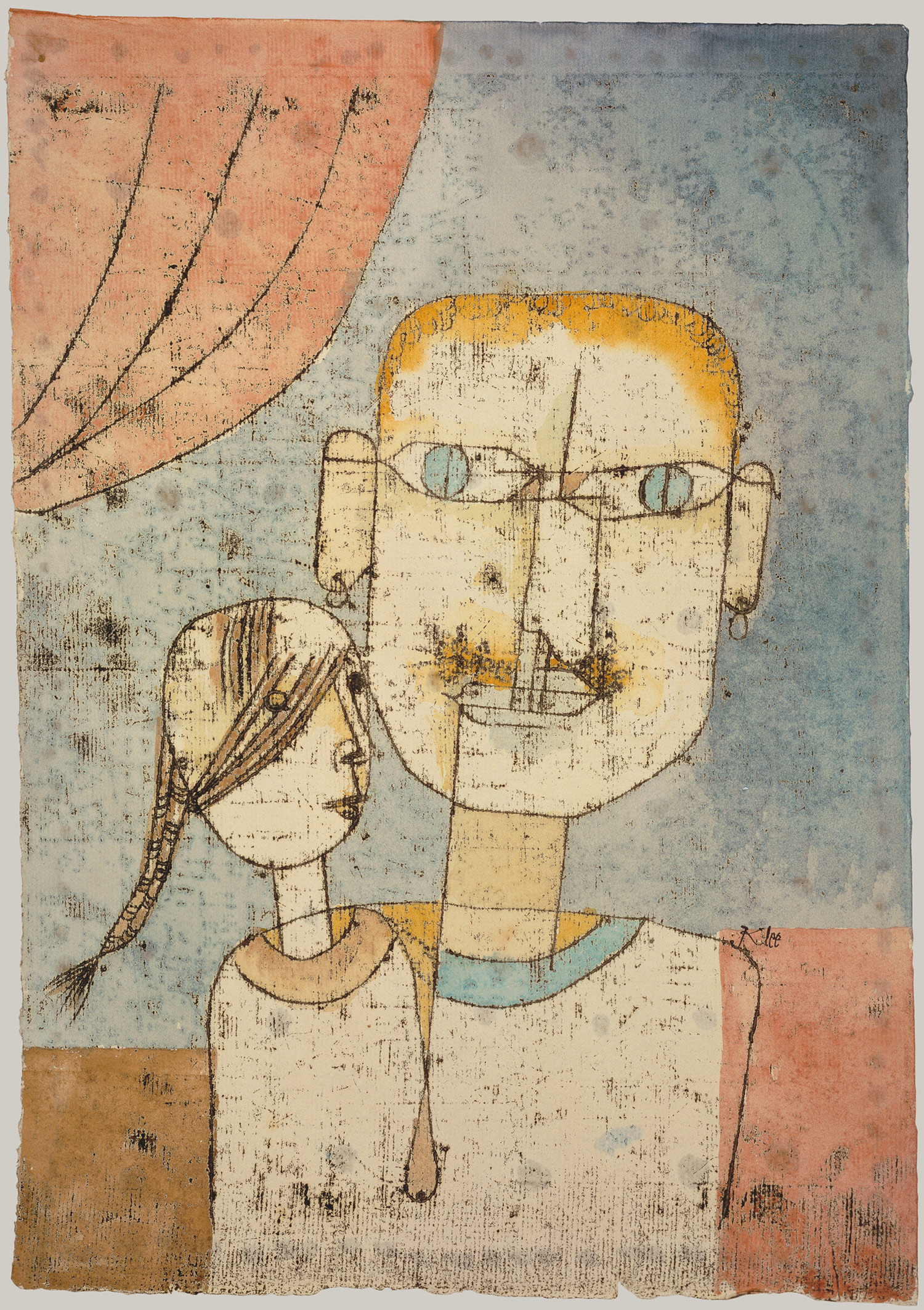
Paul Klee, Adam and Little Eve, 1921


Johann Wolfgang von Goethe: Escape From Ideas

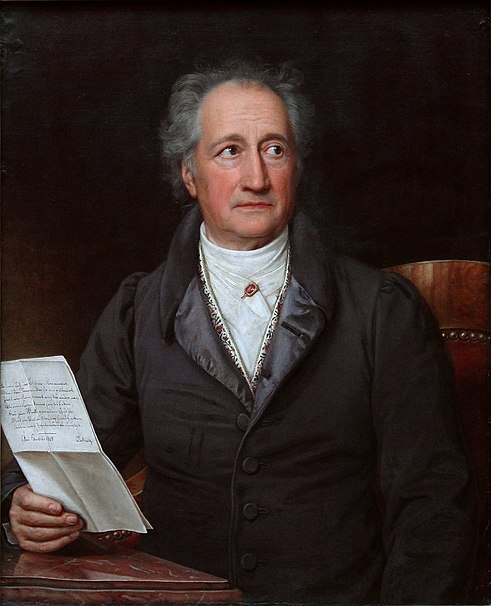
Joseph Karl Stieler, Goethe age 69, 1828
Artists are always irritated by being asked, "What are you trying to say?" and Goethe, to judge from this excerpt from J.P. Eckermann's Conversations of Goethe (1836), was no exception.
"It was ... not in my line, as a poet, to strive to embody anything abstract. I received in my mind impressions, and those of a sensual, animated, charming, varied, hundredfold kind, just as a lively imagination presented them; and I had, as a poet, nothing more to do than artistically to round off and elaborate such views and impressions, and by means of a lively representation so to bring them forward that others might receive the same impression in hearing or reading my  representation of them."
This is the artist as medium between the universe and the observer. But the role doesn't come with any responsibility to make the message simple and comprehensible: "I am rather of the opinion, that the more incommensurable, and the more incomprehensible to the understanding, a poetic production is, so much the better it is." (So much for anyone who has tried to find a simple message in Faust.)

As for the role of religion in art, "'Religion,' said Goethe, 'stands in the same relation to art as any other of the higher interests in life." What predominates for the artist is not dogma but the human element: "Art must address itself to those organs with which we apprehend it; otherwise it misses its effect. A religious material may be a good subject for art, on only in so far as it possesses general human interest." That's why portraits of the Madonna and Child have always been popular.


John Keats: Negative Capability

William Hilton, John Keats, date unknown
This famous excerpt from Keats's letter to his brothers George and Thomas has a phrase in it that I think is often mispronounced, and therefore misunderstood: "negative capability." I think the word isn't NEGative but neGAtive -- i.e., the function of negating. And we shouldn't lose the context in which Keats came up with this powerful concept: He had been to a dinner with some friends "who say things which make one start, without making one feel." Their conversation "only served to convince me how superior humour is to wit." The priority given to feeling over intellect here is characteristic, and it feeds into his though about Shakespeare's "Negative Capability, that is, when a man is capable of being in uncertainties, mysteries, doubts, without any irritable reaching after fact and reason." Keats isn't against fact and reason, he just wants to put it in its place, and its place isn't in literature.


Gustave Flaubert: Art Without Conclusions

Gustave Flaubert, date unknown
In this 1857 letter to Marie-Sophie Leroyer de Chantepie, with whom Flaubert carried on an extended correspondence, he rejects the idea that human beings can ever "attain to absolute knowledge of truth and goodness." In fact, the only road to happiness is to avoid the delusion that certainty is possible. "Life is such a hideous business that the only method of bearing it is to avoid it. And one does avoid it by living in Art, in the ceaseless quest for Truth presented by Beauty." (The kinship with Keats's conclusion, "Beauty is truth, truth Beauty, -- that is all / Ye know on earth, and all ye need to know," is evident, except that Keats's formulation of that dictum is loaded with irony.)
Superficial, limited creatures, rash, feather-brained souls, demand a conclusion from everything; they want to know the purpose of life and the dimensions of the infinite. Picking up a handful of sand in their poor, puny grasp, they say to the Ocean: "I shall now count the grains on your shores." but when the sand slips through their fingers and the sum proves long, they stamp and burst into tears. Do you know what we should do on that shore? Either kneel down or walk. You must walk. 
The advice is not to cease from questioning, but to cease from hoping for a definitive answer. Strive, but don't overreach. "No great genius has come to final conclusions; no great book ever does so, because humanity itself is forever on the march and can arrive at no goal. Homer comes to no conclusions, nor does Shakespeare, nor Goethe, nor even the Bible." Thus Flaubert rejects not only religion but also politics, believing instead in "the perpetual evolution of humanity and in its ever-changing forms, and consequently I abominate all those frames which men try to cram it into by main force, all the formulas by which they define it, and all the plans they devise for it.... it seems idiotic to me to seek the best religion or the best government. For me, the one on its deathbed is the best, since it is then making way for another."