JOURNAL OF A COMPULSIVE READER
By Charles Matthews
Showing posts with label Nicolas Berdyaev. Show all posts

Monday, May 16, 2011

30. The Modern Tradition, edited by Richard Ellmann and Charles Feidelson Jr., pp. 660-672

Myth: Myth and Literature (Friedrich Schlegel, Victor Hugo, Richard Wagner, William Blake, Nicolas Berdyaev)
_____

Friedrich Schlegel: Modern Mythology

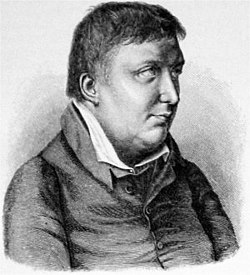
Before the anthropologists and psychoanalysts revived an interest in myth, the impetus for its study came from Romantics like Schlegel, whose "Dialogue on Poetry" (1800) was a plea for reviving the mythic impulse as a defense against materialism and rationalism. Schlegel goes so far as to define a contemporary literary malaise:
Friedrich Schlegel, date unknown
It is my contention that our poetry lacks a center, such as mythology was for the ancients, and the essential shortcomings of modern poetry may be summed up in these words: we have no mythology.
But since we don't, he continues, we have to make one, "fashioned out of the profoundest depths of the spirit; it must be the most artificial of all works of art, for it is to encompass all others, it is to be a new course or a vessel for the ancient, eternal fountainhead of poetry and itself the everlasting Poem which contains within itself the seeds of all other poems."

For Schlegel, a working myth is a cultural sine qua non, and he hopes to find impetus for it "in the great phenomenon of the age - in idealism! -- a very significant hint and a notable manifestation of what we are seeking." If we fail to do so, he argues, the results could be catastrophic: "mankind is struggling with all its might to find its center. Mankind must, as matters stand, go under or rejuvenate itself." But he is optimistic, because, he says, this is "an age of rejuvenation."

Nature, for a Romantic like Schlegel, is the source of this new mythology, which will be "a hieroglyphic expression of surrounding nature in a transfiguration of imagination and love." We must "suspend the course and laws of logically reasoning thought," in order to be transported "back to the fine confusion of the imagination, the original chaos of human nature" -- in other words, listen to what the unconscious is telling us.
All thought is divination, but man is only just beginning to become aware of his powers of divination. What immeasurable expansions will men yet experience, and even at this very time! In my estimation, whoever understands the epoch, which is to say the great process of general rejuvenation and the principles of perpetual revolution, should be able to grasp both poles of humanity, to understand the deeds of the earliest men and to know the character of the golden age that is yet to come.


Victor Hugo: Imaginative Types

Victor Hugo, date unknown
Hugo's Romanticism was long-lived, and he was continuing to cling to it in his book, William Shakespeare, in 1864, which is less about Shakespeare and more about the nature of literary genius. He asserts that all great poets wear a "human mask" through which their souls "[shine] through the mysterious aperture of the eyes" and change the mask to the various characters they create. Hugo cites characters not only from Shakespeare but also from the Bible, Homer, the Greek dramatists, Plautus, Terence, Corneille, Cervantes, Rabelais, Molière, Beaumarchais and Byron. "From the direct divine creation proceeds Adam, the prototype. From the indirect divine creation -- that is to say, from the human creation -- proceed other Adams, the types."

Shylock, whom Hugo erroneously calls "that fierce merchant of Venice" (the merchant of the play's title is Antonio), "is the embodiment of Jewishness; he is also Judaism." That is, he's the individuation of a type. Repellent as this kind of stereotyping is to us today, it coheres with Hugo's theory that literature proceeds from prototype to individual, and that the individual figure in literature succeeds in large part because he encompasses all other individuations of the type: "that is to say, [Shylock's] whole nation, the high as well as the low, faith as well as fraud; and it is because he sums up a whole race, such as oppression has made it, that Shylock is great. The Jews are, however, right in saying that none of them -- not even the medieval Jew -- is Shylock." He uses as analogy an orange tree: A leaf from the tree doesn't taste like the fruit, "yet there is a deep affinity, an identity of roots, a sap rising from the same source, a sharing of the same subterranean shadow before life. The Fruit contains the mystery of the tree, and the type contains the mystery of the man. Hence the strange vitality of the type."

If the type were "but an abstraction, men would not recognize it, and would allow this shadow to go away." Although Hugo doesn't mean by "shadow" the same thing Jung does, he is verging on something Jungian, a theory of archetypes, here. "Types are cases foreseen of God; genius realizes them.... God creates the phenomenon, genius gives it a name; God creates the miser only, genius forms Harpagon; God creates the traitor only, genius makes Iago," and so on. And literature in turn creates types, just as God created Adam: "The man of Homer, Achilles, is an Adam: from him comes the species of the slayers; the man of Aeschylus, Prometheus, is an Adam: from him comes the race of the wrestlers; the man of Shakespeare, Hamlet, is an Adam: to him belongs the family of the dreamers."


Richard Wagner: The Folk and the Myth

Hitler co-opted Wagner, as well as the concept of das Volk, literally, "the people," but with racial (not to say racist) overtones. These two excerpts, one from "The Art-Work of the Future" (1849), the other from "Opera and Drama" (1875), are muddled a little by having two different translators, each of whom fiddles uneasily with finding the right word to translate das Volk. The first excerpt, in fact, makes things more confusing by sometimes translating the word "the Folk," and sometimes "the People." (A quick check of the original shows that Wagner used das Volk in both instances.) In any case, Wagner observes, the word "has acquired an ineradicable moral" meaning -- long before Hitler proclaimed "ein Volk, ein Reich, ein Führer."

But to get to Wagner himself, he asserts, "The 'Folk' is the epitome of all those men who feel a common and collective Want," some ultimate unfulfilled need toward which they are driven. He is working here toward a version of the Jungian collective unconscious. First "the human poetic faculty" comes up with gods, which he posits as a kind of nature-myth, in which "man represents to himself the essence of natural manifestations as derived from a Cause." And the gods naturally take human form: "he must present his God not only in a shape most suitable to be apprehended by his purely human intuition but also outwardly the most intelligible."
All understanding comes to us from Love; and the natural impulse of man is toward the being of his own species. Just as the human from is to him the most intelligible, so also will the qualities of natural manifestations -- which he does not yet know in their reality -- be rendered most intelligible to him by being reduced to human shape.
In other words, humankind creates God in its own image. It anthropomorphizes nature. Thus arises myth and,  through it, art, "for these shapes must necessarily win artistic form and content, if, as is their peculiarity, they really spring from man's longing that the representation of manifestations should be thoroughly intelligible."
Art, by the very meaning of the term, is nothing else than fulfillment of the desire to recognise oneself in an admired or beloved object, to find oneself again in the manifestations of the outer world, as controlled by their representation.... Thus Greek tragedy is nothing but the artistic fufillment of the Myth itself; just as the Myth had been the poetic expression of that life-view common to all.


William Blake: Visionary History

Blake's "A Descriptive Catalogue of Pictures" is a guide to the works he exhibited in 1809, many of which were on historical themes, including the now lost "The Ancient Britons," which depicted a battle between King Arthur and the Romans. In this excerpt, Blake discusses the personifications of Strength, Beauty and Ugliness:
The Strong Man represents the human sublime. The Beautiful Man represents the human pathetic, which was in the wars of Eden divided into male and female. The Ugly Man represents the human reason. They were originally one man, who was fourfold; he was self-divided, and his real humanity slain on the stems of generation, and the form of the fourth was like the Son of God.
Blake is working toward a myth of history here, and as a Briton he naturally gravitates toward the myth of King Arthur, who is a kind of avatar of Blake's Albion:
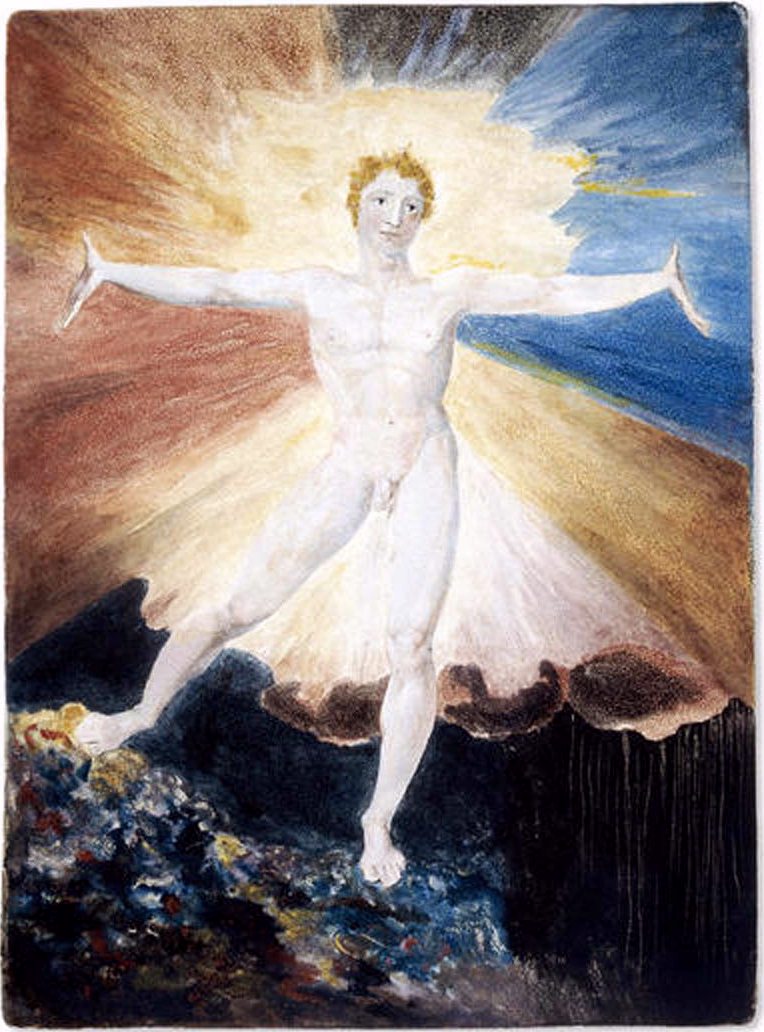
William Blake, Albion Rose, 1794-95
The giant Albion, was Patriarch of the the Atlantic; he is the Atlas of the Greeks, one of those the Greeks called Titans. The stories of Arthur are the acts of Albion, applied to a Prince of the fifth century, who conquered Europe, and held the Empire of the world in the dark age, which the Romans never again recovered.
Blake's mythology is, frankly, as mind-numbing to follow as Yeats's theory of history with its gyres and cones. But here what he's proclaiming is a connection with the historical past that has been lost in part because of the emergence of rationalism. "The antiquities of every Nation under Heaven, is no less sacred than that of the Jews," he asserts.
The reasoning historian, turner and twister of causes and consequences, such as Hume, Gibbon, and Voltaire, cannot with all their artifice turn or twist one fact or disarrange self evident action and reality. Reasons and opinions concerning acts are not history. Acts themselves alone are history, and these are neither the exclusive property of Hume, Gibbon, nor Voltaire.... All that is not action is not worth reading.... His opinions, who does not see spiritual agency, is not worth any man's reading; he who rejects a fact because it is improbable, must reject all History and retain doubts only.


Nicolas Berdyaev: Myth as Memory

"Myth is no fiction, but a reality," Berdyaev says in The Meaning of History (1923). "All great historical epochs, even those of modern history with their tendency to discredit mythology, give rise to myths." The individual human being is "a sort of microcosm in which the whole world of reality and all the great historical epochs combine and coexist." And in order to maintain some integrity of personality, of self-awareness, the individual must come to terms with this fact. Berdyaev, too, verges on the Jungian:
Only deep down in his own self can man really discover the secrets of time; for these, far from being something superficial and alien, something imposed and forced upon him from without, represent on the contrary the deepest and most mysterious strata implicit in himself. A narrow consciousness would either disregard these strata or relegate them to a secondary plane.
Like Blake, Berdyaev finds the rationalist, analytical approach to history wanting: "The divorce of the subject from object as the result of enlightened criticism may provide material for historical knowledge, but in so far as it destroys the myth and dissociates the depths of time from those of man, it only serves to divorce man from history." But unlike Blake, he is willing to grant it some value, as long as it makes room for the social function of tradition and for the role of religion:
Tradition is synonymous with the knowledge of historical life; for its symbolism reveals the inner life and the profound organic union of historical reality with that which man discovers his own spiritual self-knowledge.... I am therefore inclined to believe that the mysteries of the divine as well as of the human and world life, with all their complexity of historical destiny, admit of solution only through concrete mythology. The knowledge of the divine life is not attainable by means of abstract philosophical thought based upon the principles of formalist or rationalistic logic, but only by means of a concrete myth which conceives the divine life as a passionate destiny of concrete and active persons....
For Berdyaev, the myth, which includes the "drama of love and freedom" of Christianity, is the only way to comprehend "the destinies of both man and the world."

Sunday, May 8, 2011

24. The Modern Tradition, edited by Richard Ellmann and Charles Feidelson Jr., pp. 514-536

Cultural History: History and Imagination (André Malraux); Religion and History (Nicolas Berdyaev); Primitive Survivals (Charles Darwin, James G. Frazer, Henry Miller)
_____

André Malraux: The Triumph of Art Over History

In this excerpt from The Voices of Silence (1951), Malraux extrapolates on his concept of the "Museum Without Walls," the collective artistic achievement of humankind, approached without division into cultures or epochs.

The development of the physical museum, a creation of the most recent two centuries, "imposed on the spectator a wholly new attitude towards the work of art.... Until the nineteenth century a work of art was essentially a representation of something real or imaginary, which conditioned its existence qua work of art." A portrait was judged as a portrait of someone, and not as a painting in itself. "In the past a Gothic statue was a component part of the Cathedral; similarly a classical picture was tied up with the setting of its period, and not expected to consort with works of different mood and outlook."

But the establishment of the museum, with its "practice of pitting works of art against each other," turns the viewing of art into "an intellectual activity" rather than a contemplative one.
For over a century our approach to art has been growing more and more intellectualized. The art museum invites criticism of each of the expressions of the world it brings together; and a query as to what they have in common. To the "delight of the eye" there has been added -- owing to the sequence of conflicting styles and seemingly antagonistic schools -- an awareness of art's impassioned quest, its age-old struggle to remould the scheme of things.
But even the establishment of museums allowed only for limited exposure to the world's art. Well into the nineteenth century "a man who had seen the totality of European masterpieces was a very rare exception.... Baudelaire never set eyes on the masterpieces of El Greco, Michelangelo, Masaccio Piero della Francesca or Grünewald; or of Titian, or of Hals or Goya." The only way knowledge of these works could be widely disseminated until the mid-nineteenth century was through black-and-white engravings. "The nineteenth-century photograph was merely a more faithful print." But technological advances, not only in reproduction of images but also in transportation, made a wider array of the world's art available to almost anyone who wanted to witness it. Hence, the Museum Without Walls.

This familiarity with art of all periods and all cultures has changed our approach to art: "It is not research work that has led to the understanding of El Greco; it is modern art. Each genius that breaks with the past deflects, as it were, the whole range of earlier forms." Each masterpiece, Malraux asserts, "keeps up ... a dialogue indefeasible by Time."

Malraux distinguishes between artists and artisans: "I name that man an artist who creates forms ... and I call that man an artisan who reproduces forms, however great may be the charm or sophistication of his craftsmanship."
Romanesque tympanum, Christ in majesty, Abbey of Saint-Pierre in Moissac
The fact that our conception of the artist was something quite unknown in the Middle Ages (and for many thousand years before) and that a genius like Van Eyck was commissioned to design set pieces and to paint coffers, does not affect the fact that painters and sculptors, when possessed of genius, transfigured the art they had inherited, and the creative joy of the man who invented the Moissac Christ, the Chartres Kings and the Uta was different in kind from the satisfaction felt by the cabinet maker who had just completed a perfect chest.
Three kings from the portal of Chartres cathedral

Ekkehard and Uta, Naumburg Cathedral
The development of art consists of a series of "victories over forms, achieved by means of forms," and not as the expression of successive ideologies: "The Last Judgment was the outcome of a meditation on figures, and not a declaration of faith."

We have come to recognize that "the world of art is ... another world, the same as that of music and architecture," and that "the long-drawn conflict between pagan and Christian art in Europe" has ended. Art is "one of man's rare creations, inventive though man is."
Just as the crucial historical event of the nineteenth century was the birth of a new consciousness of history, so the crucial expression of the metamorphosis of our century is our consciousness of it. Thus today art means to us that underlying continuity due to a latent kinship between the works of art of all ages which is a historical continuity, since never does an art destroy all that it has inherited; El Greco broke with Titian, but not by painting pictures like Cézanne's. 
Through art, humankind achieves a victory over destiny: "what survives for us in the great arts of the past is the indefeasible inner voice of civilizations that have passed away." And the art of the twentieth century suggests "that there is tentatively taking form, for the first time in history, the concept of a world-wide humanism." We are coming to realize that "the cultures of civilizations that have died out" are not so much radically different from us or from one another as they are "cultures of different parts of the same plant." We have created a culture that synthesizes elements that once warred with each other: "If Aristotle and the Prophets of Israel met on the banks of the Styx, what would they exchange but insults? Montaigne had to be born before the dialogue between Christ and Plato could arise." In the humanist view, "each hero, saint or sage stands for a victory over the human situation."
We ... are the heirs not so much of this or that value in particular ... as of something that runs deeper: that undercurrent of the stream of human consciousness which brought them into being. We have at last become aware of their true nature, in the same manner as Hegelianism became aware not of forgotten values but of history; it is art as an organic whole, liberated by our modern art, that our culture for the first time is arraying against destiny.
We no longer toy with the idea of restoring "the mutilated statue" to its original form. Earlier, Malraux commented, "In 1910 it was assumed that the Winged Victory, when restored, would regain her ancient gold, her arms, her trumpet." Today, we would be as disturbed by that kind of restoration as we would be by an attempt to attach arms to the Venus de Milo. We recognize that these mutilations are a sign of the life in the work: "Mutilation is the scar left by the struggle with Time, and a reminder of it -- Time which is as much a part of ancient works of art as the material they are made of, and thrusts up through the fissures, from a dark underworld where all is at once chaos and determinism."
All art is a revolt against man's fate. 


Nicolas Berdyaev: The Historical Meaning of Christianity

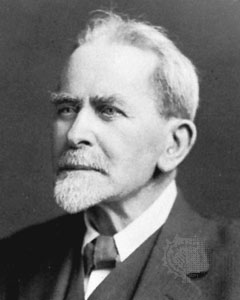
Nicolas Berdyaev, date unknown
Like Hegel and Benedetto Croce, Berdyaev, in this excerpt from The Meaning of History (1923), sees history as a movement toward freedom. But Berdyaev isolates the moment in history at which this concept became manifest as the emergence of Christianity as a dominant force.
The exceptionally dynamic and historical character of Christianity is the result of the fact that it conclusively revealed for the first time the existence of the principle of freedom, which was ignored by both the ancient and the Hebrew worlds.... The Greeks affirmed the reason and necessity of good.... Christianity, on the other hand, affirmed the freedom of good. It affirmed that good is the product of the free spirit and that only such good can possess a true value and reality. It denied the compulsory and reasonable necessity of good.... Unlike the ancient world, Christianity is not content to submit to fate.
Berdyaev's interpretation of Christianity presupposes that the fall of man was indeed a fortunate fall: "The freedom to choose and affirm the good, rooted in the will and not in reason, presupposes in its turn that freedom of the creative and active subject without which a true dynamism of history is impossible." It is "the interaction of the human spirit and nature" that distinguishes the post-Christian world. The alienation of man from God dramatized in the story of the Fall "plunged man and the human spirit into the uttermost depths of natural necessity. The fall into these depths was accompanied by man's servitude to the natural elements which had held the human spirit and will spellbound." Nature "was populated with demons and man was powerless to dominate either them or the natural cycle."

But Christianity "liberated man from the power of the baser elemental nature and demons. It did so through the agency of Christ and the mystery of Redemption.... It distinguished him from baser nature and set him up as an independent spiritual being, freeing him from submission to the natural world and exalting him to the heavens." In the Christian view, "History is in truth the path to another world," a realm of perfection not achievable in this one.
Man's historical experience has been one of steady failure and there are no grounds for supposing that it will ever be anything else. Not one single project elaborated within the historical process has ever proved successful. None of the problems of any given historical epoch whatsoever has been solved, no aims attained, no hopes realized. This radical failure of the historical process, when we regard it as a whole, can only be interpreted as the failure to realize the Kingdom of God. 
But on the other hand, "Christianity also was a complete and utter failure." (Possibly because it was left in the hands of human beings?) "Two thousand years have not sufficed to realize the ideals of Christian faith and consciousness. They will never be realized within the framework of human time and history." But Berdyaev argues that "the failure of Christianity does not mean that Christianity is not the highest truth. Historical success and achievement do not constitute a valid criterion of the true," because "nothing perfect can be realized in time." The conclusion Berdyaev reaches is "that the destiny of man reserves a higher realization for his potentialities than any to be achieved in his purely historical experience."


Charles Darwin: The Pre-Human in the Human

In The Descent of Man (1871) Darwin tactfully approaches the most controversial conclusions of his theory: humankind's kinship with other primates, or as he puts it, "that man is descended from a hairy, tailed quadruped, probably arboreal in its habits, and an inhabitant of the Old World." He rather sweetly advances some stories of kindness and altruism among monkeys and baboons to assert that this isn't so bad, and that he'd rather admit his kinship with them than with "a savage who delights to torture his enemies, offers up bloody sacrifices, practices infanticide without remorse, treats his wives like slaves, knows no decency, and is haunted by the grossest superstitions." But he insists that although humans have reached "the very summit of the organic scale" -- a concept that embarrasses many post-Darwinians,
We must ... acknowledge ... that man with all his noble qualities, with sympathy which feels for the most debased, with benevolence which extends not only to other men but to the humblest living creature, with his god-like intellect which has penetrated into the movements and constitutions of the solar system -- with all these exalted powers -- Man still bears in his bodily frame the indelible stamp of his lowly origin.


James G. Frazer: The Savage in the Human

J.G. Frazer in 1933
In these selections from Frazer's essays from the first two decades of the twentieth century, the anthropologist isn't willing to go as far as Darwin in separating the "noble qualities" of humans from the "bodily frame" he inherited from his "lowly" ancestors. In his formulation, "a savage is to a civilized man as a child is to an adult," which still leaves a lot of room for residual traits of savagery or childishness to persist into the civilized or grownup being. And research has shown anthropologists "that a mass, if not the majority, of people in every civilized country is still living in a state of intellectual savagery, that, in fact, the smooth surface of cultured society is sapped and mined by superstition." (A look at most state legislatures should be enough to confirm that assertion.)

Frazer is alarmed at the implications:
We appear to be standing on a volcano which may at any moment break out in smoke and fire to spread ruin and devastation among the gardens and palaces of ancient culture wrought so laboriously by the hands of many generations.
Moreover, "it is precisely the oldest and crudest superstitions which are most tenacious of life." For "the high gods of Egypt and Babylon, of Greece and Rome," have been forgotten except by the educated, while the masses still believe "in witches and fairies, in ghosts and hobgoblins." In them, "intellectual progress is so slow as to be hardly perceptible."

The Lion Gate at Mycenae

Henry Miller: An Archaic Mystery

Henry Miller, date unknown
Miller's 1941 travel book about Greece, The Colossus of Maroussi, contains these reflections on Mycenae, which both appeals to and repels a writer with some sympathy for the pagan point of view. "It is one of the navels of the human spirit, the place of attachment to the past and of complete severance too." What strikes Miller in particular is the aura of cruelty that lingers about the place, despite its setting of natural beauty:
Argos gleams resplendent, a point of light shooting arrows of gold into the blue. Argos belongs to myth and fable: her heroes never took on flesh. But Mycenae, like Tiryns, is peopled with the ghosts of antedilivial men, Cyclopean monsters washed up from the sunken ridges of Atlantis. Mycenae was first heavy-footed, slow, sluggish, ponderous, thought embodied in dinosaurian frames, war reared in anthropophagous luxury, reptilian, ataraxic, stunning and stunned. Mycenae swung full circle, from limbo to limbo. The monsters devoured one another, like crocodiles. The rhinoceros man gored the hippopotamic man. The walls fell on them, crushed them, flattened them into the primeval ooze. 
This is civilized man, feeling his roots.