 Self-Consciousness: Self-Realization (André Gide, D.H. Lawrence, Rainer Maria Rilke, Wassily Kandinsky); The Field of Consciousness (Henry James, William James)
_____
André Gide: The Value of InconstancyIn these excerpts from Later Fruits of the Earth (1935) and his journals for 1923, Gide embraces the fluidity of the personality as a form of liberation, looking back in particular to the repressiveness of his strict upbringing. "I feel that what is diverse in me is still myself," he asserts, rejecting the ancient command to "know thyself." In his experience, "only rather poor and limited personalities succeeded in finding and understanding themselves." He chooses instead "the perpetual and elusive process of becoming."
In his childhood, he recalls, "My parents had accustomed me to act, not according to my inner urge, but according to an ethical rule outside of me, which they considered applicable to all men.... Not to have acted, in whatever combination of circumstances, precisely as I was expected to act seemed to me abominable to such a point that all inner peace was immediately compromised, that peace without which I believed that I could not live." Following the rule seemed to them true freedom, while not following it made one "a slave to his passions." As a result, "they have an illusion of acting freely while already their choice has ceased to be free."
But liberating himself from "the rigorous puritan upbringing by which my parents had fashioned my childhood" brought about a recognition that he had achieved a kind of sincerity that replaced the hypocrisy of rule-following: "I never seemed more moral to myself than at the time when I had decided to cease being moral; I mean: to be moral henceforth only in my own way."
Henceforth, acting in any way whatever and not giving myself time to reflect, my least acts seemed to me more significant since they were no longer reasoned out. At the same time I delivered myself from anxiety, perplexity, and remorse.Finding a historical pretext for the instinctual life, he observes that "The Greeks ... recognized as many gods as there are instinct, and the problem for them was to keep the inner Olympus in equilibrium, not to subjugate and subdue any of the gods." And he observes that for the people "I consider among the best tempered, happiness lies not in comfort and quietude, but in ardor. A sort of magnificent using up is all the more desirable to them since they are constantly being renewed by it and do not so much suffer from the wearing away as they rejoice in their perpetual re-creation."
This leads him to the assertion that, as this life is all we are given -- he rejects the idea of immortality -- we might as well make the most of it, accepting "that almost perfect satisfaction I enjoy in effort itself and in the immediate realization of happiness and harmony." He turns Christ's command, "Sell all your goods and give them to the poor," into an injunction to liberate himself from moral conformity: "I began then to seek out which, among the thoughts, opinions, and tendencies of my soul and mind that were most familiar to me, were the ones that I most certainly derived from my ancestors, from my upbringing and puritan formation," and to get rid of them. "I soon felt my soul only as a loving will ..., palpitating, open to all comers, like unto everything, impersonal, a naïve confusion of appetites, greeds, desires."
But once again he finds the words of Christ applicable to his situation: "Why should you be troubled?"
I surrendered then to this provisional disorder, trusting in a more sincere and natural order that would organize itself, I thought, and believing moreover that the disorder itself was less dangerous for my soul than an arbitrary and necessarily artificial order, since I had not invented it.He also rejects what he sees as the spiritual pride of the puritan: "Considering ... that nothing separates one more from God than pride and that nothing made me prouder than my virtue, I began to detest that very virtue and everything on which I could pride myself, everything that allowed me to say: I am not like you, common run of men!" By standing puritan-Christian morality on its head, he found his way, or the freedom of lacking a way: "Every step I took forward was a venture into the unknown."
D.H. Lawrence: The Living Self
Like Gide, Lawrence finds an affirmation of this life, rather than a narrow moral path leading to the next one, provides true liberation of the spirit. And in the essay "Why the Novel Matters" (1936) he proclaims the novel to be the true holy writ.
He begins with a rejection of the mind-body dualism: "We think of ourselves as a body with a spirit in it, or a body with a soul in it, or a body with a mind in it," but argues that "the tin can business, or vessel of clay, is just bunk. And that's what you learn, when you're a novelist. And that's what you are very liable not to know, if you're a parson, or a philosopher, or a scientist, or a stupid person." The body is what matters.
Every man, philosopher included, ends in his own finger-tips. That's the end of man alive. As for the words and thoughts and sighs and aspirations that fly from him, they are so many tremulations in the ether, and not alive at all. But if the tremulations reach another man alive, he may receive them into his life, and his life may take on a new colour, like a chameleon creeping from a brown rock on to a green leaf."Only connect," urged E.M. Forster, and art is a medium for connecting one human being to another, via Lawrence's "tremulations in the ether."
"Nothing is important but life," Lawrence proclaims. And the artist is the true affirmer of life. "The philosopher, on the other hand, because he can think, decides that nothing but thoughts matter. It is as if a rabbit, because he can make little pills, should decide that nothing but little pills matter." The scientist, he says, works on inert things: "he has absolutely no use for me so long as I am man alive."
Now I absolutely flatly deny that I am a soul, or a body, or a mind, or an intelligence, or a brain, or a nervous system, or a bunch of glands, or any of the rest of these bits of me. The whole is greater than the parts.Earlier in the anthology, Lawrence had rejected the notion that the sun was "a sphere of blazing gas" as a reductionist view of science. It is the novelist, he says, who gets the point, who sees things as a whole. "And being a novelist, I consider myself superior to the saint, the scientist, the philosopher, and the poet, who are all great masters of different bits of man alive, but never get the whole hog." Novels, too, "are only tremulations on the ether. But the novel as a tremulation can make the whole man alive tremble. Which is more than poetry, philosophy, science, or any other book-tremulation can do."
Lawrence naturally has a broad view of what a novel is: He includes the Bible ("but all the Bible"), Homer and Shakespeare as "the supreme old novels," because "They set the whole tree trembling with a new access of life, they do not just stimulate growth in one direction." Like Gide, Lawrence values process, becoming: "All things flow and change, and even change is not absolute. The whole is a strange assembly of apparently incongruous parts, slipping past one another." He acknowledges that the individual maintains a kind of integrity, but that it's impossible to isolate: "It is useless to talk about my ego. That only means that I have made up an idea of myself, and that I am trying to cut myself out to pattern."
The peculiar value of the novel is that its "characters can do nothing but live. If they keep on being good, according to pattern, or bad, according to pattern, or even volatile, according to pattern, they cease to live, and the novel falls dead." This is the great function of the novel, to demonstrate the difference between being alive and being dead. "To be alive, to be man alive, to be whole man alive: that is the point," and "in the novel you can see, plainly, when the man goes dead, the woman goes inert. You can develop an instinct for life, if you will, instead of a theory of right and wrong, good and bad." For "only in the novel are all things given full play, or at least, they may be given full play, when we realize that life itself, and not inert safety, is the reason for living."
Rainer Maria Rilke: The Self and Reality
Rilke's letter to "L.H.," written in 1915 -- a time of war -- expresses the difficult relationship between an individual and a cosmos that increasingly seems severely alien. In fact, Rilke expresses "astonishment over the fact that men have for thousands of years [dealt] with life (not to mention God)" and yet "remain such helpless novices, so between fright and subterfuge, so miserable." He refers to "God and gods" as a shorthand for the undying sense that humans are dwarfed by their environment.
Who knows, I ask myself, whether we do not always approach the gods so to speak from behind, separated from their sublimely radiant face through nothing but themselves, quite near to the expression we yearn for, only just standing behind it -- but what does that mean save that our countenance and the divine face are looking out in the same direction, are at one; and this being so, how are we to approach the god from the space that lies in front of him?Humankind may, in fact, be confronting the same dilemma as the gods -- so rather than a separation, perhaps there is a harmony of purpose between us and ... whatever you want to call it.
Let us agree that since his earliest beginnings man has shaped gods in whom here and there were contained only the dead and threatening and destructive and frightful, violence, anger, superpersonal stupor, tied up as it were into a tight knot of malice: the alien, if you like, but, already to some extent implied in this alien, the admission that one was aware of it, endured it, yes, acknowledged it for a sure, secret, relationship and connection.Instead, why not recognize the gods as a projection of humanity, "a part ... of the human mind" and that this "tension" between the individual and the universe is self-defeating, a tension against oneself? Like God, death is not external, not the "other." To treat them as outside oneself is a mistake.
Nature knew nothing of this removal we had somehow accomplished -- if a tree blossoms, death blossoms in it as well as life, and the field is full of death, which from its reclining face sends out a rich expression of life, and the beasts go patiently from one [to the] other -- and everywhere about us death is still at home and he watches us out of the cracks in things, and a rusty nail, sticking up somewhere out of a plank, does nothing day and night but rejoice over death.By accepting that the universe is not alien, that in the midst of life we are in death, we liberate ourselves.
Wassily Kandinsky: An Expressionist Credo
 |
| Wassily Kandinsky, Composition VII, 1913 |
 |
| Wassily Kandinsky, c. 1913? |
The artist is not only justified in using, but is under a moral obligation to use, only those forms which fulfill his own need. Absolute freedom from anatomy or anything else of the kind must be given to the artist in his choice of means. Such spiritual freedom is as necessary in art as it is in life.As such, art's function is "the development and refinement of the human soul," and a reaction against not only materialism but also the doctrine of "art for art's sake." The center of the credo is Kandinsky's proclamation: "The artist must have something to communicate, since mastery over form is not the end but, instead, the adapting of form to internal significance." For Kandinsky, "communicating" certainly does not mean slavishly reproducing external objects, but baring the contents of his soul. Art is a kind of priesthood in which "the artist has a triple responsibility:
- he must return the talent which he has;
- his actions, feelings and thoughts, like those of every man, create a spiritual atmosphere which is either pure or infected;
- his actions and thoughts are the material for his creations, which in turn influence the spiritual atmosphere."
Beauty, in short, "is produced by internal necessity, which springs from the soul."
 |
| Wassily Kandinsky, Composition X, 1939 |
Henry James: Centers of Consciousness
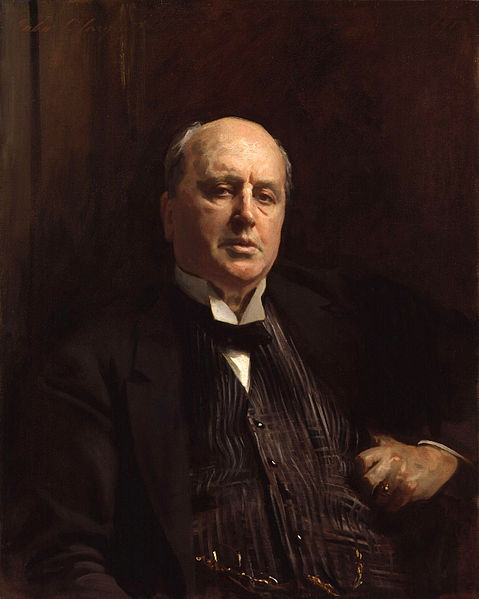
The preface to The Princess Cassamassima (1908) is late James, which means dense and mannered prose, entwining itself around a topic without clinging to it. In essence, what James is arguing here is that the novel needs a central consciousness expressed through a character who is neither a fool nor someone so intelligent that his awareness prevents him from being detached from the action in which he takes part.
We care, our curiosity and sympathy care, comparatively little for what happens to the stupid, the coarse and the blind; care for it, and for the effects of it, at the most as helping to precipitate what happens to the more deeply wondering, to the really sentient. Hamlet and Lear are surrounded, amid their complications, by the stupid and the blind, who minister in all sorts of ways to their recorded fate.It is Hamlet and Lear, of course, whom we care about. Not Regan and Goneril or -- unless one is Tom Stoppard -- Rosencrantz and Guildenstern. On the other hand, "no 'story' is possible without its fools -- as most of the fine painters of life, Shakespeare, Cervantes and Balzac, Fielding, Scott, Thackeray, Dickens, George Meredith, George Eliot, Jane Austen, have abundantly felt." But they knew that to put the fool at the forefront, to have the narrative point of view that of the fool is to put it "within the scope of a denser and duller, a more vulgar and more shallow capacity," resulting in "a picture dim and meagre." They know to place "a mind of some sort -- in the sense of a reflecting and colouring medium -- in possession of the general adventure."
When Scott fails to do so, in The Bride of Lammermoor, the novel fails: "Edgar of Ravenswood ... has a black cloak and a hat and feathers more than he has a mind," whereas Hamlet, "while equally sabled and draped and plumed, while at least equally romantic, has yet a mind still more than he has a costume." In Tom Jones, Fielding falls somewhere in between: Tom "hasn't a grain of imagination," but the novel succeeds because "his sense of bewilderment obtains altogether on the comic, never on the tragic plane." Moreover, he has an author, "handsomely possessed of a mind" so "that we see him through the mellow air of Fielding's fine old moralism, fine old humour and fine old style, which somehow really enlarge, make every one and every thing important."
The trick is to find the novel's center of consciousness in a character who "may feel enough and 'know' enough -- or be in the way of learning enough -- for his maximum dramatic value, without feeling and knowing too much for his minimum verisimilitude, his proper fusion with the fable." George Eliot presents her characters' "emotions, their stirred intelligence, their moral consciousness," which become "our own very adventure."
William James: The Stream of Consciousness
Henry's brother William is an expert on consciousness, as these excerpts from The Principles of Psychology (1890) demonstrate. It's a difficult thing to be an expert in: "No one every had a simple sensation by itself. Consciousness, from our natal day is a teeming multiplicity of objects and relations, and what we call simple sensations are results of discriminative attention, pushed often to a very high degree." We think, therefore we are, but more importantly, we are always thinking, and not in discrete little packets of thought. And even if we can isolate a thought, or an idea, we find that it mutates over time: "Often we are ourselves struck at the strange differences in our successive view of the same thing."
A permanently existing "idea" or "Vorstellung" which makes its appearance before the footlights of consciousness at periodical intervals, is as mythological an entity as the Jack of Spades.Thought is continuous. "I have already said that the breach from one mind to another is perhaps the greatest breach in nature," but there is no breach within the individual mind. Consciousness may be interrupted -- by sleep, by anesthesia, by trauma -- but "within each personal consciousness thought feels continuous. Even after an interruption, "the consciousness after it feels as if it belonged together with the consciousness before it, as another part of the same self." We don't -- except perhaps in exceptional, pathological cases -- awake from an interruption of consciousness feeling as if we are not the same person. And "the changes from one moment to another in the quality of the consciousness are never absolutely abrupt." If there are gaps, somehow we span them.
To expect the consciousness to feel the interruptions of its objective continuity as gaps, would be like expecting the eye to feel a gap of silence because it does not hear, or the ear to feel a gap of darkness because it does not see.The "common whole" that bridges the gaps "is myself, I, or me." Consequently, "In talking of it hereafter, let us call it the stream of thought, of consciousness, or of subjective life."
Even violent irruptions into the stream are nevertheless part of it. "Into the awareness of the thunder itself the awareness of the previous silence creeps and continues; for what we hear when the thunder crashes is not thunder pure, but thunder-breaking-upon-silence-and-contrasting-with-it." Context is everything. "Our own bodily position, attitude, condition, is one of the things of which some awareness, however inattentive, invariably accompanies the knowledge of whatever else we know."
But although the stream of consciousness flows steadily, we don't perceive it that way. "Like a bird's life, it seems to be made of an alternation of flights and perchings." The parts of it where it seems to perch, James calls the "substantive parts"; the flights are the "transitive parts." But it is difficult to examine the transitive parts because of what Heisenberg would later call the uncertainty principle:
As a snowflake crystal caught in the warm hand is no longer a crystal but a drop, so, instead of catching the feeling of relation moving to its term, we find we have caught some substantive thing, usually the last word we were pronouncing, statically taken, and with its function, tendency, and particular meaning in the sentence quite evaporated. The attempt at introspective analysis in these cases is in fact like seizing a spinning top to catch its motion, or trying to turn up the gas [i.e., switch on the lights] quickly enough to see how the darkness looks.Or trying to measure the position and the velocity of an atomic particle simultaneously.
The consciousness has its own grammar and syntax: "We ought to say a felling of and, a feeling of if, a feeling of but, and a feeling of by, quite as readily as we say a feeling of blue or a feeling of cold. Yet we do not: so inveterate has our habit become of recognizing the existence of the substantive parts alone, that language almost refuses to lend itself to any other use."
Yet that every datum in our remembered experience has its own context ought to be obvious when we try to remember a name that's on the tip of our tongue. If someone suggests another name, we know it's not the right one. There is a gap there that only one name will fill, just as only one piece of the jigsaw puzzle fits the gap in the picture: "A sort of wraith of the name is in it, beckoning us in a given direction, making us at moments tingle with the senses of our closeness, and then letting us sink back without the longed-for term."
In our use of language, "large tracts ... are nothing but signs of direction in thought, of which direction we nevertheless have an acutely discriminative sense." We have "rapid premonitory perspective view of schemes of thought not yet articulate," so that we can read aloud a passage that we've never seen before and anticipate the words we should emphasize and the direction that the sentence is taking.
And this foreboding of the coming grammatical scheme combined with each successive uttered word is so practically accurate that a reader incapable of understanding four ideas of the book he is reading aloud, can nevertheless read it with the most delicately modulated expression of intelligence.So although consciousness may seem to be made up of discrete bits of perception, a "halo or penumbra ... surrounds" them and "escorts" them through the stream.


 . But he also studied "with feverish fascination" a group of boys he met on the beach, including 19-year-old Marcel Plantevignes, who visited Proust in his room until a woman warned Plantevignes about Proust's homosexuality. Proust flew into a rage when the woman told him that Plantevignes had agreed with her about the accusation, "and even challenged Plantevignes's father to a duel." Proust's own seconds thought the challenge absurd and like "a duel from an operetta by Offenbach." The duel was called off and the friendship resumed when Plantevignes and his parents assured Proust that they didn't believe he was gay. Plantevignes also claimed that he suggested the title, À l'ombre des jeunes filles en fleur.