JOURNAL OF A COMPULSIVE READER
By Charles Matthews
Showing posts with label Captain Ahab. Show all posts

Wednesday, December 22, 2010

18. Moby-Dick, by Herman Melville, pp. 524-566

Moby Dick (Oxford World's Classics) Chapter CXXIX: The Cabin; Chapter CXXX: The Hat; Chapter CXXXI: The Pequod Meets the Delight; Chapter CXXXII: The Symphony; Chapter CXXXIII: The Chase -- First Day; Chapter CXXXIV: The Chase -- Second Day; Chapter CXXXV: The Chase -- Third Day; Epilogue
_____
Ahab starts to leave his cabin, and when Pip follows, warns him not to do so. "There is that in thee, poor lad, which I feel too curing to my malady. Like cures like; and for this hunt, my malady becomes my most desired health." In short, Ahab needs to be mad to proceed, and his affection for Pip weakens him. So Pip remains behind, in the captain's chair, and hears the ivory leg above on deck. "I am indeed down-hearted when you walk over me. But there I'll stay, though this stern strikes rocks; and they bulge through; and oysters come to join me."

Ahab's determination infects the crew: "Stubb no more strove to raise a smile; Starbuck no more strove to check one. Alike, joy and sorrow, hope and fear, seemed ground to finest dust, and powdered, for the time, in the clamped mortar of Ahab's iron soul." But "even as Ahab's eyes so awed the crew's, the inscrutable Parsee's glance awed his." Fedallah's mysterious hold over Ahab undermines one's sense of Ahab's indomitability, and though it doesn't quite make Ahab a sympathetic character, it humanizes him. Fedallah's "gift" of prophecy seems supernatural -- his predictions "come true," but as we'll see, they come true only because of Ahab's willingness to interpret events as fulfillments of them.

Three or four days pass with no sighting after the meeting with the Rachel, and Ahab becomes more impatient, determined that "Ahab must have the doubloon" for the first sighting of the white whale. He creates a "nest of basketed bowlines" and has himself hauled aloft for a better view, putting Starbuck -- "almost the one only man who had ever ventured to oppose him with anything in the slightest degree approaching to deecision" -- in charge of the rope that suspends him, "freely giving his whole life into such an otherwise distrusted person's hands."

Suspended there, Ahab is swooped down upon by a seahawk who carries off his hat. Ishmael recalls the legend that an eagle removed the cap worn by Tarquin the Elder, flew around him three times, and replaced the cap, an omen that Tarquin's wife, Tanaquil, took to be a prophecy that Tarquin would be king of Rome. "Ahab's hat was never restored; the wild hawk flew on and on with it; far in advance of the prow; and at last disappeared, while from the point of that disappearance, a minute black spot was dimly discerned, falling from that vast height into the sea."

The Pequod encounters another ship, "misnamed the Delight." On deck is a splintered whale-boat. Ahab asks his usual question: "Hast seen the White Whale?" and the captain of the Delight points to the wrecked boat. When Ahab asks if they killed him, the captain replied, "The harpoon is not yet forged that ever will do that," and looks at a group of sailors who are sewing a dead comrade into his hammock. In fact, the Delight is a kind of hearse, but Ahab doesn't choose to interpret as a fulfillment of Fedallah's prophecy. He defiantly brandishes his blood- and lightning-tempered harpoon, but the other captain is unmoved: "I bury but one of five stout men, who were alive only yesterday; but were dead ere night. Only that one I bury; the rest were buried before they died; you sail upon their tomb." And before Ahab's order to sail away can be accomplished, the corpse is committed to the sea, "not so quick, indeed, but that some of the flying bubbles might have sprinkled [the Pequod's] hull with their ghostly baptism." And as they sail away a voice from the Delight calls out, "In vain, oh, ye strangers, ye fly our sad burial; ye but turn us your taffrail to show us your coffin!" -- Queequeg's coffin-turned-life-buoy that hangs from the ship.

"It was a clear steel-blue day," Ishmael begins, observing that both the "feminine air" and the "masculine sea" share the hue, the birds being the "gentle thoughts" of the former, and the "mighty leviathans, sword-fish, and sharks ... the strong, troubled, murderous thinkings of the masculine sea." Caught between the two is Ahab, who "From beneath his slouched hat ... dropped a tear into the sea; nor did all the Pacific contain such wealth as that one wee drop." Starbuck carefully approaches the captain, who, it turns out, is lost in memories of the first time he went to sea forty years ago, when he was "a boy-harpooneer of eighteen." He was "past fifty" when he married "and sailed for Cape Horn the next day.... I widowed that poor girl when I married her, Starbuck." He now recognizes his own madness: "more a demon than a man! -- aye, aye! what a forty years' fool -- fool -- old fool, has Ahab been!"

He looks Starbuck in the eye -- "a human eye; it is better than to gaze into sea or sky; better than to gaze upon God." And he tells Starbuck not to join him in the boats when he pursues Moby Dick:  "I see my wife and my child in thine eye.... That hazard shall not be thine. No, no! not with the far away home I see in that eye!" Deeply moved, Starbuck once again tries to persuade Ahab to give up the chase; he tells him that his wife, Mary, takes their son to the top of the hill every day to watch for the returning Pequod. "Yes, yes! no more! it is done! we head for Nantucket!" But Ahab is convinced that he is in the grip of an immutable destiny: "By heaven, man, we are turned round and round in this world, like yonder windlass, and Fate is the handspike." He addresses Starbuck again.
But blanched to a corpse's hue with despair, the Mate had stolen away.

Ahab crossed the deck to gaze over on the other side; but started at two reflected, fixed eyes in the water there. Fedallah was motionlessly leaning over the same rail.
Starbuck, the better angel of Ahab's nature, loses to the fatal angel.  

The next morning "a long sleek on the sea" reveals the underwater presence of the whale. Ahab is hoisted in his basket, and two-thirds of the way through his ascent "he raised a gull-like cry in the air. 'There she blows! -- there she blows! A hump like a snow-hill. It is Moby Dick!" Only thirty pages before the novel's end, we get our first sight of the promised quarry.

Ahab claims the doubloon for himself, and orders three boats lowered. Starbuck is ordered to stay on board to "keep the ship." The sailors see that "the tall but shattered pole of a recent lance projected from the white whale's back."
A gentle joyousness -- a might mildness of repose in swiftness, invested the gliding whale. Not the white bull Jupiter swimming away from ravished Europa clinging to his graceful horn; his lovely, leering eyes sideways intent upon the maid; with smooth bewitching fleetness, rippling straight for the nuptial bower in Crete; not Jove, not that great majesty Supreme! did surpass the glorified White Whale as he so divinely swam. 
Here Melville has adopted an epic device, the rhetorical trick of elaborate negative comparison, found perhaps most famously in Milton's Paradise Lost:
                                Not that fair field
Of Enna, where Proserpin gath'ring flow'rs
Herself a fairer Flow'r by gloomy Dis
Was gather'd, which cost Ceres all that pain
To seek her through the world; nor that sweet Grove
Of Daphne by Orontes, and th' inspir'd
Castalian Spring might with this Paradise
Of Eden strive.... 
Just as Milton exalts the biblical Garden of Eden by asserting that it excels the gardens of classical myth, so Melville bestows divinity on Moby Dick by comparing the whale to the transformed Jupiter, who took the form of a white bull in the rape of Europa.
Titian, The Rape of Europa, 1562
The whale even presents an aspect of peacefulness. "No wonder there had been some among the hunters who namelessly transported and allured by all this serenity, had ventured to assail it; but had fatally found that quietude but the vesture of tornadoes."

Now "the grand god revealed himself, sounded and went out of sight." The three boats wait for an hour for the whale to reappear. Then suddenly Tashtego cries out, "The birds! -- the birds!" as the seabirds that had been hovering around the whale earlier begin flying toward Ahab's boat. "Their vision was keener than man's; Ahab could discover no sign in the sea." But then he glimpses a white spot "with wonderful celerity uprising, and magnifying as it rose, till it turned, and then there were plainly revealed two long crooked rows of white, glistening teeth, floating up from the undiscoverable bottom."

Ahab tries to maneuver the boat out of harm's way, but "the long, narrow, scrolled lower jaw curled high p into the open air, and one of the teeth caught in a row-lock." The whale's mouth is within six inches of Ahab, who grabs the jaw in his hands. "As now he thus vainly strove, the jaw slipped from him; the frail gunwales bent in, collapsed, and snapped, as both jaws, like an enormous shears, sliding further aft, bit the craft completely in twain." Ahab falls "flat-faced" into the water. Moby Dick swims around through the runs of the boat which "seemed to madden him, as the blood of grapes and mulberries cast before Antiochus's elephants in the book of Maccabees." (1 Maccabees 6:34, "And to the end they might provoke the elephants to fight, they shewed them the blood of grapes and mulberries.") Ahab is unable to swim, but he keeps afloat. From what's left of the boat's stern, "Fedallah incuriously and mildly eyed him." The other boats don't dare approach the scene, but the Pequod sails in and drives off the whale so they can rescue the castaways. 

The exhausted Ahab is pulled into Stubb's boat. When he finally regains his strength, he asks first about his harpoon, which Stubb shows him, and then about the men in his boat, all of whom have survived. Once the crew from the boats and the parts of the wrecked boat are on board, the Pequod sails on after the whale. Ahab is hoisted back into his perch for a while, and then descends to pace the deck, where he scolds Stubb for making light of the wrecked boat and Starbuck for calling it an ill omen. "If the gods think to speak outright to man, they will honorably speak outright; not shake their heads, and give an old wives' darkling hint." A curious position for a man to take who puts his faith in Fedallah's prophesies. 

When it is too dark for a sighting, Ahab points to the doubloon on the mast: 
"Men, this gold is mine, for I earned it; but I shall let it abide here till the White Whale is dead; and then, whosoever of ye first raises him, upon the day he shall be killed, this gold is that man's; and if on that day I shall again raise him, then, ten times its sum shall be divided among all of ye!"
On the second day, the sighting of the whale is greeted with a universal enthusiasm: "The frenzies of the chase had by this time worked them bubblingly up, like old wine worked anew. Whatever pale fears and forebodings some of them might have felt before; these were not only now kept out of sight through the growing awe of Ahab, but they were broken up, and on all sides routed, as timid prairie hares that scatter before the bounding bison." This is Melville's curiously American version of an epic simile.
They were one man, not thirty.... all the individualities of the crew, this man's valor, that man's fear; guilt and guiltiness, all varieties were welded into oneness, and were all directed to that fatal goal which Ahab their one lord and keel did point to.
In a marvelously simple sentence, a sharp counterpoint to Melville's usual biblical/Miltonic/Shakespearean diction, he writes: "The rigging lived." That is, the crew has taken to the rigging to sight the whale. "Ah! how they still strove through that infinite blueness to seek out the thing that might destroy them!"

The first cry of "There she blows!" is a false alarm -- "in their headlong eagerness, the men had mistaken some other thing for the whale-spout" -- but when the real whale is sighted, "The triumphant halloo of thirty buckskin lungs was heard." He is less than a mile away, and now he treats them to the "wondrous phenomenon of breaching."
Sperm whale breaching
Rising with his utmost velocity from the furthest depths, the Sperm Whale thus booms his entire bulk  into the pure element of air, and piling up a mountain of dazzling foam, shows his place to the distance of seven miles or more.
Moby Dick breaching, by Rockwell Kent
The boats are lowered, and once again Starbuck is left on the ship. The whale attacks the boats furiously, seeming "only intent on annihilating each separate plank of which those boats were made." In the crossing and recrossing, he becomes entangled in the lines, and soon presents "a sight more savage than the embattled teeth of sharks!" The tangled line is full of "loose harpoons and lances, with all their bristling barbs and points." Ahab takes the boat-knife and reaches into the mass of sharp steel, cutting it loose so it sinks. But Moby Dick, fastened to the lines from the boats of Stubb and Flask, dashes the two boats together and then dives.

"Flask bobbed up and down like an empty vial, twitching his legs upwards to escape the dreaded jaws of sharks; and Stubb was lustily singing out for someone to ladle him up." Then Moby Dick surfaces underneath Ahab's boat, carrying it into the air. It falls gunwale downward and Ahab and his men struggle out from beneath it. The whale again seems to want to demolish what's left of the boats: "whenever a stray oar, bit of plank, the least chip or crumb of the boats touched his skin, his tail swiftly drew back, and came sideways smiting the sea."

The Pequod again comes to the rescue, bringing the men aboard. "Some sprained shoulders, wrists, and ankles; livid contusions; wrenched harpoons and lances; inextricable intricacies of rope; shattered oars and plans; all these were there; but no fatal or even serious ill seemed to have befallen any one." But Ahab's "ivory leg had been snapped off, leaving but one short sharp splinter." Ahab proclaims himself "untouched.... Nor white whale, nor man, nor fiend, can so much as graze old Ahab in his own proper and inaccessible being."

But suddenly Ahab realizes that Fedallah is not among the rescued. Stubb says that he was "caught among the tangles of your line -- I thought I saw him dragging under." The news that Fedallah was caught in Ahab's line leads him to the realization that his blood-forged harpoon is missing, too, still suck in the whale. Ahab orders everyone to work repairing the boats and the irons. "I'll ten times girdle the unmeasured globe; yea and dive straight through it, but I'll slay him yet!"
"Great God! but for one single instant show thyself," cried Starbuck; "never, never wilt thou capture him, old man -- In Jesus' name no more of this, that's worse than devil's madness. Two days chased; twice stove to splinters; thy very leg once more snatched from under thee; thy evil shadow gone -- all good angels mobbing thee with warnings -- what more wouldst thou have? ... Oh, oh, -- Impiety and blasphemy to hunt him more!" 
Ahab is unmoved. "Ahab is for ever Ahab, man. This whole act's immutably decreed. 'Twas rehearsed by thee and me a billion years before this ocean rolled. Fool! I am the Fates' lieutenant; I act under orders." And he invokes the old legend that drowning things rise three times before they drown. "So with Moby Dick -- two days he's floated -- to-morrow will be the third." Then he reflects on Fedallah's disappearance. In the prophecy, he "was to be seen again ere I could perish." How can that be? he wonders.

The carpenter makes Ahab a leg from the wood of his ruined boat, and he is there at dawn the next day looking for the whale. By noon it is still unsighted, and then Ahab realizes that the whale has been tangled in lines and has slowed down: the ship has passed him in the night. So he has the ship turned around and sails back to where he things he will see the whale. "'Against the wind he now steers for the open jaw,' murmured Starbuck to himself." And he worries that he disobeys God by obeying Ahab.

The whale is sighted at last, and before Ahab gets in the boat he bids the ship goodbye: "Good bye, mast-head -- keep a good eye upon the whale, the while I'm gone. We'll talk to-morrow, nay, to-night, when the white whale lies down there, tied by head and tail." But he is less certain about his return when he speaks to Starbuck: "Some men die at ebb tide; some at low water; some at the full of the flood; -- and I feel now like a billow that's all one crested comb, Starbuck. I am old; -- shake hands with me, man." Starbuck's eyes are full of tears as he shakes Ahab's hand. And as Ahab's boat pulls past the stern, Pip cries out from the cabin: "The sharks! the sharks! ... O master, my master, come back!" But Ahab, who is giving orders to his crew, doesn't hear.

The sharks, in fact, are following only Ahab's boat and not the others. Ishmael speculates that it was because "Ahab's crew were all such tiger-yellow barbarians, and therefore their flesh more musky to the senses of the sharks" -- though as we learn later, Ishmael himself is part of that crew.

Ahab's thoughts are on Fedallah's prophecies still: "no coffin and no hearse can be mine; -- and hemp only can kill me!" The whale surfaces, and "maddened by yesterday's fresh irons that corroded in him, Moby Dick seemed combinedly possessed by all the angels that fell from heaven." He smashes in the sides of Stubb's and Flask's boats, but not Ahab's. And then everyone sees the whale's flank.
Lashed round and round to the fish's back; pinioned in the turns upon turns in which, during the past night, the whale had reeled the involutions of the lines around him, the half torn body of the Parsee was seen; his sable raiment frayed to shreds, his distended eyes turned full upon Ahab. 
Ahab realizes that the reappearance of Fedallah, with the whale as his hearse, fulfills those parts of the prophecy. "But I hold thee to the last letter of thy word. Where is the second hearse?" He orders the other boats to return to the ship for repairs and then rejoin him, and threatens to harpoon any of the men in his boat if they try to leave.

Moby Dick now seems to be swimming away, passing the ship. As Ahab's boat draws closer to the Pequod, he sees Starbuck leaning over the rail and Tashtego, Queequeg, and Daggoo climbing to the mast-heads. Stubb and Flask are on the deck, sorting through new harpoons and lances. Ahab also notices that the flag is gone from the main-mast-head, and shouts to Tashtego to descend for another flag and nail it to the mast. Sharks are biting at the oars of Ahab's boat, but he orders the crew to keep rowing even though the blades are getting smaller.

Ahab's boat gets near enough to Moby Dick that Ahab "darted his fierce iron, and his far fiercer curse into the hated whale." The whale swamps the boat, tossing three of the men out of it, but two of them manage to get back in, "the third man helplessly dropping astern, but still afloat and swimming." The line snaps, and Ahab cries, "What breaks in me? Some sinew cracks!" The whale turns and sees the ship now, "seemingly seeing in it the source of all his persecutions; bethinking it -- it may be -- a larger and noble foe." And so Moby Dick attacks the Pequod.

Ahab is blinded by the spray for a moment, and is horrified to see that the ship is being attacked. Tashtego, aloft, is nailing the flag to the mast-head, "and the red flag, half-wrapping him as with a plaid, then streamed itself straight out from him, as his own forward flowing heart; while Starbuck and Stubb, standing upon the bowsprit beneath, caught sight of the down-coming monster just as soon as he." Starbuck cries out, "Oh, Ahab, Ahab, lo thy work." Stubb says, "I grin at thee, thou grinning whale," and tells the other mate, "Oh, Flask, for one red cherry ere we die!" Flask replies, "Cherries? I only wish that we were where they grow," and hopes that his mother has drawn his part-pay already, because "the voyage is up."

As "the white buttress of his forehead smote the ship's starboard bow, till men and timbers reeled," the water pours into the Pequod, and Ahab realizes that another prophecy has come true: "The ship! The hearse! -- the second hearse! ... its wood could only be American!" He realizes that he has been deprived of "the last fond pride of meanest shipwrecked captains," the honor of going down with his ship. And so he turns his anger on the whale: "Towards thee I roll, thou all-destroying but unconquering whale; to the last I grapple with thee; from hell's heart I stab at thee; for hate's sake I spit my last breath at thee." He throws the harpoon, but the line "caught him round the neck, and voicelessly as Turkish mutes bowstring their victim, he was shot out of the boat, ere the crew knew he was gone." The final prophecy, death by hemp, is fulfilled.

The crew of the boat watches in horror as the ship sinks, "only the uppermost masts out of water; while fixed by infatuation, or fidelity, or fate, to their once lofty perches, the pagan harpooneers still maintained their sinking look-outs on the sea." The sinking ship creates a great vortex into which everything is drawn and swallowed up. But Tashtego's arm rises above the water, still in the act of nailing the flag to the mast-head. A sky-hawk has flown around the sinking ship and now has its wing caught between the hammer and the wood:
the submerged savage beneath, in his death-gasp, kept his hammer frozen there; and so the bird of heaven, with archangelic shrieks, and his imperial beak thrust upwards, and his whole captive form folded in the flag of Ahab, went down with his ship, which, like Satan, would not sink to hell till she had dragged a living part of heaven along with her, and helmeted herself with it.
Ishmael was the man who failed to get back into Ahab's boat, and as he is drawn toward the vortex, "the coffin life-buoy shot lengthwise from the sea, fell over, and floated by my side." Two days later, he is rescued by the Rachel, which, "in her retracing search after her missing children, only found another orphan."

Sunday, December 19, 2010

16. Moby-Dick, by Herman Melville, pp. 455-485

Moby Dick (Oxford World's Classics) Chapter CV: Does the Whale's Magnitude Diminish? -- Will He Perish? Chapter CVI: Ahab's Leg; Chapter CVII: The Carpenter; Chapter CVIII: Ahab and the Carpenter; Chapter CIX: Ahab and Starbuck in the Cabin; Chapter CX: Queequeg in His Coffin; Chapter CXII: The Blacksmith; Chapter CXIII: The Forge
_____
Ishmael now takes up a question that shows considerable foresight: the extinction of the whale. He comes to the wrong conclusion, but the fact that he raises it at all shows Melville's considerable awareness of the possibility of ecological disaster. Extinction, of course, is something the nineteenth-century pondered increasingly as the significance of the geological record became clearer.

He edges into the topic by first asking whether whales have shrunk in size, and if so, will they continue to shrink, and concludes that "The whale of to-day is as big as his ancestor's in Pliny's time," and that the figures for the size of whales provided by the ancients were exaggerated. He observes that Egyptian mummies "do not measure so much in their coffins as a modern Kentuckian in his socks," (This is the second time Ishmael has cited Kentuckians as particularly outsize. There seems to have been a legend that the most famous Kentuckian of the time, Daniel Boone, was a tall man, though he was only slightly taller than average.)
Daniel Boone Escorting Settlers Through the Cumberland Gap, George Caleb Bingham, 1851–52
But the ecological question looks forward, not backward, to the future of whale-hunting if maintained at the current rate: "whether Leviathan can long endure so wide a chase, and so remorseless a havoc; whether he must not at least be exterminated from the waters, and the last whale, like the last man, smoke his last pipe, and then himself evaporate in the final puff." The immediate comparison that comes to a mid-nineteenth-century mind is to the disappearance of the buffalo from the Great Plains.

Could the whale go the way of the buffalo? Ishmael's response to the question is that a whaling crew of forty men is lucky if it kills forty whales during a four-year hunt, whereas forty men hunting buffalo could kill a thousand times as many of their quarry over the course of four years. It's a specious argument, of course, based on the assumption that whaling technology will never change (as it so disastrously did). He also posits that whales will find some way of hiding from their hunters, retreating "to their Polar citadels, and diving under the ultimate glassy barriers and walls there, come up among icy fields and floes! and in a charmed circle of everlasting December, bid defiance to all pursuit from man.... Wherefore, for all these things, we account the whale immortal in his species, however perishable in his individuality." Melville, I feel sure, knew that Ishmael's arguments were nonsensical, but he puts them in his voice once again to underscore the obsessiveness of the whaler, even so ostensibly sane a one as Ishmael.

As for the insane whaler, Ahab is having problems with his artificial leg, which "had received a half-splintering shock" when he boarded the Samuel Enderby. And here a mystery is cleared up about Ahab's inaccessibility before they set sail from Nantucket: "he had been found one night lying prone upon the ground, and insensible; by some unknown, and seemingly inexplicable, unimaginable casualty, his ivory limb having been so violently displaced, that it had stake-wise smitten, and all but pierced his groin; nor was it without extreme difficulty that the agonizing wound was entirely cured." So his "temporary reclusiveness" had been caused by his convalescence.

Now, with another possibly defective limb, Ahab calls the carpenter to make him a new one, ordering that from the whale-bone that has been collected on the voyage, "the stoutest, clearest-grained stuff" be selected. The blacksmith is also called on to provide "whatever iron contrivances might be needed" in the fitting. The carpenter and Ahab have a dialogue on the shaping of the leg while the carpenter repeatedly sneezes from the bone-dust he is stirring up. The carpenter asks if it is true "that a dismasted man never entirely loses the feeling of his old spar, but it will be still pricking him at times, and Ahab reveals that he experiences the "phantom limb" phenomenon in his missing leg. He then departs to await the finished leg, muttering, "Here I am, proud as Greek god, and yet standing debtor to this blockhead for a bone to stand on!"

Ahab is still in a foul mood when Starbuck comes to the cabin to tell him that a leak has been detected in the casks of whale oil below decks. Starbuck wants the cargo inspected to find the source of the leak, which involves taking time off from the hunt. Ahab is too impatient to take the time, even though Starbuck argues that the leak will cause them to "waste in one day more oil than we may make good in a year. What we come twenty thousand miles to get is worth saving, sir." Ahab's response, "So it is, so it is; if we get it," reveals that he has come twenty thousand miles to get Moby Dick, not any amount of whale oil. "Begone! Let it leak!"

Starbuck stands his ground, arguing that the owners will be unhappy. But Ahab retorts, "Let the owners stand on Nantucket beach and outyell the Typhoons. What cares Ahab?" (It's always a bad sign when someone starts referring to himself by name.) He fulminates against Starbuck: "Dost thou then so much as dare to critically think of me? -- On deck!" When Starbuck persists, Ahab takes a musket from the rack and points it toward him: "There is one God that is Lord over the earth, and one Captain that is lord over the Pequod. -- On deck!"

Starbuck retorts, "I ask thee not to beware of Starbuck; thou wouldst but laugh; but let Ahab beware of Ahab; beware of thyself, old man." And he takes his leave.

Ahab observes, "He waxes brave, but nevertheless obeys; most careful bravery that!" He has noted Starbuck's flaw: his failure to follow through on what he knows to be right. But Starbuck has also made his point: "What's that he said -- Ahab beware of Ahab -- there's something there!" The remnants of sanity are there, so he goes out and tells the mate, "Thou art but too good a fellow, Starbuck," and gives the order for the cargo to be inspected.
It were perhaps vain to surmise exactly why it was, that as respecting Starbuck, Ahab thus acted. It may have been a flash of honesty in him; or mere prudential policy which, under the circumstance, imperiously forbade the slightest symptom of open disaffection, however transient, in the important chief officer of his ship.
During the work inspecting the cargo in the dankest parts of the hold, Queequeg crawls "about amid that dampness and slime, like a green spotted lizard at the bottom of a well." In consequence, "he caught a terrible chill which lapsed into a fever." Everyone thinks Queequeg is a goner, including Queequeg. On Nantucket, "he had chanced to see certainly little canoes of dark wood ... and  upon inquiry, he had learned that all whalemen who died in Nantucket, were laid to rest in those same dark canoes." So, not wanting to be "buried in his hammock, according to the usual sea-custom, tossed like something vile to the death-devouring sharks," he orders up a coffin.

When it is completed, he gets in it and lies down. "Pip, who had been slily hovering near by all this while, drew nigh to him where he lay, and with soft sobbings, took him by the hand." He tells Queequeg, "Seek out one Pip, who's now been missing long." Starbuck notices what Pip does and says, and he remembers stories of men who, in their illnesses, "have talked in ancient tongues; and that when the mystery is probed, it turns out always that in their wholly forgotten childhood those ancient tongues had been really spoken in their hearing by some lofty scholars. So, to my fond faith, poor Pip, in this strange sweetness of his lunacy, brings heavenly vouchers of all our heavenly homes." But Pip continues, excoriating himself: "Queequeg dies game! I say, game, game, game! but base little Pip, he died a coward, died all a'shiver; -- out upon Pip! ... No, no! shame upon all cowards -- shame upon them! Let 'em go drown like Pip, that jumped from a whale-boat. Shame! shame!"

Queequeg recovers, saying that "he had just recalled a little duty ashore, which he was leaving undone; and therefore he had changed his mind about dying.... With a wild whimsiness, he now used his coffin for a sea-chest; and emptying into it his canvas bag of clothes, set them in order there. Many spare hours he spent, in carving the lid with all manner of grotesque figures and drawings; and it seemed that hereby he was striving, in his rude way, to copy parts of the twisted tattooing on his body."

The Pequod now reaches the Pacific. "To any meditative Magian rover, this serene Pacific, once beheld, must ever after be the sea of his adoption," Ishmael proclaims. "Lifted by those eternal swells, you needs must own the seductive god, bowing your head to Pan." But for Ahab it is only "that sea in which the hated White Whale must even then be swimming. Launched at length upon these almost final waters, and gliding towards the Japanese cruising-ground, the old man's purpose intensified itself." In his sleep he cries out, "Stern all! the White Whale spouts thick blood!"

The ship's blacksmith, Perth, is an old man who, after losing his family and his business because of his alcoholism, went to sea. Now Ahab calls on him to forge a harpoon. "I suppose thou can'st smoothe almost any seams and dents; never mind how hard the metal, blacksmith?" Perth replies that he can smooth "all seams and dents but one." Ahab knows what he means: "'look ye here -- here -- can ye smoothe out a seam like this, blacksmith,' sweeping one hand across his ribbed brow; 'if thou could'st blacksmith, glad enough would I lay my head upon thy anvil, and feel thy heaviest hammer between my eyes. Answer! Can'st thou smoothe this seam?' 'Oh! that is the one, sir! Said I not all seams and dents but one?'"

Ahab gives the blacksmith "the gathered nail-stubbs of the shoes of racing horses," which Perth recognizes as "the best and stubbornest stuff we blacksmiths ever work." Ahab has him make twelve rods and then forge them into one; he minds the fire as the blacksmith works and then, when it is time to weld them into one shaft, Ahab hammers them himself. Fedallah comes closer "and bowing over his head towards the fire, seemed invoking some curse or some blessing on the toil." This draws Stubb's attention, who wonders, "What's that bunch of lucifers dodging about there for?'"

Perth realizes what's happening: "Is not this harpoon for the White Whale?" he asks. Ahab confirms the suspicion -- "For the white fiend!" -- and then brings the blacksmith his razors, "the best of steel; here, and make the barbs sharp as the needle-sleet of the Icy Sea." When the blacksmith hesitates, Ahab says, "I now neither shave, sup, nor pray till -- but here -- to work!" And when the blacksmith finishes and is about to temper the steel by plunging it into water:
"No, no -- no water for that; I want it of the true death-temper. Ahoy, there! Tashtego, Queequeg, Daggoo! What say ye, pagans! Will ye give me as much blood as will cover this barb?" holding it high up. A cluster of dark nods replied, Yes. Three punctures were made in the heathen flesh, and the White Wale's barbs were then tempered.

"Ego non baptiso te in nomine patris, sed in nomine diaboli!" deliriously howled Ahab, as the malignant iron scorchingly devoured the baptismal blood.
Ahab then chooses a staff and supervises the creation of a new coil of tow-line. "This done, pole, iron, and rope -- like the Three Fates -- remained inseparable." Ahab then walks away with the weapon.
But ere he entered his cabin, a light, unnatural, half-bantering, yet most piteous sound was heard. Oh! Pip, thy wretched laugh, thy idle but unresting eye; all thy strange mummeries not unmeaningly blended with the black tragedy of the melancholy ship, and mocked it!

The mock-baptism of the harpoon combines with the epic convention of the hero's forging of his sword -- Wagner's Siegfried was a quarter-century later -- for powerful ironic effect. 

Saturday, December 18, 2010

15. Moby-Dick, by Herman Melville, pp. 425-455

Moby Dick (Oxford World's Classics) Chapter XCVIII: Stowing Down and Cleaning Up; Chapter XCIX: The Doubloon; Chapter C: Leg and Arm, The Pequod, of Nantucket, Meets the Samuel Enderby, of London; Chapter CI: The Decanter; Chapter CII: A Bower in the Arsacides; Chapter CIII: Measurement of the Whale's Skeleton; Chapter CIV: The Fossil Whale
_____
The nearer to the end of his story that Ishmael gets, the slower he seems to go, as if reluctant to face cataclysm. Now he devotes a chapter to cleaning the ship after the slaughter of a whale: "One day the planks stream with freshets of blood and oil; on the sacred quarter-deck enormous masses of the whale's head are profanely piled; great rusty casks like about, as in a brewery yard; the smoke from the try-works has besooted all the bulwarks; the mariners go about suffused with unctuousness; the entire ship seems great leviathan himself; while on all hands the din is deafening." And then a day or two later, the ship has been scrubbed down. Even the ashes of the whale have been used to make lye to scrub the decks and sides. But then another whale is captured and the process is repeated, which naturally inspires Ishmael to moralize:
Yet this is life. For hardly have we mortals by long toilings extracted from the world's vast bulk its small but valuable sperm; and then, with weary patience, cleansed ourselves from its defilements, and learned to live here in clean tabernacles of the soul; hardly is this done, when -- There she blows! -- the ghost is spouted up, and away we sail to fight some other world, and go through young life's old routine again. 
The doctrine Ishmael is examining here is that of reincarnation: He imagines himself teaching the proponent of metempsychosis, Pythagoras, now reincarnated as "a green simple boy, how to splice a rope."

Then he contemplates the doubloon that Ahab nailed to the mainmast, the reward for sighting Moby Dick, which has remained unmolested despite the "ruthless crew" because "the mariners revered it as the white whale's talisman." And he gives us a series of Shakespearean soliloquies, as members of the crew pause bfore the doubloon and contemplates the images on the Ecuadorean coin: three peaks of the Andes, on one a flame, on another a tower, and on the third a rooster crowing; above them are signs of the zodiac, with the sun entering Libra.

Ahab pauses before the doubloon and identifies the figures on the mountaintops as himself: "The firm tower, that is Ahab; the volcano, that is Ahab; the courageous, the undaunted, and victorious fowl, that, too, is Ahab." Starbuck, on the other hand, sees what lies behind the mountains: "A dark valley between three mighty, heaven-abiding peaks, that almost seem the Trinity, in some faint earthly symbol. So in this vale of Death, God girds us round; and over all our gloom, the sun of Righteousness still shines a beacon and a hope."

Stubb's meditation is on the zodiac, and he runs through all of the signs whimsically, concluding, "There's a sermon now, writ in high heaven, and the sun goes through it every year, and yet comes out of it all alive and hearty. Jollily he, aloft there, wheels through toil and trouble; and so, alow here, does jolly Stubb." But for Flask, a doubloon is only a doubloon, and a good cigar is a smoke: "So, what's all this staring been about? It is worth sixteen dollars, that's true;  and at two cents the cigar, that's nine hundred and sixty cigars." An old Manxman, Queequeg, and Fedallah all pause by the doubloon.

Finally Pip arrives, and in his madness speaks prophecy: "How did it get there? And so they'll say in the resurrection, when they come to fish up this old mast, and find a doubloon lodged in it, with bedded oysters for the shaggy bark. Oh, the gold! the precious, precious gold! -- the green miser'll hoard ye soon!" And like the Shakespearean fools on which he is modeled, Pip goes away singing.
The captain of the Samuel Enderby, by Rockwell Kent

The Samuel Enderby, an English whale ship, comes alongside, and when Ahab asks if he's seen the White Whale, the captain replies: "'See you this?' and withdrawing it from the folds that had hidden it, he held up a white arm of sperm whale bone, terminating in a wooden head like a mallet." Ahab eagerly tries to go on board to meet with the captain, but he has forgotten that other ships don't have the "ingenious and very handy mechanical contrivance peculiar to the Pequod" that allows the peg-legged Ahab easy access to his ship. So he is hauled aboard the Samuel Enderby on a blubber-hook.

Once Ahab is aboard, the other captain extends his ivory arm in greeting, and Ahab puts forth his ivory leg: "Aye, aye, heart! let us shake bones together!" All Ahab wants to know, of course, is when and where he saw the whale. It was last season on the equator, he tells Ahab, and he had never heard of the white whale. They lowered their boats when they spotted a pod of four or five whales and harpooned one of them. "Presently up breaches from the bottom of the sea a bouncing great whale, with a milky-white head and hump, all crows' feet and wrinkles." There were harpoons sticking in the whale's starboard fin, he tells the excited Ahab. "'Aye, aye -- they were mine -- my irons,' cried Ahab, exultingly."

The white whale began snapping at the line that was fast in the other whale, as if to sever it, but the line seemed to get snared in the white whale's teeth, "so that when we afterwards pulled on the line, bounce we came plump on to his hump! ... Seeing how matters stood, and what a noble great whale it was -- the noblest and biggest I ever saw, sir, in my life -- I resolved to capture him, spite of the boiling rage he seemed to be in." The captain harpooned the white whale.
"But Lord, look you, sir -- hearts and souls alive, man -- the next instant, in a jiff, I was blind as a bat -- both eyes out -- all befogged and bedeadened with black foam -- the whale's tail looming straight up out of it, perpendicular in the air, like a marble steeple."
The whale's tail cut the boat in two. And the barb of another harpoon that had been lost in the destruction of the boat caught the captain just below the shoulder; as the whale dived, "the barb ript its way along the flesh -- clear along the whole length of my arm -- come out nigh my wrist, and up I floated." The ship's surgeon amputated the arm, but he insists that the decision to make the prosthesis from whalebone was the captain's idea.

Ahab impatiently listens to the joshing conversation between the captain and the surgeon, and finally cries out, "What became of the White Whale?" He is astonished to hear that they sighted him again but didn't pursue him. "Didn't want to try to; ain't one limb enough?... No more White Whales for me; I've lowered for him once, and that has satisfied me.... he's best let alone; don't you think so, Captain?" But Ahab is so agitated by the story that the surgeon thinks he's feverish and apoplectic and pulls out a lancet to ease Ahab's blood pressure.

"'Avast!' roared Ahab, dashing him against the bulwarks -- 'Man the boat! Which way heading?'" The English captain asks Fedallah, "Is your Captain crazy?" but Fedallah only puts his finger to his lips and goes to help Ahab get back to the Pequod. "In vain the English Captain hailed him. With back to the stranger ship, and face set like a flint to his own, Ahab stood upright till alongside of the Pequod."

Ishmael gives us a coda to the story that explains that the Samuel Enderby was named for the founder of "the famous whaling house of Enderby & Sons; a house which in my poor whaleman's opinion, comes not far behind the united royal houses of the Tudors and Bourbons, in point of real historical interest." And he tells us that he once boarded the Samuel Enderby off Patagonia. "It was a fine gam we had, and they were all trumps -- every soul on board. A short life to them, and a jolly death." He follows this up with a few observations about Dutch whalers and the great amount of alcohol they packed for their relatively brief voyages.

Then he turns to whale anatomy again, and a story about finding a whale skeleton in the Arsacides -- which are the Solomon Islands -- and measuring it. Because of his "wild wanderings at that period," he preserved the measurements by having them tattooed on his right arm. He calculates that "a Sperm Whale of the largest magnitude, between eighty-five and ninety feet in length, and something less than forty feet in its fullest circumference, such a whale will weigh at least ninety tons; so that, reckoning thirteen men to a ton, he would considerably outweigh the combined population of a whole village of one thousand one hundred inhabitants." (Contemporary sperm whale measurements are more modest, topping out at about 67 feet in length, and about 63 tons.)
Basilosaurus

He then ventures into whale ancestry as demonstrated in the fossil record, citing as "by far the most wonderful of all cetacean relics" the Basilosaurus found in 1842 on the plantation of Judge John Creagh of Alabama. "The awe-stricken credulous slaves in the vicinity took it for the bones of one of the fallen angels." And he records his awe at such fossils: "Who can show a pedigree like Leviathan? Ahab's harpoon had shed older blood than the Pharaoh's. Methuselah seems a schoolboy."

But maybe Ishmael is getting a little self-conscious about the pacing of his story and these extended cetological interruptions:
One often hears of writers that rise and swell with their subject, though it may seem but an ordinary one. How, then, with me, writing of this Leviathan. Unconsciously my chirography expands into placard capitals. Give me a condor's quill! Give me Vesuvius' crater for an inkstand.... Such, and so magnifying, is the virtue of a large and liberal theme! We expand to its bulk. To produce a mighty book, you must choose a mighty theme. No great and enduring volume can ever be written on the flea, though many there be who have tried it.

Thursday, December 16, 2010

13. Moby-Dick, by Herman Melville, pp. 360-389

Moby Dick (Oxford World's Classics) Chapter LXXXII: The Honor and Glory of Whaling; Chapter LXXXIII: Jonah Historically Regarded; Chapter LXXXIV: Pitchpoling; Chapter LXXXV: The Fountain; Chapter LXXXVI: The Tail; Chapter LXXXVII: The Grand Armada
_____
Tongue in cheek, Ishmael compiles a historical and mythical roster of famous whalers: Perseus, St. George ("which dragon I maintain to have been a whale; for in many old chronicles whales and dragons are strangely jumbled together, and often stand for each other"), Hercules (who in one legend was swallowed by a whale), Jonah, and Vishnu.
St. George and the Dragon, by Paolo Uccello: Very like a whale?
Jonah is perhaps the only one of those ur-whalers who doesn't really need much explanation, but Ishmael continues with an investigation into the biblical story that is in part a satire on the Higher Criticism. His authority here is an "old Sag-Harbor whaleman" who questioned the accuracy of the biblical story because of an image in an old Bible that showed the whale with two spouts in his head, a characteristic only of the right whale, whose throat is too small to swallow a man. On the other hand, Ishmael observes, Bishop Jebb suggests that Jonah wasn't swallowed but just held in the whale's mouth: "For truly, the Right Whale's mouth would accommodate a couple of whist-tables, and comfortably seat all the players."
Altarpiece in Klosterneuburg, Austria by Nicholas of Verdun

The Sag Harbor whaleman also objects that the whale's digestive juices would have killed Jonah, so Ishmael resorts to "a German exegetist" who thinks Jonah "must have taken refuge in the floating body of dead whale, -- even as the French soldiers in the Russian campaign turned their dead horses into tents, and crawled into them." (Or Luke Skywalker in his dead Tauntaun.)

And then there's the problem of Jonah's being spat up somewhere on the Mediterranean and making his way to Nineveh, more than the biblical three days' journey from anywhere on the shores of the Mediterranean. The only way he could get that close to Nineveh would be if the whale swam all the way around Africa, through the Persian Gulf and the Red Sea, and up the Tigris, which is "too shallow for any whale to swim in." Besides, that would mean going around the Cape of Good Hope before it was discovered by Bartholomew Diaz, "and so make modern history a liar." Ishmael concludes that "all these foolish arguments of old Sag-Harbor only evinced his foolish pride of reason ... and abominable, devilish rebellion against the reverend clergy." And we know how much Ishmael reveres the clergy.

After that excursion into facetiousness, Ishmael returns to matters at hand. Queequeg spends a morning rubbing oil into the bottom of his boat "as though diligently seeking to insure a crop of hair from the craft's bald keel." He does so just in time for another whale chase in which this time Stubb's boat takes the lead, and Stubb demonstrates his skill at pitchpoling: "Steel and wood included, the entire spear is some ten or twelve feet in length; the staff is much slighter than that of the harpoon, and also of a lighter material -- pine. It is furnished with a small rope called a warp, of considerable length, by which it can be hauled back to the hand after darting." Stubb succeeds in landing the weapon in the spout of the whale: "Instead of sparkling water, he now spouts red blood." Stubb exults in his conquest. "The agonized whale goes into his flurry; the tow-line is slackened, and the pitchpoler dropping astern, folds his hands, and mutely watches the monster die." Once again, you sense that Ishmael sympathizes more with the monster than with the man.

But the scene gives him an opportunity to discuss the whale's spout, and to examine a question that he says is unresolved "down to this blessed minute (fifteen and a quarter minutes past one o'clock P.M. of this sixteenth day of December, A.D. 1851)." (If true, today marks the 159th anniversary of the writing of that sentence. Quite a coincidence.) The unresolved question is "whether these spoutings are, after all, really water, or nothing but vapor." As Ishmael points out, the whale's mouth is unconnected with his lungs -- he breathes only through the blowhole. Ishmael is right in suggesting that the sperm whale has no sense of smell -- the brain lacks olfactory receptors -- but scientists have recently discovered that bowhead whales do have that sense. Ishmael points out the absence of things that a whale might want to smell: "No roses, no violets, no Cologne-water in the sea." But scientists suspect that the bowhead whales use the sense to locate their food: krill.

But back to the unresolved question, "in other words, whether the spout of the Sperm Whale is the mere vapor of the exhaled breath, or whether that exhaled breath is mixed with water taken in through the mouth" which, although it doesn't connect with the lungs, does connect with the spouting canal. Ishmael is of the opinion "that the spout is nothing but mist." The consensus today is that he's right. Ishmael also says that whalemen think the spout is poisonous, which isn't true. But he can't resist a final whimsy:
He is both ponderous and profound. And I am convinced that from the heads of all ponderous and profound beings, such as Plato, Pyrrho, the Devil, Jupiter, Dante, and so on, there always goes up a certain semi-visible steam, while in the action of thinking deep thoughts.... The invariable moisture of my hair, while plunged in deep thought, after six cups of hot tea in my thin shingled attic, of an August noon; this seems an additional argument for the above supposition. 

From the spout to the tail, which Ishmael admires more than anything else about the whale. "In no living thing are the lines of beauty more exquisitely defined than in the crescentic borders of these flukes.... in the tail the confluent measureless force of the whole whale seems concentrated to a point. Could annihilation occur to matter, this were the thing to do it." It's the combination of grace and strength that Ishmael most admires: "Real strength never impairs beauty or harmony, but it often bestows it; and in everything imposingly beautiful, strength has much to do with the magic." He cites the muscularity of statues of Hercules and the "robustness" of Michelangelo's God. But he contrasts this with images of Jesus:
And whatever they may reveal of the divine love in the Son, the soft, curled, hermaphroditical Italian pictures, in which his idea has been most successfully embodied; these pictures, so destitute as they are of all brawniness, hint nothing of any power, but the mere negative, feminine one of submission and endurance, which on all hands it is conceded, form the peculiar practical virtues of his teachings.
It's a strangely ambivalent observation: He admires strength, but the most successful pictures of Jesus reveal him as "feminine" and submissive, which "is conceded" to be the essence of Jesus's teaching. Are we to read this as a rejection of Jesus, or of the interpretation of his teachings? Heterodoxy abounds in Moby-Dick.

Back to the whale and his tail, which, "in his conflicts with man, he chiefly and contemptuously uses." He speculates that "in the whale the sense of touch is concentrated in the tail; for in this respect there is a delicacy in it only equalled by the daintiness of the elephant's trunk." But the phenomenon, except  for "the sublime breach -- somewhere else to be described --" that most excites him is the whale's dive: "this peaking of the whale's flukes is perhaps the grandest sight to be seen in all animated nature."
Out of the bottomless profundities the gigantic tail seems spasmodically snatching at the highest heaven. So in dreams, have I seen majestic Satan thrusting forth his tormented colossal claw from the flame Baltic of Hell. But in gazing at such scenes, it is all in what mood you are in; if in the Dantean, the devils will occur to you; if in that of Isaiah, the archangels. Standing at the masthead of my ship during a sunrise that crimsoned sky and sea, I once saw a large herd of whales in the east, all heading towards the sun, and for a moment vibrating in concert with peaked flukes. As it seemed to me at the time, such a grand embodiment of adoration of the gods was never beheld, even in Persia, the home of the fire worshippers.
Nature, then, is prey to the whims of the human mood. Ishmael is the aesthetic consciousness, interpreting the whales as sun-worshippers. Ahab's consciousness would doubtless find in the same scene only the massed presence of his sworn enemy. But in another mood, Ishmael himself might see the scene as hellish, and the flukes as claws reaching from the flaming sea. The task is to transcend subjectivity and to see what is really there.

But what is really there when one contemplates the whale? Or, "how comprehend his face, when face he has none? Thou shalt see my back parts, my tail, he seems to say, but my face shall not be seen. But I cannot completely make out his back parts; and hint what he will about his face, I say again he has no face." Whaleness, like divinity, remains inscrutable.

Now the Pequod reaches the Malay archipelago and the Sunda Strait. It doesn't seek port: "while other ships may have gone from China to New York, and back again, touching at a score of ports, the whale-ship, in all that interval, may not have sighted one grain of soil; her crew having seen no man but floating seamen like themselves." Here they sight "a continuous chain of whale-jets ... up-playing and sparkling in the noonday air." In this region whales are "frequently met with in extensive herds, sometimes embracing so great a multitude, that it would almost seem as if numerous nations of them had sworn solemn league and covenant for mutual assistance and protection."

But as the Pequod is eagerly headed toward the "vast fleet of whales" it has spotted, Tashtego spots something else: Malay pirates. So they set full sail to evade them. "Ahab to-and-fro paced the deck; in his forward turn beholding the monsters he chased, and in the after one the bloodthirsty pirates chasing him." They elude the pirates, and the whales try to elude them: "In all directions expanding in vast irregular circles, and aimlessly swimming hither and thither, by their short thick spoutings, they plainly betrayed their distraction of panic." Ishmael likens the scene to buffalo fleeing from a single horseman, or people trampling one another in a crowded theater at the rumor of fire, "for there is no folly of the beast of the earth which is not infinitely outdone by the madness of men."

With so many whales available, the whalers resort to blocks of wood called "druggs" that can be attached to a harpoon: "if you cannot kill them all at once, you must wing them, so that they can be afterwards killed at your leisure. Hence it is, that at times like these the drugg comes into requisition." But one of the druggs in Ishmael's boat caught under a seat, and when the whale tears it away, the seat goes with it, tearing holes in either side of the boat. The leaks are temporarily stopped by being stuffed with the sailors' drawers and shirts.

The whale that is towing their boat pulls them into the very center of the circling whales. They "glided between two whales into the innermost heart of the shoal, as if from some mountain torrent we had slid into a serene valley lake.... Yes, we were now in that enchanted calm which they say lurks at the heart of every commotion." And here they are "occasionally visited by small tame cows and calves; the women and children of this routed host."
Like household dogs they came snuffing round us, right up to our gunwales, and touching them; till it almost seemed that some spell had suddenly domesticated them. Queequeg patted their foreheads; Starbuck scratched their backs with his lance; but fearful of the consequences, for the time refrained from darting it.
The two most humane members of the Pequod's crew, Queequeg and Starbuck, share in this privileged moment. Queequeg spots what he thinks is a whale line connecting a big whale with a little one, but when Starbuck goes to look, he "saw long coils of the umbilical cord of Madame Leviathan, by which the young cub seemed still tethered to its dam. Not seldom in the rapid vicissitudes of the chase, this natural line, with the maternal end loose, becomes entangled with the hempen one, so that the cub is thereby trapped. Some of the subtlest secrets of the seas seemed divulged to us in this enchanted pond."

But enchantment fades into horror:
A whale wounded (as we afterwards learned) in [his tail-tendon], but not effectually, as it seemed, had broken away from the boat, carrying along with him half of the harpoon line; ... he had also run away with the cutting-spade in him; and while the free end of the rope attached to that weapon, had permanently caught in the coils of the harpoon-line round his tail, the cutting-spade had worked loose from his flesh. So that tormented to madness, he was now churning through the water, violently flailing with his flexible tail, and tossing the keen spade about him, wounding and murdering his own comrades. 
And now the calm that has surrounded Starbuck's boat ends, as "the entire host of whales came tumbling upon their inner centre; as if to pile themselves up in one common mountain." They manage to work their way out of the melee, with only the loss of Queequeg's hat, which was "taken clean from his head by the air-eddy made by the sudden tossing of a pair of broad flukes close by."

Despite -- or because of -- the abundance of whales, the Pequod had little success. Only Flask was able to kill a whale. "The result of this lowering was somewhat illustrative of that sagacious saying in the Fishery, -- the more whales the less fish. Of all the drugged whales only one was captured. The rest contrived to escape for the time, but only to be taken, as will hereafter be seen, by some other craft than the Pequod."

Wednesday, December 15, 2010

11. Moby-Dick, by Herman Melville, pp. 301-327

Moby Dick (Oxford World's Classics)Chapter LXVI: The Shark Massacre; Chapter LXVII: Cutting In;  Chapter LXVIII: The Blanket; Chapter LXIX: The Funeral; Chapter LXX: The Sphynx; Chapter LXXI: The Jeroboam's Story; Chapter LXXII: The Monkey-Rope; Chapter LXXIII: Stubb and Flask Kill a Right Whale; and Then Have a Talk Over Him
_____
In some ways, sharks have taken over from whales as "monsters of the deep" in the popular imagination. So the grisly feeding frenzy of the sharks around the whale carcass has a special chill for us. But so it does for the crew of the Pequod, who commence to kill as many of the sharks as they can. The murderousness (to anthropomorphize as Ishmael does) of the sharks is persistent:
A sort of generic or Pantheistic vitality seemed to lurk in their very joints and bones, after what might be called the individual life had departed. Killed and hoisted on deck for the sake of his skin, one of these sharks almost took poor Queequeg's hand off, when he tried to shut down the dead lid of his murderous jaw. 
Butchery is everywhere on the ship: "The ivory Pequod was turned into what seemed a shambles." Ishmael lingers on the peculiar features of whale anatomy as the animal is carved up, observing that "the blubber envelopes the whale precisely as the rind does an orange, so is it stripped off the body precisely as an orange is sometimes stripped by spiralizing it... the blubber in one strip uniformly peels off along the line called the 'scarf.'" In a vivid sentence, Ishmael sums up the action:
And thus the work proceeds; the two tackles hoisting and lowering simultaneously; both whale and windlass heaving, the heavers singing, the blubber-room gentlemen coiling, the mates scarfing, the ship straining, and all hands swearing occasionally, by way of assuaging the general friction.
Ishmael is particularly fascinated by the sperm whale's skin, which is covered with "an infinitely thin, transparent substance, somewhat resembling the thinnest shreds of isinglass, only it is almost as flexible and soft as satin; that is, previous to being dried, when it not only contracts and thickens, but becomes rather hard and brittle." He also notes the wrinkles of the skin, comparing them to hieroglyphics, though "the mystic-marked whale remains undecipherable." Ishmael prefers to think of the blubber as being part of its skin, and to see the whale as "wrapt up in his blubber as in a real blanket or counterpane; or, still better, an Indian poncho slipt over his head, and skirting his extremity."

Stripped of the blubber, the "colossal" carcass is cast away and pursued by sharks and seabirds. It represents for Ishmael a "great mass of death." But even in death, Ishmael claims that "a vengeful ghost survives and hovers over it to scare." He tells of ships that, spotting the whale carcass at a distance, have mistaken it for land: "straightway the whale's unharming corpse, with trembling fingers is set down in the log -- shoals, rocks, and breakers hereabout: beware! And for years afterwards, perhaps, ships shun the place.... Thus, while in life the great whale's body may have been a real terror to his foes, in his death his ghost becomes a powerless panic to the world."

Lucas Cranach the Elder, Judith with the Head of Holofernes, c. 1530
The drifting body is headless, however. As Ishmael notes, "the whale has nothing that can properly be called a neck," so it takes an expert to judge where head ends and body begins. Moreover, "the sperm whale's head embraces nearly one third of his entire bulk." That head is "hoisted against the ship's side" where "that blood-dripping head hung to the Pequod's waist like the giant Holofernes's from the girdle of Judith."

The head is enough to provoke Ahab to a fantasia about what the whale has seen in the depths of the sea "where unrecorded names and navies rust, and untold hopes and anchors rot." He continues with his moral musings when the watch cries out that a ship is approaching and bringing the wind with her. Ahab says, "Would now St. Paul would come along that way, and to my breezelessness bring his breeze! O Nature, and O soul of man! how far beyond all utterance are your linked analogies; not the smallest atom stirs or lives on matter, but has its cunning duplicate in mind."

Unfortunately, the encounter with the Jeroboam is not one that will cheer Ahab or anyone else on board, even though, like the Pequod, she hails from Nantucket. The Jeroboam's captain, Mayhew, informs them that "a malignant epidemic" has broken out on board, and that he has forbidden contact with other ships. So they attempt to make conversation from a boat that the Jeroboam has lowered, which tries to keep alongside the Pequod as best it can. There is, in fact, more than just an epidemic on the Jeroboam. In the boat is "a man of singular appearance" with a "deep, settled, fanatic delirium in his eyes." Stubb has heard about the man from the Town-Ho's crew. He grew up in what Ishmael refers to as "the crazy society of Neskyeuna [actually Niskayuna] Shakers," which he left for Nantucket, where he joined the Jeroboam's crew. But once they were as sea, "his insanity broke out in a freshet. He announced himself as the archangel Gabriel, and commanded the captain to jump overboard." He failed at that attempt, but managed to gain a following in the crew, who prevented all efforts by Captain Mayhew to get rid of him. The epidemic on board only solidified his credibility with the crew.

Ahab, of course, is only interested in whether they have seen the White Whale. Mayhew had heard about Moby Dick in an encounter with another whale-ship, but when Gabriel heard about him, "in his gibbering insanity, [pronounced] the White Whale to be no less a being than the Shaker God incarnated." A year or two later, Moby Dick was sighted, and the chief mate, Macey, decided to go after him. "Meantime, Gabriel, ascending to the main-royal mast-head, was tossing one arm in frantic gestures, and hurling forth prophecies of speedy doom to the sacrilegious assailants of his divinity." Macey was standing up in the boat when the whale surfaced. "Next instant, the luckless mate, so full of furious life, was smitten bodily into the air, and making a long arc in his descent, fell into the sea at the distance of about fifty yards. Not a chip of the boat was harmed, nor a hair of any oarsman's head; but the mate for ever sank."

Macey's death only enhanced Gabriel's reputation among the crew as a prophet. And when Mayhew asks if Ahab plans to hunt Moby Dick and Ahab answers "Aye," "Straightway, then, Gabriel once more started to his feet, glaring upon the old man, and vehemently exclaimed, with downward pointed finger -- 'Think, think of the blasphemer -- dead, and down there! -- beware of the blasphemer's end." Ahab, of course ignores the warning, and changes the subject: He has remembered that he has a letter for one of the Jeroboam's officers that had been passed on to him. Ishmael explains that whale-ships routinely collect letters "from various ships, whose delivery to the persons to whom they may be addressed, depends upon the mere chance of encountering them in the four oceans. Thus, most letters never reach their mark; and many are only received after attaining an age of two or three years or more."

Starbuck splits the end of a pole so the letter can be stuck in it and handed down to the Jeroboam's boat. Meanwhile, Ahab reads the letter and realizes that it is addressed to Macey, the mate killed by Moby Dick, and that it's from Macey's wife. Mayhew asks for it to be passed over to him. "'Nay, keep it thyself,' cried Gabriel to Ahab; 'thou art soon going that way.'"  Ahab curses Gabriel and sticks the letter in the slit in the pole, but as he hands it over, the boat drifts so that the letter is in Gabriel's reach. He grabs it, impales it on a knife, and throws it back on board the Pequod, where it lands at Ahab's feet.
Then Gabriel shrieked out to his comrades to give way with their oars, and in that manner the mutinous boat rapidly shot away from the Pequod.

As, after this interlude, the seamen resumed their work upon the jacket of the whale, many strange things were hinted in reference to this wild affair.
Ishmael now recalls that when work on the whale began, Queequeg's job was to attach the blubber-hook to the whale and to remain on its back through "the whole flensing and stripping operation." Because the body revolves as it is worked on, it's necessary to secure the person on the whale with a rope. And Ishmael had the job of being on the other end of the rope, on deck. The "monkey-rope," as it's called, was tied "fast to Queequeg's broad canvas belt, and fast to my narrow leather one." And if Queequeg were to lose his footing and fall, "both usage and honor demanded, that instead of cutting the cord, it should drag me down in his wake." Thus, Ishmael comments, "my free will had received a mortal wound." And typically, Ishmael draws a moral lesson from it:
I saw that this situation of mine was the precise situation of every mortal that breathes; only, in most cases, he, one way or other, has this Siamese connection with a plurality of other mortals. If your banker breaks, you snap; if your apothecary by mistake sends you poison in your pills, you die.
Adding to Queequeg's -- and by extension Ishmael's -- peril are the sharks, in whose midst he is hanging. And though Tashtego and Daggoo kill as many sharks as they can with their whale-spades, those sharp instruments also add to the danger because "both he and the sharks were at times half hidden by the blood-muddled water," so "those indiscreet spades of their would come nearer amputating a leg than a tail." And again Ishmael moralizes about Queequeg's plight: "Are you not the precious image of each and all of us men in this whaling world? That unsounded ocean you gasp in, is Life; those sharks, your foes; those spades, your friends; and what between sharks and spades you are in a sad pickle and peril, poor lad." Of course, in Ishmael's allegory, your friends, the spades, are almost as dangerous as your foes, the sharks.

Though the quarry of the Pequod is the  sperm whale, when right whales are sighted, Ahab gives the go-ahead to the capture. Stubb and Flask lead the pursuit and between them manage to take one. It tows both boats back toward the ship, and when the whale sounds it carries the line beneath the Pequod: "a swift tremor was felt running like lightning along the keel, as the strained line, scraping beneath the ship, suddenly rose to view under her bows, snapping and quivering." The whale tows the boats around and around the Pequod, and the sharks, attracted by the blood, follow. Finally, "with a frightful roll and vomit, he turned upon his back a corpse."

Ishmael is apparently a witness to the conversation between Stubb and Flask as they get the whale ready to be towed to the ship. Stubb wonders what Ahab wants with "this lump of foul lard," and Flask repeats a story that a ship that has had "a Sperm Whale's head  hoisted on her starboard side, and at the same time a Right Whale's one the larboard, ... can never afterwards capsize." He admits that the source of the story is "that gamboge ghost of a Fedallah" but "he seems to know all about ships' charms." (Notice that, in the end, Gabriel turns out to be a better prophet than Fedallah.) 

And so the talk between Stubb and Flask turns to Fedallah, whom Stubb takes "to be the devil in disguise" who doesn't sleep in a hammock but in a coil of rigging in which he hides his tail. Stubb further posts that "the old man is hard bent after that White Whale, and the devil there is trying to come round him, and get him to swap away his silver watch, or his soul, or something of that sort, and then he'll surrender Moby Dick." And he tells Flask a story about how the devil once asked God ("the old governor") for John. "'Take him,' says the governor -- and by the Lord, Flask, if the devil didn't give John the Asiatic cholera before he got through with him, I'll eat this whale in one mouthful." Stubb seems to have conflated the story of Faust (whose name was John) with the Book of Job, which explains Flask's confusion: "I think I remember some such story as you were telling ... but I can't remember where."

Stubb continues to suggest that God is afraid of the devil:
"Damn the devil, Flask; so you suppose I'm afraid of the devil? Who's afraid of him except the old governor who daresn't catch him him and put him in double-darbies, as he deserves, but lets him go about kidnapping people; aye, and signed a bond with him that all the people the devil kidnapped, he'd roast for him? There's a governor!" 
Stubb's justification of the ways of God to man, then, is that God so fears the devil that he gives him free rein to snare human beings, and then punishes the tempted human beings with hellfire instead of punishing the devil who tempted them. And if Fedallah is the devil, Stubb asserts, it's Ahab who's his next victim.

Flask is right about the whale heads: the right whale's head is hoisted as a counterbalance to the sperm whale's, and Ishmael draws a lesson from the Pequod's regaining an even keel, "though sorely strained, you may well believe":
So, when on one side you hoist in Locke's head, you go over that way; but now, on the other side, hoist in Kant's and you come back again; but in very poor plight. Thus, some minds for ever keep trimming boat. Oh, ye foolish! throw all these thunder-heads overboard, and then you will float light and right.
Thus speaks the American pragmatist.

As for Fedallah and Ahab, it's not so clear which one is the devil:  "Ahab chanced so to stand, that the Parsee occupied his shadow; while, if the Parsee's shadow was there at all it seemed only to blend with and lengthen Ahab's."

Monday, December 13, 2010

10. Moby-Dick, by Herman Melville, pp. 262-301

Moby Dick (Oxford World's Classics)Chapter LV: Of the Monstrous Pictures of Whales; Chapter LVI: Of the Less Erroneous Pictures of Whales, and the True Pictures of Whaling Scenes; Chapter LVII: Of Whales in Paint; in Teeth; in Wood; in Sheet-Iron; in Mountains; in Stars; Chapter LVIII: Brit; Chapter LIX: Squid; Chapter LX: The Line; Chapter LXI: Stubb Kills a Whale; Chapter LXII: The Dart; Chapter LXIII: The Crotch; Chapter LXIV: Stubb's Supper; Chapter LXV: The Whale as a Dish
______
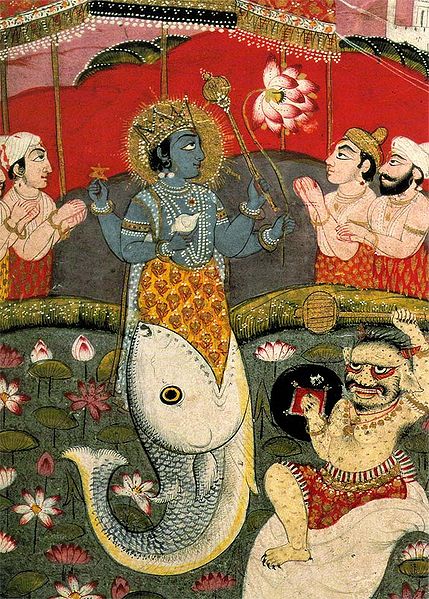
The three chapters on whale iconography are among the greatest stumbling-blocks in Moby-Dick  for the contemporary casual reader, unless he or she has a particular interest in the topic. As I think I suggested before, they serve a purpose in the novel to suggest that just as Ahab is obsessed with the White Whale, Ishmael is obsessed with the entire topic of whaling, and that Melville's novel is a study in obsessions. In this case, Ishmael is mostly obsessed with how artists got it wrong, starting with the "most ancient extant portrait anyways purporting to be the whale's," which he identifies as a sculpture found in the Elephanta caves in India: "the incarnation of Vishnu in the form of leviathan, learnedly known as the Matse Avatar." It's hard to tell what sculpture of Vishnu in the Matsya (Sanskrit for fish) avatar he has in mind, but he insists that the tail is all wrong.
Incarnation of Vishnu as a fish

Western artists don't fare much better: He denounces Guido Reni's painting of Perseus rescuing Andromeda -- a picture now so badly in need of cleaning that it's hard to see the sea-monster anyway -- and the monster in Hogarth's version of the Perseus story is equally improbable. Not to mention "Jonah's whale in the prints of old Bibles and the cuts of old primers. He also takes in the "book-binder's whale winding like a vine-stalk round the stock of a descending anchor." The well-known colophon is "universally denominated a dolphin," but Ishmael insists that it was intended to represent a whale.
Hogarth, Perseus and Andromeda
Jonah and the whale
Publisher's dolphin colophon

Even more recent images of whales by trained naturalists such as Lacépède and Cuvier fall short: "Frederick Cuvier's Sperm Whale is not a Sperm Whale, but a squash." He blames the misrepresentations on the fact that the naturalists are working from whales that have been beached: "The living whale, in his full majesty and significance, is only to be seen at sea in unfathomable waters; and afloat the vast bulk of him is out of sight, like a launched line-of-battle ship; and out of that element it is a thing eternally impossible for mortal man to hoist him bodily into the air, so as to preserve all his mighty swells and undulations." 

J. Ross Browne (1821–1875). Etchings of a Whaling Cruise
In discussing "less erroneous pictures of whales," he cites with approval J. Ross Browne and William Scoresby. But his chief praises are for "two large French engravings, well executed, and taken from paintings by one Garnery." He means Ambroise Louis Garneray:
Ambroise Louis Garneray (1783–1857), "Peche de la Baleine,” colored aquatint engraved by Frederic Martens, 1835.

Ambroise Louis Garneray, "Peche du Cachalot,” colored aquatint engraved by Frederic Martens, 1834. 
"The natural aptitude of the French for seizing the picturesqueness of things seems to be peculiarly evinced in what paintings and engravings they have of their whaling scenes."

Long exile from Christendom and civilization inevitably restores a man to that condition in which God placed him, i.e., what is called savagery. Your true whale-hunter is as much a savage as an Iroquois. I myself am a savage, owning no allegiance but to the King of the Cannibals; and ready at any moment to rebel against him. Now, one of the peculiar characteristics of the savage in his domestic hours, is his wonderful patience of industry.
This is a preamble to his discussion of carvings and other handcrafted images of whales, but it's also a reminder that when Ishmael refers to someone as a savage, he doesn't necessarily mean it as a pejorative.

The Pequod now comes upon "vast meadows of brit, the minute, yellow substance, upon which the Right Whale largely feeds." Ishmael doesn't seem to know precisely what this "substance" is, but the dictionary will tell you that brit, or britt, is (are?) the spawn of herring or similar fish. The Right Whale is, of course, the wrong whale for the Pequod, so she cruises along through the grazing whales as "these monsters swam, making a strange, grassy, cutting sound; and leaving behind them endless swaths of blue upon the yellow sea." The experience provokes Ishmael to meditation on "the subtleness of the sea; how its most dreaded creatures glide under water, unapparent for the most part, and treacherously hidden beneath the loveliest tints of azure." And of course he draws a moral: "For as this appalling ocean surrounds the verdant land, so in the soul of man there lies one insular Tahiti, full of peace and joy, but encompassed by all the horrors of the half known life. God keep thee! Push not off from that isle, thou canst never return!" This didactic flourish is not unearned, of course: Ishmael pushed off from his own isle when he signed up for a voyage with Ahab.

Speaking of whom, he is about to return to the scene when Daggoo, on watch on the main mast-head, spots "a great white mass" rising from the sea. Naturally, he thinks it's Moby Dick. Ahab rushes to see, and orders the boats lowered. It's not the whale, however. "A vast pulpy mass, furlongs in length and breadth, of a glancing cream-color, lay floating on the water, innumerable long arms radiating from its centre, and curling and twisting like a nest of anacondas, as if blindly to catch at any hapless object within reach." The giant squid gives Starbuck a serious case of the creeps:
As with a low sucking sound it slowly disappeared again, Starbuck still gazing at the agitated waters where it had sunk, with a wild voice exclaimed -- "Almost rather had I seen Moby Dick and fought him, than to have seen thee, thou white ghost!"
Not only does Starbuck make it perfectly clear that fighting Moby Dick is the last thing he wants to do, he also reveals his sense of being doomed when he adds that "few whale-ships [have] ever beheld [the giant squid] and returned to their ports to tell of it." As for Ahab, he says nothing and everyone returns in silence to the ship. Ishmael notes that some think that the giant squid is the only food the sperm whale eats, which ought to have given Ahab, at least, some encouragement. He also notes that "the great Kraken of Bishop Pontoppodan may ultimately resolve itself into Squid" -- Erik Pontoppidan was a bishop in Norway who wrote a "Natural History of Norway" describing the kraken as a vast sea monster capable of dragging down an entire ship. Naturalists, Ishmael notes, include the giant squid "among the class of cuttle-fish, to which, indeed, in certain external respects it would seem to belong, but only as the Anak of the tribe." Anak in the Bible is the progenitor of a race of giants.

Ishmael now turns to the topic of rope: "the magical, sometimes horrible whale-line." It is made of either hemp or "Manilla" (a fiber derived from abacá, a species of banana). Ishmael, "since there is an aesthetics in all things," prefers the latter: "Hemp is a dusky, dark fellow, a sort of Indian; but Manilla is as a golden-haired Circassian to behold." The rope is surprisingly thin: "only two thirds of an inch." But it "will bear a strain nearly equal to three tons." Coiled in its tub aboard the whale-boat, "the common sperm whale-line measures something over two hundred fathoms" -- about twelve hundred feet. It has to be very carefully coiled without a kink or a tangle because such a flaw can, "in running out, infallibly take somebody's arm, leg, or entire body off."  

The tub in which the whale-line is stored is about three feet in diameter and depth, which "makes a rather bulky freight for a craft whose planks are but one half inch in thickness; for the bottom of the whale-boat is like critical ice, which will bear up a considerable distributed weight, but not very much of a concentrated one." Both ends of the line are kept free. The lower one has a loop in it so it can be fastened to another line from another boat to keep a whale from going under with the entire line. If the line were fastened to the boat, "the doomed boat would infallibly be dragged down after him into the profundity of the sea."

The leading end of the line is drawn out in a complex manner, folding "the whole boat in its complicated coils, twisting and writhing around it in almost every direction." It rests "crosswise upon the loom or handle of every man's oar, so that it jogs against his wrist in rowing." So an oarsman seated "amid those hempen intricacies" is aware "that at any unknown instant the harpoon may be darted, and all these horrible contortions be put in play like ringed lightnings ... the six men composing the crew pull into the jaws of death, with a halter around every neck, as you may say." And once again, Ishmael yields to moralizing:
All men live enveloped in whale-lines. All are born with halters round their necks; but it is only when caught in the swift, sudden turn of death, that mortals realize the silent, subtle, everpresent perils of life. And if you be a philosopher, though seated in the whale-boat, you would not at heart feel one whit more of terror, than though seated before your evening fire with a poker, and not a harpoon, by your side.

All of this textbook lore about whale-lines is to the point, of course, because Stubb is about to kill a whale. Ishmael is on watch when he -- and the other watch as well as many on deck -- spots, "close under our lee, not forty fathoms off, a gigantic Sperm Whale ... rolling in the water like the capsized hull of a frigate." The chase is quickly on, though quietly at first, as Ahab has ordered "that not an oar should be used, and no man must speak but in whispers." But when "the monster perpendicularly flitted his tail forty feet into the air, and then sank out of sight like a tower swallowed up," the chase is on.

Stubb's boat is nearest to the whale, and he has lighted his pipe. Tashtego is ready with the harpoon and hurls it. "The oarsmen backed water; the same moment something went hot and hissing along every one of their wrists. It was the magical line." (See why you shouldn't skip that chapter?)  The smoke coming off the whizzing line mingles with the smoke from Stubb's pipe. He has, however, dropped "the hand-cloths, or squares of quilted canvas" that are used to handle the rope, so "it blisteringly passed through and through both of Stubb's hands.... It was like holding an enemy's sharp two-edged sword by the blade, and that enemy all the time striving to wrest it out of your clutch." Stubb calls out for the line to be wet.

The whale begins to pull the boat, and the men in the boat hold on to their seats while Tashtego crouched "almost double, in order to bring down his centre of gravity." Stubb throws dart after dart into the whale, which begins bleeding copiously. "The red tide now poured from all sides of the monster like brooks down a hill.... The slanting sun playing upon this crimson pond in the sea, sent back its reflection into every face, so that they all glowed to each other like red men." I'm not certain that detail is literally plausible, but it's a marvelous one, if only for symbolic purposes. Finally, "the monster horribly wallowed in his blood," endangering the boat in his death throes. And when it is over, Stubb scatters the "dead ashes" from his pipe "over the water; and for a moment, stood thoughtfully eyeing the vast corpse he had made."

Given the elegiac quality of that last sentence, that awareness that a living thing is now dead, I think it's appropriate that Melville postpones Stubb's triumph for a couple of chapters. Ishmael explains about the difficulties of harpooning a whale and the fact that a floundering whale with several razor-sharp harpoons flailing about him is a danger to the whalers themselves. He points out that a harpooner has to row as well as to fling "the heavy implement ... to the distance of twenty or thirty feet" and is "expected to set an example of superhuman activity to the rest, not only by incredible rowing, but by repeated loud and intrepid exclamations."
No wonder, taking the whole fleet of whalemen in a body, that out of fifty fair chances for a dart, not five are successful; no wonder that so many hapless harpooneers are madly cursed and disrated; no one that some of them actually burst their blood-vessels in the boat; no wonder that some sperm whalemen are absent four years with four barrels; no wonder that to many ship owners, whaling is but a losing concern.

Three boats now laboriously haul the whale back to the ship, toiling "hour upon hour upon that inert, sluggish corpse." Ahab is morose: "now that the creature was dead, some vague dissatisfaction, or impatience, or despair, seemed working in him; as if the sight of that dead body reminded him that Moby Dick was yet to be slain." But Stubb is ebullient and orders a steak be cut from the whale for his dinner. "Nor was Stubb the only banqueter on whale's flesh that night. Mingling their mumblings with his own mastications, thousands upon thousands of sharks, swarming round the dead leviathan, smackingly feasted on its fatness." Ishmael is struck by the horror of the feasting sharks: "If you have never seen that sight, then suspend our decision about the propriety of devil-worship, and the expediency of conciliating the devil."

Then follows a scene that may have been regarded as raucous comedy by Melville's contemporaries, but can't help but make us squirm: Stubb's taunting of Fleece, the ancient black ship's cook, who speaks in a distressing variety of minstrelese. Interestingly, however, after all of Stubb's humor at Fleece's expense, it is the black man who gets the last word:
"Wish, by gor! whale eat him, 'stead of him eat whale. I'm bressed if he ain't more of shark dan massa Shark hisself," muttered the old man, limping away; with which sage ejaculation he went to his hammock.
There is something sour and unsatisfactory after all about the triumphant taking of the Pequod's first whale. Today, when people reverence whales and argue for their protection, that reaction is natural. But I think Melville senses it, too. Now Ishmael turns Stubb's dinner into something queasy-making: "That mortal man should feed upon the creature that feeds his lamp, and, like Stubb, eat him by his own light, as you may say," seems "outlandish." He observes that whale meat would be considered "a noble dish" by whale hunters, "were there not so much of him; but when you come to sit down before a meat-pie nearly one hundred feet long, it takes away your appetite." Moreover, the whale is "too fat to be delicately good," though while the blubber is being rendered, "it is a common thing for the seamen to dip their ship-biscuit into the huge oil-pots and let them fry there awhile. Many a good supper have I thus made."

But he returns to the uncanny quality of eating whale meat by whale light. And he calls the whale "a newly murdered thing of the sea" -- a striking change from "leviathan" or "monster" and other epithets for the whale as prey. He even advances an argument for vegetarianism:
Go to the meat-market of a Saturday night and see the crowds of live bipeds staring up at the long rows of dead quadrupeds. Does not that sight take a tooth out of the cannibal's jaw? Cannibals? who is not a cannibal? I tell you it will be more tolerable for the Feejee that salted down a lean missionary in his cellar against a coming famine; it will be more tolerable for that provident Feejee, I say, in the day of judgment, than for thee, civilized and enlightened gourmand, who nailest geese to the ground and feastest on their bloated livers in thy paté-de-foie-gras.

As with his earlier rethinking of the word "savage," Ishmael now reconsiders the word "cannibal." It's a strange coda to the supposedly exhilarating and triumphant whale-hunt.