JOURNAL OF A COMPULSIVE READER
By Charles Matthews
Showing posts with label Rosa. Show all posts

Tuesday, June 28, 2011

20. Bleak House, by Charles Dickens, pp. 719-752

Chapter 47: Jo's Will through Chapter 48: Closing In

Woodcourt and Jo make their way through London, Jo sticking to the shadows while Woodcourt walks in the open. Woodcourt "revolves in his mind how and where he shall bestow his companion. 'It surely is a strange fact,' he considers, 'that in the heart of a civilised world this creature in human form should be more difficult to dispose of than an unowned dog.'" The observation takes us back more than four hundred pages, to the passage in which Jo and a dog listen to music, and Dickens observes, "how far above the human listener is the brute!"

Jo is so ill that he can't even eat, and Woodcourt takes his pulse and listens to his chest, then, unable to find an apothecary, gives Jo some wine, which restores him enough that he can eat the bread he has been given. They talk, and Woodcourt hears of "the adventure of the lady in the veil, with all its consequences." He decides to take Jo to Miss Flite, but when he reaches the old rag-and-bottle shop, he finds that she has moved. Judy Smallweed is there, and tells Woodcourt "that Miss Flite and her birds are domiciled with a Mrs Blinder, in Bell Yard" -- the former home of Gridley and the Neckett children.

Miss Flite is of course delighted to see the heroic Woodcourt, and suggests that they take Jo to Mr George, who will know what to do with him. George welcomes them. Woodcourt explains, "I am unwilling to place him in a hospital, even if I could procure him immediate admission, because I foresee that he would not stay there many hours, if he could be so much as got there. The same objection applies to a workhouse ... which is a system that I don't take kindly to." He tells George that Jo has a terror of a "person who ordered him to keep out of the way," and reveals that the man is Bucket, whom George of course knows, and describes as "a -- rum customer."

When Woodcourt mentions that he wants to tell Esther about Jo's plight, George immediately agrees to take Jo in himself: "I can assure you that I would willingly be knocked on the head at any time, if it would be at all agreeable to Miss Summerson; and consequently I esteem it a privilege to do that young lady any service, however small." Woodcourt assures him that Jo is not contagious, but he also adds, quietly, "the boy is deplorably low and reduced; and that he may be -- I do not say that he is -- too far gone to recover."

As George and Phil Squod take Jo in, Dickens comments,
He is not one of Mrs Pardiggle's Tockahoopo Indians; he is not one of Mrs Jellyby's lambs, being wholly unconnected with Borrioboola-Gha; he is not softened by distance and unfamiliarity; he is not a genuine foreign-born savage; he is the ordinary home-made article. Dirty, ugly, disagreeable to the senses, in body a common creature of the common streets, only in soul a heathen. Homely filth begrimes him, homely parasites devour him, homely sorees are in him, homely rags are on him; native ignorance, the growth of English soil and climate, sinks his immortal nature lower than the beasts that perish.
George, telling Jo that Phil Squod "was found, when a baby, in the gutter," sends the two of them off to get the boy a bath and some clean clothes. And then he talks to Woodcourt, revealing that the story about the lady in the veil took place in Tulkinghorn's offices. Woodcourt asks what sort of man Tulkinghorn is, and George replies, "a confoundedly bad kind of man. He is a slow-torturing kind of man. He is no more like flesh and blood, than a rusty old carbine is."

When Jo and Phil return, Woodcourt goes to see Jarndyce, with whom he returns. Jo's condition is worsening, and as Jo keeps mentioning Mr Snagsby, who has been his benefactor, Woodcourt goes to his place of business. When Woodcourt mentions Jo, Snagsby gives a groan: "You couldn't name an individual human being -- except myself -- that my little woman is more set and determined against than Jo." But he can't explain why, when Woodcourt asks. Nevertheless, "being tender-hearted, and affected by the account he hears of Jo's condition, he readily engages to 'look round,' as early in the evening as he can manage it quietly."

Jo tells Snagsby that Esther has been to see him and that she doesn't blame him for making him sick. And then he asks Snagsby to write something for him:
"Wot I was a thinkin on then, Mr Sangsby, wos, that wen I was moved on as fur as ever I could go and couldn't be moved no furder, whether you might be so good p'raps, as to write out, wery large so that any one could see it anywheres, as that I wos wery truly hearty sorry that I done it and that I never went fur to do it; and that though I didn't know nothink at all, I knowd was Mr Woodcot once cried over it and wos allus grieved over it, and that I hoped as he'd be able to forgiv me in his mind. If the writin could be made to say it wery large, he might."
Tearfully, Snagsby promises to do so, and, having already left three half-crowns for Jo, leaves another one.

At the end, Woodcourt asks Jo if he knows any prayers, and Jo says, as always, "Never know'd nothink, sir.... Mr Chadbands he wos a prayin wunst at Mr Sangsby's and I heerd him, but he sounded as if he wos a speakin' to his-self, and not to me." And the people who used to come to Tom-all-Alone's to pray for the people there "all mostly sed as the t'other wuns prayed wrong, and all mostly sounded to be a talking to theirsselves, or a passing blame on the t'others, and not a talkin to us." He says he would like to be buried next to "him as wos wery good to me," meaning Nemo. As Woodcourt says the Lord's Prayer, he dies, and Dickens makes his pronouncement:
Dead, your Majesty. Dead, my lords and gentlemen. Dead, Right Reverends and Wrong Reverends of every order. Dead, men and women, born with Heavenly compassion in your hearts. And dying thus around us, every day. 

Meanwhile, Lady Dedlock is the brilliant center of every social event, for "it is not in her nature, when envious eyes are looking on, to yield or to droop." But she is planning an act of defiance. She calls Rosa to her one morning, and prepares her for dismissal: "There are reasons now known to me, reasons in which you have no part, rendering it far better for you that you should not remain here. You must not remain here. I have determined that you shall not. I have written to the father of your lover, and he will be here to-day." Rosa is distraught, and Lady Dedlock assures her that it gives her great pain as well.

When Mr Rouncewell is announced, she goes to the library, where she finds Sir Leicester in conference with Tulkinghorn. She tells her husband that Rouncewell is there because she has decided "that we had better make an end of the question of that girl. I am tired to death of the matter." So Sir Leicester tells the footman to show "the iron gentleman" -- his term for Rouncewell the factory owner -- in. Under Lady Dedlock's questioning, Rouncewell tells her that his son is still in love with Rosa. She says, "if you cannot give us the assurance that this fancy is at an end, I have come to the conclusion that the girl had better leave me."

Sir Leicester protests that Rosa has had the "good fortune ... to have attracted the notice and favour of an eminent lady," and wonders whether she should be deprived of this advantage, and as he sees it, be punished just because she "has attracted the notice of Mr Rouncewell's son." Rouncewell, however, reminds him that it was his idea in the first place that she should be taken from service and educated to a higher station. Sir Leicester is, of course, affronted by what he sees as a challenge to the social order, that service to the Dedlocks should be ranked lower than marriage to the son of a man who has made his fortune in manufacturing.

Lady Dedlock intervenes: "The girl is a very good girl; I have nothing whatever to say against her; but she is so far insensible to her many advantages and her good fortune, that she is in love -- or supposes she is, poor little fool -- and unable to appreciate them." Her calculated pose of indifference changes Sir Leicester's mind, so he decides that Rosa "had better go." She maintains this façade of coldness even when Rosa enters, still evidently in distress.

At this point, Tulkinghorn speaks up, "She seems after all ... as if she were crying at going away." Rouncewell says that is because "she is not well-bred," and accompanies her out, as Rosa "thanks my Lady over and over again." Lady Dedlock doesn't betray her true feelings even then. She "waves her off with indifference." Tulkinghorn knows she is acting, however. When Sir Leicester goes out, and Lady Dedlock is left to dine alone, he asks to see her. The dismissal of Rosa, he says, "is a violation of our agreement."

She replies that she has done what she can "to spare an innocent girl (especially, remembering your own reference to her when you told my story to the assembled guests at Chesney Wold) from the taint of my impending shame." And when he tells her that, since she has broken their agreement and that he now feels justified in taking his own course in the matter, she says, "I am quite prepared."

She asks if Tulkinghorn plans to reveal her secret to Sir Leicester that night, and he says no, but he can't promise that he won't do so tomorrow: "I would rather say no more." He takes his leave and heads for his home, as Dickens observes that there is nothing that tells Tulkinghorn, "Don't go home!"

As for Lady Dedlock, she asks a servant to open the garden gate and to give her the key. "She will walk there some time, to ease her aching head," she tells him. "She may be an hour; she may be more."

Tulkinghorn  reaches home and goes to his wine cellar, having to "cross a little prison-like yard." He "looks up casually, thinking what a fine night, what a bright large moon, what multitudes of stars! A quiet night, too."

After a little while the quiet is disturbed. "What's that? Who fired a gun or pistol? Where was it?"

In Tulkinghorn's office, the allegorical Roman painted on the ceiling is still pointing.
Hablot Knight Browne (Phiz), A New Meaning in the Roman (Source: David Perdue's Charles Dickens Page)
But, a little after the coming of the day, come people to clean the rooms. And either the Roman has some new meaning in him, not expressed before, or the foremost of them goes wild; for, looking up at his outstretched hand, and looking down at what is below it, that person shrieks and flies. The others, looking in as the first one looked, shriek and fly too, and there is an alarm in the street.... It happens surely, that every one who comes into the darkened room and looks at these things, looks up at the roman, and that he is invested in all eyes with mystery and awe, as if he were a paralysed dumb witness.
Tulkinghorn has been shot through the heart.
_____

The 2005 BBC/Masterpiece Theatre dramatization features Charles Dance as Tulkinghorn, Gillian Anderson as Lady Dedlock, Richard Harrington as Allan Woodcourt, Harry Eden as Jo, Anna Maxwell Martin as Esther Summerson, Carey Mulligan as Ada Clare, Denis Lawson as John Jarndyce, Hugo Speer as Mr George, Michael Smiley as Phil Squod, Sean McGinley as Snagsby, Pauline Collins as Miss Flite, Lilo Baur as Hortense, Tom Georgeson as Clamb, Phil Davis as Smallweed, Loo Brealey as Judy Smallweed, Alun Armstrong as Mr Bucket.

Tuesday, June 21, 2011

13. Bleak House, by Charles Dickens, pp. 445-486

Chapter 28: The Ironmaster through Chapter 30: Esther's Narrative

Dickens indulges in a little attack on class snobbery. Various family hangers-on are staying at Chesney Wold, including cousin Volumnia Dedlock, "a young lady (of sixty), who is doubly highly related; having the honour to be a poor relation, by the mother's side, to another great family," and now lives in retirement in Bath; where she lives slenderly on an annual present from Sir Leicester."

The talk turns to Rosa, whom Volumnia calls "one of the prettiest girls, I think, that I ever saw in my life," and whom Lady Dedlock describes as her "pet -- secretary -- messenger -- I don't know what." They also speak highly of Mrs Rouncewell, who discovered Rosa. But then Sir Leicester gloomily announces "that I have been informed, by Mr Tulkinghorn, that Mrs Rouncewell's son has been invited to go into Parliament," whereupon Volumnia "utters a little sharp scream." In the circles of the landed gentry, no matter how idle and useless they may be, it is unthinkable that a housekeeper's son, even one who has made his fortune in industry, should be afforded such an honor.

"'He is called, I believe -- an -- Ironmaster.' Sir Leicester says it slowly, and with gravity and doubt, as not being sure but that he is called a Lead-mistress; or that the right word may be some other word expressive of some other relationship to some other metal. Volumnia utters another little scream." But Sir Leicester is gratified to report that Mr Rouncewell turned down the offer.

However, the man himself is there, and has requested an audience with Sir Leicester and Lady Dedlock on the subject of the very young woman Volumnia has just praised, Rosa. And so Mr Rouncewell enters, a man "a little over fifty perhaps, of a good figure, like his mother," with "a clear voice, a broad forehead from which his dark hair has retired, and a shrewd, though open face." Rouncewell tells them, "I have never seen Rosa until to-day, but I have some confidence in my son's good sense -- even in love. I find her what he represents her, to the best of my judgment; and my mother speaks of her with great commendation."

His son wants to marry Rosa, but before Mr Rouncewell gives his consent, he wants to make it a condition that Rosa no longer be a servant at Chesney Wold. (In other words, he would consider his son to be marrying down if Rosa remained there.) But "if her removal would be in any way inconvenient or objectionable, I will hold the matter over with him for any reasonable time, and leave it precisely where it is."

That this "Ironmaster" should even presume to impose "conditions" is a challenge to Sir Leicester's sense of the order of things. Lady Dedlock (for good reason) is not so hidebound, and she hears him out when he says, "I am the son of your housekeeper, Lady Dedlock, and passed my childhood about this house. My mother has lived here half a century, and will die here I have no doubt." He is not "ashamed of my mother's position here," he says, and he admits that he has been "an apprentice, and a workman. I have lived on workman's wages, years and years, and beyond a certain point have had to educate myself. My wife was a foreman's daughter, and plainly brought up." But, he adds, they have raised their children "to make them worthy of any station." So he suggests that Rosa should be educated to the same level as his daughters before she marries his son.

Sir Leicester's magnificence explodes. Calmly, but terribly. "Mr Rouncewell," says Sir Leicester, with his right hand in the breast of his blue coat -- the attitude of state in which he is painted in the gallery:  "do you draw a parallel between Chesney Wold, and a --" here he resists a disposition to choke -- "a factory?"

Well, yes, Mr Rouncewell says, "I think a parallel may be justly drawn between them." The village school is all very well, "and handsomely supported by this family," he says, but "I do not regard the village-school as teaching everything desirable to be known by my son's wife."

These ideas are, Sir Leicester proclaims, "so diametrically opposed" to his own, "that to prolong this discussion must be repellent to your feelings, and repellent to my own." Lady Dedlock says nothing, and Mr Rouncewell withdraws, saying, "I shall recommend my son to conquer his present inclinations," and bids them good night. But later in her room Lady Dedlock speaks to Rosa herself, and says, "I wish you to be happy, and will make you so -- if I can make anybody happy on this earth." There is something in Rosa's situation that has spoken to her. "Some melancholy influence is upon her; or why should so proud a lady close the doors, and sit alone upon the hearth so desolate?"

Next day the Dedlock cousins are "amazed to hear from Sir Leicester, at breakfast time, of the obliteration of landmarks, and opening of floodgates, and cracking of the framework of society, manifested through Mrs Rouncewell's son."

Winter comes to Chesney Wold, and the house is shut up and the Dedlocks move to their house in town. Sir Leicester and Lady Dedlock are sitting together when a footman announces "The young man, my Lady, of the name of Guppy." Sir Leicester, who has never heard of such a person, is astonished, but he learns that Lady Dedlock is familiar with "The young man of the name of Guppy" and has given instructions that he be admitted.
Hablot Knight Browne (Phiz), The Young Man of the Name of Guppy (Source: David Perdue's Charles Dickens Page)
Sir Leicester withdraws and Guppy, who has come armed with notes for the speech he is about to deliver, but hasn't fully mastered his abbreviations, finally stumbles onto his point: "whether your ladyship ever happene to hear of, or to see, a young lady of the name of Miss Esther Summerson." This gets Lady Dedlock's full attention. Did it strike Lady Dedlock that Esther bore a resemblance to anyone she knew? asks Guppy. No, she says, insisting, "I remember the young lady very well." And Guppy tells her that on his own visit to Chesney Wold, he was struck by "such a resemblance between Miss Esther Summerson and your ladyship's own portrait. So, after stumbling over his notes again, Guppy forges ahead:
"Your ladyship, there is a mystery about Miss Esther Summerson's birth and bringing up. I am informed of that fact, because -- which I mention in confidence -- I know it in the way of my profession at Kenge and Carboy's. Now, as I have already mentioned to your ladyship, Miss Summerson's image is imprinted on my art. If I could clear this mystery for her, or prove her to be well related, or find that having the honour to be a remote branch of your ladyship's family she had a right to be made a party in Jarndyce and Jarndyce, why, I might make a sort of claim upon Miss Summerson to look with an eye of more decided favour on my proposals than she has exactly done as yet.... I have encountered the person, who lived as servant with the lady who brought Miss Summerson up, before Mr Jarndyce took charge of her. That lady was a Miss Barbary, your ladyship." 
A "dreadful paleness" falls on Lady Dedlock. And when Guppy tells her that Miss Barbary's servant (i.e., Mrs Chadband, the former Mrs Rachael) was told that Esther's "real name was not Esther Summerson, but Esther Hawdon," Lady Dedlock says, "My God!"

Guppy goes on to tell her that a "law-writer" was found dead at Krook's, and that Guppy has "discovered, very lately, that that law-writer's name was Hawdon." And that a disguised lady had hired "a crossing-sweeping boy" to show her the law-writer's grave. That the boy had mentioned "the rings that sparkled on her fingers when she took her glove off." And that "It was supposed, your ladyship, that he left no rag or scrap behind him by which he could possibly be identified. But he did. He left a bundle of old letters." And tomorrow, Guppy claims, he will take possession of those letters.

Lady Dedlock maintains her calm, and when Guppy proposes to bring those letters to her, she says he may. And Guppy takes his leave.

No one else in the house hears the cry "from a wild figure on its knees."
"O my child, my child! Not dead in the first hours of her life, as my cruel sister told me; but sternly nurtured by her, after she had renounced me and my name! O my child, O my child!" 
Dickensian melodrama at its ripest, though we may prefer the cold, stoically impassive Lady Dedlock who listened with as little impression as possible to Guppy's revelations.

Esther meanwhile remains ignorant of these revelations about her parentage. At Bleak House, they have spent "nearly three weeks" entertaining Allan Woodcourt's mother, who was invited to visit by Mr Jarndyce. "She took very kindly to me," Esther reports, "and what extremely confidential: so much so that sometimes she almost made me uncomfortable." Which is Mrs Woodcourt's aim: She wants to discourage Esther and her son from marrying. She goes on and on about the Welsh nobility from which the Woodcourts are descended. ("Welsh nobility" being a kind of oxymoron to the English.) She asserts that her "son's choice of a wife, for instance, is limited by it; but the matrimonial choice of the Royal family is limited, in much the same manner." Moreover, on the father's side, Allan is "descended from a great Highland family," making him "one of the last representatives of two old families. With the blessing of Heaven he will set them up again, and unite them with another old family." She also claims that Allan "is fickleness itself ... always paying trivial attentions to young ladies ... ever since he was eighteen." And she administers the coup de grace by saying that Allan "has gone to seek his fortune, and to find a wife -- when do you mean to seek your fortune and to find a husband, Miss Summerson?" She predicts that Esther "will marry some one, very rich and very worthy, much older -- five and twenty years, perhaps -- than yourself."

"It is curious that this should make me uncomfortable, but I think it did," Esther reflects. "I know it did." But she's still willing to give Mrs Woodcourt the benefit of the doubt: "Now, I suspected that she was very cunning; next moment, I believed her honest Welsh heart to be perfectly innocent and simple." Esther has a great capacity for denial.

But for the time being there are the preparations for the wedding of Caddy Jellyby and Prince Turveydrop to occupy her. She and Ada are to be the bridesmaids. Mr Jellyby is out of the shadow of bankruptcy, having liquidated everything possible, and the Jellybys have "removed to a furnished lodging in Hatton Garden (where I found the children, when I afterwards went there, cutting the horsehair out of the seats of the chairs, and choking themselves with it)." Caddy says her father called the children "Wild Indians" and "the best thing that could happen to them was, their being all Tomahawked together," by which, she explains, he means "they are very unfortunate in being Ma's children, and that he is very unfortunate in being Ma's husband; and I am sure that's true, though it seems unnatural to say so." As for Mrs Jellyby, Caddy is unsure whether she really knows her daughter is getting married, even though she has been told so repeatedly.

Clearly something has to be done to get the wedding taken care of, so Esther takes charge. And things go off reasonably well, all things considered. The wedding guests are drawn from Mrs Jellyby's circle of activists, one of whom, Miss Wisk, is an unfortunate Dickensian caricature feminist who objects to weddings in general because "the idea of woman's mission lying chiefly in the narrow sphere of Home was an outrageous slander on the part of her Tyrant, Man." Mrs Pardiggle is there, still proclaiming "that the only one infallible course was her course of pouncing upon the poor, and applying benevolence to them like a strait-waistcoat."

And so Dickens has brought us straight up to a denouement, and postponed its resolution to wander off into a tangent.
_____
The 2005 BBC/Masterpiece Theatre dramatization features Burn Gorman as Guppy, Johnny Vegas as Krook, Gillian Anderson as Lady Dedlock, Emma Williams as Rosa, Denis Lawson as John Jarndyce, Anna Maxwell Martin as Esther Summerson, Carey Mulligan as Ada Clare, Di Botcher as Mrs Woodcourt, Harry Eden as Jo, Charlie Brooks as Jenny, Alun Armstrong as Mr Bucket, Charles Dance as Tulkinghorn, Katie Angelou as Charley Neckett, Nathaniel Parker as Harold Skimpole.

Friday, June 17, 2011

9. Bleak House, by Charles Dickens, pp. 281-331

Chapter 18: Lady Dedlock through Chapter 20: A New Lodger


Richard is so indecisive that it takes several weeks for him finally to settle on an "experimental course" in the law at Kenge and Carboy. Meanwhile, Ada, Esther and Jarndyce return to Bleak House, Jarndyce having located lodgings for Richard in London. Richard "immediately began to spend all the money he had, in buying the oddest little ornaments and luxuries for this lodging." He also continues with his odd habit of believing that if he has saved money on one thing, that allows him to spend the amount he has saved on something else, making "out that to spend anything less on something else was to save the difference."

He has postponed his decision so long, that he is unable to accompany the others to Lincolnshire for their visit to Boythorn. But Skimpole takes his place -- in more ways than one. For here Dickens makes clear the resemblance of Richard to Skimpole, by placing Richard's curious confusion about money in close proximity to Skimpole's absolute indifference to it. Skimpole has leased some furniture that is being repossessed, causing Jarndyce, who stood security for the lease, to have to pay for them. Skimpole is not in the least embarrassed by that fact, and the others continue to humor him in his "childishness."

Boythorn meets them at an inn near his house and explains, "I am obliged to conduct you nearly two miles out of the way. But, our direct road lies through Sir Leicester Dedlock's park; and, in that fellow's property, I have sworn never to set foot of mine." He tells them that "Sir Arrogant Numskull" -- his name for Sir Leicester -- is in residence and that Lady Dedlock is expected to return soon: "Whatever can have induced that transcendent woman to marry that effigy and figure-head of a baronet, is one of the most impenetrable mysteries that ever baffled human inquiry."

Esther gets her first glimpse of Chesney Wold -- "a picturesque old house, in a fine park richly wooded" -- as they drive past on the road. In the village, at the Dedlock Arms, Boythorn greets Watt Rouncewell, and tells them that Watt is the son of the housekeeper at Chesney Wold and in love with "a pretty girl up at the House" -- i.e., Rosa. Boythorn's own house is sunny and pleasant, and "everything about the place wore an aspect of maturity and abundance." It's one of those Dickensian Gardens of Eden, with its own snake -- the hostility between Boythorn and Dedlock, so that the side of the house that borders Dedlock property is guarded by "a sentry in a smock-frock, day and night, whose duty was supposed to be, in case of aggression, immediately to ring a large bell hung up there for the purpose, to unchain a great bull-dog established in a kennel as his ally, and generally to deal destruction on the enemy."

On Sunday morning they attend services at a little church, where Esther gets her first glimpse of the Dedlocks and their household, including Mrs Rouncewell, Rosa, and Hortense: "One face, and not an agreeable one, though it was handsome, seemed maliciously watchful of this pretty girl, and indeed of everyone and everything there. It was a Frenchwoman's."
Hablot Knight Browne (Phiz), The Little Church in the Park (Source: David Perdue's Charles Dickens Page)
But it is the arrival of Sir Leicester and Lady Dedlock that has the most powerful and peculiar effect on Esther:
Shall I ever forget the rapid beating at my heart, occasioned by the look I met, as I stood up! Shall I ever forget the manner in which those handsome proud eyes seemed to spring out of their languor, and to hold mine! It was only a moment before I cast mine down -- released again, if I may say so -- on my book; but, I knew the beautiful face quite well, in that short space of time. And, very strangely, there was something quickened within me, associated with the lonely days at my godmother's ... although I had never seen this lady's face before in all my life -- I was quite sure of it -- absolutely certain.
For Esther, Lady Dedlock's face is, "in a confused way, like a broken glass to me, in which I saw scraps of old remembrances." As this characteristic Victorian recognition scene continues, Esther tries to decide if Lady Dedlock somehow resembles her godmother/aunt, "but, the expression was so different, and the stern decision which had worn into my godmother's face, like weather into rocks, was so completely wanting in the face before me."
And yet I -- I, little Esther Summerson, the child who lived a life apart, and on whose birthday there was no rejoicing -- seemed to arise before my own eyes, evoked out of the past by some power in this fashionable lady, whom I not only entertained no fancy that I had ever seen, but whom I perfectly well know I had never seen until that hour.
We have pages and pages to go before this particular mystery is finally solved, and perhaps it is because so much narrative is yet to come that Dickens lays it on so thick in this scene.

Meanwhile, Boythorn and Skimpole have one of their skirmishes of Duty vs. Irresponsibility, ending with Skimpole asserting that though "the Slaves on American plantations ... are worked hard" and "don't altogether like it" and "theirs is an unpleasant experience on the whole; but, they people the landscape for me, they give it a poetry for me, and perhaps that is one of the pleasanter objects of their existence." Dickens, ardently anti-slavery, is here giving a strong hint that Skimpole may yet prove to be a villain in the novel. But on the other hand, Skimpole's sentimentalized, "picturesque" attitude toward slavery in the antebellum United States would persist for another century in novels and movies.

The following Saturday, Jarndyce, Ada and Esther are out for a walk when a storm comes up, with lightning and thunder. They take refuge in a keeper's lodge on the Dedlock property. As they are waiting in the doorway, watching the storm, someone asks, "Is it not dangerous to sit in so exposed a place?" Ada thinks Esther has spoken, but it's Lady Dedlock, who has also "taken shelter in the lodge, before our arrival there, and had come out of the gloom within." Esther has also reacted to the surprise voice, but in a different way from Ada: "The beating at my heart came back again. I had never heard the voice, as I had never seen the face, but it affected me in the same strange way. Again, in a moment, there arose before my mind innumerable pictures of myself."

It turns out that Lady Dedlock and Jarndyce have met, a long time before. She mentions the letter he had written to Sir Leicester requesting his aid in helping Richard, and asks to be introduced first to Ada and then to Esther. Learning that Esther is his ward, she asks, "Has Miss Summerson lost both her parents?" He says that she has. Lady Dedlock and Esther look at each other, and then Lady Dedlock turns away "with a hasty air, almost expressive of displeasure or dislike." She and Jarndyce, we learn, had met when they were "abroad," and she observes that Jarndyce had been better acquainted with her sister, with whom she had become estranged: "'We went our several ways,' said Lady Dedlock, 'and had little in common even before we agreed to differ. It is to be regretted, I suppose, but it could not be helped.'"
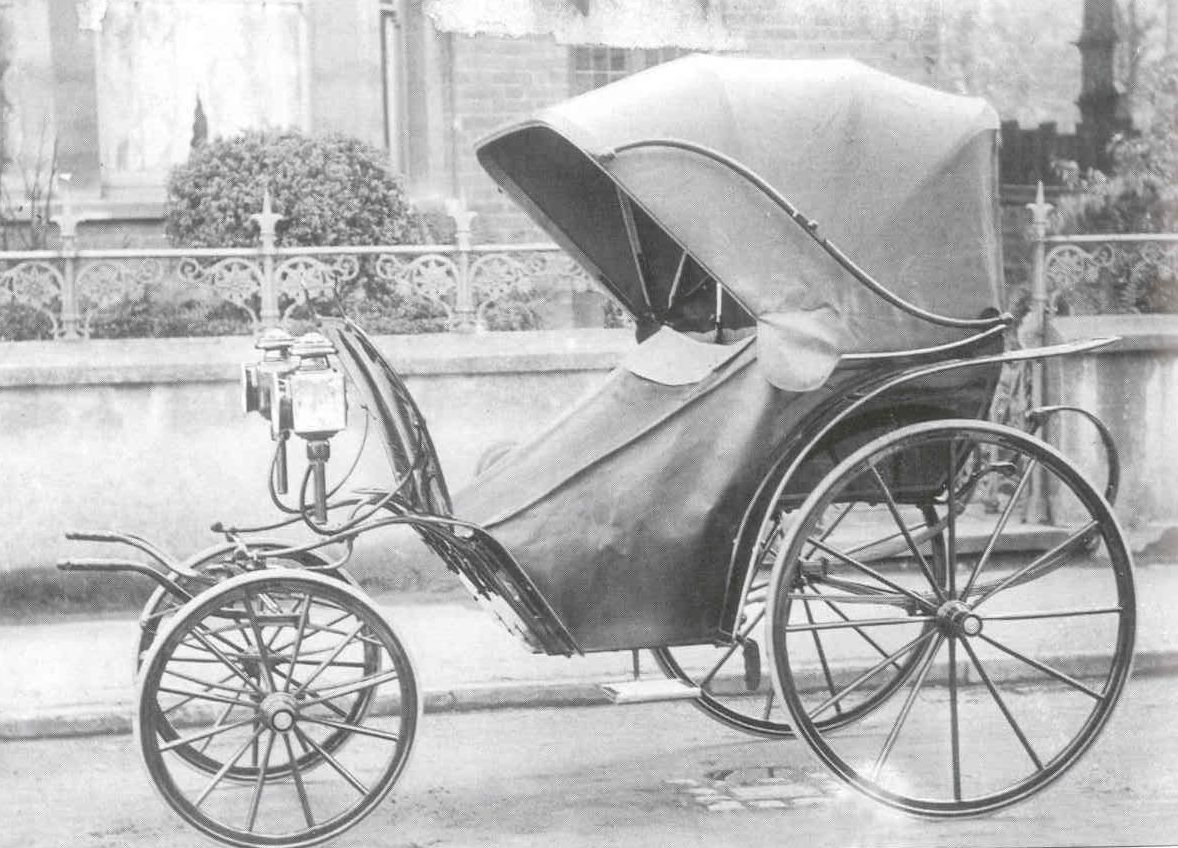
Pony phaeton (Source)

Then "a little pony phaeton" carrying Hortense and Rosa arrives. Lady Dedlock had sent for it, asking her maid to come -- meaning Rosa, though Hortense had apparently insisted that she was the one sent for.  "The Frenchwoman stood unnoticed, looking on with her lips tightly set," as Lady Dedlock offers to send the carriage back for Ada and Esther. Jarndyce declines, and Lady Dedlock "took a graceful leave of Ada -- none of me," Esther notes, and bids Rosa get into the carriage with her. As for Hortense,
She remained perfectly still until the carriage had turned into the drive, and then, without the least discomposure of countenance, slipped off her shoes, left them on the ground, and walked deliberately in the same direction, through the wettest of the wet grass.
"'Is that young woman mad?' said my guardian." The keeper says that she's just "mortal high and passionate -- powerful high and passionate; and what with having notice to leave, and having others put above her, she don't take kindly to it." And as Jarndyce, Ada and Esther return home, they see Hortense still striding through the wet grass.

In London, the omniscient narrator tells us, the courts have shut down for the long vacation, leaving all of the clerks idle, as well as the businesses that support the law, such as Mr Snagsby, the stationer. He and Mrs Snagsby are entertaining the Chadbands. Mr Chadband is a minister "attached to no particular denomination," who includes among his followers Mrs Snagsby. "'My little woman,' says Mr Snagsby to the sparrows in Staple Inn, 'like to have her religion rather sharp, you see!'"
Mr Chadband is a large yellow man, with a fat smile, and a general appearance of having a good deal of train oil in his system. Mrs Chadband is a stern, severe-looking, silent woman. Mr Chadband moves softly and cumbrously, not unlike a bear who has been taught to walk upright. He is very much embarrassed about the arms, as if they were inconvenient to him, and he wanted to grovel; is very much in a perspiration about the head; and never speaks without first putting up his great hand, as delivering a token to his hearers that he is going to edify them.
Chadband's "edification," however, typically consists of platitudes delivered in the most pompous and verbose manner possible. Still, as the narrator observes, "the Chadband style of oratory is widely received and much admired."

As the Snagsbys are entertaining the Chadbands, however, the servant, Guster, informs Mr Snagsby that he is wanted in the shop downstairs, where he finds a constable with Jo in his custody. The constable has ordered Jo to "move on," and Jo insists that there's nowhere for him to move on to. Jo has apparently indicated to the constable that Mr Snagsby can vouch for him, and although Mrs Snagsby has appeared at the top of the stairs to proclaim that he doesn't know the boy, Snagsby admits that he does.

Then Mr Guppy appears, and confirms Snagsby's acquaintance with Jo. The constable is still convinced that Jo is up to no good, partly because he lives in Tom-all-Alone's.  Moreover, Jo has money upon him, which is enough to convince the constable that Jo has been stealing. So Jo tells the story of being approached "by a lady in a wale" (i.e., veil) who gave him a sovereign to show her where Nemo lived, died, and was buried. The constable agrees to leave Snagsby in charge of Jo's moving on -- over Mrs Snagsby's protests -- and departs.

Intrigued by Jo's story of the veiled lady, Guppy begins asking questions, raising the curiosity of the others, so that Guppy and Jo are ushered upstairs to continue the interrogation. Guppy opines that "there is something out of the common here that beats anything that ever came into my way at Kenge and Carboy's," which is enough to have Mrs Chadband eager to hear more: She happens to be acquainted with Kenge and Carboy's. Before she married the Rev. Mr Chadband, she says, she "was left in charge of a child named Esther Summerson, who was put out in life by Messrs Kenge and Carboy's."

It's Guppy's turn to be astonished, though when he gasps, "Miss Summerson, ma'am!" he is rebuked by Mrs Chadband, who is apparently the Mrs Rachael who was servant to Esther's godmother/aunt. "'I call her Esther Summerson,' says Mrs Chadband, with austerity. 'There was no Miss-ing of the girl in my time. It was Esther. "Esther, do this! Esther, do that!" and she was made to do it.'"


The Rev. Chadband seizes upon this moment of astonishment to take the floor and sermonize on the topic of ... Jo, who is bewildered by everything that's going on, and "whose immediate object seems to be to get away on any terms." Guppy gives him a penny and Mr Snagsby loads him up with some of the table leftovers, and off he goes into the night.

Guppy, of course, is not going to let all these revelations go. He has been vexed by the arrival in the offices of Kenge and Carboy of Richard Carstone, but gratified "to find the new comer constantly poring over the papers in Jarndyce and Jarndyce; for he well knows that nothing but confusion and failure can come of that." So he gathers his friends, fellow law-clerks Young Smallweed and Tony Jobling, and invites them to dine with him.
Hablot Knight Browne (Phiz), Mr Guppy's Entertainment (Source: David Perdue's Charles Dickens Page)
After much Dickensian business about these swaggering striplings, during which we learn that Jobling was the one who accompanied Guppy to Chesney Wold, Guppy announces "a plan I have lately thought of proposing." It may, he stammers, "have some reference to a subject, which may -- or may not -- have cast its shadow on my existence" -- that is, of course, his failed proposal to Esther. He tells Jobling that in his duties at Kenge and Carboy's he has been delivering a weekly allowance to Miss Flite at Krook's, and that Krook has a room to let. Krook "must be precious old, you know, and he has not a soul about him, and he is reported to be immensely rich; and whether he is a smuggler, or a receiver, or an unlicensed pawnbroker, or a money-lender -- all of which I have thought likely at different times -- it might pay you to knock up a sort of knowledge of him."

Jobling is game, even when he learns that the room is where Krook's last lodger died. So they proceed to Krook's, where he is dead drunk. They manage to get him awake, and after treating him to a better quality of gin than he is used to, "Mr Guppy presents his friend under the impromptu name of Mr Weevle, and states the object of their visit." The result is that Jobling/Weevle is installed in the second-floor room, which he adorns with "copper-plate impressions from that truly national work, The Divinities of Albion, or Galaxy Gallery of British Beauty, representing ladies of title and fashion in every variety of smirk that art, combined with capital, is capable of producing." And in time the neighbor ladies are gossiping, "don't you be surprised Lord bless you, if that young man comes in at last for old Krook's money!"
_____

The 2005 BBC/Masterpiece Theatre dramatization features Burn Gorman as Guppy, Patrick Kennedy as Richard Carstone, Denis Lawson as John Jarndyce, Anna Maxwell Martin as Esther Summerson, Sally Leonard as Polly, Warren Clarke as Boythorn, Timothy West as Sir Leicester Dedlock, Gillian Anderson as Lady Dedlock, Nathaniel Parker as Harold Skimpole, Carey Mulligan as Ada Clare, Emma Williams as Rosa, Lilo Baur as Hortense, Sean McGinley as Snagsby, Robert Pugh as Mr Chadband, Catherine Tate as Mrs Chadband, Michelle Tate as Guster, Harry Eden as Jo, Dominic Coleman as Policeman, Johnny Vegas as Krook, Charles Dance as Tulkinghorn, Tom Georgeson as Clamb.

Tuesday, June 14, 2011

6. Bleak House, by Charles Dickens, pp. 181-214

Chapter 12: On the Watch through Chapter 13: Esther's Narrative


The rain has stopped at Chesney Wold and the Dedlocks are returning from Paris, where Lady Dedlock has been as bored as ever. In the carriage she notices that Sir Leicester is reading some papers sent him by Tulkinghorn, which reminds him that the lawyer sent her a message in one of them:  "I have something to tell her on her return, in reference to the person who copied the affidavit in the Chancery suit, which so powerfully stimulated her curiosity. I have seen him." Although she betrays no special emotion to Sir Leicester, she asks him to stop the carriage so she can walk for a while. After a quarter of a mile, she returns to the carriage.

When they reach home and are greeted by Mrs Rouncewell, Lady Dedlock notices the new maid, Rosa, and comments on how pretty she is. She asks Rosa how old she is, and Rosa replies "Nineteen, my Lady." Lady Dedlock repeats the age, "thoughtfully."
That evening, in the housekeeper's room, Rosa can do nothing but murmur Lady Dedlock's praises. She is so affable, so graceful, so beautiful, so elegant.... Mrs Rouncewell confirms all this, not without personal pride, reserving only the one point of affability. Mrs. Rouncewell is not quite sure as to that. Heaven forbid that she should say a syllable in dispraise of any member of that excellent family; ... but if my lady would only be "a little more free," not quite so cold and distant, Mrs Rouncewell thinks she would be more affable.
Lady Dedlock's attentions to Rosa have drawn the notice of Hortense, Lady Dedlock's maid, "a Frenchwoman of two-and-thirty, from somewhere in the Southern country about Avignon and Marseilles -- a large-eyed brown woman with black hair; who would be handsome, but for a certain feline mouth, and general uncomfortable tightness of face, rendering the jaws too eager, and the skull too prominent.... she seems to go about like a very neat She-Wolf imperfectly tamed." Hortense is offended that she, who has been in Lady Dedlock's service for five years, has never been fussed over by her mistress the way Rosa was.

The Dedlocks then entertain, "this January week, some ladies and gentlemen of the newest fashion," whom Dickens proceeds to ridicule for their vapidity and "dandyism." The house is full, except for one room set aside for Mr Tulkinghorn, after whom Lady Dedlock inquires every evening whether he has arrived yet. Finally one evening he appears in order to discuss with Sir Leicester his ongoing quarrel with Boythorn over rights-of-way. "A man of a very low character of mind," Sir Leicster says of Boythorn, "An exceedingly ill-conditioned, levelling person. A person who, fifty years ago, would probably have been tried at the Old Bailey for some demagogue proceeding, and severely punished -- if not ... if not hanged, drawn, and quartered."

Lady Dedlock intervenes in the aristocrat's denunciation of the upstart Boythorn and suggests that they go inside. She also takes the opportunity to ask Tulkinghorn about his discovery of the person whose handwriting she recognized. Yes, Tulkinghorn says, he identified the man and went to his lodgings where "I found him dead." Sir Leicester speaks first, worrying about Lady Dedlock's reaction and suggesting "the less said --." But she interrupts and asks Tulkinghorn to go on: "It is quite a story for twilight. How very shocking! Dead?" Tulkinghorn continues, "Whether by his own hand --" and again Sir Leicester protests and is overruled by his wife, "though he still feels that to bring this sort of squalor among the upper classes is really -- really --."

Apparently Lady Dedlock finds it really interesting, for she continues to draw Tulkinghorn out. He tells her that the coroner's inquest brought back a verdict of accidental death.
"He had lived so wretchedly, and was so neglected, with his gipsy colour, and his wild black hair and beard, that I should have considered him the commonest of the common. The surgeon had a notion that he had once been something better, both in appearance and condition."
Lady Dedlock asks what he was called, but Tulkinghorn reports that no one knew his name. And when she asks if he left any clues to his identity, Tulkinghorn says that there was only "an old portmanteau; but -- No, there were no papers."

Considering that Lady Dedlock nearly fainted when she first recognized the handwriting, she behaves with remarkable calm during this narration. In fact, Sir Leicester seems far more upset by the news and wants "to hear no more about a subject so far removed from my Lady's station." She refers to it as "a collection of horrors," as she gathers "up her mantles and furs" and asks Tulkinghorn to open the door for her. Tulkinghorn remains at Chesney Wold for several days, during which "Lady Dedlock is always the same exhausted deity, surrounded by worshippers, and terribly liable to be bored to death, even while presiding at her own shrine." She and Tulkinghorn
appear to take as little note of one another, as any two people, enclosed within the same walls, could. But, whether each evermore watches and suspects the other, evermore mistrustful of some great reservation; whether each is evermore prepared at all points for the other, and never to be taken unawares; what each would give to know how much the other knows -- all this is hidden, for the time, in their own hearts.

So we go back to Bleak House, where the discussion of what profession Richard is to follow continues. To Esther, Jarndyce acknowledges Richard's "indecision of character" and wonders how much of it "is chargeable on that incomprehensible heap of uncertainty and procrastination on which he has been thrown from his birth" -- i.e., the Jarndyce and Jarndyce case. Esther has her own diagnosis of the cause of Richard's character flaws, which is his traditional English public school education, in which he "had learnt, I understood, to make Latin Verses of several sorts, in the most admirable manner. But I never heard that it had been anybody's business to find out what his natural bent was, or where his failings lay, or to adapt any kind of knowledge to him."

When Jarndyce asks if Richard has any inclination toward the law, Richard replies, "I am fond of boating. Articled clerks go a good deal on the water. It's a capital profession!" Jarndyce then suggests medicine, and Richard immediately imagines himself as a Member of the Royal College of Surgeons. And "the more he thought of it, the more he felt that his destiny was clear; the art of healing was the art of all others for him." Because as a ward of chancery the decision can't be Richard's alone, they decide to consult the attorney Kenge, who endorses it as "a very good profession." Jarndyce clearly has some reservations: "'The course of study and preparation requires to be diligently pursued,' observed my Guardian, with a glance at Richard." But the matter seems to have been settled and now there's the question, as Kenge puts it, of "placing Mr Richard with some sufficiently eminent practitioner" for training. Kenge, as it turns out, has "a cousin in the medical profession."

So Jarndyce, Richard, Ada and Esther decide to spend a few weeks in London while Richard makes the acquaintance of Kenge's cousin. And it is at a theater in London that Esther once again encounters Mr Guppy.
Hablot Knight Browne (Phiz), Mr Guppy's Desolation (Source: David Perdue's Charles Dickens Page)
Esther is in a box at the theater when she looks down and beholds "Mr Guppy, with his hair flattened down upon his head, and woe depicted in his face, looking up at me." And "from that time forth, we never went to the play, without my seeing Mr Guppy in the pit -- always with his hair straight and flat, his shirt-collar turned down, and a general feebleness about him." His gaze "put such a constraint upon me that I did not like to laugh at the play, or cry at it, or to move, or to speak. I seemed able to do nothing naturally." She thinks about telling Jarndyce, but she's afraid he'll report it and Guppy will get fired. "Sometimes, I thought, should I frown at him, or shake my head. then I felt I could not do it." She thinks of writing to his mother, but she's afraid "that to open a correspondence would be to make the matter worse."

But they have come to town to get Richard started on his medical training, and that includes a visit to Kenge's cousin, Mr Bayham Badger, "who had a good practice at Chelsea." Mr Badger is "a pink, fresh-faced, crisp-looking gentleman, with a weak voice, white teeth, light hair, and surprised eyes." And like so many of the men in Bleak House, he has a wife who predominates over him. Mrs Bayham Badger is several years older, and has been married twice before to "most remarkable men!" as her husband proclaims: "Captain Swosser of the Royal Navy, who was Mrs Badger's first husband, was a very distinguished officer indeed. The name of Professor Dingo, my immediate predecessor, is one of European reputation." Moreover, Mrs Badger proclaims, she married Mr Badger on the same day of the year that she married the first two: "'So that Mrs Badger has been married to three husbands -- two of them highly distinguished men,' said Mr Badger, summing up the facts; 'and, each time, upon the twenty-first of March at Eleven in the forenoon!'"

Mr Badger then proceeds to display the portraits of his wife's late husbands with considerable pride.
Hablot Knight Browne (Phiz), The Family Portraits at Mr Bayham Badger's (Source: David Perdue's Charles Dickens Page)
And during dinner, they are urged to use "the Professor's goblet" and to drink "a wine that was imported by the Captain" and to listen to the life stories of the captain and the professor.

That evening, when they have returned to their rooms, Ada tells Esther her "secret" -- that she and Richard are in love. She also gives Esther permission to break the news to Jarndyce, though Esther assures her it will be no surprise to him either. In the morning, Esther visits him "in the room that was our town-substitute for the Growlery, and gives him the news. He has her fetch Richard and Ada to give them his blessing. It is not unmixed with a little foreshadowing, however:
"Constancy in love is a good thing; but it means nothing, and is nothing, without constancy in every effort. If you had the abilities of all the great men, past and present, you could do nothing well, without sincerely meaning it, and setting about it. If you entertain the supposition that any real success, in great things or in small, ever was or could be, ever will or can be, wrested from Fortune by fits and starts, leave that wrong idea here, or leave your cousin Ada here." 
This is not just a bit of Victorian moralizing, but an ironic glance at the future. But for now, Richard and Ada are, as Esther sees them, "So young, so beautiful, so full of promise" as they walk away from her and Jarndyce through a sun-filled room. And then, "they passed away into the shadow, and were gone. It was only a burst of light that had been so radiant. The room darkened as they went out, and the sun was clouded over."

Then Esther remembers something she had forgotten to mention about the dinner at the Badgers': There was another guest, "a gentleman of dark complexion -- a young surgeon. He was rather reserved, but I thought him very sensible and agreeable. At least, Ada asked me if I did not, and I said yes."
_____
The 2005 BBC/Masterpiece Theatre dramatization features Gillian Anderson as Lady Dedlock, Timothy West as Sir Leicester Dedlock, Charles Dance as Tulkinghorn, Tom Georgeson as Clamb, Anna Maxwell Martin as Esther Summerson, Carey Mulligan as Ada Clare, Patrick Kennedy as Richard Carstone,  Alistair McGowan as Kenge, Denis Lawson as John Jarndyce, Anne Reid as Mrs Rouncewell, Emma Williams as Rosa, Lilo Baur as Hortense, Burn Gorman as Guppy, Warren Clarke as Boythorn, Richard Griffiths as Bayham Badger, Joanna David as Mrs Bayham Badger, Richard Harrington as Allan Woodcourt, Johnny Vegas as Krook

Sunday, June 12, 2011

4. Bleak House, by Charles Dickens, pp. 103-136

Chapter 7: The Ghost's Walk through Chapter 8: Covering a Multitude of Sins


The omniscient narrator returns to take us to the Dedlocks' Lincolnshire estate, Chesney Wold, where it is still raining. Sir Leicester and Lady Dedlock, of course, are in Paris, leaving the housekeeper, Mrs Rouncewell, in charge of the house. She's certainly capable of looking after it, having been there for fifty years.

Mrs Rouncewell raised two sons, the younger of whom became a soldier and never returned. The older could have become steward at Chesney Wold, but he had a talent for science and went into manufacturing, which Sir Leicester regards as nothing less than a revolt against tradition. He married and had a son, whom he named Watt -- presumably after James Watt, whose experiments with steam Mrs Rouncewell's son once imitated.

Watt is visiting his grandmother now, and has taken note of a maid named Rosa, "the daughter of a widow in the village," in whom Mrs Rouncewell has taken particular interest, training her to give tours of the house when they have visitors who want to see it. Such visitors arrive now, and one of them sends in his card. It is Mr Guppy.

Rosa says that Guppy told her they were in the area "on business at the magistrates' meeting ten miles off," and "had heard a great deal said of Chesney Wold," so they applied to see it. "They are lawyers. He says he is not in Mr Tulkinghorn's office, but is sure he may make use of Mr Tulkinghorn's name, if necessary." Mrs Rouncewell is acquainted with Tulkinghorn through his many visits, and he even made her will, so she admits them. She and her grandson will accompany Guppy and his friend on the tour.

Guppy in fact shows no enthusiasm, and quite a bit of fatigue, during the tour, but when he sees "a portrait over the chimney-piece, painted by the fashionable artist of the day," he perks up considerably. Rosa informs him that it is "the portrait of the present Lady Dedlock." Guppy is fascinated by it and is sure he must have seen it somewhere before. He is told, however, that it has never been engraved, so he concludes "I must have had a dream of that picture, you know!"

Still brooding about the picture, Guppy follows Rosa into other rooms until they reach the end of the tour where she says, "The terrace below is much admired. It is called, from an old story in the family, The Ghost's Walk." This piques Guppy's curiosity again, but when he asks Rosa about the "old story," she admits that she doesn't know it. "'It is not related to visitors; it is almost forgotten,' says the housekeeper, advancing. 'It has never been more than a family anecdote.'" And when Guppy asks "if it has anything to do with a picture," still fascinated with the portrait of Lady Dedlock, Mrs Rouncewell assures him that it doesn't.

After Guppy and his friend leave, Mrs Rouncewell tells her grandson and Rosa the story. It dates from the time of Charles I, when the owner of Chesney Wold was Sir Morbury Dedlock. Sir Morbury was a supporter of the king, whom Mrs Rouncewell refers to as "the blessed martyr," but his wife, "who had none of the family blood in her veins, favoured the bad cause." When supporters of the king met at Chesney Wold, she would listen in on their meetings.

Mrs Rouncewell asks, "Do you hear a sound like a footstep passing along the terrace, Watt?" He replies that he hears the rain dripping and "I suppose an echo -- which is very like a halting step." She continues with her story: Sir Morbury and his lady grew further apart during the civil wars, especially after her brother was killed.
"When the Dedlocks were about to ride out from Chesney Wold in the King's cause, she is supposed to have more than once stolen down into the stables in the dead of night, and lamed their horses; and the story is, that once, at such an hour, her husband saw her gliding down the stairs, and followed her into the stall where his own favourite horse stood. There he seized her by the wrist; and in a struggle or in a fall, or through the horse being frightened and lashing out, she was lamed in the hip, and from that hour began to pine away."
She stopped speaking to Sir Morbury, but continued to walk on the terrace, back and forth, as her condition grew worse, until one day she fell. Her husband came to try to help her, but she said, "I will die here, where I have walked. And I will walk here, though I am in my grave. I will walk here, until the pride of this house is humbled. And when calamity, or when disgrace is coming to it, let the Dedlocks listen for my step!"

Since that day, Mrs Rouncewell tells Watt and Rosa, the echo has been heard from time to time, "and so sure as there is sickness or death in the family, it will be heard then." Watt reminds his grandmother that the curse also included "disgrace," but she insists, "Disgrace never comes to Chesney Wold." The present Lady Dedlock, however, continues to hear it, and Mrs Rouncewell points out "a tall French clock" that she says "has a loud beat when it is in motion, and can play music." She asks Watt to start the clock, and asks him if he can still "hear the sound upon the terrace, through the music, and the beat, and everything?" He is standing by the side of the bed in which Lady Dedlock sleeps when he says that he "certainly can" still here it. "So my lady says," his grandmother replies.

We return to Bleak House, where Esther is beginning to take charge of the household affairs, waking early in the morning and watching it grow lighter until "the day shone bright upon a cheerful landscape, prominent in which the old Abbey Church, with its massive tower, threw a softer train of shadow on the view than seemed compatible with its rugged character. But so from rough outsides (I hope I have learnt), serene and gentle influences often proceed."

With her usual (and somewhat cloying) self-deprecation, she remarks on herself as "generally a methodical, old-maidish sort of foolish little person." She takes it on herself to make tea for breakfast long before the others arise. They are joined at breakfast by Skimpole, who prattles on about bees: "he supposed the Bee liked to make honey, or he wouldn't do it -- nobody asked him" and identifies with the idle drones. Everyone enjoys his frivolity, though Esther leaves the others at the table to go about her chores.

She is passing a small room connected to Jarndyce's bedroom when he summons her into it and tells her it is "the Growlery. When I am out of humour, I come and growl here." She protests that he must use it very seldom but he tells her, "When I am deceived or disappointed in -- the wind, and it's Easterly, I take refuge here. The Growlery is the best used room in the house." She remembers how grateful she is for his patronage and impulsively kisses his hand, causing him discomfort: He "walked to the window; I almost believed with an intention of jumping out," but doesn't. It's nothing, he says: "I hear of a good little orphan girl without a protector, and I take it into my head to be that protector."

She gets her emotions under control, and he changes the subject to the Chancery suit. He explains to her that it was once "about a Will, and the trusts under a Will" but now is "about nothing but Costs.... That's the great question. All the rest, by some extraordinary means, has melted away." It began when "A certain Jarndyce, in an evil hour, made a great fortune, and made a great Will." But the question of how the trusts specified in the will were to be administered was the point that brought it all into court, with the result that "the fortune left by the Will is squandered away; the legatees under the Will are reduced to such a miserable condition that they would be sufficiently punished, if they had committed an enormous crime in having money left them; and the Will itself is made a dead letter." Still, the litigation has taken on a life of its own, and everyone involved in it "must have copies, over and over again, of everything that has accumulated about it in the way of cartloads of paper" -- the kind of paper we have seen Krook shoveling into "a kind of well in the floor." And anyone who has ever been named in the suit can't get out of it.

This, he said, is what destroyed his great-uncle, Tom Jarndyce, who was the previous owner of Bleak House. "I was his heir, and this was his house, Esther. When I came here, it was bleak indeed. He had left the signs of his misery upon it." The house had once been called the Peaks, but it was Tom Jarndyce who renamed it Bleak House. "When I brought what remained of him home here, the brains seemed to me to have been blown out of the house too; it was so shattered and ruined."

Esther remarks on "the hopeful change he had made in Bleak House," but Jarndyce observes that there is still some property of the Jarndyces in London that "is much at this day what Bleak House was then." He corrects himself: the property belongs to the Chancery suit and "Costs is the only power on earth that will ever get anything out of it now, or will ever know it for anything but an eyesore and a heartsore. It is a street of perishing blind houses, with their eyes stoned out; without a pane of glass, without so much as a window-frame." Esther cheers him up by reminding him of the great improvement in Bleak House, and he tells her that "These are things I never talk about, or even think about, excepting in the Growlery, here." He says she can tell Richard and Ada as much about these things as she wishes.

Jarndyce says that Esther should call him her Guardian, and she gladly agrees, though she warns him, "I am afraid it will be a disappointment to you to know that I am not clever." He assures her that she is "quite clever enough for him," and proceeds to bestow nursery-rhyme nicknames on her: "Old Woman, and Little Old Woman, and Cobweb, and Mrs Shipton, and Mother Hubbard, and Dame Durden." All this is getting quite icky but fortunately the topic changes to Richard, who "must have a profession." Unfortunately, he says, as a ward in Chancery, "There will be a world more Wiglomeration about it." The word puzzles Esther, so Jarndyce explains that it is his word for bureaucracy, for government officials who wear wigs. The question of Richard's profession, he says, "will be vastly ceremonious, wordy, unsatisfactory, and expensive, and I call it, in general, Wiglomeration."

Then he asks Esther if there is anything she wants to ask him about herself. It's an opportunity to clear many things up that she, unfortunately for the impatient reader, doesn't take. "I am quite sure that if there were anything I ought to know, or had any need to know, I should not have to ask you to tell it to me." But in a novel in which so much unpleasantness is turned up because of the characters' curiosity, perhaps Esther is better off for not exercising hers.

Jarndyce is, as she learns, much sought after by charities and the sort of people like Mrs Jellyby who "form themselves into committees for getting in and laying out money." Dickens's satire on do-gooding bluestockings is a bit heavy-handed, and some of its targets are a bit obscure today, such as the high church movement's "Sisterhood of Mediæval Marys." And some of his targets smack of antifeminism, such as "the Woman of England, the Daughters of Britain, the Sisters of all the Cardinal Virtues separately, the Females of America, the Ladies of a hundred denominations." And here we're introduced to Mrs Pardiggle, who exploits her children as thoroughly as Mrs Jellyby ignores hers. Esther describes her as one of "the ladies who were most distinguished for their rapacious benevolence" -- a phrase that, though she mildly apologizes for it, seems to belong less to Esther than to the other narrative voice in the novel.

Mrs Pardiggle, "a formidable style of lady, with spectacles, a prominent nose, and a loud voice" (again, a rather un-Esther description) has "the effect of wanting a great deal of room ... for she knocked down little chairs with her skirts that were quite a great way off." She has as a train her five very resentful sons -- Egbert, Oswald, Francis, Felix, and Alfred -- all of whom have made charitable donations that they obviously resent: "The face of each child, as the amount of his contribution was mentioned, darkened in a peculiarly vindictive manner." She also proclaims,
"I do not go with Mrs Jellyby in all things. I do not go with Mrs Jellyby in her treatment of her young family. It has been noticed. It has been observed that her young family are excluded from participation in the objects to which she is devoted. She may be right, she may be wrong; but, right or wrong, this is not my course with my young family. I take them everywhere." 
Their father, she announces is O.A. Pardiggle, F.R.S.  As a Fellow of the Royal Society, he is presumably a distinguished scientist, but there is evidently some tension between them over his contribution to her charitable pursuits. Esther tries to imagine what kind of conversation there might be if Mr Pardiggle dined with Mr Jellyby.

Mrs Pardiggle is also tireless: "I am a woman of business. I love hard work. I enjoy hard work.... I do not understand what it is to be tired; you cannot tire me if you try! ... I have seen my young family, and Mr Pardiggle, quite worn out with witnessing it, when I may truly say I have been fresh as a lark!" This elicits a scowl from the "dark-visaged eldest boy." And as if to demonstrate her tirelessness, she invites Esther and Ada to join her in a visit to "a brick-maker in the neighbourhood (a very bad character)." They accept the offer, and along the way Esther is pinched and trampled by the "unnaturally constrained children," who let off steam surreptitiously.
Hablot Knight Browne (Phiz), The Visit at the Brickmaker's, (Source: David Perdue's Charles Dickens Page)
The brickmaker's house is squalid, and no one there is particularly pleased to see Mrs Pardiggle and her retinue. But she sweeps in anyway and proceeds to lecture and badger the household. Then she sweeps off again to another poor household, leaving Esther to observe that "she certainly did make, in this, as in everything else, a show that was not conciliatory, of doing charity by wholesale, and of dealing in it to a large extent."

Esther and Ada linger behind, however, to check on the baby that one of the women is nursing, who seems to be very ill. And just as Ada leans over to touch the baby's face, it dies. Ada is filled with grief, and its mother bursts into tears. Esther takes the baby and covers it with her handkerchief. The men in the room, who were rude and scornful to Mrs Pardiggle, grow quiet and respectful, and the women, "coarse and shabby and beaten," are "softened by the hard trials of their lives." That night, Richard joins Ada and Esther as they return to the brickmaker's house with "some little comforts." They "said as little as we could to Mr Jarndyce, but the wind changed directly."

The chapter ends with a bit of sentimental exhortation that is not to our taste, but serves as a counterpoint to the satirical portrait of Mrs Pardiggle's ostentatious uncharitable charity.
_____
The 2005 BBC/Masterpiece Theatre dramatization features Anna Maxwell Martin as Esther Summerson, Carey Mulligan as Ada Clare, Patrick Kennedy as Richard Carstone, Denis Lawson as John Jarndyce, Nathanial Parker as Harold Skimpole,  Charles Dance as Tulkinghorn, Tom Georgeson as Clamb, John Lynch as Nemo, Lisa Hammond as Harriet, Burn Gorman as Guppy, Anne Reid as Mrs Rouncewell, Emma Williams as Rosa.