JOURNAL OF A COMPULSIVE READER
By Charles Matthews
Showing posts with label Abimelech. Show all posts

Tuesday, February 14, 2012

4. Genesis: The Bible, pp. 40-52

Chapter 26

There is a famine, but God tells Isaac not to go to Egypt to avoid it. So Isaac lives in Gerar, where like Abraham he tells people that Rebekah is his sister, so they won't kill him and take her. But Abimelech, the king of the Philistines, looks out of of the window one day and sees Isaac "sporting with Rebekah his wife." (No kidding, that's what it says.) So Abimelech calls Isaac in and asks how come he said she was his sister when she's obviously his wife? Isaac explains that he was afraid he'd get killed because she's so beautiful, but Abimelech worries that one of his people might have slept with Rebekah under the impression that she was available, and thereby "brought guiltiness upon us." So he puts out the word that nobody is to touch Isaac or Rebekah under pain of death.

Isaac gets rich, and the envious Philistines start filling up the wells Abraham had dug, so Abimelech tells him to move on, "for thou art much mightier than we." Isaac pitches his tent in the valley of Gerar and digs out the wells that had been filled up, but the herdsmen of Gerar fight with Isaac's herdsmen over the water, so Isaac moves on to Beer-sheba, where Abimelech makes a covenant with him, promising to leave him alone.

When Esau is forty, he marries two Hittite women, Judith and Bashemath, but Isaac and Rebekah are unhappy about it.

Chapter 27

Isaac grows old and blind, and before he dies he asks Esau, his favorite son, to hunt some venison and make his favorite dish out of it. Then, he says, he will give him his blessing. But Rebekah, who favors Jacob, overhears this, and tells Jacob to kill two goats and she will make Isaac's favorite dish from them before Esau returns with the venison. "And thou shalt bring it to thy father, that he may eat, and that he may bless thee before his death."

Jacob points out that Esau is hairy, whereas he is smooth, so that if Isaac touches him, he'll realize that he's being tricked. "I shall bring a curse upon me, and not a blessing." Not to worry, Rebekah says. "Upon me be thy curse, my son: only obey my voice, and go fetch me them." So Jacob does as he's told, and Rebekah prepares the meat. She also takes some of Esau's clothes and puts them on Jacob, and covers his hands and the back of his neck with the goatskins.
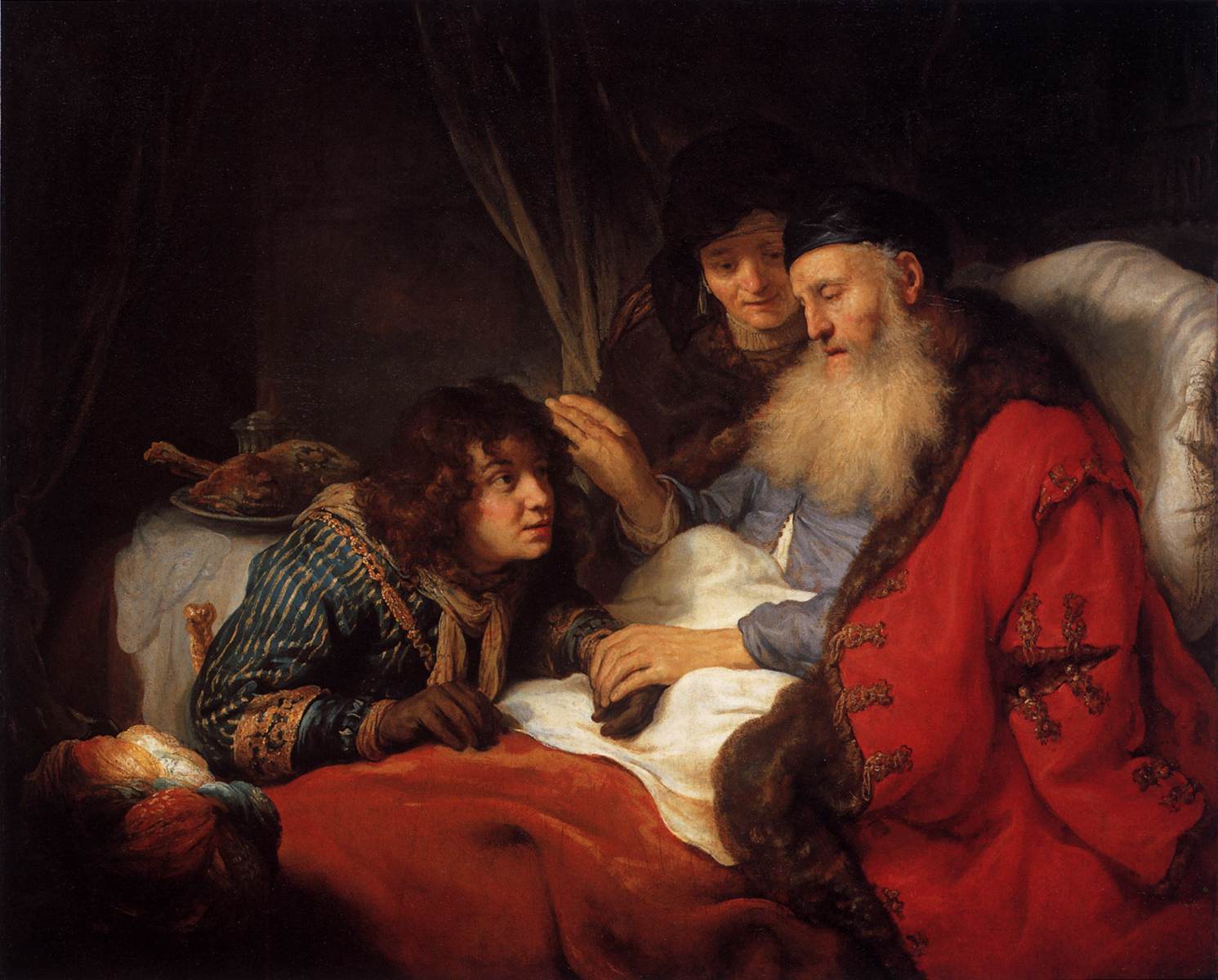
Govert Flinck, Isaac Blessing Jacob, 1638
Jacob goes to his father with the meat and says, "I am Esau thy firstborn; I have done according as thou badest me: arise, I pray thee, sit and eat of my venison, that thy soul may bless me." Isaac wonders at how quickly Esau hunted and killed the animal, but Jacob claims it was "Because the LORD thy God brought it to me." Isaac still has his doubts, and asks Jacob to come closer "that I may feel thee, my son, whether thou be my very son Esau or not." So Jacob comes closer, and Isaac touches him: "The voice is Jacob's voice, but the hands are the hands of Esau," he says.

After he eats, Isaac asks Jacob to come closer so he can kiss him, and he smells the clothes Rebekah has taken from Esau. Isaac says, "See, the smell of my son is as the smell of a field which the LORD hath blessed."
Therefore God give thee of the dew of heaven, and the fatness of the earth, and plenty of corn and wine; 
Let people serve thee, and nations bow down to thee: be lord over thy brethren, and let thy mother's sons bow down to thee: cursed be every one that curseth thee, and blessed be he that blesseth thee.
Then Esau comes back from his hunting trip, prepares the meat, and brings it to Isaac, who is confused and astonished; he "trembled very exceedingly." Isaac tells Esau what has happened: "Thy brother came with subtilty, and hath taken away thy blessing." (That word "subtilty" is interesting: The only other "subtil" creature we have heard of is the serpent who tempted Eve.)

Esau is naturally furious: He sold his birthright to Jacob for some lentils, and now his brother has stolen Isaac's blessing. Isaac admits, "I have made him thy lord, and all his brethren have I given to him for servants; and with corn and wine have I sustained him: and what shall I do now unto thee, my son?" Esau asks if there's any blessing left over, but there isn't much.
Behold, thy dwelling shall be the fatness of the earth, and of the dew of heaven from above; 
And by thy sword shalt thou live, and shalt serve thy brother; and it shall come to pass when thou shalt have the dominion, that thou shalt break his yoke from off thy neck.
Esau vows to kill Jacob as soon as the period of mourning after their father's death is over, so Rebekah tells Jacob to flee to her brother Laban's. Besides, she's still pissed off because of the Hittite women Esau married, and doesn't want Jacob to marry one of them too.

Chapter 28

Isaac, too, doesn't want Jacob marrying any of the local girls, so he sends him off to marry one of his cousins: "the daughters of Laban thy mother's brother." Esau, still smarting from Jacob's dirty trick, admits that his marriages haven't exactly made his family happy, so he marries his aunt: "Mahalath the daughter of Ishmael Abraham's son."

When Jacob stops for the night on his way to Laban's, he takes some stones for a pillow and has a dream of "a ladder set up on the earth, and the top of it reached to heaven; and behold the angels of God ascending and descending on it."
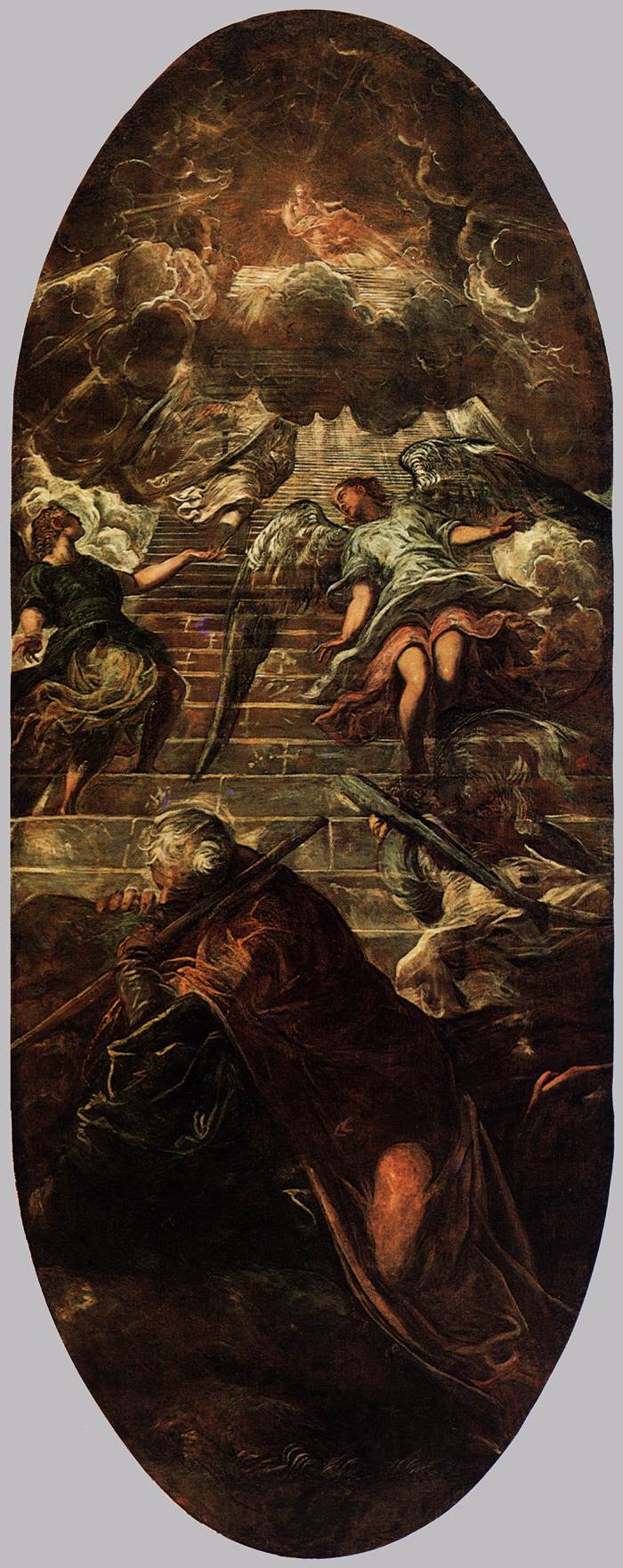
Jacopo Tintoretto, Jacob's Ladder, 1577-78
From the top of the ladder, God calls down that he is giving Jacob the land where he is sleeping and will spread his seed in all directions. He promises not to leave Jacob, and to bring him back to this land. So when Jacob wakes up he takes the stones he had been using as a pillow and piles them up in a pillar and pours oil on it. He calls the place Beth-el, and promises that it "shall be God's house."

Chapter 29

When Jacob gets near Haran, he finds some sheep waiting to be watered at a well with a great stone over its mouth. While he is talking with the shepherds, Laban's daughter Rachel arrives with her father's sheep, so Jacob rolls away the stone so they can be watered. Then he kisses Rachel and tells her that he is Rebekah's son, so she runs to fetch her father, Laban, who comes out and welcomes Jacob.

Laban has two daughters: Rachel is the younger, and Leah the elder. "Leah was tender eyed; but Rachel was beautiful and well favoured." So Jacob strikes a deal with Laban: He will serve Laban for seven years and marry Rachel. Jacob is so in love with Rachel that the seven years go by like just a few days.

When the time is up, Jacob asks to be married to Rachel, and Laban holds a feast. But after it he brings Leah to Jacob's tent in the dark. When Jacob discovers in the morning that he has slept with Leah instead, he asks what Laban has done to him. Laban explains that it's not the custom of their country to marry the younger daughter first. But if Jacob will stay with Leah for a week, then he'll give him Rachel as well -- as long as he serves Laban another seven years. So Jacob gives in and agrees.

God doesn't like it that Jacob despises Leah, so he sees to it that Leah gives birth while Rachel remains barren. Leah's first child with Jacob is Reuben, then she has another named Simeon, followed by Levi and Judah.

Chapter 30

Rachel is angry that Jacob keeps getting Leah pregnant but not her, but Jacob blames it on the Lord. So she gives Jacob her handmaid, Bilhah, hoping that she'll conceive and Rachel will have a child to raise. Bilhah gets pregnant and Rachel names the child Dan. Then Bilhah has another that Rachel calls Naphtali. Now Leah wants more children, so she gives Jacob her handmaid Zilpah, who produces a son Leah names Gad. Then Zilpah has another one that Leah calls Asher.

Leah's son Reuben finds some mandrakes and takes them to his mother. When Rachel sees them, she asks for them, and agrees to let Leah have sex with Jacob in exchange for the mandrakes. Leah conceives, and names this son Issachar. Then she has another son with Jacob that she names Zebulun, followed by a daughter, whom she calls Dinah.

Finally, God decides to let Rachel have a child, and she names him Joseph. Then Jacob decides it's time to move all of this family back to where he came from. Laban wants them to stay, but asks what Jacob wants in the way of wages. Jacob points out that he has greatly increased Laban's herd of cattle since he has been there, so he proposes to go through the heard and keep "all the speckled and spotted cattle, and all the brown cattle among the sheep, and the spotted and speckled among the goats."

But then Jacob pulls another one of his tricks, like the one he used to steal Esau's blessing. He takes "rods of green poplar, and of the hazel and chestnut tree," and peels the bark off of them in stripes. Then he puts the rods at the watering troughs where the flocks drink. "And the flocks conceived before the rods, and brought forth cattle ringstraked, speckled, and spotted. He also shows the rods to the stronger cattle, but not to the weaker ones, so that "the feebler were Laban's, and the stronger Jacob's."

Chapter 31

Laban's sons are mightily ticked off that Jacob is getting away with so much of their father's cattle, and Jacob can tell that Laban shares their anger. The Lord suggests that Jacob should get started on his move, and promises to be with him along the way. So Jacob tells Rachel and Leah to hurry and get ready. Their father, he tells him, has changed his mind about Jacob's wages ten times, but the Lord has seen to it that Jacob prospered from it. God, he says, is the one who made the cattle speckled and spotted: "Thus God hath taken away the cattle of your father, and given them to me." He claims that God appeared to him in a dream and told him that he did this because he saw how Laban mistreated Jacob. "I am the God of Beth-el, where thou anointedst the pillar, and where thou vowedst a vow unto me: now arise, get thee out from this land, and return unto the land of thy kindred."

When they have left, Laban discovers that Rachel has taken his "images" -- his idols. So Laban pursues Jacob and catches up with him at Mount Gilead. He claims that Jacob stole away "secretly," without letting Laban give him a proper send-off, "with mirth, and with songs, with tabret, and with harp," and without letting him kiss his daughters and his grandsons goodbye. He says that Jacob's God spoke to him and told him not to do Jacob harm, but he wants to know why Jacob has stolen his gods.

Jacob replies that he was afraid Laban might try to take his daughters away from him, but he doesn't know anything about the idols. So Laban searches Jacob's and Leah's tents and doesn't find the idols. Then he goes to Rachel's tent, but "Rachel had taken the images, and put them in the camel's furniture, and sat upon them. And Laban searched all the tent, but found them not."
Giovanni Battista Tiepolo, Rachel Hides the Idols from Laban, 1726-28
Jacob then upbraids Laban for his suspicions, telling him he has spent twenty years in Laban's house, serving him fourteen years for his daughters and six years tending his cattle, and Laban has changed his wages ten times.  "God hath seen my affliction and the labour of my hands, and rebuked thee yesternight."

So Laban agrees to a covenant with Jacob, and agrees that they won't bother each other anymore, as long as Jacob doesn't abuse his daughters or take other wives. The next morning, Laban kisses his daughters goodbye and goes home.
Pietro da Cortona, The Reconciliation of Jacob and Laban, 1630-35


Monday, February 13, 2012

3. Genesis: The Bible, pp. 30-40

Chapter 20

Abraham goes into the south country, and once again decides it's best to pass off Sarah as his sister, not his wife. Wait, isn't she something like ninety now? Or is the chronology scrambled? In any case, she catches the eye of Abimelech, the king of Gerar, and he "takes" her -- which I guess means for a concubine. But before any harm can be done, God appears to Abimelech in a dream and tells him he's "a dead man" because "the woman which thou hast taken ... is a man's wife." Abimelech protests that Abraham said she was his sister, and Sarah confirmed it. God admits that Abimelech has been lied to a little, and says that he actually prevented Abimelech from having sex with Sarah before he could tell him the truth. (An advantage he didn't give to Pharaoh, who suffered plagues for it.) So if Abimilech will just send Sarah back to Abraham, who is "a prophet" and will pray for him, God won't kill Abimelech.

Okay, says Abimelech, but when he takes Sarah back to Abraham, he asks why he lied to him and almost got him killed. Abraham says, "Because I thought, Surely the fear of God is not in this place; and they will slay me for my wife's sake." Anyway, he goes on, he wasn't really lying: Sarah is his half-sister, "the daughter of my father, but not the daughter of my mother."

Abimelech is satisfied with the explanation, and not only gives Sarah back to Abraham, he also gives him "sheep, and oxen, and menservants, and womenservants," as well as "a thousand pieces of silver," and tells him to stay on in his land "where it pleaseth thee." In return, Abraham prays to God, who cures the infertility of Abimelech, and his wife, and his maidservants; and they bare children." (The infertility is a detail that the narrator seems to have forgotten to mention earlier.)

Chapter 21

God cures Sarah's infertility, too, and she presents Abraham with a son whom, according to the agreement, he calls Isaac. Abraham is a hundred years old when Isaac is born, and he has Isaac circumcised when the infant is eight days old. "And Sarah said, God hath made me to laugh, so that all that hear will laugh with me." (Sarah seems to be the first person in the Bible with a sense of humor, or perhaps just something to laugh about.)

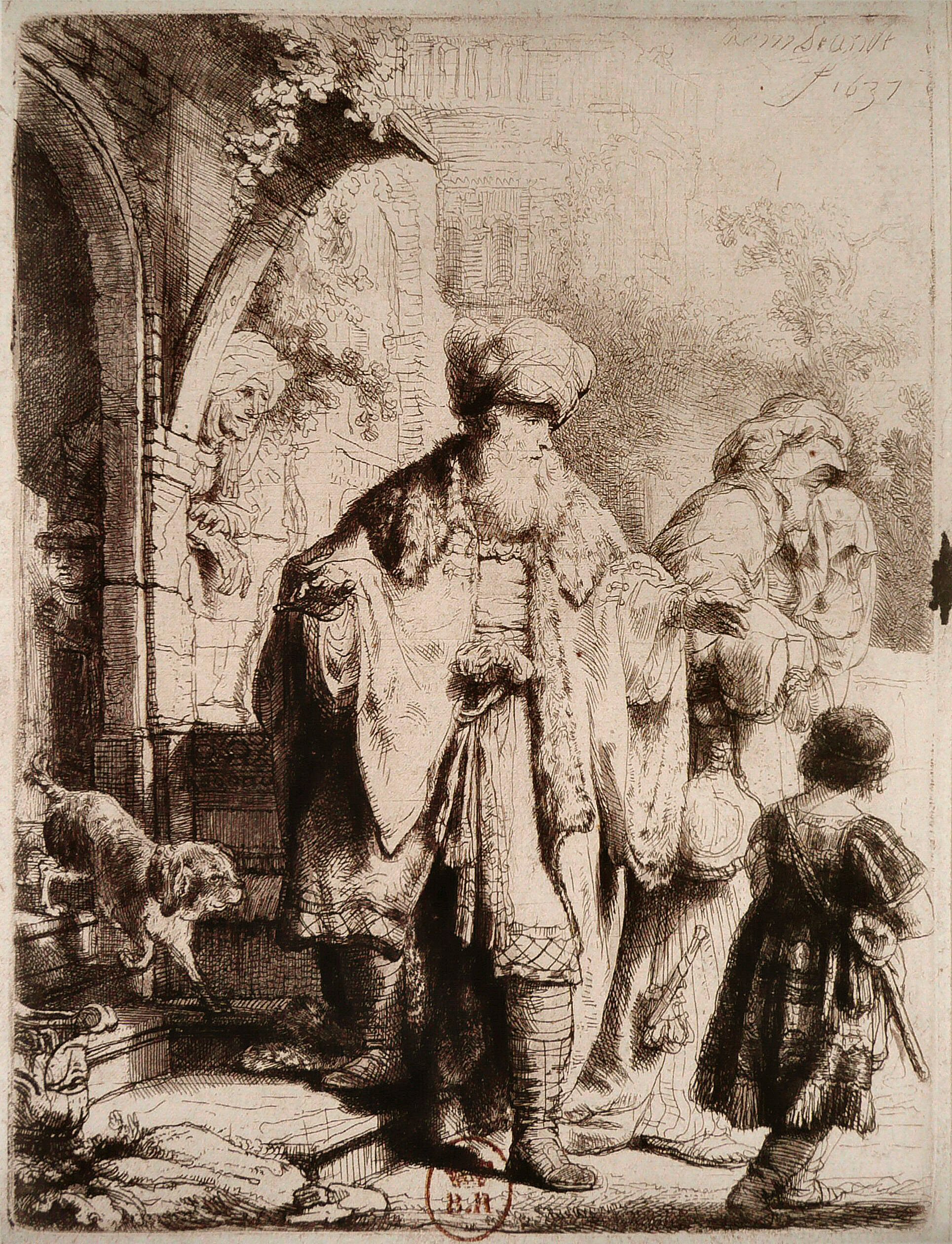
On the other hand, now that she's produced an heir for Abraham, Sarah gets kind of pissy about Hagar and Ishmael, and tells Abraham to get rid of them.
Rembrandt, The Dismissal of Hagar, 1637
 Abraham isn't at all happy about this, but God tells him not to worry, reminding him that "of the son of the bondwoman will I make a nation, because he is thy seed. Hagar and Ishmael wander out into the desert of Beersheba, but they run out of water. Not wanting to see him die, "she cast the child under one of the shrubs," and goes "a good way off" where she sits down and weeps. But an angel calls out to her to go get the boy, whom God is going to make "a great nation" out of. And God shows her a nearby well, and Hagar gives Ishmael water from it.
And God was with the lad; and he grew, and dwelt in the wilderness, and became an archer. 
And he dwelt in the wilderness of Paran: and his mother took him a wife out of the land of Egypt.
Meanwhile, Abraham and Abimelech are having a little quarrel because one of Abimelech's servants "had violently taken away" one of the wells Abraham was using. Abimelech says this is the first he's heard of it, and Abraham should have spoken up before. They patch things up when Abraham gives Abimelech "sheep and oxen," as well as "seven ewe lambs" which signify that Abraham had the well dug himself. So they make a covenant, and Abimelech leaves Abraham alone. "And Abraham sojourned in the Philistines' land many days."

Chapter 22

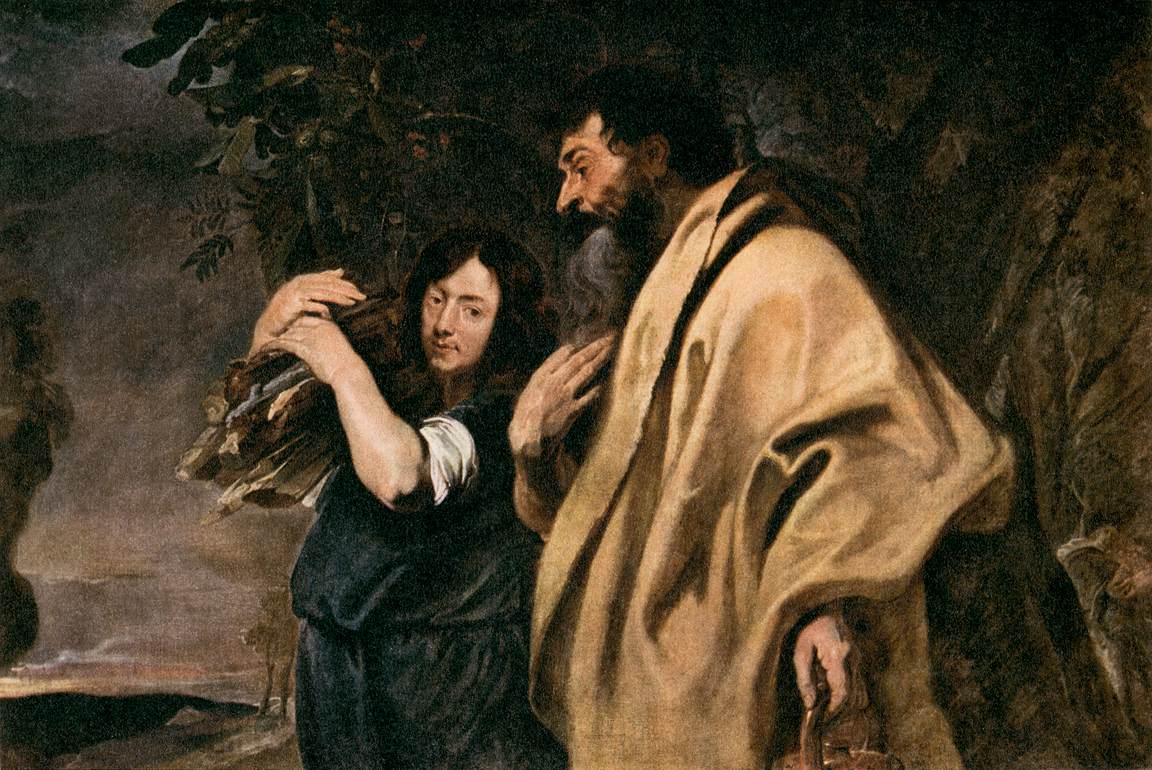
Now God decides to "tempt" Abraham: "Take now thy son, thine only son Isaac, whom thou lovest, and get thee into the land of Moriah; and offer him there for a burnt offering upon one of the mountains which I will tell thee of."  The narrator doesn't say anything about protesting or questioning this grisly order, but just that Abraham leaves the next morning, taking two young men and Isaac and some firewood with him. Three days later, Abraham sights the place "afar off," and tells the young men to stay there and he and Isaac will go on. He gives Isaac the wood to carry, while he takes the torch and a knife.
Anthony van Dyck, Abraham and Isaac, c. 1617
Isaac asks, "where is the lamb for a burnt offering?" Abraham replies, "God will provide himself a lamb for a burnt offering: so they went both of them together." When they reach the site God has indicated, Abraham builds an altar, lays out the wood, then ties up Isaac and puts him on the altar.

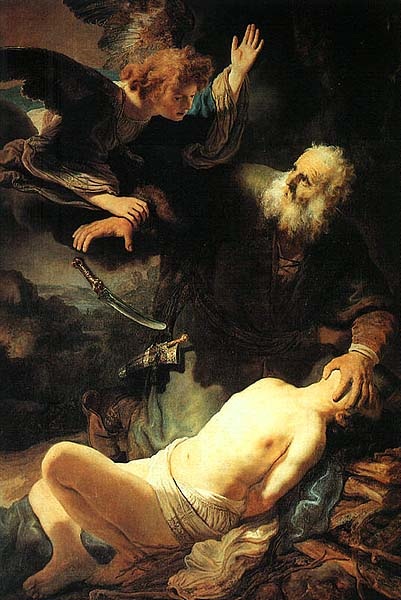
But when he gets the knife ready to kill Isaac, an angel calls out from heaven: "Lay not thine hand upon the lad, neither do thou any thing unto him; for now I know that thou fearest God, seeing thou has not withheld thy son, thine only son from me."
Rembrandt, The Sacrifice of Abraham, 1635
Abraham sees "a ram caught in a thicket by his horns," and sacrifices the ram instead. The angel then repeats God's promise:
That in blessing I will bless thee, and in multiplying I will multiply thy seed as the stars of the heaven, and as the sand which is upon the sea short; and thy seed shall possess the gate of his enemies; 
And in thy seed shall all the nations of the earth be blessed; because thou hast obeyed my voice.
There is something profoundly unpleasant about God's putting Abraham (not to mention Isaac!) through this ordeal. The preoccupation with foreskins was bad enough, and the dietary and other restriction to come are annoying, but this borders on sadism. But I'll leave Kierkegaard to wrangle with the implications of this fable.

Meanwhile, Abraham's brother Nahor and his wife Milcah have been having children, and one of them, Bethuel, has become father to Rebekah.

Chapter 23

Sarah lives to be one hundred twenty-seven. When she dies in Hebron, Abraham asks for "a buryingplace." Ephron the Hittite says he has a field with a cave in it, and offers it to Abraham, who pays him four hundred shekels of silver for it.

Chapter 24 

Getting old, Abraham tells "his eldest servant of his house, ... Put, I pray thee, thy hand under my thigh." He wants him to swear not to find a wife for Isaac among the Canaanites, but to go to the land of his kindred and find a wife for him there. The servant swears he will do it, and goes off to Mesopotamia and the city of Nahor. When he gets there, he makes his camels kneel by the well where the women of the city come to fetch water, and asks God to "let it come to pass, that the damsel to whom I shall say, Let down thy pitcher, I pray thee, that I may drink; and she shall say, Drink, and I will give thy camels drink also: let the same be she that thou hast appointed for thy servant Isaac."

And sure enough, "before he had done speaking," Rebekah, who is Abraham's grand-niece, comes out with her pitcher, answers his request for water, and volunteers to water his camels, too. "And the man wondering at her held his peace, to wit whether the LORD had made his journey prosperous or not."  After she has finished watering the camels, he gives her a golden earring and two gold bracelets and asks who her father is, and if he has a room for him to stay in. She says she's the daughter of Bethuel, the son of Micah and Nahor. The servant marvels that the Lord has led him "to the house of my master's brethren."

Rebekah runs home and tells her brother Laban what has happened, and Laban comes out to meet the man, who is standing at the well with his camels. He invites him in to eat, but the servant says he has to explain his errand first: He is Abraham's servant, and Abraham has become a rich man. Abraham's wife, Sarah, he explains, gave birth to a son when she was very old, and Abraham has made the servant swear not to find a wife for the son among the Canaanites in whose land he lives. Instead, he has sent the servant to find a wife for him among his kindred.

He explains further that if he can't find a woman willing to return with him and marry Isaac, that he's released from the oath he swore to Abraham. But he also tells about his prayer for a sign, that the woman he asks for a drink will give it to him and water the camels too, and that Rebekah has done all of that. So Laban and Bethuel agree that this is a pretty good indication that Rebekah fits the bell, and they say, "Behold, Rebekah is before thee, take her, and go, and let her be thy master's son's wife, as the LORD hath spoken."

So after some praying and feasting and exchanging gifts, he's ready to return to Abraham with Rebekah. Her brother and mother want a few days, "at the least ten," more with Rebekah, but the servant asks them not to hinder him. So they ask Rebekah, "Wilt thou go with this man? And she said, I will go."
And they blessed Rebekah, and said unto her, Thou art our sister, be thou the mother of thousands of millions, and let thy seed possess the gate of those which hate them.
So off they go.

When they get near where Isaac is living, he sees them coming. She seeks him, too, and gets off her camel, having asked the servant who the man coming through the field to meet them is. When he says it is his master, she puts on a veil. The servant tells Isaac the story, and Isaac takes Rebekah into the tent that had been Sarah's, "and she became his wife; and he loved her: and Isaac was comforted after his mother's death."

Chapter 25

Abraham takes another wife, Keturah, after Sarah's death. She bears him a bunch of children, but "Abraham gave all that he had unto Isaac." He gives gifts to the sons of his concubines, but he sends them away from Isaac. Abraham dies at the age of one hundred seventy-five, and is buried in the same field where Sarah is buried.  Ishmael fathers twelve sons before he dies at one hundred thirty-seven.

Isaac is forty when he marries Rebekah, but she is barren until he prays to the Lord. She gets pregnant with twins, who "struggled together within her." She asks the Lord what is going on, and he tells her, "Two nations are in thy womb, and two manner of people shall be separated from thy bowels; and the one people shall be stronger than the other people; and the elder shall serve the younger.

When they are born, the first one is red and hairy, and they name him Esau. The other comes out holding on to Esau's heel, and is named Jacob. Isaac is sixty years old when they are born. Esau becomes "a cunning hunter, a man of the field, whereas Jacob is "a plain man, dwelling in tents." Isaac loves Esau, "because he did eat of his venison," but Rebekah favors Jacob.

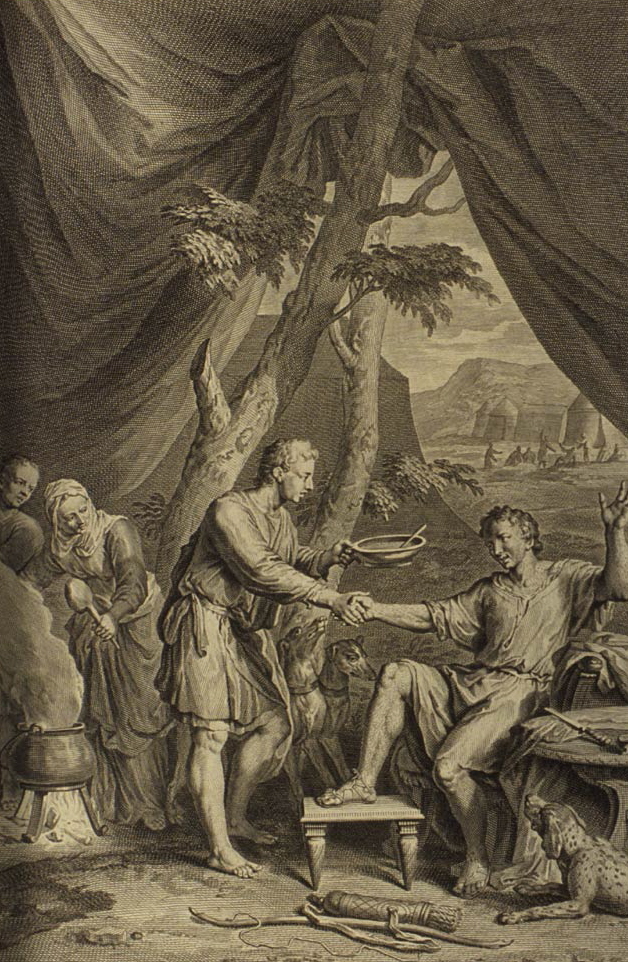
Jacob makes some pottage, and when Esau comes in from working the field, he is famished. He asks Jacob for some of the pottage, and Jacob says, "Sell me this day thy birthright." Esau is too hungry to be concerned about any old birthright, and so he sells it to Jacob, who "gave Esau bread and pottage of lentiles; and he did eat and drink, and rose up, and went his way: thus Esau despised his birthright." 
Gerard Hoet, Esau Sells His Birthright for Pottage of Lentils, 1728