JOURNAL OF A COMPULSIVE READER
By Charles Matthews
Showing posts with label William Herschel. Show all posts

Friday, October 8, 2010

14. The Age of Wonder, by Richard Holmes, pp. 405-469

The Age of Wonder: The Romantic Generation and the Discovery of the Beauty and Terror of Science (Vintage)Sorcerer and Apprentice, 6-8; Young Scientists; Epilogue
_____
John Herschel and Charles Babbage traveled in France and Italy in July through October 1821, meeting Alexander von Humboldt in Paris. Humboldt reported that John seemed to him "inferior to the originality of his father, who was astronomer, physicist and poetical cosmologist all at the same time." He treated them well, however, and told them of hearing Joseph Banks lecture in London soon after returning from his voyage of 1768-71. John returned to Slough, where William Herschel, now in his eighties, was no longer able to use the larger telescopes, and Caroline found it increasingly difficult to follow his instructions. John resumed work with the forty-foot telescope with Caroline as his devoted assistant. When he and Babbage formed the Royal Astronomical Society in 1820, John, "who had strong views about science being open to women," made her the first Honorary Member. The second was Mary Somerville, the mathematician after whom the first women's college at Oxford was named.

Caroline Herschel, by Martin François Tielemans, 1829
William grew increasingly infirm with arthritis, and Caroline came down with an eye infection that made her fear she would never do astronomical work again. She recovered, but was shaken by the experience. In August 1822, William died while John was abroad. His obituary in the Gentleman's Magazine noted "his excellent sister, Miss Caroline Herschel, whose indefatigable and unhesitating devotion in the performance of a task usually deemed incompatible with female habits, surpassed all eulogium." The same issue also noted the death by drowning of the "professed ... atheist" Percy Bysshe Shelley, the "unfortunately too well-known" author of "infamous novels and poems." Caroline, who was seventy-two, decided to return to Hanover, where she had not lived for nearly fifty years. She lived on for twenty-six years longer, corresponding regularly with John and writing her memoirs. She also compiled a new Star Catalogue, for which Herschel and Babbage saw to it that she was awarded the Astronomical Society's Gold Medal in 1828.

Humphry Davy was commissioned by the Royal Navy in 1823 to find a way to stop the corrosion of the copper hulls of the new steam warships. He analyzed the effects of salts on copper, and discovered that it could be neutralized by small iron plates along the hull that would oxidize more rapidly than the copper. Davy's remedy was put into effect quickly, and was hailed as yet another triumph. But the success was premature: after a few months it was discovered that the unoxidized copper was more subject to barnacles and weeds than before. "The navy was disgruntled, the Royal Society was embarrassed, and the press was derisive. Davy's reputation was tarnished, not to say barnacled, and his unpopularity at the Royal Society increased." Eventually, it was discovered that Davy had been right all along about the effect of the iron plates, and that a reconfiguration of their placement solved the problem, but the damage to Davy's reputation had been done. In 1824, the magazine John Bull proclaimed him one of the "Humbugs of the Age," largely because of his prominence as a socialite. Davy also managed to antagonize the younger generation of scientists by appointing John Herschel as one of the Royal Society's two secretaries in 1824, but refusing to appoint Charles Babbage to the other position.

Davy began to suffer from heart disease, and in December 1826 had a series of strokes that left him paralyzed on the right side. He was forty-eight, which was the age at which his father had died. In January, following his physician's advice, he left on a long holiday on the continent, accompanied by his brother, John, but not by his wife. He had continued to write poetry, and during his holiday he decided to write a book about fly-fishing that he called Salmonia, or Days of Fly-Fishing. It was structured as a series of dialogues among a group of friends, including a literary friend who may have been based on Coleridge and Walter Scott.

While he was writing the book, he returned to Laibach (now Ljubljana) where he took rooms at the inn owned by Josephine Dettela's father. She was now twenty-five.  In November 1827 he returned to London to resign the presidency of the Royal Society. But he went back to Laibach in the spring of 1828, again leaving Jane behind. In his letters to Jane he made frequent references to "the constant attention and kindness of my 'Illyrian maid,'" "my pretty Illyrian nurse," "my charming Illyrian nurse." He also wrote drafts of two love poems to her in his scientific notebook. That November he regretfully moved to Rome because of the weather.  

Salmonia was published in England in 1828, and he started work on expanding it, as well as beginning his last book, Consolations in Travel, or The Last Days of a Philosopher. It consists of six dialogues and an unfinished seventh, and "mixes philosophy and autobiography with highly original sections of science fiction, some visionary travel writing, various theories of history, race and society, and an important apologia for science. It also contains unexpected speculations about the nature of evolution, and the future of the human species." In one dialogue he takes issue with Coleridge, "who had said that the 'souls of 500 Newtons' had gone into the making of a single Shakespeare. Davy said emphatically that as benefactors of mankind, he held Bacon far above Shakespeare, and Newton far above Milton." In another dialogue he set forth his belief that science was a force for good, and had a positive effect on the mind, giving it "habits of accuracy, by obliging it to attend to facts.... It may be said of modern chemistry, that its beginning is pleasure, its progress knowledge, and its objects truth and utility."

In February 1829, still in Rome, he suffered another stroke, and sent for Jane. She arrived in April, and at the end of the month he decided that he wanted to travel north. John arranged for a slow journey, with many stops, and Jane went ahead to arrange for accommodations in Geneva. He arrived there on May 28, and died at 3 o'clock the next morning. He left an endowment for a Davy Medal  to be awarded by the Royal Society, and one for the maintenance of Penzance Grammar School. The rest of his estate went to Jane, except for a bequest of £150 to Josephine Dettela.

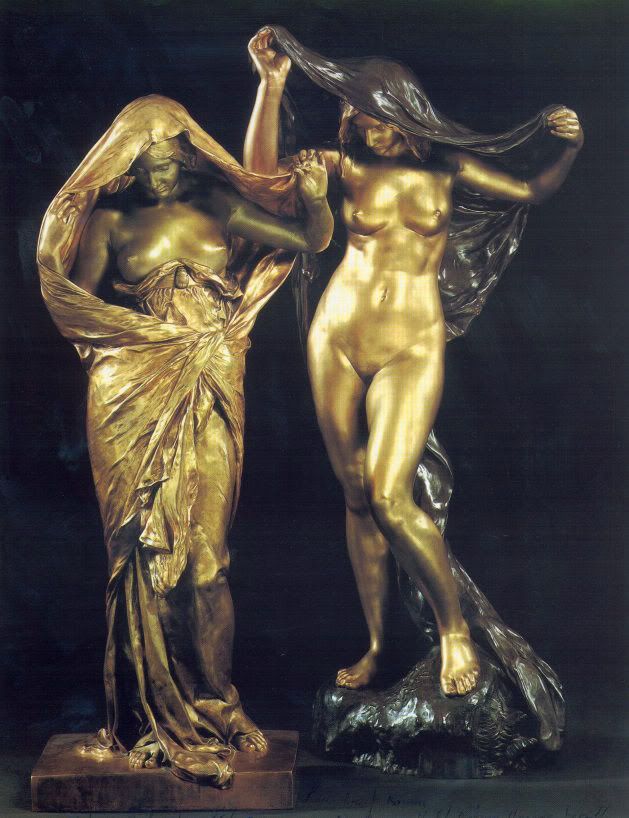
Nature Unveiling Herself Before Science, by Louis Ernest Barrias, 1890
The deaths of Banks in 1820, William Herschel in 1822, and Davy in 1829 seemed to mark the end of an era of British science and of the prestige of the Royal Society. Social critics like Thomas Carlyle began to question the role of science: "The Progress of Science ... is to destroy Wonder, and in its stead substitute Mensuration and Numeration." In a note, Holmes observes, "The troubling image of a shy, reluctant, persecuted female Nature who is crudely questioned and even physically assaulted by an exclusively male Science now begins to appear. It slowly replaces the older Romantic image of a mysterious and seductive Nature, at least a goddess, who is infinitely more powerful than her mere human petitioners and questioners."

Charles Babbage
In 1829, John Herschel was the candidate favored by young scientists to replace Davy as president of the Royal Society, but he was defeated by the Duke of Sussex, the brother of George IV, in a very close election, 119 to 111. Sussex was not a scientist, but he was obviously well-connected. As if to placate the younger scientists, Herschel was knighted soon afterward. But the supporters of Herschel, including Charles Babbage, were still outraged. In the spring of 1830, Babbage published a book, Reflections on the Decline of Science in England. Babbage was now Lucasian Professor of Mathematics at Cambridge, a chair that had been held by Isaac Newton. He was working on the first computer, the "Difference Engine No. 1," which would have used 25,000 brass cogs to perform its calculations. He had spent £17,000 of his own money on the device, so he was eager to obtain government funding for it. The one completed section of Difference Engine No. 1, with 2,000 cogs, still works as a calculator, and he had designed but never completed a more sophisticated version, using punch cards and 50,000 cogs that served as the machine's equivalent of RAM. In 1991, his design for Difference Engine No. 2, with 4,000 brass cogs, was actually constructed. It's capable of calculating to thirty-one decimal points. But Babbage was unable to persuade the funding sources that there would ever be applications for the Difference Engine.

Babbage's book suggested that the research culture in Britain was inferior to that on the continent, and that the universities were failing at the task of teaching science. The Royal Society was particularly to blame, having become more of a social institution than a scientific one: Of the 700 members, only ten percent had published two or more papers on science. He argued "that science must always be more than the simple observation of phenomena or data. It was simultaneously a subjective training in observational skills, self-criticism and interpretation: a complete education. This was of course precisely what William Herschel had said forty years before." He proposed that all the British scientific societies come together in an annual meeting to take place in a different city outside of London each year. This would be the model followed when the British Association for the Advancement of Science was formed in 1831. 

John Herschel published his own critique of science, A Preliminary Discourse on the Study of Natural Philosophy, which became hugely popular. It was cited by John Stuart Mill in his Autobiography as one of the books that helped him recover from his nervous breakdown. Herschel argued that all the sciences had the inductive method in common: the gathering of quantitative data, the formation of a hypothesis, and the testing of the hypothesis. Herschel's book was celebrated as the first book since Bacon's 1620 Novum Organum to explain to the public the nature of experimental science. It was fluently written and filled with imaginative explanations. He singled out chemistry as the central scientific discipline of the age, and prophesied that investigation of electricity and electromagnetism, which would be Faraday's field, would be the next great field of scientific endeavor. He spoke of science as a network of disciplines, coming together "to form a single philosophy or culture," and "argued that science, while often going against common sense or intuition, expanded the human imagination with previously inconceivable ideas of movement or magnitude." The book was enormously influential in shaping the thought of the Cambridge undergraduate Charles Darwin.

David Brewster, a physicist who specialized in optics and invented the kaleidoscope, picked up on Babbage's idea of forming an association of scientific organizations. Babbage and the geologist William Whewell joined him in organizing the British Association for the Advancement of Science, which held its first meeting in York in 1831. It was not particularly well attended and attracted little attention from the press. But the second meeting, at Oxford in 1832, began to attract more notice, although The Times referred to it as "a mere unexplained display of philosophical toys" and was shocked that William Buckland had delivered a talk about the courtship of reptiles "in the presence of ladies." It was the third meeting, in 1833 in Cambridge, that showed the British Association was beginning to make its mark: It was attended by Faraday, Herschel, Dalton, Babbage, Brewster, Whewell and Thomas Malthus, among other notables. Darwin, who was traveling on the Beagle, was unable to attend.

Another participant was Coleridge, now sixty and in poor health. At one meeting Coleridge weighed in on the question of what someone who worked in the sciences should be called. Whewell, who was the chairman of the meeting, noted that some proposed "philosopher," but that Coleridge was strongly against it. Someone else suggested "savant," which was rejected as too presumptuous and too French. Finally Whewell himself suggested "scientist," on the analogy with "artist," as well as "economist" and "atheist" -- though the latter was a strike against it. The geologist Adam Sedgwick rejected "scientist" as a "barbarism," but it caught on and entered the OED in 1840.

Behind all of this professionalizing of science "lay the whole question of whether the new generation of professional 'scientists' would promote safe religious belief or a dangerous secular materialism." Many saw no conflict between science and religion: "Science was a gift of God or Providence to mankind, and its purpose was to reveal the wonders' of His design." But many of the most prominent scientists dodged the question: Davy's writings "suggested a kind of science mysticism that certainly precluded a Christian God"; William Herschel's God was only a kind of "benign Creator somewhere distantly behind the great unfolding scheme of nature";  Caroline Herschel never mentioned God in her journals; and Joseph Banks's sister despaired at his lack of piety. The problem was that "science itself had yet to produce its own theory (or myth) of creation." And when one emerged, in Darwin's On the Origin of Species in 1859, it was devastating because it added to the damage already done to the book of Genesis by the geologists. "What it demonstrated was that there was no need for a divine creation at all."

From 1830 to 1836, the Earl of Bridgewater commissioned a series of books by eminent scientists that were intended to show how science reinforced Christian beliefs. But the Bridgewater Treatises were not well received by the scientific community. Mary Somerville remarked, after reading William Buckland's treatise on geology, that "facts are such stubborn things." Babbage considered writing a treatise of his own that would undermine the whole enterprise, but never finished it. And Faraday, though he was a member of the fundamentalist Sandemanian sect, just kept quiet. 

The Association continued to grow, holding its annual meetings in Edinburgh, Dublin, Bristol, Liverpool, Newcastle, Birmingham and Glasgow from 1834 to 1840, attracting 2,000 people to the meeting and an official membership of more than 1,000. There was still hostility from The Times and John Bull, and Charles Dickens lampooned the meeting with a series for Bentley's Miscellany, illustrated with cartoons by George Cruikshank, called "The Full report of the First Meeting of the Mudfog Association for the Advancement of Everything."

Faraday continued his work at the Royal Institution, and gave the Bakerian Lecture to the Royal Society in 1829.  He also accepted a professorship at the Royal Military Academy, Woolwich, and began his work on electromagnetism that would lead to the creation of the dynamo, as revolutionary as James Watt's steam engine had been. He proved to be a great science educator, and started the series of Christmas Lectures for Children that is still given today. One of them, "The Chemical History of a Candle," was so popular that Dickens reprinted it in Household Words in 1850. 

Charles Lyell's Principles of Geology in 1830 overthrew the biblical account of creation and introduced readers to a concept of "deep time" that corresponded to William Herschel's "deep space." It would form the background Darwin needed for his theory of evolution by natural selection. The publication of Humphry Davy's Consolations of Travel, or The Last Days of a Philosopher in an expanded popular edition in 1831 also introduced the public to speculations about human social evolution; Darwin wrote to his sister asking her to send him a copy. David Brewster's biography of Isaac Newton presented its subject "as a secular saint, 'the high priest of science' and a man of universal genius." And the republication, after the stage adaptations, of Mary Shelley's Frankenstein gave the public a glimpse of "terrible, blasphemous and irreversible scientific hubris."

Mary Somerville's On the Connexion of the Physical Sciences, in 1834, "was a significant attempt to bring together new developments in the fields of astronomy, physics, chemistry, botany and geology as a single, ongoing scientific process of discovery." Somerville's tone is conventionally pious, but on the other hand,
She quietly suggests that "not only man, but the globe he inhabits -- nay the whole system of which it forms so small a part -- might be annihilated, and its extinction be unperceived in the immensity of creation." The reader is left to ask -- Unperceived by God? Or without any God to perceive it?
Somerville also puts stress on the counterintuitiveness of science, on its ability to demonstrate that things are not as we see them or as common sense tells us.

John Herschel, 1846
In 1833 John Herschel fulfilled one of his dreams, to do an astronomical survey in the southern hemisphere. Independently wealthy, he turned down government sponsorship, and even a grant from the Royal Society, and sailed with his family for South Africa to set up an observatory. He shipped the twenty-foot telescope, and remained at Cape Town for four years, mapping the skies. He wrote to his aunt Caroline that "these were the happiest years of his whole life." The Herschels were visited at the Cape by Charles Darwin, on his way back from the Galapagos. "Herschel's expedition to the Cape came to represent for Darwin the important ideal of the independent working scientist, which inspired the rest of his life." Caroline Herschel, in her eighties, thought of joining John and his family at the Cape, but decided against it. She did serve as a kind of publicist for him, feeding stories to the Hanover papers that were picked up internationally. On his return in 1838, he was made a baronet and attended Queen Victoria's coronation.  He was also elected president of the Royal Society and awarded another Copley Medal. 

In 1840, the forty-foot telescope at Slough was dismantled, having been battered by winds until the scaffolding was no longer safe. On New Year's Eve, Herschel threw a party in the old tube.

Thursday, September 30, 2010

7. The Age of Wonder, by Richard Holmes, pp. 182-210

The Age of Wonder: The Romantic Generation and the Discovery of the Beauty and Terror of Science (Vintage)Herschel Among the Stars, 2-6
_____
In 1788, Herschel married Mary Pitt, a wealthy widow, causing something of a rift with Caroline, who found her role in the household suddenly shrunken. Caroline moved out of The Grove into an apartment above the stables, next to the observatory. She refused an offer of a quarterly salary of £10, but she still had the more generous stipend from the queen. Interestingly, she also destroyed her personal journals for the next decade, during which she moved out of the apartment and into the village of Slough. Whatever Caroline's feelings were about her brother's marriage, she continued to be his assistant and to do her own observations as well, discovering a second comet in December 1788. She also began a regular correspondence with the Royal Astronomer, Nevil Maskelyne.

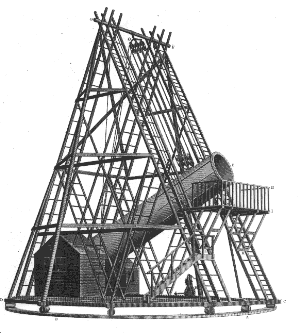
The 40-foot telescope
In spring 1789, the great forty-foot telescope was finally completed. With it, Herschel discovered the tiny moon of Saturn called Mimas, which is only 250 miles in diameter and has a huge crater eighty feet across and six miles deep. (When the crater was photographed by Voyager in 1980, it was named Herschel.) The telescope became a major tourist attraction and was hailed as one of the wonders of the world. The visiting Oliver Wendell Holmes described it as looking like "a piece of ordinance such as the revolted Angels battered the wall of Heaven with." But it was something of a dud: hard to maneuver and far more subject to weather than the smaller telescopes. The mirrors weighed a ton, and had to be repolished annually. Removing them was not only difficult but dangerous -- Herschel was nearly killed in 1807 when a mirror slipped from its harness while being removed. In the five years from 1788 to 1793, Herschel recorded only seventeen nights of optimal observing conditions. It was also more useful for observations within the solar system than into deep space: Herschel added two more moons to the five that Saturn was already known to have.

Herschel began to do more revolutionary theoretical work. In 1789 he published a paper that expanded on his earlier "On the Construction of the Heavens," suggesting that the whole universe was in a state of change, being worked on by the force of gravity. He likened the skies to a garden in which we can "witness the germination, blooming, foliage, fecundity, fading, withering and corruption of a plant." The same process was at work in the stars.
In this paper, astronomy changed decisively from a mathematical science concerned primarily (for practical purposes) with navigation, to a cosmological science concerned with the evolution of the stars and the origins of the universe.

The Herschels were also experiencing personal changes: In 1792, Mary gave birth to their only child, a boy they named John. And Caroline had entered on a new phase of her career as an astronomer. She found her third and fourth comets in 1790, a fifth in 1791, and a sixth in 1793. She began a new Star Catalogue which would be published by the Royal Society and eventually replace the standard reference published by John Flamsteed in 1776. When she found a seventh comet in 1797, she was so excited she did something completely uncharacteristic: She rode a horse by herself from Slough to London, a distance of twenty-some miles, to tell Maskelyne the news personally. She also wrote to Joseph Banks, noting that the day was a historic one because she had never ridden more than two miles outside of Slough before. This excursion was followed by her move out of the apartment and into lodgings in Slough.

In 1791, William published a paper about nebulae in which he reported on a star that was surrounded by a cloud of gas. This had caused him to reconsider his assumption "that gas clouds were simply star clusters too far beyond our galaxy to be 'resolved' by his telescopes." Now he began to question whether nebulae were gas clouds within the Milky Way, and whether there really were galaxies outside our own. "It was a decisive retreat from his most radical thinking about the size and origin of the cosmos." It may have been prompted by a conservative reaction against the atheism of the French Revolution after the declaration of war against France. Herschel's friend, the French astronomer Jérôme Lalande, had become an atheist, and in 1807 wrote, "I have searched through the heavens, and nowhere have I found a trace of God." Pierre Laplace, another atheist, used Herschel's own theory that nebulae were stars forming out of clouds of gas to posit a theory of creation that made divine intervention unnecessary. When Napoleon once told Laplace that he found no mention of God in his books, Laplace replied "I have no need of that hypothesis."

However, Herschel maintained his freedom to speculate, sometimes wildly, as when he posited that the interior of the sun was cool and inhabited by intelligent beings. He also continued to believe that the moon was inhabited and "his disapproved of God-hunting within the galaxy," rejecting the notion that the fire of the sun was in fact that of the biblical hell. Other scientists suffered from the reaction against atheism, such as Joseph Priestley, whose library was destroyed by a Birmingham mob in 1794. Some even found visiting Herschel's observatory a religious experience, such as Joseph Haydn, who credited a visit to Herschel with inspiring his oratorio The Creation

Herschel's interest in the sun produced not only wild speculation, but also a significant discovery. In 1800 he did series of experiments with thermometers that demonstrated higher temperatures outside the visible spectrum, in short, he had "discovered the presence of infra-red light." Joseph Banks predicted that this would be a more important discovery than that of the planet Uranus. It also attracted the attention of the young Humphry Davy.
This marked a decisive advance on Newton's famous optical experiments with the prism, and implied a hitherto wholly unsuspected power in nature. It would also eventually lead to a decisive breakthrough in stellar astronomy in the twentieth century. 
During wartime Herschel was commissioned to produce a spy telescope to be mounted on Walmer Castle in Kent to watch for a French invasion fleet. But in July 1802, during the Peace of Amiens, he and his wife visited Paris where they met Napoleon, with whom he had a rather awkward conversation during which the future emperor proclaimed that astronomy "gave proof of an Almighty Wisdom." Knowing that Laplace, Napoleon's chief scientific adviser, was an atheist, Herschel thought Napoleon was a hypocrite. 

Ten-year-old John Herschel, who had accompanied his parents to France, fell ill on the way back. He was nursed back to health by his Aunt Caroline, to whom he became close -- "it was she, as much as his father, who inspired in him an early passion for science and astronomy." He had been sent to Eton when he was eight, but Caroline saw how unhappy he was there and was delighted when Mary saw her son knocked down in a boxing match with an older boy and decided to bring him home to be privately tutored.

In a paper in 1802, William began to speculate on the relationship between space and time, noting that "A telescope with a power of penetrating into space, like my 40  foot one, has also, as it may be called, a power of penetrating into time past." Other observations were equally unsettling to the layman, such as the notion that sunspots, because they had an effect on the Earth's temperature, "could be related to the price of wheat," and therefore have political consequences. Or that not only did the planets revolve around the sun, but the solar system was orbiting around the center of the Milky Way, which was itself moving through space. He also continued to develop the idea that the universe itself was evolving, and that the reason the nebulae he had observed were different shapes was that they were in different stages of development.
These shapes, Herschel argued, were not different because they had been created differently, like different species. They were different simply because their stages of development in what he called "sidereal time" (meaning stellar time) had reached different points. He was suggesting the inescapable idea of evolutionary youth and age in the universe. 
Copernicus had dethroned the Earth from the center of the universe. Now Herschel had gone so far as to remove even the Milky Way from the center.

Herschel's ideas and discoveries were picked up by the younger generation of Romantic poets. Byron visited him in 1811 and was astonished "when I viewed the Moon and Stars through Herschel's telescope, and saw that they were worlds." Keats used Herschel's discovery of Uranus as a central trope in his sonnet, "On  First Looking Into Chapman's Homer": 
Then felt I like some watcher of the skies
When a new planet swims into his ken 
It's a depiction of the moment of discovery as "a moment of revelation into the idea of the unbounded, the infinite. In the case of Herschel's sighting of Uranus, Keats's word 'swims' is brilliantly evocative, because of its sensse of new life and movement." Keats described a "Eureka moment," which Herschel's meticulous observation hadn't really been, though Herschel would later describe it that way. "Herschel in the end may have remembered that night exactly as Keats imagined it." In 1813, Thomas Campbell encountered the seventy-four-year-old Herschel  on vacation in Brighton.
Herschel completely perplexed the poet by remarking that many distant stars had probably "ceased to exist" millions of years ago, and that looking up into the night sky we were seeing a stellar landscape that was not really there at all. The sky was full of ghosts. "The light did travel after the body was gone." After leaving Herschel, Campbell walked onto the shingle of Brighton beach, gazing out to sea, feeling "elated and overcome." He was reminded of Newton's observation that he was just a child picking up shells on the seashore, while the great ocean of truth lay all before him.

Wednesday, September 29, 2010

6. The Age of Wonder, by Richard Holmes, pp. 144-182

The Age of Wonder: The Romantic Generation and the Discovery of the Beauty and Terror of Science (Vintage)Balloonists in Heaven, 7-12; Herschel Among the Stars, 1
_____
Lunardi did little to advance ballooning as a serious scientific pursuit, but the man who made the second ascent in Britain, James Sadler, was more in earnest about it. He was by trade a baker and confectioner in Oxford, but he was also an amateur chemist and an inventor. He raised money for his balloon attempts from the Oxford undergraduates who patronized his confectionery business, and built both a fifty-foot-tall Montgolfier hot-air balloon and a smaller hydrogen balloon. In the first, he took a thirty-minute flight in October 1784 -- the second British flight -- and in November ascended in the hydrogen balloon, which was equipped with scientific instruments. Unfortunately, the wind was too brisk and Sadler had to jettison the instruments when the balloon tore apart after seventeen minutes. Sadler escaped with bruises, but still proclaimed the hydrogen balloon the better one.

Sadler then proclaimed his intent to fly across the English Channel. Samuel Johnson, visiting Oxford, had hoped to witness Sadler's flight but was too ill. He died less than a month later. Perhaps having heard of Sadler's loss of his instruments, Johnson "presented (or probably bequeathed) to Sadler an enormously expensive barometer" that the balloonist kept and used on later flights, even though he was tempted to sell it to raise funds. 

In France, Jean-Pierre Blanchard, who had hoped to be the first aeronaut, was experimenting with ways to steer a balloon, including his moulinet, a hand-cranked propeller. In 1784 he came to London in search of financing, and made several ascents in a hydrogen balloon. One of his backers, a member of the Royal Society named John Sheldon, equipped him with scientific instruments for a flight, but Blanchard through them overboard when he had trouble getting over the rooftops of London. Blanchard finally teamed up with John Jeffries, an American physician who had been a military surgeon for the British during the Revolutionary War.

Jeffries, who wanted to be elected to the Royal Society, saw ballooning as primarily a scientific endeavor, and proposed four points to be studied: the control of ascent and descent; the direction of the course of the balloon; the nature of the atmosphere at varying heights; and shedding "new light on the theory of winds in general." In November 1784, he and Blanchard made a flight across the Thames that was the first to accumulate significant amounts of data. It demonstrated that balloon flight was not a simple parabola but a series of ascents and descents as the balloon struggled for equilibrium. Jeffries then agreed to finance a flight from Dover to France.

Blanchard and Jeffries were not the only contenders for the first trans-Channel flight. Sadler had to give up when his balloon was destroyed by a rainstorm as it was being transported on a barge on the Thames from Oxford. Pilâtre de Rozier had the backing of the French court and the Académie des Sciences, but while he was waiting at Boulogne for favorable winds, rats ate at the balloon canopy. Blanchard and Jeffries had their own difficulties, partly caused by Blanchard's ego -- he wanted to to fly solo, and tried to trick Jeffries by wearing a lead-weighted belt which would enable him to claim that Jeffries was weighing down the balloon and that Blanchard would have to proceed alone. Jeffries caught on to the trick, however. Blanchard then insisted that Jeffries's scientific instruments were too heavy, and forced him to proceed with only a barometer and a compass.

On January 7, 1785, Blanchard and Jeffries made their ascent from Dover cliff for a two-hour flight across the Channel. When they began to lose altitude over the water, they jettisoned everything they could -- the ballast, their food, and everything except the barometer and a bottle of brandy. They were still too low for the cliffs of the Pas de Calais, so they began removing their clothes until they were in their underwear. The barometer went, too, but not the brandy. The striptease worked: As they reached the cliffs, they rose and caught the onshore wind, traveling twelve miles inland. But their course was taking them toward a forest, where a crash-landing in the trees could be fatal. So Blanchard suggested one last way of lightening the load: They urinated into the leather bladders that they had kept as potential flotation devices and threw them overboard. It was just enough to take them over the treetops. In his account of the flight, Jeffries apologized for telling the story of urinating into the bladders, but maintained it was of scientific import. Holmes, however, observes in a footnote that the volume of urine probably wouldn't have been sufficient, and suggests that they must have defecated as well. "No doubt Jeffries felt that this last detail was too much even for scientific candour."

Rescued by a crowd that had been following their descent on horseback, they were celebrated in Paris, where Jeffries in particular was honored by Benjamin Franklin, with whom he "spent several quiet evenings ... discussing the future of flight, and the beauty and intelligence of French women." He was also elected to the Royal Academy but received no other honors from the British government. He made no other flights, and in his diary he expressed relief that he had survived. Blanchard, on the other hand, made a total of sixty-three flights, none of them of scientific consequence.

The fatal Channel-crossing attempt of Pilâtre in 1785
Ballooning began to wane in popularity, especially after the disastrous attempt by Pilâtre de Rozier to cross the Channel the other way, from Boulogne to Dover, in June 1785. He attempted to combine in a single craft both a hot air balloon and a hydrogen balloon. There is some evidence that he had reservations about this potentially "lethal combination of highly inflammable gas and naked flame." The weather was not the best, and at the last moment he persuaded a third person not to attempt the flight with him and his co-pilot, Pierre Romain. As the balloon rose and drifted toward the cliffs, sparks ignited the hydrogen that Pilâtre was venting from the upper balloon. Both men were killed in the crash. Pilâtre's death, followed by the accident the next year when Ralph Heron became entangled in the ropes of Lunardi's balloon, "discredited ballooning with the British public for a generation," although the French continued to experiment, especially with the military potential of balloons. There were tales of French military balloonists taking their girlfriends up in balloons, "so the first Mile High Club was also formed." Napoleon took four balloons to Egypt in 1798, but they were destroyed the following year in the battle with Nelson at Aboukir Bay. "Military balloons were not used again in any conflict until the American Civil War.

In 1810, James Sadler returned to ballooning and an attempt to cross the Irish Sea, a more difficult flight than the English Channel. On a practice flight over the Bristol Channel, he encountered wind turbulence and in his efforts to lighten the basket was forced to throw overboard Dr. Johnson's barometer, to his great regret. In October 1812, he tried to cross from Dublin to Liverpool, but was caught in winds that swept him northward over the sea. He tried to ditch into the sea, but a passing boat refused to rescue him for fear of getting tangled in the balloon's rigging. So he dropped his emergency ballast and relaunched -- a unique maneuver -- until he finally located a second boat that was willing to attempt a rescue. Sadler's feats attracted the attention of Shelley, who in the winter of 1812 launched several small balloons, each of which carried his pamphlet "A Declaration of Rights," and wrote a sonnet about the experience. Finally, in 1817, Sadler's son, Windham, made the crossing from Dublin to Wales, a five-hour, sixty-mile journey. Like his father, Windham was a firm believer in the scientific value of ballooning, but he was killed in a balloon accident in 1824, when he was twenty-seven. His father, James, never flew again.

Although the enthusiasm for balloons waned, some scientific benefit was attained. The French chemist Joseph Gay-Lussac experimented with high ascents, and his trip to 23,000 feet above Paris in 1804 helped establish the limit at which humans can breathe. Exploration of the sky also awakened interest in meteorology, leading to Luke Howard's study and classification of clouds in 1804, which established the basic types of clouds: cumulus, stratus, cirrus, and nimbus and their various combinations. Howard was elected to the Royal Society in 1821. The interest in clouds was reflected in the art of Turner and Constable, and the poetry of Coleridge and Shelley. "It could be argued that the Romantics actually invented the idea of 'the weather' itself, as it now preoccupies us; as well, of course, as 'inner weather.'" Ballooning also led to advances in mapping, and the creation of the British Ordnance Society, the first state mapping program. 

The Royal Society under Joseph Banks was, on the whole, more interested in astronomy than in ballooning. And in 1785 Herschel began his project to create most powerful telescope ever. The octagonal tube would be 40 feet long and five feet in diameter, and have two or even three mirrors, ranging in diameter from 36 to 50 inches. Because of it its size -- higher than a house -- it would have to be specially constructed to resist the wind, as well as the extremities of weather. The viewing platform for the astronomer (Herschel) would be dangerously high, and the assistant (Caroline) would have to be housed in a special booth with a communications tube to the astronomer. And it would be very, very expensive.

"It was one of Sir Joseph Banks's most dramatic diplomatic coups that he had convinced the King to announce a grant by September 1785." The sum was £2,000 for construction and four years' expenses. In 1786, Herschel, Caroline, and Alexander moved to The Grove, a country house in the village of Slough owned by the Baldwin family, where they began construction on the observatory. Sometime that summer they were visited by an American, the fifty-year-old John Adams, who discussed the possibility of extraterrestrial life with Herschel. Adams was fascinated by the idea, and by its implications for traditional Christianity, believing that if life existed elsewhere, then the Christian ideas of the fall and redemption became absurd. Years later, he would write to Thomas Jefferson urging him not to hire British scientists to teach at the University of Virginia because too many of them -- unlike Herschel -- were orthodox Christians: "They all believe that great Principle which has produced this boundless universe, Newton's universe and Herschel's universe, came down to this little ball, to be spit upon by the Jews. And until this awful blasphemy is got rid of, there never will be any liberal science in the world." (I wonder how many of the current right-wing fundamentalists who idolize the Founding Fathers would react to this?) 

Adams was only one of the flood of visitors who distracted Herschel from the construction of the telescope. In July 1786, he was sent by the king to personally install one of his telescopes at the University of Göttingen, a gift of the king. Caroline was left to supervise the construction, attend to the household, and try to get her own astronomical observations done. She soon decided that she couldn't do all of it. "She would be an astronomer, not a housekeeper." William had built her a small telescope of her own, which "was not suitable for deep space, but it was perfectly designed to spot any strange or unknown object moving through the familiar field of 'fixed stars.'" And with it, on August 1, she discovered a comet. Only about thirty comets had been identified by that time, half of them by the French astronomer Charles Messier, so this was a significant discovery.

On August 6, a delegation consisting of Banks, Secretary to the Royal Society Charles Blagden, and Lord Palmerston came to Slough to see Caroline's comet. The result was celebrity for Caroline independent of her brother's. "The idea of a female astronomer intrigued people." Fanny Burney came to visit, and wrote, "The comet was very small, and had nothing grand or striking in its appearance; but it is the first lady's comet, and I was very desirous to see it." Caroline was, however, rather distant with Fanny. She hit it off better with, of all people, Nevil Maskelyne, who took her work seriously. As did others, after she discovered a second comet in December 1788. "Her reputation continued to grow, especially in France and Germany."

Work on the telescope continued, but in 1787 Caroline, who kept track of the finances, realized that they were facing a financial crisis that could doom the whole project. Joseph Banks came to their rescue again, suggesting that they give a Royal Telescope Garden Party for publicity and fund-raising. On August 17, George III and Queen Charlotte, and a host of royals and other dignitaries came to The Grove to witness what had been accomplished. The event "had the subtle effect, just as Banks would have foreseen, of further publicly committing the King to the scheme for which he was the acknowledged benefactor."

The publicity stunt put Herschel in a good position to request the additional funds, but he also dared to suggest that Caroline might also receive a royal stipend as his assistant. "No British monarch had ever granted a woman a salary, or even a pension, for scientific work before." The suggestion was made, perhaps by Banks, that the stipend might come from Queen Charlotte. On August 23, Banks was summoned to the palace and informed that he would renew Herschel's grant for a total of £2,000 plus an additional £50 per annum for Caroline:  "the first professional salary ever paid to a woman scientist in Britain." But the king also made it clear that he was annoyed at the request for additional funds, and at the garden party that had put him in the position of having to grant the request. He made it clear that this was the last penny he was going to spend on the telescope.

Banks was shaken by the vehemence with which the king expressed himself -- it was only a year before the madness of George III would begin to became apparent. But he was forced to communicate the king's severity to Herschel, who was upset and considered scrapping the project. Caroline was indignant, especially at the penny-pinching accounting rules that Banks said needed to be put in place. The relationship with Banks recovered, but not that with the king. Not until the Prince Regent took over for his incapacitated father did Herschel receive further honors, and although he was knighted in 1816, his £200 stipend remained the same, though its value was cut in half by inflation. 

Tuesday, September 28, 2010

5. The Age of Wonder, by Richard Holmes, pp. 114-143

The Age of Wonder: The Romantic Generation and the Discovery of the Beauty and Terror of Science (Vintage)Herschel on the Moon, 8; Balloonists in Heaven, 1-6
_____
Herschel and his brother Alexander became telescope manufacturers, starting with the five seven-foot reflectors they made for George III as royal gifts. Mirror-making remained hand-crafted, but in the course of a decade they turned out 200 mirrors for the seven-foot telescopes, 150 for the ten-foot, and eighty for the twenty-five-foot telescopes. Their customers were wealthy, and included German princes as well as Napoleon Bonaparte's brother Lucien, the Emperor of Austria, and the King of Spain, who commissioned one for the Madrid Observatory in 1806 that cost £3,500.

Herschel's celebrity attracted visitors to the observatory at Datchet. Samuel Johnson urged Susannah Thrale to visit: "What he has to show is indeed a long way off, and perhaps concerns us little, but all truth is valuable and all knowledge pleasing in its first effects, and may subsequently be useful."

Despite visitors and manufacturing orders, he continued his observations, developing a technique of "sweeping" the sky that consisted of moving "slowly up and down, while the constellations turned through the field of observation as the stars moved steadily across the night sky." It was a highly accurate technique that was also very slow: "A complete sweep could take several years to complete." Herschel's familiarity with the sky, which he could read "like a skilled musician sight-reading a musical score," helped him spot any anomalies in his observations. He also began to write about the process of observation itself, including comments on the nature of the eye.

Caroline compiled his remarks on practical observation. After the move to Datchet in 1782, he began to train her even more into an "assistant-astronomer," responding to William's "imperious shout" whenever he wanted her to write down a new observation. She was expected to respond with military precision to his instructions, and her work was essential: "at no point would William have to compromise his night vision by looking at a lit page and taking his own notes." It was cold and demanding work. "They began at eleven at night, and often did not go to bed before dawn, in a mixed state of exhaustion and euphoria.... Herschel took to rubbing his face and hands with raw onions to keep out the cold.... Caroline layered herself in woollen petticoats."

There were also risks: In the harsh winter of 1783, William was almost blown off of the scaffolding that held his twenty-foot reflector, and the frame collapsed on him so that he had to be rescued from underneath it. In December of that year, Caroline was running to record one of William's observations, tripped on one of the stakes that held the guy ropes for the scaffolding, and impaled herself on the iron hook on top of the stake. It "entered my right leg about six inches above the knee," she wrote later, and the workmen couldn't remove her from the hook "without leaving near 2 oz. of my flesh behind." But they didn't call the doctor: She bandaged the wound herself and was back at work two weeks later. "It seems that the extreme cold had an antiseptic effect on the large, open wound, and prevented fatal gangrene." A week after the accident, Dr. James Lind inspected the wound and prescribed an ointment for it. (Lind was one of Shelley's favorite teachers at Eton.) Though the wound finally healed by summer, Caroline suffered pains from it in old age.

In 1784 and 1785, Herschel "drew together his most radical ideas about the cosmos, and published two revolutionary papers in the Royal Society's Philosophical Transactions." He challenged the idea of a firmly fixed cosmos, and from his study of nebulae "for the first time suggested that many, if not all, of these must be huge independent star clusters or galaxies outside our own Milky Way." As for the Milky Way, "his later calculations produced the now-familiar discus shape ... with its characteristic arms spinning out into space, and the slight bulge of stars at its centre." In "On the Construction of the Heavens," he made the radical observation that "The heavenly 'construction' was not something architecturally fixed by the Creator, but appeared to be constantly changing and even evolving, more like some enormous living organism." His assertions had the effect of "hugely increasing the sense of the actual size of the cosmos."

He began to plan the construction of a forty-foot telescope with a four-foot mirror. And in his 1785 paper for the first time credited Caroline in print as the discoverer of "a small 'associate nebula' in Andromeda."

Meanwhile, as the British were surging ahead in astronomy, the French were making their own advances -- in ballooning. Banks heard about what they were up to in 1783 from Benjamin Franklin, who was a member of the Royal Society as well as the American ambassador to France. The French, he reported, were experimenting with lofting giant paper bags made by a paper manufacturer, Joseph Montgolfier. And then a member of the Académie des Sciences, Alexandre Charles, took things a step further by inflating a silk bag, six feet in diameter, that floated from the Champs de Mars across the Seine and drifted fifteen miles away from Paris before it burst. "This was a distance which a horseman could barely a horseman could barely cover in an hour." Charles's balloon had been filled with a newly discovered gas known as "inflammable air."

Montgolfier recovered from Charles's triumph by sending up a hot-air balloon with a wicker basket that contained a sheep, a duck, and a cockerel. It stayed in the air for seven minutes and the animals returned to earth safely. The logical next step was to send up a human being. Banks was skeptical about the experiments but recognized that they could lead to something useful, such as a "flotation device" that would make carriages and wagons lighter so that horses could pull them faster. "This aptly suggests how difficult it was, even for a trained scientific mind like Banks's, to imagine the true possibilities of flight in those early days."

The "inflammable air" that Charles had used to fill his balloon had been discovered by the English chemists Henry Cavendish and Joseph Priestley. But it was the French chemist Anton Lavoisier who repeated and refined their experiments, producing the gas from iron filings combined with sulfuric acid. He named the product "hydrogen." The Montgolfier brothers, Joseph and Étienne, followed developments in chemistry because of their paper-making business, so when they heard about this lighter-than-air gas, they speculated about using it to fly paper bags. "As early as 1782, Joseph had humorously suggested the theoretical possibility of flying an entire French army into Gibraltar, and seizing it from the English."

The Montgolfiers' first manned flight
The trouble with hydrogen is that "it was slow and dangerous to produce, potentially explosive, and easily escaped from containers made of silk or animal bladders." Hot air was easy to produce and could be contained within silk and paper -- Joseph Montgolfier said he "discovered the principle of hot air by watching his wife's chemise inflating when she hung it over the hearth to dry." The Montgolfiers first large hot air balloon, launched on June 5, 1783, was thirty feet high and 110 feet in circumference. It contained 22,000 cubic feet of hot air, rose to 60,000 feet and stayed up for ten minutes.

A twenty-nine-year-old doctor named Jean-François Pilâtre de Rozier persuaded the Montgolfiers to let him be the "test pilot" in their first manned flight on November 21, 1783. The balloon was seventy feet tall, powered by a brazier burning straw, and had a circular gallery instead of a basket for the passengers. There had to be two of them, one on either side, to balance the balloon. Pilâtre de Rozier's "co-pilot" was the Marquis d'Arlandes, an infantry major. The flight lasted twenty-seven minutes and took them across the Seine.

The launch of Alexandre Charles's hydrogen balloon
But although this was the first manned flight for the record books, the one made ten days later by Alexandre Charles is more significant for its technical breakthroughs. It was a hydrogen balloon whose silk skin had been treated with rubber. It had a valve at the top of the balloon through which the gas could be vented, and ballast bags filled with sand that could be jettisoned to control the balloon's ascent. He and an assistant, M. Robert, went up from the Tuileries Gardens on December 1, 1783.  Benjamin Franklin watched the ascent through a telescope. The flight lasted two hours and traveled twenty-seven miles. When they landed, Charles asked Robert to get out of the basket first, but the release of his weight sent the balloon aloft again, traveling to 10,000 feet in just ten minutes. Charles kept his head, however, and made notes until it grew too cold for him to hold a pen. He slowly released the hydrogen and landed again in thirty-five minutes, only three miles from the original landing spot. "It was the first solo flight in history."

Back in Britain, George III expressed his interest in getting his country into ballooning. Banks was still unconvinced that the French achievements had any practical applications, but he was definitely intrigued. William Watson Jr. had seen one of the unmanned test flights before the Montgolfiers' first manned launch, and excitedly wrote to Herschel about it. Herschel immediately thought about the possibility of using balloons to carry telescopes high into the upper air. Others began to think of the sinister side of ballooning. The novelist Horace Walpole feared the conversion of balloons into "new engines of destruction to the human race."  Benjamin Franklin recognized the military potential of aircraft and calculated that five thousand balloons, each carrying two men, could result in an airborne invasion from France.

But by the summer of 1784, the balloon craze had spread to England. "Unmanned and then manned ascents took place in almost every large city in the kingdom -- London, Oxford, Cambridge, Bristol, Edinburgh." And a twenty-five-year-old Italian, Vincent Lunardi, began to capitalize on the British enthusiasm for balloons. He made his first ascent in London on September 15, 1784, with a crowd of 150,000 as witnesses. "Lunardi drifted north-westwards across London and into Hertfordshire, eating legs of chicken and drinking champagne, and occasionally trying to 'row' his balloon with a pair of aerial oars." But his balloon had no release valve, so he had to try to snag something on the ground with a grappling anchor to end his flight, which he did in a field just outside of Ware.

When he returned to London, "a curiously modern publicity machine began to roll. He sold exclusive rights to his story, and an in-depth interview, to the Morning Post." He was introduced to the king and given a watch by the Prince of Wales, souvenirs of his flight were marketed, and he became the toast of fashionable London. Banks, on the other hand, was unimpressed, and privately referred to Lunardi as "a charlatan." Samuel Johnson was also critical of the hype that surrounded Lunardi, even before the flight, pointing out that buying a ticket to the launch was foolish because "in less than a minute they who gaze at a mile's distance will see all that can be seen." He also expressed skepticism about Lunardi's claim that he would be able to steer the balloon with his oars -- and he was correct. As for ballooning in general, he pointed out that since it couldn't be steered effectively, a balloon failed to "serve any purpose of communication; and it can give no new intelligence of the state of the air at different heights, till they have ascended above the height of mountains, which they seem never likely to do."

Another sensation was caused by Lunardi in June 1785 when he proposed to take the actress Mrs. Sage, who was a rather large woman, and a young man named George Biggin aloft with him. Mrs. Sage was to be the "First Aerial female." But the weight of the three passengers and the elaborate and showy trappings that had been attached to the gondola proved too much for the balloon, so Lunardi jumped out, leaving the two passengers to conduct the flight themselves.
Unfortunately, in his haste to depart, Lunardi failed to do up the lacings of the gondola's door. As the balloon sailed away over Piccadilly, the crowd were treated to the provoking sight of the beautiful Mrs Sage on all fours in the open entrance of the gondola. The crowd assumed that she had fainted, and was perhaps receiving some kind of intimate first-aid from Mr Biggin. 
After Mrs. Sage's flight, cartoonists indulged in ribald speculation
In fact, Mrs. Sage was trying to lace up the door, but when she regained her feet, she stepped on the barometer and broke it, so there was no way to measure how high they flew. So they drifted on, eating cold chicken and drinking Italian sparkling wine, until they landed in a field near Harrow, where they were threatened by an angry farmer and had to be rescued from him by the schoolboys from Harrow School. Afterward, there was ribald speculation about what may have happened between Biggin and Mrs. Sage during the flight. "Gallantly, Mr Biggin refused to comment."

The lack of scientific value of Lunardi's flights became the subject of criticism, and his reputation suffered in 1785 when a young man, Ralph Heron, became entangled in the ropes during a launch at Newcastle, was carried a hundred feet into the air, and fell to his death.

4. The Age of Wonder, by Richard Holmes, pp. 76-113

The Age of Wonder: The Romantic Generation and the Discovery of the Beauty and Terror of Science (Vintage)Herschel on the Moon, 5-7
_____
In 1766 Herschel moved to Bath, where he was not only organist in the Octagon
Chapel but also played in the orchestra in the Pump Room. He got into an argument with the impresario of the orchestra, James Linley, over orchestral arrangements, and set up a rival orchestra for a season, but finally made up with Linley and combined forces with him. When Linley decided to move to London, Herschel became the sole director of the concerts. He also composed and gave music lessons.

In February 1766 he had begun his first Astronomical Observation Journal, while also reading books on astronomy and attending lectures by the astronomer James Ferguson in the Pump Room. He began collecting telescopes and studying their construction. He found that refractor telescopes -- the straight kind with lenses at each end of the tube -- were insufficient for observing the stars, and turned his attention toward the reflector telescope invented by Newton. The concave mirrors in reflector telescopes gather and concentrate more light and produce less distortion than refractors.

Before Herschel, astronomers treated the night sky as if it were "the interior surface of a decorated dome, inlaid with constellations.... But Herschel began to conceive of deep space. He began to imagine a telescope which might plunge deep down into the sky and explore it like a great unplumbed ocean of stars." But the kind of mirror he would need for a reflector telescope capable of the exploration Herschel envisioned was too expensive. So he decided he would make them himself, out of metal, not glass.

Herschel's brothers, Jacob, Dietrich, and Alexander, came to visit him in Bath, and in 1770 Alexander came to stay with William in a house he rented at 7 New King Street where he gave music and singing lessons. William was concerned about Caroline, who was now twenty-one, but her mother was reluctant to give up her free housemaid until he went to Hanover and promised to pay her for a maid to replace Caroline. She returned to England with him in August 1772. He began to give her lessons in English as well as singing and the harpsichord.

As in Hanover, Caroline found herself playing housekeeper, but with the addition of music lessons, English lessons, reading aloud from English novels, and talking about astronomy. "It took time for the full emotional rapport to renew itself between the tall, handsome thirty-four-year-old bachelor brother, driven and ambitious, and the shy, tiny, awkward twenty-two-year-old sister, who ... was bursting with unfulfilled dreams and longings."
For Caroline, William was initially the great  liberator who had taken her out of the German house of bondage. But later their roles would subtly change. As William would observe to Nevil Maskelyne, it was not always self-evident which was the planet and which was the moon. 
Herschel began work on the mirrors for his telescope, getting the tools he needed for grinding and polishing the metal from John Michel, a fellow astronomer in Bath who, like Herschel, had some unconventional ideas, "such as the existence of 'black holes' in space from which light itself could not escape."

The moulds for casting metal mirrors were formed from horse-dung, and after the molten metal was poured and cooled it had to be ground down into a concave shape. It then had to be polished continually for hours without stopping; otherwise the metal would harden and become useless. In addition, there was the danger that the furnace might explode. The house at 7 New King Street became "a pungent, chaotic workshop." Caroline would read aloud to William while he polished the mirrors: "Don Quixote, the Arabian Nights, Sterne's Tristram Shandy -- all tales of fantastic adventures or eccentric heroes." Sometimes she even had to feed him by hand while he worked as long as sixteen hours without a break.
A Victorian illustrator portrayed the collaboration of William and Caroline Herschel as "a comfortable domestic scene ... in an elegant drawing room.... In fact these epic polishing sessions took place [in] the unheated, stone-flagged basement [where they] were surrounded by tools and chemicals, and the distinct, pungent smell of the horse-dung moulds. It was dirty, monotonous and exhausting work."
Herschel's first five-foot reflector telescope, finished in 1774, had a six-inch diameter mirror and was mounted in "a beautiful octagonal case of gleaming mahogany." He used it to study the moon and the then-mysterious nebulae. "Even at this early stage Herschel has the notion of a changing universe, and that nebulae might hold some clue to this mystery." When he began studying nebulae, just under a hundred had been cataloged by the French astronomer Charles Messier. "Within a decade, by the mid-1780s, Herschel would have increased this tenfold, to over a thousand nebulae.... Herschel suspected that they were star clusters at immense distances, whose composition might hold a clue to an entirely new kind of universe."

Meanwhile, to assuage the uneasiness of Jacob and Anna about Caroline's living in England, he reported that she had a small millinery business that she was running successfully, as well as continuing her music lessons. She had begun to perform as a singer in his concerts at the Pump Room. In 1779, Jacob cut back on the number of music students he was teaching, and began to work on a project to compile a catalog of double stars. He had already discovered that the Pole Star, "the key to navigation, and the poet's traditional emblem of steadiness and singularity, for centuries," was in fact two stars. By facilitating the measurement of parallax, double stars, he thought, "might provide a method of gauging the earth's distance from the rest of the Milky Way."

Conventional ideas about the cosmos at the time was not only that it was only a few thousand years old, but that the universe was only a few million miles in extent. The "fixed stars" were thought to be in an unchanging pattern and their brightness to be "a function of their size, rather than their distance.... One of Herschel's most simple and radical ideas was to assume exactly the opposite." But people had begun to speculate that the universe was much larger and that there was a high probability of extraterrestrial life.

The interest in extraterrestrial life underlay Herschel's fascination with the moon, which he was studying when, in December 1779, William Watson Jr. came upon him looking through his telescope."This was Herschel's first really important scientific contact in England, one not made until he was forty-one. Watson was only thirty-three." They became friends quickly, and Caroline later recalled that Watson came home with Herschel that night and talked until the next morning. Watson arranged Herschel's election to the Bath Philosophical Society as "optical instrument maker and mathematician," and helped him with his mirror-making. He encouraged Herschel to submit thirty-one papers to the society. Some of them were so speculative that they would now be considered "thought experiments." Among the more outlandish of them featured Herschel's idea that the craters on the moon might be man-made and designed to provide solar power to the cities and towns contained within them.

In 1781, Caroline closed her millinery shop, but it took her some time to sell off the stock, so that she was away from the house at 19 New King Street when William made a momentous discovery. On March 13 he observed "a new and unidentified disc-like object moving through the constellation of Gemini. This discovery would change his entire career, and become one of the legends of Romantic science." In a footnote, Holmes makes this observation:
Romanticism introduced three important themes into science biography. First, the "Newton syndrome," the notion of "scientific genius," in which science is largely advanced by a small number of preternaturally gifted (and usually isolated) individuals. Second, the existence of the "Eureka moment," in which great discoveries are made without warning (or much preparation) in a sudden, blazing instant of revelation and synthesis. Third, the "Frankenstein nightmare," in which all scientific progress is really a disguised form of destruction.
But the sighting of the "disc-like object" was hardly a "Eureka moment." Herschel thought he had found a new comet, and the record in his observation book contains "no expression of excitement or anticipation." Gradually, however, he began to devote his attention to the object, first to prove that it was definitely in motion and therefore not a fixed star, and then to figure out whether it was really a comet, since comets typically had "a slightly blurred, fiery outline and a distinct tail or 'coma.'" This object had neither.

Even by April 6, he was still calling it a comet in his observation book, though "the sharp, round definition and the lack of any tail could only mean one thing: a new 'wanderer,' or planet. What in fact he had observed was the seventh planet in the solar system, beyond Jupiter and Saturn, and the first new planet to be discovered for over a thousand years (since Ptolemy)." When he finally decided it was a planet, he called it "Georgium Sidus" ("George's Star") after George III. It did not finally receive the name Uranus until the middle of the nineteenth century.

Herschel told William Watson about his "comet" on March 22, and Watson passed the word on to Nevil Maskelyne and Joseph Banks. Maskelyne still thought that Herschel was something of a crackpot, but he checked it out and reported to Watson that he thought it was a comet or a planet.
The Astronomer Royal was in a dilemma. He had no reason to accept Herschel as a reliable astronomer, and to declare a new planet prematurely might bring himself and the Royal Society into disrepute, and even ridicule. On the other hand, to reject what might be the greatest British astronomical find of the century, especially if the predatory French astronomers accepted it first (and even named it), would be even more damaging.... King George III was particularly fascinated by stars, and particularly keen to outdo the French.
Finally, Maskelyne wrote directly to Herschel on April 23, and called it a planet in his letter. Herschel responded with a paper called "An Account of a Comet" in which he outlined the process of his discovery, and made it clear that he, too, thought it must be a planet, though he didn't actually say so -- probably under Watson's advice.

In his report to Banks, Maskelyne referred to Herschel as "the musician of Bath" and as "lucky" for having "accidentally" discovered the planet. "This suggestion that the discovery had been 'accidental,' and that he had been 'lucky,' was to grow increasingly disturbing to Herschel," who knew that his patient and meticulous survey and careful measuring and recording had enabled him to identify the planet. Fortunately, the rivalry with the French played in Herschel's favor when Charles Messier wrote to congratulate him on his discovery and give "his opinion that this was very likely to be the seventh planet in the solar system.... As Maskelyne and Banks were only too aware, Messier's congratulations would soon carry the weight of the entire French Académie des Sciences." And astronomers in Germany, Italy , Sweden and Russia joined in confirming and praising Herschel's discovery.

In May, Watson took Herschel to London to meet his father and Maskelyne, and Banks "claimed it as a decisive British victory over French astronomy," and announced that Herschel was to be elected to the Royal Society and receive the Copley Gold Medal -- though it took another six months for the bureaucracy to process both honors. Banks also urged Herschel to name the planet "or our nimble neighbours, the French, will certainly save us the trouble of Baptizing it." It was then that Herschel proposed naming it after the king.

Herschel was, however, still irritated by the "continuing murmurs in some quarters of the Royal Society that his discovery had been in some sense 'accidental.'" He reiterated his contention that it was the result of "a regular review of the sky" in letters to European astronomers, and as late as 1809 he was insisting that it was no accident. But he also began to romanticize the discovery, claiming that it took place in a single night instead of being the result of "the critical nights of measuring between 21 March and 6 April 1781. The effect of this account was to present and engagingly romantic image of science at work; the solitary man of genius pursuing the mysterious moment of revelation."

The discovery sparked a new popular enthusiasm for astronomy, reflected by the bestseller of 1786, Introduction to Astronomy in Letters to His Pupil by John Bonnycastle, who pointed out the challenge that astronomers were making to the biblical chronology of the creation, and wrote:
"Astronomy has enlarged the sphere of our conceptions, and opened to us a a universe without bounds, where the human Imagination is lost. Surrounded by infinite space, and swallowed up in an immensity of being, man seems but as a drop of water in the ocean, mixed and confounded with the general mass. But from this situation, perplexing as it is, he endeavours to extricate himself; and by looking abroad into Nature, employs the powers she has bestowed upon him in investigating her works." 
Though the discovery of Uranus "became a symbol of the new, pioneering discoveries of Romantic science," and was even celebrated in verse by Erasmus Darwin in his poem The Botanic Garden, there were still skeptics about Herschel and his telescopes. So Herschel packed up his telescope and brought it to Greenwich, where Maskelyne was duly impressed by the quality and clarity of Herschel's mirrors and acknowledged that "they were far more powerful than any of the official observatory telescopes, and probably than any other telescope in Europe."

In May 1782 Herschel was presented to the king and appointed the King's Personal Astronomer at Windsor with a salary of £200 per year. William, Caroline and Alexander moved to Datchet, a village near Windsor, in July 1782. He brought his telescope to Windsor for a demonstration to the royal family. The teenage princesses, Charlotte, Augusta and Elizabeth, were particularly impressed by the astronomer, especially after, on a cloudy night, he rigged up cardboard models of Jupiter and Saturn, illuminated them with candles, and placed them on a distant wall, then focused down the seven-foot telescope so they could view them.

Stargazing became a pastime that especially impressed the young Coleridge, who never forgot that when he was eight, he was taken out into the fields by his father to look at the night sky. "His Romantic sensibility -- even at the age of eight -- already inhabited the infinite and the inexplicable." Keats remembered a time at school when "the boys whirled round the playground in a huge choreographed dance, trying to imitate the entire solar system, including all the known moons (to which Herschel had by then added considerably) ... a gloriously chaotic 'human orrery.'" Keats was awarded Bonnycastle's Introduction to Astronomy as a school prize in 1811. "Reading of Herschel, he enshrined the discovery of Uranus five years later in his great sonnet of 1816, 'On First Looking into Chapman's Homer.'"

Sunday, September 26, 2010

3. The Age of Wonder, by Richard Holmes, pp. 46-76

The Age of Wonder: The Romantic Generation and the Discovery of the Beauty and Terror of Science (Vintage)Joseph Banks in Paradise, 9-10; Herschel on the Moon, 1-4
_____
Banks tried to join Cook's next Pacific expedition in the summer of 1772, enlisting such eminent figures as the chemist Joseph Priestley, the painter Johann Zoffany, and the young physician James Lind, who later taught Shelley at Eton. Cook welcomed them, and had the Resolution outfitted to accommodate them, but the Admiralty not only objected but even had the equipment that Banks had already loaded on the ship dumped on the quayside. It made it clear that it was not interested in another scientific voyage, so Banks underwrote his own, commissioning the Sir Lawrence for an expedition to the Hebrides, Fingal's Cave, and Iceland, but made no significant discoveries.

Back home, he and Solander assembled their collection into "a complete museum of Pacific culture, combining natural history with ethnology and human artefacts in a quite new way." He joined the major scientific societies in London, and became the "unofficial director" of King George's gardens at Kew. He took a mistress, Sarah Wells, whom he set up in an apartment on Chapel Street where "he would meet Solander and his other friends, give noisy dinner parties and have plenty of talk of science and adventure. This ménage seemed an extension of his Tahitian liberties." There were rumors that he and Sarah had a child together, but this is unconfirmed.

In 1774 a member of Cook's fleet returned to England with "a tall and strikingly handsome Tahitian man, who was soon to become known in England as 'Mai' or 'Omai.'" He became a celebrity in England after Banks took him in "partly as an honoured guest, and partly as an exotic specimen.... [Banks] also caused something of a scandal by absolutely refusing to teach Omai to read, or to have him instructed in any form of Christian religion."
"An imposing portrait of Omai, standing formally alongside Banks and Solander, was painted by William Parry, and displayed at the Royal Academy in 1777." 
Omai, by Joshua Reynolds
Omai returned to the South Pacific in 1777 when Cook left on his third voyage. He became a merchant, selling Western goods to the Tahitians, as well as "doing Banks's job in reverse, explaining European culture to the sceptical Tahitians, ... but [he] never fully reintegrated into Tahitian society."

Banks's open relationship with Sarah Wells "suggests that he too had been permanently affected by his Tahitian experience." He shrugged off the scandal because he "genuinely believed that British society was often cruelly restrictive toward women, although he told the author Mrs Ann Radcliffe that he thought women themselves were often responsible" because the way they treated "the smallest deviation of a Female character from the Rigid paths of Virtue is more severe than Death & more afflicting than the tortures of the Dungeon."

The news of Cook's murder by natives in Hawaii in February 1779 didn't reach England until the following year. Some of Cook's officers thought he had become too aggressive in his approach to the islanders, using "heavily armed beach landing-parties, and ... seizing native hostages upon arrival." In England Cook was celebrated as a kind of martyr, but "Cook's violent death, and Omai's strange, alienated return to Tahiti ... were premonitions of the colonial tragedy that was eventually to follow."

Somerset House in 1836
Banks never took another voyage of exploration, and after he was elected president of the Royal Society in 1778, when he was only thirty-five, he seemed to decide to settle down. In March 1779 he married a wealthy heiress, Dorothea Hugessen, after an amicable parting with Sarah Wells. "Banks settled down to a position at the heart of the British scientific establishment for the next forty-one years." He oversaw the move of the Royal Society to Somerset House on the Strand, overlooking the Thames, where it became "a palace of science." Banks was knighted in 1781 for his work on the Royal Botanic Gardens at Kew, which became one of the world's greatest botanical collections.

Solander's death in 1782 "fatally delayed any further work on Banks's great Endeavour travel book." In 1787, only forty-four, Banks suffered a disabling case of gout, which eventually incapacitated him, but didn't stem his enthusiasm for scientific discovery.
He revealed himself as a talent-spotter of genius, encouraging expeditions to Australia, Africa, China, and South America; supporting projects as diverse as telescope-building, ballooning, merino sheep-farming and weather forecasting; helping to found museums of botany, anthropology, comparative anatomy; and above all maintaining through a huge network of correspondence and personal meetings the idea of science as a truly shared and international endeavour, even in a time of war, and even in relentless (if well-mannered) competition with the French. 
But he never finished his own account of the Endeavour voyage, which the French naturalist Georges Cuvier referred to as "forming 'an epoch in the history of science.'"
Banks's Endeavour Voyage may count as one of the great unfinished masterpieces of Romanticism, as mysterious in its own way as Coleridge's "Kubla Khan," with which it bears some curious similarities, as an account of a sacred place which has been partly lost, and to which there is no return.... His great Endeavour voyage had launched an Age of Wonder. 

William Herschel, by Lemuel Francis Abbott, 1785
One of the talents that Banks spotted, shortly after becoming president of the Royal Society, was William Herschel. William Watson, secretary of the Royal Society, had heard from his son about an amateur astronomer in Bath whose homemade telescope had an unusually high resolution. The younger Watson had met the man, who spoke with a German accent, on a back street in Bath one night where he was observing the moon. Herschel was at that time the organist at the Bath Octagon Chapel and gave music lessons. After visiting him at his home, which was full of astronomical equipment, and meeting Herschel's sister, Caroline, who was his housekeeper and "astronomical assistant," Watson invited him to join the Bath Philosophical Society. Herschel also began submitting papers to the society, the best of which Watson forwarded on to his father at the Royal Society.

Herschel's papers were "strange ventures into speculative cosmology and the philosophy of science." In one of them, Herschel said that with his home-made telescopes he had seen "forests" on the moon, and he was convinced that the moon was inhabited. When this paper was published in the Royal Society's Philosophical Transactions in 1780, the Astronomer Royal, Nevil Maskelyne, was outraged, having demonstrated in his own writings that the moon had no atmosphere capable of supporting life. Maskelyne wrote to Watson in Bath challenging Herschel's assertions.

Watson advised Herschel to revise his findings in the light of Maskelyne's criticisms, and Herschel wrote to the Astronomer Royal saying that he had shown "a certain Enthusiasm" in his paper that was the result of his being "young in the Science of Astronomy." But he stuck to his belief that "the moon was 'beyond doubt' inhabited by life 'of some sort or other.'" And he made the teasing suggestion "Perhaps -- and not unlikely -- the Moon is the planet and the Earth the satellite" and expressed the sentiment, "For my part, were I to choose between the Earth and the Moon, I should not hesitate a moment to fix upon the Moon for my habitation!" Maskelyne paid a visit to Herschel in Bath, and, although "the visit seems to have been somewhat stormy," he was impressed by Herschel's home-made telescopes. He also met Caroline, who recorded the visit in her journal, including her brother's exclamation, when Maskelyne left, "That is a devil of a fellow!"

Maskelyne's conclusion was that Herschel and his sister "were provincials, émigrés, and poor self-taught enthusiasts" who were unlikely to contribute anything of potential significance to astronomy. "Less than a year later, in March 1781, Banks was amazed to hear that William Herschel was about to revolutionise the entire world of Western astronomy.... Herschel had discovered what was perhaps a new planet." The Herschels' observations "would change not only the public conception of the solar system, but of the whole Milky Way galaxy and the structure and meaning of the universe itself." 

Herschel was born in Hanover in 1738, and his sister Caroline was twelve years younger. He was in his thirties before he began to devote himself to astronomy. His father, Isaac Herschel, was a musician, a military bandsman with the Hanover Foot Guards. Because the king of England was also Elector of Hanover, the Hanoverian military was integral to the British military. Isaac and his wife, Anna, had ten children, but only six survived infancy. Anna Herschel favored her first-born, Jacob, and her eldest daughter, Sophie. "With the remaining children she was more severe, especially with her youngest and least promising daughter, Caroline."

At fourteen, William joined the Hanover regimental band to which his father and Jacob already belonged. He mastered instruments ranging from the oboe to the organ, and also turned to composing. (Some of Herschel's musical compositions are available on recordings.) He was also interested in philosophy, and Caroline remembered heated arguments between the brothers on philosophical questions. In the spring of 1756, the Hanover Foot Guards were sent to England at the outbreak of the Seven Years War, and Isaac, Jacob, and William went with them. "William fell in love with the country, began to learn the language, and made a small circle of English friends." They returned in December 1756 to fight the French, and though Jacob obtained a discharge from the army, Isaac and William fought in the battle of Hastenbeck in July 1757. The family decided to get William out of harm's way, too, and he and Jacob went to England. They supported themselves by giving music lessons and as freelance musicians, but in 1759 Jacob decided to return to Hanover.

William, now twenty-one, was alone in England. His father had been taken prisoner, making the spoiled and bullying Jacob head of the household, to Caroline's distress. When Isaac was released in 1760, his health had been ruined and he let Anna and Jacob run things, though he did manage to obtain for the AWOL William a formal discharge from the army in 1762. Caroline was in poor health, having come down with smallpox when she was five and typhus when she was eleven. Her growth had been stunted -- she was only about five feet tall -- and her face had been scarred by the smallpox. Considered unmarriageable, she became the family housekeeper and maidservant. She was delighted, then, when William, the only member of the family who had ever treated her well, returned to Hanover in the summer of 1764.

William had supported himself as a musician and music teacher in the north of England, while pursuing his literary, mechanical, and philosophical interests as well. He wrote fluently in French as well as German and English. His speculations on the nature of God had led him to describe the deity "memorably, in German, as 'the unknowable, must-exist Being.' With this formula he was able to set aside, for the time being at least, the problem of a personal Creator." He also composed an oratorio based on Paradise Lost, the score of which has been lost.

He had begun reading widely in astronomy, too, and "began to be preoccupied with various cosmological problems: what was the relation between music, mathematics and star patterns? Was there life on the moon? What was the structure and composition of the sun? How far away were the nearest stars? What was the true size and shape of the Milky Way?" He was "a tall, commanding figure, with a high, intellectual forehead, and very striking dark eyes." He made friends easily, and when he met the philosopher David Hume by accident, Hume invited him to dinner.

William's return to Hanover was brief, only two weeks, and he left on the day of Caroline's first communion, so she didn't even get to see him off. He stayed away for eight more years, and didn't return for his father's funeral in 1767.