JOURNAL OF A COMPULSIVE READER
By Charles Matthews
Showing posts with label Mark Gilbert. Show all posts

Sunday, April 3, 2011

9. Barnaby Rudge, by Charles Dickens, pp. 342-374

Barnaby Rudge (Penguin Classics)Chapters 36-39
____
It's probably worth repeating that Dickens heavily fictionalizes the circumstances of the Gordon riots, including the fact that the Catholic emancipation laws had already been passed. In the novel, the Protestant Alliance is trying to prevent their passage. And although Gordon himself was an actual figure, Gashford is fictional -- Gordon's real secretary was James Fisher. And Gordon's servant was named James M'Queen, not John Grueby. To an age that has never heard of the Gordon riots, the point is probably moot anyway.

Dickens proceeds to depict Gashford as a sinister, Svengali-like figure -- "his countenance ... was singularly repulsive and malicious" and his brow, naturally, is "beetling" and his lip "curled" as he goes to find out if Gordon has been sleeping. And Gordon continues to act as if he doesn't quite know what's going on,  asking for reassurance that they are "really forty thousand strong" or are just rounding up. Gashford proceeds to enumerate their supporters, including "Dennis the hangman" and the president of the United Bulldogs, one "Mr Simon Tappertit," whom Gordon recalls as "The little man, who sometimes brings an elderly sister to our meetings, and sometimes another female too, who is conscientious, I have no doubt, but not well-favoured." Gashford identifies the "elderly sister" and Mrs. Varden and the "tall spare female" as Miggs, but notes that Mr. Varden hasn't joined up: "A malignant ... Unworthy such a wife. he remains in outer darkness and steadily refuses."

After an outburst of enthusiasm in which he vows his devotion to the cause "for this unhappy country's sake" -- "springing up in bed, after repeating the phrase 'unhappy country's sake' to himself, at least a dozen times" -- Gordon falls asleep. Dickens proceeds to comment:
Although there was something very ludicrous in his vehement manner, taken in conjunction with his meagre aspect and ungraceful presence, it would scarcely have provoked a smile in any man of kindly feeling.... This lord was sincere in his violence and in his wavering. A nature prone to false enthusiasm, and the vanity of being a leader, were the worst qualities apparent in his composition. The rest was weakness -- sheer weakness.
After Gordon falls asleep, Gashford takes two "printed handbills" from a secret compartment in a trunk, slips one under the entrance door of the Maypole and wraps the other around a stone and tosses it from the window. The handbills are designed to attract followers, and whoever finds one is urged to pass it along.

Dickens now begins to preach a bit:
To surround anything, however monstrous or ridiculous, with an air of mystery, is to invest it with a secret charm, and power of attraction which to the crowd is irresistible. False priests, false prophets, false doctors, false patriots, false prodigies of every kind, veiling their proceedings in mystery, have always addressed themselves at an immense advantage to the popular credulity, and have been, perhaps, more indebted to that resource in gaining and keeping for a time the upper hand of Truth and Common Sense, than to any half-dozen items in the whole catalogue of imposture. Curiosity is, and has been from the creation of the world, a master-passion.
But much of his sermon is still distressingly relevant, for he certainly doesn't underestimate the power to manipulate what he calls "the unthinking portion of mankind." Gordon's aim, to persuade Parliament not to remove "the penal laws against Roman Catholic priests, the penalty for educating children in the Catholic faith, and the restrictions on inheritance of property by Catholics, might have gained some intellectual assent. But it was the power of rumor that Gordon played on: that "a secret power was mustering against the government for undefined and mighty purposes," that the "Popish powers" were planning "to degrade and enslave England, establish an inquisition in London, and turn the pens of Smithfield market into stakes and cauldrons" for torturing and executing Protestants. The whisper campaign, aided by the surreptitiously distributed fliers and pamphlets, played on fear, so "the mania spread indeed, and the body, still increasing every day, grew forty thousand strong."

The persistence of ignorance and intellectual sloth still allows politicians and their backers to make people credit their claims of "death panels" in the health care bill, or to stir the strange fear that somehow "Sharia law" is going to be imposed in the United States. As for Gordon's threat of Popery and his claim of a massing resistance to Catholic emancipation, "Whether it was the fact or otherwise, few man knew or cared to ascertain." So "he and his proceedings beg[a]n to force themselves ... upon the notice of thousands of people, ... who, without being deaf or blind to passing events, had scarcely ever thought of him before."

Dickens's Gordon is an unlikely leader for such a movement, being a simpleton easily manipulated by Gashford. He wakes from his sleep and doesn't remember where he is, but tells Gashford that he "dreamed that we were Jews.... You and I -- both of us -- Jews with long beards." (The actual Gordon converted to Judaism in 1787.) Gashford replies, "Heaven forbid, my lord! We might as well be Papists." Gashford is unable to get Gordon to focus his attention until he picks up Gordon's watch and reads the inscription on it: "Called, and chosen, and faithful." It seems to work a kind of hypnotic spell on Gordon, for "as the words were uttered, Lord George, who had been going on impetuously, stopped short, reddened, and was silent."

Gashford is then able to get Gordon focused on the work of the day, and he tells him that expects "One or two recruits" from the fliers he left last night. This brings Gordon around to urge, "We must be up and doing!" and he quickly gets ready for their departure from the Maypole. Gashford is not so swift to get ready:
--"Dreamed he was a Jew," he said thoughtfully, as he closed the bedroom door. "He may come to that before he dies. It's like enough. Well! After a time, and provided I lost nothing by it, I don't see why that religion shouldn't suit me as well as any other. There are rich men among the Jews; shaving is very troublesome; -- yes, it would suit me well enough. For the present, though, we must be Christian to the core."
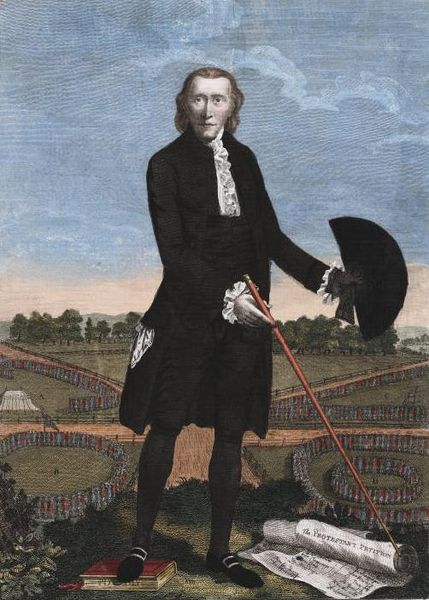
Lord George Gordon in 1780
Gordon is, in short, an ascetic whereas Gashford is both a hypocrite and a glutton, "who ate and drank to the last minute, and required some three or four reminders from John Grueby, before he could resolve to tear himself away from Mr Willet's plentiful providing." He finally emerges from the inn, "wiping his greasy mouth," to join Gordon, "who had been walking up and down before the house talking to himself." As they ride away, Dickens describes Gordon as a figure reminiscent of Don Quixote: "a nobleman of somewhat quaint and odd exterior" who sits "bolt upright on his bony steed" with "his elbows stuck out on either side ungracefully, and his whole frame jogged and shaken at every motion of his horse's feet; a more grotesque or more ungainly figure can hardly be conceived." He talks to himself all the way to London, but stops when he begins to be recognized and people call out "Hurrah Geordie! No Popery!" Then he begins to doff his hat and bow "(to the deep and unspeakable disgust of John Grueby)" all the way through London to his house near Cavendish Square.

That afternoon, Gashford is visited by Ned Dennis, "a squat, thickset personage, with a low, retreating forehead, a coarse shock head of hair, and eyes so small and near together, that his broken nose alone seemed to prevent their meeting and fusing into one of the usual size.... in his grimy hands he held a knotted stick, the knob of which was carved into a rough likeness of his own face." (A note informs us that the actual Edward Dennis, the public hangman, didn't resemble Dickens's description.) Gashford and Dennis discuss the latter's work as hangman, Gashford answering in the affirmative Dennis's question: "My work, is sound, Protestant, constitutional, English work. Is it, or is it not?" He prides himself on the number of people he has hanged, noting that he would have hanged more if George III hadn't decided to give the condemned the option of enlisting in the army or navy. He supports the Protestant Association, he tells Gashford, because, "If these Papists gets into power, and begins to boil and roast instead of hang, what becomes of my work! ... I mustn't have no biling, no roasting, no frying -- nothing but hanging."

Gashford tells Dennis that next month, or perhaps in May, they will "convene our whole body for the first time. My lord has thoughts of our walking in procession through the streets -- just as an innocent display of strength -- and accompanying our petition down to the door of the House of Commons." They will be of such numbers that they will need to be divided into groups and "Lord George has thought of you as an excellent leader for one of these parties." Dennis agrees.

Grueby then enters to tell Gashford "here's another Protestant," but although Gashford says he can't see him now, the man walks in anyway. It is Hugh.
Gashford recognizes Hugh from the Maypole and tells Grueby that it's okay. Hugh then hands Gashford one of the handbills he had dropped there. "I want to make one against the Catholics, I'm a No Popery man, and ready to be sworn in. That's what I've come here for." Dennis says, "No Popery, brother!" and Hugh replies, "No Property, brother!" Gashford corrects him -- "Popery, Popery" -- but Dennis says, "It's all the same!" He also examines Hugh and observes, "Do but cast your eye upon it. There's a neck for stretching, Muster Gashford!" He is also delighted to hear that Hugh can't read or write, "those two arts being (as Mr Dennis swore) the greatest possible curse a civilised community could know, ... militating ... agasint the professional emoluments and usefulness of the great constitutional office he had the honour to hold."

After Gashford welcomes Hugh to the Protestant Association, Hugh and Dennis walk out together, and when they reach Westminster, Dennis points out to him the weaknesses of the building where the houses of Parliament met "and how plainly, when they marched down there in great array, their roars and shouts would be heard by the members inside; with a great deal more to the same purpose, all of which Hugh received with manifest delight." He points out to Hugh several of the members of Parliament, and tells him which are favorable to their cause and which aren't. There are others there for the same purpose, always in groups of two or three, but they don't speak to others outside their group. But occasionally a paper is passed from one group to another, but so quickly that Hugh is unable to see who is handing it out. "They often trod upon a paper like the one he carried in his breast, but his companion whispered him not to touch it or to take it up, -- not even to look towards it."

Dennis then suggests that they go to The Boot, a pub "in the fields at the back of the Foundling Hospital; a very solitary spot at that period." Hugh recognizes many of the people he had seen in the crowd at Westminster, and Dennis proclaims a toast to "the health of Lord George Gordon, President of the Great Protestant Association; which toast Hugh pledged likewise." A fiddler strikes up a tune and Hugh and Dennis perform "an extemporaneous No-Popery Dance."
Then Sim Tappertit arrives with two other members of the United Bulldogs, one of whom is Mark Gilbert, whom we saw initiated into the erstwhile 'Prentice Knights. Like Sim, the other two are no longer apprentices but journeymen. Sim is acquainted with Dennis, who informs him that Hugh has joined their movement. Sim realizes then that he has seen Hugh before, and asks him "Did you ever see me before? You wouldn't be likely to forget it, you know, if you ever did." Hugh confesses that he doesn't recognize Sim, which annoys Sim very much. Then Sim recognizes that Hugh was once "hostler at the Maypole." He tells Hugh that he visited there "to ask after a vagabond that had bolted off.... Don't you remember my thinking you liked the vagabond, and on that account going to quarrel with you; and then finding you detested him worse than poison, going to drink with you?" This refreshes Hugh's memory, and he becomes great friends with Sim.
"The bare fact of being patronised by a great man whom he could have crushed with one hand, appeared in his eyes so eccentric and humorous, that a kind of ferocious merriment gained the mastery over him, and quite subdued his brutal nature." When Sim gets up on a barrel to deliver a speech against Popery, Hugh stands beside him, "and though he grinned from ear to ear at every word he said, threw out such expressive hints to scoffers in the management of his cudgel, that those who were at first the most disposed to interrupt, became remarkably attentive, and were the loudest in their approbation."

At the other end of the room, there's a group of men "in earnest conversation all the time; and when any of this group went out, fresh people were sure to come in soon afterwards and sit down in their places, as though the others had relieved them on some watch or duty; which it was pretty clear they did, for these changes took place by the clock, at intervals of half an hour." They have a collection of newspapers and read articles aloud in a low voice from them. "But the great attraction was a pamphlet called The Thunderer, which espoused their own opinions, and was supposed at that time to emanate directly from the Association.... It was impossible to discard a sense that something serious was going on, and that under the noisy revel of the public-house, there lurked unseen and dangerous matter."

Sim, meanwhile, is trying to find out what Dennis's line of work is, but the hangman remains coy about it, though he puts "his fingers with an absent air on Hugh's throat, and particularly under his left ear, as if he were studying the anatomical development of that part of his frame." This leads Sim to guess that Dennis is "a kind of artist," which Dennis enthusiastically agrees to. Sim notices the portrait carved on top of Dennis's stick, which turns out to have been done by one of his victims, although Dennis circumlocutes his way around this revelation. He was there the morning he died, he admits. "He wouldn't have gone off half as comfortable without me. I had been with three or four of his family under the same circumstances." Then he comments that every item of clothing he is wearing "belonged to a friend of mine that's left off sich incumbrances for ever." 

When they leave The Boot, Hugh accompanies Sim until he remembers that he has somewhere to go, leaving Sim to imagine his new friend's role in a revolutionary future:
"In an altered state of society -- which must ensue if we break out and are victorious -- when the locksmith's child is mine, Miggs must be got rid of somehow, or she'll poison the tea-kettle one evening when I'm out. He might marry Miggs, if he was drunk enough. It shall be done. I'll make a note of it."

Monday, March 28, 2011

3. Barnaby Rudge, by Charles Dickens, pp. 86-118

Barnaby Rudge (Penguin Classics)Chapters 5-8
_____
Varden goes to Mrs. Rudge's house in Southwark, near London Bridge, to check on the wounded Edward Chester. Mary Rudge is "about forty -- perhaps two or three years older -- with a cheerful aspect, and a face that had once been pretty." There is a family resemblance between her and Barnaby, "but where in his face there was wildness and vacancy, in hers there was the patient composure of long effort and quiet resignation." In addition, there is "the faintest, palest shadow of some look, to which an instant of intense and most unutterable horror only could have given birth." Those who knew her before her husband was murdered "recollected how the change had come, and could call to mind that when her son was born, upon the very day the deed was known, he bore upon his wrist what seemed a smear of blood but half washed out."

Varden learns that Edward's father has visited him. He also makes reference to "our other friend, ... sharpest and cunningest of all the sharp and cunning ones." This is Dickens being coy, just as he was coy about the identity of Edward Chester as the preoccupied young man at the Maypole. Varden is referring to Barnaby's raven, whom we meet in the next chapter. Mrs. Rudge tells him that the raven is in Barnaby's room.

They are interrupted by the sound of someone knocking at the shutter, and Varden offers to go check it out. But Mrs. Rudge insists on going to see by herself. As she does so, "the knocking came again, and a voice close to the window -- a voice the locksmith seemed to recollect, and to have some disagreeable association with -- whispered 'Make haste.'"
The wind rumbling in the chimney made it difficult to hear what passed, but he could tell that the door was opened, that there was the tread of a man upon the creaking boards, and then a moment's silence -- broken by a suppressed something which was not a shriek, or groan, or cry for help, and yet might have been either or all three; and the words "My God!" uttered in a voice it chilled him to hear. 
He rushes out and sees the horrified Mrs. Rudge staring at the man he had nearly collided with on the road, the stranger from the Maypole, who immediately runs away. Varden pursues him, but Mrs. Rudge calls him back: "Do not touch him on your life. I charge you, come back. He carries other lives besides his own. Come back!" She drags him back into the house where she bolts every door.

Although he begs her to tell him who the man is, she refuses, telling him that she doesn't dare say anything more about him and to swear not to "let a word or look between us, recall this circumstance." She leaves him alone, puzzling about the matter, and he finally persuades himself "it may be nothing." Then Barnaby enters to tell him "I dreamed just now that something -- it was in the shape of a man -- followed me -- came softly after me -- wouldn't let me be -- but was always hiding and crouching, like a cat in dark corners, waiting till I should pass.... Nearer, nearer, nearer -- I ran faster -- leaped -- sprung out of bed, and to the window -- and there, in the street below -- but he is waiting for us. Are you coming?"

Varden tries to figure out if there is a connection between Barnaby's dream and what has just happened, but Barnaby leads him upstairs to see Edward Chester. Varden asks Chester to tell him what happened after he left the Maypole: He says he was overtaken on the road by a rider who asked the way to London and then tried to run him down. The man's hat was blown off and Chester saw that the man's head was wrapped in a dark handkerchief. He hadn't seen the stranger at the Maypole clearly, "But, if he and the robber were two different persons, their voices were strangely and most remarkably alike; for directly the man addressed me in the road, I recognised his speech again." Varden realizes that this was the same man whom he had just seen downstairs.

But now they are interrupted by the raven, who has been listening to their conversation and begins to chatter and make noise. Varden asks Barnaby to call the raven, but Barnaby insists "He calls me, and makes me go where he will. He goes on before, and I follow. He's the master, and I'm the man. Is that the truth, Grip?" Mrs. Rudge enters the room, and Chester asks about the noise he heard earlier. Varden tells him it was a drunk who "mistook the house, and tried to force an entrance."

When Varden takes his leave, he tells Mrs. Rudge that he told a lie for her sake, and worries about leaving Chester there: "I doubt the safety of this roof, and am glad he leaves it so soon." And as he walks away, he hears the raven barking like a dog and thinks, "If there's any wickedness going on, that raven's in it, I'll be sworn."

At Varden's house, he is being awaited by his wife, "a lady of what is commonly called an uncertain temper -- a phrase which being interpreted signifies a temper tolerably certain to make everybody more or less uncomfortable.... [Her] chief aider and abettor, and at the same time her principal victim and object of wrath, was her single domestic servant, one Miss Miggs ... [who] held the male sex to be utterly contemptible and unworthy of notice." So he is not exactly greeted pleasantly when he gets home. Still, Varden reflects, "all of us have our faults. I'll not be hard upon hers. We have been man and wife too long for that."

Meanwhile, his apprentice, Sim Tappertit, has made a copy of the house key, so he can sneak out after Varden goes to bed. He goes to a street "of more than questionable character" and enters "a low-browed doorway [that] led into a blind court, or yard, profoundly dark, unpaved, and reeking with stagnant odours." He enters a house where he is greeted as "the captain" and goes to the cellar, a damp room where "the air was sickening, tainted, and offensive. It seemed, from one strong flavour which was uppermost among the various odours of the place, that it had, at no very distant period, been used as a storehouse for cheeses." The proprietor of the place, named Stagg, is blind.

It seems that Tappertit is the presiding figure of a group of apprentices known as the 'Prentice Knights. He is saluted by Stagg with "drink, noble governor. Death to all masters, life to all 'prentices, and love to all fair damsels. Drink, brave general, and warm your gallant heart!" Tappertit takes the glass and "Stagg then dropped on one knee, and gently smoothed the calves of [Tappertit's] legs, with an air of humble admiration." Tappertit is gratified by this appreciation of "his favourite limbs."

He then enters a room where the others are gathered and is handed a human thigh-bone, "a sceptre and staff of authority," and climbs up on "a large table, whereon a chair of state, cheerfully ornamented with a couple of skills, was placed ready for his reception." Another man enters with a large book and sits on a lower chair on the table.
A ceremony follows to induct a new apprentice in the organization:
"Mark Gilbert. Age, nineteen. Bound to Thomas Curzon, hosier, Golden Fleece, Aldgate. Loves Curzon's daughter. Cannot say that Curzon's daughter loves him. Should think it probable. Curzon pulled his ear last Tuesday week." 
Captain Tappertit orders a black mark put beside Curzon's name, and after additional information about the master's offenses, ups it to three black crosses, though he doesn't respond to Gilbert's specific request that the 'Prentice Knights burn Curzon's house down and help him carry off his daughter. He then leads the novice through oaths of fealty to the Constitution, Church, State "and everything established -- but the masters." And he describes "their general objects; which were briefly vengeance on their Tyrant Masters ... and the restoration ... of their ancient rights and holidays; for neither of which objects were they now quite ripe, being barely twenty strong, but which they pledged themselves to pursue with fire and sword when needful."

After the novice is welcomed to the society, Tappertit collects from him a wax impression of the novice's door-key, "for he had constructed secret door-keys for the whole society, and perhaps owed something of his influence to that mean and trivial circumstance -- on such slight accidents do even men of mind depend!" He also has the secretary of the group "write and post against the wall, a notice, proscribing one Joseph Willet (commonly known as Joe) of Chigwell; forbidding all 'Prentice Knights to succour, comfort, or hold communion with him; and requiring them, on pain of excommunication, to molest, hurt, wrong, annoy, and pick quarrels with the said Joseph, whensoever and wheresoever they, or any of them, should happen to encounter him."

After the group breaks up and heads for home as dawn is breaking, Stagg mutters, "Farewell, brave general. Bye, bye, illustrious commander. Good luck go with you for a -- conceited, bragging, empty-headed, duck-legged idiot."