Chapter 32
Jacob sends word to Esau that he is returning with "oxen, and asses, flocks, and menservants, and womenservants. And he gets word back that Esau is coming to meet him with four hundred men. Since the last he heard, twenty years ago, is that his brother wanted to kill him, Jacob is "greatly afraid and distressed" by the news. So he divides his people and his flocks into two groups; if Esau attacks one of the groups, at least the others will escape. He also prays to God for deliverance from his brother.
Then he prepares a present for Esau: "Two hundred she goats, and twenty he goats, two hundred ewes, and twenty rams, Thirty milch camels with their colts, forty kine, and ten bulls, twenty she asses, and ten foals." He puts his servants in charge of each drove of animals, and tells them that if Esau meets them, they should tell him it's a present for him. Then he sends his wives and his children ahead, and spends the night alone.
During the night, he wrestles with a man until dawn. The man, evidently an angel, doesn't win, but he touches "the hollow of his thigh" and puts it "out of joint." Finally the man asks Jacob to let him go, but Jacob says he won't until he gets a blessing. So he says, "Thy name shall be called no more Jacob, but Israel: for as a prince hast thou power with God and with men, and hast prevailed."
 |
| Eugène Delacroix, Jacob Wrestling With the Angel, 1854-1861 |
Because of the disjointed thigh, Jacob limps away. "Therefore the children of Israel eat not
of the sinew which shrank, which
is upon the hollow of the thigh, unto this day."
Now he sees Esau and his four hundred men coming, so he gets his family ready, putting the handmaids and their children in the forefront, then Leah and her children, and finally Rachel and Joseph. But to his surprise, Esau runs to meet him, hugs and kisses him, and they both weep.
 |
| Peter Paul Rubens, The Reconciliation of Jacob and Esau, 1625-28 |
Esau asks about all the animals that were being sent before him, and Jacob explains that they are a gift, "to find grace in the sight of my lord." But Esau says he has plenty and to keep what he has. Jacob insists, however, and and Esau accepts.
Esau suggests that they go on together, but Jacob points out that there are small children and young animals with him, so it would be better if he came along at a slower pace. So Esau goes back to Seir, and Jacob makes his way to Succoth where he builds a house and barns. Then he goes to Shechem and pitches a tent outside of the city.
Chapter 34
Dinah, Jacob's daughter by Leah, goes "out to see the daughters of the land," which I guess means she goes into the city of Shechem to visit some new acquaintances. While she's there, however, she is spotted by the prince named Shechem, who "took her, and lay with her, and defiled her," which seems to mean that she was raped. Then he decides he wants to marry her, to he tells his father, Hamor, to arrange it for him.
Jacob hears about the rape of Dinah while his sons are out tending the cattle. Hamor arrives to try to arrange her marriage to Shechem, as well as Jacob's granddaughters with other men of the city. Jacob's sons are furious when they hear how their sister was treated, and they insist that if these marriages are to take place, all the men of the city must be circumcised.
Hamor and Shechem are willing, and they tell the men of the city about the deal. They agree to it as well. But three days after all the men were circumcised, "when they were sore," two of Jacob's sons, Simeon and Levi, enter the city and slaughter all the men, including Hamor and Shechem. They take all the cattle in the city, along with the women and children.
Jacob isn't happy at all, telling Simeon and Levi, "Ye have troubled me to make me to stink among the inhabitants of the land." He fears that the other Canaanites will rise up against him because of their slaughter of the Shechemites. But Simeon and Levi protest, "She he [presumably Shechem] deal with our sister as with an harlot?"
Chapter 35
So Jacob decides to move to Beth-el, and tells everyone to leave any "strange gods," i.e. idols, behind. There God appears to him again, and tells Jacob his name is now Israel, and repeats his promise that his descendants will be numerous and will include kings.
Then they journey from Beth-el to Ephrath, which is now Bethlehem, and along the way Rachel gives birth to Benjamin, but dies in childbirth. This makes a total of twelve sons of Jacob, or Israel: Reuben, Simeon, Levi, Judah, Issachar, and Zebulun by Leah; Joseph and Benjamin by Rachel; Dan and Naphtali by Bilhah, Rachel's handmaid; and Gad and Asher by Zilpah, Leah's handmaid.
Jacob goes to see his father, Isaac, in Hebron, and Isaac dies, age one hundred eighty, and is buried by Esau and Jacob.
Chapter 36
Now there's a list of the descendants of Esau, who becomes the father of the Edomites. Esau and Jacob have to part ways because they are so rich and have so much cattle that there isn't enough land for both of them to live in the same place.
Chapter 37
When Joseph is seventeen, he gives his father an "evil report" about the doings of the sons of Bilhah and Zilpah. Joseph is Israel's favorite, and he has a "coat of
many colours" made for him. This doesn't endear him to his brothers, and Joseph makes things worse by telling them of a dream he had: They were "binding sheaves in the field," and his sheaf stood upright while their sheaves bowed down to it.
And his brethren said to him, Shalt thou indeed reign over us? or shalt thou indeed have dominion over us? And they hated him yet the more for his dreams, and for his words.
Then he tells them about another dream in which "the sun and the moon and the eleven stars made obeisance to me." This dream displeases his father, too: "Shall I and thy mother and thy brethren indeed come to bow down ourselves to thee to the earth?"
When his brothers go off to Shechem to feed the flocks there, Israel sends Joseph to see how they are getting along. A man Joseph meets tells them they are at Dothan, so Joseph goes there. But when the brothers see him coming, they start plotting to kill "this dreamer." They plan to throw his body into a pit and say a wild beast ate him. Reuben, however, says they shouldn't kill him, but just throw him into the pit.
So when Joseph gets there, the brothers strip him of his coat of many colors and throw him into the pit. While the brothers are eating, a caravan of Ishmeelites, carrying spices to Egypt, passes by. So Judah suggests that they should make some money by selling Joseph to the Ishmeelites, who agree to pay them twenty pieces of silver.
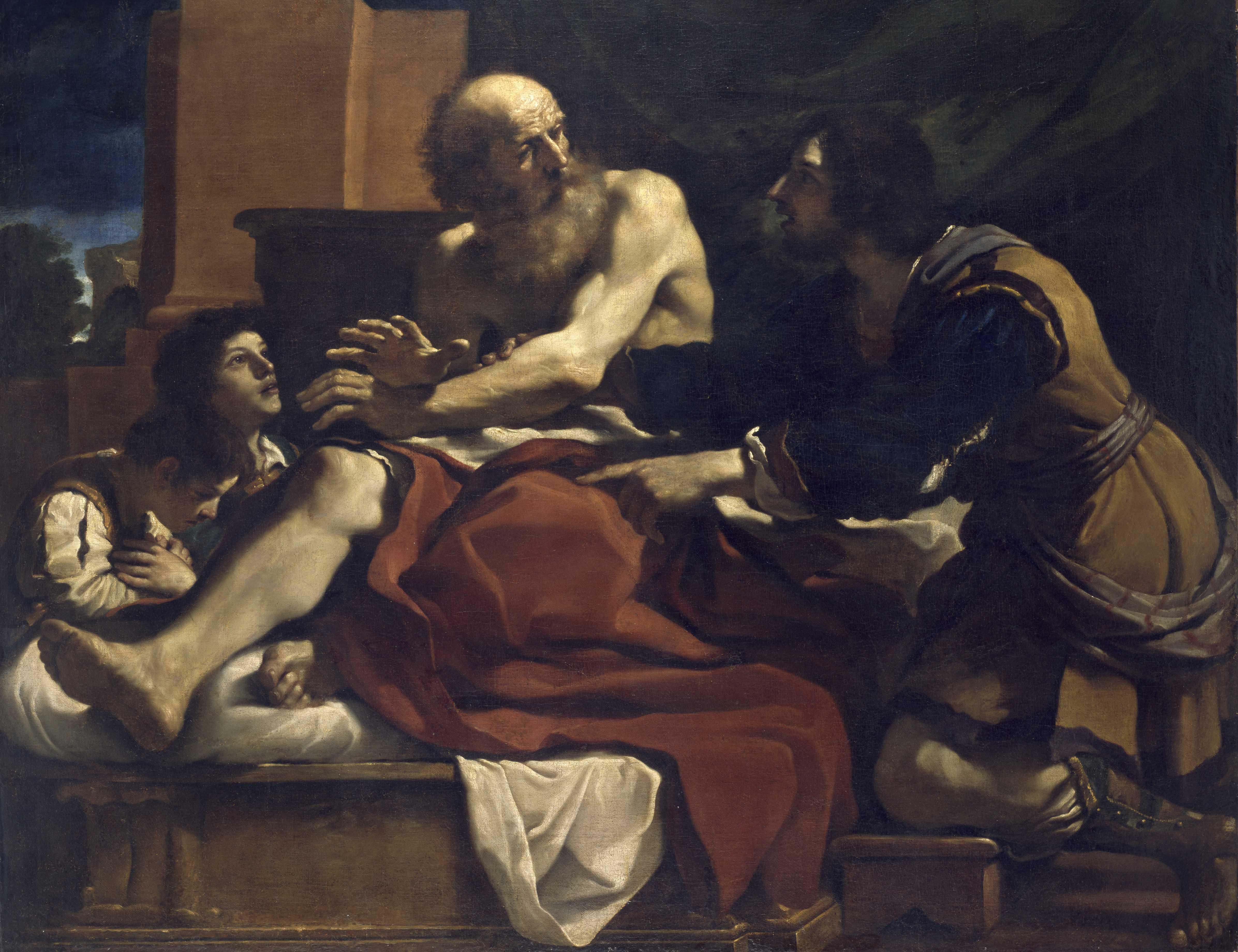
Reuben, who was away while this deal was being made, returns to find Joseph gone, and realizes that they need a story to tell their father. So they take the coat of many colors and dip it in some goat's blood. When they take it to their father, he recognizes it and concludes that "an evil beast hath devoured him." He tears his clothes and puts on sackcloth, and refuses to be consoled.
 |
| Giovanni Andrea de Ferrari, Joseph's Coat Brought to Jacob, c. 1640 |
Joseph is taken to Egypt and sold to Potiphar, the captain of Pharaoh's guard.
Chapter 38
Judah has had three children by a woman named Shuah. Their names are Er, Onan, and Shelah. He arranges a marriage of Er to a woman named Tamar, but Er is wicked and God kills him. So Judah tells Onan to marry his brother's wife. But Onan knows that the child won't be his, so when he has sex with Tamar, he resorts to coitus interruptus, spilling his seed on the ground, "lest that he should give seed to his brother." (Masturbation is sometimes, and apparently erroneously, called "onanism.") But God doesn't like his doing this, so he kills Onan, too.
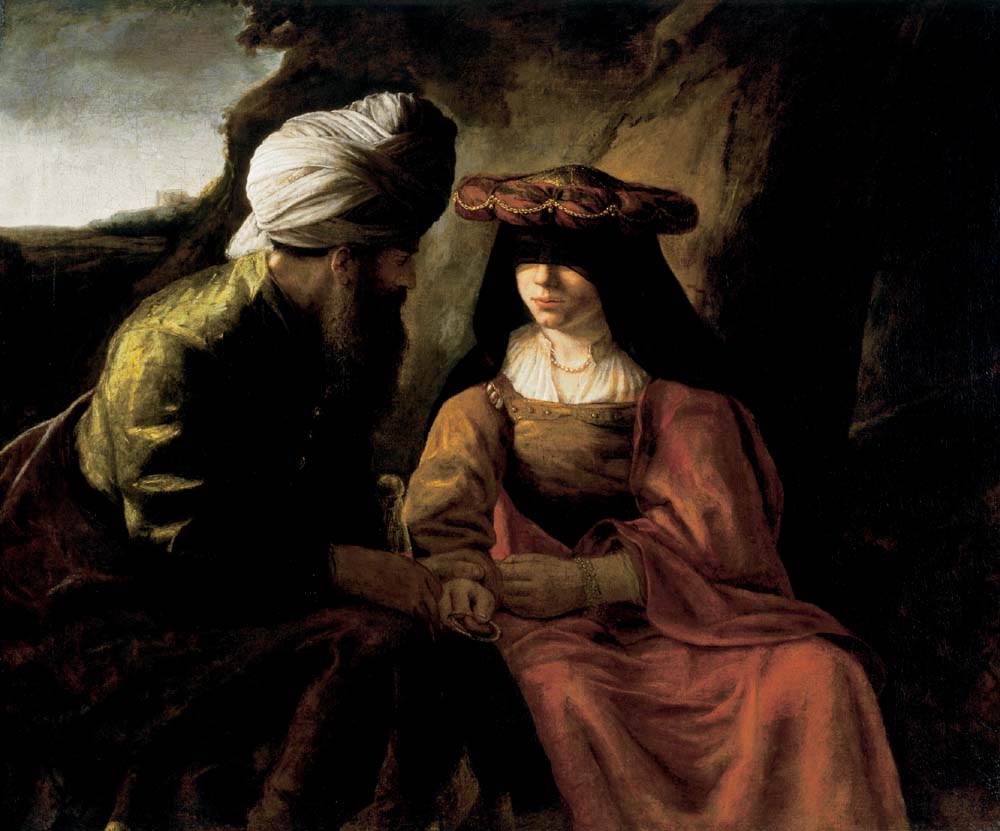
Judah then tells Tamar to wait until Shelah is grown, so Tamar goes to live with her father in the meantime. After Judah's wife dies, he goes to shear sheep at Timnath. Tamar hears this, and having realized that Shelah must be grown now and she hasn't been married to him, she puts on a veil and goes to sit by the road on the way to Timnath. Judah sees her and thinks she's a prostitute because her face is covered.
 |
| School of Rembrandt, Judah and Tamar, c. 1650-1660 |
She asks what he will pay her, and he tells her he'll send her a kid from the flock he's going to shear. But she wants a pledge from him that he'll deliver the kid, so she asks for his signet, his bracelets, and the staff he is carrying. He gives them to her, sleeps with her, and she gets pregnant.
Judah sends a friend to deliver the kid, but he can't find "the harlot, that
was openly by the way side," and people tell him there is no such harlot. So the friend goes back and tells Judah that he can't find her. Then about three months later, Judah hears that his daughter-in-law is "with child by whoredom," so Judah sends for her, intending to have her burnt.
When she arrives, she shows him the signet, the bracelets, and the staff, and tells him that they belong to the father of her child. He realizes what has happened, and says, "She hath been more righteous than I; because that I gave her not to Shelah my son."
Tamar turns out to be pregnant with twins, and during labor, when the midwife sees one put out his hand, she ties a scarlet thread around it, "saying, This came out first." But the baby pulls his hand back in and his brother comes out first. He is named Pharez. Then the other baby is born with the scarlet thread on his hand and is called Zarah.