JOURNAL OF A COMPULSIVE READER
By Charles Matthews
Showing posts with label Hortense. Show all posts

Friday, July 1, 2011

23. Bleak House, by Charles Dickens, pp. 816-865

Chapter 54: Springing a Mine through Chapter 56: Pursuit

Sir Leicester agrees to meet with Bucket in the library, excusing himself because he is "not well.... I am subject to -- gout." Sir Leicester hesitates about specifying the illness but realizes that "Mr Bucket palpably knows all about it." He suggests that Volumnia wishes to join them, too, but Bucket quickly puts an end to that idea. After checking that the door is locked, and that the key prevents anyone from peeking in, Bucket gets to the point: "I wanted but a very little to complete this case. I have now completed it, and collected proof against the person who did this crime." And it wasn't George: "It was a woman." Then he ceases to be so direct, preparing Sir Leicester for the revelations to come. But when he mentions Lady Dedlock, "Sir Leicester raises himself in his seat, and stares at him fiercely."

Bucket presses on, however, telling Sir Leicester, "She is the pivot it all turns on." Sir Leicester's anger continues: "My Lady's name is not a name for common persons to trifle with!" Still Bucket proceeds, telling Sir Leicester that Tulkinghorn "long entertained mistrusts and suspicions of Lady Dedlock." Sir Leicester says he would have killed Tulkinghorn himself if he had "dared to breathe them to me." But Bucket continues, telling him that Tulkinghorn's suspicions grew from Lady Dedlock's awareness of "the existence, in great poverty, of a certain person, who had been her lover before you courted her, and who ought to have been her husband." The man subsequently died, Bucket continued, and Tulkinghorn "suspected Lady Dedlock of visiting his wretched lodging, and his wretcheder grave, alone and in secret."

He then tells of the trick played on Jo in Tulkinghorn's office, in which Hortense appeared in the clothes that Lady Dedlock had borrowed from her, confirming Tulkinghorn's suspicions. He then suggests that Sir Leicester ask his wife whether, after Tulkinghorn left their house on the night of his murder, "she didn't go down to his chambers with the intention of saying something further to him, dressed in a loose black mantle with a deep fringe to it." If she denies it, he tells the baronet, "tell her that it's no use; that Inspector Bucket knows it, and knows that she passed the soldier as you called him (though he's not in the army now) , and knows that she knows she passed him, on the staircase."

Sir Leicester has turned pale, "and Mr Bucket soon detects an unusual slowness in his speech, with now and then a curious trouble in beginning, which occasions him to utter inarticulate sounds." He informs Sir Leicester of his suspicion that Tulkinghorn was holding this information over Lady Dedlock, threatening to reveal it to her husband.

But then Bucket is interrupted by the sound of a commotion in the hall. He listens, and recognizing what it's all about, suggests that they "let in these people now in a wrangle with your footmen," urging him to remain silent while he deals with them. Sir Leicester agrees, and admits two footmen carrying a man in a chair, accompanied by another man and two women. Bucket identifies the man in the chair as Smallweed, who identifies the others as Mr and Mrs Chadband and Mrs Snagsby. Smallweed proceeds to tell Sir Leicester that he found letters at Krook's "from the lodger's sweetheart, and she signed Honoria" -- the implication being that that's Lady Dedlock's name. Smallweed is there because he wants the letters, and asks if Sir Leicester isn't concerned about them, "Not with Captain Hawdon and his ever affectionate Honoria, and their child into the bargain?" And he implies that Lady Dedlock murdered Tulkinghorn for them.

But Bucket is a match for Smallweed, and produces the letters "from a mysterious part of his coat." Smallweed lays claim to them, and says he wants five hundred pounds for them. "'No you don't; you mean fifty,' says Mr Bucket, humorously." They proceed to bargain a little, until Bucket turns his attention to Chadband, who launches into one of his perorations until Bucket makes him come to the point and introduce his wife, who tells them, "I helped to bring up Miss Hawdon, her Ladyship's daughter. I was in the service of her Ladyship's sister, who was very sensitive to the disgrace her Ladyship brought upon her" -- Mrs Chadband lays "a bitter stress on the word 'Ladyship.'"

Then Bucket turns to Mrs Snagsby, whose presence there is at best tangential, except that she is convinced that the whole affair has something to do with her husband deceiving her and that he was the father of Jo. Bucket "has seen through the transparency of Mrs Snagsby's vinegar at a glance," so he ignores her and turns his attentions again to Smallweed and the Chadbands. He chides them for making a racket in the hall, rings for the footmen, and has them escorted out.

He turns to Sir Leicester and says that the letters in question can "be bought pretty cheap," if he wishes, but first there's the matter of apprehending the murderer, who "is now in this house." He rings for the footman who escorts Mademoiselle Hortense into the room. He informs Sir Leicester that Hortense has been a lodger in Bucket's for several weeks, and he informs her that he's taking her into custody for Tulkinghorn's murder. He then tells Sir Leicester about Hortense's hatred of Lady Dedlock for discharging her -- which Hortense disputes, as she does everything Bucket says, claiming, "I discharge myself." He cautions her to be silent, that anything she says can be used against her, but she's incapable of that. He continues to tell of her claim on Tulkinghorn for her participation in the masquerade in Tulkinghorn's chamber that revealed Lady Dedlock as the woman whom Jo showed to Hawdon's grave. And that while she was Bucket's lodger, she persisted in harassing Tulkinghorn and, to get to him, Snagsby.

After the murder, Bucket says, he arrested George because there was enough evidence for him to do so, but he was not convinced of the man's guilt. Then he went home, where Hortense was having supper with Mrs Bucket, and was persuaded by Hortense's exaggerated "respect, and all that, for the lamented memory of the deceased Mr Tulkinghorn" and when he "saw her with a knife in her hand, that she had done it!" Hortense claimed that she had been to the theater that night, and Bucket says that he has discovered that she was there "both before the deed and after it." So realizing that she was very calculating, he set a trap for her. Mrs Bucket was to continue to tell Hortense that he was convinced that George was the murderer.

But Hortense, he says, went too far. She began trying to manipulate the evidence to show that Lady Dedlock had killed Tulkinghorn. "Sir Leicester rises from his chair, and staggers down again." Hortense began writing letters to Bucket indicating that Lady Dedlock was the murderer, but Mrs Bucket was spying on her as she wrote them, and now has the letter paper and the ink as evidence.

Both Lady Dedlock and George were at Tulkinghorn's the night of the murder, and Bucket is certain that Hortense saw them from where she was waiting. "I found the wadding of the pistol with which the deceased Mr Tulkinghorn was shot. It was a bit of the printed description of your house at Chesney Wold." Mrs Bucket has the rest of the paper that Hortense tore up to make the wadding. Mrs Bucket had also accompanied Hortense to the funeral procession for Tulkinghorn, and afterward, Hortense suggested that they go to tea at a place on the edge of London. Near the tea house, there is a small body of water, and Hortense left Mrs Bucket for a short while on the pretense of finding her pocket-handkerchief; "she was rather a long time gone, and came back a little out of wind." Bucket had the pond dragged, and the gun was retrieved from it.

So Bucket puts the handcuffs on her, and although she struggles, raging all the while about Bucket and his wife, he manages to take her away. When they are gone, Sir Leicester collapses, his thoughts on his wife. "And, even to the point of his sinking on the ground, oblivious of his suffering, he can yet pronounce her name with something like distinctness in the midst of those intrusive sounds, and in a tone of mourning and compassion rather than reproach."

Meanwhile, Mrs Bagnet is returning by chaise from Lincolnshire with Mr George's mother. "Railroads shall soon traverse this country," Dickens observes, which the note tells us puts the date of the events in Bleak House somewhere in the late 1830s.  George's mother is Mrs Rouncewell, and he is the wayward son who left to join the army and hasn't been heard from since. George had seen Mrs Rouncewell at Tulkinghorn's office, and in talking about her has made Mrs Bagnet realize that she is his mother. Mrs Bagnet tells her that George is determined not to have a lawyer, but "'It won't do to have truth and justice on his side; he must have law and lawyers,' exclaims the old girl, apparently persuaded that the latter form a separate establishment, and have dissolved partnership with truth and justice for ever and a day." (Dickens can do irony when he puts his mind to it and has the right voice for it.)

When they reach London, they enter George's cell quietly. He "is writing at his table, supposing himself to be alone [and] does not raise his eyes, but remains absorbed."
Hablot Knight Browne (Phiz), Mrs Bagnet Returns From Her Expedition (Source: David Perdue's Charles Dickens Page)
Finally, Mrs Rouncewell speaks: "George Rouncewell! O my dear child, turn and look at me!" And the usual reconciliation scene proceeds. George expresses his regret for not contacting her over the years, saying that he had put it off so long that it no longer seemed to matter, and that when he heard about his brother's success he was ashamed of his own lack of it. He was afraid that they would try to "set me up as a respectable civilian. But how could any of you feel sure of me, when I couldn't so much as feel sure of myself?" Mrs Rouncewell wants to send for his brother now, but he asks her not to: He wants to be the one to make contact with his brother and to see his reaction for himself.

Mrs Rouncewell takes her leave and goes to the Dedlocks' town house, where she proceeds to Lady Dedlock's room. She tells her that she has found her lost son in prison for murdering Tulkinghorn. "Her Lady's handsome eyes regard her with astonishment, almost with fear." Mrs Rouncewell also tells her that last night "the step upon the Ghost's Walk was so constant and so solemn that I never heard the like in all these years." And then, she says, "I got this letter." She gives it to Lady Dedlock with a plea to help free her son.

When she is gone, Lady Dedlock reads it: "a printed account of the discovery of the body, as it lay face downward on the floor, shot through the heart, and underneath is written her own name, with the word Murderess attached." She drops the letter. Then a servant announces that Mr Guppy is there to see her. She admits him. In his roundabout way, Guppy finally gets to the point that he is there to warn her that Smallweed and the Chadbands have been there this morning, and he is certain that "those letters I was to have brought to your Ladyship were not destroyed when I supposed they were.... That the visitors I have alluded to have been here this morning to make money of it. And that the money is made, or making."

After he leaves, she rings for a servant who confirms Guppy's story of the visitors. "So! All is broken down. Her name is in these many mouths, her husband knows his wrongs, her shame will be published -- may be spreading while she thinks about it -- and in addition to the thunderbolt so long foreseen by her, so unforeseen by him, she is denounced by an invisible accuser as the murderess of her enemy." Tulkinghorn's death was "the key-stone of a gloomy arch removed, and now the arch begins to fall in a thousand fragments, each crushing and mangling piecemeal!" She is convinced "there is no escape but in death," and she sits down and writes a letter to her husband in which she tells him she went to Tulkinghorn's that night to plead with him. "I found his house dark and silent. I rang twice at his door, but there was no reply, and I came home." She "writes this last adieu!" then dresses, leaving her jewels and her money and goes out "in the shrill frosty wind."

Volumnia is the one who discovers the unconscious Sir Leicester on the floor of the library. "He fell down, this morning, a handsome stately gentleman; somewhat infirm, but of a fine presence, and with a well-filled face. He lies upon his bed, an aged man with sunken cheeks, the decrepit shadow of himself." When he regains consciousness he is unable to speak, but Mrs Rouncewell realizes that he wants a slate to write on. He asks about Lady Dedlock and they tell him she has gone out. He wants to know where, and they bring him her letter, which causes him to fall unconscious again. When he awakes, he writes the letter B on the slate, which Mrs Rouncewell interprets as a summons for Bucket.

Sir Leicester gives the letter to Bucket to read, and then writes, "Full forgiveness. Find--." Bucket agrees, and Sir Leicester has him open a box and take out money for expenses. Before he leaves, Bucket tells Mrs Rouncewell that George has been freed, and urges her to turn her attention to Sir Leicester. He then goes to Lady Dedlock's room to search for clues, and finds Esther's handkerchief in the inner drawer of a little chest. He then goes to George's Shooting Gallery, where George gives him Esther's address in town. He is admitted there by Jarndyce, and tells him that Sir Leicester has suffered "apoplexy or paralysis" and that Lady Dedlock has disappeared: "It looks like suicide." He asks for Esther's help in following Lady Dedlock, thinking that "if I follow her in company with a young lady, answering to the description of a young lady that she has a tenderness for," it will be easier to find her.

As he waits for Esther to join him in the search, Bucket tries to imagine where she might go.
On the waste, where the brick-kilns are burning with a pale blue flare; where the straw-roofs of the wretched huts in which the bricks are made, are being scattered by the wind; where the clay and water are hard frozen, and the mill in which the gaunt blind horse goes round all day, looks like an instrument of human torture; -- traversing this deserted blighted spot, there is a lonely figure with the sad world to itself, pelted by the snow and driven by the wind, and cast out, it would seem, from all companionship. It is the figure of a woman, too; but it is miserably dressed, and no such clothes ever came through the hall, and out at the great door, of the Dedlock mansion.
Hablot Knight Browne (Phiz), The Lonely Figure (Source: David Perdue's Charles Dickens Page)
 _____
The 2005 BBC/Masterpiece Theatre dramatization features Gillian Anderson as Lady Dedlock, Anne Reid as Mrs Rouncewell, Nathalie Press as Caddy Jellyby, Richard Harrington as Allan Woodcourt, Matthew Kelly as Mr Turveydrop, Bryan Dick as Prince Turveydrop, Anna Maxwell Martin as Esther Summerson, Patrick Kennedy as Richard Carstone, Carey Mulligan as Ada Clare, Denis Lawson as John Jarndyce, Alun Armstrong as Mr Bucket, Richard Cant as Mercury, Tom Georgeson as Clamb, Lilo Baur as Hortense, Phil Davis as Smallweed, Loo Brealey as Judy Smallweed, Timothy West as Sir Leicester Dedlock, Hugo Speer as Mr George, Michael Smiley as Phil Squod, Nathaniel Parker as Harold Skimpole, Dermot Crowley as Mr Vholes, Burn Gorman as Guppy.


Sunday, June 26, 2011

18. Bleak House, by Charles Dickens, pp. 638-686

Chapter 40: National and Domestic through Chapter 43: Esther's Narrative

There has been a change in government, necessitating new elections, so "the London season comes to a sudden end" so that the members of Parliament may campaign for re-election. This brings Sir Leicester home to Chesney Wold, which means the house has to be opened up. Dickens indulges here in a rather lovely but somewhat sinister description of the sun shining into the empty house, illuminating the portraits of Dedlocks past and bringing them to a kind of life.
But the fire of the sun is dying. Even now the floor is dusky, and shadow slowly mounts the walls, bringing the Dedlocks down like age and death. And now, upon my lady's picture over the great chimney-piece, a weird shade falls from some old tree, that turns it pale, and flutters it, and looks as if a great arm held a veil or hood, watching an opportunity to draw it over her.
As if the Ghost's Walk weren't enough haunting for one place.
Hablot Knight Browne (Phiz), Sunset in the Long Drawing-Room at Chesney Wold (Source: David Perdue's Charles Dickens Page)
A groom tells Mrs Rouncewell that Lady Dedlock has not been well since her last visit to the house, and now that she's there again she "takes no great pains to entertain the numerous guests, and, being still unwell, rarely appears until late in the day." There is much talk of politics, of course, in which she takes no interest.

She is sitting in a window looking out at the falling shadows in the park when the arrival of Mr Tulkinghorn is announced. This seems to attract her notice, but only for a moment. There is a gunshot that causes cousin Volumnia to give "her little withered scream," and ask what has happened. "'A rat,' says my Lady. 'And they have shot him.'" At this moment, Tulkinghorn enters. He announces that Sir Leicester's party has lost the seat for which the opposition wanted to put up Mrs Rouncewell's son. Sir Leicester was gratified that Mr Rouncewell chose not to run, but Tulkinghorn tells him that Rouncewell was active in the election -- "against you" and that his son, whom we know as Watt, was active also.

Sir Leicester turns to Lady Dedlock and says, "My Lady, let me suggest in reference to that young woman--" -- meaning Rosa, of course. But she cuts him off: "'I have no intention,' observes my Lady from her window, in a low but decided tone, 'of parting with her.'" Sir Leicester says he only wanted to ask that she "should exert your influence to keep her from these dangerous hands." Tulkinghorn observes "that these people are, in their way, very proud," and that he wouldn't be surprised if they "abandoned the girl ... supposing she remained at Chesney Wold." And then he proposes to tell a story.
"A townsman of this Mr Rouncewell, a man in exactly parallel circumstances as I am told, had the good fortune to have a daughter who attracted the notice of a great lady. I speak of really a great lady; not merely great to him, but married to a gentleman of your condition, Sir Leicester.... The lady was wealthy and beautiful, and had a liking for the girl, and treated her with great kindness, and kept her always near her. Now this lady preserved a secret under all her greatness, which she had preserved for many years. In fact, she had in early life been engaged to marry a young rake -- he was a captain in the army -- nothing connected with whom came to any good. She never did marry him, but she gave birth to a child of which he was the father."
Lady Dedlock remains "perfectly still" as Tulkinghorn tells this story, which ends with the lady betraying her secret through her "imprudence," causing not only "great domestic trouble and amazement," but also with the townsman removing his daughter from the lady's patronage, "as if the lady had been the commonest of commoners."

Perfectly aware why Tulkinghorn has told this story, Lady Dedlock sits through the conversation that follows, and when the other retire to bed, she does, too, "graceful" and "self-possessed." Tulkinghorn withdraws to his room, "sedately satisfied," because "To say of a man so severely and strictly self-repressed that he is triumphant, would be do to him as great an injustice as to suppose him troubled with love or sentiment, or any romantic weakness." His room is at the top of a turret, and he goes out onto its balcony. But he returns when he realizes that Lady Dedlock is at his door. She enters, and he sees "a wild disturbance -- is it fear or anger? -- in her eyes." She sits down and finally asks, "Why have you told my story to so many persons?" He says he did so to inform her that he knew it, and that he only learned it recently. She asks if it has become common gossip, and he it hasn't. As for the girl in the story, he says it was only a hypothetical case.

She volunteers to write or sign anything that would protect her husband, and he assures her that will not be necessary. And she tells him that she is prepared to leave Chesney Wold that night, and that all of her valuables, her jewels and dresses, will remain where they are. But he tells her not to do that: "before you reach the staircase I shall ring the alarm-bell and rouse the house. And then I must speak out, before every guest and servant, every man and woman in it." She must not do anything so drastic because "The sole consideration in this unhappy case is Sir Leicester.... Your flight, Lady Dedlock, would spread the whole truth, and a hundred times the whole truth, far and wide. It would be impossible to save the family credit for a day. It is not to be thought of." For the sake of Sir Leicester, the whole business must remain "hushed up, if it can be."

She replies, "I am to remain upon this gaudy platform, on which my miserable deception has been so long acted, and it is to fall beneath me when you give the signal?" And all he can say is that he will give her warning. His only concern, he insists is "Sir Leicester's feelings and honour, and the family reputation." She returns to her room where she paces the floor in anguish.

Tulkinghorn goes back to London where he finds Mr Snagsby waiting for him outside his office. Snagsby has been bedeviled by Mademoiselle Hortense, who has been regularly turned away from Tulkinghorn's offices, so she had decided to haunt Snagsby's, thinking that he can persuade Tulkinghorn to see her. Her continued presence there has driven Guster into fits and Mrs Snagsby into a jealous rage. So Tulkinghorn agrees to see her.

She arrives sooner than he anticipated, surprising him as he goes down to his wine cellar. She is furious that she was used by him to get the truth out of Jo and then paid off with two sovereigns -- which she now flings at him -- but is still unemployed: "Place me well. Find me a good condition! If you cannot, or do not choose to do that, employ me to pursue her, to chase her, to disgrace and to dishonour her." And she vows that she will keep coming back to annoy him until he does. He replies, "In this city, there are houses of correction (where the treadmills are, for women)" and that he has the power to see to it that she winds up in one if she continues to pester him or Snagsby. But she leaves angrily, making no promise not to keep bothering him.

Back at Bleak House, Esther is still worrying about Richard, and when she mentions to Jarndyce what a bad influence she thinks Skimpole is on Richard, Jarndyce doesn't take her seriously. "Who could be encouraged by Skimpole? .... Such an unworldly, uncalculating, gossamer creature, is a relief to him, and an amusement." But when she mentions that it was Skimpole who "introduced Richard to Mr Vholes, for a present of five pounds," Jarndyce looks troubled. Still, he is certain Skimpole is unaware that he might have done any harm by it, and proposes that they pay a visit to Skimpole at his home to discuss it with him.

Skimpole's household is as disorderly as one might expect. He greets them cheerfully, but when Jarndyce tries to reason with him about Richard's involvement with the Chancery suit, Skimpole blithely insists that it's all beyond his understanding. "I give you my word, Miss Clare and my dear Miss Summerson, I thought Mr Carstone was immensely rich. I thought he had only to make over something, or to sign a bond, or a draft, or a cheque, or a bell, or to put something on a file somewhere, to bring down a shower of money." He is surprised when Ada tells him that Richard is poor.

Esther is of two minds about Skimpole: "The more I saw of him, the more unlikely it seemed to me, when he was present, that he could design, conceal, or influence anything; and yet the less likely that appeared when he was not present, and the less agreeable it was to think of his having anything to do with anyone for whom I cared."

Skimpole presents his daughters, who are giddy young creatures, and his wife, "who had once been a beauty, but was now a delicate, high-nosed invalid suffering under a complication of disorders." One of their daughters has been "married these three years. Now, I dare say her marrying another child, and having two more, was all wrong in point of political economy, but it was very agreeable."

Skimpole returns with them to Bleak House, where they have a surprise visit from Sir Leicester Dedlock.
Hablot Knight Browne (Phiz), Sir Leicester Dedlock (Source: David Perdue's Charles Dickens Page)
He is there, he says, because he is concerned that his dispute with Boythorn may "have prevented you, still more ladies under your escort and charge, from seeing whatever little there may be to gratify a polite and refined taste, at my house, Chesney Wold." He had also heard that Skimpole had been with them, and was concerned that a man "who would appear to possess a cultivated taste for the Fine Arts, was likewise deterred, by some such cause, from examining the family pictures." As Skimpole is there, he is introduced and Sir Leicester extends his invitation in person.

When Sir Leicester has left, Esther decides that she has to tell Jarndyce the truth. "The possibility of my being brought into contact with my mother, of my being taken to her house, -- even of Mr Skimpole's, however distantly associated with me, receiving kindnesses and obligations from her husband -- was so painful, that I felt I could no longer guide myself without his assistance." So she goes to see him, and asks if he remembers the encounter with Lady Dedlock in which she spoke of Jarndyce's acquaintance with her sister. She asks him why the sisters went their separate ways.

Jarndyce is troubled by these questions, and replies, "Who could tell what the secrets of those two handsome and proud women were! You have seen Lady Dedlock. If you had ever seen her sister, you would know her to have been as resolute and haughty as she." Esther then says, "O guardian, I have seen her many and many a time!" He is puzzled by this response, but tells her that Lady Dedlock's sister was almost married to Mr Boythorn. It's her turn to be startled, and she asks why they didn't marry. Jarndyce says Boythorn conjectured that it had to do something with her quarrel with her sister.

Esther's characteristic response is to blame herself: "'O guardian, what have I done!' I cried, giving way to my grief; 'what sorrow have I innocently caused!'" Lady Dedlock's sister, she revealed, was the "godmother" who raised her. "And her sister is my mother!"
_____
The 2005 BBC/Masterpiece Theatre dramatization features Ian Richardson as Lord Chancellor, Patrick Kennedy as Richard Carstone, Dermot Crowley as Mr Vholes, Timothy West as Sir Leicester Dedlock, Gillian Anderson as Lady Dedlock, Charles Dance as Tulkinghorn, Emma Williams as Rosa, Anna Maxwell Martin as Ether Summerson, Denis Lawson as John Jarndyce, Lilo Baur as Hortense, Tom Georgeson as Clamb, Pauline Collins as Miss Flite, Phil Davis as Smallweed, Loo Brealey as Judy Smallweed, Nathalie Press as Caddy Jellyby, Bryan Dick as Prince Turveydrop, Matthew Kelly as Mr Turveydrop, Sheila Hancock as Mrs Guppy, Burn Gorman as Guppy, Carey Mulligan as Ada Clare, Nathaniel Parker as Harold Skimpole.


Monday, June 20, 2011

11. Bleak House, by Charles Dickens, pp. 366-406

Chapter 23: Esther's Narrative through Chapter 24: An Appeal Case

Jarndyce, Esther and Ada have returned to Bleak House after six weeks at Boythorn's, having had no more contact with Lady Dedlock, though they saw her in church. "I had a fancy," Esther says, "on more than one of those Sundays, that what this lady so curiously was to me, I was to her -- I mean that I disturbed her thoughts as she influenced mine, though in some different way."

One day, she is told that a person has come to see her, and is surprised to find that it's Mademoiselle Hortense. She tells Esther that she has left Lady Dedlock's service and pleads to be allowed to serve as Esther's maid. "I have an inexpressible desire to find service with a young lady who is good, accomplished, beautiful," and Esther fills the bill. Esther tries to persuade her that she doesn't want or need a maid, but Hortense says she'll work for her for free. She "seemed to bring visibly before me some woman from the streets of Paris in the reign of terror." Esther stands firm, however.

Before she leaves, Hortense says that her behavior on the day they encountered her at the keeper's lodge during the storm must have have surprised them. Esther admits that it did. "'I took an oath, mademoiselle,' she said, smiling, 'and I wanted to stamp it on my mind, so that I might keep it faithfully. And I will! Adieu, mademoiselle!'" They didn't see her again during their stay.

Meanwhile, Richard has been haunting Chancery and studying the Jarndyce and Jarndyce files and tells them that "nothing could be plainer than that the will under which he and Ada were to take, I don't know how many thousands of pounds, must finally be established, if there were any sense or justice in the Court of Chancery -- but O what a great if that sounded in my ears." He has become friends with Miss Flite, and Esther realizes "what a fatal link was riveting between his fresh youth and her faded age; between his free hopes and her caged birds, and her hungry garret, and her wandering mind."

One day, Esther goes into the city to meet Caddy Jellyby, who has asked her to come, and is met by Richard at the coach-office. He admits that he is not cut out for legal studies either, and that he is in debt: "I have taken rather too much to billiards, and that sort of thing." Finally he bursts into tears while talking about Ada: "I love her most devotedly; and yet I do her wrong, in doing myself wrong, every day and hour." But he persists in his belief that the suit will be settled in their favor, "and then you and Ada shall see what I can really be!" This disturbs Esther even more than his tears. Now, he says, he has decided that his real career should be the army. Esther accedes to this latest whim, but once again, "implored him, for Ada's sake, not to put any trust in Chancery."

Richard accompanies her to the meeting with Caddy and then takes his leave. Caddy announces that she and Prince Turveydrop are ready to announce their engagement, but they want Esther to be there when they approach by Mr Turveydrop and Mrs Jellyby. Esther agrees, so they go first to the dancing school. Mr Turveydrop is at first astonished when Caddy and Prince kneel before him and ask his blessing. He groans and sobs, "reclining on the sofa, and shutting out the sight with his hand, but when Prince vows, "with your approval and consent, father, we will devote ourselves to making your life agreeable." Esther notices that his attitude begins to change at this declaration, and when Prince says, "we shall always make you -- of course -- our first consideration," Mr Turveydrop gives in.
Hablot Knight Browne (Phiz), A Model of Parental Deportment (Source: David Perdue's Charles Dickens Page)
"My son and daughter, your happiness shall be my care. I will watch over you. You shall always live with me"; meaning, of course, I will always live with you; "this house is henceforth as much yours as mine; consider it your home. May you long live to share it with me!"
Leaving Prince in attendance on his father, Esther and Caddy then go to the Jellyby residence, which "looked dirtier and gloomier and ghastlier than ever," owing in part to the fact that Mr Jellyby has been forced to declare bankruptcy. Mrs Jellyby, of course, is unaffected by this turn of events: "He has been unfortunate in his affairs, and is a little out of spirits. Happily for me, I am so much engaged that I have no time to think about it." She turns her scorn on Caddy, however: "She has almost deserted her old employment, and in fact obliges me to employ a boy." Caddy protests, "surely you wouldn't have me be a mere drudge all my life," which raises her mother's ire: "A mere drudge? If you had any sympathy with the destinies of the human race, it would raise you high above any such idea." Caddy only adds fuel to the fire by saying that as concerns Africa she has no sympathies at all.

It takes Esther to prod Caddy into telling her mother the news that she is engaged. "'O, you ridiculous child!' observed Mrs Jellyby, with an abstracted air, as she looked over the dispatch last opened, 'what a goose you are!'" Caddy sobs out the truth, that she and Prince have obtained Mr Turveydrop's consent, "and I beg and pray you'll give us yours, Ma, because I never could be happy without it. I never, never could!" Mrs Jellyby is not happy, however, that Caddy should be "engaged to a dancing-master's son" when she could have had "Mr Quale, one of the first philanthropists of our time." But in the end, she decides that she can't "permit the film of a silly proceeding on the part of Caddy (from whom I expect nothing else), to interpose between me and the great African continent." And calling Caddy "a nonsensical child" and "a degenerate child," she decides that "the step is taken, and I have engaged a boy, and there is no more to be said," so she allows herself to be kissed so she can "clear off this heavy batch of papers before the afternoon post comes in!"

Esther cheers up Caddy as much as she can, by observing how much Caddy "would do for her unfortunate father, and for Peepy, when she had a home of her own," and then returns to Bleak House, where she has a surprise: Mr Jarndyce has hired Charley Neckett as her maid, and the other children are being taken care of: "Tom's at school, if you please, and learning so good! And little Emma, she's with Mrs Blinder, miss, a being took such care of!" Esther tells her never to forget who was their benefactor, and Charley says she won't: "It was all you, miss." Esther corrects her, "It was Mr Jarndyce, Charley." But Charley insists, "I am a little present with his love, and it was all done for love of you."

Meanwhile, Mr Jarndyce has has hands full with the mess Richard has made, extricating him from the arrangements with Mr Kenge. As ward of Chancery, Richard has to go before the Lord Chancellor to effect this latest revision in his career plans, and the Lord Chancellor is not pleased: He "described him, in open court, as a vexatious and capricious infant," and in chambers "very seriously reproved him for trifling with time, and not knowing his mind." But finally things are arranged for his entering the Horse Guards, applying for an Ensign's commission. He begins his military studies and in time "the commission was obtained, and Richard received directions with it to join a regiment in Ireland."

But before his departure, Jarndyce feels it necessary to have a serious talk with Richard and Ada about their future. He tells Ada, "Rick has now chosen his profession for the last time. All that he has of certainty will be expended when he is fully equipped. He has exhausted his resources, and is bound henceforward to the tree he has planted." But Richard persists in qualifying what Jarndyce has said: "I have exhausted my present resources," he insists, still clinging to the hope that a settlement will be reached. Jarndyce is appalled at this stubborn clinging to the Chancery case, and "with a sudden terror in his manner, and in an altered voice," pleads, "for the love of God, don't found a hope or expectation on the family curse! Whatever you do on this side the grave, never give one lingering glance towards the horrible phantom that has haunted us to manyh years. Better to borrow, better to beg, better to die!"

They are all shocked by Jarndyce's intensity. But he goes on further to propose that Richard and Ada release themselves of their commitment to each other, their engagement: "I ask you wholly to relinquish, for the present, any tie but your relationship.... Ada, it is better for him that he should be free, and that there should be no youthful engagement between you. Rick, it is better for her, much better; you owe it to her." He says that his experience with both of them has caused him to change his mind about the fitness of their engagement: "It is not right, and I must not recognise it."

Ada submits to the decision, and tells Richard, "I don't think you will fall in love with anybody else," and she is "not at all changeable," but she thinks Jarndyce is right in believing their engagement premature: "we are only cousins again, Richard -- for the time perhaps."

As Richard's departure for Ireland nears, he, Jarndyce, and Esther go to London to prepare. Ada remains behind at Bleak House. In London, Esther meets the man who has been training Richard with firearms and swords: Mr George. Jarndyce asks George how Richard's training has been going. "'Pretty good, sir,' he replied, folding his arms upon his broad chest, and looking very large. 'If Mr Carstone was to give his full mind to it, he would come out very good.... He did at first, sir, but not afterwards." It's a pattern Esther and Jarndyce have seen before in Richard. Then George suggests that perhaps he has "some young lady" on his mind, and looks at Esther. She hastens to assure him that she's not the young lady on Richard's mind.

Then Jarndyce tells George that she is Miss Summerson, and the look he gives her makes Esther ask if he has heard the name before. "No, miss. To my knowledge, I never heard it. I thought I had seen you somewhere." But both of them claim to remember faces well and that they've never seen each other before. Still, there is a moment of confusion before Jarndyce changes the subject, asking about the other pupils that George has trained. George mentions that one of them was, like Mr Jarndyce, a Chancery suitor. The man, "a small Shropshire farmer," he says, was so angry at how he had been treated by the law that George was afraid he intended to shoot someone and suggested he fine some other outlet for his anger.

"Was his name Gridley?" Jarndyce asks, and he and Esther are surprised at the coincidence when George says yes. Jarndyce says that he understands Gridley has gone too far in his protests about mistreatment by the court and is in hiding from the law. George admits as much, but adds that he's afraid Gridley "will be worn out soon," though he claims to know nothing about Gridley's whereabouts.

On the day of Richard's departure, everything having been taken care of, Richard proposes to Esther that they go watch the proceedings in the Court of Chancery. She has never been there, so she agrees. The scene is confusing and depressing, and "there seemed to be no reality in the whole scene, except poor little Miss Flite, the mad woman, standing on a bench, and nodding at us." She joins them, and they watch as "Jarndyce and Jarndyce" is called. "I counted twenty-three gentlemen in wigs, who said they were 'in it'; and none of them appeared to understand it much better than I." There is an hour of so of ineffectual business until the "huge volumes of affidavits" are bundled up and taken away again. "I glanced at Richard, on the termination of these hopeless proceedings, and was shocked to see the worn look of his handsome face."

Then Mr Guppy appears, and says that "there's a lady here, a friend of mine," who knows Esther. "As he spoke, I saw before me, as if she had started into bodily shape from my remembrance, Mrs Rachael of my godmother's house." She asks if Esther remembers her, and when Esther assures her she does, says, "'I am glad to see you, and glad you are not too proud to know me.' But indeed she seemed disappointed that I was not." When Esther calls her "Mrs Rachael," she "coldly" corrects her: She is now Mrs Chadband. Guppy and Mrs Chadband depart, but now Mr George makes his way through the crowd. He is looking for "a little cracked old woman," he says, unaware that Miss Flite is standing there beside Esther.

George asks Esther, "in a low whisper," if she recalls the conversation they had about Gridley. When she says yes, he tells her, "He is hiding at my place. I couldn't mention it. Hadn't his authority." But now Gridley is dying, and he wants to see Miss Flite. So Esther informs Miss Flite and they leave. On the way, Esther stops to write a note to Jarndyce about what's happening and sends it to him.

When they reach George's Shooting Gallery, "a very respectable old gentleman with grey hair" stops them and says that he is a physician who was sent for to attend a sick man at George's. Phil opens the door to admit them, and when they have entered, "the physician stopped, and, taking off his hat, appeared to vanish by magic, and to leave another and quite a different man in his place." It is Inspector Bucket, who has a warrant to arrest Gridley.

Bucket agrees to let George and Miss Flite go in to see Gridley first. As they wait, Mr Jarndyce arrives as well, and they all visit the dying man, who is no longer angry. Even Bucket speaks to him like an old friend:
"Why, Lord bless your soul, what times we have had together! Haven't I seen you in the Fleet over and over again, for contempt? Haven't I come into Court, twen-ty afternoons, for no other purpose than to see you pin the Chancellor like a bulldog? Do you remember, when you first began to threaten the lawyers, and the peace was sworn against you two or three times a week?" 
Quietly, George asks Bucket what he's going to do, and Bucket admits he doesn't know. "I only want to rouse him. I don't like to see an old acquaintance giving in like this." But a scream from Miss Flite announces that Gridley is dead: "'O no, Gridley!' she cried, as he fell heavily and calmly back from before her. 'Not without my blessing. After so many years!'"

The shadow of Gridley's death falls over Richard's departure, and as he leaves, Esther remembers what Gridley had said to Mr Jarndyce about Miss Flite: "There is a tie of many suffering year between us two, and it is the only tie I ever had on earth that Chancery has not broken!"
_____

The 2005 BBC/Masterpiece Theatre dramatization features Pauline Collins as Miss Flite, Tony Haygarth as Gridley, Anne Reid as Mrs Rouncewell, Gillian Anderson as Lady Dedlock, Hugo Speer as Mr George, Patrick Kennedy as Richard Carstone, Michael Smiley as Phil Squod, Tom Georgeson as Clamb, Charles Dance as Tulkinghorn, Anna Maxwell Martin as Esther Summerson, Katie Angelou as Charley Neckett, Denis Lawson as John Jarndyce, Phil Davis as Smallweed, Loo Brealey as Judy Smallweed, Alistair McGowan as Kenge, Carey Mulligan as Ada Clare, Nathalie Press as Caddy Jellyby, Bryan Dick as Prince Turveydrop, Matthew Kelly as Mr Turveydrop, Alun Armstrong as Inspector Bucket.

Sunday, June 19, 2011

10. Bleak House, by Charles Dickens, pp. 332-366

Chapter 21: The Smallweed Family through Chapter 22: Mr Bucket

Now it's time to introduce a whole lot of new characters. We've met Young Smallweed, whose name, it turns out, is Bartholomew, or Bart. Now we learn that he has a twin, Judith, and that they live with their grandparents. The grandmother is in "a childish state," which is unusual in the Smallweed family, in which even the children are never treated as children -- i.e., given toys or told stories or fairy tales. "With such infantine graces as a total want of observation, memory, understanding and interest, and an eternal disposition to fall asleep over the fire and into it, Mr Smallweed's grandmother has undoubtedly brightened the family."

It's probably worth remarking on the peculiar ways in which childhood and adulthood are tumbled about in Bleak House. We have childish adults (Skimpole, Grandmother Smallweed) and children deprived of childhood (Jo, Charley Neckett, even Esther Summerson). We have neglected children (the Jellybys) and exploited children (the Pardiggles). And we have childless adults (the Dedlocks, John Jarndyce, Tulkinghorn, Miss Flite, et al.). Given that one of the central mysteries of the novel centers on Esther's parentage, and that the question of inheritance (i.e., the passing down of property from one generation to another) is what makes Chancery the tangled morass it is, it's not surprising that parenting or its absence is so prominent a theme in the book.

Grandfather Smallweed, to continue, retains his wits, but is physically impaired. So he and his wife, confined to their chairs by the fireplace, face off against each other in a kind of ongoing Punch-and-Judy routine. He is provided with "a spare cushion ... in order that he may have something to throw at" her "whenever she makes an allusion to money -- a subject on which he is particularly sensitive." But when he flings the cushion, he not only knocks her over in her chair, but he also slumps down in his, so that he has to be "shaken up like a great bottle, and poked and punched like a great bolster" to get him upright again.

The person tasked with the shaking and poking and punching is their granddaughter, Judy. All of the Smallweeds "have been observed to bear a likeness to old monkeys with something depressing on their minds." Judy has "never owned a doll, never heard of Cinderella, never played at any game.... It is very doubtful whether Judy knows how to laugh. She has so rarely seen the thing done." Her twin, Bart, at least goes out in the world, where he keeps company with Mr Guppy. Judy does have help, and it turns out to be Charley Neckett, the orphaned daughter of Skimpole's old nemesis he called "Coavinses." So the Smallweeds have another tie to the novel's central characters.

Young Smallweed -- Bart -- arrives home, and we learn that he never knew his father, who died "fifteen years ago." (We learned earlier that Bart is not quite fifteen.) But he lives in the grandfather's memory as "a good accountant" and as his former partner.The twins' mother, whom the grandfather describes as "as dry as a chip," died not long after they were born. Bart is, as we know, apprenticed in a law office, and Judy, we now learn, "apprenticed to the art and mystery of artificial flower-making." 
Hablot Knight Browne (Phiz), The Smallweed Family (Source: David Perdue's Charles Dickens Page)
A knock is heard at the door, and Charley returns to inform them that it's Mr George.
He is a swarthy browned man of fifty; well made, and good-looking; with crisp dark hair, bright eyes, and a broad chest. His sinewy and powerful hands, as sunburnt as his face, have evidently been used to a pretty rough life.... His step too is measured and heavy, and would go well with a weighty clash and jingle of spurs. He is close-shaved now, but his mouth is set as if his upper lip had been for years familiar with a great moustache; and his manner of occasionally laying the open palm of his broad brown hand upon it, is to the same effect. Altogether, one might guess Mr George to have been a trooper once upon a time.
The appearance of such a substantial, somewhat realistically drawn character at this point raises suspicions that he's more than just another comic foil, like Chadband or the Bayham Badgers. Dickens even stresses the point by comparing Mr George to the Smallweeds: "His developed figure, and their stunted forms; his large manner, filling any amount of room; and their little narrow pinched ways; his sounding voice, and their sharp spare tones; are in the strongest and the strangest opposition."

Mr George has evidently come to repay a loan from Old Smallweed: "Here's the new bill, and here's the two months' interest-money, and a devil-and-all of a scrape it is to get it together in my business." When George remarks that Smallweed will "sell me up at last I suppose, when I am a day in arrear," the old man assures him, "Never! Never, my dear friend! But my friend in the city that I got to lend you the money -- he might!" George mutters, just below the old man's hearing, "The name of your friend in the city begins with a D." (I.e., the Devil.) Meanwhile, Grandmother Smallweed starts to chatter, "Twenty thousand pounds, twenty twenty-pound notes in a money box, twenty guineas, twenty million twenty per cent, twenty --" before her husband can fling the cushion at her and denounce her as "a brimstone idiot. You're a scorpion -- a brimstone scorpion! Your a sweltering toad. You're a chattering clattering broomstick witch, that ought to be burnt!" He calls on George to shake him up in his chair again, which George is glad enough to do, "agitating him violently enugh to make his head roll like a harlequin's."

When the old man recovers from his shaking-up, he asks George if he has any relatives who could vouch for him so "I could persuade my friend in the city to make you a further advance." But George indicates that he is "a vagabond, who has wasted the best time of his life," and that he is reluctant "to go back then to decent people that he never was a credit to, and live upon them.... The best kind of amends then, for having gone away, is to keep away, in my opinion."

And then Smallweed observes, "If you could have traced out the Captain, Mr George, it would have been the making of you. If, when you first came here, in consequence of our advertisements in the newspapers -- when I say 'our,' I'm alluding to the advertisements of my friend in the city, and one or two others who embark their capital in the same way, and are so friendly towards me as sometimes to give me a lift with my little pittance -- if, at that time, you could have helped us, Mr George, it would have been the making of you."

So we understand from this that Smallweed was in search of a certain Captain, whom George was unable to locate. He had responded to an advertisement asserting "that Mr Hawdon (Captain Hawdon, if you hold to the saying, Once a captain always a captain) was to hear of something to his advantage." George, a former trooper, had known this Captain Hawdon at one time, having"been at his right hand many a day, when he was charging upon ruin full gallop." And it was this that brought George into the money-lending orbit of Smallweed. The ad had been a ruse to ensnare the Captain, who "owed us immense sums, all round," Smallweed admits.

George had known the Captain "when he was sick and well, rich and poor. I laid this hand upon him, after he had run through everything and broken down everything beneath him -- when he held a pistol to his head." He should have fired it, Smallweed says, "and blow his head into as many pieces as he owed pounds!" George says, "he had been young, hopeful, and handsome in the days gone by; and I am glad I never found him." He is convinced that the Captain "was drowned long before.... He went over a ship's side. Whether intentionally or accidentally, I don't know."

As he takes his leave, he asks again, "So you think your friend in the city will be hard upon me, if I fail in a payment?" Old Smallweed says, "My dear friend, I am afraid he will." And so "Mr George strides through the streets with a massive kind of swagger and a grave-enough face." He stops in at Astley's Theatre, the home of the circus in London, and watches the performers.
Astley's in 1808 (Source: Wikipedia)
And then he makes his way to his home and place of business, "a great brick building, composed of bare walls, floor, roof-rafters, and skylights; on the front of which, if it can be said to have any front, is painted GEORGE'S SHOOTING GALLERY, &C." He is joined there by his custodian, a small man named Phil, who seems "to have been blown up, in the way of business, at some odd time or times." (We will later learn that Phil's last name is Squod.)

In Lincoln's Inn Fields, Tulkinghorn is sharing a very old port with Mr Snagsby, who is telling him the story of Jo's encounter with the veiled lady/servant. Suddenly, Snagsby realizes that he and Tulkinghorn are not alone: "at a little distance from the table, a person with a hat and stick in his hand who was not there when he himself came in, and has not since entered by the door or by either of the windows." Tulkinghorn reassures Snagsby, "This is only Mr Bucket." The unobtrusive Mr Bucket "is a stoutly-built, steady-looking, sharp-eyed man in black, of about the middle age." He was modeled on Charles Frederick Field, a Scotland Yard detective and later private investigator, whose exploits Dickens also wrote about in several essays. When Snagsby begins to show reluctance to talk about Jo, Bucket assures him, "Don't you be afraid of hurting the boy."

After Snagsby concludes his story, Bucket says, "as far as I can understand it, there seems to be a doubt whether this dead person wasn't entitled to a little property, and whether this female hasn't been up to some games respecting that property, don't you see!" Snagsby doesn't see, but he is persuaded by Bucket to accompany him to Tom-all-Alone's in search of Jo.

It turns out to be a harrowing journey for Snagsby, through filth and poverty and vice, and he "sickens in body and mind, and feels as if he were going, every moment deeper down, into the infernal gulf." Along the way they encounter a body being carried, and Snagsby learns that people there are dying from "the fever," as Bucket puts it, "like sheep with the rot." They finally get a lead that Jo might be known by the name of "Toughy, or the Tough Subject," and in their search they come upon two drunk men who have passed out and the two women with them, one of whom has a baby." The men, they learn, are brickmakers from Hertfordshire who have come to London in search of work but haven't found it. And when we learn that one of the women had a baby who died, we realize that these are the people who were the object of Mrs Pardiggle's "charity," and of Esther and Ada's subsequent attentions.

Then they come across Jo, "trembling to think that he has offended against the law in not having moved on far enough." He has come to deliver some medicine for the baby, and having delivered it agrees to go to Tulkinghorn's office to tell him the story of the veiled woman.

When they enter Tulkinghorn's chambers, however, Jo cries out, "There she is!" "A female figure, closely veiled, stands in the middle of the room, where the light falls upon it. It is quite still, and silent." When Bucket prompts him, Jo says he recognizes the veil and the bonnet and the gown that the figure is wearing. He is certain of it. Then Bucket asks him about the rings that the woman wore, and the figure takes off her glove and shows him her hand. "Jo shakes his head. 'Not rings a bit like them. Not a hand like that.... Hand was a deal whiter, a deal delicater and a deal smaller." Would Jo remember the lady's voice? He thinks he would.
The figure speaks. "Was it at all like this. I will speak as long as you like if you are not sure. Was it this voice, or at all like this voice?"

Jo looks aghast at Mr Bucket. "Not a bit!" 
So what, Bucket asks, made him think it was the lady?  It was the veil, the bonnet and the gown, he says, but it isn't her hand or her rings or her voice. So Bucket gives Jo five shillings and sends him on his way, leaving an uncomfortable Snagsby alone with the woman. But they are joined by Tulkinghorn, and the woman raises her veil, revealing Lady Dedlock's former maid, Hortense. "I will give you no further trouble regarding this little wager," Tulkinghorn tells her, but before she leaves she reminds him that she is now unemployed and needs him "to confer upon me the favour of your distinguished recommendation." He assures her he will.

Bucket confirms what Tulkinghorn already knows: "There an't a doubt that it was the other one with this one's dress on." That is, Lady Dedlock in Hortense's clothes. Snagsby is then sent home, "doubtful of his being awake and out -- doubtful of the reality of the streets through which he goes -- doubtful of the reality of the moon that shines above him." He is soon, however, confronted with "the unchallengeable reality of Mrs Snagsby, sitting up with her head in a perfect beehive of curl-papers and nightcap."
_____
The 2005 BBC/Masterpiece Theatre dramatization features  Sean McGinley as Snagsby, Charles Dance as Tulkinghorn, Alun Armstrong as Inspector Bucket, Charlie Brooks as Jenny, Harry Eden as Jo, Lilo Baur as Hortense, Patrick Kennedy as Richard Carstone, Carey Mulligan as Ada Clare, Denis Lawson as John Jarndyce, Anna Maxwell Martin as Esther Summerson.


Friday, June 17, 2011

9. Bleak House, by Charles Dickens, pp. 281-331

Chapter 18: Lady Dedlock through Chapter 20: A New Lodger


Richard is so indecisive that it takes several weeks for him finally to settle on an "experimental course" in the law at Kenge and Carboy. Meanwhile, Ada, Esther and Jarndyce return to Bleak House, Jarndyce having located lodgings for Richard in London. Richard "immediately began to spend all the money he had, in buying the oddest little ornaments and luxuries for this lodging." He also continues with his odd habit of believing that if he has saved money on one thing, that allows him to spend the amount he has saved on something else, making "out that to spend anything less on something else was to save the difference."

He has postponed his decision so long, that he is unable to accompany the others to Lincolnshire for their visit to Boythorn. But Skimpole takes his place -- in more ways than one. For here Dickens makes clear the resemblance of Richard to Skimpole, by placing Richard's curious confusion about money in close proximity to Skimpole's absolute indifference to it. Skimpole has leased some furniture that is being repossessed, causing Jarndyce, who stood security for the lease, to have to pay for them. Skimpole is not in the least embarrassed by that fact, and the others continue to humor him in his "childishness."

Boythorn meets them at an inn near his house and explains, "I am obliged to conduct you nearly two miles out of the way. But, our direct road lies through Sir Leicester Dedlock's park; and, in that fellow's property, I have sworn never to set foot of mine." He tells them that "Sir Arrogant Numskull" -- his name for Sir Leicester -- is in residence and that Lady Dedlock is expected to return soon: "Whatever can have induced that transcendent woman to marry that effigy and figure-head of a baronet, is one of the most impenetrable mysteries that ever baffled human inquiry."

Esther gets her first glimpse of Chesney Wold -- "a picturesque old house, in a fine park richly wooded" -- as they drive past on the road. In the village, at the Dedlock Arms, Boythorn greets Watt Rouncewell, and tells them that Watt is the son of the housekeeper at Chesney Wold and in love with "a pretty girl up at the House" -- i.e., Rosa. Boythorn's own house is sunny and pleasant, and "everything about the place wore an aspect of maturity and abundance." It's one of those Dickensian Gardens of Eden, with its own snake -- the hostility between Boythorn and Dedlock, so that the side of the house that borders Dedlock property is guarded by "a sentry in a smock-frock, day and night, whose duty was supposed to be, in case of aggression, immediately to ring a large bell hung up there for the purpose, to unchain a great bull-dog established in a kennel as his ally, and generally to deal destruction on the enemy."

On Sunday morning they attend services at a little church, where Esther gets her first glimpse of the Dedlocks and their household, including Mrs Rouncewell, Rosa, and Hortense: "One face, and not an agreeable one, though it was handsome, seemed maliciously watchful of this pretty girl, and indeed of everyone and everything there. It was a Frenchwoman's."
Hablot Knight Browne (Phiz), The Little Church in the Park (Source: David Perdue's Charles Dickens Page)
But it is the arrival of Sir Leicester and Lady Dedlock that has the most powerful and peculiar effect on Esther:
Shall I ever forget the rapid beating at my heart, occasioned by the look I met, as I stood up! Shall I ever forget the manner in which those handsome proud eyes seemed to spring out of their languor, and to hold mine! It was only a moment before I cast mine down -- released again, if I may say so -- on my book; but, I knew the beautiful face quite well, in that short space of time. And, very strangely, there was something quickened within me, associated with the lonely days at my godmother's ... although I had never seen this lady's face before in all my life -- I was quite sure of it -- absolutely certain.
For Esther, Lady Dedlock's face is, "in a confused way, like a broken glass to me, in which I saw scraps of old remembrances." As this characteristic Victorian recognition scene continues, Esther tries to decide if Lady Dedlock somehow resembles her godmother/aunt, "but, the expression was so different, and the stern decision which had worn into my godmother's face, like weather into rocks, was so completely wanting in the face before me."
And yet I -- I, little Esther Summerson, the child who lived a life apart, and on whose birthday there was no rejoicing -- seemed to arise before my own eyes, evoked out of the past by some power in this fashionable lady, whom I not only entertained no fancy that I had ever seen, but whom I perfectly well know I had never seen until that hour.
We have pages and pages to go before this particular mystery is finally solved, and perhaps it is because so much narrative is yet to come that Dickens lays it on so thick in this scene.

Meanwhile, Boythorn and Skimpole have one of their skirmishes of Duty vs. Irresponsibility, ending with Skimpole asserting that though "the Slaves on American plantations ... are worked hard" and "don't altogether like it" and "theirs is an unpleasant experience on the whole; but, they people the landscape for me, they give it a poetry for me, and perhaps that is one of the pleasanter objects of their existence." Dickens, ardently anti-slavery, is here giving a strong hint that Skimpole may yet prove to be a villain in the novel. But on the other hand, Skimpole's sentimentalized, "picturesque" attitude toward slavery in the antebellum United States would persist for another century in novels and movies.

The following Saturday, Jarndyce, Ada and Esther are out for a walk when a storm comes up, with lightning and thunder. They take refuge in a keeper's lodge on the Dedlock property. As they are waiting in the doorway, watching the storm, someone asks, "Is it not dangerous to sit in so exposed a place?" Ada thinks Esther has spoken, but it's Lady Dedlock, who has also "taken shelter in the lodge, before our arrival there, and had come out of the gloom within." Esther has also reacted to the surprise voice, but in a different way from Ada: "The beating at my heart came back again. I had never heard the voice, as I had never seen the face, but it affected me in the same strange way. Again, in a moment, there arose before my mind innumerable pictures of myself."

It turns out that Lady Dedlock and Jarndyce have met, a long time before. She mentions the letter he had written to Sir Leicester requesting his aid in helping Richard, and asks to be introduced first to Ada and then to Esther. Learning that Esther is his ward, she asks, "Has Miss Summerson lost both her parents?" He says that she has. Lady Dedlock and Esther look at each other, and then Lady Dedlock turns away "with a hasty air, almost expressive of displeasure or dislike." She and Jarndyce, we learn, had met when they were "abroad," and she observes that Jarndyce had been better acquainted with her sister, with whom she had become estranged: "'We went our several ways,' said Lady Dedlock, 'and had little in common even before we agreed to differ. It is to be regretted, I suppose, but it could not be helped.'"
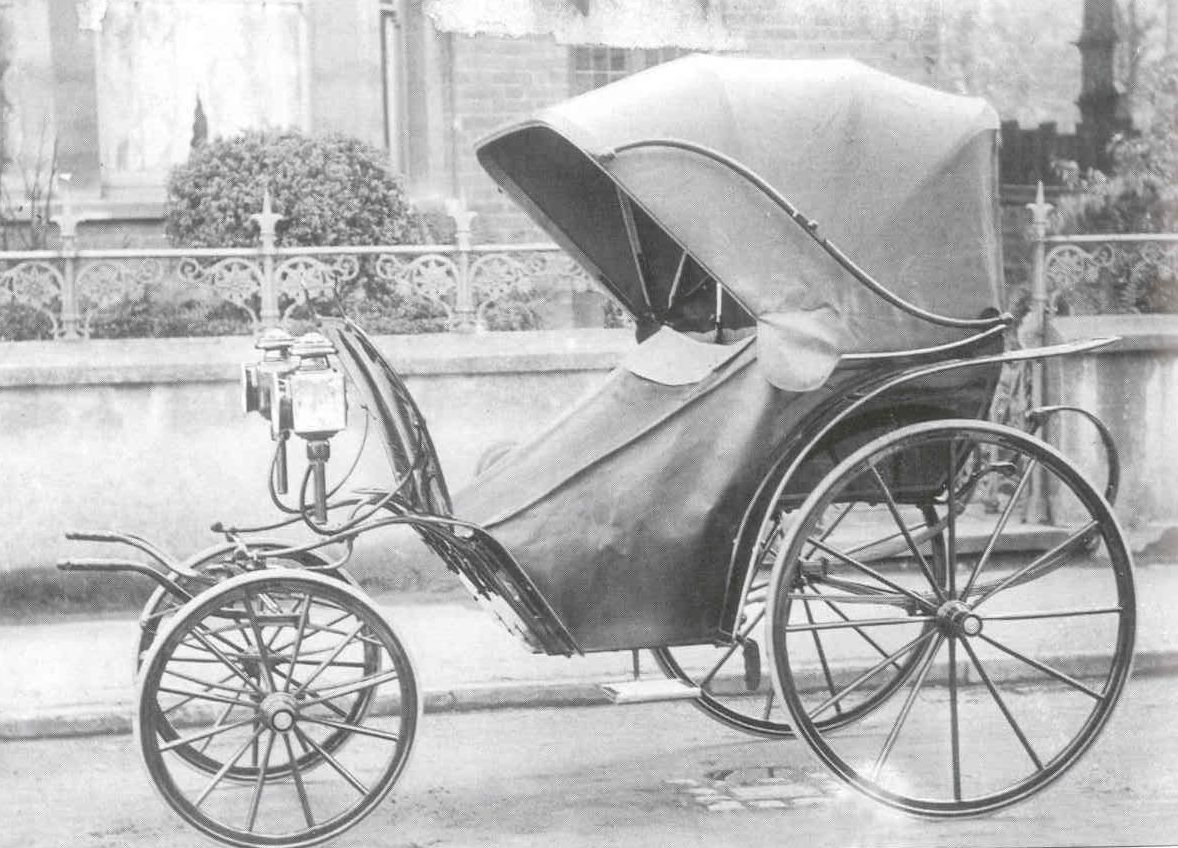
Pony phaeton (Source)

Then "a little pony phaeton" carrying Hortense and Rosa arrives. Lady Dedlock had sent for it, asking her maid to come -- meaning Rosa, though Hortense had apparently insisted that she was the one sent for.  "The Frenchwoman stood unnoticed, looking on with her lips tightly set," as Lady Dedlock offers to send the carriage back for Ada and Esther. Jarndyce declines, and Lady Dedlock "took a graceful leave of Ada -- none of me," Esther notes, and bids Rosa get into the carriage with her. As for Hortense,
She remained perfectly still until the carriage had turned into the drive, and then, without the least discomposure of countenance, slipped off her shoes, left them on the ground, and walked deliberately in the same direction, through the wettest of the wet grass.
"'Is that young woman mad?' said my guardian." The keeper says that she's just "mortal high and passionate -- powerful high and passionate; and what with having notice to leave, and having others put above her, she don't take kindly to it." And as Jarndyce, Ada and Esther return home, they see Hortense still striding through the wet grass.

In London, the omniscient narrator tells us, the courts have shut down for the long vacation, leaving all of the clerks idle, as well as the businesses that support the law, such as Mr Snagsby, the stationer. He and Mrs Snagsby are entertaining the Chadbands. Mr Chadband is a minister "attached to no particular denomination," who includes among his followers Mrs Snagsby. "'My little woman,' says Mr Snagsby to the sparrows in Staple Inn, 'like to have her religion rather sharp, you see!'"
Mr Chadband is a large yellow man, with a fat smile, and a general appearance of having a good deal of train oil in his system. Mrs Chadband is a stern, severe-looking, silent woman. Mr Chadband moves softly and cumbrously, not unlike a bear who has been taught to walk upright. He is very much embarrassed about the arms, as if they were inconvenient to him, and he wanted to grovel; is very much in a perspiration about the head; and never speaks without first putting up his great hand, as delivering a token to his hearers that he is going to edify them.
Chadband's "edification," however, typically consists of platitudes delivered in the most pompous and verbose manner possible. Still, as the narrator observes, "the Chadband style of oratory is widely received and much admired."

As the Snagsbys are entertaining the Chadbands, however, the servant, Guster, informs Mr Snagsby that he is wanted in the shop downstairs, where he finds a constable with Jo in his custody. The constable has ordered Jo to "move on," and Jo insists that there's nowhere for him to move on to. Jo has apparently indicated to the constable that Mr Snagsby can vouch for him, and although Mrs Snagsby has appeared at the top of the stairs to proclaim that he doesn't know the boy, Snagsby admits that he does.

Then Mr Guppy appears, and confirms Snagsby's acquaintance with Jo. The constable is still convinced that Jo is up to no good, partly because he lives in Tom-all-Alone's.  Moreover, Jo has money upon him, which is enough to convince the constable that Jo has been stealing. So Jo tells the story of being approached "by a lady in a wale" (i.e., veil) who gave him a sovereign to show her where Nemo lived, died, and was buried. The constable agrees to leave Snagsby in charge of Jo's moving on -- over Mrs Snagsby's protests -- and departs.

Intrigued by Jo's story of the veiled lady, Guppy begins asking questions, raising the curiosity of the others, so that Guppy and Jo are ushered upstairs to continue the interrogation. Guppy opines that "there is something out of the common here that beats anything that ever came into my way at Kenge and Carboy's," which is enough to have Mrs Chadband eager to hear more: She happens to be acquainted with Kenge and Carboy's. Before she married the Rev. Mr Chadband, she says, she "was left in charge of a child named Esther Summerson, who was put out in life by Messrs Kenge and Carboy's."

It's Guppy's turn to be astonished, though when he gasps, "Miss Summerson, ma'am!" he is rebuked by Mrs Chadband, who is apparently the Mrs Rachael who was servant to Esther's godmother/aunt. "'I call her Esther Summerson,' says Mrs Chadband, with austerity. 'There was no Miss-ing of the girl in my time. It was Esther. "Esther, do this! Esther, do that!" and she was made to do it.'"


The Rev. Chadband seizes upon this moment of astonishment to take the floor and sermonize on the topic of ... Jo, who is bewildered by everything that's going on, and "whose immediate object seems to be to get away on any terms." Guppy gives him a penny and Mr Snagsby loads him up with some of the table leftovers, and off he goes into the night.

Guppy, of course, is not going to let all these revelations go. He has been vexed by the arrival in the offices of Kenge and Carboy of Richard Carstone, but gratified "to find the new comer constantly poring over the papers in Jarndyce and Jarndyce; for he well knows that nothing but confusion and failure can come of that." So he gathers his friends, fellow law-clerks Young Smallweed and Tony Jobling, and invites them to dine with him.
Hablot Knight Browne (Phiz), Mr Guppy's Entertainment (Source: David Perdue's Charles Dickens Page)
After much Dickensian business about these swaggering striplings, during which we learn that Jobling was the one who accompanied Guppy to Chesney Wold, Guppy announces "a plan I have lately thought of proposing." It may, he stammers, "have some reference to a subject, which may -- or may not -- have cast its shadow on my existence" -- that is, of course, his failed proposal to Esther. He tells Jobling that in his duties at Kenge and Carboy's he has been delivering a weekly allowance to Miss Flite at Krook's, and that Krook has a room to let. Krook "must be precious old, you know, and he has not a soul about him, and he is reported to be immensely rich; and whether he is a smuggler, or a receiver, or an unlicensed pawnbroker, or a money-lender -- all of which I have thought likely at different times -- it might pay you to knock up a sort of knowledge of him."

Jobling is game, even when he learns that the room is where Krook's last lodger died. So they proceed to Krook's, where he is dead drunk. They manage to get him awake, and after treating him to a better quality of gin than he is used to, "Mr Guppy presents his friend under the impromptu name of Mr Weevle, and states the object of their visit." The result is that Jobling/Weevle is installed in the second-floor room, which he adorns with "copper-plate impressions from that truly national work, The Divinities of Albion, or Galaxy Gallery of British Beauty, representing ladies of title and fashion in every variety of smirk that art, combined with capital, is capable of producing." And in time the neighbor ladies are gossiping, "don't you be surprised Lord bless you, if that young man comes in at last for old Krook's money!"
_____

The 2005 BBC/Masterpiece Theatre dramatization features Burn Gorman as Guppy, Patrick Kennedy as Richard Carstone, Denis Lawson as John Jarndyce, Anna Maxwell Martin as Esther Summerson, Sally Leonard as Polly, Warren Clarke as Boythorn, Timothy West as Sir Leicester Dedlock, Gillian Anderson as Lady Dedlock, Nathaniel Parker as Harold Skimpole, Carey Mulligan as Ada Clare, Emma Williams as Rosa, Lilo Baur as Hortense, Sean McGinley as Snagsby, Robert Pugh as Mr Chadband, Catherine Tate as Mrs Chadband, Michelle Tate as Guster, Harry Eden as Jo, Dominic Coleman as Policeman, Johnny Vegas as Krook, Charles Dance as Tulkinghorn, Tom Georgeson as Clamb.

Tuesday, June 14, 2011

6. Bleak House, by Charles Dickens, pp. 181-214

Chapter 12: On the Watch through Chapter 13: Esther's Narrative


The rain has stopped at Chesney Wold and the Dedlocks are returning from Paris, where Lady Dedlock has been as bored as ever. In the carriage she notices that Sir Leicester is reading some papers sent him by Tulkinghorn, which reminds him that the lawyer sent her a message in one of them:  "I have something to tell her on her return, in reference to the person who copied the affidavit in the Chancery suit, which so powerfully stimulated her curiosity. I have seen him." Although she betrays no special emotion to Sir Leicester, she asks him to stop the carriage so she can walk for a while. After a quarter of a mile, she returns to the carriage.

When they reach home and are greeted by Mrs Rouncewell, Lady Dedlock notices the new maid, Rosa, and comments on how pretty she is. She asks Rosa how old she is, and Rosa replies "Nineteen, my Lady." Lady Dedlock repeats the age, "thoughtfully."
That evening, in the housekeeper's room, Rosa can do nothing but murmur Lady Dedlock's praises. She is so affable, so graceful, so beautiful, so elegant.... Mrs Rouncewell confirms all this, not without personal pride, reserving only the one point of affability. Mrs. Rouncewell is not quite sure as to that. Heaven forbid that she should say a syllable in dispraise of any member of that excellent family; ... but if my lady would only be "a little more free," not quite so cold and distant, Mrs Rouncewell thinks she would be more affable.
Lady Dedlock's attentions to Rosa have drawn the notice of Hortense, Lady Dedlock's maid, "a Frenchwoman of two-and-thirty, from somewhere in the Southern country about Avignon and Marseilles -- a large-eyed brown woman with black hair; who would be handsome, but for a certain feline mouth, and general uncomfortable tightness of face, rendering the jaws too eager, and the skull too prominent.... she seems to go about like a very neat She-Wolf imperfectly tamed." Hortense is offended that she, who has been in Lady Dedlock's service for five years, has never been fussed over by her mistress the way Rosa was.

The Dedlocks then entertain, "this January week, some ladies and gentlemen of the newest fashion," whom Dickens proceeds to ridicule for their vapidity and "dandyism." The house is full, except for one room set aside for Mr Tulkinghorn, after whom Lady Dedlock inquires every evening whether he has arrived yet. Finally one evening he appears in order to discuss with Sir Leicester his ongoing quarrel with Boythorn over rights-of-way. "A man of a very low character of mind," Sir Leicster says of Boythorn, "An exceedingly ill-conditioned, levelling person. A person who, fifty years ago, would probably have been tried at the Old Bailey for some demagogue proceeding, and severely punished -- if not ... if not hanged, drawn, and quartered."

Lady Dedlock intervenes in the aristocrat's denunciation of the upstart Boythorn and suggests that they go inside. She also takes the opportunity to ask Tulkinghorn about his discovery of the person whose handwriting she recognized. Yes, Tulkinghorn says, he identified the man and went to his lodgings where "I found him dead." Sir Leicester speaks first, worrying about Lady Dedlock's reaction and suggesting "the less said --." But she interrupts and asks Tulkinghorn to go on: "It is quite a story for twilight. How very shocking! Dead?" Tulkinghorn continues, "Whether by his own hand --" and again Sir Leicester protests and is overruled by his wife, "though he still feels that to bring this sort of squalor among the upper classes is really -- really --."

Apparently Lady Dedlock finds it really interesting, for she continues to draw Tulkinghorn out. He tells her that the coroner's inquest brought back a verdict of accidental death.
"He had lived so wretchedly, and was so neglected, with his gipsy colour, and his wild black hair and beard, that I should have considered him the commonest of the common. The surgeon had a notion that he had once been something better, both in appearance and condition."
Lady Dedlock asks what he was called, but Tulkinghorn reports that no one knew his name. And when she asks if he left any clues to his identity, Tulkinghorn says that there was only "an old portmanteau; but -- No, there were no papers."

Considering that Lady Dedlock nearly fainted when she first recognized the handwriting, she behaves with remarkable calm during this narration. In fact, Sir Leicester seems far more upset by the news and wants "to hear no more about a subject so far removed from my Lady's station." She refers to it as "a collection of horrors," as she gathers "up her mantles and furs" and asks Tulkinghorn to open the door for her. Tulkinghorn remains at Chesney Wold for several days, during which "Lady Dedlock is always the same exhausted deity, surrounded by worshippers, and terribly liable to be bored to death, even while presiding at her own shrine." She and Tulkinghorn
appear to take as little note of one another, as any two people, enclosed within the same walls, could. But, whether each evermore watches and suspects the other, evermore mistrustful of some great reservation; whether each is evermore prepared at all points for the other, and never to be taken unawares; what each would give to know how much the other knows -- all this is hidden, for the time, in their own hearts.

So we go back to Bleak House, where the discussion of what profession Richard is to follow continues. To Esther, Jarndyce acknowledges Richard's "indecision of character" and wonders how much of it "is chargeable on that incomprehensible heap of uncertainty and procrastination on which he has been thrown from his birth" -- i.e., the Jarndyce and Jarndyce case. Esther has her own diagnosis of the cause of Richard's character flaws, which is his traditional English public school education, in which he "had learnt, I understood, to make Latin Verses of several sorts, in the most admirable manner. But I never heard that it had been anybody's business to find out what his natural bent was, or where his failings lay, or to adapt any kind of knowledge to him."

When Jarndyce asks if Richard has any inclination toward the law, Richard replies, "I am fond of boating. Articled clerks go a good deal on the water. It's a capital profession!" Jarndyce then suggests medicine, and Richard immediately imagines himself as a Member of the Royal College of Surgeons. And "the more he thought of it, the more he felt that his destiny was clear; the art of healing was the art of all others for him." Because as a ward of chancery the decision can't be Richard's alone, they decide to consult the attorney Kenge, who endorses it as "a very good profession." Jarndyce clearly has some reservations: "'The course of study and preparation requires to be diligently pursued,' observed my Guardian, with a glance at Richard." But the matter seems to have been settled and now there's the question, as Kenge puts it, of "placing Mr Richard with some sufficiently eminent practitioner" for training. Kenge, as it turns out, has "a cousin in the medical profession."

So Jarndyce, Richard, Ada and Esther decide to spend a few weeks in London while Richard makes the acquaintance of Kenge's cousin. And it is at a theater in London that Esther once again encounters Mr Guppy.
Hablot Knight Browne (Phiz), Mr Guppy's Desolation (Source: David Perdue's Charles Dickens Page)
Esther is in a box at the theater when she looks down and beholds "Mr Guppy, with his hair flattened down upon his head, and woe depicted in his face, looking up at me." And "from that time forth, we never went to the play, without my seeing Mr Guppy in the pit -- always with his hair straight and flat, his shirt-collar turned down, and a general feebleness about him." His gaze "put such a constraint upon me that I did not like to laugh at the play, or cry at it, or to move, or to speak. I seemed able to do nothing naturally." She thinks about telling Jarndyce, but she's afraid he'll report it and Guppy will get fired. "Sometimes, I thought, should I frown at him, or shake my head. then I felt I could not do it." She thinks of writing to his mother, but she's afraid "that to open a correspondence would be to make the matter worse."

But they have come to town to get Richard started on his medical training, and that includes a visit to Kenge's cousin, Mr Bayham Badger, "who had a good practice at Chelsea." Mr Badger is "a pink, fresh-faced, crisp-looking gentleman, with a weak voice, white teeth, light hair, and surprised eyes." And like so many of the men in Bleak House, he has a wife who predominates over him. Mrs Bayham Badger is several years older, and has been married twice before to "most remarkable men!" as her husband proclaims: "Captain Swosser of the Royal Navy, who was Mrs Badger's first husband, was a very distinguished officer indeed. The name of Professor Dingo, my immediate predecessor, is one of European reputation." Moreover, Mrs Badger proclaims, she married Mr Badger on the same day of the year that she married the first two: "'So that Mrs Badger has been married to three husbands -- two of them highly distinguished men,' said Mr Badger, summing up the facts; 'and, each time, upon the twenty-first of March at Eleven in the forenoon!'"

Mr Badger then proceeds to display the portraits of his wife's late husbands with considerable pride.
Hablot Knight Browne (Phiz), The Family Portraits at Mr Bayham Badger's (Source: David Perdue's Charles Dickens Page)
And during dinner, they are urged to use "the Professor's goblet" and to drink "a wine that was imported by the Captain" and to listen to the life stories of the captain and the professor.

That evening, when they have returned to their rooms, Ada tells Esther her "secret" -- that she and Richard are in love. She also gives Esther permission to break the news to Jarndyce, though Esther assures her it will be no surprise to him either. In the morning, Esther visits him "in the room that was our town-substitute for the Growlery, and gives him the news. He has her fetch Richard and Ada to give them his blessing. It is not unmixed with a little foreshadowing, however:
"Constancy in love is a good thing; but it means nothing, and is nothing, without constancy in every effort. If you had the abilities of all the great men, past and present, you could do nothing well, without sincerely meaning it, and setting about it. If you entertain the supposition that any real success, in great things or in small, ever was or could be, ever will or can be, wrested from Fortune by fits and starts, leave that wrong idea here, or leave your cousin Ada here." 
This is not just a bit of Victorian moralizing, but an ironic glance at the future. But for now, Richard and Ada are, as Esther sees them, "So young, so beautiful, so full of promise" as they walk away from her and Jarndyce through a sun-filled room. And then, "they passed away into the shadow, and were gone. It was only a burst of light that had been so radiant. The room darkened as they went out, and the sun was clouded over."

Then Esther remembers something she had forgotten to mention about the dinner at the Badgers': There was another guest, "a gentleman of dark complexion -- a young surgeon. He was rather reserved, but I thought him very sensible and agreeable. At least, Ada asked me if I did not, and I said yes."
_____
The 2005 BBC/Masterpiece Theatre dramatization features Gillian Anderson as Lady Dedlock, Timothy West as Sir Leicester Dedlock, Charles Dance as Tulkinghorn, Tom Georgeson as Clamb, Anna Maxwell Martin as Esther Summerson, Carey Mulligan as Ada Clare, Patrick Kennedy as Richard Carstone,  Alistair McGowan as Kenge, Denis Lawson as John Jarndyce, Anne Reid as Mrs Rouncewell, Emma Williams as Rosa, Lilo Baur as Hortense, Burn Gorman as Guppy, Warren Clarke as Boythorn, Richard Griffiths as Bayham Badger, Joanna David as Mrs Bayham Badger, Richard Harrington as Allan Woodcourt, Johnny Vegas as Krook