JOURNAL OF A COMPULSIVE READER
By Charles Matthews
Showing posts with label Humphry Davy. Show all posts

Friday, October 8, 2010

14. The Age of Wonder, by Richard Holmes, pp. 405-469

The Age of Wonder: The Romantic Generation and the Discovery of the Beauty and Terror of Science (Vintage)Sorcerer and Apprentice, 6-8; Young Scientists; Epilogue
_____
John Herschel and Charles Babbage traveled in France and Italy in July through October 1821, meeting Alexander von Humboldt in Paris. Humboldt reported that John seemed to him "inferior to the originality of his father, who was astronomer, physicist and poetical cosmologist all at the same time." He treated them well, however, and told them of hearing Joseph Banks lecture in London soon after returning from his voyage of 1768-71. John returned to Slough, where William Herschel, now in his eighties, was no longer able to use the larger telescopes, and Caroline found it increasingly difficult to follow his instructions. John resumed work with the forty-foot telescope with Caroline as his devoted assistant. When he and Babbage formed the Royal Astronomical Society in 1820, John, "who had strong views about science being open to women," made her the first Honorary Member. The second was Mary Somerville, the mathematician after whom the first women's college at Oxford was named.

Caroline Herschel, by Martin François Tielemans, 1829
William grew increasingly infirm with arthritis, and Caroline came down with an eye infection that made her fear she would never do astronomical work again. She recovered, but was shaken by the experience. In August 1822, William died while John was abroad. His obituary in the Gentleman's Magazine noted "his excellent sister, Miss Caroline Herschel, whose indefatigable and unhesitating devotion in the performance of a task usually deemed incompatible with female habits, surpassed all eulogium." The same issue also noted the death by drowning of the "professed ... atheist" Percy Bysshe Shelley, the "unfortunately too well-known" author of "infamous novels and poems." Caroline, who was seventy-two, decided to return to Hanover, where she had not lived for nearly fifty years. She lived on for twenty-six years longer, corresponding regularly with John and writing her memoirs. She also compiled a new Star Catalogue, for which Herschel and Babbage saw to it that she was awarded the Astronomical Society's Gold Medal in 1828.

Humphry Davy was commissioned by the Royal Navy in 1823 to find a way to stop the corrosion of the copper hulls of the new steam warships. He analyzed the effects of salts on copper, and discovered that it could be neutralized by small iron plates along the hull that would oxidize more rapidly than the copper. Davy's remedy was put into effect quickly, and was hailed as yet another triumph. But the success was premature: after a few months it was discovered that the unoxidized copper was more subject to barnacles and weeds than before. "The navy was disgruntled, the Royal Society was embarrassed, and the press was derisive. Davy's reputation was tarnished, not to say barnacled, and his unpopularity at the Royal Society increased." Eventually, it was discovered that Davy had been right all along about the effect of the iron plates, and that a reconfiguration of their placement solved the problem, but the damage to Davy's reputation had been done. In 1824, the magazine John Bull proclaimed him one of the "Humbugs of the Age," largely because of his prominence as a socialite. Davy also managed to antagonize the younger generation of scientists by appointing John Herschel as one of the Royal Society's two secretaries in 1824, but refusing to appoint Charles Babbage to the other position.

Davy began to suffer from heart disease, and in December 1826 had a series of strokes that left him paralyzed on the right side. He was forty-eight, which was the age at which his father had died. In January, following his physician's advice, he left on a long holiday on the continent, accompanied by his brother, John, but not by his wife. He had continued to write poetry, and during his holiday he decided to write a book about fly-fishing that he called Salmonia, or Days of Fly-Fishing. It was structured as a series of dialogues among a group of friends, including a literary friend who may have been based on Coleridge and Walter Scott.

While he was writing the book, he returned to Laibach (now Ljubljana) where he took rooms at the inn owned by Josephine Dettela's father. She was now twenty-five.  In November 1827 he returned to London to resign the presidency of the Royal Society. But he went back to Laibach in the spring of 1828, again leaving Jane behind. In his letters to Jane he made frequent references to "the constant attention and kindness of my 'Illyrian maid,'" "my pretty Illyrian nurse," "my charming Illyrian nurse." He also wrote drafts of two love poems to her in his scientific notebook. That November he regretfully moved to Rome because of the weather.  

Salmonia was published in England in 1828, and he started work on expanding it, as well as beginning his last book, Consolations in Travel, or The Last Days of a Philosopher. It consists of six dialogues and an unfinished seventh, and "mixes philosophy and autobiography with highly original sections of science fiction, some visionary travel writing, various theories of history, race and society, and an important apologia for science. It also contains unexpected speculations about the nature of evolution, and the future of the human species." In one dialogue he takes issue with Coleridge, "who had said that the 'souls of 500 Newtons' had gone into the making of a single Shakespeare. Davy said emphatically that as benefactors of mankind, he held Bacon far above Shakespeare, and Newton far above Milton." In another dialogue he set forth his belief that science was a force for good, and had a positive effect on the mind, giving it "habits of accuracy, by obliging it to attend to facts.... It may be said of modern chemistry, that its beginning is pleasure, its progress knowledge, and its objects truth and utility."

In February 1829, still in Rome, he suffered another stroke, and sent for Jane. She arrived in April, and at the end of the month he decided that he wanted to travel north. John arranged for a slow journey, with many stops, and Jane went ahead to arrange for accommodations in Geneva. He arrived there on May 28, and died at 3 o'clock the next morning. He left an endowment for a Davy Medal  to be awarded by the Royal Society, and one for the maintenance of Penzance Grammar School. The rest of his estate went to Jane, except for a bequest of £150 to Josephine Dettela.

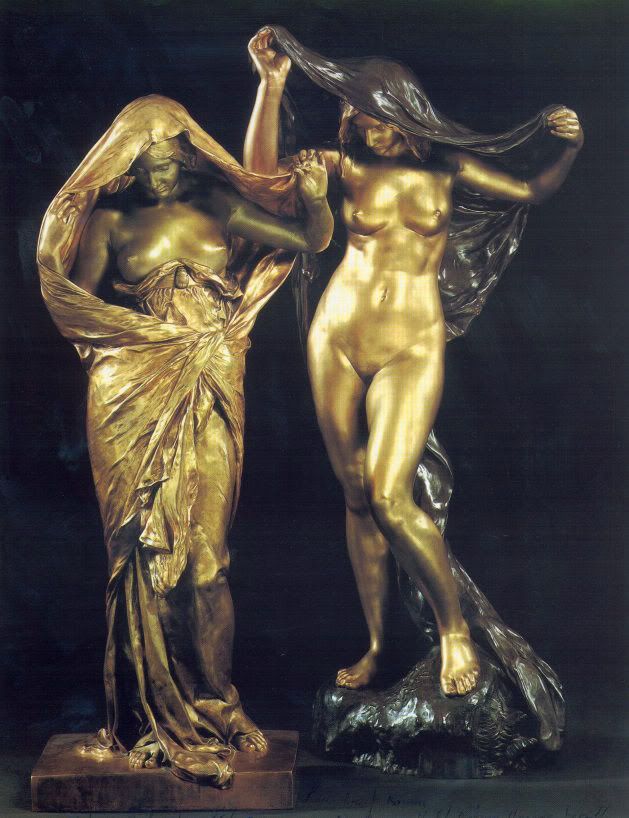
Nature Unveiling Herself Before Science, by Louis Ernest Barrias, 1890
The deaths of Banks in 1820, William Herschel in 1822, and Davy in 1829 seemed to mark the end of an era of British science and of the prestige of the Royal Society. Social critics like Thomas Carlyle began to question the role of science: "The Progress of Science ... is to destroy Wonder, and in its stead substitute Mensuration and Numeration." In a note, Holmes observes, "The troubling image of a shy, reluctant, persecuted female Nature who is crudely questioned and even physically assaulted by an exclusively male Science now begins to appear. It slowly replaces the older Romantic image of a mysterious and seductive Nature, at least a goddess, who is infinitely more powerful than her mere human petitioners and questioners."

Charles Babbage
In 1829, John Herschel was the candidate favored by young scientists to replace Davy as president of the Royal Society, but he was defeated by the Duke of Sussex, the brother of George IV, in a very close election, 119 to 111. Sussex was not a scientist, but he was obviously well-connected. As if to placate the younger scientists, Herschel was knighted soon afterward. But the supporters of Herschel, including Charles Babbage, were still outraged. In the spring of 1830, Babbage published a book, Reflections on the Decline of Science in England. Babbage was now Lucasian Professor of Mathematics at Cambridge, a chair that had been held by Isaac Newton. He was working on the first computer, the "Difference Engine No. 1," which would have used 25,000 brass cogs to perform its calculations. He had spent £17,000 of his own money on the device, so he was eager to obtain government funding for it. The one completed section of Difference Engine No. 1, with 2,000 cogs, still works as a calculator, and he had designed but never completed a more sophisticated version, using punch cards and 50,000 cogs that served as the machine's equivalent of RAM. In 1991, his design for Difference Engine No. 2, with 4,000 brass cogs, was actually constructed. It's capable of calculating to thirty-one decimal points. But Babbage was unable to persuade the funding sources that there would ever be applications for the Difference Engine.

Babbage's book suggested that the research culture in Britain was inferior to that on the continent, and that the universities were failing at the task of teaching science. The Royal Society was particularly to blame, having become more of a social institution than a scientific one: Of the 700 members, only ten percent had published two or more papers on science. He argued "that science must always be more than the simple observation of phenomena or data. It was simultaneously a subjective training in observational skills, self-criticism and interpretation: a complete education. This was of course precisely what William Herschel had said forty years before." He proposed that all the British scientific societies come together in an annual meeting to take place in a different city outside of London each year. This would be the model followed when the British Association for the Advancement of Science was formed in 1831. 

John Herschel published his own critique of science, A Preliminary Discourse on the Study of Natural Philosophy, which became hugely popular. It was cited by John Stuart Mill in his Autobiography as one of the books that helped him recover from his nervous breakdown. Herschel argued that all the sciences had the inductive method in common: the gathering of quantitative data, the formation of a hypothesis, and the testing of the hypothesis. Herschel's book was celebrated as the first book since Bacon's 1620 Novum Organum to explain to the public the nature of experimental science. It was fluently written and filled with imaginative explanations. He singled out chemistry as the central scientific discipline of the age, and prophesied that investigation of electricity and electromagnetism, which would be Faraday's field, would be the next great field of scientific endeavor. He spoke of science as a network of disciplines, coming together "to form a single philosophy or culture," and "argued that science, while often going against common sense or intuition, expanded the human imagination with previously inconceivable ideas of movement or magnitude." The book was enormously influential in shaping the thought of the Cambridge undergraduate Charles Darwin.

David Brewster, a physicist who specialized in optics and invented the kaleidoscope, picked up on Babbage's idea of forming an association of scientific organizations. Babbage and the geologist William Whewell joined him in organizing the British Association for the Advancement of Science, which held its first meeting in York in 1831. It was not particularly well attended and attracted little attention from the press. But the second meeting, at Oxford in 1832, began to attract more notice, although The Times referred to it as "a mere unexplained display of philosophical toys" and was shocked that William Buckland had delivered a talk about the courtship of reptiles "in the presence of ladies." It was the third meeting, in 1833 in Cambridge, that showed the British Association was beginning to make its mark: It was attended by Faraday, Herschel, Dalton, Babbage, Brewster, Whewell and Thomas Malthus, among other notables. Darwin, who was traveling on the Beagle, was unable to attend.

Another participant was Coleridge, now sixty and in poor health. At one meeting Coleridge weighed in on the question of what someone who worked in the sciences should be called. Whewell, who was the chairman of the meeting, noted that some proposed "philosopher," but that Coleridge was strongly against it. Someone else suggested "savant," which was rejected as too presumptuous and too French. Finally Whewell himself suggested "scientist," on the analogy with "artist," as well as "economist" and "atheist" -- though the latter was a strike against it. The geologist Adam Sedgwick rejected "scientist" as a "barbarism," but it caught on and entered the OED in 1840.

Behind all of this professionalizing of science "lay the whole question of whether the new generation of professional 'scientists' would promote safe religious belief or a dangerous secular materialism." Many saw no conflict between science and religion: "Science was a gift of God or Providence to mankind, and its purpose was to reveal the wonders' of His design." But many of the most prominent scientists dodged the question: Davy's writings "suggested a kind of science mysticism that certainly precluded a Christian God"; William Herschel's God was only a kind of "benign Creator somewhere distantly behind the great unfolding scheme of nature";  Caroline Herschel never mentioned God in her journals; and Joseph Banks's sister despaired at his lack of piety. The problem was that "science itself had yet to produce its own theory (or myth) of creation." And when one emerged, in Darwin's On the Origin of Species in 1859, it was devastating because it added to the damage already done to the book of Genesis by the geologists. "What it demonstrated was that there was no need for a divine creation at all."

From 1830 to 1836, the Earl of Bridgewater commissioned a series of books by eminent scientists that were intended to show how science reinforced Christian beliefs. But the Bridgewater Treatises were not well received by the scientific community. Mary Somerville remarked, after reading William Buckland's treatise on geology, that "facts are such stubborn things." Babbage considered writing a treatise of his own that would undermine the whole enterprise, but never finished it. And Faraday, though he was a member of the fundamentalist Sandemanian sect, just kept quiet. 

The Association continued to grow, holding its annual meetings in Edinburgh, Dublin, Bristol, Liverpool, Newcastle, Birmingham and Glasgow from 1834 to 1840, attracting 2,000 people to the meeting and an official membership of more than 1,000. There was still hostility from The Times and John Bull, and Charles Dickens lampooned the meeting with a series for Bentley's Miscellany, illustrated with cartoons by George Cruikshank, called "The Full report of the First Meeting of the Mudfog Association for the Advancement of Everything."

Faraday continued his work at the Royal Institution, and gave the Bakerian Lecture to the Royal Society in 1829.  He also accepted a professorship at the Royal Military Academy, Woolwich, and began his work on electromagnetism that would lead to the creation of the dynamo, as revolutionary as James Watt's steam engine had been. He proved to be a great science educator, and started the series of Christmas Lectures for Children that is still given today. One of them, "The Chemical History of a Candle," was so popular that Dickens reprinted it in Household Words in 1850. 

Charles Lyell's Principles of Geology in 1830 overthrew the biblical account of creation and introduced readers to a concept of "deep time" that corresponded to William Herschel's "deep space." It would form the background Darwin needed for his theory of evolution by natural selection. The publication of Humphry Davy's Consolations of Travel, or The Last Days of a Philosopher in an expanded popular edition in 1831 also introduced the public to speculations about human social evolution; Darwin wrote to his sister asking her to send him a copy. David Brewster's biography of Isaac Newton presented its subject "as a secular saint, 'the high priest of science' and a man of universal genius." And the republication, after the stage adaptations, of Mary Shelley's Frankenstein gave the public a glimpse of "terrible, blasphemous and irreversible scientific hubris."

Mary Somerville's On the Connexion of the Physical Sciences, in 1834, "was a significant attempt to bring together new developments in the fields of astronomy, physics, chemistry, botany and geology as a single, ongoing scientific process of discovery." Somerville's tone is conventionally pious, but on the other hand,
She quietly suggests that "not only man, but the globe he inhabits -- nay the whole system of which it forms so small a part -- might be annihilated, and its extinction be unperceived in the immensity of creation." The reader is left to ask -- Unperceived by God? Or without any God to perceive it?
Somerville also puts stress on the counterintuitiveness of science, on its ability to demonstrate that things are not as we see them or as common sense tells us.

John Herschel, 1846
In 1833 John Herschel fulfilled one of his dreams, to do an astronomical survey in the southern hemisphere. Independently wealthy, he turned down government sponsorship, and even a grant from the Royal Society, and sailed with his family for South Africa to set up an observatory. He shipped the twenty-foot telescope, and remained at Cape Town for four years, mapping the skies. He wrote to his aunt Caroline that "these were the happiest years of his whole life." The Herschels were visited at the Cape by Charles Darwin, on his way back from the Galapagos. "Herschel's expedition to the Cape came to represent for Darwin the important ideal of the independent working scientist, which inspired the rest of his life." Caroline Herschel, in her eighties, thought of joining John and his family at the Cape, but decided against it. She did serve as a kind of publicist for him, feeding stories to the Hanover papers that were picked up internationally. On his return in 1838, he was made a baronet and attended Queen Victoria's coronation.  He was also elected president of the Royal Society and awarded another Copley Medal. 

In 1840, the forty-foot telescope at Slough was dismantled, having been battered by winds until the scaffolding was no longer safe. On New Year's Eve, Herschel threw a party in the old tube.

Wednesday, October 6, 2010

13. The Age of Wonder, by Richard Holmes, pp. 361-405

The Age of Wonder: The Romantic Generation and the Discovery of the Beauty and Terror of Science (Vintage)Davy and the Lamp, 4-6; Sorcerer and Apprentice, 1-5
_____
After yet another mine explosion that killed fifty-seven men in June 1815, the Coal Mines Safety Committee put out an urgent call for Humphry Davy's help. So on August 24, Davy went to Newcastle to see what he could do. The working theory was that fire-damp needed to be somehow neutralized directly, perhaps with better ventilation or some other kind of gas pumped into the mine. But Davy turned the problem around: He looked at what was touching off the explosions -- the candles and oil lamps that the miners carried into the darkness.

First, however, he needed to analyze the gas and its properties, so he took bottled samples to the Royal Institution laboratory and, working with Faraday, began to study the properties of methane. He discovered that it would explode only when it reached a critical proportion of one part gas to eight parts air, and that the temperature at which the explosion occurred was quite high. With this information he could proceed to designing a lamp that would not set off an explosion. He learned that a lamp with a glass chimney sealed around the wick and with narrow metal tubes to let in air would not set off an explosion. It was a trial-and-error process that led to several explosions but he had three working prototypes ready at the end of October. He wrote to Banks about his success and sent the lamps to the Royal Society along with a scientific paper to be read on November 9.

But Davy continued to refine his invention. He and Faraday continued to work through Christmas and by January 11 he was ready to report his results to the Royal Society. He had discovered that the lamp worked even better when the wick was surrounded by a fine-gauge wire mesh instead of a sealed glass chimney. The apertures in the mesh fed air to the flame and at the same time contained and cooled it below the temperature needed to ignite the methane. Without the need for a glass chimney, the lamp was cheaper and sturdier. Davy also used the process by which the lamp was designed as an example of the scientific inductive method, writing: "Every step was furnished by experiment and induction, in which nothing can be said to be owing to accident, and in which the most simple and useful combination arose out of the most complicated circumstances." Holmes comments, "This refusal to allow anything to chance, 'accident' or good fortune was exactly the same as Herschel's insistence that chance played no part in the discovery of Uranus."

The Davy Safety Lamp was swiftly adopted all over Britain and Europe. Davy himself went down the mine at Walls End in Northumberland and demonstrated its use to the miners, pointing out that the flame itself could indicate the presence of methane: "His lamp not only caged the flame, it transformed it into a canary." He received the Rumford Medal from the Royal Society in 1817 and was made a baronet the following year, but he refused to take out a patent on the lamp. He published an account of the research, On the Safety Lamp for Miners, With Some Researches Into Flame in 1818, setting forth his belief that science could be a force for human betterment.
The gratification of the love of knowledge is delightful to every refined mind; but a much higher motive is offered in indulging it, when that knowledge is felt to be practical power, and when that power may be applied to lessen the miseries or increase the comforts of our fellow-creatures. 
But in spring 1816, he was charged with plagiarizing his design from George Stephenson, an engineer, who had tested his own safety lamp in October 1815 and presented his invention to the Newcastle Literary and Philosophical Society in December. Stephenson had suspected plagiarism when he saw reports of Davy's first lamp, the one with metal tubes instead of wire gauze, in the Newcastle papers. Stephenson's lamp also used tubes and perforations. When the Newcastle Society demonstrated Davy's gauze lamp side-by-side with Stephenson's in February 1816, it was obvious that the two lamps were different, but the controversy couldn't be stopped. There was something of a battle of North versus South involved as well. Stephenson would go on to his own fame as an inventor with the "Stephenson Rocket," an early steam-powered railway engine. He admitted that he hadn't studied the properties of methane and that his lamp was the result of trial and error. But Davy got his back up over Stephenson's claims and "never acknowledged that the over-hasty publication of his early prototypes had caused much of the problem." But even though Banks issued a firm statement in November 1817 that the Royal Society had investigated the claims and tested both lamps and concluded that Davy was the sole inventor, the controversy never died.

In May  1818, the Davys left on another European tour, planning to travel for two years. It was partly an attempt to patch up their marriage, which had been put to the test by celebrity. It was in the Balkans, in what is now the Slovenian capital of Ljubljana, that Davy had his second sighting of the "dream girl" of his feverish vision in 1808. This time she was fifteen-year-old Josephine Dettela, the daughter of an innkeeper. He dismissed it as an insignificant coincidence, though he would later write about it. They moved on to visit Lord Byron at Ravenna and then settled in Naples for the winter, about the same time as Shelley and his family, though there is no record that Davy and Shelley ever met. In spring 1819, they started north again, but Jane announced that she was ill and tired of traveling and wanted to stay in Paris. There Davy heard that Joseph Banks was also ill.

Banks had been increasingly immobilized by gout, but he continued to single out young protégés, including John Herschel, who had distinguished himself at Cambridge as a mathematician and had published a paper on mathematical formulae before his twenty-first birthday. Banks had John Herschel elected to the Royal Society in 1813. Another protégé was the zoologist Charles Waterton, who had made several journeys to South America. Banks urged Waterton, who was thirty-seven, to settle down and write the account of his journeys, something that Banks himself had failed to do. Waterton complied, and produced "a popular masterpiece," Wanderings in South America, in 1825.

In his old age, Banks had become more conservative. Although he honored women such as Caroline Herschel, he was opposed to letting women be elected to the Royal Society. And he was shocked at Byron's "Lascivious" Don Juan, which began appearing in 1819. Despite his own early distaste for slavery, he would not commit the Royal Society to abolishing it. His attitude toward slavery was not that it was a moral evil but that it was an inefficient way to manage labor: "Slavery must be abolished not on moral principles, which are in my opinion incapable of being maintained in argument, but on Commercial ones which weigh equally in moral & immoral minds." On the other hand, he hailed the revolution in Haiti: "To see a sort of Human Beings emerging from Slavery & making the most rapid Strides towards the perfection of Civilization, must I think be the most delightful of all Food for Contemplation."

Despite his early success, John Herschel was still undecided about what direction his life should take. His aunt, Caroline, was his confidante, and met his brilliant Cambridge friends, the mathematician Charles Babbage and the geologist William Whewell. But John was undecided whether to remain as a fellow at Cambridge and do pure mathematics, or to practice law in London, a career that he thought would allow him to doscientific research in chemistry and geology in his spare time. But his father discouraged him from both courses, considering law beneath him and university life too self-indulgent. He suggested that John become a clergyman. And William brushed off John's reaction that he didn't believe in the doctrine of the Anglican church, arguing, "The most conscientious clergyman may preach a sermon full of sound morality, and no one will enquire into theological subtleties."

The argument between the young man and his seventy-five-year-old father became heated, but finally William gave in and agreed that John should try out the law at Lincoln's Inn and go to regular meetings at the Royal Society. He was proved right about the law: John didn't like it, and went back to Cambridge first as a mathematics tutor and then as a fellow. But by the summer of 1816 he had decided that science was his real career. William gave his son a generous income to pursue whatever research he chose, and he joined his father and his aunt at Slough in running the observatory. In 1819 he presented his first paper, correcting Newton's ideas on polarized light, to the Royal Society. 

William Herschel's discoveries had caught the imagination of Shelley, who used them to bolster his own arguments against religion. If the cosmos was as unimaginably vast as Herschel suggested, it only showed the narrowness of the biblical account of fall and redemption. He wrote in "On the Plurality of Worlds," a note to Queen Mab:
The indefinite immensity of the universe, is the most aweful subject of contemplation.... It is impossible to believe that the Spirit that pervades this infinite machine begat a son upon the body of a Jewish woman.... The works of His fingers have borne witness against him.
He continued in this vein in other prose works, and Prometheus Unbound "revels in Herschel's new cosmology and Davy's chemistry." In it, the moon sings a song to Earth that "elegantly includes scientific notions of gravitational orbit, tidal attractions and magnetic fields."

In his last years at the Royal Society, Banks began to see the growth of science challenge his ability to keep it all under the aegis of one body. He fought against such spinoffs as the Geological Society and the Astronomical Society. It was John Herschel and Charles Babbage who were leading the formation of the latter, a step toward the compartmentalism and professionalizing of the scientific disciplines that had already begun at the universities. Banks himself was somewhat to blame for this reaction against the Royal Society's attempt to unify all the sciences in one body. Under his leadership, the membership had come to consist of such non-scientists or at best amateur scientists as clergymen (10 percent of the membership) and landed aristocrats (nearly 20 percent).  Younger members chafed against what they felt as the "stifling consensus, cautious propriety and snobbish exclusion" of the society, which had yet to recognize the achievements of chemists like John Dalton and Michael Faraday.

Banks did, however, continue to encourage his protégés, such as William Edward Parry's polar expedition through Baffin Bay, in an attempt to discover the Northwest Passage. He was also interested in setting up an observatory in South Africa, at the Cape. But in the spring of 1820 he became seriously ill with jaundice and submitted his resignation. The Society rejected it, but Banks died on June 19, 1820, having served more than forty years as president.

Davy returned to London only three days before Banks's death. He was widely regarded as the logical successor to Banks, and he wanted the job. But his marriage was still troubled, and taking on the responsibility of leading the Royal Society was not likely to please Jane. They agreed to stay together but to lead separate lives except when official events made it necessary for them to make an appearance together. They moved into a larger house that would allow them independence from each other.

The choice of Davy was not unanimous: "Aristocratic members were uneasy at Davy's Cornish background (so different from Banks's Eton and Oxford), while younger members, on the contrary, wondered if his social ambitions had overtaken his scientific ones." There was an alternative: the chemist William Hyde Wollaston, who became acting president on Banks's death. John Herschel supported this choice, writing to Babbage that Davy was "said to be arrogant in the extreme, and impatient of opposition to his scientific views, and likely, if power were placed in his hand to oppose rising merit in his own line." Davy's dispute with Gay-Lussac was also cited as evidence against him.

Nevertheless, Davy was elected without opposition in November 1820. In his opening addresses he singled out the fields where he thought the most promising new work lay: "astronomy, polar exploration, the physics of heat and light, electricity and magnetism, geology, and the physiology of plants and animals." He praised Wollaston, Dalton, and John Herschel, and voted to fund Charles Babbage's "difference engine," the precursor of the calculator. John was also awarded the Copley Medal for his work on polarized light. But Davy also offended some by publishing some remarks about Banks that seemed to characterize his predecessor as "a dilettante and a patriarch."

And his treatment of Michael Faraday, his former star pupil, was surprising: He blackballed Faraday's election as a Fellow of the Royal Society in 1823, even though Faraday had already been elected to the Accademia in Florence and the Académie des Sciences in Paris. The reason Davy presented was that Faraday had plagiarized some of Wollaston's experiments in electromagnetic rotation and claimed that he had achieved the results first. But Faraday was already a recognized authority in the field and the plagiarism seems to have been unintentional -- even Wollaston was unconcerned about it, and later supported Faraday's election. Faraday's name was resubmitted eleven times until he was finally elected in 1824, with one vote against him -- presumably Davy's. Gossip even got out that Davy had intentionally suggested an experiment that had almost blinded Faraday. 

But Davy's work in encouraging the government's support of science was significant. He became a trustee of the British Museum, helping develop its collections and bringing more scientific exhibitions to it, making it more accessible to the public. He supported the formation of the Royal Zoological Society and the creation of a zoo in Regent's Park. He was also a founder of the Athenaeum Club, though he once again used it to commit an apparent snub of Faraday, having him appointed Club Secretary. When Faraday discovered it was essentially a clerical job, he quit. But finally he was forced to give his approval to Faraday's appointment as director of the Royal Institution, which would make Faraday world-famous.

Tuesday, October 5, 2010

12. The Age of Wonder, by Richard Holmes, pp. 325-361

The Age of Wonder: The Romantic Generation and the Discovery of the Beauty and Terror of Science (Vintage)Dr Frankenstein and the Soul, 4-7; Davy and the Lamp, 1-3
_____
Mary Shelley's Frankenstein, or The Modern Prometheus was "the most singular literary response to the Vitalism debate." She had heard Davy lecture on chemistry in 1812, when she was only fourteen, and when she came to write her novel she would draw on the published version of Davy's "Introductory Discourse" in the part where the young medical student Victor Frankenstein hears Prof. Waldman lecture. Percy Shelley, with whom she  eloped to France and Switzerland in 1814, was fascinated by the question of creating artificial life, and during their stay at Villa Diodati on Lake Geneva in 1816, they discussed Aldini's galvanic experiments with Byron and Polidori. It was then that they set each other a challenge to write a tale of horror. The others dashed off their responses, but Mary took her time -- fourteen months. In August 1817, she sent the manuscript of Frankenstein to the publisher three weeks before she gave birth to a daughter, Clara.

The character of Victor Frankenstein evokes many of the age's scientists: Joseph Priestley, Henry Cavendish, Humphry Davy, "the sinister Aldini and the glamorous, iconoclastic William Lawrence may all have contributed something to the portrait." The best-known German physiologist of the day was Johann William Ritter, who was "known for certain undefined 'galvanic' experiments with animals, which were the talk of the Royal Society, although amidst a certain amount of head-shaking." Ritter became the target of the Prussian government for his experiments and moved to Munich, but "he died penniless and insane in 1810, aged thirty-three. In other circumstances his Memoirs might have been those of young Victor Frankenstein."

In developing the character of the Creature in her novel, Mary was forced to speculate on what ways it might be considered human: "Would it have language, would it have a moral conscience, would it have human feelings and sympathies, would it have a soul?" It's possible that Mary accompanied her husband to his consultations with Lawrence in spring 1817, and that the three of them discussed such questions, because "Mary Shelley's idea of the mind was, like Lawrence's, based on the notion of the strictly physical evolution of the brain." In his lectures in 1817, Lawrence directly addressed the question of "mind":
Where is the 'mind' of the foetus? Where is that of a child just born? Do we not see it actually built up before our eyes by the actions of the five external senses, and of the gradually developed internal faculties? Do we not trace it advancing by a slow progress from infancy and childhood to the perfect expansion of its faculties in the adult.
The Creature in the novel has the body of a fully developed man, but his mind is that of an infant. He has to acquire memories, language, a conscience. "Although galvanised into life by a voltaic spark, the Creature has no 'divine spark' from Heaven. Yet perhaps his life cold be called, in a phrase of the medical student John Keats, a 'vale of soul-making.'" (Note: Keats's image of life as a process of soul-construction persisted into the twentieth century in the poems of W.B. Yeats; see e.g. "Beggar to Beggar Cried," "Sailing to Byzantium," and especially the great valedictory of "The Tower.") Escaping from the laboratory, the Creature begins his process of awareness with a sighting of the moon. His mind, he tells us, "received, every day, additional ideas." Holmes notes that "Mary's account [of the Creature's evolution "through all the primitive stages of man"] is almost anthropological, reminiscent of Banks's account of the Tahitians."

It is solitude that proves the undoing of the Creature and turns him into a killer. He pleads with Frankenstein to create a mate for him, "offering to go westwards to South America or the Pacific, and to return to that primitive Edenic state glimpsed by Cook and Banks." But Frankenstein, in the midst of creating the mate for the Creature, is attacked by fears that they would propagate "a race of devils," so he destroys the half-finished female Creature. Frankenstein is pursued by the Creature to the North Pole, "the antithesis of the warm, Pacific paradise," where "both see themselves as fallen angels, doomed to eternal solitude and destruction."

The first publication of the novel was a failure, selling fewer than 500 copies. But it became famous in the 1820s through stage adaptations, of which there were at least five, starting with Presumption: or The Fate of Frankenstein in London in 1823. "Over the next four years there were fourteen separate productions, mounted in London, Bristol, Paris and New York." Mary Shelley made no money from the plays, which she didn't authorize, but "when she herself went to see the play in September 1823 she loved it." The actor T.P. Cooke became famous in the role of the Creature, just as Boris Karloff would in the 1931 film version. But the dramatizations turned Victor Frankenstein from "a romantic and idealistic figure, obsessive rather than evil, and determined to benefit mankind" into "the archetypal mad and evil scientist." And the Creature, which eventually became "The Monster," "is deprived of all words, whereas in the novel he is superbly and tragically articulate."

As for William Lawrence, whose quarrel with Abernethy had sparked so much debate, he renounced his own views and reconciled with Abernethy. He became a member of the conservative Council of the Royal College of Surgeons in 1829 and "finished his career as Surgeon-General to Queen Victoria, and was created a baronet. But perhaps he had lost his own soul."

In the spring of 1811, Humphry Davy met Jane Apreece, a wealthy thirty-one-year-old widow. (Her first husband died in 1809. They had no children.) She was socially prominent and well-connected, and claimed to be the model for the heroine of Madame de Staël's novel Corinne, having met de Staël in Geneva. She had once dined with William Blake and was a cousin of Walter Scott. As their attraction grew, their "friends predicted disaster. She was made for society, he was made for the laboratory." She turned down his proposals twice, but finally accepted after he told her that the Prince Regent had offered him a knighthood -- he would be the first scientist to be knighted since Isaac Newton. He received the honor on April 8, 1812, and three days later they were married.

On June 1 his book Elements of Chemical Philosophy, based on his Royal Institution lectures, "was published with a formal dedication to Lady Jane Davy." Though the rest of the book was too technical for the general reader, its introduction, "An Historical View of the Progress of Chemistry," helped popularize chemistry. "Percy Shelley began to incorporate Davy's ideas into his work, beginning with his visionary materialist poem Queen Mab of 1812, with its long scientific prose notes." But the advances in science increasingly made it difficult for poets to express scientific ideas in verse. "Shelley's Prometheus Unbound (1820) was to be arguably the last successful attempt to combine the two in a major English poem." In his essay on the history of chemistry, Davy proclaimed,
The ends of this branch of knowledge are the applications of natural substances to new uses, for increasing the comforts and enjoyments of man; and for the demonstrating of the order, harmony, and intelligent design for of the system of the earth.
Setting aside that still-problematic notion of "intelligent design," Davy had made the case for amateur enthusiasts for chemistry, and the first "chemistry sets" went on the market at about this time.

Davy decided to give up his lectureship and pursue his scientific research independently, which Jane's fortune allowed him to do. He began investigating explosives as part of the British war effort, but in November 1812 he was partly blinded when a test tube exploded and sent glass slivers into his eye. As a celebrity he was subject to gossip, including a rumor that his wound was the result of a fight with Jane. When he returned to the Royal Institution laboratory in London, he found that it had been allowed to degenerate. He fired the laboratory assistant and hired a new one, twenty-one-year old Michael Faraday, who had been working as a bookbinder.

There was some tension between the Davys, mostly centered on the conflict between her socializing and his laboratory work, and his tendency to escape into his hobby of fly-fishing. But he made an effort to participate in her social life, and in 1813 he was introduced to the lion of society, Lord Byron. "Unexpectedly, Byron and Davy hit it off rather well, and later when His Lordship was self-exiled in Italy, Davy remained one of the few Englishmen that he could stand to meet. He would even put him in his poem Don Juan (1819-24)." (Along with, it might be noted, a reference to Mungo Park's travels.)
This is the patent age of new inventions
For killing bodies, and for saving souls,
All propagated with the best intentions:
Sir Humphry Davy's lantern, by which coals
Are safely mined for in the mode he mentions,
Tombuctoo travels, voyages to the Poles
Are ways to benefit mankind, as true,
Perhaps, as shooting them at Waterloo.

In May 1812, an explosion in the Felling coal mine killed ninety-two men, and after another explosion in the same mine in December 1813 killed twenty-two more, it became apparent that something needed to be done urgently about the problem of "fire-damp," a lethal gas from new coal seams that could be ignited by a single candle flame. The consensus was that Davy should be called on to find a solution to the problem. But the Davys had just embarked on an eighteen-month tour of Europe, accompanied by Michael Faraday, whom Davy had singled out as a promising research assistant. Jane, on the other hand, decided to treat Faraday as a valet, since her husband refused to travel with one. In Paris, Davy was awarded the Prix Napoléon by the Institut de France, which caused him to be denounced as unpatriotic, although "Davy carefully avoided an audience with Napoleon himself, and referred to him contemptuously as 'the Corsican robber.'" He was also lured by the Académie des Sciences into a competition with the eminent French chemist Joseph Gay-Lussac, to analyze a crystal substance that was a byproduct of gunpowder manufacture. Both Davy and Gay-Lussac identified the substance as a new element, iodine. But a dispute arose after Gay-Lussac's paper was presented on December 12 and Davy's on December 13. Davy backdated his paper to December 11 when it was published in the Journal de Physique, and claimed that he had shared his ideas with Gay-Lussac before the French chemist presented his conclusions. The French still insist that Gay-Lussac was the first to identify the element.

In the spring of 1814, the party moved south. In Florence, Davy used a magnifying lens to set a diamond on fire, demonstrating that the jewel was after all just carbon. They moved on to Rome and Naples, then northward to Venice and, for the summer, crossed the Alps into Switzerland, Bavaria, and Austria, then down into one of his favorite regions in the Balkans, then known as Illyria. They returned to Florence in October, where they heard about "some strange natural gases escaping from rock formations in the Apennines at Pietra Mala, near Lucca." They were fascinated by the gas, which could even be produced by stirring the mud with a stick and burned with a blue flame. The gas had almost no smell. They bottled some of it and took it back to Florence, where they identified it as methane -- the "fire-damp" that had caused the coalmine explosions.

Finally, in March 1815, news arrived that Napoleon had escaped from Elba. They hurriedly returned to London, where Davy saw to it that Faraday was promoted to assistant to the laboratory at the Royal Institution, and encouraged him to start giving his own lectures on chemistry and to publish his first papers. Davy himself became vice-president of the Institution, giving him access to the lab and the opportunity to continue to work with his protégé, Faraday.

Davy then wrote a poem called "The Massy Pillars of the Earth":
Nothing is lost; the ethereal fire,
Which from the farthest star descends,
Through the immensity of space
Its course by worlds attracted bends,

To reach the earth; the eternal laws
Preserve one glorious wise design;
Order amidst confusion flows
And all the system is divine.

If matter cannot be destroyed,
Then living mind can never die;
If e'en creative when alloy'd,
How sure is immortality! 
Holmes notes that the first stanza seems to anticipate Einstein's theory, a hundred years later, that light is bent by gravity, confirmed by Arthur Stanley Eddington's observations during a solar eclipse in 1819. But Davy was really just affirming "a more traditional belief: the sudden confidence that 'eternal laws' govern the universe in a benign and ordered way." His assertion that "all the system is divine" is "somewhere between Romantic pantheism and the old Enlightenment deism." He also continued to question the surety of immortality.
What is striking about this poem is its sudden tone of Evangelical self-confidence and its unusually hymn-like form. It could have been written by John Wesley or Isaac Watts, though Davy carefully avoids the words "God" or "soul." ... Perhaps he wanted to settle down theologically, as well as socially. But science would never quite allow him to do either.

Monday, October 4, 2010

11. The Age of Wonder, by Richard Holmes, pp. 295-325

The Age of Wonder: The Romantic Generation and the Discovery of the Beauty and Terror of Science (Vintage)Davy on the Gas, 11-12; Dr Frankenstein and the Soul, 1-3
_____
Davy's first Bakerian Lecture at the Royal Society, in November 1806, caused an international sensation. The topic was the revolutionary possibilities of the new field of electrochemical analysis. Challenging the notion that electricity was some kind of invisible fluid, he established that it was a form of bipolar energy, with positive and negative charges, and that it could be used to analyze substances into their components, which were entirely new elements. Surveying the scientific work going on elsewhere in Europe, he asserted that British chemistry now led the scientific world. The following November, he announced the discovery of two new elements, potassium and sodium, from his experiments using voltaic batteries to decompose soda and potash. Joseph Banks was so impressed with Davy's work that when he had his portrait painted the following year, he was shown holding a copy of Davy's Bakerian Lectures.

Joseph Banks in 1809, by Thomas Phillips
Banks fell seriously ill soon after these lectures. He had been working on a ventilation system for Newgate Prison and came down a form of typhus known as "jail fever" because it was so easily spread by lice in crowded prisons. He was away from his laboratory until April 1808. During his convalescence, he worked with Coleridge, who had been debilitated by opium, on the lecture series "Poetry and the Imagination," which Coleridge delivered at the Royal Institution in the spring of 1808. Davy also reported a hallucination of a beautiful woman who had nursed him at the height of his fever. He would later claim that he met her again in 1818 and in 1827-28, noting the ten-year cycle of recurrence that took place each time he started a new decade, turning thirty, then forty, then fifty. Holmes notes, "If there had been an earlier one, it would have been in 1798, when he turned twenty, and had just met Anna Beddoes. Anna had returned to her husband and was nursing him when he died in December 1808. After his death, she moved to Bath and then finally settled in Rome. Their son Thomas Lovell Beddoes became a poet, spending twenty-five years on a long poem called Death's Jest-Book, some of the imagery of which was drawn from his childhood memories of his father's laboratory. He committed suicide in 1849, at the age of forty-five.

In 1810 Davy went to Dublin for a series of hugely popular lectures, and he returned in 1811 to receive an honorary doctorate from Trinity College.
In these lectures he particularly stressed the importance of scientific knowledge for women's education, and for "the improvement of the female mind." Milton was wrong on the subject, and Mary Wollstonecraft was right. Among his attentive and admiring audiences was a strikingly pretty and vivacious Scottish widow called Jane Apreece. At a glittering reception afterwards, Jane Apreece told Humphry Davy that she loved fishing. 

In September 1811, Fanny Burney underwent a mastectomy in Paris without anesthetic. It was successful -- she lived twenty years longer -- but the pain was so excruciating that she wrote a 10,000-word letter to her sister about the ordeal, through which she had remained conscious except for "two total chasms in my memory." Even recalling the experience was so painful that it took her two months to write the letter, which is a remarkable glimpse at the the state of medical practice, especially surgery, at the time.

Although France was considered the leader in medicine at the time, England and Scotland were gaining renown, especially for the teaching hospitals of London and Edinburgh. Once again, Banks was concerned with promoting British prestige, and when Astley Cooper of Guy's Hospital perforated a patient's eardrum to treat a potentially fatal infection of the inner ear, Banks had it written up for the Royal Society's Philosophical Transactions. Cooper became a member of the Royal Society and was awarded the Copley Medal in 1814. One of Cooper's students was John Keats. Other Romantic poets also had medical connections: Coleridge was treated by John Abernethy of St. Bartholomew's for his opium addiction, and Joseph Henry Green of Guy's was his amanuensis in 1818. Byron's traveling companion was William Polidori, who had become a doctor at Edinburgh Hospital.

One of Banks's medical protégés was William Lawrence, a young surgeon who worked under John Abernethy at St. Bartholomew's. Lawrence was a specialist in comparative anatomy, and he was elected to the Royal Society at the age of thirty. Two years later, in 1815, he became professor of anatomy at the Royal College of Surgeons. In 1814, Lawrence's mentor, Abernethy, gave a series of lectures known as the Hunterian Orations in honor of John Hunter, who had accumulated a great collection of anatomical specimens. Hunter's collection demonstrated clearly the kinship between human beings and "lower species," leading to the conclusion that mankind had developed out of the animal kingdom. Abernethy had come across papers in Hunter's collection that speculated on the nature of life itself. From these speculations, "Abernethy proposed a theory of human life based on a semi-mystical concept of a universal, physiological life force" and even "suggested that this theory brought scientific evidence -- if not exactly proof -- to the theological notion of the soul." He also connected Davy's experiments with electricity to this theory of the life force.

But in 1816, it was Abernethy's student, Lawrence, who led a vociferous attack on the "life force" theory. Abernethy felt betrayed: Lawrence had been his assistant since the age of sixteen, and had even lodged with Abernethy for three years. Still, Lawrence had also studied anthropology with Johann Friedrich Blumenbach at the University of Göttingen and was well read in French medical literature. "If not an avowed atheist, he had little time for conventional pieties." Blumenbach had not gone so far as to deny the existence of the soul, but his work tended in the direction of a materialist view of life itself. He was also interested in the comparative study of "racial types," and Lawrence had translated Blumenbach's Comparative Anatomy into English in 1807.

Like Abernethy, Lawrence was also friends with a poet: Percy Bysshe Shelley, who consulted Lawrence in July 1815 on a variety of nervous disorders. Shelley, then twenty-two, was grateful for Lawrence's advice and treatment, and by September 1815 began his long poem Alastor, or The Spirit of Solitude about the search for self, wrote some essay on the nature of life and death, and his "Essay on a Future State." He continued seeing Lawrence until he and his wife, Mary, left England for Italy, whose climate Lawrence had recommended, in 1818. 

It was Lawrence who was tapped for the Hunterian Lectures in 1816, and instead of performing the usual courtesy toward the previous lecturer, he began by attacking Abernethy and the theory of the life force. The human body, he asserted, was just "a complex physical organisation. In a phrase that became notorious, he claimed that the development of this physiological organisation could be observed unbroken, 'from an oyster to a man.'" He moved from attacking Abernethy to arguing that science, as Holmes puts it, "had an autonomous right to express its views fearlessly and objectively, without interference from Church or state." In his own words,
It seems to me that this hypothesis or fiction of a subtle invisible matter, animating the visible textures of animal bodies, and directing their motions, is only an example of that propensity in the human mind, which had led men at all times to account for those phenomena, of which the causes are not obvious, by the mysterious aid of higher and imaginary beings.
In 1819, Lawrence continued his attack on Vitalism, as Abernethy's life force theory was called, in a book, Natural History of Man, sparking a debate that had political, social and theological implications, "a premonition of the debate over Darwin's theory of evolution by natural selection, exactly forty years later."

In fact, there was nothing really new about the Vitalism debate. It had been anticipated in the 1780s by the vogue for mesmerism, which had been debunked by a series of blind trials. (Among other things, the trials provided the first demonstration of the "placebo effect," in which patients grew better simply because they believed they were being cured. Vitalism, however, got a boost from the ideas of Friedrich Schelling, who posited that "the whole world was indeed replete with spiritual energy or soul, and all physical objects 'aspired' to become something higher." This theory of evolution by aspiration was eventually laughed into extinction.

In 1803, Giovanni Aldini, a professor of anatomy from Bologna, did a series of public experiments with electricity on corpses, including an attempt to revive a hanged murderer six hours after his execution. The press reported that the electrical charges caused the muscles of the corpse to contract, the left eye to open, the fists to clench, and even made the body blow out a candle several times. "That small, grotesque detail of the opening eye may well have caught a young novelist's imagination." Further experiments on dead animals and "another human corpse which was said to have laughed and walked," caused such an outrage that Aldini was forced to leave the country.

The political implications of this quarrel over Vitalism took their character from the Napoleonic era: "Here was humane, pious English science fighting against cruel, reductive, atheistical French science." The conservative Quarterly Review, which is best known today for its savage attacks on the younger Romantic poets, weighed in with a scathing denunciation of Lawrence: "Mr Lawrence strives with all his powers to prove that men have no souls!" it fumed.

The debate also spread among the poets, and some of their comments, taken out of context, seem to suggest that they came down on the anti-science side. In December 1817, the painter Benjamin Haydon hosted a dinner at which Wordsworth, Charles Lamb, and Keats were present to celebrate Haydon's completion of part of his huge painting of Christ's entry into Jerusalem. The painting included portraits of Wordsworth (representing "natural English piety), Newton ("analytical science")  and Voltaire ("godless French philosophical scepticism"). Keats also appears in profile. Haydon recorded that the conversation centered on a debate over reason versus imagination, with the poets coming down on the side of imagination. He reported that Keats said Newton had "destroyed all the poetry of the rainbow, by reducing it to a prism." But Haydon was a devout fundamentalist Christian who "believed that most science was inevitably godless," and he may have biased his account accordingly.

Wordsworth is often cited as anti-science because of his poem "The Tables Turned," in which he refers to the "meddling intellect" and charges that scientists "murder to dissect." But Wordsworth also regarded Newton as a hero, celebrating him in The Prelude. Shelley, who was not present at the dinner, had previously twitted Haydon for his "religious superstitions" and referred to "that most detestable religion, the Christian." Like Coleridge, Shelley always defended science. Coleridge continued to argue that the soul existed, but he also rejected the idea of a "life force" as a physical fluid of some sort. He wrangled with the notion of the soul, which he identified as "the moral conscience and the spiritual identity."

Keats, from his medical studies under Cooper and J.H. Green, "undoubtedly knew more about medical, chemical and dissection procedures -- as well as the Vitalism debate itself -- than anyone else at Haydon's dinner party. His witticism at Newton's expense could be seen as the typical knowing humor of a clever medical student." But he did express some ambivalence about science in his poetry, particularly in "Lamia."
... Do not all charms fly
At the mere touch of cold philosophy?
There was an awful rainbow once in heaven:
We know her woof, her texture; she is given
In the dull catalogue of common things.
Philosophy will clip an Angel's wings....
Unweave a rainbow, as it erstwhile made
The tender-personed Lamia melt into a shade.
But the poem shows Lamia, a serpent-woman, to be something other than "tender-personed." She is an alien life-form, "both sexually alluring and yet clearly menacing and 'demonic.'" She is unnatural, and a "scientific" approach to her would have unmasked that fact. "Lamia" is a richly ambiguous poem that eventually undermines the anti-scientific position expressed in the lines above. Holmes asserts that the poem "engages many of the moral issues surrounding Vitalism, the nature of life, and the notion of human consciousness. Above all, perhaps, it asks if the beautiful Lamia has a soul." 

Sunday, October 3, 2010

10. The Age of Wonder, by Richard Holmes, pp. 265-295

The Age of Wonder: The Romantic Generation and the Discovery of the Beauty and Terror of Science (Vintage)Davy on the Gas, 5-10
_____
Robert Southey became one of Davy's most influential friends in his Bristol years, encouraging him to continue writing poetry and eventually introducing him to a greater poet, Samuel Taylor Coleridge, whose indulgence in opium naturally led him to want to try nitrous oxide. Coleridge and Davy met in October 1799 and became great friends a month later when Davy visited Coleridge in London. Coleridge introduced David to Charles and Mary Lamb, with whom the poet was living, and to William Godwin, among other prominent literary and artistic figures. Coleridge proclaimed that science, "being necessarily performed with the passion of Hope ... was poetical." Davy enthusiastically agreed.

Davy's experiments with nitrous oxide continued in a portable gas chamber designed by James Watt. It was airtight and allowed for a much longer exposure to the gas. As usual, Davy tried it on himself first: His "pulse rose to 124, his temperature to 106, and his cheeks went bright purple." His assistant, Robert Kinglake, stood by to record Davy's reactions when he emerged from the device, but Davy also recorded the experience in his laboratory notebook, saying that he had been "almost completely intoxicated," that it had been "Inconceivably pleasurable," and the he had "seemed to be a sublime being, newly created and superior to other mortals." He also proclaimed, as Kinglake recorded, "Nothing exists, but Thoughts! -- the Universe is composed of impressions, ideas, pleasures and pains!" He also experimented with combining nitrous oxide with alcohol, drinking a whole bottle of wine along with inhaling the gas. The chief effect was that he got sick but had no hangover the next morning when his "appetite was almost canine." But he began to wonder if the experiments were going a little too far.

In 1800, he published his first book, Researches Chemical and Philosophical chiefly Concerning Nitrous Oxide or Dephlogisticated Nitrous Air, and its Respiration. The publisher was Joseph Johnson, a radical who had also published Godwin, Coleridge, Wordsworth, and Mary Wollstonecraft. In the book he reported on his experiments with live animals, which would later cause Davy some uneasiness, though none of the scientists who reviewed the book objected to this kind of research. In the preface to the book, Davy expressed some concern about his own methodology:
I have endeavoured to guard against sources of error; but I cannot flatter myself that I have altogether avoided them.... Early experience has taught me the folly of hasty generalization. We are ignorant of the laws of corpuscular motion.... Chemistry in its present state, is simply a partial history of phenomena, consisting of many series more or less extensive of accurately connected facts.
In addition to Davy's own self-criticism, there were also attacks on the nitrous oxide experiments from outside, including hints "that the Bristol laboratory witnessed scenes of intoxication, hysteria and even sexual debauchery." An anonymous pamphlet, The Sceptic, in 1800 attacked Beddoes and Davy in particular, suggesting that they used the experiments to seduce women and had even made one woman pregnant while she was under the influence of nitrous oxide.

Davy was himself beginning to doubt Beddoes's theories about the efficacy of inhaling gas, and his interests began to shift to galvanism and the new battery invented by Allesandro Volta. He communicated this interest in a letter to Coleridge, who was developing his ideas about the relationship of science and poetry. Coleridge urged Davy to move to the Lake District with him and Wordsworth, and to establish a laboratory there. For his part, Davy continued to write poetry, some of it about Anna Beddoes, though he never published any of the poems he wrote after 1800, confining them to his notebooks. He did, however, continue to compare the scientific and the poetic imagination in his lectures, and wrote in 1807 some words that suggest the ideas also expressed by Coleridge and Keats:
The perception of truth is almost as simple a feeling as the perception of beauty; and the genius of Newton, of Shakespeare, of Michael Angelo, and of Handel, are not very remote in character from each other. Imagination, as well as the reason, is necessary to perfection in the philosophic mind. A rapidity of combination, a power of perceiving analogies, and of comparing them by facts, is the creative source of discovery. Discrimination and delicacy of sensation, so important in physical research, are other words for taste; and love of nature is the same passion, as the love of the magnificent, the sublime, and the beautiful. 
Benjamin Thompson, Count Rumford, by Thomas Gainsborough, 1783
Davy had begun to attract attention in London, which he visited again in 1801. Banks introduced him to Benjamin Thompson, a Fellow of the Royal Society who had been born in America but fought for the Loyalists and was knighted by George III. In 1785 he moved to Bavaria, where he lived for eleven years and was given the title of Count Rumford by the Elector of Bavaria.

Davy's eagerness to move on from his work with Beddoes in Bristol may have been heightened by his involvement with Anna Beddoes. She was unhappy in her marriage, and he became a confidant in her miseries. They began writing poem to each other, expressing not only affection but also a deep discomfort with the impossibility of furthering their relationship, although hers are more demonstrative than his. The extent of what Holmes calls "this flirtation or frustrated love affair (or whatever it was)" remains unclear. After Davy left Bristol, Anna gave birth to a daughter, Anna Maria, in the spring of 1802, and shortly after that ran off with Davies Giddy, Davy's old friend and patron from Penzance. She returned to Beddoes after several months' absence.

After eighteen months of work with nitrous oxide, Davy finally told Beddoes that he no longer believed there were therapeutic uses for the gas. Unfortunately, Davy had overlooked the fact that nitrous oxide had real potential as an anesthetic. It's not that he was unaware of the fact that it blotted out pain: He had treated his own toothache, caused by impacted wisdom teeth, with nitrous oxide, but "he did not take the next logical step of having the offending teeth removed while under the influence of nitrous oxide." He did note in writing up his experiments that nitrous oxide might be used to ease pain in surgery where there was no great blood loss -- because he believed that the gas was absorbed only through the bloodstream, he thought it would be ineffective if there was a lot of hemorrhaging. He had discussed the problem of pain with Coleridge, who had wondered why childbirth was so painful for human beings since it was essential for the continuation of the species, but again overlooked the potential use of nitrous oxide during labor. Holmes comments, "It would seem that Davy missed the greatest medical opportunity of his early career." It would be more than forty years before surgical anesthesia, using ether, was attempted, and it wasn't finally accepted "until Queen Victoria admitted to having taken a whiff of chloroform during the birth of her son Prince Leopold in April 1853."

Davy left Bristol in March 1801 to become assistant lecturer in chemistry and director of the chemical laboratory at the Royal Institution in London. The Institution, which was founded by Count Rumford, was only two years old and hadn't attracted much notice yet. But Davy's inaugural lecture on April 25 was a sensation: He was a natural educator and showman, as well as a popularizer of science, and the press raved about his presentation, noting also his effect on the many "completely spellbound" young women in the audience. He also published his first paper, on a new form of voltaic battery, in the Royal Society's Philosophical Transactions later that year.

After Davy's departure, Beddoes turned the Pneumatic Institute into a charitable clinic and gave up research. Anna left him for Davies Giddy twice, in 1804 and 1806. Beddoes's protégé continued to attract audiences -- and young women -- to his lectures. Coleridge wrote, "I attended Davy's lectures to enlarge my stock of metaphors.... Every subject in Davy's mind has the principle of Vitality. Living thoughts spring up like Turf under his feet."

In his "Discourse Introductory to a Course of Lectures on Chemistry," Davy proclaimed chemistry's central role in the advancement of science, arguing that all the other sciences, from biology to astronomy, were based on a knowledge of chemical processes. For Davy, science was the only way out of ignorance and superstition, making humankind the master of its fate. But while his argument was revolutionary, Davy was careful not to antagonize the defenders of the established order, the wealthy men who supported the institution for which he worked. He argued that "we do not ... amuse ourselves with brilliant, though delusive dreams of the infinite improveability of man.... We consider only a state of human  progression arising out of its present condition. We look for a time that we may reasonably expect, for a bright day of which we already behold the dawn."

Coleridge was much influenced by Davy's view of science as "psychologically, even spiritually, therapeutic," as Holmes puts it. And Davy's explanation of the "carbon cycle" contributed to Coleridge's idea of harmony in nature. When he and Wordsworth wrote the preface to the third edition of Lyrical Ballads in 1802, they made explicit the analogy of scientific discovery to the poetic imagination.

Davy's success boosted support for the Institution, and apparently boosted his self-confidence. When Maria Edgeworth visited London with Anna Beddoes, Davy showed them around the Institution; Edgeworth commented that Davy "was much improved since I saw him last -- talking sound sense and has left off being the 'cosmology' man." His popularity with women was particularly noted by the caricaturists Rowlandson and Gillray. He was promoted from assistant to full lecturer in 1802, the following year to professor of chemistry. In 1804 he was elected a Fellow of the Royal Society, and his salary had quadrupled, to £400, in just three years. He was invited to give summer lectures at universities, including Dublin, tripling his income.

He was shaken, however, by the death from consumption of his friend Gregory Watt in 1804, and wrote to a frend, "We know very little; but, in my opinion, we know enough to hope for the immortality, the individual immortality of the better part of man." This hope is a far cry from the "certainty of the resurrection" proclaimed by the church's creed. And in the same letter he speculated, "We are masters of the earth, but perhaps we are the slaves of some great and unknown beings," which Holmes observes is "more like the extraterrestrial intelligences of science fiction" than like God, or gods.

In 1805 he lectured at the Royal Institution on geology and spent a summer in the Lake District with Wordsworth, Southey, and Walter Scott -- Coleridge was in Italy. He returned to London to receive the Copley Medal for work on agricultural chemistry. He still had no significant discovery to attach his name to, but "There seemed nothing that could now stop his career, and his meteoric rise to fame at the age of twenty-six."

Saturday, October 2, 2010

9. The Age of Wonder, by Richard Holmes, pp. 235-265

The Age of Wonder: The Romantic Generation and the Discovery of the Beauty and Terror of Science (Vintage)Davy on the Gas, 1-4
_____
In the 1790s, Joseph Banks began hearing about experiments conducted at a "Pneumatic Institute" in Bristol by Thomas Beddoes, a former lecturer at Oxford. They involved experiments on humans, who were breathing in various gases to see what effect they might have on their conditions and diseases. Beddoes was seeking funds for his research, but the nature of the experiments caused Banks to turn him down. But when one of Beddoes's assistants, a twenty-one-year-old chemist from Cornwall named Humphry Davy, came to London in 1801, Banks invited Davy to meet with him.

Davy was mostly self-educated and had never traveled abroad, but he demonstrated an impressive knowledge of the advances in chemistry that had been made in France by Antoine Lavoisier. Davy's father, Robert, had inherited a large estate in Cornwall, where he practiced his skill as a woodcarver. In 1776, he married Grace Millet, who had been raised since the age of five by a surgeon in Penzance, John Tonkin, who had adopted her along with her two sisters when their parents died. Humphry was Robert and Davy's oldest of their five children. Tonkin became Humphry's benefactor (Robert Davy seems to have been somewhat feckless) and paid for his grammar school education in Penzance and later in Truro. But Humphry had to leave school when his father, who was deeply in debt, died suddenly in December 1794.

In February 1795, sixteen-year-old Humphry was indentured to the surgeon and apothecary John Bingham Borlase, who was a friend of Tonkin's. Davy moved into Tonkin's house, and turned his attic rooms into a painting studio and laboratory, with paining and chemical supplies generously supplied by Tonkin. He also took French lessons from an émigré priest who was one of his mother's lodgers, which enabled him to read "the language of Enlightenment science: the language of Laplace, Lamarck and Cuvier; the language of the Encyclopédie and the Biographie Universelle; the language of the Académie des Sciences, the only scientific body which rivalled the Royal Society in London. Above all it was the language of the greatest chemist of the day, Antoine Lavoisier."

Davy's voracious reading turned him into a skeptic and a materialist. He began to write essays denying the existence of the soul and wrote in his notebooks "two supreme declarations of faith.... The first was: 'Man is capable of an infinite degree of Happiness.' The second was: 'The perfectibility of science is absolutely indefinite.'" His "radical ideas about the nature of material reality" led him to a fascination with chemistry. In Tonkin's library he found both a standard English work, William Nicholson's Dictionary of Chemistry, published in 1795, and Antoine Lavoisier's Traité Élémentaire de Chimie, published in 1789.

Humphry Davy, 1803
Chemistry of the time was liberating itself not only from its roots in alchemy, but also from the ancient belief in four basic elements: earth, air, fire, and water. Water had been shown by Lavoisier to be compounded of hydrogen and oxygen in 1785, and his experiment was repeated by Nicholson and Anthony Carlisle in 1800. Fire had been thought to be caused by a substance known as "phlogiston," a theory still held by Joseph Priestley. Lavoisier thought it was the result of the combination of carbon and oxygen in the presence of a substance he called "caloric." Air was known to be composed of oxygen and nitrogen and other gases, and both Priestley and Lavoisier had demonstrated the exchange of oxygen and carbon dioxide between plants and animals, though the full significance of this exchange hadn't yet been made apparent. And the variety of minerals found in earth led to suspicions that it, too, was not a single "element." The undermining of the traditional notion of four elements was revolutionary because "it was counter-intuitive: it went against common sense and common appearances."

Davy recognized that the task of the chemist was to further decompose and analyze substances. Twelve elements had been established, including hydrogen, carbon, oxygen and nitrogen. By 1808, John Dalton was proposing a "Table of 20 Elements," the basis of the the Periodic Table created by Dmitri Mendeleyev in 1869. Banks was eager to establish Great Britain as a leader in chemistry, a task tragically simplified by the execution of France's greatest chemist, Lavoisier, by order of the Revolutionary Convention in 1794, a consequence of his earlier role as a tax collector and a feud with Jean-Paul Marat. Lavoisier had been an anglophile and a devotee of the empirical scientific method promulgated by Francis Bacon. In Lavoisier's words, "We ought to form no idea but what is a necessary consequence, and immediate effect, of an experiment or observation.... We should proceed from known facts to the unknown." This became Davy's creed as well.

John Davy later recalled his brother's early laboratory: "His apparatus consisted chiefly of phials, wine-glasses, teacups, tobacco pipes, and earthen crucibles; and his materials were chiefly the mineral acids and alkalis in common use in medicine. He began his experimental trials in his bedroom in Mr Tonkin's house." In 1797, Tokin took in a new lodger, Gregory Watt, the son of the Scottish engineer James Watt. Gregory wrote home to his father about Davy and his experiments, and Watt in turn wrote to his friend Thomas Beddoes in Bristol. Beddoes had been a lecturer at Oxford, but was forced to resign his fellowship because of his outspoken republican and atheist views. One of his students at Oxford had been Davies Giddy, a Cornishman who also knew Davy.

Thomas Beddoes
Beddoes decided to put an idea he had in effect: the Bristol Pneumatic Medical Institute, which would provide free medical care and research. He was already experimenting with drugs and diet to treat various diseases, and became interested in the chemistry of respiration, theorizing that inhaled gases entering the bloodstream might bring about cures for diseases. Though he applied to Banks for a grant from the Royal Society, he was forced to solicit his funds from private philanthropies, particularly William Henry Lambton, who bankrolled Beddoes's project in exchange for tutorial of his sons. Hearing about Davy, he decided the young man, not yet twenty, would be perfect as an assistant in his research.

Anna Beddoes, 1787
On October 1, 1798, Davy was released from his indenture and became supervisor of Beddoes's institution. In Bristol he met Beddoes's twenty-four-year-old wife, Anna, a pretty, energetic woman who was half-sister to the novelist Maria Edgeworth. Humphry was smitten with his employer's wife. That winter, Thomas Beddoes published Davy's first essays, in one of which he challenged "the imaginary fluid caloric" proposed by Lavoisier. He also wrote an essay, "On Heat, Light and the Combinations of Light," in which he set forth "an entire cosmological vision, in which the whole universe was powered by starlight as well as Newtonian gravity, and would eventually be understood as a single unified idea." He also speculated that human consciousness was a function of physiological processes, "making an almost metaphysical claim that chemistry might prove to be the path to ultimate knowledge." And in an essay in which he pointed out the interrelationship between oxygen-breathing animals and carbon dioxide breathing plants as suggesting an equilibrium in nature, he anticipated "what is now known as the 'carbon cycle.'"

In the spring of 1799, Davy began a series of experiments with gas inhalations. For the first time, he had a well-equipped laboratory, including gas-inhalation equipment which was designed for him by James Watt and based on balloon technology. He studied the work of human respiration and then tried the effects of inhaling hydrogen, carbon dioxide, carbon monoxide, and nitrous gases. Before subjecting any of his patients to the tests, he tried them out himself, nearly killing himself with carbon monoxide, as well as suffering fainting fits, nausea, and headaches. Fortunately, he kept a supply of oxygen at hand.  He finally settled on nitrous oxide, or laughing gas, as the most promising gas for trials.
At first Davy was largely concerned with the process of respiration, and possible therapeutic benefits. Later, with his human subjects, he became more interested in the physiological reactions of the whole body; and effects of pleasure and pain. Finally he became fascinated by purely psychological responses. 
There were risks to using nitrous oxide, which some, including Priestley, considered lethal, and the ammonium nitrate that was heated to produce it could explode. But Davy went ahead with it and experienced giddiness and euphoria. He wrote a poem about it:
Not in the ideal dreams of wild desire
Have I beheld a rapture-waking form;
My bosom burns with no unhallowed fire:
Yet is my cheek with rosy blushes warm
Yet are my eyes with sparkling lustre filled
Yet is my mouth replete with murmuring sound
Yet are my limbs with inward transport thrilled
And clad with newborn mightiness around.
He began regularly experimenting with nitrous oxide, carefully annotating his physical and emotional reactions to the gas, noting once that "he was 'more irritable than usual,' though that might have had other 'moral' causes. In retrospect it appears that these 'moral causes' might have been connected with Anna Beddoes." One evening he decided to take a larger dose than usual, during which he briefly lost consciousness. He was disappointed that the gas gave him no spiritual revelation or insight into the universe, which may have made him overlook the potential of the gas as an anesthetic.

In May 1799 he began clinical trials on the institution's patients. He pioneered the use of "blind" trials by not telling the patients how much nitrous oxide they were inhaling or even if they were actually inhaling plain air, as some of them were. He was fascinated by the hallucinogenic effects of the gas, and began to glimpse the possibility of its anesthetic use in surgery. In addition to patients, he also tried it out on friends and family, including Anna Beddoes. In a couple of instance women who inhaled the gas had such extreme, even hysterical reactions that it launched the notion that the gas could be used to make women lose their inhibitions and become sexually aroused.  Among others who partook of the gas were Robert Southey, several members of the Edgeworth family, Gregory and James Watt, and Peter Mark Roget, who would go on to compile the eponymous thesaurus. Southey reported that the gas made him "gloriously happy!" Maria Edgeworth visited her half-sister at the time and observed that Anna showed unusual "grace, genius, vivacity, and kindness."
Cartoon by James Gillray, "Scientific Researches! - New Discoveries in Pneumaticks! - or - an Experimental Lecture on the Powers of Air" (1802).  Davy is shown with the bellows behind the desk.