JOURNAL OF A COMPULSIVE READER
By Charles Matthews
Showing posts with label William Wordsworth. Show all posts

Tuesday, May 3, 2011

18. The Modern Tradition, edited by Richard Ellmann and Charles Feidelson Jr., pp. 381-407

Nature: Introduction; Struggle (Charles Darwin, Arthur Schopenhauer); Organicism (A.N. Whitehead)
_____
Introducing the third section, "Nature," the editors try to make it clear what the authors surveyed are talking about:
It is a principle of biological struggle, of battle for survival, yet it is also a principle of organic harmony, vital unison in things. It is automatic material energy, a complex of mechanical physical forces that menace human existence; but in still another perspective it may be seen as the very source and sanction of human inventiveness, or even as a construction of human intelligence, created by scientists in the course of physical experiment. 

Charles Darwin: The Struggle for Existence and Natural Selection
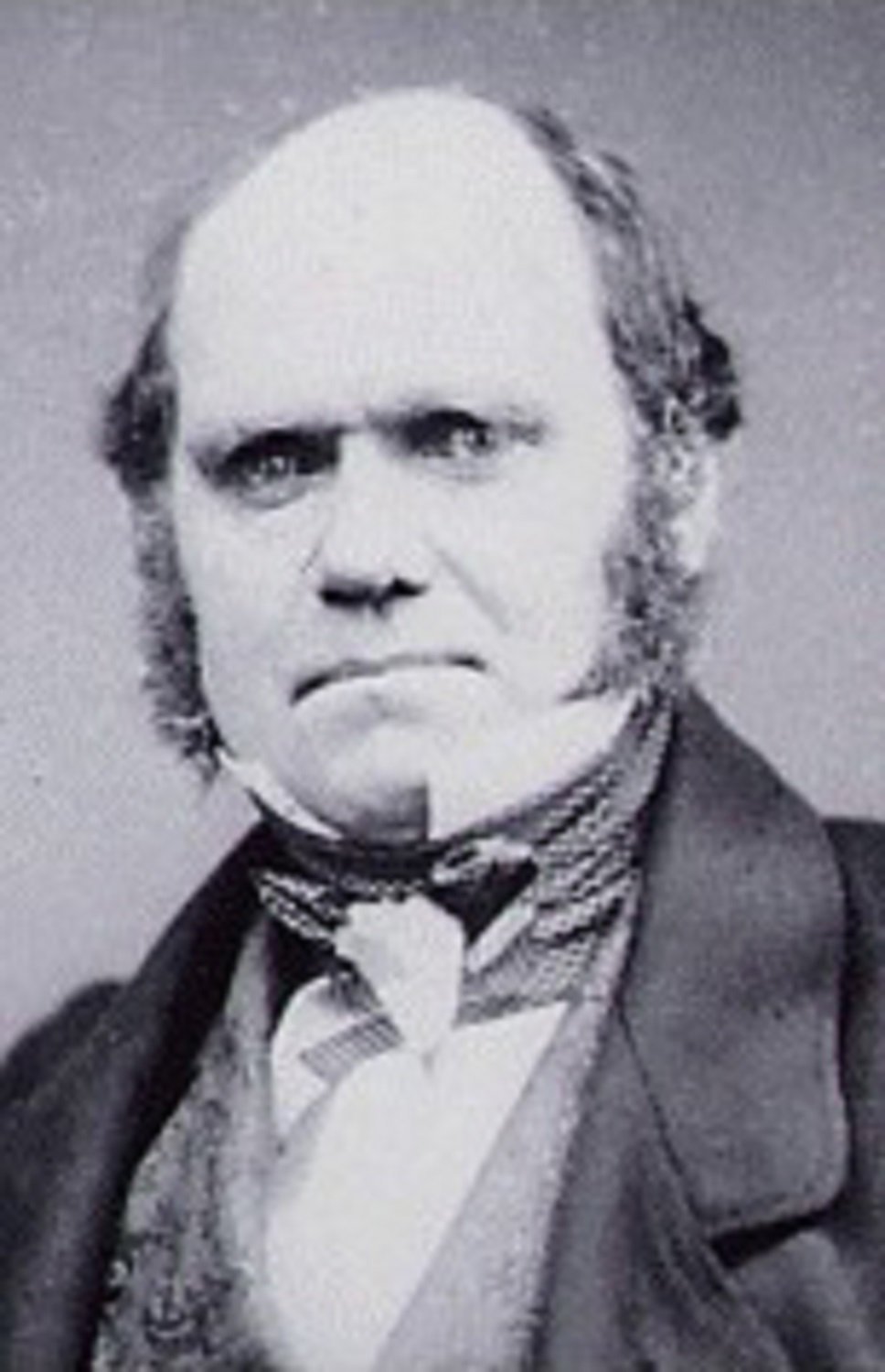
Charles Darwin in 1854
The ongoing antipathy to Darwin is one of the embarrassments of living in America, where one would have thought the ignorance about evolutionary theory had been banished 80-some years ago by the Scopes trial. Apparently not. When I taught this selection from On the Origin of Species by Means of Natural Selection (1859) to a class of freshmen in Texas some years ago, I was still confronted with incredulity and outright hostility, and to judge from the pronouncements of various politicians and the actions of state legislatures, not much has changed.

It's odd, considering that the central premise of Darwin's theory, that "the struggle of life" produces winners and losers and that the winners are those best adapted to the conditions in which they struggle, would seem to be perfectly harmonious with the tenets of the free-market conservatives who are most likely to protest against the theory.
Owing to this struggle, variations, however slight and from whatever cause proceeding, if they be in any degree profitable to the individuals of a species, in their infinitely complex relations to other organic beings and to their physical conditions of life, will tend to the preservation of such individuals and to their offspring.
"Natural Selection" was Darwin's term for the process, but he approved of Herbert Spencer's "Survival of the Fittest" as "more accurate, and ... sometimes equally convenient." He observed that the process was already known to breeders of animals, but that its course in the wild was "immeasurably superior to man's feeble efforts, as the works of Nature are to those of Art." (Thereby setting off the Nature vs. Art debate once again, to rage through the rest of the century and into the next.) The one thing Darwin was most concerned to eliminate was sentimentality about Nature. "We behold the face of nature bright with gladness, we often see superabundance of food; we do not see or we forget, that the birds which are idly singing round us mostly live on insects or seeds, and are thus constantly destroying life."

"Natural selection," he admits, can be a misleading term. For one thing, it seems to some to imply a "selector," which is not at all what Darwin has in mind: "it is difficult to avoid personifying the word Nature; but I mean by Nature, only the aggregate action and product of many natural laws, and by laws the sequence of events as ascertained by us. It also has promoted the notion of "lower" and "higher" forms of life, which is not at all what is involved: The only criterion implied by the term is success at living in a given environment, and success at reproducing. "No country can be named in which all the native inhabitant are now so perfectly adapted to each other and to the physical conditions under which they live, that none of them could still be better adapted or improved." Any given variation within a species can be judged only by its usefulness toward surviving.

And human interference only complicates things: "Man selects for his own good: Nature only for that of the being which she tends." (Darwin has just once again apologized for personifying Nature, explaining that what he means is really "the natural preservation or survival of the fittest.")
Under nature, the slightest differences of structure or condition may well turn the nicely-balanced scale in the struggle for life, and so be preserved. How fleeting are the wishes and efforts of man! how short his time! and consequently how poor will be his results, compared with those accumulated by Nature during whole geological periods! Can we wonder, then, that Nature's productions should be far "truer" in character than man's productions; that they should be infinitely better adapted to the most complex conditions of life, and should plainly bear the stamp of far higher workmanship.
That last phrase, "the stamp of far higher workmanship," has a theistic whiff to it, suggesting Darwin's discomfort with the non-theistic implications of his theory. But he goes boldly onward to proclaim his "belief that all animals and plants are descended from some one prototype," and moreover "that all the organic beings which have ever lived on this earth may be descended from some one primordial form." Still, he clings to the myth of a Creator:
To my mind it accords better with what we know of the laws impressed on matter by the Creator, that the production and extinction of the past and present inhabitants of the world should have been due to secondary causes, like those determining the birth and death of the individual. When I view all beings not as special creations, but as the lineal descendants of some few beings which lived long before the first bed of the Cambrian system was deposited, they seem to me to become ennobled.
There is no escaping the sense that Darwin was struggling to align his theory with the orthodox religious view as much as possible, doing a kind of cheerleading for the theory as a positive, almost holy, view of nature, without outright proclaiming it as "God's plan": "as natural selection works solely by and for the good of each being, all corporeal and mental endowments will tend to progress towards perfection." The question remains: perfect by whose standards? But in the famous "tangled bank" paragraph, he reaches toward an optimistic view of the struggle for existence and a reconciliation with the orthodox account of creation:
There is grandeur in this view of life, with its several powers, having been originally breathed by the Creator into a few forms or into one; and that, whilst this planet has gone cycling on according to the fixed law of gravity, from so simple a beginning endless forms most beautiful and most wonderful have been, and are being evolved.


Arthur Schopenhauer: The Will in Nature
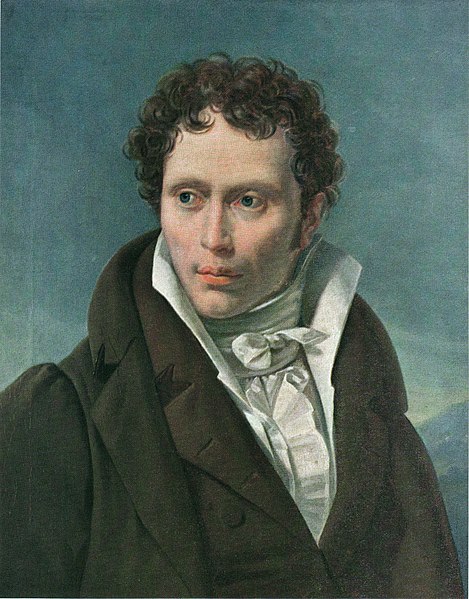
Ludwig Sigismund Ruhl, Portrait of Arthur Schopenhauer, c. 1815
Nobody ever accused Schopenhauer of optimism. Forty years before Darwin's Origin, in The World as Will and Idea (the word translated here as "Idea" is Darstellung, which is sometimes translated as "Representation"), Schopenhauer also based his thought on the prevalence of struggle in life. The human being encounters the world through the body, but the body with which we form our identity "is given as an idea in intelligent perception, as an object among objects and subject to the laws of objects." But it is also a manifestation of what Schopenhauer calls will. "The act of will and the movement of the body are not two different things objectively known, ... they are one and the same, but they are given in entirely different ways, -- immediately, and again in perception for the understanding.... It is only in reflection that to will and to act are different; in reality they are one."

When we experience pain, Schopenhauer asserts, we are experiencing that which "is opposed to the will; gratification and pleasure when it is in accordance with it." Pain and pleasure are "immediate affections of the will, in its manifestation, the body." By will, Schopenhauer doesn't just mean individual determination, as in "I will be heard!" or "His will is law." Will is a fundamental force in nature. It includes
  • "the force which germinates and vegetates in the plant"
  • "the force through which the crystal is formed"
  • "that by which the magnet turns to the north pole"
  • "the force whose shock [one] experiences from the contact of two different kinds of metals"
  • "the force which appears in the elective affinities of matter as repulsion and attraction, decomposition and combination"
  • "and, lastly, even gravitation, which acts so powerfully throughout matter, draws the stone to the earth and the earth to the sun" 
(May the Force be with you.)

All of these forces and others are the same thing: will. We experience them as separate phenomena, as ideas. "Phenomenal existence is idea and nothing more ... but the will alone is a thing in itself." Will "appears in every blind force of nature and also in the preconsidered action of man; and the great difference between these two is merely in the degree of the manifestation, not in the nature of what manifests itself." Such characteristics of matter "as rigidity, fluidity, elasticity, electricity, magnetism, chemical properties and qualities of every kind ... are in themselves immediate manifestations of will."
In the higher grades of the objectivity of will we see individuality occupy a prominent position, especially in the case of man, where it appears as the great difference of individual characters, i.e., as complete personality, outwardly expressed in strongly marked individual physiognomy, which influences the whole bodily form.... The farther down we go, the more completely is every trace of the individual character lost in the common character of the species, and the physiognomy of the species alone remains.
Will also manifests itself in the struggle of existence, in "the burden of physical life, the necessity of sleep, and finally, of death; for at last these subdued forces of nature, assisted by circumstances, win back from the organism, wearied even by the constant victory, the matter it took from them.... Thus everywhere in nature we see strife, conflict, and alternation of victory ... indeed nature exists only through it." As Darwin would be later, Schopenhauer is impressed by the fact that "each animal can only maintain its existence by the constant destruction of some other. Thus the will to live everywhere preys upon itself, and in different forms is its own nourishment." But Schopenhauer extends this process of struggle even to inanimate matter, "when, for example, crystals in process of formation meet, cross, and mutually disturb each other to such an extent that they are unable to assume the pure crystalline form, so that almost every cluster of crystals is an image of such a conflict of will at this low grade of its objectification." And just as in the microcosm, so in the macrocosm: "the constant tension between centripetal and centrifugal force ... keeps the globe in motion."

So if you're searching for an ultimate, you've found it: "Will is the thing-in-itself, the inner content, the essence of the world. Life, the visible world, the phenomenon, is only the mirror of the will."
Birth and death belong merely to the phenomenon of will, thus to life; and it is essential to this to exhibit itself in individuals which come into being and pass away, as fleeting phenomena appearing in the form of time -- phenomena of that which in itself knows no time, but must exhibit itself precisely in the way we have said, in order to objectify its peculiar nature.
A student of Hinduism, Schopenhauer notes that Shiva (or Siva, as he spells it), the god associated with destruction and death is given "as an attribute not only the necklace of skulls, but also the lingam, the symbol of generation, which appears here as the counterpart of death, thus signifying that generation and death are essentially correlatives, which reciprocally neutralise and annul each other."

Again like Darwin, Schopenhauer asserts that "it is not the individual, but only the species that Nature cares for, and for the preservation of which she so earnestly strives, providing for it with the utmost prodigality through the vast surplus of the seed and the great strength of the fructifying impulse.... [Nature's] kingdom is infinite time and infinite space.... Therefore she is always ready to let the individual fall." Nature assures continuation by making sex pleasurable. "On the other hand, excretion, the constant exhalation and throwing off of matter, is the same as that which, at a higher power, death, is the contrary of generation." In this scheme of things, in which the physical being is merely an instrument of generation, "It appears just as foolish to embalm the body as it would be to carefully preserve its excrement."
Man alone carries about with him, in abstract conceptions, the certainty of his death; yet this can only trouble him very rarely, when for a single moment some occasion calls it up to his imagination. Against the mighty voice of Nature reflection can do little. In man, as in the brute with does not think, the certainty that springs from his inmost consciousness that he himself is Nature, the world, predominates as a lasting frame of mind; and on account of this no man is observably disturbed by the thought of certain and never-distant death, but lives as if he would live forever.


A.N. Whitehead: Nature as Organism

A.N. Whitehead, date unknown
Well, speaking of struggle, there's my attempt to follow Whitehead's argument closely. Once again, the editors' introduction is of considerable help:
Whitehead is preoccupied with organisms in relation to their environment, and at the same time he is seeking to interpret the world of physics, the science of inorganic energy.... He regards the official philosophy of early twentieth-century science, which he traces back to the seventeenth century, as misleading because of its mechanistic assumptions: it makes objects falsely self-sufficient and isolates them from the minds that apprehend them. Whitehead would establish instead a recognition that he finds first expressed in the romantic poets: we do not perceive particular elements in nature as discrete entities, to the exclusion of other elements or to the exclusion of ourselves. Things and the perception of things are events, modes of interaction with other events in space and time. Parts of nature assume individuality by drawing the surrounding world into themselves and delimiting it; but these individual unities must also be seen in terms of larger unities of which they are functions. As in a plant, the whole dominates each part, and as in organic growth every partial whole virtually contains the whole that transcends it.
The excerpts come from Science and the Modern World, based on the Lowell Lectures Whitehead gave at Harvard in 1925. He begins with the usual definitions of terms, explaining that "matter, or material, is anything which has this property of simple location.... one major characteristic which refers equally both to space and to time, and other minor characteristics which are diverse as between space and time." Got that? Good. "The characteristic common both to space and time is that material can be said to be here in space and here in time, or here in space-time." The seventeenth century scientists asserted "that the world is a succession of instantaneous configurations of matter." This was a perfectly useful definition for them. It "is the famous mechanistic theory of nature, which has reigned supreme ever since the seventeenth century. It is the orthodox creed of physical science. Furthermore, the creed justified itself by the pragmatic test. It worked." But there are some problems with it, and Whitehead has a famous phrase for it: "the Fallacy of Misplaced Concreteness," by which he means "the accidental error of mistaking the abstract for the concrete."

In addition to "simple location," Whitehead says "substance and quality ... are the most natural ideas for the human mind. It is the way we think of things, and without these ways of thinking we could not get our ideas straight for daily use." But, he asks, "How concretely are we thinking when we consider nature under these conceptions?" Suppose, he says, we observe of an object that "it is hard, and blue, and round, and noisy." But are these qualities of the object itself, or are they what we bring to them by perceiving them?
These sensations are projected by the mind so as to clothe appropriate bodies in external nature. Thus the bodies are perceived as with qualities which in reality do not belong to them, qualities which in fact are purely the offspring of the mind. Thus nature gets credit which should in truth be reserved for ourselves; the rose for its scent: the nightingale for his song: and the sun for his radiance. The poets are entirely mistaken. They should address their lyrics to themselves, and should turn them into odes of self-congratulation on the excellency of the human mind. Nature is a dull affair, soundless, scentless, colourless; merely the hurrying of material, endlessly, meaninglessly. 
Yet since the seventeenth century, science has dealt with nature this way. "The enormous success of the scientific abstractions, yielding on the one hand matter with its simple location in space and time, on the other hand mind, perceiving, suffering, reasoning, but not interfering, has foisted onto philosophy the task of accepting them as the most concrete rendering of fact.... It involves a fundamental duality, with material on the one hand, and on the other hand mind."

Whitehead proposes that we analyze things in space and time: "Things are separated by space, and are separated by time: but they are also together in space, and together in time, even if they be not contemporaneous." So space-time is characterized by the separative and the prehensive, and also because everything in space has a definite location (it can't be in two places at once) and because "it endures during a certain period and through no other period" in time, it also has a modal character. It's the modal character that suggests the idea of simple location. "But it must be conjoined with the separative and prehensive characters."
The volume is the most concrete element of space. But the separative character of space, analyses a volume into sub-volumes, and so on indefinitely.... But it is the unity of volume which is the ultimate fact of experience.... Accordingly, the prime fact is the prehensive unity of volume, and this unity is mitigated or limited by the separated unities of the innumerable contained parts.... The parts form an ordered aggregate, in the sense that each part is something from the standpoint of every other part, and also from the same standpoint every other part is something in relation to it.
"Prehension" is a grasping of unity, and "Perception is simply the cognition of prehensive unification; or more shortly, perception is cognition of prehension. The actual world is a manifold of prehensions; and a "prehension" is a "prehensive occasion"; and a prehensive occasion is the most concrete finite entity, conceived as what it is in itself and for itself.... Nature is conceived as a complex of prehensive unifications."

Nature is, then, a process, a series of events. "Simple location" is no longer relevant. And "space-time is nothing else than a system of pulling together of assemblages into unities." An event has a past, present and future. "These conclusions are essential for any form of realism. For there is in the world for our cognisance, memory of the past, immediacy of realisation, and indication of things to come."

What we're dealing with now are organisms, "so that the plan of the whole influences the very characters of the various subordinate organisms which enter into it.... Thus an electron within a living body is different from an electron outside it, by reason of the plan of the body ... and this plan includes the mental state."

Whitehead now turns, thankfully, to literature, where he finds "the most interesting criticism of the thoughts of science among the leaders of the romantic reaction which accompanied and succeeded the epoch of the French Revolution." Chief among them, for Whitehead's purposes, are Wordsworth and Shelley. (Keats he dismisses, rather oddly, as "an example of literature untouched by science," and Coleridge as "only important by his influence on Wordsworth." Byron and Blake apparently are beyond consideration.) Wordsworth, he says, "alleges against science its absorption in abstractions. His consistent theme is that the important facts of nature elude the scientific method." Wordsworth "always grasps the whole of nature as involved in the tonality of the particular instance.... the first book of The Prelude ... is pervaded by this sense of the haunting presences of nature.... Wordsworth, to the height of genius, expresses the concrete facts of our apprehension, facts which are distorted in the scientific analysis."

Unlike Wordsworth, Shelley loved science, which "symbolises to him joy, and peace, and illumination.... What the hills were to Wordsworth, a chemical laboratory was to Shelley.... If Shelley had been born a hundred years later, the twentieth century would have seen a Newton among chemists." Shelley perceives the organic character of nature, "functioning with the full content of our perceptual experience." In his poems you see "an emphatic witness to a prehensive unification as constituting the very being of nature. Berkeley, Wordsworth, Shelley are representative of the intuitive refusal seriously to accept the abstract materialism of science." 

In "The Cloud," Shelley examines "the endless, eternal, elusive change of things.... Every scheme for the analysis of nature has to face these two facts: change and endurance. There is yet a third fact to be placed by it, eternality, I will call it."
The mountain endures. But when after ages it has been worn away, it has gone. If a replica arises, it is yet a new mountain. A colour is eternal. It haunts time like a spirit. It comes and it goes. But where it comes, it is the same colour. It neither survives nor does it live. It appears when it is wanted. The mountain has to time and space a different relation from that which colour has.
The nineteenth century English poets performed a valuable service in pointing out "the discord between the aesthetic intuitions of mankind and the mechanism of science." They make us aware that "a philosophy of nature must concern itself at least with these six notions: change, value, eternal objects, endurance, organism, interfusion."
You are in a certain place perceiving things. Your perception takes place where you are, and is entirely dependent on how your body is functioning. But this functioning of the body in one place, exhibits for your cognisance and aspect of the distant environment, fading away into the general knowledge that there are things beyond. If this cognisance conveys knowledge of a transcendent world, it must be because the event which is the bodily life unifies in itself aspects of the universe.... "Value" is the word I use for the intrinsic reality of an event. Value is an element which permeates through and through the poetic view of nature.

Monday, April 18, 2011

4. The Modern Tradition, edited by Richard Ellmann and Charles Feidelson Jr., pp. 54-73

Symbolism: Imagination and Nature; Symbolic Nature (William Blake, William Wordsworth, Charles Baudelaire, W.B. Yeats, Paul Klee). Symbolism: Imagination and Thought; The State of Doubt (Johann Wolfgang von Goethe, John Keats, Gustave Flaubert)
_____

William Blake: The Eternal World of Vision

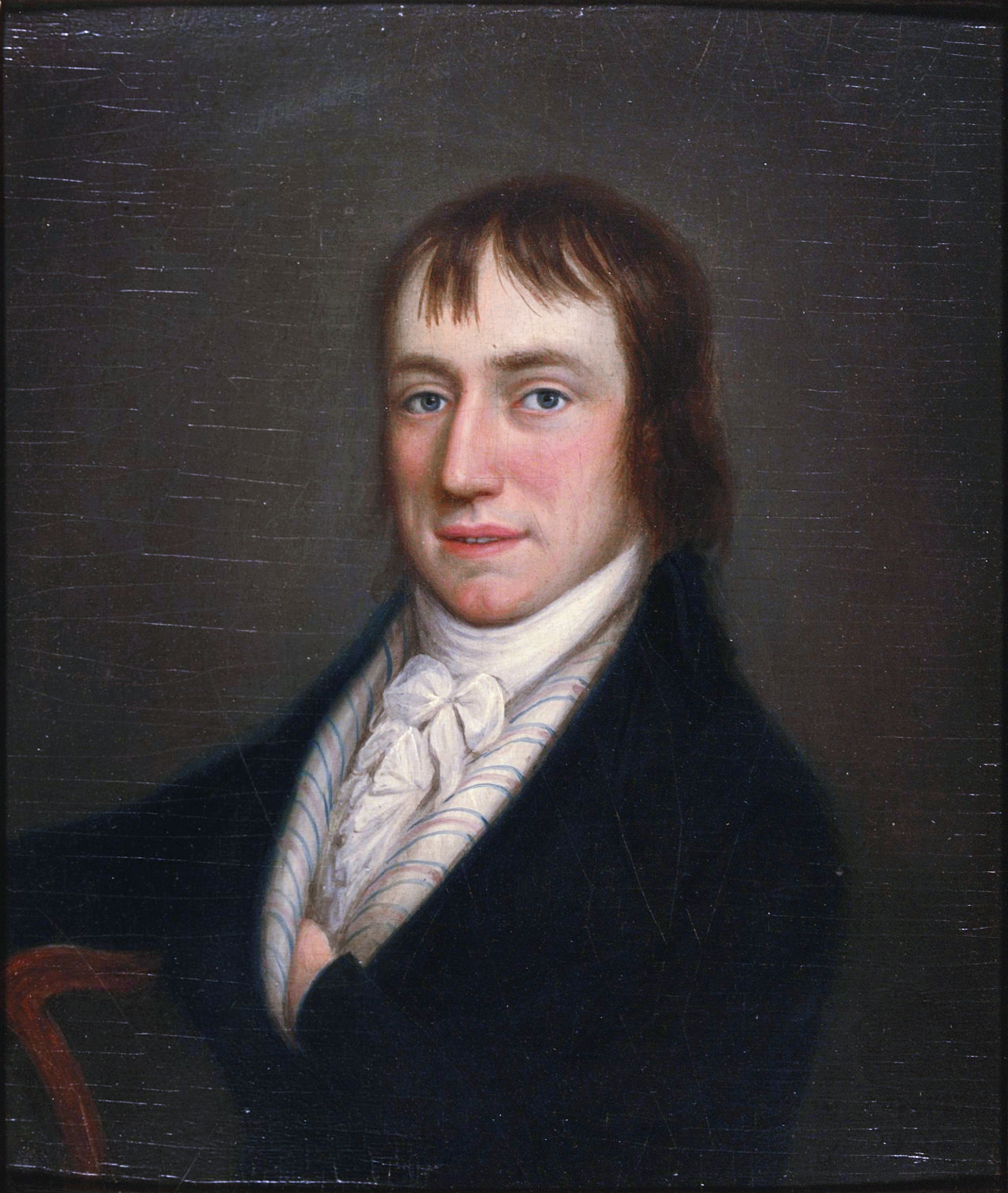
Thomas Phillips, William Blake, 1802
In the first selection, a 1799 letter to a clergyman, the Rev. Dr. Trusler, Blake asserts,
This World Is a World of Imagination & Vision. I see Every thing I paint In This World, but Every body does not see alike. To the Eyes of a Miser a Guinea is far more beautiful than the Sun, & a bag worn with the use of Money has more beautiful proportions than a Vine filled with Grapes.... But to the Eyes of the Man of Imagination, Nature is Imagination itself. 
Blake champions the imagination because it gives him an entree to the significance of the external world: "To Me This World is all One continued Vision of Fancy or Imagination," and for the great poets -- he cites Homer, Virgil and Milton in particular -- Imagination is the vehicle for "Spiritual Sensation." As for his own works of visual art, he is particularly pleased that "Children ... have taken a greater delight in contemplating my Pictures than I even hoped." Not that there is anything inherently more receptive about children: "Some Children are Fools & so are some Old Men. But There is a vast Majority on the side of Imagination or Spiritual Sensation."
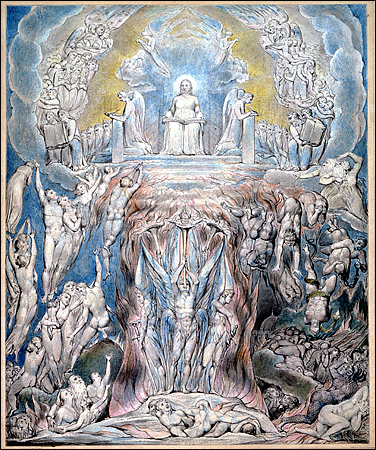
William Blake, A Vision of the Last Judgment, pen and watercolor, 1808
William Blake, watercolor illustration for Robert Blair's The Grave, 1805
Blake's painting of the Last Judgment was to be part of an exhibit in 1810, but the exhibit was canceled and the work was subsequently lost. The watercolor versions shown above follow the plan Blake outlined for the painting. In the second excerpt in this section of The Modern Tradition, written in 1810 for the catalog of the canceled exhibition, Blake discusses the work, insisting that it is "not Fable or Allegory but Vision. Fable or Allegory are a totally distinct & inferior kind of Poetry. Vision or Imagination is a Representation of what Eternally Exists, Really & Unchangeably.... The Hebrew Bible & the Gospel of Jesus are not Allegory, but Eternal Vision or Imagination of All that Exists."

For Blake, art is a rejection of mutability, of the impermanence of existence: "This world of Imagination is the world of Eternity; it is the divine bosom into which we shall all go after the death of the Vegetated body." It is also a rejection of materialism, "of Bad Art & Science. Mental Things are alone Real; what is call'd Corporeal, Nobody Knows of its Dwelling Place: it is in Fallacy, & its Existence is an Imposture." The material world is illusory, and Blake the visionary sees through it: The sun is not "a round disk of fire somewhat like a Guinea" to Blake. Instead it is "an innumerable company of the Heavenly host crying, 'Holy, Holy, Holy is the Lord God Almighty.'" The trick is to see through nature to the eternity behind it: "I question not my Corporeal or Vegetative Eye any more than I would Question a Window concerning a Sight. I look thro' it & not with it."


William Wordsworth: Natural Apocalypse

William Wordsworth in 1789
The selection from The Prelude reprinted here is a considerably tamer version of Blake's nature mysticism. Wordsworth regards an event -- or rather the recognition of an event -- as an epiphany, or what he would elsewhere call a "spot of time." The event in itself has no grand significance in material terms: The party he is traveling with has crossed the Alps. But the awareness that they have done so is "translated by our feelings" into something greater, and
Imagination -- here the Power so called
Through sad incompetence of human speech,
That awful Power rose from the mind's abyss
Like an unfathered vapour that enwraps,
At once, some lonely traveleler. 
Imagination produces "a flash that has revealed / The invisible world." And so, at least for a time, the natural phenomena they encounter -- waterfalls, winds, rocks, crags, clouds, darkness and light -- become symbols of something beyond the material world, they
Were all like workings of one mind, the features
Of the same face, blossoms upon one tree;
Characters of the great Apocalypse,
The types and symbols of Eternity,
Of first, and last, and midst, and without end. 
It's probably worth noting here that "apocalypse" has come to denote the events attendant on the end of the world, when the word's Greek origins meant "uncovering" or "revelation." An apocalypse is a revelation of truths, and not the truths themselves. So what Wordsworth means here is not a vision of the end of the world, but simply the unveiling of the meaning behind the surface phenomena of existence. He senses, but can't articulate, something eternal, which is precisely what Blake was getting at when he asserted that the imagination gives one visions of eternity.


Charles Baudelaire: The Temple of Nature

Charles Baudelaire, c. 1863
Baudelaire's poem "Correspondances" (1857) posits that nature is a temple, and by extrapolation we might suggest that the artist is its  priest, translating the "babel of words" uttered by the temple's "living pillars." The senses receive the sights, the colors, the sounds and scents as finite manifestations of infinite things. In the poem, Baudelaire lays particular emphasis on the sense of smell, which is the most intimate and subjective of the senses, taking in "perfumes" that are "fresh and cool," "mellow," "green," "perverse, rich, and triumphant." And in turn, these odors evoke the tactile ("the bodies of children"), the auditory ("oboes"), and the visual ("fields"), as well as such moral qualities as perversity, richness and triumph.


W.B. Yeats: Symbol as Revelation

John Butler Yeats, William Butler Yeats, 1900
Everybody likes to complain about journalists, and in this essay, "The Symbolism of Poetry" (1900), Yeats is out to disabuse the readers of the notion, apparently foisted upon them by journalists, that artists proceed without any higher aim or theoretical purpose. And here, of course, he proceeds to enunciate his own.

He cites several lines of verse in which metaphor takes on a larger symbolic role, beginning with Robert Burns's
The white moon is setting behind the white wave,
And Time is setting with me, O!
He says, quite correctly, "Take from them the whiteness of the moon and of the wave, whose relation to the setting of Time is too subtle for the intellect, and you take from them their beauty." And he's right: an 18th-century critic might object that neither the moon nor the wave is, strictly speaking, white. But we only have to go to Melville's great discourse on "The Whiteness of the Whale" to observe the symbolic power of the adjective. As Yeats puts it, "All sounds, all colours, all forms, either because of their pre-ordained energies or because of long association, evoke indefinable and yet precise emotions." The italics in that quotation are mine, to emphasize the seeming oxymoron: If precise, then why indefinable? But that's the point: Symbols evoke precise emotions, but if they were definable, we wouldn't need symbols to evoke them.

The function of the symbol in art, as Yeats sees it, is to bring unity out of multiplicity: "when sound, and colour, and form are in a musical relation, a beautiful relation to one another, they become as it were one sound, one colour, one form, and evoke an emotion that is made out of their distinct evocations and yet is one emotion." And it is the artist who, by perceiving the power of the symbol, translates that power to the rest of the world: "I am certainly never certain, when I hear of some war, or of some religious excitement or of some new manufacture, or of anything else that fills the ear of the world, that it has not happened because of something that a boy piped in Thessaly." Okay, that's a bit extravagant. But try this one on for truth: "I doubt ... that love itself would be more than an animal hunger but for the poet and his shadow the priest." (That subordination of the religious to the artistic is quite lovely.)

Poets and musicians achieve their effects by species of hypnotism, Yeats asserts:
The purpose of rhythm, it has always seemed to me, is to prolong the moment of contemplation, the moment when we are both asleep and awake, which is the one moment of creation, by hushing us with an alluring monotony, while it holds us waking by variety, to keep us in that state of perhaps real trance, in which the mind liberated from the pressure of the will is unfolded in symbols. If certain sensitive persons listen persistently to the ticking of a watch, or gaze persistently on the monotonous flashing of a light, they fall into the hypnotic trance; and rhythm is but the ticking of a watch made softer, that one must needs listen, and various, that one may not be swept beyond memory or grow weary of listening; while the patterns of the artist are but the monotonous flash woven to take the eyes in a subtler enchantment.
And "enchantment" is the aim, or at least as long as it is in service of something of value. The emptying out of religious belief has, in Yeats's view, crippled the world turning it toward the materialistic. "How can the arts overcome the slow dying of men's hearts that we call the progress of the world, and lay their hands upon men's heartstrings again, without becoming the garment of religion as in old times?"  If the piping of a Thessalian boy can cause people to go to war, then artists need to be conscious of the ends toward which their work can move people. Artists need to avoid the didactic, the moralizing, the anecdotal, and "that brooding over scientific opinion that so often extinguished the central flame in Tennyson." They need to discover the symbolic force of the world around them, to "return to imagination" and to understand "that the laws of art, which are the hidden laws of this world, can alone bind the imagination."

To return to the topic of rhythm, Yeats "would cast out of serious poetry those energetic rhythms, as of a man running, which are the invention of the will with its eyes always on something to be done or undone; and we would seek out those wavering, meditative, organic rhythms, which are the embodiment of the imagination, that neither desires nor hates, because it has done with time, and only wishes to gaze upon some reality, some beauty."


Paul Klee: Eternal Genesis

Paul Klee, date unknown
The excerpts are from Klee's On Modern Art (posthumously published in 1945), and are a series of brief, epigrammatic paragraphs. Klee asserts that the artist's role is defined by the word "creation" and that art is perpetually generative, creating a new nature as it were.
The deeper he looks, the more readily he can extend his view from the present to the past, the more deeply he is impressed by the one essential image of creation itself, of Genesis, rather than by the image of nature, the finished product. 
We are back here to the distinction between natura naturata ("the finished product") and natura naturans ("creation itself'" or the act of creating). Klee looks to the artist to create new things, not to reproduce the things already created.
Paul Klee, Flower Myth, 1918

The artist's role is "not to provide a scientific check on the truth of nature" but to demand "freedom," defined as "the right to develop, as great Nature herself develops." The source of it all is, of course, imagination, and "What springs from this source, whatever it may be called, dream, idea or phantasy -- must be taken seriously only if it unites with the proper creative means to form a work of art." He retorts to the critics of his own work, who have called it "childish," that the label "most have originated from those linear compositions of mine in which I tried to combine a concrete image, say that of a man, with the pure representation of the linear element.
Had I wished to present the man "as he is," then I  should have had to use such a bewildering confusion of line that pure elementary representation would have been our of the question. The result would have been vagueness beyond recognition.

And anyway, I do not wish to represent the man as he is, but only as he might be.
Paul Klee, Miraculous Landing, or the "112!"  1920
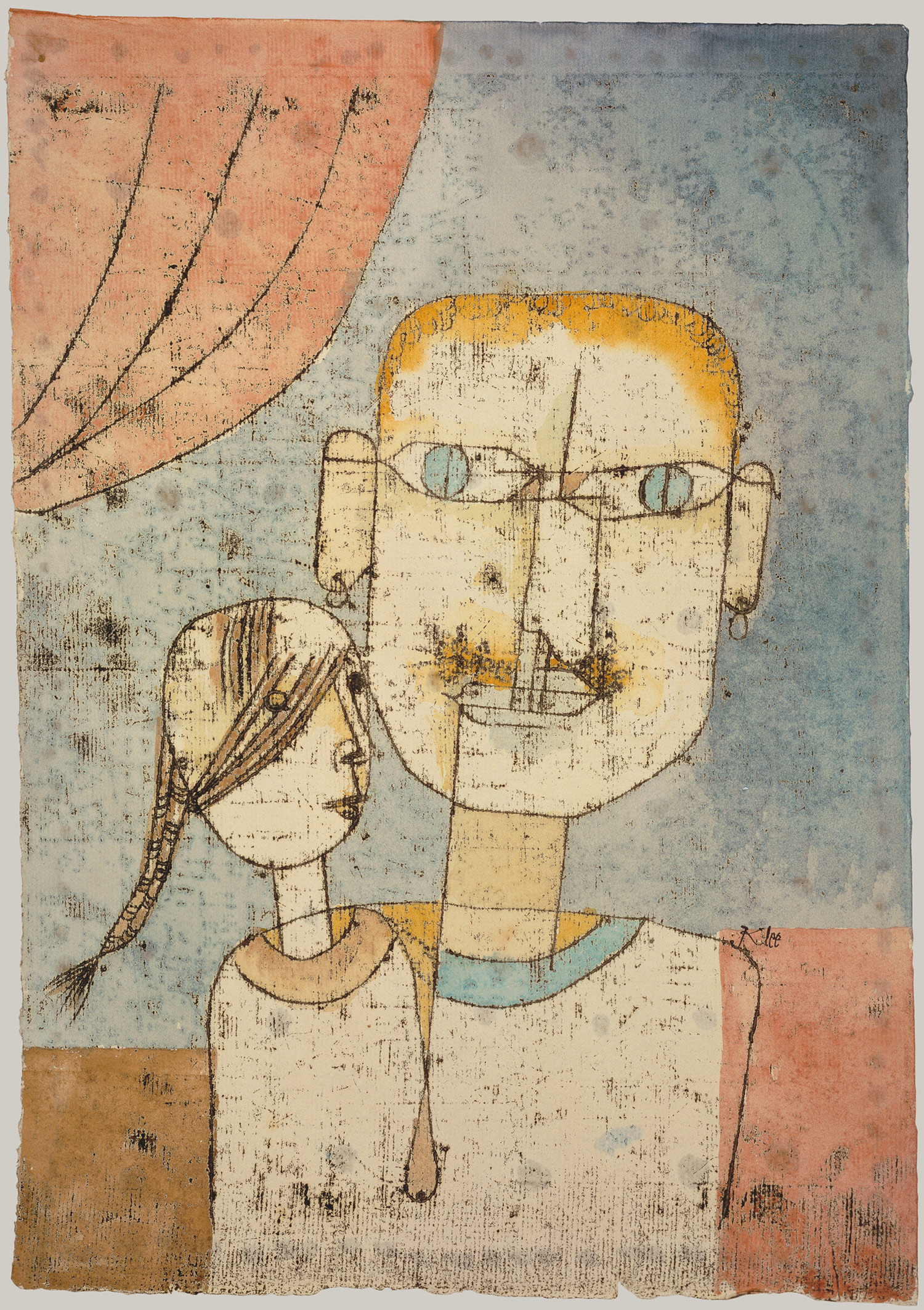
Paul Klee, Adam and Little Eve, 1921


Johann Wolfgang von Goethe: Escape From Ideas

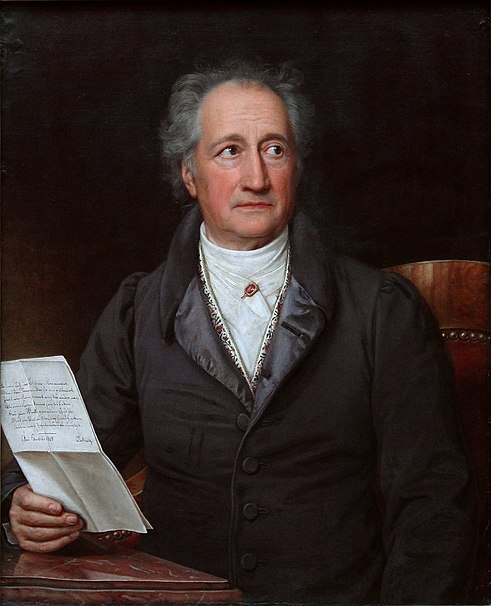
Joseph Karl Stieler, Goethe age 69, 1828
Artists are always irritated by being asked, "What are you trying to say?" and Goethe, to judge from this excerpt from J.P. Eckermann's Conversations of Goethe (1836), was no exception.
"It was ... not in my line, as a poet, to strive to embody anything abstract. I received in my mind impressions, and those of a sensual, animated, charming, varied, hundredfold kind, just as a lively imagination presented them; and I had, as a poet, nothing more to do than artistically to round off and elaborate such views and impressions, and by means of a lively representation so to bring them forward that others might receive the same impression in hearing or reading my  representation of them."
This is the artist as medium between the universe and the observer. But the role doesn't come with any responsibility to make the message simple and comprehensible: "I am rather of the opinion, that the more incommensurable, and the more incomprehensible to the understanding, a poetic production is, so much the better it is." (So much for anyone who has tried to find a simple message in Faust.)

As for the role of religion in art, "'Religion,' said Goethe, 'stands in the same relation to art as any other of the higher interests in life." What predominates for the artist is not dogma but the human element: "Art must address itself to those organs with which we apprehend it; otherwise it misses its effect. A religious material may be a good subject for art, on only in so far as it possesses general human interest." That's why portraits of the Madonna and Child have always been popular.


John Keats: Negative Capability

William Hilton, John Keats, date unknown
This famous excerpt from Keats's letter to his brothers George and Thomas has a phrase in it that I think is often mispronounced, and therefore misunderstood: "negative capability." I think the word isn't NEGative but neGAtive -- i.e., the function of negating. And we shouldn't lose the context in which Keats came up with this powerful concept: He had been to a dinner with some friends "who say things which make one start, without making one feel." Their conversation "only served to convince me how superior humour is to wit." The priority given to feeling over intellect here is characteristic, and it feeds into his though about Shakespeare's "Negative Capability, that is, when a man is capable of being in uncertainties, mysteries, doubts, without any irritable reaching after fact and reason." Keats isn't against fact and reason, he just wants to put it in its place, and its place isn't in literature.


Gustave Flaubert: Art Without Conclusions

Gustave Flaubert, date unknown
In this 1857 letter to Marie-Sophie Leroyer de Chantepie, with whom Flaubert carried on an extended correspondence, he rejects the idea that human beings can ever "attain to absolute knowledge of truth and goodness." In fact, the only road to happiness is to avoid the delusion that certainty is possible. "Life is such a hideous business that the only method of bearing it is to avoid it. And one does avoid it by living in Art, in the ceaseless quest for Truth presented by Beauty." (The kinship with Keats's conclusion, "Beauty is truth, truth Beauty, -- that is all / Ye know on earth, and all ye need to know," is evident, except that Keats's formulation of that dictum is loaded with irony.)
Superficial, limited creatures, rash, feather-brained souls, demand a conclusion from everything; they want to know the purpose of life and the dimensions of the infinite. Picking up a handful of sand in their poor, puny grasp, they say to the Ocean: "I shall now count the grains on your shores." but when the sand slips through their fingers and the sum proves long, they stamp and burst into tears. Do you know what we should do on that shore? Either kneel down or walk. You must walk. 
The advice is not to cease from questioning, but to cease from hoping for a definitive answer. Strive, but don't overreach. "No great genius has come to final conclusions; no great book ever does so, because humanity itself is forever on the march and can arrive at no goal. Homer comes to no conclusions, nor does Shakespeare, nor Goethe, nor even the Bible." Thus Flaubert rejects not only religion but also politics, believing instead in "the perpetual evolution of humanity and in its ever-changing forms, and consequently I abominate all those frames which men try to cram it into by main force, all the formulas by which they define it, and all the plans they devise for it.... it seems idiotic to me to seek the best religion or the best government. For me, the one on its deathbed is the best, since it is then making way for another."

Friday, October 1, 2010

8. The Age of Wonder, by Richard Holmes, pp. 211-234

The Age of Wonder: The Romantic Generation and the Discovery of the Beauty and Terror of Science (Vintage)Mungo Park in Africa
_____
Tied down by gout and administrative responsibility, Joseph Banks was still fascinated by exploration, so in 1788 he became one of the founders of the Association for Promoting the Discovery of the Inland Districts of Africa  (later mercifully shortened to the Africa Association and finally merged with the Royal Geographic Society in 1831).  The association was designed to promote exploration and commerce, though it of course also paved the way for colonialism and the cultural imperialism of Christian evangelicals, particularly after the war against Napoleon began and Banks became a member of the Privy Council. The great goal of the explorers of the late eighteenth century was the city of Timbuctoo (now Timbuktu in the nation of Mali), which had the legendary aura of an El Dorado.

In 1792 Banks met a twenty-one-year old Scottish-physician named Mungo Park. The tall, athletic Park had come to London to find something more interesting to do with his life than being a doctor. Banks arranged for him to go on a naval expedition to Sumatra as an assistant ship's surgeon. He acquitted himself so well on the eighteen-month voyage that Banks suggested to the Africa Association that they send Park to explore the Niger. He was outfitted with "two shotguns, two compasses, a sextant, a thermometer, a small medicine chest (the regular use of quinine as a prophylactic against malaria had not yet been adopted), a wide-brimmed hat and the indispensable British umbrella. There were also two vital objects of sartorial formality: a blue dress coat with brass buttons, and a malacca cane with a silver top." His objective was to seek out the source of the Niger and to try to get as far as Timbuctoo.

By July 1795 Park was at Pasania, a hundred miles up the river Gambia. He spent five months there, learning Mandingo and recovering from a bout with malarial fever, before setting off with an African guide and interpreter named Johnson and an African slave boy, Demba, whom Park intended to set free on his return. Their expedition began, following the Gambia eastward, on December 2.  But when he entered the territory controlled by a Moorish chieftain known as Ali, all of the good he had brought with him for trading were stolen, Johnson and Demba disappeared, and Park became a virtual prisoner of Ali. He recalled in particular a rather embarrassing examination by Ali's wife, Fatima, and her female entourage, who wanted to know if he was circumcised.

Park escaped, and on July 20, 1796, got his first sight of the Niger, which, he was pleased to note, flowed eastward, as Herodotus had predicted. He was treated kindly by a group of women who invited him in, fed him, and sang him to sleep. He realized that the extemporized song was about him, the poor white man that they had fed and sheltered. "The women reversed all Park's assumptions about his travels in Africa. He realised that it was he -- the heroic white man -- who was in reality the lonely, ignorant, pitiable, motherless and unloved outcast. It was he who came and sat under their tree and drank at their river." When he left he gave the woman who had taken him in the four brass buttons from his coat.

On August 25, he decided not to proceed as far as Timbuktu and to begin his return journey. But he was set upon by Moorish bandits, who robbed him of everything he had left, except his trousers, his boots (which were falling apart) and his hat, in the band of which he had hidden his travel journal. He recorded sitting there in despair, naked, hungry and exhausted, staring at the ground, with "no alternative, but to lie down and perish."
He noticed a tiny piece of flowering moss pushing up through the stony earth beside his boot. In a flash, his scientific interest was aroused, and leaning forward to examine the minute plant, for one moment he forgot his terrible situation. He carefully described this movement out of paralysing despair: "At this moment, painful as my reflections were, the extraordinary beauty of a small moss in fructification, irresistibly caught my eye. I mention this to show from what trifling circumstance the mind will sometimes derive consolation.... Can the Being (thought I) who planted, watered, and brought to perfection, in this obscure part of the world, a thing which appears of so small importance, look with unconcern upon the situation and suffering of creatures formed after his own image? -- surely not!" 
He kept going on his journey westward, discovering that he could pay his way by writing out verses from the Quran on scraps of paper torn off of the pages of his journal and selling them. Holmes likens Park's redemption from despair to that of the Ancient Mariner, who is released from the curse of killing the albatross when he blesses the sea creatures surrounding his ship.

Park returned to London just before Christmas in 1797. His adventures made him a celebrity and when his account of them was published in the spring of 1799 as Travels in the Interior of Africa, he earned enough to marry Allison Anderson, who had been his childhood sweetheart. He settled down as a physician in Peebles, and fathered two sons and a daughter. Among his patients was the young Walter Scott, to whom Park confessed in 1803 that he was discontented with being a country doctor on the "lonely heaths and gloomy hills" of Scotland and "would rather brave Africa and all its horrors."

So in 1805 Park set out on his second expedition, this one well-financed and -equipped. The war with France changed the aim of the expedition "from a geographical survey to that of an armed trading caravan, its main purpose to seek to establish a commercial trade down the Niger." Banks proposed it as a step "to secure to the British Throne, either by conquest or by Treaty, the whole of the Coast of Africa from Arguin [in Mauritania] to Sierra Leone." He sounded the note of British imperialism, to bring the benefits of Christianity and benign rule to the natives, though "It is not clear how much of this imperial dream he ever vouchsafed to Park himself."

Park would be accompanied by his wife's brother, Alexander Anderson. They were to be given the military ranks of captain and lieutenant respectively, and though Park pleaded to be allowed to travel with only two or three people, including George Scott, the expedition's artist, in the end he was accompanied by forty soldiers under the command of twenty-two-year-old Captain John Martyn. They arrived at Goree on March 28, 1805, just before the beginning of the rainy season, and finally set off on the Gambia on April 27. The rains came, and the soldiers began to succumb to malaria fever and dysentery. By the time they reached the Niger on August 19, only twelve Europeans from the original party remained alive. Five more, including Scott, died when they reached Sansanding, and Park nearly poisoned himself with mercury calomel trying to cure a bad case of dysentery.

They set out on the Niger with a party of nine, including Anderson, three troopers, Martyn, two slaves who had been promised freedom, and an Arabic-speaking guide, Amadi. Park planned to descend the river after it turned southward at Timbuktu and follow it to the bay of Benin. Martyn recorded Park's efficiency in a letter written to a fellow officer, but on November 4, he added a note on the outside of the envelope telling of the death of Anderson and a trooper. Park also recorded Anderson's death and burial in his journal: "I then felt myself as if left a second time, lonely and friendless, amidst the wilds of Africa." Before leaving Sansanding, he wrote farewells to the sponsor of the expedition, Lord Camden at the Colonial Office, to Banks, and to his wife. "But he also sent back to Goree by Arabic messenger his journals written up to that date, as if this would be the last chance."

About November 21, 1805, accompanied by Martyn and three soldiers (he wrote in a last note that one of the soldiers was "deranged in his mind"), he set off downriver from Sansanding. They never reached Timbuctoo, which became a symbol of an inaccessible goal. One of Tennyson's early poems is called "Timbucto," and it won him the Chancellor's Medal at Cambridge in 1827.  Park was reportedly attacked from the riverbank because he refused to pay the tribute demanded by local chiefs. Amadi, the guide, left them by agreement, but later found a witness who reported that after the rest of the party was killed, Park and Martyn jumped into the river. Their bodies were never found.

Park was thirty-four at the time of his assumed death in February 1896. His wife was paid £4,000 in  prearranged compensation, and the portion of his journal that survived was published in 1815. But legends of Park's survival persisted, and in 1826 his son Thomas set out to try to find him. Thomas had studied science at Edinburgh University and was a lieutenant in the Royal Navy, but he left without warning his family. The accounts of his travels and death are various and unreliable. His body was never found, but "in November 1827, a clean white shirt, pressed and labeled 'T Park,' turned up in a basket of laundry delivered to the explorer Richard Lander at Sokoto, a hundred miles away on the western coast." (Note: Thomas Park's journey, as described by Holmes, is impossible to follow on a map today. "Yansong," which Holmes says is "140 miles inland" from Accra, has either disappeared or undergone a name change. The references to it on Google seem to be from the sources contemporary with Park's journey on which Holmes based his account. There is a Sokoto in northwest Nigeria, but not on the "western coast.") 

Mungo Park's story had the kind of appeal you might expect to the Romantic imagination. It was picked up by Wordsworth in an early version of The Prelude and by Robert Southey in Thalaba the Destroyer, though Holmes observes that "Park's quiet, fresh, limpid prose has easily outlasted Southey's gaudy, melodramatic poem." A better tribute to Park may be Shelley's Alastor, or The Spirit of Solitude, which "reflects the spiritual loneliness of the desert traveller who pursues a perilous river, and knows he will never return.... [Shelley] captures something of Mungo Park's enigmatic wanderlust, and transforms it into an unearthly Miltonic quest for the strange and magnificent limits of the known world." And Keats gave a copy of his poem Endymion to the explorer Joseph Ritchie when he set out on a journey into the Sahara, with instruction to read it and "throw it into the heart of the Sahara Desert." Ritchie wrote to Keats in December 1818 from Cairo that "Endymion has arrived thus far on his way to the Desart." Ritchie never returned.