JOURNAL OF A COMPULSIVE READER
By Charles Matthews
Showing posts with label Manny Padilla. Show all posts

Sunday, August 14, 2011

15. The Adventures of Augie March, by Saul Bellow (in Novels 1944-1953), pp. 893-927

Chapter XXII

Returning to his Chicago haunts, Augie begins working on getting a teaching certificate, and the school at which he does his practice teaching employs his old neighbor, Kayo Obermark. Augie also buys a used Buick, which won't start on cold mornings without a push. Kayo nags him about not being married and becoming a father. "I seemed to have critics everywhere," Augie reflects, and he tells Kayo "my pride has always been hurt by my not being able to give an account of myself and always being manipulated." In fact, Augie's drift through life has been a series of manipulations: by Grandma, by Einhorn, by Simon, by the Renlings, by the Magnuses, and by Thea -- among others. He asserts that "Reality comes from giving an account of yourself, and that's the worst of being helpless."

Kayo invites Augie home to meet his wife, and while he's there Kayo's brother-in-law offers to buy the Buick. Augie sells it to him for one hundred eighty dollars, paid by check, but then the brother-in-law insists they play poker. Kayo and his brother-in-law's wife play too, but Augie is the only winner. He gives Kayo his money back on the way home, but the brother-in-law stops the check when the Buick stops running, and Augie has to come fetch it.

He resumes his affair with Sophie Geratis, who is married now. But Sophie's husband has turned out to be gay, and she wants to divorce him and marry Augie. Despite Kayo's advice, Augie isn't ready to get married and tells Sophie so. She says, "I'm all right for bed, but not to marry.... Nothing is ever good enough for you to stick to. Your old man must have been some aristocrat bastard." Augie tells her that all he knows about his father is that he drove a truck for a laundry. But he knows that Sophie "would have scolded me for my own good too much."

Another friend, Clem Tambow, has an idea: He and Augie will open a vocational counseling service. Clem is about to get his psychology degree, so he'll give aptitude tests and Augie can conduct interviews. Augie rejects the idea as too much of a scam. He tells Clem that he has had a revelation: "since I've been working for Robey I have reached the conclusion that I couldn't utilize even ten percent of what I already knew.... Anything that just adds information that you can't use is just plain dangerous." So he wants to simplify his life: He wants to buy a little land and settle on it. He'll "get married and set up a kind of home and teach school." He'll get his mother and his brother out of their respective institutions, and he'll get the students for his school from state institutions. He'll teach woodworking and maybe his brother George can teach shoe repair. "Maybe I'll study languages so I could teach them. My mother could sit on the porch and the animals would come around her, by her shoes, the roosters and the cats. Maybe we could start a tree nursery."

Clem scoffs at Augie's little utopia, starting with the students: "You think you'll love them so they'll turn into little Michelangelos and Tolstois, and you'll give them their chance in life and rescue them, so you'll be their saint and holy father. But if you make them so good, how will they get along in the world?" Augie wants to be a king, he says, "You sonofabitch, you want to be the kind goddam king over these women and children and your half-wit brother. Your father ditched the family, and you did your share of ditching too, so now you want to make up for it."

Augie persists in this daydream, however, and even thinks about marrying Sophie. But then Pearl Harbor is attacked, and suddenly his attention shifts elsewhere: "At first I went off my rocker, I hated the enemy, I couldn't wait to go and fight. I was a madman in the movies and yelled and clapped in the newsreel." But when he goes to volunteer he discovers that he has developed a hernia from the fall with Bizcocho. So he goes into County Hospital to have the operation done.

Sophie visits him every day in the hospital, though she thinks he's crazy for having the operation when it could get him out of the draft. Her husband has been drafted, which she sees as another reason for Augie to stick around. "Simon came to see me and threw a bag of oranges on the bed. He bawled me out that I hadn't gone to a private hospital." Padilla has let his girlfriend use Augie's room while he was in the hospital, so he's essentially living there, too. So he lets Augie move into his own place. "It took me many long months to get better, and I was doing very poorly. And about this time I got a letter from Thea, APO San Francisco, telling me that she had married an Air Force captain."

Augie goes to visit his mother, and they go for a walk. On their way back, Simon drives up with a blond woman in the car. He signals to Augie not to let their mother know about the woman. Simon "was making real dough now. A company he had invested in was manufacturing a gimmick for the Army." After taking their mother home, Simon introduces Augie to his mistress, Renée. "It was a hard thing for me to get through my head, after I came to know her, that she could be so important to him," Augie recalls. She seems immature and somehow suspicious and uncertain to him. Though Simon proclaims his love for Renée, "He was romantic about Charlotte too. And Renée had to bear it and know she could never have any exclusive claim on him." Augie reflects, however, that he had treated Stella pretty much the same way when Thea turned up in his life. Renée gets her own by demanding from Simon everything that Charlotte has. They fight about it: "Charlotte has her own money, don't you realize that?" Renée replies, "But not what you want. I've got that."

While waiting to recover from the hernia operation, Augie takes a job as a salesman with a business machine company -- a plum job made available by the wartime manpower shortage. But he remains eager to get into the service, to Simon's disgust -- Simon has been declared 4F because of an ear problem. The Army and Navy continue to reject Augie, so he joins the Merchant Marine. While he's waiting to go to Sheepshead Bay for training, Augie runs into Simon, who tells him that Renée tried to commit suicide -- though he admits that she may have been faking it. Charlotte had found out about Renée and told Simon that it had to stop. After a meeting in which Renée cursed Charlotte and both Charlotte and Simon slapped Renée, Simon paid Renée off and sent her to California. But she had come back and telephoned Simon with the news that she was pregnant. Simon told her he didn't care and called her a crook. "After a silence she hung up. This was when he thought she would kill herself." So he went to check on her and found her unconscious. She is in her fourth month of pregnancy, and he asks Augie what to do.

"What's there to do? Nothing. There'll be a kid now. Who knows but that this is the way you and George and I happened to come into the world."

Chapter XXIII

Augie applies to the Purser's and Pharmacist's Mate School, but has to do training on Chesapeake Bay first. In Baltimore there are letters from friends, including Sophie, who has joined her husband at Camp Blanding. "She said farewell but kept saying it in different letters." They return to Sheepshead, where he studies bookkeeping and "ship's doctoring." Stella Chesney, whom he helped get out of Mexico, is in New York. He learns that Oliver had promised to make her a star in Hollywood, and that they had wound up in Mexico on a kind of side trip. On a weekend leave, Augie and Stella resume their affair, and he falls in love with her.
Was she a vain person, or injurious or cynical, it couldn't make any difference now. Or was I a foolish, uncorrected, blundering, provisional, unreliable man, this was taken away as of no account and couldn't have any sense or meaning. 
He has to return to the base on Monday morning, and he is on his best behavior for fear that his next weekend leave will be canceled. He hurries back to her the next Saturday and finds her sick in bed, partly because she was worried if he really loved her. He proposes to her, and they decide to get married once his training at Sheepshead is over.

Saturday, August 13, 2011

14. The Adventures of Augie March, by Saul Bellow (in Novels 1944-1953), pp. 861-892

Chapter XXI

Augie makes his way back to Chicago with a detour to see his brother George who despite his mental handicap is "a man of fine appearance, as he had been a beautiful child." He is being trained as a shoemaker. After he leaves, he wishes he could find a way other than institutionalization for his brother: "I thought how quick we were to latch onto the excuse to deal practically with any element, like jailbirds, orphans, cripples, the weak-brained or the old." So he goes from the one institution to the other, the one where his mother lives. Simon has kept their mother supplied with everything that his money can buy, though his occasional visits are mainly to check to see if the money is being well-spent. "I knew how Simon could be when he was doing something for your good and welfare; he could make things hot."

Augie's mother frets about how thin he is, and urges him to see his brother, so Augie complies. Simon turns out to be eager to see him, and Augie "found out that I couldn't be critical of Simon when I saw him after a long interval. No matter what he had done or what he was up to now, the instant I saw him I loved him again." But he has no intention of telling him the full story of what had happened in Mexico. "I didn't say anything about the bird or my failures and lessons. Maybe I should have. He criticized me anyway in his mind for my randomness and sentiment."

But Simon really wants to talk about himself anyway, about how successful he has been and how much money he has made, buying and selling businesses. "Since he didn't want to have to do with the Magnuses he had gone into other kinds of business and he was very lucky." He tells Augie, "If I'm not a millionaire soon there's a hitch in my arithmetic." But of course now he wants to take Augie on as a project. They go to Simon's opulent apartment where Augie is forced to get rid of his old clothes and Simon dresses him in new and expensive ones. He has the old clothes thrown down the incinerator. They go to his office where Simon wheels and deals on an international scale: "He was in on a deal to buy some macaroni in Brazil and sell it in Helsinki. Then he was interested in some mining machinery from Sudbury, Ontario, that was wanted by an Indo-Chinese company." They go to Simon's club where "he forced his way into a poker game. I could tell he was hated, but no one could stand up to him" as he slanders the other players.

Augie asks why he wants to make them hate him, and Simon replies, "Because I hate them. I want them to know it." So why does he belong to a club with people he hates?  "Why not? I enjoy being a member of a club." (Which is the flip side of Groucho Marx's line about not wanting to be a member of any club that would let him in.)

On the way home they pick up Charlotte, "grimly handsome and immense." Then Mrs. Magnus arrives, and Augie witnesses the bizarre relationship of Simon and his mother-in-law. He nags her about her cheap clothes, and when she comes to the table he sits there reading the paper and ignoring her.
But suddenly Simon threw himself across the table, spilling the cherries and overturning coffee cups. He grabbed his mother-in-law's dress at the collar, thrust in his hand, and tore the cloth down to the waist. She screamed. There were her giant soft breasts wrapped in the pink band. What a great astonishment it was to see them! She panted and covered the top nudity with her hands and turned away. However, her cries were also cries of laughter. How she loved Simon! He knew it too.
He writes her a check ordering her to buy something that doesn't make her look like a scrubwoman. "He went and kissed her on the braids, and she took his head and gave his kisses back two for one and with tremendous humor."

Next Augie goes to see Einhorn, who is recovering from a prostate operation and is complaining about the relationship of his son with Mimi Villars. Mimi and Arthur are living together while Arthur works on a book. She has tried to help him get a job, but Arthur is incapable of holding one. Augie also visits Manny Padilla, who is not sympathetic when he hears about Augie's experiences in Mexico: "Holy Christ, March, what did you have to go there for, with a broad like that and a bird!" Augie protests that he was in love, but Padilla replies, "Is love supposed to ruin you? It seems to me you shouldn't destroy yourself out of life for purposes of love -- or what good is it?"

Padilla diagnoses Augie's problem: "you're too ambitious. You want too much, and therefore if you miss out you blame yourself too hard." It's a familiar problem of Bellow's protagonists: Remember Henderson's "I want, I want" or Herzog's obsessions over Madeleine. Talking to Clem Tambow, Augie decides that his problem is his refusal to specialize: "Specialization was leaving the like of me behind. I didn't know spot-welding, I didn't know traffic management, I couldn't remove an appendix, or anything like that." Clem tells him, "You have ambitions. But you're ambitious in general. You're not concrete enough. You have to be concrete. Now Napoleon was. Goethe was."
"You can't adjust to the reality situation. I can see it all over you. You want there should be Man, with capital M, with great stature. As we've been pals since boyhood, I know you and what you think. Remember how you used to come to the house every day? But I know what you want. O paidea! O King David! O Plutarch and Seneca! O chivalry, O Abbot Suger! O Strozzi Palace, O Weimar! O Don Giovanni, O lineaments of gratified desire! O godlike man!" 
So far, Augie admits, he has found only one specialization: He trained a bird. "I always believed that for what I wanted there wasn't much hope if you had to be a specialist.... And besides specialization means difficulty, or what's there to be a specialist about? I had Padilla's slogan of 'Easy or not at all.'"

Mimi puts him on to a job opportunity that she had found for Arthur, but he doesn't want to be tied down by it: "there was a millionaire engaged in writing a book and he was looking for a research assistant." Augie needs the money: He has finally heard from Stella, but she tells him she is unable to repay his debt just yet -- she will when she finds a job, she promises. So Augie goes to see the millionaire, a man named Robey, who had been one of Frazer's students when Frazer was teaching. "Arthur said the book was to be a survey or history of human happiness from the standpoint of the rich." Augie is justifiably skeptical, but he doesn't want to be dependent on Simon, so he goes to see Robey.

The house sits on a lakefront, and is lavishly and eccentrically furnished. There is a portrait of Robey's mother, who "looked demented and wore a crown, a scepter in one hand and a rose in the other." Arthur has told Augie that she believed "she was the queen of Rockford, Illinois.... She had a throne. She expected everyone in town to bow to her." Though he is afflicted with a stammer, Robey rambles on about his plans for the book. "I thought, Oh, what a crazy bastard! What kind of screwloose millionaire have they sent me to?" But he decides to go through with it, and after some haggling gets Robey to agree to pay him thirty dollars a week for thirty hours work. "I was used to enthusiastic projects that would never leave the inventor's hangar. Like Einhorn's indexed Shakespeare back in the old days." (Or, he might have added, Thea's hunting trip.)

So he submits to Robey's reading assignments and twice-a-week conferences in which he reports on what he's read and answers Robey's questions. "In the autumn he lost his grip on himself. He went on giving me assignments and I collected my thirty bucks with a free conscience, but he didn't do any work." Robey comes to depend on Augie for some kind of stability. "But he gave me a rough time just the same. He was very sensitive and wanted my good opinion; however, he was extremely variable, humble one minute and making sure of his money's worth the next, or yelling or being sullen, sticking out his big red mouth in unhappiness or anger."

His even more eccentric sister, Caroline, also lives in the mansion. "She was screwy. And when she found I had been in Mexico she took a shine to me, believing herself Spanish." But Augie reflects, "I had taken care of my brother George. That ability or quality was with me yet, and sometimes people sensed it. Sometimes I wished I could become a shoemaker too."

Tuesday, August 9, 2011

10. The Adventures of Augie March, by Saul Bellow (in Novels 1944-1953), pp. 739-757

Chapter XIV

Augie gives up his union-organizing job for Thea: "I just didn't have the calling to be a union man or in politics.... It wasn't what I was meant to be." But was he meant to be as head-over-heels in love with Thea as he is?

They fall into a passionate embrace in the elevator of her apartment house. "Not noticing the blood-stiffened shirt, she passed her hand over my chest and up to my shoulders. I opened her housecoat on her breasts. I was not in control of my head, nearly blind." But Augie isn't the only blind one. When she finally notices the bruises from his beating, "the specific reason for my being beaten didn't interest her and she wasn't very curious about it."
Yes, she had heard of the big union drive, but that I was in it was sort of irrelevant. For while I was not with her, where I was intended to be, it didn't make much difference where I was. All intervening things and interferences were of the same unreal kind and belonged -- out there. 
And for the time being, Augie is the same way. "Suitcases were standing around the bed, but I didn't ask about them." He is only mildly surprised that she keeps money, cash and checks, in the refrigerator, "mixed up with rotting salad leaves and lying with saucers of bacon grease, which she didn't like to throw away." 

Gradually this blind infatuation -- "I loved her to the degree that anything she chanced to do was welcome to me" -- begins to allow reality to creep in. He learns that she is married, but is going to Mexico to get a divorce. Her husband is older and very wealthy. Esther, too, has married a rich man, a lawyer in Washington, D.C. Thea assumes that Augie will go with her to Mexico, and for the moment at least he is not inclined to refuse anything she asks of him.

He calls Grammick at the union offices. "He said the union guy and his boys were really gunning for me, to lay low," and although he is surprised when Augie tells him he's quitting, he admits that the conflict between the unions was "a lousy deal" to get involved in.

Thea starts outfitting Augie for the trip. "She wanted me to look like a sportsman," and buys expensive things for him, squandering money everywhere. Augie notices her foolish extravagances, but "It didn't matter. I let a lot of things go past.... I was never before so taken up with a single human being." He follows Thea's lead in everything, though occasionally is aware that he is "abandoning some mighty old protections."
Here Thea appeared with her money, her decided mind set on love and great circumstances, her car, her guns and Leicas and boots, her talk about Mexico, her ideas. One of the chiefest of these ideas being that there must be something better than what people call reality.
He recognizes "that she was used to having what she wanted, including me." Augie opens up to her about everything, but he sees that "she was in many ways suspicious." But she doesn't open up as completely.
She had several times tried to tell me what we would do in Mexico obtaining her divorce, and she seemed to assume that I knew intuitively what her plans were. I frequently was confused. I couldn't tell whether she owned or rented a house in the town of Acatla, and what she described of the country didn't make me altogether happy. It sounded like a risky place when she talked of the mountains, hunting, diseases, robbery, and the dangerous population.
They are, he learns, going to go hunting with eagles. "She had gotten the idea for this hunt from reading articles by Dan and Julie Mannix, who actually had gone to Taxco some years before with a trained bald eagle and used the bird to catch iguanas." They are going to stop on the way at a place near Texarkana where a man raises eagles. The iguanas are for a friend of her father's who has a private zoo. "As this information came out, which I didn't know how seriously to take, I thought this was like me and my life -- I could not find myself in love without it should have some peculiarity." (The vernacular touch of "without it should have" is a deft reminder that Augie is mostly self-taught.)

Their trip is delayed while Thea waits to hear from her husband's lawyer, and she spends part of the time giving Augie riding lessons. She also shows him an album of family photographs, including some of her husband, Smitty. Augie is struck by these pictures of a wealthy family at play, and finds it difficult to imagine himself fitting in with them. "And then the hunting troubled me. I didn't know how earnestly I was to take it."

He takes his uncertainties to Mimi, who is not exactly sympathetic, especially when he tells her about the eagle. "What, what, what! You have an eagle to pick up in Arkansas? Don't you mean a buzzard?" He finds that Arthur has taken over his room, and has found the Harvard Classics under the bed. He asks to be allowed to take care of them, and since they have Arthur's father's name in them, Augie agrees. Arthur is undergoing treatment for his venereal disease. Augie also goes to see his mother, who asks if Thea is "a rich girl, like Simon's wife?" He wonders if she thinks he's still involved with Lucy Magnus, and assures her that she has nothing to do with Charlotte's family. She tells him that Simon has a new Cadillac. "Oh, it's wonderful! He's going to be a very rich fellow." Augie doesn't grudge him that, "But I have to admit that I couldn't keep down the satisfaction of the thought that Thea was an heiress too."

He also goes to see Padilla, who "wasn't so terribly pleased that I was bound for Mexico, and he warned me not to go near Chihuahua, his province." Padilla gives Augie the name of a cousin in Mexico City, but isn't sure whether "he'll rob you or help." In fact, everyone gives him some sort of warning about the trip, so that he finally asks Thea, "Do we have to go to Mexico?" She could get divorced in Reno, he points out. But she tells him that she's already arranged with Smitty's lawyer to get divorced there.

Then she adds that there's another reason for going to Mexico: "I won't have much money after the divorce." He's astonished to hear this, and she explains that "our part of the family never did have much money." It's her uncle who has the money. And she adds that she caused a scandal by running away from her husband with a naval cadet who looked just like Augie. "I was thinking of you all the time, but you weren't there." So her uncle has put her "on probation." "And that's one more reason why I have to go to Mexico, to make some money." In addition to the lizard-catching eagles, she wants to make movies about hunting and "sell articles about it to the National Geographic."

Augie is floored. What about all the money they're spending now, he asks. She explains that "Smitty pays all the expenses until the divorce is final." Despite all these revelations, Augie realizes "that I could no more stay here and let her go than I could put out my eyes" -- and that Thea knows it. She assures him that it will all be okay, but he is uncertain enough about the hunting part of it that he goes to the zoo to see their eagle. "How could anybody ever tame him? And also, We'd better make speed for Texarkana and start with this thing before it grows too big."

And so they set out on their journey.

Sunday, August 7, 2011

8. The Adventures of Augie March, by Saul Bellow (in Novels 1944-1953), pp. 655-708

Chapter XII

When cold weather comes, Simon starts making money and gets married -- officially. Augie, outfitted in his tuxedo, picks up his mother in Simon's Pontiac for the ceremony and takes her to the ostentatious hotel where the wedding is to take place, though he is somewhat underwhelmed by its luxury.
I know that I in, say, an ancient place like Venice or in Rome, passing along the side of majestic walls where great men once sat, experienced what it was to be simply a dot, a speck that scans across the cornea, a corpuscle, almost white, almost nothing but air.... But in this modern power of luxury, with its battalions of service workers and engineers, it's the things themselves, the products that are distinguished, and the individual man isn't nearly equal to their great sum. Finally they are what becomes great -- the multitude of baths with never-failing hot water, the enormous air conditioning units and the elaborate machinery. No opposing greatness is allowed, and the disturbing person is the one who won't serve by using or denies by not wishing to enjoy.
He has, however, fallen in step with Simon's plans: for him to marry Lucy Magnus, "who had more money even than Charlotte," to work for Simon, who will pay his tuition while he finishes pre-law at the university and then goes to John Marshall law school at night. "Eventually I could become his partner. Or if his business didn't suit me, we could go into real estate with our joint capital. Or perhaps into manufacturing." Simon even hints at the possibility of going into politics, noting that Henry Horner, who is Jewish, has become governor of Illinois. "He had come into a view of mutability, and I too could see that one is only ostensibly born to remain in specified limits." 

Simon's exercise in power sometimes becomes overbearing, as when he tries to take his mother's cane away from her at that wedding, claiming that it will mar the photographs. She resists, however, and Augie "approved of Mama's exhibition of will, wondering at the surprises the meek will pull." Simon has invited the Einhorns to the wedding, as well as Five Properties and his wife, Simon's former girlfriend, Cissy, "partly to show Cissy what he had gone out to do and also to subject Five Properties to a cruel comparison. At the reception, Five Properties makes a bit of a scene "because he and Cissy had been put at a little table apart behind a pillar." Augie is uncertain who made this arrangement: Simon or Charlotte.

Augie has grown used to the idea of marrying Lucy Magnus, who looks at him "in her unambiguously declarative way" during the ceremony -- they have been paired off as groomsman and bridesmaid. "In some way, not the deepest nor yet trivially, I was gone on her and as far as I was allowed gave her a real embrace that she returned, licking my ear and praising and promising me; she already called me her husband." He hasn't yet gained the family's full confidence, however. "I was, as at the Renlings', under an influence and not the carrier of it."

At the coal yard, Simon drives Augie hard. He is also convinced that Augie is having an affair with Mimi Villars. But he's okay with that as long as it's just sex, knowing that it will help keep Augie from trying to persuade Lucy Magnus to sleep with him. But Simon's controlling nature also gets him in trouble at the coal yard when he gets into a fight with a dealer named Guzynski whose truck breaks down and causes a jam of other trucks that extends out into the seat. Simon pulls a gun on Guzynski, who is drunk, and pistol-whips him. Guzynski leaves and, afraid that he'll call the cops, Simon calls his friend on the force, Lt. Nuzzo, who has Guzynski locked up pre-emptively. "Nuzzo, or Nuzzo's people, had put a deep fright him in their cellar below cellar," and Guzynski stays on his best behavior thereafter. At Christmas, Simon sends Guzynski a bottle of gin and his wife a box of candy. "Simon wanted to show me how justly he handled such crises, and how badly, by contrast -- because of chicken-heartedness -- I did.

Augie grows so obsessed with trying to stay on Simon's good side, that "Mimi Villars heard me talking in my sleep one night about prices and came in and asked me questions, as though in a telephone conversation. She quoted the prices back to me in the morning, all correctly. 'Brother! things must be bad for you,' she said, 'if that's all you dream.'" One night, late for a date with Lucy, Augie has a minor traffic accident, breaking the taillights on Simon's Pontiac. He is so shaken by it that Lucy notices: "She foresaw that Simon would raise hell about the damage -- as he did -- and what's more, no point of view but his seemed possible to her, and she was somewhat frightened at me, feeling that I had one." When Simon does raise hell, Augie replies:
"What are you fussing about? It wasn't much of an accident, and you're insured." This was just where the error was; it was that I had to feel bad about the back shell of the car and those crustacean eyes that were dragging by the wires, and it wasn't so much the accident as my failure to care as I should that he minded.
One evening Mimi Villars comes to his room with the news that she's pregnant. Her lover, Frazer, is out of town, and she wants to have an abortion before he returns. One of the waitresses she works with has given her the name of a doctor who is said to have an injection that will take care of it. Augie is skeptical about anything so untried, and asks why she doesn't have the baby. She scoffs at the idea of herself as a mother, and taunts Augie with the notion that he objects to the abortion because "you wouldn't be here if your mother had ideas like mine. Nor your brothers either." Why should she go through with the pregnancy?
"So the souls of these things shouldn't get after me when I die and accuse me of not letting them be born? I'd tell them, 'Listen, stop haunting me. What do you think you ever were? Why a kind of little scallop, that's all. You don't know how lucky you are. What makes you think you would have liked it? Take it from me, you're indignant because you don't know.'" 
He argues that life isn't so bad, saying, "I could tell you a lot about how pleasant my life has been." She retorts, "That's hunky-dory for you; maybe you like the way you are, but most people suffer from it." But her main point is that Augie is a man, and can't possibly know what she's going through: "she was the one for whom it was the flesh and blood problem."

So he agrees to go with her to see the doctor, who says that the injection causes contractions, and that it may succeed in aborting the fetus, but that there are no guarantees. She goes through with it anyway, paying fifteen dollars for the injection. She returns to her room, where she suffers cramps, but nothing more. She curses the doctor, and then realizes that she can't carry the child to term even if she wanted to: "I can't let it alone now and be born, with all the stuff I've taken. It might be hurt."

The next day when he gets home, Mimi tells him that she has found a way to get rid of the fetus legally:  She had gone to the clinic and said she was pregnant but was having difficulties. The doctor who examined her said "he was pretty sure I had a tube pregnancy. So I have to be examined again, and if they still think so they might have to operate." Augie doesn't see her for several days, being busy at work and then with Magnus family social obligations. But one day at work he has a call from a nurse at a South Side hospital with a message that Mimi is there and wants to see him. He tells Simon that he needs to leave early, and Simon immediately seizes on the truth that he's involved in some way with Mimi. All Simon is worried about is "If this gets around to them" -- the Magnuses. "I saw that he had already handled the consequences of this to himself; he'd repudiate me, and it would do him no harm."

In the hospital he finds Mimi, depressed because she has had an operation to resolve the tubal pregnancy, but during the operation they had found that the pregnancy was entirely normal. Everyone, she says, has been coming in to congratulate her. She sees no recourse but to return to the doctor who had given her the injection and to have him finish the job. They want her to stay in the hospital for ten days, but she insists that she won't stay that long and tells Augie to make an appointment with the first doctor for late in the next week.

They will need money, so Augie goes back to stealing books. Unfortunately, he gets caught. But the store detective who catches him turns out to be Jimmy Klein, his old partner in crime when they were caught skimming quarters. Klein makes up a story that Augie dropped the books when he was pursued, returns the books to the store, then meets Augie at a cafeteria. Augie learns that Klein is married to a girl he got pregnant: "The path of wretchedness as Mrs. Renling had drawn it for me when she predicted what would happen if Simon married Cissy." Augie tells him that he was stealing the books to pay for his friend's abortion, and Klein lends him the money he needs.

On the day of the abortion, Augie has a date with Lucy, but he manages to get out of it, promising that he'll be on time the next night when there is a formal affair for New Year's Eve. He meets Mimi after the abortion, and finds her so faint that he has to prop her up. "She was only two days out of the hospital, and the variety of decisions she had made alone, not counting pain and blood loss, was enough to have taken away her strength." As they are going down the stairs, they meet Kelly Weintraub, "the Magnuses' cousin by marriage who came from my neighborhood, the one who had threatened me about George." And the doctor, it turns out, is Weintraub's cousin. (Coming so soon after Augie's capture by Jimmy Klein, this is, perhaps, one coincidental close encounter too many at this turn of the novel.)

Augie doesn't have time to spare confronting Weintraub, but he's fully aware that damage has been done. He hurries back to the rooming house with Mimi, who hemorrhages when she is put to bed.
There have great things been done to mitigate the worst human sights and teach you something different from revulsion at them. All the Golgothas have been painted with this aim. But since probably very few people are now helped by these things and lessons, each falls back on whatever he has. 
So Augie copes. The hemorrhaging stops and the next morning "Mimi seemed to be very hot but normally asleep." Augie goes to work, where "Simon kept examining me, so that I wondered whether Kelly had already reached him." But it's only Simon's usual severe watchfulness. At the end of the day he tells Augie to take the Pontiac. When he gets home he meets the roomer next door, Kayo Obermark, who has been looking in on Mimi. She's running a high fever, but doesn't seem to be bleeding. Augie calls Padilla, who brings over some pills for the fever recommended by physiology students.

"Then Lucy phoned to ask me to come an hour earlier than arranged. I felt that there was trouble at that end too and said, 'What's up?'"  She doesn't say any more than to try to be there by eight. It's after six, so Augie shaves and starts to get dressed while talking with Kayo and Padilla about Mimi. Padilla says it might be septicemia or puerperal fever, and that Augie has to take her to the hospital. Mimi objects: "They'll try to get me to tell on the doctor," which she stubbornly refuses to do. But they hustle her into the car, and just as they are about to leave Simon telephones: "I just had a call from Charlotte, and Kelly Weintraub is spreading a story about you that you took a bim to have an abortion." Simon refuses to hear the truth about Augie's relationship to Mimi: "Don't try to tell me you're not horny. We all are, in our family. What do you think started us out in the first place?" He tells Augie that he's done with him, and that he won't stand up to the Magnuses on his behalf. "'You sonofabitch!' I yelled with tears. 'You shit! I hope to see you dead!'"


They take Mimi to the hospital where she had the operation, but are turned away. She reports that she was told, "We got no room in a place like this for people like you. Why didn't you have the kid? Go home and wait for the undertaker." But Padilla knows someone who works in a lab in a North Side hospital who might help. Augie goes in this time, and because he is in a tuxedo gets a little respect from the cop at the entrance: "I was in the clothes of a gentleman, and therefore why should he take chances?"

Padilla locates his friend, and tells the doctor that Mimi tried to abort the fetus herself. The doctor doesn't really believe him, but says, "Well, if the women live we don't look for the abortionist, because what good does it do the profession?" Padilla urges Augie to leave, and the doctor gives him his name so he can ask for him when he returns. Augie figures if Weintraub has already seen Uncle Charlie Magnus he won't be there very long.

When he reaches the Magnuses' he adjusts his tie in the mirror and sees "backward, by the drape in the living room, the tense belly of Uncle Charlie, his sharp feet prepared, and sitting waiting in the oriental mix-up of brass, silk, wool, and all that gave the place so much power, Lucy, her mother, and Sam, observing me. I felt there was a big machine set against me." He thinks for a moment that if, as she had always said, Lucy really loved him, they could go it on their own, without an inheritance. But "I saw she had been gotten to by her parents and that decisions had been made."

He is told, "you're not what we had in mind for Lucy." She doesn't go counter to them, and her father says, "No dough if she marries you!" As Augie is putting on his coat in the hall, her brother, Sam, tells him "that he would break my back if I bothered his sister, but with all his thickset hairiness and spreading keister, he couldn't make it mean anything to me."

Back at the hospital, he finds Padilla, who has given Lucy blood. Mimi has been taken upstairs, Padilla says. Augie gives him cab fare for the trip back, but he doesn't answer when Padilla asks why he's back from the party so soon. Upstairs he finds Mimi in a room in the maternity ward, the only available place. The doctor tells him not to attract attention or he'll get thrown out. "I think she's going to pull out of it though she did everything she could not to except cut her wrists and take poison."

As he waits, the New Year's celebrations take place, though the noise is distant and faint. Mimi wakes about one, and after they talk briefly Augie walks through the maternity ward, hearing the groans of women in labor and seeing a woman who had given birth on the way to the hospital wheeled in: "she and the baby appeared like enemies forced to have each other, like figures of a war." A nurse angrily tells Augie that he shouldn't be there, so after checking on Mimi he leaves.

On the way back he has a flat, and he can't figure out how to use the jack. He realizes that he is not far from the Coblins', for whom he used to work, so he goes there. When morning comes, he looks out at the Greek church across the way, outlined against the blue of the sky.
I passed over the church too and rested only on the great profound blue. The days have not changed, though the times have. The sailors who first saw America, that sweet the sight, where the belly of the ocean had brought them, didn't see more beautiful color than this. 
His Cousin Anna shows him a picture of Friedl, whom Augie was always supposed to marry. She is a student at the University of Michigan. Anna asks, "And why do you want to get mixed up with your brother's new relatives, those coarse people?"

Friday, August 5, 2011

6. The Adventures of Augie March, by Saul Bellow (in Novels 1944-1953), pp. 584-612

Chapter X

Augie gets home to find that strangers have moved into his mother's apartment: Simon has sold the furniture to a Polish family and moved their mother into a room with the Kreindls downstairs. Augie gets another blow when he sees his mother and she tells him of Grandma's death.

He asks Mrs. Kreindl about what made his brother do such a thing, but she's unable to tell him anything useful. He goes to Einhorn's, and on the way meets Coblin and Five Properties, who tell him that Five Properties is getting married. It's Passover, and they try to get him to come with them to a Seder, but Augie hasn't washed after his ordeal on the road, and is eager to see Einhorn to solve the mysteries of what Simon has done.

He's afraid Einhorn is going to chew him out for getting involved with Gorman again, but he doesn't:  "I must have looked too sick -- low, gaunt, pushed to an extreme, burned." Einhorn does ask him why he had to bum his way back home: "Your brother told me he was sending you the money to Buffalo." Einhorn had loaned Simon the money for Augie, and made another loan to Simon himself.

Augie's anger at his brother increases with this revelation, and he learns that Simon had got mixed up with a betting pool, and got beat up when things went bad. He wanted the money so he could get married, but Einhorn tells Augie that won't happen now: Five Properties is marrying Simon's girlfriend. And when Simon heard the news, he went to the home of his girlfriend's father, caused a scene, and was thrown in jail. Simon spent one night there and was released when no charges were filed. Einhorn's opinion is that Simon deserved it, but Augie breaks down in tears at the extent of the mess that has been made.

Einhorn gives him a place to stay for the night, and assures him that he'll work something out for his mother. He searches for Simon the next day, but is unable to find him. He meets with Kreindl, who says, "you can see what kind of a man your brother is, that when he gets it in his mind he can sell the goods of the house and put his mother out." Augie assures him that he'll make arrangements for his mother.

He finds a place for his mother at a home for the blind, which costs fifteen dollars a month. He goes to his old room on the South Side and takes his good clothes to a pawnshop, moves his mother to the home, and starts looking for work. Einhorn locates a job with a "luxury dog service," which picks up the pets of wealthy people and takes them to a place where the dogs are "entertained as well as steamed, massaged, manicured, clipped," and are "supposed to be taught manners and tricks." The fee is twenty dollars a month, which as Augie observes, "was more than I had to pay for Mama in the Home." The job is tiring, and at the end of the day he smells so strongly of dog that people move away from him on the streetcar. It also involves going to the homes of people in the class to which he would have belonged if he had agreed to be adopted by the Renlings.Simon continues to elude him, and doesn't answer the messages he leaves for him with his mother and other people.

He still has "Dr. Eliot's Five-Foot Shelf," his set of the Harvard Classics that Einhorn had given him after the fire. He is reading Hermann von Helmholtz's On the Conservation of Force one day while waiting for streetcar when a man he had known during his college studies, Manny Padilla, sees him. Padilla had been a whiz in the math class they took together, and is now at the university on a math and physics scholarship. "I wash dogs," Augie tells him.

Padilla tells him he should go back to school: "Don't you see that to do any little thing you have to take an examination, you have to pay a fee and get a card or a diploma?" Augie tells him he doesn't have the money, but Padilla explains that he's "in a racket swiping books," which supplements his tuition scholarship. He takes orders from students for textbooks, steals them from the bookstore, and sells them cheaply. "What's the matter, are you honest?" Padilla asks. Augie replies, "Not completely." Padilla explains that he plans to quit as soon as he can afford it. He goes into bookstores carrying one of his own books, which he puts down on top of the one he wants to steal. Then if he's stopped, he can explain that he absent-mindedly picked up the stolen book with his own. He never hides them in his coat, because that would be hard to explain away.
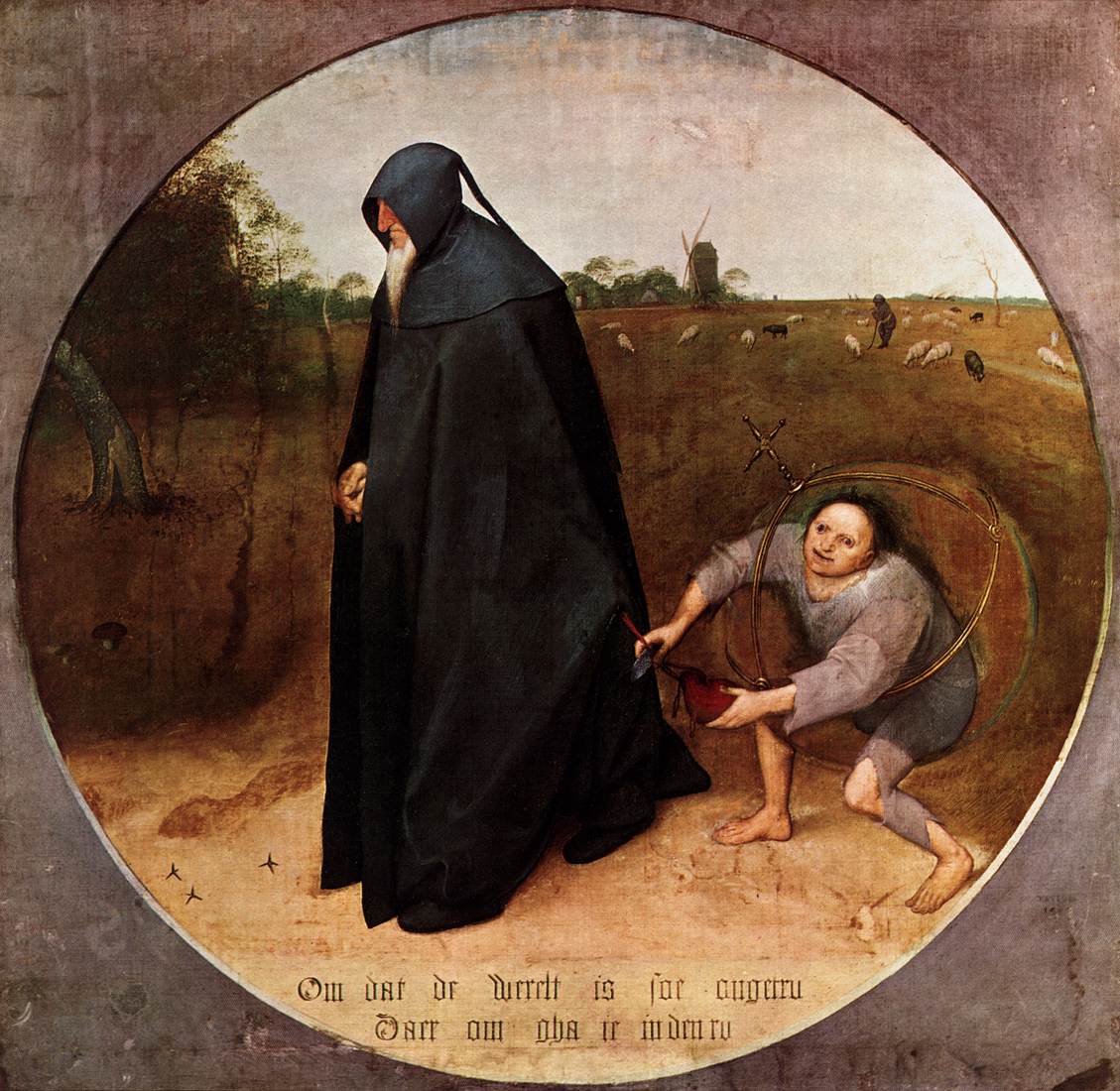
Pieter Bruegel the Elder, The Misanthrope, 1598 (Source)
There's an old, singular, beautiful Netherlands picture I once saw in an Italian gallery, of a wise old man walking in empty fields, pensive, while a thief behind cuts the string of his purse. The old man, in black, thinking probably of God's City, nevertheless has a foolish length of nose and is much too satisfied with his dream. But the peculiarity of the thief is that he is enclosed in a glass ball, and on the glass ball there is a surmounting cross, and it looks like the emperor's symbol of rule. Meaning that it is earthly power that steals while the ridiculous wise are in a dream about this world and the next, and perhaps missing this one, they will have nothing, neither this nor the next, so there is a sharp pain of satire in this amusing thing, and even the painted field does not have too much charm; it is a flat place.
So Augie and Padilla become friends and accomplices, even sharing the favors of two black girls of Padilla's acquaintance. And Augie picks up a phrase from Padilla: "Either this stuff comes easy or it doesn't come at all." Augie interprets this to mean, "People were mad to be knocking themselves out over difficulties because they thought difficulty was a sign of the right thing." But Augie also doesn't intend to make larceny his profession: "I didn't mean to settle down to a career of stealing even if it were to come easy, but only to give myself a start at something better."

They decide that Augie will concentrate on books in the humanities, while Padilla continues to filch math texts and technical books. Augie is queasy about his first theft, a copy of Jowett's Plato, but he gets used to it. When he is in a store like Carson Pirie or Marshall Field, he says, "it never entered my mind to branch out and steal other stuff." Soon he is able to quit his dog-club job, but his problem is that he "was struck by the reading fever. I lay in my room and read, feeding on print and pages like a famished man. Sometimes I couldn't give a book up to a customer who had ordered it, and for a long time this was all I could care about."

Padilla is upset when he discovers that Augie is keeping stolen books in his room, and that he holds out on customers until he finishes the books, some of which are very long. He tells Augie he can use his library card and borrow from the library. "But somehow that wasn't the same. As eating hour own meal, I suppose, is different from a handout, even if calory [sic] for calory it's the same value; maybe the body even uses it differently."
I sat and read. I had no eye, ear, or interest for anything else -- that is, for usual, second-order, oatmeal, mere-phenomenal, snarled-shoelace-carfare-laundry-ticket plainness, unspecified dismalness, unknown captivities; the life of despair-harness, or the life of  organization-habits which is meant to supplant accidents with calm abiding. Well, now, who can really expect the daily facts to go, toil or prisons to go, oatmeal and laundry tickets and all the rest, and insist that all moments be raised to the greatest importance, demand that everyone breathe the pointy, star-furnished air at its highest difficulty, abolish all brick, vaultlike rooms, all dreariness, and live like prophets or gods? Why, everybody knows this triumphant life can only be periodic. So there's a schism about it, some saying only this triumphant life is real and others that only the daily facts are. For me there was no debate, and I made speed into the former.
But then the "daily fact" of Simon reenters his life. Seeing Augie's monastic life allows Simon to assume the upper hand in their relationship when he comes to repay the five dollars he owes Augie. And Augie is unable to follow Einhorn's advice to be hard on his brother. He forgives Simon for not sending the money he needed -- "he'd been in dutch." He forgives him for evicting their mother from the old flat: "we couldn't have kept the old home going much longer and set up a gentle kind of retirement there for Mama, neither of us having that filial tabby dormancy that natural bachelors have." He observes that Simon has grown fat. "However, it wasn't comfortable-looking fat but as if it came from not eating right."

Simon mocks Augie's bookishness: "So you must be in the book business. It can't be much of a business though, because I see you read them too. Leave it to you to find a business like this!" But Augie observes that "there was a dead place where the scorn should have rung." And Simon admits that he hasn't done so well with his life either. He breaks down and admits his mistake in getting mixed up with mobsters, and is filled with regret and disgust at his girlfriend's marrying Five Properties. And he tells Augie that he thought of committing suicide when he spent the night in jail. "This reference to suicide was only factual. Simon didn't work me for pity; he never seemed to require it of me."

But he hedges on the specifics of his current life, telling Augie only that he lives on the Near North Side, and ducking the question of what he's doing for a living. "He had been a fool and done wrong, he showed up sallow and with the smaller disgrace that he was fat, as if overeating were his reply to being crushed -- and with this all over him he wasn't going to tell me, he balked at telling, some small details." But then he says, "I think I'm getting married soon.... To a woman with money." He hasn't even seen her yet, but he thinks, "She's about twenty-two." The marriage is being arranged by his former boss. When Augie says this sounds "cold-blooded," Simon objects: "how can you pretend to me that it makes a difference that Bob loves Mary who marries Jerry? That's for the movies."

Augie stifles the complex of feelings and thoughts that his brother's cynicism arouses in him, and asks why this rich woman wants to marry him. Simon treats it entirely as a business proposition: "Well, first of all we're all handsome men in our family." And, "I'm not marrying a rich girl in order to live on her dough and have a good time. They'll get full value out of me, these people." And, "I have to make money. I'm not one of those guys that give up what they want as soon as they realize they want it. I want money, and I mean want, and I can handle it. Those are my assets. So I couldn't be more on the level with them."

Her name is Charlotte Magnus, he tells Augie, who recognizes Magnus as the name of a coal business. Simon tells him that he's going to ask for a coal yard as a wedding present. And he has come to Augie because he needs a family presence on his side. So Augie agrees to get his good clothes out of hock to play brother of the groom.