JOURNAL OF A COMPULSIVE READER
By Charles Matthews
Showing posts with label Krook. Show all posts

Thursday, June 23, 2011

14. Bleak House, by Charles Dickens, pp. 486-519

Chapter 31: Nurse and Patient through Chapter 32: The Appointed Time

The brickmaker's family that Mrs Pardiggle belabored with charity early in the novel has returned to the vicinity of Bleak House, and Charley, Esther's maid, tells her that they need her help. As they leave for their visit to the brickmaker's hovel, Esther has a moment of heightened consciousness:
I had no thought, that night -- none, I am quite sure -- of what was soon to happen to me. But I have always remembered since, that when we had stopped at the garden gate to look up at the sky, and when we went upon our way, I had for a moment an undefinable impression of myself as being something different from what I then was. I know it was then, and there, that I had it. I have every since connected the feeling with that spot and time, and with everything associated with that spot and time, to the distant voices in the town, the barking of a dog, and the sound of wheels coming down the miry hill.
Not quite a Proustian moment or a Joycean epiphany, but also something more than a conventional Victorian novel premonition.

They enter the cottage, which "was closer than before, and had an unhealthy, and a very peculiar smell." In it, in addition to the women we met earlier (and have seen since in London) is Jo, who "staggered up instantly, and stared at me with a remarkable expression of surprise and terror." He has mistaken her for Lady Dedlock, of course, and can hardly be persuaded that it isn't she.

The women explain that they had known Jo in London, in Tom-all-Alone's, and that he had ust turned up that morning in the town. Evidently, he has been hounded out of London by Mrs Snagsby, who's "always a watching, and a driving of me." He is clearly quite ill, but the women can't give him lodging because their husbands will disapprove of it. So Esther and Charley take him to Bleak House. Along the way, Jo whispers to Charley: "If she ain't the t'other one, she ain't the forrenner. Is there three of 'em then?"

They leave Jo in the hall and fetch Mr Jarndyce, who is accompanied by Skimpole, a recent arrival. Skimpole, who once studied medicine, says, "You had better turn him out.... He's not safe, you know. There's a bad sort of fever about him." Esther protests that "he is getting worse," and Skimpole argues that this is all the more reason for turning him out. Jarndyce comes up with a solution: "There is a bed in the wholesome loft-room in the stable; we had better keep him there till morning, when he can be wrapped up and removed."

But in the morning Jo is gone. Skimpole suggests "that it had occurred to our young friend that he was not a safe inmate, having a bad kind of fever upon him; and that he had, with great natural politeness, taken himself off." They search for him, but after five days Charley becomes sick too. Esther has her moved to her own room, and quarantines the two of them there.

Hablot Knight Browne (Phiz), Nurse and Patient (Source: David Perdue's Charles Dickens Page)
But when Charley recovers, Esther herself falls ill, and nurse and patient exchange roles. Esther asks Charley to sit beside her, "and touch me with your hand. For I cannot see you, Charley; I am blind."

Cliffhangers come thick and fast now. We are back in the hands of the omniscient narrator, who is hanging about Krook's, where Jobling has taken Nemo's (i.e., Captain Hawdon's) room under the pseudonym Weevle. He is particularly on edge tonight, and Mr Snagsby finds him at the door of Krook's shop. He asks if Jobling is taking the air before going to bed, and Jobling observes, "Why, there's not much air to be got here; and what there is, is not very freshening." Snagsby agrees "that you're -- not to put too fine a point on it -- that you're rather greasy here." Jobling blames it on the "chops at the Sol's Arms," and Snagsby says the cook must have burnt them, and that they must not have been fresh to start with.

After some rather gloomy conversation, Snagsby moves on, leaving Jobling impatiently waiting for someone. That someone is Guppy, to whom he complains, "here have I been stewing and fuming in this jolly old crib, till I have had the horrors falling on me as thick as hail." Guppy goes to Jobling's room, where he admires the portrait of Lady Dedlock that Jobling has cut from "the Galaxy gallery of British beauty." And now we realize the reason for Guppy's visit and Jobling's impatience: At midnight, Krook has promised to give Jobling the bundle of letters that he filched from the portmanteau in Nemo/Hawdon's room.

Jobling says he last saw Krook about eight, when he helped shut up the shop, and "He has been as quiet, since, as an old rat asleep in his hole." They discuss the letters, and whether Krook has read them -- Jobling insisting that Krook can't read -- and whether they came from a man or a woman. It is Jobling's opinion, from what he has seen of the letters, that they are in a woman's hand.

And then Guppy ";happens to look at his coat-sleeve. It takes his attention. He stares at it, aghast." It is covered in soot. "Confound the stuff, it won't blow off -- smears, like black fat." Jobling repeats what he told Snagsby about the chops at the Sol's Arms, and they try to change the subject. Guppy says, "You are to bring the letters to your room to read and compare, and to get yourself into a position to tell him all about them. That's the arrangement, isn't it, Tony?" Guppy proposes that they make a packet of dummy letters and swap them for the originals, but Jobling argues that Krook is too smart to fall for that. So then Guppy says they'll tell Krook that the letters aren't legally his anyway and that he put them in the hands of his "legal friend" -- i.e. Guppy.

The bell of Saint Paul's strikes eleven, and the other bells in the city follow suit. Then Jobling complains about the soot also, and opens the window. They go and sit on the window-sill and talk some more about Krook and the letters.
Mr Guppy sitting on the window-sill ... continues thoughtfully to tap it, and clasp it, and measure it with his hand, until he hastily draws his hand away.
"What, in the Devil's name," he says, "is this! Look at my fingers!"
A thick, yellow liquor defiles them, which is offensive to the touch and sight, and more offensive to the smell. A stagnant, sickening oil, with some natural repulsion in it that makes them both shudder.
....
And yet look here -- and look here! When he brings the candle, here, from the corner of the window-sill, it slowly drips and creeps away down the bricks; here, likes in a little thick nauseous pool
"This is a horrible house," says Mr Guppy, shutting down the window. "Give me some water, or I shall cut my hand off."
It is one of Dickens's most memorable and horrifying scenes. The ghastly residue of the spontaneously combusted Krook, defiling everything.

When Guppy's equanimity is restored by scrubbing and brandy, the bells strike midnight, and it is time for Jobling to go down and retrieve the letters. But he returns, terrified, only a minute or two later: "I couldn't make him hear, and I softly opened the door and looked in. And the burning smell is there -- and the soot is there, and the oil is there -- and he is not there!"

Guppy goes down with him to see, and they find Krook's cat "snarling -- not at them; at something on the ground, before the fire." Jobling remembers that when he last saw Krook, at eight that evening, "I left him turning the letters over in his hand, standing just where that crumpled black thing is upon the floor." The cat is snarling at the something on the floor.
Hablot Knight Browne (Phiz), The Appointed Time (Source: David Perdue's Charles Dickens Page)
Here is a small burnt patch of flooring; here is the tinder from a little bundle of burnt paper, but not so light as usual, seeming to be steeped in something; and here it is -- is it the cinder of a small charred and broken log of wood sprinkled with white ashes, or is it coal? O Horror, he is here! and this, from which we run away, striking out the light and overturning one another into the street, is all that represents him.... Call the death by any name Your Higness will, attribute it to whom you will, or say that it might have been prevented how you will, it is the same death eternally -- inborn, inbred, engendered in the corrupted humours of the vicious body itself, and that only -- Spontaneous Combustion, and none other of all the deaths that can be died.
_____
The 2005 BBC/Masterpiece Theatre dramatization features Carey Mulligan as Ada Clare, Denis Lawson as John Jarndyce, Anne Reid as Mrs Rouncewell, Gillian Anderson as Lady Dedlock, Johnny Vegas as Krook, Pauline Collins as Miss Flite, Sean McGinley as Mr Snagsby, Burn Gorman as Guppy, Peter Guinness as the Coroner.


Friday, June 17, 2011

9. Bleak House, by Charles Dickens, pp. 281-331

Chapter 18: Lady Dedlock through Chapter 20: A New Lodger


Richard is so indecisive that it takes several weeks for him finally to settle on an "experimental course" in the law at Kenge and Carboy. Meanwhile, Ada, Esther and Jarndyce return to Bleak House, Jarndyce having located lodgings for Richard in London. Richard "immediately began to spend all the money he had, in buying the oddest little ornaments and luxuries for this lodging." He also continues with his odd habit of believing that if he has saved money on one thing, that allows him to spend the amount he has saved on something else, making "out that to spend anything less on something else was to save the difference."

He has postponed his decision so long, that he is unable to accompany the others to Lincolnshire for their visit to Boythorn. But Skimpole takes his place -- in more ways than one. For here Dickens makes clear the resemblance of Richard to Skimpole, by placing Richard's curious confusion about money in close proximity to Skimpole's absolute indifference to it. Skimpole has leased some furniture that is being repossessed, causing Jarndyce, who stood security for the lease, to have to pay for them. Skimpole is not in the least embarrassed by that fact, and the others continue to humor him in his "childishness."

Boythorn meets them at an inn near his house and explains, "I am obliged to conduct you nearly two miles out of the way. But, our direct road lies through Sir Leicester Dedlock's park; and, in that fellow's property, I have sworn never to set foot of mine." He tells them that "Sir Arrogant Numskull" -- his name for Sir Leicester -- is in residence and that Lady Dedlock is expected to return soon: "Whatever can have induced that transcendent woman to marry that effigy and figure-head of a baronet, is one of the most impenetrable mysteries that ever baffled human inquiry."

Esther gets her first glimpse of Chesney Wold -- "a picturesque old house, in a fine park richly wooded" -- as they drive past on the road. In the village, at the Dedlock Arms, Boythorn greets Watt Rouncewell, and tells them that Watt is the son of the housekeeper at Chesney Wold and in love with "a pretty girl up at the House" -- i.e., Rosa. Boythorn's own house is sunny and pleasant, and "everything about the place wore an aspect of maturity and abundance." It's one of those Dickensian Gardens of Eden, with its own snake -- the hostility between Boythorn and Dedlock, so that the side of the house that borders Dedlock property is guarded by "a sentry in a smock-frock, day and night, whose duty was supposed to be, in case of aggression, immediately to ring a large bell hung up there for the purpose, to unchain a great bull-dog established in a kennel as his ally, and generally to deal destruction on the enemy."

On Sunday morning they attend services at a little church, where Esther gets her first glimpse of the Dedlocks and their household, including Mrs Rouncewell, Rosa, and Hortense: "One face, and not an agreeable one, though it was handsome, seemed maliciously watchful of this pretty girl, and indeed of everyone and everything there. It was a Frenchwoman's."
Hablot Knight Browne (Phiz), The Little Church in the Park (Source: David Perdue's Charles Dickens Page)
But it is the arrival of Sir Leicester and Lady Dedlock that has the most powerful and peculiar effect on Esther:
Shall I ever forget the rapid beating at my heart, occasioned by the look I met, as I stood up! Shall I ever forget the manner in which those handsome proud eyes seemed to spring out of their languor, and to hold mine! It was only a moment before I cast mine down -- released again, if I may say so -- on my book; but, I knew the beautiful face quite well, in that short space of time. And, very strangely, there was something quickened within me, associated with the lonely days at my godmother's ... although I had never seen this lady's face before in all my life -- I was quite sure of it -- absolutely certain.
For Esther, Lady Dedlock's face is, "in a confused way, like a broken glass to me, in which I saw scraps of old remembrances." As this characteristic Victorian recognition scene continues, Esther tries to decide if Lady Dedlock somehow resembles her godmother/aunt, "but, the expression was so different, and the stern decision which had worn into my godmother's face, like weather into rocks, was so completely wanting in the face before me."
And yet I -- I, little Esther Summerson, the child who lived a life apart, and on whose birthday there was no rejoicing -- seemed to arise before my own eyes, evoked out of the past by some power in this fashionable lady, whom I not only entertained no fancy that I had ever seen, but whom I perfectly well know I had never seen until that hour.
We have pages and pages to go before this particular mystery is finally solved, and perhaps it is because so much narrative is yet to come that Dickens lays it on so thick in this scene.

Meanwhile, Boythorn and Skimpole have one of their skirmishes of Duty vs. Irresponsibility, ending with Skimpole asserting that though "the Slaves on American plantations ... are worked hard" and "don't altogether like it" and "theirs is an unpleasant experience on the whole; but, they people the landscape for me, they give it a poetry for me, and perhaps that is one of the pleasanter objects of their existence." Dickens, ardently anti-slavery, is here giving a strong hint that Skimpole may yet prove to be a villain in the novel. But on the other hand, Skimpole's sentimentalized, "picturesque" attitude toward slavery in the antebellum United States would persist for another century in novels and movies.

The following Saturday, Jarndyce, Ada and Esther are out for a walk when a storm comes up, with lightning and thunder. They take refuge in a keeper's lodge on the Dedlock property. As they are waiting in the doorway, watching the storm, someone asks, "Is it not dangerous to sit in so exposed a place?" Ada thinks Esther has spoken, but it's Lady Dedlock, who has also "taken shelter in the lodge, before our arrival there, and had come out of the gloom within." Esther has also reacted to the surprise voice, but in a different way from Ada: "The beating at my heart came back again. I had never heard the voice, as I had never seen the face, but it affected me in the same strange way. Again, in a moment, there arose before my mind innumerable pictures of myself."

It turns out that Lady Dedlock and Jarndyce have met, a long time before. She mentions the letter he had written to Sir Leicester requesting his aid in helping Richard, and asks to be introduced first to Ada and then to Esther. Learning that Esther is his ward, she asks, "Has Miss Summerson lost both her parents?" He says that she has. Lady Dedlock and Esther look at each other, and then Lady Dedlock turns away "with a hasty air, almost expressive of displeasure or dislike." She and Jarndyce, we learn, had met when they were "abroad," and she observes that Jarndyce had been better acquainted with her sister, with whom she had become estranged: "'We went our several ways,' said Lady Dedlock, 'and had little in common even before we agreed to differ. It is to be regretted, I suppose, but it could not be helped.'"
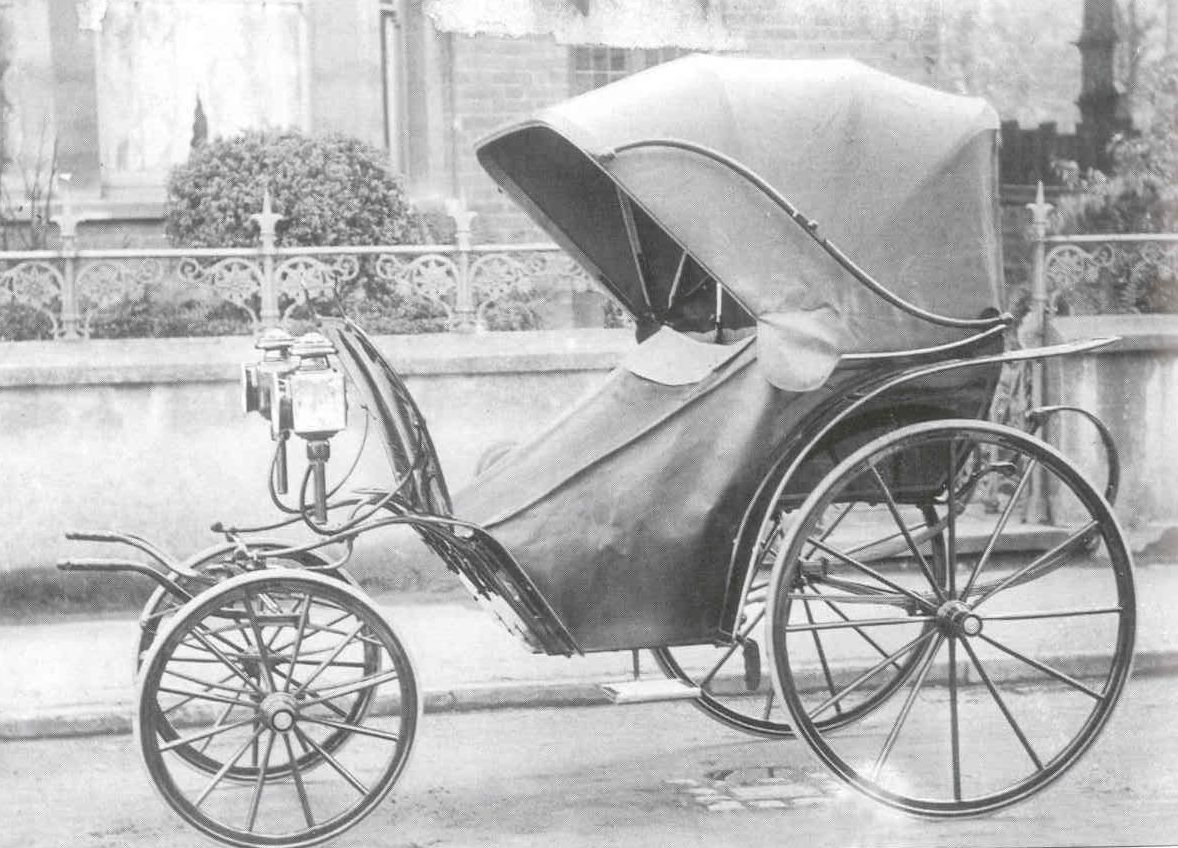
Pony phaeton (Source)

Then "a little pony phaeton" carrying Hortense and Rosa arrives. Lady Dedlock had sent for it, asking her maid to come -- meaning Rosa, though Hortense had apparently insisted that she was the one sent for.  "The Frenchwoman stood unnoticed, looking on with her lips tightly set," as Lady Dedlock offers to send the carriage back for Ada and Esther. Jarndyce declines, and Lady Dedlock "took a graceful leave of Ada -- none of me," Esther notes, and bids Rosa get into the carriage with her. As for Hortense,
She remained perfectly still until the carriage had turned into the drive, and then, without the least discomposure of countenance, slipped off her shoes, left them on the ground, and walked deliberately in the same direction, through the wettest of the wet grass.
"'Is that young woman mad?' said my guardian." The keeper says that she's just "mortal high and passionate -- powerful high and passionate; and what with having notice to leave, and having others put above her, she don't take kindly to it." And as Jarndyce, Ada and Esther return home, they see Hortense still striding through the wet grass.

In London, the omniscient narrator tells us, the courts have shut down for the long vacation, leaving all of the clerks idle, as well as the businesses that support the law, such as Mr Snagsby, the stationer. He and Mrs Snagsby are entertaining the Chadbands. Mr Chadband is a minister "attached to no particular denomination," who includes among his followers Mrs Snagsby. "'My little woman,' says Mr Snagsby to the sparrows in Staple Inn, 'like to have her religion rather sharp, you see!'"
Mr Chadband is a large yellow man, with a fat smile, and a general appearance of having a good deal of train oil in his system. Mrs Chadband is a stern, severe-looking, silent woman. Mr Chadband moves softly and cumbrously, not unlike a bear who has been taught to walk upright. He is very much embarrassed about the arms, as if they were inconvenient to him, and he wanted to grovel; is very much in a perspiration about the head; and never speaks without first putting up his great hand, as delivering a token to his hearers that he is going to edify them.
Chadband's "edification," however, typically consists of platitudes delivered in the most pompous and verbose manner possible. Still, as the narrator observes, "the Chadband style of oratory is widely received and much admired."

As the Snagsbys are entertaining the Chadbands, however, the servant, Guster, informs Mr Snagsby that he is wanted in the shop downstairs, where he finds a constable with Jo in his custody. The constable has ordered Jo to "move on," and Jo insists that there's nowhere for him to move on to. Jo has apparently indicated to the constable that Mr Snagsby can vouch for him, and although Mrs Snagsby has appeared at the top of the stairs to proclaim that he doesn't know the boy, Snagsby admits that he does.

Then Mr Guppy appears, and confirms Snagsby's acquaintance with Jo. The constable is still convinced that Jo is up to no good, partly because he lives in Tom-all-Alone's.  Moreover, Jo has money upon him, which is enough to convince the constable that Jo has been stealing. So Jo tells the story of being approached "by a lady in a wale" (i.e., veil) who gave him a sovereign to show her where Nemo lived, died, and was buried. The constable agrees to leave Snagsby in charge of Jo's moving on -- over Mrs Snagsby's protests -- and departs.

Intrigued by Jo's story of the veiled lady, Guppy begins asking questions, raising the curiosity of the others, so that Guppy and Jo are ushered upstairs to continue the interrogation. Guppy opines that "there is something out of the common here that beats anything that ever came into my way at Kenge and Carboy's," which is enough to have Mrs Chadband eager to hear more: She happens to be acquainted with Kenge and Carboy's. Before she married the Rev. Mr Chadband, she says, she "was left in charge of a child named Esther Summerson, who was put out in life by Messrs Kenge and Carboy's."

It's Guppy's turn to be astonished, though when he gasps, "Miss Summerson, ma'am!" he is rebuked by Mrs Chadband, who is apparently the Mrs Rachael who was servant to Esther's godmother/aunt. "'I call her Esther Summerson,' says Mrs Chadband, with austerity. 'There was no Miss-ing of the girl in my time. It was Esther. "Esther, do this! Esther, do that!" and she was made to do it.'"


The Rev. Chadband seizes upon this moment of astonishment to take the floor and sermonize on the topic of ... Jo, who is bewildered by everything that's going on, and "whose immediate object seems to be to get away on any terms." Guppy gives him a penny and Mr Snagsby loads him up with some of the table leftovers, and off he goes into the night.

Guppy, of course, is not going to let all these revelations go. He has been vexed by the arrival in the offices of Kenge and Carboy of Richard Carstone, but gratified "to find the new comer constantly poring over the papers in Jarndyce and Jarndyce; for he well knows that nothing but confusion and failure can come of that." So he gathers his friends, fellow law-clerks Young Smallweed and Tony Jobling, and invites them to dine with him.
Hablot Knight Browne (Phiz), Mr Guppy's Entertainment (Source: David Perdue's Charles Dickens Page)
After much Dickensian business about these swaggering striplings, during which we learn that Jobling was the one who accompanied Guppy to Chesney Wold, Guppy announces "a plan I have lately thought of proposing." It may, he stammers, "have some reference to a subject, which may -- or may not -- have cast its shadow on my existence" -- that is, of course, his failed proposal to Esther. He tells Jobling that in his duties at Kenge and Carboy's he has been delivering a weekly allowance to Miss Flite at Krook's, and that Krook has a room to let. Krook "must be precious old, you know, and he has not a soul about him, and he is reported to be immensely rich; and whether he is a smuggler, or a receiver, or an unlicensed pawnbroker, or a money-lender -- all of which I have thought likely at different times -- it might pay you to knock up a sort of knowledge of him."

Jobling is game, even when he learns that the room is where Krook's last lodger died. So they proceed to Krook's, where he is dead drunk. They manage to get him awake, and after treating him to a better quality of gin than he is used to, "Mr Guppy presents his friend under the impromptu name of Mr Weevle, and states the object of their visit." The result is that Jobling/Weevle is installed in the second-floor room, which he adorns with "copper-plate impressions from that truly national work, The Divinities of Albion, or Galaxy Gallery of British Beauty, representing ladies of title and fashion in every variety of smirk that art, combined with capital, is capable of producing." And in time the neighbor ladies are gossiping, "don't you be surprised Lord bless you, if that young man comes in at last for old Krook's money!"
_____

The 2005 BBC/Masterpiece Theatre dramatization features Burn Gorman as Guppy, Patrick Kennedy as Richard Carstone, Denis Lawson as John Jarndyce, Anna Maxwell Martin as Esther Summerson, Sally Leonard as Polly, Warren Clarke as Boythorn, Timothy West as Sir Leicester Dedlock, Gillian Anderson as Lady Dedlock, Nathaniel Parker as Harold Skimpole, Carey Mulligan as Ada Clare, Emma Williams as Rosa, Lilo Baur as Hortense, Sean McGinley as Snagsby, Robert Pugh as Mr Chadband, Catherine Tate as Mrs Chadband, Michelle Tate as Guster, Harry Eden as Jo, Dominic Coleman as Policeman, Johnny Vegas as Krook, Charles Dance as Tulkinghorn, Tom Georgeson as Clamb.

Thursday, June 16, 2011

7. Bleak House, by Charles Dickens, pp. 214-254

Chapter 14: Deportment through Chapter 15: Bell Yard

Richard goes off to his medical studies with Bayham Badger, vowing that when he is settled in his profession and he and Ada are married, Esther should come live with them and be their housekeeper. "I was to be made happy for ever and a day," Esther reports, not without, I suspect, a touch of irony. He adds, "And if the suit should make us rich, Esther -- which it may you know!" but is met with disapproval from Ada, who quite sensibly worries about the consequences of Richard's expectations of wealth -- "it may be better to forget all about it," she warns. He ignores the warning. 

One day, Caddy Jellyby comes to call, bringing Peepy with her, both of them dressed in such an odd assemblages of castoffs that Mr Jarndyce immediately feels the wind shift to the east and retires to "the temporary Growlery" as soon as he can. Things are still as chaotic as ever at the Jellybys: "Pa will be a bankrupt before long, and then I hope Ma will be satisfied.... His family is nothing but bills, dirt, waste, noise, tumbles down-stairs, confusion and wretchedness." Moreover, Mrs Jellyby still has hopes of marrying Caddy off to Mr Quale: "A pretty thing, indeed, to marry a Philanthropist. As if I hadn't had quite enough of that!" 

But Caddy has thwarted that expectation: "I am engaged." Her parents know nothing of it however. She tells Esther that her visits to the house made her determined to improve herself, so she started taking dancing lessons at Mr Turveydrop's Academy. There are two Mr Turveydrops, she explains, father and son, and it's the son, who gives the lessons, to whom she is engaged. And thanks to that, she proclaims, "I shall never hear of Africa after I am married. Young Mr Turveydrop hates it for my sake; and if old Mr Turveydrop knows there is such a place, it's as much as he does." 

Caddy also tells her that she has "improved her acquaintance with Miss Flite, the little crazy old lady; and that she frequently went there early in the morning, and met her lover for a few minutes before breakfast." The younger Turveydrop, she tells her, is named Prince -- "I wish it wasn't, because it sounds like a dog, but of course he didn't christen himself. Old Mr Turveydrop had him christened Prince, in remembrance of the Prince Regent." 

Esther has been planning to visit Miss Flite, so she suggests that she go with Caddy and Peepy to the Academy and meet Prince Turveydrop, then join up with Ada and Jarndyce at Miss Flite's later. 
Hablot Knight Browne (Phiz), The Dancing School (Source: David Perdue's Charles Dickens Page)
Prince turns out to be "a little blue-eyed fair man of youthful appearance, with flaxen hair parted in the middle, and curling at the ends all round his head.... His little dancing shoes were particularly diminutive, and he had a little innocent, feminine manner, which not only appealed to me in an amiable way, but made this singular effect upon me: that I received the impression that he was like his mother, and that his mother had not been much considered or well used." 

The elder Turveydrop is "a fat old gentleman with a false complexion, false teeth, false whiskers, and a wig.... He was pinched in, and swelled out, and got up, and strapped down, as much as he could possibly  bear.... He had a cane, he had an eye-glass, he had a snuff-box, he had rings, he had wristbands, he had everything but any touch of nature; he was not like youth, he was not like age, he was like nothing in the world but a model of Deportment." 

That Esther feels a sympathy for the effeminate fiancé of her friend, but none for the falsity and affectation of his father is significant. Prince Turveydrop is no sexual threat, of course, and so Esther regards him as "safe." As for the elder Turveydrop, Esther's opinions are influenced in part by those of "an old lady of censorious countenance," who sits next to her in the dancing school and expresses her distaste for him. She informs Esther that the senior Turveydrop "had married a meek little dancing-mistress, ... (having never in his life before done anything but deport himself), and had worked her to death." He is now doing the same to Prince, who "now, at thirty years of age, worked for his father twelve hours a-day, and looked up to him with veneration on the old imaginary pinnacle." Esther imbibes enough of this story to find Mr Turveydrop's salutation to "his sainted mother" as "a devoted creature" as filled with a "very disagreeable gallantry." 

As for Prince, "The few moments that were occupied by Prince in taking leave of us (and particularly of one of us, as I saw, being in the secret), enhanced my favourable impression of his almost childish character." Childishness in Bleak House is a double-edged characteristic. In Skimpole, it is irresponsible; in Prince Turveydrop, who is diligent and devoted, it becomes a virtue. Moreover, he is made for Caddy in the sense that she now has someone to whom she can devote herself: "You know what a house ours is. It's of no use my trying to learn anything that it would be useful for Prince's wife to know, in our house. We live in such a state of muddle that it's impossible, and I have only been more disheartened whenever I have tried." So she has taken Miss Flite as a project, helping clean her room and take care of her birds and learning to make coffee. "And since I have been engaged to Prince, and have been doing all this, I have felt better-tempered, I hope, and more forgiving to Ma." 

In Esther's world-view there are two cardinal virtues: diligence and selflessness. Esther herself is the perfect embodiment of them. And their opposites are the corresponding vices: negligence and selfishness. Her do-gooders, like Mrs Jellyby and Mrs Pardiggle, think themselves diligent, dutiful to the needs of others, but that is because they neglect the duties close at hand: their own families. And their pride in what they see as doing good is selfish. Skimpole, of course, is the epitome of negligence and selfishness, although his conduct is mitigated by the amusement he provides others -- until, of course, it begins to do harm. 

This simple Victorian morality prevails only in Esther's part of the narrative. The omniscient narrator's account of what lies outside of Esther's point of view is far more morally complex, and in the end it brings much of Esther's moral vision into question. That is the point, of course, the whole reason for the narrative schism at the heart of Bleak House

So now Esther and Caddy go to Krook's, which is a portal between Esther's world and the omniscient narrator's world. As they ascend the stairs, they notice that the room on the second floor is to let. Caddy tells Esther that there has been a death there, and they can't help looking in on the room as they pass by. "A sad and desolate place it was; a gloomy, sorrowful place, that gave me a strange sensation of mournfulness and even dread. 'You look pale,' said Caddy, when we came out, 'and cold!' I felt as if the room had chilled me." 

But Miss Flite greets them warmly. Ada and Jarndyce have already arrived, as has "a medical gentleman who was so good as to attend Miss Flite with much solicitude and compassion." And so Allan Woodcourt sidles into the narrative again. The obliqueness with which Dickens introduces, and reintroduces, Woodcourt is coy and somewhat gratuitous, but it is meant to suggest Esther's diffidence about the man who is to play an increasingly significant role in her life. He is introduced to them by Miss Flite, and we finally learn the reason for his initial mysterious appearance at the deathbed of Nemo: Miss Flite "brought me here, in the first hurry of the discovery, though too late for me to be of any use to the unfortunate man." Why it was necessary to summon the other physician as well -- and then to drop him almost immediately from the narrative -- remains one of those curious anomalies of Dickens's storytelling. 

Woodcourt tells them that Miss Flite has had a stroke of good fortune: Every Saturday, Kenge or his clerk Guppy brings her a sum of money. Miss Flite thinks it come from the Lord Chancellor himself, but Esther suspects that the benefactor is Jarndyce, who is studiously contemplating Miss Flite's birds. He asks if they have names, but at that moment they are interrupted by the appearance of Krook and his cat, whom Miss Flite anxiously asks him to remove. Krook says that the cat would never harm "the birds when I was here, unless I told her to it." Krook proceeds to name the birds: 
"Hope, Joy, Youth, Peace, Rest, Life, Dust, Ashes, Waste, Want, Ruin, Despair, Madness, Death, Cunning, Folly, Words, Wigs, Rags, Sheepskin, Plunder, Precedent, Jargon, Gammon, and Spinach." 
The recitation causes Jarndyce to feel the east wind. And when Krook proclaims that if Miss Flite were ever to receive her judgment and release the birds, "if that ever was to happen -- which it won't -- the birds that have never been caged would kill 'em." Jarndyce feels the wind more sharply.

As they begin to leave Krook's, he latches onto Jarndyce, who notices in the shop that there are several alphabets pasted on the wall. Krook explains that he is trying to teach himself to read and write, but is not getting very far with it. Jarndyce suggests that having someone teach him might be more efficient. "'Aye, but they might teach me wrong!' returned the old man, with a wonderfully suspicious flash of his eye." 

Finally, they escape from Krook's and send Caddy and Peepy home. And then Esther adds a coda: "I have forgotten to mention -- at least I have not mentioned -- that Mr Woodcourt was the same dark young surgeon whom we had met at Mr Badger's. Or, that Mr Jarndyce invited him to dinner that day. Or, that he came." And then there is a coy little bit suggesting, but not stating outright, that Ada made reference to an attachment between Esther and Woodcourt. 

During their stay, Jarndyce is beset by "the crowd of excitable ladies and gentlemen" seeking donations to their various causes. Mrs Pardiggle and Mr Quale provide an introduction to their friend Mr Gusher, "a flabby gentleman with a moist surface, and eyes so much too small for his moon of a face that they seemed to have been originally made for somebody else." Esther's voice is being overridden by Dickens's own here. Mr Gusher tells Jarndyce of his success in persuading the boys and girls of two charity schools to donate what little money they had to his causes. Esther notes, "I think the wind was in the east for three whole weeks." 

This kind of hypocrisy makes Jarndyce welcome the return of Skimpole, who, whatever else he may be, is no hypocrite. Skimpole has seen Boythorn, who Esther observes is almost Skimpole's antithesis: "Mr Boythorn attaching so much importance to many things, and Mr Skimpole caring so little for anything." Boythorn has told him that Jarndyce and Ada and Esther promised to visit him in Lincolnshire, and that he had invited Skimpole as well, even volunteering to pay Skimpole's way. 

And then Skimpole remembers to tell Esther something: "You remember our old friend Coavinses, Miss Summerson?" "Coavinses" was Skimpole's name for the debt collector who had pursued him to Bleak House. "Coavinses has been arrested by the great Bailiff," Skimpole says. Esther is a little shocked at the flippancy with which Skimpole delivers this news of the man's death, but she is more shocked when Skimpole tells them that the debt collector left three motherless children. 

Esther and Jarndyce decide to check on the condition in which the collector -- also known as a "follower" -- had left the children, so Skimpole directs them to his home. They find "a mite of a boy, some five or six years old, nursing and hushing a child of eighteen months." They have been left alone, locked in a room, while the oldest child, a girl named Charley (for Charlotte), goes out to find work to earn food for them. She turns up while they are there: "a very little girl, childish in figure but shrewd and older-looking in the face -- pretty-faced too -- wearing a womanly sort of bonnet much to large for her, and drying her bare arms on a womanly sort of apron." She has been working in a laundry and has come to check on the others. 

Jarndyce asks her age, and she replies "Over thirteen, sir." She tells him, "Since father died, sir, I've gone out to work. I'm out washing to-day." Their mother had died after the baby was born. The landlady, Mrs Blinder, and the downstairs neighbor, Mr Gridley, look in on them while Charley is at work. The other neighbors disapproved of what Neckett, the children's father, did for a living, but people have been kind to them, though, Mrs Blinder says, "certainly not so many as would have been, if their father's calling had been different." Some people won't hire Charley because of her father, and some "perhaps pay her less and put upon her more." 

Mr Gridley, the choleric downstairs neighbor, now enters to chide them for what he assumes to be idle curiosity, and stays to reveal that he, too, is a victim of Chancery, having been dragged into a lawsuit over an estate that has been eaten up by legal costs. When Jarndyce mentions that he was hardly the only one to be "unjustly treated by this monstrous system," Gridley angrily replies, "The system! I am told on all hands, it's the system. I mustn't look to individuals. It's the system." But he is so furious at having been victimized by it that he continues to appear at court to "shame them. To the last, I'll shew myself in that court to its shame." But for now, he is there only to take the boy, Tom, and the baby, Emma, down to his room for a while. 

Skimpole's reaction is a Candide-like optimism: "He said, Well, it was really very pleasant to see how things lazily adapted themselves to purposes. Here was this Mr Gridley, a man of a robust will, and surprising energy ... and he could easily imagine that there Gridley was, years ago, wandering about in life for something to expend his superfluous combativeness upon ... when the Court of Chancery came in his way, and accommodated him with the exact thing he wanted.... Otherwise he might have been a great general, blowing up all sorts of towns." And Skimpole observes of himself, "That, all that time, he had been giving employment to a most deserving man; that he had been a benefactor to Coavinses; that he had actually been enabling Coavinses to bring up these charming children in this agreeable way, developing these social virtues!" 
There was something so captivating in his light way of touching these fantastic strings, and he was such a mirthful child by the side of the graver childhood we had seen, that he made my Guardian smile even as he turned towards us from a little private talk with Mrs Blinder.  
They bid goodbye to Charley as she runs off to work again. 
_____
The 2005 BBC/Masterpiece Theatre dramatization features Anna Maxwell Martin as Esther Summerson, Carey Mulligan as Ada Clare, Patrick Kennedy as Richard Carstone,  Denis Lawson as John Jarndyce, Burn Gorman as Guppy, Charles Dance as Tulkinghorn, Tom Georgeson as Clamb, Natalie Press as Caddy Jellyby, Bryan Dick as Prince Turveydrop, Matthew Kelly as Mr Turveydrop, Gillian Anderson as Lady Dedlock, Timothy West as Sir Leicester Dedlock, Ian Richardson as the Chancellor, Tony Haygarth as Gridley, Pauline Collins as Miss Flite, Richard Harrington as Allan Woodcourt, Johnny Vegas as Krook, Nathaniel Parker as Harold Skimpole, Billy Hill as Tom Neckett, Katie Angelou as Charley Neckett, Harry Eden as Jo, Richard Griffiths as Bayham Badger, Joanna David as Mrs Bayham Badger


Monday, June 13, 2011

5. Bleak House, by Charles Dickens, pp. 137-181

Chapter 9: Signs and Tokens through Chapter 11: Our Dear Brother


Days pass at Bleak House, and Esther begins to notice that Richard is "one of the most restless people in the world." So far, however, nobody seems to be terribly concerned about his restlessness. He expresses a vague interest in going to sea, so Jarndyce writes "to a relation of the family, a great Sir Leicester Dedlock," about Richard's prospects, but Sir Leicester responds by essentially blowing Richard off: "he would be happy to advance the prospects of the young gentleman if it should ever prove to be within his power, which was not at all probable." Lady Dedlock does add a nice note about recalling that she was related to Richard in some distant fashion "and trusted that he would ever do his duty in any honourable profession to which he might devote himself." This is notable only as the first intersection of the distantly separated worlds of Bleak House and Chesney Wold. Richard shrugs off the shrugging off, and retreats into fantasies of commanding his own "clipping privateer" -- a merchant vessel -- and abducting the Lord Chancellor until he judges in their favor.

Esther remarks to herself that "Richard had a carelessness in his character that quite perplexed me -- principally because he mistook it, in such a very odd way, for prudence." When Mr Jarndyce replaces the money Richard and Esther had contributed to pay off Skimpole's debts, Richard treats it not as replenished funds but as "found money" -- as if he now had an extra ten pounds. Esther tries to talk sense to him, but he isn't hearing it. Still, she regards him as "frank and generous" and notes, "He was ardent and brave, and in the midst of all his wild restlessness, was so gentle that I knew him like a brother in a few weeks."

Jarndyce now receives a visit from an old friend, Lawrence Boythorn, who is modeled on the writer Walter Savage Landor, a friend of Dickens. Jarndyce, who knew Boythorn at school, says, "He was the most impetuous boy in the world, and now he is the most impetuous man. He was then the loudest boy in the world, and he is now the loudest man. He was then the heartiest and sturdiest boy in the world, and he is now the heartiest and sturdiest man. He is a tremendous fellow." All of this seems to presage Boythorn's being something of a bore to the reader, and he is, but Dickens is determined to wedge Boythorn/Landor into the novel, and he does. His chief role in the novel is as an antagonist to Sir Leicester Dedlock, who is his neighbor in Lincolnshire, and with whom he has a running feud over right of way to his property. Once again, the Bleak House and Chesney Wold worlds make contact.

Aside from being a large and loud and "very handsome old gentleman" in Esther's view, he also brings with him a tiny canary who flits around and perches on his head in a manner that is supposed to emphasize Boythorn's gentle-giantness. At the dinner table, Boythorn fulminates about the Dedlocks: "that fellow is, and his father was, and his grandfather was, the most stiff-necked, arrogant, imbecile, pig-headed numskull, ever, by some inexplicable mistake of Nature, born in any station of life but a walking-stick's!" But he has kind words for Lady Dedlock, "the most accomplished lady in the world, to whom I would do any homage that a plain gentleman, and no baronet with a head seven hundred years thick, may."

Boythorn asks if there have been any communications for him from Kenge and Carboy, but Esther, who now keeps track of the mail, says no. Later, playing backgammon with Jarndyce, she asks if Mr Boythorn had been married. Jarndyce says no, but "He was all but married, once. Long ago. And once." He hints that the failure of this romance "has had its influence on all his later life," but Esther senses that Jarndyce really doesn't want to talk about it: "I could not pursue the subject without changing the wind."

The next morning, a letter comes from Kenge and Carboy brought by one of their clerks, who turns out to be Mr Guppy. At first, Esther is "glad to see him, because he was associated with my present happiness," insofar as he was the one who met her when she arrived in London to join the Jarndyce household. Guppy takes the correspondence to Boythorn, and it seems to upset him. Even though his room was in another part of the house, Esther "heard his loud voice rising every now and then like a high wind, and evidently blowing perfect broadsides of denunciation."

Guppy returns a little shaken, and Esther serves him lunch, at which Guppy quickly drinks several glasses of wine. She is in the middle of working on the household accounts, and continues to do so as Guppy launches into a proposal:
"My present salary, Miss Summerson, at Kenge and Carboy's, is two pound a-week.... My mother has a little property, which takes the form of a small life annuity.... She is eminently calculated for a mother-in-law.... My own abode is lodgings at Penton Place, Pentonville. It is lowly, but airy, open at the back, and considered one of the 'ealthiest outlets. Miss Summerson! In the mildest language, I adore you. Would you be so kind as to allow me (as I may say) to file a declaration -- to make an offer!"
Hablot Knight Browne (Phiz), In Re Guppy. Extraordinary Proceedings (Source: David Perdue's Charles Dickens Page)
Esther declines, decisively: "Get up from that ridiculous position immediately, sir, or you will oblige me to break my implied promise and rink the bell!" Guppy persists. Esther resists. Finally, she gets rid of him, but it's clear that Guppy is not one to take a firm no for anything but a maybe.
I sat there for another hour or more, finishing my books and payments, and getting through plenty of business. Then, I arranged my desk, and put everything away, and was so composed and cheerful that I thought I had quite dismissed this unexpected incident. But, when I went up-stairs to my own room, I surprised myself by beginning to laugh about it, and then surprised myself still more by beginning to cry about it.
Dickens is not always as psychologically shrewd as he is with Esther at this moment.

Back in London, the omniscient narrator introduces us to Mr Snagsby, who deals in paper, parchment, and other stationery supplies necessary in the legal business. "He is a mild, bald, timid man, with a shining head, and a scrubby clump of black hair sticking out at the back. He tends to meekness and obesity." He is, of course, as Dickens's "mild, bald, timid" men tend to be, thoroughly henpecked. He and his wife have a servant named Guster, "a lean young woman from a workhouse," who is subject to fits.

Today, Mr Snagsby receives a visit from Tulkinghorn, who interrupts the Snagsbys' tea. He has come to inquire about some affidavits that he recently commissioned Snagsby to have copied, and in particular one, "the handwriting of which is peculiar, and I rather like." It takes Snagsby some time to identify the copyist, but he tells Tulkinghorn that it "was given out, sir, to a Writer who lodges just over on the opposite side of the lane." His name, Snagsby says, is Nemo. Tulkinghorn repeats the name and says, "Nemo is Latin for no one." Snagsby assures him that "It must be English for some one, sir, I think." At least, "this may not be his name, but it's the name he goes by." He also tells Tulkinghorn, "The advantage of this particular man is, that he never wants sleep. He'll go at it right on end, if you want him to, as long as ever you like."

So at Tulkinghorn's request, Snagsby conducts him to where Nemo lives, then bids him good evening. Tulkinghorn walks on "a short way, turns back, comes again to the shop of Mr Krook, and enters it straight." Krook recognizes Tulkinghorn and offers to go up to Nemo's lodging and ask him to come down, but Tulkinghorn takes a candle and goes up the stairs to the second floor. "The lawyer looks down over the hand-rail. The cat expands her wicked mouth, and snarls at him." Krook scolds the cat and whispers up to Tulkinghorn, "You know what they say of my lodger? ... They say he has sold himself to the Enemy; but you and I know better -- he don't buy."

Tulkinghorn knocks on Nemo's door, and receiving no answer, he opens it. A gust of air blows out his candle. "The air of the room is almost bad enough to have extinguished it, if he had not. It is a small room, nearly black with soot, and grease, and dirt." On one of the chairs is "a ragged portmanteau," which is all the "cabinet or wardrobe" that the tenant needs. By the light of a guttering candle, Tulkinghorn sees a man lying on a low bed.
Foul and filthy as the room is, foul and filthy as the air, it is not easy to perceive what fumes those are which most oppress the senses in it; but through the general sickliness and faintness, and the odour of stale tobacco, there comes into the lawyer's mouth the bitter, vapid taste of opium.
The candle near the bed goes out, and in the darkness Tulkinghorn feels someone touch his hand. It is Krook, who has followed him into the room. As Krook goes back downstairs to fetch a candle, Tulkinghorn waits on the stairs rather than in the room. The cat follows Krook as he returns. Tulkinghorn re-enters the room with the light and looks at the man on the bed: "God save us!" exclaims Mr Tulkinghorn. "He is dead!"

Krook, "with his lean hands spread out above the body like a vampire's wings," tells Tulkinghorn to call Miss Flite and send her for a doctor. Tulkinghorn goes out onto the landing to call for her. "Krook follows him with his eyes, and, while he is calling, finds opportunity to steal to the old portmanteau, and steal back again."

Miss Flite runs out and "soon returns, accompanied by a testy medical man, brought from his dinner," who certifies that the man on the bed is indeed dead. Tulkinghorn, who is "standing by the old portmanteau" that has recently been the object of Krook's attentions, asks how long he has been dead, and the doctor estimates "about three hours." This estimate is corroborated by "a dark young man, on the other side of the bed," who has appeared seemingly out of nowhere. When the doctor learns that this young man is also a physician, he excuses himself and returns to his dinner. "The dark young surgeon passes the candle across and across the face, and carefully examines the law-writer, who has established his pretensions to the name by become indeed No one."

We'll eventually learn that this "dark young surgeon" is named Allan Woodcourt, but Dickens isn't ready to clue us in to that, or even to why he has made such a sudden appearance in the story. He tells Tulkinghorn and Krook that Nemo has been purchasing opium from him for a year and a half -- it was perfectly legal at the time -- and that he has died of an overdose. There's enough opium in the old teapot near the bed "to kill a dozen people." He doesn't believe it was an intentional overdose, however. "I recollect once thinking there was something in his manner, uncouth as it was, that denoted a fall in life." But Krook says the only thing he knows is that Nemo was his lodger for a year and a half, and that he was a law-writer.

Tulkinghorn suggests that since he was directed there by Snagsby, Miss Flight should go to fetch him. But when Snagsby arrives, he is no help: "'I know no more where he came from, than I know --' 'Where he has gone to, perhaps,' suggests the surgeon, to help him out." Snagsby says he came into the shop a year and a half ago and showed Mrs Snagsby a sample of his handwriting, and it was she who insisted that Snagsby give him some commissions. Tulkinghorn then suggests that they look for some papers that might give them a clue. Snagsby points out the portmanteau, which "Mr Tulkinghorn does not appear to have seen ... before." But aside from some "worthless articles of clothing," some pawnbrokers' tickets, and some memoranda which seemed to track the amount of opium he was taking for a while but were discontinued some time ago, there is nothing.

So Miss Flite is sent out once again, this time for the beadle. As they leave the room, the surgeon orders, "Don't leave the cat there! .... that won't do!" So Lady Jane is hustled down the stairs, "winding her lithe tail  and licking her lips."

Gossip about Nemo's death spreads through the neighborhood, which is excited when the coroner's inquest takes place the next day. The beadle is very officious about keeping order but also about seeing to it "that two gentlemen not very neat about the cuffs and buttons ... should see all that is to be seen." They are reporters, and the beadle "hopes to read in print what 'Mooney, the active and intelligent beadle of the district,' said and did." A Mrs Piper volunteers her testimony that she had seen Nemo "wexed and worrited" by the children in the street, but that she never saw him talk to anyone "excepting the boy that sweeps the crossing down the lane over the way round the corner which if he was here would tell you that he has been seen a speaking to him frequent."

So the coroner sends for the boy, who tells them that his name is Jo. "Nothing else that he knows on. Don't know that everybody has two names." He has "No father, no mother, no friends. Never been to school." The coroner rules Jo's testimony inadmissible and the jury hands down a verdict of "Accidental death."

Tulkinghorn, however, lingers to talk to Jo, and hears what he might have testified:
That one cold winter night, when he, the boy, was shivering in a doorway near his crossing, the man turned to look at him, and came back, and, having questioned him and found that he had not a friend in the world, said, "Neither have I. Not one!" and gave him the price of a supper and a night's lodging. That the man had often spoken to him since; and asked him whether he slept sound at night, and how he bore cold and hunger, and whether he ever wished to die; and similar strange questions. That when the man had no money, he would say in passing, "I am as poor as you to-day, Jo"; but that when he had any, he had always (as the boy most heartily believes) been glad to give him some.
As he leaves, Mr Snagsby gives Jo half a crown and warns him never to refer to it if he sees him in the company of Mrs Snagsby. When he gets back home, however, his account of Nemo's end and the inquest so upsets the servant, Guster, "that at supper-time she projected herself into the kitchen, preceded by a flying Dutch-cheese, and fell into a fit of unusual duration."

The beadle, who has been described in the papers as "active and intelligent," is charged with disposing of Nemo's body, which is taken "to a hemmed-in churchyard, pestiferous and obscene, whence malignant diseases are communicated to the bodies of our dear brothers and sisters who have not departed."
With houses looking on, on every side, save where a reeking little tunnel of a court gives access to the iron gate -- with every villainy of life in action close on death, and every poisonous element of death in action close on life -- here, they lower our dear brother down a foot or two: here, sow him in corruption, to be raised in corruption: an avenging ghost at many a sick-bedside: a shameful testimony to future ages, how civilisation and barbarism walked this boastful island together.
There, at night, Jo comes to sweep the little tunnel clean, and to mutter, "He wos wery good to me, he wos!"
_____

The 2005 BBC/Masterpiece Theatre dramatization features Anna Maxwell Martin as Esther Summerson, Carey Mulligan as Ada Clare, Patrick Kennedy as Richard Carstone, Denis Lawson as John Jarndyce, Nathaniel Parker as Harold Skimpole,  Charles Dance as Tulkinghorn, Tom Georgeson as Clamb, Roberta Taylor as Mrs Pardiggle, John Lynch as Nemo, Harry Eden as Jo, Burn Gorman as Guppy, Sean McGinley as Snagsby, Johnny Vegas as Krook, Richard Harrington as Allan Woodcourt, Peter Guinness as the Coroner, Pauline Collins as Miss Flite. 


Saturday, June 11, 2011

3. Bleak House, by Charles Dickens, pp. 63-103

Chapter 5: A Morning Adventure through Chapter 6: Quite at Home


Caddy Jellyby suggests to Esther that they take a walk, which Ester, "sufficiently curious about London," readily agrees to. Ada joins them, and on the street they meet Richard, who has already gone out. So they stroll in pairs, with Caddy and Esther taking the lead and Ada and Richard following, but Caddy walks on so fast that the other two are obliged to ask her to slow down.

Caddy is eager to complain some more to Esther, this time about Mr Quale, who had visited after dinner the night before. Caddy is convinced that her parents are trying to marry her off to Quale. She complains equally about her mother's neglect: "where's Ma's duty as a parent? All made over to the public and Africa, I suppose!"

They find themselves once again in the environs of Chancery, and there they encounter Miss Flite, who is waiting for the court to open. She suggests that the four of them come see her lodgings, which are nearby: "It will be a good omen for me. Youth, and hope, and beauty, are very seldom there." They find themselves in front of a shop with a number of signs: KROOK, BAG AND BOTTLE WAREHOUSE. KROOK, DEALER IN MARINE STORES. BONES BOUGHT. KITCHEN-STUFF BOUGHT. OLD IRON BOUGHT. WASTE PAPER BOUGHT. LADIES' AND GENTLEMEN'S WARDROBES BOUGHT.
Everything seemed to be bought, and nothing to be sold there. In all parts of the window, were quantities of dirty bottles: blacking bottles, medicines bottles, ginger-beer and soda-water bottles, pickle bottles, wine bottles, ink bottles.
There is also a sign advertising the copying services provided by a man named Nemo. Copyists were in demand before the advent of typewriters and carbon paper and of course long before Xerox machines. We have already seen Lady Dedlock express surprise at the handwriting of a copyist in the documents brought to her by Tulkinghorn. Nemo (the name means "no one," of course) resides at Krook's, as does Miss Flite.

The shop is a jumble of papers and rusty old keys, and rags and bones.
One had only to fancy, as Richard whispered to Ada and me while we all stood looking in, that yonder bones in a corner, piled together and picked very clean, were the bones of clients, to make the picture complete.
Krook himself is in the shop, "an old man in spectacles and a hairy cap ... short, cadaverous and withered; with his head sunk sideways between his shoulders, and the breath issuing in visible smoke from his mouth, as if he were on fire within." That last detail is worth remembering. "His throat, chin, and eyebrows, were so frosted with white hairs, and so gnarled with veins and puckered skin, that he looked, from his breast upward, like some old root in a fall of snow."

Miss Flite urges them in, though none of them are too eager to enter, and introduces them to Krook. "He is called among the neighbours the Lord Chancellor. His shop is called the Court of Chancery." Krook takes a particular interest in Ada's hair: "I have got three sacks of ladies' hair below, but none so beautiful and fine as this. What colour, and what texture!" Richard intervenes indignantly when Krook takes a strand of Ada's hair in his hand. Krook confesses that he can't bear to part with the "old parchmentses and papers in my stock. And I have a liking for rust and must and cobwebs." He is joined by a large gray cat named Lady Jane, and informs them that he also deals in cat skin, but couldn't bear to skin Lady Jane.

He is startled when Miss Flite tells him that these are "the wards in Jarndyce," and when he hears Richard's name, he says, "Carstone.... Yes. There was the name of Barbary, and the name of Clare, and the name of Dedlock, too, I think," among the names he recalls from the case. And he tells them rather gruesomely about the suicide of Tom Jarndyce, who visited the shops when the case was being heard, and said that Chancery was like "being ground to bits in a slow mill; it's being roasted at a slow fire; it's being stung to death by single bees; it's being drowned by drops; it's going mad by grains." The story of Tom Jarndyce makes Ada and Richard turn pale.

Miss Flite intervenes and ushers them upstairs to her room "at the top of the house, ... from which she had a glimpse of the roof of Lincoln's Inn Hall." Esther notes that there is no sign of any food or any clothes other than the ones she is wearing in the room, but in the garret window there are "a number of bird-cages hanging there; some containing birds. There were larks, linnets, and goldfinches -- I thought think at least twenty." Miss Flite tells them that she intends to set them free "When my judgment should be given." But that "Their lives, poor silly things, are so short in comparison with Chancery proceedings, that, one by one, the whole collection has died over and over again." And that she wonders if "I may not one day be found lying stark and senseless here, as I have found so many birds!"

Richard, prompted by Ada, leaves some money on the mantel for Miss Flite, who goes on to say that she can't open the windows because Krook's cat crouches outside looking at the birds, and that "her natural cruelty is sharpened by a jealous fear of their regaining their liberty." As they go back downstairs, she points to the second-floor door to another room, which is Nemo's:
"The only other lodger," she now whispered, in explanation; "a law-writer. The children in the lanes here, say he has sold himself to the devil. I don't know what he can have done with the money."
Downstairs, they find Krook putting some papers "in a kind of well in the floor." Esther brings up the rear as they start to leave, and is accosted by him. He begins writing the letter J on the wall with a piece of chalk. And one by one, erasing each letter when it is finished, he spells out the name "Jarndyce." When Esther confirms that that is indeed the word he has spelled, he proceeds to do the same with "the letters forming the words BLEAK HOUSE." He then explains to her, "I have a turn for copying from memory, you see, miss, though I can neither read nor write."
Hablot Knight Browne (Phiz), The Lord Chancellor Copies From Memory, (Source: David Perdue's Charles Dickens Page)
 They take their leave of Miss Flite and return to Mrs Jellyby's. Along the way, Richard remarks to Ada on how depressing he finds the Chancery business. She agrees, and also agrees to let him call her Ada. He tells her, "We have been happily brought together, thanks to our good kinsman, and it [Chancery] can't divide us now!" Caddy gives Esther's arm a squeeze, acknowledging this developing relationship between Richard and Ada.

They reach Mrs Jellyby's to find that Peepy has been "lost for an hour and a half, and brought home from Newgate market by a policeman." Esther has a pang of regret when she realizes that he must have been searching for her. Fortunately, he is asleep when the coach arrives that will take her away.

On the road, their coach is met by a wagon headed to London, which stops them and delivers welcoming messages for Esther, Richard and Ada from Mr John Jarndyce. In his message, he proposes "that we meet as old friends, and take the past for granted, which confirms in Ada and Richard an impression "that their cousin Jarndyce could never bear acknowledgments for any kindness he performed, and that, sooner than receive any, he would resort to the most singular expedients and evasions, or would even run away." This characteristic bothers Esther, who wonders how she can possibly thank "one who had been my benefactor and sole earthly dependence through so many years."

Finally, they reach Bleak House and are greeted "in a fatherly way" by Mr Jarndyce, who has "a handsome, lively, quick face, full of change and motion; and his hair was a silvered iron-grey. I took him to be nearer sixty than fifty, but he was upright, hearty, and robust." Then Esther realizes that "a pleasant expression in his eyes, recalled the gentleman in the stage-coach, six years ago, on the memorable day of my journey to Reading. I was certain it was he," but, "appearing to read my thoughts, [he] gave such a look at the door that I thought we had lost him."

There is a moment of awkwardness when Jarndyce asks what they thought of Mrs Jellyby. Richard and Ada are evasive, so Jarndyce confronts Esther. "'We rather thought,' said I, glancing at Richard and Ada, who entreated me with their eyes to speak, 'that perhaps she was a little unmindful of her home.'" Jarndyce claims to be "Floored!" but continues to draw out Esther's real opinion. "I may have sent you there on purpose," he tells her. So Esther opines that Mrs Jellyby neglects her domestic duties and subordinates them to her African cause. And Richard blurts out, "The little Jellybys ... are really -- I can't help expressing myself strongly, sir -- in a devil of a state."

Jarndyce then puzzles them by observing, "The wind's in the east." Richard says it was in the north when they were on their way, but Jarndyce insists, "I am always conscious of an uncomfortable sensation now and then when the wind is blowing in the east." This is one of Jarndyce's identifying Dickensian characteristics, blaming a discomfiting situation on an east wind. But Ada praises Esther for taking charge of the children and for making a friend of Caddy, so that Jarndyce asks Richard again about the wind, and when told that it was from the north agrees, "You are right. There's no east in it. A mistake of mine." And he shows them around the house, which turns out to be one of those cozy and complicated dwellings that Dickens takes such delight in.
It was one of those delightfully irregular houses where you go up and down steps out of one room into another, and where you come upon more rooms when you think you have seen all there are, and where there is a bountiful provision of little halls and passage, and where you find still older cottage-rooms in unexpected places, with lattice windows and green growth pressing through them.... The furniture, old-fashioned rather than old, like the house, was as pleasantly irregular.

After they have settled in their rooms and explored the place some more, Jarndyce tells them there is a guest there, "the finest creature upon earth -- a child." But not "literally a child.... He is grown up -- he is at least as old as I am -- but in simplicity, and freshness, and enthusiasm, and a fine guileless inaptitude for all worldly affairs, he is a perfect child." This is Harold Skimpole, whom Dickens modeled on the essayist and poet Leigh Hunt, a friend of Keats and Shelley whose fecklessness resembled Skimpole's.

Although Jarndyce begins cheerfully praising Skimpole's childlike innocence, when Richard asks questions about Skimpole's children, Jarndyce admits that "Harold Skimpole's children have tumbled up somehow or other," and then begins to admit the truth about his friend. "The wind's getting round again, I am afraid. I feel it rather!" Richard then notes that Bleak House is rather exposed to the elements -- it is on a hilltop. And thus Dickens works in the metaphorical significance of his titular house: Its coziness and charm are threatened by the cold realities of the outside world. It is a retreat, but not an escape.

(A side note on "Skimpole's" children. One of Leigh Hunt's children was Thornton Leigh Hunt, who fathered three children by Agnes Lewes, the wife of George Henry Lewes. When Lewes fell in love with Marian Evans (George Eliot), he was unable to divorce Agnes because he had condoned her adultery with Hunt.)

When they return to their rooms to unpack their luggage, a maid brings the keys to the household to Esther, who is surprised to receive them. They then go downstairs and meet Skimpole, "a little bright creature, with a rather large head; but a delicate face, and a sweet voice, and there was a perfect charm in him.... Indeed, he had more the appearance, in all respects, of a damaged young man, than a well-preserved elderly one." Esther sees in him "a romantic youth who had undergone some unique process of depreciation."

Skimpole rattles on insouciantly about his unfitness for the real world, confessing "that he had no idea of time [and] no idea of money." His advice to others is to "go after glory, holiness, commerce, trade, any object you prefer; only -- let Harold Skimpole live!" He also prides himself on allowing others to express their generous impulses by helping him: "I almost feel as if you ought to be grateful to me, for giving you the opportunity of enjoying the luxury of generosity." Esther shrewdly perceives that this explains the affection Jarndyce feels for Skimpole, who will never be tempted to embarrass Jarndyce by expressing his gratitude. They are charmed by Skimpole themselves, "and especially Richard."

Jarndyce is pleased by the way things are proceeding, though he is alert to nuances. When Skimpole praises Ada as a "child of the universe," for example, Jarndyce observes, "The universe ... makes rather an indifferent parent, I am afraid." He also notices the growing closeness of Ada and Richard -- and Esther notices his noticing: "His look was thoughtful, but had a benignant expression in it which I often (how often!) saw again: which has long been engraven on my heart." And as Ada plays the piano and sings softly, with Richard bending over her, Esther notices:
Upon the wall, their shadows blended together, surrounded by strange forms, not without a ghostly motion caught from the unsteady fire, though reflected from motionless objects. Ada touched the notes so softly, and sang so low, that the wind, sighing away to the distant hills, was as audible as the music. The mystery of the future, and the little clue added to it by the voice of the present, seemed expressed in the whole picture.
As with the remark earlier about the exposure of Bleak House to the elements, there's a sinister element haunting this cozy scene.

Some while later, after first Skimpole and then Richard have left the room, the maid who had brought the keys to Esther asks her to come to Skimpole's room: "He has been took, miss!" Esther assumes that she means Skimpole is ill, but it turns out, as Richard explains to her when she enters, that Skimpole has been "arrested for debt." A man in a white great-coat is there to take him away to jail or, as the man says, to "Coavinses." (The note explains that this would be a house of detention run by a man named Coavins. Skimpole applies the name to the man arresting him, and "Coavins's house" becomes "Coavinses.")

Skimpole is unperturbed, even delighted, by the situation, for although he knows that Jarndyce would readily bail him out of the situation by paying the money owed, "'I have the epicure-like feeling that I would prefer a novelty in help; that I would rather,' and he looked at Richard and me, 'develop generosity in a new soil, and in a new form of flower.'" He can't even remember how much he owes, and when the man says "twenty-four pound, sixteen, and sevenpence ha'penny," Skimpole says it sounds "like a small sum?" Esther and Richard scrape together the amount, Esther reflecting, "It was a most singular thing that the arrest was our embarrassement, and not Mr Skimpole's."
Hablot Knight Browne (Phiz), Coavinses (Source: David Perdue's Charles Dickens Page)
 Skimpole observes, "The butterflies are free. Mankind will surely not deny to Harold Skimpole what it concedes to the butterflies!"

The matter settled, they return downstairs, where Esther takes a lesson in playing backgammon from Jarndyce, although "Richard and I seemed to retain the transferred impression of having been arrested since dinner, and that it was very curious altogether." Finally, Skimpole goes to bed, and Ada, Richard and Esther are sitting by the fire when Jarndyce returns, very upset:
"What's this, they tell me? Rick, my boy, Esther, my dear, what have you been doing? Why did you do it? How could you do it? How much apiece was it? -- The wind's round again. I feel it all over me!"
He has learned of their bailing out Skimpole. Esther reminds him that he has characterized Skimpole as a child, and so they treated him as one, which mollifies Jarndyce a bit: "Nobody but a child would have thought of singling you two out for parties in the affair! Nobody but a child would have thought of your having the money! If it had been a thousand pounds, it would have been just the same!" But he makes them promise never to let Skimpole have money -- "Not even sixpences!" -- again. That done, he reports, "I find it was a false alarm about the wind. It's in the south!"
Ada and I agreed, as we talked together for a little while upstairs, that this caprice about the wind was a fiction; and that he used the pretence to account for any disappointment he could not conceal, rather than he would blame the real cause of it, or disparage or depreciate any one.
But it's a dangerous form of transference.

Left alone, Esther reflects on the developing relationship of Ada and Richard, and then to her own situation, particularly the "shadowy speculations which had sometimes trembled there in the dark, as to what knowledge Mr Jarndyce had of my earliest history -- even as to the possibility of his being my father -- though that idle dream was quite gone now."
_____
The 2005 BBC/Masterpiece Theatre dramatization features Anna Maxwell Martin as Esther Summerson, Carey Mulligan as Ada Clare, Patrick Kennedy as Richard Carstone, Denis Lawson as John Jarndyce, Nathanial Parker as Harold Skimpole, Gillian Anderson as Lady Dedlock, Timothy West as Sir Leicester Dedlock, Charles Dance as Tulkinghorn, Tom Georgeson as Clamb, John Lynch as Nemo, Johnny Vegas as Krook, Natalie Press as Caddy Jellyby, Lisa Hammond as Harriet, Burn Gorman as Guppy.