JOURNAL OF A COMPULSIVE READER
By Charles Matthews
Showing posts with label William Shakespeare. Show all posts

Friday, February 10, 2012

7. Cymbeline, by William Shakespeare

Selected Criticism: 
 
Almost every critique of Cymbeline begins with Samuel Johnson's almost unanswerable criticism:
The play has many just sentiments, some natural dialogue, and some pleasing scenes, but they are obtained at the expense of much incongruity. To remark the folly of the fiction, the absurdity of the conduct, the confusion of the names, and manners of different times, and the impossibility of the events in any system of life, were to waste criticism upon unresisting imbecility, upon faults too evident for detection, and too gross for aggravation. 
And then they try to answer it.

From Shakespeare: The Invention of the Human, by Harold Bloom:

Bloom is certainly no exception to the rule. "Johnson was both right and wrong," he says. Like Nosworthy, he sees Cymbeline as an experimental play, and in particular he sees Shakespeare as trying to set himself apart from his greatest contemporary, Ben Jonson: "Shakespeare wants us to remark his freestyle audacity, his iimproviser's freedom from the scruples that sank without trace Ben Jonson's laborious tragedies." Cymbeline is a "wild play" in which "Nothing fits, anything goes." It "is more a dramatic poem than it is a play."

Bloom's thesis, that Shakespeare invented the portrayal of human complexity in literature, is belied by Cymbeline, in which almost none of the characters has anything of the depth of humanity that mark his greatest works. Except for "Imogen, who almost alone in Shakespeare's late romances is represented with something of the inwardness that had been the playwright's greatest strength." And even she, in the scene in which Iachimo attempts to seduce her, sometimes falls short of credibility.

"Everything about Cymbeline is madly problematical, as Shakespeare, in a willful mood, evidently intended." Even his villains are problematical: "To call Iachimo even a 'comic villain' overrates him; Iago and Edmund are abysses of nihilism, endless to meditation. Iachimo is a zany, like the ridiculously unpleasant Cloten." Bloom thinks that the play amounts to "a pungent self-parody on Shakespeare's part: we revisit King Lear, Othello, The Comedy of Errors, and a dozen other plays, but we see them now through a distorting lens."

But does the play work even as self-parody, or does the comparative depth and humanity in the character of Imogen throw it out of whack? Posthumus is certainly no one's ideal romantic hero, and even though many of Shakespeare's romantic heroes don't seem to deserve the women they win, "he portrays Posthumus as a very painful character." Bloom sees him "as something bordering upon Shakespearean self-punishment," perhaps a sour parody of the Orlando who doesn't quite seem right for Rosalind. "The wonder again is why Shakespeare so consistently labors to make Posthumus so dubious a protagonist, so estranged from the audience that we simply cannot welcome his final reunion with Imogen."

Other characters, such as "the wicked Queen and the rotten Cloten," are used to parody Shakespeare's superpatriots, such as John of Gaunt and Henry V, with their jingoist excesses in urging the British king to defy the Romans. But whenever "Imogen speaks in Cymbeline, self-parody stops and the beautiful voice that reinvented the human returns to us." The other exception is Belarius, who, although he remains a limited, even stock character, often speaks to us in a voice that is very much, Bloom thinks, like "Shakespeare's own." As for the plot, that too, especially in the unraveling complexities of Acts IV and V, seems to Bloom to be parody, "since after Cymbeline Shakespeare will seem as weary of plot as of characterization. The Winter's Tale has a much simpler design, and The Tempest is virtually plotless."

Bloom's determination to find "Shakespeare himself" in the play also extends to what he calls "the finest thing in a peculiarly uneven play":  "Since the song 'Fear no more' is too grand for its context (Imogen merely sleeps), I have no difficulty hearing in it Shakespeare's own stance toward dying, and regard it as the locus classicus of Shakespeare upon death." But he can't join in the attempts of critics such as Wilson Knight to find the "doggerel" of the scene with the family ghosts and Jupiter as anything but "outrageous parody."

In the final scene, Iachimo's recapitulation of almost the entire play is "the travesty of a chorus." But here, in the character of Iachimo, Bloom senses a kind of "shrewdness" on Shakespeare's part"
Iago, like Hamlet and Macbeth, is beyond us, but we are Iachimo. Our bravado, malice, fearfulness, confusion are all in Iachimo, who is not much worse than we are, and whom Shakespeare intends to spare. About two years before Cymbeline, Shakespeare would have attended Ben Jonson's masterpiece Volpone, where the savagely moralistic Jonson shocks us at the end of his play (or at least me) by harshly punishing Volpone and Mosca, two marvelously likable rogues. Iachimo's reprieve by Posthumus seems to me another of Shakespeare's smiling rejoinders to Jonson's ethical ferocity.
In any case, the play ends nonsensically: "After bloodily defeating the Roman Empire, in a war prompted by his refusal to continue paying tribute, Cymbeline suddenly declares that he will pay the tribute anyway!" There is something tired about the play, Bloom thinks, as if Shakespeare were "alienated from his own art." His art is epitomized in the play by "Imogen, who deserves to have been in a better play."

From The Reader's Encyclopedia of Shakespeare (1966):
Of all Shakespeare's women [Imogen] is perhaps the most tender and the most artless. Her incredulity in the opening scene with Iachimo, as to her husband's infidelity, is much the same as Desdemona's backwardness to believe Othello's jealousy. Her answer to the most distressing part of the picture is only, "My lord, I fear, has forgot Britain." Her readiness to pardon Iachimo's false imputations and his designs against herself, is a good lesson to prudes; and may shew that where there is a real attachment to virtue, it has no need to bolster itself up with an outrageous or affected antipathy to vice.
--William Hazlitt, 1817
Hazlitt initiates what would become a chorus of praise for Imogen over the next century, but perhaps for the wrong reason, seeing her as an exemplar of virtue rather than as the only human being in the play.  
The charm of [Imogen's] divine purity and tenderness is finely blended with the rapid but enchanting glimpses we obtain of her personal grace and attractiveness. She is undoubtedly one of the most exquisite of all Shakespeare's female creations. But we still cannot class such a figure among the greatest achievements of his genius, for it is evidently one that arose out of a refined sensibility rather than out of the highest creative imagination. 
--Thomas Kenny, 1864
Following Hazlitt's lead, the high-Victorian emphasis on "purity" and "refined sensibility" is very much at work here.
[Cymbeline] is for the most part stagey trash of the lowest melodramatic order, in parts abominably written, throughout intellectually vulgar, and judged in point of though by modern intellectual standards, vulgar, foolish, offensive, indecent, and exasperating beyond all tolerance.... With the single exception of Homer, there is no eminent writer, not even Sir Walter Scott, whom I can despise so entirely as I despise Shakespear when I measure my mind against his.... To read Cymbeline and to think of Goethe, of Wagner, of Ibsen, is, for me, to imperil the habit of studied moderation of a statement which years of public responsibility as a journalist have made almost second nature to me.
--George Bernard Shaw, 1896
A famous diatribe. The play almost deserves it. Shakespeare not so much.
The thing is a florid fairy-tale, of a construction so loose and unpropped that it can scarce be said to stand upright at all, and of a psychological sketchiness that never touches firm ground, but plays, at its better times, with an indifferent shake of golden locks, in the high, sunny air of delightful poetry.
--Henry James, 1896
James is here reviewing Henry Irving's production, one of the scenery-heavy stagings of the day. The sense is that the play itself doesn't hold up under the weight of the sets.
A fair amount of the play -- both of its design and execution -- is pretty certainly not Shakespeare's.... This relieves him of responsibility for the poor planning of the whole.... No one will rank Cymbeline with the greater plays. It is not conceived greatly, it is full of imperfections. But it has merits all its own; and one turns to it from Othello, or King Lear, or Antony and Cleopatra, as one turns from a masterly painting to, say, a fine piece of tapestry, from commanding beauty to more recondite charm.
--Harley Granville-Barker, 1927-1947
Granville-Barker, like most of those who think the play a collaboration or a reworking of somebody else's drama, picks and chooses the parts he likes and gives them to Shakespeare.
Cymbeline is a vast parable, with affinities to Lyly's Endimion, though far more compacted and weight and with no stiffness of allegory. A sense of destiny is pointed by two transcendental incidents: (i) the appearance of Jupiter and (ii) the Soothsayer's vision; the reference of the one being mainly persona; of the other national; although the two interests dovetail.... Posthumus's happiness is one with Britain's welfare. His marriage-happiness is assured by Jupiter, in whose 'Temple' he was married (V.iv.106); and indeed the will to preserve the marriage bond inviolate, so strong in Shakespeare's work, may well be derivative from Roman rather than Hebraic sources. So young Britain revives, through Posthumus, the blessing and protection of great Jupiter, the guardian deity of ancient Rome.
--G. Wilson Knight, 1947
I doubt that anyone else takes the play, or Posthumus, as seriously as Knight does.

From Soul of the Age: A Biography of the Mind of William Shakespeare, by Jonathan Bate:
It is perhaps in Cymbeline that Shakespeare's art of natural observation is at its most acute. The supposedly dead Fidele is apostrophized with the phrase "the azured harebell like thy veins." The color and structure of the harebell do precisely resemble those of human veins.... And the mole on Imogen's left breast: "cinque-spotted, like the crimson drops / in the bottom of a cowslip. Is there any other English poet, save the countryman John Clare, who has such an eye as this? ... It is unlikely to be a coincidence that Shakespeare turned to pastoral romance in the plague years around 1607-10: of all his plays, Cymbeline and The Winter's Tale are the ones that have the most distinctive air of having been written back home in Stratford.
....
Imagine King James watching the play: he would have seen himself as a composite version of Cymbeline and Augustus, both a British king and a neo-Roman emperor. From the point of view of characterization, the part of King Cymbeline is astonishingly underwritten. His interior life is never opened to us, as is that of Lear or, in this play, Princess Innogen. All he seems to do in the long closing scene is ask questions, express amazement, and pronounce benediction. This makes sense if he is intended to offer an oblique representation of James, king of Britain. it would not do to inquire too closely into the monarch's interior life. Instead, Cymbeline is the ideal spectator: during a court performance, the king would have been sitting at the focal point of the hall.
I do have to wonder how, if James is supposed to identify with Cymbeline, he would have responded to the king as so easily swayed by his conniving Queen and her rotten son.

Saturday, February 4, 2012

1. Cymbeline, by William Shakespeare, pp. ix-lxxxv

Preface and Introduction, by J.M. Nosworthy 

The text of Cymbeline appears only in the 1623 folio, where it is grouped with the tragedies, and given the title The Tragedie of Cymbeline. Some think that this mistake means that it was received late in the process of printing the folio. Its style indicates that it was written late in Shakespeare's career, and in 1611, a schoolmaster named Simon Forman recorded it among the plays that he had seen in London. He doesn't record the date or place of the performance, but most of the plays he mentions were at the Globe Theatre, and Forman died in September of that year. The earliest date of composition is probably about 1606, owing to a detail that seems to be drawn from Holinshed's account of the reign of King Kenneth of Scotland in Chronicle, a source for Macbeth, which is usually dated 1606. Nosworthy concludes "that Cymbeline has sufficient points of contact with Antony and Cleopatra on the one hand, and with Pericles and The Winter's Tale on the other, for it to be certain that all these plays belong to one fairly narrow area of Shakespearean chronology."

The sources for the play, in addition to Holinshed, are complicated. Spenser's Faerie Queene, with its reference to "Kimbeline," is obviously one that Shakespeare would have known. Other details appear to have come from Boccaccio, but there was no English translation of the Decameron until 1620 and little evidence that Shakespeare knew Italian well enough to read the original. There were, however, two French translations, though no evidence that Shakespeare was familiar with them. There is an English retelling of the story from Boccaccio called Frederyke of Jennen, that was published in Antwerp in 1518 and in London in 1520 and 1560. Its popularity in the later sixteenth century makes it possible that Shakespeare had read it, and there are details in the tale that differ from Boccaccio and parallel ones in Cymbeline. Another possible source is a play, The Rare Triumphs of Love and Fortune, performed for the queen at Windsor Castle in 1582 and published in 1589. There are some verbal parallels between the plays, and Love and Fortune also includes a character named Hermione, a name that Shakespeare used in The Winter's Tale.

Nosworthy also finds Love and Fortune significant in that it is a romance, a genre in which Shakespeare is just beginning to work when he writes Cymbeline:
He was no longer concerned with historical drama or with comedy of intrigue but with the golden inconsequences of romance, which is a thing per se, existing in undefined dimensions of space and time, and is devoted, to the exclusion of more mundane affairs, to the adventures of princes and princesses, to the finding of long-lost children, to wizards and witches and hermits dwelling in desert places, to the righting of old wrongs and to the life that is happy ever after. Of the various sources that we have considered, it is Love and Fortune which presents this scheme of things most fully and most consistently, and which should, in consequence, be regarded as Shakespeare's primary source or impulse.
Some critics think Shakespeare had a collaborator on Cymbeline, an explanation for some of the structural weakness and inconsistency of the play. But Nosworthy argues that Cymbeline is by nature "experimental." "Shakespeare, who had proved himself the supreme master of both tragedy and comedy, was yet unpracticed in the art of blending the two in the service of romance." Although prose romance had thrived throughout the Elizabethan era, the genre had not taken the stage as thoroughly as had tragedy and comedy. Nosworthy asserts, "It is important that we should recognise from the outset that Pericles, Cymbeline and, to a certain but insignificant extent, The Winter's Tale were the pioneer colonizing efforts of a Shakespeare more completely without a reputable model than he had ever been."
The portrayal of idealised characters in unreal situations must have represented, to the Shakespeare who for some eight or ten years had been occupied almost exclusively with individual relationships, psychological probability and the terrible logic of human destiny, a change so fundamental as to be perplexing and, at first, detrimental.
Eventually, he would solve the problem in a masterly fashion in The Tempest, which shows up the clumsiness of Cymbeline, in which "Shakespeare has not yet solved a novel and complex problem." Twelfth Night had been his last "orthodox comedy," and after it he had turned his hand mostly to tragedy. Now he was attempting something like a fusion of the two.

Others argue that Posthumus's vision and the appearance of Jupiter in Act V show the hand of a collaborator. But Nosworthy points out "that theophanies are common to all the romances. Diana appears in Pericles, and The Tempest presents Juno, Iris and Ceres," and that the personified Time in The Winter's Tale "goes half way towards a theophany." Since Beaumont and Fletcher would also become masters of the theatrical romance, some suggest that similarities between their Philaster and Cymbeline may hint at collaboration. But Nosworthy thinks that Philaster was influenced by Cymbeline rather than the other way around: "Philaster is clearly a play written in the shadow of Shakespeare, and its echoes of Troilus and Cressida, ... Hamlet and King Lear can point only one way."

Cymbeline was pretty thoroughly dismissed by Samuel Johnson for "the folly of the fiction, the absurdity of the conduct, the confusion of the names, and manners of different times, and the impossibility of the events in any system of life." And at the time Nosworthy was preparing the edition had been subjected to critical neglect. There was something of a cult of Imogen* in the nineteenth century, which produced Swinburne's "rhapsody" on the character as "the immortal godhead of womanhood." This produced a riposte from the great anti-Victorian Lytton Strachey, who found Cymbeline an example of Shakespeare in decline, "half bored to death" by writing plays. Nosworthy comments,
The charge that The Winter's Tale and The Tempest are the work of a man half bored to death seems to me to require only a categorical denial, and the detailed analysis of Cymbeline which the present edition has imposed has convinced me that it is the creation of a man perpetually fascinated by his dramatic experiment, surprised and exhilarated by the new sensations and discoveries which the elaboration of his unfamiliar material has yielded.
Much post-Victorian criticism has focused on the themes and ideas set forth in the play, such as E.M.W. Tillyard's assertion that the late plays focus on "regeneration," moving beyond tragedy into atonement. Others, such as Wilson Knight, see the play in historical and political terms, interpreting "the conflict between Posthumus, who symbolises what is best in British manhood, and Iachimo, the representative ... of the corrupt Italy of the Renaissance." F.R. Leavis, on the other hand, thinks such critics are "attempting to impose a profound significance upon a play whose scope does not, in fact, extend beyond that of conventional romance."

Nosworthy's position is that Cymbeline "accommodates its comic, tragic, national, regenerative and other patterns within the strict formula of romance, yet is able to resolve them into a unity in which their individual qualities no longer matter." As for the defects enumerated by Samuel Johnson, these are "among the prime virtues of conventional romance. They crave to be accepted, not excused." In this view, Cymbeline is an experiment that ultimately led to a triumph, The Tempest, which "is generally admitted to verge on the miraculous."

Where Cymbeline fails is in its imperfect fusion of tragedy and comedy. Its plot extends disorder and the potential for tragedy far longer than it should: "It is very significant that chaos in The Winter's Tale does not extend beyond the third act: more significant still that, in The Tempest, the cataclysm is reduced to a single introductory scene." Shakespeare also has difficulties making dramatic sense out of characters who are merely symbolic. In a prose narrative, symbolic figures such as Arviragus and Guiderius don't need to come to life. But on the stage they are presented by live performers and are therefore "unconvincing, an embarrassment to actor, producer and audience."
Since he gives his name to the play, Cymbeline should, strictly, be regarded as a central controlling force, and that, if we accept him at his nominal value, is what he is, fulfilling as he does the function of the symbolic king of fairy tale. He is a puppet who never comes to life.
The Queen, as an "embodiment of malevolence," suffers from comparison to such vivid creations as Goneril and Lady Macbeth, but she "bears little or no relation to every-day experience."  Cloten "is a more complex symbol, but is not presented with sufficient clarity. Caliban, later, is the thing itself." Iachimo, on the other hand, comes closer to the rounded figure exemplified by Edmund and Iago, but he is "a stock figure, a reduced pattern of the Italian villain." In the end, his villainy is excused and he becomes merely a fool. He "stands, in relation to Shakespearean character patterns, about midway between Shylock and Autolycus."

As a figure who should by rights achieve some depth, Posthumus "is quite one of the dullest of Shakespeare's heroes." His about-face, his denunciation of women, comes off as "a clumsily executed tragic soliloquy," and it is significant that after it he disappears from the play for two whole acts. Only Imogen* succeeds, almost accidentally, in coming to life:
At one moment she assumes the temper of Beatrice, at another, the resourcefulness of Rosalind. She plays Cordelia to her father, but Desdemona to her husband. She is, to adopt a phrase from Keats, continually informing and filling some other body, though her primary symbolical meaning is never really lost. She is, we must cheerfully admit, a character sadly out of character in this play of Cymbeline, and analysis shows her to be a various and erratic tissue of inconsistencies. Yet the cumulative effect is enchanting, and if, on occasion, we are content to forget the play and concentrate on its heroine, no great harm is done, provided that the disproportionate response remains a private one.
Just as Shakespeare is feeling his way toward a new method of creating characters, so he is experimenting with style, not always successfully. Posthumus's soliloquy, Nosworthy asserts, "degenerates into an incoherent rant" that "is bad tragedy and, what is worse, bad tragi-comedy." On the other hand, "the master craftsman ... emerges in Imogen's* soliloquy over the headless body of Cloten, which, in my opinion, is the finest thing in the play."

After beginning the play in the tragic mode, Shakespeare seems to feel his way toward "a tragi-comic utterance" that is "a new kind of poetry, frankly lyrical in tone, characteristic of the Elizabethan Renaissance." He seems, in fact, to have gone back to his own Venus and Adonis for inspiration: "Both play and poem exhibit the same Arcadian features, extensive use of the pathetic fallacy and the long episodic sentence, and both move within the same range of imagery." But at the same time that he looks backward, he also moves forward: "Iachimo's speech in Imogen's* bedchamber ... undoubtedly belongs to Shakespeare's maturity and ranks with the loveliest poetry that he ever wrote."

The play also exploits a kind of sensationalism that seems new in Shakespeare: "Iachimo emerging from a trunk, an old man and two boys living in a cave, a seemingly dead heroine coming to life again, a parade of ghosts and the descent of Jupiter: these are all surprising and thrilling circumstances." Most of his previous plays had been based on well-known stories and "were notable for richness of treatment rather than novelty of incident." Cymbeline seems designed to upend expectations, to surprise. At points it seems to be going in the tragic direction of Othello, and then the story shifts so that, when Posthumus believes that Imogen* is dead, "the Romeo and Juliet catastrophe seems imminent."

Still, it's something of a mess -- or is that what Shakespeare intended it to be?
I believe that Cymbeline, no less than the last works of Beethoven, is a comprehensive piece of impressionism, that it finally expresses something which Shakespeare never quite achieves elsewhere, and that, when all the still valid objections have been taken into account, it must yet be reckoned among his supreme utterances.
One critic, Nosworthy tells us, says "that it reads ... as if Browning had written it." (To which my marginal comment is: Ouch!) But Nosworthy persists in finding something transcendent about its ending, something approaching "a vision of perfect tranquillity."

*Or Innogen, if you will. Discussion of the name will follow when we talk about the play rather than Nosworthy's introduction.


Monday, September 5, 2011

1. Coriolanus, by William Shakespeare, pp. 1-89

Illustration by Rockwell Kent (Virgilia: The sorrow that delivers us thus chang'd / Makes you think so. Coriolanus, Act 5, Scene 3)

Introduction, by Philip Brockbank

Coriolanus is one of the plays that we know only from the First Folio. It was, in fact, meant to be the first play in the section devoted to the tragedies, but Troilus and Cressida was inserted before it late in the printing. One editor calls it "the worst printed play in the whole First Folio" because of perceived corruptions in its text, which have led to a long history of corrections and emendations. This may show that it was set from Shakespeare's own manuscript, without the intervention of someone such as a prompter regularizing the speech-headings, stage directions and the spelling of names. Brockbank argues that editors should be conservative in making changes for this reason.

There are act divisions but no scene divisions in the Folio. The early editors introduced the scene divisions, as well as locations that can be derived from the text. The stage directions are unusually elaborate, and "show Shakespeare more than usually conscious of the sounds and movements of the spectacle."

The consensus holds that Coriolanus was written between 1605 and 1610. The earlier date comes from Shakespeare's use of William Camden's Remaines of a Greater Worke, Concerning Britain, which is the source of the "fable of the belly" in Act 1, Scene 1. Camden's book was published in 1605, although its dedicatory epistle is dated June 1603, so it's possible that Shakespeare saw it in manuscript. The argument for the terminal date is based on a possible allusion to Shakespeare's play in Ben Jonson's Epicoene, which was performed in late 1609 or early 1610. There is also an apparent reference to the great frost of the winter of 1607-08, when the Thames froze so solid that fires could be lighted in the middle of the river. Others have suggested that the death of Shakespeare's mother in 1608 inspired the treatment of Coriolanus's mother, Volumnia, who plays a greater role in the play than she does in its source, Plutarch's Lives.

The corn riots in the play are also from Plutarch, but some scholars have called attention to "the Oxfordshire rising of 1597 and the Midlands disturbances of 1608/7 in dating the play. Brockbank argues, however, "Food shortages in the towns and peasant discontents in the country were commonplace both in Elizabeth's reign and James's owing to the displacement of tillage by pasture and to the widespread enclosure of common land," so that any specific riot is not of much use in setting a date of composition.

Some have argued that Coriolanus is drawn from "Raleigh, or Essex, or even ... King James himself," and Brockbank notes, "it is good to know that the virtues and defects of Essex as a soldier ... were much like those of Coriolanus, and that divided command was a theme in Shakespeare's England as well as in ancient Rome." But "Both Rome and England offered older precedents for conflict between king and commons."

In the end, Brockbank concurs with "[E.K.] Chambers's necessarily tentative conclusion that the play 'may have been produced early in 1608' and therefore suppose[s] that it was Shakespeare's final tragedy."

The principal source, as already noted, was Plutarch's Lives, in which Coriolanus's biographic parallel is Alcibiades. But in turning it into a play, Shakespeare was going it alone: There had been no previous plays about Coriolanus with which he might have been familiar. His reshaping of the source material was considerable: "he allows to figures who appear transiently, intermittently, or tardily in the source a continuing presence in the play, and endows each with an individuality and a representative significance." The character of Volumnia, for example, "is pre-eminently Shakespeare's, with her political and rhetorical powers extended through the play from evidence the source partly offers." He also reorders events, turning several of the popular uprisings into a single one.

It is evident that Shakespeare chose this particular historical subject with contemporary events in mind.
Shakespeare's tragic art is alive to the energies and stresses of the political life of Rome that were still promptly intelligible to a Jacobean audience because they still threatened the integrity of the state. It is an art that transposes political conflict into the agon or ritual conflict of the theatre, and it is attended by the historical insight that sustains political continuities over a span of two thousand years.
He had dealt with popular uprising before, in Henry VI, Part 2, in Julius Caesar, and in the portion of Sir Thomas More that has been attributed to him. But the play is as much about a personal crisis as it is about a political one. "Pride is the essence of Martius' nature, at once his vice and virtue, the instrument of his service to the Roman state and the source of his bond with his mother."  

Menenius's "parable of the belly" sets the political theme early in the play. "Shakespeare's contemporaries had inherited from many sources the conviction that the state is, or ought to be, a unity made from a variety of functions, a system of mutual responsibilities." In Plutarch, the uprising is the product of "war and usury," but Shakespeare shifts the emphasis to famine, thereby heightening the theme of the organic unity of the state.

On the personal level, the struggle within Coriolanus is to maintain his integrity, to hold to his "conviction that valour is the whole of virtue." And valor is maintained by adhering to "a military ideal.  Menenius in contrast represents the mature patrician awareness that the state must somehow be kept whole, saved from disintegration." The integrity of the individual, i.e., Coriolanus, thereby come into conflict with the integrity of the state.

"The tragedy requires ... that the impersonal stresses of the Roman state be acted out in the relationship between the Roman mother and her Roman son." In Shakespeare, Volumnia embodies the "Roman heroic tradition" and it is she who shapes "the youthful Martius' inclination to the wars that Plutarch reports." She embodies "the matronly disciplines of Rome and Sparta." Shakespeare plays with the audience's sympathies, enlisting "sympathy for the virtus that disdains compromise," even as we see the tragic results.
The engagement and alienation of the audience's sympathies are so regulated that is is not easy wholly to acquiesce in Coriolanus' sense of the significance of his banishment or wholly to resist it.... We ... admire the disinherited Roman who cries "There is a world elsewhere" far more than we could the conforming mountebank.
But at the same time, we are asked to judge the excess of pride that undermines Coriolanus.

The image of the state as a body, set forth by the "parable of the belly" at the beginning of the play, recurs in Coriolanus's physical revulsion at the bad breath of the common people. "Characteristically, Martius' physical nausea reaches us as a judgement -- that of the triumphant body upon common carcasses. It is another manifestation of pride."
By making Coriolanus shrink from displaying his wounds to the people (in Plutarch he readily goes through with it) Shakespeare focuses further action and spectacle upon the hero's body, and much of the thought and metaphor is attentive to the unity of body and mind. It is "integrity" in yet another sense: we are under pressure to realize that all qualities of the spirit have a physical manifestation.
In the end, "the 'stinking breaths' that Coriolanus is obliged to beg in the market-place are those that whoop him out of Rome."

Valor proves to be insufficient: "The integrity of the soldier destroys the integrity of the man." It is the "uncompromising ideal of military virtue" that makes it impossible for Coriolanus to live in peace. "Shakespeare diagnoses the great hubristic drive that moved those heroes of the ancient world whose god was Mars."
The role of Aufidius, much amplified from the source, is designed by Shakespeare both as a vehicle for the measured, political judgements upon Martius which North's Plutarch advances and many of the plays critics would endorse, and as vital proof that absolute virtue in the service of Mars cannot coexist with those skills and insights of expedience that in the play he shares with Volumnia and the tribunes.... Aufidius' jealousy shapes the plot into a form that may be seen to satisfy historical and tragic laws.... But his plot can work only if he can divert the "great shouts of the people" to his own ends, exploiting the terrible instabilities of the situation.
The tragedy works out as a "purging of hubris, the pride of power, both from the state and from its hero.... Coriolanus stages his own death with an effect contrary to that which Aufidius designed for it, making it a triumph, not a humiliation." In Coriolanus's surrender to death "the tragic recovery of the old self is also a farewell to it."

The language of the play, as with most of Shakespeare's late plays, is strikingly innovative, putting "pressure upon the resources of the language, turning it to new notes, compelling old words to fresh service, coining novel new ones, recovering forgotten ones." In Coriolanus Shakespeare frequently turns nouns into verbs or participles, or uses words in rare or unique senses.
The heroic idiom apart, there is often reason to admire the ordinary talk of the play, and its continuities from plebeian to patrician settings. Menenius' gift for talking to, if not listening to, the people, is owed to his being allowed something of Shakespeare's taste for proverbs (no gentleman uses a proverb), domestic wit, and vulgar wisdom. 

There is no evidence that Coriolanus was actually performed during Shakespeare's lifetime, but the unusually detailed stage directions show that it was certainly ready to be performed. And the appearance of Coriolanus plays in other countries and languages suggests that the story had a wide appeal. The earliest known theatrical version of the story was a pageant performed in Milan in 1453 during Francisco Sforza's campaign against Venice. In 1599, Hermann Kirchner of Marburg wrote a Coriolanus play whose themes are "moral rather than political and have to do with the damaging consequences of ungoverned passion." Between 1625 and 1821, there were fifteen French plays dealing with Coriolanus.

In 1681, Nahum Tate created a pastiche called The Ingratitude of a Common-Wealth using parts of Shakespeare with some "lurid" additions involving rape, suicide and torture. John Dennis did another adaptation in 1719. Shakespeare's original was revived in 1721 and 1722, but disappeared from the stage for thirty years, during which James Tomson wrote another play on the theme, which was combined with Shakespeare's in a hybrid version in 1752. David Garrick brought the Shakespeare play back to the stage in 1754 in a condensed version. The hybrid Shakespeare-Thomson version was performed off and on at Covent Garden until 1768. Then there was a twenty-year hiatus until John Philip Kemble staged Shakespeare's unadulterated play in 1789.

Edmund Kean performed a restored version of Shakespeare's play "with omissions only" in 1820, but it was poorly received because Kean was miscast in the title role. William Macready took on the role in 1819, but the reception was mixed. Samuel Phelps had a success in the role, but after 1860 the play disappeared from the London stage for forty years. During that time it was performed several times in the United States by Edwin Forrest. Frank Benson and Henry Irving brought it back to the London stage in 1901.

But the performance that gained Coriolanus a solid foothold in the repertoire was that of Laurence Olivier at the Old Vic in 1938. Subsequently, Alec Clunes, Anthony Quayle, John Clements and Richard Burton had successes in the role. And in 1959, Olivier triumphed again in a production at Stratford directed by Peter Hall with Edith Evans as Volumnia. Ian Richardson and Nicol Williamson have also been successful in the part.

In the twentieth century, the political themes of the play inspired adaptations by Günter Grass and Bertolt Brecht, and a controversial reworking of the original as A Place Calling Itself Rome by John Osborne in 1973.   

Nicolas Poussin, Coriolanus, c. 1640. Many eighteenth-century productions were inspired by the paintings of Poussin and Tiepolo.
Giovanni Battista Tiepolo, Coriolanus at the Walls of Rome, c. 1730

Wednesday, June 8, 2011

7. The Comedy of Errors, by William Shakespeare

Selected criticism:


From Shakespeare: The Invention of the Human, by Harold Bloom:
The shortest and most unified of all Shakespeare's plays, The Comedy of Errors, is regarded by many scholars as his very first, which I tend to doubt. It shows such skill, indeed mastery -- in action, incipient character, and stagecraft -- that it far outshines the three Henry VI plays and the rather lame comedy The Two Gentlemen of Verona.
....
The twin Antipholuses are dead ringers but inwardly are very different. The Syracusan Antipholus has a quasi-metaphysical temperament.... The Ephesian Antipholus is not a very interesting fellow, compared with his Syracusan twin, upon whom Shakespeare chooses to concentrate.... Antipholus of Syracuse, already lost to himself before entering Ephesus, very nearly loses his sense of self-identity as the play proceeds.
Perhaps all farce is implicitly metaphysical; Shakespeare departs from Plautus in making the uneasiness overt.
....
The recognition scene, Shakespeare's first in what would become an extraordinary procession, prompts the astonished Duke of Ephesus to the play's deepest reflection: 
One of these men is genius to the other,
And so of these, which is the natural man,
And which the spirit? Who deciphers them? 
[V.i.332-34]
Though Antipholus of Syracuse cannot be called his brother's daemon or attendant spirit, one possible answer to the Duke's questions might be that the discerning playgoer would locate the spirit in the outlander, and the natural man in the Ephesian merchant. Shakespeare, who will perfect the art of ellipsis, begins here by giving the two Antipholuses no affective reactions whatsoever to their reunion.... the coldness or dispassionateness of the Antipholuses is striking in contrast to the charming reunion of the Dromios, with which Shakespeare sweetly ends his comedy.... Shakespeare, from the start, prefers his clowns to his merchants.
This is one of Bloom's briefest commentaries on the plays, but it's tremendously insightful, especially about the play's ending. He does wander into some disputed areas of the play without commenting on the nature of the dispute: He says that Emilia is "presumably a priestess of Diana," though the play several times makes its Christian context implicit, and he observes,"We can wonder, if we want to, why she has been in Ephesus for twenty-three years without declaring herself to her son who dwells there." The text makes it "thirty-three" years, though this doesn't jibe with the calculation that Antipholus was eighteen when he left Syracuse and Egeon has been searching for him for seven years, which would accord with Bloom's "twenty-three." (And let's set aside the fact that Egeon at one point says it was five years, not seven.) But more to the point, it's an open question whether Emilia even knew that her son was living in Ephesus: She would hardly have recognized a boy she last saw as an infant. No matter, though. These are questions an audience doesn't need to ask, as Bloom acknowledges.

From The Reader's Encyclopedia of Shakespeare (1966):
In adapting Plautus to the English stage Shakespeare ... seriously modified the tone of these two plays by injecting the feature of romantic love.... The Romans saw nothing ennobling in sexual attraction. The frustrations met in the incessant pursuit of women, they thought ridiculous. Hence, in Plautus sex arouses no tenderness -- only scornful laughter. The Elizabethan attitude toward love was much more like ours. Centuries of the practice of courtly love and knightly devotion to a lady (never a wife) lay between Plautus and Shakespeare.
....
When Shakespeare designed his comedy, his sole object was doubtless to provide his audience with an occasion for an hour or two of boisterous laughter, but his developing interest in the actions and motives of his characters produces a conviction that the destiny of all of them is a matter of human significance.... It [offers] a richer and more complex experience than pure farce and thus, in however crude a fashion, it serves to foreshadow some of the later great achievements of Shakespearean comedy.
--Oscar James Campbell
Like Bloom, and like Foakes in the Arden introduction, Campbell, in his commentary for the Reader's Encyclopedia, is beginning to take the play more seriously than earlier critics did. 

This comedy is taken very much from the Menæchmi of Plautus, and is not an improvement on it. Shakespear appears to have bestowed no great pains on it, and there are but a few passages which bear the decided stamp of his genius. He seems to have relied on his author, and on the interest arising out of the intricacy of the plot. The curiosity excited is certainly very considerable, though not of the most pleasing kind.
--William Hazlitt, 1817
Hazlitt's would have been a representative view among the more serious Bardolators and collectors of the "beauties" of Shakespeare -- i.e., the great purple passages of Shakespearean verse. But it's interesting to see that he finds no significant differences between Plautus's play and Shakespeare's. 

The myriad-minded man, our, and all men's, Shakespeare, has in this piece presented us with a legitimate farce in exactest consonance with the philosophical principles and character of farce, as distinguished from comedy and from entertainments. A proper farce is mainly distinguished from comedy by the license allowed, and even required, in the fable, in order to produce strange and laughable situations. The story need not be probable, it is enough that it is possible. A comedy would scarcely allow even the two Antipholuses; because, although there have been instances of almost indistinguishable likeness in two persons, yet these are more individual accidents.... But farce dares add the two Dromios, and is justified in so doing by the laws of its end and constitution. In a word, farces commence in a postulate, which must be granted.
--Samuel Taylor Coleridge
Coleridge's distinction between farce and comedy is a bit labored, especially for a man who coined the phrase "willing suspension of disbelief." 

Nothing can be more beautifully managed, or is altogether more Shaksperean, than the narrative of Ægeon; and that narrative is so clear and so impressive, that the reader never forgets it amidst all the errors and perplexities which follow.... It appears to us that every one of an audience of "The Comedy of Errors," who keeps his eyes open, will, after he has become a little familiar with the persons of the two Antipholuses and the two Dromios, find out some clue by which he can detect a difference between each. 
--Charles Knight, 1849
It's charmingly characteristic of a Victorian critic that the sentimental element -- the plight of Egeon -- should predominate in his criticism. But he also begins to sense that there are individualizing elements in the two Antipholuses, a focus of later criticism. (The Dromios? Not so much.) 

The Comedy of Errors is to be classed as a comedy. But the label hardly applies to it as a whole, since ... the ethical element, no less than the element of romance, in the play has been imported into the original design under the promptings of the Elizabeth mood.... If the rehandling of the Plautine structure is to be attributed to Shakespeare himself, he was already a master of stage-craft. To this particular type of drama it is possible to give the name of farce rather than of comedy, if certain distinctions are observed. Farce, indeed, is a term which has been used by literary historians in two rather different shades of meaning. In one acceptation, derived from its use as applied to ... examples of fifteenth-century French dramatic humour, it does not so much connote something other than comedy, as a variety of comedy itself. It is a matter of temper and milieu. Farce is comedy translated from the speech and manners of a cultivated society into the speech and manners of the bourgeoisie; or perhaps it would really be more historical to say that comedy represents a development out of farce, due to the sharpening of the wits and the refinement of the moral issues which accompany or form part of the growth of a cultivated society as distinct from a bourgeoisie. Such farce is a comedy of the ruder vices and the more robust virtues, a comedy in which fisticuffs, literal and verbal, take the place of rapier-play.
--E.K. Chambers, 1925
Chambers seems to be anticipating (or perhaps suggesting?) Bloom's view that, because of the skillful "stage-craft," The Comedy of Errors doesn't seem to be the work of a novice playwright. He loses me in the distinction between comedy and farce -- farce as a bourgeois development out of "cultivated" comedy -- but perhaps because the excerpt here doesn't make it clear how the distinction applies to The Comedy of Errors

Adriana is doubtless shrew, virago and vixen to boot.... An English shrew, moreover, much more than a Roman one, is hampered by memories of the affection she once had for the man of her choice.... But her single lapse into the broken-hearted bride who will weep and die in tears is a fall both from type and from character.... Yet at the end of the play, the shrew is not so much out of countenance as she was meant to be. One cannot but remember that the person solemnly reproving Adriana for her shrewishness is not, as in Plautus, her own natural parent, but her mother-in-law. Nor does her husband appear to suffer much spiritual disquiet from her moods. A man who conducts a domestic tiff by calling his wife a dissembling harlot, and by threats to pluck out her eyes, is not too sensitive a fellow and has a sufficient protection in the thickness of his skin. Indeed, the general temper of the life depicted in The Comedy of Errors is so crude, coarse, and brutal, that Adriana's fault appears to be not so much her shrewishness as her undiplomatic use of it.
--H.B. Charlton, 1938
Charlton singles out Adriana's "lapse into the broken-hearted bride" as "out of character." I think this very much depends on how the actress plays the part. Depending on how the scene is integrated into the whole characterization, it can come off as self-pitying or self-justifying, and in any case can serve to humanize an otherwise one-note role. 

[In contrast with its source,] Shakespeare's play has a new beginning, a new end and en infusion of tenderness; there is love in it. In face he medievalized the story, starting it off in trouble, ending it in joy.... The [final] scene gathers in the whole cast and concludes in rejoicing, a model to all subsequent comedy, with a stage crammed at the end with happy people. The play-world has been led into delight, and with it the world of the audience. Although its main business is the fun of mistaken identity, The Comedy of Errors is given a touch of delicacy by the language of amour courtois (a thing unknown to Plautus) and the invention of a romantic sub-plot --- the love affair between Antipholus of Syracuse and Luciana.... Thus could the fantasy of the Middle Ages transform the stolid fun of the world of Roman imagination.
--Nevill Coghill

The play belongs in the stream of popular comedy, from Menander to Minsky; but it also shows an intelligence and control, on the part of the author, which is rare in any kind of play.... This mastery is revealed ... in the consistency with which its farcical limitations are accepted, and in the ingenuity of the plot.... Comedy of this type, or taste -- rationalistic, built on a Latin base -- was to be more fully explored in the succeeding age of the Enlightenment, in the innumerable comedies which lighted the theaters of Europe from Molière through Mozart. But Shakespeare was developing in a different direction ... not toward further ingenuity, but toward deeper insight.... Only Shakespeare could derive The Comedy of Errors from Plautus, and only he could proceed from that simple fun to the enigmatic humor of his maturity.
--Francis Fergusson, 1957 
Mistakes of identity all but destroy relationship, and loss of relationship calls true identity yet more into question; the chief persons suspect themselves or are suspected of insanity, or of being possessed, surrounded, or assailed by supernatural powers -- madness or demoniac possession would be the eclipse of the true self, and sorcery might overwhelm it. The alien Antipholus and Dromio fear Circean metamorphosis; Egeon, that he has been deformed out of recognition by time. Yet the hazard of metamorphosis and of the loss of present identity is also the way to fresh or restored relationship. Antipholus the bachelor desires that Luciana will transform him and create him new; and Adriana's belief that in marriage the former identities coalesce and emerge identified with each other, is true if rightly interpreted.... Adriana's envy of a husband's status contravenes principles of order that for Shakespeare and orthodox Elizabethans extended through the whole cosmos.... Adriana comes to style her husband lord, and they each lay their case, as each has come to see it, before the Duke, reminding themselves and him that the match was first made by his authority. By this point, disorder from the various disruptions of relationship has gone so far in the community, that only the appeals for justice addressed to the Abbess and to him, God's viceroys spiritual and temporal, are capable, the time now being ripe, of leading to a solution.
--Harold Brooks, 1961
We've come a long way from comedy in this interpretation, which has something too sober-sided and thesis-ridden about it. But Brooks makes a good point about the way the audience's expectation of the restoration of order is at the heart of any drama. 

Thursday, June 2, 2011

1. The Comedy of Errors, by William Shakespeare, pp. xi-lv

Illustration by Rockwell Kent. (Antipholus of Ephesus: Who talks within there? ho! open the door. The Comedy of Errors, Act 3, Scene 1) 


The Comedy of Errors (Arden Shakespeare: Second Series)Introduction, by R.A. Foakes


We know The Comedy of Errors only because it was published in the First Folio in 1623, having been registered  by Edward Blount and Isaac Jaggard in November of that year, a sign that the play "had not, as far as they knew, or we know now, appeared in print before." That the characters are named inconsistently in the Folio suggests that the typesetter was working from a text very close to the author's manuscript -- if he had been working from a prompter's copy, there would have been more consistency in the names. "On the whole the stage-directions seem to be the author's; several provide information superfluous to a prompter's needs," but which suggest that Shakespeare was making notes to remind himself that Adriana was the wife of Antipholus of Ephesus and that Pinch was a schoolmaster.  And some inconsistencies in the directions for entrances and exits suggest that the play was first divided into acts for the Folio publication.
It is unnecessary to introduce a prompter or scribes to account for the peculiarities of this text; they may all be explained in terms of an author inattentive to petty details, a printer who added act-divisions, and compositors who solved an occasional puzzle as best they could. 
Everyone agrees that it's an early play. It's also the shortest one in the Shakespeare canon, at only 1,800 lines. (Hamlet is the longest.) The earliest known performance of it was at Gray's Inn in December 1594, but scholars have combed the play for evidence of earlier composition. There are what seem to be allusions to the Spanish Armada, the civil war in France, and plays by Marlowe and Lyly that would suggest that it was written no earlier than 1588, but scholars being what they are, even these possible references have been challenged by those who want an earlier or a later date. There is, for example, "the possibility that the phrase, 'armadoes of carracks' (III.ii.135), may refer, not to the Great Armada, of 1588, but to the Great Carrack, the Madre de Dios, a Portuguese galleon captured and brought to England in September 1592." This has resulted in a "tendency to fix on 1592 as the date of composition." But the performance date of 1594 is the best evidence we have to go on.

Some scholars have also pointed out similarities in the play to the narrative poems of 1593, Venus and Adonis and The Rape of Lucrece, as well as links to Love's Labour's Lost and The Two Gentlemen of Verona, which seem to be roughly contemporaneous with The Comedy of Errors. "These linkages tend to reinforce the supposition that The Comedy of Errors was written not long before or immediately after the long spell of plague which caused all acting to be prohibited in London throughout most of the year 1593, and which probably turned Shakespeare to writing his narrative poems."

The principal source is Menaechmi, by Plautus, of which there were several sixteenth-century Latin editions. The Roman play centered around the confusion caused by a single set of twins, both named Menaechmus, but "Shakespeare not only multiplied the twins and the possibilities of error in his play by creating the Dromios, he also altered the emphasis of the Plautine plot" by eliminating several characters and placing significantly more emphasis on one of the Antipholuses: "Antipholus of Syracuse has nearly a hundred lines more than his brother, as well as a more sympathetic role."

A translation of Menaechmi by William Warner was published in 1595, which has led some to believe that Shakespeare saw the translation in manuscript. "However, even those who have made as much as possible of the verbal similarities [between Shakespeare's play and Warner's translation] have not been able to build up a convincing case that Shakespeare knew Warner's translation; indeed, the reverse could be true, that Warner echoed Shakespeare."

Shakespeare also seems to have borrowed from another play by Plautus, Amphitruo, which tells of Jupiter's seduction of Alcmena by disguising himself as her husband, Amphitryon. "In this play there are two pairs of twins, masters and servants, who cannot be distinguished by their friends or by Alcmena, and Shakespeare doubtless took a hint from this play for the development of the twin Dromios in addition to their twin masters."
Shakespeare altered the tone of his Latin sources considerably, not merely by putting an emphasis on marriage and courtship, rather than on the husband's relations with a courtesan, but also by giving his play a certain Christian colouring, and developing ideas of sorcery and witchcraft.... Shakespeare also transferred the setting of The Comedy of Errors from Epidamnum, the scene of Menaechmi, to Ephesus, recalling for himself and his audience St Paul's Epistle to the Ephesians. 
Other sources may have included the story of Apollonius of Tyre, as told by John Gower in Confessio Amantis, Plautus's Rudens, and such Italian plays as Gl'Inganni and L'Ammalata, which also hinge on mistaken identity. John Lyly's play Mother Bombie, which was printed in 1594 but had been acted as early as 1590, also includes a servant named Dromio, and there are a number of phrases in Lyly's play that seem to be echoed in The Comedy of Errors.

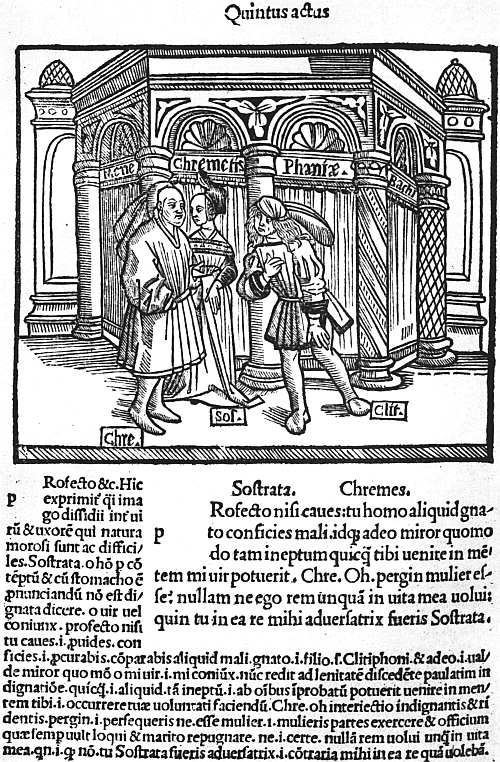
Unlike most of Shakespeare's plays, The Comedy of Errors "preserves a unity of place and of time, for the entire action takes place within Ephesus and within the space of one day; and, in addition, it seems to require only four playing-areas, or at the most five." There is the street, the house of Antipholus of Ephesus (whose sign is the Phoenix), the Courtesan's house (the Porpentine, i.e., Porcupine), and the Priory, which probably bore the sign of a cross. An upper gallery may also have been used.
It is tempting to suppose that this short play, with its classical background, was designed for performance in a hall with no gallery, and for an audience used to "houses" on stage, and perhaps familiar with the kind of arcade setting to be seen in illustrations to several early editions of Terence.
A page from the edition of Terence's comedies published by Johann Trechsel in 1493. The artist imagines a Roman stage with an arcade that has entrances labeled for each house represented in the play. (Source: Project Gutenberg)  


The Comedy of Errors has not been the object of much critical attention beyond acknowledgement that it is a "clever adaptation of Roman comedy," and that it is "the 'best plotted of Shakespeare's early comedies,'" though some have seen it "as an attempt to combine romance and farce, with disastrous results." But Foakes points to the serious element in the plot, the story of Egeon: "in spite of the implausibility and fantastic coincidences of Egeon's tale of the shipwreck, we are directly affected by his wretchedness, his dramatic presence on stage as a lonely, pathetic figure, lacking money and friends, and sentenced to die at the day's end." This "sombre tone established in Act I is never entirely dispelled until the end of the play, and is carried over immediately into Act II in the suggestions of sorcery and witchcraft in Ephesus."

The question of identity, and the horrifying loss of it, is also at the heart of the play. Foakes asserts that "Shakespeare had a larger purpose than merely to soften the harsh world of Plautine comedy, or exploit more fully the ancient comic device of mistaken identity. His modifications of the sources are used to develop a serious concern for the personal identity of each of the main characters," as well as the "disruption of family, personal, and social relationships." In addition to the invocation of witchcraft, there is also the fear of loss of sanity: Antipholus of Ephesus "regards himself as alone sane in a world gone mad. He is given some force of character, and a tendency to violence, so that when he is shut out of his own house, he is driven to bewilderment and to passionate exclamation." There is "a sense of evil at work in Ephesus" that feeds into the role of the Priory in resolving the problems of the characters and "lends a faintly holy and redeeming colour to the end of the play."

This redemptive aspect is characteristic of Shakespeare's comedies:
For the sense of deliverance in them is a means to an end -- the end being a re-establishment of responsibility among individuals in a society in the light of a test undergone, or a penance endured, an acceptance of moral bondage in the full understanding of what this means.... The Comedy of Errors, then, differs from its Plautine models in a characteristically Shakespearian way; later on Shakespeare was to absorb the pole of violence or suffering into his comedies, as in Twelfth Night or Much Ado, or to make the enveloping action, as in As You Like It, slide so smoothly into the central plot that it is hardly noticed as a frame at all.

After the 1594 Gray's Inn performance and a performance at court in 1604, there are no other recorded performances in the seventeenth century. In the eighteenth century there were some adaptations of the play, and in 1819 Frederick Reynolds turned it into an opera. It was revived in more or less original form in the nineteenth century, and a 1915 production at the Old Vic provided a debut for Sybil Thorndike in the role of Adriana. Theodore Komisarjevsky's production at Stratford in 1938 was a hit. The same year, Richard Rodgers and Lorenz Hart's musical comedy version, The Boys From Syracuse, was performed on Broadway, and there have been several musical adaptations since then.

Monday, April 18, 2011

4. The Modern Tradition, edited by Richard Ellmann and Charles Feidelson Jr., pp. 54-73

Symbolism: Imagination and Nature; Symbolic Nature (William Blake, William Wordsworth, Charles Baudelaire, W.B. Yeats, Paul Klee). Symbolism: Imagination and Thought; The State of Doubt (Johann Wolfgang von Goethe, John Keats, Gustave Flaubert)
_____

William Blake: The Eternal World of Vision

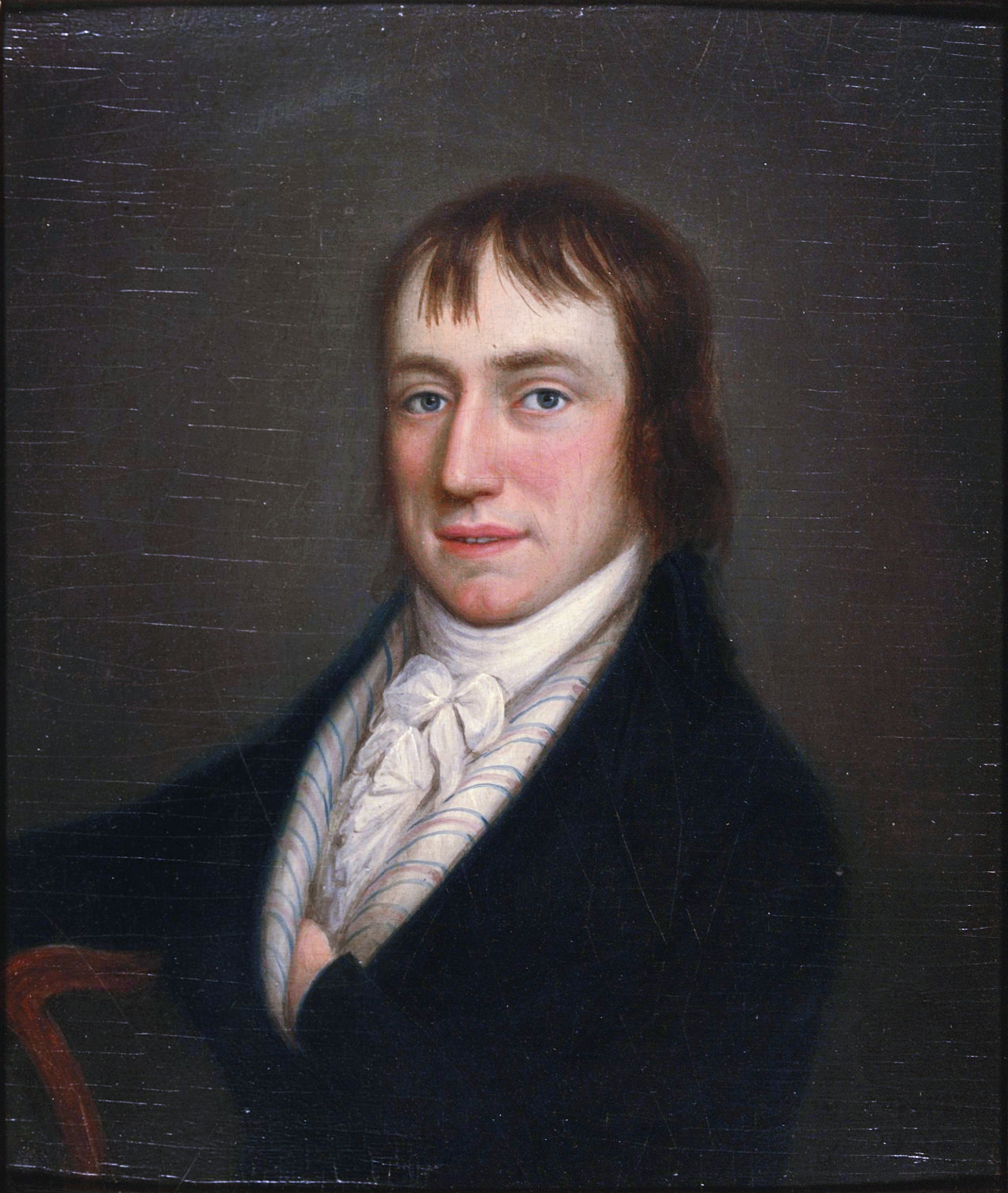
Thomas Phillips, William Blake, 1802
In the first selection, a 1799 letter to a clergyman, the Rev. Dr. Trusler, Blake asserts,
This World Is a World of Imagination & Vision. I see Every thing I paint In This World, but Every body does not see alike. To the Eyes of a Miser a Guinea is far more beautiful than the Sun, & a bag worn with the use of Money has more beautiful proportions than a Vine filled with Grapes.... But to the Eyes of the Man of Imagination, Nature is Imagination itself. 
Blake champions the imagination because it gives him an entree to the significance of the external world: "To Me This World is all One continued Vision of Fancy or Imagination," and for the great poets -- he cites Homer, Virgil and Milton in particular -- Imagination is the vehicle for "Spiritual Sensation." As for his own works of visual art, he is particularly pleased that "Children ... have taken a greater delight in contemplating my Pictures than I even hoped." Not that there is anything inherently more receptive about children: "Some Children are Fools & so are some Old Men. But There is a vast Majority on the side of Imagination or Spiritual Sensation."
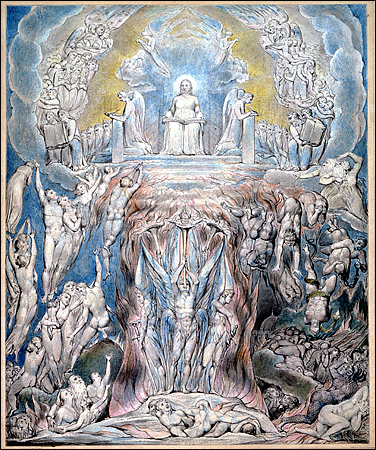
William Blake, A Vision of the Last Judgment, pen and watercolor, 1808
William Blake, watercolor illustration for Robert Blair's The Grave, 1805
Blake's painting of the Last Judgment was to be part of an exhibit in 1810, but the exhibit was canceled and the work was subsequently lost. The watercolor versions shown above follow the plan Blake outlined for the painting. In the second excerpt in this section of The Modern Tradition, written in 1810 for the catalog of the canceled exhibition, Blake discusses the work, insisting that it is "not Fable or Allegory but Vision. Fable or Allegory are a totally distinct & inferior kind of Poetry. Vision or Imagination is a Representation of what Eternally Exists, Really & Unchangeably.... The Hebrew Bible & the Gospel of Jesus are not Allegory, but Eternal Vision or Imagination of All that Exists."

For Blake, art is a rejection of mutability, of the impermanence of existence: "This world of Imagination is the world of Eternity; it is the divine bosom into which we shall all go after the death of the Vegetated body." It is also a rejection of materialism, "of Bad Art & Science. Mental Things are alone Real; what is call'd Corporeal, Nobody Knows of its Dwelling Place: it is in Fallacy, & its Existence is an Imposture." The material world is illusory, and Blake the visionary sees through it: The sun is not "a round disk of fire somewhat like a Guinea" to Blake. Instead it is "an innumerable company of the Heavenly host crying, 'Holy, Holy, Holy is the Lord God Almighty.'" The trick is to see through nature to the eternity behind it: "I question not my Corporeal or Vegetative Eye any more than I would Question a Window concerning a Sight. I look thro' it & not with it."


William Wordsworth: Natural Apocalypse

William Wordsworth in 1789
The selection from The Prelude reprinted here is a considerably tamer version of Blake's nature mysticism. Wordsworth regards an event -- or rather the recognition of an event -- as an epiphany, or what he would elsewhere call a "spot of time." The event in itself has no grand significance in material terms: The party he is traveling with has crossed the Alps. But the awareness that they have done so is "translated by our feelings" into something greater, and
Imagination -- here the Power so called
Through sad incompetence of human speech,
That awful Power rose from the mind's abyss
Like an unfathered vapour that enwraps,
At once, some lonely traveleler. 
Imagination produces "a flash that has revealed / The invisible world." And so, at least for a time, the natural phenomena they encounter -- waterfalls, winds, rocks, crags, clouds, darkness and light -- become symbols of something beyond the material world, they
Were all like workings of one mind, the features
Of the same face, blossoms upon one tree;
Characters of the great Apocalypse,
The types and symbols of Eternity,
Of first, and last, and midst, and without end. 
It's probably worth noting here that "apocalypse" has come to denote the events attendant on the end of the world, when the word's Greek origins meant "uncovering" or "revelation." An apocalypse is a revelation of truths, and not the truths themselves. So what Wordsworth means here is not a vision of the end of the world, but simply the unveiling of the meaning behind the surface phenomena of existence. He senses, but can't articulate, something eternal, which is precisely what Blake was getting at when he asserted that the imagination gives one visions of eternity.


Charles Baudelaire: The Temple of Nature

Charles Baudelaire, c. 1863
Baudelaire's poem "Correspondances" (1857) posits that nature is a temple, and by extrapolation we might suggest that the artist is its  priest, translating the "babel of words" uttered by the temple's "living pillars." The senses receive the sights, the colors, the sounds and scents as finite manifestations of infinite things. In the poem, Baudelaire lays particular emphasis on the sense of smell, which is the most intimate and subjective of the senses, taking in "perfumes" that are "fresh and cool," "mellow," "green," "perverse, rich, and triumphant." And in turn, these odors evoke the tactile ("the bodies of children"), the auditory ("oboes"), and the visual ("fields"), as well as such moral qualities as perversity, richness and triumph.


W.B. Yeats: Symbol as Revelation

John Butler Yeats, William Butler Yeats, 1900
Everybody likes to complain about journalists, and in this essay, "The Symbolism of Poetry" (1900), Yeats is out to disabuse the readers of the notion, apparently foisted upon them by journalists, that artists proceed without any higher aim or theoretical purpose. And here, of course, he proceeds to enunciate his own.

He cites several lines of verse in which metaphor takes on a larger symbolic role, beginning with Robert Burns's
The white moon is setting behind the white wave,
And Time is setting with me, O!
He says, quite correctly, "Take from them the whiteness of the moon and of the wave, whose relation to the setting of Time is too subtle for the intellect, and you take from them their beauty." And he's right: an 18th-century critic might object that neither the moon nor the wave is, strictly speaking, white. But we only have to go to Melville's great discourse on "The Whiteness of the Whale" to observe the symbolic power of the adjective. As Yeats puts it, "All sounds, all colours, all forms, either because of their pre-ordained energies or because of long association, evoke indefinable and yet precise emotions." The italics in that quotation are mine, to emphasize the seeming oxymoron: If precise, then why indefinable? But that's the point: Symbols evoke precise emotions, but if they were definable, we wouldn't need symbols to evoke them.

The function of the symbol in art, as Yeats sees it, is to bring unity out of multiplicity: "when sound, and colour, and form are in a musical relation, a beautiful relation to one another, they become as it were one sound, one colour, one form, and evoke an emotion that is made out of their distinct evocations and yet is one emotion." And it is the artist who, by perceiving the power of the symbol, translates that power to the rest of the world: "I am certainly never certain, when I hear of some war, or of some religious excitement or of some new manufacture, or of anything else that fills the ear of the world, that it has not happened because of something that a boy piped in Thessaly." Okay, that's a bit extravagant. But try this one on for truth: "I doubt ... that love itself would be more than an animal hunger but for the poet and his shadow the priest." (That subordination of the religious to the artistic is quite lovely.)

Poets and musicians achieve their effects by species of hypnotism, Yeats asserts:
The purpose of rhythm, it has always seemed to me, is to prolong the moment of contemplation, the moment when we are both asleep and awake, which is the one moment of creation, by hushing us with an alluring monotony, while it holds us waking by variety, to keep us in that state of perhaps real trance, in which the mind liberated from the pressure of the will is unfolded in symbols. If certain sensitive persons listen persistently to the ticking of a watch, or gaze persistently on the monotonous flashing of a light, they fall into the hypnotic trance; and rhythm is but the ticking of a watch made softer, that one must needs listen, and various, that one may not be swept beyond memory or grow weary of listening; while the patterns of the artist are but the monotonous flash woven to take the eyes in a subtler enchantment.
And "enchantment" is the aim, or at least as long as it is in service of something of value. The emptying out of religious belief has, in Yeats's view, crippled the world turning it toward the materialistic. "How can the arts overcome the slow dying of men's hearts that we call the progress of the world, and lay their hands upon men's heartstrings again, without becoming the garment of religion as in old times?"  If the piping of a Thessalian boy can cause people to go to war, then artists need to be conscious of the ends toward which their work can move people. Artists need to avoid the didactic, the moralizing, the anecdotal, and "that brooding over scientific opinion that so often extinguished the central flame in Tennyson." They need to discover the symbolic force of the world around them, to "return to imagination" and to understand "that the laws of art, which are the hidden laws of this world, can alone bind the imagination."

To return to the topic of rhythm, Yeats "would cast out of serious poetry those energetic rhythms, as of a man running, which are the invention of the will with its eyes always on something to be done or undone; and we would seek out those wavering, meditative, organic rhythms, which are the embodiment of the imagination, that neither desires nor hates, because it has done with time, and only wishes to gaze upon some reality, some beauty."


Paul Klee: Eternal Genesis

Paul Klee, date unknown
The excerpts are from Klee's On Modern Art (posthumously published in 1945), and are a series of brief, epigrammatic paragraphs. Klee asserts that the artist's role is defined by the word "creation" and that art is perpetually generative, creating a new nature as it were.
The deeper he looks, the more readily he can extend his view from the present to the past, the more deeply he is impressed by the one essential image of creation itself, of Genesis, rather than by the image of nature, the finished product. 
We are back here to the distinction between natura naturata ("the finished product") and natura naturans ("creation itself'" or the act of creating). Klee looks to the artist to create new things, not to reproduce the things already created.
Paul Klee, Flower Myth, 1918

The artist's role is "not to provide a scientific check on the truth of nature" but to demand "freedom," defined as "the right to develop, as great Nature herself develops." The source of it all is, of course, imagination, and "What springs from this source, whatever it may be called, dream, idea or phantasy -- must be taken seriously only if it unites with the proper creative means to form a work of art." He retorts to the critics of his own work, who have called it "childish," that the label "most have originated from those linear compositions of mine in which I tried to combine a concrete image, say that of a man, with the pure representation of the linear element.
Had I wished to present the man "as he is," then I  should have had to use such a bewildering confusion of line that pure elementary representation would have been our of the question. The result would have been vagueness beyond recognition.

And anyway, I do not wish to represent the man as he is, but only as he might be.
Paul Klee, Miraculous Landing, or the "112!"  1920
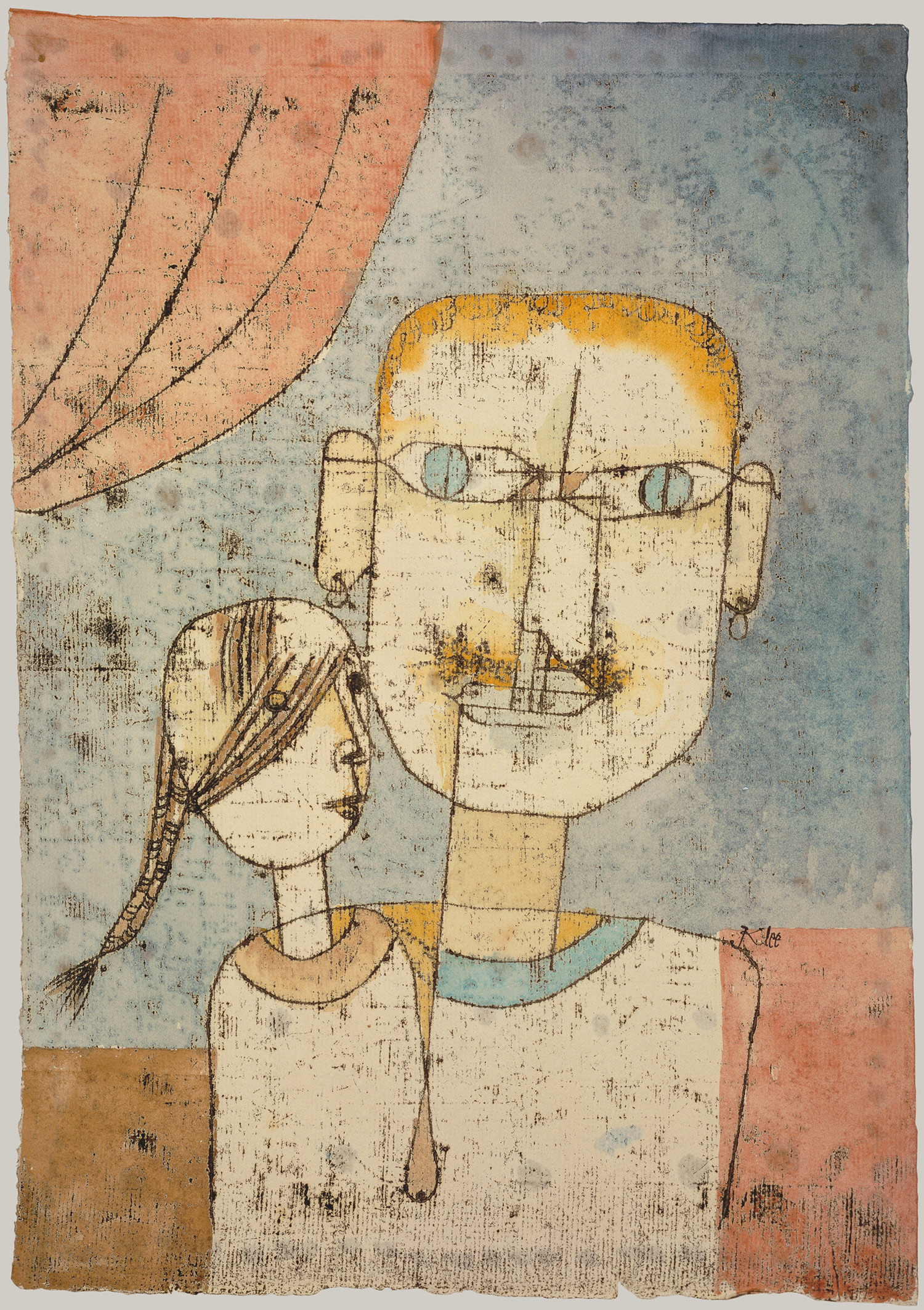
Paul Klee, Adam and Little Eve, 1921


Johann Wolfgang von Goethe: Escape From Ideas

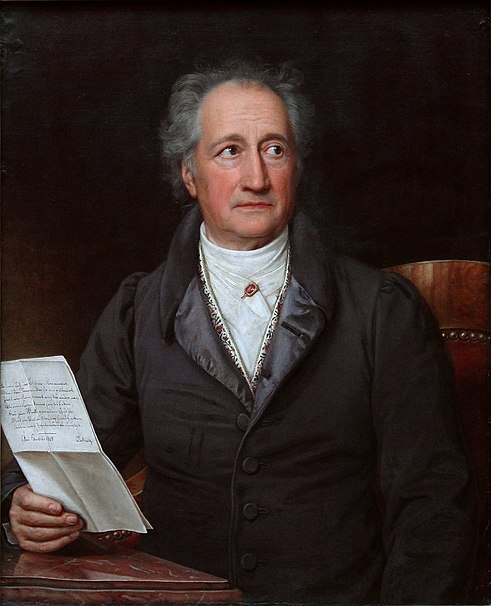
Joseph Karl Stieler, Goethe age 69, 1828
Artists are always irritated by being asked, "What are you trying to say?" and Goethe, to judge from this excerpt from J.P. Eckermann's Conversations of Goethe (1836), was no exception.
"It was ... not in my line, as a poet, to strive to embody anything abstract. I received in my mind impressions, and those of a sensual, animated, charming, varied, hundredfold kind, just as a lively imagination presented them; and I had, as a poet, nothing more to do than artistically to round off and elaborate such views and impressions, and by means of a lively representation so to bring them forward that others might receive the same impression in hearing or reading my  representation of them."
This is the artist as medium between the universe and the observer. But the role doesn't come with any responsibility to make the message simple and comprehensible: "I am rather of the opinion, that the more incommensurable, and the more incomprehensible to the understanding, a poetic production is, so much the better it is." (So much for anyone who has tried to find a simple message in Faust.)

As for the role of religion in art, "'Religion,' said Goethe, 'stands in the same relation to art as any other of the higher interests in life." What predominates for the artist is not dogma but the human element: "Art must address itself to those organs with which we apprehend it; otherwise it misses its effect. A religious material may be a good subject for art, on only in so far as it possesses general human interest." That's why portraits of the Madonna and Child have always been popular.


John Keats: Negative Capability

William Hilton, John Keats, date unknown
This famous excerpt from Keats's letter to his brothers George and Thomas has a phrase in it that I think is often mispronounced, and therefore misunderstood: "negative capability." I think the word isn't NEGative but neGAtive -- i.e., the function of negating. And we shouldn't lose the context in which Keats came up with this powerful concept: He had been to a dinner with some friends "who say things which make one start, without making one feel." Their conversation "only served to convince me how superior humour is to wit." The priority given to feeling over intellect here is characteristic, and it feeds into his though about Shakespeare's "Negative Capability, that is, when a man is capable of being in uncertainties, mysteries, doubts, without any irritable reaching after fact and reason." Keats isn't against fact and reason, he just wants to put it in its place, and its place isn't in literature.


Gustave Flaubert: Art Without Conclusions

Gustave Flaubert, date unknown
In this 1857 letter to Marie-Sophie Leroyer de Chantepie, with whom Flaubert carried on an extended correspondence, he rejects the idea that human beings can ever "attain to absolute knowledge of truth and goodness." In fact, the only road to happiness is to avoid the delusion that certainty is possible. "Life is such a hideous business that the only method of bearing it is to avoid it. And one does avoid it by living in Art, in the ceaseless quest for Truth presented by Beauty." (The kinship with Keats's conclusion, "Beauty is truth, truth Beauty, -- that is all / Ye know on earth, and all ye need to know," is evident, except that Keats's formulation of that dictum is loaded with irony.)
Superficial, limited creatures, rash, feather-brained souls, demand a conclusion from everything; they want to know the purpose of life and the dimensions of the infinite. Picking up a handful of sand in their poor, puny grasp, they say to the Ocean: "I shall now count the grains on your shores." but when the sand slips through their fingers and the sum proves long, they stamp and burst into tears. Do you know what we should do on that shore? Either kneel down or walk. You must walk. 
The advice is not to cease from questioning, but to cease from hoping for a definitive answer. Strive, but don't overreach. "No great genius has come to final conclusions; no great book ever does so, because humanity itself is forever on the march and can arrive at no goal. Homer comes to no conclusions, nor does Shakespeare, nor Goethe, nor even the Bible." Thus Flaubert rejects not only religion but also politics, believing instead in "the perpetual evolution of humanity and in its ever-changing forms, and consequently I abominate all those frames which men try to cram it into by main force, all the formulas by which they define it, and all the plans they devise for it.... it seems idiotic to me to seek the best religion or the best government. For me, the one on its deathbed is the best, since it is then making way for another."