JOURNAL OF A COMPULSIVE READER
By Charles Matthews
Showing posts with label André Malraux. Show all posts

Sunday, May 8, 2011

24. The Modern Tradition, edited by Richard Ellmann and Charles Feidelson Jr., pp. 514-536

Cultural History: History and Imagination (André Malraux); Religion and History (Nicolas Berdyaev); Primitive Survivals (Charles Darwin, James G. Frazer, Henry Miller)
_____

André Malraux: The Triumph of Art Over History

In this excerpt from The Voices of Silence (1951), Malraux extrapolates on his concept of the "Museum Without Walls," the collective artistic achievement of humankind, approached without division into cultures or epochs.

The development of the physical museum, a creation of the most recent two centuries, "imposed on the spectator a wholly new attitude towards the work of art.... Until the nineteenth century a work of art was essentially a representation of something real or imaginary, which conditioned its existence qua work of art." A portrait was judged as a portrait of someone, and not as a painting in itself. "In the past a Gothic statue was a component part of the Cathedral; similarly a classical picture was tied up with the setting of its period, and not expected to consort with works of different mood and outlook."

But the establishment of the museum, with its "practice of pitting works of art against each other," turns the viewing of art into "an intellectual activity" rather than a contemplative one.
For over a century our approach to art has been growing more and more intellectualized. The art museum invites criticism of each of the expressions of the world it brings together; and a query as to what they have in common. To the "delight of the eye" there has been added -- owing to the sequence of conflicting styles and seemingly antagonistic schools -- an awareness of art's impassioned quest, its age-old struggle to remould the scheme of things.
But even the establishment of museums allowed only for limited exposure to the world's art. Well into the nineteenth century "a man who had seen the totality of European masterpieces was a very rare exception.... Baudelaire never set eyes on the masterpieces of El Greco, Michelangelo, Masaccio Piero della Francesca or Grünewald; or of Titian, or of Hals or Goya." The only way knowledge of these works could be widely disseminated until the mid-nineteenth century was through black-and-white engravings. "The nineteenth-century photograph was merely a more faithful print." But technological advances, not only in reproduction of images but also in transportation, made a wider array of the world's art available to almost anyone who wanted to witness it. Hence, the Museum Without Walls.

This familiarity with art of all periods and all cultures has changed our approach to art: "It is not research work that has led to the understanding of El Greco; it is modern art. Each genius that breaks with the past deflects, as it were, the whole range of earlier forms." Each masterpiece, Malraux asserts, "keeps up ... a dialogue indefeasible by Time."

Malraux distinguishes between artists and artisans: "I name that man an artist who creates forms ... and I call that man an artisan who reproduces forms, however great may be the charm or sophistication of his craftsmanship."
Romanesque tympanum, Christ in majesty, Abbey of Saint-Pierre in Moissac
The fact that our conception of the artist was something quite unknown in the Middle Ages (and for many thousand years before) and that a genius like Van Eyck was commissioned to design set pieces and to paint coffers, does not affect the fact that painters and sculptors, when possessed of genius, transfigured the art they had inherited, and the creative joy of the man who invented the Moissac Christ, the Chartres Kings and the Uta was different in kind from the satisfaction felt by the cabinet maker who had just completed a perfect chest.
Three kings from the portal of Chartres cathedral

Ekkehard and Uta, Naumburg Cathedral
The development of art consists of a series of "victories over forms, achieved by means of forms," and not as the expression of successive ideologies: "The Last Judgment was the outcome of a meditation on figures, and not a declaration of faith."

We have come to recognize that "the world of art is ... another world, the same as that of music and architecture," and that "the long-drawn conflict between pagan and Christian art in Europe" has ended. Art is "one of man's rare creations, inventive though man is."
Just as the crucial historical event of the nineteenth century was the birth of a new consciousness of history, so the crucial expression of the metamorphosis of our century is our consciousness of it. Thus today art means to us that underlying continuity due to a latent kinship between the works of art of all ages which is a historical continuity, since never does an art destroy all that it has inherited; El Greco broke with Titian, but not by painting pictures like Cézanne's. 
Through art, humankind achieves a victory over destiny: "what survives for us in the great arts of the past is the indefeasible inner voice of civilizations that have passed away." And the art of the twentieth century suggests "that there is tentatively taking form, for the first time in history, the concept of a world-wide humanism." We are coming to realize that "the cultures of civilizations that have died out" are not so much radically different from us or from one another as they are "cultures of different parts of the same plant." We have created a culture that synthesizes elements that once warred with each other: "If Aristotle and the Prophets of Israel met on the banks of the Styx, what would they exchange but insults? Montaigne had to be born before the dialogue between Christ and Plato could arise." In the humanist view, "each hero, saint or sage stands for a victory over the human situation."
We ... are the heirs not so much of this or that value in particular ... as of something that runs deeper: that undercurrent of the stream of human consciousness which brought them into being. We have at last become aware of their true nature, in the same manner as Hegelianism became aware not of forgotten values but of history; it is art as an organic whole, liberated by our modern art, that our culture for the first time is arraying against destiny.
We no longer toy with the idea of restoring "the mutilated statue" to its original form. Earlier, Malraux commented, "In 1910 it was assumed that the Winged Victory, when restored, would regain her ancient gold, her arms, her trumpet." Today, we would be as disturbed by that kind of restoration as we would be by an attempt to attach arms to the Venus de Milo. We recognize that these mutilations are a sign of the life in the work: "Mutilation is the scar left by the struggle with Time, and a reminder of it -- Time which is as much a part of ancient works of art as the material they are made of, and thrusts up through the fissures, from a dark underworld where all is at once chaos and determinism."
All art is a revolt against man's fate. 


Nicolas Berdyaev: The Historical Meaning of Christianity

Nicolas Berdyaev, date unknown
Like Hegel and Benedetto Croce, Berdyaev, in this excerpt from The Meaning of History (1923), sees history as a movement toward freedom. But Berdyaev isolates the moment in history at which this concept became manifest as the emergence of Christianity as a dominant force.
The exceptionally dynamic and historical character of Christianity is the result of the fact that it conclusively revealed for the first time the existence of the principle of freedom, which was ignored by both the ancient and the Hebrew worlds.... The Greeks affirmed the reason and necessity of good.... Christianity, on the other hand, affirmed the freedom of good. It affirmed that good is the product of the free spirit and that only such good can possess a true value and reality. It denied the compulsory and reasonable necessity of good.... Unlike the ancient world, Christianity is not content to submit to fate.
Berdyaev's interpretation of Christianity presupposes that the fall of man was indeed a fortunate fall: "The freedom to choose and affirm the good, rooted in the will and not in reason, presupposes in its turn that freedom of the creative and active subject without which a true dynamism of history is impossible." It is "the interaction of the human spirit and nature" that distinguishes the post-Christian world. The alienation of man from God dramatized in the story of the Fall "plunged man and the human spirit into the uttermost depths of natural necessity. The fall into these depths was accompanied by man's servitude to the natural elements which had held the human spirit and will spellbound." Nature "was populated with demons and man was powerless to dominate either them or the natural cycle."

But Christianity "liberated man from the power of the baser elemental nature and demons. It did so through the agency of Christ and the mystery of Redemption.... It distinguished him from baser nature and set him up as an independent spiritual being, freeing him from submission to the natural world and exalting him to the heavens." In the Christian view, "History is in truth the path to another world," a realm of perfection not achievable in this one.
Man's historical experience has been one of steady failure and there are no grounds for supposing that it will ever be anything else. Not one single project elaborated within the historical process has ever proved successful. None of the problems of any given historical epoch whatsoever has been solved, no aims attained, no hopes realized. This radical failure of the historical process, when we regard it as a whole, can only be interpreted as the failure to realize the Kingdom of God. 
But on the other hand, "Christianity also was a complete and utter failure." (Possibly because it was left in the hands of human beings?) "Two thousand years have not sufficed to realize the ideals of Christian faith and consciousness. They will never be realized within the framework of human time and history." But Berdyaev argues that "the failure of Christianity does not mean that Christianity is not the highest truth. Historical success and achievement do not constitute a valid criterion of the true," because "nothing perfect can be realized in time." The conclusion Berdyaev reaches is "that the destiny of man reserves a higher realization for his potentialities than any to be achieved in his purely historical experience."


Charles Darwin: The Pre-Human in the Human

In The Descent of Man (1871) Darwin tactfully approaches the most controversial conclusions of his theory: humankind's kinship with other primates, or as he puts it, "that man is descended from a hairy, tailed quadruped, probably arboreal in its habits, and an inhabitant of the Old World." He rather sweetly advances some stories of kindness and altruism among monkeys and baboons to assert that this isn't so bad, and that he'd rather admit his kinship with them than with "a savage who delights to torture his enemies, offers up bloody sacrifices, practices infanticide without remorse, treats his wives like slaves, knows no decency, and is haunted by the grossest superstitions." But he insists that although humans have reached "the very summit of the organic scale" -- a concept that embarrasses many post-Darwinians,
We must ... acknowledge ... that man with all his noble qualities, with sympathy which feels for the most debased, with benevolence which extends not only to other men but to the humblest living creature, with his god-like intellect which has penetrated into the movements and constitutions of the solar system -- with all these exalted powers -- Man still bears in his bodily frame the indelible stamp of his lowly origin.


James G. Frazer: The Savage in the Human
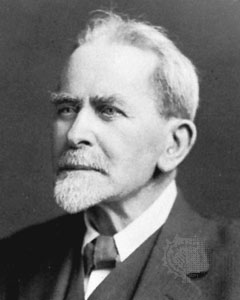
J.G. Frazer in 1933
In these selections from Frazer's essays from the first two decades of the twentieth century, the anthropologist isn't willing to go as far as Darwin in separating the "noble qualities" of humans from the "bodily frame" he inherited from his "lowly" ancestors. In his formulation, "a savage is to a civilized man as a child is to an adult," which still leaves a lot of room for residual traits of savagery or childishness to persist into the civilized or grownup being. And research has shown anthropologists "that a mass, if not the majority, of people in every civilized country is still living in a state of intellectual savagery, that, in fact, the smooth surface of cultured society is sapped and mined by superstition." (A look at most state legislatures should be enough to confirm that assertion.)

Frazer is alarmed at the implications:
We appear to be standing on a volcano which may at any moment break out in smoke and fire to spread ruin and devastation among the gardens and palaces of ancient culture wrought so laboriously by the hands of many generations.
Moreover, "it is precisely the oldest and crudest superstitions which are most tenacious of life." For "the high gods of Egypt and Babylon, of Greece and Rome," have been forgotten except by the educated, while the masses still believe "in witches and fairies, in ghosts and hobgoblins." In them, "intellectual progress is so slow as to be hardly perceptible."

The Lion Gate at Mycenae

Henry Miller: An Archaic Mystery

Henry Miller, date unknown
Miller's 1941 travel book about Greece, The Colossus of Maroussi, contains these reflections on Mycenae, which both appeals to and repels a writer with some sympathy for the pagan point of view. "It is one of the navels of the human spirit, the place of attachment to the past and of complete severance too." What strikes Miller in particular is the aura of cruelty that lingers about the place, despite its setting of natural beauty:
Argos gleams resplendent, a point of light shooting arrows of gold into the blue. Argos belongs to myth and fable: her heroes never took on flesh. But Mycenae, like Tiryns, is peopled with the ghosts of antedilivial men, Cyclopean monsters washed up from the sunken ridges of Atlantis. Mycenae was first heavy-footed, slow, sluggish, ponderous, thought embodied in dinosaurian frames, war reared in anthropophagous luxury, reptilian, ataraxic, stunning and stunned. Mycenae swung full circle, from limbo to limbo. The monsters devoured one another, like crocodiles. The rhinoceros man gored the hippopotamic man. The walls fell on them, crushed them, flattened them into the primeval ooze. 
This is civilized man, feeling his roots.

Friday, April 15, 2011

2. The Modern Tradition, edited by Richard Ellmann and Charles Feidelson Jr., pp. 17-33

Symbolism: Imagination and Nature; The Revolt Against Nature (Oscar Wilde, Rainer Maria Rilke, Pablo Picasso, André Malraux)
_____
Oscar Wilde: The Priority of Art

In this excerpt from the dialogue "The Decay of Lying," Cyril and Vivian discuss the relationship between Art and Nature.

Anyone can come up with paradoxes, but Wilde is one of the few who can make them not only clever but also wise. Vivian rattles them off here in a run of seemingly glib antitheses:
the more we study Art, the less we care for Nature
...
Art is our spirited protest, our gallant attempt to teach Nature her proper place.
...
The ancient historians gave us delightful fiction in the form of fact; the modern novelist presents us with dull facts under the guise of fiction.
...
Many a young man starts in life with a natural gift for exaggeration which, if nurtured in congenial and sympathetic surroundings, or by the imitation of the best models, might grow into something really great and wonderful. But, as a rule, he comes to nothing.... He either falls into careless habits of accuracy, or takes to frequenting the society of the aged and the well-informed.
...
[He] often ends by writing novels which are so life-like that no one can possibly believe in their probability.
...
Wordsworth ... found in stones the sermons he had already hidden there. 

And finally:
Life imitates Art far more than Art imitates Life.
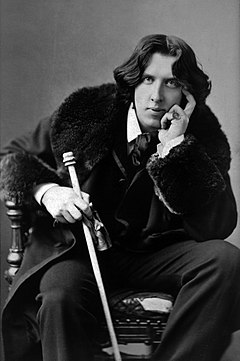
Oscar Wilde in 1882
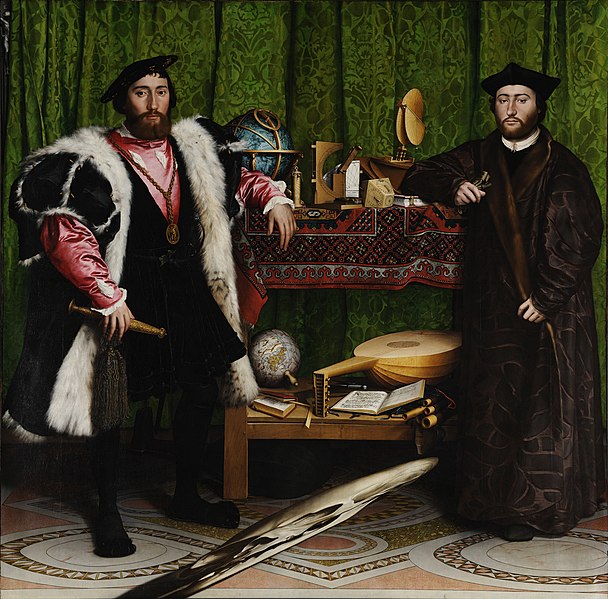
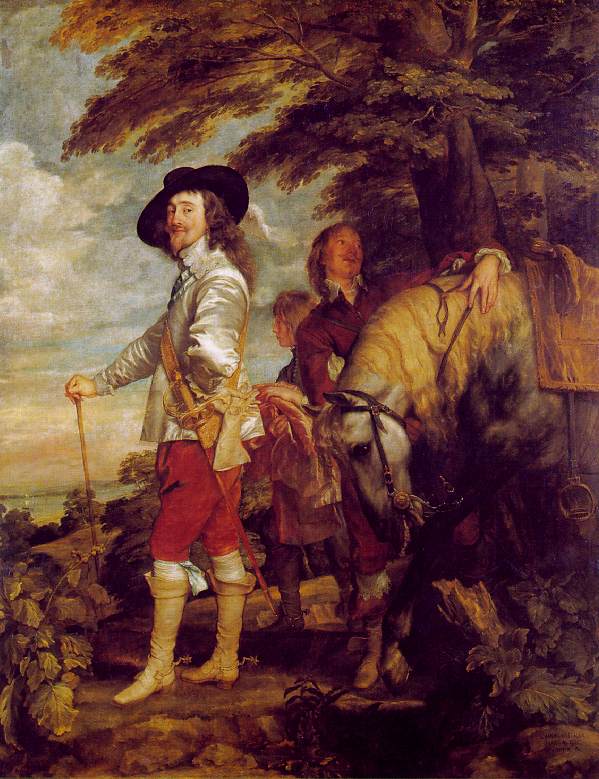
Dazzling and witty, yes. But also the basis of an entirely serious aesthetic, as Vivian/Wilde goes on to demonstrate. By inverting the traditional image of Art holding a mirror up to Nature, insisting instead that Art "is a veil, rather than a mirror," Wilde examines the role of the imagination, especially as it manifests itself in artistic creation. And he concludes that Art is the organizing principle that brings a unity, or perhaps one should say a Gestalt, to our potentially chaotic experience of the external world. "Neither Holbein nor Vandyck found in England what they have given us," Vivian asserts. "They brought their types with them, and Life with her keen imitative faculty set herself to supply the master with models."
Hans Holbein the Younger, The Ambassadors, 1533

Anthony Van Dyck, Charles I of England, c. 1635
Literature exhibits the same phenomenon: "Schopenhauer has analysed the pessimism that characterises modern thought, but Hamlet invented it. The world has become sad because a puppet was once melancholy." In short, "Things are because we see them, and what we see, and how we see it, depends on the Arts that have influenced us.... At present, people see fogs, not because there are fogs, but because poets and painters have taught them the mysterious loveliness of such effects."
James McNeill Whistler, Nocturne: Blue and Gold - Old Battersea Bridge, c 1872-75
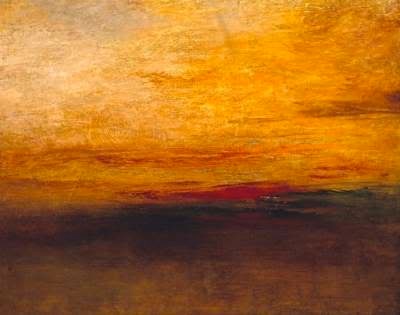
Called once to admire a sunset, Vivian claims that "It was simply a very second-rate Turner, a Turner of a bad period, with all the painter's worst faults exaggerated and over-emphasized."
J.M.W. Turner, Sunset, 1830-35
But for all Wilde's tongue-in-cheekery and seemingly outrageous claims, there is a core of seriousness in his doctrine, which he has Vivian sum up in four major points:
  • "Art never expresses anything but itself."
  • "All bad art comes from returning to Life and Nature, and elevating them into ideals.... The moment Art surrenders its imaginative medium it surrenders everything.... Life goes faster than Realism, but Romanticism is always in front of Life."
  • "Life imitates Art far more than Art imitates Life." 
  • "Lying, the telling of beautiful untrue things, is the proper aim of Art."
As we'll see, others have made the same claims, though perhaps with less wit and more evident earnestness.


Rainer Maria Rilke: The Unnatural Will to Art
Rainer Maria Rilke, c. 1900

This excerpt is from a letter written by Rilke in 1920 to his lover, Baladine Klossowska, whom he called "Merline." He speaks in it of his "struggle towards concentration," his attempt to touch his "center of production" and to find the "purest impulse" and to "recreate [the] first innocence" at which "the Angel discovered you when he brought you the first binding message." In short, to become open to the traditional moment of inspiration. But what is less traditional is essentially a paraphrase of what Wilde asserted above. Rilke puts it this way: "Art, as I conceive it, is a movement contrary to nature."

And to go against nature is of necessity a struggle. We artists, he asserts, must "throw ourselves into the abyss of our being." This is a form of self-immolation: "If the meaning of sacrifice is that the moment of greatest danger coincides with that when one is saved, then certainly nothing resembles sacrifice more than this terrible will to Art." Most humans try to forget things to survive, but artists "are always bent on discovering, on magnifying even" the things that others strive to forget: "it is we who are the real awakeners of our monsters, to which we are not hostile enough to become their conquerors; for in a certain sense we are at one with them" -- they supply the strength that the artist needs. It's not a question of conquest at all: "it is not for us to consider ourselves the tamers of our internal lions. But suddenly we feel ourselves walking beside them, as in a Triumph, without being able to remember the exact moment when this inconceivable reconciliation took place (bridge barely curved that connects the terrible with the tender ... )"

That ravishing parenthetical phrase and the artist's role as creator ex nihilo brings to mind one of Rilke's Sonnets to Orpheus:
O dieses ist das Tier, das es nicht giebt. 
     O this is the animal that does not exist.
Sie wußtens nicht und habens jeden Falls 
     But they didn't know that, and, in any case, 
-- sein Wandeln, seine Haltung, seinen Hals, 
     they loved it -- loved its gait, its stance, 
bis in des stillen Blickes Licht -- geliebt. 
     its neck, loved the light in its quiet gaze. 

Zwar war es nicht. Doch weil sie's liebten, ward 
    It never was. But since they loved it,  
ein reines Tier. Sie ließen immer Raum. 
     a pure animal became. They always left space. 
Und in dem Raume, klar und ausgespart, 
     And in that space, unoccupied and bright, 
erhob es leicht sein Haupt und brauchte kaum 
     it calmly raised its head and scarcely needed 

zu sein. Sie nährten es mit keinem Korn, 
     to be. They fed it not with grain, --  
nur immer mit der Möglichkeit, es sei. 
    only with the promise of its being. 
Und die gab solche Stärke an das Tier, 
    And this gave the animal such power, 

daß es aus sich ein Stirnhorn trieb. Ein Horn. 
     that a horn sprouted from its brow. One horn. 
Zu einer Jungfrau kam es weiß herbei -- 
    White, it strode up to a virgin -- and was
und war im Silber-Spiegel und in ihr. 
      in the mirror's silver and in her. 
Translation by Edward Snow


Pablo Picasso: Art as Individual Idea
Pablo Picasso, date unknown

In this essay from 1923, Picasso aligns himself with the Romantic idea of spontaneity, and with art as a serendipitous pursuit: "When I paint my object is to show what I have found and not what I am looking for.... What one does is what counts and not what one had the intention of doing." And he, too, makes statements that sound like paraphrases of Wilde: "Art is a lie that makes us realize truth, at least the truth that is given us to understand." And: "Nature and art, being two different things, cannot be the same thing. Through art we express our conception of what nature is not." But he also warns against overambitiousness, the "attempt to paint the invisible and, therefore, the unpaintable."

Art is not a representation of external things, but of the artist's ideas about them. Both Velasquez and Rubens, he notes, painted portraits of Philip IV, but they seem to be two different people.
Diego Velasquez, Philip IV at Fraga, 1644
Peter Paul Rubens, Philip IV, 1628-29
"We believe in the one painted by Velasquez," Picasso asserts, "for he convinces us by his right of might." But even in the work of painters who claim to be "painting nature as it is, art has always been art and not nature." What artists aim for is "more or less convincing lies."

Moreover, art exists independently of history: "there is no past or future in art.... The art of the Greeks, of the Egyptians, of the great painters who lived in other times, is not an art of the past; perhaps it is more alive today than it ever was." (The point could be extended, of course, to literature, to Homer, Virgil, Dante, Chaucer, and Shakespeare.) Nor does an artist, he claims, "evolve": "The several manners I have used in my art must not be considered as an evolution, or steps toward an unknown ideal of painting." On the other hand, there "are periods in which there are better artists than in others." (The difficulty here, is that Picasso supplies no solid criteria by which we can judge this.)

And so he rejects the idea that a movement such as Cubism should be regarded as "a seed or a foetus," a stage in the development toward something else. Cubism is "an art dealing primarily with forms, and when a form is realized, it is there to live its own life." Critics who approached Cubism through analogies to "Mathematics, trigonometry, chemistry, psychoanalysis, music, and whatnot" have missed the point. Their comments are "pure literature, not to say nonsense, ... blinding people with theories." And finally he disarms all criticism: "But of what use is it to say what we do when everybody can see it if he wants to?


André Malraux: Art as the Modern Absolute
André Malraux, 1935

In this selection from The Voices of Silence (1951), Malraux observes that "the art museum is by way of becoming a shrine" to "a vague deity known as Art." The trend started with the Romantics, who elevated the artist to a kind of priest, and as a consequence changed the artist's concept of his role: "Such men as Velazquez and Leonardo who painted only when commissioned were very different from Cézanne for whom painting was a vocation." And so artists began to claim for themselves a special aim: "to dominate appearances and build anew the world that had vanished from Europe, a world that had known and venerated supreme values" -- i.e., those supposedly proclaimed by God. And so "modern art ... does not sponsor any makeshift absolute" such as those proclaimed by religion "but, at least in the artist's eyes, has stepped into its -- the absolute's -- place. It is not a religion, but a faith. Not a sacrament, but the negation of a tainted world."

Even when the artist is a believer, his art stands apart from his belief: "If Cézanne, the good Catholic, had painted Crucifixions, they would have been Cézannesque, and that is doubtless whey he painted none."
Sacred art and religious art can exist only in a community, a social group swayed by the same belief, and if that group dies out or is dispersed, these arts are forced to undergo a metamorphosis. The only 'community' available to the artist consists of those who more or less are of his own kind.
Art in the past took its role and purpose from religion: "Michelangelo, Titian, Rubens and Rembrandt linked men up with the universe; as did even Goya, flinging them his gifts of darkness." With the decline of the universal Christian belief that animated the work of these artists, that gave them patrons and subject matter, the nature and purpose of art was forced to change. "As for the art of today -- does it not tend to bring to men only that scission of the consciousness, whence it took its rise?"

Our culture is now founded on the "spirit of enquiry," on what Malraux sees as "the alarming power" of science. "Our art, too, is becoming an uneasy questioning of the scheme of things." It is the uneasiness that Malraux feels most intensely: "The great Christian art did not die because all possible forms had been used up; it died because faith was being transformed into piety." That is, from an intensely internalized view of one's role in the universe into an external show, a pretense of belief lacking an an essential core. But the "spirit of questioning" that now prevails is "usually anxious and perplexed." In this respect, modern art departs in character from the art of previous ages: "Despite the insatiable questioning basic to Greek thought, the impression Greek art made on the world for many centuries was one of a triumphant affirmation."

The replacement of religion with science has produced "a culture that is not categorical but explorative."
It is quite possible that the successor of the art we call 'modern'will be still more individualist; and it is not impossible that it will assume, to begin with, the form of a resuscitation before developing into a new art, vaster in scope and deeper, born of this resuscitation.
Malraux's "possible" future hasn't come to pass yet. Postmodernism is certainly neither vast in scope nor deep.