JOURNAL OF A COMPULSIVE READER
By Charles Matthews
Showing posts with label W.B. Yeats. Show all posts

Saturday, May 21, 2011

35. The Modern Tradition, edited by Richard Ellmann and Charles Feidelson Jr., pp. 754-779

Self-Consciousness: The Divided Self (Friedrich Nietzsche, W.B. Yeats); Freedom (Arthur Schopenhauer, Friedrich Nietzsche)
_____


Friedrich Nietzsche: The Masks of Truth 


"Everything deep loves masks; the deepest things have a veritable hatred of image and likeness." Thus spoke Nietzsche in Beyond Good and Evil (1886). The mask is the face that the self presents to the world, and it is essential to the artist and the philosopher. It is not a mask necessarily a mask assumed by them, but one that grows out of their relationship to the world: "around every deep thinker a mask constantly grows, thanks to the continually wrong, i.e. superficial, interpretations of his every word, his every step, his every sign of life." 


Humankind fears the truth and takes refuge in superficialities: 
It is deep, suspicious fear of incurable pessimism that forces whole millenniums to sink their teeth into a religious interpretation of life. It is that fearful instinct which intuits that man might come into possession of the truth too soon, before he has grown strong enough, hard enough, artist enough. Looked at in this light, piety, "living in God," would appear to be the subtlest and ultimate product of the fear of truth.
We put on the mask to "become so much a work of art, of surface, of color-play, and goodness, that one no longer suffers whenever one looks at" us, and "one writes books in order to conceal what is concealed in one."  
Every philosophy is a foreground-philosophy.... There is something arbitrary in the fact that the philosopher stopped here, that he looked back and looked around, that here he refrained from digging deeper, that he laid aside his spade.... Each philosophy also conceals a philosophy; each opinion is also a hiding place; each word is also a mask.... Man, a complex, lying, artificial, and inscrutable animal ... has invented the clear conscience, so that he might have the sensation, for once, that his psyche is a simple thing. All of morality is a continuous courageous forgery, without which an enjoyment of the sight of man's soul would be impossible.


W.B. Yeats: The Anti-Self 


Yeats's masks, described in Per Amica Silentia Lunae (1918), are also a product of the artist's  self-concealment, as well as a spontaneous expression of characteristics of the artist that he or she chooses to suppress. Yeats is aware that his public self is not the one that he finds when he closes the door to his study and sits down to write. "When I come to put in rhyme what I have found it will be a hard toil, but for a moment I believe I have found myself and not my anti-self. It is only the shrinking from toil perhaps that convinces me that I have been no more myself than is the cat the medicinal grass it is eating in the garden." The anti-self protects the self, just as the grass nourishes and heals the cat.


He sees this in the work of his friends, such as the woman (possibly Augusta Gregory) whose "only fault is a habit of harsh judgement with those who do not have her sympathy," but whose plays are anything but harsh and judging. Or the actress who plays meek and self-effacing young women on stage but "in private life is like the captain of some buccaneer ship holding his crew to good behavior at the mouth of a blunderbuss." Even the art she collects is a mask of her private self: 
When I last saw her in her own house she lived in a torrent of words and movements, she could not listen, and all about her upon the walls were women drawn by Burne-Jones in his latest period ... women who were always listening, and are as necessary to her as a contemplative Buddha to a Japanese Samurai.   
He also contrasts the "gentle and silent" John Millington Synge with the "voluble dare-devils" of his plays: "in all his imagination he delights in fine physical life. And "William Morris, a happy, busy, most irascible man, described dim colour and pensive emotion." Yeats posits that "the work is the man's flight from his entire horoscope." Keats, who was "ignorant, poor, and in poor health, and not perfectly well-bred," in his poetry indulged in "imaginary delights" and "gave us his dream of luxury." Dante "celebrated the most pure lady poet ever sung and the Divine Justice," but "had to struggle in his own heart with his unjust anger and his lust." 


Which leads Yeats to one of his best-known prose aphorisms: "We make out of the quarrel with others, rhetoric; but of the quarrel with ourselves, poetry." Not everyone achieves this ability to express the anti-self: "The other self, the anti-self or the antithetical self, as one may choose to name it, comes but to those who are no longer deceived, whose passion is reality." It comes from struggle: "He only can create the greatest imaginable beauty who has endured all imaginable pangs, for only when we have seen and foreseen what we dread shall we be rewarded by that dazzling unforeseen wing-footed wanderer." 


So Yeats dismisses the contemporary "doctrine of sincerity and self-realisation." It has "made us gentle and passive," when what is needed is "the energy to assume the mask of some other life."
If we cannot imagine ourselves as different from what we are, and try to assume that second self, we cannot impose a discipline upon ourselves though we may accept one from others.... Wordsworth, great poet though he be, is so often flat and heavy partly because his moral sense, being a discipline he had not created, a mere obedience, has no theatrical element.
Yeats, tinkering with spiritualism, posits the role of a classical daemon in the artist's life: 
the Daemon comes not as like to like but seeking its own opposite, for man and Daemon feed the hunger in one another's hearts. Because the ghost is simple, the man heterogeneous and confused, they are but knit together when the man has found a mask whose lineaments permit the expression of all the man most lacks, and it may be dreads, and of that only.
Finally, Yeats confronts contemporary psychology: "The doctors of medicine have discovered that certain dreams of the night, for I do not grant them all, are the day's unfulfilled desire, and that our terror of desires condemned by the conscience has distorted and disturbed our dreams." Artists have no need of dreams to do this for them. They have their masks. 


Arthur Schopenhauer: Sympathy and Asceticism


Asceticism, the denial of the body in order to come closer to the spirit, has been the traditional way of dealing with dualism in almost all cultures. For the modern, it is a path toward self-knowledge, toward freeing the self from physical demands. Schopenhauer, in The World as Will and Idea (1818) deals with it in terms of the individual will attempting to separate itself from the universal will. 
If that veil of Mâyâ, the principle of individuation, is lifted from the eyes of a man to such an extent that he no longer makes the egotistical distinction between his person and that of others, but takes as much interest in the sufferings of other individuals as his own, and therefore is not only benevolent in the highest degree, but even ready to sacrifice his own individuality whenever such a sacrifice will save a number of other persons, then it clearly follows that such a man, who recognises in all beings his own inmost and true self, must also regard the infinite suffering of all suffering beings as his own, and take on himself the pain of the whole world.
This cognition of wholeness, of the "constant passing away, vain striving, inward conflict, and continual suffering," is contrasted by Schopenhauer with "the principle of individuation" and "egoism" that only knows particular things and their relation to his own person." By turning away from the ego, "Man ... attains to the state of voluntary renunciation, resignation, and perfect will-lessness." But the process is difficult: "Therefore Jesus says, 'It is easier for a camel to go through the eye of a needle, than for a rich man to enter the kingdom of God.'" The things of the world call to us. "Asceticism ... shows itself ... in voluntary and intentional poverty." 


This "mortification of will" is the rejection of "the source of his own suffering existence and that of the world." For "so long as the body lives, the whole will to live exists potentially, and constantly strives to become actual, and to burn again with all its ardour." But silencing "all volition, gives the deepest peace and opens the door of freedom." Those who attain this state "strive with all their might to keep upon this path, by enforced renunciation of every kind, by penance and severity of life, and by selecting whatever is disagreeable to them, all in order to suppress the will, which is constantly springing up anew." 


Friedrich Nietzsche: Self-Overcoming 


A keen student of Schopenhauer, Nietzsche also embraced a form of asceticism, but as a means of rising above the herd mentality and "slave morality" of humanity. "Man is something that should be overcome," he had Zarathustra proclaim in Thus Spoke Zarathustra (1883), in order to make way for the Übermensch. (The usual translation, "Superman," has comic connotations that are unfortunately unavoidable.) Just as we mock our simian ancestors, so the Superman toward which we should be evolving will mock us. "All creatures hitherto have created something beyond themselves," he argues, so man must evolve into Superman. 


And forget about becoming something higher in an afterlife: "I entreat you, my brothers, remain true to the earth, and do not believe those who speak to you of superterrestrial hopes! ... Once blasphemy against God was the greatest blasphemy, but God died, and thereupon these blasphemers died too. To blaspheme the earth is now the most dreadful offence, and to esteem the bowels of the Inscrutable more highly than the meaning of the earth." (He has already defined "the meaning of the earth" as the Superman.) 


The path to the Superman is an ascetic one, because the soul, which was once upon a time "lean, monstrous, and famished" has become "poverty and dirt and a miserable ease," and as a result "man is a polluted river." To become Superman, man must contemn happiness, reason, virtue, justice and pity. The wise man must learn the "will to power": "You want to create the world before which you can kneel: this is your ultimate hope and intoxication." The "will to power" is "the unexhausted, procreating life-will." 


Existence is by nature a struggle, and life is "that which must overcome itself again and again." All creatures, Nietzsche asserts, wish to obey but also to command those weaker than themselves, but "commanding is more difficult than obeying ... because the commander bears the burden of all who obey, and ... this burden can easily crush him." 
The strange fact ... is that everything of freedom, subtlety, boldness, dance, and craftsmanlike certainty that one can find on earth, whether it applies to thinking, or ruling, or speaking, or persuading -- in the arts as well as in codes of conduct -- would never have developed save through "the tyranny of ... arbitrary laws." Indeed, the probability is strong that this is "nature" and "natural." 
In Beyond Good and Evil (1886), Nietzsche stresses again the necessity of obedience. He appeals to history to show that "violence, arbitrariness, rigor, gruesomeness and antirationality turned out to be the means for disciplining the European spirit into strength, ruthless inquisitiveness, and subtle flexibility," although the same time "much which is irreplaceable in energy and spirit was suppressed, choked out, and ruined in this same process." But cruelty is a necessity on the way to "everything that we call 'superior culture.'" 
What constitutes the painful delight of tragedy is cruelty; what is pleasurable in so-called tragic pity, and basically in everything sublime right up to the highest and subtest thrills of metaphysics, gets its sweetness from nothing other than the added ingredient of cruelty.... Naturally we must get rid of the old ridiculous psychology which knew no better than to teach that cruelty only arises at the sight of someone else's suffering. There is a rich, an over-rich pleasure in one's own suffering, in making oneself suffer.
Which brings us back to Schopenhauer's asceticism. 


Nietzsche also proclaims the necessity of aristocracy: "Every heightening of the type 'man' hitherto has been the work of an aristocratic society -- and thus it will always be; a society which believes in a long ladder of rank order and value differences in men, which needs slavery in some sense." This, Nietzsche posits, is the only way in which man can attain "a higher level of being." Naturally, he also acknowledges that aristocracies come and go, and that they decline and decay. Egalitarianism may be "proper behavior," but as "the basic principle of society, it shows itself for what it is: the will to negate life, the principle of dissolution and decay." For life "is essential assimilation, injury, violation of the foreign and the weaker, suppression, hardness, the forcing of one's own forms upon something else, ingestion and -- at least in its mildest form -- exploitation." This last, in the evolutionary process, "belongs to the nature of living things, it is a basic organic function, a consequence of the will to power which is the will to life."


In all higher cultures, Nietzsche says, there is an attempt to mediate between "master-morality and slave-morality." The former is the definition of the "good" as those qualities "which are felt to be what excels and determines the order of rank" in society. "What is despised is the coward, the timid man, and the petty man, he who thinks in terms of narrow utility; likewise the suspicious man with his cowed look, the one who humiliates himself, the dog-type who lets himself be mistreated, the begging flatterer, and above all the liar: it is the basic faith of all aristocrats that the common people are liars." The master "feels himself as value-determining; ... he knows that he is the something which gives honor to objects; he creates values." 


Slave-morality is that which makes "existence easier for the sufferers: here compassion, the complaisant helping hand, the warm heart, patience diligence, humility and friendliness are honored, for these are the useful qualities and almost the only means for enduring the pressure of existence. Slave-morality is essentially a utility-morality."
Here is the cornerstone for the origin of that famous Antithesis "good vs. evil." Power and dangerousness, a certain frightfulness, subtlety and strength which do not permit of despisal, are felt to belong to evil. Hence according to slave morality, the "evil" man inspires fear; according to master morality, the "good" man does and wants to, whereas the "bad" man is felt to be despicable.

Saturday, May 7, 2011

23. The Modern Tradition, edited by Richard Ellmann and Charles Feidelson Jr., pp. 497-513

Cultural History: History and Imagination (W.B. Yeats)
_____

W.B. Yeats: History as Symbolic Reality

How seriously did Yeats really take the elaborate system of cones and gyres that he outlined in the theory of history he set forth in A Vision (written in 1925 and revised in 1937)?  As seriously as he took any work of art, which is what the symbolic pattern in the book is: a creation of the artist's imagination working on the data of history. I think the excerpt in this book is overlong, but Ellmann was one of the great Yeats scholars and can be excused for indulging in something he knew quite well.

The system is explained clearly (or as clearly as something so eccentric can be explained) in the editors' note, so I won't attempt to summarize it here. Instead, I'll just comment on some passages that arrested my attention.
A civilisation is a struggle to keep self-control, and in this it is like some great tragic person, some Niobe who must display an almost superhuman will or the cry will not touch our sympathy.
Yeats considers history here as a macrocosmic version of the tragic experience in human life. In fact,  all of the "organic" theories of history extrapolate from human experience: birth, education, maturity, stasis, decline, death.
Each age unwinds the thread another age had wound, and it amuses one to remember that before Phidias, and his westward-moving art, Persia fell, and that when full moon came round again, amid eastward-moving thought, and brought Byzantine glory, Rome fell; and that at the outset of our westward-moving Renaissance Byzantium fell; all things dying each other's life, living each other's death. 
"All things fall and are built again," Yeats wrote in "Lapis Lazuli." And the image of things being wound and unwound is recurrent, as in poems such as "Byzantium" ("For Hades' bobbin bound in mummy-cloth / May unwind the winding path").
Even before Plato that collective image of man dear to Stoic and Epicurean alike, the moral double of bronze or marble athlete, had been invoked by Anaxagoras when he declared that thought and not the warring opposites created the world. At that sentence the heroic life, passionate fragmentary man, all that had been imagined by great poets and sculptors began to pass away, and instead of seeking noble antagonists, imagination moved towards divine man and the ridiculous devil. Now must sages lure men away from the arms of women because in those arms man becomes a fragment; and all is ready for revelation.

When revelation comes athlete and sage are merged; the earliest sculptured image of Christ is copied from that of the Apotheosis of Alexander the Great; the tradition is founded which declares even to our own day that Christ alone was exactly six feet high, perfect physical man.
Anaxagoras's proclamation that νοῦς, or mind, is the force behind the universe is an anticipation of Schopenhauer's "will." As for the merging of athlete and sage, the assumption that matter and spirit are one necessitates that the perfect embodiment of divinity must itself be perfect.
Night will fall upon man's wisdom now that man has been taught that he is nothing. He had discovered, or half-discovered, that the world is round and one of many like it, but now he must believe that the sky is but a tent spread above a level floor, blot out the knowledge or half-knowledge that he has lived many times, and think that all eternity depends upon a moment's decision.
For Yeats, beginning his section on "A.D. 1 to A.D. 1050,"  the "dark ages" were truly dark.
Love is created and preserved by intellectual analysis, for we love only that which is unique, and it belongs to contemplation, not to action, for we would not change that which we love. A lover will admit to a greater beauty than that of his mistress but not its like, and surrenders his days to a delighted laborious study of all her ways and looks, and he pities only if something threatens that which has never been before and can never be again.
The desire to preserve beauty runs through all Romantic and post-Romantic poetry, and receives one of its definitive statements in Yeats's "Among School Children," with its familiar final question, "How can we know the dancer from the dance?" -- that is, we can't separate beauty from the process of which it is a part and which eventually takes it away. The beauty of the schoolchildren brings to mind "her" (i.e., Maud Gonne's) former beauty until "Her present image floats into the mind / ... Hollow of cheek as though it drank the wind / And took a mess of shadows for its meat."
The world became Christian, "that fabulous formless darkness," as it seemed to a philosopher of the fourth century, blotted out "every beautiful thing," not through the conversion of crowds or general change of opinion, or through any pressure from below, for civilisation was antithetical still, but by an act of power.
The fourth-century philosopher was the neoplatonist Antoninus, and the "act of power" was the legitimizing of the Christian religion by Constantine.
I think that in early Byzantium, maybe never before or since in recorded history, religious, aesthetic and practical life were one, that architect and artificers -- though not, it may be, poets, for language had been the instrument of controversy and must have grown abstract -- spoke to the multitude and the few alike. The painter, the mosaic worker, the worker in gold and silver, the illuminator of sacred books, were almost impersonal, almost perhaps without the consciousness of individual design, absorbed in their subject-matter and that the vision of a whole people. They could copy out of old Gospel books those pictures that seemed as sacred at the text, and yet weave all into a vast design, the work of many that seemed the work of one, that made building, picture, pattern, metal-work of rail and lamp, seem but a single image; and this vision, this proclamation of their invisible master, had the Greek nobility, Satan always the still half-divine Serpent, and never the horned scarecrow of the didactic Middle Ages. 
This passage is almost a gloss on the two Byzantium poems, and especially on "Sailing to Byzantium," in which the old man, "sick with desire / And fastened to a dying animal," wishes to be part of the "vast design" and the "single image" Yeats speaks of above, to transcend process
Once out of nature I shall never take
My bodily form from any natural thing,
But such a form as Grecian goldsmiths make
Of hammered gold and gold enamelling
To keep a drowsy Emperor awake;
Or set upon a golden bough to sing
To lords and ladies of Byzantium
Of what is past, or passing, or to come.

I knew a man once who, seeking for an image of the Absolute, saw one persistent image, a slug, as thought it were suggested to him that Being which is beyond human comprehension is mirrored in the least organised forms of life. 
Yeats's skepticism about divinity was never more pithily expressed.
The public certainty that sufficed for Dante and St. Thomas has disappeared, and there is yet no private certainty. Is it that the human mind now longs for solitude, for escape from all that hereditary splendour, and does not know what ails it; or is it that the Image itself encouraged by the new technical method, the flexible brush-stroke instead of the unchanging cube of glass, and wearied of its part in a crowded ghostly dance, longs for a solitary human body?  That body comes in the period from 1380 to 1450 and is discovered by Masaccio, and by Chaucer who is partly of the old gyre, and by Villon who is wholly of the new. 
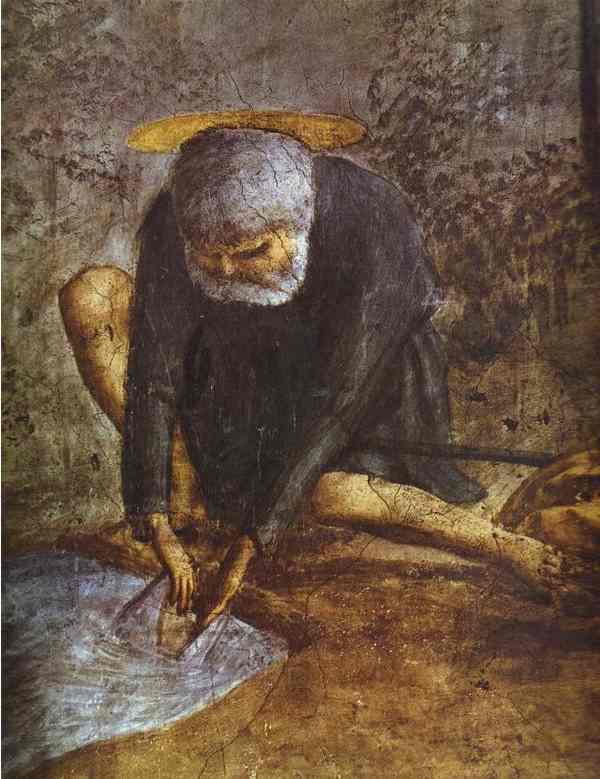
Art moves from the static and impersonal to the dynamic and personal. Chaucer may be "partly of the old gyre," that is a man of the Middle Ages, but his Canterbury Tales and Troilus and Criseyde celebrate the individually human, not the individual as moral type. Yeats goes on to comment that Masaccio "discovered a naturalism that begins to weary us a little; making the naked young man awaiting baptism shiver with the cold,
St. Peter grow red with the exertion of dragging the money out of the miraculous fish's mouth,
while Adam and Eve, flying before the sword of the Angel, show faces disfigured by their suffering."
It is very likely because I am a poet and not a painter that I feel so much more keenly that suffering of Villon ... in whom the human soul for the first time stands alone before a death ever present in imagination, without help from a Chruch that is fading away; or is it that I remember Aubrey Beardsley, a man of like phase though so different epoch, and so read into Villon's suffering our modern conscience which gathers intensity as we approach the close of an era? 
Dying of tuberculosis, Beardsley sought to negate his reputation as a producer of "obscene" art by converting to Catholicism and requesting that his more scandalous work be destroyed. (It wasn't.)
The eighth gyre, which ... completes itself say between 1550 and 1650, begins with Raphael, Michael Angelo and Titian, and the forms, as in Titian, awaken sexual desire -- we had not desired to touch the forms of Botticelli or even of Da Vinci -- or they threaten us like those of Michael Angelo, and the painter himself handles his brush with a conscious facility or exaltation.
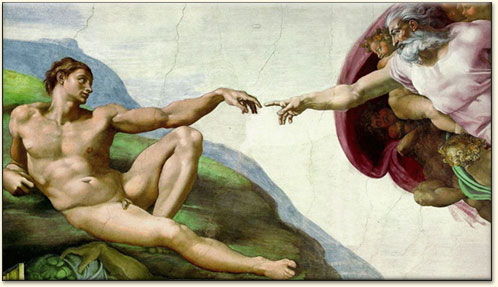
Although Yeats taxes Titian with making his art too sensuous, in his poems he singled out Michelangelo, and particularly the figure of Adam in the Sistine Chapel. In "Long-Legged Fly":
That girls at puberty may find
The first Adam in their thought,
Shut the door of the Pope's chapel,
Keep those children out.
And in "Under Ben Bulben":
Michael Angelo left a proof
On the Sistine Chapel roof,
Where but half-awakened Adam
Can disturb globe-trotting Madam
Till her bowels are in heat,
Proof that there's a purpose set
Before the secret working mind:
Profane perfection of mankind.
"Profane" acknowledges that the specifically religious content of Michelangelo's art is secondary.
Shakespeare represents the next step toward the fully secular role of art, as well as what Harold Bloom calls "the invention of the human":
I see in Shakespeare a man in whom human personality, hitherto restrained by its dependence upon Christendom or by its own need for self-control, burst like a shell. Perhaps secular intellect, setting itself free after five hundred years of struggle, has made him the greatest of dramatists, and yet ... we might, had the total works of Sophocles survived -- they too born of a like struggle though with a different enemy -- not think him the greatest. Do we not feel an unrest like that of travel itself when we watch those personages, more living than ourselves, ... when we are carried from Rome to Venice, from Egypt to Saxon England, or in the one play from Roman to Christian mythology?
Milton, however, strikes Yeats as a man betrayed by his moment in history, too late for the kind of synthesis of the sacred and profane that Michelangelo succeeded in accomplishing. The result is "his unreality and his cold rhetoric." In "On the Morning of Christ's Nativity," "his classical mythology is an artificial ornament." Christian humanism has become passé.

By the end of the eighteenth century,
Personality is everywhere spreading out its fingers in vain, or grasping with an always more convulsive grasp a world where the predominance of physical science, of finance and economics in all their forms, of democratic politics, of vast populations, of architecture where styles jostle with one another, of newspapers where all is heterogeneous, show that mechanical force will in a moment become supreme.
Locke sank into a swoon;
The Garden died;
God took the spinning-jenny
Out of his side. 
The rise of the novel takes us into the age of mass man:
Dickens was able with a single book, Pickwick, to substitute for Jane Austen's privileged and perilous research the camaraderie of the inn parlour, qualities that every man might hope to possess, and it did not return till Henry James began to write.
And in the absence of a unifying, all-encompassing spiritual belief,
there came synthesis for its own sake, organisation where there is no masterful director, books where the author has disappeared, painting where some accomplished brush paints with an equal pleasure, or with a bored impartiality, the human form or an old bottle, dirty weather and clean sunshine. I too think of famous works where synthesis has been carried to the utmost limit possible, where there are elements of inconsequence or discovery of hitherto ignored ugliness, and I notice that when the limit is approached or past, when the moment of surrender is reached, when the new gyre begins to stir, I am filled with excitement. I think of recent mathematical research; even the ignorant can compare it with that of Newton ... with its objective world intelligible to intellect; I can recognise that the limit itself has become a new dimension, that this every-hidden thing which makes us fold our hands has begun to press down upon multitudes. Having bruised their hands upon that limit, men, for the first time since the seventeenth century, see the world as an object of contemplation, not as something to be remade, and some few, meeting the limit in their special study, even doubt if there is any common experience, doubt the possibility of science.
And what rough beast, its hour come round at last,
Slouches towards Bethlehem to be born?

Saturday, April 23, 2011

9. The Modern Tradition, edited by Richard Ellmann and Charles Feidelson Jr., pp. 170-192

Symbolism: The Artist-Hero; The Morality of the Artist (W.B. Yeats, Gustave Flaubert, Rainer Maria Rilke, Paul Valéry). The Art of Life (Walter Pater, Joris-Karl Huysmans, André Gide, W.B. Yeats, Rainer Maria Rilke)
_____

W.B. Yeats: The Courage of the Artist

In a 1907 speech, referring to the late poet and critic Lionel Johnson, Yeats asserts, "A poet is by the very nature of things a man who lives with entire sincerity, or rather, the better his poetry the more sincere his life." I'm a little unsure how one lives sincerely. One expresses sincerity, of course, and that may be what Yeats means. "Above all it is necessary that the lyric poet's life should be known, that we should understand that his poetry is no rootless flower but the speech of a man." Yeats, who was very much a public figure in his day, would of course advocate this kind of openness. "Why should we honor those that die upon the field of battle, a man may show as reckless a courage in entering into the abyss of himself."


Gustave Flaubert: Art as Ascetic Religion

Writing to Louise Colet in 1857, Flaubert claims to have written twenty-five pages of Madame Bovary in six weeks and to be sustained in this snail's pace of composition "only by a kind of permanent rage, which sometimes makes me weep tears of impotence but which never abates." He is definitely not sustained by the indifference and hostility of the society in which he lives:
If everything around us, instead of permanently conspiring to drown us in a slough of mud, contributed rather to keep our spirits healthy, who can tell whether we might not be able to do for aesthetics what stoicism did for morals? Greek art was not an art; it was the very constitution of an entire people, of an entire race, of the country itself.
Humankind, he claims, has no use for beauty at this time. "The more Art develops, the more scientific it will be, just as science will become artistic." The result is, even when he is pleased with his work, he feels "great despair and emptiness -- doubts that taunt me at my moments of naïvest satisfaction. And yet I would not exchange all this for anything, because my conscience tells me that I am fulfilling my duty, obeying a decree of fate -- that I am doing what is Good, that I am in the Right."


Rainer Maria Rilke: The Mission of the Artist

Writing to the novelist Ludwig Ganghofer in 1897, the 21-year-old Rilke chafes against the philistinism of his relatives, whose view is that "Art is something one just cultivates on the side in free hours." Instead, for Rilke,
Whoever does not consecrate himself wholly to art with all his wishes and values can never reach the highest goal. He is not an artist at all.... I feel myself to be an artist, weak and wavering in strength and boldness, yet aware of bright goals, and hence to me every creative activity is serious, glorious, and true. Not as martyrdom do I regard art -- but as a battle the chosen one has to wage with himself and his environment in order to go forward.... But that needs a whole man! Not a few weary leisure hours.
Many 21-year-olds have made such proclamations. Few of them became Rilke.


Paul Valéry: The Artist as Universal Man

For this long philosophical disquisition, centered on Leonardo da Vinci, from 1895, I need to turn again to the introduction by Ellmann and Feidelson for guidance.
Artistic heroism is epitomized by Paul Valéry in his figure of Leonardo da Vinci, a type of the artist as universal man. Exploring the night of consciousness, the artist discovers the reality to which we are accustomed is but one solution out of many possible ones. He is able to divest objects of their peculiarities and, at the same time, to sense what consciousness is apart from its objects, to reach "the deep note of existence itself." Such a man is interested in everything, yet always seems to be thinking of something else, for his mental life is double, a drama of mental images proceeding concurrently with an awareness of the movements of thought itself. He takes responsibility for his perceptions in a way that others do not, and he is concerned not with results but with the exercise of creative power. 
Once again, music is the touchstone for creativity: "the elusive art of music unites the liberties of sleep with the development and consistency of extreme attention" -- the mind is free in dreams, but only with wakeful attention can the things discovered in our dreams become whole and consistent. This "synthesis of intimate things" is impermanent, however. The products of the imagination are varied, and "The wonder is not that such things should be; it is that there should be such things and not such other things." We come "to suspect all accustomed reality of being only one solution amongst many others of universal problems."

So "the perfected consciousness ... has to begin by denying an infinite number of faiths, an infinite number of elements.... It reminds one absurdly of an audience invisible in the darkness of a theater which cannot see itself, which can see only the spectacle before it, and which, yet, all the time, invincibly feels itself the center of a breathlessly interesting evening." Consciousness is "an inexhaustible activity," compounded of "our most intimate feelings" as well as "exterior objects and events." Consciousness chooses what is important to it: "All things are replaceable by all things -- may not this be the definition of things?"
Is there anything that resists the lure of the senses, the dissipation of ideas, the fading of memories, the slow variation in the organism, the incessant and multiform activities of the universe? There is only this consciousness, and this consciousness only at its most abstract. Our personality itself, which, stupidly, we take to be our most intimate and deepest possession, our sovereign good, is only a thing, and mutable and accidental.
The achievement of identity comes from isolating a "substantial permanence from the strife of everyday truths." The ego that results from this effort "is no more sensitive, no less real than the center of gravity of a planetary system or ring, but ... is a result of the whole, whatever that whole may be."

In Leonardo, Valéry finds "a man whose activities seem so distant from each other that if I can find a unifying idea of them it may well seem more comprehensive than all other ideas.... Everything interests him.... He leaves behind him churches and fortresses; he fashions ornaments -- full of sweetness and strength -- and a thousand machines; and he makes calculation along many unsurveyed lines."

Artists, he observes, participate in a "coquetry of silence ... as to the origins of their work." They claim an autonomy for their creations. And "certain works of science, and mathematics in particular, show such clarity in their construction that one would say they were not the work of any one person at all. There is something unhuman about them. And this quality has had the effect of making people suppose so great a difference between certain studies, as, for instance, between the sciences and the arts, that, owing to it, opinion has also assumed a separation between the results of their labors."

But artists and scientists alike reach their results through a power to decide among the possibilities. The process at work is so insusceptible to analysis that "one invokes gods, genius and inspiration." We profess to believe "that something has created itself -- for man adores mystery and the marvelous.... One treats what is logical as if it were a miracle. But the 'inspired' author has been ready to perform his task a year before it was done, had been ripe, had been thinking of it always, perhaps without being conscious of the fact.... The consciousness of the operations of thought, the unrecognized logic of which I have spoken, exists but rarely, even in the most powerful minds."

The task is to maintain the mental flexibility necessary for creation, for "a thought that has become fixed takes on the characteristics of hypnosis and becomes, in the language of logic, an idol; in the domain of poetic construction and art, a sterile monotony." Liberation from that which is fixed, and the ability of "the mind to foresee its own activities, to imagine the structure of what has to be imagined in detail as a whole, and the effect of the sequence thus calculated, this sense is the condition of all generalization. It is that which in certain individuals appears as a veritable passion, and with an energy that is remarkable."
The universal man begins ... by simple contemplation, but he always returns to be impregnated by what he sees, returns to the intoxication of the particular instinct and to the emotion which the least of things real arouses if one keeps in mind the two, thing and instinct, in every way separate from each other and yet combining, in so many ways, so many different qualities.


Walter Pater: The Intensity of the Moment

Walter Pater, date unknown
Pater's Studies in the History of the Renaissance (1873) and his novel Marius the Epicurean (1885) became central texts for many fin de siècle intellectuals, and his prose influenced writers as various as Proust and Joyce, Pound and Wallace Stevens. He also drew fire from conservatives, who accused him of misleading his young followers. The word "exquisite," which appears early in these selections, is characteristic.

He, too, is aware that consciousness is a fragmentary and impermanent thing, that "That clear, perpetual outline of face and limb is but an image of ours," that life is "flame-like" in "that it is but the concurrence, renewed from moment, of forces parting sooner or later on their ways." (Compare Apollinaire's flame image in his discourse on painting.) So the trick is not to be swept away in the "flood of external objects, pressing upon us with a sharp and importunate reality, calling us out of ourselves in a thousand forms of action."

The result is "that continual vanishing away, that strange, perpetual weaving and unweaving of ourselves," and the challenge is to "be present always at the focus where the greatest number of vital forces unite in their purest energy." (An objection has been lodged against this image: that the point at which forces unite is the point at which they cancel one another out.) Pater argues for intensity of experience: "Not the fruit of experience, but experience itself, is the end." And instead of being swept away with the flood, "To burn always with this hard, gemlike flame, to maintain this ecstasy, is success in life."
While all melts under our feet, we may well grasp at any exquisite passion, or any contribution to knowledge that seems by a lifted horizon to set the spirit free for a moment, or any stirring of the senses, strange dyes, strange colours, and curious odours, or work of the artist's hands, or the face of one's friend.
Notice here the absence of hierarchy of experience, that art is but one of the media through which experience may be channeled. It may be something as content-free as a strange smell, or as content-rich as a "contribution to knowledge." It's this lack of value judgment that most troubled Pater's critics. Similarly, Pater, who had given up on Christianity, argues for a kind of perpetual agnosticism: "What we have to do is to be for ever curiously testing new opinions and courting new impressions, never acquiescing in a facile orthodoxy of Comte, or of Hegel, or of our own." 

Finally, however, he comes around to valorizing art:
Great passions may give us this quickened sense of life, ecstasy and sorrow of love, the various forms of enthusiastic activity, disinterested or otherwise, which come naturally to many of us. Only be sure it is passion -- that it does yield you this fruit of a quickened, multiplied consciousness. Of such wisdom, the poetic passion, the desire of beauty, the love of art for its own sake, has most. For art comes to you proposing frankly to give nothing but the highest quality to your moments as they pass, and simply for those moments' sake.
In Marius, set in the second century C.E., Pater does come around to the question of religion, but typically it is regarded as only one avenue of experience:
the products of the imagination must themselves be held to present the most perfect forms of life -- spirit and matter alike under their purest and most perfect conditions -- the most strictly appropriate objects of that impassioned contemplation, which, in the world of intellectual discipline, as in the highest forms of morality and religion, must be held to be the essential function of the "perfect." Such manner of life might come even to seem a kind of religion -- an inward, visionary, mystic piety, or religion.


Joris-Karl Huysmans: Artificial Sensation

Joris-Karl Huysmans, c. 1895
Huysmans's À rebours, the title of which is translated here Against Nature, but has also been translated Against the Grain, is an 1884 novel about the ultimate aesthete, des Esseintes. If Pater is interested in the experiential possibilities of "strange dyes, strange colours, and curious odours," he has nothing on des Esseintes.

In the excerpt, des Esseintes has devised elaborate ways of recreating the experience of sea travel without the tedious necessity of actually going to sea, because the pleasure of such an experience "exists only in recollection of the past and hardly ever in experience of the present," and he could enjoy this pleasure "in full and in comfort, without fatigue or worry.... Travel, indeed, struck him as a waste of time, since he believed that the imagination could provide a more-than-adequate substitute for the vulgar reality of actual experience."

Arthur Zaidenberg, illustration for À rebours, 1931
In fact, the character of des Esseintes is the logical extension of all of the arguments that art is superior to nature -- "artifice was considered by Des Esseintes to be the distinctive mark of human genius. Nature, he used to say, has had her day." Moreover, if all arts aspire to the condition of music, then des Esseintes has found a unique way of having the musical experience and ... drinking it too, with his "mouth organ," providing drops of liqueurs that evoke the sounds of various musical instruments.

These over-the-top excerpts from À rebours suggest that Huysmans was having sly fun, but the book was taken quite seriously. It is generally thought to be the "poisonous French novel" referred to in Wilde's The Picture of Dorian Gray.


André Gide: The Reflexive Image

These excerpts from Gide's journals for January 1892 find the 22-year-old writer setting out on his career in some confusion. He has met Oscar Wilde and felt overwhelmed by the force of his personality and intellect: "In his company I had lost the habit of thinking.... A few thoughts from time to time, but my clumsiness in handling them made me give them up." He is longing to find a direction for his life: "I am anxious to know what I shall be.... I am aware of a thousand possibilities in me, but I cannot resign myself to want to be only one of them."

André Gide in 1893
Moreover, he has achieved the self-consciousness of the artist before he has truly figured out what course his art will take: "A man's life is his image," he proclaims, and he hasn't decided what that image is. An encounter with Wilde, the master image-maker, must surely have provoked this dilemma. He is also in the early stages of discovering and exploring his sexual orientation, which may be what provokes his reflections on morality and sincerity:
Morality consists in substituting for the natural creature (the old Adam) a fiction that you prefer. But then you are no longer sincere. The old Adam is the sincere man.

This occurs to me: the old Adam is the poet. The new man, whom you prefer, is the artist. The artist must take the place of the poet. From the struggle between the two is born the work of art.


W.B. Yeats: The Completed Image

If, as Gide asserted, "A man's life is his image," Yeats, in a letter written not long before his death to Lady Elizabeth Pelham, a friend with whom he had considered traveling to India, seems content with his.
It seems to me that I have found what I wanted. When I try to put all into a phrase I say, "Man can embody truth but he cannot know it. "I must embody it in the completion of my life. The abstract is not life and everywhere draws out its contradictions.


Rainer Maria Rilke: The Aesthetic Transformation of the Earth

Writing in 1925 to Witold von Hulewicz, his Polish translator, about the Duino Elegies, Rilke balks at an explanation: "They reach out infinitely beyond me." The poet, he says, becomes part of a collective experience of the world. "We of the here and now are not for a moment hedged in the time-world, nor confined within it; we are incessantly flowing over and over to those who preceded us, to our origins and to those who seemingly come after us." In the Elegies, he says the world of immediate experience, "the beloved visible and tangible" is being converted "into the invisible vibrations and excitation of our own nature, which introduces new vibration-frequencies into the vibration-spheres of the universe... The earth has no way out other than to become invisible: in us who with a part of our natures partake of the invisible, have (at least) stock in it, and can increase our holdings in the invisible during our sojourn here."

The angel in the poems is not the angels of Christianity, but more like the angels in Islam: "that creature in whom the transformation of the visible into the invisible, which we are accomplishing, appears already consummated.... All the worlds of the universe are plunging into the invisible as into their next deepest reality."

Wednesday, April 20, 2011

6. The Modern Tradition, edited by Richard Ellmann and Charles Feidelson Jr., pp. 98-120

Symbolism: Imagination and Thought; The State of Affirmation (Friedrich Nietzsche, W.B. Yeats). Symbolism: The Autonomy of Art; The Doctrine of Purity (Charles Baudelaire, Oscar Wilde, Richard Wagner, Stéphane Mallarmé, Guillaume Apollinaire, Marcel Duchamp)
_____

Friedrich Nietzsche: The Acceptance of Untruth

For help with these excerpts from The Joyful Wisdom and The Antichrist, I need to turn to Ellmann and Feidelson's introduction again:
Friedrich Nietzsche, date unknown
Another face of poetic inconclusiveness and non-assertion is poetic affirmation, which is equally indifferent to objective tests of truth [as Richards's "pseudo-statements"]. Nietzsche finds that "untruth" is a condition of life; opinions, ideas, and beliefs are unavoidably false, yet they are necessary to gauge reality against imagined standards without which life would be arid. Affirmations, however fictional, are life-furthering because they extend man's sway over things and also provide necessary food for the passions, which crave attachments. Consequently skeptics, including Zarathustra himself, employ convictions as expressive material. 
In Nietzsche's view, we have art to thank for making us used to untrue things, otherwise "the insight into the general untruth and falsity of things now given us by science -- an insight into delusion and error as conditions of intelligent and sentient existence -- would be quite unendurable." Existence itself has now become "an aesthetic phenomenon," and we should relish the fact that we are all fools content with illusions: "we must now and then be joyful in our folly, that we may continue to be joyful in our wisdom!" Art gives us this joy: "we need all arrogant, soaring, dancing, mocking, childish and blessed Art, in order not to lose the free dominion over things which our ideal demands of us."

We should also celebrate our liberation from dogma. "Strength, freedom which is born of the strength and overstrength of the spirit, proves itself by skepticism.... Convictions are prisons.... Freedom from all kinds of convictions, to be able to see freely, is part of strength."


W.B. Yeats: The Conquest of Scepticism

Skepticism can only take us so far, Yeats argued in his journal in 1929. He cites Ezra Pound's contention "that we know nothing but sequences. 'If I touch the button the electric lamp will light up -- all our knowledge is like that.'" Yeats argues that this may be scientifically accurate, but philosophically false. Skepticism "is mere acknowledgement of a limit." To affirm something that may be verifiably untrue from the skeptical point of view may nevertheless prove useful: "I have felt when re-writing every poem ... that by assuming a self of past years, as remote from that of today as some dramatic creation, I touched a stronger passion, a greater confidence than I possess, or ever did possess." Pound, he says, does the same thing when he writes his imitations of Propertius or the Chinese poets: he "escapes his scepticism." It's not that we believe when we imagine things, it's that we put ourselves in the same state of mind as if we believed, with the same result. We accept the power of tradition when we do so. "The 'modern man' is a term invented by modern poetry to dignify our scepticism."


Charles Baudelaire: The Didactic Heresy

It was Théophile Gautier who took for his slogan the phrase "l'art pour l'art," which we know as "art for art's sake" (or as the MGM slogan Ars gratia artis, coined by some studio publicist with a smattering of Latin). And the Baudelaire selection is from his 1861 essay on Gautier, a defense of that poet's doctrine. Naturally, the corollary to the premise that art is an end in itself is that art must not sacrifice its integrity for the sake of teaching or preaching. So Baudelaire insists, "Poetry ... has no object but itself: it can have no other, and no poem will be so great, so noble, so truly worthy of the name of poem as that which has been written solely for the pleasure of writing a poem." There is a wee bit of a desire to shock in the statement, and both its message and the tone in which it is delivered clearly influenced Oscar Wilde's pronouncements on the same topic. When Baudelaire says, "I say that if the poet has pursued a moral end, he has diminished his poetical power," he's saying the same thing we've already seen Wilde say (except that Wilde said it more wittily).


Oscar Wilde: The Improvidence of Art

And Wilde says it again in the preface to The Picture of Dorian Gray thirty years after Baudelaire's essay on Gautier. He continues to try to shock, when he claims, "No artist has ethical sympathies. An ethical sympathy in an artist is an unpardonable mannerism of style." Well, obviously artists do have "ethical sympathies," but the point is that they shouldn't let them show -- at least not blatantly."

The central point in Wilde's preface, I think, the one that links him with so many others in this section of the anthology, is, "From the point of view of form, the type of all the arts is the art of the musician." In music, form and content are the same thing, which is the ideal toward which Wilde and his contemporaries repeatedly claimed to strive. But Wilde also adds, "From the point of view of feeling, the actor's craft is the type." The actor may or may not actually feel what the character he plays is feeling, but he is judged only by how successfully he makes the audience believe that he does. Sincerity is not in question, or as the cynical saying goes, "If you can fake that, you've got it made."

And then there's this knotty sequence of epigrams:
All art is at once surface and symbol. 
Those who go beneath the surface do so at their peril. 
Those who read the symbol do so at their peril. 
It is the spectator, and not life, that art really mirrors. 
If we equate "surface" with "form," and "symbol" with "content," we oversimplify what Wilde is saying, but it may help us get closer to his meaning. It is really an echo of the two statements made earlier in the preface:
The nineteenth century dislike of Realism is the rage of Caliban seeing his own face in a glass.
The nineteenth century dislike of Romanticism is the rage of Caliban not seeing his own face in a glass. 
For Caliban, the untutored savage, read "bourgeois philistine," who chafes at both the realistic artist's candor and the romantic artist's idealizations.

And finally: "All art is quite useless." Which only means that art that can be used to point a moral, adorn a tale, elect a candidate, promote a dogma, and so on, isn't really art.


Richard Wagner: Literature as Music-Drama

Richard Wagner, c. 1862
No one believed more whole-heartedly than Wagner that music was the highest of all the arts, which is why he argued for the assimilation of the other arts into the Gesamtkunstwerk, that untranslatable Germanism that means something like "total work of art," or "synthesis of the arts," or "all-encompassing art form," and so on. It was "The Music of the Future," he proclaimed in this 1860 essay.

He begins with some nationalistic reflections on the "peculiar significance of German efforts in art," which are characteristic of Wagner but nevertheless a little embarrassing today. But he finally settles down to the aesthetics of the matter, the pre-eminence of "music, that language intelligible to all men." He asserts that "the special, separately developed branches of art, however much their capabilities of expression might finally be brought out and heightened by great geniuses, nevertheless, without falling into unnaturalness and decided error, could never aim to supply in any way that all-powerful work of art which was only possible through a union of their forces."

Each artistic medium, he asserts, runs the risk of developing itself to its limits, "and that it cannot pass these limits without the danger of losing itself in the unintelligible and absolutely fantastic -- even in the absurd." (Some would say that literature passed these limits with Finnegans Wake, or painting with the exhibition of perfectly white canvases, or even music, with John Cage's 4'33" -- four minutes and thirty-three seconds of silence.) Wagner's solution to the problem of limits is for the media to join forces. And particularly for poetry and music to collaborate. He began "to see in the opera an ideal branch of art."
The poet seeks, in his language, to make the abstract, conventional meaning of words subordinate to their original, sensible one; and to secure, by rhythmic order, as well as by the almost musical dressing of words in versification, an effect for his phraseology which shall gain possession of and influence the feelings as though by enchantment.

In this course of the poet, so necessary to his very nature, we see him finally come to the limits of his branch of art, where it already seems to touch music, and thus the most successful work of the poet must be, for us, that which should be, in its perfection, entirely musical.
For Wagner, Beethoven is chief among his predecessors for having, through the symphony, achieved a kind of drama, "a language of which no one in any preceding age had any knowledge, inasmuch as the pure musical expression in it enchains the hearer with a lasting effect hitherto unknown." He speculates that human language "developed from a purely sensuous, subjectively-felt signification of words, into a more abstract sense" that eventually robbed words of feeling "and made their very connection and construction entirely dependent on certain rules that could be learned." (Very few language experts would agree.) So he sees only two paths open for the development of poetry: either into pure abstraction as a vehicle for philosophy, or "it must become intimately bound up with music, and with such music as that whose endless power is revealed to us by the symphony of Beethoven."

And for the poet, "no poetic form is fitted for his use but that in which the poet no longer describes, but brings his subject into actual representation, that is convincing to the senses; -- and this form is nothing but -- the drama," which "awakens in the spectator real participation in the action presented to him."


Stéphane Mallarmé: Poetry as Incantation

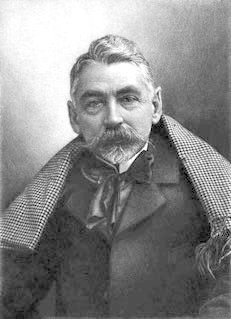
Stéphane Mallarmé, 1896
The title of Mallarmé's essay, "Crisis in Poetry" (1886-95), suggests a certain ambivalence about the "new freedom" won by poets in their liberation from the academic rules and forms -- such as the "artificial metronomes" of the alexandrine, the twelve-syllable line. And he resorts to the familiar analogy to music to describe this freedom: "for the first time in the literary history of any nation, ... any poet with an individual technique and ear can build his own instrument, so long as his fluting, bowing, or drumming are accomplished."

But language is not music:
I am disappointed when I consider how impossible it is for language to express things by means of certain keys which would reproduce their brilliance and aura.... When compared to the opacity of the word ombre, the word ténèbres does not seem very dark; and how frustrating the perverseness and contradiction which lend dark tones to jour, bright tones to nuit! We dream of words brilliant at once in meaning and sound, or darkening in meaning and so in sound, luminously and elementally self-succeeding. But, let us remember that if our dream were fulfilled, verse would not exist -- verse which, in all its wisdom, atones for the sins of languages, comes nobly to their aid.
It's that old duality of sound and sense again. So he welcomes Wagner's Gesamtkunstwerk: "We now hear undeniable rays of light, like arrows gilding and piercing the meanderings of son. I mean that, since Wagner appeared, Music and Verse have combined to form Poetry."

The one thing that poets must now begin to avoid in their verse is description, "that erroneous esthetic ... which would have the poet fill the delicate pages of his book with the actual and palpable wood of trees, rather than with the forest's shuddering or the silent scattering of thunder through the foliage." Instead of description the poet should rely on "evocation, allusion, suggestion." Poetry that too directly confronts reality risks didacticism and loses its special role: "Speech is no more than a commercial approach to realisty. In literature, allusion is sufficient: essences are distilled and then embodied in Idea."

In Wilde's preface to The Picture of Dorian Gray, he asserted, "To reveal art and conceal the artist is art's aim." Mallarmé makes a similar assertion: "If the poem is to be pure, the poet's voice must be stilled and the initiative taken by the words themselves, which will be set in motion as they meet unequally in collision." Pure poetry is the aim, as in Mallarmé's own poem, "Le tombeau d'Edgar Poe," which lauds the attempt to "purify the words of the tribe":  "Donner un sens plus pur aux mots de la tribu."

Where Wagner would give priority to music, Mallarmé would substitute language. "For, undeniably, the true source of Music must not be the elemental sound of brasses, strings, or wood winds, but the intellectual and written word in all its glory -- Music of perfect fulness and clarity, the totality of universal relationships." Like Richards, Mallarmé distinguishes between something like statements and pseudo-statements, dividing words "into two different categories: first, for vulgar or immediate, second, for essential purposes. The first is for narrative, instruction, or description.... Language, in the hands of the mob, leads to the same facility and directness as does money. But, in the Poet's hands, it is turned, above all, to dream and song."


Guillaume Apollinaire: Pure Painting

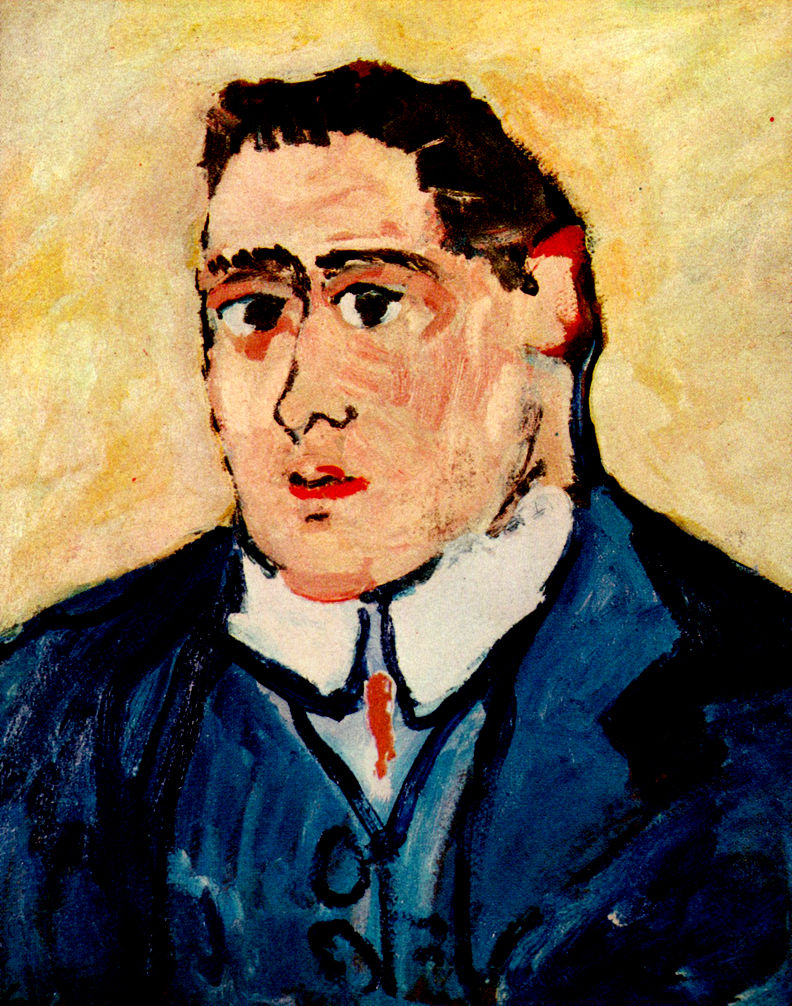
Maurice Vlaminck, Guillaume Apollinaire, 1903
Apollinaire's manifesto appeared in 1913, and like Mallarmé, he abhors the descriptive: "too many painters still adore plants, stones, the sea, or men." He finds a persuasive image for his conception of painting:
Flame is the symbol of painting, and the three plastic virtues burn with radiance. 

Flame has a purity which tolerates nothing alien, and cruelly transforms in its image whatever it touches.

Flame has a magical unity; if it is divided, each fork will be like the single flame.

Finally it has the sublime and incontestable truth of its own light. 
He argues that the more a painting exists on its own terms, insists on its own integrity, the more it participates in the eternal: "We will not go astray in the unknown future, which, severed from eternity, is but a word fated to tempt man. We will not waste our strength on the too fugitive present; the fashionable, for the artist, can only be the mask of death." And of course, the artist must resemble God the Creator: "Each god creates in his own image, and so do painters. Only photographers manufacture duplicates of nature." (Howls of protest from photographers.)

Like Mallarmé, he rejects the descriptive, or in painterly terms, the representational: "Real resemblance no longer has any importance, since everything is sacrificed by the artist to truth, to the necessities of a higher nature whose existence he assumes but does not lay bare. The subject has little or no importance any more.... While the goal of painting is today, as always, the pleasure of the eye, the art-lover is henceforth asked to expect delights other than those which looking at natural objects can easily provide."

Once again, music is the norm: "we are moving towards an entirely new art which will stand, with respect to painting ... as music stands to literature. It will be pure painting, just as music is pure literature." At the basis of pure painting is mathematics: "geometry is to the plastic arts what grammar is to the art of the writer." Unlike the Greeks, who "took man as the measure of perfection, ... the art of the new painters takes the infinite universe as its ideal."

Once again, we are told, essentially, that Nature imitates Art: "It is the social function of great poets and artists to renew continually the appearance nature has for the eyes of men. Without poets, without artists, men would soon weary of nature's monotony... The order which we find in nature, and which is only an effect of art, would at once vanish. Everything would break up in chaos."
Pablo Picasso, Houses on the Hill, Hora de Ebro, 1909

He turns to a particular school of painting, Cubism, which he says is "a name first applied to it in the fall of 1908 in a spirit of derision by Henri Matisse, who had just seen a picture of some houses, whose cube-like appearance had greatly struck him." (Perhaps the Picasso painting above, dated a year later.) "Cubism differs from the old schools of painting in that it aims, not at an art of imitation, but at an art of conception, which tends to rise to the height of creation." Apollinaire distinguishes several subsets of Cubism, and concludes, "I love the art of today because above all else I love the light, for man loves light more than anything; it was he who invented fire."


Marcel Duchamp: The Non-Picture
Marcel Duchamp 1950. © Jacqueline Matisse Monnier

Duchamp's suggestion that we substitute the word "delay" for "painting" or "picture" is not merely the great surrealist's whimsy. It in fact acknowledges the independence of the work itself, that its significance exists in the encounter with a viewer, who is "delayed" by his or her contemplation of the work. It acknowledges all of the themes we have been covering: the independence of the artwork from intellectual correlatives, its purity, its existence in time and outside of it.

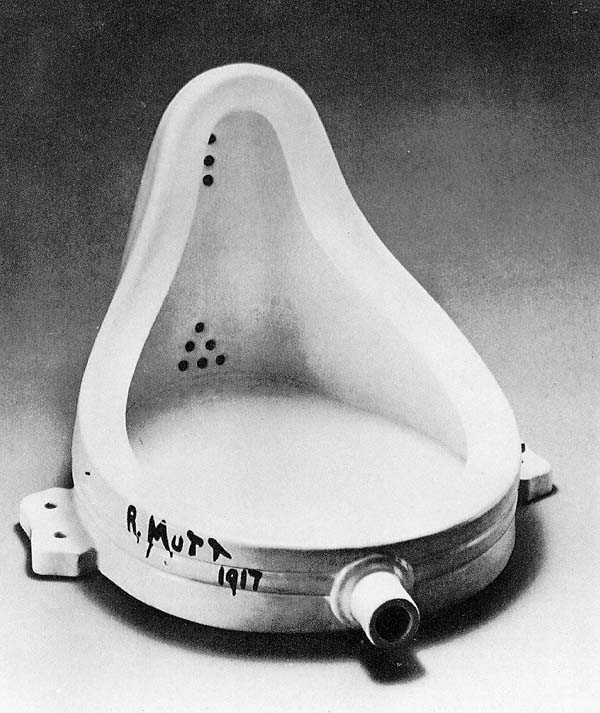
Duchamp, of course, is famous for teasing the viewer into contemplation of what is or isn't a work of art. Is a urinal labeled "A Fountain" a work of art or a silly joke? Is Mona Lisa with a mustache (and an obscene pun for a title) a work of art or a desecration of a masterpiece? Discuss.
Marcel Duchamp, Fountain, 1917


Marcel Duchamp, L.H.O.O.Q., 1919

Monday, April 18, 2011

4. The Modern Tradition, edited by Richard Ellmann and Charles Feidelson Jr., pp. 54-73

Symbolism: Imagination and Nature; Symbolic Nature (William Blake, William Wordsworth, Charles Baudelaire, W.B. Yeats, Paul Klee). Symbolism: Imagination and Thought; The State of Doubt (Johann Wolfgang von Goethe, John Keats, Gustave Flaubert)
_____

William Blake: The Eternal World of Vision

Thomas Phillips, William Blake, 1802
In the first selection, a 1799 letter to a clergyman, the Rev. Dr. Trusler, Blake asserts,
This World Is a World of Imagination & Vision. I see Every thing I paint In This World, but Every body does not see alike. To the Eyes of a Miser a Guinea is far more beautiful than the Sun, & a bag worn with the use of Money has more beautiful proportions than a Vine filled with Grapes.... But to the Eyes of the Man of Imagination, Nature is Imagination itself. 
Blake champions the imagination because it gives him an entree to the significance of the external world: "To Me This World is all One continued Vision of Fancy or Imagination," and for the great poets -- he cites Homer, Virgil and Milton in particular -- Imagination is the vehicle for "Spiritual Sensation." As for his own works of visual art, he is particularly pleased that "Children ... have taken a greater delight in contemplating my Pictures than I even hoped." Not that there is anything inherently more receptive about children: "Some Children are Fools & so are some Old Men. But There is a vast Majority on the side of Imagination or Spiritual Sensation."
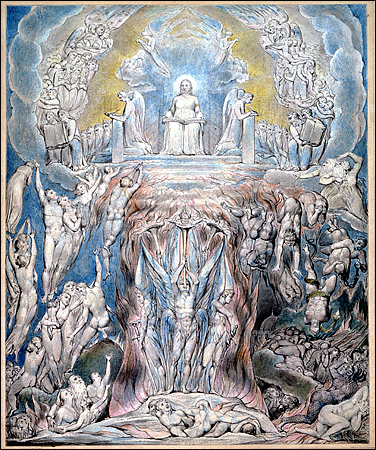
William Blake, A Vision of the Last Judgment, pen and watercolor, 1808
William Blake, watercolor illustration for Robert Blair's The Grave, 1805
Blake's painting of the Last Judgment was to be part of an exhibit in 1810, but the exhibit was canceled and the work was subsequently lost. The watercolor versions shown above follow the plan Blake outlined for the painting. In the second excerpt in this section of The Modern Tradition, written in 1810 for the catalog of the canceled exhibition, Blake discusses the work, insisting that it is "not Fable or Allegory but Vision. Fable or Allegory are a totally distinct & inferior kind of Poetry. Vision or Imagination is a Representation of what Eternally Exists, Really & Unchangeably.... The Hebrew Bible & the Gospel of Jesus are not Allegory, but Eternal Vision or Imagination of All that Exists."

For Blake, art is a rejection of mutability, of the impermanence of existence: "This world of Imagination is the world of Eternity; it is the divine bosom into which we shall all go after the death of the Vegetated body." It is also a rejection of materialism, "of Bad Art & Science. Mental Things are alone Real; what is call'd Corporeal, Nobody Knows of its Dwelling Place: it is in Fallacy, & its Existence is an Imposture." The material world is illusory, and Blake the visionary sees through it: The sun is not "a round disk of fire somewhat like a Guinea" to Blake. Instead it is "an innumerable company of the Heavenly host crying, 'Holy, Holy, Holy is the Lord God Almighty.'" The trick is to see through nature to the eternity behind it: "I question not my Corporeal or Vegetative Eye any more than I would Question a Window concerning a Sight. I look thro' it & not with it."


William Wordsworth: Natural Apocalypse

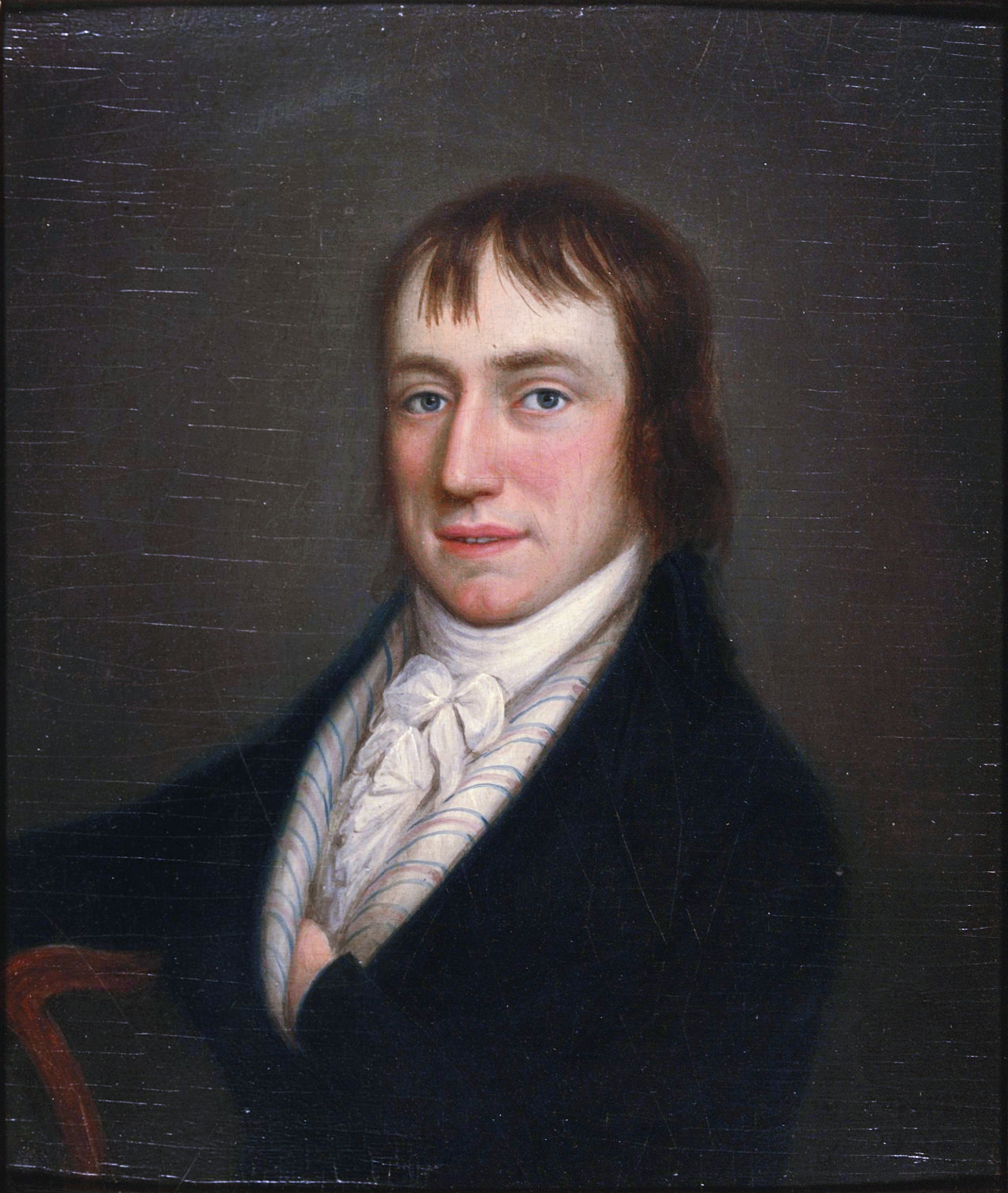
William Wordsworth in 1789
The selection from The Prelude reprinted here is a considerably tamer version of Blake's nature mysticism. Wordsworth regards an event -- or rather the recognition of an event -- as an epiphany, or what he would elsewhere call a "spot of time." The event in itself has no grand significance in material terms: The party he is traveling with has crossed the Alps. But the awareness that they have done so is "translated by our feelings" into something greater, and
Imagination -- here the Power so called
Through sad incompetence of human speech,
That awful Power rose from the mind's abyss
Like an unfathered vapour that enwraps,
At once, some lonely traveleler. 
Imagination produces "a flash that has revealed / The invisible world." And so, at least for a time, the natural phenomena they encounter -- waterfalls, winds, rocks, crags, clouds, darkness and light -- become symbols of something beyond the material world, they
Were all like workings of one mind, the features
Of the same face, blossoms upon one tree;
Characters of the great Apocalypse,
The types and symbols of Eternity,
Of first, and last, and midst, and without end. 
It's probably worth noting here that "apocalypse" has come to denote the events attendant on the end of the world, when the word's Greek origins meant "uncovering" or "revelation." An apocalypse is a revelation of truths, and not the truths themselves. So what Wordsworth means here is not a vision of the end of the world, but simply the unveiling of the meaning behind the surface phenomena of existence. He senses, but can't articulate, something eternal, which is precisely what Blake was getting at when he asserted that the imagination gives one visions of eternity.


Charles Baudelaire: The Temple of Nature

Charles Baudelaire, c. 1863
Baudelaire's poem "Correspondances" (1857) posits that nature is a temple, and by extrapolation we might suggest that the artist is its  priest, translating the "babel of words" uttered by the temple's "living pillars." The senses receive the sights, the colors, the sounds and scents as finite manifestations of infinite things. In the poem, Baudelaire lays particular emphasis on the sense of smell, which is the most intimate and subjective of the senses, taking in "perfumes" that are "fresh and cool," "mellow," "green," "perverse, rich, and triumphant." And in turn, these odors evoke the tactile ("the bodies of children"), the auditory ("oboes"), and the visual ("fields"), as well as such moral qualities as perversity, richness and triumph.


W.B. Yeats: Symbol as Revelation

John Butler Yeats, William Butler Yeats, 1900
Everybody likes to complain about journalists, and in this essay, "The Symbolism of Poetry" (1900), Yeats is out to disabuse the readers of the notion, apparently foisted upon them by journalists, that artists proceed without any higher aim or theoretical purpose. And here, of course, he proceeds to enunciate his own.

He cites several lines of verse in which metaphor takes on a larger symbolic role, beginning with Robert Burns's
The white moon is setting behind the white wave,
And Time is setting with me, O!
He says, quite correctly, "Take from them the whiteness of the moon and of the wave, whose relation to the setting of Time is too subtle for the intellect, and you take from them their beauty." And he's right: an 18th-century critic might object that neither the moon nor the wave is, strictly speaking, white. But we only have to go to Melville's great discourse on "The Whiteness of the Whale" to observe the symbolic power of the adjective. As Yeats puts it, "All sounds, all colours, all forms, either because of their pre-ordained energies or because of long association, evoke indefinable and yet precise emotions." The italics in that quotation are mine, to emphasize the seeming oxymoron: If precise, then why indefinable? But that's the point: Symbols evoke precise emotions, but if they were definable, we wouldn't need symbols to evoke them.

The function of the symbol in art, as Yeats sees it, is to bring unity out of multiplicity: "when sound, and colour, and form are in a musical relation, a beautiful relation to one another, they become as it were one sound, one colour, one form, and evoke an emotion that is made out of their distinct evocations and yet is one emotion." And it is the artist who, by perceiving the power of the symbol, translates that power to the rest of the world: "I am certainly never certain, when I hear of some war, or of some religious excitement or of some new manufacture, or of anything else that fills the ear of the world, that it has not happened because of something that a boy piped in Thessaly." Okay, that's a bit extravagant. But try this one on for truth: "I doubt ... that love itself would be more than an animal hunger but for the poet and his shadow the priest." (That subordination of the religious to the artistic is quite lovely.)

Poets and musicians achieve their effects by species of hypnotism, Yeats asserts:
The purpose of rhythm, it has always seemed to me, is to prolong the moment of contemplation, the moment when we are both asleep and awake, which is the one moment of creation, by hushing us with an alluring monotony, while it holds us waking by variety, to keep us in that state of perhaps real trance, in which the mind liberated from the pressure of the will is unfolded in symbols. If certain sensitive persons listen persistently to the ticking of a watch, or gaze persistently on the monotonous flashing of a light, they fall into the hypnotic trance; and rhythm is but the ticking of a watch made softer, that one must needs listen, and various, that one may not be swept beyond memory or grow weary of listening; while the patterns of the artist are but the monotonous flash woven to take the eyes in a subtler enchantment.
And "enchantment" is the aim, or at least as long as it is in service of something of value. The emptying out of religious belief has, in Yeats's view, crippled the world turning it toward the materialistic. "How can the arts overcome the slow dying of men's hearts that we call the progress of the world, and lay their hands upon men's heartstrings again, without becoming the garment of religion as in old times?"  If the piping of a Thessalian boy can cause people to go to war, then artists need to be conscious of the ends toward which their work can move people. Artists need to avoid the didactic, the moralizing, the anecdotal, and "that brooding over scientific opinion that so often extinguished the central flame in Tennyson." They need to discover the symbolic force of the world around them, to "return to imagination" and to understand "that the laws of art, which are the hidden laws of this world, can alone bind the imagination."

To return to the topic of rhythm, Yeats "would cast out of serious poetry those energetic rhythms, as of a man running, which are the invention of the will with its eyes always on something to be done or undone; and we would seek out those wavering, meditative, organic rhythms, which are the embodiment of the imagination, that neither desires nor hates, because it has done with time, and only wishes to gaze upon some reality, some beauty."


Paul Klee: Eternal Genesis

Paul Klee, date unknown
The excerpts are from Klee's On Modern Art (posthumously published in 1945), and are a series of brief, epigrammatic paragraphs. Klee asserts that the artist's role is defined by the word "creation" and that art is perpetually generative, creating a new nature as it were.
The deeper he looks, the more readily he can extend his view from the present to the past, the more deeply he is impressed by the one essential image of creation itself, of Genesis, rather than by the image of nature, the finished product. 
We are back here to the distinction between natura naturata ("the finished product") and natura naturans ("creation itself'" or the act of creating). Klee looks to the artist to create new things, not to reproduce the things already created.
Paul Klee, Flower Myth, 1918

The artist's role is "not to provide a scientific check on the truth of nature" but to demand "freedom," defined as "the right to develop, as great Nature herself develops." The source of it all is, of course, imagination, and "What springs from this source, whatever it may be called, dream, idea or phantasy -- must be taken seriously only if it unites with the proper creative means to form a work of art." He retorts to the critics of his own work, who have called it "childish," that the label "most have originated from those linear compositions of mine in which I tried to combine a concrete image, say that of a man, with the pure representation of the linear element.
Had I wished to present the man "as he is," then I  should have had to use such a bewildering confusion of line that pure elementary representation would have been our of the question. The result would have been vagueness beyond recognition.

And anyway, I do not wish to represent the man as he is, but only as he might be.
Paul Klee, Miraculous Landing, or the "112!"  1920
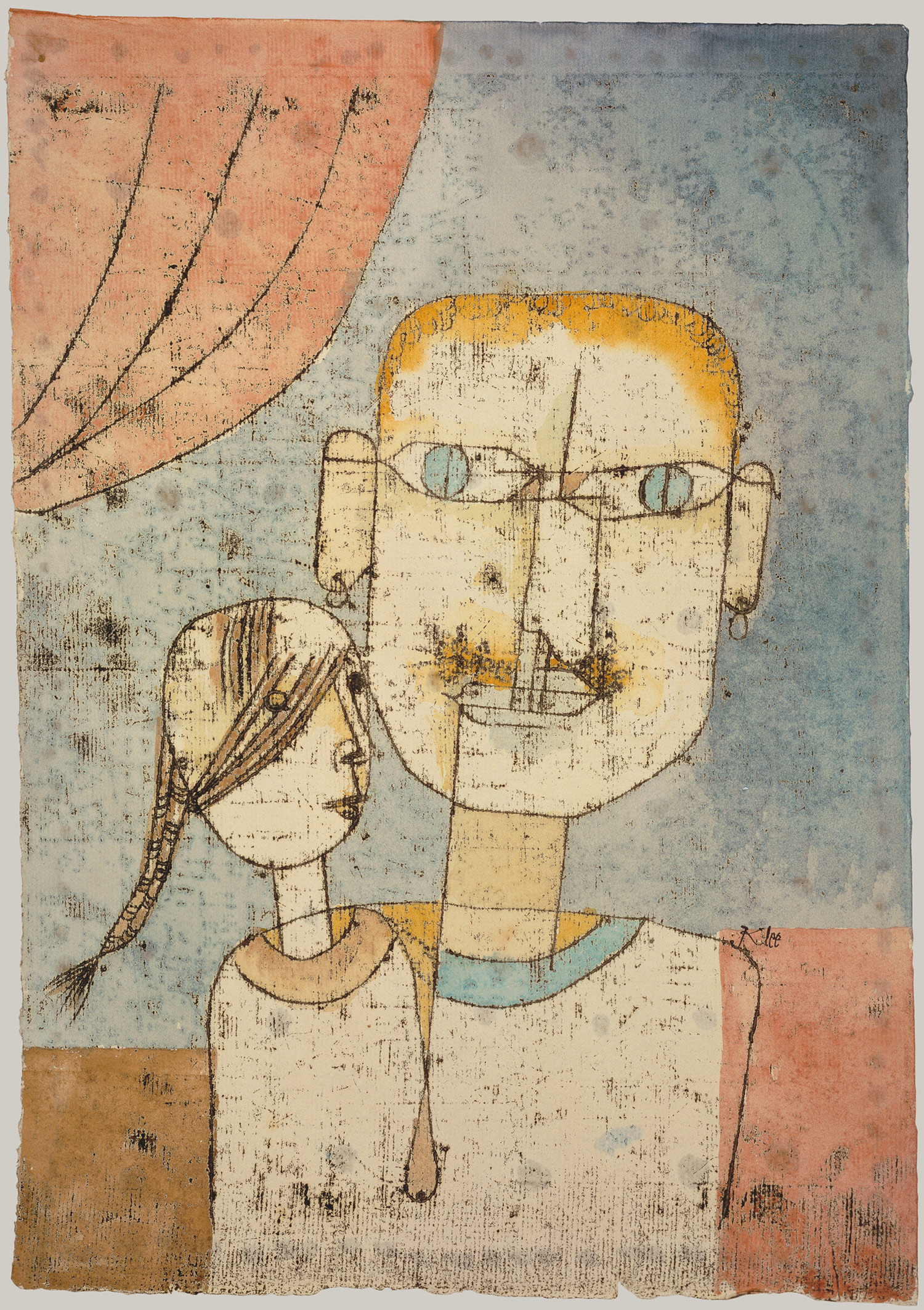
Paul Klee, Adam and Little Eve, 1921


Johann Wolfgang von Goethe: Escape From Ideas

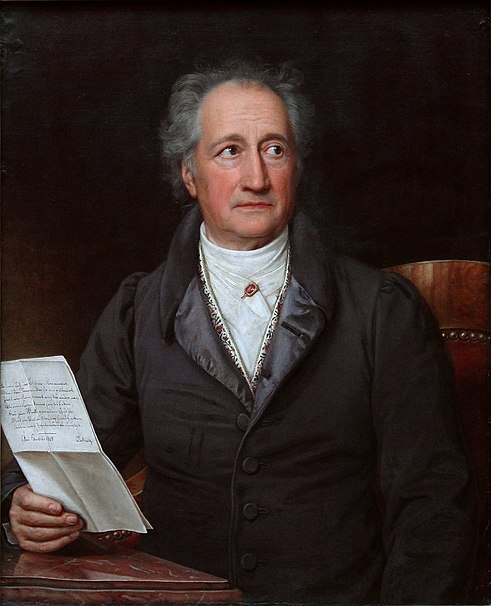
Joseph Karl Stieler, Goethe age 69, 1828
Artists are always irritated by being asked, "What are you trying to say?" and Goethe, to judge from this excerpt from J.P. Eckermann's Conversations of Goethe (1836), was no exception.
"It was ... not in my line, as a poet, to strive to embody anything abstract. I received in my mind impressions, and those of a sensual, animated, charming, varied, hundredfold kind, just as a lively imagination presented them; and I had, as a poet, nothing more to do than artistically to round off and elaborate such views and impressions, and by means of a lively representation so to bring them forward that others might receive the same impression in hearing or reading my  representation of them."
This is the artist as medium between the universe and the observer. But the role doesn't come with any responsibility to make the message simple and comprehensible: "I am rather of the opinion, that the more incommensurable, and the more incomprehensible to the understanding, a poetic production is, so much the better it is." (So much for anyone who has tried to find a simple message in Faust.)

As for the role of religion in art, "'Religion,' said Goethe, 'stands in the same relation to art as any other of the higher interests in life." What predominates for the artist is not dogma but the human element: "Art must address itself to those organs with which we apprehend it; otherwise it misses its effect. A religious material may be a good subject for art, on only in so far as it possesses general human interest." That's why portraits of the Madonna and Child have always been popular.


John Keats: Negative Capability

William Hilton, John Keats, date unknown
This famous excerpt from Keats's letter to his brothers George and Thomas has a phrase in it that I think is often mispronounced, and therefore misunderstood: "negative capability." I think the word isn't NEGative but neGAtive -- i.e., the function of negating. And we shouldn't lose the context in which Keats came up with this powerful concept: He had been to a dinner with some friends "who say things which make one start, without making one feel." Their conversation "only served to convince me how superior humour is to wit." The priority given to feeling over intellect here is characteristic, and it feeds into his though about Shakespeare's "Negative Capability, that is, when a man is capable of being in uncertainties, mysteries, doubts, without any irritable reaching after fact and reason." Keats isn't against fact and reason, he just wants to put it in its place, and its place isn't in literature.


Gustave Flaubert: Art Without Conclusions

Gustave Flaubert, date unknown
In this 1857 letter to Marie-Sophie Leroyer de Chantepie, with whom Flaubert carried on an extended correspondence, he rejects the idea that human beings can ever "attain to absolute knowledge of truth and goodness." In fact, the only road to happiness is to avoid the delusion that certainty is possible. "Life is such a hideous business that the only method of bearing it is to avoid it. And one does avoid it by living in Art, in the ceaseless quest for Truth presented by Beauty." (The kinship with Keats's conclusion, "Beauty is truth, truth Beauty, -- that is all / Ye know on earth, and all ye need to know," is evident, except that Keats's formulation of that dictum is loaded with irony.)
Superficial, limited creatures, rash, feather-brained souls, demand a conclusion from everything; they want to know the purpose of life and the dimensions of the infinite. Picking up a handful of sand in their poor, puny grasp, they say to the Ocean: "I shall now count the grains on your shores." but when the sand slips through their fingers and the sum proves long, they stamp and burst into tears. Do you know what we should do on that shore? Either kneel down or walk. You must walk. 
The advice is not to cease from questioning, but to cease from hoping for a definitive answer. Strive, but don't overreach. "No great genius has come to final conclusions; no great book ever does so, because humanity itself is forever on the march and can arrive at no goal. Homer comes to no conclusions, nor does Shakespeare, nor Goethe, nor even the Bible." Thus Flaubert rejects not only religion but also politics, believing instead in "the perpetual evolution of humanity and in its ever-changing forms, and consequently I abominate all those frames which men try to cram it into by main force, all the formulas by which they define it, and all the plans they devise for it.... it seems idiotic to me to seek the best religion or the best government. For me, the one on its deathbed is the best, since it is then making way for another."