JOURNAL OF A COMPULSIVE READER
By Charles Matthews
Showing posts with label Richard Wagner. Show all posts

Monday, May 16, 2011

30. The Modern Tradition, edited by Richard Ellmann and Charles Feidelson Jr., pp. 660-672

Myth: Myth and Literature (Friedrich Schlegel, Victor Hugo, Richard Wagner, William Blake, Nicolas Berdyaev)
_____

Friedrich Schlegel: Modern Mythology

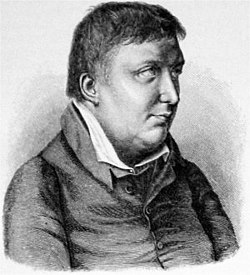
Before the anthropologists and psychoanalysts revived an interest in myth, the impetus for its study came from Romantics like Schlegel, whose "Dialogue on Poetry" (1800) was a plea for reviving the mythic impulse as a defense against materialism and rationalism. Schlegel goes so far as to define a contemporary literary malaise:
Friedrich Schlegel, date unknown
It is my contention that our poetry lacks a center, such as mythology was for the ancients, and the essential shortcomings of modern poetry may be summed up in these words: we have no mythology.
But since we don't, he continues, we have to make one, "fashioned out of the profoundest depths of the spirit; it must be the most artificial of all works of art, for it is to encompass all others, it is to be a new course or a vessel for the ancient, eternal fountainhead of poetry and itself the everlasting Poem which contains within itself the seeds of all other poems."

For Schlegel, a working myth is a cultural sine qua non, and he hopes to find impetus for it "in the great phenomenon of the age - in idealism! -- a very significant hint and a notable manifestation of what we are seeking." If we fail to do so, he argues, the results could be catastrophic: "mankind is struggling with all its might to find its center. Mankind must, as matters stand, go under or rejuvenate itself." But he is optimistic, because, he says, this is "an age of rejuvenation."

Nature, for a Romantic like Schlegel, is the source of this new mythology, which will be "a hieroglyphic expression of surrounding nature in a transfiguration of imagination and love." We must "suspend the course and laws of logically reasoning thought," in order to be transported "back to the fine confusion of the imagination, the original chaos of human nature" -- in other words, listen to what the unconscious is telling us.
All thought is divination, but man is only just beginning to become aware of his powers of divination. What immeasurable expansions will men yet experience, and even at this very time! In my estimation, whoever understands the epoch, which is to say the great process of general rejuvenation and the principles of perpetual revolution, should be able to grasp both poles of humanity, to understand the deeds of the earliest men and to know the character of the golden age that is yet to come.


Victor Hugo: Imaginative Types

Victor Hugo, date unknown
Hugo's Romanticism was long-lived, and he was continuing to cling to it in his book, William Shakespeare, in 1864, which is less about Shakespeare and more about the nature of literary genius. He asserts that all great poets wear a "human mask" through which their souls "[shine] through the mysterious aperture of the eyes" and change the mask to the various characters they create. Hugo cites characters not only from Shakespeare but also from the Bible, Homer, the Greek dramatists, Plautus, Terence, Corneille, Cervantes, Rabelais, Molière, Beaumarchais and Byron. "From the direct divine creation proceeds Adam, the prototype. From the indirect divine creation -- that is to say, from the human creation -- proceed other Adams, the types."

Shylock, whom Hugo erroneously calls "that fierce merchant of Venice" (the merchant of the play's title is Antonio), "is the embodiment of Jewishness; he is also Judaism." That is, he's the individuation of a type. Repellent as this kind of stereotyping is to us today, it coheres with Hugo's theory that literature proceeds from prototype to individual, and that the individual figure in literature succeeds in large part because he encompasses all other individuations of the type: "that is to say, [Shylock's] whole nation, the high as well as the low, faith as well as fraud; and it is because he sums up a whole race, such as oppression has made it, that Shylock is great. The Jews are, however, right in saying that none of them -- not even the medieval Jew -- is Shylock." He uses as analogy an orange tree: A leaf from the tree doesn't taste like the fruit, "yet there is a deep affinity, an identity of roots, a sap rising from the same source, a sharing of the same subterranean shadow before life. The Fruit contains the mystery of the tree, and the type contains the mystery of the man. Hence the strange vitality of the type."

If the type were "but an abstraction, men would not recognize it, and would allow this shadow to go away." Although Hugo doesn't mean by "shadow" the same thing Jung does, he is verging on something Jungian, a theory of archetypes, here. "Types are cases foreseen of God; genius realizes them.... God creates the phenomenon, genius gives it a name; God creates the miser only, genius forms Harpagon; God creates the traitor only, genius makes Iago," and so on. And literature in turn creates types, just as God created Adam: "The man of Homer, Achilles, is an Adam: from him comes the species of the slayers; the man of Aeschylus, Prometheus, is an Adam: from him comes the race of the wrestlers; the man of Shakespeare, Hamlet, is an Adam: to him belongs the family of the dreamers."


Richard Wagner: The Folk and the Myth

Hitler co-opted Wagner, as well as the concept of das Volk, literally, "the people," but with racial (not to say racist) overtones. These two excerpts, one from "The Art-Work of the Future" (1849), the other from "Opera and Drama" (1875), are muddled a little by having two different translators, each of whom fiddles uneasily with finding the right word to translate das Volk. The first excerpt, in fact, makes things more confusing by sometimes translating the word "the Folk," and sometimes "the People." (A quick check of the original shows that Wagner used das Volk in both instances.) In any case, Wagner observes, the word "has acquired an ineradicable moral" meaning -- long before Hitler proclaimed "ein Volk, ein Reich, ein Führer."

But to get to Wagner himself, he asserts, "The 'Folk' is the epitome of all those men who feel a common and collective Want," some ultimate unfulfilled need toward which they are driven. He is working here toward a version of the Jungian collective unconscious. First "the human poetic faculty" comes up with gods, which he posits as a kind of nature-myth, in which "man represents to himself the essence of natural manifestations as derived from a Cause." And the gods naturally take human form: "he must present his God not only in a shape most suitable to be apprehended by his purely human intuition but also outwardly the most intelligible."
All understanding comes to us from Love; and the natural impulse of man is toward the being of his own species. Just as the human from is to him the most intelligible, so also will the qualities of natural manifestations -- which he does not yet know in their reality -- be rendered most intelligible to him by being reduced to human shape.
In other words, humankind creates God in its own image. It anthropomorphizes nature. Thus arises myth and,  through it, art, "for these shapes must necessarily win artistic form and content, if, as is their peculiarity, they really spring from man's longing that the representation of manifestations should be thoroughly intelligible."
Art, by the very meaning of the term, is nothing else than fulfillment of the desire to recognise oneself in an admired or beloved object, to find oneself again in the manifestations of the outer world, as controlled by their representation.... Thus Greek tragedy is nothing but the artistic fufillment of the Myth itself; just as the Myth had been the poetic expression of that life-view common to all.


William Blake: Visionary History

Blake's "A Descriptive Catalogue of Pictures" is a guide to the works he exhibited in 1809, many of which were on historical themes, including the now lost "The Ancient Britons," which depicted a battle between King Arthur and the Romans. In this excerpt, Blake discusses the personifications of Strength, Beauty and Ugliness:
The Strong Man represents the human sublime. The Beautiful Man represents the human pathetic, which was in the wars of Eden divided into male and female. The Ugly Man represents the human reason. They were originally one man, who was fourfold; he was self-divided, and his real humanity slain on the stems of generation, and the form of the fourth was like the Son of God.
Blake is working toward a myth of history here, and as a Briton he naturally gravitates toward the myth of King Arthur, who is a kind of avatar of Blake's Albion:
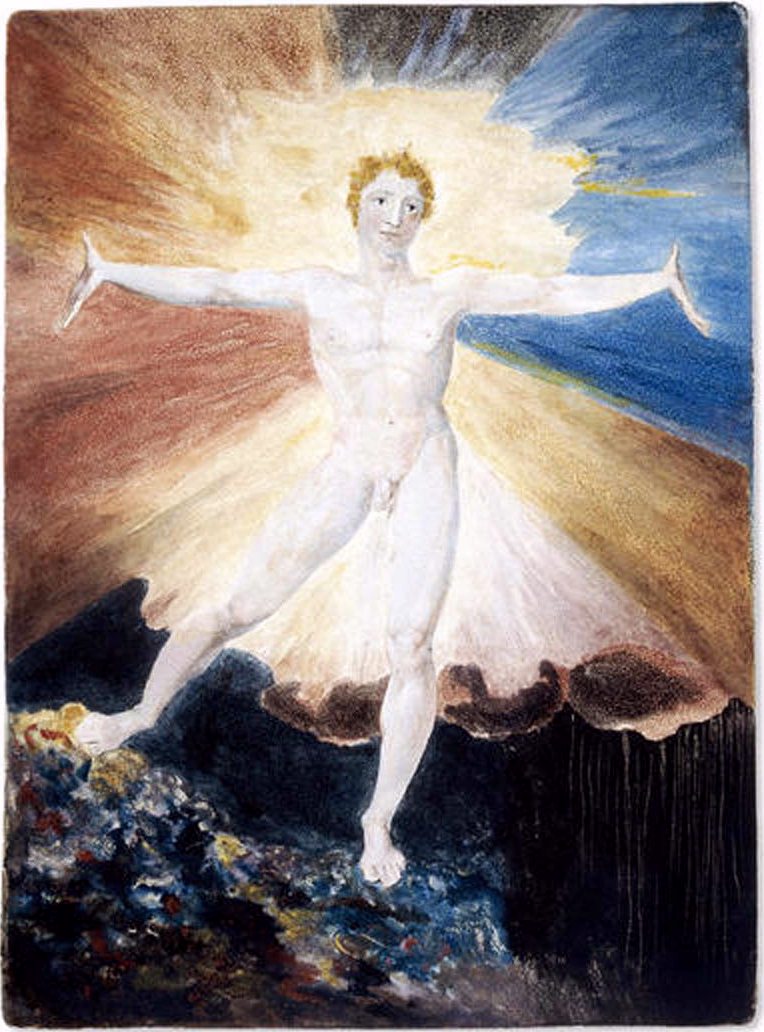
William Blake, Albion Rose, 1794-95
The giant Albion, was Patriarch of the the Atlantic; he is the Atlas of the Greeks, one of those the Greeks called Titans. The stories of Arthur are the acts of Albion, applied to a Prince of the fifth century, who conquered Europe, and held the Empire of the world in the dark age, which the Romans never again recovered.
Blake's mythology is, frankly, as mind-numbing to follow as Yeats's theory of history with its gyres and cones. But here what he's proclaiming is a connection with the historical past that has been lost in part because of the emergence of rationalism. "The antiquities of every Nation under Heaven, is no less sacred than that of the Jews," he asserts.
The reasoning historian, turner and twister of causes and consequences, such as Hume, Gibbon, and Voltaire, cannot with all their artifice turn or twist one fact or disarrange self evident action and reality. Reasons and opinions concerning acts are not history. Acts themselves alone are history, and these are neither the exclusive property of Hume, Gibbon, nor Voltaire.... All that is not action is not worth reading.... His opinions, who does not see spiritual agency, is not worth any man's reading; he who rejects a fact because it is improbable, must reject all History and retain doubts only.


Nicolas Berdyaev: Myth as Memory

"Myth is no fiction, but a reality," Berdyaev says in The Meaning of History (1923). "All great historical epochs, even those of modern history with their tendency to discredit mythology, give rise to myths." The individual human being is "a sort of microcosm in which the whole world of reality and all the great historical epochs combine and coexist." And in order to maintain some integrity of personality, of self-awareness, the individual must come to terms with this fact. Berdyaev, too, verges on the Jungian:
Only deep down in his own self can man really discover the secrets of time; for these, far from being something superficial and alien, something imposed and forced upon him from without, represent on the contrary the deepest and most mysterious strata implicit in himself. A narrow consciousness would either disregard these strata or relegate them to a secondary plane.
Like Blake, Berdyaev finds the rationalist, analytical approach to history wanting: "The divorce of the subject from object as the result of enlightened criticism may provide material for historical knowledge, but in so far as it destroys the myth and dissociates the depths of time from those of man, it only serves to divorce man from history." But unlike Blake, he is willing to grant it some value, as long as it makes room for the social function of tradition and for the role of religion:
Tradition is synonymous with the knowledge of historical life; for its symbolism reveals the inner life and the profound organic union of historical reality with that which man discovers his own spiritual self-knowledge.... I am therefore inclined to believe that the mysteries of the divine as well as of the human and world life, with all their complexity of historical destiny, admit of solution only through concrete mythology. The knowledge of the divine life is not attainable by means of abstract philosophical thought based upon the principles of formalist or rationalistic logic, but only by means of a concrete myth which conceives the divine life as a passionate destiny of concrete and active persons....
For Berdyaev, the myth, which includes the "drama of love and freedom" of Christianity, is the only way to comprehend "the destinies of both man and the world."

Wednesday, April 20, 2011

6. The Modern Tradition, edited by Richard Ellmann and Charles Feidelson Jr., pp. 98-120

Symbolism: Imagination and Thought; The State of Affirmation (Friedrich Nietzsche, W.B. Yeats). Symbolism: The Autonomy of Art; The Doctrine of Purity (Charles Baudelaire, Oscar Wilde, Richard Wagner, Stéphane Mallarmé, Guillaume Apollinaire, Marcel Duchamp)
_____

Friedrich Nietzsche: The Acceptance of Untruth

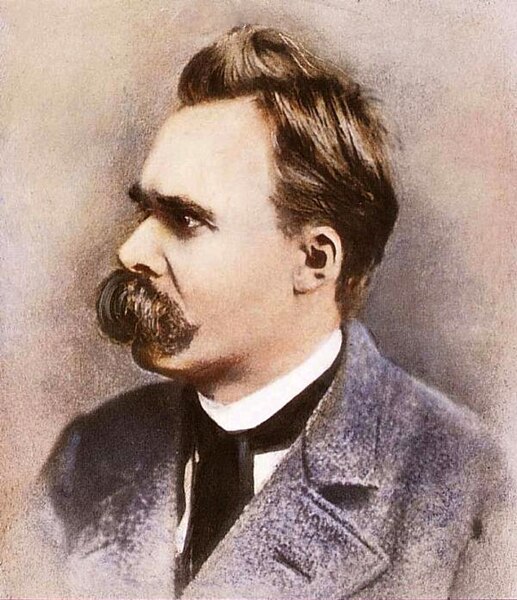
For help with these excerpts from The Joyful Wisdom and The Antichrist, I need to turn to Ellmann and Feidelson's introduction again:
Friedrich Nietzsche, date unknown
Another face of poetic inconclusiveness and non-assertion is poetic affirmation, which is equally indifferent to objective tests of truth [as Richards's "pseudo-statements"]. Nietzsche finds that "untruth" is a condition of life; opinions, ideas, and beliefs are unavoidably false, yet they are necessary to gauge reality against imagined standards without which life would be arid. Affirmations, however fictional, are life-furthering because they extend man's sway over things and also provide necessary food for the passions, which crave attachments. Consequently skeptics, including Zarathustra himself, employ convictions as expressive material. 
In Nietzsche's view, we have art to thank for making us used to untrue things, otherwise "the insight into the general untruth and falsity of things now given us by science -- an insight into delusion and error as conditions of intelligent and sentient existence -- would be quite unendurable." Existence itself has now become "an aesthetic phenomenon," and we should relish the fact that we are all fools content with illusions: "we must now and then be joyful in our folly, that we may continue to be joyful in our wisdom!" Art gives us this joy: "we need all arrogant, soaring, dancing, mocking, childish and blessed Art, in order not to lose the free dominion over things which our ideal demands of us."

We should also celebrate our liberation from dogma. "Strength, freedom which is born of the strength and overstrength of the spirit, proves itself by skepticism.... Convictions are prisons.... Freedom from all kinds of convictions, to be able to see freely, is part of strength."


W.B. Yeats: The Conquest of Scepticism

Skepticism can only take us so far, Yeats argued in his journal in 1929. He cites Ezra Pound's contention "that we know nothing but sequences. 'If I touch the button the electric lamp will light up -- all our knowledge is like that.'" Yeats argues that this may be scientifically accurate, but philosophically false. Skepticism "is mere acknowledgement of a limit." To affirm something that may be verifiably untrue from the skeptical point of view may nevertheless prove useful: "I have felt when re-writing every poem ... that by assuming a self of past years, as remote from that of today as some dramatic creation, I touched a stronger passion, a greater confidence than I possess, or ever did possess." Pound, he says, does the same thing when he writes his imitations of Propertius or the Chinese poets: he "escapes his scepticism." It's not that we believe when we imagine things, it's that we put ourselves in the same state of mind as if we believed, with the same result. We accept the power of tradition when we do so. "The 'modern man' is a term invented by modern poetry to dignify our scepticism."


Charles Baudelaire: The Didactic Heresy

It was Théophile Gautier who took for his slogan the phrase "l'art pour l'art," which we know as "art for art's sake" (or as the MGM slogan Ars gratia artis, coined by some studio publicist with a smattering of Latin). And the Baudelaire selection is from his 1861 essay on Gautier, a defense of that poet's doctrine. Naturally, the corollary to the premise that art is an end in itself is that art must not sacrifice its integrity for the sake of teaching or preaching. So Baudelaire insists, "Poetry ... has no object but itself: it can have no other, and no poem will be so great, so noble, so truly worthy of the name of poem as that which has been written solely for the pleasure of writing a poem." There is a wee bit of a desire to shock in the statement, and both its message and the tone in which it is delivered clearly influenced Oscar Wilde's pronouncements on the same topic. When Baudelaire says, "I say that if the poet has pursued a moral end, he has diminished his poetical power," he's saying the same thing we've already seen Wilde say (except that Wilde said it more wittily).


Oscar Wilde: The Improvidence of Art

And Wilde says it again in the preface to The Picture of Dorian Gray thirty years after Baudelaire's essay on Gautier. He continues to try to shock, when he claims, "No artist has ethical sympathies. An ethical sympathy in an artist is an unpardonable mannerism of style." Well, obviously artists do have "ethical sympathies," but the point is that they shouldn't let them show -- at least not blatantly."

The central point in Wilde's preface, I think, the one that links him with so many others in this section of the anthology, is, "From the point of view of form, the type of all the arts is the art of the musician." In music, form and content are the same thing, which is the ideal toward which Wilde and his contemporaries repeatedly claimed to strive. But Wilde also adds, "From the point of view of feeling, the actor's craft is the type." The actor may or may not actually feel what the character he plays is feeling, but he is judged only by how successfully he makes the audience believe that he does. Sincerity is not in question, or as the cynical saying goes, "If you can fake that, you've got it made."

And then there's this knotty sequence of epigrams:
All art is at once surface and symbol. 
Those who go beneath the surface do so at their peril. 
Those who read the symbol do so at their peril. 
It is the spectator, and not life, that art really mirrors. 
If we equate "surface" with "form," and "symbol" with "content," we oversimplify what Wilde is saying, but it may help us get closer to his meaning. It is really an echo of the two statements made earlier in the preface:
The nineteenth century dislike of Realism is the rage of Caliban seeing his own face in a glass.
The nineteenth century dislike of Romanticism is the rage of Caliban not seeing his own face in a glass. 
For Caliban, the untutored savage, read "bourgeois philistine," who chafes at both the realistic artist's candor and the romantic artist's idealizations.

And finally: "All art is quite useless." Which only means that art that can be used to point a moral, adorn a tale, elect a candidate, promote a dogma, and so on, isn't really art.


Richard Wagner: Literature as Music-Drama

Richard Wagner, c. 1862
No one believed more whole-heartedly than Wagner that music was the highest of all the arts, which is why he argued for the assimilation of the other arts into the Gesamtkunstwerk, that untranslatable Germanism that means something like "total work of art," or "synthesis of the arts," or "all-encompassing art form," and so on. It was "The Music of the Future," he proclaimed in this 1860 essay.

He begins with some nationalistic reflections on the "peculiar significance of German efforts in art," which are characteristic of Wagner but nevertheless a little embarrassing today. But he finally settles down to the aesthetics of the matter, the pre-eminence of "music, that language intelligible to all men." He asserts that "the special, separately developed branches of art, however much their capabilities of expression might finally be brought out and heightened by great geniuses, nevertheless, without falling into unnaturalness and decided error, could never aim to supply in any way that all-powerful work of art which was only possible through a union of their forces."

Each artistic medium, he asserts, runs the risk of developing itself to its limits, "and that it cannot pass these limits without the danger of losing itself in the unintelligible and absolutely fantastic -- even in the absurd." (Some would say that literature passed these limits with Finnegans Wake, or painting with the exhibition of perfectly white canvases, or even music, with John Cage's 4'33" -- four minutes and thirty-three seconds of silence.) Wagner's solution to the problem of limits is for the media to join forces. And particularly for poetry and music to collaborate. He began "to see in the opera an ideal branch of art."
The poet seeks, in his language, to make the abstract, conventional meaning of words subordinate to their original, sensible one; and to secure, by rhythmic order, as well as by the almost musical dressing of words in versification, an effect for his phraseology which shall gain possession of and influence the feelings as though by enchantment.

In this course of the poet, so necessary to his very nature, we see him finally come to the limits of his branch of art, where it already seems to touch music, and thus the most successful work of the poet must be, for us, that which should be, in its perfection, entirely musical.
For Wagner, Beethoven is chief among his predecessors for having, through the symphony, achieved a kind of drama, "a language of which no one in any preceding age had any knowledge, inasmuch as the pure musical expression in it enchains the hearer with a lasting effect hitherto unknown." He speculates that human language "developed from a purely sensuous, subjectively-felt signification of words, into a more abstract sense" that eventually robbed words of feeling "and made their very connection and construction entirely dependent on certain rules that could be learned." (Very few language experts would agree.) So he sees only two paths open for the development of poetry: either into pure abstraction as a vehicle for philosophy, or "it must become intimately bound up with music, and with such music as that whose endless power is revealed to us by the symphony of Beethoven."

And for the poet, "no poetic form is fitted for his use but that in which the poet no longer describes, but brings his subject into actual representation, that is convincing to the senses; -- and this form is nothing but -- the drama," which "awakens in the spectator real participation in the action presented to him."


Stéphane Mallarmé: Poetry as Incantation

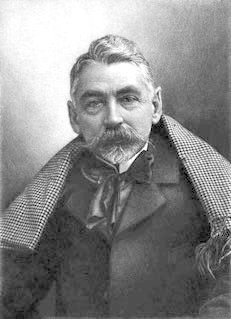
Stéphane Mallarmé, 1896
The title of Mallarmé's essay, "Crisis in Poetry" (1886-95), suggests a certain ambivalence about the "new freedom" won by poets in their liberation from the academic rules and forms -- such as the "artificial metronomes" of the alexandrine, the twelve-syllable line. And he resorts to the familiar analogy to music to describe this freedom: "for the first time in the literary history of any nation, ... any poet with an individual technique and ear can build his own instrument, so long as his fluting, bowing, or drumming are accomplished."

But language is not music:
I am disappointed when I consider how impossible it is for language to express things by means of certain keys which would reproduce their brilliance and aura.... When compared to the opacity of the word ombre, the word ténèbres does not seem very dark; and how frustrating the perverseness and contradiction which lend dark tones to jour, bright tones to nuit! We dream of words brilliant at once in meaning and sound, or darkening in meaning and so in sound, luminously and elementally self-succeeding. But, let us remember that if our dream were fulfilled, verse would not exist -- verse which, in all its wisdom, atones for the sins of languages, comes nobly to their aid.
It's that old duality of sound and sense again. So he welcomes Wagner's Gesamtkunstwerk: "We now hear undeniable rays of light, like arrows gilding and piercing the meanderings of son. I mean that, since Wagner appeared, Music and Verse have combined to form Poetry."

The one thing that poets must now begin to avoid in their verse is description, "that erroneous esthetic ... which would have the poet fill the delicate pages of his book with the actual and palpable wood of trees, rather than with the forest's shuddering or the silent scattering of thunder through the foliage." Instead of description the poet should rely on "evocation, allusion, suggestion." Poetry that too directly confronts reality risks didacticism and loses its special role: "Speech is no more than a commercial approach to realisty. In literature, allusion is sufficient: essences are distilled and then embodied in Idea."

In Wilde's preface to The Picture of Dorian Gray, he asserted, "To reveal art and conceal the artist is art's aim." Mallarmé makes a similar assertion: "If the poem is to be pure, the poet's voice must be stilled and the initiative taken by the words themselves, which will be set in motion as they meet unequally in collision." Pure poetry is the aim, as in Mallarmé's own poem, "Le tombeau d'Edgar Poe," which lauds the attempt to "purify the words of the tribe":  "Donner un sens plus pur aux mots de la tribu."

Where Wagner would give priority to music, Mallarmé would substitute language. "For, undeniably, the true source of Music must not be the elemental sound of brasses, strings, or wood winds, but the intellectual and written word in all its glory -- Music of perfect fulness and clarity, the totality of universal relationships." Like Richards, Mallarmé distinguishes between something like statements and pseudo-statements, dividing words "into two different categories: first, for vulgar or immediate, second, for essential purposes. The first is for narrative, instruction, or description.... Language, in the hands of the mob, leads to the same facility and directness as does money. But, in the Poet's hands, it is turned, above all, to dream and song."


Guillaume Apollinaire: Pure Painting

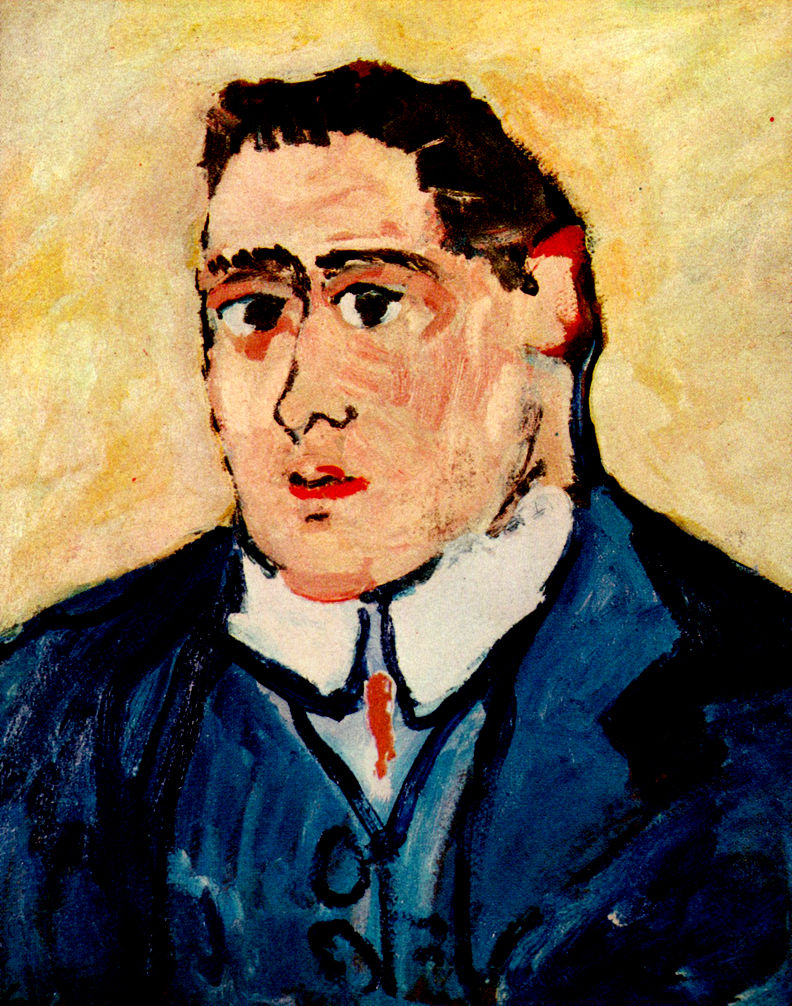
Maurice Vlaminck, Guillaume Apollinaire, 1903
Apollinaire's manifesto appeared in 1913, and like Mallarmé, he abhors the descriptive: "too many painters still adore plants, stones, the sea, or men." He finds a persuasive image for his conception of painting:
Flame is the symbol of painting, and the three plastic virtues burn with radiance. 

Flame has a purity which tolerates nothing alien, and cruelly transforms in its image whatever it touches.

Flame has a magical unity; if it is divided, each fork will be like the single flame.

Finally it has the sublime and incontestable truth of its own light. 
He argues that the more a painting exists on its own terms, insists on its own integrity, the more it participates in the eternal: "We will not go astray in the unknown future, which, severed from eternity, is but a word fated to tempt man. We will not waste our strength on the too fugitive present; the fashionable, for the artist, can only be the mask of death." And of course, the artist must resemble God the Creator: "Each god creates in his own image, and so do painters. Only photographers manufacture duplicates of nature." (Howls of protest from photographers.)

Like Mallarmé, he rejects the descriptive, or in painterly terms, the representational: "Real resemblance no longer has any importance, since everything is sacrificed by the artist to truth, to the necessities of a higher nature whose existence he assumes but does not lay bare. The subject has little or no importance any more.... While the goal of painting is today, as always, the pleasure of the eye, the art-lover is henceforth asked to expect delights other than those which looking at natural objects can easily provide."

Once again, music is the norm: "we are moving towards an entirely new art which will stand, with respect to painting ... as music stands to literature. It will be pure painting, just as music is pure literature." At the basis of pure painting is mathematics: "geometry is to the plastic arts what grammar is to the art of the writer." Unlike the Greeks, who "took man as the measure of perfection, ... the art of the new painters takes the infinite universe as its ideal."

Once again, we are told, essentially, that Nature imitates Art: "It is the social function of great poets and artists to renew continually the appearance nature has for the eyes of men. Without poets, without artists, men would soon weary of nature's monotony... The order which we find in nature, and which is only an effect of art, would at once vanish. Everything would break up in chaos."
Pablo Picasso, Houses on the Hill, Hora de Ebro, 1909

He turns to a particular school of painting, Cubism, which he says is "a name first applied to it in the fall of 1908 in a spirit of derision by Henri Matisse, who had just seen a picture of some houses, whose cube-like appearance had greatly struck him." (Perhaps the Picasso painting above, dated a year later.) "Cubism differs from the old schools of painting in that it aims, not at an art of imitation, but at an art of conception, which tends to rise to the height of creation." Apollinaire distinguishes several subsets of Cubism, and concludes, "I love the art of today because above all else I love the light, for man loves light more than anything; it was he who invented fire."


Marcel Duchamp: The Non-Picture
Marcel Duchamp 1950. © Jacqueline Matisse Monnier

Duchamp's suggestion that we substitute the word "delay" for "painting" or "picture" is not merely the great surrealist's whimsy. It in fact acknowledges the independence of the work itself, that its significance exists in the encounter with a viewer, who is "delayed" by his or her contemplation of the work. It acknowledges all of the themes we have been covering: the independence of the artwork from intellectual correlatives, its purity, its existence in time and outside of it.

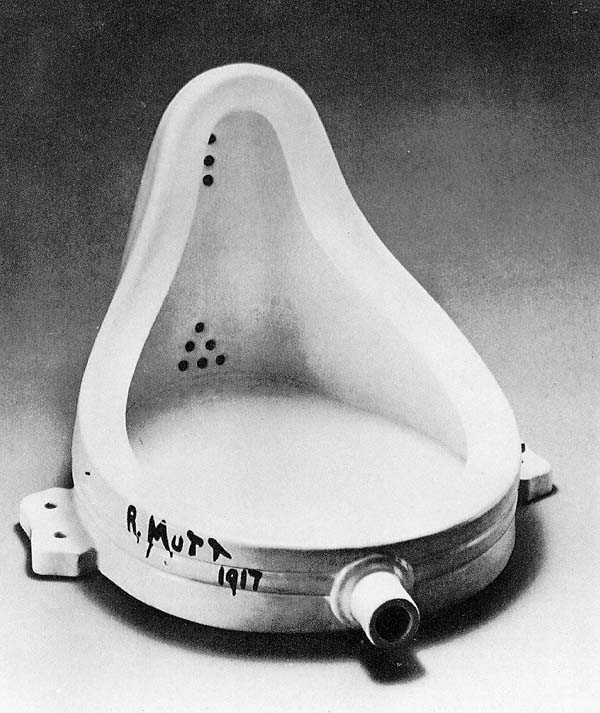
Duchamp, of course, is famous for teasing the viewer into contemplation of what is or isn't a work of art. Is a urinal labeled "A Fountain" a work of art or a silly joke? Is Mona Lisa with a mustache (and an obscene pun for a title) a work of art or a desecration of a masterpiece? Discuss.
Marcel Duchamp, Fountain, 1917


Marcel Duchamp, L.H.O.O.Q., 1919

Tuesday, July 13, 2010

4. Marcel Proust: A Life, by Edmund White, pp. 89-119

VII. His parents' deaths; financial independence; the cork-lined room; the beginnings of the Search. VIII. Against Sainte-Beuve; sense of urgency in writing; models for "the gang of girls"; Marcel Plantevignes; original conception of the Search; "Swann in Love"; Charles Dickens and Henry James; Richard Wagner; Albert Nahmias; searching for a publisher.
_____
In February 1903, his brother Robert married, and in November of that year their father died, one day after the birth of Robert's daughter. Two years later, in September 1905, their mother died at age fifty-six. Marcel would mourn her death for the rest of his life, saying, "In dying, Maman took with her her little Marcel," which White interprets as a turning point from "the intellectual dandified Marcel" to "the determined, wise, ascetic Proust." He also observes that the narrator's mother in the Search has Proust's mother's "disappointment with her son's lack of self-discipline," while the narrator's grandmother is given "his real mother's tenderness, her unconditional love for him in spite of all his failings."


He was thirty-four when his mother died, and had published only a book of stories and a translation of Ruskin, but his ambition was "to write a book that would rival Balzac's panorama of Parisian society." He had both the knowledge of the world and the sensibility to accomplish the task, and he had been left a fortune by his parents: "the equivalent of about $6 million of our money today, including a monthly revenue of some $15,000." He would squander a lot of it on gifts, even ordering an airplane for Alfred Agostinelli -- though he canceled the order after Agostinelli's death -- which becomes the yacht the narrator offers to buy Albertine in The Prisoner. He would also make bad investments on a whim. But he spent little on himself: "He was a playboy-monk."

In December 1906 he moved to 102 boulevard Haussmann, where he insulated his bedroom from noise and dust, lining the walls with cork and covering the windows "with layers of heavy curtains that were never opened." Here he began his project, beginning it "as a sort of Platonic dialogue with his mother on the subject of Sainte-Beuve, the nineteenth-century literary critic," the centenary of whose birth had been widely celebrated in December 1904. Proust dissented radically from Sainte-Beuve's belief that the reader should study a writer's biography in order to fully understand his work. Proust believed that this led Sainte-Beuve to radically undervalue such writers as Stendhal, Baudelaire, and Nerval. "A book is the product of a different self from the one we manifest in our habits, our social life and our vices," Proust asserted. But the dialogue about Sainte-Beuve was not the only thing he was planning to write:
In a letter of this period he said he was planning: a study of the nobility; a Parisian novel; an essay on Sainte-Beuve and Flaubert; an essay on women; and an essay on pederasty. Other topics mentioned were gravestones, stained-glass church windows -- and an essay on the novel. What is crucial to underline is that at its very inception Proust thought of his book as several books, mostly essays. 

By June 1908 he was working on the fictional conversation with his mother on Sainte-Beuve, writing constantly, but also worrying about publishing what he was writing, which he called "obscene." The work, which had a "provisional title," Against Sainte-Beuve, Memories of a Morning, was a novel, and one of the characters was gay. It would end, he wrote to Georges de Lauris, "with a long conversation on Sainte-Beuve and aesthetics." White observes that In Search of Lost Time ends with a meditation and not a conversation on aesthetics. And that Sainte-Beuve's autobiographical theory has been countered in the novel by Vinteuil, who "is a mighty creator as a composer and a totally self-effacing wimp as a man -- the perfect counterargument to Sainte-Beuve's theory of the harmonious congruity between an individual's life and work." And that from the very beginning Proust had planned to write about homosexuality in his novel.

He was afraid he wouldn't live to complete the work: "He was so ill that he was spending about twenty thousand dollars a year for medicines." But he hadn't completely withdrawn from the world. At Cabourg, "he studied the actress Lucy Gérard and the two daughters of Viscount d'Alton" as models for the "gang of girls" in In the Shadow of Young Girls in Flower. But he also studied "with feverish fascination" a group of boys he met on the beach, including 19-year-old Marcel Plantevignes, who visited Proust in his room until a woman warned Plantevignes about Proust's homosexuality. Proust flew into a rage when the woman told him that Plantevignes had agreed with her about the accusation, "and even challenged Plantevignes's father to a duel." Proust's own seconds thought the challenge absurd and like "a duel from an operetta by Offenbach." The duel was called off and the friendship resumed when Plantevignes and his parents assured Proust that they didn't believe he was gay. Plantevignes also claimed that he suggested the title, À l'ombre des jeunes filles en fleur.

In mid-August 1909 Proust talked to an editor about the novel he said he had nearly finished: a novel of about 300 pages, followed by an essay, a conversation about Sainte-Beuve, of 150 pages. The editor turned it down and another decided not to publish it as a newspaper serial. Proust decided to continue work and did so for the next three years. He conceived of the novel as a story about the narrator's childhood in Combray followed by the adolescent experiences of the narrator and Gilberte Swann in the gardens of the Champs-Élysées -- the "Swann in Love" section, which is four-fifths of Swann's Way, was not part of the original conception. The section is integral to the complete Search because Swann's unreciprocated love for Odette is echoed later in the narrator's relationship with Albertine, and Swann's failure to become a writer is reflected in the experience of the narrator, who finally overcomes what is blocking his writing.
And it suggests that one reason for Swann's failure is his addiction to friendship and frivolity and especially to "idolatry," by which Proust meant the collector's love of fine furnishings, beautiful mistresses, and great paintings: the perishable Things of this world rather than the immortal ideas that lie behind them, which can be recaptured only through involuntary memory -- and which only then can be codified in great works of literary art. 
Proust had learned how to shape a novel, how to introduce a theme, drop it, and return to it later, and how to work with a narrator whose impressions of other characters changes as the story progresses: The narrator of the Search first hears of Charlus as a womanizer and assumes that he is Odette's lover, but gradually learns otherwise. The creation of the character of Charlus, White observes, "falls midway between that of Dickens and that of Henry James." Like Dickens's characters, Charlus is made up of "memorable traits" and presented in "Dickensian bold relief." But "by building up a slow composite of images through time, Proust achieves the same complexity that James had aimed at."
Dickens could draw with a firm bounding line but used so little shading he gave no sense of perspective. James was all shading and depth but (especially in his late novels) nothing vigorous distinguished the profile of one character from another. Proust succeeded in rendering characters with the same startling simplicity as Dickens but generated a lifelike subtlety and motion by giving us successive "takes" over hundreds of pages.
Proust rewrote and expanded the first volume of the Search from 1909 through 1911. He dictated to his stenographers, had the manuscript set in type, then filled the margins with changes and additions, even pasting in new pages. "In fact, if any writer would have benefited from a word processor it would have been Proust." He paid for the typesetting, which was expensive, himself. In 1910 he worked on what would become Swann's Way and The Guermantes Way, then divided the manuscript in two volume, one called Time Lost and the other Time Regained. He rarely went out, although he was present at the famously controversial opening night of the Stravinsky/Diaghilev/Nijinsky Rite of Spring. In 1911, he subscribed to Théâtrophone, which broadcast concerts over the telephone. He heard Act III of Die Meistersinger and the opera Pelléas et Mélisande this way. He preferred Wagner, and some critics have compared the Search to Parsifal: Parsifal's quest for the Grail being parallel to the narrator's search for "the secret of literature" and the "young girls in flower" to the Flower Maidens. And the name Guermantes may be an echo of the name Gurnemanz, the leader of the Grail Knights.

By 1912, Proust's manuscript had reached 1,200 pages and he began to look for a publisher. He was working with a typist named Albert Nahmias, on whom he had a crush, and who eventually lent his name to Albertine. The novel was sent in October to the publisher Fasquelle, which had published Flaubert, Zola, and the Goncourt brothers. They returned it in December with a reader's note expressing complete bewilderment. He then sent it to Gallimard, which was a new publishing house started by André Gide, Jacques Copeau and Jean Schlumberger. But the readers, led by Gide, seem not to have read the manuscript, dismissing Proust as "a socialite and a snob." In any case, "the book was much too long for a fledgling house." Gide would later express regret at the missed opportunity. Then it went to Ollendorff, where a reader protested about Proust's using "thirty pages to describe how he tosses and turns in his bed before falling asleep."

Finally, Proust resorted to self-publication through Bernard Grasset:
Grasset, whom Proust compared to an ebony paper-cutter, so hard and sharp and efficient was he, virtually invented modern publishing in France; he was the first to resort to massive press offensives, advertising, bribing well-known personalities to launch a good word-of-mouth campaign, and so on.