JOURNAL OF A COMPULSIVE READER
By Charles Matthews
Showing posts with label Lord Byron. Show all posts

Tuesday, October 5, 2010

12. The Age of Wonder, by Richard Holmes, pp. 325-361

The Age of Wonder: The Romantic Generation and the Discovery of the Beauty and Terror of Science (Vintage)Dr Frankenstein and the Soul, 4-7; Davy and the Lamp, 1-3
_____
Mary Shelley's Frankenstein, or The Modern Prometheus was "the most singular literary response to the Vitalism debate." She had heard Davy lecture on chemistry in 1812, when she was only fourteen, and when she came to write her novel she would draw on the published version of Davy's "Introductory Discourse" in the part where the young medical student Victor Frankenstein hears Prof. Waldman lecture. Percy Shelley, with whom she  eloped to France and Switzerland in 1814, was fascinated by the question of creating artificial life, and during their stay at Villa Diodati on Lake Geneva in 1816, they discussed Aldini's galvanic experiments with Byron and Polidori. It was then that they set each other a challenge to write a tale of horror. The others dashed off their responses, but Mary took her time -- fourteen months. In August 1817, she sent the manuscript of Frankenstein to the publisher three weeks before she gave birth to a daughter, Clara.

The character of Victor Frankenstein evokes many of the age's scientists: Joseph Priestley, Henry Cavendish, Humphry Davy, "the sinister Aldini and the glamorous, iconoclastic William Lawrence may all have contributed something to the portrait." The best-known German physiologist of the day was Johann William Ritter, who was "known for certain undefined 'galvanic' experiments with animals, which were the talk of the Royal Society, although amidst a certain amount of head-shaking." Ritter became the target of the Prussian government for his experiments and moved to Munich, but "he died penniless and insane in 1810, aged thirty-three. In other circumstances his Memoirs might have been those of young Victor Frankenstein."

In developing the character of the Creature in her novel, Mary was forced to speculate on what ways it might be considered human: "Would it have language, would it have a moral conscience, would it have human feelings and sympathies, would it have a soul?" It's possible that Mary accompanied her husband to his consultations with Lawrence in spring 1817, and that the three of them discussed such questions, because "Mary Shelley's idea of the mind was, like Lawrence's, based on the notion of the strictly physical evolution of the brain." In his lectures in 1817, Lawrence directly addressed the question of "mind":
Where is the 'mind' of the foetus? Where is that of a child just born? Do we not see it actually built up before our eyes by the actions of the five external senses, and of the gradually developed internal faculties? Do we not trace it advancing by a slow progress from infancy and childhood to the perfect expansion of its faculties in the adult.
The Creature in the novel has the body of a fully developed man, but his mind is that of an infant. He has to acquire memories, language, a conscience. "Although galvanised into life by a voltaic spark, the Creature has no 'divine spark' from Heaven. Yet perhaps his life cold be called, in a phrase of the medical student John Keats, a 'vale of soul-making.'" (Note: Keats's image of life as a process of soul-construction persisted into the twentieth century in the poems of W.B. Yeats; see e.g. "Beggar to Beggar Cried," "Sailing to Byzantium," and especially the great valedictory of "The Tower.") Escaping from the laboratory, the Creature begins his process of awareness with a sighting of the moon. His mind, he tells us, "received, every day, additional ideas." Holmes notes that "Mary's account [of the Creature's evolution "through all the primitive stages of man"] is almost anthropological, reminiscent of Banks's account of the Tahitians."

It is solitude that proves the undoing of the Creature and turns him into a killer. He pleads with Frankenstein to create a mate for him, "offering to go westwards to South America or the Pacific, and to return to that primitive Edenic state glimpsed by Cook and Banks." But Frankenstein, in the midst of creating the mate for the Creature, is attacked by fears that they would propagate "a race of devils," so he destroys the half-finished female Creature. Frankenstein is pursued by the Creature to the North Pole, "the antithesis of the warm, Pacific paradise," where "both see themselves as fallen angels, doomed to eternal solitude and destruction."

The first publication of the novel was a failure, selling fewer than 500 copies. But it became famous in the 1820s through stage adaptations, of which there were at least five, starting with Presumption: or The Fate of Frankenstein in London in 1823. "Over the next four years there were fourteen separate productions, mounted in London, Bristol, Paris and New York." Mary Shelley made no money from the plays, which she didn't authorize, but "when she herself went to see the play in September 1823 she loved it." The actor T.P. Cooke became famous in the role of the Creature, just as Boris Karloff would in the 1931 film version. But the dramatizations turned Victor Frankenstein from "a romantic and idealistic figure, obsessive rather than evil, and determined to benefit mankind" into "the archetypal mad and evil scientist." And the Creature, which eventually became "The Monster," "is deprived of all words, whereas in the novel he is superbly and tragically articulate."

As for William Lawrence, whose quarrel with Abernethy had sparked so much debate, he renounced his own views and reconciled with Abernethy. He became a member of the conservative Council of the Royal College of Surgeons in 1829 and "finished his career as Surgeon-General to Queen Victoria, and was created a baronet. But perhaps he had lost his own soul."

In the spring of 1811, Humphry Davy met Jane Apreece, a wealthy thirty-one-year-old widow. (Her first husband died in 1809. They had no children.) She was socially prominent and well-connected, and claimed to be the model for the heroine of Madame de Staël's novel Corinne, having met de Staël in Geneva. She had once dined with William Blake and was a cousin of Walter Scott. As their attraction grew, their "friends predicted disaster. She was made for society, he was made for the laboratory." She turned down his proposals twice, but finally accepted after he told her that the Prince Regent had offered him a knighthood -- he would be the first scientist to be knighted since Isaac Newton. He received the honor on April 8, 1812, and three days later they were married.

On June 1 his book Elements of Chemical Philosophy, based on his Royal Institution lectures, "was published with a formal dedication to Lady Jane Davy." Though the rest of the book was too technical for the general reader, its introduction, "An Historical View of the Progress of Chemistry," helped popularize chemistry. "Percy Shelley began to incorporate Davy's ideas into his work, beginning with his visionary materialist poem Queen Mab of 1812, with its long scientific prose notes." But the advances in science increasingly made it difficult for poets to express scientific ideas in verse. "Shelley's Prometheus Unbound (1820) was to be arguably the last successful attempt to combine the two in a major English poem." In his essay on the history of chemistry, Davy proclaimed,
The ends of this branch of knowledge are the applications of natural substances to new uses, for increasing the comforts and enjoyments of man; and for the demonstrating of the order, harmony, and intelligent design for of the system of the earth.
Setting aside that still-problematic notion of "intelligent design," Davy had made the case for amateur enthusiasts for chemistry, and the first "chemistry sets" went on the market at about this time.

Davy decided to give up his lectureship and pursue his scientific research independently, which Jane's fortune allowed him to do. He began investigating explosives as part of the British war effort, but in November 1812 he was partly blinded when a test tube exploded and sent glass slivers into his eye. As a celebrity he was subject to gossip, including a rumor that his wound was the result of a fight with Jane. When he returned to the Royal Institution laboratory in London, he found that it had been allowed to degenerate. He fired the laboratory assistant and hired a new one, twenty-one-year old Michael Faraday, who had been working as a bookbinder.

There was some tension between the Davys, mostly centered on the conflict between her socializing and his laboratory work, and his tendency to escape into his hobby of fly-fishing. But he made an effort to participate in her social life, and in 1813 he was introduced to the lion of society, Lord Byron. "Unexpectedly, Byron and Davy hit it off rather well, and later when His Lordship was self-exiled in Italy, Davy remained one of the few Englishmen that he could stand to meet. He would even put him in his poem Don Juan (1819-24)." (Along with, it might be noted, a reference to Mungo Park's travels.)
This is the patent age of new inventions
For killing bodies, and for saving souls,
All propagated with the best intentions:
Sir Humphry Davy's lantern, by which coals
Are safely mined for in the mode he mentions,
Tombuctoo travels, voyages to the Poles
Are ways to benefit mankind, as true,
Perhaps, as shooting them at Waterloo.

In May 1812, an explosion in the Felling coal mine killed ninety-two men, and after another explosion in the same mine in December 1813 killed twenty-two more, it became apparent that something needed to be done urgently about the problem of "fire-damp," a lethal gas from new coal seams that could be ignited by a single candle flame. The consensus was that Davy should be called on to find a solution to the problem. But the Davys had just embarked on an eighteen-month tour of Europe, accompanied by Michael Faraday, whom Davy had singled out as a promising research assistant. Jane, on the other hand, decided to treat Faraday as a valet, since her husband refused to travel with one. In Paris, Davy was awarded the Prix Napoléon by the Institut de France, which caused him to be denounced as unpatriotic, although "Davy carefully avoided an audience with Napoleon himself, and referred to him contemptuously as 'the Corsican robber.'" He was also lured by the Académie des Sciences into a competition with the eminent French chemist Joseph Gay-Lussac, to analyze a crystal substance that was a byproduct of gunpowder manufacture. Both Davy and Gay-Lussac identified the substance as a new element, iodine. But a dispute arose after Gay-Lussac's paper was presented on December 12 and Davy's on December 13. Davy backdated his paper to December 11 when it was published in the Journal de Physique, and claimed that he had shared his ideas with Gay-Lussac before the French chemist presented his conclusions. The French still insist that Gay-Lussac was the first to identify the element.

In the spring of 1814, the party moved south. In Florence, Davy used a magnifying lens to set a diamond on fire, demonstrating that the jewel was after all just carbon. They moved on to Rome and Naples, then northward to Venice and, for the summer, crossed the Alps into Switzerland, Bavaria, and Austria, then down into one of his favorite regions in the Balkans, then known as Illyria. They returned to Florence in October, where they heard about "some strange natural gases escaping from rock formations in the Apennines at Pietra Mala, near Lucca." They were fascinated by the gas, which could even be produced by stirring the mud with a stick and burned with a blue flame. The gas had almost no smell. They bottled some of it and took it back to Florence, where they identified it as methane -- the "fire-damp" that had caused the coalmine explosions.

Finally, in March 1815, news arrived that Napoleon had escaped from Elba. They hurriedly returned to London, where Davy saw to it that Faraday was promoted to assistant to the laboratory at the Royal Institution, and encouraged him to start giving his own lectures on chemistry and to publish his first papers. Davy himself became vice-president of the Institution, giving him access to the lab and the opportunity to continue to work with his protégé, Faraday.

Davy then wrote a poem called "The Massy Pillars of the Earth":
Nothing is lost; the ethereal fire,
Which from the farthest star descends,
Through the immensity of space
Its course by worlds attracted bends,

To reach the earth; the eternal laws
Preserve one glorious wise design;
Order amidst confusion flows
And all the system is divine.

If matter cannot be destroyed,
Then living mind can never die;
If e'en creative when alloy'd,
How sure is immortality! 
Holmes notes that the first stanza seems to anticipate Einstein's theory, a hundred years later, that light is bent by gravity, confirmed by Arthur Stanley Eddington's observations during a solar eclipse in 1819. But Davy was really just affirming "a more traditional belief: the sudden confidence that 'eternal laws' govern the universe in a benign and ordered way." His assertion that "all the system is divine" is "somewhere between Romantic pantheism and the old Enlightenment deism." He also continued to question the surety of immortality.
What is striking about this poem is its sudden tone of Evangelical self-confidence and its unusually hymn-like form. It could have been written by John Wesley or Isaac Watts, though Davy carefully avoids the words "God" or "soul." ... Perhaps he wanted to settle down theologically, as well as socially. But science would never quite allow him to do either.

Thursday, September 30, 2010

7. The Age of Wonder, by Richard Holmes, pp. 182-210

The Age of Wonder: The Romantic Generation and the Discovery of the Beauty and Terror of Science (Vintage)Herschel Among the Stars, 2-6
_____
In 1788, Herschel married Mary Pitt, a wealthy widow, causing something of a rift with Caroline, who found her role in the household suddenly shrunken. Caroline moved out of The Grove into an apartment above the stables, next to the observatory. She refused an offer of a quarterly salary of £10, but she still had the more generous stipend from the queen. Interestingly, she also destroyed her personal journals for the next decade, during which she moved out of the apartment and into the village of Slough. Whatever Caroline's feelings were about her brother's marriage, she continued to be his assistant and to do her own observations as well, discovering a second comet in December 1788. She also began a regular correspondence with the Royal Astronomer, Nevil Maskelyne.

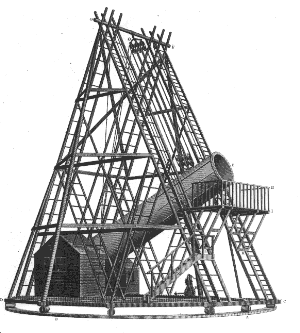
The 40-foot telescope
In spring 1789, the great forty-foot telescope was finally completed. With it, Herschel discovered the tiny moon of Saturn called Mimas, which is only 250 miles in diameter and has a huge crater eighty feet across and six miles deep. (When the crater was photographed by Voyager in 1980, it was named Herschel.) The telescope became a major tourist attraction and was hailed as one of the wonders of the world. The visiting Oliver Wendell Holmes described it as looking like "a piece of ordinance such as the revolted Angels battered the wall of Heaven with." But it was something of a dud: hard to maneuver and far more subject to weather than the smaller telescopes. The mirrors weighed a ton, and had to be repolished annually. Removing them was not only difficult but dangerous -- Herschel was nearly killed in 1807 when a mirror slipped from its harness while being removed. In the five years from 1788 to 1793, Herschel recorded only seventeen nights of optimal observing conditions. It was also more useful for observations within the solar system than into deep space: Herschel added two more moons to the five that Saturn was already known to have.

Herschel began to do more revolutionary theoretical work. In 1789 he published a paper that expanded on his earlier "On the Construction of the Heavens," suggesting that the whole universe was in a state of change, being worked on by the force of gravity. He likened the skies to a garden in which we can "witness the germination, blooming, foliage, fecundity, fading, withering and corruption of a plant." The same process was at work in the stars.
In this paper, astronomy changed decisively from a mathematical science concerned primarily (for practical purposes) with navigation, to a cosmological science concerned with the evolution of the stars and the origins of the universe.

The Herschels were also experiencing personal changes: In 1792, Mary gave birth to their only child, a boy they named John. And Caroline had entered on a new phase of her career as an astronomer. She found her third and fourth comets in 1790, a fifth in 1791, and a sixth in 1793. She began a new Star Catalogue which would be published by the Royal Society and eventually replace the standard reference published by John Flamsteed in 1776. When she found a seventh comet in 1797, she was so excited she did something completely uncharacteristic: She rode a horse by herself from Slough to London, a distance of twenty-some miles, to tell Maskelyne the news personally. She also wrote to Joseph Banks, noting that the day was a historic one because she had never ridden more than two miles outside of Slough before. This excursion was followed by her move out of the apartment and into lodgings in Slough.

In 1791, William published a paper about nebulae in which he reported on a star that was surrounded by a cloud of gas. This had caused him to reconsider his assumption "that gas clouds were simply star clusters too far beyond our galaxy to be 'resolved' by his telescopes." Now he began to question whether nebulae were gas clouds within the Milky Way, and whether there really were galaxies outside our own. "It was a decisive retreat from his most radical thinking about the size and origin of the cosmos." It may have been prompted by a conservative reaction against the atheism of the French Revolution after the declaration of war against France. Herschel's friend, the French astronomer Jérôme Lalande, had become an atheist, and in 1807 wrote, "I have searched through the heavens, and nowhere have I found a trace of God." Pierre Laplace, another atheist, used Herschel's own theory that nebulae were stars forming out of clouds of gas to posit a theory of creation that made divine intervention unnecessary. When Napoleon once told Laplace that he found no mention of God in his books, Laplace replied "I have no need of that hypothesis."

However, Herschel maintained his freedom to speculate, sometimes wildly, as when he posited that the interior of the sun was cool and inhabited by intelligent beings. He also continued to believe that the moon was inhabited and "his disapproved of God-hunting within the galaxy," rejecting the notion that the fire of the sun was in fact that of the biblical hell. Other scientists suffered from the reaction against atheism, such as Joseph Priestley, whose library was destroyed by a Birmingham mob in 1794. Some even found visiting Herschel's observatory a religious experience, such as Joseph Haydn, who credited a visit to Herschel with inspiring his oratorio The Creation

Herschel's interest in the sun produced not only wild speculation, but also a significant discovery. In 1800 he did series of experiments with thermometers that demonstrated higher temperatures outside the visible spectrum, in short, he had "discovered the presence of infra-red light." Joseph Banks predicted that this would be a more important discovery than that of the planet Uranus. It also attracted the attention of the young Humphry Davy.
This marked a decisive advance on Newton's famous optical experiments with the prism, and implied a hitherto wholly unsuspected power in nature. It would also eventually lead to a decisive breakthrough in stellar astronomy in the twentieth century. 
During wartime Herschel was commissioned to produce a spy telescope to be mounted on Walmer Castle in Kent to watch for a French invasion fleet. But in July 1802, during the Peace of Amiens, he and his wife visited Paris where they met Napoleon, with whom he had a rather awkward conversation during which the future emperor proclaimed that astronomy "gave proof of an Almighty Wisdom." Knowing that Laplace, Napoleon's chief scientific adviser, was an atheist, Herschel thought Napoleon was a hypocrite. 

Ten-year-old John Herschel, who had accompanied his parents to France, fell ill on the way back. He was nursed back to health by his Aunt Caroline, to whom he became close -- "it was she, as much as his father, who inspired in him an early passion for science and astronomy." He had been sent to Eton when he was eight, but Caroline saw how unhappy he was there and was delighted when Mary saw her son knocked down in a boxing match with an older boy and decided to bring him home to be privately tutored.

In a paper in 1802, William began to speculate on the relationship between space and time, noting that "A telescope with a power of penetrating into space, like my 40  foot one, has also, as it may be called, a power of penetrating into time past." Other observations were equally unsettling to the layman, such as the notion that sunspots, because they had an effect on the Earth's temperature, "could be related to the price of wheat," and therefore have political consequences. Or that not only did the planets revolve around the sun, but the solar system was orbiting around the center of the Milky Way, which was itself moving through space. He also continued to develop the idea that the universe itself was evolving, and that the reason the nebulae he had observed were different shapes was that they were in different stages of development.
These shapes, Herschel argued, were not different because they had been created differently, like different species. They were different simply because their stages of development in what he called "sidereal time" (meaning stellar time) had reached different points. He was suggesting the inescapable idea of evolutionary youth and age in the universe. 
Copernicus had dethroned the Earth from the center of the universe. Now Herschel had gone so far as to remove even the Milky Way from the center.

Herschel's ideas and discoveries were picked up by the younger generation of Romantic poets. Byron visited him in 1811 and was astonished "when I viewed the Moon and Stars through Herschel's telescope, and saw that they were worlds." Keats used Herschel's discovery of Uranus as a central trope in his sonnet, "On  First Looking Into Chapman's Homer": 
Then felt I like some watcher of the skies
When a new planet swims into his ken 
It's a depiction of the moment of discovery as "a moment of revelation into the idea of the unbounded, the infinite. In the case of Herschel's sighting of Uranus, Keats's word 'swims' is brilliantly evocative, because of its sensse of new life and movement." Keats described a "Eureka moment," which Herschel's meticulous observation hadn't really been, though Herschel would later describe it that way. "Herschel in the end may have remembered that night exactly as Keats imagined it." In 1813, Thomas Campbell encountered the seventy-four-year-old Herschel  on vacation in Brighton.
Herschel completely perplexed the poet by remarking that many distant stars had probably "ceased to exist" millions of years ago, and that looking up into the night sky we were seeing a stellar landscape that was not really there at all. The sky was full of ghosts. "The light did travel after the body was gone." After leaving Herschel, Campbell walked onto the shingle of Brighton beach, gazing out to sea, feeling "elated and overcome." He was reminded of Newton's observation that he was just a child picking up shells on the seashore, while the great ocean of truth lay all before him.

Wednesday, August 18, 2010

13. Being Shelley, by Ann Wroe, pp. 343-390

Being Shelley: The Poet's Search for Himself (Vintage)Part IV: Fire, 3. Being; Coda: The voyage out
_____
Shelley was aware of the physical and astronomical truths about the stars, that they "are supposed to be suns, each of them the centre of a system like ours." Mary had given him an ivory-and-brass telescope for his 24th birthday. Still, they merged into his imagined cosmology quite easily, reinforced by Paracelsus's speculation that "the primordial stuff from which man was made ... was not merely dust and earth but an extract of the stars.... What Shelley gazed on, Shelley was."
In the act of making poetry, he already sensed his own fire. He had no need of stoves, galvanic machines or the trickery of Mephistopheles. His own refining agent was his poetic imagination.... Shelley called imagination "the Sun of life," that "lake-reflected sun" out of which his poems came. It was also the God of those poems, he told Hunt, "the master ... and the Spirit by which they live and are."
He referred to man as "pre-eminently an imaginative being," and quoted approvingly Tasso's statement, "non c'e in mondo chi merita nome di creatore, che Dio ed il Poeta" -- only God and the poet are worth of being called creators. "There might be no Creator-God in his universe, but he admitted naturally the possibility of a Mind holding in conception the landscape of the world, the colours of the atmosphere and the system of the stars, 'these things not before existing,' and imagining them forth, as he could.... As a Poet, his first duty was to shadow forth Reality; his second, to open readers' eyes to that 'wonder' within themselves."
When he wrote of the sun, ... he wrote of himself. He would not have wanted the public to know it, but they would not in any case suspect it. Almost every aspect of his "Hymn of Apollo" was also a canticle to his own imagination, making colour and form, bringing wisdom, bringing light.... No fire intrigued him more than the one that was himself. 
Shelley's reading of Plato led him into speculations about the soul and its immortality, including metempsychosis and the pre-existence of the soul. At Oxford he once snatched up a baby from its startled mother and gazed into its eyes, searching for evidence of its prenatal existence. He also speculated on the intermingling of souls, though he shied away from "any deeper expression of male love than linking arms joyously to walk, or snuggling close to the fire with Hunt in the comfort of each other. His beloved Greeks would have gone further, in acts Shelley squeamishly tried to idealise and to abstract entirely from the body." He was undisturbed by incest, however, fancying the union of brother and sister as "mystical and innocent."
Eventually it was ... Emilia Viviani ... to whom in 1821 Shelley dedicated his longest and most ecstatic poem of soul-seeking and soul-finding. Again in their letters they had become sister and brother.... She was his Epipsychidion, the soul out of my soul, a word by which he meant to hint again at the flaming night torches of the epithalamium or marriage song. But her earthly identity did not matter, for the poem's core, in truth, was not about her or any woman he knew.
He struggled, however, to articulate the essence of this mystical union of souls. "The same words appeared again and again in the crossed-out confusion of the Epipsychidion drafts: light and fire, life and motion, love. These were all he could think of, or cling to." Others, such as Mary and Byron, were sure that there was more of body than of soul in his attraction to Emilia.
During the period of depression he experienced after his expulsion from Oxford in 1811, he had had an epiphanic moment one morning when he saw the Morning Star, Venus, shining brightly, and it became his personal emblem. "Yet as a star-daemon, the shadow-messenger of Truth and Love and Beauty, he could not prevail on Earth.... The spirit of the Morning Star fought battles frequently, light against false light, and lost most of them."
As for immortality, "the only Heaven Shelley appeared to hope for was a steadily perfecting Earth.... Yet he knew even then that all earthly heavens were as transient as man was. He found absurd, even 'demoniacal,' Wordsworth's remark that happiness was found in the world 'or not at all.'"
In 1820, three arguing voices in his head strove to define where Heaven was and what it might be. The first saw it as the immeasurable, star-strewn container of all things and all time. The second, 'a Remoter Voice,' described it as the mind's first chamber, where bewildered insect-fancies faintly climbed and dreamed of glory. But the third, 'a Louder and still Remoter Voice,' saw a Heaven far more astonishing, a tiny globe of fire-dew at the centre of 'some eyed flower.'
But in the end, he fell back on the necessity of inarticulateness. In his Essay on Christianity he argued, "Where indefiniteness ends idolatry and anthropomorphism begin."
He finally rejected the idea of a personal immortality.
If his imagination was divine light and fire reflected in himself, his own imagining soul might be drawn back at last to the source of it, flame rejoining flame. In Adonais, almost willing this apotheosis, he began to foresee what might happen to him.
   The Light whose smile kindles the Universe,
   That Beauty in which all things work and move,
   That Benediction which the eclipsing Curse
   Of birth can quench not, that sustaining Love
   Which through the web of being blindly wove
   By man and beast and earth and air and sea,
   Burns bright or dim, as each are mirrors of
   The fire for which all thirst; now beams on me,
Consuming the last clouds of cold mortality. 
In sum, "The end was possibly some sort of exquisite immolation in which nothing of him would survive." The last words he wrote were "an aching question:
Then, what is Life I cried -- 
The page was folded at the top. On the joining sheet, in faint outline, a boat began to appear."
On July 8, 1822, he and Edward Williams got in a boat, the Don Juan, and sailed out to sea. What was left of his body washed ashore ten days later.

Tuesday, August 17, 2010

12, Being Shelley, by Ann Wroe, pp. 317-340

Being Shelley: The Poet's Search for Himself (Vintage)Part IV: Fire, 2. Burning
_____
Having his own ideas about God, Shelley naturally had corresponding ones about God's adversary. Even as a boy he liked to play Satan and to conduct experiments with chemicals and incantations to raise the devil, and he terrified Harriet with talk of "his supreme Majesty the Devil." She overcame her fears only to have them resurrected by an experience in February 1813. They were in Wales, where Shelley had gotten involved with an effort to reclaim land from the sea, a project that had stout opposition. One night, Shelley heard a noise downstairs and took his pistols with him when he went to investigate. A man, who was leaving through a window, fired a shot at him and missed. Shelley returned fire but the man escaped, vowing revenge. A few hours later, he heard another noise at the window and someone fired another shot at him, which narrowly missed. "Shelley fired his own pistol and grabbed an old sword to beat the stranger off but then, losing him, set fire to the nearby woods to burn him alive.... Most probably, local enemies had come to scare the nuisance-radical away. But to Shelley, at the instant he saw him, he was the Devil."

For Shelley, "Satan and God alike were projections of man's mind, nothing else. They were sappers of his will, crushers of his potential, but self-made.... If God was the callous monarch, the Devil was 'the Informer, the Attorney General, and the jailor of the Celestial tribunal.'" But Satan was also himself, "the bad daemon twinned with the good." He found his archetype in Paradise Lost: "Milton, Shelley wrote, 'alleged no superiority of moral virtue to his God over his Devil.' In fact, the Devil was 'far superior.'.... Shelley's closing cry to enslaved manking in his Declaration of Rights was Satan's, to his angels, from Paradise Lost: 'Awake! -- arise! -- or be forever fallen.'" If Milton's Satan could only overcome "hate, pride and his own belief, amounting sometimes to despair, in the tyrant-God who tormented him ... [he] could be divine, as Shelley could. Only an act of will was needed."

Shelley believed "that God in his infinite cruelty had devised unending tortures for his creatures while tempting them, in their frailty and ignorance, towards the sin that would condemn them. The gift of 'most merciful God' to man was an eternity of pain. By contrast Satan's gift, through the fatal apple, had been self-knowledge."
Shelley kept the churchmen's Hell to bait God with, not believing it, fearing it or caring. And he could find smaller hells aplenty strewn across the universe. In his essay On the Devil and Devils he had cynical fun with the argument that the sun might be a Hell, swarming with devils as unconcerned about boiling as the animalculae he had seen in mutton broth, and that the countless comets might be needed as little hells too for the overflow of "sinners" and the "damned." With the mind of a bigot, he could make eternal torture chambers even of the stars. 
With his polemic pamphlets, Shelley practiced a kind of pyromania: "His writings were meant to start destroying and purifying fires, the words searing individually into minds and hears and igniting, he hoped, a roaring chain reaction." Peacock caricatured him in Nightmare Abbey as Scythrop Glowry, "a burnt child" who was the author of Philosophical Gas; or, a Project for a General Illumination of the Human Mind. Shelley liked the caricature "but both the enlightenment and the pyrotechnics were seriously meant." He once asked a man in Hampstead to help him find shelter for a sick woman and when the man refused, proclaimed "that if ever a 'convulsion' came to England, which was 'very probable,' 'you will have your house ... burnt over your head!'"

He was, in fact, a good shot, having handled firearms since childhood: "he was often the best at Byron's shooting afternoons in the vineyards outside Pisa, squarely hitting the pumpkin or the five-paul piece stuck in a cane, even though, Byron said, 'he is thinking of metaphysics rather than of firing.'" But his real weapon was the pen, which "carried his imaginings, glowing and dangerous: again, the reed tipped with flame, or the hollow stem in which Prometheus, his hero, had stolen fire from the gods."
After that sly theft, Prometheus had founded all the human arts that were most precious to Shelley. Language and words; music and prophetic song; the art of building in columns to admit the air, and the science of navigation by the stars. Each talent forged by Prometheus was  touched by the leaping life of imagination, the fire he had stolen, approaching the divine.... In Aeschylus's fragment Prometheus Bound, from which Shelley developed his own "lyrical drama," Prometheus had been intended eventually to reach a pact with Jupiter. Shelley rejected "a catastrophe so feeble." His Prometheus would make no deals with tyrants. 
Shelley's attitude toward Jesus Christ was ambivalent. He "hated the 'Galilean serpent'; but he could stomach his name, even revere it, once the trappings of established Christianity had been stripped away. Christ as the Son of God, he had written in 1812, was 'a hypocritical Daemon,' Christ as a man, on the other hand, 'stands in the foremost list of those true heroes who have died in the glorious martyrdom of liberty.'" Shelley paired this Jesus "with Socrates, an outcast from the state."

His chief weapon was Love, which "was the law of life. Creation, motion, gravitation, magnetism, heat and electricity were all that force.... Love was infinite, unsatiated, ever divisible and inexhaustible; to share and divide it (as with Harriet, Mary, Claire, Emilia, Jane) was merely to increase it. In his new Promethean world, growing towards perfection, Love would be 'common as light,' and light itself." But he was also "not such an optimist, or a fool, to believe that this would last. Nothing on Earth lasted. History moved in inexorable cycles. ... Prometheus would become Jupiter again." 
 

Thursday, August 12, 2010

7. Being Shelley, by Ann Wroe, pp. 182-210

Being Shelley: The Poet's Search for Himself (Vintage)Part II: Water, 3. Escape from "Many of his Poet-journeys were inward..." through end. Part III: Air, 1. The shadow through "... a radiant light rests on men, and life is sweet."
_____
Shelley made several journeys attempting to trace the source of streams and lakes, a quest that resembled his inward one:  "At some point thought, like water, disappeared underground, enticing him into the dark." He was fascinated with mazes, drawing them in his notebooks and exploring the maze-like ruins of the Baths of Caracalla, where he wrote Prometheus Unbound. His walks in woods and cities would often end up with him getting lost.

He loved to build boats, both toy ones and real, and in 1822 he designed a sailboat to explore the Bay of Spezia. As a joke, Byron, whose own boat was built in the same yard, had "the name Don Juan painted in large black letters on the mainsail." The attempts to wash the letters out left the sail dingy, and it had to be replaced so the boat could be the pure white Shelley wanted. It was refitted as well, becoming "swifter, slimmer and less stable.... Most remarkable and foolish was a gaff topsail, providing more surface to the wind than unskilled sailors could possibly manage. But that was the point of her."

Shelley was a careless sailor, too preoccupied with his thoughts and the books and notebooks he brought on board with him. "He took exercise in boats, he told Claire, 'to dissipate thought,' or in other words to stop time weighing on him." And he thought of boats as a means to escape from persecutors, such as the Lord Chancellor who had taken away his children by Harriet. He took his children out on boats even when they were small: "the sole memory his son Percy, who was two when [Shelley] died, preserved of him [was of] strong, cradling arms lifting him on board." He imagined his boats as birds: "Among his very last drafts of poetry Shelley drew a page of sleek prows, giving them wings."
In 1823 a Geneva boatman gave his views on Shelley. He remembered him stretched on the bottom of the boat "gazing at Heaven, where he would never enter." Mary had a similar memory of Shelley observing skies and clouds as he drifted on the river at Marlow. He floated in a light cocoon between the water and the air. Often the two were interchangeable. The sea was "Heaven's ever-changing shadow," the sky "the inverse deep," each mirroring the other. The air was eddying and liquid; birds dived in it, as fish in the sea; clouds became sunrise-tinted foam, and waves broke in shiverings of mist and light. Though Shelley could not cope in water, in air he imagined he could move like a swimmer, his "subtle spirit" gliding and turning in an element that could carry him.
He was fascinated by clouds, and particularly by their relationship to the earth: "They clung like thought itself to the tops of the woods, or trailed on the flanks of mountains." He was amazed to find the peaks of the Alps rising above the clouds: "his mountain summits were always 'aery,' 'aëreal,' 'floating' or 'íslanded' in the deep sea of the sky." He was intrigued by Humphry Davy's writings about the atom, which "pictured transparent atoms in tiny revolutions about their own axes and about each other, copying the motions of the universe. They were mostly empty, letting movement in." He echoed this in Prometheus Unbound, and thought of his body as "the model of the moving universe; his substance, which seemed so solid, was as porous and open to influence the wide pulsating air."

He also thought of himself, the Poet, as a chameleon, taking on the colors of his surroundings. "His chameleon nature also sensitised him to the least sign of good or evil in the world. Friends saw that sensitivity in Shelley's own change of colour, from the pallor of his 'languid' days to the furious blushing when he was forced to be sociable or was caught out in lying." The chameleon Shelley was manifested in his personality. Sometimes he took on the manner of "Socrates, his hero, ... careless of clothes and shoes, happy on a diet of bread and vegetables, and, most of all, suddenly losing himself, so wrapped in thought that he took no stock of where he was." He was was undependable:
Summoned to appointments, he did not come. Called to dinner, he was out in the woods or by water, writing. He told Trelawny, rather sharply, that the Muses who lived in the air did not dine. Bird-like, he picked at any food he found -- wild strawberries, "milky" pine-nuts shaken in the grass -- and winged his way back with the birds as evening fell.
He was notoriously difficult to capture in portraits, though many of his friends tried. "All these friends presumed him uncatchable because he was not of the earth." Some of them, "only half joking, presumed Shelley could fly." They compared him to Oberon or Puck from A Midsummer Night's Dream, or to aliens from outer space. "Keats -- who encountered him at Hunt's in Hampstead, but foudn him too overbearing -- once remarked, with slight jealousy, that Shelley probably never sat with his wings furled for six months together."

Wednesday, August 11, 2010

6. Being Shelley, by Ann Wroe, pp. 147-181

Being Shelley: The Poet's Search for Himself (Vintage)Part II: Water, 2. Reflection from "What he also sought in water or in mirrors ..." through end. 3. Escape through "... leaned down towards an embrace."
_____
Reflections were also, in Shelley's Platonic idealism, a medium through which ultimate reality could be perceived. "The mind, Plato said, should be treated like an eye, guided gently from obscurity to light." For Shelley, the eye was also the window to the soul. He gazed deeply into Mary's eyes, and sketched images of eyes in his noteooks.
Eyes, he believed, became intricate from "the acquisition of knowledge and the cultivation of sentiment." Dreams, too, could be read there. In their "mazy depth of colour behind colour" he could lose himself with looking, as Narcissus did, at his own idealised image reflected in the mind of another.... In deepest thought, using the inner eye of his mind, he could sometimes begin to observe within himself the bright form of which Shelley, with his lined cheeks and greying hair, was only the mortal shadow.... Hence the hours spent musing by ponds and pools and, in female company, the uncomfortable intensity of his longing, blue-eyed stare. 
It was Southey, whom Shelley visited in 1811, who suggested he read Berkeley, who conceived of reality as "a construct of mind." He didn't go to the solipsistic extreme, but argued, "Mind, as far as we have any experience of its properties, and beyond that experience how vain is argument! cannot create, it can only perceive." He also posited a universal Mind, not a divinity to be worshiped but "a source from which his thoughts drew energy." This concept was reinforced by an Alpine epiphany in the summer of 1816 in which he "sensed a presence in the mountains" when he visited the glacier at Chamounix.
As he picnicked with Mary and Claire at the glacier's edge they could hear it creak and crack; they once saw, not far off, the thunderclap smoke and rubble of an avalanche it caused, bearing down into the valley "all the ruins of the mountains."... Three years later, in Prometheus Unbound, he made this the echo of all men's thoughts suddenly released from the ice.... The great mountain represented the secret law that governed though: solemn, inaccessible, transcendent. Mutability and chance could not come near it. Only mind could ponder it. In its remoteness it marked the last of the visible and natural causes men could see before ... they lost the thread of their understanding and reached, clumsily and blindly for the notion "God." 
Shelley crossed a bridge over the river Arve and saw the torrent below as an image of "his own thoughts, 'now dark -- now glittering,' and ceaselessly bursting and raving among the rocks." He wrote to Peacock of his "realisation that his existence and the mountain's were one in his mind. He had made the whole landscape his idea, his thought, and part of him. Mind became what it contemplated, and what he saw became himself." As Poet, "he could shape, colour, fill with meaning, invest with light and life." The human mind was a mirror of the vast sea of mind. "The notion of 'distinct individual minds, similar to that which is employed in now questioning its own nature,' was a delusion. He was simply an infinitesimal ripple in a Mind infinitely extensive."
In Dante's Convito, God dreamed man and the divine Intelligences made him, according to God's idea. But in Shelley's Queen Mab, man dreamed God. Y los sueños, sueños son. ... Others, standing in awe under the same Swiss sky, had bowed before the God who made the mountain. Shelley had been made aware of, and had tested, his own power. 
This concept of the power of mind informed his politics. "Perceptions, opinions and dispositions could be changed, not least by his own writing and incessant, urgent arguing.... Mind would triumph over matter, and the world could be transformed."
"You talk Utopia," said Byron shortly. Perhaps Shelley did; he knew that men did not dare this, that they did not even know their lack of daring, that "the good want power, but to weep barren tears," and that the revolution in France had failed precisely because its promoters had persisted in seeing the world in terms of oppression and revenge. But he talked Utopia because "some few, like we know who" saw it believed it, and knew it had to be shown forth to other minds. It could be built that way.
Shelley thought of his political writings as stones cast into the lake, the ripple made by the disturbance spreading outward. It was an image suggested by Godwin, who called truth "the pebble in the lake." "The Necessity of Atheism had been one such pebble, in Shelley's view." In November 1817, he wrote his Address to the People on the Death of the Princess Charlotte, in which he contrasted the widespread grief over the death of the young princess with the "indifference to the death of Liberty in England." Two years later, in Italy, he began work on A Philosophical View of Reform, but it was left unfinished and unpublished for a century. "Shelley crouched by the water with his mind full of spreading circles of light. But the pond, and England, slept again."

One problem is that Shelley had a short attention span: "His life seemed compounded of eddying ideas that begged to be heeded and followed. Sudden notions drove him to grab friends by the arm and tug them eastwards, westwards, sideways, into bread-shops and pawn-shops in the London streets." Trelawny said, "He overbore all opposition in those less self-willed than he was." In Hogg's view, "Shelley never fled towards, but escaped from whatever it was that moved him."

Increasingly, Shelley resorted to images of "free fall through nothingness, or water, or the illusory solidity of the body and the self." In 1820, he jumped into the Arno from the Ponte della Trinità in Florence, from which Trelawny, who had failed to teach him to swim, rescued him. Despite the horror of Harriet's drowning, he had convinced himself that he would drown calmly. In 1816, he had been sailing with Byron on Lake Geneva when they were caught in a sudden windstorm. Byron, a strong swimmer, "assured him he could save him, as long as he did not struggle. Shelley replied that he had no notion of being saved." And when Trelawny rescued him from the Arno, "Shelley was sorely disappointed that he had not left him there."

He took Jane Williams and her two small children out in a small boat in the Bay of Lerici in the spring of 1822 and fell oddly silent as the little coracle drifted far from shore. "Jane watched him as he sat, head bowed, motionless and wordless. His melancholy was terrifying." Finally he announced his interest in finding out what mysteries lay in the afterlife. Jane told him that she and the children would rather have dinner first, and when they got back to shore she "swore she would never go out in a boat with Shelley again."

He had persuaded himself that drowning "was a state much like sleeping."
He was confident ... that thought did not die. It might even become more influential once the thinker had gone. Books, paintings, sculptures, products of mind, survived, with immortality in them as long as men lived to admire them. ... Yet the question for Shelley was whether minds themselves persisted, and whether his own mind, with all its pulsings of thought, would dissolve as a billow in the ocean or go on. His reasoning self insisted that things beyond the grave could not be known. Men could believe, if they cared to, in eternal life; but in belief of that sort, the sort that priests demanded, the will was passive and the intellect suspended.... Nothing beyond visible phenomena could be subjected to rational analysis. It was a realm of phantoms and faith. The first he had outgrown, the second he rejected as poison. But looking into water -- water running deep and quiet, his own face looking back at him -- he sometimes felt he was on the edge of understanding, and leaned down towards an embrace.

Tuesday, August 10, 2010

5. Being Shelley, by Ann Wroe, pp. 117-147

Being Shelley: The Poet's Search for Himself (Vintage)Part II: Water, 1. Immersion from "Water could not be counted his friend...." through end. 2. Reflection through "... Drängt immer fremd und fremder stoff sich an."
_____
He disliked some forms of water, such as "The loathed baptismal fluid." And "The English rain, whenever it fell, turned him aguish, bilious and weak.... In his poems, rain fell bleakly over cities ruled by tyrants: sullen, rotting, poisoned rain." But he fancied himself invulnerable to water, like the Wandering Jew, who could not drown. He saw himself as like the tides, controlled by the moon, and he symbolized Mary as the moon: "In the early summer of 1814, when his passion for Mary had first erupted and he was threatening suicide if he could not have her, it was she -- so he claimed -- who was exerting influence on him, her passive lover. His mind without her, he told her later, was 'dead & cold as the dark midnight river when the moon is down.'" Later, it was Jane Williams whom he compared to the moon. He also likened orgasmic ecstasy to drowning:
Ecstasy, for him, was a condition of dissolution. "To sink and die" was a favourite phrase, commingling death and love as consummation to be longed for. He would expire in the deep like a lover subsiding with the spasms of the sexual act, "the quick dying gasps / Of the life meeting." 
He was fascinated by the undersea world, which was silent and filled with wonders. It "was also the realm of dreams." Shelley slept erratically, sometimes seeming to resent and resist sleep, though it "brought a disconnect between body and mind, and mind and spirit, that ceaselessly interested him." There are three recorded instances of his walking in his sleep. He tried to keep a record of his dreams, and once found himself terrified when he encountered a landscape that he thought he had seen before in a dream. He read with great fascination Calderón's La vida es sueño.
Was sleep a form of death, or a deeper form of waking life? Was life death, at least of the spirit? Was death a form of sleep in which, in Hamlet's words, "what dreams may come ... Must give us pause"? Or was it like the slumber of a baby, which "in the dim newness of its being feels / The impulses of sublunary things"? In Queen Mab Shelley called Death Sleep's brother, and described the quiescent body of Ianthe as though either Sleep or Death had embraced her, leaving her state indeterminate.
He believed in ghosts, or rather that he had seen them, and he regarded "all tyrannised notions of government, religion and God as clouds of phantoms, or bats, or Spenser's swarming flies, continually forming and fluttering around men's heads." In the spring of 1822, he saw what he believed to be the ghost of Allegra, the daughter of Byron and Claire Clairmont, a few weeks after she had died at the age of five. "She appeared to him as a naked child rising from the sea foam in the moonlight." And several times he encountered his Doppelgänger.

Water also provided a reflective surface, and as such "had an almost hypnotic attraction for him." The flower narcissus, named for the Greek who drowned admiring his image in the water, was also the garland for the Poet in Alastor.
Reflection was almost always more beautiful than life. Sunset on the Jura snowfields looked far lovelier to Shelley in the lake that lay below; at noon, "a more heavenly and serener light" than daylight was reflected from the "icy mirrors" of the mountain peaks.... The ripples of the surface current could not change this scene. It became for Shelley an image of timelessness and purity, the reverse of human life.
The quest for purity, for "unchanging perfect forms: Beauty, Justice, Truth, Equality," led him to the Greeks. "For him they were "those divine people who, in their very errors, are the mirrors, as it were, in which all that is delicate and graceful contemplates itself." He studied Greek statuary in this quest "for unity, harmony and simplicity, for light and life."

Monday, August 9, 2010

4. Being Shelley, by Ann Wroe, pp. 93-117

Being Shelley: The Poet's Search for Himself (Vintage)Part I: Earth, 3. Masks from "In December 1812 Shelley addressed ... " through end. Part II: Water, 1. Immersion through "... no wish to keep his body floating."
_____
When Mary wrote Frankenstein, Shelley "found brotherhood with the gruesome monster Frankenstein had created, the would-be benefactor of mankind who was reviled and driven away." Although he regarded hatred as "tyrant behaviour," he was capable of proclaiming anathema on his enemies, including "Lord Eldon, the Chancellor who in 1817, citing Shelley's immorality, had removed his children by Harriet and placed them with sober church-going folk." He relished images of horror, and his nightmares included eyes that appeared in place of nipples on women's breasts. Hell "was a city much like London, 'a populous and a smoky city.'"

He grew fond of flaunting his atheism. "His furious, public break with Christianity came at seventeen, when the religious squeamishness of Harriet Grove's parents put an end to his 'engagement' to her.... In January 1811, back at Field Place from Oxford for the holidays, he tried to persuade his father that Christ had never existed, satisfactorily shocking him." But his pamphlet The Necessity of Atheism, which got him expelled from Oxford, was "a slim production politely and reasonably asking for better proofs of God's existence than had been provided so far." Not only was kicked out of the university for it, but his father barred him from returning to Field Place for fear that he would corrupt his sisters.
On a spare leaf of paper, around 1819, he began to sketch out what he meant by atheism. The Greek word atheos meant impious, and was a term of reproach. Yet he himself did not deny "whatever power, and mystery, and might may lie behind the universe." He simply disagreed that this great system of things was arranged by one intellectual being"; to rebuke him for that, or for impiety, was "insolence" and "intolerable." 
But he still signed visitors' books with "P.B. Shelley, Atheist, Democrat, Philanthropist," although he did so in Greek. Byron dubbed him "the Snake," and Shelley liked it so much he adapted it as one of his personae.

"Shelley sought water always. [Edward] Trelawny called it a mania with him, and Hogg attributed all his restlessness to the need to see streams and green banks, or hear waterfalls." Water became for him a symbol of "the mutable and eternal in constant tension." As he said of a waterfall near Spoleto, "The very imagination is bewildered in it." One of his favorite passages in Dante's Paradiso described a stream so pure that water on Earth would seem "turbid" in comparison. "Like Dante, he pursued clear running water as the distillation of wisdom, slaking a thirst that was spiritual as much as physical in the desert of the world."
More than a poet's interest bred Shelley's affinity with water. Scientifically its suppleness delighted him: its molecules spreading out, as old Dr Walker had described it in lectures at Eton, and its parts sliding smoothly over each other as its purity increased. Water marked the first escape from densest matter, slippery and quick and translucent.... "It is a faculty of the human mind," [Thomas] Paine said [in Rights of Man] -- in a phrase Shelley took and repeated and adopted -- "to become what it contemplates, and to act in unison with its object." In the ceaseless braiding and unfurling of mountain torrents Shelley was both the falling force, forever changing yet forever the same, and the bubbles that were battered and broken in the surf, constantly remade.
He liked to plunge his face into cold water several times a day, and at Villa Magni he spent much of his time in the sea, letting "the salt water dry on him, disdaining combs and towels." Once, when a dinner party was being held at the villa, "Shelley came in from a ducking, naked. Sea water trickled down his nose, and there was seaweed in his hair. He smelt of brine." A maid tried to screen him from the guests but "he drew himself up beside a lady's chair" and "launched his own defence, explaining loudly that he had to go to his room to fetch his clothes. Water running down him formed a puddle on the floor; the lady averted her eyes."

The madman who is one of his personae in Julian and Maddalo is also described as a sea-creature and a weeper of "dizzying, scalding tears." Shelly too could be found "wild with weeping," a state that he called "inexplicably pleasing." He "sometimes laughed until he cried. Water as delight, water as tears, tears as 'sweet medicine and relief' all swelled in Shelley's head.

And yet, fatally, "he could not swim." Trelawny tried to teach him, but Shelley sank to the bottom.
Not for the last time, Trelawny fished him out. He spluttered and jerked on the bank, where in the water he had been still, calm, as if asleep. Trelawny thought his spine was curved the wrong way; if he could only unbend it, and turn on his back as he rose to the air, he could swim perfectly well. He failed to bear in mind that Shelley might have no wish to keep his body floating.

Friday, August 6, 2010

1. Being Shelley, by Ann Wroe, pp. ix-34

Being Shelley: The Poet's Search for Himself (Vintage)Introduction; Prelude: The Voyage Out; Part I: Earth, 1. Substance
_____
Ann Wroe says her book is "an experiment, ... an attempt to write the life of a poet from the inside out: that is, from the perspective of the creative spirit struggling to discover its true nature." She wants to "reconstruct the world of a poet into which earthly life keeps intruding," because she regrets that, in the twentieth century, so much attention was directed at Shelley's politics that "his spiritual force seems to have been largely forgotten." The narrative of the book is not chronological but instead tracks "the poet's quest for truth through the steadily rarefying elements of earth, water, air and fire." And if the book shifts the focus away from the life to the ideas, so be it. Shelley believed, "No revolution in the moral and social order could take place until he, and all men and women, knew themselves for what they were and could unlock the true power they possessed."

Wroe's "Prelude: the voyage out" is an impressionist series of vignettes in which the poet launches his words onto the sea in paper boats on which the ink begins to "blur and run." Each is "a shell of woven paper" moving "intrepidly and madly on the sea." "To the casual eye he was on shore, a tall, stooped young man with tangled hair and yet more boats in his pockets.... Yet in reality he was out on the huge sea adventuring, one of them." Inevitably the boats sink, foreshadowing the poet's own death: "His body would go on falling through the blue deep, softly, like paper. He had once told a small boy, watching with him, that this would be his favourite of all deaths."

Charles MacFarlane remembered his first encounter with Shelley in the Royal Bourbon Museum in Naples in February 1819. The stranger, who joined him in admiring a statue, had a "soft and strangely touching" voice and "was a gentleman of twenty-five or twenty-six, thin, with a delicate and negligent, even wild, appearance." Their conversation left MacFarlane with "fragments of deep thought, like leaves from a private notebook."

Percy Bysshe Shelley was born at Field Place, Horsham, Sussex, in 1792. His father was Timothy Shelley, a landowner who would become a baronet in 1815. Bysshe, as his family called him, was the oldest child, and would be joined by four sisters and, 14 years later, a brother. He attended Syon House Academy and Eton, but was expelled from Oxford after one term, in 1811, for writing, along with Thomas Jefferson Hogg, "a pamphlet entitled The Necessity of Atheism." In August he eloped with 16-year-old Harriet Westbrook, and after that marriage failed in 1814 with Mary Godwin, the daughter of William Godwin and Mary Wollstonecraft. Mary's step-half-sister, Jane Clairmont, who would later be called Claire, went with them France and Germany and set up house with them after they returned to England. His father cut off ties with him, and in 1817, the Lord Chancellor "deprived him, on the double grounds of immorality and atheism, of the two infant children of his first marriage. He left England for Italy in March 1818.

Shelley told many stories about his childhood, but Hogg observed, "He was altogether incapable of rendering an account of any transaction whatsoever, according to the strict and precise truth, and the bare naked realities of actual life." Sometimes he thought of himself as a farmer, which is what he entered as his occupation on the register when he married Harriet. He was interested in agricultural chemistry and his poetic imagery often reflects his rural background. He inspected things so closely that people thought he was near-sighted, but "Shelley himself sometimes complained not of dim vision but the reverse."
One of his most treasured possessions, from boyhood onwards, was a solar microscope in a heavy mahogany box that projected, on a sheet or a wall, giant images of the animalculae that wriggled in vinegar, or the overlapping plates of a fly's wing, or the mites entombed in cheese.... He believed with Erasmus Darwin, whose books on science and Nature he also devoured as a schoolboy, that the minute worlds he saw suffered and felt as he did.... From his earliest years of scientific enquiry Shelley pictured Nature as one concurring whole, with an iron chain of Necessity binding the smallest to the mightiest.
Following the logic of Hume, he rejected the notion of "a designer and a cause," setting forth his ideas in The Necessity of Atheism. For him, "Unending mutability was the nature of existence.... Chance atoms came together: Shelley lived. He would die when by some stroke they dispersed again."

For all his ties to the land, "Earth was not his element, either in its substance or its society." He simply didn't like getting dirty: "At Eton he roared with pain when leather footballs, caked and soaked from the field, were kicked deliberately and hard against the boy who would not play games.... 'Filth' was almost the strongest word in his lexicon, a spasm of horror." But for all his finickiness, he was a fighter:
Contemporaries remembered ... a prankster and a brawler, a tall, slovenly looking boy (though also like 'a girl in Boy's clothes') who flailed around with his fists and was fearsomely violent when thwarted. Yet in his mind he was the quiet, trembling youth at the edge of the playing field.
At some point, he seems to have had an epiphany of sorts, a "sudden awakening, on one particular morning, to the shadow of the Spirit of Beauty in the world.... Several of his poems described the moment of conversion, but enclosed it in details too vague to pinpoint where or when it had occurred." In any case, it seems to have confirmed him in his radicalism.

His relationship with his parents was one manifestation of this radicalism. "He nursed no strong feelings for his mother, whom he thought mildly ineffectual and 'narrow-minded.' Towards his father he came to feel nothing but loathing and defiance." His father was shocked by everything he did, but especially when in April 1811, he decided "to give up the entail on his grandfather's estate, exchanging a secure landed inheritance for £200 yearly in cash." Even the annuity was cut off in August, when he eloped with Harriet Westbrook. For Shelley, his father symbolized tyranny. Shelley believed that his father, whom he referred to as "Old Buck" "had never loved him, but only the continuation of a name, property and status he represented, like a house or a field."

But though the break with his father left him destitute, Shelley never gave up his taste for luxury. At Oxford he "wore extraordinary clothes," and after he was expelled he boasted that he could live on £50 a year. But by 1817 he was in debt to the most fashionable upholsterers in Bath for £1,192 1s. 10d. He skipped out on the debt when he left for Italy. "For most of his life he kept horses and a carriage," but by 1819 he had decided that
It was the duty of the rich man to give and the right of the poor man to demand. On that principle, Shelley gave away his shoes (arriving at a neighbour's barefoot), his money, and Mary's clothes, continuing to hand out spontaneous charity until the last weeks of his life. On the same principle he took other men's books, and raided [Leigh] Hunt's wardrobe for waistcoats and handkerchiefs he might need himself. To take as well as give -- though sometimes blushing "not a little," Hunt said, in doing it -- was proper redistributive justice. 
But he also looked down on the poor: "most men, he was convinced, lived in a state of 'squalid ignorance, & moral imbecility' from which he foresaw no improvement." And he felt a contempt for the physical: "The link between political oppression, moral evil and physical degradation was all too obvious to him. The common folk of Dublin were 'one mass of animated filth,' the Austrian-occupied Italians 'stupid & shrivelled slaves.'" He thought that human corruption was the result not of "original sin" but of education, of "the 'wrong impressions' stamped on the young by nurses and parents and, if they grew older, by the barbarity of schools and systems of government."

Shelley himself was "tall, vigorous and strong-limbed.... In his notebooks he drew himself naked and muscle-bound, often with weapons in his hands." But the Poet thought of himself as frail and sickly, as susceptible to "'the contagion of the world's slow stain,' so easily fatal to poets, the sort of languors and vapours and excessive sensibilities that made young men throw themselves into chairs with their handkerchiefs pressed to their faces." He suffered from what may have been kidney stones and his hair had premature gray touches, "a syphilitic symptom that filled him with foreboding."


For a while he seemed to live on bread and milk and tea, but with occasional indulgences in gluttony. "From at least the age of nineteen, he was a practising vegetarian" and when he wanted to evoke a sense of horror "he described the eating of flesh, usually human, dwelling on its warm fibrous feel between his teeth and the rust or salt 'bitterness' of blood." He drank mostly water -- alcohol overstimulated him. "Yet his resolution wavered. He was found demolishing bacon ('Bring more bacon!') and feasting on veal chops, well peppered. Cold meat was discovered on his luncheon plate in Italy.... In general, however, the diet and the scruples were observed." Byron worried that if the Shelleys were to raise his daughter Allegra, "she would 'perish of Starvation, and green fruit.'"


He was thought to be mad by a lot of people, including sometimes himself. "This madness was always of the same kind: seeing what others could not see, yearning for what others could not fathom, not belonging." In Julian and Maddalo, "He was both the serious, idealistic Julian ... and a Maniac in a madhouse."
Each Shelley-character held a memory -- disturbed, but not eclipsed, even by stark grief -- of a blissful, momentary, controlling presence both within and beyond himself. This was what had made him mad.... Under its influence, Shelley had made his boyhood vow -- stumblingly, but devotedly -- to Truth, Beauty, Liberty and Love.... He did not know to whom, or what, he made this promise. For years he could not even try to name what it was that had so moved him. But his search for it became his history, and his life.