JOURNAL OF A COMPULSIVE READER
By Charles Matthews
Showing posts with label Charles Dickens. Show all posts

Friday, February 18, 2011

9. American Notes, by Charles Dickens, pp. 289-335

American Notes (Modern Library)Chapter 16: The Passage Home. Chapter 17: Slavery. Chapter 18: Concluding Remarks. Postscript.
_____
They return to England by sail, not by steam, which means waiting for a favorable wind: "anything with west in it, will do." And they get that wind on Tuesday, June 7. "In the after-cabin we were only fifteen passengers in all, and the greater part were from Canada." And aside from the "talk of icebergs" there is little to disturb them on the return. Dickens does note, however, the plight of the passengers in steerage -- "nearly a hundred," some of whom "had sold their clothes to raise the passage money, and had hardly rags to cover them; others had no food, and lived upon the charity of the rest; and one man, it was discovered nearly at the end of the voyage ... had had no sustenance whatever but the bones and scraps of fat he took from the plates used in the after-cabin dinner, when they were put out to be washed."
The history of every family we had on board was pretty much the same. After hoarding up, and borrowing, and begging, and selling everything to pay the passage, they had gone out to New York, expecting to find its streets paved with gold;and had found them paved with very hard and very real stones.... They were coming back, even poorer than they went.
On Monday, June 27, they sight Cape Clear Island, off the southwest coast of Ireland, and by the next morning are in Liverpool.

The scathing chapter on slavery follows. Dickens begins by dividing the "upholders of slavery in America" into three groups. One is the "more moderate and rational owners of human cattle, who ... admit the frightful nature of the Institution in the abstract." Then there are the "owners, breeders, users, buyers and sellers of slaves, who ... doggedly deny the horrors of the system." And finally there those of "that delicate gentility which cannot bear a superior, and cannot brook an equal, ... whose pride, in a land where voluntary servitude is shunned as a disgrace, must be ministered to by slaves."
Slavery is not a whit the more endurable because some hearts are to be found which can partially resist its hardening influences; nor can the indignant tide of honest wrath stand still, because in its onward course it overwhelms a few who are comparatively innocent, among a host of guilty.
He inveighs in particular against moderates who claim that "Public opinion is all-sufficient to prevent such cruelty as you denounce." He has a deep distrust of "public opinion" (for reasons we'll see shortly): "Public opinion has knotted the lash, heated the branding-iron, loaded the rifle, and shielded the murderer." Slave-owners, he observes, are able to mold public opinion, so that even presidential candidates "bow down most humbly" before them.

He presents a long bill of particulars on the cruelty of slavery, drawn from the newspaper advertisements for runaway slaves. And then documents instances of violence committed in America that he blames on the desensitization toward human suffering that slavery has fostered:
Do we not know that as [a man who] is a coward in his domestic life, stalking among his shrinking men and woman slaves armed with his heavy whip, so he will be a coward out of doors, and carrying cowards' weapons hidden in his breast, will shoot men down and stab them when he quarrels? 
Slavery is a form of savagery:
Shall we whimper over legends of the tortures practised on each other by the Pagan Indians, and smile upon the cruelties of Christian men! Shall we, so long as these things last, exult above the scattered remnants of that race, and triumph in the white enjoyment of their possessions? Rather, for me, restore the forest and the Indian village; in lieu of stars and stripes, let some poor feather flutter in the breeze; replace the streets and squares by wigwams; and though the deathsong of a hundred haughty warriors fill the air, it will be music to the shriek of one unhappy slave.
And so he concludes his account of his visit to the United States with a harsh critique. Although the Americans he met were "by nature, frank, brave, cordial, hospitable, and affectionate," and "an educated American one of the most endearing and most generous of friends," Americans en masse leave a lot to be desired. One American characteristic he finds pervasive is "Universal Distrust," a skepticism and wariness toward strangers, and a pride that leads them to undermine anyone who sets himself apart from the crowd, a tendency abetted by the popular press.
Any man who attains a high place among you, from the President downwards, may date his downfall from that moment; for any printed lie that any notorious villain pens, although it militate directly against the character and conduct of a life, appeals at once to your distrust, and is believed.
He also singles out the admiration for "'smart' dealing, which gilds over many a swindle and gross breach of trust." He recounts "a dialogue I have held a hundred times" about some swindler or con man, in which the interlocutor admits that the man is "a public nuisance," a "convicted liar," "utterly dishonourable, debased, and profligate," but nevertheless winds up calling him "a smart man." This he sees as a consequence of the American "love of trade," of a devotion to getting ahead, that manifests itself in workaholism: "that comfortless custom, so very prevalent in country towns, of married persons living in hotels, having no fireside of their own, and seldom meeting from morning until late at night" and for the absence of "healthful amusements, cheerful means of recreation, and wholesome fancies, [which] must fade before the stern utilitarian joys of trade."

The major American villain, however, is "the newspaper press of America." Because of its tendency to "ribald slander," its encouragement of "rampant ignorance and base dishonesty," he says, "high moral improvement in that country is hopeless." Anyone "of any grade of desert in intellect or character" who hopes to "climb to any public distinction" is forced to bend "the knee before this monster of depravity."

Moreover, he finds the Americans "not a humorous people, and their temperament always impressed me as being of a dull and gloomy character.... I was quite oppressed by the prevailing seriousness and melancholy air of business." He also found that Americans tended to reject "the graces of life as undeserving of attention."

He dissents from those who assert that the diversity of religions in America is owing to the lack of an established church. If there were such an institution, he says, "I think the temper of the people ... would lead them to desert it, as a matter of course, merely because it was established." (In fact, something of the lack of religious belief prevalent in Europe today is founded on a rebellion against established religion.) Almost all of the forms of religion found in America, he observes, had their origins in Europe: "even the Shakers emigrated from England; our country is not unknown to Mr. Joseph Smith, the apostle of Mormonism, or to his benighted disciples."

Even public health in America doesn't meet his approval. Some of it he blames on "vegetable decomposition" -- he frequently remarks on the felled trees being left to rot after land is cleared -- but also on the lack of "personal cleanliness" and "the custom of hastily swallowing large quantities of animal food, three times-a-day, and rushing back to sedentary pursuits."

And he concludes by proclaiming his own bona fides: "I have written the Truth in relation to the mass of those who form their judgments and express their opinions, [so] it will be seen that I have no desire to court, by any adventitious means, the popular applause."

In a postscript, he reports that on returning to America in April 1868, he told an audience of his amazement at the "amazing changes I have seen around me on every side, -- changes moral, changes physical, changes in the amount of land subdued and peopled, changes in the rise of vast new cities, changes in the growth of older cities almost out of recognition, changes in the graces and amenities of life, changes in the Press, without whose advancement no advancement can take place anywhere." (As to the last, he twigs the press for reporting that he's writing another book about America:  "no consideration on earth would induce me to write one." It's not an apology for American Notes -- he feels no reason to apologize for telling the world about what he saw then -- but an acknowledgment of change for the good. And he considers it "an act of plain justice and honour" that he should order this postscript to be "republished, as an appendix to every copy of those two books of mine in which I have referred to America." (The other book is Martin Chuzzlewit, which is, if anything, far more savagely critical of the United States than is American Notes.)

Thursday, February 17, 2011

8. American Notes, by Charles Dickens, pp. 243-288

American Notes (Modern Library)Chapter 14: Return to Cincinnati. A Stage-coach Ride From That City to Columbus, and Thence to Sandusky. So, by Lake Erie, to the Falls of Niagara.; Chapter 15: In Canada; Toronto; Kingston; Montreal; Quebec; St. John's. In the United States Again; Lebanon; the Shaker Village; West Point.
_____
Wanting to see "the interior of the state of Ohio" on his way to Niagara Falls, Dickens returns to Cincinnati by river. But postponements in the steamboat schedule make him decide to travel by land "to an old French village on the river, called properly Carondelet, and nicknamed Vide Poche" -- "empty pocket," a name that the absence of food in the village "certainly seemed to justify." They eventually find a tavern run by "a characteristic old couple ... who were perhaps a very good sample of that kind of people in the West." The man is "dry, tough, hard-faced," a veteran of the War of 1812, with an itch to keep moving westward.
He was one of the very many descendants of Cain proper to this continent, who seem destined from their birth to serve as pioneers in the great human army: who gladly go on from year to year extending its outposts, and leaving home after home behind them; and die at last, utterly regardless of their graves being left thousands of miles behind, by the wandering generation who succeed. 
His wife, by contrast, is "a domesticated kind-hearted old soul" originally from Philadelphia, with "no love for this Western country," especially because she had outlived her children.

They board the steamboat and are soon "in sight of the detestable morass called Cairo," which at least means that he will soon leave "the hideous waters of the Mississippi.... that horrible river dragging its slimy length and ugly freight abruptly off towards New Orleans." Soon they are "again upon the clear Ohio, never, I trust, to see the Mississippi more, saving in troubled dreams and nightmares." They reach Louisville in four days, spend a night there before going on to Cincinnati. From there, they go to Columbus on "a macadamised road (rare blessing!)," on which they can reach the remarkable speed of six miles an hour.
Worm fence and cabin

He compares the "beautiful ..., richly cultivated, and luxuriant" countryside to Kent, except that "the primitive worm-fence is universal, and an ugly thing it is." (One era's ugly is another's picturesque.) The travel is marred by the "dirty, sullen, and taciturn" coachman, who "always chews and always spits, and never encumbers himself with a pocket-handkerchief. The consequences to the box passenger, especially when the wind blows towards him, are not agreeable." And when they make a stop it's at "a Temperance Hotel, and spirits are not to be had for love or money." The "tea and coffee ... are both very bad and the water is worse," and he suspects the landlord of raising the prices for them "by way of recompence for the loss of their profit on the sale of spiritous liquors."

In Columbus they stay at "a very large unfinished hotel called the Neill [sic: Neil] House" that reminds them of an Italian mansion. "The town is clean and pretty, and of course is 'going to be' much larger. It is the seat of the State legislature of Ohio, and lays claim, in consequence, to some consideration and importance." But they have to hire their own coach to take them to the town of Tiffin, where they can catch a train to Sandusky.
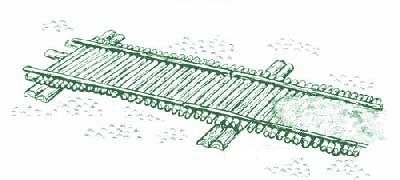
Corduroy road
A great portion of the way was over what is called a corduroy road, which is made by throwing trunks of trees into a marsh, and leaving them to settle there. The very slightest of jolts with which the ponderous carriage fell from log to log, was enough, it seemed to have dislocated all the bones in the human body.... Still, it was a fine day, and the temperature was delicious, and though we had left Summer behind us in the west, and were fast leaving Spring, we were moving towards Niagara and home. 
They spend the night in Upper Sandusky, a settlement of the Wyandot Indians, in a "large, low, ghostly room" with doors that open onto "the black night and wild country, and so contrived, that one of them always blew the other open."
My Boston friend climbed up to bed, somewhere in the roof, where another guest was already snoring hugely. But being bitten beyond his power of endurance, he turned out again, and fled for shelter to the coach, which was airing itself in front of the house. This was not a very politic step, as it turned out; for the pigs scenting him, and looking upon the coach as a kind of pie with some manner of meat inside, grunted round it so hideously, that he was afraid to come out again, and lay there shivering, till morning. 
Accommodations are somewhat better when they reach Sandusky, although Dickens observes that their host at the "comfortable little hotel on the brink of Lake Erie" is somewhat casual about their privacy: "he constantly walked in and out of the room with his hat on; and stopped to converse in the same free-and-easy state; and lay down on our sofa, and pulled his newspaper out of his pocket.... I should undoubtedly be offended by such proceedings at home, because there they are not the custom, and where they are not, they would be impertinences; but in America, the only desire of a good-natured fellow of this kind, is to treat is guests hospitably and well."

They take a steamboat to Cleveland, which he's interested in seeing because he read a newspaper from there while he was in Sandusky. A writer in the newspaper, commenting on negotiations being conducted over "points in dispute between the United States Government and Great Britain," had informed readers "that as America had 'whipped' England in her infancy, and whipped her again in her youth, so it was clearly necessary that she must whip her once again in her maturity." He finds Cleveland "a pretty town" and although he doesn't have an opportunity to meet "the wit who indited the paragraph in question, ... I have no doubt he is a prodigious man in his way, and held in high repute by a select circle."

Owing to the thinness of the walls between the cabins on board the steamboat, he also overhears some comments about himself: "'Boz is on board still, my dear.' After a considerable pause, he added, complainingly, 'Boz keeps himself very close;' which was true enough, for I was not very well, and was lying down, with a book.... 'I suppose that Boz will be writing a book by-and-by, and putting all our names in it!' at which imaginary consequence of being on board a boat with Boz, he groaned, and became silent."

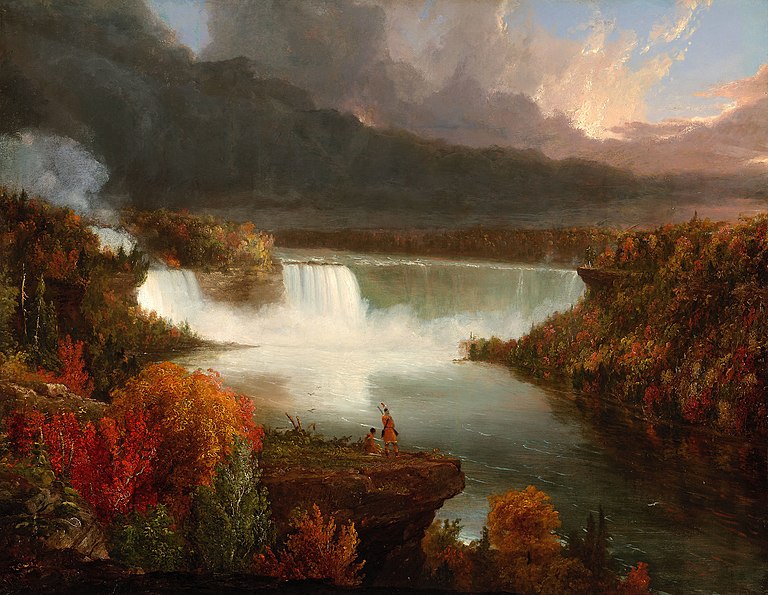
They reach Buffalo, where they take the train to Niagara on "a miserable day, chilly and raw," that is transformed when "for the first time, I heard the mighty rush of water, and felt the ground tremble underneath my feet." Niagara Falls has grown so familiar to us that it's hard to recapture the experience of the 19th century traveler who, as Thomas Cole did in his painting, identified it with the sublime.
Distant View of Niagara Falls (1830) by Thomas Cole, Art Institute of Chicago
Dickens put it this way:
It was not until I came on Table Rock, and looked -- Great Heaven, on what a fall of bright-green water! -- that it came upon me in its full might and majesty. Then, when I felt how near to my Creator I was standing, the first effect, and the enduring one -- instant and lasting -- of the tremendous spectacle, was Peace. Peace of Mind, tranquillity, calm recollections of the Dead, great thoughts of Eternal Rest and Happiness; nothing of gloom or terror. Niagara was at once stamped upon my heart, an Image of Beauty; to remain there, changeless and indelible, until its pulses cease to beat, for ever. 
And then on to Canada, which, he assures us, he does not intend to compare with the United States, so he'll keep it brief. Before leaving Niagara, however, he looks in the guest-books at Niagara Falls, "turned over a few leaves, and found them scrawled all over with the vilest and the filthiest ribaldry that ever human hogs delighted in ... and a reproach to the English side, on which they are preserved." (Interestingly, he refers to "the English side," and not the Canadian side.) He also notes that the quarters of the British soldiers at Niagara "are finely and airily situated," but also that "where the line of demarcation between one country and another is so very narrow as at Niagara, desertion from the ranks can scarcely fail to be of frequent occurrence."

They take the steamboat on Lake Ontario to Toronto, a town "full of life and motion, bustle, business, and improvement." From Toronto to Kingston, "a very poor town, rendered still poorer in the appearance of its market-place by the ravages of a recent fire. Indeed, it may be said of Kingston, that one half of it appears to be burnt down, and the other half not to be built up." But, he notes, it has "an admirable jail."

On May 10, they take a steamboat to Montreal on the St. Lawrence, a "noble stream ... especially in the commencement of this journey when it winds its way among the thousand islands." But the portages by stagecoach when the river grows too wild for the steamboat "render the way between the towns of Montreal and Kingston, somewhat tedious." The countryside near Montreal is "pleasant and well-cultivated" and "perfectly French in every respect: in the appearance of the cottages; the air, language, and dress of the peasantry; the sign-boards on the shops and taverns; and the Virgin's shrines, and crosses, by the wayside." They spend more than two weeks in Montreal, but Dickens finds little of interest to say about it, especially in comparison to Quebec.
Quebec seen from the Citadel, 1838, by John R.C. Smyth
The impression made upon the visitor by this Gibraltar of America; its giddy heights; its citadel suspended, as it were, in the air; its picturesque steep streets and frowning gateways; and the splendid views which burst upon the eye at every turn: is at once unique and lasting.
He also observes the "vast numbers of emigrants who have newly arrived from England or from Ireland" that pass through Quebec and Montreal on their way to the interior of Canada.

On May 30, they begin their return to New York. "But Canada has held, and always will retain, a foremost place in my remembrance. Few Englishmen are prepared to find it what it is" -- not a sleepy outpost of empire but a place "full of hope and promise." They travel on Lake Champlain to Burlington, Vermont, in a steamboat called the Burlington that is "a perfectly exquisite achievement of neatness, elegance, and order." From the "pretty town" of Burlington, they continue to Whitehall and then by stagecoach to Albany, "a large and busy town."

With only five days left before they sail for England, Dickens decides that he wants to see the Shaker village at Mount Lebanon. The journey through the Catskills (or "Kaatskill mountains" as he calls them) reminds him of scenes from Washington Irving. But along the way they come on a village of Irish settlers: "With means at hand of building decent cabins, it was wonderful to see how clumsy, rough, and wretched, its hovels were.... Hideously ugly old women and very buxom young ones, pigs, dogs, men, children, babies, pots, kettles, dunghills, vile refuse, rank straw, and standing water, all wallowing together in an inseparable heap, composed the furniture of every dark and dirty hut."

By contrast, the Shakers at Mount Lebanon (Dickens omits the "Mount") are clean and neat, but they don't win Dickens over either: "I felt about as much sympathy for them, and as much interest in them, as if they had been so many figure-heads of ships." They ask to see a worship service, and are shown to "some person in authority" in "a grim room, where several grim hats were hanging on grim pegs, and the time was grimly told by a grim clock which uttered every tick with a kind of struggle, as if it broke the grim silence reluctantly, and under protest." The "grim old Shaker" tells them that so many strangers had interrupted their worship that the chapel had been closed for a year.

So they go to shop for Shaker crafts in a store tended "by something alive in a russet case, which the elder said was a woman; and which I suppose was a woman, though I should not have suspected it." They are disappointed not to have witnessed Shaker worship, which he has been told "consists of a dance" in which the participants "accompany themselves with a droning, humming noise, and dance until they are quite exhausted, alternately advancing and retiring in a preposterous sort of trot. The effect is said to be unspeakably absurd: and if I may judge from a print of this ceremony which I have in my possession ... must be infinitely grotesque."
Engraving of Shakers dancing, c. 1840
There is no union of the sexes, and every Shaker, male and female, is devoted to a life of celibacy. Rumour has been busy upon this theme, but here again I must refer to the lady of the store, and say, that if many of the sister Shakers resemble her, I treat all such slander as bearing on its face the strongest marks of wild improbability.
As he does with all manifestations of Puritanism, Dickens is offended by that "which would strip life of its healthful graces, rob youth of its innocent pleasures, pluck from maturity and age their pleasant ornaments, and make existence but a narrow path towards the grave." So he leaves "the Shaker village with a hearty dislike of the old Shakers, and a hearty pity for the young ones."

The last stop on his itinerary is in "the fair and lovely Highlands of the North River, at West Point, which "could not stand on more appropriate ground, and any ground more beautiful can hardly be."
I was glad to think that among the last memorable beauties which had glided past us, and softened in the bright perspective, were those whose pictures, traced by no common hand, are fresh in most men's minds; not easily to grow old, or fade beneath the dust of Time: the Kaatskill Mountains, Sleepy Hollow, and the Tappaan Zee.

Wednesday, February 16, 2011

7. American Notes, by Charles Dickens, pp. 205-242

American Notes (Modern Library)Chapter 11: From Pittsburg to Cincinnati in a Western Steamboat. Cincinnati.; Chapter 12: From Cincinnati to Louisville in Another Western Steamboat; and From Louisville to St. Louis in Another. St. Louis.; Chapter 13: A Jaunt to the Looking-Glass Prairie and Back.
_____
They board the Messenger, which has "some forty passengers on board, exclusive of the poorer persons on the lower deck," having made sure to secure a stateroom toward the stern: "we had been a great many times very gravely recommended to keep as far aft as possible, 'because the steamboats generally blew up forward.'"
The steamboat Moselle exploded en route from Cincinnati to St. Louis on April 25, 1838.
"In all modes of travelling, the American customs, with reference to the means of personal cleanliness and wholesome ablution, are extremely negligent and filthy; and I strongly incline to the belief that a considerable amount of illness is referable to this cause." So a three-day journey, as this one was scheduled to be, was a trial to the fastidious. But another trial was mealtime: "Nobody says anything, at any meal, to anybody.... There is no conversation, no laughter, no cheerfulness, no sociality, except in spitting; and that is done in silent fellowship round the stove, when the meal is over." The poorer passengers on the lower deck, however, seem to have had some fun: "they amused themselves last evening till the night was pretty far advanced, by alternately firing off pistols and singing hymns."

The scenery along the Ohio is wilderness for miles and miles, "unbroken by any sign of human life or trace of human footstep; nor is anything seen to move about them but the blue jay, whose colour is so bright, and yet so delicate, that it looks like a flying flower." At rare intervals they see land being cleared for a farm, and in what is now West Virginia they come across the Grave Creek Mound:
so old, that mighty oaks and other forest trees have struck their roots into its earth; and so high, that it is a hill, even among the hills that Nature planted round it. The very river, as though it shared one's feelings of compassion for the extinct tribes who lived so pleasantly here, in their blessed ignorance of white existence, hundreds of years ago, steals out of its way to ripple near this mound; and there are few places where the Ohio sparkles more brightly than in the Big Grave Creek.
Further along the river at night, they come upon a fire in the forest: "The shape of every branch and twig is expressed in a deep red glow, and as the light wind stirs and ruffles it, they seem to vegetate in fire It is such a sight as we read of in legends of enchanted forests." Dickens meditates on the length of time that will have to pass for the forest to be regrown, and imagines a distant future in which the land has been recycled and another Dickens has come to see it:
But the time will come; and when, in their changed ashes, the growth of centuries unborn has struck its roots, the restless men of distant ages will repair to these again unpeopled solitudes; and their fellows, in cities far away, that slumber now, perhaps, beneath the rolling sea, will read in language strange to any ears in being now, but very old to them, of primeval forests where the axe was never heard, and where the jungled ground was never trodden by a human foot.
They reach Cincinnati, "a beautiful city; cheerful, thriving, and animated. I have not often seen a place that commends itself so favourably and pleasantly to a stranger at the first glance as this does: with its clean houses of red and white, its well-paved roads, and foot-ways of bright tile." A Temperance Convention is taking place while Dickens is there, and he's "pleased to see the Irishmen, who formed a distinct society among themselves," taking part in it. In the parade there's a banner showing on one side the explosion of "the steamship Alcohol ... while upon the other, the good ship Temperance sailed away with a fair wind."
A view of Cincinnati from the north in 1841.

He also visits one of the city's free schools and a courtroom, and pronounces its citizens "intelligent, courteous, and agreeable, observing that "but two-and-fifty years have passed away since the ground on which it stands (bought at that time for a few dollars) was a wild wood, and its citizens but a handful of dwellers in scattered log huts upon the river's shore."

Peter Pitchlynn

On the steamboat to Louisville, Dickens encounters the Choctaw chief Peter Pitchlynn, whom he finds a relief from "the usual crowd of dreary passengers." When he tells Pitchlynn that he is sorry not to see him in native dress, Pitchlynn replies "that his race were losing many things besides their dreass, and would soon be seen upon the earth no more." Pitchlynn is returning from Washington, so Dickens "asked him what he thought of Congress? He answered, with a smile, that it wanted dignity, in an Indian's eyes." Dickens invites him to visit England and assures him he would be well-received there. "He was evidently pleased by this assurance, though he rejoined with a good-humoured smile and an arch shake of the head, that the English used to be very fond of the Red Men when they wanted their help, but had not cared much for them, since."

Jim Porter
Louisville doesn't interest Dickens much, so they set out on another steamboat, the Fulton, right away. On it he encounters another celebrity, the Kentuckian Jim Porter, who stood seven feet, eight inches tall, and "went bobbing down the cabin, among men of six feet high and upwards, like a lighthouse walking among lamp-posts." But once again he finds the dreariness of the silent meals aboard the steamboat oppressive: "Reading and writing on my knee, in our little cabin, I really dreaded the coming of the hour that summoned us to table; and was as glad to escape from it again, as if it had been a penance or a punishment.... I seriously believe the recollection of these funeral feasts will be a waking nightmare to me all my life."

But another kind of nightmare presents itself as they near the confluence of the Ohio and Mississippi Rivers at Cairo: "a spot so much more desolate than any we had yet beheld," "a breeding-place of fever, ague, and death," "A dismal swamp, on which the half-built houses rot away: cleared here and there for the space of a few yards; and teeming, then, with rank, unwholesome vegetation," "a place without one single quality, in earth or air or water, to commend it: such is this dismal Cairo." But the Mississippi River itself is even worse, in Dickens's eyes: "An enormous ditch, sometimes two or three miles wide, running liquid mud, six miles and hour.... For two days we toiled up this foul stream." Even a magnificent sunset doesn't cheer him; as it fades, "the scene became a thousand times more lonesome and more dreary than before, and all its influences darkened with the sky." Nevertheless, he "drank the muddy water of this river while we were upon it. It is considered wholesome by the natives, and is something more opaque than gruel."

Reaching St. Louis, then, is a relief, and the hotel, the Planter's House, pleases him: "the proprietors have the most bountiful notions of providing the creature comforts. Dining alone with my wife in our room, one day, I counted fourteen dishes on the table at once." Still, the city, he finds, "is not likely ever to vie, in point of elegance or beauty, with Cincinnati." He particularly dislikes the climate: "I think it must rather dispose to fever, in the summer and autumnal seasons. Just adding, that it is very hot, lies among great rivers, and has vast tracks of undrained swampy land around it, I leave the reader to form his own opinion."

The great plains of America were something new for many Europeans, and Dickens hankered to witness the prairie for himself, arranging a visit to the Looking-Glass Prairie near St. Louis, but on the other side of the river, in Illinois.
I may premise that the word Prairie is variously pronounced paraaer, parearer, and paroarer. The latter mode of pronunciation is perhaps the most in favour.
Was this ever true? In any case, the journey to this grassland that so fascinated Dickens was a troublesome one through mucky, insect-ridden swamps, and when he got there, he was unimpressed. The day before they set out "had been -- not to say hot, for the term is weak and lukewarm in its power of conveying an idea of the temperature. The town had been on fire; in a blaze." Along the way, "The air resounded in all directions with the loud chirping of the frogs, who, with the pigs (a coarse, ugly breed, as unwholesome-looking as thought they were the spontaneous growth of the country), had the whole scene to themselves."

The journey takes them through a town called Belleville, "a small collection of wooden houses, huddled together in the very heart of the bush and swamp," where Dickens encounters a Doctor Crocus, "a tall fine-looking Scotchman, but rather fierce and warlike in appearance for a professor of the peaceful art of healing." Although Doctor Crocus, who is there to give a lecture on phrenology, greets Dickens as a "countryman," he seems to be unimpressed with the famous author, "as if I didn't by any means realise his expectations, which, in a linen blouse, and a great straw hat, with a green ribbon, and no gloves, and my face and nose profusely ornamented with the stings of mosquitoes and the bites of bugs, it is very likely I did not." When Dickens asks if Doctor Crocus plans to return "to the old country" anytime soon, the doctor makes a great show of his answer, summoning the crowd by repeating Dickens's question and then saying, "in a very loud voice:"
"Not yet awhile, Sir, not yet. You won't catch me at that just yet, Sir. I am a little too fond of freedom for that, Sir. Ha, ha! It's not so easy for a man to tear himself from a free country such as this is, Sir. Ha, ha! No, no! Ha, ha! None of that till one's obliged to do it, Sir. No, no!" 
The next day they travel on, and their goal at sunset. "It would be difficult to say why, or how -- though it was possibly from having heard and read so much about it -- but the effect on me was disappointment. Looking towards the setting sun, there lay, stretched out before my view, a vast expanse of level ground; unbroken, save by one thin line of trees, which scarcely amounted to a scratch upon the great blank." What Dickens seems to have been anticipating from the prairie is "that sense of freedom and exhilaration which a Scottish heath inspires, or even our English downs awaken. It was lonely and wild, but oppressive in its barren monotony."
The Monks Mound

They return to St. Louis by a different route, which takes them past the great Monks Mound at the Cahokia Mounds near Collinsville. But Dickens is less interested in this great remnant of the Mississippian culture than in its association with "a body of fanatics of the order of La Trappe, who founded a desolate convent there, many years ago, when there were no settlers within a thousand miles, and were all swept off by the pernicious climate: in which lamentable fatality, few rational people will suppose, perhaps, that society experienced any very severe deprivation." The difficult and disappointing journey to the prairie may explain the harshness of Dickens's mood, which continues when they pass
a spot called Bloody Island, the duelling-ground of St. Louis, and so designated in honour of the last fatal combat fought there, which was with pistols, breast to breast. Both combatants fell dead upon the ground; and possibly some rational people may think of them, as of the gloomy madmen on the Monks' Mound, that they were no great loss to the community.
The duel referred to was between Thomas Biddle and Spencer Darwin Pettis in 1831. Biddle challenged Pettis for slandering Biddle's brother, Nicholas Biddle, president of the Second Bank of the United States, the abandoned headquarters of which had been across the street from Dickens's hotel in Philadelphia.

Monday, February 14, 2011

5. American Notes, by Charles Dickens, pp. 128-168

American Notes (Modern Library)Chapter 7: Philadelphia, and Its Solitary Prison; Chapter 8: Washington. The Legislature. And the President's House.
_____
I'm sure this joke has been made before, but sometimes it seems like American Notes should really have been titled Great Expectorations. The attack on the American habit of spitting begins on the train ride from New York to Philadelphia, in which Dickens observes that the "gentlemen's car" in front of the one in which he was riding seemed to contain
a number of industrious persons inside, ripping open feather-beds, and giving the feathers to the wind. At length it occurred to me that they were only spitting, which was indeed the case; though how any number of passengers which it was possible for that car to contain, could have maintained such a playful and incessant shower of expectoration, I am still at a loss to understand.
In any case, it is only a prelude to what Dickens calls the "salivatory phenomena" that he subsequently documents.
The Second Bank of the United States

From his hotel room in Philadelphia, Dickens looks out on "a handsome building of white marble, which had a mournful, ghost-like aspect, dreary to behold." He learns that the building is "the Tomb of many fortunes; the Great Catacomb of investment; the memorable United States Bank" whose failure in 1841 was a financial disaster. The phrase "too big to fail" had not yet been coined.

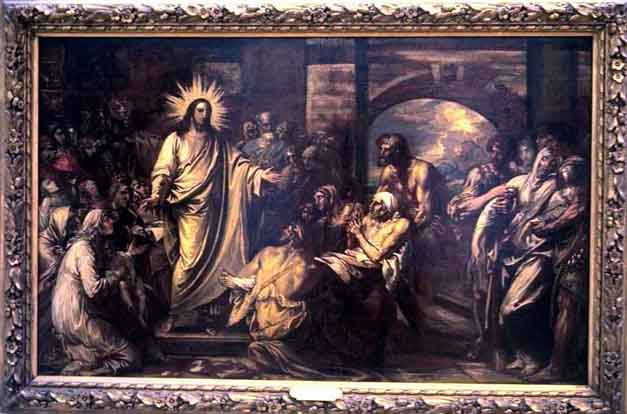
Philadelphia itself "is a handsome city, but distractingly regular. After walking about it for an hour or two, I felt that I would have given the world for a crooked street." As usual, he inspects the various public institutions, including "a most excellent Hospital -- a quaker establishment, but not sectarian in the great benefits it confers," and which contains "a picture by West, which is exhibited for the benefit of the funds of the institution. The subject is, our Saviour healing the sick, and it is, perhaps, as favourable a specimen of the master as can be seen anywhere. Whether this be high or low praise, depends upon the reader's taste." (Dickens, one suspects, didn't care much for it.)
Benjamin West, Christ Healing the Sick in the Temple
He found Philadelphia, on the whole, "more provincial than Boston or New York."
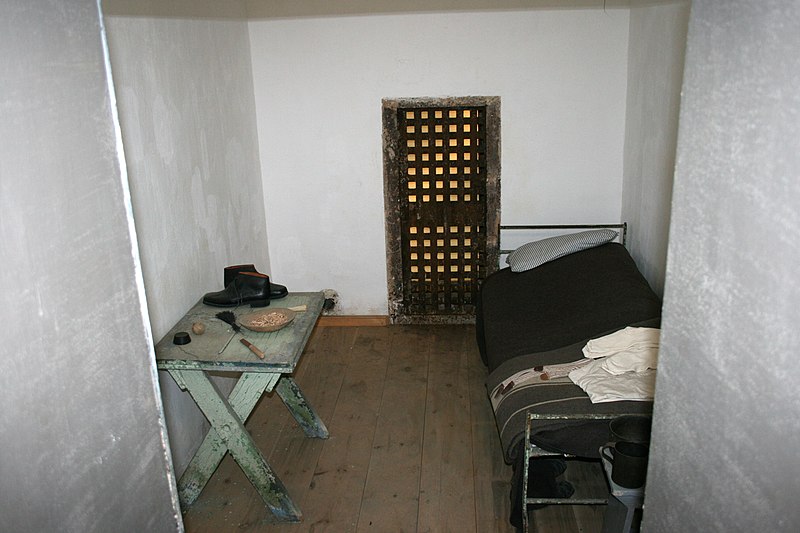
In the outskirts, stands a great prison, called the Eastern Pentitentiary; conducted on a plan peculiar to the state of Pennsylvania. The system here, is rigid, strict, and hopeless solitary confinement. I believe it, in its effects, to be cruel and wrong.
The State Penitentiary for the Eastern District of Pennsylvania, 1855.
Dickens's account of the life of prisoners at the Eastern Penitentiary is scathingly empathic. "He is a man buried alive; to be dug out in the slow round of years; and in the meantime dead to everything but torturing anxieties and horrible despair." He mistrusts the prisoners who assure him that they are made better by the solitary ordeal, denouncing one for "the unmitigated hypocrisy with which he declared that he blessed the day on which he came into that prison, and that he never would commit another robbery as long as he lived." And he uncovers once again the pervasive racism of the era when, discovering a "pretty coloured boy" housed in the prison, he asks if there are no juvenile facilities for young offenders and is told, "Yes, but only for white children."
A contemporary re-creation of a cell at the Eastern Penitentiary
On the haggard face of every man among these prisoners, the same expression sat. I know not what to liken it to. It had something of that strained attention which we see upon the faces of the blind and deaf, mingled with a kind of horror, as though they had all been secretly terrified.
He does find, however, that the women prisoners seem to fare better than the men, "Whether this be because of their better nature, which is elicited in solitude, or because of their being gentler creatures, of greater patience and longer suffering, I do not know; but so it is." He even observes that solitary confinement seems to dull the prisoners' sense of hearing, an impression confirmed in a conversation with one of the prisoners.

From Philadelphia they go by steamboat to Washington, encountering on the journey some fellow Englishmen who turn out to "display an amount of insolent conceit and cool assumption of superiority, quite monstrous to behold." So much so, "that I would cheerfully have submitted to a reasonable fine, if I could have given any other country in the whole world, the honour of claiming them for its children."

But Washington turns out to be "the head-quarters of tobacco-tinctured saliva" and he regrets that he had once been persuaded "that previous tourists have exaggerated its extent. The thing itself is an exaggeration of nastiness, which cannot be overdone." He is also unnerved by a stop at Baltimore where they "were waited on, for the first time, by slaves." And he experiences the downside of celebrity, when, transferring to a train, they are beset by gawkers who "feel to comparing notes on the subject of my personal appearance, with as much indifference as if I were a stuffed figure. I never gained so much uncompromising information with reference to my own nose and eyes, and various impressions wrought by my mouth and chin on different minds, and how my head looks when it is viewed from behind."

The United States Capitol, c. 1840. The original dome was replaced in 1855. 
Reaching Washington, he is impressed by "a beautiful view of the Capitol, which is a fine building of the Corinthian order, placed upon a noble and commanding eminence." But the rest of the city failed to impress him:
Take the worst parts of the City Road and Pentonville, or the straggling outskirts of Paris, where the houses are smallest, preserving all their oddities, but especially the small shops and dwellings.... Burn the whole down; build it up again in wood and plaster; widen it a little; throw in parts of St. John's Wood; put green blinds outside all the private houses, with a red curtain and a white one in every window; plough up all the roads; plant a great deal of coarse turf in every place where it ought not to be; erect three handsome buildings in stone and marble, anywhere, but the more entirely out of everybody's way the better; call one the Post Office, one the Patent Office, and one the Treasury; make it scorching hot in the morning, and freezing cold in the afternoon, with an occasional tornado of wind and dust; leave a brick-field without all the bricks, in all central places where a street may naturally be expected, and that's Washington. 
And he has no hopes for improvement: "Such as it is, it is likely to remain." That's because its only source of income is the government: "It has no trade or commerce of its own." It is also "very unhealthy."

He admires the Capitol rotunda, but is less impressed with Horatio Greenough's statue of George Washington, which "struck me as being rather strained and violent for its subject." But then he ventures into Congress, which doesn't impress him at all: "In the first place -- it may be from some imperfect development of my organ of veneration -- I do not remember having ever fainted away, or having even been moved to tears of joyful pride, at sight of any legislative body." But he is infuriated by the attacks in the United States Congress against members who oppose "the infamy of that traffic, which has for its accursed merchandise men and women, and their unborn children." He admits that among the congressmen and senators there are men of "intelligence and refinement: the true, honest, patriotic heart of America, ... but they scarcely coloured the stream of desperate adventurers which sets that way for profit and for pay." He also acknowledges that "the distinguished gentleman who is now [the United States'] Minister at the British Court sustains its highest character abroad." (The ambassador to Great Britain in 1842 was Edward Everett.) And of course, Congress is full of spitters:
Both houses are handsomely carpeted; but the state to which these carpets are reduced by the universal disregard of the spittoon with which every honourable member is accommodated, and the extraordinary improvements on the pattern which are squirted and dabbled upon it in every direction, do not admit of being described.
Daguerreotype of the south front of the White House in 1846, the first known photograph of the building
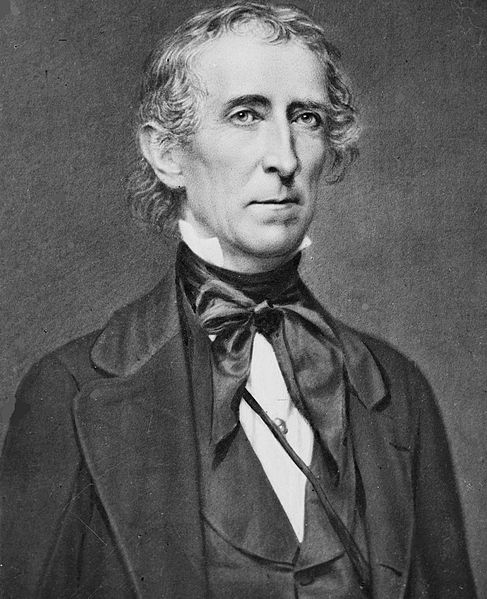
John Tyler, daguerreotype by Mathew Brady, 1845
The White House "is more like an English clubhouse, both within and without, than any other kind of establishment with which I can compare it." Even there, the spitters are at work, bestowing "their favours so abundantly upon the carpet, that I take it for granted the Presidential housemaids have high wages." He is presented to President John Tyler, who "looked somewhat worn and anxious, and well he might; being a war with everybody -- but the expression of his face was mild and pleasant, and his manner was remarkably unaffected, gentlemanly, and agreeable. I thought that in his whole carriage and demeanour, he became his station well." The Dickenses attend a dinner at the White House, where he is happy to encounter a friend, Washington Irving, who has just been appointed ambassador to Spain.

The "premature heat of the season" makes Dickens change his plans to go south to Charleston, which would also expose him to "the pain of living in the constant contemplation of slavery." So he decides instead to "listen to old whisperings which had often been present to me at home in England, when I little thought of ever being here; and to dream again of cities growing up, like palaces in fairy tales, among the wilds and forests of the west."

Sunday, February 13, 2011

4. American Notes, by Charles Dickens, pp. 93-127

American Notes (Modern Library)Chapter 5: Worcester. The Connecticut River. Hartford. New Haven. To New York.; Chapter 6: New York.
_____
And so into the hinterlands, with a first stop at the "pretty New England town" of Worcester, Mass. Dickens notes, parenthetically, that many of the towns and cities of New England "would be villages in Old England." He also observes that "The well-trimmed lawns and green meadows of home are not there; and the grass, compared with our ornamental plots and pastures, is rank, and rough, and wild." And once again, it's the newness of everything that amazes him: "All the buildings looked as if they had been built and painted that morning, and could be taken down on Monday with very little trouble." But the town lacks the picturesqueness he's accustomed to: "It would have been the better for an old church; better still for some old graves." (Wait a century or so, and tourists will flock to New England for precisely that sense of antiquity and stability.)

From Worcester, they travel by rail to Springfield, and thence by steamboat to Hartford on the Connecticut River, which is unusually free of ice for this time of year -- it was only "the second February trip, I believe, within the memory of man." The boat strikes him as tiny, but he notes that even in the "Lilliputian" cabin "there was a rocking-chair. It would be impossible to get on anywhere, in America, without a rocking chair." The weather was bad -- not one of those crystal-clear days he has remarked on earlier: "It rained all day as I once thought it never did rain anywhere, but in the Highlands of Scotland" -- but they were wrapped up well and "bade defiance to the weather, and enjoyed the journey."  

They stay in Hartford for four days, but Dickens finds little to remark on except that
It is the seat of the local legislature of Connecticut, which sage body enacted, in bygone times, the renowned code of "Blue Laws," in virtue whereof, among other enlightened provisions, any citizen who could be proved to have kissed his wife on Sunday, was punishable, I believe, with the stocks. Too much of the old Puritan spirit exists in these parts to the present hour.
Otherwise, he "found the courts of law here, just the same as at Boston; the public institutions almost as good." As usual, he visits an institution for the mentally ill, and is charmed once again by the way the staff humors the delusions of the inmates. A woman approaches him and asks for his autograph, which he grants. Once she leaves, he asks the doctor, "I hope she is not mad?" But she is, the doctor admits: "She hears voices in the air." Which provokes Dickens to wish that "a few false prophets of these later times, who have professed to do the same" could be institutionalized: "I should like to try the experiment on a Mormonist or two to begin with."

They go by railroad to New Haven, where they admire the abundance of elm trees, especially those that "surround Yale College, an establishment of considerable eminence and reputation.... The effect is very like that of an old cathedral yard in England; and when their branches are in full leaf, must be extremely picturesque." The trees give New Haven "a very quaint appearance: seeming ot bring about a kind of compromise between town and country."

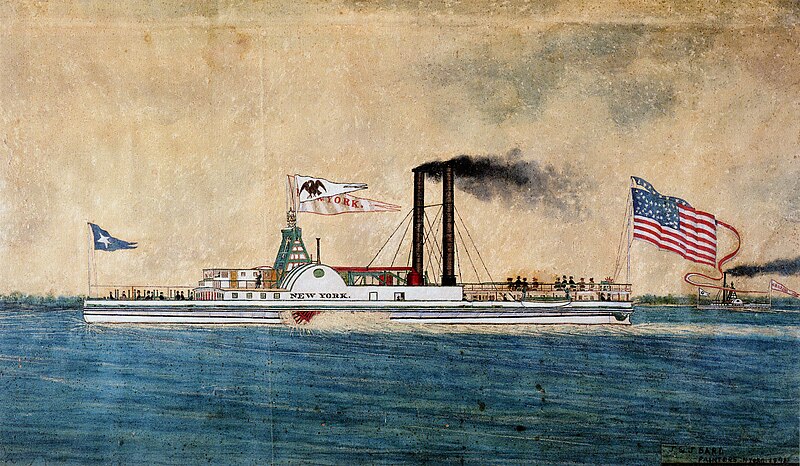
The New York, a Long Island Sound steamboat built in 1836
From New Haven they sail for New York on "the first American steamboat of any size that I had seen; and certainly to an English eye it was infinitely less like a steamboat than a huge floating bath." 

The beautiful metropolis of America is by no means so clean a city as Boston, but many of its streets have the same characteristics; except that the houses are not quite so fresh-coloured, the sign-boards are not quite so gaudy, the gilded letters not quite so golden, the bricks not quite so red, the stone not quite so white, the blinds and area railings not quite so green, the knobs and plates so bright and twinkling.
Looking south on lower Broadway toward Trinity Church, 1834
They walk down Broadway, impressed by the thronging variety of people, but particularly noticing a pair of Irish workmen in search of an address. "It would be hard to keep your model republics going, without the countrymen and countrywomen of those two labourers. For who else would dig, and delve, and drudge, and do domestic work, and make canals and roads, and execute great lines of Internal Improvement." Dickens talks with them and learns that one had worked to earn money to bring the other over. "That done, they worked together side by side, contentedly sharing hard labour and hard living for another term, and then their sisters came, and then another brother, and lastly, their old mother." She, however, longs to return home to be buried with her people, so now they are working to pay her return passage.

The Halls of Justice, known as The Tombs, c. 1870
He visits Wall Street and the Bowery, and winds up contemplating a "dismal-fronted pile of bastard Egyptian, like an enchanter's palace in a melodrama! -- a famous prison, called the Tombs." It's not quite the model prison Dickens is looking for, and among other things he discovers that "coloured people" are kept in the lowest and most "unwholesome" cells. None of the prisoners is allowed exercise, and the guard he talks to is unimpressed with Dickens's statement, "In England, if a man be under sentence of death, even he has air and exercise at certain periods of the day." He find the son, "ten or twelve years old," of a man charged with murdering his wife, housed in the same "dreadful place" until he can be a witness in the trial. As for why the place is called "The Tombs," the jailer can only say that "Some suicides happened here, when it was first built. I expect it come about from that."

Back on the streets, Dickens observes the swine that roam the city, serving as scavengers. "Ugly brutes they are; having, for the most part, scanty brown backs, like the lids of old horsehair trunks:  spotted with unwholesome black blotches. They have long, gaunt legs, too, and such peaked snouts, that if one of them could be persuaded to sit for his profile, nobody would recognise it for a pig's likeness." When night falls, Broadway grows quiet, for there are no street musicians and performers, and as he will later tell us, the theaters for which it became famous didn't exist then. The sole "amusements" he can find are the newspapers hawked by "precocious urchins" that deal
in round abuse and blackguard names; pulling off the roofs of private houses, ... pimping and pandering for all degrees of vicious taste, and gorging with coined lies the most voracious maw; imputing to every man in public life the coarsest and vilest motives; scaring away from the stabbed and prostrate body-politic, every Samaritan of clear conscience and good deeds; and setting on, with yell and whistle and the clapping of foul hands, the vilest vermin and worst birds of prey.
Dickens now ventures into the slum known as Five Points, "narrow ways, diverging to the right and left, and reeking everywhere with dirt and filth." He is taken into a place that turns out to be a kind of barracks for poor blacks, where "the floor is covered with heaps of negro women, waking from their sleep; their white teeth chattering, and their bright eyes glistening and winking on all sides with surprise and fear.... Where dogs would howl to lie, women, and men, and boys slink off to sleep, forcing the dislodged rats to move away in quest of better lodgings."

Then he is taken to a place where black performers dance for the amusement of customers:
William Henry Lane ("Master Juba") dances in New York's Five Points District as Charles Dickens and a companion watch in the background. Engraving from American Notes by Charles Dickens (1842).
They return to the streets and find themselves in the vicinity of The Tombs, at the "city watch-house," where offenders (presumably prostitutes, though Dickens is not able to say the word) rounded up await the magistrate's court that opens at five in the morning. "Why, such indecent and disgusting dungeons as these cells, would bring disgrace upon the most despotic empire in the world." It is "a place, quite unsurpassed in all the vice, neglect, and devilry, of the worst old town in Europe."

Nor is he cheered by a visit he makes "to the different public institutions on Long Island, or Rhode Island: I forget which." (He presumably means Long Island, since a trip to Rhode Island would take him a long way back in the direction he came from.) He visits another "Lunatic Asylum," but in this one he doesn't find the atmosphere of tolerance that he found in the ones in New England: "The terrible crowd with which these halls and galleries were filled, so shocked me, that I abridged my stay within the shortest limits and declined to see that portion of the building in which the refractory and violent were under closer restraint." He ascribes the difference of this institution to the fact that its management consists of the beneficiaries of political patronage:
the miserable strife of Party feeling is carried even into this sad refuge of afflicted and degraded humanity.... Will it be believed that the governor of such a house as this, is appointed, and deposed, and changed perpetually, as Parties fluctuate and vary....? A hundred times in every week, some new most paltry exhibition of that narrow-minded and injurious Party Spirit, which is the Simoom of America, sickening and blighting everything of wholesome life within its reach, was forced upon my notice.
The Alms House, an institution for the poor, is no better, though he observes that "The prison for the State at Sing Sing, is, on the other hand, a model jail." And there are in New York, he notes, "excellent hospitals and schools, literary institutions and libraries; an admirable fire department (as indeed it should be, having constant practice), and charities of every sort and kind."

But there are only "three principal theatres," and two of them "are, I grieve to write it, generally deserted. The third, the Olympic, is a tiny show-box for vaudevilles and burlesques." And there is "a small summer theatre, called Niblo's ... but I believe it is not exempt from the general depression under which Theatrical Property, or what is humorously called by that name, unfortunately labours." Niblo's and other theaters would later thrive.

While in New York, he books his return ticket for June, "the month in which I had determined, if prevented by no accident in the course of my ramblings, to leave America." And he ends his account of his stay in New York with a tribute to the friends he had made there: "I never thought the name of any place, so far away and so lately known, could ever associate itself in my mind with the crowd of affectionate remembrances that now cluster about it."

Saturday, February 12, 2011

3. American Notes, by Charles Dickens, pp. 81-92

American Notes (Modern Library)Chapter 4: An American Railroad. Lowell and Its Factory System.
_____
Dickens takes the train to Lowell, Mass., and naturally has much to say about the American railway system.
There are no first and second class carriages as with us; but there is a gentlemen's car and a ladies' car: the main distinction beween which is that in the first, everybody smokes; and in the second, nobody does. As a black man never travels with a white one, there is also a negro car; which is a great blundering clumsy chest, such as Gulliver put to sea in, from the kingdom of Brobdingnag. 
And as usual in America, the train is overheated: "In the centre of the carriage, there is a stove, fed with charcoal or anthracite coal; which is for the most part red-hot. It is insufferably close."

He is struck by the fact that "any lady may travel alone, from one end of the United States to the other, and be certain of the most courteous and considerate treatment everywhere." But he finds his fellow male travelers to be rather difficult to communicate with, since many of them seem so concerned to demonstrate the superiority of the United States over England, "and wherever you are going, you invariably learn that you can't get there without immense difficulty and danger, and that all the great sights are somewhere else."
Politics are much discussed, so are banks, so is cotton. Quiet people avoid the question of the Presidency, for there will be a new election in three years and a half, and party feeling runs very high: the great constitutional feature of this institution being, that directly the acrimony of the last election is over, the acrimony of the next one begins.
Some things don't change.

Along the way to Lowell, Dickens gets his first look at the young country being transformed by the railroad, observing that "on every side there are the boughs, and trunks, and stumps of trees, in every possible stage of decay, decomposition, and neglect." The debris of the wilderness that is being cleared is occasionally interrupted by "open country, glittering with some bright lake or pool, broad as many an English river, but so small here that it scarcely has a name." I remember a friend whose father had come to the United States as a small boy from England. When an aunt who had stayed in England came to visit, my friend was amused by the question she would ask as they drove about the American countryside: "Now, what is the name of that wood?" The vast emptiness and newness of the land Dickens encounters both fascinates and disturbs him.
The train calls at stations in the woods, where the wild impossibility of anybody having the smallest reason to get out, is only to be equalled by the apparently desperate hopelessness of there being anybody to get in. 
This is, we remember, Massachusetts in 1842, not the wilds of Montana. And the journey by rail from Boston to Lowell was only 26 miles.

He's equally impressed by the newness of Lowell, which is "only just of age -- for if my recollection serve me, it has been a manufacturing town barely one-and-twenty years." (Dickens is a little off here: The Boott Mill, the first Lowell textile mill, opened in 1823.) Indeed, "nothing in the whole town looked old to me, except the mud, which in some parts was almost knee-deep, and might have been deposited there, on the subsiding of the waters of the Deluge ... and when I saw a baby of some week or ten days old in a woman's arms at a street corner, I found myself unconsciously wondering where it came from: never supposing for an instant that it could have been born in such a young town as that."

He has been invited there, of course, as a critic of the abuses of the Industrial Revolution, to inspect the working conditions of the Lowell mill girls, and he comes away impressed. (Far more impressed than later critics of the exploitation of the young female workers, drawn from New England farms.) He finds them "all well dressed, but not to my thinking above their condition; for I like to see the humbler classes of society careful of their dress and appearance."
The rooms in which they worked, were as well ordered as themselves. In the windows of some, there were green plants, which were trained to shade the glass; in all, there was as much fresh air, cleanliness, and comfort, as the nature of the occupation would possibly admit of.
He notes that "There are a few children employed in these factories, but not many. The laws of the State forbid their working more than nine months in the year, and require that they be educated during the other three."

Compared to the documented horrors of English mill work, this seems to Dickens quite satisfactory. And he expects that his readers will be shocked to learn, further, that "Firstly, there is a joint-stock piano in a great many of the boarding-houses. Secondly, nearly all these young ladies subscribe to circulating libraries." And thirdly, that they publish their own periodical, The Lowell Offering, "A repository of original articles, written exclusively by females actively employed in the mills." The objection in England that he anticipates is, "These things are above their station." He replies, "Are we quite sure that we in England have not formed our ideas of the 'station' of working people, from accustoming ourselves to the contemplation of that class as they are, and not as they might be?"

Still, he claims, "I have carefully abstained from drawing a comparison between these factories and those of our own land." Largely because the reader of Dickens already knows what comparisons he would draw.

2. American Notes, by Charles Dickens, pp. 14-80

American Notes (Modern Library)Chapter 2: The Passage Out; Chapter 3: Boston
_____
There are eighty-six passengers on the Britannia, and they are in for a harrowing voyage. Even at the best, as Dickens notes, there is an "extraordinary compound of strange smells, which is to be found nowhere but on bard ship, and which is such a subtle perfume that it seems to enter at every pore of the skin, and whisper of the hold." You can imagine what a poorly ventilated steamship in 1842 with eighty-six passengers, plus crew, might smell like. Especially when seasickness begins to afflict everyone, as it now does.
Everything sloped the wrong way: which in itself was an aggravation scarcely to be borne. I had left the door open, a moment before, in the bosom of a gentle declivity, and, when I turned to shut it, it was on the summit of a lofty eminence.... I am awakened out of my sleep by a dismal shriek from my wife, who demands to know whether there is any danger.... The water-jug is plunging and leaping like a lively dolphin; all the smaller articles are afloat, except my shoes, which are stranded on a carpet-bag, high and dry, like a couple of coal-barges. Suddenly I see them spring into the air, and behold the looking-glass, which is nailed to the wall, sticking fast upon the ceiling. At the same time the door entirely disappears, and a new one is opened in the floor. Then I begin to comprehend that the state-room is standing on its head.
A steward informs him, "Rather a heavy sea on." The tumult is followed in the day by "the very remarkable and far from exhilarating sounds raised in their various staterooms by the seventy passengers who were too ill to get up to breakfast." I don't get seasick (except in a porch swing, which makes me terribly nauseated), and remember crossing the English Channel with a lot of people who were. I think it might have been better to be sick and to elicit sympathy for it than to spend one's time dodging effluents. Dickens rather nastily remembers being pleased that his wife was "too ill to talk to" him.


Below decks was bad enough, but when Dickens ventures above, "I could not even make out which was the sea, and which the sky, for the horizon seemed drunk, and was flying wildly about in all directions." And so on, with various Dickensian exaggerations, including his attempt to give his wife and a friend some brandy and water while they are seated on a sofa. The rolling of the ship causes them to slide back and forth. "I dodged them up and down this sofa for at least a quarter of an hour, without reaching them once; and by the time I did catch them, the brandy-and-water was diminished, by constant spilling, to a teaspoonful."


The best assurance he can get from the crew is that the weather is going to improve: "the weather is always going to improve to-morrow, at sea." But finally, after fifteen days of this, they reach Halifax -- or almost, for they get stuck on a mud-bank, and then wind up off course. "Our captain had foreseen from the first that we must be in a place called the Eastern passage; and so we were. It was about the last place in the world in which we had any business or reason to be, but a sudden fog, and some error on the pilot's part, were the cause." But eventually they make it to Halifax, which "would have appeared an Elysium, though it had been a curiosity of ugly dulness. But I carried away with me a most pleasant impression of the town and its inhabitants, and have preserved it to this hour."


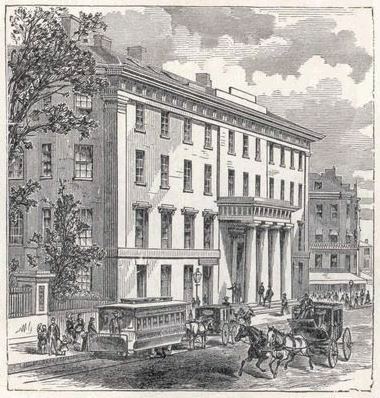
The Tremont House, Boston, c. 1850-1860
After seven hours at Halifax, they set out again, encounter more rough seas in the Bay of Fundy, and finally, "on Saturday, the twenty-second of January, an American pilot-boat came alongside, and soon afterwards the 'Britannia' steam-packet, from Liverpool, eighteen days out, was telegraphed at Boston." And soon the Dickenses are at the Tremont House, which "has more galleries, colonnades, piazzas, and passages than I can remember, or the reader would believe.


Dickens likes Boston. He praises the "courtesy" and the "attention, politeness and good humour" of its officials. He is a bit annoyed on the first morning there, a Sunday, when he is accosted by all manner of people inviting him to their churches. (He had the excuse that his clothes hadn't been unpacked.) He regrets that he didn't have a chance to hear William Ellery Channing preach, especially because of "the bold philanthropy with which he has ever opposed himself to that most hideous blot and foul disgrace -- Slavery." (This is the first reference to the subject in the book.) 


The bright, clear air in the city invigorates him, though it seems to him so fresh and new as to be "slight and unsubstantial in appearance.
The suburbs are, if possible, even more unsubstantial-looking than the city. The white wooden houses (so white that it makes one wink to look at them), with their green jalousie blinds, are so sprinkled and dropped about in all directions, without seeming to have any root at all in the ground; and the small churches and chapels are so prim, and bright, and highly varnished; that I almost believed the whole affair could be taken up piecemeal like a child's toy and crammed into a little box. The city is a beautiful one, and cannot fail, I should imagine, to impress all strangers very favourably.
He attributes the "intellectual refinement and superiority of Boston" to the presence of Harvard, or as he calls it, "the University of Cambridge, which is within three or four miles of the city." And he launches into an encomium (which Hitchens thinks somewhat undeserved) of American higher education:
Whatever the defects of American universities may be, they disseminate no prejudices; rear no bigots; dig up the buried ashes of no old superstitions; never interpose between the people and their improvement; exclude no man because of his religious opinions; above all, in their whole course of study and instruction, recognise a world, and a broad one too, lying beyond the college walls.
It might be remembered that Dickens was not a university man, and so had a bias against the British universities.


He then turns his attention to "the public institutions and charities of this capital of Massachusetts," which he believes to be "as nearly perfect, as the most considerate wisdom, benevolence, and humanity, can make them." He proclaims his belief in the necessity of public charity: "I cannot but think, with a view to the principle and its tendency to elevate or depress the character of the industrious classes, that a Public Charity is immeasurably better than a Private Foundation, no matter how munificently the latter may be endowed."


He is particularly impressed with the Perkins Institution and Massachusetts Asylum for the Blind. He goes there on a day with "an Italian sky above, and the air so clear and bright on every side, that even my eyes, which are none of the best, could follow the minute lines and scraps of tracery in distant buildings." This is a setup for an encounter with a sightless boy at the school. Dickens is admiring the view when he turns and sees "a blind boy with his sightless face addressed that way, as though he too had some sense within him of the glorious distance: I felt a king of sorrow that the place should be so very light, and a strange wish that for his sake it were darker." It's a strange kind of imaginative sympathy that comes out of a sense of guilt at being gifted with something another person lacks.
It is strange to watch the faces of the blind, and see how free they are from all concealment of what is passing in their thoughts; observing which, a man with eyes may blush to contemplate the mask he wears.
Laura Bridgman, c. 1855
The bulk of the visit is taken up with the story of Laura Bridgman, who was deaf and blind. Bridgman entered the Perkins school at the age of eight, and was taught by developing her sense of touch. Samuel Gridley Howe, the director of the institution, was her teacher. (His wife, Julia Ward Howe, wrote "The Battle Hymn of the Republic.") Dickens's account of Laura Bridgman's education at Perkins was later read by Helen Keller's mother, which led her to hire Anne Sullivan, a Perkins graduate, as Helen's tutor. When Dickens and his wife are presented to Bridgman, "My hand she rejected at once, as she does that of any man who is a stranger to her. But she retained my wife's with evident pleasure, kissed her, and examined her dress with a girl's curiosity and interest." Dickens is typically effusive about the encounter: "Self-elected saints with gloomy brows, this sightless, earless, voiceless child may teach you lessons you will do well to follow."


He also visits the "State Hospital for the insane" in South Boston, which similarly impresses him as "admirably conducted on those enlightened principles of conciliation and kindness, which twenty years ago would have been worse than hysterical." He's impressed with the way a physician at the institution humors an eccentrically dressed patient in her delusions: "This lady is the hostess of this mansion, Sir," he tells Dickens. "It is obvious that one great feature of this system, is the inculcation and encouragement, even among such unhappy persons, of a decent self-respect." He gets the same impression at the "House of Industry," a home for the elderly poor, and in the adjacent facility for orphaned children of the poor, whose furniture, he notes, is miniaturized versions of adult furniture. This allows him to get in a dig at the English keepers of poorhouses and orphanages: "I can imagine the glee of our Poor Law Commissioners at the notion of these seats having arms and backs; but ... I thought even this provision very merciful and kind."


Virtually the only fault he finds in these institutions is one "common to all American interiors: the presence of the eternal, accursed, suffocating, red-hot demon of a stove, whose breath would blight the purest air under Heaven."


He visits the Boylston school for "neglected and indigent boys," designed to prevent juvenile crime, and a reform school for those who have already committed crimes. "They are both under the same roof, but the two classes of boys never come in contact." And then goes to a prison for adults in which "I found it difficult at first to persuade myself that I was really in a jail: a place of ignominious punishment and endurance. And to this hour I very much question whether the humane boast that is is not like one, has its root in the true wisdom or philosophy of the matter." A part of him thinks that that jail should be a deterrent, like the old practice of exposing executed criminals to the general view, but he admits "that in her sweeping reform and bright example to other countries on this head, America has shown great wisdom, great benevolence, and exalted policy.... I merely seek to show that with all its drawbacks, ours has some advantages of its own."

He also goes to court, to witness that "there is no such thing as  wig or gown connected with the administration of justice" and that in America there is no distinction between barristers and attorneys. He also observes, "In every Public Institution, the right of the people to attend, and to have an interest in the proceedings, is most fully and distinctly recognised." On the other hand, the legal system is still prey to obfuscators. He listens to a lawyer addressing a jury "for about a quarter of an hour; and, coming out of court at the expiration of that time, without the faintest ray of enlightenment as to the merits of the case, felt as if I were at home again."

As for social matters, "The tone of society in Boston is one of perfect politeness, courtesy, and good breeding. The ladies are unquestionably very beautiful -- in face; but there I am compelled to stop. Their education is much as with us; neither better nor worse." Religion is heavily oriented toward the evangelical, and "The peculiar province of the Pulpit in New England (always excepting the Unitarian Ministry) would appear to be the denouncement of all innocent and rational amusements." He notes that "there has sprung up in Boston a sect of philosophers known as Transcendentalists," but is somewhat as a loss to explain what the philosophy is: "I was given to understand that whatever was unintelligible would be certainly transcendental." He notes that Transcendentalists seem to be followers of "my friend Mr. Carlyle," and of "Mr. Ralph Waldo Emerson. This gentleman has written a volume of Essays, in which, among much that is dreamy and fanciful (if he will pardon me for saying so), there is much more that is true and manly, honest and bold." And noting that Transcendentalists seem to share "a hearty disgust of Cant," he decides "if I were a Bostonian, I think I would be a Transcendentalist."

Finally, he observes, "The usual dinner-hour is two o'clock. A dinner party takes place at five; and at an evening party, they seldom sup later than eleven; so that it goes hard but one gets home, even from a rout, by midnight." And that "at every dinner, [there is] an unusual amount of poultry on the table; and at every supper, at least two mighty bowls of hot stewed oysters, in any one of which a half-grown Duke of Clarence might be smothered easily." 

Thursday, February 10, 2011

1. American Notes, by Charles Dickens, pp, ix-xviii, 1-13

American Notes (Modern Library)Introduction, by Christopher Hitchens; Chapter 1: Going Away
_____
If you feel any great eagerness about starting Dickens's account of his 1842 trip to America, don't read Christopher Hitchens's introduction first. He is mercilessly critical of the book.

Hitchens begins by noting the enthusiasm for American democracy that prevailed "among urban and rural radicals in England ... until well after the Civil War." But Dickens was among those who put a chill on that enthusiasm: "If Dickens set out [for the United States] with any prejudice, he did not announce it. But ... the great man had a bad time and wrote a vengeful book.... Is it possible that Charles Dickens was the first visitor to be simply bored by the United States?" Throughout the book "he shows symptoms of a less than full engagement with his subject." The truth seems to be that Dickens was distrustful of democracy: "a persistent theme of the book [is] the author's watchfulness against the mob and the herd."

But even the great gifts of Dickens as author aren't brought to bear in American Notes, Hitchens says. "It is a striking fact, but a fact nonetheless, that Dickens introduces us to no lasting individuals on this voyage. He draws no sketches, summons no personalities." He demonstrates what seems astonishing to a lover of his novels, a "want of sympathy or imagination throughout." And although his chapter on slavery is a powerful indictment of the institution that, Hitchens says, "is not surpassed by Uncle Tom's Cabin," it is not the product of firsthand observation: Dickens decided not to go south from Washington because it was too hot. He drew his observations about the brutality of slavery from a pamphlet published by the American Anti-Slavery Society.
George Orwell once summarized the appeal of Dickens as a moral craftsman in the telling phrase "generously angry." Here is the grand exception to that style; a masterpiece of early Victorian prudery, reserve, and resentment. It takes its place as a document of its time and as a classic instance of travel narrowing the mind.
Well, let us see for ourselves.

It is January 3, 1842, and the Dickenses have boarded the Britannia to inspect their stateroom and discovered that it's barely large enough for four people to stand up in, and that the beds consist of "a very flat quilt, covering a very thin mattress, spread like a surgical plaster on a most inaccessible shelf." Their "portmanteaus ... could ... no more be got in at the door, not to say stowed away, than a giraffe could be persuaded or forced into a flower-pot." And so the journey begins.

They grow accustomed to it, however, by jollying one another up, though another passenger "has been frowned down by the rest, and morally trampled upon and crushed," for mentioning the sinking of another ship. And then when boarding time arrives,
the packet is beset and over-run by its late freight, who instantly pervade the whole ship, and are to be met with by the dozen in every nook and corner: swarming down below with their own baggage, and stumbling over other people's; disposing themselves comfortably in wrong cabins, and creating a most horrible confusion by having to turn out again; madly bent upon opening locked doors, and on forcing a passage into all kinds of out-of-the-way places where there is no thoroughfare; sending wild stewards, with elfin hair, to and fro upon the breezy decks on unintelligible errands, impossible of execution; and in short, creating the most extraordinary and bewildering tumult.
This is good stuff, but not the most promising start to a voyage.