JOURNAL OF A COMPULSIVE READER
By Charles Matthews
Showing posts with label Amédée Garsin. Show all posts

Wednesday, July 6, 2011

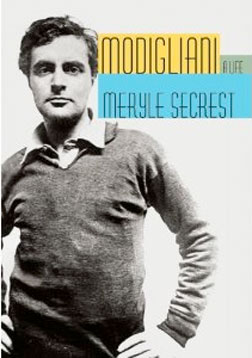
3. Modigliani: A Life, by Meryle Secrest, pp. 72-120

Chapter 5: The Perfect Line; Chapter 6: La Vie de Bohème

As a grown man, Modigliani was only five foot three, although this was closer to the average height than it is today. He was involved in a continuous succession of love affairs, apparently only with women, although when he was a student he refused to join the others on their visits to brothels. "Somewhat later, it is said, it was a point of pride for Modigliani to talk about how many brothels he had visited." He was also a bit of a dandy, especially while his uncle Amédée was paying the bills.

In the spring of 1901, he and his mother returned to Livorno, but he then persuaded his uncle to pay his expenses to study in Florence and then to spend the winter in Rome. When he returned to Florence in early 1902, he came down with scarlet fever, and after being nursed through the illness by his mother, spent some time convalescing in the Austrian Alps. In the spring of 1903, he went to study in Venice, where he became acquainted with the painter and sculptor Umberto Boccioni, as well as the artists Fabio Mauroner, Mario Crepet, Cesare Mainella, Guido Marussi, Ardengo Soffici, and Guido Cadarin.
Tino di Camaino, Carità, 1321 (Source)

It was the Chilean artist Manuel Ortiz de Zarate who filled him with the idea of going to the center of the art world, Paris. Ortiz was not particularly impressed with Modigliani's painting at the time, but that may have been because Modigliani wanted to become a sculptor. Jeanne Modigliani, Amedeo's daughter, later wrote that her father had been inspired to become a sculptor by his visits to churches in Naples, and by the work of the fourteenth-century sculptor Tino di Camaino in Siena and Florence. Modigliani went to the marble quarries in Carrara, but gave up marble for the less expensive stone, producing several sculpted heads before he decided to turn to painting again.

Fabio Mauroner recalled that in Venice Modigliani "would spend the evenings, and stay late into the night, in the remotest brothels where, he said, he learned more than in any academy." In his work, Mauroner says, Modigliani was looking to simplify the line, "which he saw as having a spiritual value ... as a solution to his search for the essential meaning of life. But while he was in Venice this ambition was hardly more than a vague abstract idea in his mind." Others recall how in conversation with Modigliani "a discussion of the practical problems of technique and composition would take a sudden turn and start examining the riddle of existence."

Early in 1905, Amédée Garsin, Modigliani's benefactor, died, leaving him a small inheritance that supported him for the next three years. In January 1906, according to Jeanne Modigliani, he made the move to Paris, arriving, Secrest says, "in style, as witnessed by numbers of his friends, who thought he had been left a fortune by a rich uncle." Others, however, claim that he didn't move to Paris until the fall of that year.
The Paris Modigliani found during the Third Republic was a city in dynamic flux, one of boundless opportunity.... As part of their transforming revolution the Impressionist -- Manet, Monet, Caillebotte, Cézanne, Degas, Morisot, Renoir, and Sisley -- brought a new sense of daily life, real people in real situations. The year of Modigliani's arrival Cézanne had just died -- of hypothermia, after being caught in a storm at age sixty-seven -- painters like Bonnard and Vuillard were developing their theories about flat planes of color, and an even more radical group, Matisse, Derain, Vlaminck, and Rouault, had introduced their own movement at the Salon d'Automne in 1905. Their resulting canvases quickly earned them the name of "Les Fauves" -- "Wild Beasts." Picasso and his Cubistic conundrums were just around the corner.
Modigliani enrolled in classes at the Académie Colarossi, where Rodin, Whistler, and Gauguin had studied, as well as Ortiz de Zarate, "who no doubt recommended it to Modigliani." Ludwig Meidner, a friend from the time, remembered him "painting very small portraits on rough canvas or smooth card with thin colors," some of which he "covered with ten coats of varnish and, with their transparent golden appearance, recalled the Old Masters." Some were put on display in a gallery in December 1906, but none of them sold. Meidner remembered that Modigliani was constantly drawing and that he developed his own technique:
"He drew from life on thin paper, but before it was finished he placed another white sheet beneath it and a piece of graphite paper between the two; then he traced the drawing, greatly simplifying the lines.... Whereas in later years he developed his own style of painting, his drawing remained essentially unchanged. Once he set to it, he could produce dozens of portraits in this way."
Modigliani also made a friend of the artist Anselmo Bucci, who saw the portraits in the gallery and sought him out. Bucci recalled Modigliani claiming that the only good painter in Italy was Oscar Ghiglia, and that he singled out Matisse and Picasso in France -- and almost added himself. Meidner recalled that Modigliani was interested in the works of Gauguin and Whistler, and that in addition to Matisse and Picasso, "He also admired Ensor and Munch, who wee almost unknown in Paris," as well as "some of the young Hungarian Expressionists who were just coming into favor." Another friend, Gino Severini, wrote about their discussions, "Impressionism no longer satisfied [us]; Picasso was too much of an intellectual.... Modi never agreed with anyone. And in particular, he didn't agree with Futurism. Futurism was based on color relationships, on a certain impressionism. Modigliani didn't give a damn about all that. He was interested in the Genovese primitivdes, in Negro art, in the Venetians."

In the winter of 1906, Modigliani moved into the center of the artists' quarter in Montmartre, in what the poet Louis Latourette recalled as a "shanty ... in a state of wild disorder." He also rented a studio that Meidner called "a tumbledown shake on a treeless, ugly scrap of ground, and although it was furnished in the most spartan manner, oppressive and neglected like a beggar's hovel, one was always glad to go there for one found an artistic atmosphere in which one was never bored."

But the center of the bohemian life was a café called the Lapin Agile.
Au Lapin Agile, 1880-1890 (Source: Wikipedia)
What was once a cottage on the north side of Montmartre had become a tavern. It had been bought in 1903 by Aristide Bruant, a cabaret singer for whom Toulouse-Lautrec had painted several posters.
Henri de Toulouse-Lautrec, poster, 1892 (Source: Wikipedia)
Gill's rabbit (Source)
Bruant had commissioned the artist André Gill to come up with a sign for his café, and Gill produced a rabbit with a wine bottle jumping out of a saucepan. It became known as "Gill's rabbit" or the "lapin à Gill," and hence, Lapin Agile. Bruant was a celebrity, and his place drew a crowd:
Along with the small-time criminals who had frequented Les Assassins [the name of the club under its previous owner], there were poets like Guillaume Apollinaire and Max Jacob, writers like Francis Carco and André Salmon, and, most of all, artists: Picasso, Braque, Derain, Vlaminck, Valadon, Utrillo, Gris, and so many others. With his usual perspicacity Modigliani at once attached himself to the list.
Secrest: "Modigliani made himself a part of the new crowd with ease. He had the rare gift of being perfectly delighted in any company. One sees this in a series of candid camera photographs taken by Cocteau during World War I.... Modigiliani is all eager attentiveness as Picasso explains a joke to André Salmon to which, no doubt, he is about to add an irresistible coda." (Image source)
Ilya Ehrenburg recalled Modigliani's "rare combination of childlikeness and wisdom ... by childlikeness I mean freshness of perception, immediacy, inner purity." Gino Severini said, "Everyone loved Modigliani." He also began to dress like an artist, in "a suit of chocolate-brown corduroy with a matching vest, an open-necked shirt, and a red kerchief." His sense of style pleased Picasso, who said, "There's only one man in Paris who knows how to dress and that is Modigliani." Jean Cocteau called him "our aristocrat."


Almost everyone of artistic prominence, with the exception of Matisse and Vlaminck, lived in Montmartre. Picasso, Juan Gris, and Kees van Dongen resided in a former piano factory called the Bateau Lavoir, a "squalid tenement" with rent that even an artist could afford, which is why Modigliani eventually moved in too.
Picasso's biographer John Richardson described the Bateau Lavoir as "so jerry-built that the walls oozed moisture ... hence a prevailing smell of mildew, cat piss and drains.... On a basement landing was the one and only toilet, a dark and filthy hole with an unlockable door ... and next to it, the one and only tap." (Image source)
The move seemed to have come in 1907, when Modigliani struck up a conversation with André Utter, an amateur painter who was working on a picture on a street in Montmartre. Modigliani said he had just returned from London and couldn't pay the bill at the hotel he was staying at. The proprietor had confiscated his paintings until he paid up. Modigliani was never penniless, because he received money from his mother and from his brother Emanuele, but Secrest comments that he had "the Garsin predilection for taking advantage of good times and drowning in debut in lean ones."


He could also rely on the generosity of Rosalie Tobia, who had once been a nude model but was now "completely shapeless." She ran a small restaurant, Chez Rosalie, and was sympathetic to starving artists. Modigliani was one of her special favorites, though they also had frequent fights over his inability to pay the bills. He sometimes paid her in drawings, as did other artists. "The legend, probably true, is that she kept them, covered with grease, in a kitchen cupboard, the rats gnawed away at them, and when she thought of cashing them in it was too late." On her walls were paintings by Modigliani, Picasso, and Utrillo, and Modigliani once painted a fresco on one of her walls that she disliked and had it whitewashed over.


Modigliani was also "thinking of giving up painting and going back to sculpture." He would "court the masons working on new buildings over a bottle of wine and then make off with a block of stone." But he was not yet ready to give up painting. In 1907 he exhibited seven works at the Salon d'Automne, but sold none of them. The same exhibition also featured forty-eight paintings by Cézanne, who had died the year before, and Modigliani was dazzled by them. He carried in his pocket a reproduction of one of Cézanne's several paintings of a boy in a red vest. In the same year, he saw the pioneering Cubist painting Les Demoiselles d'Avignon in Picasso's studio, a work that even Picasso's contemporaries failed to appreciate at first sight. "Modigliani admired Picasso without reservation. 'How great he is,' he once remarked. 'He's always ten years ahead of the rest of us.'"
Pablo Picasso, Les Demoiselles d'Avignon, 1907 (Source)
Although his paintings were not selling, in 1907 Modigliani met one of the first collectors of his work, Dr Paul Alexandre, who had moved into a twelve-room house that the city was planning to demolish. Alexandre persuaded the city to give him a lease on it and made it into a place for artists to meet. Modigliani began visiting there in November 1907, and after finding a studio space nearby was a frequent visitor.
Amedeo Modigliani, Portrait of Paul Alexandre, 1909 (Source)
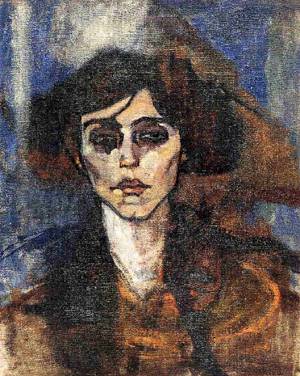
On his first visit to Alexandre, he was accompanied by an American woman, Maud Abrantes, about whom little is known, except that he "made several studies of her and painted her portrait in grayed-off pastels.
Secrest: "Her features, well marked and handsome, are notable for the eyes, which are disproportionately large, and smudged with blotches of paint as if to indicate mute suffering." (Image source)
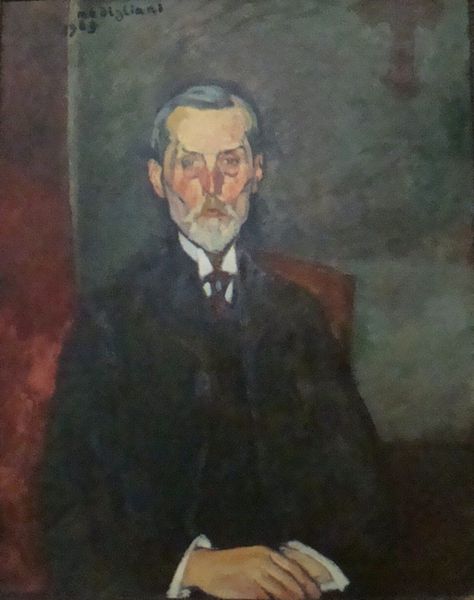
One of Alexandre's first commissions to Modigliani was a portrait of his father, Jean-Baptiste Alexandre.
Secrest: "The old man confronts the viewer with grave distinction, his white beard precisely trimmed to reveal a pink bottom lip, his eyes tired but calm. He has a natural authority and so does his son, who strikingly resembles him." (Image source)
Paul Alexandre was impressed by Modigliani, and in him the artist "had found someone with an eighteenth-century concept of the patron who recognizes, and nurtures, a rara avis. He was twenty-six; Modigliani was twenty-three." Alexandre was struck by Modigliani's perfectionism, and by the way he would make countless sketches of a subject until he found the precise line he wanted. "Anything less than perfection would be tossed on the floor. This is where Alexandre made, perhaps, his ultimate gift to posterity: he picked them up."

There was much drinking and drug-taking at the Alexandre salon, but many witnesses assert that Modigliani did not drink excessively, and although he participated in the experimentation with drugs, especially hashish, he "seldom drew while taking hashish, preferring to recall his visions in sobriety with the aim of  reproducing the heightened effect."
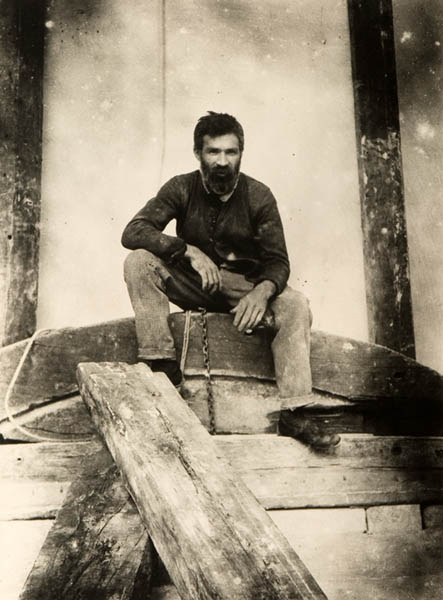
Constantin Brancusi, 1905 (Source)
Alexandre also acted as a patron to Constantin Brancusi, who would become a friend of Modigliani's.
[Herbert Read wrote,] "Brancusi strove to find the irreducible organic form, the shape that signified the subject's mode of being, its essential reality." Searching for the reality behind appearances: this, in Modigliani's case, was wedded to his belief in art as a magical force offering the path to exorcism and transfiguration.
Modigliani had become the prototypical bohemian, careless with money, given to reckless behavior, but enduring despite the sometimes self-imposed hardships. For "the belief that art was still a noble cause, in stark contrast to the grubby, money-focused goals of the bourgeoisie, when to the heart of the Bohemian creed.... It did not seem to matter to Modigliani that he was hounded by debts, sleeping on the run, with no money for good and no buyers for his drawings. He was surviving somehow."


Tuesday, July 5, 2011

2. Modigliani: A Life, by Meryle Secrest, pp. 31-71

Chapter 3: "Dedo"; Chapter 4: The Blood-Red Banner

To support the family after Flaminio's bankruptcy, Eugénie started teaching French, along with her sisters, Laure and Gabrielle, who came to live with them, as did their father, Isaaco. They were so successful as teachers that they started a language school, employing other teachers.

By the age of five, Amedeo, called "Dedo," "could read and write and was probably bilingual." His grandfather, Isaaco, who lived with them from 1886 until his death ten years later, was an erudite man who "was an important influence on Dedo's intellectual development until he was twelve. Another influential figure was his uncle, Amédée Garsin, who "was rich, except for all the times when he was not." Amédée saw to it that Dedo's brother Emanuele got his law degree at the University of Pisa and his brother Umberto studied engineering at the University of Liège. But he was also careless with money, which he considered an "aristocratic" trait. "A talent for acting; the cultivation of seigneurial indifference to money -- such lessons were not lost on Dedo."

Eugénie was also a major influence on her youngest son. Among her friends was Rodolfo Mondolfi, "a well known teacher at a Livornese high school," who helped the boys with homework and whose son Uberto was Dedo's best friend. Eugénie was unusually independent for a woman in Italy of that time, and her intellectual achievements included translations of the poems of Gabriele d'Annunzio into French and writing novels and stories under a pen name. An American professor bought her essays on Italian literature and then published them as his own.
Modigliani's birthplace in Livorno, now a museum (Source)

"The young Amedeo was being brought up in an atmosphere of genteel poverty." As a child he loved books, and although some biographers claim that he showed no interest in art until he was fourteen, his brother Umberto recalled that he loved to draw when he was a small child, and was he was eleven Eugénie wrote "Perhaps an artist?" when speculating what he might turn out to be. In that same year, 1895, he suffered his first major illness, a respiratory attack that was diagnosed as pleurisy. By the next year, his mother wrote, "He already sees himself as an artist." He had stopped studying and was doing poorly in school.

Amedeo's brother Emanuele, meantime, was developing a political conscience. He joined the Socialist Party, "and his life would be devoted to liberal causes, his belief in the dignity of manual labor and votes for women, while his political stance was anticolonialist, pacifist, and dedicated to change from within." In 1898, when he was twenty-six, he became the editor of a progressive newspaper in Piacenza, which because Tuscany was under martial law, led to his arrest and a sentence of six months in prison. 

A month after his brother was sentenced, Amedeo suffered an attack of typhoid, and was in serious condition, "hovering between life and death and delirious for more than a month." In a memoir of her son that she dictated to her daughter, Margherita, in 1924, Eugénie claimed that the delirious Amedeo "said he wanted to study painting. He had never before spoken of this and probably believed it was an impossible dream that could never be realized." She claims that she promised to get him a drawing master when he recovered. This belies not only the notes made earlier in her diaries about seeing himself as an artist, but also the fact that she had recorded in her diary on August 1, 1898, shortly before he fell ill, that Amedeo had started drawing lessons and was interested in painting. As Secrest observes, the later anecdote "sounds like a fallible recollection made thirty years after the event."

Guglielmo Micheli, self-portrait, date unknown (Source)
In December 1898, Emanuele was released from prison, and Amedeo, fully recovered, began his studies with the artist Guglielmo Micheli, who had been a pupil of the artist Giovanni Fattori. "Micheli and Fattori encouraged students to seek their inspiration in the contemporary scene," and were associated with a group of artists known as the Macchiaoli: "They applied their colors in short brushstrokes and dots of paint; 'macchia' means stain or blot, and these were the 'makers of patches.'" Like the French Impressionists, they preferred to work out of doors. "But unlike the Impressionists the Macchiaoli took their cue from the muted, earth-toned palettes of Millet, Corot, and others of the Barbizon school." Fattori often visited Micheli's classroom, and on one occasion praised a charcoal sketch that Amedeo was working on.
Giovanni Fattori, self-portrait, 1894 (Source)

Modigliani's classmates recalled him as "introverted and shy," and as sickly-looking, but also recalled his temper when something made him angry. He was also given to quoting d'Annunzio and Baudelaire, Nietzsche and Henri Bergson. He disliked painting nature, but loved going through museums to study the Italian Renaissance masters, although he admired the work of Fattori and of the Pre-Raphaelites as well.

Samples of Modigliani's student work are rare, and the authentications of them are controversial at best. Secrest believes, however, that "A pencil self-portrait is evidence of a rapidly maturing talent at a moment when Modigliani was aged about twelve or thirteen." She was working in the G.E. Modigliani archives in Rome in 2008 when she came across a box of photographs. One of them was of a boy, "perhaps aged eight or ten, with cropped hair and in a fashionable sailor jacket, perhaps a slightly younger version of the boy in the self-portrait. Written in a laborious hand on the reverse was, 'Al mio caro, A...'" Giuseppe Emanuele had kept it all his life.

As Amedeo became more involved with his art, he also began to adopt the bohemian lifestyle that the rest of the family disapproved of as "shiftless and idle. But his classmates saw him as "distinguished, disciplined and studious." And Eugénie remarked in her diary in 1899, "Dedo has completely given up his studies and does nothing but paint, but he does it all day and every day with an unflagging ardor that amazes and enchants me." At fifteen, he moved into a studio in Livorno that had been given to Micheli for the use of his students. Its previous owner had died of tuberculosis, and in September 1900, Modigliani came down with it, too. The fact of the studio owner's death from the disease is probably coincidental; he was probably already infected with it. He first developed pleurisy, and was not diagnosed with tuberculosis till he was sixteen.

There are no accounts of how Modigliani was treated for the disease. "He would certainly have been given antispasmodics such as morphine and heroin which were, in any case, freely available. Other remedies guaranteed to soothe the cough and stop the diarrhea included whiskey, brandy, and laudanum (opium dissolved in alcohol)." The two other students who shared the studio with Modigliani also came down with the disease. Both of them died. It is possible that Modigliani underwent a surgical collapse of one lung, which was a painful process because of the lack of full anesthesia, but there is no record of that fact in any of the family memoirs. "All we know is that, as an adult, he was terrified of doctors," and that he was the only one from the studio who survived.

When he was well enough, Eugénie took him to spend the fall and winter in Naples, a trip financed by his uncle Amédée.
Modigliani's infection -- with luck, tuberculosis went into a lengthy remission -- declined relatively rapidly. One of the great factors ws his mother's selfless care. The other was the right diet. The third may have been psychological; Uncle Amédée had thoughtfully provided a studio as well. He began sketching again remarkably soon.... He started visiting museums, always accompanied by his mother, who slept in the same room. He was gaining weight and, as he entered his seventeenth year, began to grow a light, curly beard.
After wintering in Capri, they traveled to Rome, which thrilled him with its museums. In letters to his friend Oscar Ghiglia, a classmate who was eight years his senior and was beginning to make a name for himself, he expressed a kind of "giddy optimism" about his future, "tempered by the very real possibility that he did not have long to live." He had imbibed Nietzsche's ideas about the Übermensch, and wrote to Ghiglia, "People like us ... have different rights, different values than do normal, ordinary people because we have different needs which put us -- it has to be said and you must believe it - above their moral standards." Secrest comments, "In his mind, fatalism and idealism, creativity and death, seemed intertwined."