JOURNAL OF A COMPULSIVE READER
By Charles Matthews
Showing posts with label Marcel Proust. Show all posts

Thursday, May 19, 2011

33. The Modern Tradition, edited by Richard Ellmann and Charles Feidelson Jr., pp. 723-737

Self-Consciousness: The Field of Consciousness (Henri Bergson, Marcel Proust)
_____
Henri Bergson: Duration 


Bergson's indebtedness to William James's concept of consciousness as a continuous stream is evident in these excerpts from Creative Evolution (1907) and An Introduction to Metaphysics (1903). 


Like Descartes, he starts from the near-undeniable fact of existence, only to question what "existence" may be, or rather, what does our consciousness tell us about existence? "I find, first of all, that I pass from state to state. I am warm or cold, I am merry or sad, I work or I do nothing." In short, he changes: "there is no feeling, no idea, no volition, which is not undergoing change every moment: if a mental state ceased to vary, its duration would cease to flow." Even "the visual perception of a motionless external object" is subject to this constant modification by consciousness. "My mental state, as it advances on the road of time, is continually swelling with the duration which it accumulates."
J.E. Blanche, Portrait of Henri Bergson, 1891


We think, however, of consciousness as a series of discrete moments. "The apparent discontinuity of the psychical life is ... due to our attention being fixed on it by a series of separate acts: actually there is only a gentle slope; but in following the broken line of our acts of attention, we think we perceive separate steps."
Discontinuous though they appear, however, in point of fact they stand out against the continuity of a background on which they are designed, and to which indeed they owe the intervals that separate them; they are the beats of the drum which break forth here and there in the symphony. Our attention focuses on them because they interest it more, but each of them is borne by the fluid mass of our whole psychical existence.
We imagine "a formless ego" that threads together these individual moments, but the concept presupposes an unchanging psychic state. The real existence of this fictive stable ego is negated by the very fact of existence in time, but we cling to it because serves "the requirements of logic and language." Time is the stuff of which the actual "psychical life" is made. "Duration is the continuous progress of the past which gnaws into the future and which swells as it advances."
In reality, the past is preserved by itself, automatically. In its entirety, probably, it follows us at every instant; all that we have felt, thought and willed from our earliest infancy is there, leaning over the present which is about to join it, pressing against the portals of consciousness that would fain leave it outside.... What are we, in fact, what is our character, if not the condensation of the history that we have lived from our birth -- nay, even before our birth, since we bring with us prenatal dispositions?
Because the past is cumulative, we can never experience the same thing twice. "We could not live over a single moment, for we should have to begin by effacing the memory of all that had followed. Even could we erase this memory from our intellect, we could not from our will." By the same token, we can never foresee the future, because that would imply a discontinuity: "that which has never been perceived ... is necessarily unforeseeable." We are, in short, "creating ourselves continually ... to exist is to change, to change is to mature, to mature is to go on creating oneself endlessly." 


This makes self-perception a difficult process. We can start with our perceptions, our memories, and our "tendencies and motor habits." But "if I search in the depth of my being that which is most uniformly, most constantly, and most enduringly myself, I find an altogether different thing."
This inner life may be compared to the unrolling of a coil, for there is no living being who does not feel himself coming gradually to the end of his role; and to live is to grow old. But it may just as well be compared to a continual rolling up, for our past follows us, it swells incessantly with the present that it picks up on its way; and consciousness means memory.... A consciousness which could experience two identical moments would be a consciousness without memory. It would die and be born again continually.
A better analogy might be the spectrum, "with its insensible gradations leading from one shade to another.... Yet even here the successive shades of the spectrum always remain external one to another. They are juxtaposed; they occupy space. But pure duration, on the contrary, excludes all idea of juxtaposition, reciprocal externality, and extension." 


The fact that we have such difficulty imagining the constant flux of our inner life once again suggests what would come to be formulated by Heisenberg as the "uncertainty principle": "the unrolling of our duration resembles in some of its aspects the unity of an advancing movement and in others the multiplicity of expanding states; and clearly no metaphor can express one of these two aspects without sacrificing the other.... The inner life is all this at once: variety of qualities, continuity of progress, and unity of direction. It cannot be represented by images." 
If I consider duration as a multiplicity of moments bound to each other by a unity which goes through them like a thread, then, however short the chosen duration may be, these moments are unlimited in number. I can suppose them as close together as I please; there will always be between these mathematical units other mathematical points, and so on to infinity. Looked at from the point of view of multiplicity, then, duration disintegrates into a powder of moments, none of which endures, each being an instantaneity. If, on the other hand, I consider the unity which binds the moment together, this cannot endure either, since by hypothesis everything that is changing, and everything that is really durable in the duration, has been put to the account of the multiplicity of moments.
Underlying it all, then, "is only one unique duration, which carries everything with it -- a bottomless, bankless river, which flows without assignable force in a direction which could not be defined." 


Marcel Proust: The Recapturing of Time 


Proust had met Bergson, but although some have tried to connect Proust's preoccupation with time and memory to Bergson's, there seems to be no essential link between the two. I have written elsewhere about these two excerpts from the beginning and the end of In Search of Lost Time (or Remembrance of Things Past in the Scott Moncrieff translation), so I'll pick up some elements from my postings there. (The translation quoted is that of Lydia Davis for Swann's Way and Ian Patterson for Finding Time Again -- aka The Past Recaptured in the Frederick A. Blossom translation quoted by Ellmann and Feidelson).


Everyone knows (or rather, everyone who cares to know knows) about Proust's madeleine, the pastry dipped in tea that triggered the most famous "Proustian moment" -- the spontaneous memory. In the novel, the narrator's account of the scenes of his childhood rising before him comes just after his account of the rare, privileged night his mother spent in his room, reading to him. It is "a sort of puberty of grief, of emancipation from tears," "the beginning of a new era" that "would remain as a sad date." 

But for years afterward, his childhood in Combray remained limited to what it has been in the first 40-some pages of the novel: "the theater and drama of my bedtime" -- "as though Combray had consisted only of two floors connected by a slender staircase and as though it had always been seven o'clock in the evening there." The rest of it comes to life when he pursues something ineffable awakened by the taste of the madeleine in tea. At first, he doesn't know what he has glimpsed: "Undoubtedly what is palpitating thus, deep inside me, must be the image, the visual memory which is attached to this taste and is trying to follow it to me." Note here that he ascribes the volition to the memory, that he must meet the memory -- "struggling too far away" -- halfway. 

Ten times I must begin again, lean down toward it. And each time, the laziness that deters us from every difficult task, every work of importance, has counseled me to leave it, to drink my tea and think only about my worries of today, my desires for tomorrow, upon which I may ruminate effortlessly.
For Proust this is, I think, the distinction between the artist and the layman, the willingness to struggle against the "laziness" that traps most of us in the quotidian. 

And then he meets the memory of aunt Léonie giving him a taste of madeleine soaked in lime-blossom tea. It's the fortuitous combination of tea and madeleine that does it -- the intimate power of taste that proves more effective than sight alone in raising the past. He had seen madeleines in shops without awakening any distinct sensations. He even finds a way of moralizing the image of the little shell-shaped cake, "so fatly sensual within its severe and pious pleating."


But, when nothing subsists of an old past, after the death of people, after the destruction of things, alone, frailer but more enduring, more immaterial, more persistent, more faithful, smell and taste still remain for a long time, like souls, remembering, waiting, hoping, upon the ruins of all the rest, bearing without giving way, on their almost impalpable droplet, the immense edifice of memory.
And so rooms, roads, people and the town join themselves in his imagination. The stage is set for the vast novel that follows. 

These spontaneous eruptions of memory continue throughout the Search. In In the Shadow of Young Girls in Flower (Scott Moncrieff's Within a Budding Grove), the narrator tells us that "the mere breath of trees in full leaf" has brought back the memory of riding through the countryside with Mme. de Villeparisis. In The Guermantes Way, he comments on the difference between the spontaneous memory and the "voluntary memory," a distinction that persists throughout the Search: 

[S]hould a sensation from the distant past ... enable our memory to make us hear that name with the particular tone it then had for our ears, even if the name seems not to have changed, we can still feel the distance between the various dreams which its unchanging syllables evoked for us in turn. For a second, rehearing the warbling from some distant springtime, we can extract from it, as from the little tubes of color used in painting, the precise tint -- forgotten, mysterious, and fresh -- of the days we thought we remembered when, like bad painters, we were in fact spreading our whole past on a single canvas and painting it with the conventional monochrome of voluntary memory.
Later in the same book, "the hiccuping sound of the new furnace boiler" brings back memories of his stay at Doncières, where his friend Robert de Saint-Loup is stationed with the army. In Sodom and Gomorrah (Scott Moncrieff's Cities of the Plain), the narrator returns to Balbec, the seaside resort where he had spent time with his late grandmother, and experiences for the first time an overwhelming grief for her that voluntary memory had been unable to trigger:
For to the disturbances of memory are linked the intermittences of the heart. It is no doubt the existence of our body, similar for us to a vase in which our spirituality is enclosed, that induces us to suppose that all our inner goods, our past joys, all our sorrows, are perpetually in our possession. Perhaps this is as inaccurate as to believe that they escape or return. At all events, if they do remain inside us, it is for most of the time in an unknown domain where they are of no service to us, and where even the most ordinary of them are repressed by memories of a different order, which exclude all simultaneity with them in our consciousness. But if the framework of sensations in which they are preserved be recaptured, they have in their turn the same capacity to expel all that is incompatible with them, to install in us, on its own, the self that experienced them. 
But the series of memory-stirring events in Finding Lost Time, the final book in the Search, are the most crucial ones, for they set the narrator on the course that has eluded him: writing the novel itself. 

Entering the courtyard to the Guermantes's house, he dodges an approaching car and steps on some uneven paving stones, triggering the first of a series of epiphanies:
But at the moment when, regaining my balance, I set my foot down on a stone which was slightly lower than the one next to it, all my discouragement vanished in the face of the same happiness that, at different points in my life, had given me the sight of trees I had thought I recognized when I was taking a drive around Balbec, the sight of the steeples of Martinville, the taste of a madeleine dipped in herb tea, and all the other sensations I have spoken about, and which the last works of Vinteuil had seemed to me to synthesize. Just as at the moment when I tasted the madeleine, all uneasiness about the future and all intellectual doubt were gone. Those that had assailed me a moment earlier about the reality of my intellectual talent, even the reality of literature, were lifted as if by enchantment.
He realizes that the paving stones had triggered a memory of similarly "uneven flagstones in the baptistery of St Mark's" in Venice, just as "the taste of the little madeleine had reminded me of Combray. But why had the images of Combray and Venice given me at these two separate moments a joy akin to certainty and sufficient, without any other proofs, to make death a matter of indifference to me?"

Then, while he is waiting in a sitting room for the conclusion of a piece of music that his hostess wishes not to be interrupted, it happens again: a servant knocks a spoon against a plate, which triggers his memory of a hammer striking the wheel of the train he had recently sat in, feeling indifferent to the beauty of the countryside. And again, a butler gives him a plate of petits fours and a glass of orangeade, and when he wipes his mouth with the napkin, the texture of it recalls a similar sensation while he was looking out to sea at Balbec. Each instant of involuntary memory -- connections between past and present triggered by the madeleine, the paving stones, the sound of the spoon, the texture of the napkin -- "suddenly makes us breathe a new air, new precisely because it is air we have breathed before, this purer air which the poets have tried in vain to make reign in paradise and which could not provide this profound feeling of renewal if it had not already been breathed, for the only true paradise is a paradise that we have lost."

The narrator perceives in these moments in which "the past was made to encroach upon the present and make me uncertain about which of the two I was in" something he calls "extra-temporal." When he tasted the madeleine, "at that very moment the being that I had been was an extra-temporal being."
This being had only ever come to me, only ever manifested itself to me on the occasions, outside of action and immediate pleasure, when the miracle of an analogy had made me escape from the present. It alone had the power to make me find the old days again, the lost time, in the face of which the efforts of my memory and my intellect always failed.
He believes he has experienced "a little bit of time in its pure state." This perception of "the essence of things"
languishes in the observation of the present where the senses cannot bring this to it, in the consideration of a past where the intelligence desiccates it, and in the expectation of a future which the will constructs out of fragments of the present and the past from which it extracts even more of their reality without retaining any more than is useful for the narrowly human, utilitarian ends that it assigns to them. 
"I knew that places were not the same as the pictures conjured up by their names" -- an observation that takes us back to the concluding sections of Swann's Way ("Place-Names: The Name") and In the Shadow of Young Girls in Flower ("Place-Names: The Place"). He recalls the disillusionments at Balbec, the fact that he did not experience its beauty when he was there as much as he did in remembering it, and that he was unable to recapture that beauty when he went back for a second visit.
Impressions of the sort that I was trying to stabilize would simply evaporate if they came in contact with a direct pleasure which was powerless to bring them into being. The only way to continue to appreciate them was to try to understand them more completely just as they were, that is to say within myself, to make them transparent enough to see right down into their depths.
This is a vindication of the narrative strategy of In Search of Lost Time, the endless analysis of relationships (Swann-Odette, narrator-Gilberte, narrator-Albertine), the attempt to understand the emotional intricacies of a life.

It is also an attempt to give coherence to one's own existence:
I remembered with pleasure, because it showed me that I was already the same then and gave me back something that was fundamental to my nature, but also with sadness when I thought that I had not progressed since then, that in Combray already I used attentively to fix before my mind's eye some image which had impelled me to look at it. 
He has been trying to decipher "impressions such as that made on my by the sight of the steeples of Martinville" and other epiphanic moments. And he concludes
I had to try to interpret the sensations as the signs of so many laws and ideas, at the same time as trying to think, that is to draw out from the penumbra what I had felt, and convert it into a spiritual equivalent. And what was this method, which seemed to me to be the only one, but the making of a work of art? 

The "primary character" of these epiphanies, the thing that gives them their authenticity for the narrator (and hence for the reader), "was that I was not free to choose them." They are not subject to logical analysis. "The ideas formed by pure intelligence contain no more than a logical truth, a possible truth; their choice is arbitrary." Whereas the spontaneous impression contains its own truth, and demands an elucidation that "can bring the mind to a more perfected state, and give it pure happiness. An impression is for the writer what an experiment is for the scientist, except that for the scientist the work of the intelligence precedes it, and for the writer it comes afterwards."

Art, then, is a process of discovery, not of will: "we have no freedom at all in the face of the work of art, ... we cannot shape it according to our wishes." And above all, it can't be dominated by rules or theories: "A work in which there are theories is like an object with its price-tag still attached." Proust/the narrator here strikes back at proclamations about the social or political role of the artist: "the sound of the spoon on a plate, or the starched stiffness of the napkin ... had been more valuable for my spiritual renewal than any number of humanitarian, patriotic, internationalist or metaphysical conversations." He admits that the war has brought out proponents of these roles, which remind him of "M. de Norpois's simple theories in opposition to 'flute-players'" when he criticized Bergotte to the young narrator. And he even takes a dig, I think, at stream-of-consciousness writers:
Some even wanted the novel to be a sort of cinematographic stream of things. This was an absurd idea. Nothing sets us further apart from what we have really perceived than that sort of cinematographic approach.  

Wednesday, May 4, 2011

19. The Modern Tradition, edited by Richard Ellmann and Charles Feidelson Jr., pp. 408-423

Nature: Organicism (Rainer Maria Rilke, Marcel Proust, André Gide, D.H. Lawrence)
_____

Rainer Maria Rilke: Nature, Man, and Art

I have to admit relief at turning from philosophers like Schopenhauer and Whitehead to poet and novelists, even though Rilke can present his own problems. This 1903 essay deals with the attempt of human beings to reconcile themselves through art to the manifest gulf between humanity and nature. In the statement, "It always seems that Nature does not know at all that we cultivate her and timidly put a small part of her forces to our own use," Rilke acknowledges not only the separation but also the implicit superiority of Nature. For "whatever men may have achieved, no man has been great enough to cause her to sympathize with his pain, to share in his rejoicing."

Like Robbe-Grillet, Rilke acknowledges the "pathetic fallacy," but unlike him, he is not ready to embrace the separation as the impetus to a new art. There are those who are
unwilling to leave the Nature they have lost, [who] go in pursuit of her and try now, consciously and by the use of their concentrated will, to come as near to her again as they were in their childhood without knowing it. It will be understood that [these people] are artists: poets or painters, composers or architects, fundamentally lonely spirits, who, in turning to Nature, put the eternal above the transitory, that which is most profoundly based on law above that which is fundamentally ephemeral, and who, since they cannot persuade nature to concern herself with them, see their task to be the understanding of Nature, so that they may take their place somewhere in her great design.
Rilke sees this attempt at a reunion with Nature as "the theme and purpose of all art," that is, "the reconciliation of the Individual and the All, and the moment of exaltation, the artistically important Moment, would seem to be that in which the two scales of the balance counterpoise one another." Thus, "a symphony mingles the voices of a stormy day with the tumult of our blood" and "a building owes its character half to us and half to the forest."


Marcel Proust: The Life of the Hawthorn  
Marcel Proust, date unknown
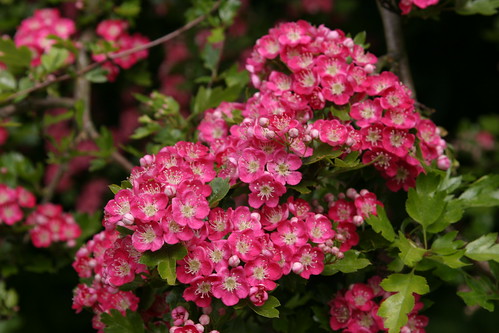
In this rhapsodic selection from Swann's Way, Proust recounts the narrator's boyhood experience contemplating the beauty of hawthorn blossoms. In the context of the novel, it links up with his first encounter with Gilberte, Swann's daughter, the object of endless fascination throughout much of In Search of Lost Time. It also serves to introduce the narrator's passionate desire to establish some sort of intimacy with nature, "to absorb myself in the rhythm which disposed their flowers here and there with the light-heartedness of youth, and at intervals as unexpected as certain intervals of music ... like those melodies which one can play over a hundred times in succession without coming any nearer to their secret." Music once again becomes the touchstone for the aesthetic experience. But he is doomed to failure: 
the sentiment which they aroused in me remained obscure and vague, struggling and failing to free itself, to float across and become one with the flowers. They themselves offered me no enlightenment, and I could not call upon any other flowers to satisfy this mysterious longing.
Elsewhere in the Search we will learn that only through "involuntary memory," an experience triggered unbidden by a sound, a tactile sensation, or, most famously, the taste of a madeleine dipped in lime-flower tea, can contact with the world outside the self offer the enlightenment the narrator seeks here. 

It's also significant that this is a childhood experience of the narrator's, an impression made on the unsophisticated mind. The narrator's grandfather directs his attention to a spectacular pink hawthorn, which makes him think of crushed strawberries mixed in cream cheese: 
And these flowers had chose precisely the colour of some edible and delicious thing, or of some exquisite addition to one's costume for a great festival, which colours, inasmuch as they make plain the reason for their superiority, are those whose beauty is most evident to the eyes of children, and for that reason must always seem more vivid and more natural than any other tints, even after the child's mind has realised that they offer no gratification to the appetite, and have not been selected by the dressmaker.
He ascribes their beauty to Nature's attempt to charm: "And indeed, I had felt at once, as I had felt before the white blossom, but now still more marvelling, that it was in no artificial manner, by no device of human construction, that the festal intention of these flowers was revealed, but that it was Nature herself who had spontaneously expressed it."

But there is also something sensuous about the flowers: "a thousand buds where swelling and opening, paler in colour, but each disclosing as it burst, as at the bottom of a cup of pink marble, its blood-red stain." The language here hints at pubescence, menstruation, and the loss of virginity, at the same time that the flower is "ready for the 'Month of Mary,' of which it seemed already to form a part, ... a Catholic bush indeed." 


André Gide: Natural Joy 

In 1935, when Gide was involved in a flirtation with communism (which would end when he actually visited the Soviet Union), he wrote Later Fruits of the Earth, an addendum of sorts to the original Fruits of the Earth, published forty years earlier. These excerpts capture him in an affirmative mood tempered by realizations of human limitations. "All nature ... teaches that man is born for happiness. It is the effort after pleasure that makes the plant germinate, fills the hive with honey, and the human heart with love." It's worth remembering Schopenhauer's assertion that pleasure is a bodily manifestation of will, and that will is, among other things, "the force which germinates and vegetates in the plant."

But in order to achieve the happiness he seeks, Gide wants to be freed from the past, to which he is "in bondage.... Not a gesture to-day but was determined by what I was yesterday. But I who am at this moment, I, instantaneous, fleeting, irreplaceable, I escape." Or he tries to, halted by fears of the future as well: "Consequence of our acts. Consequence with ourselves. Am I to expect nothing from myself but a sequel?" So he determines to throw caution to the winds: "Winds of the abyss, bear me away!"

He is also trammeled by the things of the world: "the important thing is that we should contemplate God with the clearest possible eyes, and I feel that every object on this earth that I covet becomes opaque by very  reason of my coveting it, and that the whole world then loses its transparence ... so that God ceases to be perceptible to my soul, and by abandoning the Creator for the creature, my soul ceases to live in eternity and loses the kingdom of God." (As we see later, by "God" he means Nature.)

He returns to the original thought, that the pleasure principle is supreme: "With pleasure for a guide, all things aspire to greater thriving, to increased consciousness, to progress.... And this is why I have found more instruction in pleasure than in books; why I have found in books more obfuscation than light." Physical pleasure allows him to transcend himself: "the secret workings of carnal desire drove me out of myself towards an enchanting confusion." And paradoxically, "When I stopped looking for myself it was in love that I found myself again." His desires "alone were capable of instructing me. I yielded to them."

Contemplating the impossibility that a caterpillar should ever turn into something so radically different as a butterfly -- "not only does the shape change, but the habits, the appetites" -- provokes a realization about the trap in which one is caught by clinging too closely to one's identity. The pursuit of self-knowledge is a trap:
Know thyself. A maxim as pernicious as it is ugly. To observe oneself is to arrest one's development. The caterpillar that tried "to know itself" would never become a butterfly.

So nature becomes his divinity, "for simplicity's sake and because it irritates the theologians." Among the lessons to be learned from nature is "that everything that is young is tender ... and no growth is possible unless it bursts the sheathes in which at first it was swaddled." Humankind has failed to progress because it is wrapped in the past: "Comrade, you must refuse henceforth to seek your nourishment in the milk of tradition, man-distilled and man-filtered.... Look at the winged seeds of the plane or the sycamore flying off as if they understood that the paternal shade can offer them nothing but a dwindling and atrophied existence."
Understand rightly the Greek fable. It teaches us that Achilles was invulnerable except in that spot of his body which had been made soft by the remembrance of his mother's touch. 


D.H. Lawrence: The Death of Pan

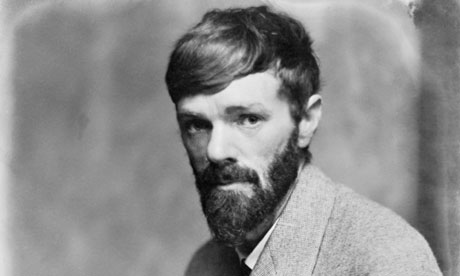
D.H. Lawrence, c. 1920
In the preceding excerpt, Gide asks, "Who was it said that great Pan was dead? I saw him through the mist of my breath. My lips are stretched towards him. Was it not he who whispered in my ear this morning, 'What are you waiting for?'" The legend of Pan's death seems to have started with a tale told by Plutarch that during the reign of Tiberius, a cry was heard by sailors that Pan was dead, which metamorphosed, as Lawrence suggests in "Pan in America" (1926), into a Christian legend that the resurrection of Jesus signaled the death of Pan, and that the figure of Satan is modeled on the goat-horned and -hoofed god.

Like Gide, Lawrence is not quite ready to accept the death of Pan, except insofar as it becomes a metaphor for the detachment of human beings from nature.
Gradually men moved into cities. And they loved the display of people better than the display of a tree. They liked the glory they got of overpowering one another in war. And, above all, they loved the vainglory of their own words, the pomp of argument and the vanity of ideas.
Pan survives, however, in poetic pantheists such as Wordsworth and Whitman, but Lawrence dismisses this as trifling. "All Walt is Pan, but not all Pan is Walt."
We still pretend to believe that there is One mysterious Something-or-other back of Everything, ordaining all things for the ultimate good of humanity. It wasn't back of the Germans in 1914, of course, and whether it's back of the bolshevists is still a grave question. But still, it's back of us, so that's all right. 
But this is all make-believe, Lawrence insists. "In the days before man got too much separated from the universe, he was Pan, along with all the rest."

Still, Lawrence senses the presence of Pan in trees, such as the big pine on the ranch where he lived in New Mexico. He admires the tree as a "magnificent assertion" -- a phallic one -- and says that he has "become conscious of the tree, and of its interpenetration into my life.... I am conscious that  it helps to change me, vitally. I am even conscious that shivers of energy cross my living plasm, from the tree, and I become a degree more like unto the tree, more bristling and turpentiney, in Pan." But then he distances himself from these assertions, keying into the reader's own resistance to such nature-worship:
Of course, if I like to cut myself off, and say it is all bunk, a tree is merely so much lumber not yet sawn, then in a great measure I shall be cut off. So much depends on one's attitude. One can shut many, many doors of receptivity in oneself; or one can open many doors that are shut.
And therein lies Lawrence's point, which is very much the point that Wallace Stevens, among others, made: One can choose to engage the imagination, to open the doors and participate in nature, or not. "So much depends on one's attitude," Lawrence puts it, and Lawrence is all about attitude:
Is it truer to life to insulate oneself from the influence of the tree's life, and to walk about in an inanimate forest of standing lumber, marketable in St. Louis, Mo.? Or is it truer to life to know, with a pantheistic sensuality, that the tree has its own life, its own assertive existence, its own living relatedness to me: that my life is added to, or militated against, by the tree's life?... What can a man do with his life but live it? And what does life consist in, save a vivid relatedness between the man and the living universe that surrounds him? Yet man insulates himself more and more into mechanism, and repudiates everything but the machine and the contrivance of which he himself is master, god in the machine.
Pan's death came about not with the arrival of Christianity, Lawrence asserts, but with the scientific revolution, when human beings "discovered the 'idea.' He found that all things were related by certain laws. The moment man learned to abstract, he began to make engines that would do the work of his body." The power of abstraction, of the acceptance of a duality of mind and body, "was the death of the great Pan. The idea and the engine came between man and all things, like a death. The old connexion, the old Allness, was severed, and can never be ideally restored. Great Pan is dead."

So humans became what realists such as Zola, for example, advocated: masters of nature:
With all the mechanism of the human world, man is to a great extent master of all life, and of most phenomena.

And what then? Once you have conquered a thing, you have lost it. Its real relation to you collapses.

A conquered world is no good to man. He sits stupefied with boredom upon his conquest.
Lawrence then gives us a picture of primitive life, when man "lived in a ceaseless living relation to his surrounding universe." But just when one thinks that Lawrence is indulging in a sentimental primitivism, he throws some cold water on the scene: "It is useless to glorify the savage. For he will kill Pan with his own hands, for the sake of a motor-car.... And we cannot return to the primitive life, to live in tepees and hunt with bows and arrows." So although "The Pan relationship, which the world of man once had with all the world, was better than anything man has now," it can't be recovered. The best Lawrence has to offer is a recognition that "life itself consists in a live relatedness between man and his universe: sun, moon, stars, earth, trees, flowers, birds, animals, men, everything -- and not in a 'conquest' of anything by anything."

Thursday, April 14, 2011

1. The Modern Tradition, edited by Richard Ellmann and Charles Feidelson Jr., pp. v-ix, 7-16

Preface; Symbolism: Introduction
_____
If we're postmodern, then what is it that we're post? When Ellmann and Feidelson published their anthology in the mid-1960s, their aim was to provide the material to define "modern" as it applies to the arts and literature, to give clarity and precision to a word that then denoted "a blur of book titles, a mood of impatience with anachronisms, a diffuse feeling of difference." Modern, they noted, was a label for "a distinctive kind of imagination," and  "works we call modern ... claim modernity; they profess modernism." But the vagueness persists, even now that "the great age of the [twentieth] century's literature, the age of Yeats, Joyce, Eliot, and Lawrence, of Proust, Valéry, and Gide, of Mann, Rilke, and Kafka, has already passed into history." And the word denotes more than literature; rather, it encompasses "a large spiritual enterprise including philosophic, social, and scientific thought, and aesthetic and literary theories and manifestoes, as well as poems, novels, dramas."

If we can postulate a modern tradition, we must add that it is a paradoxically untraditional tradition. Modernism strongly implies some sort of historical discontinuity, either a liberation from inherited patterns or, at another extreme, deprivation and disinheritance.... [M]odern literature has elevated individual existence over social man, unconscious feeling over self-conscious perception, passion and will over intellection and systematic morals, dynamic vision over the static image, dense actuality over practical reality.
At the same time that modern artists and writers have embraced the future eagerly, they have also been haunted by "a sense of loss, alienation, and despair. These are the two faces, positive and negative, of the modern as the anti-traditional: freedom and deprivation, a living present and a dead past."

But giving the modern a starting point is not easy. Did we become "modern" at "the end of Victorianism, the beginning of romanticism, the mid-seventeenth century, the end of the Middle Ages"? Stephen Spender observed that the modern is characterized by a confrontation with the past and an inclusion of this confrontation "within itself as part of a single total experience," in what Spender called "the vision of a whole situation." Writers who valued originality and an attempt to free themselves from established models, media and genres, nevertheless "have been classicists, custodians of language, communicators, traditionalists in their fashion."

Ellmann and Feidelson say that their anthology is an attempt to provide materials toward an understanding of modernism, not "to argue a general theory of modernism." The selections in the anthology are from the "discursive statements by writers, artists, philosophers, and scientists" -- not the works themselves, but the essays, letters, prefaces, and other writings in which they discuss their works or the ideas that give rise to them.

The book has been divided into nine sections, each of them a topic "around which modern thinking whirls or clings." they are:
  • Symbolism: "the concept of imagination, the autonomy of the work of art, formalism, the creative process, and the heroic role of the artist.
  • Realism: "art as a function of environment," historic or social, "the pressures of experience and the responsibility of truthfulness."
  • Nature: theories "of organic harmony, of biological struggle, of mechanistic force, and of human or scientific experiment."
  • Cultural History: the "patterns -- dialectical, repetitive, symbolic, or religious -- by which the historical process has been shaped."
  • The Unconscious: "Freudian ... and post-Freudian programs for the liberation of impulse."
  • Myth: "anthropological and Jungian versions of the myth-making mind, along with more properly literary doctrines of mythic imagination." 
  • Self-Consciousness: "self-realization, the situation and process of consciousness, the inner divisions of the self, and the pursuit of personal freedom."
  • Existence: "The existentialist analysis of ... selfhood."
  • Faith: religion "in the decline of Christianity."
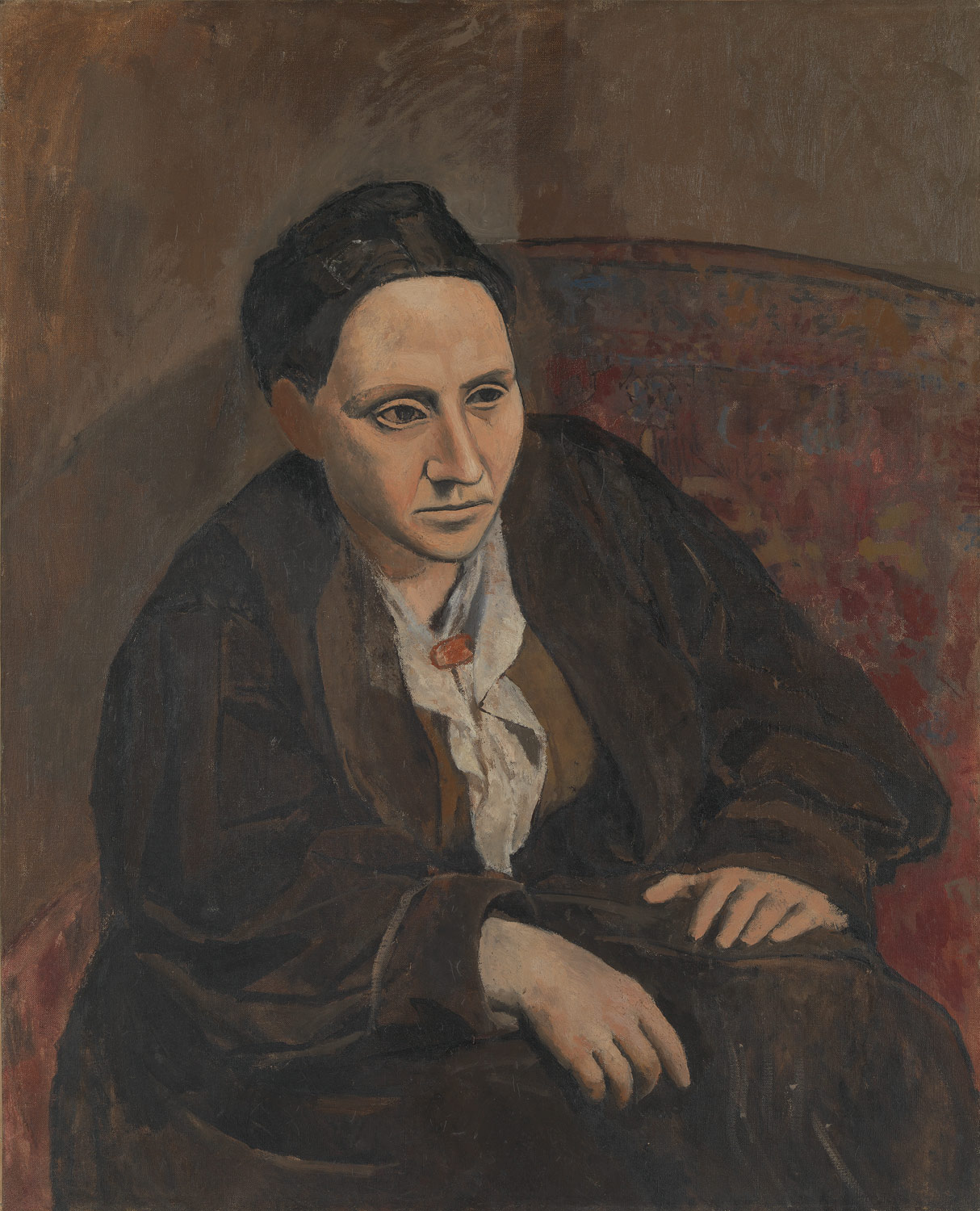
The first topic, symbolism, focuses on the nature and function of the imagination and its role in the life and work of the artist. It valorizes imagination as a unifying force, and views the artist as heroic in his or her creative role, and tends to disparage logic and reason. It also often elevates the human over the natural, and the fabrications of the artist over the phenomena of the external world. Rilke sees the artist as "uncovering a hidden reality that nature, especially our own human nature, urges us to ignore." Art is to be judged not by its fidelity to nature but by its own coherence, and hence has a way of reeducating the viewer (or reader, listener, etc.). "When people objected to his portrait of Gertrude Stein as on the grounds that it did not resemble her, Picasso replied, 'It will.'"
Pablo Picasso, "Gertrude Stein," 1905-06
"The world of aesthetic ideas, the products of genius, is like a second nature built out of the first.... It has the ideal quality of intellectual forms and the intuitive, untranslatable immediacy of sensory perception." Coleridge saw imagination as "an activity or function that lies between" nature and the human, "a union and reconcilement of" the two.

Symbolism also stresses the open-endedness of art, asserting that "art is perhaps most effective when imperfectly understood. For Flaubert, "not to conclude is a characteristic of the creative mind," an affirmation of what Keats called "'negative capability,' meaning he acceptance of uncertainties, mysteries and doubts, without any compulsion to resolve them in rational terms or to weigh them by factual probability." I.A. Richards asserts that poetry makes what he called "pseudo-statements," which are "not to be judged by truth or falsity, but only by their effect in releasing or organizing many impulses and attitudes." Not surprisingly, didacticism is shunned in this view of art. Walter Pater's dictum that "All the arts aspire to the condition of music," emphasizes the premise that literature and the visual arts should give immediacy priority over description. Poetry advances beyond prose by attempting to evoke that which is beyond speech. Paintings should not be given titles that suggest they are "about" something but should be considered as things in themselves.

As for the artist, he or she should disappear into the work. "Though art does not reproduce the objective world, the work itself must be objective, not subjective." The medium in which the artist works is more important than the artist: It "takes control, leaving [the artist], as [T.S.] Eliot once wrote ..., no more than a catalytic agent." Eisenstein, writing about the effect of montage in film, notes that "splicing heterogeneous images together [achieves] an effect not paraphrasable or in any other way attainable."

The power of the artist to create makes him or her a heroic figure, one who "takes risks and suffers in order to create," becoming "an exemplar for human behavior.... On this principle, life itself may come to be a kind of artifact," and the creations of the artist may serve as guides to life, especially with the waning of the role of religion in people's lives.

Wednesday, July 14, 2010

5. Marcel Proust: A Life, by Edmund White, pp. 121-156

IX. Alfred Agostinelli; publication of Swann's Way. X. World War I; Proust's visit to a male brothel; his sexuality; publication of In the Shadow of Young Girls in Flower; critical reception of his novels; involuntary memory. XI. Henri Rochat; essay on Flaubert; publication of Sodom and Gomorrah; death; Proust and the modern reader.
_____
Proust met Alfred Agostinelli in 1907; he chauffeured Proust in Normandy, and again a year later drove him from Cabourg to Versailles. But Proust did not see him again until 1913, when Agostinelli was 25 and living with a woman named Anna. Proust hired him as a secretary, and both Agostinelli and Anna moved into Proust's apartment.
At that time homosexual relations, especially between the classes, were viewed benignly as a form of patronage -- or weren't focused upon at all, except when a scandal erupted; and such scandals were never characteristic of France ... in large part because the laws dating back to 1791 (and ratified by the penal code of 1810) had already decriminalized sodomy.
"Patronage" relationships were typically between an older rich man and a younger poor man, and were then "considered to be charitable and generous." Proust was certainly generous, sending money to members of Agostinelli's family. He "was certainly in love," and his fits of jealousy are reflected not only in his portrayal of the relationship between the narrator and Albertine, but also in that of Swann and Odette, passages of which he reworked in August 1913.

Agostinelli and Anna moved out of Proust's apartment on December 1, 1913, while Proust was sleeping. They had lived with him from the beginning of the year. Proust was "devastated" and tried to lure Agostinelli back by promising to buy him an airplane -- Agostinelli's interest in flying is reflected in the narrator's accompanying Albertine to the airfields around Paris. The departure of Agostinelli cast a shadow over the publication of Swann's Way in November 1913. The reviews were good, but Proust took no pleasure in them.

On May 30, 1914, Agostinelli died while making his second solo flight over the Mediterranean: He clung to the wreckage of the plane, but couldn't swim. Proust took Anna in and helped her until she could go out on her own again. He was unable to work even on the page proofs of In the Shadow of Young Girls in Flower, which he began receiving in June. But the publication of that book had to be postponed because of the outbreak of World War I in August, giving him time to rework it, to separate it from The Guermantes Way, and to give Albertine a greater role in it. He also conceived of The Prisoner and The Fugitive at this time. He also gave the theme of lesbianism a greater prominence in the work as a whole. "In the eight years following Agostinelli's death Proust's book doubled in volume." As the nature of the book Proust was working on became better known, André Gide wrote him to apologize for rejecting Swann's Way.  Proust also recovered from Agostinelli's death by having an affair with Ernst Forssgren, "a six-foot-four blond Swedish Adonis," his valet-secretary, which ended when Forssgren emigrated to the United States to avoid being drafted into the Swedish army.

Proust worked through the war, researching details by writing thousands of letters. He lost many friends in the war, including Bertrand de Fénelon, killed in combat, and Emmanuel Bibesco, who killed himself because he had a terminal illness. His faithful companion and only servant during the war was Céleste Albaret, who wrote a memoir of her life with Proust. "Only his mother and Céleste ever gave him the unconditional love that he expected." She steadfastly denied to biographers that he was gay, but admitted that he had visited a male brothel -- for "research," she claimed. He "even gave some of his parents' furniture to be used in this hotbed of homosexual prostitution" -- a detail reflected in In the Shadow of Young Girls in Flower, in which the narrator gives some of the furniture he has inherited from his Aunt Léonie to a brothel. According to one not entirely reliable witness Proust liked to see live rats stabbed to death with hatpins. Several others report that he would spit on his mother's picture while having sex -- a reënactment of the scene with Vinteuil's daughter and her lesbian lover in Swann's Way, and perhaps also reflected in The Guermantes Way when Charlus has excited fantasy about wanting to see Bloch beat his mother.

In 1917 and 1918 Proust started going out more often, especially to the Ritz, whose headwaiter, Olivier Dabescat, gave him many anecdotes about the well-to-do for the novel. But his health, exacerbated by uppers like adrenaline and caffeine and downers like opium, was deteriorating. He was also forced to move, and stayed for a while in the home of the actress Réjane, one of the models for La Berma, before settling at 44 rue Hamelin.

In June 1919, Gallimard reissued Swann's Way, and published In the Shadow of Young Girls in Flower and a collection of short pieces and pastiches. At the end of the year he won the Goncourt Prize for In the Shadow of Young Girls in Flower, by a vote of six to four, after campaigning for the award with presents and dinners for the judges. The award was controversial, regarded by some as "the coronation of an invalid who lived in the past." His book was "dismissed ... as disorganized childhood and adolescent memories -- formless, plotless, endless." The criticism was frustrating for Proust, who knew the shape of the novel as a whole, and especially the role of memory in it: "the theme of involuntary memory" is introduced in the episode with the madeleine near the beginning of Swann's Way, but is not fully developed until the final book, Finding Time Again. The complete work was not published until 1927, five years after Proust's death.
Proust was anti-intellectual and convinced that the domain of art, which is recollected experience, can never be tapped through reasoning or method alone; it must be delivered to us, fresh and vivid, through a process beyond the control of the intellect or willpower. Paradoxically, if Proust was anti-intellectual he was also profoundly philosophical, in that what he sought was not the accidents but the essence of a past event. Involuntary memory, be definition anti-intellectual, nevertheless refines away all the unnecessary details of a forgotten moment and retains only its unadorned core. 

In the summer of 1918, he fell in love with a waiter at the Ritz, Henri Rochat, "a handsome Swiss who wanted to be a painter." Although his fortune had been shrunk by 25 percent through spending and poor investing, he again showered his lover with gifts. Rochat moved into Proust's apartment where he spent his days painting.
What researchers have figured out in recent years is that Proust wrote first The Fugitive, soon after Agostinelli's departure and death, while the material was still vivid in his mind and a weight on his heart, whereas he elaborated [The Prisoner] later, even though the book actually precedes The Fugitive in the published sequence. Why? Simply because the main inspiration for the Albertine of [The Prisoner] is Henri Rochat, not Alfred Agostinelli. It was Rochat who lived in his own room, solitary and self-sufficient, in Proust's gloomy apartment, whereas Agostinelli had lived with his wife and only briefly under Proust's roof. Accordingly, [The Prisoner], which had been sketched out as early as 1916, doubled in size during the two years Rochat lived with Proust. 
Eventually, Proust tired of Rochat's mooching and managed to get rid of him.

In January 1920, Proust published his essay on Flaubert in La Nouvelle Revue Française, in which he differentiates his style from Flaubert's by writing about the author's lack of use of metaphor, whereas Proust's style is richly metaphorical. In the spring of 1921, he began to suffer increasingly from dizzy spells, and one of his last outings was to see Vermeer's The View of Delft on loan to the Jeu de Paume. He would refer to this visit in his account of Bergotte's similar outing and death, and "on the night before he died Proust dictated a last sentence, 'There is a Chinese patience in Vermeer's craft.'" (Vermeer is also the subject of Swann's never-completed study.)

In May 1921, Sodom and Gomarrah was published, "and Proust was almost disappointed by the lack of scandal." One who took offense at Proust's "ugly picture ... of homosexuals" was André Gide. In a conversation with Gide, Proust explained "that he had transposed to the female characters all his homosexual memories that were tender and charming and so had been left with nothing but grotesque details for his homosexual characters." But elsewhere Proust argued that gay people had been so persecuted by Christians "that the only gays who'd survived had been invalids impossible to cure."

In September 1922, his health began to fail more rapidly. He developed pneumonia which turned into bronchitis and a lung abscess. He died in the evening of November 18, 1922.

"Every page of Proust is the transcript of a mind thinking ... the fully orchestrated, ceaseless, and disciplined ruminations of one mind, one voice: the sovereign intellect," White comments. He is not, however, a realist: "Instead, we read his fables of caste and lust, of family virtue and social vice, of the depredations of jealousy and the consolations of art not as reports but as fairy tales."
Proust may be telling us that love is a chimera, a projection of rich fantasies onto an indifferent, certainly mysterious surface, but nevertheless those fantasies are undeniably beautiful, intimations of paradise -- the artificial paradise of art.... Proust is the first contemporary writer of the twentieth century, for he was the first to describe the permanent instability of our times. 

Tuesday, July 13, 2010

4. Marcel Proust: A Life, by Edmund White, pp. 89-119

VII. His parents' deaths; financial independence; the cork-lined room; the beginnings of the Search. VIII. Against Sainte-Beuve; sense of urgency in writing; models for "the gang of girls"; Marcel Plantevignes; original conception of the Search; "Swann in Love"; Charles Dickens and Henry James; Richard Wagner; Albert Nahmias; searching for a publisher.
_____
In February 1903, his brother Robert married, and in November of that year their father died, one day after the birth of Robert's daughter. Two years later, in September 1905, their mother died at age fifty-six. Marcel would mourn her death for the rest of his life, saying, "In dying, Maman took with her her little Marcel," which White interprets as a turning point from "the intellectual dandified Marcel" to "the determined, wise, ascetic Proust." He also observes that the narrator's mother in the Search has Proust's mother's "disappointment with her son's lack of self-discipline," while the narrator's grandmother is given "his real mother's tenderness, her unconditional love for him in spite of all his failings."


He was thirty-four when his mother died, and had published only a book of stories and a translation of Ruskin, but his ambition was "to write a book that would rival Balzac's panorama of Parisian society." He had both the knowledge of the world and the sensibility to accomplish the task, and he had been left a fortune by his parents: "the equivalent of about $6 million of our money today, including a monthly revenue of some $15,000." He would squander a lot of it on gifts, even ordering an airplane for Alfred Agostinelli -- though he canceled the order after Agostinelli's death -- which becomes the yacht the narrator offers to buy Albertine in The Prisoner. He would also make bad investments on a whim. But he spent little on himself: "He was a playboy-monk."

In December 1906 he moved to 102 boulevard Haussmann, where he insulated his bedroom from noise and dust, lining the walls with cork and covering the windows "with layers of heavy curtains that were never opened." Here he began his project, beginning it "as a sort of Platonic dialogue with his mother on the subject of Sainte-Beuve, the nineteenth-century literary critic," the centenary of whose birth had been widely celebrated in December 1904. Proust dissented radically from Sainte-Beuve's belief that the reader should study a writer's biography in order to fully understand his work. Proust believed that this led Sainte-Beuve to radically undervalue such writers as Stendhal, Baudelaire, and Nerval. "A book is the product of a different self from the one we manifest in our habits, our social life and our vices," Proust asserted. But the dialogue about Sainte-Beuve was not the only thing he was planning to write:
In a letter of this period he said he was planning: a study of the nobility; a Parisian novel; an essay on Sainte-Beuve and Flaubert; an essay on women; and an essay on pederasty. Other topics mentioned were gravestones, stained-glass church windows -- and an essay on the novel. What is crucial to underline is that at its very inception Proust thought of his book as several books, mostly essays. 

By June 1908 he was working on the fictional conversation with his mother on Sainte-Beuve, writing constantly, but also worrying about publishing what he was writing, which he called "obscene." The work, which had a "provisional title," Against Sainte-Beuve, Memories of a Morning, was a novel, and one of the characters was gay. It would end, he wrote to Georges de Lauris, "with a long conversation on Sainte-Beuve and aesthetics." White observes that In Search of Lost Time ends with a meditation and not a conversation on aesthetics. And that Sainte-Beuve's autobiographical theory has been countered in the novel by Vinteuil, who "is a mighty creator as a composer and a totally self-effacing wimp as a man -- the perfect counterargument to Sainte-Beuve's theory of the harmonious congruity between an individual's life and work." And that from the very beginning Proust had planned to write about homosexuality in his novel.

He was afraid he wouldn't live to complete the work: "He was so ill that he was spending about twenty thousand dollars a year for medicines." But he hadn't completely withdrawn from the world. At Cabourg, "he studied the actress Lucy Gérard and the two daughters of Viscount d'Alton" as models for the "gang of girls" in In the Shadow of Young Girls in Flower. But he also studied "with feverish fascination" a group of boys he met on the beach, including 19-year-old Marcel Plantevignes, who visited Proust in his room until a woman warned Plantevignes about Proust's homosexuality. Proust flew into a rage when the woman told him that Plantevignes had agreed with her about the accusation, "and even challenged Plantevignes's father to a duel." Proust's own seconds thought the challenge absurd and like "a duel from an operetta by Offenbach." The duel was called off and the friendship resumed when Plantevignes and his parents assured Proust that they didn't believe he was gay. Plantevignes also claimed that he suggested the title, À l'ombre des jeunes filles en fleur.

In mid-August 1909 Proust talked to an editor about the novel he said he had nearly finished: a novel of about 300 pages, followed by an essay, a conversation about Sainte-Beuve, of 150 pages. The editor turned it down and another decided not to publish it as a newspaper serial. Proust decided to continue work and did so for the next three years. He conceived of the novel as a story about the narrator's childhood in Combray followed by the adolescent experiences of the narrator and Gilberte Swann in the gardens of the Champs-Élysées -- the "Swann in Love" section, which is four-fifths of Swann's Way, was not part of the original conception. The section is integral to the complete Search because Swann's unreciprocated love for Odette is echoed later in the narrator's relationship with Albertine, and Swann's failure to become a writer is reflected in the experience of the narrator, who finally overcomes what is blocking his writing.
And it suggests that one reason for Swann's failure is his addiction to friendship and frivolity and especially to "idolatry," by which Proust meant the collector's love of fine furnishings, beautiful mistresses, and great paintings: the perishable Things of this world rather than the immortal ideas that lie behind them, which can be recaptured only through involuntary memory -- and which only then can be codified in great works of literary art. 
Proust had learned how to shape a novel, how to introduce a theme, drop it, and return to it later, and how to work with a narrator whose impressions of other characters changes as the story progresses: The narrator of the Search first hears of Charlus as a womanizer and assumes that he is Odette's lover, but gradually learns otherwise. The creation of the character of Charlus, White observes, "falls midway between that of Dickens and that of Henry James." Like Dickens's characters, Charlus is made up of "memorable traits" and presented in "Dickensian bold relief." But "by building up a slow composite of images through time, Proust achieves the same complexity that James had aimed at."
Dickens could draw with a firm bounding line but used so little shading he gave no sense of perspective. James was all shading and depth but (especially in his late novels) nothing vigorous distinguished the profile of one character from another. Proust succeeded in rendering characters with the same startling simplicity as Dickens but generated a lifelike subtlety and motion by giving us successive "takes" over hundreds of pages.
Proust rewrote and expanded the first volume of the Search from 1909 through 1911. He dictated to his stenographers, had the manuscript set in type, then filled the margins with changes and additions, even pasting in new pages. "In fact, if any writer would have benefited from a word processor it would have been Proust." He paid for the typesetting, which was expensive, himself. In 1910 he worked on what would become Swann's Way and The Guermantes Way, then divided the manuscript in two volume, one called Time Lost and the other Time Regained. He rarely went out, although he was present at the famously controversial opening night of the Stravinsky/Diaghilev/Nijinsky Rite of Spring. In 1911, he subscribed to Théâtrophone, which broadcast concerts over the telephone. He heard Act III of Die Meistersinger and the opera Pelléas et Mélisande this way. He preferred Wagner, and some critics have compared the Search to Parsifal: Parsifal's quest for the Grail being parallel to the narrator's search for "the secret of literature" and the "young girls in flower" to the Flower Maidens. And the name Guermantes may be an echo of the name Gurnemanz, the leader of the Grail Knights.

By 1912, Proust's manuscript had reached 1,200 pages and he began to look for a publisher. He was working with a typist named Albert Nahmias, on whom he had a crush, and who eventually lent his name to Albertine. The novel was sent in October to the publisher Fasquelle, which had published Flaubert, Zola, and the Goncourt brothers. They returned it in December with a reader's note expressing complete bewilderment. He then sent it to Gallimard, which was a new publishing house started by André Gide, Jacques Copeau and Jean Schlumberger. But the readers, led by Gide, seem not to have read the manuscript, dismissing Proust as "a socialite and a snob." In any case, "the book was much too long for a fledgling house." Gide would later express regret at the missed opportunity. Then it went to Ollendorff, where a reader protested about Proust's using "thirty pages to describe how he tosses and turns in his bed before falling asleep."

Finally, Proust resorted to self-publication through Bernard Grasset:
Grasset, whom Proust compared to an ebony paper-cutter, so hard and sharp and efficient was he, virtually invented modern publishing in France; he was the first to resort to massive press offensives, advertising, bribing well-known personalities to launch a good word-of-mouth campaign, and so on. 

Monday, July 12, 2010

3. Marcel Proust: A Life, by Edmund White, pp. 57-87

V. Early writings; Robert de Montesquiou; Reynaldo Hahn; Jean Santeuil; Lucien Daudet; Pleasures and Days; influence of Balzac; dueling. VI. Translating Ruskin; "On Reading"; friendships with young aristocrats; travel.
_____
In 1892-93, Proust, Daniel Halévy, Robert Dreyfus and Fernand Gregh started a literary magazine called Le Banquet. When it folded, Proust began publishing fiction in La Revue Blanche. In 1893, he met the dandy Robert de Montesquiou, who became one of the models for Charlus, as he had already been the model for des Esseintes in Huysmans' Against the Grain, although Huysmans had never met him -- he heard about Montesquiou from Mallarmé. Montesquiou was a subject for Proust's mimickry, but he admired his "reverence for the arts and extraordinary social connections; the young man shared the first and coveted the second." But Montesquiou wasn't the only model for Charlus's "tantrums, his preposterous pride in his social position and lineage, his endless monologues." Proust also modeled the baron on the corpulent Jacques Doasan, "who ruined himself heaping presents on a Polish violinist," just as Charlus does with Charles Morel. And White suggest that Proust gave Charlus "his own tyrannical whims, his aestheticizing, and his peevishness."


In 1894, he met the composer Reynaldo Hahn, who was five years his junior, beginning an affair that would last for two years -- "like Proust, he was half-Jewish, gay, and artistic." They "traveled together and were put up in châteaus together by tolerant hostesses." One hostess who tolerated them was Madame Lemaire, whose "tyrannical ... attentions to her guests" influenced Proust in his creation of Madame Verdurin. Their relationship finally foundered on Proust's "obsessive neediness." The scene in which Swann goes searching through Paris for Odette "had its antecedent in Proust's life when he was unable to find Reynaldo and nerly went mad."

In 1895 they visited Sarah Bernhardt at Belle-Île on the coast of Brittany. While there, Proust began writing Jean Santeuil, a novel that he later abandoned. The character he based on himself is not the narrator but is observed in third person. In it, his parents are depicted as "vulgar bullies and obstructionists who stand in the way of their son's social and artistic ambitions," whereas in the Search, written after their deaths, they are "wise, refined, melancholy beings who want nothing but their ailing, neurasthenic son's health and happiness." There is scant mention of homosexuality in the early novel, "although already Proust is disguising his boyfriends as girls," and Jean obsesses over a suspected lesbian relationship over two girls modeled on Hahn and Daudet. Hahn is not represented in the Search: "Already in Jean Santeuil Proust was ridding himself of Hahn by writing about him, since for Proust to paint the verbal portrait of a friend was to give him the kiss-off." White suggests that breaking up with Hahn may have been one reason why Proust stopped working on the novel. But its was also "one of the few equal and reciprocated sexual and romantic relationships of Proust's life" and they remained friends -- Proust read Swann's Way to him while he was working on it, and the relationship of Swann and Odette in the novel, with its "alternating bouts of jealousy and reconciliation," is based on the dynamic of Proust's relationship with Hahn.

Lucien Daudet, seven years younger than Proust, was his next "focus of amorous interest in 1896 and 1897." Daudet was the son of one of the most celebrated French writers of the day and had studied painting with Whistler. Their affair lasted eighteen months, and they, too, remained friends afterward.

Proust's first book, Pleasures and Days, was published in 1896, when he was twenty-seven. It was not enthusiastically received. Anatole France, the model for Bergotte in the Search, "complained that Proust wrote 'sentences long enough to make you consumptive,'" and Léon Blum called it "this book that is too coquettish and too pretty," partly because it was printed in an unusually luxurious and expensive edition, costing four times as much as other books its size. Proust did no significant writing in 1897 and 1899, but read constantly, particularly Balzac.
Proust was influenced by the story of how young, ambitious men from the provinces (epitomized by Lucien de Rubempré in Lost Illusions) could social-climb their way through Paris with the help of mistresses -- and even a powerful male lover: Lucien, for instance, is aided by Vautrin, a master criminal who is clearly in love with him. 
Balzac also gave him "a taste for the theatrical," as in the scenes in Jupien's male brothel in Finding Time Again, the scene in Swann's Way in which Mlle. Vinteuil and her female lover desecrate the portrait of Mlle. Vinteuil's father, and the cruel treatment of Charlus by Mme. Verdurin in The Prisoner. Proust also read Shakespeare, Goethe, and George Eliot, and was especially affected by the character of Casaubon in Middlemarch, "who labored all his life on an insignificant and absurd work," as Proust put it.

In 1897, Proust fought a duel with the novelist Jean Lorrain, who had called Proust "one of those pretty little society boys who've managed to get themselves pregnant with literature" in a review of Pleasures and Days, and managed to suggest that Proust was gay in a newspaper article. (Lorrain was gay, too.) Neither man was injured. He would fight other duels in the years to follow, never harming anyone. (The narrator of the Search alludes to his own duels, but never gives an account of one.)
It was this hypervirile image  that Proust was eager to cultivate, as a way of offsetting his spreading reputation as a homosexual. To be labeled a homosexual in print (as opposed to living a homosexual life in private or discreetly among friends) was social anathema, even in Paris, until the recent past. 

Proust now turned his literary efforts to translating John Ruskin's The Bible of Amiens and Sesame and Lilies. He was interested in Ruskin the aesthete, not Ruskin the social thinker and pacifist. White notes that Proust "was a fierce patriot, a proud ex-soldier, and anything but a pacifist." He worked from a literal, word-for-word translation done by his mother and Marie Nordlinger, Hahn's English cousin, and traveled to Amiens with Hahn and to Venice with his mother to see the architecture Ruskin described. "The style Proust worked out in French and retained for his later fiction, with its complex syntax and long sentences (so unusual in French literature) sounds very much like Ruskin." But it's the essay that served as the translation's preface, "On Reading," that constitutes Proust's "first mature piece of writing." It's about the effect of reading on the development of a child's imagination, a theme to which Proust returned in the "Combray" section of Swann's Way. 
What is important to point out is that Proust's first genuine writing came in the form of a personal essay written in opposition to the theories of a major thinker.... So much of the literary art of our times has struck sparks by opposing one genre to another -- novel and memoir, for instance, or fiction and essay.... In Proust's case, the fertile encounter took place between the essay and the novel. 

Proust now made friends among the aristocracy. Gabriel de La Rochefoucauld, a member of one of France's most eminent families, is one of the models for Robert de Saint-Loup. Another friends was Antoine de Bibesco, a Romanian prince, who once tried to show Proust how to shake hands with a firmer grip, only to be told that people would think he was gay if he did.
Which is just an indication of how devious the thinking of a homosexual of the period could become -- a homosexual affects a limp handshake so that heterosexuals will not think he is a homosexual disguising himself as a hearty hetero -- whereas in fact he is exactly what he appears to be: a homosexual with a limp handshake...
He was shocked when Bibesco told people what Proust had confided to him: an attraction to another aristocrat, Bertrand de Fénelon. "Proust seems not to have realized how his reputation as a homosexual had become general knowledge in his circle." It turned out that Fénelon was bisexual, but Proust didn't learn it until later years. Fénelon also contributed to the portrait of Saint-Loup: He once walked along the backs of the banquettes in a restaurant to fetch a coat for Proust, as Saint-Loup does for the narrator in The Guermantes Way. Proust also enlisted Bibesco to spy on Fénelon, as the narrator does "in his fits of jealousy over Albertine." With his friends, he traveled to various cathedrals around Paris, recording architectural details that would enter into descriptions in the Search. He went to Holland with Fénelon in 1902, where he saw Vermeer's View of Delft, which is the painting with the patch of yellow that Bergotte goes to see in The Prisoner before being felled by a stroke.