JOURNAL OF A COMPULSIVE READER
By Charles Matthews
Showing posts with label Harold Skimpole. Show all posts

Monday, July 4, 2011

25. Bleak House, by Charles Dickens, pp. 916-989

Chapter 60: Perspective through Chapter 67: The Close of Esther's Narrative

As one might expect from the shock and the exposure to the elements she has endured, Esther becomes ill, though not for a long time. When Esther recovers he tells her that he plans to stay on in London for as much as six months, because "Ada stands much in need of you." Jarndyce is concerned that, because of his estrangement from Richard, he has little contact with the wards in Jarndyce, so he cautions Esther, as he says he cautioned Woodcourt, not to bring up the subject of the case with Ada and Richard, lest she alienate herself from them: "She cannot afford, and he cannot afford, the remotest chance of another separation from a friend."

Then he mentions Mrs Woodcourt, who has been a guest at his house in London for some time. Esther admits that she finds her "more agreeable than she used to be," and that she hasn't harped on the Woodcourt pedigree as much as she used to. So he proposes to ask Mrs Woodcourt to stay a while longer. Esther has some mixed feelings about this that she can't articulate to herself, given that she doesn't want to admit that she is still in love with Woodcourt, but she agrees. She asks Jarndyce if Woodcourt still has plans to try his profession in another country, and he tells her that in about half a year there is to be an opening for "a medical attendant for the poor" in Yorkshire, and that Woodcourt is a strong candidate for it.

So Esther resumes regular visits to Ada and Richard, and on one of them meets Miss Flite, who has just been to see Ada. She tells Esther that Richard hasn't returned from the court yet, and that when she left he was in conference with Mr Vholes. She urges Esther, "Don't like Vholes. Dan-gerous man!" She has named Richard her executor, she says, "if I should wear out, he will be able to watch that judgment." Her previous executor was Gridley, "But he wore out." And then she mentions that she has added two birds to her collection and named them "the Wards in Jarndyce." Esther recalls, "Her manner of running over the names of her birds, as if she were afraid of hearing them even from her own lips, quite chilled me."

Richard brings Vholes to dinner with him, and the lawyer takes Esther aside to sound her out on how ill Richard is looking. But his manner is "So slow, so eager, so bloodless and gaunt, I felt as if Richard were wasting away beneath the eyes of this adviser, and there were something of the Vampire in him." Vholes also comments that he thinks the marriage of Richard and Ada is "very ill-advised," to which Esther retorts that it would be much better "if Richard were persuaded to turn his back on the fatal pursuit in which you are engaged with him." Vholes "inclined his head as if he did not wholly dispute even that." His defense is that Richard "had laid down the principle of watching his own interests; and that when a client of mine laid down a principle which was not of an immoral (that is to say, unlawful) nature, it devolved upon me to carry it out. I have carried it out; I do carry it out." Esther can only reflect that she "well understood Mr Vholes's scrupulous way of saving himself and his respectability."

She observes of Richard, "There is a ruin of youth which is not like age; and into such a ruin, Richard's youth and youthful beauty had all fallen away." Richard sees Mr Vholes out. "On his return he told us, more than once, that Vholes was a good fellow, a safe fellow, a man who did what he pretended to do, a very good fellow indeed! He was so defiant about it, that it struck me he had begun to doubt Mr Vholes."

Woodcourt arrives, and takes Richard out for a walk, leaving Esther alone with Ada, who tells her she is perfectly aware of Richard's condition and their financial plight. "But when I married Richard I as quite determined, Esther, if Heaven would help me, never to show him that I grieved for what he did, and so to make him unhappy." And then she adds, "And something else supports me, Esther." She is pregnant. (Dickens doesn't say so in those words, of course, and the way in which Ada delivers the news is curiously oblique, as if designed to avoid shocking the most squeamish of Victorian readers.) But she can't help feeling dread when she looks at Richard: "That he may not live to see his child."

On one of Esther's visits Skimpole is there, and realizing what a potential drain on Richard and Ada's meager resources he can be, Esther decides to pay him a visit. She informs him that Richard is "in very embarrassed circumstance," which only delights Skimpole because he is, too. She hesitates to ask him outright not to go there anymore, but Skimpole anticipates the request: "Not go there? Certainly not, my dear Miss Summerson, most assuredly not. Why should I go there? When I go anywhere, I go for pleasure. I don't go anywhere for pain, because I was made for pleasure." Esther is "disconcerted" by Skimpole's backward logic, and then emboldened to bring up the matter of his ratting on Jo. He blithely falls back into the old "I'm just a child" routine, cheerfully admitting his irresponsibility. So Esther says "that it was not right to betray my guardian's confidence for a bribe." Skimpole retorts, "I can't be bribed." He doesn't understand money, so he has no idea of its value, therefore, he argues, bribing him is impossible. And he weaves an airy justification for turning Jo over to Bucket that is perfectly logical if based on the premise that Skimpole is a child and therefore by nature incapable of responsibility.

After Skimpole accompanies her home, Esther says, she never saw him again. Jarndyce broke with him, and he died five years later, leaving a diary and letters from which a biography was constructed. "It was considered very pleasant reading, but I never read more of it myself than the sentence on which I chanced to light on opening the book. It was this. 'Jarndyce, in common with most other men I have known, is the Incarnation of Selfishness.'"

The months pass, and one day after visiting Richard and Ada, Esther goes to the place where she usually meets Jarndyce for the return home. She is accompanied by Woodcourt, but Jarndyce is late, and after half an hour Woodcourt walks her home. When they get there, both Jarndyce and Mrs Woodcourt are out. Woodcourt takes the opportunity of being alone with Esther to declare his love for her. She reflects, "O, too late to know it now, too late, too late. That was the first ungrateful thought I had. Too late." She tells him that she is not free to accept him, but "never believe ... that while my heart beats, it can be insensible to the pride and joy of having been beloved by you." Esther also learns that he has accepted the position in Yorkshire, which Jarndyce helped him obtain. When she wishes him "Good night" and "good-bye," he understands her meaning: "The first, until we meet to-morrow; the second, as a farewell to this theme between us for ever."

Yeah, well, we'll see about that. Again, having locked himself into Esther's point of view, Dickens shows his uncertainty about how to handle the Woodcourt-Esther-Jarndyce triangle. The omniscient narrator could have presented the irony of Esther's situation -- love vs. respect, duty vs. passion -- without some of the mawkishness attendant on Esther's self-consciousness, as well as the awkwardness of her withholding an outcome she knows too well. We feel a genuine sympathy for Elizabeth when she thinks she has lost Darcy or Emma when she thinks she has lost Mr Knightley, but that's because Jane Austen has been able to view the situation with some measure of objectivity. Esther's emotion here seems false and sentimental by contrast.

So of course what Esther does is go to her room and cry and then take out Jarndyce's proposal letter, which, she says, she knows by heart. And then the next day to keep "as busy as possible," repressing her emotions. (Though still crabbing about Charley's inability to learn grammar.) Jarndyce congratulates her on how well she handles the household finances: In fact, he does it twice, repeating the sentence "There never was such a Dame Durden ... for making money last." His praise reminds us that Esther is not marrying Jarndyce so much as she is marrying Bleak House -- which becomes a key point later. Finally, she announces, "I will be the mistress of Bleak House when you please." She leaves the decision up to him, and when he proposes "Next month?" she agrees.

They are interrupted by the appearance of Mr Bucket, who brings with him "an old man in a black skull-cap, unable to walk" and therefore carried in a chair. They are introduced to Smallweed, and are informed that in rummaging through the papers at Krook's Smallweed has discovered another Jarndyce will. Jarndyce refuses to examine it, however, holding to his refusal to become involved in the case, but promises Smallweed that he will be remunerated for discovering it. Jarndyce and Esther go to Kenge's office, where the lawyer tells them that "it is a Will of later date than any in the suit. It appears to be all in the Testator's handwriting. It is duly executed and attested." It is "a perfect instrument!" Its effect would be to reduce Jarndyce's share of the estate in the favor of Richard and Ada. Vholes is summoned, and he agrees that it is "a very remarkable document" and "a very important document," and that it should be introduced in court when the term begins next month.

Meanwhile, Mr George, who has been at Chesney Wold tending to the recuperating Sir Leicester, goes to "the iron country farther north" to see his brother, and learns how prominent a name Rouncewell is there, which almost makes him back off from the encounter. But at the factory, which is "a place to make a man's head ache," in his opinion, he encounters his nephew, who is "devilish like me!" George thinks. He asks his nephew to take him to see Mr Rouncewell, and when the nephew asks what name he should tell his father, "George, full of the idea of iron, in desperation answers, 'Steel.'"

Presented to Rouncewell, George claims to have been in the army with Rouncewell's brother, but the ironmaster recognizes him and embraces him. Rouncewell tells George that he has come on an auspicious day: He is about to announce Watt's engagement to Rosa, who is leaving for Germany as part of her education tomorrow: The wedding will be in a year. George is astonished by his swift acceptance into the family, but balks when Rouncewell proposes to find a job for him in the business. He is also concerned that his return will disadvantage Rouncewell's children: He wants their mother to "scratch" him out of her will. Rouncewell assures him that their mother would never do such a thing, but if he feels so strongly about it, he can dispose of any inheritance however he sees fit, which George accepts. As for a job in the business, "I am a kind of a Weed, and it's too late to plant me in a regular garden.... But I shall get on best at Chesney Wold -- where there's more room for a Weed than there is here; and the dear old lady will be made happy besides."

George also asks his brother to send a letter he has written to Esther, but didn't want to mail to her from Chesney Wold because he was afraid the associations with the place would pain her. In it he apologizes for turning over to Tulkinghorn the paper in Hawdon's handwriting. Finally, the brothers part, "the ironmaster turning his face to the smoke and fires, and the trooper to the green country."

Jarndyce has given Esther two hundred pounds for the wedding preparations, with the understanding that the wedding would not take place until after the court hearing on the new will. Jarndyce goes to Yorkshire "on Mr Woodcourt's business," and sends for Esther. When she arrives, he tells her that he had wanted to do something to thank Woodcourt for "his humanity to poor unfortunate Jo, his inestimable service to my young cousins, and his value to us all," so he has found a house for him and he wants Esther to look it over, since she is so experienced as a housekeeper. Esther is so touched by the generosity, she tells us, that she starts to cry. Jarndyce tells her "I meant it as a pleasant surprise for the little mistress of Bleak House."

She cries again that night, she tells us, "but I hope it was with pleasure, though I am not quite sure it was with pleasure," and she repeats the words of Jarndyce's proposal letter twice, as a reminder of her duty. In the morning they tour the house, which is a perfect replica of "all the pretty objects, my little tastes and fancies, my little methods and inventions which they used to laugh at while they praised them, my odd ways everywhere." She is a little disturbed, she says, at the thought that it might remind Woodcourt of her, and "what he believed he had lost." Finally, Jarndyce tells her, there's the name of the house: "We went out of the porch; and he showed me written over it, BLEAK HOUSE."

He tells her, "I had no doubt of your being contented and happy with me, being so dutiful and so devoted; but I saw with whom you would be happier." Woodcourt had confided in him, but he hadn't confided in Woodcourt until yesterday. He had also taken Mrs Woodcourt "into a separate confidence," and had invited her to stay with them so she would get to know and appreciate Esther. And when Woodcourt made his declaration of love to Esther, "he spoke with my knowledge and consent -- but I gave him no encouragement, not I, for these surprises were my great reward, and I was too miserly to part with a scrap of it." So now Woodcourt enters. "My husband -- I have called him by that name full seven happy years now -- stood at my side."

Jarndyce's renunciation is barely credible, and only because we have never really known Jarndyce: We have seen him only through Esther's eyes. It exists as a plot device, and what satisfactions we may derive from it are from the outcome of a story, the resolution of a prickly dilemma.

From here on out, the novel largely consists of tying up loose ends. Guppy is one of those loose ends: a character so prominent in the narrative that he needs to be disposed of one way or another. So when Esther returns to London, she finds that he has called on her during her absence. She agrees to receive him, and he arrives with his mother and his "particular friend, Mr Weevle. that is to say, my friend has gone by the name of Weevle, but his name is really and truly Jobling." Guppy informs them that his apprenticeship is over and he is now "admitted ... on the roll of attorneys," and that he is setting up housekeeping in Lambeth, where Jobling, his clerk, and his mother will also reside. And so now he wants to renew his proposal to Esther.
Hablot Knight Browne (Phiz), Magnanimous Conduct of Mr Guppy (Source: David Perdue's Charles Dickens Page)

Jarndyce has been listening and responding to all of this on Esther's behalf.
"I take it upon myself, sir," said my guardian, laughing as he rang the bell, "to reply to your proposals on the part of Miss Summerson. She is very sensible of your handsome intentions, and wishes you good evening, and wishes you well." 
Guppy is uncertain whether this signifies "acceptance, or rejection, or consideration," and Jarndyce says, "decided rejection." Whereupon Mrs Guppy indignantly orders Jarndyce out of his own house, and has to be bodily ushered out by Guppy and Jobling.

Court resumes, and Esther and Woodcourt decide to be present at the hearing on the new will. "Richard was extremely agitated, and was so weak and low, though his illness was still of the mind, that my dear girl indeed had sore occasion to be supported." But on the way, Esther and Woodcourt are stopped by Caddy Jellyby, who is on her way to one of her dancing classes, so they are late arriving at the court. They find, to their amazement, that there is a great crowd that seems to be amused at something. They find that Jarndyce and Jarndyce is "over for good." They assume that this means there has been a ruling in favor of the new will, but then they meet Kenge and Vholes, who tell them that the will hasn't even been discussed. Finally Woodcourt figures out what they're saying: the estate has been found to be entirely absorbed by the costs of litigating it, and "thus the suit lapses and melts away."

Woodcourt realizes, too, what this will mean to Richard. Vholes tells them that he left Richard still in the courtroom, and then "gave one gasp as if he had swallowed the last morsel of this client, and his black buttoned-up unwholesome figure glided away." Woodcourt sends Esther to Jarndyce with the news, and then goes to find Richard. In the afternoon, Jarndyce accompanies Esther to Richard and Ada's, where Ada tells her that Woodcourt had found Richard "sitting in a corner of the court ... like a stone figure. On being roused, he had broken away, and made as if he would have spoken in a fierce voice to the judge. He was stopped by his mouth being full of blood, and Allan had brought him home."

Richard is week but looks "handsomer than I had seen him look for many a day." He welcomes Esther, and promises to be at her wedding if he can stand. He dozes for a while, and then notices Jarndyce waiting in the hall and asks who it is. Richard admits him and Jarndyce comes in and puts his hand on Richard's. "'O sir,' said Richard, 'you are a good man, you are good man!' and burst into tears for the first time." He tells Jarndyce that he would like to see Esther and Woodcourt's house. "If I could be moved there when I begin to recover my strength, I feel as if I should get well there, sooner than anywhere." He talks of visiting the old Bleak House as well, and then of starting a new life: "'I will begin the world!' said Richard, with a light in his eyes." Esther notices that Woodcourt "drew a little nearer towards Ada, and I saw him solemnly life up his hand to warn my guardian." He speaks of being "a guide to my unborn child," and asks Ada to forgive him. She kisses him and he dies.
When all was still, at a late hour, poor crazed Miss Flite came weeping to me, and told me that she had given her birds their liberty.
Hablot Knight Browne (Phiz), The Mausoleum at Chesney Wold (Source: David Perdue's Charles Dickens Page)
At Chesney Wold, Sir Leicester is "invalided, bent, and almost blind, but of a worthy presence yet -- riding with a stalwart man beside him, constant to his bridle-rein." He still carries on his feud with Boythorn, but Boythorn is really humoring the old baronet, who doesn't know "how near together he and his antagonist have suffered, in the fortunes of two sisters; and his antagonist, who knows it now, is not the man to tell him."

Mr George has taken up lodging in the keeper's house where Esther took shelter from the rain and had her first encounter with her mother, and Phil Squod stays busy polishing "anything in the way of a stable-yard that will take a polish." The house is mostly shut up, and is not open to visitors anymore. "Volumnia, growing with the flight of time pinker as to the red in her face and yellower as to the white, reads to Sir Leicester in the long evenings," fighting off yawns; "passion and pride, even to the stranger's eye, have died away from the place in Lincolnshire, and yielded it to dull repose."

Ada gives birth to a boy who is named Richard, and goes to live at the old Bleak House. Esther and Woodcourt have two daughters. Charley marries a miller, and her little sister, Emma, takes over as Esther's maid. Their brother, Tom, is apprenticed to the miller. Caddy gives the dancing lessons now, because Prince is lame. Their daughter is deaf and dumb. Mrs Jellyby has turned against Africa because the King of Borrioboola tried "to sell everybody -- who survived the climate -- for Rum; but she has taken up with the rights of women to sit in Parliament."

Esther is still in love with Ada: Richard, Ada's son, "says that he has two mamas, and I am one."
_____

The 2005 BBC/Masterpiece Theatre dramatization features Carey Mulligan as Ada Clare, Anna Maxwell Martin as Esther Summerson, Richard Harrington as Allan Woodcourt, Patrick Kennedy as Richard Carstone, Denis Lawson as John Jarndyce, Phil Davis as Smallweed, Loo Brealey as Judy Smallweed, Alun Armstrong as Mr Bucket, Burn Gorman as Guppy, Alistair McGowan as Kenge, Dermot Crowley as Mr Vholes, Katie Angelou as Charley Neckett, Sheila Hancock as Mrs Guppy, Ian Richardson as the Lord Chancellor, Pauline Collins as Miss Flite.


Sunday, June 26, 2011

18. Bleak House, by Charles Dickens, pp. 638-686

Chapter 40: National and Domestic through Chapter 43: Esther's Narrative

There has been a change in government, necessitating new elections, so "the London season comes to a sudden end" so that the members of Parliament may campaign for re-election. This brings Sir Leicester home to Chesney Wold, which means the house has to be opened up. Dickens indulges here in a rather lovely but somewhat sinister description of the sun shining into the empty house, illuminating the portraits of Dedlocks past and bringing them to a kind of life.
But the fire of the sun is dying. Even now the floor is dusky, and shadow slowly mounts the walls, bringing the Dedlocks down like age and death. And now, upon my lady's picture over the great chimney-piece, a weird shade falls from some old tree, that turns it pale, and flutters it, and looks as if a great arm held a veil or hood, watching an opportunity to draw it over her.
As if the Ghost's Walk weren't enough haunting for one place.
Hablot Knight Browne (Phiz), Sunset in the Long Drawing-Room at Chesney Wold (Source: David Perdue's Charles Dickens Page)
A groom tells Mrs Rouncewell that Lady Dedlock has not been well since her last visit to the house, and now that she's there again she "takes no great pains to entertain the numerous guests, and, being still unwell, rarely appears until late in the day." There is much talk of politics, of course, in which she takes no interest.

She is sitting in a window looking out at the falling shadows in the park when the arrival of Mr Tulkinghorn is announced. This seems to attract her notice, but only for a moment. There is a gunshot that causes cousin Volumnia to give "her little withered scream," and ask what has happened. "'A rat,' says my Lady. 'And they have shot him.'" At this moment, Tulkinghorn enters. He announces that Sir Leicester's party has lost the seat for which the opposition wanted to put up Mrs Rouncewell's son. Sir Leicester was gratified that Mr Rouncewell chose not to run, but Tulkinghorn tells him that Rouncewell was active in the election -- "against you" and that his son, whom we know as Watt, was active also.

Sir Leicester turns to Lady Dedlock and says, "My Lady, let me suggest in reference to that young woman--" -- meaning Rosa, of course. But she cuts him off: "'I have no intention,' observes my Lady from her window, in a low but decided tone, 'of parting with her.'" Sir Leicester says he only wanted to ask that she "should exert your influence to keep her from these dangerous hands." Tulkinghorn observes "that these people are, in their way, very proud," and that he wouldn't be surprised if they "abandoned the girl ... supposing she remained at Chesney Wold." And then he proposes to tell a story.
"A townsman of this Mr Rouncewell, a man in exactly parallel circumstances as I am told, had the good fortune to have a daughter who attracted the notice of a great lady. I speak of really a great lady; not merely great to him, but married to a gentleman of your condition, Sir Leicester.... The lady was wealthy and beautiful, and had a liking for the girl, and treated her with great kindness, and kept her always near her. Now this lady preserved a secret under all her greatness, which she had preserved for many years. In fact, she had in early life been engaged to marry a young rake -- he was a captain in the army -- nothing connected with whom came to any good. She never did marry him, but she gave birth to a child of which he was the father."
Lady Dedlock remains "perfectly still" as Tulkinghorn tells this story, which ends with the lady betraying her secret through her "imprudence," causing not only "great domestic trouble and amazement," but also with the townsman removing his daughter from the lady's patronage, "as if the lady had been the commonest of commoners."

Perfectly aware why Tulkinghorn has told this story, Lady Dedlock sits through the conversation that follows, and when the other retire to bed, she does, too, "graceful" and "self-possessed." Tulkinghorn withdraws to his room, "sedately satisfied," because "To say of a man so severely and strictly self-repressed that he is triumphant, would be do to him as great an injustice as to suppose him troubled with love or sentiment, or any romantic weakness." His room is at the top of a turret, and he goes out onto its balcony. But he returns when he realizes that Lady Dedlock is at his door. She enters, and he sees "a wild disturbance -- is it fear or anger? -- in her eyes." She sits down and finally asks, "Why have you told my story to so many persons?" He says he did so to inform her that he knew it, and that he only learned it recently. She asks if it has become common gossip, and he it hasn't. As for the girl in the story, he says it was only a hypothetical case.

She volunteers to write or sign anything that would protect her husband, and he assures her that will not be necessary. And she tells him that she is prepared to leave Chesney Wold that night, and that all of her valuables, her jewels and dresses, will remain where they are. But he tells her not to do that: "before you reach the staircase I shall ring the alarm-bell and rouse the house. And then I must speak out, before every guest and servant, every man and woman in it." She must not do anything so drastic because "The sole consideration in this unhappy case is Sir Leicester.... Your flight, Lady Dedlock, would spread the whole truth, and a hundred times the whole truth, far and wide. It would be impossible to save the family credit for a day. It is not to be thought of." For the sake of Sir Leicester, the whole business must remain "hushed up, if it can be."

She replies, "I am to remain upon this gaudy platform, on which my miserable deception has been so long acted, and it is to fall beneath me when you give the signal?" And all he can say is that he will give her warning. His only concern, he insists is "Sir Leicester's feelings and honour, and the family reputation." She returns to her room where she paces the floor in anguish.

Tulkinghorn goes back to London where he finds Mr Snagsby waiting for him outside his office. Snagsby has been bedeviled by Mademoiselle Hortense, who has been regularly turned away from Tulkinghorn's offices, so she had decided to haunt Snagsby's, thinking that he can persuade Tulkinghorn to see her. Her continued presence there has driven Guster into fits and Mrs Snagsby into a jealous rage. So Tulkinghorn agrees to see her.

She arrives sooner than he anticipated, surprising him as he goes down to his wine cellar. She is furious that she was used by him to get the truth out of Jo and then paid off with two sovereigns -- which she now flings at him -- but is still unemployed: "Place me well. Find me a good condition! If you cannot, or do not choose to do that, employ me to pursue her, to chase her, to disgrace and to dishonour her." And she vows that she will keep coming back to annoy him until he does. He replies, "In this city, there are houses of correction (where the treadmills are, for women)" and that he has the power to see to it that she winds up in one if she continues to pester him or Snagsby. But she leaves angrily, making no promise not to keep bothering him.

Back at Bleak House, Esther is still worrying about Richard, and when she mentions to Jarndyce what a bad influence she thinks Skimpole is on Richard, Jarndyce doesn't take her seriously. "Who could be encouraged by Skimpole? .... Such an unworldly, uncalculating, gossamer creature, is a relief to him, and an amusement." But when she mentions that it was Skimpole who "introduced Richard to Mr Vholes, for a present of five pounds," Jarndyce looks troubled. Still, he is certain Skimpole is unaware that he might have done any harm by it, and proposes that they pay a visit to Skimpole at his home to discuss it with him.

Skimpole's household is as disorderly as one might expect. He greets them cheerfully, but when Jarndyce tries to reason with him about Richard's involvement with the Chancery suit, Skimpole blithely insists that it's all beyond his understanding. "I give you my word, Miss Clare and my dear Miss Summerson, I thought Mr Carstone was immensely rich. I thought he had only to make over something, or to sign a bond, or a draft, or a cheque, or a bell, or to put something on a file somewhere, to bring down a shower of money." He is surprised when Ada tells him that Richard is poor.

Esther is of two minds about Skimpole: "The more I saw of him, the more unlikely it seemed to me, when he was present, that he could design, conceal, or influence anything; and yet the less likely that appeared when he was not present, and the less agreeable it was to think of his having anything to do with anyone for whom I cared."

Skimpole presents his daughters, who are giddy young creatures, and his wife, "who had once been a beauty, but was now a delicate, high-nosed invalid suffering under a complication of disorders." One of their daughters has been "married these three years. Now, I dare say her marrying another child, and having two more, was all wrong in point of political economy, but it was very agreeable."

Skimpole returns with them to Bleak House, where they have a surprise visit from Sir Leicester Dedlock.
Hablot Knight Browne (Phiz), Sir Leicester Dedlock (Source: David Perdue's Charles Dickens Page)
He is there, he says, because he is concerned that his dispute with Boythorn may "have prevented you, still more ladies under your escort and charge, from seeing whatever little there may be to gratify a polite and refined taste, at my house, Chesney Wold." He had also heard that Skimpole had been with them, and was concerned that a man "who would appear to possess a cultivated taste for the Fine Arts, was likewise deterred, by some such cause, from examining the family pictures." As Skimpole is there, he is introduced and Sir Leicester extends his invitation in person.

When Sir Leicester has left, Esther decides that she has to tell Jarndyce the truth. "The possibility of my being brought into contact with my mother, of my being taken to her house, -- even of Mr Skimpole's, however distantly associated with me, receiving kindnesses and obligations from her husband -- was so painful, that I felt I could no longer guide myself without his assistance." So she goes to see him, and asks if he remembers the encounter with Lady Dedlock in which she spoke of Jarndyce's acquaintance with her sister. She asks him why the sisters went their separate ways.

Jarndyce is troubled by these questions, and replies, "Who could tell what the secrets of those two handsome and proud women were! You have seen Lady Dedlock. If you had ever seen her sister, you would know her to have been as resolute and haughty as she." Esther then says, "O guardian, I have seen her many and many a time!" He is puzzled by this response, but tells her that Lady Dedlock's sister was almost married to Mr Boythorn. It's her turn to be startled, and she asks why they didn't marry. Jarndyce says Boythorn conjectured that it had to do something with her quarrel with her sister.

Esther's characteristic response is to blame herself: "'O guardian, what have I done!' I cried, giving way to my grief; 'what sorrow have I innocently caused!'" Lady Dedlock's sister, she revealed, was the "godmother" who raised her. "And her sister is my mother!"
_____
The 2005 BBC/Masterpiece Theatre dramatization features Ian Richardson as Lord Chancellor, Patrick Kennedy as Richard Carstone, Dermot Crowley as Mr Vholes, Timothy West as Sir Leicester Dedlock, Gillian Anderson as Lady Dedlock, Charles Dance as Tulkinghorn, Emma Williams as Rosa, Anna Maxwell Martin as Ether Summerson, Denis Lawson as John Jarndyce, Lilo Baur as Hortense, Tom Georgeson as Clamb, Pauline Collins as Miss Flite, Phil Davis as Smallweed, Loo Brealey as Judy Smallweed, Nathalie Press as Caddy Jellyby, Bryan Dick as Prince Turveydrop, Matthew Kelly as Mr Turveydrop, Sheila Hancock as Mrs Guppy, Burn Gorman as Guppy, Carey Mulligan as Ada Clare, Nathaniel Parker as Harold Skimpole.


Saturday, June 25, 2011

16. Bleak House, by Charles Dickens, pp. 555-608

Chapter 35: Esther's Narrative through Chapter 37: Jarndyce and Jarndyce

Esther's blindness turns out to have been nothing but a cliffhanger: She has gotten over it by the time Dickens resumes her narrative. It seems to have been one of those pitfalls of serial publication, betraying Dickens into a discontinuity for the sake of melodrama. It would have been a challenge for him to continue the narrative in her voice if she had remained unable to see, but the introduction and casual withdrawal of the blindness seems to me a considerable flaw.

Instead of blindness, then, we get disfigurement of some vaguely specified sort. It seems to trouble Esther far more than it does any of the other characters -- except for one small child who burbles out that she isn't pretty anymore. We can take Esther's sensitivity to her disfigurement as either an inconsistency in one who has been presented as self-deprecating, or a deepening of the character, showing that she is more complex than she likes to admit. For all my sense that introducing Esther as a narrator was a mistake in the first place, I incline to the latter view: that Esther becomes more interesting because of these inconsistencies. But the "Esther problem" is something for another discussion.

There are some haunting touches in Esther's account of her delirium, in which she "laboured up colossal staircases, ever striving to reach the top, and ever turned, as I have seen a worm in a garden path, by some obstruction, and labouring again." Or "that worse time when, strung together somewhere in great black space, there was a flaming necklace, or ring, or starry circle of some kind, of which I was one of the beads! And when my only prayer was to be taken off from the rest, and when it was such inexplicable agony and misery to be a part of the dreadful thing." These are genuine fever dreams.

Meanwhile, Ada has been crying at the door, wanting to be let in to share in the nursing. Ada is a remarkably uninteresting character in herself, but she serves a dual function: First, as Esther's one true love, a same-sex relationship lacking any hint of sexuality -- a "safe" relationship for the Victorians, a more provocative one for us. But she is also Esther's idealization of herself: beautiful and loved, which Esther can never truly believe herself to be. And so this alter ego has to be kept from the sickroom, and then, for a long time afterward, even when Esther gets well, kept from seeing the "changed" and disfigured Esther, as if Ada should be kept from the truth that only Esther knows. In fact, the truth has been kept from Esther as long as possible by the well-meaning Charley and by Jarndyce: They have taken the precautions of removing the mirrors.

When she has recovered enough for Jarndyce to visit, he tells her that he and Ada have "been perfectly forlorn and miserable; here has your friend Caddy been coming and going late and early; here has everyone about the house been utterly lost and dejected; here has even poor Rick been writing -- to me too -- in his anxiety for you!" I'm not sure you want to tell someone that they've been making other people miserable by your own involuntary illness, but it doesn't seem to bother Esther. She is more interested in Richard's writing to Jarndyce. And once again, Ada has been kept out of the loop: "I have thought it better not to mention it to her." Is this the best policy, especially in a world where secrets have so much power to disorder and destroy as the world Dickens has created?

Richard, Jarndyce says, has written "coldly, haughtily, distantly, resentfully" to Jarndyce, only because he was unable to write directly to Esther with any expectation that she could answer him. "Jarndyce and Jarndyce has warped him out of himself, and perverted me in his eyes," Jarndyce says. Esther clings to a "hope that a little experience will teach him what a false and wretched thing" the Chancery suit is, but Jarndyce is more realistic, having seen its effects before.

Meanwhile, they agree that Ada needs to be kept from the truth about Esther's "altered self." And Jarndyce tells her that Boythorn has offered his place for her recuperation. Esther is glad to accept, "for of all the places I could have thought of, I should have liked to go to none so well as Chesney Wold."

Now she receives a visit from Miss Flite, who had heard of her illness and walked the twenty miles from London "in a pair of dancing shoes" to inquire about her. They make arrangements for her to be brought by carriage. And chattering on, Miss Flite says something about a pocket-handkerchief, and then breaks off in embarrassment and looks at Charley, who had met the carriage, for a decision on whether she should continue to tell the story. Charley gives her the go-ahead, and Miss Flite says that they had been followed on the road by "a poor person in a very ungenteel bonnet," whom Charley identifies as Jenny, the brickmaker's wife. Jenny told them that "a lady with a veil" had stopped at the brickmaker's cottage to ask if they had any information on Esther's health, and that the lady took "a handkerchief away with her as a little keepsake," after learning that it had been Esther's.

Charley explains that it was the handkerchief that Esther had used to cover Jenny's dead baby on the evening of the Pardiggle invasion, and that Jenny had set it aside as a keepsake. "And Jenny wants you to know that she wouldn't have made away with it herself for a heap of money, but that the lady took it, and left some money instead." Miss Flite is convinced that it was "the Lord Chancellor's wife," but Esther "did not think very much about this lady then, for I had an impression that it might be Caddy."

Miss Flite inevitably wanders back into her favorite subject, Chancery, about which she says, "There's a cruel attraction in the place. You can't leave it. And you must expect." Her own father and brother had been drawn by it into bankruptcy, and "drunkenness. And rags. And death. Then my sister was drawn. Hush! Never ask to what!" (I.e., prostitution.) Miss Flite "was ill, and in misery; and heard, as I had often heard before, that this was all the work of Chancery. When I got better, I went to look at the Monster. And then I found out how it was, and I was drawn to stay there." And she warns about Richard: "Let some one hold him back. Or he'll b drawn to ruin."

Then she cheers up: "You have not congratulated me on my physician." Esther is puzzled, and then Miss Flite explains that she's talking about Allan Woodcourt, whose heroism during "a terrible shipwreck over in those East-Indian seas" has been in the news during Esther's illness. She has a clipping about the shipwreck that she gives Esther, who reads it over and over. Miss Flite proclaims, "my brave physician ought to have a Title bestowed upon him. And no doubt he will. You are of that opinion?" Esther says he should, but he won't be so honored:
I said it was not the custom in England to confer titles on men distinguished by peaceful services, however good and great; unless occasionally, when they consisted of the accumulation of some very large amount of money.
Miss Flite is shocked at Esther's cynicism, insisting "that all the greatest ornaments of England, in knowledge, imagination, active humanity, and improvement of every sort, are added to its nobility!" Esther reflects, "I am afraid she believed what she said; for there were moments when she was very mad indeed."  Once again, Dickens can't resist letting his own voice override Esther's.

All of this talk about Woodcourt leads Esther to a revelation of "the little secret I have thus far tried to keep. I had thought, sometimes, that Mr Woodcourt loved me." But now, she claims, she can be happy that they never avowed their love because "the poor face he had known as mine was quite gone from me," and she doesn't have to release him from the vows they never made to each other. (Dickens is clearly borrowing from Jane Austen's Persuasion, which hinges on the reunion of Anne Elliot with a former love after she has "lost her bloom.")

Esther and Charley take up lodgings at Boythorn's, and she delights in "everything in nature.... This was my first gain from my illness. How little I had lost, when the wide world was so full of delight for me." But now we learn that she still hasn't seen herself in the mirror, and she summons up her courage and does it: "I was very much changed -- O very, very much.... I had never been a beauty, and never had thought myself one; but I had been very different from this." And now she's "troubled" because she "had kept Mr Woodcourt's flowers. When they were withered I had dried them, and put them in a book that I was fond of. Nobody knew this, not even Ada." (Considering how much else Ada is being kept in the dark about, that's not surprising.) But she decides to keep them "only as a remembrance of what was irrevocably past and gone, never to be looked back on any more, in any other light."

So then she and Charley set up a schedule of fresh air and exercise, leaving her "scarcely any time to think about that little loss of mine." And one day they are sitting in "a favourite spot of mine in the park-woods of Chesney Wold" that has a "picturesque" view of the "part of the Hall, called The Ghost's Walk." She has heard the legend and it "mingled with the view and gave it something of a mysterious interest." She has heard that the family is not at the mansion, so she is surprised when Lady Dedlock appears.
Hablot Knight Browne (Phiz), Lady Dedlock in the Wood (Source: David Perdue's Charles Dickens Page)
I was rendered motionless. Not so much by her quick advance and outstretched hands, not so much by the great change in her manner, and the absence of her haughty self-restraint, as by a something in her face that I had pined for and dreamed of when I was a little child; something I had never seen in any face; something I had never seen in hers before.
Dickens is laboring mightily to indicate that the "something" is the look a mother gives her child. The scene that follows is inevitably mawkish, especially when Esther sees "in her hand my handkerchief, with which I had covered the dead baby," Esther being the baby that Lady Dedlock had thought dead. Lady Dedlock has her send Charley on ahead as she walks with Esther and reveals, "O my child, my child, I am your wicked and unhappy mother! O try to forgive me!"

She is possessed by a guilt -- over a child born out of wedlock -- that we find difficult to imagine. In a way, the muffling volume of Victorian dress, the layers and layers of cloth, in the Phiz illustration above best expresses the societal repressiveness under which Lady Dedlock and Esther labor. They have a secret that must be kept, partly, as Lady Dedlock exclaims, because "I have a husband, wretched and dishonouring creature that I am!"

This will have to be their only meeting, Lady Dedlock proclaims: "We could never associate, never could communicate, never probably from that time forth could interchange another word, on earth." She gives Esther a letter that she says must be destroyed: "I must evermore consider her as dead." And when Esther asks if their secret is safe, Lady Dedlock warns that "It may be lost by another accident -- tomorrow, any day." She is afraid of Tulkinghorn, "mechanically faithful without attachment, and very  jealous of the profit, privilege, and reputation of being master of the mysteries of great houses.... He is indifferent to everything but his calling. His calling is the acquisition of secrets, and the holding possession of such power as they give him, with no sharer or opponent in it." But, she says, "I will outlive this danger, and outdie it, if I can." ("Outdie" is Dickens's strange and foreboding coinage: It's not in the OED.)

Esther suggests that she might tell Mr Jarndyce, and Lady Dedlock gives her consent -- "a small gift from such a mother to her injured child" -- as long as Esther doesn't tell her that she has done so. "Some pride is left in me, even yet." And as they part, she tells her, "If you hear of Lady Dedlock, brilliant, prosperous, and flattered; think of your wretched mother, conscience-stricken, underneath that mask!"

When she returns to Boythorn's, Esther tells Charley that she has overtired herself from walking after Lady Dedlock left, and that she wants to lie down. She goes to her room and reads the letter:
I had not been abandoned by my mother. Her elder and only sister, the godmother of my childhood, discovering signs of life in me when I had been laid aside as dead, had, in her stern sense of duty, with no desire or willingness that I should live, reared me in rigid secrecy, and had never again beheld my mother's face from within a few hours of my birth.
As for Lady Dedlock's reaction on seeing Esther in the church, she had made her think of what her child might be like "if it had ever lived, and had lived on; but that was all, then."

The revelation makes Esther "heavily sorrowful to think that I had ever been reared.... I felt as if I knew it would have been better and happier for many people, if indeed I had never breathed.... I had a terror of myself, as the danger and the possible disgrace of my own mother, and of a proud family name." As evening comes on, she feels herself drawn toward Chesney Wold, and she goes out again, making her way toward The Ghost's Walk.
Hablot Knight Browne (Phiz), The Ghost's Walk (Source: David Perdue's Charles Dickens Page)
When she reaches it, "my echoing footsteps brought it suddenly into my mind that there was a dreadful truth in the legend of the Ghost's Walk; that it was I, who was to bring calamity upon the stately house; and that my warning feet were haunting it even then." She turns and runs back to Boythorn's.

But in the morning she is cheered by a letter announcing that Ada is coming to visit, and another from Jarndyce complaining that "the housekeeping was going to rack and ruin" at Bleak House.
I saw very well that I could not have been intended to die, or I should never have lived: not to say should never have been reserved for such a happy life. I saw very well how many things had worked together, for my welfare; and that if the sins of the fathers were sometimes visited upon the children, the phrase did not mean what I had in the morning feared it meant. 
In short, Esther experiences some of the optimism carried to an extreme by Skimpole.

Ada arrives, and the reunion is a flood of tears and kisses. Then one day Esther is summoned to meet "a gentleman" at the Dedlock Arms, the inn in the village. She goes there to find Richard, who is on leave. "I want to appear quietly in your country house  here, with you under my arm, and give my charming cousin a surprise. I suppose your loyalty to John Jarndyce will allow that?" He has made it clear to her that he is "not accountable to Mr Jarndyce, or Mr Anybody." She says he is welcome. When she asks how he likes his profession, however, he gives a familiar answer: "It does as well as anything else, for a time." Which causes her to reflect, "So young and handsome, and in all respects so perfectly the opposite of Miss Flite! And yet, in the clouded, eager, seeking look that passed over him, so dreadfully like her!" For he is more full than ever of the thought that Jarndyce and Jarndyce will be settled, and to his advantage.

Moreover, he has brought Skimpole along with him, and says, "He does me more good than anybody." In Esther's opinion, "Richard could scarcely have found a worse friend than this," but she welcomes him anyway. So they go to Boythorn's and surprise Ada, whose love for Richard seems unchanged. On the other hand, Esther reflects, "I almost mistrusted myself, as growing quite wicked in my suspicions, but I was not so sure that Richard loved her dearly." Richard tells Ada that he isn't there to change the terms between them that they had agreed on when they broke their engagement, but was just there to visit.

But inevitably he and Esther quarrel about Jarndyce, when she refers to his warnings about "the family curse," the Chancery suit: "My dear Esther, how can you be so blind? Don't you see that he is an interested party, and that it may be very well for him to wish me to know nothing of the suit, and care nothing about it, but that it may not be quite so well for me?" He has grown suspicious that Jarndyce hopes to benefit at his expense from the suit. "I don't say that he is not an honourable man, out of all this complication and uncertainty; I am sure he is. But it taints everybody. You know it taints everybody. You have heard him say so fifty times. Then why should he escape?" In fact, he says, from studying the conflicting wills, he has discovered that one of them gives him more money than it gives Jarndyce. That has aroused his suspicions about why Jarndyce wants him to stay out of the case. Esther continues to defend Jarndyce as kind and generous, but Richard is unpersuaded.
"I may find out, when it's over, that I have been mistaken in John Jarndyce. My head may be clearer when I am free of it, and I may then agree with what you say today. Very well. Then I shall acknowledge it, and make him reparation."
Esther asks if he is in debt again, and he says, "Why of course I am." He claims that in order to pursue the will most favorable to him and to Ada, he has some expenses.

Esther decides that her only recourse is to try to get Ada on her side, so she "told her exactly what reason we had to dread that Richard was losing himself, and scattering his whole life to the winds." It makes Ada unhappy, and she still believes he's capable of changing his ways, but she writes a letter to him saying, "You can do nothing for my sake that will make me half so happy, as for ever turning your back upon the shadow in which we both were born." It seems to have no effect on him, however.

Esther even tries to enlist Skimpole's help, but although he agrees that the suit is "nothing but fees, fraud, horsehair wigs, and black gowns," he is too childishly self-involved to be of any help in persuading Richard of that.

And then Esther discovers that Richard has a new "legal adviser," a man named Vholes, to whom Skimpole introduced him. Vholes himself comes down to see Richard and is introduced to Esther. He is "a sallow man with pinched lips that looked as if they were cold, a red eruption here and there upon his face, tall and thin, about fifty years of age, high-shouldered, and stooping. Dressed in black, black-gloved, and buttoned to the chin, there was nothing so remarkable in him as a lifeless manner, and a slow fixed way he had of looking at Richard." Rather like a vulture, it would seem. Vholes has come to see Richard because he has been told to let him know whenever the case is being heard in Chancery, and that it will be tomorrow.

So Richard gets ready to go, but when Esther asks Vholes if Richard's presence in court will make any difference, "'No, miss,' Mr Vholes replied. 'I am not aware that it can.'"
I never shall forget those two seated side by side in the lantern's light; Richard, all flush and fire and laughter, with the reins in his hand; Mr Vholes, quite still, black-gloved, and buttoned up, looking at him as if he were looking at his prey and charming it.
And Ada tells Esther "that the more he needed love from one unchanging heart, the more love that unchanging heart would have to give him."
_____
The 2005 BBC/Masterpiece Theatre dramatization features Phil Davis as Smallweed, Charles Dance as Tulkinghorn, Anna Maxwell Martin as Ether Summerson, Hugo Speer as Mr George, Tom Georgeson as Clamb, Michael Smiley as Phil Squod, Pauline Collins as Miss Flite, Denis Lawson as John Jarndyce, Carey Mulligan as Ada Clare, Loo Brealey as Judy Smallweed, Burn Gorman as Guppy, Gillian Anderson as Lady Dedlock, Anne Reid as Mrs Rouncewell, Warren Clarke as Boythorn, Katie Angelou as Charley Neckett.


Thursday, June 23, 2011

14. Bleak House, by Charles Dickens, pp. 486-519

Chapter 31: Nurse and Patient through Chapter 32: The Appointed Time

The brickmaker's family that Mrs Pardiggle belabored with charity early in the novel has returned to the vicinity of Bleak House, and Charley, Esther's maid, tells her that they need her help. As they leave for their visit to the brickmaker's hovel, Esther has a moment of heightened consciousness:
I had no thought, that night -- none, I am quite sure -- of what was soon to happen to me. But I have always remembered since, that when we had stopped at the garden gate to look up at the sky, and when we went upon our way, I had for a moment an undefinable impression of myself as being something different from what I then was. I know it was then, and there, that I had it. I have every since connected the feeling with that spot and time, and with everything associated with that spot and time, to the distant voices in the town, the barking of a dog, and the sound of wheels coming down the miry hill.
Not quite a Proustian moment or a Joycean epiphany, but also something more than a conventional Victorian novel premonition.

They enter the cottage, which "was closer than before, and had an unhealthy, and a very peculiar smell." In it, in addition to the women we met earlier (and have seen since in London) is Jo, who "staggered up instantly, and stared at me with a remarkable expression of surprise and terror." He has mistaken her for Lady Dedlock, of course, and can hardly be persuaded that it isn't she.

The women explain that they had known Jo in London, in Tom-all-Alone's, and that he had ust turned up that morning in the town. Evidently, he has been hounded out of London by Mrs Snagsby, who's "always a watching, and a driving of me." He is clearly quite ill, but the women can't give him lodging because their husbands will disapprove of it. So Esther and Charley take him to Bleak House. Along the way, Jo whispers to Charley: "If she ain't the t'other one, she ain't the forrenner. Is there three of 'em then?"

They leave Jo in the hall and fetch Mr Jarndyce, who is accompanied by Skimpole, a recent arrival. Skimpole, who once studied medicine, says, "You had better turn him out.... He's not safe, you know. There's a bad sort of fever about him." Esther protests that "he is getting worse," and Skimpole argues that this is all the more reason for turning him out. Jarndyce comes up with a solution: "There is a bed in the wholesome loft-room in the stable; we had better keep him there till morning, when he can be wrapped up and removed."

But in the morning Jo is gone. Skimpole suggests "that it had occurred to our young friend that he was not a safe inmate, having a bad kind of fever upon him; and that he had, with great natural politeness, taken himself off." They search for him, but after five days Charley becomes sick too. Esther has her moved to her own room, and quarantines the two of them there.

Hablot Knight Browne (Phiz), Nurse and Patient (Source: David Perdue's Charles Dickens Page)
But when Charley recovers, Esther herself falls ill, and nurse and patient exchange roles. Esther asks Charley to sit beside her, "and touch me with your hand. For I cannot see you, Charley; I am blind."

Cliffhangers come thick and fast now. We are back in the hands of the omniscient narrator, who is hanging about Krook's, where Jobling has taken Nemo's (i.e., Captain Hawdon's) room under the pseudonym Weevle. He is particularly on edge tonight, and Mr Snagsby finds him at the door of Krook's shop. He asks if Jobling is taking the air before going to bed, and Jobling observes, "Why, there's not much air to be got here; and what there is, is not very freshening." Snagsby agrees "that you're -- not to put too fine a point on it -- that you're rather greasy here." Jobling blames it on the "chops at the Sol's Arms," and Snagsby says the cook must have burnt them, and that they must not have been fresh to start with.

After some rather gloomy conversation, Snagsby moves on, leaving Jobling impatiently waiting for someone. That someone is Guppy, to whom he complains, "here have I been stewing and fuming in this jolly old crib, till I have had the horrors falling on me as thick as hail." Guppy goes to Jobling's room, where he admires the portrait of Lady Dedlock that Jobling has cut from "the Galaxy gallery of British beauty." And now we realize the reason for Guppy's visit and Jobling's impatience: At midnight, Krook has promised to give Jobling the bundle of letters that he filched from the portmanteau in Nemo/Hawdon's room.

Jobling says he last saw Krook about eight, when he helped shut up the shop, and "He has been as quiet, since, as an old rat asleep in his hole." They discuss the letters, and whether Krook has read them -- Jobling insisting that Krook can't read -- and whether they came from a man or a woman. It is Jobling's opinion, from what he has seen of the letters, that they are in a woman's hand.

And then Guppy ";happens to look at his coat-sleeve. It takes his attention. He stares at it, aghast." It is covered in soot. "Confound the stuff, it won't blow off -- smears, like black fat." Jobling repeats what he told Snagsby about the chops at the Sol's Arms, and they try to change the subject. Guppy says, "You are to bring the letters to your room to read and compare, and to get yourself into a position to tell him all about them. That's the arrangement, isn't it, Tony?" Guppy proposes that they make a packet of dummy letters and swap them for the originals, but Jobling argues that Krook is too smart to fall for that. So then Guppy says they'll tell Krook that the letters aren't legally his anyway and that he put them in the hands of his "legal friend" -- i.e. Guppy.

The bell of Saint Paul's strikes eleven, and the other bells in the city follow suit. Then Jobling complains about the soot also, and opens the window. They go and sit on the window-sill and talk some more about Krook and the letters.
Mr Guppy sitting on the window-sill ... continues thoughtfully to tap it, and clasp it, and measure it with his hand, until he hastily draws his hand away.
"What, in the Devil's name," he says, "is this! Look at my fingers!"
A thick, yellow liquor defiles them, which is offensive to the touch and sight, and more offensive to the smell. A stagnant, sickening oil, with some natural repulsion in it that makes them both shudder.
....
And yet look here -- and look here! When he brings the candle, here, from the corner of the window-sill, it slowly drips and creeps away down the bricks; here, likes in a little thick nauseous pool
"This is a horrible house," says Mr Guppy, shutting down the window. "Give me some water, or I shall cut my hand off."
It is one of Dickens's most memorable and horrifying scenes. The ghastly residue of the spontaneously combusted Krook, defiling everything.

When Guppy's equanimity is restored by scrubbing and brandy, the bells strike midnight, and it is time for Jobling to go down and retrieve the letters. But he returns, terrified, only a minute or two later: "I couldn't make him hear, and I softly opened the door and looked in. And the burning smell is there -- and the soot is there, and the oil is there -- and he is not there!"

Guppy goes down with him to see, and they find Krook's cat "snarling -- not at them; at something on the ground, before the fire." Jobling remembers that when he last saw Krook, at eight that evening, "I left him turning the letters over in his hand, standing just where that crumpled black thing is upon the floor." The cat is snarling at the something on the floor.
Hablot Knight Browne (Phiz), The Appointed Time (Source: David Perdue's Charles Dickens Page)
Here is a small burnt patch of flooring; here is the tinder from a little bundle of burnt paper, but not so light as usual, seeming to be steeped in something; and here it is -- is it the cinder of a small charred and broken log of wood sprinkled with white ashes, or is it coal? O Horror, he is here! and this, from which we run away, striking out the light and overturning one another into the street, is all that represents him.... Call the death by any name Your Higness will, attribute it to whom you will, or say that it might have been prevented how you will, it is the same death eternally -- inborn, inbred, engendered in the corrupted humours of the vicious body itself, and that only -- Spontaneous Combustion, and none other of all the deaths that can be died.
_____
The 2005 BBC/Masterpiece Theatre dramatization features Carey Mulligan as Ada Clare, Denis Lawson as John Jarndyce, Anne Reid as Mrs Rouncewell, Gillian Anderson as Lady Dedlock, Johnny Vegas as Krook, Pauline Collins as Miss Flite, Sean McGinley as Mr Snagsby, Burn Gorman as Guppy, Peter Guinness as the Coroner.


Friday, June 17, 2011

9. Bleak House, by Charles Dickens, pp. 281-331

Chapter 18: Lady Dedlock through Chapter 20: A New Lodger


Richard is so indecisive that it takes several weeks for him finally to settle on an "experimental course" in the law at Kenge and Carboy. Meanwhile, Ada, Esther and Jarndyce return to Bleak House, Jarndyce having located lodgings for Richard in London. Richard "immediately began to spend all the money he had, in buying the oddest little ornaments and luxuries for this lodging." He also continues with his odd habit of believing that if he has saved money on one thing, that allows him to spend the amount he has saved on something else, making "out that to spend anything less on something else was to save the difference."

He has postponed his decision so long, that he is unable to accompany the others to Lincolnshire for their visit to Boythorn. But Skimpole takes his place -- in more ways than one. For here Dickens makes clear the resemblance of Richard to Skimpole, by placing Richard's curious confusion about money in close proximity to Skimpole's absolute indifference to it. Skimpole has leased some furniture that is being repossessed, causing Jarndyce, who stood security for the lease, to have to pay for them. Skimpole is not in the least embarrassed by that fact, and the others continue to humor him in his "childishness."

Boythorn meets them at an inn near his house and explains, "I am obliged to conduct you nearly two miles out of the way. But, our direct road lies through Sir Leicester Dedlock's park; and, in that fellow's property, I have sworn never to set foot of mine." He tells them that "Sir Arrogant Numskull" -- his name for Sir Leicester -- is in residence and that Lady Dedlock is expected to return soon: "Whatever can have induced that transcendent woman to marry that effigy and figure-head of a baronet, is one of the most impenetrable mysteries that ever baffled human inquiry."

Esther gets her first glimpse of Chesney Wold -- "a picturesque old house, in a fine park richly wooded" -- as they drive past on the road. In the village, at the Dedlock Arms, Boythorn greets Watt Rouncewell, and tells them that Watt is the son of the housekeeper at Chesney Wold and in love with "a pretty girl up at the House" -- i.e., Rosa. Boythorn's own house is sunny and pleasant, and "everything about the place wore an aspect of maturity and abundance." It's one of those Dickensian Gardens of Eden, with its own snake -- the hostility between Boythorn and Dedlock, so that the side of the house that borders Dedlock property is guarded by "a sentry in a smock-frock, day and night, whose duty was supposed to be, in case of aggression, immediately to ring a large bell hung up there for the purpose, to unchain a great bull-dog established in a kennel as his ally, and generally to deal destruction on the enemy."

On Sunday morning they attend services at a little church, where Esther gets her first glimpse of the Dedlocks and their household, including Mrs Rouncewell, Rosa, and Hortense: "One face, and not an agreeable one, though it was handsome, seemed maliciously watchful of this pretty girl, and indeed of everyone and everything there. It was a Frenchwoman's."
Hablot Knight Browne (Phiz), The Little Church in the Park (Source: David Perdue's Charles Dickens Page)
But it is the arrival of Sir Leicester and Lady Dedlock that has the most powerful and peculiar effect on Esther:
Shall I ever forget the rapid beating at my heart, occasioned by the look I met, as I stood up! Shall I ever forget the manner in which those handsome proud eyes seemed to spring out of their languor, and to hold mine! It was only a moment before I cast mine down -- released again, if I may say so -- on my book; but, I knew the beautiful face quite well, in that short space of time. And, very strangely, there was something quickened within me, associated with the lonely days at my godmother's ... although I had never seen this lady's face before in all my life -- I was quite sure of it -- absolutely certain.
For Esther, Lady Dedlock's face is, "in a confused way, like a broken glass to me, in which I saw scraps of old remembrances." As this characteristic Victorian recognition scene continues, Esther tries to decide if Lady Dedlock somehow resembles her godmother/aunt, "but, the expression was so different, and the stern decision which had worn into my godmother's face, like weather into rocks, was so completely wanting in the face before me."
And yet I -- I, little Esther Summerson, the child who lived a life apart, and on whose birthday there was no rejoicing -- seemed to arise before my own eyes, evoked out of the past by some power in this fashionable lady, whom I not only entertained no fancy that I had ever seen, but whom I perfectly well know I had never seen until that hour.
We have pages and pages to go before this particular mystery is finally solved, and perhaps it is because so much narrative is yet to come that Dickens lays it on so thick in this scene.

Meanwhile, Boythorn and Skimpole have one of their skirmishes of Duty vs. Irresponsibility, ending with Skimpole asserting that though "the Slaves on American plantations ... are worked hard" and "don't altogether like it" and "theirs is an unpleasant experience on the whole; but, they people the landscape for me, they give it a poetry for me, and perhaps that is one of the pleasanter objects of their existence." Dickens, ardently anti-slavery, is here giving a strong hint that Skimpole may yet prove to be a villain in the novel. But on the other hand, Skimpole's sentimentalized, "picturesque" attitude toward slavery in the antebellum United States would persist for another century in novels and movies.

The following Saturday, Jarndyce, Ada and Esther are out for a walk when a storm comes up, with lightning and thunder. They take refuge in a keeper's lodge on the Dedlock property. As they are waiting in the doorway, watching the storm, someone asks, "Is it not dangerous to sit in so exposed a place?" Ada thinks Esther has spoken, but it's Lady Dedlock, who has also "taken shelter in the lodge, before our arrival there, and had come out of the gloom within." Esther has also reacted to the surprise voice, but in a different way from Ada: "The beating at my heart came back again. I had never heard the voice, as I had never seen the face, but it affected me in the same strange way. Again, in a moment, there arose before my mind innumerable pictures of myself."

It turns out that Lady Dedlock and Jarndyce have met, a long time before. She mentions the letter he had written to Sir Leicester requesting his aid in helping Richard, and asks to be introduced first to Ada and then to Esther. Learning that Esther is his ward, she asks, "Has Miss Summerson lost both her parents?" He says that she has. Lady Dedlock and Esther look at each other, and then Lady Dedlock turns away "with a hasty air, almost expressive of displeasure or dislike." She and Jarndyce, we learn, had met when they were "abroad," and she observes that Jarndyce had been better acquainted with her sister, with whom she had become estranged: "'We went our several ways,' said Lady Dedlock, 'and had little in common even before we agreed to differ. It is to be regretted, I suppose, but it could not be helped.'"
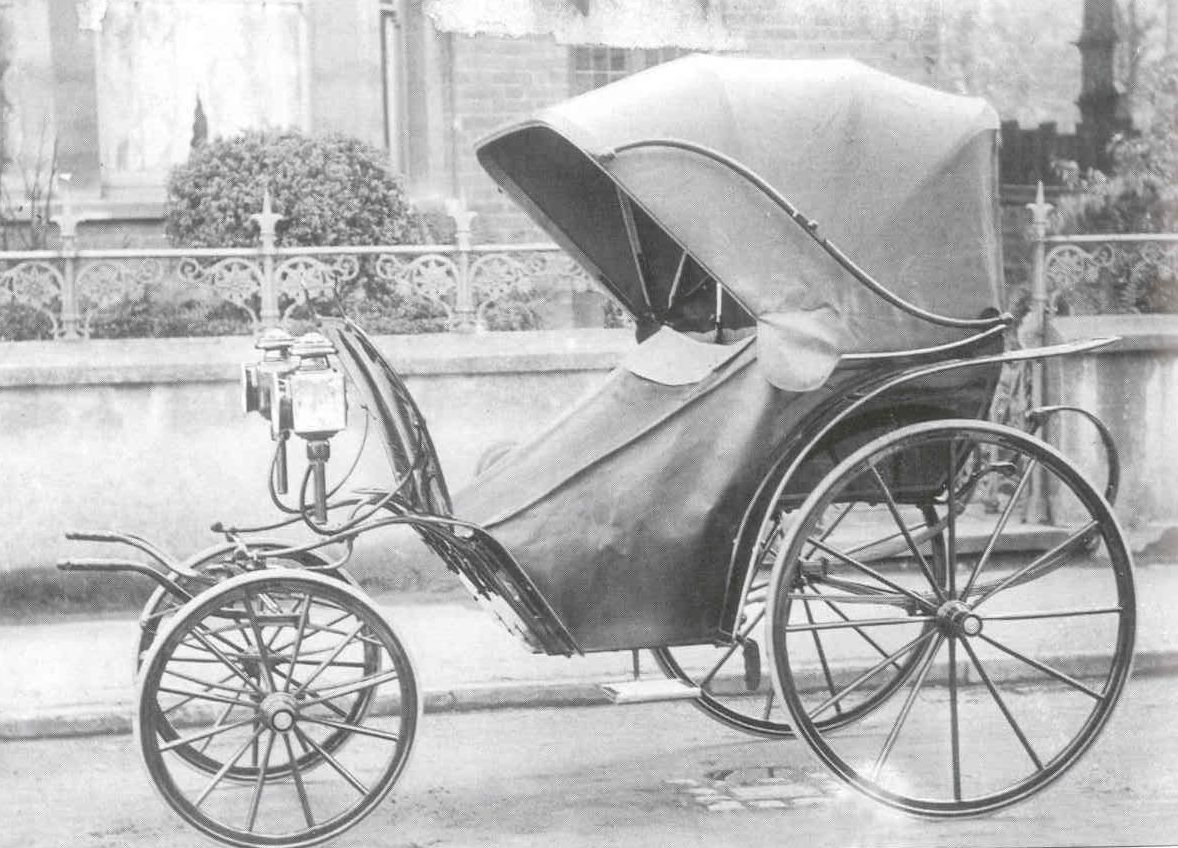
Pony phaeton (Source)

Then "a little pony phaeton" carrying Hortense and Rosa arrives. Lady Dedlock had sent for it, asking her maid to come -- meaning Rosa, though Hortense had apparently insisted that she was the one sent for.  "The Frenchwoman stood unnoticed, looking on with her lips tightly set," as Lady Dedlock offers to send the carriage back for Ada and Esther. Jarndyce declines, and Lady Dedlock "took a graceful leave of Ada -- none of me," Esther notes, and bids Rosa get into the carriage with her. As for Hortense,
She remained perfectly still until the carriage had turned into the drive, and then, without the least discomposure of countenance, slipped off her shoes, left them on the ground, and walked deliberately in the same direction, through the wettest of the wet grass.
"'Is that young woman mad?' said my guardian." The keeper says that she's just "mortal high and passionate -- powerful high and passionate; and what with having notice to leave, and having others put above her, she don't take kindly to it." And as Jarndyce, Ada and Esther return home, they see Hortense still striding through the wet grass.

In London, the omniscient narrator tells us, the courts have shut down for the long vacation, leaving all of the clerks idle, as well as the businesses that support the law, such as Mr Snagsby, the stationer. He and Mrs Snagsby are entertaining the Chadbands. Mr Chadband is a minister "attached to no particular denomination," who includes among his followers Mrs Snagsby. "'My little woman,' says Mr Snagsby to the sparrows in Staple Inn, 'like to have her religion rather sharp, you see!'"
Mr Chadband is a large yellow man, with a fat smile, and a general appearance of having a good deal of train oil in his system. Mrs Chadband is a stern, severe-looking, silent woman. Mr Chadband moves softly and cumbrously, not unlike a bear who has been taught to walk upright. He is very much embarrassed about the arms, as if they were inconvenient to him, and he wanted to grovel; is very much in a perspiration about the head; and never speaks without first putting up his great hand, as delivering a token to his hearers that he is going to edify them.
Chadband's "edification," however, typically consists of platitudes delivered in the most pompous and verbose manner possible. Still, as the narrator observes, "the Chadband style of oratory is widely received and much admired."

As the Snagsbys are entertaining the Chadbands, however, the servant, Guster, informs Mr Snagsby that he is wanted in the shop downstairs, where he finds a constable with Jo in his custody. The constable has ordered Jo to "move on," and Jo insists that there's nowhere for him to move on to. Jo has apparently indicated to the constable that Mr Snagsby can vouch for him, and although Mrs Snagsby has appeared at the top of the stairs to proclaim that he doesn't know the boy, Snagsby admits that he does.

Then Mr Guppy appears, and confirms Snagsby's acquaintance with Jo. The constable is still convinced that Jo is up to no good, partly because he lives in Tom-all-Alone's.  Moreover, Jo has money upon him, which is enough to convince the constable that Jo has been stealing. So Jo tells the story of being approached "by a lady in a wale" (i.e., veil) who gave him a sovereign to show her where Nemo lived, died, and was buried. The constable agrees to leave Snagsby in charge of Jo's moving on -- over Mrs Snagsby's protests -- and departs.

Intrigued by Jo's story of the veiled lady, Guppy begins asking questions, raising the curiosity of the others, so that Guppy and Jo are ushered upstairs to continue the interrogation. Guppy opines that "there is something out of the common here that beats anything that ever came into my way at Kenge and Carboy's," which is enough to have Mrs Chadband eager to hear more: She happens to be acquainted with Kenge and Carboy's. Before she married the Rev. Mr Chadband, she says, she "was left in charge of a child named Esther Summerson, who was put out in life by Messrs Kenge and Carboy's."

It's Guppy's turn to be astonished, though when he gasps, "Miss Summerson, ma'am!" he is rebuked by Mrs Chadband, who is apparently the Mrs Rachael who was servant to Esther's godmother/aunt. "'I call her Esther Summerson,' says Mrs Chadband, with austerity. 'There was no Miss-ing of the girl in my time. It was Esther. "Esther, do this! Esther, do that!" and she was made to do it.'"


The Rev. Chadband seizes upon this moment of astonishment to take the floor and sermonize on the topic of ... Jo, who is bewildered by everything that's going on, and "whose immediate object seems to be to get away on any terms." Guppy gives him a penny and Mr Snagsby loads him up with some of the table leftovers, and off he goes into the night.

Guppy, of course, is not going to let all these revelations go. He has been vexed by the arrival in the offices of Kenge and Carboy of Richard Carstone, but gratified "to find the new comer constantly poring over the papers in Jarndyce and Jarndyce; for he well knows that nothing but confusion and failure can come of that." So he gathers his friends, fellow law-clerks Young Smallweed and Tony Jobling, and invites them to dine with him.
Hablot Knight Browne (Phiz), Mr Guppy's Entertainment (Source: David Perdue's Charles Dickens Page)
After much Dickensian business about these swaggering striplings, during which we learn that Jobling was the one who accompanied Guppy to Chesney Wold, Guppy announces "a plan I have lately thought of proposing." It may, he stammers, "have some reference to a subject, which may -- or may not -- have cast its shadow on my existence" -- that is, of course, his failed proposal to Esther. He tells Jobling that in his duties at Kenge and Carboy's he has been delivering a weekly allowance to Miss Flite at Krook's, and that Krook has a room to let. Krook "must be precious old, you know, and he has not a soul about him, and he is reported to be immensely rich; and whether he is a smuggler, or a receiver, or an unlicensed pawnbroker, or a money-lender -- all of which I have thought likely at different times -- it might pay you to knock up a sort of knowledge of him."

Jobling is game, even when he learns that the room is where Krook's last lodger died. So they proceed to Krook's, where he is dead drunk. They manage to get him awake, and after treating him to a better quality of gin than he is used to, "Mr Guppy presents his friend under the impromptu name of Mr Weevle, and states the object of their visit." The result is that Jobling/Weevle is installed in the second-floor room, which he adorns with "copper-plate impressions from that truly national work, The Divinities of Albion, or Galaxy Gallery of British Beauty, representing ladies of title and fashion in every variety of smirk that art, combined with capital, is capable of producing." And in time the neighbor ladies are gossiping, "don't you be surprised Lord bless you, if that young man comes in at last for old Krook's money!"
_____

The 2005 BBC/Masterpiece Theatre dramatization features Burn Gorman as Guppy, Patrick Kennedy as Richard Carstone, Denis Lawson as John Jarndyce, Anna Maxwell Martin as Esther Summerson, Sally Leonard as Polly, Warren Clarke as Boythorn, Timothy West as Sir Leicester Dedlock, Gillian Anderson as Lady Dedlock, Nathaniel Parker as Harold Skimpole, Carey Mulligan as Ada Clare, Emma Williams as Rosa, Lilo Baur as Hortense, Sean McGinley as Snagsby, Robert Pugh as Mr Chadband, Catherine Tate as Mrs Chadband, Michelle Tate as Guster, Harry Eden as Jo, Dominic Coleman as Policeman, Johnny Vegas as Krook, Charles Dance as Tulkinghorn, Tom Georgeson as Clamb.