
Richard is so indecisive that it takes several weeks for him finally to settle on an "experimental course" in the law at Kenge and Carboy. Meanwhile, Ada, Esther and Jarndyce return to Bleak House, Jarndyce having located lodgings for Richard in London. Richard "immediately began to spend all the money he had, in buying the oddest little ornaments and luxuries for this lodging." He also continues with his odd habit of believing that if he has saved money on one thing, that allows him to spend the amount he has saved on something else, making "out that to spend anything less on something else was to save the difference."
He has postponed his decision so long, that he is unable to accompany the others to Lincolnshire for their visit to Boythorn. But Skimpole takes his place -- in more ways than one. For here Dickens makes clear the resemblance of Richard to Skimpole, by placing Richard's curious confusion about money in close proximity to Skimpole's absolute indifference to it. Skimpole has leased some furniture that is being repossessed, causing Jarndyce, who stood security for the lease, to have to pay for them. Skimpole is not in the least embarrassed by that fact, and the others continue to humor him in his "childishness."
Boythorn meets them at an inn near his house and explains, "I am obliged to conduct you nearly two miles out of the way. But, our direct road lies through Sir Leicester Dedlock's park; and, in that fellow's property, I have sworn never to set foot of mine." He tells them that "Sir Arrogant Numskull" -- his name for Sir Leicester -- is in residence and that Lady Dedlock is expected to return soon: "Whatever can have induced that transcendent woman to marry that effigy and figure-head of a baronet, is one of the most impenetrable mysteries that ever baffled human inquiry."
Esther gets her first glimpse of Chesney Wold -- "a picturesque old house, in a fine park richly wooded" -- as they drive past on the road. In the village, at the Dedlock Arms, Boythorn greets Watt Rouncewell, and tells them that Watt is the son of the housekeeper at Chesney Wold and in love with "a pretty girl up at the House" -- i.e., Rosa. Boythorn's own house is sunny and pleasant, and "everything about the place wore an aspect of maturity and abundance." It's one of those Dickensian Gardens of Eden, with its own snake -- the hostility between Boythorn and Dedlock, so that the side of the house that borders Dedlock property is guarded by "a sentry in a smock-frock, day and night, whose duty was supposed to be, in case of aggression, immediately to ring a large bell hung up there for the purpose, to unchain a great bull-dog established in a kennel as his ally, and generally to deal destruction on the enemy."
On Sunday morning they attend services at a little church, where Esther gets her first glimpse of the Dedlocks and their household, including Mrs Rouncewell, Rosa, and Hortense: "One face, and not an agreeable one, though it was handsome, seemed maliciously watchful of this pretty girl, and indeed of everyone and everything there. It was a Frenchwoman's."
 |
| Hablot Knight Browne (Phiz), The Little Church in the Park (Source: David Perdue's Charles Dickens Page) |
Shall I ever forget the rapid beating at my heart, occasioned by the look I met, as I stood up! Shall I ever forget the manner in which those handsome proud eyes seemed to spring out of their languor, and to hold mine! It was only a moment before I cast mine down -- released again, if I may say so -- on my book; but, I knew the beautiful face quite well, in that short space of time. And, very strangely, there was something quickened within me, associated with the lonely days at my godmother's ... although I had never seen this lady's face before in all my life -- I was quite sure of it -- absolutely certain.For Esther, Lady Dedlock's face is, "in a confused way, like a broken glass to me, in which I saw scraps of old remembrances." As this characteristic Victorian recognition scene continues, Esther tries to decide if Lady Dedlock somehow resembles her godmother/aunt, "but, the expression was so different, and the stern decision which had worn into my godmother's face, like weather into rocks, was so completely wanting in the face before me."
And yet I -- I, little Esther Summerson, the child who lived a life apart, and on whose birthday there was no rejoicing -- seemed to arise before my own eyes, evoked out of the past by some power in this fashionable lady, whom I not only entertained no fancy that I had ever seen, but whom I perfectly well know I had never seen until that hour.We have pages and pages to go before this particular mystery is finally solved, and perhaps it is because so much narrative is yet to come that Dickens lays it on so thick in this scene.
Meanwhile, Boythorn and Skimpole have one of their skirmishes of Duty vs. Irresponsibility, ending with Skimpole asserting that though "the Slaves on American plantations ... are worked hard" and "don't altogether like it" and "theirs is an unpleasant experience on the whole; but, they people the landscape for me, they give it a poetry for me, and perhaps that is one of the pleasanter objects of their existence." Dickens, ardently anti-slavery, is here giving a strong hint that Skimpole may yet prove to be a villain in the novel. But on the other hand, Skimpole's sentimentalized, "picturesque" attitude toward slavery in the antebellum United States would persist for another century in novels and movies.
The following Saturday, Jarndyce, Ada and Esther are out for a walk when a storm comes up, with lightning and thunder. They take refuge in a keeper's lodge on the Dedlock property. As they are waiting in the doorway, watching the storm, someone asks, "Is it not dangerous to sit in so exposed a place?" Ada thinks Esther has spoken, but it's Lady Dedlock, who has also "taken shelter in the lodge, before our arrival there, and had come out of the gloom within." Esther has also reacted to the surprise voice, but in a different way from Ada: "The beating at my heart came back again. I had never heard the voice, as I had never seen the face, but it affected me in the same strange way. Again, in a moment, there arose before my mind innumerable pictures of myself."
It turns out that Lady Dedlock and Jarndyce have met, a long time before. She mentions the letter he had written to Sir Leicester requesting his aid in helping Richard, and asks to be introduced first to Ada and then to Esther. Learning that Esther is his ward, she asks, "Has Miss Summerson lost both her parents?" He says that she has. Lady Dedlock and Esther look at each other, and then Lady Dedlock turns away "with a hasty air, almost expressive of displeasure or dislike." She and Jarndyce, we learn, had met when they were "abroad," and she observes that Jarndyce had been better acquainted with her sister, with whom she had become estranged: "'We went our several ways,' said Lady Dedlock, 'and had little in common even before we agreed to differ. It is to be regretted, I suppose, but it could not be helped.'"
 |
| Pony phaeton (Source) |
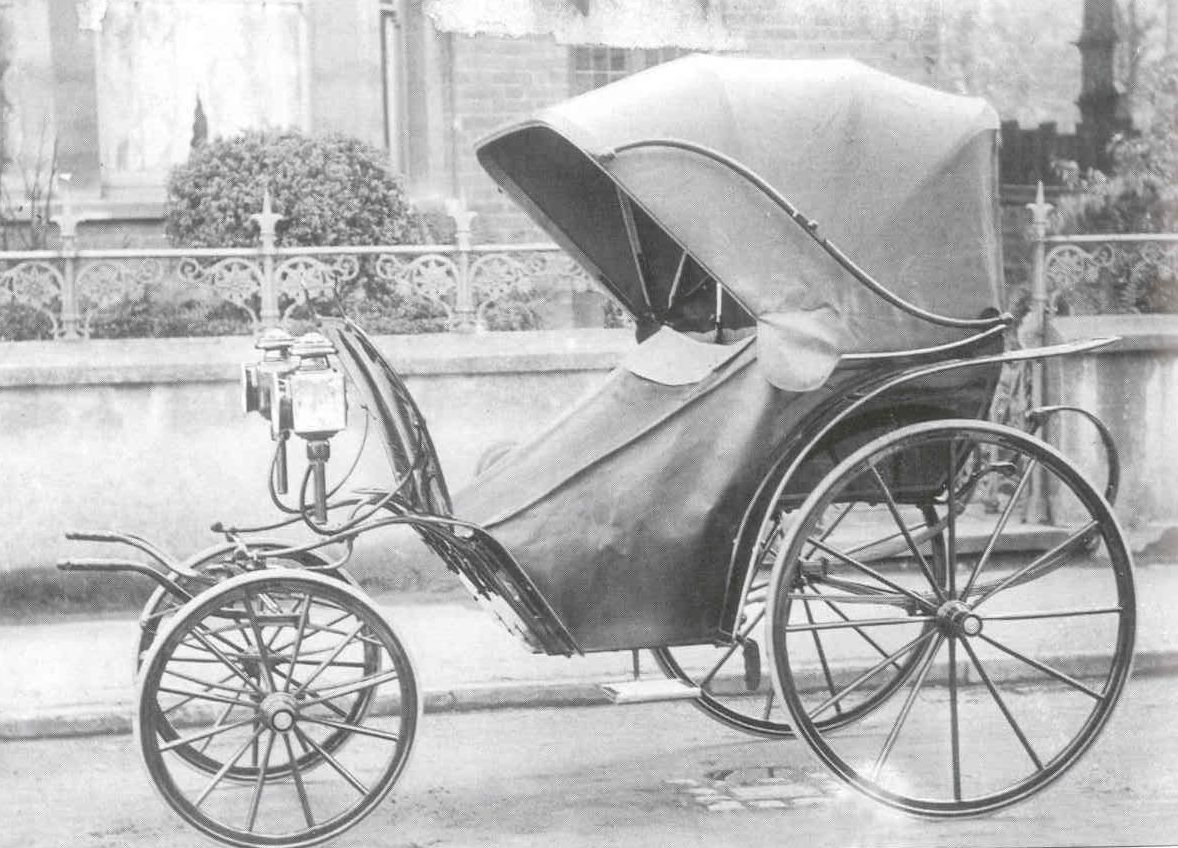
Then "a little pony phaeton" carrying Hortense and Rosa arrives. Lady Dedlock had sent for it, asking her maid to come -- meaning Rosa, though Hortense had apparently insisted that she was the one sent for. "The Frenchwoman stood unnoticed, looking on with her lips tightly set," as Lady Dedlock offers to send the carriage back for Ada and Esther. Jarndyce declines, and Lady Dedlock "took a graceful leave of Ada -- none of me," Esther notes, and bids Rosa get into the carriage with her. As for Hortense,
She remained perfectly still until the carriage had turned into the drive, and then, without the least discomposure of countenance, slipped off her shoes, left them on the ground, and walked deliberately in the same direction, through the wettest of the wet grass."'Is that young woman mad?' said my guardian." The keeper says that she's just "mortal high and passionate -- powerful high and passionate; and what with having notice to leave, and having others put above her, she don't take kindly to it." And as Jarndyce, Ada and Esther return home, they see Hortense still striding through the wet grass.
In London, the omniscient narrator tells us, the courts have shut down for the long vacation, leaving all of the clerks idle, as well as the businesses that support the law, such as Mr Snagsby, the stationer. He and Mrs Snagsby are entertaining the Chadbands. Mr Chadband is a minister "attached to no particular denomination," who includes among his followers Mrs Snagsby. "'My little woman,' says Mr Snagsby to the sparrows in Staple Inn, 'like to have her religion rather sharp, you see!'"
Mr Chadband is a large yellow man, with a fat smile, and a general appearance of having a good deal of train oil in his system. Mrs Chadband is a stern, severe-looking, silent woman. Mr Chadband moves softly and cumbrously, not unlike a bear who has been taught to walk upright. He is very much embarrassed about the arms, as if they were inconvenient to him, and he wanted to grovel; is very much in a perspiration about the head; and never speaks without first putting up his great hand, as delivering a token to his hearers that he is going to edify them.Chadband's "edification," however, typically consists of platitudes delivered in the most pompous and verbose manner possible. Still, as the narrator observes, "the Chadband style of oratory is widely received and much admired."
As the Snagsbys are entertaining the Chadbands, however, the servant, Guster, informs Mr Snagsby that he is wanted in the shop downstairs, where he finds a constable with Jo in his custody. The constable has ordered Jo to "move on," and Jo insists that there's nowhere for him to move on to. Jo has apparently indicated to the constable that Mr Snagsby can vouch for him, and although Mrs Snagsby has appeared at the top of the stairs to proclaim that he doesn't know the boy, Snagsby admits that he does.
Then Mr Guppy appears, and confirms Snagsby's acquaintance with Jo. The constable is still convinced that Jo is up to no good, partly because he lives in Tom-all-Alone's. Moreover, Jo has money upon him, which is enough to convince the constable that Jo has been stealing. So Jo tells the story of being approached "by a lady in a wale" (i.e., veil) who gave him a sovereign to show her where Nemo lived, died, and was buried. The constable agrees to leave Snagsby in charge of Jo's moving on -- over Mrs Snagsby's protests -- and departs.
Intrigued by Jo's story of the veiled lady, Guppy begins asking questions, raising the curiosity of the others, so that Guppy and Jo are ushered upstairs to continue the interrogation. Guppy opines that "there is something out of the common here that beats anything that ever came into my way at Kenge and Carboy's," which is enough to have Mrs Chadband eager to hear more: She happens to be acquainted with Kenge and Carboy's. Before she married the Rev. Mr Chadband, she says, she "was left in charge of a child named Esther Summerson, who was put out in life by Messrs Kenge and Carboy's."
It's Guppy's turn to be astonished, though when he gasps, "Miss Summerson, ma'am!" he is rebuked by Mrs Chadband, who is apparently the Mrs Rachael who was servant to Esther's godmother/aunt. "'I call her Esther Summerson,' says Mrs Chadband, with austerity. 'There was no Miss-ing of the girl in my time. It was Esther. "Esther, do this! Esther, do that!" and she was made to do it.'"
The Rev. Chadband seizes upon this moment of astonishment to take the floor and sermonize on the topic of ... Jo, who is bewildered by everything that's going on, and "whose immediate object seems to be to get away on any terms." Guppy gives him a penny and Mr Snagsby loads him up with some of the table leftovers, and off he goes into the night.
Guppy, of course, is not going to let all these revelations go. He has been vexed by the arrival in the offices of Kenge and Carboy of Richard Carstone, but gratified "to find the new comer constantly poring over the papers in Jarndyce and Jarndyce; for he well knows that nothing but confusion and failure can come of that." So he gathers his friends, fellow law-clerks Young Smallweed and Tony Jobling, and invites them to dine with him.
 |
| Hablot Knight Browne (Phiz), Mr Guppy's Entertainment (Source: David Perdue's Charles Dickens Page) |
Jobling is game, even when he learns that the room is where Krook's last lodger died. So they proceed to Krook's, where he is dead drunk. They manage to get him awake, and after treating him to a better quality of gin than he is used to, "Mr Guppy presents his friend under the impromptu name of Mr Weevle, and states the object of their visit." The result is that Jobling/Weevle is installed in the second-floor room, which he adorns with "copper-plate impressions from that truly national work, The Divinities of Albion, or Galaxy Gallery of British Beauty, representing ladies of title and fashion in every variety of smirk that art, combined with capital, is capable of producing." And in time the neighbor ladies are gossiping, "don't you be surprised Lord bless you, if that young man comes in at last for old Krook's money!"
_____
The 2005 BBC/Masterpiece Theatre dramatization features Burn Gorman as Guppy, Patrick Kennedy as Richard Carstone, Denis Lawson as John Jarndyce, Anna Maxwell Martin as Esther Summerson, Sally Leonard as Polly, Warren Clarke as Boythorn, Timothy West as Sir Leicester Dedlock, Gillian Anderson as Lady Dedlock, Nathaniel Parker as Harold Skimpole, Carey Mulligan as Ada Clare, Emma Williams as Rosa, Lilo Baur as Hortense, Sean McGinley as Snagsby, Robert Pugh as Mr Chadband, Catherine Tate as Mrs Chadband, Michelle Tate as Guster, Harry Eden as Jo, Dominic Coleman as Policeman, Johnny Vegas as Krook, Charles Dance as Tulkinghorn, Tom Georgeson as Clamb.


