JOURNAL OF A COMPULSIVE READER
By Charles Matthews
Showing posts with label Ishmael. Show all posts

Monday, February 13, 2012

3. Genesis: The Bible, pp. 30-40

Chapter 20

Abraham goes into the south country, and once again decides it's best to pass off Sarah as his sister, not his wife. Wait, isn't she something like ninety now? Or is the chronology scrambled? In any case, she catches the eye of Abimelech, the king of Gerar, and he "takes" her -- which I guess means for a concubine. But before any harm can be done, God appears to Abimelech in a dream and tells him he's "a dead man" because "the woman which thou hast taken ... is a man's wife." Abimelech protests that Abraham said she was his sister, and Sarah confirmed it. God admits that Abimelech has been lied to a little, and says that he actually prevented Abimelech from having sex with Sarah before he could tell him the truth. (An advantage he didn't give to Pharaoh, who suffered plagues for it.) So if Abimilech will just send Sarah back to Abraham, who is "a prophet" and will pray for him, God won't kill Abimelech.

Okay, says Abimelech, but when he takes Sarah back to Abraham, he asks why he lied to him and almost got him killed. Abraham says, "Because I thought, Surely the fear of God is not in this place; and they will slay me for my wife's sake." Anyway, he goes on, he wasn't really lying: Sarah is his half-sister, "the daughter of my father, but not the daughter of my mother."

Abimelech is satisfied with the explanation, and not only gives Sarah back to Abraham, he also gives him "sheep, and oxen, and menservants, and womenservants," as well as "a thousand pieces of silver," and tells him to stay on in his land "where it pleaseth thee." In return, Abraham prays to God, who cures the infertility of Abimelech, and his wife, and his maidservants; and they bare children." (The infertility is a detail that the narrator seems to have forgotten to mention earlier.)

Chapter 21

God cures Sarah's infertility, too, and she presents Abraham with a son whom, according to the agreement, he calls Isaac. Abraham is a hundred years old when Isaac is born, and he has Isaac circumcised when the infant is eight days old. "And Sarah said, God hath made me to laugh, so that all that hear will laugh with me." (Sarah seems to be the first person in the Bible with a sense of humor, or perhaps just something to laugh about.)

On the other hand, now that she's produced an heir for Abraham, Sarah gets kind of pissy about Hagar and Ishmael, and tells Abraham to get rid of them.
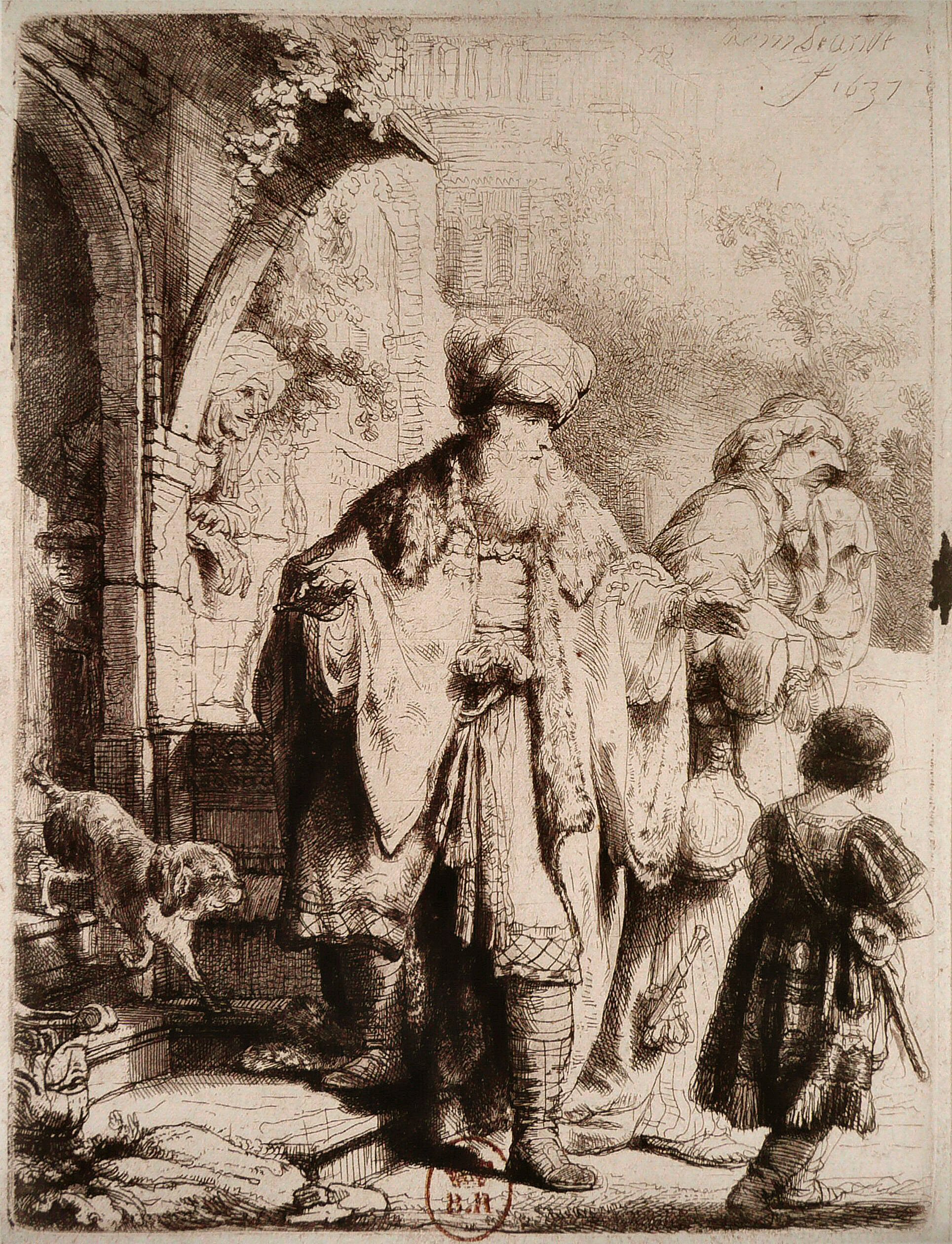
Rembrandt, The Dismissal of Hagar, 1637
 Abraham isn't at all happy about this, but God tells him not to worry, reminding him that "of the son of the bondwoman will I make a nation, because he is thy seed. Hagar and Ishmael wander out into the desert of Beersheba, but they run out of water. Not wanting to see him die, "she cast the child under one of the shrubs," and goes "a good way off" where she sits down and weeps. But an angel calls out to her to go get the boy, whom God is going to make "a great nation" out of. And God shows her a nearby well, and Hagar gives Ishmael water from it.
And God was with the lad; and he grew, and dwelt in the wilderness, and became an archer. 
And he dwelt in the wilderness of Paran: and his mother took him a wife out of the land of Egypt.
Meanwhile, Abraham and Abimelech are having a little quarrel because one of Abimelech's servants "had violently taken away" one of the wells Abraham was using. Abimelech says this is the first he's heard of it, and Abraham should have spoken up before. They patch things up when Abraham gives Abimelech "sheep and oxen," as well as "seven ewe lambs" which signify that Abraham had the well dug himself. So they make a covenant, and Abimelech leaves Abraham alone. "And Abraham sojourned in the Philistines' land many days."

Chapter 22

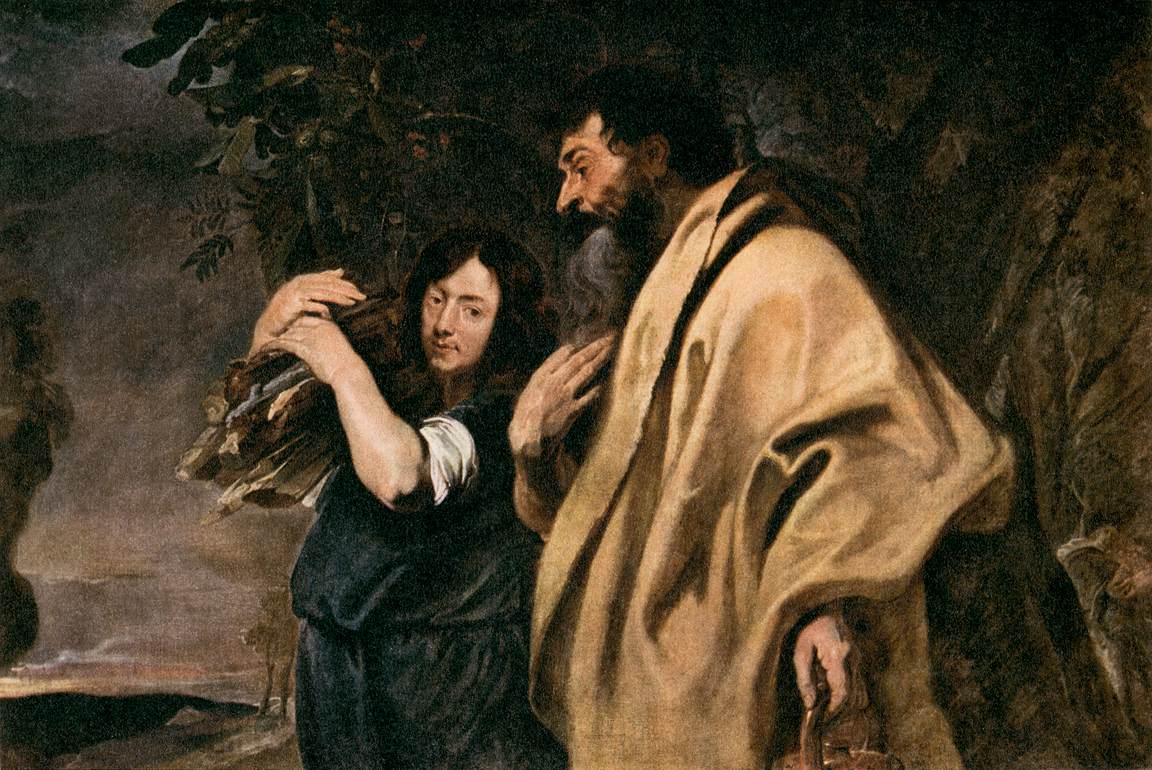
Now God decides to "tempt" Abraham: "Take now thy son, thine only son Isaac, whom thou lovest, and get thee into the land of Moriah; and offer him there for a burnt offering upon one of the mountains which I will tell thee of."  The narrator doesn't say anything about protesting or questioning this grisly order, but just that Abraham leaves the next morning, taking two young men and Isaac and some firewood with him. Three days later, Abraham sights the place "afar off," and tells the young men to stay there and he and Isaac will go on. He gives Isaac the wood to carry, while he takes the torch and a knife.
Anthony van Dyck, Abraham and Isaac, c. 1617
Isaac asks, "where is the lamb for a burnt offering?" Abraham replies, "God will provide himself a lamb for a burnt offering: so they went both of them together." When they reach the site God has indicated, Abraham builds an altar, lays out the wood, then ties up Isaac and puts him on the altar.

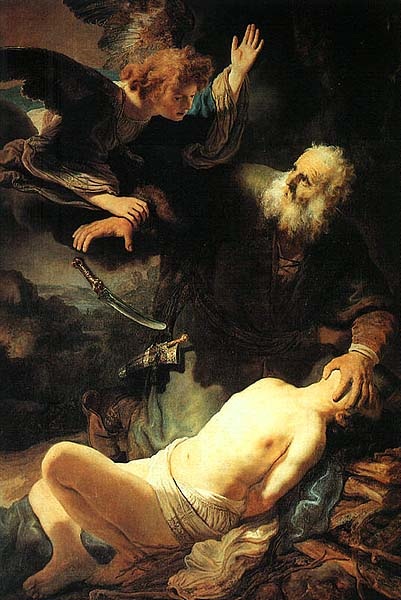
But when he gets the knife ready to kill Isaac, an angel calls out from heaven: "Lay not thine hand upon the lad, neither do thou any thing unto him; for now I know that thou fearest God, seeing thou has not withheld thy son, thine only son from me."
Rembrandt, The Sacrifice of Abraham, 1635
Abraham sees "a ram caught in a thicket by his horns," and sacrifices the ram instead. The angel then repeats God's promise:
That in blessing I will bless thee, and in multiplying I will multiply thy seed as the stars of the heaven, and as the sand which is upon the sea short; and thy seed shall possess the gate of his enemies; 
And in thy seed shall all the nations of the earth be blessed; because thou hast obeyed my voice.
There is something profoundly unpleasant about God's putting Abraham (not to mention Isaac!) through this ordeal. The preoccupation with foreskins was bad enough, and the dietary and other restriction to come are annoying, but this borders on sadism. But I'll leave Kierkegaard to wrangle with the implications of this fable.

Meanwhile, Abraham's brother Nahor and his wife Milcah have been having children, and one of them, Bethuel, has become father to Rebekah.

Chapter 23

Sarah lives to be one hundred twenty-seven. When she dies in Hebron, Abraham asks for "a buryingplace." Ephron the Hittite says he has a field with a cave in it, and offers it to Abraham, who pays him four hundred shekels of silver for it.

Chapter 24 

Getting old, Abraham tells "his eldest servant of his house, ... Put, I pray thee, thy hand under my thigh." He wants him to swear not to find a wife for Isaac among the Canaanites, but to go to the land of his kindred and find a wife for him there. The servant swears he will do it, and goes off to Mesopotamia and the city of Nahor. When he gets there, he makes his camels kneel by the well where the women of the city come to fetch water, and asks God to "let it come to pass, that the damsel to whom I shall say, Let down thy pitcher, I pray thee, that I may drink; and she shall say, Drink, and I will give thy camels drink also: let the same be she that thou hast appointed for thy servant Isaac."

And sure enough, "before he had done speaking," Rebekah, who is Abraham's grand-niece, comes out with her pitcher, answers his request for water, and volunteers to water his camels, too. "And the man wondering at her held his peace, to wit whether the LORD had made his journey prosperous or not."  After she has finished watering the camels, he gives her a golden earring and two gold bracelets and asks who her father is, and if he has a room for him to stay in. She says she's the daughter of Bethuel, the son of Micah and Nahor. The servant marvels that the Lord has led him "to the house of my master's brethren."

Rebekah runs home and tells her brother Laban what has happened, and Laban comes out to meet the man, who is standing at the well with his camels. He invites him in to eat, but the servant says he has to explain his errand first: He is Abraham's servant, and Abraham has become a rich man. Abraham's wife, Sarah, he explains, gave birth to a son when she was very old, and Abraham has made the servant swear not to find a wife for the son among the Canaanites in whose land he lives. Instead, he has sent the servant to find a wife for him among his kindred.

He explains further that if he can't find a woman willing to return with him and marry Isaac, that he's released from the oath he swore to Abraham. But he also tells about his prayer for a sign, that the woman he asks for a drink will give it to him and water the camels too, and that Rebekah has done all of that. So Laban and Bethuel agree that this is a pretty good indication that Rebekah fits the bell, and they say, "Behold, Rebekah is before thee, take her, and go, and let her be thy master's son's wife, as the LORD hath spoken."

So after some praying and feasting and exchanging gifts, he's ready to return to Abraham with Rebekah. Her brother and mother want a few days, "at the least ten," more with Rebekah, but the servant asks them not to hinder him. So they ask Rebekah, "Wilt thou go with this man? And she said, I will go."
And they blessed Rebekah, and said unto her, Thou art our sister, be thou the mother of thousands of millions, and let thy seed possess the gate of those which hate them.
So off they go.

When they get near where Isaac is living, he sees them coming. She seeks him, too, and gets off her camel, having asked the servant who the man coming through the field to meet them is. When he says it is his master, she puts on a veil. The servant tells Isaac the story, and Isaac takes Rebekah into the tent that had been Sarah's, "and she became his wife; and he loved her: and Isaac was comforted after his mother's death."

Chapter 25

Abraham takes another wife, Keturah, after Sarah's death. She bears him a bunch of children, but "Abraham gave all that he had unto Isaac." He gives gifts to the sons of his concubines, but he sends them away from Isaac. Abraham dies at the age of one hundred seventy-five, and is buried in the same field where Sarah is buried.  Ishmael fathers twelve sons before he dies at one hundred thirty-seven.

Isaac is forty when he marries Rebekah, but she is barren until he prays to the Lord. She gets pregnant with twins, who "struggled together within her." She asks the Lord what is going on, and he tells her, "Two nations are in thy womb, and two manner of people shall be separated from thy bowels; and the one people shall be stronger than the other people; and the elder shall serve the younger.

When they are born, the first one is red and hairy, and they name him Esau. The other comes out holding on to Esau's heel, and is named Jacob. Isaac is sixty years old when they are born. Esau becomes "a cunning hunter, a man of the field, whereas Jacob is "a plain man, dwelling in tents." Isaac loves Esau, "because he did eat of his venison," but Rebekah favors Jacob.

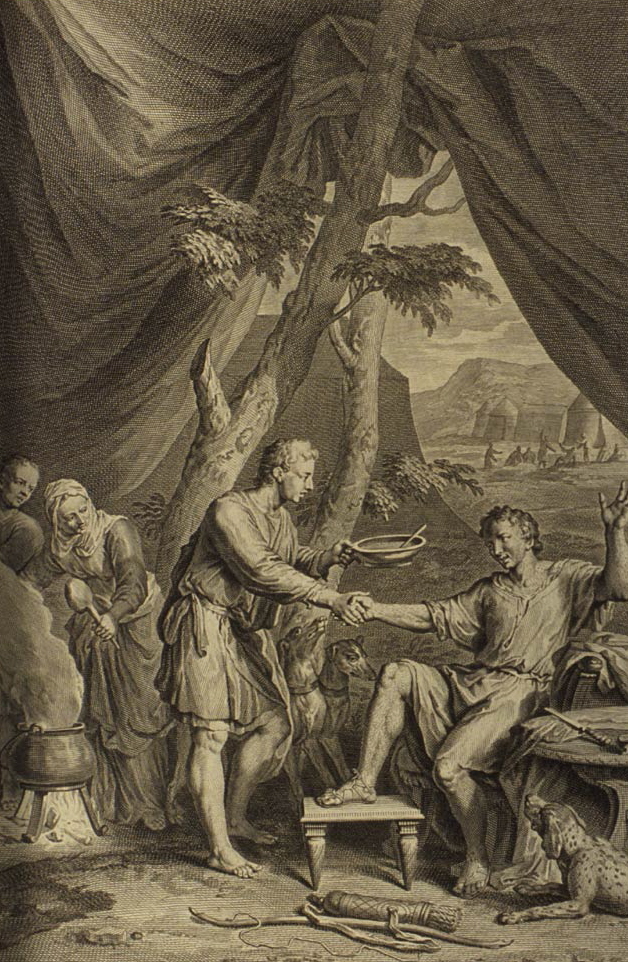
Jacob makes some pottage, and when Esau comes in from working the field, he is famished. He asks Jacob for some of the pottage, and Jacob says, "Sell me this day thy birthright." Esau is too hungry to be concerned about any old birthright, and so he sells it to Jacob, who "gave Esau bread and pottage of lentiles; and he did eat and drink, and rose up, and went his way: thus Esau despised his birthright." 
Gerard Hoet, Esau Sells His Birthright for Pottage of Lentils, 1728


Sunday, February 12, 2012

2. Genesis: The Bible, pp. 19-30

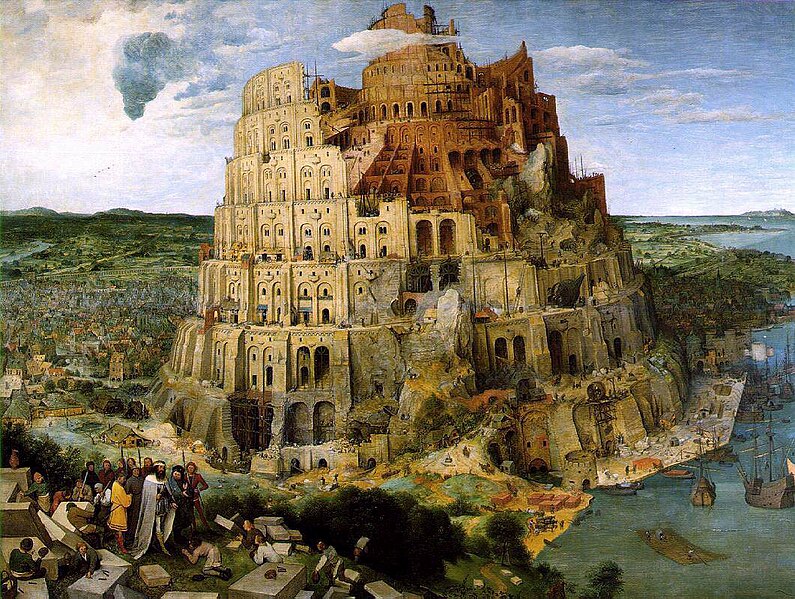
Pieter Brueghel the Elder, The Tower of Babel, 1563
Chapter 11

Since they were all descended from Noah, they all spoke the same language. But when they settled in the land of Shinar, they decided to build "a city and a tower, whose top may reach unto heaven," and not to go spreading out all over the Earth. But God took a look at the city and the tower and wasn't happy with all this unity. They're all speaking the same language, he observed, and this idea of staying in one place isn't what he had in mind.

So he said (to whom?): "let us go down, and there confound their language, that they may not understand one another's speech." This made building the city pretty much impossible, and God "scattered them abroad from thence upon the face of all the earth." I had always thought the point of the Tower of Babel was the hubris of reaching toward heaven, but it seems to be instead a fable about unity of purpose -- God promoting diversity, as it were.

Then comes more genealogy, the descendants of Shem, finally winding up with Terah, who fathers Abram, Nahor, and Haran. Haran dies comparatively young, but not before fathering Lot and Milcah, who marries her uncle Nahor. Abram marries Sarai, but she seems to be barren. Terah takes them all out of Ur of the Chaldees and into the land of Canaan, then dies at age two hundred five.

Chapter 12

God now tells Abram to split off from Nahor and his family and go where he shows him. "And I will make of thee a great nation, and I will bless thee, and make thy name great; and thou shalt be a blessing." So Abram and Sarai, joined by Abram's nephew Lot, go out into Canaan, which is inhabited, naturally, by Canaanites. God promises to give this land to Abram, but in the meanwhile Abram and company keep going south.

A famine makes them head for Egypt, but Abram worries that when the Egyptians see how beautiful his wife, Sarai, is, they will kill him and take her. So he has her pretend to be his sister. Sure enough, when they get to Egypt, "the Egyptians beheld the woman that she was very fair." The word gets to Pharaoh of her beauty, and she is "taken into Pharaoh's house." It's pretty obvious that she isn't just a servant, because Pharaoh rewards her "brother," Abram, with "sheep, and oxen, and he asses, and menservants, and maidservants, and she asses, and camels."

But God isn't pleased with this arrangement, and sends "great plagues" on Pharaoh and his house. Pharaoh sends for Abram and asks, "What is this that thou hast done unto me? why didst thou not tell me that she was thy wife?" He sends Abram and Sarai packing, though Abram apparently gets to keep all the stuff Pharaoh has given him.

Chapter 13

So Abram and Sarai and Lot head back north again, to Beth-el, where Abram had previously pitched his tent and built an altar to the Lord. Except now, "Abram was very rich in cattle, in silver, and in gold." Lot was pretty well off too, with "flocks, and herds, and tents," which makes it difficult for Lot and Abram to share the same land. Moreover, "the herdmen of Abram's cattle and the herdmen of Lot's cattle" don't get along, so Abram proposes that they split up: If you go left, he tells Lot, I'll go right, or vice versa.

Lot likes the looks of the plain of Jordan, which "was well watered every where, before the LORD destroyed Sodom and Gomorrah," so he goes east toward Jordan to "the cities of the plain, and pitched his tent toward Sodom," even though "the men of Sodom were wicked and sinners before the LORD exceedingly."

After Lot leaves, God tells Abram to look around, "For all the land which thou seest, to thee will I give it, and to thy seed for ever." He promises to make Abram's "seed as the dust of the earth: so that if a man can number the dust of the earth, then shall thy seed also be numbered." So Abram goes to the plain of Mamre, in Hebron, and builds an altar to the Lord.

Chapter 14

War breaks out "in the vale of Siddim, which is the salt sea," and when the kings of Sodom and Gomorrah fall, Lot is taken captive. Word comes to Abram that his nephew has been taken prisoner, so he trains his servants and rescues Lot. Melchizedek, the king of Salem and a priest, blesses Abram, and the king of Sodom offers to reward him. But Abram vows "That I will not take from a thread even to a shoelatchet, and that I will not take any thing that is thine, lest thou shouldest say, I have made Abram rich."

Chapter 15

God comes to Abram again, this time "in a vision," and tells him not to worry, but Abram complains that he and Sarai are still childless, so it looks like his heir is going to be Eliezer of Damascus, the steward of his house. But God reassures him again, showing him the stars, and promises, as he had done before with "the dust of the earth," that his "seed" will be equally numberless. He brought Abram out of Ur of the Chaldees to inherit this land, and tells Abram to sacrifice "an heifer of three years old, and a she goat of three years old, and a ram of three years old, and a turtledove, and a young pigeon."

Abram brings all of these things, and shoos the predatory birds away from the carcasses, then falls into a deep sleep wherein "an horror of great darkness fell upon him." God tells him that his "seed shall be a stranger in a land that is not theirs, and shall serve them" for four hundred years, but "afterward shall they come out with great substance." He will live to "a good old age," but "in the fourth generation they shall come hither again: for the iniquity of the Amorites is not yet full." (The Amorites are the mountain people of Canaan that Joshua will have to conquer.) But God goes on to promise Abram that his seed will inherit "this land" from the Nile to the Euphrates.

Chapter 16

But Abram and Sarai are still childless, so Sarai proposes that he sleep with her maid, Hagar, an Egyptian. Sure enough, Hagar gets pregnant, but she also gets a little uppity with Sarai about it. Abram tells Sarai to deal with it, so she does, and sends Hagar packing. An "angel of the LORD," the first we've encountered directly, finds Hagar and tells her to go back to Sarai and "submit thyself under her hands." He also promises, "I will multiply thy seed," and to call her son Ishmael, who "will be a wild man; his hand will be against every man, and every man's hand against him." So Hagar goes back and gives birth to Ishmael when Abram is eighty-six years old.

Chapter 17

When Abram is ninety-nine, God comes to him again and tells him, "I will make my covenant between me and thee, and will multiply thee exceedingly." He tells Abram his name is now Abraham and he is "a father of many nations." He "will give unto thee, and to thy seed after thee, the land wherein thou art a stranger, all the land of Canaan, for an everlasting possession; and I will be their God."

As "token of the covenant," Abraham has to see to it that "Every man child among you shall be circumcised." God goes on to make a big deal out of his preoccupation with prepuces:
And he that is eight days old shall be circumcised among you, every man child in your generations, he that is born in the house, or bought with money of any stranger, which is not of thy seed..... And the uncircumcised man child whose flesh of his foreskin is not circumcised, that soul shall be cut off from his people; he hath broken my covenant.
This will be only the first of a long series of somewhat arbitrary things Abraham's people are expected to do.

As for Sarai, she is now Sarah, and she will bear Abraham a son. It's easy to forgive Abraham for laughing at this: "Shall a child be born unto him that is an hundred years old? and shall Sarah, that is ninety years old, bear?" Oh, yes, indeed, says God, "and thou shalt call his name Isaac." You can imagine Abraham thinking at this point that committing himself and his people to cutting off their foreskins would be a small, if painful, price to pay for such a miracle. Even though the covenant will be with Isaac, Ishmael will also benefit: He'll beget "twelve princes" and God "will make him a great nation." So Abraham has himself circumcised at the age of ninety-nine, and Ishmael, who is thirteen, and every other man in the household.

Chapter 18

Abraham is sitting in his tent door when he looks up and sees the Lord and three men. He runs and tells a servant to fetch some water so they can wash their feet, and tells Sarah to prepare some cakes "of fine meal," and he gets "a calf tender and good," and has a young man prepare it to serve to the men. They ask after Sarah, and deliver the news that she is going to have a son. Sarah laughs at the idea, but "the LORD said unto Abraham, Wherefore did Sarah laugh...? Is anything too hard for the LORD?" Sarah says she wasn't really laughing, she was just afraid, but he says, "Nay; but thou didst laugh." (Always has to have the last word, this God.)

Abraham goes with them in the direction of Sodom, and God confides that he is going to check out what he's heard about the wickedness of Sodom and Gomorrah. The men proceed on their way toward Sodom, but God stays a while longer with Abraham, who worries that God is going to destroy the righteous along with the wicked in the city: "That be far from thee to do after this manner, to slay the righteous with the wicked." So the Lord says if he finds fifty righteous people in the city he will spare it. Well, says Abraham, what if there are forty-five righteous people? Okay, says God, I'll spare it if there are forty-five. How about forty, then? Or twenty? And finally God agrees that he'll spare it if there are as few as ten. This seems to satisfy Abraham, who goes home and lets the Lord go about his business. I guess if you've got a covenant, and sacrificed your foreskin, and your ninety-year-old wife is about to have a baby, you can press your luck a little.

Chapter 19

So two angels arrive at Sodom, and Lot meets them at the gate. He offers them lodging for the night, but they say no, they'll just spend the night in the street. But Lot persists, and they agree to spend the night in his house.
But before they lay down, the men of the city, even the men of Sodom, compassed the house round, both old and young, all the people from every quarter; 
And they called unto Lot, and said unto him, Where are the men which came in to thee this night? bring them out unto us, that we may know them.
And so begins millenniums of interpretation, most of which have a homophobic bent, centered on the demand "that we may know them," i.e., have carnal knowledge of them. Lot certainly seems to interpret the demand that way; he offers them instead his "two daughters which have not known man." The mob is having none of it, and is about to break down the door, but the angels pull Lot inside and smite the men at the door with blindness.

They're about to destroy the city, the angels tell Lot, so they suggest he gather up his belongings and his household and get ready to leave. Lot has some married daughters and he tries to persuade his sons-in-law to leave with him, but they think he's nuts and refuse. So in the morning, Lot and his wife and his two virgin daughters are hustled out of the city.
Peter Paul Rubens, Lot and His Family Flee Sodom, c. 1615
The angels urge Lot not to look behind him at the destruction, but to head into the mountains, but Lot is afraid and suggests that they go to a little city nearby named Zoar. So while they're at Zoar, "the LORD rained upon Sodom and upon Gomorrah brimstone and fire from the LORD out of heaven;
And he overthrew those cities, and all the plain, and that which grew upon the ground." Sadly, Lot's wife can't resist looking back at the spectacular disaster, "and she became a pillar of salt."
The Nuremberg Chronicle, Lot fleeing Sodom, as his wife turns into a pillar of salt, 1493
Abraham sees the smoke from the destruction of Sodom, and Lot decides that Zoar isn't safe either, so he goes into the mountains and lives in a cave. His daughters, however, are concerned because there aren't any men around for them to marry. So they get their father drunk and the firstborn has sex with him one night, and the younger the next, to "preserve seed" of their father. The firstborn calls her son Moab, and he becomes the progenitor of the Moabites. The younger's son is Ben-ammi, "the father of the children of Ammon unto this day.

So homosexuality is condemned -- granted, something like homosexual rape -- but incest is rewarded? I mean, Ham got his son cursed for just seeing his drunken father naked, but the daughters of Lot sleep with their drunken father and produce patriarchs.

Wednesday, December 22, 2010

18. Moby-Dick, by Herman Melville, pp. 524-566

Moby Dick (Oxford World's Classics) Chapter CXXIX: The Cabin; Chapter CXXX: The Hat; Chapter CXXXI: The Pequod Meets the Delight; Chapter CXXXII: The Symphony; Chapter CXXXIII: The Chase -- First Day; Chapter CXXXIV: The Chase -- Second Day; Chapter CXXXV: The Chase -- Third Day; Epilogue
_____
Ahab starts to leave his cabin, and when Pip follows, warns him not to do so. "There is that in thee, poor lad, which I feel too curing to my malady. Like cures like; and for this hunt, my malady becomes my most desired health." In short, Ahab needs to be mad to proceed, and his affection for Pip weakens him. So Pip remains behind, in the captain's chair, and hears the ivory leg above on deck. "I am indeed down-hearted when you walk over me. But there I'll stay, though this stern strikes rocks; and they bulge through; and oysters come to join me."

Ahab's determination infects the crew: "Stubb no more strove to raise a smile; Starbuck no more strove to check one. Alike, joy and sorrow, hope and fear, seemed ground to finest dust, and powdered, for the time, in the clamped mortar of Ahab's iron soul." But "even as Ahab's eyes so awed the crew's, the inscrutable Parsee's glance awed his." Fedallah's mysterious hold over Ahab undermines one's sense of Ahab's indomitability, and though it doesn't quite make Ahab a sympathetic character, it humanizes him. Fedallah's "gift" of prophecy seems supernatural -- his predictions "come true," but as we'll see, they come true only because of Ahab's willingness to interpret events as fulfillments of them.

Three or four days pass with no sighting after the meeting with the Rachel, and Ahab becomes more impatient, determined that "Ahab must have the doubloon" for the first sighting of the white whale. He creates a "nest of basketed bowlines" and has himself hauled aloft for a better view, putting Starbuck -- "almost the one only man who had ever ventured to oppose him with anything in the slightest degree approaching to deecision" -- in charge of the rope that suspends him, "freely giving his whole life into such an otherwise distrusted person's hands."

Suspended there, Ahab is swooped down upon by a seahawk who carries off his hat. Ishmael recalls the legend that an eagle removed the cap worn by Tarquin the Elder, flew around him three times, and replaced the cap, an omen that Tarquin's wife, Tanaquil, took to be a prophecy that Tarquin would be king of Rome. "Ahab's hat was never restored; the wild hawk flew on and on with it; far in advance of the prow; and at last disappeared, while from the point of that disappearance, a minute black spot was dimly discerned, falling from that vast height into the sea."

The Pequod encounters another ship, "misnamed the Delight." On deck is a splintered whale-boat. Ahab asks his usual question: "Hast seen the White Whale?" and the captain of the Delight points to the wrecked boat. When Ahab asks if they killed him, the captain replied, "The harpoon is not yet forged that ever will do that," and looks at a group of sailors who are sewing a dead comrade into his hammock. In fact, the Delight is a kind of hearse, but Ahab doesn't choose to interpret as a fulfillment of Fedallah's prophecy. He defiantly brandishes his blood- and lightning-tempered harpoon, but the other captain is unmoved: "I bury but one of five stout men, who were alive only yesterday; but were dead ere night. Only that one I bury; the rest were buried before they died; you sail upon their tomb." And before Ahab's order to sail away can be accomplished, the corpse is committed to the sea, "not so quick, indeed, but that some of the flying bubbles might have sprinkled [the Pequod's] hull with their ghostly baptism." And as they sail away a voice from the Delight calls out, "In vain, oh, ye strangers, ye fly our sad burial; ye but turn us your taffrail to show us your coffin!" -- Queequeg's coffin-turned-life-buoy that hangs from the ship.

"It was a clear steel-blue day," Ishmael begins, observing that both the "feminine air" and the "masculine sea" share the hue, the birds being the "gentle thoughts" of the former, and the "mighty leviathans, sword-fish, and sharks ... the strong, troubled, murderous thinkings of the masculine sea." Caught between the two is Ahab, who "From beneath his slouched hat ... dropped a tear into the sea; nor did all the Pacific contain such wealth as that one wee drop." Starbuck carefully approaches the captain, who, it turns out, is lost in memories of the first time he went to sea forty years ago, when he was "a boy-harpooneer of eighteen." He was "past fifty" when he married "and sailed for Cape Horn the next day.... I widowed that poor girl when I married her, Starbuck." He now recognizes his own madness: "more a demon than a man! -- aye, aye! what a forty years' fool -- fool -- old fool, has Ahab been!"

He looks Starbuck in the eye -- "a human eye; it is better than to gaze into sea or sky; better than to gaze upon God." And he tells Starbuck not to join him in the boats when he pursues Moby Dick:  "I see my wife and my child in thine eye.... That hazard shall not be thine. No, no! not with the far away home I see in that eye!" Deeply moved, Starbuck once again tries to persuade Ahab to give up the chase; he tells him that his wife, Mary, takes their son to the top of the hill every day to watch for the returning Pequod. "Yes, yes! no more! it is done! we head for Nantucket!" But Ahab is convinced that he is in the grip of an immutable destiny: "By heaven, man, we are turned round and round in this world, like yonder windlass, and Fate is the handspike." He addresses Starbuck again.
But blanched to a corpse's hue with despair, the Mate had stolen away.

Ahab crossed the deck to gaze over on the other side; but started at two reflected, fixed eyes in the water there. Fedallah was motionlessly leaning over the same rail.
Starbuck, the better angel of Ahab's nature, loses to the fatal angel.  

The next morning "a long sleek on the sea" reveals the underwater presence of the whale. Ahab is hoisted in his basket, and two-thirds of the way through his ascent "he raised a gull-like cry in the air. 'There she blows! -- there she blows! A hump like a snow-hill. It is Moby Dick!" Only thirty pages before the novel's end, we get our first sight of the promised quarry.

Ahab claims the doubloon for himself, and orders three boats lowered. Starbuck is ordered to stay on board to "keep the ship." The sailors see that "the tall but shattered pole of a recent lance projected from the white whale's back."
A gentle joyousness -- a might mildness of repose in swiftness, invested the gliding whale. Not the white bull Jupiter swimming away from ravished Europa clinging to his graceful horn; his lovely, leering eyes sideways intent upon the maid; with smooth bewitching fleetness, rippling straight for the nuptial bower in Crete; not Jove, not that great majesty Supreme! did surpass the glorified White Whale as he so divinely swam. 
Here Melville has adopted an epic device, the rhetorical trick of elaborate negative comparison, found perhaps most famously in Milton's Paradise Lost:
                                Not that fair field
Of Enna, where Proserpin gath'ring flow'rs
Herself a fairer Flow'r by gloomy Dis
Was gather'd, which cost Ceres all that pain
To seek her through the world; nor that sweet Grove
Of Daphne by Orontes, and th' inspir'd
Castalian Spring might with this Paradise
Of Eden strive.... 
Just as Milton exalts the biblical Garden of Eden by asserting that it excels the gardens of classical myth, so Melville bestows divinity on Moby Dick by comparing the whale to the transformed Jupiter, who took the form of a white bull in the rape of Europa.
Titian, The Rape of Europa, 1562
The whale even presents an aspect of peacefulness. "No wonder there had been some among the hunters who namelessly transported and allured by all this serenity, had ventured to assail it; but had fatally found that quietude but the vesture of tornadoes."

Now "the grand god revealed himself, sounded and went out of sight." The three boats wait for an hour for the whale to reappear. Then suddenly Tashtego cries out, "The birds! -- the birds!" as the seabirds that had been hovering around the whale earlier begin flying toward Ahab's boat. "Their vision was keener than man's; Ahab could discover no sign in the sea." But then he glimpses a white spot "with wonderful celerity uprising, and magnifying as it rose, till it turned, and then there were plainly revealed two long crooked rows of white, glistening teeth, floating up from the undiscoverable bottom."

Ahab tries to maneuver the boat out of harm's way, but "the long, narrow, scrolled lower jaw curled high p into the open air, and one of the teeth caught in a row-lock." The whale's mouth is within six inches of Ahab, who grabs the jaw in his hands. "As now he thus vainly strove, the jaw slipped from him; the frail gunwales bent in, collapsed, and snapped, as both jaws, like an enormous shears, sliding further aft, bit the craft completely in twain." Ahab falls "flat-faced" into the water. Moby Dick swims around through the runs of the boat which "seemed to madden him, as the blood of grapes and mulberries cast before Antiochus's elephants in the book of Maccabees." (1 Maccabees 6:34, "And to the end they might provoke the elephants to fight, they shewed them the blood of grapes and mulberries.") Ahab is unable to swim, but he keeps afloat. From what's left of the boat's stern, "Fedallah incuriously and mildly eyed him." The other boats don't dare approach the scene, but the Pequod sails in and drives off the whale so they can rescue the castaways. 

The exhausted Ahab is pulled into Stubb's boat. When he finally regains his strength, he asks first about his harpoon, which Stubb shows him, and then about the men in his boat, all of whom have survived. Once the crew from the boats and the parts of the wrecked boat are on board, the Pequod sails on after the whale. Ahab is hoisted back into his perch for a while, and then descends to pace the deck, where he scolds Stubb for making light of the wrecked boat and Starbuck for calling it an ill omen. "If the gods think to speak outright to man, they will honorably speak outright; not shake their heads, and give an old wives' darkling hint." A curious position for a man to take who puts his faith in Fedallah's prophesies. 

When it is too dark for a sighting, Ahab points to the doubloon on the mast: 
"Men, this gold is mine, for I earned it; but I shall let it abide here till the White Whale is dead; and then, whosoever of ye first raises him, upon the day he shall be killed, this gold is that man's; and if on that day I shall again raise him, then, ten times its sum shall be divided among all of ye!"
On the second day, the sighting of the whale is greeted with a universal enthusiasm: "The frenzies of the chase had by this time worked them bubblingly up, like old wine worked anew. Whatever pale fears and forebodings some of them might have felt before; these were not only now kept out of sight through the growing awe of Ahab, but they were broken up, and on all sides routed, as timid prairie hares that scatter before the bounding bison." This is Melville's curiously American version of an epic simile.
They were one man, not thirty.... all the individualities of the crew, this man's valor, that man's fear; guilt and guiltiness, all varieties were welded into oneness, and were all directed to that fatal goal which Ahab their one lord and keel did point to.
In a marvelously simple sentence, a sharp counterpoint to Melville's usual biblical/Miltonic/Shakespearean diction, he writes: "The rigging lived." That is, the crew has taken to the rigging to sight the whale. "Ah! how they still strove through that infinite blueness to seek out the thing that might destroy them!"

The first cry of "There she blows!" is a false alarm -- "in their headlong eagerness, the men had mistaken some other thing for the whale-spout" -- but when the real whale is sighted, "The triumphant halloo of thirty buckskin lungs was heard." He is less than a mile away, and now he treats them to the "wondrous phenomenon of breaching."
Sperm whale breaching
Rising with his utmost velocity from the furthest depths, the Sperm Whale thus booms his entire bulk  into the pure element of air, and piling up a mountain of dazzling foam, shows his place to the distance of seven miles or more.
Moby Dick breaching, by Rockwell Kent
The boats are lowered, and once again Starbuck is left on the ship. The whale attacks the boats furiously, seeming "only intent on annihilating each separate plank of which those boats were made." In the crossing and recrossing, he becomes entangled in the lines, and soon presents "a sight more savage than the embattled teeth of sharks!" The tangled line is full of "loose harpoons and lances, with all their bristling barbs and points." Ahab takes the boat-knife and reaches into the mass of sharp steel, cutting it loose so it sinks. But Moby Dick, fastened to the lines from the boats of Stubb and Flask, dashes the two boats together and then dives.

"Flask bobbed up and down like an empty vial, twitching his legs upwards to escape the dreaded jaws of sharks; and Stubb was lustily singing out for someone to ladle him up." Then Moby Dick surfaces underneath Ahab's boat, carrying it into the air. It falls gunwale downward and Ahab and his men struggle out from beneath it. The whale again seems to want to demolish what's left of the boats: "whenever a stray oar, bit of plank, the least chip or crumb of the boats touched his skin, his tail swiftly drew back, and came sideways smiting the sea."

The Pequod again comes to the rescue, bringing the men aboard. "Some sprained shoulders, wrists, and ankles; livid contusions; wrenched harpoons and lances; inextricable intricacies of rope; shattered oars and plans; all these were there; but no fatal or even serious ill seemed to have befallen any one." But Ahab's "ivory leg had been snapped off, leaving but one short sharp splinter." Ahab proclaims himself "untouched.... Nor white whale, nor man, nor fiend, can so much as graze old Ahab in his own proper and inaccessible being."

But suddenly Ahab realizes that Fedallah is not among the rescued. Stubb says that he was "caught among the tangles of your line -- I thought I saw him dragging under." The news that Fedallah was caught in Ahab's line leads him to the realization that his blood-forged harpoon is missing, too, still suck in the whale. Ahab orders everyone to work repairing the boats and the irons. "I'll ten times girdle the unmeasured globe; yea and dive straight through it, but I'll slay him yet!"
"Great God! but for one single instant show thyself," cried Starbuck; "never, never wilt thou capture him, old man -- In Jesus' name no more of this, that's worse than devil's madness. Two days chased; twice stove to splinters; thy very leg once more snatched from under thee; thy evil shadow gone -- all good angels mobbing thee with warnings -- what more wouldst thou have? ... Oh, oh, -- Impiety and blasphemy to hunt him more!" 
Ahab is unmoved. "Ahab is for ever Ahab, man. This whole act's immutably decreed. 'Twas rehearsed by thee and me a billion years before this ocean rolled. Fool! I am the Fates' lieutenant; I act under orders." And he invokes the old legend that drowning things rise three times before they drown. "So with Moby Dick -- two days he's floated -- to-morrow will be the third." Then he reflects on Fedallah's disappearance. In the prophecy, he "was to be seen again ere I could perish." How can that be? he wonders.

The carpenter makes Ahab a leg from the wood of his ruined boat, and he is there at dawn the next day looking for the whale. By noon it is still unsighted, and then Ahab realizes that the whale has been tangled in lines and has slowed down: the ship has passed him in the night. So he has the ship turned around and sails back to where he things he will see the whale. "'Against the wind he now steers for the open jaw,' murmured Starbuck to himself." And he worries that he disobeys God by obeying Ahab.

The whale is sighted at last, and before Ahab gets in the boat he bids the ship goodbye: "Good bye, mast-head -- keep a good eye upon the whale, the while I'm gone. We'll talk to-morrow, nay, to-night, when the white whale lies down there, tied by head and tail." But he is less certain about his return when he speaks to Starbuck: "Some men die at ebb tide; some at low water; some at the full of the flood; -- and I feel now like a billow that's all one crested comb, Starbuck. I am old; -- shake hands with me, man." Starbuck's eyes are full of tears as he shakes Ahab's hand. And as Ahab's boat pulls past the stern, Pip cries out from the cabin: "The sharks! the sharks! ... O master, my master, come back!" But Ahab, who is giving orders to his crew, doesn't hear.

The sharks, in fact, are following only Ahab's boat and not the others. Ishmael speculates that it was because "Ahab's crew were all such tiger-yellow barbarians, and therefore their flesh more musky to the senses of the sharks" -- though as we learn later, Ishmael himself is part of that crew.

Ahab's thoughts are on Fedallah's prophecies still: "no coffin and no hearse can be mine; -- and hemp only can kill me!" The whale surfaces, and "maddened by yesterday's fresh irons that corroded in him, Moby Dick seemed combinedly possessed by all the angels that fell from heaven." He smashes in the sides of Stubb's and Flask's boats, but not Ahab's. And then everyone sees the whale's flank.
Lashed round and round to the fish's back; pinioned in the turns upon turns in which, during the past night, the whale had reeled the involutions of the lines around him, the half torn body of the Parsee was seen; his sable raiment frayed to shreds, his distended eyes turned full upon Ahab. 
Ahab realizes that the reappearance of Fedallah, with the whale as his hearse, fulfills those parts of the prophecy. "But I hold thee to the last letter of thy word. Where is the second hearse?" He orders the other boats to return to the ship for repairs and then rejoin him, and threatens to harpoon any of the men in his boat if they try to leave.

Moby Dick now seems to be swimming away, passing the ship. As Ahab's boat draws closer to the Pequod, he sees Starbuck leaning over the rail and Tashtego, Queequeg, and Daggoo climbing to the mast-heads. Stubb and Flask are on the deck, sorting through new harpoons and lances. Ahab also notices that the flag is gone from the main-mast-head, and shouts to Tashtego to descend for another flag and nail it to the mast. Sharks are biting at the oars of Ahab's boat, but he orders the crew to keep rowing even though the blades are getting smaller.

Ahab's boat gets near enough to Moby Dick that Ahab "darted his fierce iron, and his far fiercer curse into the hated whale." The whale swamps the boat, tossing three of the men out of it, but two of them manage to get back in, "the third man helplessly dropping astern, but still afloat and swimming." The line snaps, and Ahab cries, "What breaks in me? Some sinew cracks!" The whale turns and sees the ship now, "seemingly seeing in it the source of all his persecutions; bethinking it -- it may be -- a larger and noble foe." And so Moby Dick attacks the Pequod.

Ahab is blinded by the spray for a moment, and is horrified to see that the ship is being attacked. Tashtego, aloft, is nailing the flag to the mast-head, "and the red flag, half-wrapping him as with a plaid, then streamed itself straight out from him, as his own forward flowing heart; while Starbuck and Stubb, standing upon the bowsprit beneath, caught sight of the down-coming monster just as soon as he." Starbuck cries out, "Oh, Ahab, Ahab, lo thy work." Stubb says, "I grin at thee, thou grinning whale," and tells the other mate, "Oh, Flask, for one red cherry ere we die!" Flask replies, "Cherries? I only wish that we were where they grow," and hopes that his mother has drawn his part-pay already, because "the voyage is up."

As "the white buttress of his forehead smote the ship's starboard bow, till men and timbers reeled," the water pours into the Pequod, and Ahab realizes that another prophecy has come true: "The ship! The hearse! -- the second hearse! ... its wood could only be American!" He realizes that he has been deprived of "the last fond pride of meanest shipwrecked captains," the honor of going down with his ship. And so he turns his anger on the whale: "Towards thee I roll, thou all-destroying but unconquering whale; to the last I grapple with thee; from hell's heart I stab at thee; for hate's sake I spit my last breath at thee." He throws the harpoon, but the line "caught him round the neck, and voicelessly as Turkish mutes bowstring their victim, he was shot out of the boat, ere the crew knew he was gone." The final prophecy, death by hemp, is fulfilled.

The crew of the boat watches in horror as the ship sinks, "only the uppermost masts out of water; while fixed by infatuation, or fidelity, or fate, to their once lofty perches, the pagan harpooneers still maintained their sinking look-outs on the sea." The sinking ship creates a great vortex into which everything is drawn and swallowed up. But Tashtego's arm rises above the water, still in the act of nailing the flag to the mast-head. A sky-hawk has flown around the sinking ship and now has its wing caught between the hammer and the wood:
the submerged savage beneath, in his death-gasp, kept his hammer frozen there; and so the bird of heaven, with archangelic shrieks, and his imperial beak thrust upwards, and his whole captive form folded in the flag of Ahab, went down with his ship, which, like Satan, would not sink to hell till she had dragged a living part of heaven along with her, and helmeted herself with it.
Ishmael was the man who failed to get back into Ahab's boat, and as he is drawn toward the vortex, "the coffin life-buoy shot lengthwise from the sea, fell over, and floated by my side." Two days later, he is rescued by the Rachel, which, "in her retracing search after her missing children, only found another orphan."
Sunday, December 19, 2010

16. Moby-Dick, by Herman Melville, pp. 455-485

Moby Dick (Oxford World's Classics) Chapter CV: Does the Whale's Magnitude Diminish? -- Will He Perish? Chapter CVI: Ahab's Leg; Chapter CVII: The Carpenter; Chapter CVIII: Ahab and the Carpenter; Chapter CIX: Ahab and Starbuck in the Cabin; Chapter CX: Queequeg in His Coffin; Chapter CXII: The Blacksmith; Chapter CXIII: The Forge
_____
Ishmael now takes up a question that shows considerable foresight: the extinction of the whale. He comes to the wrong conclusion, but the fact that he raises it at all shows Melville's considerable awareness of the possibility of ecological disaster. Extinction, of course, is something the nineteenth-century pondered increasingly as the significance of the geological record became clearer.

He edges into the topic by first asking whether whales have shrunk in size, and if so, will they continue to shrink, and concludes that "The whale of to-day is as big as his ancestor's in Pliny's time," and that the figures for the size of whales provided by the ancients were exaggerated. He observes that Egyptian mummies "do not measure so much in their coffins as a modern Kentuckian in his socks," (This is the second time Ishmael has cited Kentuckians as particularly outsize. There seems to have been a legend that the most famous Kentuckian of the time, Daniel Boone, was a tall man, though he was only slightly taller than average.)
Daniel Boone Escorting Settlers Through the Cumberland Gap, George Caleb Bingham, 1851–52
But the ecological question looks forward, not backward, to the future of whale-hunting if maintained at the current rate: "whether Leviathan can long endure so wide a chase, and so remorseless a havoc; whether he must not at least be exterminated from the waters, and the last whale, like the last man, smoke his last pipe, and then himself evaporate in the final puff." The immediate comparison that comes to a mid-nineteenth-century mind is to the disappearance of the buffalo from the Great Plains.

Could the whale go the way of the buffalo? Ishmael's response to the question is that a whaling crew of forty men is lucky if it kills forty whales during a four-year hunt, whereas forty men hunting buffalo could kill a thousand times as many of their quarry over the course of four years. It's a specious argument, of course, based on the assumption that whaling technology will never change (as it so disastrously did). He also posits that whales will find some way of hiding from their hunters, retreating "to their Polar citadels, and diving under the ultimate glassy barriers and walls there, come up among icy fields and floes! and in a charmed circle of everlasting December, bid defiance to all pursuit from man.... Wherefore, for all these things, we account the whale immortal in his species, however perishable in his individuality." Melville, I feel sure, knew that Ishmael's arguments were nonsensical, but he puts them in his voice once again to underscore the obsessiveness of the whaler, even so ostensibly sane a one as Ishmael.

As for the insane whaler, Ahab is having problems with his artificial leg, which "had received a half-splintering shock" when he boarded the Samuel Enderby. And here a mystery is cleared up about Ahab's inaccessibility before they set sail from Nantucket: "he had been found one night lying prone upon the ground, and insensible; by some unknown, and seemingly inexplicable, unimaginable casualty, his ivory limb having been so violently displaced, that it had stake-wise smitten, and all but pierced his groin; nor was it without extreme difficulty that the agonizing wound was entirely cured." So his "temporary reclusiveness" had been caused by his convalescence.

Now, with another possibly defective limb, Ahab calls the carpenter to make him a new one, ordering that from the whale-bone that has been collected on the voyage, "the stoutest, clearest-grained stuff" be selected. The blacksmith is also called on to provide "whatever iron contrivances might be needed" in the fitting. The carpenter and Ahab have a dialogue on the shaping of the leg while the carpenter repeatedly sneezes from the bone-dust he is stirring up. The carpenter asks if it is true "that a dismasted man never entirely loses the feeling of his old spar, but it will be still pricking him at times, and Ahab reveals that he experiences the "phantom limb" phenomenon in his missing leg. He then departs to await the finished leg, muttering, "Here I am, proud as Greek god, and yet standing debtor to this blockhead for a bone to stand on!"

Ahab is still in a foul mood when Starbuck comes to the cabin to tell him that a leak has been detected in the casks of whale oil below decks. Starbuck wants the cargo inspected to find the source of the leak, which involves taking time off from the hunt. Ahab is too impatient to take the time, even though Starbuck argues that the leak will cause them to "waste in one day more oil than we may make good in a year. What we come twenty thousand miles to get is worth saving, sir." Ahab's response, "So it is, so it is; if we get it," reveals that he has come twenty thousand miles to get Moby Dick, not any amount of whale oil. "Begone! Let it leak!"

Starbuck stands his ground, arguing that the owners will be unhappy. But Ahab retorts, "Let the owners stand on Nantucket beach and outyell the Typhoons. What cares Ahab?" (It's always a bad sign when someone starts referring to himself by name.) He fulminates against Starbuck: "Dost thou then so much as dare to critically think of me? -- On deck!" When Starbuck persists, Ahab takes a musket from the rack and points it toward him: "There is one God that is Lord over the earth, and one Captain that is lord over the Pequod. -- On deck!"

Starbuck retorts, "I ask thee not to beware of Starbuck; thou wouldst but laugh; but let Ahab beware of Ahab; beware of thyself, old man." And he takes his leave.

Ahab observes, "He waxes brave, but nevertheless obeys; most careful bravery that!" He has noted Starbuck's flaw: his failure to follow through on what he knows to be right. But Starbuck has also made his point: "What's that he said -- Ahab beware of Ahab -- there's something there!" The remnants of sanity are there, so he goes out and tells the mate, "Thou art but too good a fellow, Starbuck," and gives the order for the cargo to be inspected.
It were perhaps vain to surmise exactly why it was, that as respecting Starbuck, Ahab thus acted. It may have been a flash of honesty in him; or mere prudential policy which, under the circumstance, imperiously forbade the slightest symptom of open disaffection, however transient, in the important chief officer of his ship.
During the work inspecting the cargo in the dankest parts of the hold, Queequeg crawls "about amid that dampness and slime, like a green spotted lizard at the bottom of a well." In consequence, "he caught a terrible chill which lapsed into a fever." Everyone thinks Queequeg is a goner, including Queequeg. On Nantucket, "he had chanced to see certainly little canoes of dark wood ... and  upon inquiry, he had learned that all whalemen who died in Nantucket, were laid to rest in those same dark canoes." So, not wanting to be "buried in his hammock, according to the usual sea-custom, tossed like something vile to the death-devouring sharks," he orders up a coffin.

When it is completed, he gets in it and lies down. "Pip, who had been slily hovering near by all this while, drew nigh to him where he lay, and with soft sobbings, took him by the hand." He tells Queequeg, "Seek out one Pip, who's now been missing long." Starbuck notices what Pip does and says, and he remembers stories of men who, in their illnesses, "have talked in ancient tongues; and that when the mystery is probed, it turns out always that in their wholly forgotten childhood those ancient tongues had been really spoken in their hearing by some lofty scholars. So, to my fond faith, poor Pip, in this strange sweetness of his lunacy, brings heavenly vouchers of all our heavenly homes." But Pip continues, excoriating himself: "Queequeg dies game! I say, game, game, game! but base little Pip, he died a coward, died all a'shiver; -- out upon Pip! ... No, no! shame upon all cowards -- shame upon them! Let 'em go drown like Pip, that jumped from a whale-boat. Shame! shame!"

Queequeg recovers, saying that "he had just recalled a little duty ashore, which he was leaving undone; and therefore he had changed his mind about dying.... With a wild whimsiness, he now used his coffin for a sea-chest; and emptying into it his canvas bag of clothes, set them in order there. Many spare hours he spent, in carving the lid with all manner of grotesque figures and drawings; and it seemed that hereby he was striving, in his rude way, to copy parts of the twisted tattooing on his body."

The Pequod now reaches the Pacific. "To any meditative Magian rover, this serene Pacific, once beheld, must ever after be the sea of his adoption," Ishmael proclaims. "Lifted by those eternal swells, you needs must own the seductive god, bowing your head to Pan." But for Ahab it is only "that sea in which the hated White Whale must even then be swimming. Launched at length upon these almost final waters, and gliding towards the Japanese cruising-ground, the old man's purpose intensified itself." In his sleep he cries out, "Stern all! the White Whale spouts thick blood!"

The ship's blacksmith, Perth, is an old man who, after losing his family and his business because of his alcoholism, went to sea. Now Ahab calls on him to forge a harpoon. "I suppose thou can'st smoothe almost any seams and dents; never mind how hard the metal, blacksmith?" Perth replies that he can smooth "all seams and dents but one." Ahab knows what he means: "'look ye here -- here -- can ye smoothe out a seam like this, blacksmith,' sweeping one hand across his ribbed brow; 'if thou could'st blacksmith, glad enough would I lay my head upon thy anvil, and feel thy heaviest hammer between my eyes. Answer! Can'st thou smoothe this seam?' 'Oh! that is the one, sir! Said I not all seams and dents but one?'"

Ahab gives the blacksmith "the gathered nail-stubbs of the shoes of racing horses," which Perth recognizes as "the best and stubbornest stuff we blacksmiths ever work." Ahab has him make twelve rods and then forge them into one; he minds the fire as the blacksmith works and then, when it is time to weld them into one shaft, Ahab hammers them himself. Fedallah comes closer "and bowing over his head towards the fire, seemed invoking some curse or some blessing on the toil." This draws Stubb's attention, who wonders, "What's that bunch of lucifers dodging about there for?'"

Perth realizes what's happening: "Is not this harpoon for the White Whale?" he asks. Ahab confirms the suspicion -- "For the white fiend!" -- and then brings the blacksmith his razors, "the best of steel; here, and make the barbs sharp as the needle-sleet of the Icy Sea." When the blacksmith hesitates, Ahab says, "I now neither shave, sup, nor pray till -- but here -- to work!" And when the blacksmith finishes and is about to temper the steel by plunging it into water:
"No, no -- no water for that; I want it of the true death-temper. Ahoy, there! Tashtego, Queequeg, Daggoo! What say ye, pagans! Will ye give me as much blood as will cover this barb?" holding it high up. A cluster of dark nods replied, Yes. Three punctures were made in the heathen flesh, and the White Wale's barbs were then tempered.

"Ego non baptiso te in nomine patris, sed in nomine diaboli!" deliriously howled Ahab, as the malignant iron scorchingly devoured the baptismal blood.
Ahab then chooses a staff and supervises the creation of a new coil of tow-line. "This done, pole, iron, and rope -- like the Three Fates -- remained inseparable." Ahab then walks away with the weapon.
But ere he entered his cabin, a light, unnatural, half-bantering, yet most piteous sound was heard. Oh! Pip, thy wretched laugh, thy idle but unresting eye; all thy strange mummeries not unmeaningly blended with the black tragedy of the melancholy ship, and mocked it!

The mock-baptism of the harpoon combines with the epic convention of the hero's forging of his sword -- Wagner's Siegfried was a quarter-century later -- for powerful ironic effect. 

Saturday, December 18, 2010

15. Moby-Dick, by Herman Melville, pp. 425-455

Moby Dick (Oxford World's Classics) Chapter XCVIII: Stowing Down and Cleaning Up; Chapter XCIX: The Doubloon; Chapter C: Leg and Arm, The Pequod, of Nantucket, Meets the Samuel Enderby, of London; Chapter CI: The Decanter; Chapter CII: A Bower in the Arsacides; Chapter CIII: Measurement of the Whale's Skeleton; Chapter CIV: The Fossil Whale
_____
The nearer to the end of his story that Ishmael gets, the slower he seems to go, as if reluctant to face cataclysm. Now he devotes a chapter to cleaning the ship after the slaughter of a whale: "One day the planks stream with freshets of blood and oil; on the sacred quarter-deck enormous masses of the whale's head are profanely piled; great rusty casks like about, as in a brewery yard; the smoke from the try-works has besooted all the bulwarks; the mariners go about suffused with unctuousness; the entire ship seems great leviathan himself; while on all hands the din is deafening." And then a day or two later, the ship has been scrubbed down. Even the ashes of the whale have been used to make lye to scrub the decks and sides. But then another whale is captured and the process is repeated, which naturally inspires Ishmael to moralize:
Yet this is life. For hardly have we mortals by long toilings extracted from the world's vast bulk its small but valuable sperm; and then, with weary patience, cleansed ourselves from its defilements, and learned to live here in clean tabernacles of the soul; hardly is this done, when -- There she blows! -- the ghost is spouted up, and away we sail to fight some other world, and go through young life's old routine again. 
The doctrine Ishmael is examining here is that of reincarnation: He imagines himself teaching the proponent of metempsychosis, Pythagoras, now reincarnated as "a green simple boy, how to splice a rope."

Then he contemplates the doubloon that Ahab nailed to the mainmast, the reward for sighting Moby Dick, which has remained unmolested despite the "ruthless crew" because "the mariners revered it as the white whale's talisman." And he gives us a series of Shakespearean soliloquies, as members of the crew pause bfore the doubloon and contemplates the images on the Ecuadorean coin: three peaks of the Andes, on one a flame, on another a tower, and on the third a rooster crowing; above them are signs of the zodiac, with the sun entering Libra.

Ahab pauses before the doubloon and identifies the figures on the mountaintops as himself: "The firm tower, that is Ahab; the volcano, that is Ahab; the courageous, the undaunted, and victorious fowl, that, too, is Ahab." Starbuck, on the other hand, sees what lies behind the mountains: "A dark valley between three mighty, heaven-abiding peaks, that almost seem the Trinity, in some faint earthly symbol. So in this vale of Death, God girds us round; and over all our gloom, the sun of Righteousness still shines a beacon and a hope."

Stubb's meditation is on the zodiac, and he runs through all of the signs whimsically, concluding, "There's a sermon now, writ in high heaven, and the sun goes through it every year, and yet comes out of it all alive and hearty. Jollily he, aloft there, wheels through toil and trouble; and so, alow here, does jolly Stubb." But for Flask, a doubloon is only a doubloon, and a good cigar is a smoke: "So, what's all this staring been about? It is worth sixteen dollars, that's true;  and at two cents the cigar, that's nine hundred and sixty cigars." An old Manxman, Queequeg, and Fedallah all pause by the doubloon.

Finally Pip arrives, and in his madness speaks prophecy: "How did it get there? And so they'll say in the resurrection, when they come to fish up this old mast, and find a doubloon lodged in it, with bedded oysters for the shaggy bark. Oh, the gold! the precious, precious gold! -- the green miser'll hoard ye soon!" And like the Shakespearean fools on which he is modeled, Pip goes away singing.
The captain of the Samuel Enderby, by Rockwell Kent

The Samuel Enderby, an English whale ship, comes alongside, and when Ahab asks if he's seen the White Whale, the captain replies: "'See you this?' and withdrawing it from the folds that had hidden it, he held up a white arm of sperm whale bone, terminating in a wooden head like a mallet." Ahab eagerly tries to go on board to meet with the captain, but he has forgotten that other ships don't have the "ingenious and very handy mechanical contrivance peculiar to the Pequod" that allows the peg-legged Ahab easy access to his ship. So he is hauled aboard the Samuel Enderby on a blubber-hook.

Once Ahab is aboard, the other captain extends his ivory arm in greeting, and Ahab puts forth his ivory leg: "Aye, aye, heart! let us shake bones together!" All Ahab wants to know, of course, is when and where he saw the whale. It was last season on the equator, he tells Ahab, and he had never heard of the white whale. They lowered their boats when they spotted a pod of four or five whales and harpooned one of them. "Presently up breaches from the bottom of the sea a bouncing great whale, with a milky-white head and hump, all crows' feet and wrinkles." There were harpoons sticking in the whale's starboard fin, he tells the excited Ahab. "'Aye, aye -- they were mine -- my irons,' cried Ahab, exultingly."

The white whale began snapping at the line that was fast in the other whale, as if to sever it, but the line seemed to get snared in the white whale's teeth, "so that when we afterwards pulled on the line, bounce we came plump on to his hump! ... Seeing how matters stood, and what a noble great whale it was -- the noblest and biggest I ever saw, sir, in my life -- I resolved to capture him, spite of the boiling rage he seemed to be in." The captain harpooned the white whale.
"But Lord, look you, sir -- hearts and souls alive, man -- the next instant, in a jiff, I was blind as a bat -- both eyes out -- all befogged and bedeadened with black foam -- the whale's tail looming straight up out of it, perpendicular in the air, like a marble steeple."
The whale's tail cut the boat in two. And the barb of another harpoon that had been lost in the destruction of the boat caught the captain just below the shoulder; as the whale dived, "the barb ript its way along the flesh -- clear along the whole length of my arm -- come out nigh my wrist, and up I floated." The ship's surgeon amputated the arm, but he insists that the decision to make the prosthesis from whalebone was the captain's idea.

Ahab impatiently listens to the joshing conversation between the captain and the surgeon, and finally cries out, "What became of the White Whale?" He is astonished to hear that they sighted him again but didn't pursue him. "Didn't want to try to; ain't one limb enough?... No more White Whales for me; I've lowered for him once, and that has satisfied me.... he's best let alone; don't you think so, Captain?" But Ahab is so agitated by the story that the surgeon thinks he's feverish and apoplectic and pulls out a lancet to ease Ahab's blood pressure.

"'Avast!' roared Ahab, dashing him against the bulwarks -- 'Man the boat! Which way heading?'" The English captain asks Fedallah, "Is your Captain crazy?" but Fedallah only puts his finger to his lips and goes to help Ahab get back to the Pequod. "In vain the English Captain hailed him. With back to the stranger ship, and face set like a flint to his own, Ahab stood upright till alongside of the Pequod."

Ishmael gives us a coda to the story that explains that the Samuel Enderby was named for the founder of "the famous whaling house of Enderby & Sons; a house which in my poor whaleman's opinion, comes not far behind the united royal houses of the Tudors and Bourbons, in point of real historical interest." And he tells us that he once boarded the Samuel Enderby off Patagonia. "It was a fine gam we had, and they were all trumps -- every soul on board. A short life to them, and a jolly death." He follows this up with a few observations about Dutch whalers and the great amount of alcohol they packed for their relatively brief voyages.

Then he turns to whale anatomy again, and a story about finding a whale skeleton in the Arsacides -- which are the Solomon Islands -- and measuring it. Because of his "wild wanderings at that period," he preserved the measurements by having them tattooed on his right arm. He calculates that "a Sperm Whale of the largest magnitude, between eighty-five and ninety feet in length, and something less than forty feet in its fullest circumference, such a whale will weigh at least ninety tons; so that, reckoning thirteen men to a ton, he would considerably outweigh the combined population of a whole village of one thousand one hundred inhabitants." (Contemporary sperm whale measurements are more modest, topping out at about 67 feet in length, and about 63 tons.)
Basilosaurus

He then ventures into whale ancestry as demonstrated in the fossil record, citing as "by far the most wonderful of all cetacean relics" the Basilosaurus found in 1842 on the plantation of Judge John Creagh of Alabama. "The awe-stricken credulous slaves in the vicinity took it for the bones of one of the fallen angels." And he records his awe at such fossils: "Who can show a pedigree like Leviathan? Ahab's harpoon had shed older blood than the Pharaoh's. Methuselah seems a schoolboy."

But maybe Ishmael is getting a little self-conscious about the pacing of his story and these extended cetological interruptions:
One often hears of writers that rise and swell with their subject, though it may seem but an ordinary one. How, then, with me, writing of this Leviathan. Unconsciously my chirography expands into placard capitals. Give me a condor's quill! Give me Vesuvius' crater for an inkstand.... Such, and so magnifying, is the virtue of a large and liberal theme! We expand to its bulk. To produce a mighty book, you must choose a mighty theme. No great and enduring volume can ever be written on the flea, though many there be who have tried it.

Friday, December 17, 2010

14. Moby-Dick, by Herman Melville, pp. 390-423

Moby Dick (Oxford World's Classics) Chapter LXXXVIII: Schools and Schoolmasters; Chapter LXXXIX: Fast-Fish and Loose-Fish; Chapter XC: Heads or Tails; Chapter XCI: The Pequod Meets the Rose-Bud; Chapter XCII: Ambergris; Chapter XCIII: The Castaway; Chapter XCIV:  A Squeeze of the Hand; Chapter XCV: The Cassock; Chapter XCVI: The Try-Works; Chapter XCVII: The Lamp
_____
Whalers, Ishmael tell us, refer to a bull sperm whale and his "harem" of females as a school, and to the male as their schoolmaster, which spurs him to what was probably a rather racy joke in 1851: "the man who first thus entitled this sort of Ottoman whale, must have read the memoirs of Vidocq, and informed himself what sort of a country-schoolmaster that famous Frenchman was in his younger days, and what was the nature of those occult lessons he inculcated into some of his pupils." This is a reference to a passage in the memoirs of Eugène François Vidocq, the celebrated criminal-turned-detective who was, among other things, the model for Balzac's Vautrin:
I had in my classes some pretty peasant girls, who were very teachable. All went on well for some time, but at length a distrust of me was evinced; I was watched, and it was discovered that I pushed my instructions occasionally rather too far and complaint was made to father Lambert, who told me of the charges against me, which I stoutly denied. The complainants were silenced, but redoubled their vigilance; and one night, when, impelled by classic zeal, I was about to give a lesson in a hay-loft to a female scholar about sixteen years of age, I was seized by four brewers' men, dragged into a hop-ground, stripped of my clothes, and scourged, till the blood flowed copiously, with rods of nettles and thistles.
Ishmael observes that whales are found in smaller groups and that "Almost universally, a lone whale -- as a solitary Leviathan is called -- proves an ancient one." And he notes that if you kill a male sperm whale, "all his comrades quit him. But strike a member of the harem school, and her companions swim around her with every token of concern, sometimes lingering so near her and so long, as themselves to fall a prey."


Then he turns to the legal question: If one ship strikes a whale but it escapes, and then another ship captures it, to which ship does the whale belong?  It turns out to be more a matter of custom and law, but the rule of thumb is that if a whale is "fast," secured to a ship or a boat "by any medium at all controllable by the occupant or occupants, -- a mast, an oar, a nine-inch cable, a telegraph wire, or a strand of cobweb," then it belongs to that ship or boat. But if it is "loose," it's "fair game for anybody who can soonest catch it."

But this of course inspires Ishmael to a disquisition on "Fast-Fish" and "Loose-Fish." By this definition, in which "possession is the whole of the law," then Fast-Fish include "the sinews and souls of Russian serfs and Republican slaves," the "widow's last mite" in the hands of a "rapacious landlord," the "villain's marble mansion," Ireland to England, and so on. And Loose-Fish include all the territories being claimed by imperial powers:  America was a Loose-Fish when Columbus claimed her for the king and queen of Spain. In the aftermath of the Mexican-American War, Ishmael observes that Texas has become a Fast-Fish for the United States, but suggests that Mexico remains a Loose-Fish in the eyes of the United States.
What are the Rights of Man and the Liberties of the World but Loose-Fish? What all men's minds and opinions but Loose-Fish? What is the principle of religious belief in them but a Loose-Fish? What to the ostentatious smuggling verbalists are the thoughts of thinkers but Loose-Fish? What is the great globe itself but a Loose-Fish? And what are you, reader, but a Loose-Fish and a Fast-Fish, too?
(Melville, a notorious snapper-up of unconsidered trifles, certainly included himself among the "ostentatious smuggling verbalists" borrowing from the thoughts of others.) In a separate chapter, Ishmael notes that for English whalers, whose numbers had grown fewer, the law of possession had another consequence: He asserts that by English law, the head of a whale belonged to the king, and the tail to the queen. This spurs him to several paragraphs of whimsy, easily skimmable.


Fortunately, we now go back to sea, where the Pequod encounters a foul-smelling French whaler ironically named the Bouton de rose, or Rosebud. The odor comes from two whales lashed alongside the ship. One of them is "what the fishermen call a blasted whale, that is, a whale that has died unmolested on the sea, and so floated an unappropriated corpse." The other, "even more of a nosegay than the first," is so dried-up that it's clear it will yield no oil, but Stubb reconizes that "it may contain something worth a good deal more than oil; yes, ambergris." So the Pequod pulls up next to the Rose-Bud, "fairly entrapped in the smell," while Stubb pulls a con on the French captain.


The chief mate of the Rose-Bud turns out to be from Guernsey, so he's able to act as interpreter with the captain. The mate knows that there won't be any oil in the dried-up whale, but he says, "the Captain here won't believe it; this is his first voyage; he was a Cologne manufacturer before." Realizing that "the Guernsey-man had not the slightest suspicion concerning the ambergris," Stubb gets the captain to turn over the whale to the Pequod: "the Guernsey-man, under cover of an interpreter's office, was to tell the Captain what he pleased, but as coming from Stubb; and as for Stubb, he was to utter any nonsense that should come uppermost in him during the interview."


So Stubb proceeds to insult the captain in various ways -- e.g., "tell him from me he's a baboon" -- while the mate tells the captain that the Pequod had met a ship whose captain and chief mate had "died of a fever caught from a blasted whale," and that the dried-up whale is even more dangerous. The frightened captain orders both whales cut loose, and Stubb generously offers to tow away the dried-up one.


When the French ship has sailed away, Stubb take "his sharp boat-spade" and "commenced an excavation in the body, a little behind the side fin ... when suddenly from out the very heart of this plague there stole a faint stream of perfume.... Dropping his spade, he thrust both hands in, and drew out handfuls of something that looked like ripe Windsor soap, or rich mottled old cheese; very unctuous and savoury withal. You might easily dent it with your thumb; it is of a hue between yellow and ash color. And this, good friends, is ambergris, worth a gold guinea an ounce to any druggist."
Ambergris is produced in the whale's intestines and is usually expelled with the feces, or when too large to pass that way, in the whale's vomitus. Fresh ambergris has a fecal smell, but when it ages it begins to smell like isopropyl alcohol.
Ishmael enumerates the uses of ambergris for perfumes, candles, hair-powder, and other cosmetics. "The Turks use it in cooking, and also carry it to Mecca, for the same purpose that frankincense is carried to St. Peter's in Rome. Some wine merchants drop a few grains into claret, to flavor it." So he's quick to emphasize the irony that a substance so prized by "fine ladies and gentlemen" is "found in the inglorious bowels of a sick whale!" He also notes that "there were found in this ambergris, certain hard, round, bony plates." Stubb thought they were buttons from sailors' trousers, but they turned out to be squid bones. Some still theorize that ambergris is produced by the whale to ease the passage of indigestible bits from its intestines.


A few days later, a whale sighting occurs, but one of Stubb's oarsmen had suffered an injury. The only hand available to take his place is the cabin-boy Pip, who has never taken part in a whale-hunt before. And so, Ishmael foreshadows, the Pequod is presented with "a living and ever accompanying prophecy of whatever shattered sequel might prove her own."


Pip is, of course, black, and Ishmael can't resist stumbling over that fact with attitudes carried over from the minstrel-show era: "Pip, though over tender-hearted, was at bottom very bright, with that pleasant, genial, jolly brightness peculiar to his tribe; a tribe, which ever enjoy all holidays and festivities with finer, freer relish than any other race. For blacks, the year's calendar should show naught but three  hundred and sixty-five Fourth of Julys and New Year's Days." As condescendingly racist as this is, there is also a veiled envy in it. He goes on to add, "Nor smile so, while I write that this little black boy was brilliant, for even blackness has its brilliancy; behold yon lustrous ebony, panelled in king's cabinets." Overcoming his own racism is a struggle for Ishmael, but at least he's struggling.


Cheerful and bright as Pip is, a whale-boat is no place for him, and when the whale is harpooned and bumps into the boat, the terrified boy not only leaps out of the boat but becomes entangled in the whale-line. Tashtego, "full of the fire of the hunt," is furiously angry at Pip, and looks to Stubb for directions as to whether he should cut the line. "'Damn him, cut!' roared Stubb; and so the whale was lost and Pip was saved." The crew angrily curses Pip, after which "Stubb then in a plain, business-like, but still half humorous manner, cursed Pip officially; and that done, unofficially gave him much wholesome advice."
"Stick to the boat, Pip, or by the Lord I won't pick you up if you jump, mind that. We can't afford to lose whales by the likes of you; a whale would sell for thirty times what you would, Pip, in Alabama. Bear that in mind, and don't jump any more." Hereby perhaps Stubb indirectly hinted, that though man loved his fellow, yet man is a money-making animal, which propensity too often interferes with his benevolence.
But it happens again, and Pip jumps again, and Stubb does leave him adrift in the sea. Stubb, Ishmael says, assumed that the other two boats would pick Pip up, but they don't see him before they turn aside to pursue other whales. And so Pip is alone at sea.
By the merest chance the ship itself at last rescued him; but from that hour the little negro went about the deck an idiot.... The sea had jeeringly kept his finite body up, but drowned the infinite of his soul. Not drowned entirely, though. Rather carried down alive to wondrous depths, where strange shapes of the unwarped primal world glided to and fro before his passive eyes; and the miser-merman, Wisdom, revealed his hoarded heaps; and among the joyous, heartless, ever-juvenile eternities, Pip saw the multitudinous, God-omnipresent, coral insets, that out of the firmament of waters heaved the colossal orbs. He saw God's foot upon the treadle of the loom, and spoke it; and therefore his shipmates called him mad. So man's insanity is heaven's sense; and wandering from all mortal reason, man comes at last to that celestial thought, which, to reason, is absurd and frantic; and weal or woe, feels then uncompromised, indifferent as his God.
Humankind cannot bear very much reality.


Ishmael is working with the spermaceti, which has crystallized and needs to be broken down again. So he and others gather around a tub and work the substance with their hands, breaking up the congealed lumps. It seems to be an emollient not only for the hands but for the soul: "I almost began to credit the old Paracelsan superstition that sperm is of rare virtue in allaying the heat of anger; while bathing in that bath, I felt divinely free from all ill-will, or petulance, or malice, of any sort whatever." It does more than that: It also awakens something latent when he finds himself "unwittingly squeezing" his co-workers' hands "and looking up into their eyes sentimentally." We are reminded that these guys have been at sea for months together: "Come; let us squeeze hands all round; nay, let us squeeze ourselves universally into the very milk and sperm of kindness." Let the homophobic write off this scene as "male bonding," but I don't buy it. I have a pretty clear idea what's being squeezed here to produce all that milk and sperm, and it's not just hands.


Coming down from that scene, Ishmael works through several chapters of the processing of whale-flesh, defining such terms as "white-horse," "plum-pudding," "slobgollion,""gurry," and "nippers," and indulging in a little macabre humor: "This spade is sharp as hone can make it; the spademan's feet are shoeless.... Toes are scarce among veteran blubber-room men." He describes the "cassock" that a mincer makes out of whale skin. And he tells about the great brick and masonry try-works on the deck between the foremast and mainmast, whose fire is started with wood but maintained by burning scraps of whale. It is, of course, a hellish scene that "smells like the left wing of the day of judgment."


Standing at the helm, he beholds "the rushing Pequod, freighted with savages, an laden with fire, and burning a corpse, and plunging into that blackness of darkness." It becomes a correlative for its mad captain: "the material counterpart of her monomaniac commander's soul." Standing at the tiller, guiding "the way of this fire-ship on the sea," he falls asleep for a moment and comes to with a start, fearing that he has gone mad: "Convulsively my hands grasped the tiller, but with the crazy conceit that the tiller was, somehow, in some enchanted way, inverted. My God! what is the matter with me? thought I." And then he realizes that he has turned around in his sleep and is facing the stern. "In an instant I faced back, just in time to prevent the vessel from flying up into the wind, and very probably capsizing her." Naturally, this provokes a sermon: "Look not too long in the face of the fire, O man! Never dream with thy hand on the helm!" He takes his text from Ecclesiastes: "All is vanity." And his lesson, from staring into the fire of the try-works is, "Give not thyself up, then, to fire, lest it invert thee, deaden thee; as for the time it did me. There is wisdom that is woe; but there is a woe that is madness."