JOURNAL OF A COMPULSIVE READER
By Charles Matthews
Showing posts with label Martha Varden. Show all posts

Thursday, April 7, 2011

12. Barnaby Rudge, by Charles Dickens, pp. 441-482

Barnaby Rudge (Penguin Classics)Chapters 48-52
_____
As Mrs. Rudge and Barnaby decide what to do now, they find a recessed area on the bridge and sit down to rest. They notice that "a vast throng of persons were crossing the river from the Middlesex to the Surrey short, in unusual haste and evident excitement." Most of the men are wearing blue ribbon cockades in their hats of the kind John Grueby complained about wearing much earlier: an insignia of the Protestant Association. Although the people crossing seem to be in groups of two or three, the crowd finally grows so large that for two hours the bridge is jammed.

Finally, a man stops and sits beside them, and informs them that the crowd is made up of "Lord George Gordon's great association. This is the day that he presents the petition against the Catholics, God bless him!" Moreover, he says, "his lordship has declared he won't present it to the house at all, unless it is attended to the door by forty thousand good and true men at least." Barnaby grows excited, telling his mother, "You remember what the blind man said, about the gold. Here's a brave crowd!" Mrs. Rudge tries to calm him, but a hackney-coach stops and offers him a blue cockade. She tries to discourage the man from giving it to him, but he tosses it to Barnaby and says, "Make haste to St George's Fields."
As she pleads with Barnaby not to go, two men appear, walking along the other side of the road. They are Gashford and Lord George Gordon, and they persuade Barnaby to join them. Mrs. Rudge protests, "He is not in his right senses, he is not, indeed!" Gordon scolds her as an "unnatural mother" for speaking that way of her son, and Gashford calls her "a very sad picture of female depravity," and they succeed in getting Barnaby to follow them, with Mrs. Rudge, consumed with "fear and grief," trailing after them.

When they reach St. George's Fields, the crowd has gathered in regiments, marching with a variety of blue flags and singing hymns. Gordon suggests that they find one for Barnaby to join. Suddenly a man appears out of the crowd "and smote Barnaby on the shoulders with his heavy hand." It's Hugh, delighted to see him again, and he tells Gordon, "'He shall march, my lord, between me and Dennis; and she shall carry,' he added, taking a flag of a tired man who tendered it, 'the gayest silken streamer in this valiant army.'" As Mrs. Rudge cries out for Barnaby, Sim Tappertit also appears and protests, "Ladies are carrying off our gallant soldiers from their duty." Mrs. Rudge is "thrown to the ground; the whole field was in motion; Barnaby was whirled away into the heart of a dense mass of men, and she saw him no more."
Hugh plays on Barnaby's gullibility, assuring him that "His flag's the largest of the lot, the brightest too" and when he worries about his mother, he tells him, "I've provided for her, and sent half-a-dozen gentlemen, every one of 'em with a blue flag (but not half as fine as yours), to take her, in state, to a grand house all hung round with gold and silver banners." And he adds, "Money, cocked hats and feathers, red coats and gold lace; all the fine things there are, ever were, or will be; will belong to us if we are true to that noble gentleman." He whispers to Dennis, "the lad's a natural, and can be got to do anything, if you take him the right way."

The groups then proceed to Westminster, forming a "vast throng, sprinkled doubtless here and there with honest zealots, but composed for the most part of the very scum and refuse of London." Members of Parliament were forced to work their way through the mob:
Lords, commoners, and reverend bishops, with little distinction of person or party, were kicked and pinched and hustled; passed from hand to hand through various stages of ill-usage; and sent to their fellow-senators at last with their clothes hanging in ribands about them, their bagwigs torn off, themselves speechless and breathless, and their persons covered with the powder which had been cuffed and beaten out of their hair.... The mob raged and roared, like a mad monster as it was, unceasingly, and each new outrage served to swell its fury.... when the door of the House, partially and cautiously opened by those within for [Gordon's] admission, gave them a momentary glimpse of the interior, they grew more wild and savage, like beasts at the sight of prey, and made a rush against the portal which strained its locks and bolts in their staples, and shook the very beams.

There are two short flights of stairs on either side of "a kind of well, or unglazed skylight, for the admission of light and air into the lobby, which might be some eighteen or twenty feet below." (Dickens is better at giving the atmosphere and color of a setting than he is at describing it so one can visualize it.) Gordon appears at the head of one of the stairs from time to time to report on what is happening in the House. Barnaby, Hugh and Dennis are on the stairs, too, along with Gashford. The roar of the crowd is so loud that Hugh has to bellow for quiet so Gordon can be heard.

Then two men come from inside and push past Gordon to address the crowd. One is General Conway, and the other is Colonel Gordon -- who says he is Lord George's "near relation" -- and they both warn the mob that they are prepared to defend the House from anyone who dares to enter it. The crowd is at first intimidated -- they "faltered and stared at each other with irresolute and timid looks" -- but at a signal from Gashford, Hugh urges them on, and then "threw himself headlong over the bannisters into the lobby below. He had hardly touched the ground when Barnaby was at his side." Then the mob "threw themselves against the doors pell-mell and besieged the House in earnest."

But then a rumor that troops are approaching spreads through the crowd, and it begins to retreat in panic, carrying Hugh and Barnaby along with it, as "a large detachment of the Guards, both horse and foot, came hurrying up; clearing the ground before them so rapidly that the people seemed to melt away as they advanced." They "made straight towards Barnaby and Hugh, who had no doubt been pointed out as the two men who dropped into the lobby." Barnaby is sickened at the sight of blood, which the Guards had shed, but Hugh makes him stand his ground and he knocks a soldier from his charging horse with his flagpole, then the two of them run for the river, where they jump into a boat and make their escape. They learn that a magistrate had offered to withdraw the troops if the mob would disperse, and thereby put an end to the riot. Back on land, they narrowly miss an encounter with soldiers escorting the prisoners they had taken to Newgate, and make their way to The Boot.

They are joined at the tavern by Sim Tappertit and Dennis. The latter is disgusted at the ease with which the mob was persuaded to disperse, but he praises Hugh and Barnaby for their conduct. The group in The Boot grows smaller until only Dennis, Hugh and Barnaby are there when Gashford arrives. He tells them that Gordon's petition has been rejected by a vote of 192 to 6, and he starts ripping the blue cockade out of his hat. He also tells them that a reward may be offered for the apprehension of Barnaby and Hugh. The latter is still fired up, and he has persuaded Barnaby "that he was among the most virtuous and disinterested heroes in the world," so Gashford says, "I hear -- but I cannot say whether it be true or false -- that the men who are loitering in the streets to-night are half disposed to pull down a Romish chapel or two, and that they only want leaders." So Hugh, Dennis and Barnaby take the hint and rush out to where the action is.

Gashford then strolls about and listens to the rumors that are flying about. After a while, "a great many women and children came flying along the street -- often panting and looking back." He takes shelter in a house where he watches from an upstairs window as the torch-bearing mob passes, carrying the spoils they have taken from a Catholic church: "the vestments of priests, and rich fragments of altar furniture." Barnaby, Hugh and Dennis are at the head of the crowd, "their hands and faces jagged and bleeding with the wounds of rusty nails." The mob is filled with people who have been hurt by "falling bricks, and stones, and beams." It is "a dream of demon heads and savage eyes, and sticks and iron bars uplifted in the air, and whirled about."

Gashford goes back outside after the mob has passed, and hears a scream. Someone tells him "that a widow woman had descried her son among the rioters. 'Is that all?' said the secretary, turning his face homewards. 'Well! I think this looks a little more like business.'"

At the Vardens, Gabriel, his wife, and Miggs are waiting up for the arrival of Sim. Miggs has "arrived at that restless state and sensitive condition of the nervous system which are the result of long watching," and is annoying Gabriel with her twitches and sighs. Some time after two a.m. "there was a sound at the street door, as if somebody had fallen against the knocker by accident." Gabriel goes and admits the tattered and filthy Sim, who is drunk. When Sim says that he wasn't at the scene of the destruction of the Catholic churches, Gabriel says he's glad to hear it, "for if he had been, and it could be proved against him, Martha, your Great Association would have been to him the cart that draws men to the gallows and leaves them hanging in the air."

Sim reiterates that he wasn't at those places but that he was at Westminster and that he roughed up some of the members of Parliament: "'Who knows? This,' he added, putting his hand into his waistcoat-pocket and taking out a large tooth, at the sight of which both Miggs and Mrs Varden screamed, 'this was a bishop's. Beware, G. Varden!'" Gabriel says, "Be sorry for what you have done, and we will try to save you." He offers to clean him up and get him out of London, and says that Mrs. Varden's cousin in Canterbury can "give him work till this storm has blown over." But Sim defies his aid, and produces a letter signed by Gordon proclaiming that "the proprietor of this house is a staunch and worth friend to the cause." If Gabriel will keep the letter safe and write "No Popery" in chalk on his door for the next week, no harm will come to them. Then he bids them farewell. Mrs. Varden and Miggs try to prevent his leaving, and he threatens to pinch Miggs if she doesn't get out of the way.
"Release me," said Simon, struggling to free himself from her chaste, but spider-like embrace. "Let me go! I have made arrangements for you in an altered state of society, and mean to provide for you comfortably in life -- there! Will that satisfy you?"

"Oh Simmun!" cried Miss Miggs. "Oh my blessed Simmon! Oh mim! what are my feelings at this conflicting moment?" 
Gabriel continues to try to put some sense in Sim's head, but he resists the effort: "This night, sir, I have been in the country, planning an expedition which shall fill your bell-hanging soul with wonder and dismay. The plot demands my utmost energy." Finally, he manages to get to the door, and though Gabriel chases him down the street he can't catch up with him. He makes his way to The Boot where he knows he is awaited.

Gabriel returns to the house where he demands the little cash box which Mrs. Varden used for contributions to the Protestant Association, and which she has already decided to hide from him. She gives it up and he smashes it. "'That,' said the locksmith, 'is easily disposed of, and I would to Heaven that everything growing out of the same society could be settled as easily.'" Then he tears the letter from Gordon into pieces, sends Mrs. Varden and Miggs to bed, and goes to work in his shop.

At The Boot, Hugh and Dennis awake. Hugh is covered with scratches, and Dennis observes, "You hurt yourself a hundred times more than you need, because you will be foremost in everything, and will do more than the rest." But Hugh singles out Barnaby for praise: "What did I tell you about him? Did I say he was worth a dozen, when you doubted him?" But the only thing that bothers Dennis about Barnaby is that he washes himself so much. Barnaby is now standing sentry outside the tavern with his flagstaff. Sim is asleep still.

Hugh tells Dennis that he and Sim "have planned for to-morrow a roaring expedition, with good profit in it. Moreover Sim "has thoughts of carrying off a woman in the bustle, and -- ha ha ha! -- and so have I!" Dennis, who "as a general principle ... objected to women altogether," is not so enthusiastic about that part of it. The only thing is that Barnaby can't be part of it because "the people we mean to visit, were friends of his, once upon a time," so Hugh has persuaded him "that Lord George has picked him out to guard this place to-morrow while we're away."

Sim awakens, and Hugh suggests he have a drink -- "Another hair of the dog that bit you, captain!" He has enough money to pay for it because he has a stash "of gold and silver cups and candlesticks buried" under his bed. Sim, who is hung over, is not so enthusiastic about the drink, but he settles down with the other two to plan their escapade, and "their loud and frequent roars of laughter ... startled Barnaby on his post, and made him wonder at their levity."

At twilight, joined by others, they go out again "towards Moorfields, where there was a rich chapel, and in which neighbourhood several Catholic families were known to reside." They loot and vandalize the houses and the church.
Fifty resolute men might have turned them at any moment; a single company of soldiers could have scattered them like dust; but no man interposed, no authority restrained them, and, except by the terrified persons who fled from their approach, they were as little heeded as if they were pursuing their lawful occupations with the utmost sobriety and good conduct.
They build bonfires of the less valuable part of their looting, and dance around them till they are tired. As Hugh and the others are walking away from the scene, they encounter Gashford, who is disgusted with their antics. Hugh insists, "Fevers are never at their height at once. They must get on by degrees." Gashford wants something more than bonfires: "Can you burn nothing whole?"

Hugh counsels patience: "Wait but a few hours, and you shall see. Look for a redness in the sky, to-morrow night."

Monday, April 4, 2011

10. Barnaby Rudge, by Charles Dickens, pp. 375-415

Barnaby Rudge (Penguin Classics)Chapters 40-44
_____
Hugh's belated visit is to John Chester, who is now Sir John Chester, M.P., owing to some conniving and toadying. We learn from the visit that it is Sir John who read the flier from the Protestant Association to Hugh, and who encouraged him to investigate the organization, especially as a way of using Hugh against the Catholic Geoffrey Haredale. Hugh says, "I'd do anything to have some revenge on him -- anything. And when you told me that he and all the Catholics would suffer from those who joined together under that handbill, I said I'd make one of 'em, if their master was the devil himself." He tells Chester that when he signed up he met Dennis, and Chester asks if Dennis told him what his trade is. Hugh says, "He keeps it secret," and Chester assures him, "you'll know it one day, I dare swear."

When Hugh leaves, Chester meditates on the way his plots are shaping up: "we cannot commit ourselves by joining with a very extravagant madman, such as this Gordon most undoubtedly is," but he has "a very apt instrument" in his "savage friend." And if they "inflict some little chastisement on Haredale" it "would amuse me beyond measure." But he fears that Hugh is "following fast in the footsteps of his mother. His intimacy with Mr Dennis is very ominous."

At his workshop, Gabriel Varden is working merrily away, but he stops work to finish putting on "the uniform of a serjeant in the Royal East London Volunteers," who are meeting that night. Mrs. Varden, naturally, disapproves of his volunteer soldiering as "unchristian," but he soothes her by pointing out that it is in defense of Dolly and of her. The last appeals to her, and she relents.

Dolly enters, and Dickens effuses about her blooming charms and countless suitors, as well as the envy she arouses in other girls: "How many young ladies had publicly professed, with tears in their eyes, that for their tastes she was much too short, too tall, too bold, too cold, too stout, too thin, too fair, too dark -- too everything but handsome!" But "she was Dolly Varden still, all smiles and dimples and pleasant looks, and caring no more for the fifty or sixty young fellows who at that very moment were breaking their hearts to marry her, than if so many oysters had been crossed in love and opened afterwards." She has accepted Haredale's offer to be a companion to Emma, so she spends most of her time at the Warren, which concerns Gabriel. She tells him that Haredale "has been away from home for some days past," and hasn't told Emma why he is traveling. Gabriel, who is aware of the anti-Catholic fervor, knows, but doesn't want to tell her. She also asks him about "this ghost story, which nobody is to tell Miss Emma, and which seems to be mixed up with his going away." Gabriel dismisses it as "some foolish fear of little Solomon's," and advises her, "Read Blue Beard, and don't be too curious."

Mrs. Varden overhears the reference to Blue Beard and "could not find it in her conscience to sit tamely by, and hear her child recommended to peruse the adventures of a Turk and Musssulman." She advises Dolly instead to watch Fox News ... uh, read "the Thunderer, where she would have an opportunity of reading Lord George Gordon's speeches word for word." She has a collection box for the Protestant Association, and is dismayed that her husband has put nothing in it but "two fragments of tobacco-pipe" and that Dolly spends her money on "ribbons and such gauds" instead of on "the great cause." She points out that Miggs "flung her wages, as it were, into the very countenance of the Pope, and bruised his features with her quarter's money." Miggs announces that her "sacrifices ... are quite a widder's mite" and accompanies the statement "with a great burst of tears -- for with her they never came on by degrees." Her constant show of "self-denial" is amply rewarded by Mrs. Varden, so that her contributions return "interest, at the rate of seven or eight per cent. in money, and fifty at least in personal repute and credit."

Dolly helps her father get "into one of the tightest coats that ever was made by mortal tailor, but when he advises her "never marry a soldier" and begins to talk about how the uniform reminds him of "poor Joe Willet," Dolly tries to hide her emotions. When he continues to talk about Joe, she finally breaks out in tears. He's puzzled:  "'What have I done?' said poor Gabriel. 'It was agreed that Mr Edward's name was never to be mentioned, and I have not spoken of him, have I?'" And he leaves, muttering, "Every man came into the world for something; my department seems to be to make every woman cry without meaning it."

When he gets home after the meeting of the volunteers, Geoffrey Haredale is waiting in a hackney-coach outside his house. Haredale invites Gabriel to ride with him, and in the coach he tells him that he is on a strange errand. Gabriel asks if he has had any news of Barnaby and Mrs. Rudge, but Haredale says the search has been hopeless. He has had an uneasy feeling since the night of the nineteenth of March, he tells Gabriel, and he is now on his way to Mrs. Rudge's former house, where he plans to spend the nights. He asks Gabriel not to tell Emma or Dolly where he is, and he probes Gabriel with questions about the man he saw at Mrs. Rudge's.

When they reach the house, Gabriel goes in with him, and when Haredale lights a candle, "the locksmith saw for the first time how haggard, pale, and changed he looked; how worn and thin he was." But he looks "perfectly collected and rational," which reassures Gabriel. They explore the house, and return to the downstairs where "Mr Haredale unbuckled his sword and laid it on the table, with a pair of pocket pistols; then told the locksmith he would light him to the door." Gabriel leaves him there, "listening in the solitary house to every sound that stirred."
 Haredale keeps up this vigil for weeks. He spends the day in a lodging in Vauxhall, but "every night he was at his post, the same stern, sleepless, sentinel." One evening, on his way from the daytime lodging to Mrs. Rudge's house, he passes through Westminster Hall, where "a pretty large concourse of people assembled round the Houses of Parliament. "As he made his way among the throng, he heard once or twice the No-Popery cry, ... but holding it in very slight regard, and observing that the idlers were of the lowest grade, he neither though nor cared about it."
Then he notices two people, "a gentleman in elegant attire" and "an obsequious, crouching, fawning figure." He moves to avoid them but they "faced about quickly, and stumbled upon him." Sir John Chester recognizes and greets him, then says, "You know our friend here, Haredale?" The "friend" obviously wants to avoid this meeting, but Haredale is acquainted with Gashford, who used to be a Catholic. In fact, as Sir John is pleased to observe, the three of them were "schoolfellows, in Westminster Hall; tree old boarders in a remarkably dull and shady seminary at Saint Omer's, where you, being Catholics and of necessity educated out of England, were brought up; and where I, being a promising young Protestant at the time, was sent to learn the French tongue from a native of Paris!" Haredale responds by noting the irony "that some of you Protestants of promise are at this moment leagued in yonder building, to prevent our having the surpassing and unheard-of privilege of teaching our children to read and write." He observes of them, "You are the essence of your great Association, in yourselves." Sir John protests that he's mistaken: "I don't belong to the body." But Haredale knows the truth: "Men of your capacity plot in secrecy and safety, and leave exposed posts to the duller wits."

The standoff is interrupted by the appearance of Lord George Gordon, and the "lurking look of triumph" on the faces of Chester and Gashford "made it a natural impulse on Mr Haredale's part not to give way before this leader, but to stand there while he passed." As he reaches where they're standing, "Lord George turned round and, making a few remarks of a sufficiently violent and incoherent kind, concluded with the usual sentiment, and called for three cheers to back it." Sir John introduces Haredale and Gordon, and Haredale says of Gordon's address, "For shame, my lord, for shame!... If every one of those men had arms in their hands at this moment, as they have them in their heads, I would not leave this place without telling you that you disgrace your station." He goes on to denounce Gashford as a thief in his boyhood and "a servile, false, and truckling knave ... who has crawled and crept through life, wounding the hands he licked, and biting those he fawned upon."

Gordon feigns indifference to Haredale's accusations, but on his "unwholesome face the perspiration had broken out during this speech, in blotches of wet."
"Is it not enough, my lord," Mr Haredale continued, "that I, as good a gentleman as you, must hold my property, such as it is, by a trick at which the state connives because of these hard laws; and that we may not teach our youth in schools the common principles of right and wrong; but must we be denounced and ridden by such men as this! Here is a man to head your No-Popery cry! For shame. For shame!"
Gordon briefly says that he won't be "deterred from doing my duty to my country and my countrymen" by Haredale's attack, and walks away with Gashford and Chester, as Haredale turns and goes to the top of the stairs down to the river, where he hailed a boatman. But the crowd surges behind him, pushing Gordon, Chester, and Gashford in front of them to the top of the stairs.
There are cries of "Down with the Papists!" and "Stone him" and "Duck him" and "No Popery!" and then someone throws a stone that strikes Haredale "on the head, and made him stagger like a drunken man. The blood sprung feely from the wound, and trickled down his coat." Haredale turns and faces the mob, demanding "Who did that? Show me the man who hit me." There is no answer from the crowd. Haredale then seizes Gashford: "Dog, was it you? It was your deed, if not your hand -- I know you." He throws Gashford to the ground, and when some of the crowd try to take hold of him, Haredale draws his sword and they back off. He charges Gordon and Chester to draw their swords, and strikes Chester with the flat of his sword: "there was a change in Sir John's smooth face, such as no man ever saw there."

Finally John Grueby makes his way through the crowd, and urges Haredale, "Now do retire, sir, or take my word for it you'll be worse used than you would be if every man in the crowd was a woman, and that woman Bloody Mary." Grueby helps Haredale into the boat and gives it a shove off. The mob, intimidated by Grueby, backs off, and dissipates into random vandalism.

Gashford spots Hugh and Dennis in the mob, and, "breathing curses and threats of vengeance," follows them to a shantytown in Green Lanes. He asks them who threw the stone, and after he says, "It was well done!" Dennis praises Hugh for doing it: "If it hadn't been for me to-day, he'd have had that 'ere Roman down, and made a riot of it, in another minute." Hugh replies, "And why not? ... Where's the good of putting things off? Strike while the iron's hot; that's what I say." But Dennis counsels patience and preparation, and Gashford supports him: "Dennis has great knowledge of the world." "I ought to have, Muster Gashford, seeing what a many people I've helped out of it, eh?"

Then Gashford tells them that Gordon "consigns to you two ... the pleasant task of punishing this Haredale. You may do as you please with him, or his, provided that you show no mercy, and no quarter, and leave no two beams of his house standing where the builder placed them. You may sack it, burn it, do with it as you like, but it must come down; it must be razed to the ground; and he, and all belonging to him, left as shelterless as new-born infants whom their mothers have exposed." Hugh is delighted to hear this. 

Saturday, April 2, 2011

7. Barnaby Rudge, by Charles Dickens, pp. 259-297

Barnaby Rudge (Penguin Classics)Chapters 26-30
_____
Gabriel Varden tells Geoffrey Haredale that he isn't surprised at Mrs. Rudge's decision to forgo her annuity and disappear: He has, after all, witnessed her strange behavior earlier: "I say, in the passage of her house one evening after dark, the highwayman who robbed and wounded Mr Edward Chester, and on the same night threatened me." Moreover, he tells Haredale, she prevented him from apprehending the stranger. Haredale wonders if she has secretly married again: "Suppose she married incautiously -- it is not improbably, for her existence has been a lonely and monotonous one for many years -- and the man turned out a ruffian, she would be anxious to screen him, and yet would revolt from his crimes." Moreover, he wonders if it's possible that Mrs. Rudge had deceived them all along, "that this connection was formed in her husband's lifetime, and led to his and my brother's --"

Gabriel interrupts to protest: "Five-and-twenty years ago, where was there a girl like her? A gay, handsome, laughing, bright-eyed damsel!" He had courted her, and although he thinks she was too good for Rudge, he also thinks she was too good for himself. Haredale retreats from his suspicions, admitting that Varden's characterization of Mary Rudge is correct.

Varden has accompanied Haredale to the meeting at Mrs. Rudge's, but when they arrive they discover only John Chester at the house. He tells them that, as part of his plan to separate Edward and Emma, he has bought off Mrs. Rudge and Barnaby, giving them money and sending them away. "She appointed to see you here to-night, I know, but found it inconvenient, and couldn't wait. Here is the key of the door. I am afraid you'll find it inconveniently large; but as the tenement is yours, your good-nature will excuse that, Haredale, I am certain!"

Chester leaves Varden and Haredale, who are furious at this turn of events, but goes to Varden's house, where he is greeted by Sim Tappertit, who once again reminds Chester of the name of his enemy: Joseph Willet.  Sim admits Chester to the parlor, where Mrs. Varden, Dolly, and Miggs are sitting. Chester pretends to mistake Mrs. Varden for Dolly and to be amazed when Miggs cries out, "If he an't been and took Missis for her own daughter." Then he insists that Dolly must be Mrs. Varden's sister. "'My daughter, indeed, sir,' returned Mrs V., blushing with great juvenility." Dolly, however, has the sense to see through this flattery, and notes that "there was a broad, bold look of admiration in Mr Chester's face, refined and polished though it sought to be, which distressed her very much."

Chester goes on to pretend to piety when he sees Mrs. Varden's copy of the Protestant Manual: "My favourite book, dear madam." (So much for Lord Chesterfield's letters.) He lays it on thick, aware that "as hollow vessels produce a far more musical sound in falling than those which are substantial, so it will oftentimes be found that sentiments which have nothing in them make the loudest ringing in the world, and are the most relished.... Even Dolly ... could not help owning within herself that he was the sweetest-spoken gentleman she had ever seen."

He now presses his advantage by asking Mrs. Varden if he can speak with her privately, and they withdraw to an upstairs sitting-room. There he works his charm first to dissuade her from further support of Edward in his courting of Emma: "there are grave and weighty reasons, pressing family considerations, and apart even from these, points of religious difference, which interpose themselves, and render their union impossible; utterly im-possible." He tells her, moreover, that Edward "is bound by his duty to me, by his honour, by every solemn tie and obligation, to marry some one else." Of course, he doesn't specify that there is a particular "some one else" he is bound to marry, for there isn't. But naturally Mrs. Varden takes it that way, which instantly brands Edward in her mind as a cad.

On the other hand, Mrs. Varden feels a twinge where Emma is concerned: "if you take Miss Emma's lover away, sir, what becomes of the poor thing's heart then?" He assures her, "A marriage with my son, whom I should be compelled to disown, would be followed by yeas of misery; they would be separated, my dear madam, in a twelvemonth." And now he plays his trump card: He has heard that Dolly has been in the company of "a young man (I am sorry to say, a dissolute fellow, of very indifferent character) of whom I have heard Ned speak -- Bullet was it -- Pullet -- Mullet --" She identifies him as Joe Willet, and Chester goes in for the kill: "Suppose this Joseph Willet now, were to aspire to the affections of your charming daughter, and  were to engage them." Mrs. Varden is indignant at the thought.

And having achieve his goal (and Sim Tappertit's as well), Mr. Chester takes his leave. Only Dolly is not completely seduced: "For all his politeness and pleasant speaking, I am pretty sure he was making game of us, more than once." Mrs. Varden is so shocked by this that she bursts into tears.

It has to be said here that although Dickens's characters are really just caricatures, he plays with them so skillfully that a reader can't help becoming indignant at John Chester's villainy, Mrs. Varden's credulousness, and the predicament into which he has cast Dolly, Joe, Edward and Emma.

Chester retires to "a noted coffee-house in Covent Garden" where he gloats (and stiffs the waiter). Then he returns home where he finds Hugh asleep on the staircase. While Hugh sleeps, Chester bends over and examines his face closely, observing the sleeping man "with a searching eye." The only reason for this action would seem to be that Chester has some suspicions about Hugh's identity, his true parentage. Finally he wakes Hugh, who tells him that he has had a "curious" dream in which Chester was a part. "'I hope it may never come true, master." It is "a comfort," he says, that we're not where I thought we were.' He looked round him as he spoke, and in particular looked above his head, as though he half expected to be standing under some object which had had existence in his dream." Dickens doesn't tell us what the object is: the gallows, perhaps?

They go into Chester's drawing room, where Hugh explains that he's there because Edward had tried to see Emma but was unsuccessful, so he left a "letter or some message" for Joe to deliver to her. But John Willet forbade Joe from delivering it: "He says (that's the old one does) that none of his people shall interfere and get him in trouble." Chester calls John Willet "a jewel ... and the better for being a dull one." Dolly also wrote Emma a message to tell her that she had lost the letter she was supposed to give to Edward, which Joe was also forbidden to deliver. Joe gave it to Hugh to deliver, but he now hands it over to Chester.

But to Hugh's surprise, Chester doesn't burn this letter as he did the one from Emma to Edward. Again he chides Hugh for breaking the law: "Don't you know that the letter you brought to me, was directed to my son who resides in this very place? And can you descry no difference between his letters and those addressed to other people?" Chester tells Hugh that he will deliver it, and asks when Emma usually walks in the garden at the Warren. Hugh tells him, and Chester cautions him not to show signs around other people that they have any prior acquaintance other than the casual one of Maypole servant and Maypole guest.

Hugh departs, and after reflecting "the plot thickens," Chester goes to bed and falls asleep, "but had not slept long when he started up and thought that Hugh was at the outer door, calling in a strange voice, very different from his own, to be admitted." He gets up and looks out, and even calls Hugh's name, but no one is there. Finally he falls asleep again. The plot thickens, indeed.

The next day Chester rides to the Warren to see Emma. Dickens uses the journey to moralize: "The thoughts of worldly men are for ever regulated by a moral law of gravitation, which, like the physical one, holds them down to earth. The bright glory of day, and the silent wonders of a starlit night, appeal to their minds in vain." So it is that Chester rides through a beautiful spring day, "so fair a world" redolent with "hope and promise," but takes no notice of it. He has "no greater thought of the day or the scene through which he moved, than that he was fortunate (being choicely dressed) to have such favourable weather. He smiled very complacently at such times, but rather as if he were satisfied with himself than with anything else."

He stops at the Maypole, where Hugh comes out to assist him at the same time that John Willet appears. Willet is "rather surprised by the quickness with which he appeared," and treats Hugh harshly. Then, after Chester observes that Hugh is "an active fellow," Willet orders Hugh to perform a trick for him: to hang Willet's wig from the weathercock, which Hugh does with "inconceivable rapidity" and then vaults on his horse and leaves. "There never was such a chap for flinging himself about and never hurting his bones," Willet comments. Chester asks about Joe, and Willet informs him, "My son, sir, is upon his patrole." This confuses Chester, "who naturally thought that being on patrole, implied walking about somewhere." Chester, it turns out, means that Joe is "on parole," or as he explains, "He is upon patrole of honour, sir, not to leave the premises," to keep him from "doing anything unpleasant in opposing your desires."
Chester makes his way to the Warren, where he finds Emma taking her walk and accosts her, introducing himself as "the father of him whom you honour and distinguish above all other men." She is a little alarmed, but he assures her, "Edward is well -- quite well. It is of him I wish to speak, certainly; but I have no misfortune to communicate." Then he says, "You have heard me described as cold-hearted, calculating, selfish --" But she assures him that neither Edward nor her uncle has ever spoken of him that way. Of her uncle she says, "It is not his nature to stab in the dark, nor is it mine to love such deeds." This is the opening Chester needs so he can proclaim, "apostrophising the air; 'it is this frank, ingenuous, noble nature, Ned, that you can wound so lightly. Shame -- shame upon you, boy!'"

She is angered at this, but he proceeds to flatter her in preparation for saying, "Miss Haredale, you are deceived; you are deceived by your unworthy lover, and my unworthy son." He gives her Dolly's note, claiming, "It reached my hands by chance, and by mistake, and should have accounted to you (as I am told) for my son's not answering some other note of yours." She responds to this as he hoped she would, as "something so very candid, so scrupulously honourable, so very truthful and just," and bursts into tears. He comforts her, and moves in for the kill:
"Edward seeks to break with you upon a false and most unwarrantable pretence. I have it on his own showing; in his own hand.... There lies on his desk at this present moment, ready for transmission to you, a letter, in which he tells you that our poverty -- our poverty; his and mine, Miss Haredale -- forbids him to pursue his claim upon your hand; in which he offers, voluntarily proposes, to free you from your pledge; and talks magnanimously (men do so, very commonly, in such cases) of being in time more worthy of your regard -- and so forth."
He puts it more bluntly: Edward, he says "not only jilts you ... but affects to make a merit and a virtue of the act."

Just as she is falling for this line, her uncle appears and demands an explanation for his presence. She leaves them, and Chester tells Haredale that he was informing Emma that his son has written a letter breaking off with her, "a boyish, honest, sentimental composition, which remains as yet in his desk, because he hasn't had the heart to send it.... If she receives Ned's letter by to-morrow noon, you may date their parting from to-morrow night." Haredale informs Chester that he is sorry he ever got involved with him. "When I am most remorseful for this treachery, I will think of you and your marriage, and try to justify myself in such remembrances, for having torn asunder Emma and your son, at any cost." We now learn that Haredale had been in love with the woman whom Chester married, or as Chester puts it, as he leaves Haredale, he "could not keep his mistress when he had won her, and threw me in her way to carry off the prize; I triumph in the present and the past." Chester also draws his sword, thinking how much he would enjoy crossing swords with Haredale, but puts the sword away and became "his unruffled self again."

Joe Willet, meanwhile, is suffering from his father's treatment more than ever, and John Willet's "Maypole cronies" aid and abet his harshness, praising him as "a father of the good old English sort" and claiming "that there were no new-fangled notions or modern ways in him; that he put them in mind of what their fathers were when they were boys," and so on. "In short, between old John and old John's friends, there never was an unfortunate young fellow so bullied, badgered, worried, fretted, and brow-beaten; so constantly beset, or made so tired of his life, as poor Joe Willet."
When Chester reaches the Maypole and his horse is brought out, Joe goes to help him, but is reined in by his father: "No breaking of patroles. How dare you come out of the door, sir, without leave?" But Joe also notices "the smile upon their visitor's face, and observes the pleasure his disgrace afforded him." He goes in and lays his head on his arms on a table and reflects that "but for Dolly, who I couldn't bear should think me the rascal they would make me out to be if I ran away, this house and I should part to-night."

That evening, the usual company of Willet's friends are at the Maypole, and Tom Cobb provokes Joe with another admonition to "obey his father in all things." Joe tells him, "don't talk to me," but Cobb sneers at him for talking back.
Crowding into one moment the vexation and the wrath of years, Joe started up, overturned the table, fell upon his long enemy, pummelled him with all his might and main, and finished by driving him with surprising swiftness against a heap of spittoons in one corner; plunging into which, head foremost, with a tremendous crash, he lay at full length among the ruins, stunned and motionless.
Joe goes to his room and barricades the door with furniture, then thinks, "The Maypole and I must part company. I'm a roving vagabond -- she hates me for evermore -- it's all over!"

Thursday, March 31, 2011

6. Barnaby Rudge, by Charles Dickens, pp. 217-259

Barnaby Rudge (Penguin Classics)Chapters 21-25
_____
Dolly is happy to discover that the man who has accosted her on the way from the Warren to the Maypole is just Hugh. She doesn't stay happy for long: "The having him for an unbidden companion in so solitary a place, with the darkness fast gathering about them, renewed and even increased the alarm she had felt at first." Moreover, he looks at her "like a handsome satyr," and when she protests his walking so near to her, he draws even closer, "passing his harm about her waist, held her in his strong grasp as easily as if she had been a bird." He even addresses her as "Sweetlips."
"'Hugh,' cried the panting girl, 'good Hugh; if you will leave me I will give you anything -- everything I have -- and never tell one word of this to any living creature.'" He assures her that he intends to hold her to that promise: "Bring trouble on me, and I'll bring trouble and something more on them" -- meaning Dolly's family -- "in return....  I'd sooner kill a man than a dog any day. I've never been sorry for a man's death in all my life, and I have for a dog's."

She runs away, but he catches up with her. Then her cry for help is answered by a shout from Joe Willet. Hugh runs off, but warns her, "Tell him; and see what follows!" So when Joe arrives, and takes her in his arms, she tells him that she didn't know who the man was, and that "he began by begging, and went on to threats of robbery." Hugh has convinced her that if she reveals his identity, he will do harm to Joe. Then she discovers that both the letter and the bracelet Emma had given her are missing.

At the Maypole, Gabriel Varden lavishes praise and thanks on Joe for rescuing his daughter. John Willet, as usual, is unimpressed with anything his son has done, and "it occurred to him that if his son and heir had been seriously damaged in a scuffle, the consequences would assuredly have been expensive and inconvenient, and might perhaps have proved detrimental to the Maypole business." But Joe is determined to go back and hunt for the missing letter and bracelet. To Dolly's dismay, he calls for Hugh to help him. And when Hugh asks her to describe the man who attacked her, Dolly lies and says he wasn't as tall as Hugh and that he was wearing a loose coat and had his face covered with a handkerchief. The search, of course, is unsuccessful.

After dinner at the Maypole, the Vardens depart in their chaise, with Joe riding alongside. He is hopelessly smitten, and she vows that they will always be "friends from that time forth.... And when Joe said, not friends he hoped, Dolly was quite surprised, and said not enemies she hoped; and when Joe said, couldn't they be something much better than either, Dolly all of a sudden found out a star which was brighter than all the other stars, and begged to call his attention to the same, and was ten thousand times more innocent and unconscious than ever."

Joe's bliss is interrupted by the arrival of Hugh, who says he was sent by Joe's father to ride back with him. Joe is disgusted by the parental treatment, and goes along further with the Vardens, though Hugh follows. When he finally decides that it's time to leave them, he tells Dolly good night.
"Good night," said Dolly. She would have added, "Take care of that man, and pray don't trust him," but he had turned his horse's head, and was standing close to them.
...
What she thought about, going home; and whether the coachmaker held as favourable a place in her meditations as he had occupied in the morning, is unknown.
This is an instance of Dickens's coyness and his insouciance about point of view, for within the space of a very few lines he has first been in Dolly's thoughts -- reporting her desire to tell Joe not to trust Hugh -- and then contradicted himself by denying his ability to read them. Narrative finesse always takes a back seat in Dickens in favor of color and sentiment.

The Vardens arrive home safely, and Dolly breaks down in tears. This being Mrs. Varden's stock in trade, Dolly at first gets very little sympathy from her or from the sycophant Miggs. Dolly, Dickens notes, "was by no means accustomed to displays of this sort, rather learning from her mother's example to avoid them as much as possible." So when Dolly breaks down, Mrs. Varden's reaction is to make it all about herself. "To all such propositions Miggs assented freely." When it becomes apparent that Dolly is not comforted by their selfishness, "and seeing that she was really ill, both Mrs. Varden and Miggs were moved to compassion, and tended her in earnest." But as soon as Dolly begins to recover, once again it's Mrs. Varden who is the victim and the sufferer.

Afterward, Miggs brings Sim his supper in the workshop, and takes the opportunity to give her view on the events of the evening. Sim is at first not inclined to pay Miggs much attention: He "disliked Miss Miggs more when she laid her hand on her heart and panted for breath than at any other time, as her deficiency of outline was most apparent under such circumstances." ("Deficiency of outline" is a lovely Victorianism for flat-chestedness.) But he is incensed when Miggs badmouths Dolly: "The idea of interfering with her. What people can see in her to make it worth their while to do so, that's the joke -- he he he!" And she adds to his irritation when she praises Sim's archenemy: "But, oh upon my word and honour, young Joseph Willet is a brave one; and he do deserve her, that he do."

Sim now demands a full account of what happened, and Miggs obliges by telling him that Dolly "had been attacked by three or four tall men" and that Joe has "with his own single hand put them all the flight" and thereby earned "the eternal love and gratitude of Dolly Varden." Whereupon Sim vows, "His days are numbered" and orders Miggs to leave.
The next morning, John Chester is in his dressing room reading his bible: Lord Chesterfield's letters to his son, with their Machiavellian advice on making one's way in society. He relishes each "captivating hypocrisy" and "superlative piece of selfishness." A servant enters to inform him that a man has arrived to return "the riding-whip you lost the other day." Chester gives the servant the word for the man to come up providing "he rubs his shoes for exactly five minutes first."

Hugh enters, "followed by a dog, as rough and sullen as himself." Chester studiously ignores him for several moments as he attends to his toilette. It's his way of taming Hugh, and it works: "Hard words he could have returned, violence he would have repaid with interest; but this cool, complacent, contemptuous, self-possessed reception, caused him to feel his inferiority more completely than the most elaborate arguments." Finally, Hugh asks, "am I the man that you privately left your whip with before you rode away from the Maypole, and told to bring it back whenever he might want to see you on a certain subject?" Chester grants that he is, and Hugh presents him with the letter he stole from Dolly. Chester then asks if Hugh stole anything else. He denies that he did so -- except for, he says, "a kiss" -- but Chester confronts him with his knowledge that Hugh stole the bracelet as well. How he knows this, we aren't told here, but it has the appropriate effect of cowing Hugh even further. But he lets Hugh have the bracelet, saying, "I am neither a thief, nor a receiver." Hugh protests this claim, "striking the letter with his heavy hand," but Chester coolly tell him that the letter is "quite another thing," and offers Hugh a drink.

The drink, which is quickly followed by several more, is another way of controlling Hugh, who says, "Give me enough of this ... and I'll do murder if you ask me!... What else has given me the strength and courage of a man, when men would have left me to die, a puny child?" Chester questions him about his age, and Hugh admits that he doesn't know. Whereupon Chester observes, "you are young enough to escape what I may call a natural death for some years to come. How can you trust yourself in my hands on so short an acquaintance, with a halter round your neck? What a confiding nature yours must be!"

Hugh is taken aback as Chester continues, "Robbery on the king's highway, my young friend, is a very dangerous and ticklish occupation," and if Hugh continues to confide in others that he has committed it, "I am afraid your career will be an extremely short one." In short, Chester has Hugh under his control. "Hugh's submission was complete. He dreaded him beyond description; and felt that accident and artifice had spun a web about him, which at a touch from such a master-hand as his, would bind him to the gallows."

Chester then reads the letter Emma wrote to Edward and burns it. He gives Hugh some money, and tells him that if other such information comes his way to bring it to him. "This was said with a smile which implied -- or Hugh thought it did -- 'fail to do so at your peril!' He answered that he would." And Chester tells him, "Your neck is as safe in my hands, my good fellow, as though a baby's fingers clasped it, I assure you."

Chester then asks if Hugh has any other name, and is told that he doesn't. He never knew his father and when he was six years old, "they hung my mother up at Tyburn for a couple of thousand men to stare at." He indicates his dog and says, "Such a dog as that, and one of the same breed, was the only living thing except me that howled that day.... Out of the two thousand odd -- there was a larger crowd for its being a woman -- the dog and I alone had any pity."

Hugh takes his leave with Chester's assurance that "you have a friend in me, on whose silence you may rely." Then Chester prepares to go out, reflecting, "I do not like their having hanged his mother. The fellow has a fine eye, and I am sure she was handsome. But very probably she was coarse -- red-nosed, perhaps, and had clumsy feet. Aye, it was all for the best, no doubt." He tells his servant to sprinkle perfume on the floor and air the chair in which Hugh sat, then is carried off in his sedan chair, "humming a fashionable tune."
The next morning, Chester has another visitor: Sim Tappertit. He wants to act as a spy on Edward and Emma, and as a reward to enlist Chester in his revenge against Joe Willet, "a villain at that Maypole, a monster in human shape, a vagabond of the deepest dye, that unless you get rid of, and have kidnapped and carried off at the very least -- nothing less will do -- will marry your son to that young woman." He claims that Joe "comes backwards and forwards to our house, libelling, and denouncing, and threatening you, and how I shudder when I hear him, you'd hate him worse than I do." When Sim takes his leave, Chester reflects, "I fear I may be obliged to make great havoc among these worthy people. A troublesome necessity! I quite feel for them." And he falls into "such a gentle, pleasant sleep, that it was quite infantine."

Mrs. Rudge and Barnaby make their way to Chigwell on foot, allowing Dickens to spend some time meditating on the careworn mother and her carefree son:
It is something to look upon enjoyment, so that it be free and wild and in the face of nature, though it is but the enjoyment of an idiot. It is something to know that Heaven has left the capacity of gladness in such a creature's breast; it is something to be assured that, however lightly men may crush that faculty in their fellows, the Great Creator of mankind imparts it even to his despised and slighted work. Who would not rather see a poor idiot happy in the sunlight, than a wise man pining in a darkened jail! 
Well, yes, if those are the alternatives offered. And he goes on for another paragraph, until we get to the purpose of Mrs. Rudge's journey. She is going to the Warren, which she left twenty-two years ago "after the event which had changed her whole existence." When they reach there, Haredale is walking in the garden and unlocks the gate to admit them. He tells her that he is worried that, because her husband had been his brother's steward, "and died in his service and defence, you have come in some sort to connect us with his murder." She insists that nothing could be further from the truth -- and in a tone that suggests that she knows a truth about the murder that he doesn't. He asks why she has made the journey when he would have been glad to come to see her instead, and she tells him, "I took my resolution but last night, and taking it, felt that I must not lose a day -- a day! an hour -- in having speech with you."
  They enter the house and go to the library, where Emma has been reading. She rises to greet them, "But the widow shrunk from her embrace as though she feared her, and sunk down trembling on a chair." She hesitates to tell them why she came -- "You will think my mind disordered" -- but finally says that she is there "to reject your aid from this moment, and to say that henceforth I launch myself upon the world, alone and unassisted, to sink or swim as Heaven may decree!" She proclaims it her duty to do so. "If I did not discharge it, I should be a base and guilty wretch. Having said that, my lips are sealed, and I can say no more."

Haredale is astonished that she is "determined to resign the annuity we settled on you twenty years ago -- to leave house, and home, and goods, and begin life anew -- and this, for some secret reason or monstrous fancy which is incapable of explanation, which only now exists, and has been dormant all this time?" All she can say in reply is, "You do not know ... to what uses it may be applied; into what hands it may pass. I do, and I renounce it." She intends to leave the house in Southwark tomorrow and to keep secret wherever she goes, and asks that if Barnaby shows up at the Warren, "do not tempt him to disclose it or have him watched when he returns; for if we are hunted, we must fly again." She will allow Haredale to visit her at the house tomorrow, and agrees to reconsider her decision, but she assures them that she won't change her mind.

"It was remarkable in the raven that during the whole interview he had kept his eye on [a book on the desk] with exactly the air of a very sly human rascal, who, under the mask of pretending to read hard, was listening to everything." They leave the Warren and wait for the coach back to London in the churchyard, "a quiet pretty spot, but a sad one for Barnaby's mother; for Mr Reuben Haredale lay there, and near the vault in which his ashes rested, was a stone to the memory of her own husband, with a brief inscription recording how and when he had lost his life."

5. Barnaby Rudge, by Charles Dickens, pp. 167-217

Barnaby Rudge (Penguin Classics)Chapters 15-20
_____
John Chester has returned home to the Temple -- "a room in Paper Buildings -- a row of goodly tenements, shaded in front by ancient trees, and looking, at the back, upon the Temple Gardens." From the window as he breakfasts he sees his son, Edward, sitting on a bench. He has been waiting, apparently, to confront his father, and finally makes his move. John greets him with his usual languid affectation, and Edward launches into the substance of his visit: "I know where you were last night -- from being on the spot, indeed -- and whom you saw, and what your purpose was."
He reproaches his father for what he has done, insisting that he loves Emma Haredale, but his father scoffs, "you do nothing of the kind. You don't know anything about it. There's no such thing, I assure you." Edward says, "From my childhood I have been accustomed to luxury and idleness, and have been bred as though my fortune were large, and my expectations almost without a limit.... I have been, as the phrase is, liberally educated, and am fit for nothing." He no longer wants to be dependent on his father and asks, "Will you give me the means of devoting such abilities and energies as I possess, to some worthy purpose?"

His father retorts that he has given him all that he can, which is "being of good family." He married Edward's mother for her money, which her father was willing to allow because the Chesters were socially superior ("I fear his father dealt in pork," John comments). "She stepped at once into the politest and best circles, and I stepped into a fortune which I assure you was very necessary to my comfort -- quite indispensable. Now, my good fellow, that fortune is among the things that have been. It is gone, Ned, and has been gone" for eighteen or nineteen years. He lives "upon an inconsiderable annuity and my past reputation." As for doing anything for Edward, he has given him an entree into society and now expects Edward to "provide for me in return" by marrying well.

Edward is indignant that his father wants him to be "A mere fortune-hunter!" But John shrugs it off as in the nature of things, and says he was amazed to find that Edward was unaware of it: "how you can ever have mistaken our positions and designs, I confess I cannot understand. I conceived, until I found your fancy for this girl, that all these points were tacitly agreed upon between us." Besides, "In a religious point of view alone, how could you ever think of uniting yourself to a Catholic, unless she was amazingly rich." Moreover, "The very idea of marrying a girl whose father was killed, like meat! Good God, Ned, how disagreeable! ... I really think the girl ought to have been put to death by the state to prevent its happening." Then he admits that he is "perhaps" teasing about this, but he leaves his son "in what appeared to be a kind of stupor."

Dickens then gives us a picture of London at night, where even "in the lightest thoroughfares, there was at every turn some obscure and dangerous spot whither a thief might fly or shelter, and few would care to follow; and the city being belted round by fields, green lanes, waste grounds, and lonely roads, dividing it at that time from the suburbs that have joined it since, escape, even when the pursuit was hot, was rendered easy."
This is a prelude to the reappearance of our mysterious stranger, who is a "man from whom many as uncouth and fierce as he, shrunk with an involuntary dread."
Directly it was dark, he was abroad -- never in company with any one, but always alone; never lingering or loitering, but always walking swiftly; and looking (so they said who had seen him) over his shoulder from time to time, and as he did so quickening his pace.
He has been noticed by others -- footpads, beggars, vagrants, grave-robbers -- and one of them ventured to tell him, "There are tales among us that you have sold yourself to the devil, and I know not what." The stranger replies, "We all have, have we not?" and warns him, "I carry arms which go off easily -- they have done so, before now -- and make it dangerous for strangers who don't know the trick of them, to lay hands upon me."

He makes his way over London Bridge and into Southwark where he sees Mrs. Rudge out shopping and follows her home, then makes his way inside with her. He demands food and drink, and she identifies him as "the robber on the Chigwell road ... And nearly a murderer then." He admits as much. He also tells her that he won't hurt her, "But I will not be taken alive; and so surely as you threaten me above your breath, I fall a dead man on this floor," and takes out a pistol. She brings him food and drink, "and he ate with the voracity of a famished hound." Then they hear a noise outside, and she tells him, "Hark to that foot upon the ground. Do you tremble to hear it! It is my son, my idiot son." The man tells her to let him in, "I fear him less than the dark, houseless night." But she refuses: "Evil will fall upon him, if you stand eye to eye."

It's clear, of course, that Mrs. Rudge recognizes him, and that he has more significance to her than Dickens is willing to let on at this point -- or willing to do more than hint at. The excessive melodrama of the scene -- the man's villainous poses, Mrs. Rudge's cries to heaven -- is a result of the evasiveness about the character's identity. As a mystery, it's a flimsy one, a weakness in the armature of the novel that makes Barnaby Rudge one of the less successful of Dickens's novels. But we have to play along with it for a while.

When Barnaby calls out to be let in, the man recognizes his voice: "It was he who grappled with me in the road." He grabs a knife from the table and hides in the closet just as Barnaby raises the window and climbs in.
Barnaby remains ignorant of the man hiding in the closet, but the raven, which he has carried in a basket on his back, doesn't: "Grip -- alive to everything his master was unconscious of -- had his head out of the basket, and in return was watching him with his glistening eye." Barnaby tells his mother that he has been doing something today but "it's a secret, mind, and only known to me, and Grip, and Hugh. We had the dog with us, but he's not like Grip, clever as he is, and doesn't guess it yet, I'll wager." Then he notices his mother's uneasiness, and grows frightened: "'There's -- there's none of this about, is there?" and he clasps the birthmark on his wrist. (See chapter 5.) She calms him, and he continues with his story: He and Hugh have been waiting in the forest with a dog that they plan to sic onto the man who attacked Edward Chester. Barnaby wraps an handkerchief around his head and pulls his coat around him "and stood up before her: so like the original he counterfeited, that the dark figure peering out behind him might have passed for his own shadow." Barnaby vows that they'll catch the man and bring him to London for trial and to be hanged "if we have luck. So Hugh says."

Mrs. Rudge is naturally even more upset by all of this, and she tries to get Barnaby to go to bed, but he says he prefers to lie by the fire and watch "the wild faces" in the coals. He has supper and asks his mother if it's his birthday because "I have always seen you -- I didn't let you know it, but I have -- on the evening of that day grow very sad. I have seen you cry when Grip and I were most glad; and look frightened with no reason; and I have touched your hand, and felt that it was cold -- as it is now."

Finally, Barnaby falls asleep by the fire. "The widow, scarcely venturing to breathe, rose from her seat. The man glided from the closet, and extinguished the candle. Grip begins to chatter noisily, but it doesn't wake Barnaby. The man looks at Barnaby and says, "In him, of whose existence I was ignorant until to-night, I have you in my power.... I am destitute and starving, and a wanderer upon the earth. I may take a sure and slow revenge." And he points at Barnaby as he leaves.

The man goes in search of a place to spend the night and "was passing down a mean street, when from an alley close at hand some shouts of revelry arose, and there came straggling forth a dozen madcaps, whooping and calling to each other." Thinking he can find a public house to spend the night in, he looks for the place they came from, and dodges into a doorway when he hears people talking and a man comes forward with a light.
It's "a young man of small stature and uncommon self-importance, dressed in an obsolete and very gaudy fashion." In other words, it's Sim Tappertit leaving a meeting of the 'Prentice Knights, having his way lighted by Stagg. From his hiding place, the man can see that Stagg is blind, but Stagg's hearing is sharp and he senses the man's presence. After Sim has left, the man approaches Stagg and asks for lodging, and being refused, begs him for it and offers payment. Stagg gives in and finds a room for him in the cellar, but after the man falls asleep, Stagg kneels down beside him and passes "his hand lightly but carefully over his face and person." Then he waits and listens by the man until daylight.
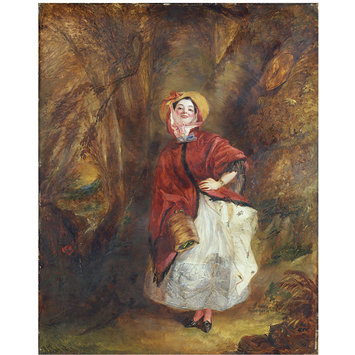
Dolly Varden, by William Powell Frith, 1842

It has been three days since Dolly disappointed Joe Willet by deserting him for a party, and she is still cherishing memories of it, including being flirted with by a young coachmaker. Edward Chester arrives at the Vardens as they are having breakfast, to ask if Dolly will take a message for him to the Warren. But Mrs. Varden associates the Warren with the Maypole and uses this occasion to throw a very funny fit. (Mrs. Varden's fit seems even funnier after the dreary melodrama at Mrs. Rudge's.) 
Mrs Varden wept, and laughed, and sobbed, and shivered, and hiccoughed, and choked; and said she knew it was very foolish but she couldn't help it; and that when she was dead and gone, perhaps they wouldn't be sorry for it -- which really under the circumstances did not appear quite so probable as she seemed to think -- with a great deal more to the same effect. In a word, she passed with great decency through all the ceremonies incidental to such occasions; and being supported upstairs, was deposited in a highly spasmodic state on her own bed, where Miss Miggs shortly afterwards flung herself upon the body.
The whole display takes place because Mrs. Varden really wants to accompany Dolly and her husband on the trip to the Warren, but she wants to be begged to do so. And finally, "the locksmith humbled himself, and the end was gained." And when she comes downstairs "decked out for the journey, she really looked as if nothing had happened, and appeared in the very best health imaginable." As for Dolly, she wears "a little straw hat trimmed with cherry-coloured ribbons, and worn the merest trifle on one side -- just enough in short to make it the wickedest and most provoking head-dress that ever malicious milliner devised." (The Dolly Varden style, including a flat straw hat trimmed with cherry-colored ribbons, became fashionable in the 1870s.)

On their way out of the city, the Vardens pass the young coachmaker on the street, and he is obviously smitten. The trip takes a long time because they make numerous stops at taverns along the way, and though Mrs. Varden is "all affability and delight," she is silently collecting evidence against her husband. Finally they reach the Maypole, where Joe Willet makes a dash to help the Vardens out of the coach, "to Mr Willet's mighty and inexpressible indignation." Joe gets "a glimpse of happiness" when he helps Dolly get out, having her in his arms "for a space of time no longer than you could count one in."

There follows a celebration of the Maypole's bar, another Dickensian tribute to snugness and coziness. "It is a poor heart that never rejoices -- it must have been the poorest, weakest, and most watery heart that ever beat, which would not have warmed towards the Maypole bar. Mrs Varden's did directly. She could no more have reproached John Willet among those household gods, the kegs and bottles, lemons, pipes, and cheese, than she could have stabbed him with his own bright carving-knife."

Dolly meanwhile heads for the Warren, with which she is familiar from her childhood friendship with Emma, though she holds her breath and tiptoes past the library on her way to Emma's room. There, Emma reads and rereads Edward's letter, while Dolly admires herself in a mirror and "could not help wondering whether the coachmaker suffered very much, and quite pitied the poor man."
Emma is upset by the contents of Edward's letter, but Dolly "set it down in her own mind that all this came from Miss Haredale's being so constant, and that if she would only take on with some other young gentleman -- just in the most innocent way possible, to keep her first lover up to the mark -- she would find herself inexpressibly comforted." Emma gives her a reply to take to Edward "and endowed her moreover with a pretty little bracelet as a keepsake."

On her way out, however, Dolly is met at the library door by Haredale, who forces her to confess that she had delivered a letter to Emma from Edward Chester. She bursts into tears when she confesses, but when he asks if she is carrying a reply for Edward, she says she won't part with it. He assures her that he doesn't want the letter, and then asks her if she would like to come stay at the Warren as a companion for Emma. She says she will have to ask her family. He tells her to do so and sends her on her way.

As she is crossing the grounds, she hears a rustling in the hedges and is frightened. Then "the bushes crackled and snapped, and a man came plunging through them, close before her."

Tuesday, March 29, 2011

4. Barnaby Rudge, by Charles Dickens, pp. 119-167

Barnaby Rudge (Penguin Classics)Chapters 9-14
_____
Miggs helps Mrs. Varden get ready for bed, and then seats herself at the window of her room. But hearing a noise downstairs, she discovers Sim Tappertit's secret: that he has a copy of the house-key. So she takes some fine ash and fills the lock with it.
"There!" cried Miggs, rubbing her hands, "now let's see whether you won't be glad to take some notice of me, mister. He, he, he! You'll have eyes for somebody besides Miss Dolly now, I think. A fat-faced puss she is, as ever I come across!" 
So she sits up all night waiting for Sim's return.
He returns at dawn, and bends his key when it jams in the lock, so that Miggs, pretending to be frightened, has to go down and let him in. She also feigns reluctance, so that Sim is forced to pay court to her: "'My darling Miggs -- ' Miggs screamed slightly. ' -- That I love so much, and can never help thinking of,' and it is impossible to describe the use he made of his eyes when he said this -- 'do, -- for my sake, do.'" She does, after making him promise not to kiss her, which he swears he won't, "with remarkable earnestness."

She faints when she lets him in, and "Mr Tappertit leant her against the wall as one might dispose of a walking-stick or umbrella, until he had secured the window, when he took her in his arms again, and, in short stages and with great difficulty -- arising from her being tall and his being short ... carried her upstairs, and planting her, in the same umbrella and walking-stick fashion, just inside her door, left her to her repose."

At the Maypole that morning, Willet receives a guest, "a staid, grave, placid gentleman, something past the prime of life, yet upright in his carriage, for all that, and slim as a greyhound." The man wants his horse stabled, an early dinner, and a room. Joe Willet has been sent to London on business, so Willet is forced to call on his servant, Hugh, for help. He gives the man the best apartment in the Maypole, which "had the melancholy aspect of grandeur in decay, and was much too vast for comfort.
The guest asks for a message to be sent to the Warren, and Willet calls on Barnaby to deliver it, which surprises the man, who says, "I saw him in London last night." Willet explains that Barnaby goes back and forth between there and the city all the time. The man observes that Barnaby's mother has said that he often goes to the Warren, and Willet confides that Barnaby's father was murdered there, and that "Mrs Rudge lives on a little pension from the family, and that Barnaby's as free of the house as any cat or dog about it." So the man agrees to have Barnaby run the errand, and tells Willet to tell Barnaby "it's Mr Chester. He will remember my name, I dare say."

Dickens has typically withheld the identification of the man as John Chester, Edward's father. Willet is very surprised that Chester should be holding any kind of communication with Geoffrey Haredale, but he keeps his surprise to himself as he summons Barnaby. Chester tells Barnaby to wait for a reply from Haredale and bring it back, or else to tell Haredale that he is at the inn and will receive him there at his convenience. But before Barnaby leaves, he takes Chester to the window and shows him the clothes hanging on the line to dry, revealing that he sees them not as clothes but as ghosts: "You don't see shadowy people there, like those that live in sleep -- not you. Nor eyes in the knotted panes of glass, nor swift ghosts when it blows hard, nor do you hear voices in the air, nor see men stalking in the sky -- not you!  I lead a merrier life than you, with all your cleverness." Then he departs on his errand.

Willet goes about his work, astonished "That Mr Chester, between whom and Mr Haredale, it was notorious to all the neighbourhood, a deep and bitter animosity existed, should come down there for the sole purpose, as it seemed, of seeing him, and should choose the Maypole for their place of meeting, and should send to him express."

Barnaby is late in returning, and decides to spend the night at the Maypole, so Willet offers him the bed that "Your noble son -- a fine young gentleman -- slept in ... last, sir, half a year ago." (Edward Chester apparently didn't sleep there on the night before he was attacked on the way to London.) John Chester doesn't take this as much of a recommendation, however.

Barnaby returns with word that Haredale would be there in an hour. Meanwhile, the regular customers gather, having heard of the pending encounter between Chester and Haredale: "Here was a good, dark-looking mystery progressing under that very roof." Barnaby pretends to be asleep in the chimney corner, while Hugh is asleep on the other side of the hearth. Hugh is "a young man, of a hale athletic figure, and a giant's strength, whose sunburnt face and swarthy throat, overgrown with jet black hair, might have served a painter for a model." (It serves Phiz as a model for the illustration, anyway.) "The negligence and disorder of the whole man, with something fierce and sullen in his features, gave him a picturesque appearance, that attracted the regards even of the Maypole customers who knew him well." Willet comments, "He's more at his ease among horses than men. I look upon him as a animal himself."
Willet informs them that Hugh's mother was hanged when he was a little boy, for passing counterfeit money, and that he can't read or write.

The talk turns to the coming meeting between Chester and Haredale, and Solomon Daisy is convinced that they are going to fight a duel. They then speculate on whether it will be swords or pistols, and Willet worries for a moment about breakage until he remembers that one of the two men will be alive afterward to pay for it. Then they talk about the potential bloodstains on the floor, and Solomon claims that there is a spot in the Warren where Haredale's brother was killed, and that "Mr Geoffrey made that room his study, and sits there, always, with his foot (as I have heard) upon it; and he believes, through thinking of it long and very much, that it will never fade until he finds the man who did the deed." Just then Haredale arrives and Willet offers to show him to the room where Chester awaits: "old John, in his agitation, ingeniously lighting everything but the way, and making a stumble on every second step."

In the room, the two men confront each other.
The one was soft-spoken, delicately made, precise, and elegant; the other, a burly square-built man, negligently dressed, rough and abrupt in manner, stern, and, in his present mood, forbidding both in look and speech. The one preserved a calm and placid smile; the other, a distrustful frown. The new-comer, indeed, appeared bent on showing by his every tone and gesture his determined opposition and hostility to the man he had come to meet. 
Haredale skips the pleasantries Chester offers and wants to get right to business. That business is the attraction between Chester's son and Haredale's niece. Chester proposes that they approach "each other sensibly" and "prevent it, and part them." Haredale says he loves his niece, and Chester says, "I like Ned too -- or, as you say, love him -- that's the word among such near relations. I'm very fond of Ned." But "independently of the religious differences between us -- and damn it, that's important -- I couldn't afford a match of this description." (Dickens is, of course, not ready to tell us what those religious differences are.) Haredale is angry at the very fact that there might be any love between his niece and "any one who was akin to you." He demands to know who are "their go-betweens, and agents," and Chester reveals that Barnaby is the chief one.

Haredale vows, "Trust me, Mr Chester, my niece shall change from this time. I will appeal ... to her woman's heart, her dignity, her pride, her duty --" Chester concurs as far as his son goes, but in a rather different tone:
"I shall represent to him that we cannot possibly afford it -- that I have always looked forward to his marrying well, for a genteel provision for myself in the autumn of life -- that there are a great many clamorous dogs to pay, whose claims are perfectly just and right, and who must be paid out of his wife's fortune. In short, that the very highest and most honourable feelings of our nature, with every consideration of filial duty and affection, and all that sort of thing, imperatively demand that he should run away with an heiress." 
Haredale responds to Chester's caddishness by saying, "you have the head and heart of an evil spirit in all matters of deception." Chester takes it as a compliment and assures Haredale that he will "exert those powers on which you flatter me so highly" and "resort to a few little trivial subterfuges" to separate them. Haredale says he means "treachery" and "lying." But Chester brushes this off as "Only a little management, a little diplomacy, a little -- intriguing, that's the word." Though he's uneasy about the business, Haredale agrees to "second your endeavours to the utmost of my power" and that they weill "act in concert, but apart."

Downstairs, the group is "very much astonished to see Mr Haredale come down without a scratch, call for his horse, and ride away thoughtfully at a footpace." While they are debating whether to go up and see if Chester is dead, he rings the guest's bell, and Willet goes up to find him whole and asking for his bed.

Joe Willet has gone to London because it is the twenty-fifth of March, the end of a quarter when his father's accounts with the vintner and distiller in the city has to be settled. Joe has argued with his father because he won't give him any money of his own when he goes to the city, except for a shilling for use in case the horse throws a shoe, and sixpence "to spend in the diversions of London; and the diversion I recommend is going to the top of the Monument, and sitting there. There's no temptation there, sir -- no drink -- no young women -- no bad characters of any sort -- nothing but imagination. That's the way I enjoyed myself when I was your age, sir."

But before he took the road to London, he stopped at the Warren, where he looked up at a window until "a small white hand was waved to him for an instant from this casement, and the young man, with a respectful bow, departed." Dickens is coy about it, of course, but we can assume that this signifies there is no message from Emma Haredale for Joe to deliver to Edward Chester.

After settling his father's business in London, Joe goes to the Vardens, "attracted by the eyes of blooming Dolly Varden, for whom he has plucked a nosegay of snowdrops and crocuses (and been scolded by his father for it). But Gabriel Varden prevents him from giving them to Dolly and tells him to give them to Mrs. Varden instead. Mrs. Varden, however, associates Joe with the Maypole, which she views "as a sort of human mantrap, or decoy for husbands," and she pretends that the flowers make her ill and has him put them outside the window.

Finally, after Mrs. Varden carries on about the evils of drink and she and Miggs join in a pious litany of contemptus mundi, with Miggs contributing, "I hope I know my own unworthiness, and that I hate and despise myself and all my fellow-creatures as every practicable Christian should," Dolly enters and strikes Joe "quite dumb with her beauty." Unfortunately, she is on her way to a party, and he is forced to sit "tamely there, when she was at a dance with more lovers than man could calculate fluttering about her -- with the whole party doting on and adoring her." So he heads for home, convinced that "the only congenial prospect left him, was to go for a soldier or a sailor, and get some obliging enemy to knock his brains out as soon as possible."

On the road home, he meets up with Edward Chester, and offers to go with him to the Warren to spare him the walk from the Maypole and back again. As they pass the Maypole, they notice that there are lights in the large room and in the best bedchamber, and wonder who is there. At the Warren, Edward is met at the gate by a female servant, who takes him to where Emma is waiting. "Almost at the same instant a heavy hand was laid upon her arm, Edward felt himself thrust away, and Mr Haredale stood between them."
Haredale orders him to leave "and return no more." They exchange words, and Edward asserts, "Your niece has plighted her faith to me, and I have plighted mine to her." But he is outmatched by her uncle and leaves. "A few words to Joe as he mounted his horse sufficiently explained what had passed, and renewed all that young gentleman's despondency with tenfold aggravation."

At the Maypole, Edward learns from John Willet that his father is staying there and that "Mr Haredale has been having a long talk with him, and hasn't been gone an hour." Edward decides to get on his horse and go back to London.