JOURNAL OF A COMPULSIVE READER
By Charles Matthews
Showing posts with label Percy Bysshe Shelley. Show all posts

Tuesday, May 3, 2011

18. The Modern Tradition, edited by Richard Ellmann and Charles Feidelson Jr., pp. 381-407

Nature: Introduction; Struggle (Charles Darwin, Arthur Schopenhauer); Organicism (A.N. Whitehead)
_____
Introducing the third section, "Nature," the editors try to make it clear what the authors surveyed are talking about:
It is a principle of biological struggle, of battle for survival, yet it is also a principle of organic harmony, vital unison in things. It is automatic material energy, a complex of mechanical physical forces that menace human existence; but in still another perspective it may be seen as the very source and sanction of human inventiveness, or even as a construction of human intelligence, created by scientists in the course of physical experiment. 

Charles Darwin: The Struggle for Existence and Natural Selection
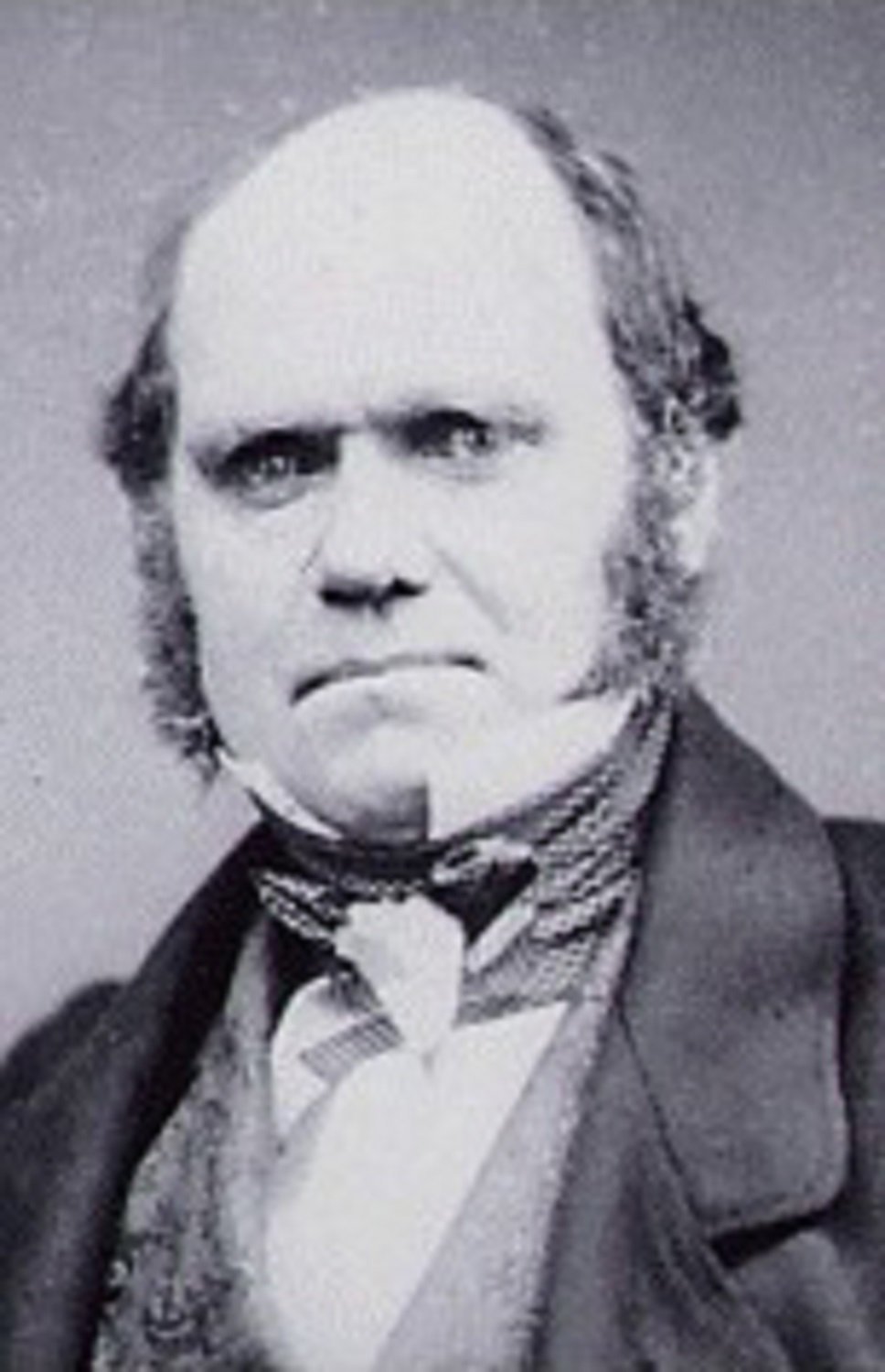
Charles Darwin in 1854
The ongoing antipathy to Darwin is one of the embarrassments of living in America, where one would have thought the ignorance about evolutionary theory had been banished 80-some years ago by the Scopes trial. Apparently not. When I taught this selection from On the Origin of Species by Means of Natural Selection (1859) to a class of freshmen in Texas some years ago, I was still confronted with incredulity and outright hostility, and to judge from the pronouncements of various politicians and the actions of state legislatures, not much has changed.

It's odd, considering that the central premise of Darwin's theory, that "the struggle of life" produces winners and losers and that the winners are those best adapted to the conditions in which they struggle, would seem to be perfectly harmonious with the tenets of the free-market conservatives who are most likely to protest against the theory.
Owing to this struggle, variations, however slight and from whatever cause proceeding, if they be in any degree profitable to the individuals of a species, in their infinitely complex relations to other organic beings and to their physical conditions of life, will tend to the preservation of such individuals and to their offspring.
"Natural Selection" was Darwin's term for the process, but he approved of Herbert Spencer's "Survival of the Fittest" as "more accurate, and ... sometimes equally convenient." He observed that the process was already known to breeders of animals, but that its course in the wild was "immeasurably superior to man's feeble efforts, as the works of Nature are to those of Art." (Thereby setting off the Nature vs. Art debate once again, to rage through the rest of the century and into the next.) The one thing Darwin was most concerned to eliminate was sentimentality about Nature. "We behold the face of nature bright with gladness, we often see superabundance of food; we do not see or we forget, that the birds which are idly singing round us mostly live on insects or seeds, and are thus constantly destroying life."

"Natural selection," he admits, can be a misleading term. For one thing, it seems to some to imply a "selector," which is not at all what Darwin has in mind: "it is difficult to avoid personifying the word Nature; but I mean by Nature, only the aggregate action and product of many natural laws, and by laws the sequence of events as ascertained by us. It also has promoted the notion of "lower" and "higher" forms of life, which is not at all what is involved: The only criterion implied by the term is success at living in a given environment, and success at reproducing. "No country can be named in which all the native inhabitant are now so perfectly adapted to each other and to the physical conditions under which they live, that none of them could still be better adapted or improved." Any given variation within a species can be judged only by its usefulness toward surviving.

And human interference only complicates things: "Man selects for his own good: Nature only for that of the being which she tends." (Darwin has just once again apologized for personifying Nature, explaining that what he means is really "the natural preservation or survival of the fittest.")
Under nature, the slightest differences of structure or condition may well turn the nicely-balanced scale in the struggle for life, and so be preserved. How fleeting are the wishes and efforts of man! how short his time! and consequently how poor will be his results, compared with those accumulated by Nature during whole geological periods! Can we wonder, then, that Nature's productions should be far "truer" in character than man's productions; that they should be infinitely better adapted to the most complex conditions of life, and should plainly bear the stamp of far higher workmanship.
That last phrase, "the stamp of far higher workmanship," has a theistic whiff to it, suggesting Darwin's discomfort with the non-theistic implications of his theory. But he goes boldly onward to proclaim his "belief that all animals and plants are descended from some one prototype," and moreover "that all the organic beings which have ever lived on this earth may be descended from some one primordial form." Still, he clings to the myth of a Creator:
To my mind it accords better with what we know of the laws impressed on matter by the Creator, that the production and extinction of the past and present inhabitants of the world should have been due to secondary causes, like those determining the birth and death of the individual. When I view all beings not as special creations, but as the lineal descendants of some few beings which lived long before the first bed of the Cambrian system was deposited, they seem to me to become ennobled.
There is no escaping the sense that Darwin was struggling to align his theory with the orthodox religious view as much as possible, doing a kind of cheerleading for the theory as a positive, almost holy, view of nature, without outright proclaiming it as "God's plan": "as natural selection works solely by and for the good of each being, all corporeal and mental endowments will tend to progress towards perfection." The question remains: perfect by whose standards? But in the famous "tangled bank" paragraph, he reaches toward an optimistic view of the struggle for existence and a reconciliation with the orthodox account of creation:
There is grandeur in this view of life, with its several powers, having been originally breathed by the Creator into a few forms or into one; and that, whilst this planet has gone cycling on according to the fixed law of gravity, from so simple a beginning endless forms most beautiful and most wonderful have been, and are being evolved.


Arthur Schopenhauer: The Will in Nature
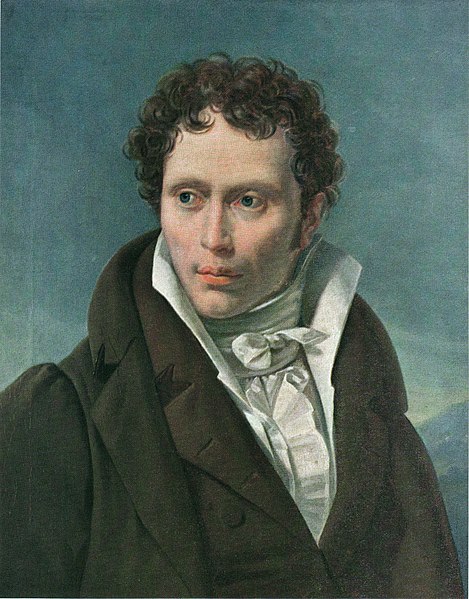
Ludwig Sigismund Ruhl, Portrait of Arthur Schopenhauer, c. 1815
Nobody ever accused Schopenhauer of optimism. Forty years before Darwin's Origin, in The World as Will and Idea (the word translated here as "Idea" is Darstellung, which is sometimes translated as "Representation"), Schopenhauer also based his thought on the prevalence of struggle in life. The human being encounters the world through the body, but the body with which we form our identity "is given as an idea in intelligent perception, as an object among objects and subject to the laws of objects." But it is also a manifestation of what Schopenhauer calls will. "The act of will and the movement of the body are not two different things objectively known, ... they are one and the same, but they are given in entirely different ways, -- immediately, and again in perception for the understanding.... It is only in reflection that to will and to act are different; in reality they are one."

When we experience pain, Schopenhauer asserts, we are experiencing that which "is opposed to the will; gratification and pleasure when it is in accordance with it." Pain and pleasure are "immediate affections of the will, in its manifestation, the body." By will, Schopenhauer doesn't just mean individual determination, as in "I will be heard!" or "His will is law." Will is a fundamental force in nature. It includes
  • "the force which germinates and vegetates in the plant"
  • "the force through which the crystal is formed"
  • "that by which the magnet turns to the north pole"
  • "the force whose shock [one] experiences from the contact of two different kinds of metals"
  • "the force which appears in the elective affinities of matter as repulsion and attraction, decomposition and combination"
  • "and, lastly, even gravitation, which acts so powerfully throughout matter, draws the stone to the earth and the earth to the sun" 
(May the Force be with you.)

All of these forces and others are the same thing: will. We experience them as separate phenomena, as ideas. "Phenomenal existence is idea and nothing more ... but the will alone is a thing in itself." Will "appears in every blind force of nature and also in the preconsidered action of man; and the great difference between these two is merely in the degree of the manifestation, not in the nature of what manifests itself." Such characteristics of matter "as rigidity, fluidity, elasticity, electricity, magnetism, chemical properties and qualities of every kind ... are in themselves immediate manifestations of will."
In the higher grades of the objectivity of will we see individuality occupy a prominent position, especially in the case of man, where it appears as the great difference of individual characters, i.e., as complete personality, outwardly expressed in strongly marked individual physiognomy, which influences the whole bodily form.... The farther down we go, the more completely is every trace of the individual character lost in the common character of the species, and the physiognomy of the species alone remains.
Will also manifests itself in the struggle of existence, in "the burden of physical life, the necessity of sleep, and finally, of death; for at last these subdued forces of nature, assisted by circumstances, win back from the organism, wearied even by the constant victory, the matter it took from them.... Thus everywhere in nature we see strife, conflict, and alternation of victory ... indeed nature exists only through it." As Darwin would be later, Schopenhauer is impressed by the fact that "each animal can only maintain its existence by the constant destruction of some other. Thus the will to live everywhere preys upon itself, and in different forms is its own nourishment." But Schopenhauer extends this process of struggle even to inanimate matter, "when, for example, crystals in process of formation meet, cross, and mutually disturb each other to such an extent that they are unable to assume the pure crystalline form, so that almost every cluster of crystals is an image of such a conflict of will at this low grade of its objectification." And just as in the microcosm, so in the macrocosm: "the constant tension between centripetal and centrifugal force ... keeps the globe in motion."

So if you're searching for an ultimate, you've found it: "Will is the thing-in-itself, the inner content, the essence of the world. Life, the visible world, the phenomenon, is only the mirror of the will."
Birth and death belong merely to the phenomenon of will, thus to life; and it is essential to this to exhibit itself in individuals which come into being and pass away, as fleeting phenomena appearing in the form of time -- phenomena of that which in itself knows no time, but must exhibit itself precisely in the way we have said, in order to objectify its peculiar nature.
A student of Hinduism, Schopenhauer notes that Shiva (or Siva, as he spells it), the god associated with destruction and death is given "as an attribute not only the necklace of skulls, but also the lingam, the symbol of generation, which appears here as the counterpart of death, thus signifying that generation and death are essentially correlatives, which reciprocally neutralise and annul each other."

Again like Darwin, Schopenhauer asserts that "it is not the individual, but only the species that Nature cares for, and for the preservation of which she so earnestly strives, providing for it with the utmost prodigality through the vast surplus of the seed and the great strength of the fructifying impulse.... [Nature's] kingdom is infinite time and infinite space.... Therefore she is always ready to let the individual fall." Nature assures continuation by making sex pleasurable. "On the other hand, excretion, the constant exhalation and throwing off of matter, is the same as that which, at a higher power, death, is the contrary of generation." In this scheme of things, in which the physical being is merely an instrument of generation, "It appears just as foolish to embalm the body as it would be to carefully preserve its excrement."
Man alone carries about with him, in abstract conceptions, the certainty of his death; yet this can only trouble him very rarely, when for a single moment some occasion calls it up to his imagination. Against the mighty voice of Nature reflection can do little. In man, as in the brute with does not think, the certainty that springs from his inmost consciousness that he himself is Nature, the world, predominates as a lasting frame of mind; and on account of this no man is observably disturbed by the thought of certain and never-distant death, but lives as if he would live forever.


A.N. Whitehead: Nature as Organism

A.N. Whitehead, date unknown
Well, speaking of struggle, there's my attempt to follow Whitehead's argument closely. Once again, the editors' introduction is of considerable help:
Whitehead is preoccupied with organisms in relation to their environment, and at the same time he is seeking to interpret the world of physics, the science of inorganic energy.... He regards the official philosophy of early twentieth-century science, which he traces back to the seventeenth century, as misleading because of its mechanistic assumptions: it makes objects falsely self-sufficient and isolates them from the minds that apprehend them. Whitehead would establish instead a recognition that he finds first expressed in the romantic poets: we do not perceive particular elements in nature as discrete entities, to the exclusion of other elements or to the exclusion of ourselves. Things and the perception of things are events, modes of interaction with other events in space and time. Parts of nature assume individuality by drawing the surrounding world into themselves and delimiting it; but these individual unities must also be seen in terms of larger unities of which they are functions. As in a plant, the whole dominates each part, and as in organic growth every partial whole virtually contains the whole that transcends it.
The excerpts come from Science and the Modern World, based on the Lowell Lectures Whitehead gave at Harvard in 1925. He begins with the usual definitions of terms, explaining that "matter, or material, is anything which has this property of simple location.... one major characteristic which refers equally both to space and to time, and other minor characteristics which are diverse as between space and time." Got that? Good. "The characteristic common both to space and time is that material can be said to be here in space and here in time, or here in space-time." The seventeenth century scientists asserted "that the world is a succession of instantaneous configurations of matter." This was a perfectly useful definition for them. It "is the famous mechanistic theory of nature, which has reigned supreme ever since the seventeenth century. It is the orthodox creed of physical science. Furthermore, the creed justified itself by the pragmatic test. It worked." But there are some problems with it, and Whitehead has a famous phrase for it: "the Fallacy of Misplaced Concreteness," by which he means "the accidental error of mistaking the abstract for the concrete."

In addition to "simple location," Whitehead says "substance and quality ... are the most natural ideas for the human mind. It is the way we think of things, and without these ways of thinking we could not get our ideas straight for daily use." But, he asks, "How concretely are we thinking when we consider nature under these conceptions?" Suppose, he says, we observe of an object that "it is hard, and blue, and round, and noisy." But are these qualities of the object itself, or are they what we bring to them by perceiving them?
These sensations are projected by the mind so as to clothe appropriate bodies in external nature. Thus the bodies are perceived as with qualities which in reality do not belong to them, qualities which in fact are purely the offspring of the mind. Thus nature gets credit which should in truth be reserved for ourselves; the rose for its scent: the nightingale for his song: and the sun for his radiance. The poets are entirely mistaken. They should address their lyrics to themselves, and should turn them into odes of self-congratulation on the excellency of the human mind. Nature is a dull affair, soundless, scentless, colourless; merely the hurrying of material, endlessly, meaninglessly. 
Yet since the seventeenth century, science has dealt with nature this way. "The enormous success of the scientific abstractions, yielding on the one hand matter with its simple location in space and time, on the other hand mind, perceiving, suffering, reasoning, but not interfering, has foisted onto philosophy the task of accepting them as the most concrete rendering of fact.... It involves a fundamental duality, with material on the one hand, and on the other hand mind."

Whitehead proposes that we analyze things in space and time: "Things are separated by space, and are separated by time: but they are also together in space, and together in time, even if they be not contemporaneous." So space-time is characterized by the separative and the prehensive, and also because everything in space has a definite location (it can't be in two places at once) and because "it endures during a certain period and through no other period" in time, it also has a modal character. It's the modal character that suggests the idea of simple location. "But it must be conjoined with the separative and prehensive characters."
The volume is the most concrete element of space. But the separative character of space, analyses a volume into sub-volumes, and so on indefinitely.... But it is the unity of volume which is the ultimate fact of experience.... Accordingly, the prime fact is the prehensive unity of volume, and this unity is mitigated or limited by the separated unities of the innumerable contained parts.... The parts form an ordered aggregate, in the sense that each part is something from the standpoint of every other part, and also from the same standpoint every other part is something in relation to it.
"Prehension" is a grasping of unity, and "Perception is simply the cognition of prehensive unification; or more shortly, perception is cognition of prehension. The actual world is a manifold of prehensions; and a "prehension" is a "prehensive occasion"; and a prehensive occasion is the most concrete finite entity, conceived as what it is in itself and for itself.... Nature is conceived as a complex of prehensive unifications."

Nature is, then, a process, a series of events. "Simple location" is no longer relevant. And "space-time is nothing else than a system of pulling together of assemblages into unities." An event has a past, present and future. "These conclusions are essential for any form of realism. For there is in the world for our cognisance, memory of the past, immediacy of realisation, and indication of things to come."

What we're dealing with now are organisms, "so that the plan of the whole influences the very characters of the various subordinate organisms which enter into it.... Thus an electron within a living body is different from an electron outside it, by reason of the plan of the body ... and this plan includes the mental state."

Whitehead now turns, thankfully, to literature, where he finds "the most interesting criticism of the thoughts of science among the leaders of the romantic reaction which accompanied and succeeded the epoch of the French Revolution." Chief among them, for Whitehead's purposes, are Wordsworth and Shelley. (Keats he dismisses, rather oddly, as "an example of literature untouched by science," and Coleridge as "only important by his influence on Wordsworth." Byron and Blake apparently are beyond consideration.) Wordsworth, he says, "alleges against science its absorption in abstractions. His consistent theme is that the important facts of nature elude the scientific method." Wordsworth "always grasps the whole of nature as involved in the tonality of the particular instance.... the first book of The Prelude ... is pervaded by this sense of the haunting presences of nature.... Wordsworth, to the height of genius, expresses the concrete facts of our apprehension, facts which are distorted in the scientific analysis."

Unlike Wordsworth, Shelley loved science, which "symbolises to him joy, and peace, and illumination.... What the hills were to Wordsworth, a chemical laboratory was to Shelley.... If Shelley had been born a hundred years later, the twentieth century would have seen a Newton among chemists." Shelley perceives the organic character of nature, "functioning with the full content of our perceptual experience." In his poems you see "an emphatic witness to a prehensive unification as constituting the very being of nature. Berkeley, Wordsworth, Shelley are representative of the intuitive refusal seriously to accept the abstract materialism of science." 

In "The Cloud," Shelley examines "the endless, eternal, elusive change of things.... Every scheme for the analysis of nature has to face these two facts: change and endurance. There is yet a third fact to be placed by it, eternality, I will call it."
The mountain endures. But when after ages it has been worn away, it has gone. If a replica arises, it is yet a new mountain. A colour is eternal. It haunts time like a spirit. It comes and it goes. But where it comes, it is the same colour. It neither survives nor does it live. It appears when it is wanted. The mountain has to time and space a different relation from that which colour has.
The nineteenth century English poets performed a valuable service in pointing out "the discord between the aesthetic intuitions of mankind and the mechanism of science." They make us aware that "a philosophy of nature must concern itself at least with these six notions: change, value, eternal objects, endurance, organism, interfusion."
You are in a certain place perceiving things. Your perception takes place where you are, and is entirely dependent on how your body is functioning. But this functioning of the body in one place, exhibits for your cognisance and aspect of the distant environment, fading away into the general knowledge that there are things beyond. If this cognisance conveys knowledge of a transcendent world, it must be because the event which is the bodily life unifies in itself aspects of the universe.... "Value" is the word I use for the intrinsic reality of an event. Value is an element which permeates through and through the poetic view of nature.

Tuesday, April 26, 2011

11. The Modern Tradition, edited by Richard Ellmann and Charles Feidelson Jr., pp. 229-245

Realism: Introduction. Objectivity. (George Eliot, George Bernard Shaw, Gustave Flaubert, Anton Chekhov)
_____
The shift from Symbolism to Realism is not such an about-face as it might seem, especially when you have a figure like Flaubert who participates in both camps. The chief distinction seems to be in the approach to an audience:
Opposing symbolist predilections for an esoteric subject-matter, for perfection of form, and for an elite audience, the realist offers his work as a means of communication among men, dealing with large subjects in a comprehensible way, form subordinated to content. 
But even here, we'll see, there are different kinds of audiences. The mob still remains somewhat out of the artist's consideration, and realists seem as compelled as symbolists to explain what they're about.


George Eliot: A Realism of Love

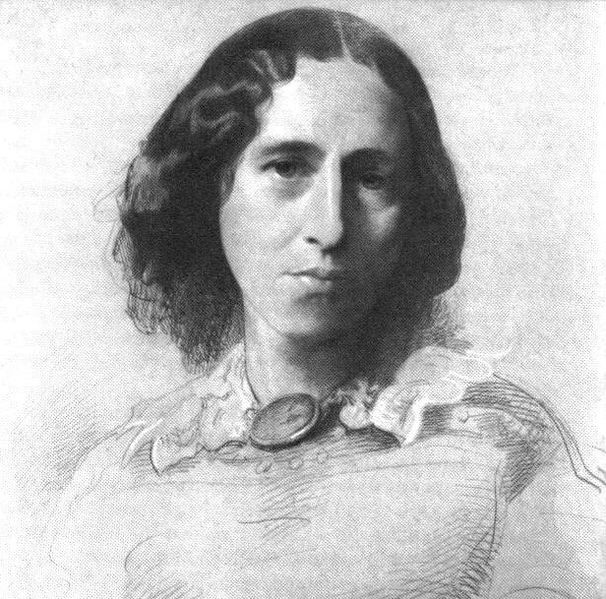
Samuel Laurence, Portrait of George Eliot, c. 1860
Never shy about breaking into her novels to explain things, Eliot interrupts the story (or as her chapter title suggests, pauses it a little) to anticipate objections. Specifically the objection that the minister in Adam Bede is too worldly. She pleads that she can only represent things "as they have mirrored themselves in my mind," and suggests that her own mirror "is doubtless defective." She then asks the read if he or she hasn't know people who aren't wholly good or wholly evil.
These fellow-mortals, every one, must be accepted as they are: you can neither straighten their noses, nor brighten their wit, nor rectify their dispositions; and it is these people -- amongst whom your life is passed -- that it is needful you should tolerate, pity, and love: it is these more or less ugly, stupid, inconsistent people, whose movements of goodness you should be able to admire -- for whom you should cherish all possible hopes, all possible patience.
But what does this have to do with art? they might ask. And Eliot's response would be that art shouldn't lie to you. Moreover, sentimentalizing and simplifying human character is a cop-out: "Falsehood is so easy, truth so difficult." It's easier, she points out, to draw a fantastic creature like a griffin than to make a convincing picture of a real lion.

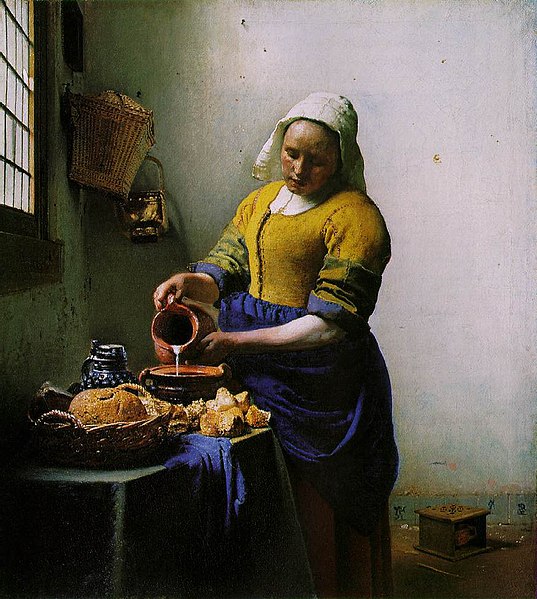
Johannes Vermeer, The Milkmaid, c. 1660
Adriaen van Ostade, Peasants in an Interior, 1661
Her analogy for what she's trying to do in Adam Bede is the painting of the Dutch realists. "I find a source of delicious sympathy in these faithful pictures of a monotonous homely existence, which has been the fate of so many more among my fellow-mortals than a life of pomp or of absolute indigence, of tragic suffering or world-stirring action."  The key word here is "sympathy," which carries with it its own kind of beauty: "human feeling is like the mighty rivers that bless the earth: it does not wait for beauty -- it flows with restless force and brings beauty with it." She appeals to artists "to give the loving pains of a life to the faithful representing of commonplace things."


George Bernard Shaw: False Ideals Exposed

In 1890, Shaw, at the peak of his enthusiasm for Ibsen, writes savagely about the fake idealism that masks hypocrisy. And his remarks have remained pertinent to this day, when "family-values" politicians are constantly being revealed as adulterers, and those who purport to be "saving marriage" turn out to be closeted homosexuals. And fiction has too often played along with them: "In our novels and romances especially we see the most beautiful of all the masks: those devised to disguise the brutalities of the sexual instinct in the earlier stages of its development, and to soften the rigorous aspect of the iron laws by which Society regulates its gratification." In the idealizing of marriage, "men try to graft pleasure on necessity by desperately pretending that the institution forced upon them is a congenial one."

He imagines "a community of a thousand persons," 700 of whom are comfortable with the institution of marriage, and 299 of whom "find it a failure, but must put up with it since they are in a minority." Because they don't want to admit their failure, this minority becomes the loudest in proclaiming that "the family is a beautiful and holy natural institution. For the fox not only declares that the grapes he cannot get are sour: he also insists that the sloes he can get are sweet.... Our 299 domestic failures are therefore become idealists as to marriage; and in proclaiming the ideal in fiction, poetry, pulpit and platform oratory, and serious private conversations, they will far outdo the 700 who comfortably accept marriage as a matter of course, never dreaming of calling it an 'institution,' much less a holy and beautiful one." So in this community there are 299 idealists and 700 Philistines.

But there's one person left over. He sees that marriage is not in itself either holy or beautiful, and that it often fails, so he thinks it "insufferable that two human beings, having entered into relations which only warm affection can render tolerable, should be forced to maintain them after such affections have ceased to exist, or in spite of the fact that they have never arisen. The alleged natural attractions and repulsions upon which the family ideal is based do not exists; and it is historically false that the family was founded for the purpose of satisfying them." But he'll get no support from the 700 Philistines, who are so complacently settled in their situations that they'll "simply think him mad." And the 299 idealists are so terrified at being revealed as failures and hypocrites, that they'll denounce him. "They will crucify him, burn him, violate their own ideals of family affection by taking his children away from him, ostracize him, brand him as immoral, profligate, filthy, and appeal against him to the despised Philistines, specially idealized for the occasion as Society."

Shaw calls on Shelley as an example: "The idealists ... called him a fiend until they invented a new illusion to enable them to enjoy the beauty of his lyrics, this illusion being nothing less than the pretence that since he was at bottom an idealist himself, his ideals must be identical with those of Tennyson and Longfellow, neither of whom ever wrote a line in which some highly respectable ideal was not implicit." So Shaw tackles the problem of the word "idealist," because it's necessary "to distinguish pioneers like Shelley and Ibsen as realists from the idealists of my imaginary community of one thousand."

In Shaw's definition of "realist," he means someone who sees that fake ideals have been concocted as "something to blind us, something to numb us, something to murder self in us, something whereby, instead of resisting death, we can disarm it by committing suicide. The idealist, who has taken refuge with the ideals because he hates himself and is ashamed of himself, thinks that all this is so much the better."
The realist declares that when a man abnegates the will to live and be free in a world of the living and free, seeking only to conform to ideals for the sake of being, not himself, but 'a good man,' then he is morally dead and rotten, and must be left unheeded to abide his resurrection, if that by good luck arrive before his bodily death.


Gustave Flaubert: Heroic Honesty

In 1856, as Madame Bovary was being serialized in La Revue de Paris, Flaubert responded to the critique of its co-editor, Laurence Pichat, that he was as disgusted by some of the details in it too: "I hold the everyday life in detestation.... But aesthetically I wanted this time, and only this time, to exhaust it thoroughly. So I took the thing in an heroic fashion, I mean a minute one, accepting everything, saying everything, depicting everything -- an ambitious statement!" And it took a lot out of him, he wrote to his friend, poet and playwright Louis Bouilhet. His meticulousness and perfectionism was "an insane way of working," and his mother asserted, "The mania for phrases has dried up your heart."


Anton Chekhov: Dunghills as Artistic Material

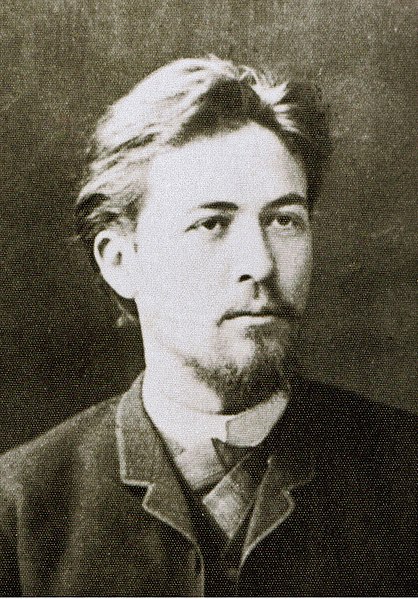
Anton Chekhov in 1889
Chekhov's friend Mariya Kiselev objected to some of the sordid material in his stories "On the Road" and "Mire," and in this 1887 letter he responds. "I do not know who is right: Homer, Shakespeare, Lope de Vega, the ancients generally who did not fear to grub in the 'dung-hill,' but who were more stable in their moral relations than we; or the modern writers, fastidious on paper, but coldly cynical in soul and in their manner of life?" He proceeds to reject the idea that literature should only "gather the pure grain from the muck heap." The artist "is not a confectioner, not a dealer in cosmetics, not an entertainer; he is a man bound, under compulsion, by the realization of his duty, and by his conscience." We wouldn't want a journalist to whitewash the facts, and we shouldn't expect the writer to do so either. Like the reporter, the writer must strive for objectivity: "he must know that dung-heaps play a very respectable part in a landscape, and that evil passions are as inherent in life as good ones."

He chafes against censorship because "The fate of literature would be woeful ... if you left it to the will of individuals.... there is no police which we can consider competent in literary matters.... you cannot find a better police for literature than criticism and the author's own conscience."

And like George Eliot, he defends the choice of lower class figures as artistic material:
To be condescending toward humble people because of their humbleness does not do honor to the human heart. In literature, the lower ranks are as necessary as in the army, -- so says the mind, and the heart ought to confirm this most thoroughly.

Wednesday, October 6, 2010

13. The Age of Wonder, by Richard Holmes, pp. 361-405

The Age of Wonder: The Romantic Generation and the Discovery of the Beauty and Terror of Science (Vintage)Davy and the Lamp, 4-6; Sorcerer and Apprentice, 1-5
_____
After yet another mine explosion that killed fifty-seven men in June 1815, the Coal Mines Safety Committee put out an urgent call for Humphry Davy's help. So on August 24, Davy went to Newcastle to see what he could do. The working theory was that fire-damp needed to be somehow neutralized directly, perhaps with better ventilation or some other kind of gas pumped into the mine. But Davy turned the problem around: He looked at what was touching off the explosions -- the candles and oil lamps that the miners carried into the darkness.

First, however, he needed to analyze the gas and its properties, so he took bottled samples to the Royal Institution laboratory and, working with Faraday, began to study the properties of methane. He discovered that it would explode only when it reached a critical proportion of one part gas to eight parts air, and that the temperature at which the explosion occurred was quite high. With this information he could proceed to designing a lamp that would not set off an explosion. He learned that a lamp with a glass chimney sealed around the wick and with narrow metal tubes to let in air would not set off an explosion. It was a trial-and-error process that led to several explosions but he had three working prototypes ready at the end of October. He wrote to Banks about his success and sent the lamps to the Royal Society along with a scientific paper to be read on November 9.

But Davy continued to refine his invention. He and Faraday continued to work through Christmas and by January 11 he was ready to report his results to the Royal Society. He had discovered that the lamp worked even better when the wick was surrounded by a fine-gauge wire mesh instead of a sealed glass chimney. The apertures in the mesh fed air to the flame and at the same time contained and cooled it below the temperature needed to ignite the methane. Without the need for a glass chimney, the lamp was cheaper and sturdier. Davy also used the process by which the lamp was designed as an example of the scientific inductive method, writing: "Every step was furnished by experiment and induction, in which nothing can be said to be owing to accident, and in which the most simple and useful combination arose out of the most complicated circumstances." Holmes comments, "This refusal to allow anything to chance, 'accident' or good fortune was exactly the same as Herschel's insistence that chance played no part in the discovery of Uranus."

The Davy Safety Lamp was swiftly adopted all over Britain and Europe. Davy himself went down the mine at Walls End in Northumberland and demonstrated its use to the miners, pointing out that the flame itself could indicate the presence of methane: "His lamp not only caged the flame, it transformed it into a canary." He received the Rumford Medal from the Royal Society in 1817 and was made a baronet the following year, but he refused to take out a patent on the lamp. He published an account of the research, On the Safety Lamp for Miners, With Some Researches Into Flame in 1818, setting forth his belief that science could be a force for human betterment.
The gratification of the love of knowledge is delightful to every refined mind; but a much higher motive is offered in indulging it, when that knowledge is felt to be practical power, and when that power may be applied to lessen the miseries or increase the comforts of our fellow-creatures. 
But in spring 1816, he was charged with plagiarizing his design from George Stephenson, an engineer, who had tested his own safety lamp in October 1815 and presented his invention to the Newcastle Literary and Philosophical Society in December. Stephenson had suspected plagiarism when he saw reports of Davy's first lamp, the one with metal tubes instead of wire gauze, in the Newcastle papers. Stephenson's lamp also used tubes and perforations. When the Newcastle Society demonstrated Davy's gauze lamp side-by-side with Stephenson's in February 1816, it was obvious that the two lamps were different, but the controversy couldn't be stopped. There was something of a battle of North versus South involved as well. Stephenson would go on to his own fame as an inventor with the "Stephenson Rocket," an early steam-powered railway engine. He admitted that he hadn't studied the properties of methane and that his lamp was the result of trial and error. But Davy got his back up over Stephenson's claims and "never acknowledged that the over-hasty publication of his early prototypes had caused much of the problem." But even though Banks issued a firm statement in November 1817 that the Royal Society had investigated the claims and tested both lamps and concluded that Davy was the sole inventor, the controversy never died.

In May  1818, the Davys left on another European tour, planning to travel for two years. It was partly an attempt to patch up their marriage, which had been put to the test by celebrity. It was in the Balkans, in what is now the Slovenian capital of Ljubljana, that Davy had his second sighting of the "dream girl" of his feverish vision in 1808. This time she was fifteen-year-old Josephine Dettela, the daughter of an innkeeper. He dismissed it as an insignificant coincidence, though he would later write about it. They moved on to visit Lord Byron at Ravenna and then settled in Naples for the winter, about the same time as Shelley and his family, though there is no record that Davy and Shelley ever met. In spring 1819, they started north again, but Jane announced that she was ill and tired of traveling and wanted to stay in Paris. There Davy heard that Joseph Banks was also ill.

Banks had been increasingly immobilized by gout, but he continued to single out young protégés, including John Herschel, who had distinguished himself at Cambridge as a mathematician and had published a paper on mathematical formulae before his twenty-first birthday. Banks had John Herschel elected to the Royal Society in 1813. Another protégé was the zoologist Charles Waterton, who had made several journeys to South America. Banks urged Waterton, who was thirty-seven, to settle down and write the account of his journeys, something that Banks himself had failed to do. Waterton complied, and produced "a popular masterpiece," Wanderings in South America, in 1825.

In his old age, Banks had become more conservative. Although he honored women such as Caroline Herschel, he was opposed to letting women be elected to the Royal Society. And he was shocked at Byron's "Lascivious" Don Juan, which began appearing in 1819. Despite his own early distaste for slavery, he would not commit the Royal Society to abolishing it. His attitude toward slavery was not that it was a moral evil but that it was an inefficient way to manage labor: "Slavery must be abolished not on moral principles, which are in my opinion incapable of being maintained in argument, but on Commercial ones which weigh equally in moral & immoral minds." On the other hand, he hailed the revolution in Haiti: "To see a sort of Human Beings emerging from Slavery & making the most rapid Strides towards the perfection of Civilization, must I think be the most delightful of all Food for Contemplation."

Despite his early success, John Herschel was still undecided about what direction his life should take. His aunt, Caroline, was his confidante, and met his brilliant Cambridge friends, the mathematician Charles Babbage and the geologist William Whewell. But John was undecided whether to remain as a fellow at Cambridge and do pure mathematics, or to practice law in London, a career that he thought would allow him to doscientific research in chemistry and geology in his spare time. But his father discouraged him from both courses, considering law beneath him and university life too self-indulgent. He suggested that John become a clergyman. And William brushed off John's reaction that he didn't believe in the doctrine of the Anglican church, arguing, "The most conscientious clergyman may preach a sermon full of sound morality, and no one will enquire into theological subtleties."

The argument between the young man and his seventy-five-year-old father became heated, but finally William gave in and agreed that John should try out the law at Lincoln's Inn and go to regular meetings at the Royal Society. He was proved right about the law: John didn't like it, and went back to Cambridge first as a mathematics tutor and then as a fellow. But by the summer of 1816 he had decided that science was his real career. William gave his son a generous income to pursue whatever research he chose, and he joined his father and his aunt at Slough in running the observatory. In 1819 he presented his first paper, correcting Newton's ideas on polarized light, to the Royal Society. 

William Herschel's discoveries had caught the imagination of Shelley, who used them to bolster his own arguments against religion. If the cosmos was as unimaginably vast as Herschel suggested, it only showed the narrowness of the biblical account of fall and redemption. He wrote in "On the Plurality of Worlds," a note to Queen Mab:
The indefinite immensity of the universe, is the most aweful subject of contemplation.... It is impossible to believe that the Spirit that pervades this infinite machine begat a son upon the body of a Jewish woman.... The works of His fingers have borne witness against him.
He continued in this vein in other prose works, and Prometheus Unbound "revels in Herschel's new cosmology and Davy's chemistry." In it, the moon sings a song to Earth that "elegantly includes scientific notions of gravitational orbit, tidal attractions and magnetic fields."

In his last years at the Royal Society, Banks began to see the growth of science challenge his ability to keep it all under the aegis of one body. He fought against such spinoffs as the Geological Society and the Astronomical Society. It was John Herschel and Charles Babbage who were leading the formation of the latter, a step toward the compartmentalism and professionalizing of the scientific disciplines that had already begun at the universities. Banks himself was somewhat to blame for this reaction against the Royal Society's attempt to unify all the sciences in one body. Under his leadership, the membership had come to consist of such non-scientists or at best amateur scientists as clergymen (10 percent of the membership) and landed aristocrats (nearly 20 percent).  Younger members chafed against what they felt as the "stifling consensus, cautious propriety and snobbish exclusion" of the society, which had yet to recognize the achievements of chemists like John Dalton and Michael Faraday.

Banks did, however, continue to encourage his protégés, such as William Edward Parry's polar expedition through Baffin Bay, in an attempt to discover the Northwest Passage. He was also interested in setting up an observatory in South Africa, at the Cape. But in the spring of 1820 he became seriously ill with jaundice and submitted his resignation. The Society rejected it, but Banks died on June 19, 1820, having served more than forty years as president.

Davy returned to London only three days before Banks's death. He was widely regarded as the logical successor to Banks, and he wanted the job. But his marriage was still troubled, and taking on the responsibility of leading the Royal Society was not likely to please Jane. They agreed to stay together but to lead separate lives except when official events made it necessary for them to make an appearance together. They moved into a larger house that would allow them independence from each other.

The choice of Davy was not unanimous: "Aristocratic members were uneasy at Davy's Cornish background (so different from Banks's Eton and Oxford), while younger members, on the contrary, wondered if his social ambitions had overtaken his scientific ones." There was an alternative: the chemist William Hyde Wollaston, who became acting president on Banks's death. John Herschel supported this choice, writing to Babbage that Davy was "said to be arrogant in the extreme, and impatient of opposition to his scientific views, and likely, if power were placed in his hand to oppose rising merit in his own line." Davy's dispute with Gay-Lussac was also cited as evidence against him.

Nevertheless, Davy was elected without opposition in November 1820. In his opening addresses he singled out the fields where he thought the most promising new work lay: "astronomy, polar exploration, the physics of heat and light, electricity and magnetism, geology, and the physiology of plants and animals." He praised Wollaston, Dalton, and John Herschel, and voted to fund Charles Babbage's "difference engine," the precursor of the calculator. John was also awarded the Copley Medal for his work on polarized light. But Davy also offended some by publishing some remarks about Banks that seemed to characterize his predecessor as "a dilettante and a patriarch."

And his treatment of Michael Faraday, his former star pupil, was surprising: He blackballed Faraday's election as a Fellow of the Royal Society in 1823, even though Faraday had already been elected to the Accademia in Florence and the Académie des Sciences in Paris. The reason Davy presented was that Faraday had plagiarized some of Wollaston's experiments in electromagnetic rotation and claimed that he had achieved the results first. But Faraday was already a recognized authority in the field and the plagiarism seems to have been unintentional -- even Wollaston was unconcerned about it, and later supported Faraday's election. Faraday's name was resubmitted eleven times until he was finally elected in 1824, with one vote against him -- presumably Davy's. Gossip even got out that Davy had intentionally suggested an experiment that had almost blinded Faraday. 

But Davy's work in encouraging the government's support of science was significant. He became a trustee of the British Museum, helping develop its collections and bringing more scientific exhibitions to it, making it more accessible to the public. He supported the formation of the Royal Zoological Society and the creation of a zoo in Regent's Park. He was also a founder of the Athenaeum Club, though he once again used it to commit an apparent snub of Faraday, having him appointed Club Secretary. When Faraday discovered it was essentially a clerical job, he quit. But finally he was forced to give his approval to Faraday's appointment as director of the Royal Institution, which would make Faraday world-famous.

Tuesday, October 5, 2010

12. The Age of Wonder, by Richard Holmes, pp. 325-361

The Age of Wonder: The Romantic Generation and the Discovery of the Beauty and Terror of Science (Vintage)Dr Frankenstein and the Soul, 4-7; Davy and the Lamp, 1-3
_____
Mary Shelley's Frankenstein, or The Modern Prometheus was "the most singular literary response to the Vitalism debate." She had heard Davy lecture on chemistry in 1812, when she was only fourteen, and when she came to write her novel she would draw on the published version of Davy's "Introductory Discourse" in the part where the young medical student Victor Frankenstein hears Prof. Waldman lecture. Percy Shelley, with whom she  eloped to France and Switzerland in 1814, was fascinated by the question of creating artificial life, and during their stay at Villa Diodati on Lake Geneva in 1816, they discussed Aldini's galvanic experiments with Byron and Polidori. It was then that they set each other a challenge to write a tale of horror. The others dashed off their responses, but Mary took her time -- fourteen months. In August 1817, she sent the manuscript of Frankenstein to the publisher three weeks before she gave birth to a daughter, Clara.

The character of Victor Frankenstein evokes many of the age's scientists: Joseph Priestley, Henry Cavendish, Humphry Davy, "the sinister Aldini and the glamorous, iconoclastic William Lawrence may all have contributed something to the portrait." The best-known German physiologist of the day was Johann William Ritter, who was "known for certain undefined 'galvanic' experiments with animals, which were the talk of the Royal Society, although amidst a certain amount of head-shaking." Ritter became the target of the Prussian government for his experiments and moved to Munich, but "he died penniless and insane in 1810, aged thirty-three. In other circumstances his Memoirs might have been those of young Victor Frankenstein."

In developing the character of the Creature in her novel, Mary was forced to speculate on what ways it might be considered human: "Would it have language, would it have a moral conscience, would it have human feelings and sympathies, would it have a soul?" It's possible that Mary accompanied her husband to his consultations with Lawrence in spring 1817, and that the three of them discussed such questions, because "Mary Shelley's idea of the mind was, like Lawrence's, based on the notion of the strictly physical evolution of the brain." In his lectures in 1817, Lawrence directly addressed the question of "mind":
Where is the 'mind' of the foetus? Where is that of a child just born? Do we not see it actually built up before our eyes by the actions of the five external senses, and of the gradually developed internal faculties? Do we not trace it advancing by a slow progress from infancy and childhood to the perfect expansion of its faculties in the adult.
The Creature in the novel has the body of a fully developed man, but his mind is that of an infant. He has to acquire memories, language, a conscience. "Although galvanised into life by a voltaic spark, the Creature has no 'divine spark' from Heaven. Yet perhaps his life cold be called, in a phrase of the medical student John Keats, a 'vale of soul-making.'" (Note: Keats's image of life as a process of soul-construction persisted into the twentieth century in the poems of W.B. Yeats; see e.g. "Beggar to Beggar Cried," "Sailing to Byzantium," and especially the great valedictory of "The Tower.") Escaping from the laboratory, the Creature begins his process of awareness with a sighting of the moon. His mind, he tells us, "received, every day, additional ideas." Holmes notes that "Mary's account [of the Creature's evolution "through all the primitive stages of man"] is almost anthropological, reminiscent of Banks's account of the Tahitians."

It is solitude that proves the undoing of the Creature and turns him into a killer. He pleads with Frankenstein to create a mate for him, "offering to go westwards to South America or the Pacific, and to return to that primitive Edenic state glimpsed by Cook and Banks." But Frankenstein, in the midst of creating the mate for the Creature, is attacked by fears that they would propagate "a race of devils," so he destroys the half-finished female Creature. Frankenstein is pursued by the Creature to the North Pole, "the antithesis of the warm, Pacific paradise," where "both see themselves as fallen angels, doomed to eternal solitude and destruction."

The first publication of the novel was a failure, selling fewer than 500 copies. But it became famous in the 1820s through stage adaptations, of which there were at least five, starting with Presumption: or The Fate of Frankenstein in London in 1823. "Over the next four years there were fourteen separate productions, mounted in London, Bristol, Paris and New York." Mary Shelley made no money from the plays, which she didn't authorize, but "when she herself went to see the play in September 1823 she loved it." The actor T.P. Cooke became famous in the role of the Creature, just as Boris Karloff would in the 1931 film version. But the dramatizations turned Victor Frankenstein from "a romantic and idealistic figure, obsessive rather than evil, and determined to benefit mankind" into "the archetypal mad and evil scientist." And the Creature, which eventually became "The Monster," "is deprived of all words, whereas in the novel he is superbly and tragically articulate."

As for William Lawrence, whose quarrel with Abernethy had sparked so much debate, he renounced his own views and reconciled with Abernethy. He became a member of the conservative Council of the Royal College of Surgeons in 1829 and "finished his career as Surgeon-General to Queen Victoria, and was created a baronet. But perhaps he had lost his own soul."

In the spring of 1811, Humphry Davy met Jane Apreece, a wealthy thirty-one-year-old widow. (Her first husband died in 1809. They had no children.) She was socially prominent and well-connected, and claimed to be the model for the heroine of Madame de Staël's novel Corinne, having met de Staël in Geneva. She had once dined with William Blake and was a cousin of Walter Scott. As their attraction grew, their "friends predicted disaster. She was made for society, he was made for the laboratory." She turned down his proposals twice, but finally accepted after he told her that the Prince Regent had offered him a knighthood -- he would be the first scientist to be knighted since Isaac Newton. He received the honor on April 8, 1812, and three days later they were married.

On June 1 his book Elements of Chemical Philosophy, based on his Royal Institution lectures, "was published with a formal dedication to Lady Jane Davy." Though the rest of the book was too technical for the general reader, its introduction, "An Historical View of the Progress of Chemistry," helped popularize chemistry. "Percy Shelley began to incorporate Davy's ideas into his work, beginning with his visionary materialist poem Queen Mab of 1812, with its long scientific prose notes." But the advances in science increasingly made it difficult for poets to express scientific ideas in verse. "Shelley's Prometheus Unbound (1820) was to be arguably the last successful attempt to combine the two in a major English poem." In his essay on the history of chemistry, Davy proclaimed,
The ends of this branch of knowledge are the applications of natural substances to new uses, for increasing the comforts and enjoyments of man; and for the demonstrating of the order, harmony, and intelligent design for of the system of the earth.
Setting aside that still-problematic notion of "intelligent design," Davy had made the case for amateur enthusiasts for chemistry, and the first "chemistry sets" went on the market at about this time.

Davy decided to give up his lectureship and pursue his scientific research independently, which Jane's fortune allowed him to do. He began investigating explosives as part of the British war effort, but in November 1812 he was partly blinded when a test tube exploded and sent glass slivers into his eye. As a celebrity he was subject to gossip, including a rumor that his wound was the result of a fight with Jane. When he returned to the Royal Institution laboratory in London, he found that it had been allowed to degenerate. He fired the laboratory assistant and hired a new one, twenty-one-year old Michael Faraday, who had been working as a bookbinder.

There was some tension between the Davys, mostly centered on the conflict between her socializing and his laboratory work, and his tendency to escape into his hobby of fly-fishing. But he made an effort to participate in her social life, and in 1813 he was introduced to the lion of society, Lord Byron. "Unexpectedly, Byron and Davy hit it off rather well, and later when His Lordship was self-exiled in Italy, Davy remained one of the few Englishmen that he could stand to meet. He would even put him in his poem Don Juan (1819-24)." (Along with, it might be noted, a reference to Mungo Park's travels.)
This is the patent age of new inventions
For killing bodies, and for saving souls,
All propagated with the best intentions:
Sir Humphry Davy's lantern, by which coals
Are safely mined for in the mode he mentions,
Tombuctoo travels, voyages to the Poles
Are ways to benefit mankind, as true,
Perhaps, as shooting them at Waterloo.

In May 1812, an explosion in the Felling coal mine killed ninety-two men, and after another explosion in the same mine in December 1813 killed twenty-two more, it became apparent that something needed to be done urgently about the problem of "fire-damp," a lethal gas from new coal seams that could be ignited by a single candle flame. The consensus was that Davy should be called on to find a solution to the problem. But the Davys had just embarked on an eighteen-month tour of Europe, accompanied by Michael Faraday, whom Davy had singled out as a promising research assistant. Jane, on the other hand, decided to treat Faraday as a valet, since her husband refused to travel with one. In Paris, Davy was awarded the Prix Napoléon by the Institut de France, which caused him to be denounced as unpatriotic, although "Davy carefully avoided an audience with Napoleon himself, and referred to him contemptuously as 'the Corsican robber.'" He was also lured by the Académie des Sciences into a competition with the eminent French chemist Joseph Gay-Lussac, to analyze a crystal substance that was a byproduct of gunpowder manufacture. Both Davy and Gay-Lussac identified the substance as a new element, iodine. But a dispute arose after Gay-Lussac's paper was presented on December 12 and Davy's on December 13. Davy backdated his paper to December 11 when it was published in the Journal de Physique, and claimed that he had shared his ideas with Gay-Lussac before the French chemist presented his conclusions. The French still insist that Gay-Lussac was the first to identify the element.

In the spring of 1814, the party moved south. In Florence, Davy used a magnifying lens to set a diamond on fire, demonstrating that the jewel was after all just carbon. They moved on to Rome and Naples, then northward to Venice and, for the summer, crossed the Alps into Switzerland, Bavaria, and Austria, then down into one of his favorite regions in the Balkans, then known as Illyria. They returned to Florence in October, where they heard about "some strange natural gases escaping from rock formations in the Apennines at Pietra Mala, near Lucca." They were fascinated by the gas, which could even be produced by stirring the mud with a stick and burned with a blue flame. The gas had almost no smell. They bottled some of it and took it back to Florence, where they identified it as methane -- the "fire-damp" that had caused the coalmine explosions.

Finally, in March 1815, news arrived that Napoleon had escaped from Elba. They hurriedly returned to London, where Davy saw to it that Faraday was promoted to assistant to the laboratory at the Royal Institution, and encouraged him to start giving his own lectures on chemistry and to publish his first papers. Davy himself became vice-president of the Institution, giving him access to the lab and the opportunity to continue to work with his protégé, Faraday.

Davy then wrote a poem called "The Massy Pillars of the Earth":
Nothing is lost; the ethereal fire,
Which from the farthest star descends,
Through the immensity of space
Its course by worlds attracted bends,

To reach the earth; the eternal laws
Preserve one glorious wise design;
Order amidst confusion flows
And all the system is divine.

If matter cannot be destroyed,
Then living mind can never die;
If e'en creative when alloy'd,
How sure is immortality! 
Holmes notes that the first stanza seems to anticipate Einstein's theory, a hundred years later, that light is bent by gravity, confirmed by Arthur Stanley Eddington's observations during a solar eclipse in 1819. But Davy was really just affirming "a more traditional belief: the sudden confidence that 'eternal laws' govern the universe in a benign and ordered way." His assertion that "all the system is divine" is "somewhere between Romantic pantheism and the old Enlightenment deism." He also continued to question the surety of immortality.
What is striking about this poem is its sudden tone of Evangelical self-confidence and its unusually hymn-like form. It could have been written by John Wesley or Isaac Watts, though Davy carefully avoids the words "God" or "soul." ... Perhaps he wanted to settle down theologically, as well as socially. But science would never quite allow him to do either.

Monday, October 4, 2010

11. The Age of Wonder, by Richard Holmes, pp. 295-325

The Age of Wonder: The Romantic Generation and the Discovery of the Beauty and Terror of Science (Vintage)Davy on the Gas, 11-12; Dr Frankenstein and the Soul, 1-3
_____
Davy's first Bakerian Lecture at the Royal Society, in November 1806, caused an international sensation. The topic was the revolutionary possibilities of the new field of electrochemical analysis. Challenging the notion that electricity was some kind of invisible fluid, he established that it was a form of bipolar energy, with positive and negative charges, and that it could be used to analyze substances into their components, which were entirely new elements. Surveying the scientific work going on elsewhere in Europe, he asserted that British chemistry now led the scientific world. The following November, he announced the discovery of two new elements, potassium and sodium, from his experiments using voltaic batteries to decompose soda and potash. Joseph Banks was so impressed with Davy's work that when he had his portrait painted the following year, he was shown holding a copy of Davy's Bakerian Lectures.

Joseph Banks in 1809, by Thomas Phillips
Banks fell seriously ill soon after these lectures. He had been working on a ventilation system for Newgate Prison and came down a form of typhus known as "jail fever" because it was so easily spread by lice in crowded prisons. He was away from his laboratory until April 1808. During his convalescence, he worked with Coleridge, who had been debilitated by opium, on the lecture series "Poetry and the Imagination," which Coleridge delivered at the Royal Institution in the spring of 1808. Davy also reported a hallucination of a beautiful woman who had nursed him at the height of his fever. He would later claim that he met her again in 1818 and in 1827-28, noting the ten-year cycle of recurrence that took place each time he started a new decade, turning thirty, then forty, then fifty. Holmes notes, "If there had been an earlier one, it would have been in 1798, when he turned twenty, and had just met Anna Beddoes. Anna had returned to her husband and was nursing him when he died in December 1808. After his death, she moved to Bath and then finally settled in Rome. Their son Thomas Lovell Beddoes became a poet, spending twenty-five years on a long poem called Death's Jest-Book, some of the imagery of which was drawn from his childhood memories of his father's laboratory. He committed suicide in 1849, at the age of forty-five.

In 1810 Davy went to Dublin for a series of hugely popular lectures, and he returned in 1811 to receive an honorary doctorate from Trinity College.
In these lectures he particularly stressed the importance of scientific knowledge for women's education, and for "the improvement of the female mind." Milton was wrong on the subject, and Mary Wollstonecraft was right. Among his attentive and admiring audiences was a strikingly pretty and vivacious Scottish widow called Jane Apreece. At a glittering reception afterwards, Jane Apreece told Humphry Davy that she loved fishing. 

In September 1811, Fanny Burney underwent a mastectomy in Paris without anesthetic. It was successful -- she lived twenty years longer -- but the pain was so excruciating that she wrote a 10,000-word letter to her sister about the ordeal, through which she had remained conscious except for "two total chasms in my memory." Even recalling the experience was so painful that it took her two months to write the letter, which is a remarkable glimpse at the the state of medical practice, especially surgery, at the time.

Although France was considered the leader in medicine at the time, England and Scotland were gaining renown, especially for the teaching hospitals of London and Edinburgh. Once again, Banks was concerned with promoting British prestige, and when Astley Cooper of Guy's Hospital perforated a patient's eardrum to treat a potentially fatal infection of the inner ear, Banks had it written up for the Royal Society's Philosophical Transactions. Cooper became a member of the Royal Society and was awarded the Copley Medal in 1814. One of Cooper's students was John Keats. Other Romantic poets also had medical connections: Coleridge was treated by John Abernethy of St. Bartholomew's for his opium addiction, and Joseph Henry Green of Guy's was his amanuensis in 1818. Byron's traveling companion was William Polidori, who had become a doctor at Edinburgh Hospital.

One of Banks's medical protégés was William Lawrence, a young surgeon who worked under John Abernethy at St. Bartholomew's. Lawrence was a specialist in comparative anatomy, and he was elected to the Royal Society at the age of thirty. Two years later, in 1815, he became professor of anatomy at the Royal College of Surgeons. In 1814, Lawrence's mentor, Abernethy, gave a series of lectures known as the Hunterian Orations in honor of John Hunter, who had accumulated a great collection of anatomical specimens. Hunter's collection demonstrated clearly the kinship between human beings and "lower species," leading to the conclusion that mankind had developed out of the animal kingdom. Abernethy had come across papers in Hunter's collection that speculated on the nature of life itself. From these speculations, "Abernethy proposed a theory of human life based on a semi-mystical concept of a universal, physiological life force" and even "suggested that this theory brought scientific evidence -- if not exactly proof -- to the theological notion of the soul." He also connected Davy's experiments with electricity to this theory of the life force.

But in 1816, it was Abernethy's student, Lawrence, who led a vociferous attack on the "life force" theory. Abernethy felt betrayed: Lawrence had been his assistant since the age of sixteen, and had even lodged with Abernethy for three years. Still, Lawrence had also studied anthropology with Johann Friedrich Blumenbach at the University of Göttingen and was well read in French medical literature. "If not an avowed atheist, he had little time for conventional pieties." Blumenbach had not gone so far as to deny the existence of the soul, but his work tended in the direction of a materialist view of life itself. He was also interested in the comparative study of "racial types," and Lawrence had translated Blumenbach's Comparative Anatomy into English in 1807.

Like Abernethy, Lawrence was also friends with a poet: Percy Bysshe Shelley, who consulted Lawrence in July 1815 on a variety of nervous disorders. Shelley, then twenty-two, was grateful for Lawrence's advice and treatment, and by September 1815 began his long poem Alastor, or The Spirit of Solitude about the search for self, wrote some essay on the nature of life and death, and his "Essay on a Future State." He continued seeing Lawrence until he and his wife, Mary, left England for Italy, whose climate Lawrence had recommended, in 1818. 

It was Lawrence who was tapped for the Hunterian Lectures in 1816, and instead of performing the usual courtesy toward the previous lecturer, he began by attacking Abernethy and the theory of the life force. The human body, he asserted, was just "a complex physical organisation. In a phrase that became notorious, he claimed that the development of this physiological organisation could be observed unbroken, 'from an oyster to a man.'" He moved from attacking Abernethy to arguing that science, as Holmes puts it, "had an autonomous right to express its views fearlessly and objectively, without interference from Church or state." In his own words,
It seems to me that this hypothesis or fiction of a subtle invisible matter, animating the visible textures of animal bodies, and directing their motions, is only an example of that propensity in the human mind, which had led men at all times to account for those phenomena, of which the causes are not obvious, by the mysterious aid of higher and imaginary beings.
In 1819, Lawrence continued his attack on Vitalism, as Abernethy's life force theory was called, in a book, Natural History of Man, sparking a debate that had political, social and theological implications, "a premonition of the debate over Darwin's theory of evolution by natural selection, exactly forty years later."

In fact, there was nothing really new about the Vitalism debate. It had been anticipated in the 1780s by the vogue for mesmerism, which had been debunked by a series of blind trials. (Among other things, the trials provided the first demonstration of the "placebo effect," in which patients grew better simply because they believed they were being cured. Vitalism, however, got a boost from the ideas of Friedrich Schelling, who posited that "the whole world was indeed replete with spiritual energy or soul, and all physical objects 'aspired' to become something higher." This theory of evolution by aspiration was eventually laughed into extinction.

In 1803, Giovanni Aldini, a professor of anatomy from Bologna, did a series of public experiments with electricity on corpses, including an attempt to revive a hanged murderer six hours after his execution. The press reported that the electrical charges caused the muscles of the corpse to contract, the left eye to open, the fists to clench, and even made the body blow out a candle several times. "That small, grotesque detail of the opening eye may well have caught a young novelist's imagination." Further experiments on dead animals and "another human corpse which was said to have laughed and walked," caused such an outrage that Aldini was forced to leave the country.

The political implications of this quarrel over Vitalism took their character from the Napoleonic era: "Here was humane, pious English science fighting against cruel, reductive, atheistical French science." The conservative Quarterly Review, which is best known today for its savage attacks on the younger Romantic poets, weighed in with a scathing denunciation of Lawrence: "Mr Lawrence strives with all his powers to prove that men have no souls!" it fumed.

The debate also spread among the poets, and some of their comments, taken out of context, seem to suggest that they came down on the anti-science side. In December 1817, the painter Benjamin Haydon hosted a dinner at which Wordsworth, Charles Lamb, and Keats were present to celebrate Haydon's completion of part of his huge painting of Christ's entry into Jerusalem. The painting included portraits of Wordsworth (representing "natural English piety), Newton ("analytical science")  and Voltaire ("godless French philosophical scepticism"). Keats also appears in profile. Haydon recorded that the conversation centered on a debate over reason versus imagination, with the poets coming down on the side of imagination. He reported that Keats said Newton had "destroyed all the poetry of the rainbow, by reducing it to a prism." But Haydon was a devout fundamentalist Christian who "believed that most science was inevitably godless," and he may have biased his account accordingly.

Wordsworth is often cited as anti-science because of his poem "The Tables Turned," in which he refers to the "meddling intellect" and charges that scientists "murder to dissect." But Wordsworth also regarded Newton as a hero, celebrating him in The Prelude. Shelley, who was not present at the dinner, had previously twitted Haydon for his "religious superstitions" and referred to "that most detestable religion, the Christian." Like Coleridge, Shelley always defended science. Coleridge continued to argue that the soul existed, but he also rejected the idea of a "life force" as a physical fluid of some sort. He wrangled with the notion of the soul, which he identified as "the moral conscience and the spiritual identity."

Keats, from his medical studies under Cooper and J.H. Green, "undoubtedly knew more about medical, chemical and dissection procedures -- as well as the Vitalism debate itself -- than anyone else at Haydon's dinner party. His witticism at Newton's expense could be seen as the typical knowing humor of a clever medical student." But he did express some ambivalence about science in his poetry, particularly in "Lamia."
... Do not all charms fly
At the mere touch of cold philosophy?
There was an awful rainbow once in heaven:
We know her woof, her texture; she is given
In the dull catalogue of common things.
Philosophy will clip an Angel's wings....
Unweave a rainbow, as it erstwhile made
The tender-personed Lamia melt into a shade.
But the poem shows Lamia, a serpent-woman, to be something other than "tender-personed." She is an alien life-form, "both sexually alluring and yet clearly menacing and 'demonic.'" She is unnatural, and a "scientific" approach to her would have unmasked that fact. "Lamia" is a richly ambiguous poem that eventually undermines the anti-scientific position expressed in the lines above. Holmes asserts that the poem "engages many of the moral issues surrounding Vitalism, the nature of life, and the notion of human consciousness. Above all, perhaps, it asks if the beautiful Lamia has a soul." 

Friday, October 1, 2010

8. The Age of Wonder, by Richard Holmes, pp. 211-234

The Age of Wonder: The Romantic Generation and the Discovery of the Beauty and Terror of Science (Vintage)Mungo Park in Africa
_____
Tied down by gout and administrative responsibility, Joseph Banks was still fascinated by exploration, so in 1788 he became one of the founders of the Association for Promoting the Discovery of the Inland Districts of Africa  (later mercifully shortened to the Africa Association and finally merged with the Royal Geographic Society in 1831).  The association was designed to promote exploration and commerce, though it of course also paved the way for colonialism and the cultural imperialism of Christian evangelicals, particularly after the war against Napoleon began and Banks became a member of the Privy Council. The great goal of the explorers of the late eighteenth century was the city of Timbuctoo (now Timbuktu in the nation of Mali), which had the legendary aura of an El Dorado.

In 1792 Banks met a twenty-one-year old Scottish-physician named Mungo Park. The tall, athletic Park had come to London to find something more interesting to do with his life than being a doctor. Banks arranged for him to go on a naval expedition to Sumatra as an assistant ship's surgeon. He acquitted himself so well on the eighteen-month voyage that Banks suggested to the Africa Association that they send Park to explore the Niger. He was outfitted with "two shotguns, two compasses, a sextant, a thermometer, a small medicine chest (the regular use of quinine as a prophylactic against malaria had not yet been adopted), a wide-brimmed hat and the indispensable British umbrella. There were also two vital objects of sartorial formality: a blue dress coat with brass buttons, and a malacca cane with a silver top." His objective was to seek out the source of the Niger and to try to get as far as Timbuctoo.

By July 1795 Park was at Pasania, a hundred miles up the river Gambia. He spent five months there, learning Mandingo and recovering from a bout with malarial fever, before setting off with an African guide and interpreter named Johnson and an African slave boy, Demba, whom Park intended to set free on his return. Their expedition began, following the Gambia eastward, on December 2.  But when he entered the territory controlled by a Moorish chieftain known as Ali, all of the good he had brought with him for trading were stolen, Johnson and Demba disappeared, and Park became a virtual prisoner of Ali. He recalled in particular a rather embarrassing examination by Ali's wife, Fatima, and her female entourage, who wanted to know if he was circumcised.

Park escaped, and on July 20, 1796, got his first sight of the Niger, which, he was pleased to note, flowed eastward, as Herodotus had predicted. He was treated kindly by a group of women who invited him in, fed him, and sang him to sleep. He realized that the extemporized song was about him, the poor white man that they had fed and sheltered. "The women reversed all Park's assumptions about his travels in Africa. He realised that it was he -- the heroic white man -- who was in reality the lonely, ignorant, pitiable, motherless and unloved outcast. It was he who came and sat under their tree and drank at their river." When he left he gave the woman who had taken him in the four brass buttons from his coat.

On August 25, he decided not to proceed as far as Timbuktu and to begin his return journey. But he was set upon by Moorish bandits, who robbed him of everything he had left, except his trousers, his boots (which were falling apart) and his hat, in the band of which he had hidden his travel journal. He recorded sitting there in despair, naked, hungry and exhausted, staring at the ground, with "no alternative, but to lie down and perish."
He noticed a tiny piece of flowering moss pushing up through the stony earth beside his boot. In a flash, his scientific interest was aroused, and leaning forward to examine the minute plant, for one moment he forgot his terrible situation. He carefully described this movement out of paralysing despair: "At this moment, painful as my reflections were, the extraordinary beauty of a small moss in fructification, irresistibly caught my eye. I mention this to show from what trifling circumstance the mind will sometimes derive consolation.... Can the Being (thought I) who planted, watered, and brought to perfection, in this obscure part of the world, a thing which appears of so small importance, look with unconcern upon the situation and suffering of creatures formed after his own image? -- surely not!" 
He kept going on his journey westward, discovering that he could pay his way by writing out verses from the Quran on scraps of paper torn off of the pages of his journal and selling them. Holmes likens Park's redemption from despair to that of the Ancient Mariner, who is released from the curse of killing the albatross when he blesses the sea creatures surrounding his ship.

Park returned to London just before Christmas in 1797. His adventures made him a celebrity and when his account of them was published in the spring of 1799 as Travels in the Interior of Africa, he earned enough to marry Allison Anderson, who had been his childhood sweetheart. He settled down as a physician in Peebles, and fathered two sons and a daughter. Among his patients was the young Walter Scott, to whom Park confessed in 1803 that he was discontented with being a country doctor on the "lonely heaths and gloomy hills" of Scotland and "would rather brave Africa and all its horrors."

So in 1805 Park set out on his second expedition, this one well-financed and -equipped. The war with France changed the aim of the expedition "from a geographical survey to that of an armed trading caravan, its main purpose to seek to establish a commercial trade down the Niger." Banks proposed it as a step "to secure to the British Throne, either by conquest or by Treaty, the whole of the Coast of Africa from Arguin [in Mauritania] to Sierra Leone." He sounded the note of British imperialism, to bring the benefits of Christianity and benign rule to the natives, though "It is not clear how much of this imperial dream he ever vouchsafed to Park himself."

Park would be accompanied by his wife's brother, Alexander Anderson. They were to be given the military ranks of captain and lieutenant respectively, and though Park pleaded to be allowed to travel with only two or three people, including George Scott, the expedition's artist, in the end he was accompanied by forty soldiers under the command of twenty-two-year-old Captain John Martyn. They arrived at Goree on March 28, 1805, just before the beginning of the rainy season, and finally set off on the Gambia on April 27. The rains came, and the soldiers began to succumb to malaria fever and dysentery. By the time they reached the Niger on August 19, only twelve Europeans from the original party remained alive. Five more, including Scott, died when they reached Sansanding, and Park nearly poisoned himself with mercury calomel trying to cure a bad case of dysentery.

They set out on the Niger with a party of nine, including Anderson, three troopers, Martyn, two slaves who had been promised freedom, and an Arabic-speaking guide, Amadi. Park planned to descend the river after it turned southward at Timbuktu and follow it to the bay of Benin. Martyn recorded Park's efficiency in a letter written to a fellow officer, but on November 4, he added a note on the outside of the envelope telling of the death of Anderson and a trooper. Park also recorded Anderson's death and burial in his journal: "I then felt myself as if left a second time, lonely and friendless, amidst the wilds of Africa." Before leaving Sansanding, he wrote farewells to the sponsor of the expedition, Lord Camden at the Colonial Office, to Banks, and to his wife. "But he also sent back to Goree by Arabic messenger his journals written up to that date, as if this would be the last chance."

About November 21, 1805, accompanied by Martyn and three soldiers (he wrote in a last note that one of the soldiers was "deranged in his mind"), he set off downriver from Sansanding. They never reached Timbuctoo, which became a symbol of an inaccessible goal. One of Tennyson's early poems is called "Timbucto," and it won him the Chancellor's Medal at Cambridge in 1827.  Park was reportedly attacked from the riverbank because he refused to pay the tribute demanded by local chiefs. Amadi, the guide, left them by agreement, but later found a witness who reported that after the rest of the party was killed, Park and Martyn jumped into the river. Their bodies were never found.

Park was thirty-four at the time of his assumed death in February 1896. His wife was paid £4,000 in  prearranged compensation, and the portion of his journal that survived was published in 1815. But legends of Park's survival persisted, and in 1826 his son Thomas set out to try to find him. Thomas had studied science at Edinburgh University and was a lieutenant in the Royal Navy, but he left without warning his family. The accounts of his travels and death are various and unreliable. His body was never found, but "in November 1827, a clean white shirt, pressed and labeled 'T Park,' turned up in a basket of laundry delivered to the explorer Richard Lander at Sokoto, a hundred miles away on the western coast." (Note: Thomas Park's journey, as described by Holmes, is impossible to follow on a map today. "Yansong," which Holmes says is "140 miles inland" from Accra, has either disappeared or undergone a name change. The references to it on Google seem to be from the sources contemporary with Park's journey on which Holmes based his account. There is a Sokoto in northwest Nigeria, but not on the "western coast.") 

Mungo Park's story had the kind of appeal you might expect to the Romantic imagination. It was picked up by Wordsworth in an early version of The Prelude and by Robert Southey in Thalaba the Destroyer, though Holmes observes that "Park's quiet, fresh, limpid prose has easily outlasted Southey's gaudy, melodramatic poem." A better tribute to Park may be Shelley's Alastor, or The Spirit of Solitude, which "reflects the spiritual loneliness of the desert traveller who pursues a perilous river, and knows he will never return.... [Shelley] captures something of Mungo Park's enigmatic wanderlust, and transforms it into an unearthly Miltonic quest for the strange and magnificent limits of the known world." And Keats gave a copy of his poem Endymion to the explorer Joseph Ritchie when he set out on a journey into the Sahara, with instruction to read it and "throw it into the heart of the Sahara Desert." Ritchie wrote to Keats in December 1818 from Cairo that "Endymion has arrived thus far on his way to the Desart." Ritchie never returned.

Wednesday, August 18, 2010

13. Being Shelley, by Ann Wroe, pp. 343-390

Being Shelley: The Poet's Search for Himself (Vintage)Part IV: Fire, 3. Being; Coda: The voyage out
_____
Shelley was aware of the physical and astronomical truths about the stars, that they "are supposed to be suns, each of them the centre of a system like ours." Mary had given him an ivory-and-brass telescope for his 24th birthday. Still, they merged into his imagined cosmology quite easily, reinforced by Paracelsus's speculation that "the primordial stuff from which man was made ... was not merely dust and earth but an extract of the stars.... What Shelley gazed on, Shelley was."
In the act of making poetry, he already sensed his own fire. He had no need of stoves, galvanic machines or the trickery of Mephistopheles. His own refining agent was his poetic imagination.... Shelley called imagination "the Sun of life," that "lake-reflected sun" out of which his poems came. It was also the God of those poems, he told Hunt, "the master ... and the Spirit by which they live and are."
He referred to man as "pre-eminently an imaginative being," and quoted approvingly Tasso's statement, "non c'e in mondo chi merita nome di creatore, che Dio ed il Poeta" -- only God and the poet are worth of being called creators. "There might be no Creator-God in his universe, but he admitted naturally the possibility of a Mind holding in conception the landscape of the world, the colours of the atmosphere and the system of the stars, 'these things not before existing,' and imagining them forth, as he could.... As a Poet, his first duty was to shadow forth Reality; his second, to open readers' eyes to that 'wonder' within themselves."
When he wrote of the sun, ... he wrote of himself. He would not have wanted the public to know it, but they would not in any case suspect it. Almost every aspect of his "Hymn of Apollo" was also a canticle to his own imagination, making colour and form, bringing wisdom, bringing light.... No fire intrigued him more than the one that was himself. 
Shelley's reading of Plato led him into speculations about the soul and its immortality, including metempsychosis and the pre-existence of the soul. At Oxford he once snatched up a baby from its startled mother and gazed into its eyes, searching for evidence of its prenatal existence. He also speculated on the intermingling of souls, though he shied away from "any deeper expression of male love than linking arms joyously to walk, or snuggling close to the fire with Hunt in the comfort of each other. His beloved Greeks would have gone further, in acts Shelley squeamishly tried to idealise and to abstract entirely from the body." He was undisturbed by incest, however, fancying the union of brother and sister as "mystical and innocent."
Eventually it was ... Emilia Viviani ... to whom in 1821 Shelley dedicated his longest and most ecstatic poem of soul-seeking and soul-finding. Again in their letters they had become sister and brother.... She was his Epipsychidion, the soul out of my soul, a word by which he meant to hint again at the flaming night torches of the epithalamium or marriage song. But her earthly identity did not matter, for the poem's core, in truth, was not about her or any woman he knew.
He struggled, however, to articulate the essence of this mystical union of souls. "The same words appeared again and again in the crossed-out confusion of the Epipsychidion drafts: light and fire, life and motion, love. These were all he could think of, or cling to." Others, such as Mary and Byron, were sure that there was more of body than of soul in his attraction to Emilia.
During the period of depression he experienced after his expulsion from Oxford in 1811, he had had an epiphanic moment one morning when he saw the Morning Star, Venus, shining brightly, and it became his personal emblem. "Yet as a star-daemon, the shadow-messenger of Truth and Love and Beauty, he could not prevail on Earth.... The spirit of the Morning Star fought battles frequently, light against false light, and lost most of them."
As for immortality, "the only Heaven Shelley appeared to hope for was a steadily perfecting Earth.... Yet he knew even then that all earthly heavens were as transient as man was. He found absurd, even 'demoniacal,' Wordsworth's remark that happiness was found in the world 'or not at all.'"
In 1820, three arguing voices in his head strove to define where Heaven was and what it might be. The first saw it as the immeasurable, star-strewn container of all things and all time. The second, 'a Remoter Voice,' described it as the mind's first chamber, where bewildered insect-fancies faintly climbed and dreamed of glory. But the third, 'a Louder and still Remoter Voice,' saw a Heaven far more astonishing, a tiny globe of fire-dew at the centre of 'some eyed flower.'
But in the end, he fell back on the necessity of inarticulateness. In his Essay on Christianity he argued, "Where indefiniteness ends idolatry and anthropomorphism begin."
He finally rejected the idea of a personal immortality.
If his imagination was divine light and fire reflected in himself, his own imagining soul might be drawn back at last to the source of it, flame rejoining flame. In Adonais, almost willing this apotheosis, he began to foresee what might happen to him.
   The Light whose smile kindles the Universe,
   That Beauty in which all things work and move,
   That Benediction which the eclipsing Curse
   Of birth can quench not, that sustaining Love
   Which through the web of being blindly wove
   By man and beast and earth and air and sea,
   Burns bright or dim, as each are mirrors of
   The fire for which all thirst; now beams on me,
Consuming the last clouds of cold mortality. 
In sum, "The end was possibly some sort of exquisite immolation in which nothing of him would survive." The last words he wrote were "an aching question:
Then, what is Life I cried -- 
The page was folded at the top. On the joining sheet, in faint outline, a boat began to appear."
On July 8, 1822, he and Edward Williams got in a boat, the Don Juan, and sailed out to sea. What was left of his body washed ashore ten days later.