JOURNAL OF A COMPULSIVE READER
By Charles Matthews
Showing posts with label Gashford. Show all posts

Sunday, April 10, 2011

16. Barnaby Rudge, by Charles Dickens, pp. 613-652

Barnaby Rudge (Penguin Classics)Chapters 68-72
_____
Barnaby and his father make their way to the edge of the crowd and free themselves from the shackles. They move on to less inhabited parts of the city and find a shed where they spend the rest of the night and the following day. The following night, Rudge sends Barnaby in search of Stagg, but the blind man's house is empty.

After his release and his reunion with his father, Barnaby's view of the riots has changed: The town now seems "peopled by a legion of devils," and since he is no longer playing a leading role in the rioting, he sees it from a different perspective. He comes upon the mob besieging Langdale's house, and "there, in the midst, towering above them all, close before the house they were attacking now, was Hugh on horseback, calling to the rest!" He forces his way through the mob "and in time was nearly up with Hugh, who was savagely threatening some one, but whom or what he said, he could not, in the great confusion, understand. At that moment the crowd forced their way into the house, and Hugh -- it was impossible to see by what means, in such a concourse -- fell headlong down."

Hugh gets to his feet, but the blow (delivered, as we know, by Edward Chester) has left him confused, and the horse has kicked him in the head while he was down. After a moment he recognizes Barnaby and asks him where Dennis is, then collapses, "already frantic with drinking and with the wound in his head." The casks in the vintner's house have been breached and the street is running with their contents, some of it on fire. Hugh "crawled to a stream of the burning spirit which was pouring down the kennel, and began to drink as if it were a brook of water." Barnaby gets him to his feet, but he is unable to stand or walk, and he climbs up on the back of the horse. Barnaby leads the horse, which is still festooned with chains, away from the scene.

Dickens's descriptions of the riots have become increasingly more lurid, and they reach a peak here, with an account of people literally drinking themselves to death:
The gutters of the street, and every crack and fissure in the stones, ran with scorching spirit, which being dammed up by busy hands, overflowed the road and pavement, and formed a great pool, into which the people dropped down dead by dozens. They lay in heaps all round this fearful pond, husbands and wives, fathers and sons, mothers and daughters, women with children in their arms and babies at their breasts, and drank until they died. While some stooped with their lips to the brink and never raised their heads again, others sprang up from their fiery draught, and danced, half in a mad triumph, and half in the agony of their suffocation, until they fell, and steeped their corpses in the spirit that had killed them.... From the burning cellars, where they drank out of hats, pails, buckets, tubs, and shoes, some men were drawn, alive, but all alight from head to foot; who, in their unendurable anguish and suffering, making for anything that had the look of water, rolled, hissing, in this hideous lake, and splashed up liquid fire which lapped in all it met with as it ran along the surface, and neither spared the living nor the dead.

Barnaby leads the horse toward the shed where his father is, but stops about half a mile from it and removes the chains from the horse and sets it loose in the fields. Then he helps Hugh to the shed where his father, in a paranoid fit, accuses Barnaby of meeting with Mrs. Rudge and betraying him. Barnaby assures him that nothing of the sort has happened, and tells him that he was unable to find Stagg. Finally Barnaby is able to bring Rudge to his senses -- almost. He explains that Hugh "would have been killed if I had left him over yonder. They were firing guns and shedding blood. Does the sight of blood turn you sick, father? I see it does, by your face. That's like me -- What are you looking at?" Rudge is looking over Barnaby's head, where presumably he sees the ghost of the man he murdered.

They settle the unconscious Hugh in the shed and fall asleep, but Barnaby awakes early and is reminded by the pleasantness of the morning of better times, though "He had no consciousness, God help him, of having done wrong, nor had he any new perception of the merits of the cause in which he had been engaged, or those of the men who advocated it." His father also awakes, and sends him back into the city to look for the blind man, insisting that he must stay until he finds him, no matter how long it takes.

At sundown, Barnaby returns with Stagg. Rudge sends Barnaby to talk to Hugh, who is finally emerging from his stupor, and takes Stagg aside to hear that Mrs. Rudge has been hospitalized since her separation from Barnaby, but that she refuses to come to terms with Rudge, saying "that Heaven would help her and her innocent son; and that to Heaven she appealed against us." He advises Rudge to take Barnaby and get as far away from London as possible. He assures him that Mrs. Rudge will eventually give in. When Rudge asks how they will support themselves, Stagg slaps his pocket and says "the streets are running money," then calls out for Hugh to share the flask he has brought.

Hugh appears, "Exhausted, unwashed, unshorn, begrimed with smoke and dust, his hair clotted with blood, his voice quite gone, so that he spoke in whispers; his skin parched up by fever, his whole body bruised and cut, and beaten about." As Hugh is drinking from Stagg's flask, Dennis darkens the door of the hut and greets Barnaby by name, though he doesn't seem to know Stagg or Rudge. He explains that he knew from the sound of the chains on the horse which direction Hugh had taken. This is the first they've seen of each other since their encounter at the prison when Dennis was trying to keep the condemned men from being freed. Hugh asks, "Where did you go when you left me in the jail? Why did you leave me? And what did you mean by rolling your eyes and shaking your fist at me, eh?" Hugh has suspected that Dennis deserted the rioters, but Dennis denies it.

But not for long: Barnaby sights the soldiers hiding behind a hedgerow. Dennis gives the signal and "the shed was filled with armed men; and a body of horse, galloping into the field, drew up before it." Dennis identifies Barnaby and Hugh as "them two young ones, gentlemen, that the proclamation puts a price on." And now he fingers Rudge, too, as "an escaped felon." Stagg, however, had heard the soldiers before Barnaby sighted them, and made his escape. He "was now seen running across the open meadow," and the soldiers fire and kill him. Dennis is disconsolate because here's someone he can't hang: "What's to become of the country if the military power's to go a superseding the ciwilians in this way?"

Barnaby and his father are marched off on foot, while Hugh is bound to a horse and guarded by cavalry. Hugh is certain that he'll be freed by the mob, but when they reach Fleet Market he sees that the military is in full control "and felt that he was riding to his death."
"Having taken up arms and resorted to deeds of violence, with the great main object of preserving the Old Baily in all its purity, and the gallows in all its pristine usefulness and moral grandeur," Dennis now goes to the house where Emma and Dolly -- and Miggs -- are being kept. Their abduction, he realizes, could still get him in trouble, and he needs to resolve that problem immediately. When he enters the room where the three women are confined, Miggs immediately makes a scene, while Dolly and Emma shrink into a corner. Dennis pays court to Miggs.
He asks when she saw Sim Tappertit last, and tells her that Sim had "meant all along to carry off" Dolly -- "And to hand you over to somebody else." So he hints that he will get Dolly "out of the way" if "you'll only be quiet and slip away at the right time." Then it occurs to him that he also has to deal with Emma, and that Gashford has designs on her. Miggs informs him that she had heard Hugh and Sim say that Emma "was to be removed alone (not by them, but by somebody else), to-morrow night." So he tells Miggs that he would find "some daring young fellow" among the rioters to carry off Dolly. "With regard to Dolly, the gentleman would exercise his own discretion. He would be bound to do nothing but to take her away, and keep her away. All other arrangements and dispositions would rest entirely with himself." Miggs is more than happy with this plan -- though she pretends not to have heard him at all -- and Dennis sets off to make his arrangements.

The next day, Emma, Dolly, and Miggs remain locked in the room, but they can hear coming and going in the outer room where the men guarding them had been stationed. The sounds are unusually subdued, however, in contrast to the boisterous noise that had been made while the riots were at their height. Then they hear moans, as if a sick man had been brought into the outer room. Dolly is particularly upset because she knows that both Hugh and Sim have their eyes on her, and the idea of having to yield to either of them is repugnant. Miggs becomes more annoying than ever when she decides that it is her duty to convert Emma to Protestantism.

When night comes, they are left in darkness -- before this, "their jailers had been regular in bringing food and candles"-- and they hear "now and then a moan which seemed to be wrung from a person in great pain, who made an effort to subdue it, but could not." Miggs's carrying-on provokes Dolly to tell her to hold her tongue, which instead unleashes from Miggs a wonderful Dickensian monologue:
"Ho yes! I am a abject slave, and a toiling, moiling, constant-working, always-being-found-fault-with, never-giving-satisfactions, nor-having-no-time-to-clean-oneself, potter's wessel -- an't I, miss! Ho yes! My situations is lowly, and my capacities is limited, and my duties is to humble myself afore the base degenerating daughters of their blessed mothers as is fit to keep companies with holy saints but is born to persecutions from wicked relations -- and to demean myself before them as is no better than Infidels -- an't it, miss! Ho yes! My only becoming occupations is to help young flaunting pagins to brush and comb and titiwate theirselves into whitening and seppulchres, and leave the young men to think that there an't a bit of padding in it nor no pinching ins nor fillings out nor pomatums nor deceits nor earthly wanities -- an't it, miss! Yes, to be sure it is -- ho yes!"
This diatribe is finally stilled by the sound of knocking at the house door, then a struggle in the outside room. Believing that someone has come to rescue them, Emma and Dolly cry out for help, and a man carrying a sword and a candle rushes into their room. He assures Dolly that her friends will be there soon, and tells Emma that her uncle "has succeeded where many of our creed have failed, and is safe -- has crossed the sea, and is out of Britain." But, he tells her, the soldiers have joined league with the rioters and the people are united against the Catholics, so that she will be unable to follow her uncle without his help. "I have the means of saving you; and in redemption of my sacred promise, made to him, I am here; pledged not to leave you until I have placed you in his arms."

Emma quite sensibly wants to make sure she can trust him and asks for "some note or token from my uncle." And Dolly is even more suspicious: "I am sure he doesn't. Don't go with him for the world!" The man calls her a "pretty fool" and says that he didn't bring anything in writing with him for fear it might lead to his capture, and that he never thought of some "other token, nor did Mr Haredale think of entrusting me with one -- possibly because he had good experience of my faith and honesty, and owed his life to me."

Dolly still isn't buying this, and begs Emma not to trust him. Emma suggests that Dolly go with them, and the man says transporting two women through the streets is impossible, and anyway, Dolly will be rescued shortly. Emma tells her, "I will trust to this gentleman," but Dolly clings to her in tears. The man then separates them and pulls Emma toward the door, calling out to someone outside, "are you ready?"

But the voice that answers his call isn't one that he expects to hear. "And in an instant he was felled like an ox in the butcher's shambles." Haredale and Mr. and Mrs. Varden rush into the room, and the women fall into their arms.
Behind them are Edward Chester and Joe Willet. Edward had knocked down the man (who is Gashford, of course) and Joe has his foot planted on his chest. Gashford tries to bargain with Haredale: He has incriminating information of all sorts about Lord George Gordon, but if he's ill-treated he won't reveal it. But Joe tells him to get up and leave: "you're waited for, outside." Gashford exits with "a baffled malevolence, yet with an air of despicable humility." 

As they leave through the outer room, they discover "Mr Dennis in safe keeping" and Sim Tappertit "burnt and bruised, and with a gun-shot wound in his body; and his legs -- his perfect legs, the pride and glory of his life, the comfort of his existence -- crushed into shapeless ugliness." 

They travel to the Black Lion tavern, where they are joined by John Willet, who is still not quite right in the head. Among other things, he is puzzled by his son's missing arm, "which he had never yet got himself thoroughly to believe, or comprehend." He stares at the empty sleeve and keeps finding ways of feeling it, until he concludes, "It's been took off!" The landlord of the Black Lion prompts Joe to tell his father where it happened: "At the defence of the Savannah, father," Joe says. (The siege of Savannah, Georgia, an attempt by American forces to take control of the city from the British, took place in September and October, 1779.)  Joe also explains that Savannah is "In America, where the war is." (We learn that "the same information had been conveyed to him in the same terms, at least fifty times before.") 

Finally, Dolly is left by herself and Joe comes to talk to her. After the night he came to see her, he tells her, "I have been abroad, fighting all the summer and frozen up all the winter, ever since. I have come back as poor in purse as I went, and crippled for life besides.... I did hope once ... that I might come back a rich man, and marry you. But I was a boy then, and have long known better than that.... It's a comfort to me to know that you'll talk to your husband about me; and I hope the time will come when I may be able to like him, and to shake hands with him, and to come and see you as a poor friend who knew you when you were a girl." And he leaves.  

Friday, April 8, 2011

13. Barnaby Rudge, by Charles Dickens, pp. 483-534

Barnaby Rudge (Penguin Classics)Chapters 53-58
_____
Macbeth put it this way:  
I am in blood 
Stepp'd in so far that, should I wade no more, 
Returning were as tedious as go o'er.
Dickens puts it this way: "the sense of having gone too far to be forgiven, held the timid together no less than the bold." So the rioters continue to do their mischief:  "They all hoped and believed, in greater or less degree, that the government they seemed to have paralysed, would, in its terror, come to terms with them in the end, and suffer them to make their own conditions." 


Gashford goes to The Boot in search of Hugh, but finds only Barnaby and Dennis. The latter claims he doesn't know where Hugh has gone, but he arrives shortly, with Barnaby welcoming him eagerly. Gashford gives them the news that the King in Council has offered a reward of five hundred pounds "to any one who will discover the person or persons most active in demolishing those chapels." He also announces that the rioters who were arrested have been arraigned, and that there are witnesses against them, "Among others, a gentleman who saw the work going on in Warwick Street; a Catholic gentleman; one Haredale." Hugh tries to shush Gashford, but Barnaby has overheard the name and turns around in surprise. Hugh is able to distract him, however, by urging him to get on guard, and especially to make sure that nobody finds what's under his bed. The name fades "from his memory, like breath from a polished mirror." 


Gashford is most concerned that the witnesses should be intimidated, and particularly Haredale, but Hugh needs no persuading, especially as he has been in communication with Sir John Chester about doing harm to Haredale -- as Gashford knows and alludes to in several references to "your friend." He reiterates: "No mercy, no quarter, no two beams of his house to be left standing where the builder placed them!" Hugh and Dennis hurry out, and Gashford goes to Gordon's house to watch as the rioters make their way to their various targets: Catholic chapels and homes. The group including Sim Tappertit, Dennis, and Hugh is the last to pass by. As Hugh goes by, he acknowledges a spectator on the other side of the street: Sir John. "Gashford had seen him recognise Hugh with the air of a patron." Then a carriage with a woman in it drives up, she and Sir John talk for a minute "in which it was apparent that he was vastly entertaining on the subject of the mob, he stepped lightly in, and was driven away." 


Gashford has his dinner and paces impatiently, and finally climbs upstairs and goes out on the roof, where he sits looking toward the east. 
"'Nothing but gloom in that direction, still!' he muttered restlessly. 'Dog! where is the redness in the sky, you promised me!'" 


At the Maypole, John Willet and his friends Cobb, Parkes, and Daisy are arguing about the riots. Willet maintains, "Don't I tell you that His blessed Majesty King George the Third would no more stand a rioting and rollicking in his streets, than he'd stand being crowed over by his own Parliament!" The others insists that there have been riots and destruction of churches and houses, but Willet is adamant: "'Do you suppose if all this was true, that Mr Haredale would be constantly away from home, as he is?' said John, after another silence. 'Do you think he wouldn't be afraid to leave his house with them two young women in it, and only a couple of men, or so?'" Solomon Daisy admits that the Warren is "a goodish way out of London" and that "some of the Catholic gentlefolks have actually sent trinkets and suchlike down here for safety -- at least so the story goes." Willet pooh-poohs even this: "The story goes that you saw a ghost last March. But nobody believes it."


And so the three friends decide to set out for London to see for themselves. Willet refuses even to shake their hands when they leave. After they have gone, he falls asleep, and when he wakes it is nighttime. Then he hears a sound "very faint and distant" that comes and goes and then gets louder and louder until "it burst into a distinct sound -- the voices, and the tramping feet of many men." His cook and housemaid are terrified and run "screaming upstairs" where they lock "themselves into one of the old garrets, -- shrieking dismally when they had done so, by way of rendering their place of refuge perfectly secret and secure." Willet shouts angrily at them but he uses only "one word, and called that up the stairs in a stentorian voice, six distinct times." The word is "a monosyllable, which, however inoffensive when applied to the quadruped it denotes, is highly reprehensible when used in connection with females of unimpeachable character." (The only word that comes to my mind that both applies to a quadruped and is "reprehensible" is "bitch." Even a veiled allusion to that word seems awfully daring in Dickens's day. And since there are two women in question, wouldn't the word have to be "bitches," which is not a monosyllable? Little help here?) 


Left alone in the Maypole, "John Willet, in whom the very uttermost extent of dull-headed perplexity supplied the place of courage, stationed himself in the porch, and waited for their coming up." He doesn't wait long before the mob attacks and manhandles him, but Hugh intervenes and tells them not to hurt him. And the surprise of the mob and of Hugh's presence in it seems to undo Willet completely: "Mr Willet looked at him, and saw it was Hugh; but he said nothing and thought nothing." From here on he seems to be stunned.
He sits "in an arm-chair, ... watching the destruction of his property, as if it were some queer play or entertainment." The Maypole is laid waste by the mob, "swarming on like insects: noise, smoke, light, darkness, frolic, anger, laughter, groans, plunder, fear, and ruin!" Through it all, even though Hugh is among the most destructive of the rioters, he nevertheless protects Willet from bodily harm, "even when Mr Tappertit, excited by liquor, came up, and in assertion of his prerogative politely kicked John Willet on the shins, Hugh bade him return the compliment; and if old John had had sufficient presence of mind to understand this whispered direction, and to profit by it, he might no doubt, under Hugh's protection, have done so with impunity." 


Finally, the mob starts to move on toward their main goal, the Warren, and there is a debate about what to do with Willet, including burning down the inn with him in it. Hugh overrules all the ideas except tying him to his chair and leaving him there, and Dennis is sent for some rope. Dennis, however, is under the impression that they want the rope for his usual professional duty "and raising his eyes to the ceiling, looked all over it, and round the walls and cornice, with a curious eye." Hugh is surprised when he realizes what Dennis has in mind -- we are reminded that Hugh "was ignorant of his calling" -- and simply binds Willet to the chair, to Dennis's disappointment. 
Traumatized into a waking stupor, Willet sits in the middle of his ruined inn.
John saw this desolation, and yet saw it not. He was perfectly contented to sit there, staring at it, and felt no more indignation or discomfort in his bonds than if they had been robes of honour. So far as he was personally concerned, old Time lay snoring, and the world stood still.
Finally he hears a footstep and a man in "a large, dark, faded cloak, and a slouched hat" appears. It's the mysterious stranger, of course, though his identity won't be mysterious much longer. He asks which way the mob went, and when Willet nods in the opposite direction, the man says he's lying. Then he realizes that Willet is not in his right mind and refrains from striking him. He empties the remaining liquor in a cask into his mouth and voraciously eats some bread and meat that has been left behind. Finally, he asks again where the mob went, and Willet points him in the right direction. But just as he rushes out, an alarm bell begins to ring and "a bright and vivid glare streamed up, which illumined, not only the whole chamber, but all the county." But it's the bell rather than the brightness of the fire that terrifies the man. "He clutched his hair, and stopped his ears, and travelled madly round and round.... There was murder in its every note -- cruel, relentless, savage murder -- the murder of a confiding man, by one who held his every trust."

The rioters, meanwhile, have breached the iron fence around the Warren and surrounded the house, "knocking violently at the doors, and calling to those within, to come down and open them on peril of their lives." No one answers, and they begin to break in, having raided the garden tool-shed for axes, hoes and other implements to use as weapons, and spreading fire from torch to torch so that "at least two-thirds of the whole roaring mass bore, each man in his hand, a blazing brand." Hugh and those closest to him concentrate on the turret where he had met Haredale in the company of John Willet. 

There are a few servants with arms in the hall, but they are so outnumbered that they pretend to be among the rioters and make their escape, "with the exception of one old man who was never heard of again, and was said to have had his brains beaten out with an iron bar ... and to have been afterwards burnt in the flames." The rampaging mob begins to destroy and set fire to everything, including one another, "kindling the building in so many parts that some had no time for escape, and were seen, with drooping hands and blackened faces, hanging senseless on the window-sills to which they had crawled, until they were sucked and drawn into the burning gulf." 

Although the alarm bell rang for a long time, no one came to fight the fire. "Some of the insurgents said that when it ceased, they heard the shrieks of women, and saw some garments fluttering in the air, as a party of men bore away no unresisting burdens." Finally, Hugh gives the signal to disperse, but not everyone is ready to leave.
There were men who rushed up to the fire, and paddled in it with their hands as if in water; and others who where retrained by force from plunging in, to gratify their deadly longing. On the skull of one drunken lad -- not twenty, by his looks -- who lay upon the ground with a bottle to his mouth, the lead from the roof came streaming down in a shower of liquid fire, white hot; melting his head like wax.
John Willet's friends from the Maypole have continued their journey toward London, hearing reports of continued destruction along the way, and being warned that they should wear blue cockades in their hats if they want to escape harm. As they get nearer to the city, they see "No Popery" chalked on almost every door. 

At a tollbooth a horseman rides up from the city and calls for the gate to be opened. The gatekeeper comes out and notices that the sky is lighted up by another fire. "At this, the three turned their heads, and saw in the distance -- straight in the direction whence they had come -- a broad sheet of flame, casting a threatening light upon the clouds." The horseman, who is Haredale, realizes what is on fire and urges the gatekeeper to open the gate. The gatekeeper recognizes and urges him not to go -- "You will be murdered" -- or at least to wear a blue cockade to protect himself, handing him the one from his own hat. When the three friends join in urging him to do so, Haredale recognizes Solomon Daisy, and asks him to come with him. Daisy gets on the horse behind him and they ride on till they reach the Maypole. 

They find the destruction at the inn and the demented Willet still bound to the chair. Daisy is distraught "That the Maypole bar should come to this, and we should live to see it!" But Willet stares "at him with an unearthly glare, and display[s], by every possible symptom, entire and complete unconsciousness." Daisy asks if they beat him, and finally Willet seems to come to his senses: "If they'd only had the goodness to murder me, I'd have thanked 'em kindly." As Haredale is untying the ropes, Willet says, "let's go and pitch ourselves in the nighest pool of water as is deep enough to hold us; for our day is over!" 

Haredale asks if he had seen Emma, but Willet says no. "'They rode away, I trust in Heaven, before these dreadful scenes began,' said Mr Haredale, who, between his agitation, his eagerness to mount his horse again, and the dexterity with which the cords were tied, had scarcely yet undone one knot." Then Willet asks them, "either of you gentlemen -- see a -- a coffin anywheres, did you?" He tells them, "a dead man called a little time ago, on his way yonder. I could have told you what name was on the plate, if he had brought his coffin with him, and left it behind." 

Haredale realizes the significance of what Willet is saying, and hurries off with Solomon Daisy in tow. When they reach the house, Haredale draws his sword and they search all around the house for signs of life. He calls the names of his servants but gets no response. They stop at the foot of the turret where "a part of the staircase still remained, winding upward from a great mound of dust and cinders." Then they hear a faint noise, and Haredale covers Daisy's mouth and signals for him to stay there and be silent. Then he enters the turret with his sword drawn. Daisy stays below and watches, "And now a figure was dimply visible; climbing very softly; and often stopping to look down." Daisy looks at a place illuminated by the moonlight where if the figure continues to ascend it will appear. When it finally does, and looks around, "The horror-stricken clerk uttered a scream that pierced the air, and cried, 'The ghost! The ghost!'" Then Haredale appears and grabs the figure by the throat. 
"Villain!" cried Mr Haredale, in a terrible voice.... "Dead and buried, as all men supposed through your infernal arts, but reserved by Heaven for this -- at last -- at last -- I have you. You, whose hands are red with my brother's blood, and that of his faithful servant, shed to conceal your own atrocious guilt -- You, Rudge, double murderer and monster, I arrest you in the name of God, who has delivered you into my hands. No. Though you had the strength of twenty men," he added, as the murderer writhed and struggled, "you could not escape me or loosen my grip tonight!" 
 Barnaby has stood guard at The Boot, with Grip as his companion. (Has anyone else wondered about Grip all this time? Where was he when Barnaby was in the middle of the mob, or ransacking a church?) Now Grip is busying himself with "scattering the straw, hiding under it such small articles as had been casually left about, and haunting Hugh's bed, to which he seemed to have taken a particular attachment." He has also learned to say "No Popery!" 


Lord George Gordon and John Grueby ride up. Gordon talks with Barnaby a while, and listens as he explains that Grip is "my brother, Grip is -- always with me -- always talking -- always merry -- eh, Grip?" Unfortunately, Gordon doesn't know what to make of Barnaby, and when he asks Grueby, the servant says Barnaby is mad. This bothers Gordon, perhaps because he himself is mad, and he gets angry at Grueby, who says, "look at his dress, look at his eyes, look at his restless way, hear him cry 'No Popery!' Mad, my lord.... Stark, staring, raving, roaring mad." Gordon turns on him: "You are an ill-conditioned, most ungrateful fellow, ... a spy, for anything I know.... You will leave me to-night -- nay, as soon as we reach home. The sooner the better." 


Grueby accepts this verdict, knowing that Gashford is in part behind it, but he is concerned about Barnaby, too. "He had better get to a place of safety if he can, poor creature." He tells Barnaby, "I think, young man, ... that the soldiers may turn out and take you; and that if they do, you will certainly be hung by the neck till you're dead -- dead -- dead. And I think you had better go from here, as fast as you can. That's what I think." But Barnaby retorts with, "Let them come! Gordon for ever!" Which pleases Gordon, of course: "This a madman!" he says to Grueby. And to Barnaby, "I am proud to be the leader of such men as you." It's a case of the mad leading the mad. Gordon rides off, "glancing angrily round to see that his servant followed." Grueby does follow, "but not before he had again warned Barnaby to retreat." 


Barnaby continues his patrol. Late in the afternoon, some men arrive to warn the inmates of The Boot that soldiers are on their way, and everybody but Barnaby and an old woman clears out. Five minutes later the soldiers arrive. One of them is the man whom Barnaby knocked off his horse with his flagstaff at Westminster. There are two civilians as well. Barnaby is ordered to surrender, but he stands in the doorway holding his flagpole crosswise. The soldiers move in, and Barnaby fends them off with his pole until finally he is struck with the butt of a gun and taken prisoner. 


Then an officer expresses surprise: Grip "had plucked away the straw from Hugh's bed, and turned up the loose ground with his iron bill.... Golden cups, spoons, candlesticks, coined guineas -- all the riches were revealed." Barnaby is marched away by four soldiers with fixed bayonets: "those cold, bright, sharp, shining points turned towards him: the mere looking down at which, now that he was bound and helpless, made the warm current of his life run cold." 


He is taken to a barracks where a double guard is set for him. He dozes for a while and then hears two men talking about him. One is a sergeant and the other is a civilian called Tom Green. The sergeant is protesting that the magistrates have not given the military the authority to quell the riots: "Here's a proclamation. Here's a man referred to in that proclamation. Here's proof against him, and a witness on the spot. Damme! Take him out and shoot him, sir. Who wants a magistrate?" Tom Green asks when Barnaby goes before Sir John Fielding, the presiding magistrate. The sergeant says eight p.m., but he expects that when Barnaby is committed to Newgate Prison, the soldiers will be attacked by the mob and forced to retreat because the magistrates haven't given them order to fire on the rioters. 


Barnaby peeks out at the men, and sees that Tom Green "was a gallant, manly, handsome fellow, but he had lost his left arm." His bearing suggests that he had once been a soldier. And he says, "it makes a man sorrowful to come back to old England, and see her in this condition." Then when the sergeant says that they have a bird in the guard-house that "bawls 'No Popery,' like a man -- or like a devil, as he says he is," Tom Green starts to go take a look at the bird when Barnaby calls out that it's his friend Grip: "He's the only friend I have left now." And he begs them not to hurt him. The sergeant taunts him with a threat to kill the bird and him as well, and Barnaby angrily replies, "Kill anything you can, and so revenge yourself on those who with their bare hands untied could do as much to you!" Barnaby rarely sounds "idiotic," but here he breaks character entirely, at least until he begins to cry, and mutter, "Good bye, Grip -- good bye, dear old Grip!" He has noticed that the one-armed man seemed sympathetic, but he does nothing to help him at this point. 


Barnaby is taken to Bow Street, where "a blind gentleman" -- i.e., Fielding, who was Henry Fielding's half-brother -- sends him to Newgate. As the sergeant had predicted, the mob attacks the soldiers taking him to the prison, but they succeed in getting him there. A "set of heavy irons" are riveted on him and he is taken to a cell. There he is joined by "Grip, who, with his head drooping and his deep black plumes rough and rumpled, appeared to comprehend and to partake, his master's fallen fortunes." 


Thursday, April 7, 2011

12. Barnaby Rudge, by Charles Dickens, pp. 441-482

Barnaby Rudge (Penguin Classics)Chapters 48-52
_____
As Mrs. Rudge and Barnaby decide what to do now, they find a recessed area on the bridge and sit down to rest. They notice that "a vast throng of persons were crossing the river from the Middlesex to the Surrey short, in unusual haste and evident excitement." Most of the men are wearing blue ribbon cockades in their hats of the kind John Grueby complained about wearing much earlier: an insignia of the Protestant Association. Although the people crossing seem to be in groups of two or three, the crowd finally grows so large that for two hours the bridge is jammed.

Finally, a man stops and sits beside them, and informs them that the crowd is made up of "Lord George Gordon's great association. This is the day that he presents the petition against the Catholics, God bless him!" Moreover, he says, "his lordship has declared he won't present it to the house at all, unless it is attended to the door by forty thousand good and true men at least." Barnaby grows excited, telling his mother, "You remember what the blind man said, about the gold. Here's a brave crowd!" Mrs. Rudge tries to calm him, but a hackney-coach stops and offers him a blue cockade. She tries to discourage the man from giving it to him, but he tosses it to Barnaby and says, "Make haste to St George's Fields."
As she pleads with Barnaby not to go, two men appear, walking along the other side of the road. They are Gashford and Lord George Gordon, and they persuade Barnaby to join them. Mrs. Rudge protests, "He is not in his right senses, he is not, indeed!" Gordon scolds her as an "unnatural mother" for speaking that way of her son, and Gashford calls her "a very sad picture of female depravity," and they succeed in getting Barnaby to follow them, with Mrs. Rudge, consumed with "fear and grief," trailing after them.

When they reach St. George's Fields, the crowd has gathered in regiments, marching with a variety of blue flags and singing hymns. Gordon suggests that they find one for Barnaby to join. Suddenly a man appears out of the crowd "and smote Barnaby on the shoulders with his heavy hand." It's Hugh, delighted to see him again, and he tells Gordon, "'He shall march, my lord, between me and Dennis; and she shall carry,' he added, taking a flag of a tired man who tendered it, 'the gayest silken streamer in this valiant army.'" As Mrs. Rudge cries out for Barnaby, Sim Tappertit also appears and protests, "Ladies are carrying off our gallant soldiers from their duty." Mrs. Rudge is "thrown to the ground; the whole field was in motion; Barnaby was whirled away into the heart of a dense mass of men, and she saw him no more."
Hugh plays on Barnaby's gullibility, assuring him that "His flag's the largest of the lot, the brightest too" and when he worries about his mother, he tells him, "I've provided for her, and sent half-a-dozen gentlemen, every one of 'em with a blue flag (but not half as fine as yours), to take her, in state, to a grand house all hung round with gold and silver banners." And he adds, "Money, cocked hats and feathers, red coats and gold lace; all the fine things there are, ever were, or will be; will belong to us if we are true to that noble gentleman." He whispers to Dennis, "the lad's a natural, and can be got to do anything, if you take him the right way."

The groups then proceed to Westminster, forming a "vast throng, sprinkled doubtless here and there with honest zealots, but composed for the most part of the very scum and refuse of London." Members of Parliament were forced to work their way through the mob:
Lords, commoners, and reverend bishops, with little distinction of person or party, were kicked and pinched and hustled; passed from hand to hand through various stages of ill-usage; and sent to their fellow-senators at last with their clothes hanging in ribands about them, their bagwigs torn off, themselves speechless and breathless, and their persons covered with the powder which had been cuffed and beaten out of their hair.... The mob raged and roared, like a mad monster as it was, unceasingly, and each new outrage served to swell its fury.... when the door of the House, partially and cautiously opened by those within for [Gordon's] admission, gave them a momentary glimpse of the interior, they grew more wild and savage, like beasts at the sight of prey, and made a rush against the portal which strained its locks and bolts in their staples, and shook the very beams.

There are two short flights of stairs on either side of "a kind of well, or unglazed skylight, for the admission of light and air into the lobby, which might be some eighteen or twenty feet below." (Dickens is better at giving the atmosphere and color of a setting than he is at describing it so one can visualize it.) Gordon appears at the head of one of the stairs from time to time to report on what is happening in the House. Barnaby, Hugh and Dennis are on the stairs, too, along with Gashford. The roar of the crowd is so loud that Hugh has to bellow for quiet so Gordon can be heard.

Then two men come from inside and push past Gordon to address the crowd. One is General Conway, and the other is Colonel Gordon -- who says he is Lord George's "near relation" -- and they both warn the mob that they are prepared to defend the House from anyone who dares to enter it. The crowd is at first intimidated -- they "faltered and stared at each other with irresolute and timid looks" -- but at a signal from Gashford, Hugh urges them on, and then "threw himself headlong over the bannisters into the lobby below. He had hardly touched the ground when Barnaby was at his side." Then the mob "threw themselves against the doors pell-mell and besieged the House in earnest."

But then a rumor that troops are approaching spreads through the crowd, and it begins to retreat in panic, carrying Hugh and Barnaby along with it, as "a large detachment of the Guards, both horse and foot, came hurrying up; clearing the ground before them so rapidly that the people seemed to melt away as they advanced." They "made straight towards Barnaby and Hugh, who had no doubt been pointed out as the two men who dropped into the lobby." Barnaby is sickened at the sight of blood, which the Guards had shed, but Hugh makes him stand his ground and he knocks a soldier from his charging horse with his flagpole, then the two of them run for the river, where they jump into a boat and make their escape. They learn that a magistrate had offered to withdraw the troops if the mob would disperse, and thereby put an end to the riot. Back on land, they narrowly miss an encounter with soldiers escorting the prisoners they had taken to Newgate, and make their way to The Boot.

They are joined at the tavern by Sim Tappertit and Dennis. The latter is disgusted at the ease with which the mob was persuaded to disperse, but he praises Hugh and Barnaby for their conduct. The group in The Boot grows smaller until only Dennis, Hugh and Barnaby are there when Gashford arrives. He tells them that Gordon's petition has been rejected by a vote of 192 to 6, and he starts ripping the blue cockade out of his hat. He also tells them that a reward may be offered for the apprehension of Barnaby and Hugh. The latter is still fired up, and he has persuaded Barnaby "that he was among the most virtuous and disinterested heroes in the world," so Gashford says, "I hear -- but I cannot say whether it be true or false -- that the men who are loitering in the streets to-night are half disposed to pull down a Romish chapel or two, and that they only want leaders." So Hugh, Dennis and Barnaby take the hint and rush out to where the action is.

Gashford then strolls about and listens to the rumors that are flying about. After a while, "a great many women and children came flying along the street -- often panting and looking back." He takes shelter in a house where he watches from an upstairs window as the torch-bearing mob passes, carrying the spoils they have taken from a Catholic church: "the vestments of priests, and rich fragments of altar furniture." Barnaby, Hugh and Dennis are at the head of the crowd, "their hands and faces jagged and bleeding with the wounds of rusty nails." The mob is filled with people who have been hurt by "falling bricks, and stones, and beams." It is "a dream of demon heads and savage eyes, and sticks and iron bars uplifted in the air, and whirled about."

Gashford goes back outside after the mob has passed, and hears a scream. Someone tells him "that a widow woman had descried her son among the rioters. 'Is that all?' said the secretary, turning his face homewards. 'Well! I think this looks a little more like business.'"

At the Vardens, Gabriel, his wife, and Miggs are waiting up for the arrival of Sim. Miggs has "arrived at that restless state and sensitive condition of the nervous system which are the result of long watching," and is annoying Gabriel with her twitches and sighs. Some time after two a.m. "there was a sound at the street door, as if somebody had fallen against the knocker by accident." Gabriel goes and admits the tattered and filthy Sim, who is drunk. When Sim says that he wasn't at the scene of the destruction of the Catholic churches, Gabriel says he's glad to hear it, "for if he had been, and it could be proved against him, Martha, your Great Association would have been to him the cart that draws men to the gallows and leaves them hanging in the air."

Sim reiterates that he wasn't at those places but that he was at Westminster and that he roughed up some of the members of Parliament: "'Who knows? This,' he added, putting his hand into his waistcoat-pocket and taking out a large tooth, at the sight of which both Miggs and Mrs Varden screamed, 'this was a bishop's. Beware, G. Varden!'" Gabriel says, "Be sorry for what you have done, and we will try to save you." He offers to clean him up and get him out of London, and says that Mrs. Varden's cousin in Canterbury can "give him work till this storm has blown over." But Sim defies his aid, and produces a letter signed by Gordon proclaiming that "the proprietor of this house is a staunch and worth friend to the cause." If Gabriel will keep the letter safe and write "No Popery" in chalk on his door for the next week, no harm will come to them. Then he bids them farewell. Mrs. Varden and Miggs try to prevent his leaving, and he threatens to pinch Miggs if she doesn't get out of the way.
"Release me," said Simon, struggling to free himself from her chaste, but spider-like embrace. "Let me go! I have made arrangements for you in an altered state of society, and mean to provide for you comfortably in life -- there! Will that satisfy you?"

"Oh Simmun!" cried Miss Miggs. "Oh my blessed Simmon! Oh mim! what are my feelings at this conflicting moment?" 
Gabriel continues to try to put some sense in Sim's head, but he resists the effort: "This night, sir, I have been in the country, planning an expedition which shall fill your bell-hanging soul with wonder and dismay. The plot demands my utmost energy." Finally, he manages to get to the door, and though Gabriel chases him down the street he can't catch up with him. He makes his way to The Boot where he knows he is awaited.

Gabriel returns to the house where he demands the little cash box which Mrs. Varden used for contributions to the Protestant Association, and which she has already decided to hide from him. She gives it up and he smashes it. "'That,' said the locksmith, 'is easily disposed of, and I would to Heaven that everything growing out of the same society could be settled as easily.'" Then he tears the letter from Gordon into pieces, sends Mrs. Varden and Miggs to bed, and goes to work in his shop.

At The Boot, Hugh and Dennis awake. Hugh is covered with scratches, and Dennis observes, "You hurt yourself a hundred times more than you need, because you will be foremost in everything, and will do more than the rest." But Hugh singles out Barnaby for praise: "What did I tell you about him? Did I say he was worth a dozen, when you doubted him?" But the only thing that bothers Dennis about Barnaby is that he washes himself so much. Barnaby is now standing sentry outside the tavern with his flagstaff. Sim is asleep still.

Hugh tells Dennis that he and Sim "have planned for to-morrow a roaring expedition, with good profit in it. Moreover Sim "has thoughts of carrying off a woman in the bustle, and -- ha ha ha! -- and so have I!" Dennis, who "as a general principle ... objected to women altogether," is not so enthusiastic about that part of it. The only thing is that Barnaby can't be part of it because "the people we mean to visit, were friends of his, once upon a time," so Hugh has persuaded him "that Lord George has picked him out to guard this place to-morrow while we're away."

Sim awakens, and Hugh suggests he have a drink -- "Another hair of the dog that bit you, captain!" He has enough money to pay for it because he has a stash "of gold and silver cups and candlesticks buried" under his bed. Sim, who is hung over, is not so enthusiastic about the drink, but he settles down with the other two to plan their escapade, and "their loud and frequent roars of laughter ... startled Barnaby on his post, and made him wonder at their levity."

At twilight, joined by others, they go out again "towards Moorfields, where there was a rich chapel, and in which neighbourhood several Catholic families were known to reside." They loot and vandalize the houses and the church.
Fifty resolute men might have turned them at any moment; a single company of soldiers could have scattered them like dust; but no man interposed, no authority restrained them, and, except by the terrified persons who fled from their approach, they were as little heeded as if they were pursuing their lawful occupations with the utmost sobriety and good conduct.
They build bonfires of the less valuable part of their looting, and dance around them till they are tired. As Hugh and the others are walking away from the scene, they encounter Gashford, who is disgusted with their antics. Hugh insists, "Fevers are never at their height at once. They must get on by degrees." Gashford wants something more than bonfires: "Can you burn nothing whole?"

Hugh counsels patience: "Wait but a few hours, and you shall see. Look for a redness in the sky, to-morrow night."

Monday, April 4, 2011

10. Barnaby Rudge, by Charles Dickens, pp. 375-415

Barnaby Rudge (Penguin Classics)Chapters 40-44
_____
Hugh's belated visit is to John Chester, who is now Sir John Chester, M.P., owing to some conniving and toadying. We learn from the visit that it is Sir John who read the flier from the Protestant Association to Hugh, and who encouraged him to investigate the organization, especially as a way of using Hugh against the Catholic Geoffrey Haredale. Hugh says, "I'd do anything to have some revenge on him -- anything. And when you told me that he and all the Catholics would suffer from those who joined together under that handbill, I said I'd make one of 'em, if their master was the devil himself." He tells Chester that when he signed up he met Dennis, and Chester asks if Dennis told him what his trade is. Hugh says, "He keeps it secret," and Chester assures him, "you'll know it one day, I dare swear."

When Hugh leaves, Chester meditates on the way his plots are shaping up: "we cannot commit ourselves by joining with a very extravagant madman, such as this Gordon most undoubtedly is," but he has "a very apt instrument" in his "savage friend." And if they "inflict some little chastisement on Haredale" it "would amuse me beyond measure." But he fears that Hugh is "following fast in the footsteps of his mother. His intimacy with Mr Dennis is very ominous."

At his workshop, Gabriel Varden is working merrily away, but he stops work to finish putting on "the uniform of a serjeant in the Royal East London Volunteers," who are meeting that night. Mrs. Varden, naturally, disapproves of his volunteer soldiering as "unchristian," but he soothes her by pointing out that it is in defense of Dolly and of her. The last appeals to her, and she relents.

Dolly enters, and Dickens effuses about her blooming charms and countless suitors, as well as the envy she arouses in other girls: "How many young ladies had publicly professed, with tears in their eyes, that for their tastes she was much too short, too tall, too bold, too cold, too stout, too thin, too fair, too dark -- too everything but handsome!" But "she was Dolly Varden still, all smiles and dimples and pleasant looks, and caring no more for the fifty or sixty young fellows who at that very moment were breaking their hearts to marry her, than if so many oysters had been crossed in love and opened afterwards." She has accepted Haredale's offer to be a companion to Emma, so she spends most of her time at the Warren, which concerns Gabriel. She tells him that Haredale "has been away from home for some days past," and hasn't told Emma why he is traveling. Gabriel, who is aware of the anti-Catholic fervor, knows, but doesn't want to tell her. She also asks him about "this ghost story, which nobody is to tell Miss Emma, and which seems to be mixed up with his going away." Gabriel dismisses it as "some foolish fear of little Solomon's," and advises her, "Read Blue Beard, and don't be too curious."

Mrs. Varden overhears the reference to Blue Beard and "could not find it in her conscience to sit tamely by, and hear her child recommended to peruse the adventures of a Turk and Musssulman." She advises Dolly instead to watch Fox News ... uh, read "the Thunderer, where she would have an opportunity of reading Lord George Gordon's speeches word for word." She has a collection box for the Protestant Association, and is dismayed that her husband has put nothing in it but "two fragments of tobacco-pipe" and that Dolly spends her money on "ribbons and such gauds" instead of on "the great cause." She points out that Miggs "flung her wages, as it were, into the very countenance of the Pope, and bruised his features with her quarter's money." Miggs announces that her "sacrifices ... are quite a widder's mite" and accompanies the statement "with a great burst of tears -- for with her they never came on by degrees." Her constant show of "self-denial" is amply rewarded by Mrs. Varden, so that her contributions return "interest, at the rate of seven or eight per cent. in money, and fifty at least in personal repute and credit."

Dolly helps her father get "into one of the tightest coats that ever was made by mortal tailor, but when he advises her "never marry a soldier" and begins to talk about how the uniform reminds him of "poor Joe Willet," Dolly tries to hide her emotions. When he continues to talk about Joe, she finally breaks out in tears. He's puzzled:  "'What have I done?' said poor Gabriel. 'It was agreed that Mr Edward's name was never to be mentioned, and I have not spoken of him, have I?'" And he leaves, muttering, "Every man came into the world for something; my department seems to be to make every woman cry without meaning it."

When he gets home after the meeting of the volunteers, Geoffrey Haredale is waiting in a hackney-coach outside his house. Haredale invites Gabriel to ride with him, and in the coach he tells him that he is on a strange errand. Gabriel asks if he has had any news of Barnaby and Mrs. Rudge, but Haredale says the search has been hopeless. He has had an uneasy feeling since the night of the nineteenth of March, he tells Gabriel, and he is now on his way to Mrs. Rudge's former house, where he plans to spend the nights. He asks Gabriel not to tell Emma or Dolly where he is, and he probes Gabriel with questions about the man he saw at Mrs. Rudge's.

When they reach the house, Gabriel goes in with him, and when Haredale lights a candle, "the locksmith saw for the first time how haggard, pale, and changed he looked; how worn and thin he was." But he looks "perfectly collected and rational," which reassures Gabriel. They explore the house, and return to the downstairs where "Mr Haredale unbuckled his sword and laid it on the table, with a pair of pocket pistols; then told the locksmith he would light him to the door." Gabriel leaves him there, "listening in the solitary house to every sound that stirred."
 Haredale keeps up this vigil for weeks. He spends the day in a lodging in Vauxhall, but "every night he was at his post, the same stern, sleepless, sentinel." One evening, on his way from the daytime lodging to Mrs. Rudge's house, he passes through Westminster Hall, where "a pretty large concourse of people assembled round the Houses of Parliament. "As he made his way among the throng, he heard once or twice the No-Popery cry, ... but holding it in very slight regard, and observing that the idlers were of the lowest grade, he neither though nor cared about it."
Then he notices two people, "a gentleman in elegant attire" and "an obsequious, crouching, fawning figure." He moves to avoid them but they "faced about quickly, and stumbled upon him." Sir John Chester recognizes and greets him, then says, "You know our friend here, Haredale?" The "friend" obviously wants to avoid this meeting, but Haredale is acquainted with Gashford, who used to be a Catholic. In fact, as Sir John is pleased to observe, the three of them were "schoolfellows, in Westminster Hall; tree old boarders in a remarkably dull and shady seminary at Saint Omer's, where you, being Catholics and of necessity educated out of England, were brought up; and where I, being a promising young Protestant at the time, was sent to learn the French tongue from a native of Paris!" Haredale responds by noting the irony "that some of you Protestants of promise are at this moment leagued in yonder building, to prevent our having the surpassing and unheard-of privilege of teaching our children to read and write." He observes of them, "You are the essence of your great Association, in yourselves." Sir John protests that he's mistaken: "I don't belong to the body." But Haredale knows the truth: "Men of your capacity plot in secrecy and safety, and leave exposed posts to the duller wits."

The standoff is interrupted by the appearance of Lord George Gordon, and the "lurking look of triumph" on the faces of Chester and Gashford "made it a natural impulse on Mr Haredale's part not to give way before this leader, but to stand there while he passed." As he reaches where they're standing, "Lord George turned round and, making a few remarks of a sufficiently violent and incoherent kind, concluded with the usual sentiment, and called for three cheers to back it." Sir John introduces Haredale and Gordon, and Haredale says of Gordon's address, "For shame, my lord, for shame!... If every one of those men had arms in their hands at this moment, as they have them in their heads, I would not leave this place without telling you that you disgrace your station." He goes on to denounce Gashford as a thief in his boyhood and "a servile, false, and truckling knave ... who has crawled and crept through life, wounding the hands he licked, and biting those he fawned upon."

Gordon feigns indifference to Haredale's accusations, but on his "unwholesome face the perspiration had broken out during this speech, in blotches of wet."
"Is it not enough, my lord," Mr Haredale continued, "that I, as good a gentleman as you, must hold my property, such as it is, by a trick at which the state connives because of these hard laws; and that we may not teach our youth in schools the common principles of right and wrong; but must we be denounced and ridden by such men as this! Here is a man to head your No-Popery cry! For shame. For shame!"
Gordon briefly says that he won't be "deterred from doing my duty to my country and my countrymen" by Haredale's attack, and walks away with Gashford and Chester, as Haredale turns and goes to the top of the stairs down to the river, where he hailed a boatman. But the crowd surges behind him, pushing Gordon, Chester, and Gashford in front of them to the top of the stairs.
There are cries of "Down with the Papists!" and "Stone him" and "Duck him" and "No Popery!" and then someone throws a stone that strikes Haredale "on the head, and made him stagger like a drunken man. The blood sprung feely from the wound, and trickled down his coat." Haredale turns and faces the mob, demanding "Who did that? Show me the man who hit me." There is no answer from the crowd. Haredale then seizes Gashford: "Dog, was it you? It was your deed, if not your hand -- I know you." He throws Gashford to the ground, and when some of the crowd try to take hold of him, Haredale draws his sword and they back off. He charges Gordon and Chester to draw their swords, and strikes Chester with the flat of his sword: "there was a change in Sir John's smooth face, such as no man ever saw there."

Finally John Grueby makes his way through the crowd, and urges Haredale, "Now do retire, sir, or take my word for it you'll be worse used than you would be if every man in the crowd was a woman, and that woman Bloody Mary." Grueby helps Haredale into the boat and gives it a shove off. The mob, intimidated by Grueby, backs off, and dissipates into random vandalism.

Gashford spots Hugh and Dennis in the mob, and, "breathing curses and threats of vengeance," follows them to a shantytown in Green Lanes. He asks them who threw the stone, and after he says, "It was well done!" Dennis praises Hugh for doing it: "If it hadn't been for me to-day, he'd have had that 'ere Roman down, and made a riot of it, in another minute." Hugh replies, "And why not? ... Where's the good of putting things off? Strike while the iron's hot; that's what I say." But Dennis counsels patience and preparation, and Gashford supports him: "Dennis has great knowledge of the world." "I ought to have, Muster Gashford, seeing what a many people I've helped out of it, eh?"

Then Gashford tells them that Gordon "consigns to you two ... the pleasant task of punishing this Haredale. You may do as you please with him, or his, provided that you show no mercy, and no quarter, and leave no two beams of his house standing where the builder placed them. You may sack it, burn it, do with it as you like, but it must come down; it must be razed to the ground; and he, and all belonging to him, left as shelterless as new-born infants whom their mothers have exposed." Hugh is delighted to hear this. 

Sunday, April 3, 2011

9. Barnaby Rudge, by Charles Dickens, pp. 342-374

Barnaby Rudge (Penguin Classics)Chapters 36-39
____
It's probably worth repeating that Dickens heavily fictionalizes the circumstances of the Gordon riots, including the fact that the Catholic emancipation laws had already been passed. In the novel, the Protestant Alliance is trying to prevent their passage. And although Gordon himself was an actual figure, Gashford is fictional -- Gordon's real secretary was James Fisher. And Gordon's servant was named James M'Queen, not John Grueby. To an age that has never heard of the Gordon riots, the point is probably moot anyway.

Dickens proceeds to depict Gashford as a sinister, Svengali-like figure -- "his countenance ... was singularly repulsive and malicious" and his brow, naturally, is "beetling" and his lip "curled" as he goes to find out if Gordon has been sleeping. And Gordon continues to act as if he doesn't quite know what's going on,  asking for reassurance that they are "really forty thousand strong" or are just rounding up. Gashford proceeds to enumerate their supporters, including "Dennis the hangman" and the president of the United Bulldogs, one "Mr Simon Tappertit," whom Gordon recalls as "The little man, who sometimes brings an elderly sister to our meetings, and sometimes another female too, who is conscientious, I have no doubt, but not well-favoured." Gashford identifies the "elderly sister" and Mrs. Varden and the "tall spare female" as Miggs, but notes that Mr. Varden hasn't joined up: "A malignant ... Unworthy such a wife. he remains in outer darkness and steadily refuses."

After an outburst of enthusiasm in which he vows his devotion to the cause "for this unhappy country's sake" -- "springing up in bed, after repeating the phrase 'unhappy country's sake' to himself, at least a dozen times" -- Gordon falls asleep. Dickens proceeds to comment:
Although there was something very ludicrous in his vehement manner, taken in conjunction with his meagre aspect and ungraceful presence, it would scarcely have provoked a smile in any man of kindly feeling.... This lord was sincere in his violence and in his wavering. A nature prone to false enthusiasm, and the vanity of being a leader, were the worst qualities apparent in his composition. The rest was weakness -- sheer weakness.
After Gordon falls asleep, Gashford takes two "printed handbills" from a secret compartment in a trunk, slips one under the entrance door of the Maypole and wraps the other around a stone and tosses it from the window. The handbills are designed to attract followers, and whoever finds one is urged to pass it along.

Dickens now begins to preach a bit:
To surround anything, however monstrous or ridiculous, with an air of mystery, is to invest it with a secret charm, and power of attraction which to the crowd is irresistible. False priests, false prophets, false doctors, false patriots, false prodigies of every kind, veiling their proceedings in mystery, have always addressed themselves at an immense advantage to the popular credulity, and have been, perhaps, more indebted to that resource in gaining and keeping for a time the upper hand of Truth and Common Sense, than to any half-dozen items in the whole catalogue of imposture. Curiosity is, and has been from the creation of the world, a master-passion.
But much of his sermon is still distressingly relevant, for he certainly doesn't underestimate the power to manipulate what he calls "the unthinking portion of mankind." Gordon's aim, to persuade Parliament not to remove "the penal laws against Roman Catholic priests, the penalty for educating children in the Catholic faith, and the restrictions on inheritance of property by Catholics, might have gained some intellectual assent. But it was the power of rumor that Gordon played on: that "a secret power was mustering against the government for undefined and mighty purposes," that the "Popish powers" were planning "to degrade and enslave England, establish an inquisition in London, and turn the pens of Smithfield market into stakes and cauldrons" for torturing and executing Protestants. The whisper campaign, aided by the surreptitiously distributed fliers and pamphlets, played on fear, so "the mania spread indeed, and the body, still increasing every day, grew forty thousand strong."

The persistence of ignorance and intellectual sloth still allows politicians and their backers to make people credit their claims of "death panels" in the health care bill, or to stir the strange fear that somehow "Sharia law" is going to be imposed in the United States. As for Gordon's threat of Popery and his claim of a massing resistance to Catholic emancipation, "Whether it was the fact or otherwise, few man knew or cared to ascertain." So "he and his proceedings beg[a]n to force themselves ... upon the notice of thousands of people, ... who, without being deaf or blind to passing events, had scarcely ever thought of him before."

Dickens's Gordon is an unlikely leader for such a movement, being a simpleton easily manipulated by Gashford. He wakes from his sleep and doesn't remember where he is, but tells Gashford that he "dreamed that we were Jews.... You and I -- both of us -- Jews with long beards." (The actual Gordon converted to Judaism in 1787.) Gashford replies, "Heaven forbid, my lord! We might as well be Papists." Gashford is unable to get Gordon to focus his attention until he picks up Gordon's watch and reads the inscription on it: "Called, and chosen, and faithful." It seems to work a kind of hypnotic spell on Gordon, for "as the words were uttered, Lord George, who had been going on impetuously, stopped short, reddened, and was silent."

Gashford is then able to get Gordon focused on the work of the day, and he tells him that expects "One or two recruits" from the fliers he left last night. This brings Gordon around to urge, "We must be up and doing!" and he quickly gets ready for their departure from the Maypole. Gashford is not so swift to get ready:
--"Dreamed he was a Jew," he said thoughtfully, as he closed the bedroom door. "He may come to that before he dies. It's like enough. Well! After a time, and provided I lost nothing by it, I don't see why that religion shouldn't suit me as well as any other. There are rich men among the Jews; shaving is very troublesome; -- yes, it would suit me well enough. For the present, though, we must be Christian to the core."
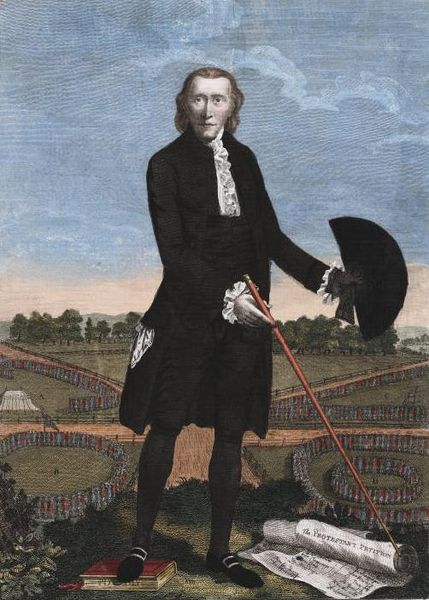
Lord George Gordon in 1780
Gordon is, in short, an ascetic whereas Gashford is both a hypocrite and a glutton, "who ate and drank to the last minute, and required some three or four reminders from John Grueby, before he could resolve to tear himself away from Mr Willet's plentiful providing." He finally emerges from the inn, "wiping his greasy mouth," to join Gordon, "who had been walking up and down before the house talking to himself." As they ride away, Dickens describes Gordon as a figure reminiscent of Don Quixote: "a nobleman of somewhat quaint and odd exterior" who sits "bolt upright on his bony steed" with "his elbows stuck out on either side ungracefully, and his whole frame jogged and shaken at every motion of his horse's feet; a more grotesque or more ungainly figure can hardly be conceived." He talks to himself all the way to London, but stops when he begins to be recognized and people call out "Hurrah Geordie! No Popery!" Then he begins to doff his hat and bow "(to the deep and unspeakable disgust of John Grueby)" all the way through London to his house near Cavendish Square.

That afternoon, Gashford is visited by Ned Dennis, "a squat, thickset personage, with a low, retreating forehead, a coarse shock head of hair, and eyes so small and near together, that his broken nose alone seemed to prevent their meeting and fusing into one of the usual size.... in his grimy hands he held a knotted stick, the knob of which was carved into a rough likeness of his own face." (A note informs us that the actual Edward Dennis, the public hangman, didn't resemble Dickens's description.) Gashford and Dennis discuss the latter's work as hangman, Gashford answering in the affirmative Dennis's question: "My work, is sound, Protestant, constitutional, English work. Is it, or is it not?" He prides himself on the number of people he has hanged, noting that he would have hanged more if George III hadn't decided to give the condemned the option of enlisting in the army or navy. He supports the Protestant Association, he tells Gashford, because, "If these Papists gets into power, and begins to boil and roast instead of hang, what becomes of my work! ... I mustn't have no biling, no roasting, no frying -- nothing but hanging."

Gashford tells Dennis that next month, or perhaps in May, they will "convene our whole body for the first time. My lord has thoughts of our walking in procession through the streets -- just as an innocent display of strength -- and accompanying our petition down to the door of the House of Commons." They will be of such numbers that they will need to be divided into groups and "Lord George has thought of you as an excellent leader for one of these parties." Dennis agrees.

Grueby then enters to tell Gashford "here's another Protestant," but although Gashford says he can't see him now, the man walks in anyway. It is Hugh.
Gashford recognizes Hugh from the Maypole and tells Grueby that it's okay. Hugh then hands Gashford one of the handbills he had dropped there. "I want to make one against the Catholics, I'm a No Popery man, and ready to be sworn in. That's what I've come here for." Dennis says, "No Popery, brother!" and Hugh replies, "No Property, brother!" Gashford corrects him -- "Popery, Popery" -- but Dennis says, "It's all the same!" He also examines Hugh and observes, "Do but cast your eye upon it. There's a neck for stretching, Muster Gashford!" He is also delighted to hear that Hugh can't read or write, "those two arts being (as Mr Dennis swore) the greatest possible curse a civilised community could know, ... militating ... agasint the professional emoluments and usefulness of the great constitutional office he had the honour to hold."

After Gashford welcomes Hugh to the Protestant Association, Hugh and Dennis walk out together, and when they reach Westminster, Dennis points out to him the weaknesses of the building where the houses of Parliament met "and how plainly, when they marched down there in great array, their roars and shouts would be heard by the members inside; with a great deal more to the same purpose, all of which Hugh received with manifest delight." He points out to Hugh several of the members of Parliament, and tells him which are favorable to their cause and which aren't. There are others there for the same purpose, always in groups of two or three, but they don't speak to others outside their group. But occasionally a paper is passed from one group to another, but so quickly that Hugh is unable to see who is handing it out. "They often trod upon a paper like the one he carried in his breast, but his companion whispered him not to touch it or to take it up, -- not even to look towards it."

Dennis then suggests that they go to The Boot, a pub "in the fields at the back of the Foundling Hospital; a very solitary spot at that period." Hugh recognizes many of the people he had seen in the crowd at Westminster, and Dennis proclaims a toast to "the health of Lord George Gordon, President of the Great Protestant Association; which toast Hugh pledged likewise." A fiddler strikes up a tune and Hugh and Dennis perform "an extemporaneous No-Popery Dance."
Then Sim Tappertit arrives with two other members of the United Bulldogs, one of whom is Mark Gilbert, whom we saw initiated into the erstwhile 'Prentice Knights. Like Sim, the other two are no longer apprentices but journeymen. Sim is acquainted with Dennis, who informs him that Hugh has joined their movement. Sim realizes then that he has seen Hugh before, and asks him "Did you ever see me before? You wouldn't be likely to forget it, you know, if you ever did." Hugh confesses that he doesn't recognize Sim, which annoys Sim very much. Then Sim recognizes that Hugh was once "hostler at the Maypole." He tells Hugh that he visited there "to ask after a vagabond that had bolted off.... Don't you remember my thinking you liked the vagabond, and on that account going to quarrel with you; and then finding you detested him worse than poison, going to drink with you?" This refreshes Hugh's memory, and he becomes great friends with Sim.
"The bare fact of being patronised by a great man whom he could have crushed with one hand, appeared in his eyes so eccentric and humorous, that a kind of ferocious merriment gained the mastery over him, and quite subdued his brutal nature." When Sim gets up on a barrel to deliver a speech against Popery, Hugh stands beside him, "and though he grinned from ear to ear at every word he said, threw out such expressive hints to scoffers in the management of his cudgel, that those who were at first the most disposed to interrupt, became remarkably attentive, and were the loudest in their approbation."

At the other end of the room, there's a group of men "in earnest conversation all the time; and when any of this group went out, fresh people were sure to come in soon afterwards and sit down in their places, as though the others had relieved them on some watch or duty; which it was pretty clear they did, for these changes took place by the clock, at intervals of half an hour." They have a collection of newspapers and read articles aloud in a low voice from them. "But the great attraction was a pamphlet called The Thunderer, which espoused their own opinions, and was supposed at that time to emanate directly from the Association.... It was impossible to discard a sense that something serious was going on, and that under the noisy revel of the public-house, there lurked unseen and dangerous matter."

Sim, meanwhile, is trying to find out what Dennis's line of work is, but the hangman remains coy about it, though he puts "his fingers with an absent air on Hugh's throat, and particularly under his left ear, as if he were studying the anatomical development of that part of his frame." This leads Sim to guess that Dennis is "a kind of artist," which Dennis enthusiastically agrees to. Sim notices the portrait carved on top of Dennis's stick, which turns out to have been done by one of his victims, although Dennis circumlocutes his way around this revelation. He was there the morning he died, he admits. "He wouldn't have gone off half as comfortable without me. I had been with three or four of his family under the same circumstances." Then he comments that every item of clothing he is wearing "belonged to a friend of mine that's left off sich incumbrances for ever." 

When they leave The Boot, Hugh accompanies Sim until he remembers that he has somewhere to go, leaving Sim to imagine his new friend's role in a revolutionary future:
"In an altered state of society -- which must ensue if we break out and are victorious -- when the locksmith's child is mine, Miggs must be got rid of somehow, or she'll poison the tea-kettle one evening when I'm out. He might marry Miggs, if he was drunk enough. It shall be done. I'll make a note of it."

Saturday, April 2, 2011

8. Barnaby Rudge, by Charles Dickens, pp. 297-342

Barnaby Rudge (Penguin Classics)Chapters 31-35
_____
Barricaded in his room, Joe waits to be confronted by his father for his assault on Cobb, but when morning comes, he climbs out of his window and leaves, looking "up at the old Maypole, it might be for the last time." He reaches the Black Lion pub in London, where he learns that a recruiting sergeant is signing men up. The recruiter is eager to have him, but Joe wants to wait until that evening, so that he has time to talk to Dolly. The recruiter promises that if he does sign, he'll leave London the next day: "You'll go abroad -- a country where it's all sunshine and plunder -- the finest climate in the world." That sounds to Joe exactly like what he wants. "Needs must when the devil drives; and the devil that drives me is an empty pocket and an unhappy home."

By evening, he has spent all his money on food, while waiting for a time when Mrs. Varden usually goes out to a lecture. He finds Dolly alone (or so he thinks).
Dolly welcomes him in her father's workshop, but when he tells her he is there "to say good-bye -- to say good-bye for I don't know how many years; perhaps for ever. I am going abroad," she reacts coldly. "Dolly released her hand and said, 'Indeed!' She remarked in the same breath that it was a fine night, and in short, betrayed no more emotion than the forge itself." Unfortunately for Joe, "that gallant coachmaker had vowed but the night before that Miss Varden held him bound in adamantine chains." She is expecting to be wooed, not to be forced to confront reality.
Joe had small experience in love affairs, and had no notion how different young ladies are at different times; he had expected to take Dolly up again at the very point where he had left her after that delicious evening ride, and was no more prepared for such an alteration than to see the sun and moon change places.
So even though he now declares, "I love you dearly, with all my heart and soul; with as much truth and earnestness as ever man loved woman in this world, I do believe," Dolly is expecting more. She "was a coquette by nature, and a spoilt child," convinced that "The coachmaker would have been dissolved in tears, and ... done all kinds of poetry." The truth of what she has done by not begging him to stay is slow to hit her. After he has left, she waits for him to come back, looks out into the street, waits some more and then "went upstairs humming a tune, bolted herself in, laid her head down on her bed, and cried as if her heart would break."

After she has gone, Sim comes out from his hiding place in triumph, admires his legs in the mirror, and proclaims, "Tremble, Willet, and despair. She's mine! She's mine!"

Joe goes to the recruiting sergeant and signs up, and the next morning, "The party embarked in a passage-boat bound for Gravesend, whence they were to proceed on foot to Chatham; the wind was in their favour, and they soon left London behind them; a mere dark mist -- a giant phantom in the air."

Dickens announces the parallel father-son story, that of Edward and John Chester, with "Misfortunes, saith the adage, never come singly."
Phiz underscores a point: Notice the picture of Abraham sacrificing Isaac above John Chester.
John and Edward Chester are dining together, the father trying to cheer up the son. But when Edward calls him "father," John protests, "for Heaven's sake don't call me by that obsolete and ancient name. Have some regard for delicacy. Am I grey, or wrinkled, do I go on crutches, have I lost my teeth, that you adopt such a mode of address? Good God, how very coarse!" And Edward only makes it worse when he protests, "I was about to speak to you from my heart, sir." For John, the heart is only "the centre of the blood-vessels and all that sort of thing.... How can you be so very vulgar and absurd? These anatomical allusions should be left to gentlemen of the medical profession. They are really not agreeable in society.... Men are sometimes stabbed to the heart, shot to the heart; but as to speaking from the heart, or to the heart, or being warm-hearted, or cold-hearted, or broken-hearted, or being all heart, or having no heart -- pah! these things are nonsense, Ned."

Edward, perhaps to put an end to his father's lecture, says, "No doubt." But John continues, narrowing his focus to Emma: "No doubt in your mind she was all heart once. Now she has none at all." Edward protests that though she appears to have changed, it was "by vile means, I believe." John insists, "She supposed you to be rich, or at least rich enough; and found you poor. Marriage is a civil contract; people marry to better their worldly condition and improve appearances; it is an affair of house and furniture, of liveries, servants, equipage, and so forth. The lady being poor and you poor also, there is an end of the matter." Dickens certainly wants us to believe that this is John Chester's heartless materialism, and therefore to be dismissed, but modern readers may find some uncomfortable truths in it. And then he goes on to a revelation:
"Edward, my father had a son, who being a fool like you, and, like you, entertaining low and disobedient sentiments, he disinherited and cursed one morning after breakfast. The circumstance occurs to me with a singular clearness of recollection this evening. I remember eating muffins at the time, with marmalade. He led a miserable life (the son, I mean) and died early; it was a happy release on all accounts; he degraded the family very much." 
This would seem to be a significant revelation to Edward: that he had an uncle who went astray. Perhaps his father is only making it up as a warning, but in a novel filled with hints and secrets, such as the identity of the mysterious stranger who robbed Edward and threatens Mrs. Rudge, or the parentage of Hugh and John Chester's motive for his intense scrutiny of Hugh's face, it also give the reader a license to speculate. But only for a moment, for John now responds to his son's plea for an audience to his concerns with a bitter dismissal: "if, in short, you are resolved to take your own course, you must take it, and my curse with it."

Now it's Edward's turn to surprise us: "'The curse may pass your lips,' said Edward, 'but it will be but empty breath. I do not believe that any man on earth has greater power to call one down upon his fellow -- least of all, upon his own child -- than he has to make one drop of rain or flake of snow fall from the clouds above us at his impious bidding." This is the kind of skepticism about melodramatic devises such as paternal curses that we would normally expect from John Chester, not from Edward. But John Chester naturally knows how to turn it back on his son: "You are so very irreligious, so exceedingly undutiful, so horribly profane.... Return to this roof no more, I beg you. Go, sir, since you have no moral sense remaining; and go to the Devil, at my express desire. Good day."

Edward leaves, "and turned his back upon the house for ever." So with both Joe and Edward cast adrift upon the world, Dickens now jumps ahead five years, from 1775 to 1780. 
It's a night of terrible weather, and Joe Willet, Tom Cobb, and Phil Parkes are waiting for their companion, Solomon Daisy, in the coziness of the Maypole kitchen. Dickens makes much of the contrast between the warm, quiet interior and the cold, windy night outside, so much so that it's almost an inversion of the disjunction between nature and humanity that we saw earlier when John Chester was making his way inattentively through a beautiful spring day. It is half past ten at night, and Willet is snoring -- although he is awake: "his breathing was pretty much the same, awake or asleep, saving that in the latter case he sometimes experienced a slight difficulty in respiration" (which we would call apnea).

Over the chimney there is a poster of "a youth of tender years running away very fast." After Joe's disappearance, Willet had distributed these, offering a reward of five pounds, but he "obstinately peristed, despite the advice and entreaties of his friends, in describing his son as a 'young boy;' and furthermore as being from eighteen inches to a couple of feet shorter than he really was," with the result that he has had delivered to him "at various times and at a vast expense, ... some five-and-forty runaways varying from six years old to twelve."

Finally a cry is heard outside and Solomon Daisy enters, terror-stricken and for a moment unable to speak. Willet decides the way to get him to tell them what has happened is to bully him: "Tell us what's the matter, sir, ... or I'll kill you.... How dare you look like that?" Finally Daisy is able to tell them "to lock the house-door and close and bar the shutters of the room, without a moment's loss of time." They follow his advice, and he begins to moan, "Why did I leave this house to-night! On the nineteenth of March -- of all nights in the year, on the nineteenth of March!" This is the anniversary of the murder of Reuben Haredale, twenty-seven years ago. He tells them that he realized that he had forgotten to wind the clock in the church, and he went to do it, even though the storm was raging outside, and no one else was about. When he got there, he realized it was the nineteenth of March, and "at the very same moment, I heard a voice outside the tower -- rising from among the graves." It was the kind of cry one might give "if something dreadful followed us in a dream, and came upon us unawares; and then it died off: seeming to pass quite round the church."

When he opened the church door to leave, "there crossed me -- so close, that by stretching out my finger I could have touched it -- something in the likeness of a man. It was bare-headed to the storm. It turned its face without stopping, and it fixed its eyes on mine. It was a ghost -- a spirit." He falls back weakly as the others demand "Whose?" but only Willet hears the answer: "'Gentlemen,' said Mr Willet after a long pause, 'you needn't ask. The likeness of a murdered man. This is the nineteenth of March.'"

Receiving this news, they all vow to keep it to themselves. But after they leave, Willet decides that he has to share this information with Geoffrey Haredale as soon as possible. So he summons Hugh, who complains about going out at midnight in a storm, but whom Willet needs to lead him through the darkness to the Warren. When they reach it, the place is dark except for a light in one of the towers, which Willet realizes is "Mr Reuben's own apartment, God be with us! I wonder his brother likes to sit there, so late at night -- on this night too." Hugh scoffs at this: "Is it less warm or dry, because a man was killed there?" Willet begins "to think it just barely possible that he was something of a dangerous character, and that it might be advisable to get rid of him one of these days."

Haredale lets them in, and they climb the stairs to the room, though Haredale asks Hugh to wait outside. "He has an evil eye," he tells Willet. After Willet tells him what Solomon Daisy saw, Haredale says it was a good idea to keep it secret, though he regards the story as "a foolish fancy on he part of this weak-brained man, bred in his fears and superstition. But Miss Haredale, though she would know it to be so, would be disturbed by it if it reached her ears."

When Willet prepares to leave, Haredale offers Hugh a drink, and when he gives it to him, Hugh "threw part of it upon the floor." Willet scolds him, but Hugh says, "'I'm drinking a toast... to this house and its master.' With that he muttered something to himself, and drank the rest, and setting down the glass, preceded them without another word." Willet is "scandalised" by this. And when they leave, Willet notices that Haredale's "face had changed so much and grown so haggard since their entrance, that he almost seemed another man."

Willet and Hugh take to the road again, but are suddenly almost run down by three men on horseback. They stop and ask if this is the road to London. "'If you follow it right, it is,' replied Hugh roughly." The man who asked calls Hugh's manner "churlish," but Willet assures them it is, and then scolds Hugh for provoking "three great neck-or-nothing chaps, that could keep on running over use, back'ards and for'ards, till we was dead, and then take our bodies up behind 'em, and drown us ten miles off." When he informs the men that London is thirteen miles away, they decide it's too far to ride that night, and ask for an inn, which Willet is happy to answer.

One of the men then asks if Willet has "one excellent bed, landlord? Hem! A bed that you can recommend -- a bed that you are sure is well aired -- a bed that has been slept in by some perfectly respectable and unexceptionable person?" And he launches into a long speech about how "forty thousand men of this our island in the wave (exclusive of women and children) rivet their eyes and thoughts on Lord George Gordon; and every day, from the rising up of the sun to the going down of the same, pray for his health and vigour." And so on. He insists that only Gordon needs the bed: "Let me sleep on a chair -- the carpet -- anywhere. No one will repine if I take cold or fever." And as for the third man, "Let John Grueby pass the night beneath the open sky -- no one will repine for him."

Willet, "who had never heard so many words spoken together at one time, or delivered with such volubility and emphasis as by the long-winded gentleman," assures them that he has accommodations for all three of them. And we learn that the three men are Gordon, his secretary Gashford ("the long-winded gentleman"), and his servant, John Grueby. Gordon says they will follow Willet and Hugh to the Maypole, but Grueby doesn't like Hugh's looks and insists on riding ahead with him. As they proceed, Hugh sizes Grueby up:
He was a square-built, strong-made, bull-necked fellow, of the true English breed; and as Hugh measured him with his eye, he measured Hugh, regarding him meanwhile with a look of bluff disdain. He was much older than the Maypole man, being to all appearance five-and-forty; but was one of those self-possessed, hard-headed, imperturbable fellows, who, if they are ever beaten at fisticuffs, or other kind of warfare, never know it, and go on coolly till they win.
Which is pretty much what happens now, as Hugh decides to challenge Grueby on his skill with a cudgel, waving his about and receiving a blow on the head from the butt end of Grueby's whip. Grueby comments, "You wear your hear too long; I should have cracked your crown if it had been a little shorter." Hugh meditates on escalating the combat, but backs down, recognizing that he was dealing with "a customer of almost supernatural toughness."
 Willet shows them to the Maypole, where he observes that Gordon is "about the middle height, of a slender make, and sallow complexion, with an aquiline nose, and long hair of a reddish brown, combed perfectly straight and smooth about his ears, and slightly powdered, but without the faintest vestige of a curl." He is "not yet thirty," and "his face ... was thin and mild, and wore an air of melancholy; but it was suggestive of an indefinable uneasiness." Gashford "was taller, angularly made, high-shouldered, bony, and ungraceful.... His manner was smooth and humble, but very sly and slinking. He wore the aspect of a man who was always lying in wait for something that wouldn't come to pass; but he looked patient -- very patient -- and fawned like a spaniel dog." (Dickens will do this better when he creates Uriah Heep, though "lying in wait for something that wouldn't come to pass" is quite wonderful.)

When they are settled in, Gordon and Gashford look back on what Gashford calls "the blessed work of a most blessed day," and Gordon prompts the secretary to tell him how he moved the Protestants of Suffolk: "They cried to be led against the Papists, they vowed a dreadful vengeance on their heads, they roared like men possessed." He goes on to say, "when you cried 'Perish the Pope and all his base adherents; the penal laws against them shall never be repealed while Englishmen have hearts and hands' -- and waved your own an touched your sword; and when they cried, 'No Popery!' and you cried 'No; not even if we wade in blood,' and they threw up their hats and cried 'Hurrah! not even if we wade in blood; No Popery! Lord George! Down with the Papists -- Vengeance on their heads.'"

Gordon seems to be under Gashford's spell. He even asks, "But -- dear Gashford -- did I really say all that?" Gashford assures him he did, and he reminds him that he, Gashford, had been "stricken by the magic of his eloquence in Scotland but a year ago, [and] abjured the errors of the Romish church." Gordon continues to be in something of a daze, and to need Gashford's reassurance. He has "a heightened colour" and puts a "fevered hand" on Gashford's shoulder; "struggling through his Puritan's demeanour, was something wild and ungovernable which broke through all restraint." Meanwhile, Gashford is taking more than his share of the mulled wine.

Willet and Grueby arrive to show "the deluded lord into his chamber." Gashford falls asleep by the fire, only to be awakened by Grueby, who is concerned about his master's state of mind: "'Between Bloody Marys, and blue cockades, and glorious Queen Besses, and no Popery, and Protestant associations, and making of speeches,' pursued John Grueby, ... 'my lord's half off his head.... One of these evenings, when the weather gets warmer and Protestants are thirsty, they'll be pulling London down, -- and I never heard that Bloody Mary went as far as that.'"