JOURNAL OF A COMPULSIVE READER
By Charles Matthews
Showing posts with label Arthur Schopenhauer. Show all posts

Saturday, May 21, 2011

35. The Modern Tradition, edited by Richard Ellmann and Charles Feidelson Jr., pp. 754-779

Self-Consciousness: The Divided Self (Friedrich Nietzsche, W.B. Yeats); Freedom (Arthur Schopenhauer, Friedrich Nietzsche)
_____


Friedrich Nietzsche: The Masks of Truth 


"Everything deep loves masks; the deepest things have a veritable hatred of image and likeness." Thus spoke Nietzsche in Beyond Good and Evil (1886). The mask is the face that the self presents to the world, and it is essential to the artist and the philosopher. It is not a mask necessarily a mask assumed by them, but one that grows out of their relationship to the world: "around every deep thinker a mask constantly grows, thanks to the continually wrong, i.e. superficial, interpretations of his every word, his every step, his every sign of life." 


Humankind fears the truth and takes refuge in superficialities: 
It is deep, suspicious fear of incurable pessimism that forces whole millenniums to sink their teeth into a religious interpretation of life. It is that fearful instinct which intuits that man might come into possession of the truth too soon, before he has grown strong enough, hard enough, artist enough. Looked at in this light, piety, "living in God," would appear to be the subtlest and ultimate product of the fear of truth.
We put on the mask to "become so much a work of art, of surface, of color-play, and goodness, that one no longer suffers whenever one looks at" us, and "one writes books in order to conceal what is concealed in one."  
Every philosophy is a foreground-philosophy.... There is something arbitrary in the fact that the philosopher stopped here, that he looked back and looked around, that here he refrained from digging deeper, that he laid aside his spade.... Each philosophy also conceals a philosophy; each opinion is also a hiding place; each word is also a mask.... Man, a complex, lying, artificial, and inscrutable animal ... has invented the clear conscience, so that he might have the sensation, for once, that his psyche is a simple thing. All of morality is a continuous courageous forgery, without which an enjoyment of the sight of man's soul would be impossible.


W.B. Yeats: The Anti-Self 


Yeats's masks, described in Per Amica Silentia Lunae (1918), are also a product of the artist's  self-concealment, as well as a spontaneous expression of characteristics of the artist that he or she chooses to suppress. Yeats is aware that his public self is not the one that he finds when he closes the door to his study and sits down to write. "When I come to put in rhyme what I have found it will be a hard toil, but for a moment I believe I have found myself and not my anti-self. It is only the shrinking from toil perhaps that convinces me that I have been no more myself than is the cat the medicinal grass it is eating in the garden." The anti-self protects the self, just as the grass nourishes and heals the cat.


He sees this in the work of his friends, such as the woman (possibly Augusta Gregory) whose "only fault is a habit of harsh judgement with those who do not have her sympathy," but whose plays are anything but harsh and judging. Or the actress who plays meek and self-effacing young women on stage but "in private life is like the captain of some buccaneer ship holding his crew to good behavior at the mouth of a blunderbuss." Even the art she collects is a mask of her private self: 
When I last saw her in her own house she lived in a torrent of words and movements, she could not listen, and all about her upon the walls were women drawn by Burne-Jones in his latest period ... women who were always listening, and are as necessary to her as a contemplative Buddha to a Japanese Samurai.   
He also contrasts the "gentle and silent" John Millington Synge with the "voluble dare-devils" of his plays: "in all his imagination he delights in fine physical life. And "William Morris, a happy, busy, most irascible man, described dim colour and pensive emotion." Yeats posits that "the work is the man's flight from his entire horoscope." Keats, who was "ignorant, poor, and in poor health, and not perfectly well-bred," in his poetry indulged in "imaginary delights" and "gave us his dream of luxury." Dante "celebrated the most pure lady poet ever sung and the Divine Justice," but "had to struggle in his own heart with his unjust anger and his lust." 


Which leads Yeats to one of his best-known prose aphorisms: "We make out of the quarrel with others, rhetoric; but of the quarrel with ourselves, poetry." Not everyone achieves this ability to express the anti-self: "The other self, the anti-self or the antithetical self, as one may choose to name it, comes but to those who are no longer deceived, whose passion is reality." It comes from struggle: "He only can create the greatest imaginable beauty who has endured all imaginable pangs, for only when we have seen and foreseen what we dread shall we be rewarded by that dazzling unforeseen wing-footed wanderer." 


So Yeats dismisses the contemporary "doctrine of sincerity and self-realisation." It has "made us gentle and passive," when what is needed is "the energy to assume the mask of some other life."
If we cannot imagine ourselves as different from what we are, and try to assume that second self, we cannot impose a discipline upon ourselves though we may accept one from others.... Wordsworth, great poet though he be, is so often flat and heavy partly because his moral sense, being a discipline he had not created, a mere obedience, has no theatrical element.
Yeats, tinkering with spiritualism, posits the role of a classical daemon in the artist's life: 
the Daemon comes not as like to like but seeking its own opposite, for man and Daemon feed the hunger in one another's hearts. Because the ghost is simple, the man heterogeneous and confused, they are but knit together when the man has found a mask whose lineaments permit the expression of all the man most lacks, and it may be dreads, and of that only.
Finally, Yeats confronts contemporary psychology: "The doctors of medicine have discovered that certain dreams of the night, for I do not grant them all, are the day's unfulfilled desire, and that our terror of desires condemned by the conscience has distorted and disturbed our dreams." Artists have no need of dreams to do this for them. They have their masks. 


Arthur Schopenhauer: Sympathy and Asceticism


Asceticism, the denial of the body in order to come closer to the spirit, has been the traditional way of dealing with dualism in almost all cultures. For the modern, it is a path toward self-knowledge, toward freeing the self from physical demands. Schopenhauer, in The World as Will and Idea (1818) deals with it in terms of the individual will attempting to separate itself from the universal will. 
If that veil of Mâyâ, the principle of individuation, is lifted from the eyes of a man to such an extent that he no longer makes the egotistical distinction between his person and that of others, but takes as much interest in the sufferings of other individuals as his own, and therefore is not only benevolent in the highest degree, but even ready to sacrifice his own individuality whenever such a sacrifice will save a number of other persons, then it clearly follows that such a man, who recognises in all beings his own inmost and true self, must also regard the infinite suffering of all suffering beings as his own, and take on himself the pain of the whole world.
This cognition of wholeness, of the "constant passing away, vain striving, inward conflict, and continual suffering," is contrasted by Schopenhauer with "the principle of individuation" and "egoism" that only knows particular things and their relation to his own person." By turning away from the ego, "Man ... attains to the state of voluntary renunciation, resignation, and perfect will-lessness." But the process is difficult: "Therefore Jesus says, 'It is easier for a camel to go through the eye of a needle, than for a rich man to enter the kingdom of God.'" The things of the world call to us. "Asceticism ... shows itself ... in voluntary and intentional poverty." 


This "mortification of will" is the rejection of "the source of his own suffering existence and that of the world." For "so long as the body lives, the whole will to live exists potentially, and constantly strives to become actual, and to burn again with all its ardour." But silencing "all volition, gives the deepest peace and opens the door of freedom." Those who attain this state "strive with all their might to keep upon this path, by enforced renunciation of every kind, by penance and severity of life, and by selecting whatever is disagreeable to them, all in order to suppress the will, which is constantly springing up anew." 


Friedrich Nietzsche: Self-Overcoming 


A keen student of Schopenhauer, Nietzsche also embraced a form of asceticism, but as a means of rising above the herd mentality and "slave morality" of humanity. "Man is something that should be overcome," he had Zarathustra proclaim in Thus Spoke Zarathustra (1883), in order to make way for the Übermensch. (The usual translation, "Superman," has comic connotations that are unfortunately unavoidable.) Just as we mock our simian ancestors, so the Superman toward which we should be evolving will mock us. "All creatures hitherto have created something beyond themselves," he argues, so man must evolve into Superman. 


And forget about becoming something higher in an afterlife: "I entreat you, my brothers, remain true to the earth, and do not believe those who speak to you of superterrestrial hopes! ... Once blasphemy against God was the greatest blasphemy, but God died, and thereupon these blasphemers died too. To blaspheme the earth is now the most dreadful offence, and to esteem the bowels of the Inscrutable more highly than the meaning of the earth." (He has already defined "the meaning of the earth" as the Superman.) 


The path to the Superman is an ascetic one, because the soul, which was once upon a time "lean, monstrous, and famished" has become "poverty and dirt and a miserable ease," and as a result "man is a polluted river." To become Superman, man must contemn happiness, reason, virtue, justice and pity. The wise man must learn the "will to power": "You want to create the world before which you can kneel: this is your ultimate hope and intoxication." The "will to power" is "the unexhausted, procreating life-will." 


Existence is by nature a struggle, and life is "that which must overcome itself again and again." All creatures, Nietzsche asserts, wish to obey but also to command those weaker than themselves, but "commanding is more difficult than obeying ... because the commander bears the burden of all who obey, and ... this burden can easily crush him." 
The strange fact ... is that everything of freedom, subtlety, boldness, dance, and craftsmanlike certainty that one can find on earth, whether it applies to thinking, or ruling, or speaking, or persuading -- in the arts as well as in codes of conduct -- would never have developed save through "the tyranny of ... arbitrary laws." Indeed, the probability is strong that this is "nature" and "natural." 
In Beyond Good and Evil (1886), Nietzsche stresses again the necessity of obedience. He appeals to history to show that "violence, arbitrariness, rigor, gruesomeness and antirationality turned out to be the means for disciplining the European spirit into strength, ruthless inquisitiveness, and subtle flexibility," although the same time "much which is irreplaceable in energy and spirit was suppressed, choked out, and ruined in this same process." But cruelty is a necessity on the way to "everything that we call 'superior culture.'" 
What constitutes the painful delight of tragedy is cruelty; what is pleasurable in so-called tragic pity, and basically in everything sublime right up to the highest and subtest thrills of metaphysics, gets its sweetness from nothing other than the added ingredient of cruelty.... Naturally we must get rid of the old ridiculous psychology which knew no better than to teach that cruelty only arises at the sight of someone else's suffering. There is a rich, an over-rich pleasure in one's own suffering, in making oneself suffer.
Which brings us back to Schopenhauer's asceticism. 


Nietzsche also proclaims the necessity of aristocracy: "Every heightening of the type 'man' hitherto has been the work of an aristocratic society -- and thus it will always be; a society which believes in a long ladder of rank order and value differences in men, which needs slavery in some sense." This, Nietzsche posits, is the only way in which man can attain "a higher level of being." Naturally, he also acknowledges that aristocracies come and go, and that they decline and decay. Egalitarianism may be "proper behavior," but as "the basic principle of society, it shows itself for what it is: the will to negate life, the principle of dissolution and decay." For life "is essential assimilation, injury, violation of the foreign and the weaker, suppression, hardness, the forcing of one's own forms upon something else, ingestion and -- at least in its mildest form -- exploitation." This last, in the evolutionary process, "belongs to the nature of living things, it is a basic organic function, a consequence of the will to power which is the will to life."


In all higher cultures, Nietzsche says, there is an attempt to mediate between "master-morality and slave-morality." The former is the definition of the "good" as those qualities "which are felt to be what excels and determines the order of rank" in society. "What is despised is the coward, the timid man, and the petty man, he who thinks in terms of narrow utility; likewise the suspicious man with his cowed look, the one who humiliates himself, the dog-type who lets himself be mistreated, the begging flatterer, and above all the liar: it is the basic faith of all aristocrats that the common people are liars." The master "feels himself as value-determining; ... he knows that he is the something which gives honor to objects; he creates values." 


Slave-morality is that which makes "existence easier for the sufferers: here compassion, the complaisant helping hand, the warm heart, patience diligence, humility and friendliness are honored, for these are the useful qualities and almost the only means for enduring the pressure of existence. Slave-morality is essentially a utility-morality."
Here is the cornerstone for the origin of that famous Antithesis "good vs. evil." Power and dangerousness, a certain frightfulness, subtlety and strength which do not permit of despisal, are felt to belong to evil. Hence according to slave morality, the "evil" man inspires fear; according to master morality, the "good" man does and wants to, whereas the "bad" man is felt to be despicable.

Tuesday, May 10, 2011

25. The Modern Tradition, edited by Richard Ellmann and Charles Feidelson Jr., pp. 539-558

The Unconscious: Introduction; Unreason and Reason (Johann Wolfgang von Goethe, William Blake, Arthur Schopenhauer, Friedrich Nietzsche)
_____

Johann Wolfgang von Goethe: The Demoniac

As the editors' introduction says, in the movement of thought leading up to Freud's creation of psychoanalysis, "The traditional primacy of ideas over feeling, purpose over instinct, reason over energy, is ... questioned and often repudiated." In this selection from Truth and Fiction Relating to My Life (a very clunky translation of the title Aus meinem Leben: Dichtung und Wahrheit, 1811-1822), Goethe examines the sense of something in nature that "was not godlike, for it seemed unreasonable; not human, for it had no understanding; nor devilish, for it was beneficent; nor angelic, for it often betrayed a malicious pleasure." He calls it the "Demoniac, after the example of the ancients," and notes that he has observed it in certain individuals who seem to possess "a tremendous energy"and to "exercise a wonderful power over all creatures."
Seldom if ever do the great men of an age find their equals among their contemporaries, and they are to be overcome by nothing but by the universe itself; and it is from observaton of this fact, that the strange but most striking proverb must have risen, Nemo contra Deum nisi Deus ipse.
No one can oppose a god if he isn't a god himself.


William Blake: Energy and Reason


Blake's "The Marriage of Heaven and Hell" (1793) accepts what Goethe calls the Demoniac as an essential creative principle, and anticipates Nietzsche's dualism of Apollonian and Dionysian. Hell is energy, and Heaven is reason, to oversimplify. And as Blake asserts, "Religion is an endeavour to reconcile the two." 


Arthur Schopenhauer: Will and Knowledge

In The World as Will and Idea (1818), Schopenhauer represents the traditional view as an assertion that human beings possess a soul that is primarily a vehicle for knowledge, and that from this knowledge humans learn that certain things are good. They then apply the secondary power of will to seek that which is good. This is, he says, "a reversal of the true relation." The will is the primary force: "Will is first and original; knowledge is merely added to it as an instrument belonging to the phenomenon of will."
What the man really and in general wills, the striving of his inmost nature, and the end he pursues in accordance with it, this we can never change by influence upon him from without by instruction, otherwise we could transform him.
The best we can do through moral instruction is to "teach the will that it erred in the means it employed and can therefore bring it about that the end after which it strives ... shall be pursued on an entirely different path and in an entirely different object from what has hitherto been the case. But it can never bring about that the will shall will something actually different from what it has hitherto willed."

The individual human is a finite being "in infinite space and time, and consequently ... a vanishing quantity compared with them." We exist "only in the present, whose unchecked flight into the past is a constant transition into death, a constant dying." In physical terms, just as "walking is ... merely a constantly prevented falling," bodily existence "is only a constantly prevented dying." And mental activity "is a constantly deferred ennui."
We pursue our life, however, with great interest and much solicitude as long as possible, as we blow out a soap-bubble as long and as large as possible, although we know that it will burst.
Because frustration of the will produces pain, and "too easy satisfaction" of what it desires produces only "a terrible void and ennui," life is a continual oscillation "between pain and ennui." The religious portrayal of hell as a place of constant pain, therefore, leaves "nothing over for heaven but ennui."

The body itself "is nothing but the objectified will to live." And the human being "stands upon the earth ... uncertain about everything except his own need and misery." For the mass of humanity, life is a constant struggle for existence, "with the certainty of losing it at last. But what enables them to endure this wearisome battle is not so much the love of life as the fear of death, which yet stands in the background as inevitable, and may come upon them at any moment."


Friedrich Nietzsche: Dionysos and Apollo

In The Birth of Tragedy (1872), Nietzsche posits a duality of the Apollonian and the Dionysiac -- roughly a dichotomy of reason and order vs. passion and chaos -- that, like Blake's Heaven and Hell, marry and beget "Attic tragedy, which exhibits the salient features of both parents." He compares the states of "dream and intoxication, two physiological phenomena standing toward one another in much the same relationship as the Apollonian and Dionysiac."
The person who is responsive to the stimuli of art behaves toward the reality of dream much the way the philosopher behaves toward the reality of existence: he observes exactly and enjoys his observations, for it is by these images that he interprets life, by these processes that he rehearses it. Nor is it by pleasant images alone that such plausible connections are made: the who divine comedy of life, including its somber aspects, its sudden balkings, impish accidents, anxious expectations, moves past him, not quite like a shadow play -- yet never without giving a fleeting sense of illusion.
Apollo was both the god of light and the soothsayer, and as the bearer of truths represents both the dream state and art, which are closely related. Apollo's "looks and gestures radiate the full delight, wisdom, and beauty of 'illusion.'"

The Dionysiac "rapture, whose closest analogy is furnished by physical intoxication," brings about the bond between individual human beings and between humanity and nature.
If one were to convert Beethoven's "Paean to Joy" into a painting, and refuse to curb the imagination when that multitude prostrates itself reverently in the dust, one might form some apprehension of the Dionysiac ritual. Now the slave emerges as a freeman; all the rigid, hostile walls which either necessity or despotism has erected between men are shattered.... He feels himself to be godlike and strides with the same elation and ecstasy as the gods he has seen in his dreams.
Nietzsche goes on to interpret the choral finale of Beethoven's Ninth as an expression of Dionysiac rapture, quoting the line from the Schiller poem set by Beethoven: "Do you fall on your knees, multitudes, do you divine your creator?" (Ihr stürzt nieder, Millionen? Ahnest du den Schöpfer, Welt?)

Nietzsche asserts that the cult of Dionysus was prevalent elsewhere in the ancient world but was held in check in Greece by "the proud, imposing image of Apollo, who in holding up the head of the Gorgon to those brutal and grotesque Dionysiac forces subdued them. Doric art has immortalized Apollo's majestic rejection of all license."
Apollo's music was a Doric architecture of sound -- of barely hinted sounds such as are proper to the cithara. Those very elements which characterize Dionysiac music and, after it, music quite generally: the heart-shaking power of tone, the uniform stream of melody, the incomparable resources of harmony -- all these elements had been carefully kept at a distance as being inconsistent with the Apollonian norm.
Do I need to interject here that classical scholars dismiss Nietzsche's account of Greek art and religion as pure fantasy? But Nietzsche was not really interested in presenting a factual account of ancient history, any more than Blake was describing a literal marriage of Heaven and Hell. Apollo represents for him the Olympian attitude, with Dionysos as an expression of Goethe's Demoniac force. "The same drive that found its most complete representation in Apollo generated the whole Olympian world, and in this sense we may consider Apollo the father of that world.... Nothing in these deities reminds us of asceticism, high intellect, or duty: we are confronted by luxuriant, triumphant existence, which deifies the good and the bad indifferently."

He tells the story of King Midas, who asked Silenus, the companion and (in one version of the myth) the tutor of Dionysos, "what he considered man's greatest good." Silenus responded:
"Ephemeral wretch, begotten by accident and toil, why do you force me to tell you what it would be your greatest boon not to hear? What would be best for you is quite beyond your reach: not to have been born, not to be, to be nothing. But the second best is to die soon."
That makes Schopenhauer sound cheerful. Nietzsche sees the Olympian gods as a projection of human beings, "keenly aware of the terrors and horrors of existence; in order to be able to live at all they had to place before them the shining fantasy of the Olympians." The same religion-as-fantasy impulse also gave rise to art "as a completion and consummation of existence." As for the gods, they "justified human life by living it themselves -- the only satisfactory theodicy ever invented." (The same impetus to project human existence into divinity also gives rise to the Christian idea of the Incarnation, of God become Man.) 

With the example of the immortal gods before them, "Now it became possible to stand the wisdom of Silenus on its head and proclaim that it was the worst evil for man to die soon, and second worst for him to die at all." Thus human heroes, a little bit lower than the gods, appeared in the poetry of Homer.
It should have become apparent by now that the harmony with nature which we late-comers regard with such nostalgia, and for which Schiller has coined the cant term naïve, is by no means a simple and inevitable condition to be found at the gateway to every culture, a kind of paradise.... The naïveté of Homer must be viewed as a complete victory of Apollonian illusion.... In the case of the Greeks it was the will wishing to behold itself in the transcendence of genius; but in order so to behold itself its creatures had to view themselves as glorious, to transpose themselves to a higher sphere, without having that sphere of pure contemplation either challenge them or upbraid them with insufficiency. It was in that sphere of beauty that the Greeks saw the Olympians as their mirror images; it was by means of that esthetic mirror that the Greek will opposed suffering and the somber wisdom of suffering which always accompanies artistic talent.
Humans have "an intense longing for illusion" and our dreams "appear to us as illusions of illusions, hence as a still higher form of satisfaction of the original desire for illusion." Nietzsche turns here to a later artist, Raphael, and his painting of the Transfiguration.
He finds in it "that reduction of illusion to further illusion which is the original act of the naïve artist and at the same time of all Apollonian culture." In the lower half of the painting we have confusion ("the helpless, terrified disciples")  and pain ("the possessed boy") -- "íllusion' here is a reflection of eternal contradiction, begetter of all things. From this illusion there arises, like the fragrance of ambrosia, a new illusory world, invisible to those enmeshed in the first; a radiant vision of pure delight, a rapt seeing through wide-open eyes. Here we have, in a great symbol of art, both the fair world of Apollo and its substratum, the terrible wisdom of Silenus, and we can comprehend intuitively how they mutually require one another."

The Apollonian attitude "demands self-control" and produces maxims like "Know thyself" and "Nothing too much." Consequently, "the Dionysiac spirit struck the Apollonian Greeks as titanic and barbaric." But antithetical forces must coexist. And out of their coexistence comes the tragic vision, producing "the sublime and much lauded achievement of the dramatic dithyramb and Attic tragedy, as the common goal of both urges; whose mysterious marriage, after long discord, ennobled itself with such a child, at once Antigone and Cassandra."

In Beyond Good and Evil (1886), Nietzsche returned to the Apollonian and Dionysian, but in a more prophetic, less explanatory vein, reporting the conversation of a devotee with Dionysus:
Once, for example, he said "I love mankind under certain conditions" (alluding to Ariadne who was there at the time), "man seems to me to be a pleasant, courageous, inventive animal who has not his likes on earth; he can find his way around any labyrinth. I wish him well; I often contemplate how I might advance him, how I might make him stronger, more evil, and deeper than he is." "Stronger, more evil, and deeper?" I asked, shocked. "Yes," he said once more, "stronger, more evil, deeper, and also -- more beautiful!" -- and saying this he smiled his halcyon smile, this Tempter-God, as though he had delivered himself of an endearing courtesy. One sees at once that it is not only modesty which this divinity lacks.... There are good reasons, in fact, for supposing that all the gods could learn from us men in several respects. We man are more -- humane....

Tuesday, May 3, 2011

18. The Modern Tradition, edited by Richard Ellmann and Charles Feidelson Jr., pp. 381-407

Nature: Introduction; Struggle (Charles Darwin, Arthur Schopenhauer); Organicism (A.N. Whitehead)
_____
Introducing the third section, "Nature," the editors try to make it clear what the authors surveyed are talking about:
It is a principle of biological struggle, of battle for survival, yet it is also a principle of organic harmony, vital unison in things. It is automatic material energy, a complex of mechanical physical forces that menace human existence; but in still another perspective it may be seen as the very source and sanction of human inventiveness, or even as a construction of human intelligence, created by scientists in the course of physical experiment. 

Charles Darwin: The Struggle for Existence and Natural Selection

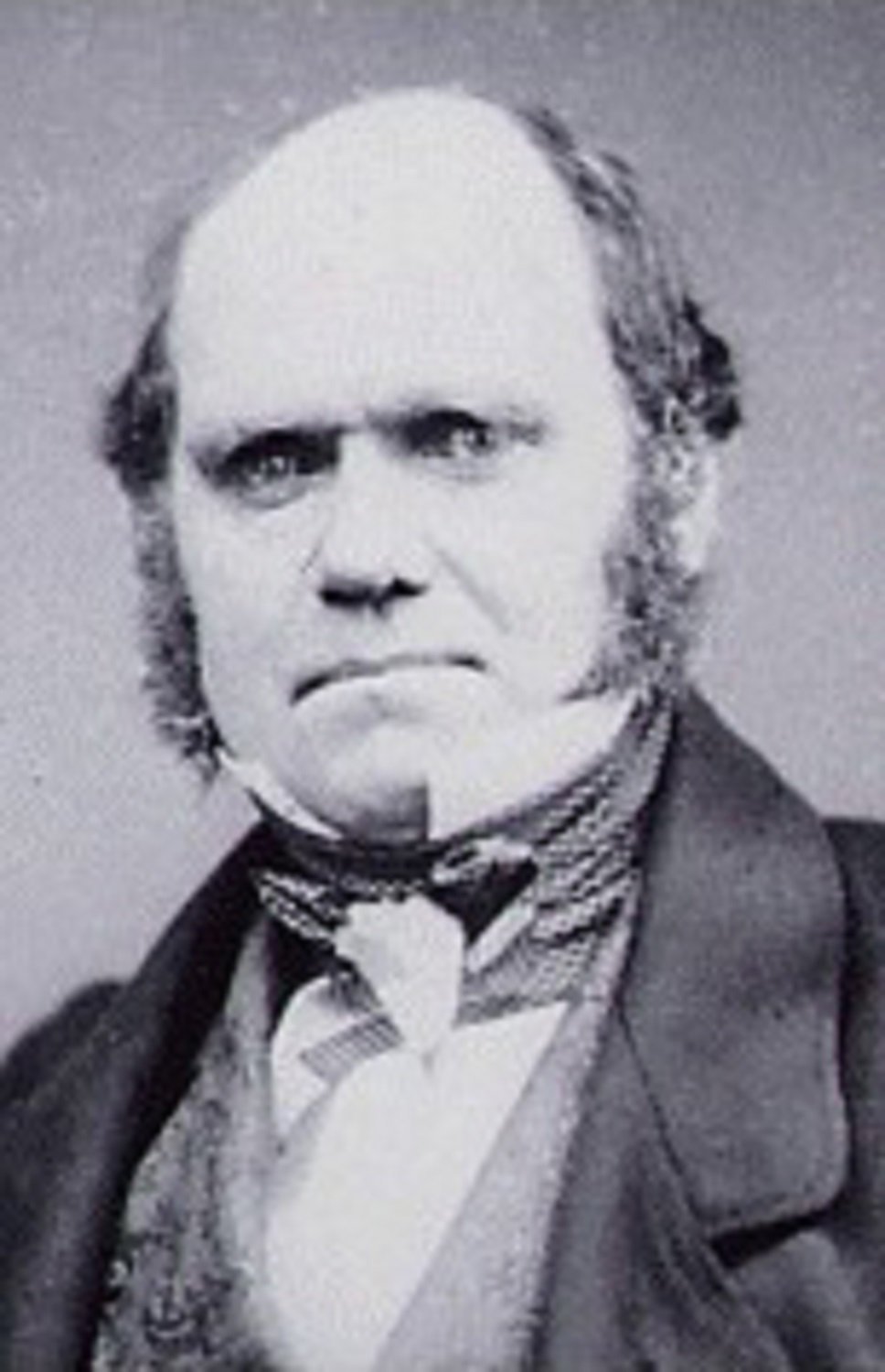
Charles Darwin in 1854
The ongoing antipathy to Darwin is one of the embarrassments of living in America, where one would have thought the ignorance about evolutionary theory had been banished 80-some years ago by the Scopes trial. Apparently not. When I taught this selection from On the Origin of Species by Means of Natural Selection (1859) to a class of freshmen in Texas some years ago, I was still confronted with incredulity and outright hostility, and to judge from the pronouncements of various politicians and the actions of state legislatures, not much has changed.

It's odd, considering that the central premise of Darwin's theory, that "the struggle of life" produces winners and losers and that the winners are those best adapted to the conditions in which they struggle, would seem to be perfectly harmonious with the tenets of the free-market conservatives who are most likely to protest against the theory.
Owing to this struggle, variations, however slight and from whatever cause proceeding, if they be in any degree profitable to the individuals of a species, in their infinitely complex relations to other organic beings and to their physical conditions of life, will tend to the preservation of such individuals and to their offspring.
"Natural Selection" was Darwin's term for the process, but he approved of Herbert Spencer's "Survival of the Fittest" as "more accurate, and ... sometimes equally convenient." He observed that the process was already known to breeders of animals, but that its course in the wild was "immeasurably superior to man's feeble efforts, as the works of Nature are to those of Art." (Thereby setting off the Nature vs. Art debate once again, to rage through the rest of the century and into the next.) The one thing Darwin was most concerned to eliminate was sentimentality about Nature. "We behold the face of nature bright with gladness, we often see superabundance of food; we do not see or we forget, that the birds which are idly singing round us mostly live on insects or seeds, and are thus constantly destroying life."

"Natural selection," he admits, can be a misleading term. For one thing, it seems to some to imply a "selector," which is not at all what Darwin has in mind: "it is difficult to avoid personifying the word Nature; but I mean by Nature, only the aggregate action and product of many natural laws, and by laws the sequence of events as ascertained by us. It also has promoted the notion of "lower" and "higher" forms of life, which is not at all what is involved: The only criterion implied by the term is success at living in a given environment, and success at reproducing. "No country can be named in which all the native inhabitant are now so perfectly adapted to each other and to the physical conditions under which they live, that none of them could still be better adapted or improved." Any given variation within a species can be judged only by its usefulness toward surviving.

And human interference only complicates things: "Man selects for his own good: Nature only for that of the being which she tends." (Darwin has just once again apologized for personifying Nature, explaining that what he means is really "the natural preservation or survival of the fittest.")
Under nature, the slightest differences of structure or condition may well turn the nicely-balanced scale in the struggle for life, and so be preserved. How fleeting are the wishes and efforts of man! how short his time! and consequently how poor will be his results, compared with those accumulated by Nature during whole geological periods! Can we wonder, then, that Nature's productions should be far "truer" in character than man's productions; that they should be infinitely better adapted to the most complex conditions of life, and should plainly bear the stamp of far higher workmanship.
That last phrase, "the stamp of far higher workmanship," has a theistic whiff to it, suggesting Darwin's discomfort with the non-theistic implications of his theory. But he goes boldly onward to proclaim his "belief that all animals and plants are descended from some one prototype," and moreover "that all the organic beings which have ever lived on this earth may be descended from some one primordial form." Still, he clings to the myth of a Creator:
To my mind it accords better with what we know of the laws impressed on matter by the Creator, that the production and extinction of the past and present inhabitants of the world should have been due to secondary causes, like those determining the birth and death of the individual. When I view all beings not as special creations, but as the lineal descendants of some few beings which lived long before the first bed of the Cambrian system was deposited, they seem to me to become ennobled.
There is no escaping the sense that Darwin was struggling to align his theory with the orthodox religious view as much as possible, doing a kind of cheerleading for the theory as a positive, almost holy, view of nature, without outright proclaiming it as "God's plan": "as natural selection works solely by and for the good of each being, all corporeal and mental endowments will tend to progress towards perfection." The question remains: perfect by whose standards? But in the famous "tangled bank" paragraph, he reaches toward an optimistic view of the struggle for existence and a reconciliation with the orthodox account of creation:
There is grandeur in this view of life, with its several powers, having been originally breathed by the Creator into a few forms or into one; and that, whilst this planet has gone cycling on according to the fixed law of gravity, from so simple a beginning endless forms most beautiful and most wonderful have been, and are being evolved.


Arthur Schopenhauer: The Will in Nature

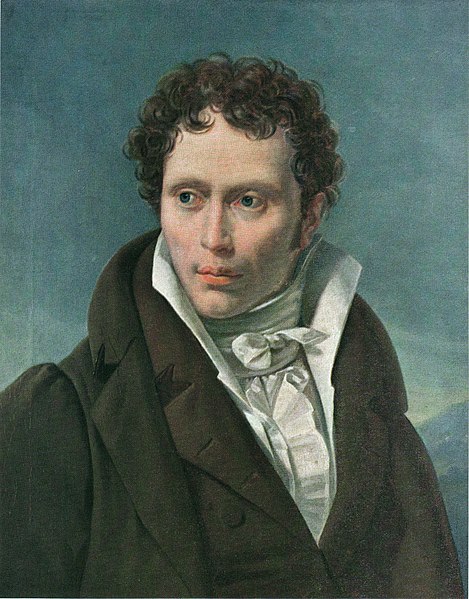
Ludwig Sigismund Ruhl, Portrait of Arthur Schopenhauer, c. 1815
Nobody ever accused Schopenhauer of optimism. Forty years before Darwin's Origin, in The World as Will and Idea (the word translated here as "Idea" is Darstellung, which is sometimes translated as "Representation"), Schopenhauer also based his thought on the prevalence of struggle in life. The human being encounters the world through the body, but the body with which we form our identity "is given as an idea in intelligent perception, as an object among objects and subject to the laws of objects." But it is also a manifestation of what Schopenhauer calls will. "The act of will and the movement of the body are not two different things objectively known, ... they are one and the same, but they are given in entirely different ways, -- immediately, and again in perception for the understanding.... It is only in reflection that to will and to act are different; in reality they are one."

When we experience pain, Schopenhauer asserts, we are experiencing that which "is opposed to the will; gratification and pleasure when it is in accordance with it." Pain and pleasure are "immediate affections of the will, in its manifestation, the body." By will, Schopenhauer doesn't just mean individual determination, as in "I will be heard!" or "His will is law." Will is a fundamental force in nature. It includes
  • "the force which germinates and vegetates in the plant"
  • "the force through which the crystal is formed"
  • "that by which the magnet turns to the north pole"
  • "the force whose shock [one] experiences from the contact of two different kinds of metals"
  • "the force which appears in the elective affinities of matter as repulsion and attraction, decomposition and combination"
  • "and, lastly, even gravitation, which acts so powerfully throughout matter, draws the stone to the earth and the earth to the sun" 
(May the Force be with you.)

All of these forces and others are the same thing: will. We experience them as separate phenomena, as ideas. "Phenomenal existence is idea and nothing more ... but the will alone is a thing in itself." Will "appears in every blind force of nature and also in the preconsidered action of man; and the great difference between these two is merely in the degree of the manifestation, not in the nature of what manifests itself." Such characteristics of matter "as rigidity, fluidity, elasticity, electricity, magnetism, chemical properties and qualities of every kind ... are in themselves immediate manifestations of will."
In the higher grades of the objectivity of will we see individuality occupy a prominent position, especially in the case of man, where it appears as the great difference of individual characters, i.e., as complete personality, outwardly expressed in strongly marked individual physiognomy, which influences the whole bodily form.... The farther down we go, the more completely is every trace of the individual character lost in the common character of the species, and the physiognomy of the species alone remains.
Will also manifests itself in the struggle of existence, in "the burden of physical life, the necessity of sleep, and finally, of death; for at last these subdued forces of nature, assisted by circumstances, win back from the organism, wearied even by the constant victory, the matter it took from them.... Thus everywhere in nature we see strife, conflict, and alternation of victory ... indeed nature exists only through it." As Darwin would be later, Schopenhauer is impressed by the fact that "each animal can only maintain its existence by the constant destruction of some other. Thus the will to live everywhere preys upon itself, and in different forms is its own nourishment." But Schopenhauer extends this process of struggle even to inanimate matter, "when, for example, crystals in process of formation meet, cross, and mutually disturb each other to such an extent that they are unable to assume the pure crystalline form, so that almost every cluster of crystals is an image of such a conflict of will at this low grade of its objectification." And just as in the microcosm, so in the macrocosm: "the constant tension between centripetal and centrifugal force ... keeps the globe in motion."

So if you're searching for an ultimate, you've found it: "Will is the thing-in-itself, the inner content, the essence of the world. Life, the visible world, the phenomenon, is only the mirror of the will."
Birth and death belong merely to the phenomenon of will, thus to life; and it is essential to this to exhibit itself in individuals which come into being and pass away, as fleeting phenomena appearing in the form of time -- phenomena of that which in itself knows no time, but must exhibit itself precisely in the way we have said, in order to objectify its peculiar nature.
A student of Hinduism, Schopenhauer notes that Shiva (or Siva, as he spells it), the god associated with destruction and death is given "as an attribute not only the necklace of skulls, but also the lingam, the symbol of generation, which appears here as the counterpart of death, thus signifying that generation and death are essentially correlatives, which reciprocally neutralise and annul each other."

Again like Darwin, Schopenhauer asserts that "it is not the individual, but only the species that Nature cares for, and for the preservation of which she so earnestly strives, providing for it with the utmost prodigality through the vast surplus of the seed and the great strength of the fructifying impulse.... [Nature's] kingdom is infinite time and infinite space.... Therefore she is always ready to let the individual fall." Nature assures continuation by making sex pleasurable. "On the other hand, excretion, the constant exhalation and throwing off of matter, is the same as that which, at a higher power, death, is the contrary of generation." In this scheme of things, in which the physical being is merely an instrument of generation, "It appears just as foolish to embalm the body as it would be to carefully preserve its excrement."
Man alone carries about with him, in abstract conceptions, the certainty of his death; yet this can only trouble him very rarely, when for a single moment some occasion calls it up to his imagination. Against the mighty voice of Nature reflection can do little. In man, as in the brute with does not think, the certainty that springs from his inmost consciousness that he himself is Nature, the world, predominates as a lasting frame of mind; and on account of this no man is observably disturbed by the thought of certain and never-distant death, but lives as if he would live forever.


A.N. Whitehead: Nature as Organism

A.N. Whitehead, date unknown
Well, speaking of struggle, there's my attempt to follow Whitehead's argument closely. Once again, the editors' introduction is of considerable help:
Whitehead is preoccupied with organisms in relation to their environment, and at the same time he is seeking to interpret the world of physics, the science of inorganic energy.... He regards the official philosophy of early twentieth-century science, which he traces back to the seventeenth century, as misleading because of its mechanistic assumptions: it makes objects falsely self-sufficient and isolates them from the minds that apprehend them. Whitehead would establish instead a recognition that he finds first expressed in the romantic poets: we do not perceive particular elements in nature as discrete entities, to the exclusion of other elements or to the exclusion of ourselves. Things and the perception of things are events, modes of interaction with other events in space and time. Parts of nature assume individuality by drawing the surrounding world into themselves and delimiting it; but these individual unities must also be seen in terms of larger unities of which they are functions. As in a plant, the whole dominates each part, and as in organic growth every partial whole virtually contains the whole that transcends it.
The excerpts come from Science and the Modern World, based on the Lowell Lectures Whitehead gave at Harvard in 1925. He begins with the usual definitions of terms, explaining that "matter, or material, is anything which has this property of simple location.... one major characteristic which refers equally both to space and to time, and other minor characteristics which are diverse as between space and time." Got that? Good. "The characteristic common both to space and time is that material can be said to be here in space and here in time, or here in space-time." The seventeenth century scientists asserted "that the world is a succession of instantaneous configurations of matter." This was a perfectly useful definition for them. It "is the famous mechanistic theory of nature, which has reigned supreme ever since the seventeenth century. It is the orthodox creed of physical science. Furthermore, the creed justified itself by the pragmatic test. It worked." But there are some problems with it, and Whitehead has a famous phrase for it: "the Fallacy of Misplaced Concreteness," by which he means "the accidental error of mistaking the abstract for the concrete."

In addition to "simple location," Whitehead says "substance and quality ... are the most natural ideas for the human mind. It is the way we think of things, and without these ways of thinking we could not get our ideas straight for daily use." But, he asks, "How concretely are we thinking when we consider nature under these conceptions?" Suppose, he says, we observe of an object that "it is hard, and blue, and round, and noisy." But are these qualities of the object itself, or are they what we bring to them by perceiving them?
These sensations are projected by the mind so as to clothe appropriate bodies in external nature. Thus the bodies are perceived as with qualities which in reality do not belong to them, qualities which in fact are purely the offspring of the mind. Thus nature gets credit which should in truth be reserved for ourselves; the rose for its scent: the nightingale for his song: and the sun for his radiance. The poets are entirely mistaken. They should address their lyrics to themselves, and should turn them into odes of self-congratulation on the excellency of the human mind. Nature is a dull affair, soundless, scentless, colourless; merely the hurrying of material, endlessly, meaninglessly. 
Yet since the seventeenth century, science has dealt with nature this way. "The enormous success of the scientific abstractions, yielding on the one hand matter with its simple location in space and time, on the other hand mind, perceiving, suffering, reasoning, but not interfering, has foisted onto philosophy the task of accepting them as the most concrete rendering of fact.... It involves a fundamental duality, with material on the one hand, and on the other hand mind."

Whitehead proposes that we analyze things in space and time: "Things are separated by space, and are separated by time: but they are also together in space, and together in time, even if they be not contemporaneous." So space-time is characterized by the separative and the prehensive, and also because everything in space has a definite location (it can't be in two places at once) and because "it endures during a certain period and through no other period" in time, it also has a modal character. It's the modal character that suggests the idea of simple location. "But it must be conjoined with the separative and prehensive characters."
The volume is the most concrete element of space. But the separative character of space, analyses a volume into sub-volumes, and so on indefinitely.... But it is the unity of volume which is the ultimate fact of experience.... Accordingly, the prime fact is the prehensive unity of volume, and this unity is mitigated or limited by the separated unities of the innumerable contained parts.... The parts form an ordered aggregate, in the sense that each part is something from the standpoint of every other part, and also from the same standpoint every other part is something in relation to it.
"Prehension" is a grasping of unity, and "Perception is simply the cognition of prehensive unification; or more shortly, perception is cognition of prehension. The actual world is a manifold of prehensions; and a "prehension" is a "prehensive occasion"; and a prehensive occasion is the most concrete finite entity, conceived as what it is in itself and for itself.... Nature is conceived as a complex of prehensive unifications."

Nature is, then, a process, a series of events. "Simple location" is no longer relevant. And "space-time is nothing else than a system of pulling together of assemblages into unities." An event has a past, present and future. "These conclusions are essential for any form of realism. For there is in the world for our cognisance, memory of the past, immediacy of realisation, and indication of things to come."

What we're dealing with now are organisms, "so that the plan of the whole influences the very characters of the various subordinate organisms which enter into it.... Thus an electron within a living body is different from an electron outside it, by reason of the plan of the body ... and this plan includes the mental state."

Whitehead now turns, thankfully, to literature, where he finds "the most interesting criticism of the thoughts of science among the leaders of the romantic reaction which accompanied and succeeded the epoch of the French Revolution." Chief among them, for Whitehead's purposes, are Wordsworth and Shelley. (Keats he dismisses, rather oddly, as "an example of literature untouched by science," and Coleridge as "only important by his influence on Wordsworth." Byron and Blake apparently are beyond consideration.) Wordsworth, he says, "alleges against science its absorption in abstractions. His consistent theme is that the important facts of nature elude the scientific method." Wordsworth "always grasps the whole of nature as involved in the tonality of the particular instance.... the first book of The Prelude ... is pervaded by this sense of the haunting presences of nature.... Wordsworth, to the height of genius, expresses the concrete facts of our apprehension, facts which are distorted in the scientific analysis."

Unlike Wordsworth, Shelley loved science, which "symbolises to him joy, and peace, and illumination.... What the hills were to Wordsworth, a chemical laboratory was to Shelley.... If Shelley had been born a hundred years later, the twentieth century would have seen a Newton among chemists." Shelley perceives the organic character of nature, "functioning with the full content of our perceptual experience." In his poems you see "an emphatic witness to a prehensive unification as constituting the very being of nature. Berkeley, Wordsworth, Shelley are representative of the intuitive refusal seriously to accept the abstract materialism of science." 

In "The Cloud," Shelley examines "the endless, eternal, elusive change of things.... Every scheme for the analysis of nature has to face these two facts: change and endurance. There is yet a third fact to be placed by it, eternality, I will call it."
The mountain endures. But when after ages it has been worn away, it has gone. If a replica arises, it is yet a new mountain. A colour is eternal. It haunts time like a spirit. It comes and it goes. But where it comes, it is the same colour. It neither survives nor does it live. It appears when it is wanted. The mountain has to time and space a different relation from that which colour has.
The nineteenth century English poets performed a valuable service in pointing out "the discord between the aesthetic intuitions of mankind and the mechanism of science." They make us aware that "a philosophy of nature must concern itself at least with these six notions: change, value, eternal objects, endurance, organism, interfusion."
You are in a certain place perceiving things. Your perception takes place where you are, and is entirely dependent on how your body is functioning. But this functioning of the body in one place, exhibits for your cognisance and aspect of the distant environment, fading away into the general knowledge that there are things beyond. If this cognisance conveys knowledge of a transcendent world, it must be because the event which is the bodily life unifies in itself aspects of the universe.... "Value" is the word I use for the intrinsic reality of an event. Value is an element which permeates through and through the poetic view of nature.