JOURNAL OF A COMPULSIVE READER
By Charles Matthews
Showing posts with label God. Show all posts

Sunday, February 12, 2012

2. Genesis: The Bible, pp. 19-30

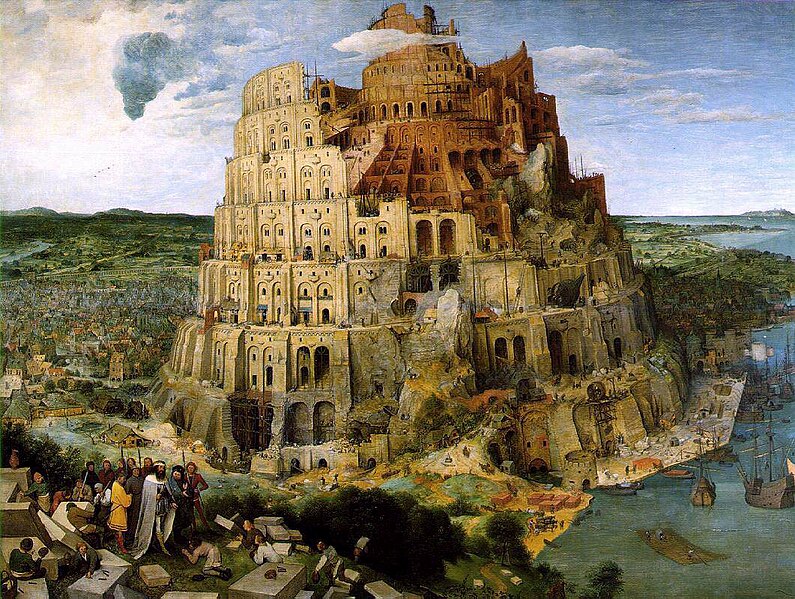
Pieter Brueghel the Elder, The Tower of Babel, 1563
Chapter 11

Since they were all descended from Noah, they all spoke the same language. But when they settled in the land of Shinar, they decided to build "a city and a tower, whose top may reach unto heaven," and not to go spreading out all over the Earth. But God took a look at the city and the tower and wasn't happy with all this unity. They're all speaking the same language, he observed, and this idea of staying in one place isn't what he had in mind.

So he said (to whom?): "let us go down, and there confound their language, that they may not understand one another's speech." This made building the city pretty much impossible, and God "scattered them abroad from thence upon the face of all the earth." I had always thought the point of the Tower of Babel was the hubris of reaching toward heaven, but it seems to be instead a fable about unity of purpose -- God promoting diversity, as it were.

Then comes more genealogy, the descendants of Shem, finally winding up with Terah, who fathers Abram, Nahor, and Haran. Haran dies comparatively young, but not before fathering Lot and Milcah, who marries her uncle Nahor. Abram marries Sarai, but she seems to be barren. Terah takes them all out of Ur of the Chaldees and into the land of Canaan, then dies at age two hundred five.

Chapter 12

God now tells Abram to split off from Nahor and his family and go where he shows him. "And I will make of thee a great nation, and I will bless thee, and make thy name great; and thou shalt be a blessing." So Abram and Sarai, joined by Abram's nephew Lot, go out into Canaan, which is inhabited, naturally, by Canaanites. God promises to give this land to Abram, but in the meanwhile Abram and company keep going south.

A famine makes them head for Egypt, but Abram worries that when the Egyptians see how beautiful his wife, Sarai, is, they will kill him and take her. So he has her pretend to be his sister. Sure enough, when they get to Egypt, "the Egyptians beheld the woman that she was very fair." The word gets to Pharaoh of her beauty, and she is "taken into Pharaoh's house." It's pretty obvious that she isn't just a servant, because Pharaoh rewards her "brother," Abram, with "sheep, and oxen, and he asses, and menservants, and maidservants, and she asses, and camels."

But God isn't pleased with this arrangement, and sends "great plagues" on Pharaoh and his house. Pharaoh sends for Abram and asks, "What is this that thou hast done unto me? why didst thou not tell me that she was thy wife?" He sends Abram and Sarai packing, though Abram apparently gets to keep all the stuff Pharaoh has given him.

Chapter 13

So Abram and Sarai and Lot head back north again, to Beth-el, where Abram had previously pitched his tent and built an altar to the Lord. Except now, "Abram was very rich in cattle, in silver, and in gold." Lot was pretty well off too, with "flocks, and herds, and tents," which makes it difficult for Lot and Abram to share the same land. Moreover, "the herdmen of Abram's cattle and the herdmen of Lot's cattle" don't get along, so Abram proposes that they split up: If you go left, he tells Lot, I'll go right, or vice versa.

Lot likes the looks of the plain of Jordan, which "was well watered every where, before the LORD destroyed Sodom and Gomorrah," so he goes east toward Jordan to "the cities of the plain, and pitched his tent toward Sodom," even though "the men of Sodom were wicked and sinners before the LORD exceedingly."

After Lot leaves, God tells Abram to look around, "For all the land which thou seest, to thee will I give it, and to thy seed for ever." He promises to make Abram's "seed as the dust of the earth: so that if a man can number the dust of the earth, then shall thy seed also be numbered." So Abram goes to the plain of Mamre, in Hebron, and builds an altar to the Lord.

Chapter 14

War breaks out "in the vale of Siddim, which is the salt sea," and when the kings of Sodom and Gomorrah fall, Lot is taken captive. Word comes to Abram that his nephew has been taken prisoner, so he trains his servants and rescues Lot. Melchizedek, the king of Salem and a priest, blesses Abram, and the king of Sodom offers to reward him. But Abram vows "That I will not take from a thread even to a shoelatchet, and that I will not take any thing that is thine, lest thou shouldest say, I have made Abram rich."

Chapter 15

God comes to Abram again, this time "in a vision," and tells him not to worry, but Abram complains that he and Sarai are still childless, so it looks like his heir is going to be Eliezer of Damascus, the steward of his house. But God reassures him again, showing him the stars, and promises, as he had done before with "the dust of the earth," that his "seed" will be equally numberless. He brought Abram out of Ur of the Chaldees to inherit this land, and tells Abram to sacrifice "an heifer of three years old, and a she goat of three years old, and a ram of three years old, and a turtledove, and a young pigeon."

Abram brings all of these things, and shoos the predatory birds away from the carcasses, then falls into a deep sleep wherein "an horror of great darkness fell upon him." God tells him that his "seed shall be a stranger in a land that is not theirs, and shall serve them" for four hundred years, but "afterward shall they come out with great substance." He will live to "a good old age," but "in the fourth generation they shall come hither again: for the iniquity of the Amorites is not yet full." (The Amorites are the mountain people of Canaan that Joshua will have to conquer.) But God goes on to promise Abram that his seed will inherit "this land" from the Nile to the Euphrates.

Chapter 16

But Abram and Sarai are still childless, so Sarai proposes that he sleep with her maid, Hagar, an Egyptian. Sure enough, Hagar gets pregnant, but she also gets a little uppity with Sarai about it. Abram tells Sarai to deal with it, so she does, and sends Hagar packing. An "angel of the LORD," the first we've encountered directly, finds Hagar and tells her to go back to Sarai and "submit thyself under her hands." He also promises, "I will multiply thy seed," and to call her son Ishmael, who "will be a wild man; his hand will be against every man, and every man's hand against him." So Hagar goes back and gives birth to Ishmael when Abram is eighty-six years old.

Chapter 17

When Abram is ninety-nine, God comes to him again and tells him, "I will make my covenant between me and thee, and will multiply thee exceedingly." He tells Abram his name is now Abraham and he is "a father of many nations." He "will give unto thee, and to thy seed after thee, the land wherein thou art a stranger, all the land of Canaan, for an everlasting possession; and I will be their God."

As "token of the covenant," Abraham has to see to it that "Every man child among you shall be circumcised." God goes on to make a big deal out of his preoccupation with prepuces:
And he that is eight days old shall be circumcised among you, every man child in your generations, he that is born in the house, or bought with money of any stranger, which is not of thy seed..... And the uncircumcised man child whose flesh of his foreskin is not circumcised, that soul shall be cut off from his people; he hath broken my covenant.
This will be only the first of a long series of somewhat arbitrary things Abraham's people are expected to do.

As for Sarai, she is now Sarah, and she will bear Abraham a son. It's easy to forgive Abraham for laughing at this: "Shall a child be born unto him that is an hundred years old? and shall Sarah, that is ninety years old, bear?" Oh, yes, indeed, says God, "and thou shalt call his name Isaac." You can imagine Abraham thinking at this point that committing himself and his people to cutting off their foreskins would be a small, if painful, price to pay for such a miracle. Even though the covenant will be with Isaac, Ishmael will also benefit: He'll beget "twelve princes" and God "will make him a great nation." So Abraham has himself circumcised at the age of ninety-nine, and Ishmael, who is thirteen, and every other man in the household.

Chapter 18

Abraham is sitting in his tent door when he looks up and sees the Lord and three men. He runs and tells a servant to fetch some water so they can wash their feet, and tells Sarah to prepare some cakes "of fine meal," and he gets "a calf tender and good," and has a young man prepare it to serve to the men. They ask after Sarah, and deliver the news that she is going to have a son. Sarah laughs at the idea, but "the LORD said unto Abraham, Wherefore did Sarah laugh...? Is anything too hard for the LORD?" Sarah says she wasn't really laughing, she was just afraid, but he says, "Nay; but thou didst laugh." (Always has to have the last word, this God.)

Abraham goes with them in the direction of Sodom, and God confides that he is going to check out what he's heard about the wickedness of Sodom and Gomorrah. The men proceed on their way toward Sodom, but God stays a while longer with Abraham, who worries that God is going to destroy the righteous along with the wicked in the city: "That be far from thee to do after this manner, to slay the righteous with the wicked." So the Lord says if he finds fifty righteous people in the city he will spare it. Well, says Abraham, what if there are forty-five righteous people? Okay, says God, I'll spare it if there are forty-five. How about forty, then? Or twenty? And finally God agrees that he'll spare it if there are as few as ten. This seems to satisfy Abraham, who goes home and lets the Lord go about his business. I guess if you've got a covenant, and sacrificed your foreskin, and your ninety-year-old wife is about to have a baby, you can press your luck a little.

Chapter 19

So two angels arrive at Sodom, and Lot meets them at the gate. He offers them lodging for the night, but they say no, they'll just spend the night in the street. But Lot persists, and they agree to spend the night in his house.
But before they lay down, the men of the city, even the men of Sodom, compassed the house round, both old and young, all the people from every quarter; 
And they called unto Lot, and said unto him, Where are the men which came in to thee this night? bring them out unto us, that we may know them.
And so begins millenniums of interpretation, most of which have a homophobic bent, centered on the demand "that we may know them," i.e., have carnal knowledge of them. Lot certainly seems to interpret the demand that way; he offers them instead his "two daughters which have not known man." The mob is having none of it, and is about to break down the door, but the angels pull Lot inside and smite the men at the door with blindness.

They're about to destroy the city, the angels tell Lot, so they suggest he gather up his belongings and his household and get ready to leave. Lot has some married daughters and he tries to persuade his sons-in-law to leave with him, but they think he's nuts and refuse. So in the morning, Lot and his wife and his two virgin daughters are hustled out of the city.
Peter Paul Rubens, Lot and His Family Flee Sodom, c. 1615
The angels urge Lot not to look behind him at the destruction, but to head into the mountains, but Lot is afraid and suggests that they go to a little city nearby named Zoar. So while they're at Zoar, "the LORD rained upon Sodom and upon Gomorrah brimstone and fire from the LORD out of heaven;
And he overthrew those cities, and all the plain, and that which grew upon the ground." Sadly, Lot's wife can't resist looking back at the spectacular disaster, "and she became a pillar of salt."
The Nuremberg Chronicle, Lot fleeing Sodom, as his wife turns into a pillar of salt, 1493
Abraham sees the smoke from the destruction of Sodom, and Lot decides that Zoar isn't safe either, so he goes into the mountains and lives in a cave. His daughters, however, are concerned because there aren't any men around for them to marry. So they get their father drunk and the firstborn has sex with him one night, and the younger the next, to "preserve seed" of their father. The firstborn calls her son Moab, and he becomes the progenitor of the Moabites. The younger's son is Ben-ammi, "the father of the children of Ammon unto this day.

So homosexuality is condemned -- granted, something like homosexual rape -- but incest is rewarded? I mean, Ham got his son cursed for just seeing his drunken father naked, but the daughters of Lot sleep with their drunken father and produce patriarchs.

Saturday, February 11, 2012

1. Genesis: The Bible, pp. 7-19

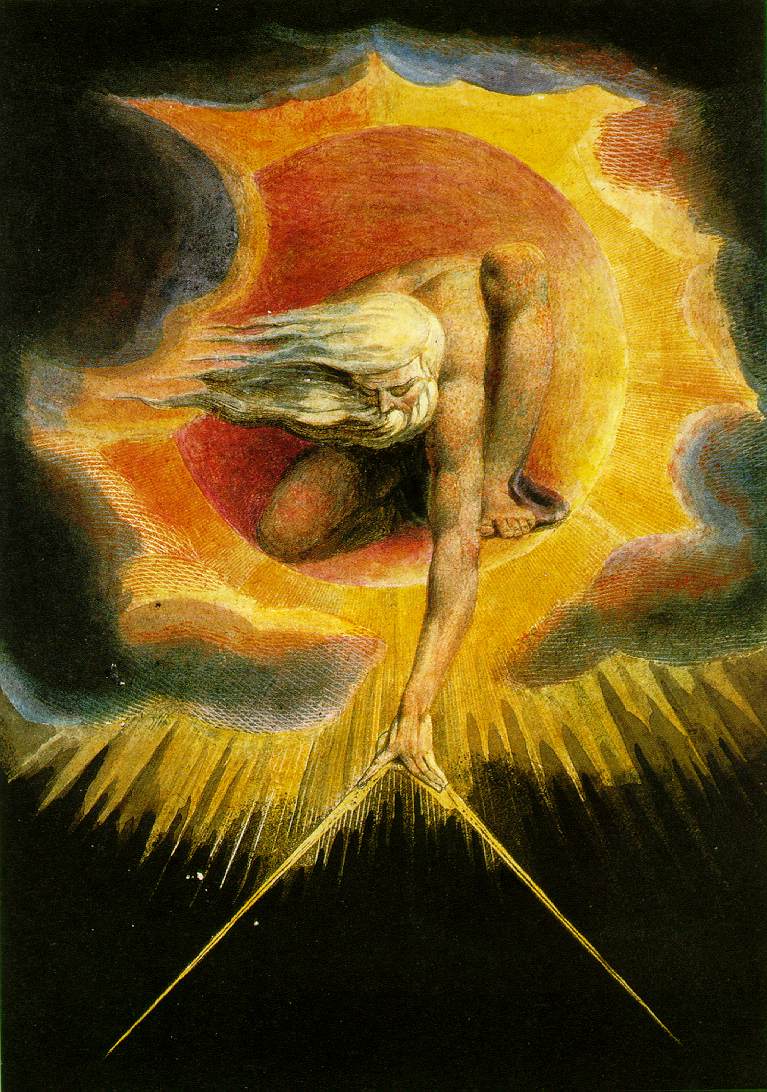
William Blake, Ancient of Days, 1794
Chapter 1

"In the beginning God created the heaven and the earth...." Except, if it was the beginning, where did this "God" come from? That's the puzzle in all cosmologies: How did something get there out of nothing? Even with a big bang theory, where did the stuff come from that went boom? I guess the usual answer to the biblical version is that God is a spirit: "The Spirit of God moved upon the face of the waters," we read in the next verse. (Except where did these "waters" come from?) I guess the solution is that "spirit" somehow created "matter," which is what this creation myth is dealing with: the beginning of matter.

In any case, "the earth was without form and void; and darkness was upon the face of the deep." So there is now "something" there to work with, a chaos of matter, perhaps a tumble of atoms, to put it in Lucretian terms. It seems to have been liquid: "the Spirit of God moved upon the face of the waters." And this spirit turned on the light, dividing it from darkness, and "called the light Day, and the darkness he called Night." The first step in bringing order out of chaos: Lights on, lights off.

Also, significantly, giving things names: Day and Night. And once he's set up a regular alternation of the two, he has created the first day. (Not the first capital-letter Day, notice.)

Then he set himself to dividing these waters with a "firmament," some kind of structure that separates them into two layers. There's the water up there and the water down here. Again with the naming: "God called the firmament Heaven." And this took another day.

Next, he moved "the waters under the heaven" and revealed dry land. Which I guess means that back when the whole thing was chaos, the land was all mixed in with the waters, sort of a primordial soup, and on this third day God separated out the solids from the liquid. And he named them: Earth and Seas. As when he created light, he "saw that it was good." Nothing like a job well done. But he's not through yet: He has the earth produce grass and fruit trees and has both yield seed so they can self-perpetuate. This is a bigger step than it sounds like: God has just created life. And all of this on the third day.

On the fourth day, he goes about creating "lights," which seems to be something different from creating light, though it's not quite clear how. After all, he has already created Day and Night and evenings and mornings so that he could count off three days. But I guess what he does here is systematize the whole thing, so that it can proceed automatically, making "two great lights; the greater light to rule the day, and the lesser light to rule the night: he made the stars also." And he likes what he's done here, too.

Animal life is next: fish and birds and "great whales." (The last seem to be neither fish nor fowl in the scheme of things.) And seeing "that it was good," he blesses them and tells them, "Be fruitful, and multiply," which he's shortly going to be instructing humankind to do as well.

On the sixth day he has "the earth bring forth the living creature after his kind, and cattle after their kind, and every thing that creepeth upon the earth after his kind." He started with creatures that live in water and creatures that fly in the air, so now it's time to work on the land animals. Why the priority here? He makes each of these land animals "after his/their kind," which I think means each as a distinct species, not a whole bunch of higgledy-piggledy individuals, like one dog with a set of antlers and another with eight legs. In any case, he once again sees "that it was good."

But wait, he's not finished:
And God said, Let us make man in our image, after our likeness: and let them have dominion over the fish of the sea, and over the fowl of the air, and over the cattle, and over all the earth, and over every creeping; thing that creepeth upon the earth. 
So God created man in his own image, in the image of God created he him; male and female created he them.
Okay, a few things to puzzle about here. "Let us make man in our image, after our likeness." Who's this "us" and "our"? Who's he talking to? Or is this just the divine equivalent of the royal We? Also, how come a spirit has an "image"? We haven't been told that God has eyes and ears and nose and teeth and two arms and two legs, but that is surely what it sounds like here. Also, isn't this a bit abrupt? Where's the business about creating Adam first and then Eve? It's coming, of course, but in this account the specifics of creating humans don't seem so terribly important. Notice, too, that this account doesn't specify just one man and one woman, but leaves open the possibility that God created a whole bunch of people at once.

So God tells these human beings, as he did the fish and the birds, "Be fruitful, and multiply." But he also gives them "dominion over the fish of the sea, and over the fowl of the air, and over every living thing that moveth upon the earth." Lots of us are not happy with this concept of "dominion," but it seems to be a fait accompli. On the other hand, God seems to be a vegetarian, telling his human beings, "I have given you every herb bearing seed, which is upon the face of the earth, and every tree, in the which is the fruit of a tree yielding seed; to you it shall be for meat." And he has done the same thing, he says, for the animals: "I have given every green herb for meat."

So he sees "every thing that he had made, and behold, it was very good."

Chapter 2
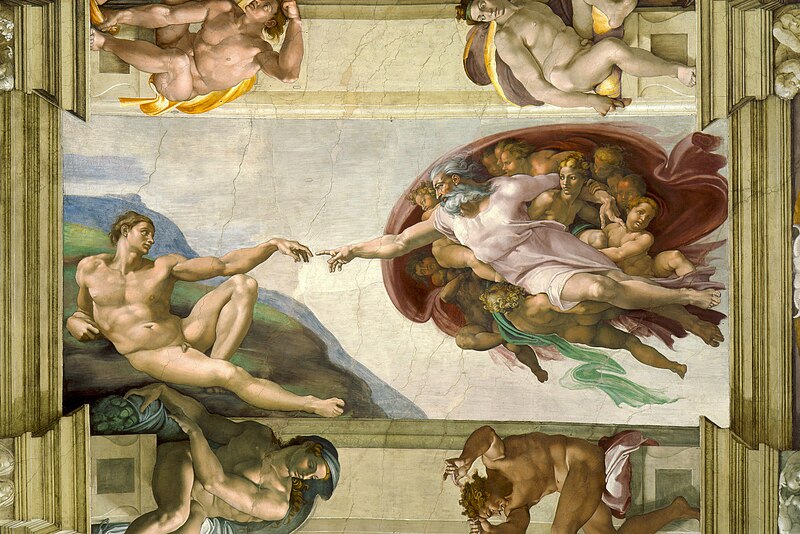
Michelangelo, Creation of Adam, from the Sistine Chapel, c. 1511
Everything's done and God's happy with it, so he spends the seventh day resting. It most have been a good rest, because he "blessed the seventh day, and sanctified it." And then on the next day there's some leftover work to be done, "for the LORD God had not caused it to rain upon the earth, and there was not a man to till the ground." But God does a little irrigating, sending up "a mist from the earth, and watered the whole face of the ground."

Now we get a second account of the creation of humankind, which doesn't supplement the first version but rather complicates it. For "the LORD God formed man of  the dust of the ground, and breathed into his nostrils the breath of life." (Notice that it's not just "God" now, but "the LORD God." Looks like we've got a different voice telling the story.) This God plants "a garden eastward in Eden" for the man he has created, making it a place with "every tree that is pleasant to the sight, and good for food; the tree of life also in the midst of the garden, and the tree of knowledge of good and evil." We're still vegetarians, it seems. (The "tree of life" seems to get forgotten in tellings of the story, and it's not real clear what its function is.)

The location of Eden gets a little more specific in the next few verses (10-14), as the narrator talks about the river that waters the garden and then divides into four more rivers: Pison, "which encompasseth the whole land of Havilah"; Gihon, which somewhat impossibly "compasseth the whole land of Ethiopia"; Hiddekel, "which goeth toward the east of Assyria" and is probably the Tigris, which borders Syria; and the Euphrates. Naturally, all attempts to trace any existing four rivers back to a single source are frustrating at best.

But back to this man in Eden, whom God commands not to eat the fruit of the tree of the knowledge of good and evil, "for in the day that thou eatest therof thou shalt surely die." (A rather pointless warning, since Adam -- as he begins to be called a couple of verses later -- can't have any concept of death until he learns about good and evil. God keeps throwing out Catch-22s like that.)

And now God decides the man needs "an help meet." But first he creates the animals -- which in the previous telling of the story he did before creating humans -- and parades them past Adam (so named for the first time) so that he can give them names. Again, naming things seems to be an essential activity. Then God puts Adam to sleep and takes out one of his ribs and fashions a woman out of it. So instead of "male and female he created them," we now get a primary creation, Adam, and a secondary one who "shall be called Woman, because she was taken out of Man." This last seems to be Adam's etymology. And the moral of is that, as Adam says, "This is now bone of my bones, and flesh of my flesh," which leads to the corollary, "Therefore shall a man leave his father and mother, and shall cleave unto his wife: and they shall be one flesh."

Oh, and the narrator adds an aside: that "they were both naked, the man and his wife, and were not ashamed."

Chapter 3

Hans Baldung, Eve, Serpent, and Death, 1512
Enter the villain: "the serpent ... more subtil than any beast of the field." It would be nice to have a little more back story on the serpent here, to explain why in creating all the animals God made one "more subtil." But it left the field open for Milton and others to supply. The serpent sidles up to the woman (she isn't actually called Eve until 1:20) and asks, "Ye shall not eat of every tree of the garden?" Sure, except for the one in the middle of the garden, she says. God told them, "Ye shall not eat of it, neither shall ye touch it, lest ye die." The serpent, unsatisfied with this prohibition, tells her she won't die: "For God doth know that in the day ye eat thereof, then your eyes shall be opened, and ye shall be as gods, knowing good and evil." (Notice that plural, "gods," allowing for a multiplicity of them.)

Eve doesn't stop to ask how the serpent knows this, just as the narrator here doesn't stop to explain what the serpent's motive for telling her the story is. She looks at the fruit and somehow sees "that the tree was good for food," and that it's pretty. And since it's "a tree to be desired to make one wise, she took of the fruit thereof, and did eat, and gave also unto her husband with her; and he did eat."

Notice that there's no beating around the bush (as it were) here, no dialogue in which Adam says, hey wait a minute, Eve, we're not supposed to do that. She does it, and he does it, and that's that. And the first consequence of learning about good and evil? That it's bad to be naked. So they sew some fig leaves together and make aprons.

But God decides to take a stroll "in the garden in the cool of the day," and when he calls out for Adam, they hide. When they're discovered, Adam explains that he wasn't dressed for the encounter: "I heard thy voice in the garden, and I was afraid, because I was naked; and I hid myself." Adam is not real bright, of course, and God asks the obvious question: "Who told thee thou wast naked?" But he doesn't pause for an answer. "Hast thou eaten of the tree, whereof I commanded thee that thou shouldest not eat?"

Notice how Adam sidesteps responsibility here: "The woman whom thou gavest to be with me, she gave me of the tree, and I did eat." He blames first Eve and then God, who gave her to him. Of course, Eve is no better at accepting responsibility: "The serpent beguiled me, and I did eat." The serpent doesn't get a chance to play the blame game before God curses him "above all cattle, and above every beast of the field," to go on his belly and eat dust. The children of Eve and their descendants will be the serpent's enemies, bruising his head, though the serpent will sometimes get his own back by bruising their heels.

Eve's punishment is the pain of childbirth, "and thy desire shall be to thy husband, and he shall rule over thee." Adam's is a lifetime of labor, no longer wandering around the garden and eating at leisure, but tilling the soil, pulling out weed, until he dies, "for dust thou art, and unto dust shalt thou return." (There's an interesting tie here between the dust that the serpent eats and the dust that Adam becomes.)

Adam decides at this point to call his wife Eve "because she was the mother of all living." (So much for the inference from Chapter 1 that God created a number of human beings on that sixth day, but one still wonders where all the wives come from who participate in the begetting in the next few chapters.)

God makes them "coats of skins," putting an end to a vegetarian existence that would have pleased PETA, and says, "Behold, the man is become as one of us, to know good and evil." There's that "us" again, and this time it seems to refer to other beings with knowledge of good and evil. It's not just the royal Us. Now he mentions that "tree of life" again: He doesn't want the man (and presumably the woman) to "take also of the tree of life, and eat, and live for ever." The tree of life wasn't prohibited before, but then it didn't have to be. Then God drives them out of the garden "and he placed at the east of the garden of Eden Cherubims, and a flaming sword which turned every way, to keep the way of the tree of life." Nobody, then, is getting at the tree of life.

But Cherubims? Where did they come from? There's a whole cast of superhuman beings that's just beginning to be glimpsed. Have they been there all along, before the "beginning"?
Masaccio, Expulsion of Adam and Eve from the Garden, 1427
Chapter 4

Titian, Cain and Abel, 1542-44
Eve gives birth to Cain and then to Abel. "And Abel was a keeper of sheep, but Cain was a tiller of the ground." Now, remembering that God had condemned Adam to till the soil and eat bread earned from the sweat of his face, you might think that God would approve of Cain's profession. But when it comes time for the brothers to make offerings to God, "the LORD had respect until Abel and his offering," which consisted of "the firstlings of his flock and of the fat thereof." But for Cain's "fruit of the ground," God "had not respect."

This makes Cain sulky, though God tries to talk him out of it: "If thou doest well, shalt thou not be accepted? and if thou doest not well, sin lieth at the door. And unto thee shall be his desire, and thou shalt rule over him." Now, I admit to being a little puzzled by this myself: Who's ruling over whom? Cain over sin? Cain over Abel?  There are some mixed signals here at best, though they don't quite explain why, after talking it over with Abel, Cain winds up killing him.

God comes to investigate, just as he did after Adam and Eve ate the fruit: Where's Abel? he asks Cain, who claims not to know: "Am I my brother's keeper?" But God won't put up with a smart-ass answer like that, for "the voice of thy brother's blood crieth unto me from the ground." Cain is cursed with bad crops: Because he spilled his brother's blood on the ground, "When thou tillest the ground, it shall not henceforth yield unto thee her strength." He'll become "a fugitive and a vagabond."

This is too much, Cain complains: No matter where I go, people will know what I've done and try to kill me. But God declares that if anyone kills Cain, "vengeance shall be taken on him sevenfold," and he puts a mark on Cain to warn people of that. So Cain goes to the land of Nod, east of Eden, gets married -- uh, where did this wife come from? -- and fathers Enoch and builds a city that he names for his son.

Then follows the first of many series of begettings: Enoch begets Irad who begets Mehujael who begets Methusael who begets Lamech. Lamech has two wives: With Adah he begets Jabal, "the father of such as dwell in tents, and of such as have cattle," and, perhaps more interestingly, Jubal, "the father of all such as handle the harp and organ" -- the first musician. And with Zillah he begets Tubal-cain, "an instructer of every artificer in brass and iron," and his sister Naamah. Then Lamech does something very curious: He tells his wives that he has killed a man, and claims, "If Cain shall be avenged sevenfold, truly Lamech seventy and sevenfold." I'm not sure how he comes by that reasoning, but the Lamech murder case doesn't seem to have interested the narrator beyond this statement.

Meanwhile, Adam and Eve have another son named Seth, who fathers a son named Enos.

Chapter 5

Much begetting now, and a little backtracking, as the narrator, perhaps a different one, tells us again that Adam begat Seth who begat Enos. This time, we get a little chronology in the works: the ages of the patriarchs. Adam lived nine hundred and thirty years before he died. Sorry, nothing about how long Eve lived, but during that time Adam "begat sons and daughters," so she must have been around for a while. Seth lived to be nine hundred twelve, and Enos nine hundred five. They begat other sons and daughters, too, but it seems to be the firstborn that counts. Enos's firstborn was Cainan who begat Mahalalee, who begat Jared, who begat Enoch, all of them living up into at least the eight hundreds.

And here things get a little fuzzy. There was an Enoch before, remember? Cain's son. This Enoch is the father of the longest-lived of them all: Methuselah, who lived "nine hundred and sixty and nine years." But the funny thing about this Enoch is that we are told he lived only "three hundred and sixty and five years," a comparative stripling among patriarchs. Moreover, "Enoch walked with God: and he was not; for God took him." Not that he died, but that he was taken. You can bet that there's been a lot of speculation about this.

But another funny thing: The Enoch who was "taken" has the same name as Cain's son, and that Enoch's great-grandson was named Methusael, which is a lot like Methuselah. And Methusael's son was named Lamech, the one who was involved in the funny murder, as befits a descendant of Cain. But Methuselah also begets a son named Lamech. So are we getting a confusion of genealogies here?

If the Lamech descended from Cain had some interesting offspring, the ancestors of musicians and metalworkers, so does this Lamech, who is supposedly descended from Seth. He begat Noah, who begat Shem, Ham, and Japheth.

Chapter 6

Things have gotten all muddled up in the begetting, and now they get muddled up in the telling. Men have begun "to multiply on the face of the earth, and daughters were born unto them." (Wouldn't be much multiplying without them.) As a consequence, "the sons of God saw the daughters of men that they were fair; and they took them wives of all which they chose." What's going on here? Who are these "sons of God"? Are they like other offspring of God, i.e., not men?

The next verse, unfortunately, doesn't clarify things:
And the LORD said, My spirit shall not always strive with man, for that he also is flesh: yet his days shall be an hundred and twenty years.
Whose days? Mankind's? Is this God putting an end to those eight- and nine-hundred-year-olds? And what does this have to do with the sons of God wedding the daughters of men? And then we read "There were giants in the earth in those days," and that the offspring of the sons of God and the daughters of men "became mighty men which were of old, men of renown."

All of this seems to do with what happens next: God decides that humankind has grown so wicked that he is sorry he created it to start with: "I will destroy man whom I have created from the face of the earth; both man, and beast, and the creeping thing, and the fowls of the air; for it repenteth me that I have made them."

Still, there was Noah, "a just man and perfect in his generations, and Noah walked with God." We're also reminded of what we were told before: that Noah had "three sons, Shem, Ham, and Japheth." So he decides to save them, out of all the "corrupted" men on earth. He goes and tells Noah of his plans to destroy life on earth, and tells him to make "an ark of gopher wood," giving him the specs in cubits, with a window and a door and three stories inside. He's going to cause a flood, "and every thing that is in the earth shall die." But he will make a "covenant" with Noah and his wife and sons and his sons's wives.

They are to gather up two of every kind of creature on the earth, male and female, and food for them. So Noah does as he's told.

Chapter 7

Edward Hicks, Noah's Ark, 1846
In this chapter, God refines on the "two of every sort" commandment: "Of every clean beast thou shalt take to thee by sevens, the male and his female: and of beasts that are not clean by two, the male and his female." Birds are allowed by sevens as well. Noah has seven days to get this done before God makes it "rain upon the earth for forty days and forty nights."

So Noah gets it done, and seven days later the rains start. It is "the six hundredth year of Noah's life, in the second month, the seventeenth day of the month," and it rains for forty days and forty nights, covering up "all the high hills, that were under the whole heaven." The waters rose up fifteen cubits (the ark itself is thirty cubits high) and covers the mountains. "All in whose nostrils was the breath of life, of all that was in the dry land, died." And the waters last for "an hundred and fifty days."

Chapter 8

In "the seventh month, on the seventeenth day of the month," the ark goes aground on "the mountains of Ararat." Still, they have to wait in the ark while the waters continue to recede, and on the first day of the tenth month they can see the tops of the mountains. Noah opens the window of the ark and lets out a raven and a dove. The raven seems to disappear, but the dove comes back. He waits another seven days and sends her out again, and she comes back with an olive leaf. But he waits another seven days, sends out the dove again, and she doesn't return.
The Holkham Bible Picture Book, Noah Releasing a Dove and a Raven, c. 1320-30

So Noah, now in the first day of the first month of his six hundred and first year, takes the covering off the ark and sees dry land. On the twenty-seventh day of the second month, he sends his family and the animals out to repopulate the earth. He builds an altar and makes "burnt offerings" of "every clean beast, and of every clean fowl." (Imagine having spent all those months cooped up in this smelly boat, and then getting slaughtered for a sacrifice.) And "the LORD smelled a sweet savour" -- he does seem to have a thing for roast meat -- and promises never to do this sort of thing again. He promises it quite beautifully:
While the earth remaineth, seedtime and harvest, and cold and heat, and summer and winter, and day and night shall not cease.

Chapter 9

Giovanni Bellini, The Drunkenness of Noah, c. 1515
Once again, God gives out the command to "Be fruitful, and multiply, and replenish the earth." (He doesn't say anything about letting the sons of God meddle around with the daughters of man, but maybe he doesn't have to.) This time he adds that animals and birds and fish are afraid of human beings, but that humans are allowed to eat them, "even as the green herb have I given you all things." So don't worry about being vegetarians, if that was bothering you. Except, "flesh with the life therof, which is the blood therof, shall ye not eat." I'm not sure whether this is a warning against eating raw or rare meat, or eating something while it's still alive, but it seems to be the beginning of a new divine preoccupation with dietary regulations. Given the history of humankind's propensity to kill one another, he also warns, "Whoso sheddeth man's blood, by man shall his blood be shed." The advocates of capital punishment love that one. But he also promises never to destroy the earth with a flood again, and as a "token of the covenant" with Noah, he produces the rainbow.

Retiring from the shipping business, Noah plants a vineyard. Unfortunately, he's a little too fond of the grape, "And he drank of the wine, and was drunken; and he was uncovered within his tent." Ham sees his father naked, and goes and tells Shem and Japheth about it. They enter backward, not looking at Noah's nakedness, and cover him up.

When Noah sobers up and finds out that Ham had seen him naked, he curses Ham's son, Canaan, for some reason, making him a servant to Shem and Japheth. This "Hamitic" curse has been used as a justification for slavery: Notice that in Giovanni Bellini's painting, the son on the left, presumably Ham, is black.

Chapter 10 

Since this is a new beginning for the human race, there are more begats. (One of Ham's grandsons is Nimrod, "a mighty hunter before the LORD.") Among them, the three sons of Noah create the new nations of the postdiluvian world.
Sunday, March 6, 2011

7. Paradise Lost, by John Milton, pp. 138-163

PARADISE LOST by John Milton, edited by Merritt Y. HughesBook VI
_____
Raphael continues to tell Adam and Eve about Satan's rebellion and the war in Heaven. Abdiel, having defied the rebel angels, returns to tell God what has happened and is applauded for his obedience. He now joins in the effort
                                                                 to subdue
By force, who reason for thir Law refuse,
Right reason for thir Law, and for thir King
Messiah, who by right of merit reigns.
"Right reason," like "Christian humanism," is one of those phrases that have an oxymoronic ring to modern ears, but it goes back to Plato and the Stoics and is the basis of the concept of natural law. "Right" is the operative word: Reason alone is not a moral concept.  Of course, for Adam and Eve, who are supposedly not yet aware of the distinction between good and evil, Raphael is getting a little bit ahead of himself in the lesson.

Milton was a pacifist, and the very concept of war was anathema to him, so he depicts it as anarchy and chaos brought on by the false heroics of Satan, who arrives with his hordes in a vainglorious display:
                                     exalted as a God
Th' Apostate in his Sun-bright Chariot sat
Idol of Majesty divine, enclos'd
With Flaming Cherubim, and golden Shields
The war begins with a verbal contest, just as it does in Homer and Virgil. Abdiel comes forth to denounce Satan as a fool for thinking that God wouldn't meet his challenge. Satan in response taunts the faithful angels for giving up their "Liberty" in serving God, accusing them of servility and sloth, and as "Minist'ring Spirits, train'd up in Feast and Song," not proud warriors. Abdiel counters that Satan "deprav's it with the name / Of Servitude to serve whom God ordains, / Or Nature: God and Nature bid the same, / When he who rules is worthiest, and excels / Them whom he governs." And having said this, "a noble stroke he lifted high ... On the proud Crest of Satan." It rocks Satan back "ten paces huge," amazing Satan's troops. The battle begins.
Abdiel smites Satan, by Gustave Doré, 1866
The battle begins, by Gustave Doré, 1866
The wounded Satan, by Gustave Doré, 1866

Satan and Michael have words in the midst of battle, with Michael promising to send Satan "to the place of evil, Hell," and Satan retorting that "we mean to wind, / Or turn this Heav'n itself into the Hell / Thou fabl'st." And Michael deals Satan a blow that "deep ent'ring shear'd / All his right side; then Satan first knew pain ... but th' Ethereal substance clos'd / Not long divvisible, and from the gash / A stream of Nectarous humor issuing flow'd / Sanguine, such as Celestial Spirits may bleed." He is borne away by his troops
Back to his Chariot, where it stood retir'd
From off the files of war: there they him laid
Gnashing for anguish and despite and shame
To find himself not matchless, and his pride
Humbl'd by such rebuke, so far beneath
His confidence to equal God in power.
Yet soon he heal'd; for Spirits that live throughout
Vital in every part, not as frail man
In Entrails, Heart or Head, Liver or Reins,
Cannot but by annihilating die
It's nice that Raphael explains all this, except that it once again raises the issue of his audience: How could Adam and Eve understand the concepts of things they haven't experienced, like pain and death? In fact, as Milton reminds us, these concepts were new to the angels as well, especially the rebels, "to such evil brought / By sin of disobedience, till that hour / Not liable to fear or flight or pain."
Night comes on after the first day of battle, by Gustave Doré, 1866
Michael and the other angels keep watch, by Gustave Doré, 1866

Night comes on and the armies return to their camps, where Satan suggests that "perhaps more valid Arms, / Weapons more violent, when next we meet, / May serve to better us, and worse our foes." And so he urges them to create the first weapons of mass destruction from materials found
Deep under ground, materials dark and crude,
Of spiritous and fiery spume, till toucht
With Heav'n's ray, and temper'd they shoot forth
So beauteous, op'ning to the ambient light.
These in thir dark Nativity the Deep
Shall yield us, pregnant with infernal flame,
Which into hollow Engines long and round
Thick ramm'd, at th' other bore with touch of fire
Dilated and infuriate shall send forth
From far with thund'ring noise among our foes
Such implements of mischief as shall dash
To pieces, and o'erwhelm whatever stands
Adverse, that they shall fear we have disarm'd
The Thunderer of his only dreaded bolt. 
He even foresees the possibility that in the future, if they triumph, "Some one intent on mischief, or inspir'd / With dev'lish machination might devise / Like instrument to plague the Sons of men / For sin, on war ad mutual slaughter bent."

So the next day they wheel out their cannons and blast the unsuspecting angels: "down they fell / By thousands, Angel on Arch-Angel roll'd." Satan mocks them by commenting that it looked like "they would dance, yet for a dance they seem'd / Somewaht extravagant and wild." But as the rebel angels "Stood scoffing, highth'n'd in thir thoughts beyond / All doubt and victory," God's troops
           pluckt the seated Hills with all thir load,
Rocks, Waters, Woods, and by the shaggy tops
Uplifting bore them in thir hands: Amaze,
Be sure, and terror seiz'd the rebel Host,
When coming towards them so dread they saw
The bottom of the Mountains upward turn'd
So the rebels start flinging mountains back, "and now all Heav'n / Had gone to wrack, with ruin overspread," except that God had foreseen all this and let it take place in order "To honor his Anointed Son aveng'd / Upon his enemies, and to declare / All power on him transferr'd." The whole two days of war, it seems, was just to set the stage for the Son's triumph on the third day -- a pattern to be repeated in the crucifixion and resurrection.

So on the third morning, the Son rides forth in a chariot "Flashing thick flames, Wheel within Wheel," accompanied
By four Cherubic shapes, four Faces each
Had wondrous, as with Stars thir bodies all
And Wings were set with Eyes, with Eyes the Wheels
Of Beryl, and careering Fires between;
Over thir heads a crystal Firmament,
Whereon a Sapphire Throne, inlaid with pure
Amber, and colors of the show'ry Arch. 
The destroyed landscape is restored "At his command ... And with fresh Flow'rets Hill and Valley smil'd." Telling the assembled angels to stand aside, the Son bears down on the enemy, and "under his burning Wheels / The steadfast Empyrean shook throughout, / All but the Throne itself of God." (Satan had boasted in Book I that he shook that throne.) The rebel angels retreat,
                                                     for he meant
Not to destroy, but root them out of Heav'n:
The overthrown he rais'd, and as a Herd
Of Goats or timorous flock together throng'd
Drove them before him Thunder-struck, pursu'd
With terrors and with furies to the bounds
And Crystal wall of Heav'n, which op'ning wide,
Roll'd inward, and a spacious Gap isclos'd
Into the wasteful Deep
(Samuel Johnson observed that the flock shouldn't have been described as "timorous" by Raphael before the Fall, but as we've seen, consistency has long been absent from the narrative.) Hell opens up and "Yawning receiv'd them whole, and on them clos'd." And the Son rides in triumph back to "the Courts / And Temple of his mighty Father Thron'd / On high."
Engraving by Francis Hayman, 1749
William Blake, 1808
Gustave Doré, 1866

And Raphael ends his narrative by pointing the moral:
        let it profit thee to have heard
By terrible Example the reward
Of disobedience; firm they might have stood,
Yet fell; remember, and fear to transgress. 

Saturday, March 5, 2011

6. Paradise Lost, by John Milton, pp. 113-137

PARADISE LOST by John Milton, edited by Merritt Y. HughesBook V
_____
Morning arrives, and Adam addresses a kind of aubade to Eve. But she's had a troubling dream, presumably caused by Satan's whispering in her ear last night. In it, she heard a voice she thought at first to be Adam's, urging her to go walking in the night. She went to the "Tree / Of interdicted Knowledge," where an angelic figure argued that she should taste of its fruit, and sampled some himself. Though "mee damp horror chill'd / At such bold words voucht with a deed so bold," eventually she yielded to the invitation and "Forthwith up to the Clouds / With him I flew." But she assures Adam that she was "glad ... To find this but a dream!" Adam tells her the "uncouth dream" was "of evil sprung I fear."
Engraving by Francis Hayman, 1749
Adam awakens Eve, by Gustave Doré, 1866

Okay, how does Adam know anything about evil? Isn't the whole point of the Tree of Knowledge that it awakens Adam and Eve to the concept of evil? Yet here we have Adam recognizing it right off, and Eve feeling something like guilt -- a consequence of the ability to know evil when you see it. In Eve's case, the reaction can be likened to a child's fear of the unknown, but Adam specifically identifies the dream as "evil," and questions where it could have come from: "Yet evil whence? in thee can harbor none, / Created pure." He decides that it's a product of "Fancy":
Evil into the mind of God or Man
May come and go, so unapprov'd, and leave
No spot or blame behind: Which gives me hope
That what in sleep thou didst abhor to dream,
Waking thou never wilt consent to do. 
He cheers her up, but nevertheless she weeps "a gentle tear ... From either eye," which he kisses as "the gracious signs of sweet remorse / And pious awe." "So all was clear'd," Milton assures us, though what isn't cleared is the fact that prelapsarian Adam and Eve seem to have a far more sophisticated knowledge of good and evil than they are supposed to have, including a concept of "remorse." How can you have that without the knowledge that you are supposed to feel remorseful for doing something wrong? 

Anyway, they set off to work after their morning prayers, which are "In various style, for neither various style / Nor holy rapture wanted they to praise / Thir Maker" -- in other words, they don't have a liturgy to follow by rote, but their praise of the maker flows out of untrained and spontaneous awe, unlike the scripted prayers of the established church. And in the conclusion of their prayers, the problematic note of awareness of evil arises once again:
                                            and if the night
Have gather'd aught of evil or conceal'd,
Disperse it, as now light dispels the dark.
Adam and Eve see Raphael approaching, by Gustave Doré, 1866

Meanwhile, God summons Raphael, "the sociable spirit," and sends him to "Converse with Adam." Milton follows Raphael's flight until he finds Adam sitting at the door of the bower while Eve prepares their dinner. Finding that they have a guest, Adam sends Eve off to get some more food and set another plate, which she does without complaint. This idealized domesticity does get a little heavy-handed, especially when Milton observes, "A while discourse they hold; / No fear lest Dinner cool."
Adam, Eve, and Raphael, by William Blake, 1808
Raphael lectures on cosmology, by Gustave Doré, 1866
Eve, Raphael, and Adam, by William Strang, 1896

Raphael goes on a while about the way all nature nourishes itself, and when Adam observes that Raphael seems to enjoy earthly food even though it must not be comparable to "Heav'n's high feasts," Raphael replies with a lecture on cosmology. All things, he says, proceed from "one first matter," which grows increasingly "more refin'd, more spiritous, and pure" as one ascends the great chain of being. Milton's concept of the chain is dynamic: The universe is a process of perpetual becoming:
                                                         So from the root
Springs lighter the green stalk, from thence the leaves
More aery, last the bright consummate flow'r
Spirits odorous breathes
Matter constantly passes into spirit, which is, Douglas Bush observed,  a kind of "optimistic monism."
And from these corporal nutriments perhaps
Your bodies may at last turn all to spirit,
Improv'd by tract of time, and wing'd ascend
Ethereal, as wee
Adam thanks him for the lesson, but he's bothered -- rightly -- by the command of obedience. Raphael explains that
God made thee perfet, not immutable; 
And good he made thee, but to persevere 
He left it in thy power, ordain'd thy will 
By nature free, not  over-rul'd by Fate 
Inextricable, or strict necessity; 
Our voluntary service he requires, 
Not our necessitated....
....
... freely we serve, 
Because we freely love, as in our will 
To love or not; in this we stand or fall: 
And some are fall'n, to disobedience fall'n, 
And so from Heav'n to deepest Hell; O fall
From what high state of bliss into what woe!
Again, this is knowledge of good and evil. What more can they learn from the fruit of the Tree?

Adam wants to know more, and points out that they have a lot of time for the story, as it's only midday. So Raphael launches into the story of the war in Heaven, though he points out that it was a spiritual conflict, not a physical ones, and that he's only describing it in physical terms because Adam wouldn't understand it otherwise:
                                 yet for thy good
This is dispens't, and what surmounts the reach
Of human sense, I shall delineate so,
By lik'ning spiritual to corporal forms. 
So he tells Adam about the day when God summoned all the "Angels, Progeny of Light, / Thrones, Dominations, Princedoms, Virtues, Powers," to tell them that he has begotten a Son and put him in charge of all of them. There was much jubilation, including a
Mystical dance, which yonder starry Sphere
Of Planets and of fixt in all her Wheels
Resembles nearest, mazes intricate,
Eccentric, intervolv'd, yet regular
Then most, when most irregular they seem:
And in thir motions harmony Divine
So smooths her charming tones, that God's own ear
Listens delighted. 
A dance to the music of the spheres, which is about as mystical as you get. But not everybody was dancing, especially "Satan, so call him now, his former name / Is heard no more in Heav'n." He who must not be named is usually identified as Lucifer, the light-bearer, who was "of the first, / If not the first Arch-Angel, great in Power, / In favor and preëminence, yet fraught with envy against the Son of God." (Again, Raphael is tipping Adam and Eve off about evil: the sin of envy, which presumably they have had no experience of.)

So Satan assembles his followers, which constituted "the third part of Heav'n's Host," to foment rebellion. God warns the Son about the uprising, and the Son assures his Father that he has things under control. In "The Palace of great Lucifer," Satan charges the Son with a power grab, and urges his followers to "cast off this Yoke." The speech goes over well with everyone except the seraph Abdiel (a character invented by Milton, using a biblical name that means "servant of God"), who accuses Satan of blasphemy. God, he says, "made / Thee what thou art, and form'd the Pow'rs of Heav'n / Such as he pleas'd, and circumscrib'd thir being," and who is Satan to challenge that? "Cease this impious rage," he orders, "but his zeal / None seconded." So he departs, "through hostile scorn, which he sustain'd / Superior":
Among the faithless, faithful only hee;
Among innumerable false, unmov'd,
Unshak'n, unseduc'd, unterrifi'd
His Loyalty he kept, his Love, his Zeal.
It's a heroic moment equal or superior to Satan's more familiar heroic moments.

Thursday, March 3, 2011

4. Paradise Lost, by John Milton, pp. 60-83

PARADISE LOST by John Milton, edited by Merritt Y. HughesBook III
_____
One reason why so many think Milton was on Satan's side is that once he's off-stage and the Father and the Son start discussing theology, things slow way down. (Dante had the same problem: A lot more people read the Inferno than the Paradiso.)

Book III starts rather magnificently, however, with Milton's invocation to Light and the poignant acknowledgment that he can no longer perceive it: "thou / Revisit'st not these eyes, that roll in vain / To find thy piercing ray, and find no dawn." Even in the invocation, there's a recognition that the origins of light are unknown: Was it "offspring of Heavn'n first-born" -- i.e. the first thing God created -- or is it the essence of God and therefore "Coeternal" with him, "Bright effluence of bright essence increate"? Perhaps the question is unanswerable: "pure Ethereal stream / Whose Fountain who should tell?" Did it exist before Creation, "before the Sun, / Before the Heavens"? 

In any case, he welcomes the opportunity to escape "the Stygian pool" of hell, and prays for a compensatory inward light because his blindness prevents direct experience of external light:
                                              Thus with the Year
Seasons return, but not to me returns
Day, or the sweet approach of Ev'n or Morn,
Or sight of vernal bloom, or Summer's Rose,
Or flock, or herds, or human face divine;
But cloud instead, and ever-during dark
Surrounds me, from the cheerful ways of men
Cut off, and for the Book of knowledge fair
Presented with a Universal blanc
Of Nature's works to me expung'd and ras'd,
And wisdom at one entrance quite shut out.
So much the rather thou Celestial Light
Shine inward, and the mind through all her powers
Irradiate, there plant eyes, all mist from thence
Purge and disperse, that I may see and tell
Of things invisible to mortal sight. 
So we ascend to Heaven and a scene that corresponds to the one that just took place in Hell. God is seated on his throne, addressing the angels as Satan addressed the devils, and with the Son as his right-hand man, just as Satan had Beëlzebub. Of course, God has an advantage over Satan in that he not only sees what's going on -- i.e., Adam and Eve "in the happy Garden plac't, / Reaping immortal fruits of joy and love," as well as Satan making his way upward from hell -- but also knows what's going to happen next. Milton's choice to make God a speaking character in the narrative has been rightly criticized, especially because in the first things he says he sounds rather peevish, especially with regard to Satan:
                                                     So will fall
Hee and his faithless Progeny: whose fault?
Whose but his own? ingrate, he had of mee
All he could have; I made him just and right,
Sufficient to have stood, though free to fall.
The repudiation of Calvinist predestination is also a little overdone here, too. He admits that he knew Satan was going to rebel and fail, but "if I foreknew, / Foreknowledge had no influence on their fault."

For many modern readers, the elaborate superstructure of Christian theology is a wearisome imposition, but Milton feels compelled to have Father and Son discuss it, because the Son is bothered by what he knows is about to happen, that Satan is going to tempt humankind into disobedience:
                                         wilt thou thyself
Abolish thy Creation, and unmake,
For him, what for thy glory thou hast made?
So should thy goodness and thy greatness both
Be question'd and blasphem'd without defense. 
In short, why bother creating Paradise if you already know it's going to be lost? It seems like a bad PR move, if nothing else. But God reassures him that "Man shall not quite be lost" and that he has already chosen some "of peculiar grace / Elect above the rest," and that the others will have to work for their salvation. What he really needs is for someone to volunteer to atone for their sins, "Some other able, and as willing, pay / The rigid satisfaction, death for death." And he calls on the "Heavn'ly Powers" for a volunteer. (The scene, of course, parallels the one in which Satan describes the task of going out to check on the world God has created and volunteers himself.)

"He ask'd, but all the Heavn'ly Choir stood mute." Anyone? Anyone? Okay, I'll do it, says the Son.
Behold mee then, mee for him, life for life
I offer, on mee let thine anger fall;
Account mee man; I for his sake will leave
Thy bosom, and this glory next to thee
Freely put off, and for him lastly die
Well pleas'd, on me let Death wreck all his rage;
Under his gloomy power I shall not long
Lie vanquisht
It is, of course, a truly heroic act, unlike Satan's blustering posture of heroism. The problem is that it doesn't have the heroic ring that Milton was able to give Satan's defiance. And this dramatic weakness in the narrative is the poem's central literary defect. We have to remember, however, that Milton wasn't thinking literarily here, but rather religiously. He couldn't have known that the kind of Christian orthodoxy he was dramatizing would fade into irrelevance for many of his future readers.
The Son agrees to atone for humankind's sins, by William Blake, 1808

And so God commissions him to become both human and divine: "Be thou in Adam's room / The Head of all mankind, though Adam's Son." Everything will turn out fine, God assures the assembled angels, who then burst out in cheers and music, accompanying themselves on the harps that have become a cartoon accessory for angels ever since.
The angels rejoice at the Son's decision, by Gustave Doré, 1866

But while they are spending "Thir happy hours in joy and hymning," Satan is steadily making his way to the new world, alighting like a vulture on the outermost sphere of the new universe.where Milton has located a "Paradise of Fools," a kind of limbo for "all things vain, and all who in vain things / Built thir fond hopes of Glory or lasting fame, / Or happiness in this or th' other life." These will eventually include the builders of the tower of Babel, suicides like Empedocles and Cleombrotus who take their lives with the expectation of achieving divinity, and of course a whole host of "Eremites and Friars / White, Black and Grey, with all thir trumpery," especially the Dominicans and the Franciscans, particular targets of the Protestants.
A violent cross wind from either Coast
Blows them transverse ten thousand Leagues awry
Into the devious Air; then might ye see
Cowls, Hoods and Habits with thir wearers tost
And flutter'd into Rags, then Reliques, Beads,
Indulgences, Dispenses, Pardons, Bulls,
The sport of Winds
The Paradise of Fools, by Gustave Doré, 1866
 
Now he sees the stairway to Heaven, which is sometimes drawn up like a ladder, and "Looks down with wonder at the sudden view / Of all this World at once." So he begins his flight down to the Earth at its center -- or perhaps near it: Milton waffles about whether this universe is geocentric or heliocentric. Along the way he passes "other Worlds, / Or other Worlds they seem'd" -- Milton isn't over-concerned about whether these worlds are populated, and neither is Satan: "who dwelt happy there / He stay'd not to enquire." He sees the sun, but it's "hard to tell" whether it's at the center of this universe or not. And he finds a spot to land "like which perhaps / Astronomer in the Sun's lucent Orb / Through his glaz'd Optic Tube yet never saw" -- as the note tells us, Galileo had used his telescope in 1609 to discover sun spots.
Satan in disguise tricks Uriel into pointing the way to Paradise, engraving by Simon Francois Ravenet after Francis Hayman, 1749

There "he soon / Saw within ken a glorious Angel stand," and recognizes the archangel Uriel, whose back is turned, giving Satan time to put on a disguise as "a stripling Cherub." (We think of cherubs, or cherubim, as chubby little baby angels, but those are putti, merely decorative figures in Renaissance and Baroque art; the cherubim of Judeo-Christian tradition are the second order of angels, after the seraphim.) In this disguise, Satan is able to trick Uriel into giving him directions to the Earthly Paradise, "For neither Man nor Angel can discern / Hypocrisy, the only evil that walks / Invisible, except to God alone, / By his permissive will, through Heav'n and Earth." (God seems to permit the oddest things, while banning others that seem less consequential.)
Satan on his way to Earth, by Gustave Doré, 1866

And so Satan makes his fatal way to the top of Mount Niphates.