JOURNAL OF A COMPULSIVE READER
By Charles Matthews
Showing posts with label Charles Darwin. Show all posts

Sunday, May 8, 2011

24. The Modern Tradition, edited by Richard Ellmann and Charles Feidelson Jr., pp. 514-536

Cultural History: History and Imagination (André Malraux); Religion and History (Nicolas Berdyaev); Primitive Survivals (Charles Darwin, James G. Frazer, Henry Miller)
_____

André Malraux: The Triumph of Art Over History

In this excerpt from The Voices of Silence (1951), Malraux extrapolates on his concept of the "Museum Without Walls," the collective artistic achievement of humankind, approached without division into cultures or epochs.

The development of the physical museum, a creation of the most recent two centuries, "imposed on the spectator a wholly new attitude towards the work of art.... Until the nineteenth century a work of art was essentially a representation of something real or imaginary, which conditioned its existence qua work of art." A portrait was judged as a portrait of someone, and not as a painting in itself. "In the past a Gothic statue was a component part of the Cathedral; similarly a classical picture was tied up with the setting of its period, and not expected to consort with works of different mood and outlook."

But the establishment of the museum, with its "practice of pitting works of art against each other," turns the viewing of art into "an intellectual activity" rather than a contemplative one.
For over a century our approach to art has been growing more and more intellectualized. The art museum invites criticism of each of the expressions of the world it brings together; and a query as to what they have in common. To the "delight of the eye" there has been added -- owing to the sequence of conflicting styles and seemingly antagonistic schools -- an awareness of art's impassioned quest, its age-old struggle to remould the scheme of things.
But even the establishment of museums allowed only for limited exposure to the world's art. Well into the nineteenth century "a man who had seen the totality of European masterpieces was a very rare exception.... Baudelaire never set eyes on the masterpieces of El Greco, Michelangelo, Masaccio Piero della Francesca or Grünewald; or of Titian, or of Hals or Goya." The only way knowledge of these works could be widely disseminated until the mid-nineteenth century was through black-and-white engravings. "The nineteenth-century photograph was merely a more faithful print." But technological advances, not only in reproduction of images but also in transportation, made a wider array of the world's art available to almost anyone who wanted to witness it. Hence, the Museum Without Walls.

This familiarity with art of all periods and all cultures has changed our approach to art: "It is not research work that has led to the understanding of El Greco; it is modern art. Each genius that breaks with the past deflects, as it were, the whole range of earlier forms." Each masterpiece, Malraux asserts, "keeps up ... a dialogue indefeasible by Time."

Malraux distinguishes between artists and artisans: "I name that man an artist who creates forms ... and I call that man an artisan who reproduces forms, however great may be the charm or sophistication of his craftsmanship."
Romanesque tympanum, Christ in majesty, Abbey of Saint-Pierre in Moissac
The fact that our conception of the artist was something quite unknown in the Middle Ages (and for many thousand years before) and that a genius like Van Eyck was commissioned to design set pieces and to paint coffers, does not affect the fact that painters and sculptors, when possessed of genius, transfigured the art they had inherited, and the creative joy of the man who invented the Moissac Christ, the Chartres Kings and the Uta was different in kind from the satisfaction felt by the cabinet maker who had just completed a perfect chest.
Three kings from the portal of Chartres cathedral

Ekkehard and Uta, Naumburg Cathedral
The development of art consists of a series of "victories over forms, achieved by means of forms," and not as the expression of successive ideologies: "The Last Judgment was the outcome of a meditation on figures, and not a declaration of faith."

We have come to recognize that "the world of art is ... another world, the same as that of music and architecture," and that "the long-drawn conflict between pagan and Christian art in Europe" has ended. Art is "one of man's rare creations, inventive though man is."
Just as the crucial historical event of the nineteenth century was the birth of a new consciousness of history, so the crucial expression of the metamorphosis of our century is our consciousness of it. Thus today art means to us that underlying continuity due to a latent kinship between the works of art of all ages which is a historical continuity, since never does an art destroy all that it has inherited; El Greco broke with Titian, but not by painting pictures like Cézanne's. 
Through art, humankind achieves a victory over destiny: "what survives for us in the great arts of the past is the indefeasible inner voice of civilizations that have passed away." And the art of the twentieth century suggests "that there is tentatively taking form, for the first time in history, the concept of a world-wide humanism." We are coming to realize that "the cultures of civilizations that have died out" are not so much radically different from us or from one another as they are "cultures of different parts of the same plant." We have created a culture that synthesizes elements that once warred with each other: "If Aristotle and the Prophets of Israel met on the banks of the Styx, what would they exchange but insults? Montaigne had to be born before the dialogue between Christ and Plato could arise." In the humanist view, "each hero, saint or sage stands for a victory over the human situation."
We ... are the heirs not so much of this or that value in particular ... as of something that runs deeper: that undercurrent of the stream of human consciousness which brought them into being. We have at last become aware of their true nature, in the same manner as Hegelianism became aware not of forgotten values but of history; it is art as an organic whole, liberated by our modern art, that our culture for the first time is arraying against destiny.
We no longer toy with the idea of restoring "the mutilated statue" to its original form. Earlier, Malraux commented, "In 1910 it was assumed that the Winged Victory, when restored, would regain her ancient gold, her arms, her trumpet." Today, we would be as disturbed by that kind of restoration as we would be by an attempt to attach arms to the Venus de Milo. We recognize that these mutilations are a sign of the life in the work: "Mutilation is the scar left by the struggle with Time, and a reminder of it -- Time which is as much a part of ancient works of art as the material they are made of, and thrusts up through the fissures, from a dark underworld where all is at once chaos and determinism."
All art is a revolt against man's fate. 


Nicolas Berdyaev: The Historical Meaning of Christianity

Nicolas Berdyaev, date unknown
Like Hegel and Benedetto Croce, Berdyaev, in this excerpt from The Meaning of History (1923), sees history as a movement toward freedom. But Berdyaev isolates the moment in history at which this concept became manifest as the emergence of Christianity as a dominant force.
The exceptionally dynamic and historical character of Christianity is the result of the fact that it conclusively revealed for the first time the existence of the principle of freedom, which was ignored by both the ancient and the Hebrew worlds.... The Greeks affirmed the reason and necessity of good.... Christianity, on the other hand, affirmed the freedom of good. It affirmed that good is the product of the free spirit and that only such good can possess a true value and reality. It denied the compulsory and reasonable necessity of good.... Unlike the ancient world, Christianity is not content to submit to fate.
Berdyaev's interpretation of Christianity presupposes that the fall of man was indeed a fortunate fall: "The freedom to choose and affirm the good, rooted in the will and not in reason, presupposes in its turn that freedom of the creative and active subject without which a true dynamism of history is impossible." It is "the interaction of the human spirit and nature" that distinguishes the post-Christian world. The alienation of man from God dramatized in the story of the Fall "plunged man and the human spirit into the uttermost depths of natural necessity. The fall into these depths was accompanied by man's servitude to the natural elements which had held the human spirit and will spellbound." Nature "was populated with demons and man was powerless to dominate either them or the natural cycle."

But Christianity "liberated man from the power of the baser elemental nature and demons. It did so through the agency of Christ and the mystery of Redemption.... It distinguished him from baser nature and set him up as an independent spiritual being, freeing him from submission to the natural world and exalting him to the heavens." In the Christian view, "History is in truth the path to another world," a realm of perfection not achievable in this one.
Man's historical experience has been one of steady failure and there are no grounds for supposing that it will ever be anything else. Not one single project elaborated within the historical process has ever proved successful. None of the problems of any given historical epoch whatsoever has been solved, no aims attained, no hopes realized. This radical failure of the historical process, when we regard it as a whole, can only be interpreted as the failure to realize the Kingdom of God. 
But on the other hand, "Christianity also was a complete and utter failure." (Possibly because it was left in the hands of human beings?) "Two thousand years have not sufficed to realize the ideals of Christian faith and consciousness. They will never be realized within the framework of human time and history." But Berdyaev argues that "the failure of Christianity does not mean that Christianity is not the highest truth. Historical success and achievement do not constitute a valid criterion of the true," because "nothing perfect can be realized in time." The conclusion Berdyaev reaches is "that the destiny of man reserves a higher realization for his potentialities than any to be achieved in his purely historical experience."


Charles Darwin: The Pre-Human in the Human

In The Descent of Man (1871) Darwin tactfully approaches the most controversial conclusions of his theory: humankind's kinship with other primates, or as he puts it, "that man is descended from a hairy, tailed quadruped, probably arboreal in its habits, and an inhabitant of the Old World." He rather sweetly advances some stories of kindness and altruism among monkeys and baboons to assert that this isn't so bad, and that he'd rather admit his kinship with them than with "a savage who delights to torture his enemies, offers up bloody sacrifices, practices infanticide without remorse, treats his wives like slaves, knows no decency, and is haunted by the grossest superstitions." But he insists that although humans have reached "the very summit of the organic scale" -- a concept that embarrasses many post-Darwinians,
We must ... acknowledge ... that man with all his noble qualities, with sympathy which feels for the most debased, with benevolence which extends not only to other men but to the humblest living creature, with his god-like intellect which has penetrated into the movements and constitutions of the solar system -- with all these exalted powers -- Man still bears in his bodily frame the indelible stamp of his lowly origin.


James G. Frazer: The Savage in the Human
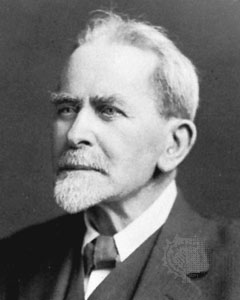
J.G. Frazer in 1933
In these selections from Frazer's essays from the first two decades of the twentieth century, the anthropologist isn't willing to go as far as Darwin in separating the "noble qualities" of humans from the "bodily frame" he inherited from his "lowly" ancestors. In his formulation, "a savage is to a civilized man as a child is to an adult," which still leaves a lot of room for residual traits of savagery or childishness to persist into the civilized or grownup being. And research has shown anthropologists "that a mass, if not the majority, of people in every civilized country is still living in a state of intellectual savagery, that, in fact, the smooth surface of cultured society is sapped and mined by superstition." (A look at most state legislatures should be enough to confirm that assertion.)

Frazer is alarmed at the implications:
We appear to be standing on a volcano which may at any moment break out in smoke and fire to spread ruin and devastation among the gardens and palaces of ancient culture wrought so laboriously by the hands of many generations.
Moreover, "it is precisely the oldest and crudest superstitions which are most tenacious of life." For "the high gods of Egypt and Babylon, of Greece and Rome," have been forgotten except by the educated, while the masses still believe "in witches and fairies, in ghosts and hobgoblins." In them, "intellectual progress is so slow as to be hardly perceptible."

The Lion Gate at Mycenae

Henry Miller: An Archaic Mystery

Henry Miller, date unknown
Miller's 1941 travel book about Greece, The Colossus of Maroussi, contains these reflections on Mycenae, which both appeals to and repels a writer with some sympathy for the pagan point of view. "It is one of the navels of the human spirit, the place of attachment to the past and of complete severance too." What strikes Miller in particular is the aura of cruelty that lingers about the place, despite its setting of natural beauty:
Argos gleams resplendent, a point of light shooting arrows of gold into the blue. Argos belongs to myth and fable: her heroes never took on flesh. But Mycenae, like Tiryns, is peopled with the ghosts of antedilivial men, Cyclopean monsters washed up from the sunken ridges of Atlantis. Mycenae was first heavy-footed, slow, sluggish, ponderous, thought embodied in dinosaurian frames, war reared in anthropophagous luxury, reptilian, ataraxic, stunning and stunned. Mycenae swung full circle, from limbo to limbo. The monsters devoured one another, like crocodiles. The rhinoceros man gored the hippopotamic man. The walls fell on them, crushed them, flattened them into the primeval ooze. 
This is civilized man, feeling his roots.

Tuesday, May 3, 2011

18. The Modern Tradition, edited by Richard Ellmann and Charles Feidelson Jr., pp. 381-407

Nature: Introduction; Struggle (Charles Darwin, Arthur Schopenhauer); Organicism (A.N. Whitehead)
_____
Introducing the third section, "Nature," the editors try to make it clear what the authors surveyed are talking about:
It is a principle of biological struggle, of battle for survival, yet it is also a principle of organic harmony, vital unison in things. It is automatic material energy, a complex of mechanical physical forces that menace human existence; but in still another perspective it may be seen as the very source and sanction of human inventiveness, or even as a construction of human intelligence, created by scientists in the course of physical experiment. 

Charles Darwin: The Struggle for Existence and Natural Selection

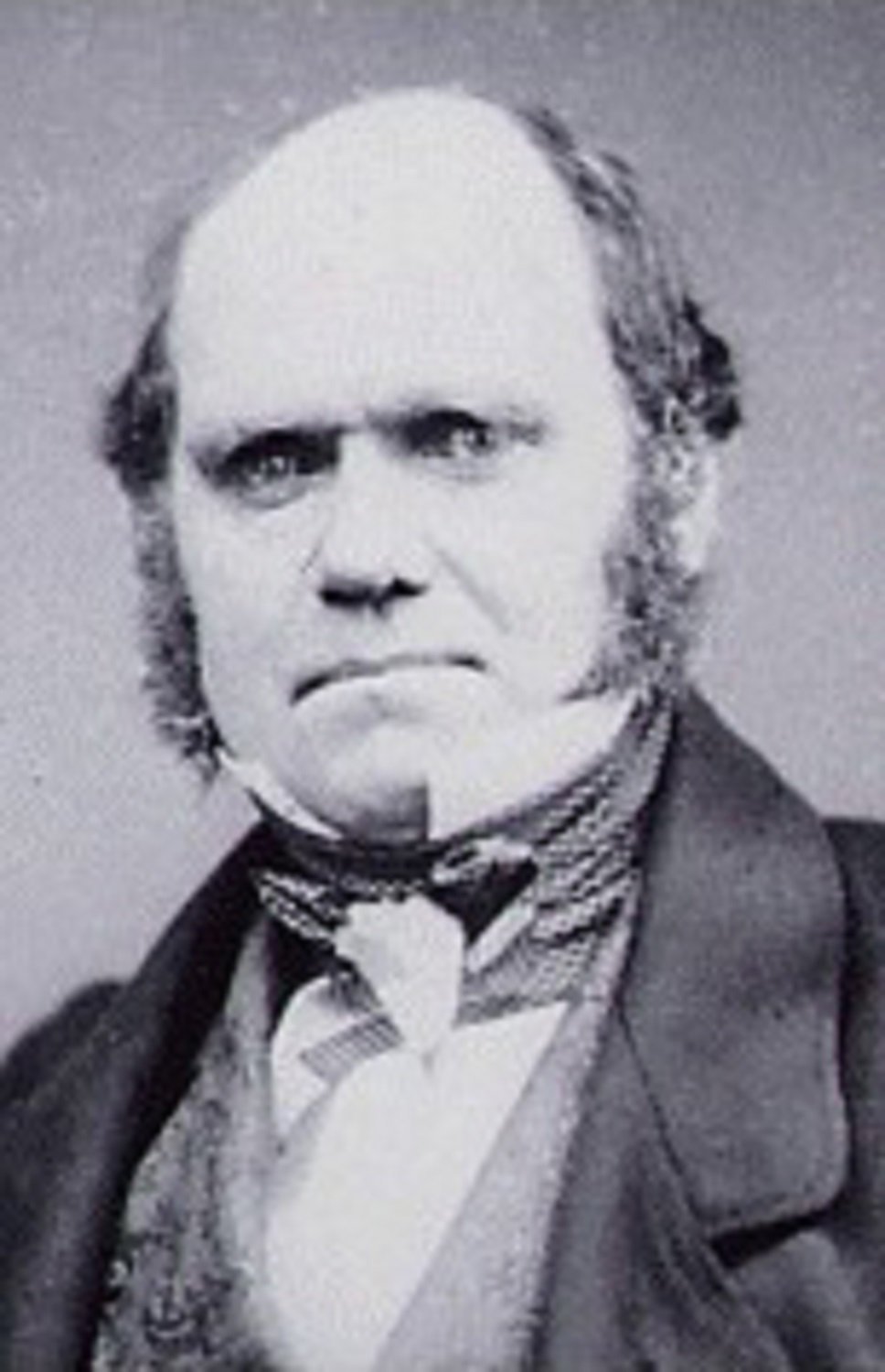
Charles Darwin in 1854
The ongoing antipathy to Darwin is one of the embarrassments of living in America, where one would have thought the ignorance about evolutionary theory had been banished 80-some years ago by the Scopes trial. Apparently not. When I taught this selection from On the Origin of Species by Means of Natural Selection (1859) to a class of freshmen in Texas some years ago, I was still confronted with incredulity and outright hostility, and to judge from the pronouncements of various politicians and the actions of state legislatures, not much has changed.

It's odd, considering that the central premise of Darwin's theory, that "the struggle of life" produces winners and losers and that the winners are those best adapted to the conditions in which they struggle, would seem to be perfectly harmonious with the tenets of the free-market conservatives who are most likely to protest against the theory.
Owing to this struggle, variations, however slight and from whatever cause proceeding, if they be in any degree profitable to the individuals of a species, in their infinitely complex relations to other organic beings and to their physical conditions of life, will tend to the preservation of such individuals and to their offspring.
"Natural Selection" was Darwin's term for the process, but he approved of Herbert Spencer's "Survival of the Fittest" as "more accurate, and ... sometimes equally convenient." He observed that the process was already known to breeders of animals, but that its course in the wild was "immeasurably superior to man's feeble efforts, as the works of Nature are to those of Art." (Thereby setting off the Nature vs. Art debate once again, to rage through the rest of the century and into the next.) The one thing Darwin was most concerned to eliminate was sentimentality about Nature. "We behold the face of nature bright with gladness, we often see superabundance of food; we do not see or we forget, that the birds which are idly singing round us mostly live on insects or seeds, and are thus constantly destroying life."

"Natural selection," he admits, can be a misleading term. For one thing, it seems to some to imply a "selector," which is not at all what Darwin has in mind: "it is difficult to avoid personifying the word Nature; but I mean by Nature, only the aggregate action and product of many natural laws, and by laws the sequence of events as ascertained by us. It also has promoted the notion of "lower" and "higher" forms of life, which is not at all what is involved: The only criterion implied by the term is success at living in a given environment, and success at reproducing. "No country can be named in which all the native inhabitant are now so perfectly adapted to each other and to the physical conditions under which they live, that none of them could still be better adapted or improved." Any given variation within a species can be judged only by its usefulness toward surviving.

And human interference only complicates things: "Man selects for his own good: Nature only for that of the being which she tends." (Darwin has just once again apologized for personifying Nature, explaining that what he means is really "the natural preservation or survival of the fittest.")
Under nature, the slightest differences of structure or condition may well turn the nicely-balanced scale in the struggle for life, and so be preserved. How fleeting are the wishes and efforts of man! how short his time! and consequently how poor will be his results, compared with those accumulated by Nature during whole geological periods! Can we wonder, then, that Nature's productions should be far "truer" in character than man's productions; that they should be infinitely better adapted to the most complex conditions of life, and should plainly bear the stamp of far higher workmanship.
That last phrase, "the stamp of far higher workmanship," has a theistic whiff to it, suggesting Darwin's discomfort with the non-theistic implications of his theory. But he goes boldly onward to proclaim his "belief that all animals and plants are descended from some one prototype," and moreover "that all the organic beings which have ever lived on this earth may be descended from some one primordial form." Still, he clings to the myth of a Creator:
To my mind it accords better with what we know of the laws impressed on matter by the Creator, that the production and extinction of the past and present inhabitants of the world should have been due to secondary causes, like those determining the birth and death of the individual. When I view all beings not as special creations, but as the lineal descendants of some few beings which lived long before the first bed of the Cambrian system was deposited, they seem to me to become ennobled.
There is no escaping the sense that Darwin was struggling to align his theory with the orthodox religious view as much as possible, doing a kind of cheerleading for the theory as a positive, almost holy, view of nature, without outright proclaiming it as "God's plan": "as natural selection works solely by and for the good of each being, all corporeal and mental endowments will tend to progress towards perfection." The question remains: perfect by whose standards? But in the famous "tangled bank" paragraph, he reaches toward an optimistic view of the struggle for existence and a reconciliation with the orthodox account of creation:
There is grandeur in this view of life, with its several powers, having been originally breathed by the Creator into a few forms or into one; and that, whilst this planet has gone cycling on according to the fixed law of gravity, from so simple a beginning endless forms most beautiful and most wonderful have been, and are being evolved.


Arthur Schopenhauer: The Will in Nature

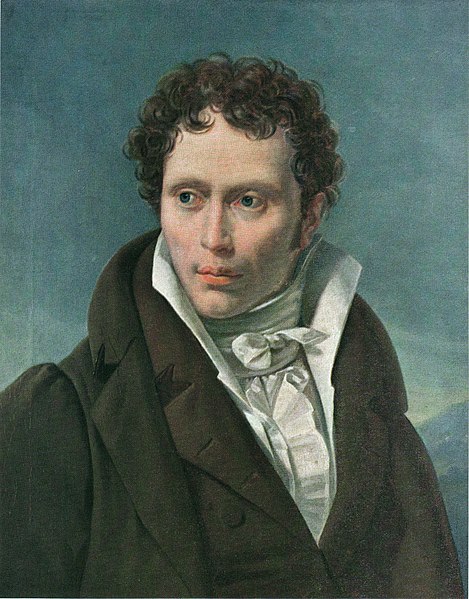
Ludwig Sigismund Ruhl, Portrait of Arthur Schopenhauer, c. 1815
Nobody ever accused Schopenhauer of optimism. Forty years before Darwin's Origin, in The World as Will and Idea (the word translated here as "Idea" is Darstellung, which is sometimes translated as "Representation"), Schopenhauer also based his thought on the prevalence of struggle in life. The human being encounters the world through the body, but the body with which we form our identity "is given as an idea in intelligent perception, as an object among objects and subject to the laws of objects." But it is also a manifestation of what Schopenhauer calls will. "The act of will and the movement of the body are not two different things objectively known, ... they are one and the same, but they are given in entirely different ways, -- immediately, and again in perception for the understanding.... It is only in reflection that to will and to act are different; in reality they are one."

When we experience pain, Schopenhauer asserts, we are experiencing that which "is opposed to the will; gratification and pleasure when it is in accordance with it." Pain and pleasure are "immediate affections of the will, in its manifestation, the body." By will, Schopenhauer doesn't just mean individual determination, as in "I will be heard!" or "His will is law." Will is a fundamental force in nature. It includes
  • "the force which germinates and vegetates in the plant"
  • "the force through which the crystal is formed"
  • "that by which the magnet turns to the north pole"
  • "the force whose shock [one] experiences from the contact of two different kinds of metals"
  • "the force which appears in the elective affinities of matter as repulsion and attraction, decomposition and combination"
  • "and, lastly, even gravitation, which acts so powerfully throughout matter, draws the stone to the earth and the earth to the sun" 
(May the Force be with you.)

All of these forces and others are the same thing: will. We experience them as separate phenomena, as ideas. "Phenomenal existence is idea and nothing more ... but the will alone is a thing in itself." Will "appears in every blind force of nature and also in the preconsidered action of man; and the great difference between these two is merely in the degree of the manifestation, not in the nature of what manifests itself." Such characteristics of matter "as rigidity, fluidity, elasticity, electricity, magnetism, chemical properties and qualities of every kind ... are in themselves immediate manifestations of will."
In the higher grades of the objectivity of will we see individuality occupy a prominent position, especially in the case of man, where it appears as the great difference of individual characters, i.e., as complete personality, outwardly expressed in strongly marked individual physiognomy, which influences the whole bodily form.... The farther down we go, the more completely is every trace of the individual character lost in the common character of the species, and the physiognomy of the species alone remains.
Will also manifests itself in the struggle of existence, in "the burden of physical life, the necessity of sleep, and finally, of death; for at last these subdued forces of nature, assisted by circumstances, win back from the organism, wearied even by the constant victory, the matter it took from them.... Thus everywhere in nature we see strife, conflict, and alternation of victory ... indeed nature exists only through it." As Darwin would be later, Schopenhauer is impressed by the fact that "each animal can only maintain its existence by the constant destruction of some other. Thus the will to live everywhere preys upon itself, and in different forms is its own nourishment." But Schopenhauer extends this process of struggle even to inanimate matter, "when, for example, crystals in process of formation meet, cross, and mutually disturb each other to such an extent that they are unable to assume the pure crystalline form, so that almost every cluster of crystals is an image of such a conflict of will at this low grade of its objectification." And just as in the microcosm, so in the macrocosm: "the constant tension between centripetal and centrifugal force ... keeps the globe in motion."

So if you're searching for an ultimate, you've found it: "Will is the thing-in-itself, the inner content, the essence of the world. Life, the visible world, the phenomenon, is only the mirror of the will."
Birth and death belong merely to the phenomenon of will, thus to life; and it is essential to this to exhibit itself in individuals which come into being and pass away, as fleeting phenomena appearing in the form of time -- phenomena of that which in itself knows no time, but must exhibit itself precisely in the way we have said, in order to objectify its peculiar nature.
A student of Hinduism, Schopenhauer notes that Shiva (or Siva, as he spells it), the god associated with destruction and death is given "as an attribute not only the necklace of skulls, but also the lingam, the symbol of generation, which appears here as the counterpart of death, thus signifying that generation and death are essentially correlatives, which reciprocally neutralise and annul each other."

Again like Darwin, Schopenhauer asserts that "it is not the individual, but only the species that Nature cares for, and for the preservation of which she so earnestly strives, providing for it with the utmost prodigality through the vast surplus of the seed and the great strength of the fructifying impulse.... [Nature's] kingdom is infinite time and infinite space.... Therefore she is always ready to let the individual fall." Nature assures continuation by making sex pleasurable. "On the other hand, excretion, the constant exhalation and throwing off of matter, is the same as that which, at a higher power, death, is the contrary of generation." In this scheme of things, in which the physical being is merely an instrument of generation, "It appears just as foolish to embalm the body as it would be to carefully preserve its excrement."
Man alone carries about with him, in abstract conceptions, the certainty of his death; yet this can only trouble him very rarely, when for a single moment some occasion calls it up to his imagination. Against the mighty voice of Nature reflection can do little. In man, as in the brute with does not think, the certainty that springs from his inmost consciousness that he himself is Nature, the world, predominates as a lasting frame of mind; and on account of this no man is observably disturbed by the thought of certain and never-distant death, but lives as if he would live forever.


A.N. Whitehead: Nature as Organism

A.N. Whitehead, date unknown
Well, speaking of struggle, there's my attempt to follow Whitehead's argument closely. Once again, the editors' introduction is of considerable help:
Whitehead is preoccupied with organisms in relation to their environment, and at the same time he is seeking to interpret the world of physics, the science of inorganic energy.... He regards the official philosophy of early twentieth-century science, which he traces back to the seventeenth century, as misleading because of its mechanistic assumptions: it makes objects falsely self-sufficient and isolates them from the minds that apprehend them. Whitehead would establish instead a recognition that he finds first expressed in the romantic poets: we do not perceive particular elements in nature as discrete entities, to the exclusion of other elements or to the exclusion of ourselves. Things and the perception of things are events, modes of interaction with other events in space and time. Parts of nature assume individuality by drawing the surrounding world into themselves and delimiting it; but these individual unities must also be seen in terms of larger unities of which they are functions. As in a plant, the whole dominates each part, and as in organic growth every partial whole virtually contains the whole that transcends it.
The excerpts come from Science and the Modern World, based on the Lowell Lectures Whitehead gave at Harvard in 1925. He begins with the usual definitions of terms, explaining that "matter, or material, is anything which has this property of simple location.... one major characteristic which refers equally both to space and to time, and other minor characteristics which are diverse as between space and time." Got that? Good. "The characteristic common both to space and time is that material can be said to be here in space and here in time, or here in space-time." The seventeenth century scientists asserted "that the world is a succession of instantaneous configurations of matter." This was a perfectly useful definition for them. It "is the famous mechanistic theory of nature, which has reigned supreme ever since the seventeenth century. It is the orthodox creed of physical science. Furthermore, the creed justified itself by the pragmatic test. It worked." But there are some problems with it, and Whitehead has a famous phrase for it: "the Fallacy of Misplaced Concreteness," by which he means "the accidental error of mistaking the abstract for the concrete."

In addition to "simple location," Whitehead says "substance and quality ... are the most natural ideas for the human mind. It is the way we think of things, and without these ways of thinking we could not get our ideas straight for daily use." But, he asks, "How concretely are we thinking when we consider nature under these conceptions?" Suppose, he says, we observe of an object that "it is hard, and blue, and round, and noisy." But are these qualities of the object itself, or are they what we bring to them by perceiving them?
These sensations are projected by the mind so as to clothe appropriate bodies in external nature. Thus the bodies are perceived as with qualities which in reality do not belong to them, qualities which in fact are purely the offspring of the mind. Thus nature gets credit which should in truth be reserved for ourselves; the rose for its scent: the nightingale for his song: and the sun for his radiance. The poets are entirely mistaken. They should address their lyrics to themselves, and should turn them into odes of self-congratulation on the excellency of the human mind. Nature is a dull affair, soundless, scentless, colourless; merely the hurrying of material, endlessly, meaninglessly. 
Yet since the seventeenth century, science has dealt with nature this way. "The enormous success of the scientific abstractions, yielding on the one hand matter with its simple location in space and time, on the other hand mind, perceiving, suffering, reasoning, but not interfering, has foisted onto philosophy the task of accepting them as the most concrete rendering of fact.... It involves a fundamental duality, with material on the one hand, and on the other hand mind."

Whitehead proposes that we analyze things in space and time: "Things are separated by space, and are separated by time: but they are also together in space, and together in time, even if they be not contemporaneous." So space-time is characterized by the separative and the prehensive, and also because everything in space has a definite location (it can't be in two places at once) and because "it endures during a certain period and through no other period" in time, it also has a modal character. It's the modal character that suggests the idea of simple location. "But it must be conjoined with the separative and prehensive characters."
The volume is the most concrete element of space. But the separative character of space, analyses a volume into sub-volumes, and so on indefinitely.... But it is the unity of volume which is the ultimate fact of experience.... Accordingly, the prime fact is the prehensive unity of volume, and this unity is mitigated or limited by the separated unities of the innumerable contained parts.... The parts form an ordered aggregate, in the sense that each part is something from the standpoint of every other part, and also from the same standpoint every other part is something in relation to it.
"Prehension" is a grasping of unity, and "Perception is simply the cognition of prehensive unification; or more shortly, perception is cognition of prehension. The actual world is a manifold of prehensions; and a "prehension" is a "prehensive occasion"; and a prehensive occasion is the most concrete finite entity, conceived as what it is in itself and for itself.... Nature is conceived as a complex of prehensive unifications."

Nature is, then, a process, a series of events. "Simple location" is no longer relevant. And "space-time is nothing else than a system of pulling together of assemblages into unities." An event has a past, present and future. "These conclusions are essential for any form of realism. For there is in the world for our cognisance, memory of the past, immediacy of realisation, and indication of things to come."

What we're dealing with now are organisms, "so that the plan of the whole influences the very characters of the various subordinate organisms which enter into it.... Thus an electron within a living body is different from an electron outside it, by reason of the plan of the body ... and this plan includes the mental state."

Whitehead now turns, thankfully, to literature, where he finds "the most interesting criticism of the thoughts of science among the leaders of the romantic reaction which accompanied and succeeded the epoch of the French Revolution." Chief among them, for Whitehead's purposes, are Wordsworth and Shelley. (Keats he dismisses, rather oddly, as "an example of literature untouched by science," and Coleridge as "only important by his influence on Wordsworth." Byron and Blake apparently are beyond consideration.) Wordsworth, he says, "alleges against science its absorption in abstractions. His consistent theme is that the important facts of nature elude the scientific method." Wordsworth "always grasps the whole of nature as involved in the tonality of the particular instance.... the first book of The Prelude ... is pervaded by this sense of the haunting presences of nature.... Wordsworth, to the height of genius, expresses the concrete facts of our apprehension, facts which are distorted in the scientific analysis."

Unlike Wordsworth, Shelley loved science, which "symbolises to him joy, and peace, and illumination.... What the hills were to Wordsworth, a chemical laboratory was to Shelley.... If Shelley had been born a hundred years later, the twentieth century would have seen a Newton among chemists." Shelley perceives the organic character of nature, "functioning with the full content of our perceptual experience." In his poems you see "an emphatic witness to a prehensive unification as constituting the very being of nature. Berkeley, Wordsworth, Shelley are representative of the intuitive refusal seriously to accept the abstract materialism of science." 

In "The Cloud," Shelley examines "the endless, eternal, elusive change of things.... Every scheme for the analysis of nature has to face these two facts: change and endurance. There is yet a third fact to be placed by it, eternality, I will call it."
The mountain endures. But when after ages it has been worn away, it has gone. If a replica arises, it is yet a new mountain. A colour is eternal. It haunts time like a spirit. It comes and it goes. But where it comes, it is the same colour. It neither survives nor does it live. It appears when it is wanted. The mountain has to time and space a different relation from that which colour has.
The nineteenth century English poets performed a valuable service in pointing out "the discord between the aesthetic intuitions of mankind and the mechanism of science." They make us aware that "a philosophy of nature must concern itself at least with these six notions: change, value, eternal objects, endurance, organism, interfusion."
You are in a certain place perceiving things. Your perception takes place where you are, and is entirely dependent on how your body is functioning. But this functioning of the body in one place, exhibits for your cognisance and aspect of the distant environment, fading away into the general knowledge that there are things beyond. If this cognisance conveys knowledge of a transcendent world, it must be because the event which is the bodily life unifies in itself aspects of the universe.... "Value" is the word I use for the intrinsic reality of an event. Value is an element which permeates through and through the poetic view of nature.

Friday, October 8, 2010

14. The Age of Wonder, by Richard Holmes, pp. 405-469

The Age of Wonder: The Romantic Generation and the Discovery of the Beauty and Terror of Science (Vintage)Sorcerer and Apprentice, 6-8; Young Scientists; Epilogue
_____
John Herschel and Charles Babbage traveled in France and Italy in July through October 1821, meeting Alexander von Humboldt in Paris. Humboldt reported that John seemed to him "inferior to the originality of his father, who was astronomer, physicist and poetical cosmologist all at the same time." He treated them well, however, and told them of hearing Joseph Banks lecture in London soon after returning from his voyage of 1768-71. John returned to Slough, where William Herschel, now in his eighties, was no longer able to use the larger telescopes, and Caroline found it increasingly difficult to follow his instructions. John resumed work with the forty-foot telescope with Caroline as his devoted assistant. When he and Babbage formed the Royal Astronomical Society in 1820, John, "who had strong views about science being open to women," made her the first Honorary Member. The second was Mary Somerville, the mathematician after whom the first women's college at Oxford was named.

Caroline Herschel, by Martin François Tielemans, 1829
William grew increasingly infirm with arthritis, and Caroline came down with an eye infection that made her fear she would never do astronomical work again. She recovered, but was shaken by the experience. In August 1822, William died while John was abroad. His obituary in the Gentleman's Magazine noted "his excellent sister, Miss Caroline Herschel, whose indefatigable and unhesitating devotion in the performance of a task usually deemed incompatible with female habits, surpassed all eulogium." The same issue also noted the death by drowning of the "professed ... atheist" Percy Bysshe Shelley, the "unfortunately too well-known" author of "infamous novels and poems." Caroline, who was seventy-two, decided to return to Hanover, where she had not lived for nearly fifty years. She lived on for twenty-six years longer, corresponding regularly with John and writing her memoirs. She also compiled a new Star Catalogue, for which Herschel and Babbage saw to it that she was awarded the Astronomical Society's Gold Medal in 1828.

Humphry Davy was commissioned by the Royal Navy in 1823 to find a way to stop the corrosion of the copper hulls of the new steam warships. He analyzed the effects of salts on copper, and discovered that it could be neutralized by small iron plates along the hull that would oxidize more rapidly than the copper. Davy's remedy was put into effect quickly, and was hailed as yet another triumph. But the success was premature: after a few months it was discovered that the unoxidized copper was more subject to barnacles and weeds than before. "The navy was disgruntled, the Royal Society was embarrassed, and the press was derisive. Davy's reputation was tarnished, not to say barnacled, and his unpopularity at the Royal Society increased." Eventually, it was discovered that Davy had been right all along about the effect of the iron plates, and that a reconfiguration of their placement solved the problem, but the damage to Davy's reputation had been done. In 1824, the magazine John Bull proclaimed him one of the "Humbugs of the Age," largely because of his prominence as a socialite. Davy also managed to antagonize the younger generation of scientists by appointing John Herschel as one of the Royal Society's two secretaries in 1824, but refusing to appoint Charles Babbage to the other position.

Davy began to suffer from heart disease, and in December 1826 had a series of strokes that left him paralyzed on the right side. He was forty-eight, which was the age at which his father had died. In January, following his physician's advice, he left on a long holiday on the continent, accompanied by his brother, John, but not by his wife. He had continued to write poetry, and during his holiday he decided to write a book about fly-fishing that he called Salmonia, or Days of Fly-Fishing. It was structured as a series of dialogues among a group of friends, including a literary friend who may have been based on Coleridge and Walter Scott.

While he was writing the book, he returned to Laibach (now Ljubljana) where he took rooms at the inn owned by Josephine Dettela's father. She was now twenty-five.  In November 1827 he returned to London to resign the presidency of the Royal Society. But he went back to Laibach in the spring of 1828, again leaving Jane behind. In his letters to Jane he made frequent references to "the constant attention and kindness of my 'Illyrian maid,'" "my pretty Illyrian nurse," "my charming Illyrian nurse." He also wrote drafts of two love poems to her in his scientific notebook. That November he regretfully moved to Rome because of the weather.  

Salmonia was published in England in 1828, and he started work on expanding it, as well as beginning his last book, Consolations in Travel, or The Last Days of a Philosopher. It consists of six dialogues and an unfinished seventh, and "mixes philosophy and autobiography with highly original sections of science fiction, some visionary travel writing, various theories of history, race and society, and an important apologia for science. It also contains unexpected speculations about the nature of evolution, and the future of the human species." In one dialogue he takes issue with Coleridge, "who had said that the 'souls of 500 Newtons' had gone into the making of a single Shakespeare. Davy said emphatically that as benefactors of mankind, he held Bacon far above Shakespeare, and Newton far above Milton." In another dialogue he set forth his belief that science was a force for good, and had a positive effect on the mind, giving it "habits of accuracy, by obliging it to attend to facts.... It may be said of modern chemistry, that its beginning is pleasure, its progress knowledge, and its objects truth and utility."

In February 1829, still in Rome, he suffered another stroke, and sent for Jane. She arrived in April, and at the end of the month he decided that he wanted to travel north. John arranged for a slow journey, with many stops, and Jane went ahead to arrange for accommodations in Geneva. He arrived there on May 28, and died at 3 o'clock the next morning. He left an endowment for a Davy Medal  to be awarded by the Royal Society, and one for the maintenance of Penzance Grammar School. The rest of his estate went to Jane, except for a bequest of £150 to Josephine Dettela.

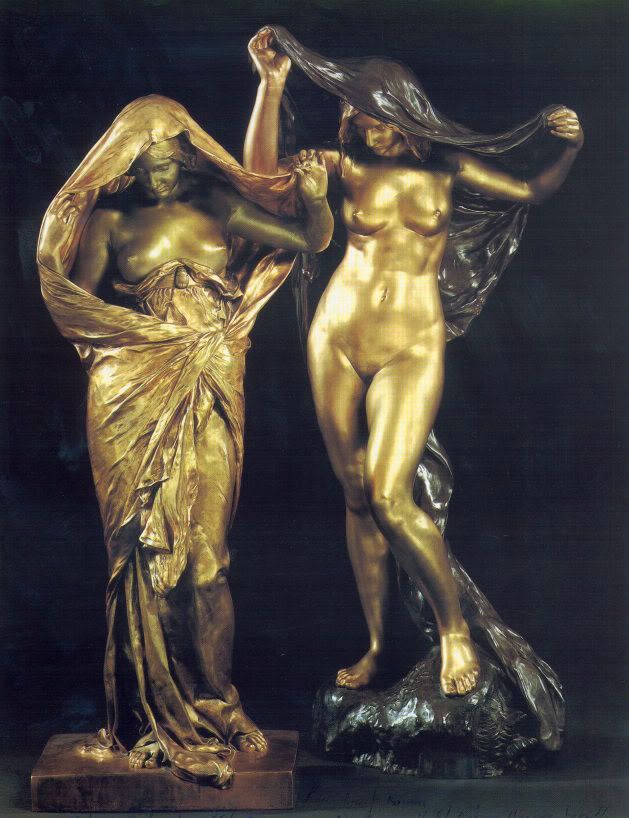
Nature Unveiling Herself Before Science, by Louis Ernest Barrias, 1890
The deaths of Banks in 1820, William Herschel in 1822, and Davy in 1829 seemed to mark the end of an era of British science and of the prestige of the Royal Society. Social critics like Thomas Carlyle began to question the role of science: "The Progress of Science ... is to destroy Wonder, and in its stead substitute Mensuration and Numeration." In a note, Holmes observes, "The troubling image of a shy, reluctant, persecuted female Nature who is crudely questioned and even physically assaulted by an exclusively male Science now begins to appear. It slowly replaces the older Romantic image of a mysterious and seductive Nature, at least a goddess, who is infinitely more powerful than her mere human petitioners and questioners."

Charles Babbage
In 1829, John Herschel was the candidate favored by young scientists to replace Davy as president of the Royal Society, but he was defeated by the Duke of Sussex, the brother of George IV, in a very close election, 119 to 111. Sussex was not a scientist, but he was obviously well-connected. As if to placate the younger scientists, Herschel was knighted soon afterward. But the supporters of Herschel, including Charles Babbage, were still outraged. In the spring of 1830, Babbage published a book, Reflections on the Decline of Science in England. Babbage was now Lucasian Professor of Mathematics at Cambridge, a chair that had been held by Isaac Newton. He was working on the first computer, the "Difference Engine No. 1," which would have used 25,000 brass cogs to perform its calculations. He had spent £17,000 of his own money on the device, so he was eager to obtain government funding for it. The one completed section of Difference Engine No. 1, with 2,000 cogs, still works as a calculator, and he had designed but never completed a more sophisticated version, using punch cards and 50,000 cogs that served as the machine's equivalent of RAM. In 1991, his design for Difference Engine No. 2, with 4,000 brass cogs, was actually constructed. It's capable of calculating to thirty-one decimal points. But Babbage was unable to persuade the funding sources that there would ever be applications for the Difference Engine.

Babbage's book suggested that the research culture in Britain was inferior to that on the continent, and that the universities were failing at the task of teaching science. The Royal Society was particularly to blame, having become more of a social institution than a scientific one: Of the 700 members, only ten percent had published two or more papers on science. He argued "that science must always be more than the simple observation of phenomena or data. It was simultaneously a subjective training in observational skills, self-criticism and interpretation: a complete education. This was of course precisely what William Herschel had said forty years before." He proposed that all the British scientific societies come together in an annual meeting to take place in a different city outside of London each year. This would be the model followed when the British Association for the Advancement of Science was formed in 1831. 

John Herschel published his own critique of science, A Preliminary Discourse on the Study of Natural Philosophy, which became hugely popular. It was cited by John Stuart Mill in his Autobiography as one of the books that helped him recover from his nervous breakdown. Herschel argued that all the sciences had the inductive method in common: the gathering of quantitative data, the formation of a hypothesis, and the testing of the hypothesis. Herschel's book was celebrated as the first book since Bacon's 1620 Novum Organum to explain to the public the nature of experimental science. It was fluently written and filled with imaginative explanations. He singled out chemistry as the central scientific discipline of the age, and prophesied that investigation of electricity and electromagnetism, which would be Faraday's field, would be the next great field of scientific endeavor. He spoke of science as a network of disciplines, coming together "to form a single philosophy or culture," and "argued that science, while often going against common sense or intuition, expanded the human imagination with previously inconceivable ideas of movement or magnitude." The book was enormously influential in shaping the thought of the Cambridge undergraduate Charles Darwin.

David Brewster, a physicist who specialized in optics and invented the kaleidoscope, picked up on Babbage's idea of forming an association of scientific organizations. Babbage and the geologist William Whewell joined him in organizing the British Association for the Advancement of Science, which held its first meeting in York in 1831. It was not particularly well attended and attracted little attention from the press. But the second meeting, at Oxford in 1832, began to attract more notice, although The Times referred to it as "a mere unexplained display of philosophical toys" and was shocked that William Buckland had delivered a talk about the courtship of reptiles "in the presence of ladies." It was the third meeting, in 1833 in Cambridge, that showed the British Association was beginning to make its mark: It was attended by Faraday, Herschel, Dalton, Babbage, Brewster, Whewell and Thomas Malthus, among other notables. Darwin, who was traveling on the Beagle, was unable to attend.

Another participant was Coleridge, now sixty and in poor health. At one meeting Coleridge weighed in on the question of what someone who worked in the sciences should be called. Whewell, who was the chairman of the meeting, noted that some proposed "philosopher," but that Coleridge was strongly against it. Someone else suggested "savant," which was rejected as too presumptuous and too French. Finally Whewell himself suggested "scientist," on the analogy with "artist," as well as "economist" and "atheist" -- though the latter was a strike against it. The geologist Adam Sedgwick rejected "scientist" as a "barbarism," but it caught on and entered the OED in 1840.

Behind all of this professionalizing of science "lay the whole question of whether the new generation of professional 'scientists' would promote safe religious belief or a dangerous secular materialism." Many saw no conflict between science and religion: "Science was a gift of God or Providence to mankind, and its purpose was to reveal the wonders' of His design." But many of the most prominent scientists dodged the question: Davy's writings "suggested a kind of science mysticism that certainly precluded a Christian God"; William Herschel's God was only a kind of "benign Creator somewhere distantly behind the great unfolding scheme of nature";  Caroline Herschel never mentioned God in her journals; and Joseph Banks's sister despaired at his lack of piety. The problem was that "science itself had yet to produce its own theory (or myth) of creation." And when one emerged, in Darwin's On the Origin of Species in 1859, it was devastating because it added to the damage already done to the book of Genesis by the geologists. "What it demonstrated was that there was no need for a divine creation at all."

From 1830 to 1836, the Earl of Bridgewater commissioned a series of books by eminent scientists that were intended to show how science reinforced Christian beliefs. But the Bridgewater Treatises were not well received by the scientific community. Mary Somerville remarked, after reading William Buckland's treatise on geology, that "facts are such stubborn things." Babbage considered writing a treatise of his own that would undermine the whole enterprise, but never finished it. And Faraday, though he was a member of the fundamentalist Sandemanian sect, just kept quiet. 

The Association continued to grow, holding its annual meetings in Edinburgh, Dublin, Bristol, Liverpool, Newcastle, Birmingham and Glasgow from 1834 to 1840, attracting 2,000 people to the meeting and an official membership of more than 1,000. There was still hostility from The Times and John Bull, and Charles Dickens lampooned the meeting with a series for Bentley's Miscellany, illustrated with cartoons by George Cruikshank, called "The Full report of the First Meeting of the Mudfog Association for the Advancement of Everything."

Faraday continued his work at the Royal Institution, and gave the Bakerian Lecture to the Royal Society in 1829.  He also accepted a professorship at the Royal Military Academy, Woolwich, and began his work on electromagnetism that would lead to the creation of the dynamo, as revolutionary as James Watt's steam engine had been. He proved to be a great science educator, and started the series of Christmas Lectures for Children that is still given today. One of them, "The Chemical History of a Candle," was so popular that Dickens reprinted it in Household Words in 1850. 

Charles Lyell's Principles of Geology in 1830 overthrew the biblical account of creation and introduced readers to a concept of "deep time" that corresponded to William Herschel's "deep space." It would form the background Darwin needed for his theory of evolution by natural selection. The publication of Humphry Davy's Consolations of Travel, or The Last Days of a Philosopher in an expanded popular edition in 1831 also introduced the public to speculations about human social evolution; Darwin wrote to his sister asking her to send him a copy. David Brewster's biography of Isaac Newton presented its subject "as a secular saint, 'the high priest of science' and a man of universal genius." And the republication, after the stage adaptations, of Mary Shelley's Frankenstein gave the public a glimpse of "terrible, blasphemous and irreversible scientific hubris."

Mary Somerville's On the Connexion of the Physical Sciences, in 1834, "was a significant attempt to bring together new developments in the fields of astronomy, physics, chemistry, botany and geology as a single, ongoing scientific process of discovery." Somerville's tone is conventionally pious, but on the other hand,
She quietly suggests that "not only man, but the globe he inhabits -- nay the whole system of which it forms so small a part -- might be annihilated, and its extinction be unperceived in the immensity of creation." The reader is left to ask -- Unperceived by God? Or without any God to perceive it?
Somerville also puts stress on the counterintuitiveness of science, on its ability to demonstrate that things are not as we see them or as common sense tells us.

John Herschel, 1846
In 1833 John Herschel fulfilled one of his dreams, to do an astronomical survey in the southern hemisphere. Independently wealthy, he turned down government sponsorship, and even a grant from the Royal Society, and sailed with his family for South Africa to set up an observatory. He shipped the twenty-foot telescope, and remained at Cape Town for four years, mapping the skies. He wrote to his aunt Caroline that "these were the happiest years of his whole life." The Herschels were visited at the Cape by Charles Darwin, on his way back from the Galapagos. "Herschel's expedition to the Cape came to represent for Darwin the important ideal of the independent working scientist, which inspired the rest of his life." Caroline Herschel, in her eighties, thought of joining John and his family at the Cape, but decided against it. She did serve as a kind of publicist for him, feeding stories to the Hanover papers that were picked up internationally. On his return in 1838, he was made a baronet and attended Queen Victoria's coronation.  He was also elected president of the Royal Society and awarded another Copley Medal. 

In 1840, the forty-foot telescope at Slough was dismantled, having been battered by winds until the scaffolding was no longer safe. On New Year's Eve, Herschel threw a party in the old tube.