JOURNAL OF A COMPULSIVE READER
By Charles Matthews
Showing posts with label George Sand. Show all posts

Saturday, April 30, 2011

15. The Modern Tradition, edited by Richard Ellmann and Charles Feidelson Jr., pp. 309-328

Realism: Melioristic Realism (F.M. Dostoevsky, George Sand and Gustave Flaubert, H.G. Wells and Henry James)
_____

F.M. Dostoevsky: Prophetic Realism

In his letters, Dostoevsky explained that his novel The Idiot was an attempt to represent "a truly perfect and noble man," a task he didn't underestimate: "All writers ... who have sought to represent Absolute Beauty, where unequal to the task, for it is an infinitely difficult one." Like Tolstoy, he bases his ideas about the novel in Christianity, but only insofar as the image of Christ -- the "one figure of absolute beauty" -- gives him an ideal to strive for.
Vasily Perov, Portrait of F.M. Dostoevsky, 1872

Dostoevsky's choice of the noblest figures in Christian literature are comic ones: Don Quixote and the members of Dickens's Pickwick club. "The reader feels sympathy and compassion with the Beautiful, derided and unconscious of its own worth. The secret of humour consists precisely in this art of wakening the reader's sympathy."

Dostoevsky's realism was of a different order from Zola's: 
I have my own idea about art, and it is this: What most people regard as fantastic and lacking in universality, I hold to be the inmost essence of truth. Arid observation of everyday trivialities I have long ceased to regard as realism -- it is quite the reverse. In any newspaper one takes up, one comes across reports of wholly authentic facts, which nevertheless strike one as extraordinary. Our writers regard them as fantastic, and take no account of them; and yet they are the truth, for they are facts.
He proposed to concentrate on the spiritual development in Russia, even though "all the realists would shriek that it was pure fantasy! ... It is the one true, deep realism; theirs is altogether too superficial."


George Sand and Gustave Flaubert: The Counter-Religions of Humanity and Art

George Sand in 1864
In their correspondence in the mid-1870s, Sand seems determined to cheer Flaubert up: "You love literature too much; it will destroy you and you will not destroy the imbecility of the human race." Though they both agreed that humanity was messed up, she viewed it, she says, "with maternal eyes: for it is a childhood and all childhood is sacred. What hatred you have devoted to it! what warfare you wage on it!"

She urges him to remember that "there is something above art: namely, wisdom, of which art at its apogee is only the expression." She insists on optimism: "to perceive the continual gravitation of all tangible and intangible things towards the necessity of the decent, the good, the true, the beautiful." She admits that "the general aspect is for the moment poor and ugly," but refuses to let go of her expectations for improvement. And she wants him to recognize that he is "about to enter gradually upon the happiest and most favorable time of life: old age. It is then that art reveals itself in its sweetness; as long as one is young, it manifests itself with anguish."

She advises him to make the aim of his books clearer:
L'Éducation sentimentale has been a misunderstood book ... because people did not understand that you wanted precisely to depict a deplorable state of society that encourages these bad instincts and ruins noble efforts; when people do not understand us it is always our fault. What the reader wants, first of all, is to penetrate into our thought, and that is what you deny him, arrogantly.... You say that it ought to be like that, and that M. Flaubert will violate the rules of good taste if he shows his thought and the aim of his literary enterprise.
She expresses disbelief in his claim that he "writes for twenty intelligent people and does not care a fig for the rest. It is not true, since the lack of success irritates you and troubles you." She asserts a more sensible version of Tolstoy's view of art: "Whatever you do, your tale is a conversation between you and the reader." By hiding himself from the reader, by insisting on the autonomy of the work, he misses this essential connection. "Keep your cult for form; but pay more attention to the substance. Do not take true virtue for a commonplace in literature. Give it its representative, make honest and strong men pass among the fools and the imbeciles that you love to ridicule.... in short, abandon the convention of the realist and return to the true reality, which is a mingling of the beautiful and the ugly, the dull and the brilliant."

Flaubert calls her advice "affectionate and motherly," which he presumably meant kindly but which sounds condescending. But he rejects her advice with an insistence that he can do no other: "I write according to the dictates of my heart. The rest is beyond my control." And he continues to insist that art should conceal the artist:
I burst with suppressed anger and indignation. But my ideal of Art demands that the artist show none of this, and that he appear in his work no more than God in nature. The man is nothing, the work is everything!
Nor does he intend to compromise on his view of human nature: "No monsters, no heroes!" As for style, it remains a primary concern: "Goncourt is very happy when he has picked up in the street some word that he can stick into a book; I am very satisfied when I have written a page without assonances or repetitions.... I try to think well in order to write well. But my aim is to write well -- I have never said it was anything else."


H.G. Wells and Henry James: The Counter-Claims of Content and Form

H.G. Wells, date unknown
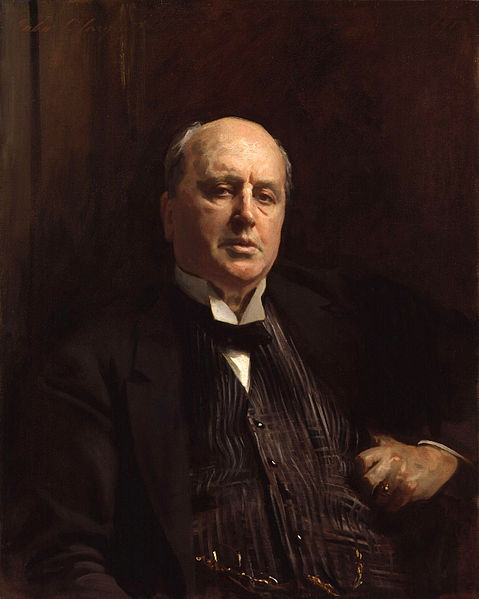
John Singer Sargent, Portrait of Henry James, 1913
Virginia Woolf was not the only writer to have problems with the fiction of H.G. Wells and Arnold Bennett. In an article, "The Younger Generation," in the Times Literary Supplement in 1914, James trained his exquisite sensibilities on both writers and found them somewhat wanting. Bennett and Wells, he wrote "squeeze out to the utmost the plump and more or less juicy orange of a particular acquainted state and let this affirmation of energy, however directed or undirected, constitute for them the 'treatment' of the theme." They mass details for us, as Bennett does in his novel Clayhanger, recording "in dense unconfused array, every fact required to make the life of the Five Towns press upon us and make our sense of it, so full fed, content us." But then it occurs to the reader (or at least to James) to ask: "Yes, yes; but is this all?" We see the details, but not why they're being presented to us: "where is the interest itself, where and what is its centre and how are we to measure it in relation to that?"

He takes Tolstoy "as the great illustrative master-hand on all this ground of disconnexion of method from matter." His "epic genius," however, makes him a bad model: "from no other projector of the human image and the human idea is so much truth to be extracted under an equal leakage of its value." James sees Bennett and Wells as deriving, "by multiplied if diluted transmissions, from the great Russian." Descriptive detail in Bennett's novels gives the reader such a sense of "the solidity of every appearance that it may be said to represent our whole relation to the work and completely to exhaust or reaction upon it."

In Wells's case, he "affects us as taking all knowledge for his province and as inspiring in us to the very highest degree the confidence enjoyed by himself.... The more he knows and knows, or at any rate learns and learns -- the more, in other words, he establishes his saturation -- the greater is our impression of his holding it good enough for us, such as we are, that he shall but turn out his mind and its contents upon us by any free familiar gesture and as from a high window forever open." His books are a kind of brain dump. But James finds him a careless artist, who gives us only the outlines of the experience of his characters.

In Wells's 1934 Experiment in Autobiography, he recalled his acquaintance with James, who "liked me and ... found my work respectable enough to be greatly distressed about it." Where they most disagreed, he says, was that James "had no idea of the possible use of the novel as a help to conduct." James, Wells says, believed in "The Novel ... as an Art Form and ... novelists as artists of a very special and exalted type.... I was disposed to regard a novel as about as much an art form as a market place our a boulevard. It had not even necessarily to get anywhere. You went by it on your various occasions."

James had focused on Wells's novel Marriage in his TLS article, and criticized it because the characters seemed to talk to the reader more than they did to each other. Wells responds,
If the Novel was properly a presentation of real people as real people, in absolutely natural reaction in a story, then my characters were not simply sketchy, they were eked out by wires and pads of non-living matter and they stood condemned.... And the only point upon which I might have argued ... was this, that the Novel was not necessarily, as he assumed, this real through and through and absolutely true treatment of people more living than life. It might be more and less than that and still be a novel.... The important point ... was that the novel of completely consistent characterization arranged beautifully in a story and painted deep and round and solid, no more exhausts the possibilities of the novel, than the art of Velazquez exhausts the possibilities of the painted picture. 
Wells concludes by questioning whether "The Novel, a great and stately addendum to reality," has ever "been realized -- or can it ever been realized?"

But this autobiographical retort, some twenty years later, was not Wells's first response to James's critique. In 1915, he published a satire called Boon, in which the characters discuss James's fiction.
"He wants a novel to be simply and completely done. He wants it to have a unity, he demands homogeneity.... Why should a book have that? For a picture it's reasonable, because you have to see it all at once. But there's no need to see a book all at once. It's like wanting to have a whole country done in one style and period of architecture." 
One character suggests that James should "have gone into philosophy and been greater even than his wonderful brother," and argues that "if the novel is to follow life it must be various and discursive. Life is diversity and entertainment, not completeness and satisfaction." James's characters have no "opinions," in them there are "no people with defined political opinions, no people with religious opinions, none with clear partisanships or with lusts or whims, none definitely up to any specifically impersonal thing.... James's denatured people are only the equivalent in fiction of those egg-faced, black-haired ladies, who sit and sit, in the Japanese colour-prints, the unresisting stuff for an arrangement of blacks."

And then comes the often-quoted simile, likening a James novel to "a church lit but without a congregation to distract you, with every light and line focused on the high altar. And on the altar, very reverently placed, intensely there, is a dead kitten, an egg-shell, a bit of string." And the effect of the novel is that of a hippopotamus trying to pick up a pea.

James was not happy with what he called "the bad manners of Boon," and wrote to Wells arguing that "the extension of life ... is the novel's best gift," and asserting, "It is art that makes life, makes interest, makes importance, ... and I know of no substitute for the force and beauty of its process." But it was posterity who gave James the last word, keeping his novels alive while James's, except for the science fiction, are forgotten. 

Monday, September 20, 2010

5. Zuleika Dobson, by Max Beerbohm, pp. 147-184

Zuleika Dobson (Modern Library Paperbacks)IX-X
_____
The Duke and his followers' mad dash seems to have been unnecessary: Zuleika hasn't yet arrived. The Warden explains that she had decided to change dresses. The Duke regards the Warden in a new light:
Here was a man who -- for had he not married and begotten a child? -- must have known, in some degree, the emotion of love. How, after that, could he have gone on thus, year by year, rusting among his books, asking no favour of life, waiting for death without a sign of impatience? Why had he not killed himself long ago? Why cumbered he the earth? 
Meanwhile, an undergraduate is on stage singing a song about a lover who "predicted that only when he were 'laid within the church-yard cold and grey' would his lady begin to pity him." For the Duke, "This fictitious love-affair was less nugatory than the actual humdrum for which Dr. Dobson had sold his soul to the devil."

And then Zuleika arrives, "brilliant in black." She leads the audience in an ovation for the singer, who has had to start over because of the sensation caused by her arrival. And then she turns to the Duke to point out the reason for her decision to change her dress: The pearls in her earrings have turned black. It is a sign, she tells him, that she has gone "quite unconsciously into mourning for him." She is so thrilled with the idea of his dying for love of her that she asks, "Will you, please, at the last moment to-morrow, call out my name in a loud voice, so that every one around can hear?" He agrees to do so.

Meanwhile, news of the Duke's plan to take his life has buzzed through the audience, spread by those who had been at the Junta. Everyone is eagerly awaiting his performance on the piano, and although he hadn't decided beforehand what to play, as he sits at the keyboard it comes to him: Chopin's Funeral March. The performance even summons the ghosts of Frédéric Chopin and George Sand. Despite the nature of the music, "he smiled brilliantly through" the performance. "And Zuleika returned his gaze with a smile not less gay. She was not sure what he was playing. But she assumed that it was for her, and that the music had some reference to his impending death." Chopin's ghost is thrilled with the performance, but George Sand warns him that he'll have a headache if they don't leave. Besides, she tells him, he'll be joining them tomorrow.

When they leave the hall, the Duke and Zuleika are greeted by a throng of undergraduates, now convinced that they too must die for love of her.
If any one of the undergraduates had met Miss Dobson in the desert of Sahara, he would have fallen in love with her; but not one in a thousand of them would have wished to die because she did not love him. The Duke's was a peculiar case.... These other, these quite ordinary, young men were the victims less of Zuleika than of the Duke's example, and of one another. A crowd, proportionately to its size, magnifies all that in its units pertains to the emotions, and diminishes all that in them pertains to thought.... To die for Miss Dobson was "the thing to do." The Duke was going to do it. The Junta was going to do it. It is a hateful fact, but we must face the fact that snobbishness was one of the springs to the tragedy here chronicled. 
Zuleika, meanwhile, still has her mind set on retrieving the transformed studs from the Duke's shirtfront as "a keepsake of the tragedy that was to be." But she's startled when she learns that the magnitude of the tragedy now threatens to increase, that the men at the Junta had vowed to follow his example. He assures her, "They will recant their folly. I shall force them to."

The MacQuern approaches them with a handkerchief that he claims Zuleika dropped, though it "was obviously a man's" handkerchief. It's a pretext for an introduction to which the Duke accedes "with sulky grace." The MacQuern -- whom Zuleika decides to call Mr. MacQuern because "'The' would sound so odd in the vocative" -- confirms that they are all determined to die tomorrow, "After the Eights, I suppose; at the same time as the Duke. It wouldn't do to leave the races undecided." Whereupon Zuleika decides that she must do something to "show [her] gratitude" for their devotion. She calls on her maid, Mélisande, to bring the malachite casket in which she keeps her magic tricks.

The second part of the concert is still going on, but the only ones in the hall are the performers, a few dons, and the sisters and cousins of the men who had brought them but had abandoned them to gaze at Zuleika. So Zuleika decides to put on her magic show there in the quad. "She stood with eyes downcast and hands folded behind her, moonlit in the glow of lanterns, modest to the point of pathos, while the Duke gracefully and simply introduced her to the multitude."
Two or three thousands of human bodies, human souls? Yet the effect of them in the moonlight was as of one great passive monster. So it was seen by the Duke, as he stood leaning against the wall, behind Zuleika's table. He saw it as a monster couchant and enchanted, a monster that was to die; and its death was in part his own doing.
Zuleika begins her performance, the one that has thrilled audiences on two continents. And we learn that it is cheesy and amateurish, a "stale and narrow repertory" that demonstrates "her marked lack of skill." The truth even dawns on the Duke, "who blushed to think what these men thought of her.... They forgave her -- confound their impudence! -- because of her beauty. The banality of her performance was an added grace. It made her piteous. Damn them, they were sorry for her."

Her final trick is the Magic Canister, into which she asks men in the audience to deposit a watch, a cigarette-case, a necktie and the like. And she asks the Duke for his studs. "There was no help for it. He quickly extricated from his shirt-front the black pearl and the pink." All of the items in the canister then disappear into its hidden compartment. She shows the audience the "empty" canister, then makes them reappear -- all but the two studs. "Would she rob the Duke, and his heir-presumptive, and the Tanville-Tankertons yet unborn? Alas, yes. But what she now did was proof that she had qualms.... With a gesture of her disengaged hand, so swift as to be scarcely visible, she unhooked her earrings and 'passed' them into the canister." It is these she returns to the Duke, keeping his studs. Realizing that he has been tricked, he tells her to keep them.

She acknowledges the applause of the crowd "in the manner of a prima donna -- chin up, eyelids down, all teeth manifest, and hands from the bosom flung ecstatically wide asunder." As the crowd breaks up, the forsaken ladies from the concert inside having "moved down into the quadrangle, spreading their resentment like a miasma," The MacQuern approaches to invite her to lunch with him the next day. She agrees, asking him to bring his friends, which is not what he had planned. "'I had hoped --' he began. 'Vainly,' she cut him short." So he agrees to invite the Duke.

Naturally, the Duke is miffed: "Had it not been arranged that he and she should spend his last day together? Did it mean nothing that she had given him her ear-rings?" He and The MacQuern almost come to blows now over which will walk Zuleika home. "Men had fought for Zuleika, but never in her presence. Her eyes dilated." She wonders if she should "be holding aloft a candelabra of lit tapers; no, that was only done indoors, and in the eighteenth century." But it turns out that "The Duke and The MacQuern would never have come to blows in the presence of a lady. Their conflict was necessarily spiritual. And it was the Scotsman, Scots though he was, who had to yield."

As they walk, she wonders if the black owls are sitting on the battlements of Tankerton. When they reach the door, the Duke seizes her hands, but she angrily twists out of his grip.
He laughed. "You are afraid of me. You are afraid to let me kiss you, because you are afraid of loving me. This afternoon -- here -- I all but kissed you. I mistook you for Death. I was enamoured of Death. I was a fool. That is what you are, you incomparable darling: you are a fool. You are afraid of life. I am not. I love life. I am going to live for you, you hear?" 
Is he going back on his promise? she asks. He insists that she will release him from it because she really loves him. She calls him a coward and goes indoors. "No man had ever dared to lay hands on her," she reflects, noticing the red marks on her wrists. "With a sense of contamination, she proceeded to wash her hands thoroughly with soap and water." As she goes on in this melodramatic manner, it starts to rain, which pleases her because he told her he would wait under her window.
He had told her she was afraid of life. Life! -- to have herself caressed by him; humbly to devote herself to being humbly doted on; to be the slave of a slave; to swim in a private pond of treacle -- ugh! If the thought weren't so cloying and degrading, it would be laughable.
She thinks of leaving Oxford by the first train in the morning, "But this could not be done without slighting all those hundred of other men." So instead she takes the water jug and empties its contents out the window onto the Duke.