JOURNAL OF A COMPULSIVE READER
By Charles Matthews
Showing posts with label Chadband. Show all posts

Friday, July 1, 2011

23. Bleak House, by Charles Dickens, pp. 816-865

Chapter 54: Springing a Mine through Chapter 56: Pursuit

Sir Leicester agrees to meet with Bucket in the library, excusing himself because he is "not well.... I am subject to -- gout." Sir Leicester hesitates about specifying the illness but realizes that "Mr Bucket palpably knows all about it." He suggests that Volumnia wishes to join them, too, but Bucket quickly puts an end to that idea. After checking that the door is locked, and that the key prevents anyone from peeking in, Bucket gets to the point: "I wanted but a very little to complete this case. I have now completed it, and collected proof against the person who did this crime." And it wasn't George: "It was a woman." Then he ceases to be so direct, preparing Sir Leicester for the revelations to come. But when he mentions Lady Dedlock, "Sir Leicester raises himself in his seat, and stares at him fiercely."

Bucket presses on, however, telling Sir Leicester, "She is the pivot it all turns on." Sir Leicester's anger continues: "My Lady's name is not a name for common persons to trifle with!" Still Bucket proceeds, telling Sir Leicester that Tulkinghorn "long entertained mistrusts and suspicions of Lady Dedlock." Sir Leicester says he would have killed Tulkinghorn himself if he had "dared to breathe them to me." But Bucket continues, telling him that Tulkinghorn's suspicions grew from Lady Dedlock's awareness of "the existence, in great poverty, of a certain person, who had been her lover before you courted her, and who ought to have been her husband." The man subsequently died, Bucket continued, and Tulkinghorn "suspected Lady Dedlock of visiting his wretched lodging, and his wretcheder grave, alone and in secret."

He then tells of the trick played on Jo in Tulkinghorn's office, in which Hortense appeared in the clothes that Lady Dedlock had borrowed from her, confirming Tulkinghorn's suspicions. He then suggests that Sir Leicester ask his wife whether, after Tulkinghorn left their house on the night of his murder, "she didn't go down to his chambers with the intention of saying something further to him, dressed in a loose black mantle with a deep fringe to it." If she denies it, he tells the baronet, "tell her that it's no use; that Inspector Bucket knows it, and knows that she passed the soldier as you called him (though he's not in the army now) , and knows that she knows she passed him, on the staircase."

Sir Leicester has turned pale, "and Mr Bucket soon detects an unusual slowness in his speech, with now and then a curious trouble in beginning, which occasions him to utter inarticulate sounds." He informs Sir Leicester of his suspicion that Tulkinghorn was holding this information over Lady Dedlock, threatening to reveal it to her husband.

But then Bucket is interrupted by the sound of a commotion in the hall. He listens, and recognizing what it's all about, suggests that they "let in these people now in a wrangle with your footmen," urging him to remain silent while he deals with them. Sir Leicester agrees, and admits two footmen carrying a man in a chair, accompanied by another man and two women. Bucket identifies the man in the chair as Smallweed, who identifies the others as Mr and Mrs Chadband and Mrs Snagsby. Smallweed proceeds to tell Sir Leicester that he found letters at Krook's "from the lodger's sweetheart, and she signed Honoria" -- the implication being that that's Lady Dedlock's name. Smallweed is there because he wants the letters, and asks if Sir Leicester isn't concerned about them, "Not with Captain Hawdon and his ever affectionate Honoria, and their child into the bargain?" And he implies that Lady Dedlock murdered Tulkinghorn for them.

But Bucket is a match for Smallweed, and produces the letters "from a mysterious part of his coat." Smallweed lays claim to them, and says he wants five hundred pounds for them. "'No you don't; you mean fifty,' says Mr Bucket, humorously." They proceed to bargain a little, until Bucket turns his attention to Chadband, who launches into one of his perorations until Bucket makes him come to the point and introduce his wife, who tells them, "I helped to bring up Miss Hawdon, her Ladyship's daughter. I was in the service of her Ladyship's sister, who was very sensitive to the disgrace her Ladyship brought upon her" -- Mrs Chadband lays "a bitter stress on the word 'Ladyship.'"

Then Bucket turns to Mrs Snagsby, whose presence there is at best tangential, except that she is convinced that the whole affair has something to do with her husband deceiving her and that he was the father of Jo. Bucket "has seen through the transparency of Mrs Snagsby's vinegar at a glance," so he ignores her and turns his attentions again to Smallweed and the Chadbands. He chides them for making a racket in the hall, rings for the footmen, and has them escorted out.

He turns to Sir Leicester and says that the letters in question can "be bought pretty cheap," if he wishes, but first there's the matter of apprehending the murderer, who "is now in this house." He rings for the footman who escorts Mademoiselle Hortense into the room. He informs Sir Leicester that Hortense has been a lodger in Bucket's for several weeks, and he informs her that he's taking her into custody for Tulkinghorn's murder. He then tells Sir Leicester about Hortense's hatred of Lady Dedlock for discharging her -- which Hortense disputes, as she does everything Bucket says, claiming, "I discharge myself." He cautions her to be silent, that anything she says can be used against her, but she's incapable of that. He continues to tell of her claim on Tulkinghorn for her participation in the masquerade in Tulkinghorn's chamber that revealed Lady Dedlock as the woman whom Jo showed to Hawdon's grave. And that while she was Bucket's lodger, she persisted in harassing Tulkinghorn and, to get to him, Snagsby.

After the murder, Bucket says, he arrested George because there was enough evidence for him to do so, but he was not convinced of the man's guilt. Then he went home, where Hortense was having supper with Mrs Bucket, and was persuaded by Hortense's exaggerated "respect, and all that, for the lamented memory of the deceased Mr Tulkinghorn" and when he "saw her with a knife in her hand, that she had done it!" Hortense claimed that she had been to the theater that night, and Bucket says that he has discovered that she was there "both before the deed and after it." So realizing that she was very calculating, he set a trap for her. Mrs Bucket was to continue to tell Hortense that he was convinced that George was the murderer.

But Hortense, he says, went too far. She began trying to manipulate the evidence to show that Lady Dedlock had killed Tulkinghorn. "Sir Leicester rises from his chair, and staggers down again." Hortense began writing letters to Bucket indicating that Lady Dedlock was the murderer, but Mrs Bucket was spying on her as she wrote them, and now has the letter paper and the ink as evidence.

Both Lady Dedlock and George were at Tulkinghorn's the night of the murder, and Bucket is certain that Hortense saw them from where she was waiting. "I found the wadding of the pistol with which the deceased Mr Tulkinghorn was shot. It was a bit of the printed description of your house at Chesney Wold." Mrs Bucket has the rest of the paper that Hortense tore up to make the wadding. Mrs Bucket had also accompanied Hortense to the funeral procession for Tulkinghorn, and afterward, Hortense suggested that they go to tea at a place on the edge of London. Near the tea house, there is a small body of water, and Hortense left Mrs Bucket for a short while on the pretense of finding her pocket-handkerchief; "she was rather a long time gone, and came back a little out of wind." Bucket had the pond dragged, and the gun was retrieved from it.

So Bucket puts the handcuffs on her, and although she struggles, raging all the while about Bucket and his wife, he manages to take her away. When they are gone, Sir Leicester collapses, his thoughts on his wife. "And, even to the point of his sinking on the ground, oblivious of his suffering, he can yet pronounce her name with something like distinctness in the midst of those intrusive sounds, and in a tone of mourning and compassion rather than reproach."

Meanwhile, Mrs Bagnet is returning by chaise from Lincolnshire with Mr George's mother. "Railroads shall soon traverse this country," Dickens observes, which the note tells us puts the date of the events in Bleak House somewhere in the late 1830s.  George's mother is Mrs Rouncewell, and he is the wayward son who left to join the army and hasn't been heard from since. George had seen Mrs Rouncewell at Tulkinghorn's office, and in talking about her has made Mrs Bagnet realize that she is his mother. Mrs Bagnet tells her that George is determined not to have a lawyer, but "'It won't do to have truth and justice on his side; he must have law and lawyers,' exclaims the old girl, apparently persuaded that the latter form a separate establishment, and have dissolved partnership with truth and justice for ever and a day." (Dickens can do irony when he puts his mind to it and has the right voice for it.)

When they reach London, they enter George's cell quietly. He "is writing at his table, supposing himself to be alone [and] does not raise his eyes, but remains absorbed."
Hablot Knight Browne (Phiz), Mrs Bagnet Returns From Her Expedition (Source: David Perdue's Charles Dickens Page)
Finally, Mrs Rouncewell speaks: "George Rouncewell! O my dear child, turn and look at me!" And the usual reconciliation scene proceeds. George expresses his regret for not contacting her over the years, saying that he had put it off so long that it no longer seemed to matter, and that when he heard about his brother's success he was ashamed of his own lack of it. He was afraid that they would try to "set me up as a respectable civilian. But how could any of you feel sure of me, when I couldn't so much as feel sure of myself?" Mrs Rouncewell wants to send for his brother now, but he asks her not to: He wants to be the one to make contact with his brother and to see his reaction for himself.

Mrs Rouncewell takes her leave and goes to the Dedlocks' town house, where she proceeds to Lady Dedlock's room. She tells her that she has found her lost son in prison for murdering Tulkinghorn. "Her Lady's handsome eyes regard her with astonishment, almost with fear." Mrs Rouncewell also tells her that last night "the step upon the Ghost's Walk was so constant and so solemn that I never heard the like in all these years." And then, she says, "I got this letter." She gives it to Lady Dedlock with a plea to help free her son.

When she is gone, Lady Dedlock reads it: "a printed account of the discovery of the body, as it lay face downward on the floor, shot through the heart, and underneath is written her own name, with the word Murderess attached." She drops the letter. Then a servant announces that Mr Guppy is there to see her. She admits him. In his roundabout way, Guppy finally gets to the point that he is there to warn her that Smallweed and the Chadbands have been there this morning, and he is certain that "those letters I was to have brought to your Ladyship were not destroyed when I supposed they were.... That the visitors I have alluded to have been here this morning to make money of it. And that the money is made, or making."

After he leaves, she rings for a servant who confirms Guppy's story of the visitors. "So! All is broken down. Her name is in these many mouths, her husband knows his wrongs, her shame will be published -- may be spreading while she thinks about it -- and in addition to the thunderbolt so long foreseen by her, so unforeseen by him, she is denounced by an invisible accuser as the murderess of her enemy." Tulkinghorn's death was "the key-stone of a gloomy arch removed, and now the arch begins to fall in a thousand fragments, each crushing and mangling piecemeal!" She is convinced "there is no escape but in death," and she sits down and writes a letter to her husband in which she tells him she went to Tulkinghorn's that night to plead with him. "I found his house dark and silent. I rang twice at his door, but there was no reply, and I came home." She "writes this last adieu!" then dresses, leaving her jewels and her money and goes out "in the shrill frosty wind."

Volumnia is the one who discovers the unconscious Sir Leicester on the floor of the library. "He fell down, this morning, a handsome stately gentleman; somewhat infirm, but of a fine presence, and with a well-filled face. He lies upon his bed, an aged man with sunken cheeks, the decrepit shadow of himself." When he regains consciousness he is unable to speak, but Mrs Rouncewell realizes that he wants a slate to write on. He asks about Lady Dedlock and they tell him she has gone out. He wants to know where, and they bring him her letter, which causes him to fall unconscious again. When he awakes, he writes the letter B on the slate, which Mrs Rouncewell interprets as a summons for Bucket.

Sir Leicester gives the letter to Bucket to read, and then writes, "Full forgiveness. Find--." Bucket agrees, and Sir Leicester has him open a box and take out money for expenses. Before he leaves, Bucket tells Mrs Rouncewell that George has been freed, and urges her to turn her attention to Sir Leicester. He then goes to Lady Dedlock's room to search for clues, and finds Esther's handkerchief in the inner drawer of a little chest. He then goes to George's Shooting Gallery, where George gives him Esther's address in town. He is admitted there by Jarndyce, and tells him that Sir Leicester has suffered "apoplexy or paralysis" and that Lady Dedlock has disappeared: "It looks like suicide." He asks for Esther's help in following Lady Dedlock, thinking that "if I follow her in company with a young lady, answering to the description of a young lady that she has a tenderness for," it will be easier to find her.

As he waits for Esther to join him in the search, Bucket tries to imagine where she might go.
On the waste, where the brick-kilns are burning with a pale blue flare; where the straw-roofs of the wretched huts in which the bricks are made, are being scattered by the wind; where the clay and water are hard frozen, and the mill in which the gaunt blind horse goes round all day, looks like an instrument of human torture; -- traversing this deserted blighted spot, there is a lonely figure with the sad world to itself, pelted by the snow and driven by the wind, and cast out, it would seem, from all companionship. It is the figure of a woman, too; but it is miserably dressed, and no such clothes ever came through the hall, and out at the great door, of the Dedlock mansion.
Hablot Knight Browne (Phiz), The Lonely Figure (Source: David Perdue's Charles Dickens Page)
 _____
The 2005 BBC/Masterpiece Theatre dramatization features Gillian Anderson as Lady Dedlock, Anne Reid as Mrs Rouncewell, Nathalie Press as Caddy Jellyby, Richard Harrington as Allan Woodcourt, Matthew Kelly as Mr Turveydrop, Bryan Dick as Prince Turveydrop, Anna Maxwell Martin as Esther Summerson, Patrick Kennedy as Richard Carstone, Carey Mulligan as Ada Clare, Denis Lawson as John Jarndyce, Alun Armstrong as Mr Bucket, Richard Cant as Mercury, Tom Georgeson as Clamb, Lilo Baur as Hortense, Phil Davis as Smallweed, Loo Brealey as Judy Smallweed, Timothy West as Sir Leicester Dedlock, Hugo Speer as Mr George, Michael Smiley as Phil Squod, Nathaniel Parker as Harold Skimpole, Dermot Crowley as Mr Vholes, Burn Gorman as Guppy.


Monday, June 20, 2011

12. Bleak House, by Charles Dickens, pp. 406-445

Chapter 25: Mrs Snagsby Sees It All through Chapter 27: More Old Soldiers Than One

Mr Snagsby has so far been on the periphery of something momentous, and Mrs Snagsby wants to know what it is, which gives him "much of the air of air of a dog who has a reservation from his master, and will look anywhere rather than meet his eye." And so Mrs Snagsby has enlisted Mr Chadband in uncovering her husband's secret. Having located Jo again, Chadband hauls him before an assembly that includes Mrs Chadband, the Snagsbys, Mr Snagsby's apprentices, and Guster. And observing the glances that pass between Snagsby and Jo, Mrs Snagsby suddenly has a revelation: "It is as clear as crystal that Mr Snagsby is that boy's father."

But Chadband takes charge of the meeting, and having wrestled into submission Jo, who is under the impression that the preacher wants to cut his hair, Chadband launches into a sermon about what he pronounces "Terewth."
Hablot Knight Browne (Phiz), Mr Chadband "Improving" a Tough Subject (Source: David Perdue's Charles Dickens Page)
Jo, quite fittingly, falls asleep as Chadband maunders on, but when the preacher speaks of "the unnatural parents of this slumbering Heathen -- for parents he had ... beyond a doubt," it's too much for Mrs Snagsby, who shrieks and then, "becoming cataleptic, she has to be carried up the narrow staircase like a grand piano." In the commotion Jo makes his escape, only to be stopped by Guster, who gives him her supper of bread and cheese and "patted him on the shoulder; and it is the first time in his life that any decent hand has been so laid upon him." Mr Snagsby appears as well and gives him another half-crown with thanks for not telling his wife about the others. But from now on, "into whatsoever atmosphere of secrecy his own shadow may pass, ... the watchful Mrs Snagsby is there too -- bone of his bone, flesh of his flesh, shadow of his shadow."

At the Shooting Gallery, Mr George performs his morning ablutions and exercises and is conversing with Phil Squod when they are interrupted by the entrance of "a limp and ugly figure carried in a chair by two bearers, and attended by a lean female with a face like a pinched mask." It is Smallweed and his granddaughter, Judy.
Hablot Knight Browne (Phiz), Visitors at the Shooting Gallery (Source: David Perdue's Charles Dickens Page)
Smallweed reveals that George's pupil, Richard, has also been in debt to his "friend in the city," but his debts were settled before he left for the army. Smallweed is certain, however, that this isn't the end of it: "He has good friends, and he is good for his pay, and he is good for the selling price of his commission, and he is good for his chance in a lawsuit, and he is good for his chance in a wife, and .... I think my friend would consider the young gentleman good for something yet!"

But what Smallweed has really come for is a sample of the handwriting of George's friend Captain Hawdon. Tulkinghorn has commissioned him to produce it: "He wants to see some fragment in Captain Hawdon's writing. He don't want to keep it. He only wants to see it, and compare it with a writing in his possession." George professes to have no such sample, "But if I had bushels of it, I would not show as much as would make a cartridge, without knowing why." He agrees, however, to accompany Smallweed to Tulkinghorn's offices to discuss the request.

In the office, George notes the names of the clients on the file boxes: "Sir Leicester Dedlock, Baronet" and "Manor of Chesney Wold." Tulkinghorn makes his entrance and bids George be seated, which he does, "bolt upright and profoundly silent -- very forward in his chair." Tulkinghorn asks, "You served under Captain Hawdon at one time, and were his attendant in illness, and rendered him many little services, and were rather in his confidence, I am told." George agrees that this is so. And Tulkinghorn proceeds to ask George three questions: Whether he has any of Hawdon's writing, what he would take in compensation for producing it, and whether it resembles the writing on an affidavit that Tulkinghorn hands him. George repeats the three questions as each is asked, but doesn't even glance at the affidavit.

He stands up, "looking immense," and tells Tulkinghorn, "I would rather, if you'll excuse me, have nothing to do with this." Tulkinghorn asks why. "'Why, sir,' returns the trooper. 'Except on military compulsion, I am not a man of business. Among civilians I am what they call in Scotland a ne'er-do-weel. I have no head for papers, sir. I can stand any fire better than a fire of cross questions." He puts the affidavit back on Tulkinghorn's desk and puts "his hands behind him as if to prevent himself from accepting any other document whatever."

Smallweed is furious, but Tulkinghorn retains "an appearance of perfect indifference." Then George asks why Tulkinghorn wants the sample of Hawdon's writing, and Tulkinghorn declines to answer. So George asks if he may consult with "a friend of mine, who has a better head for business than I have, and who is an old soldier." He will talk with the friend and give Tulkinghorn an answer by the end of the day.

Smallweed requests a conference with Tulkinghorn, and George withdraws. Whereupon Smallweed furiously whispers to the lawyer that George has the writing buttoned up in his tunic. "Judy saw him put it there. Speak up, you crabbed image for the sign of a walking-stick shop, and say you saw him put it there!" Tulkinghorn "coolly" says, "Violence will not do for me, my friend," as Smallweed threatens to commit it. But Smallweed is put back in the carriage with some difficulty, and George departs to see his friend.

He is met by his friend's wife, Mrs Bagnet, who tells him, "I never ... consider Matthew Bagnet safe a minute when you're near him. You are that restless and that roving --." George admits that he is, but she allows him to wait until Mr Bagnet and his son come home. They are theatrical musicians: The father plays the bassoon and the son a fife. George accepts an invitation to stay for dinner, and Bagnet tells him that he'll consider what George wants to ask him, but the decision will have to be Mrs Bagnet's.

So after dinner, George lays out the case, and Bagnet asks his wife to "give him my opinion. You know it. Tell him what it is."
It is, that he cannot have too little to do with people who are too deep for him, and cannot be too careful of interference with matters he does not understand; that the plain rule is, to do nothing in the dark, to be a party to nothing under-handed or mysterious, and never to put his foot where he cannot see the ground. This, in effect, is Mr Bagnet's opinion as delivered through the old girl; and it so relieves Mr George's mind, by confirming his own opinion and banishing his doubts, that he composes himself to smoke another pipe on that exceptional occasion, and to have a talk over old times with the whole Bagnet family, according to their various ranges of experience. 
It is late when he returns to Tulkinghorn's to tell him of his decision, which Tulkinghorn already knows. But Tulkinghorn asks if he was the man who gave Gridley a hiding-place. George says he was, and Tulkinghorn says, "I don't like your associates. You should not have seen the inside of my door this morning, if I had thought of your being that man. Gridley? A threatening, murderous, dangerous fellow." Tulkinghorn "goes into his rooms, and shuts the door with a thundering noise."

George leaves "in great dudgeon; the greater, because a clerk coming up the stars had heard the last words of all, and evidently applies them to him." So "for five minutes he is in an ill humour. But he whistles that off, like the rest of it; and marches home to the Shooting Gallery."
_____
The 2005 BBC/Masterpiece Theatre dramatization features Hugo Speer as Mr George, Phil Davis as Smallweed, Charles Dance as Tulkinghorn, Gillian Anderson as Lady Dedlock, Timothy West as Sir Leicester Dedlock, Emma Williams as Rosa, Tim Dantay as Mr Rouncewell, Michael Smiley as Phil Squod, Johnny Vegas as Krook, Burn Gorman as Guppy.


Friday, June 17, 2011

9. Bleak House, by Charles Dickens, pp. 281-331

Chapter 18: Lady Dedlock through Chapter 20: A New Lodger


Richard is so indecisive that it takes several weeks for him finally to settle on an "experimental course" in the law at Kenge and Carboy. Meanwhile, Ada, Esther and Jarndyce return to Bleak House, Jarndyce having located lodgings for Richard in London. Richard "immediately began to spend all the money he had, in buying the oddest little ornaments and luxuries for this lodging." He also continues with his odd habit of believing that if he has saved money on one thing, that allows him to spend the amount he has saved on something else, making "out that to spend anything less on something else was to save the difference."

He has postponed his decision so long, that he is unable to accompany the others to Lincolnshire for their visit to Boythorn. But Skimpole takes his place -- in more ways than one. For here Dickens makes clear the resemblance of Richard to Skimpole, by placing Richard's curious confusion about money in close proximity to Skimpole's absolute indifference to it. Skimpole has leased some furniture that is being repossessed, causing Jarndyce, who stood security for the lease, to have to pay for them. Skimpole is not in the least embarrassed by that fact, and the others continue to humor him in his "childishness."

Boythorn meets them at an inn near his house and explains, "I am obliged to conduct you nearly two miles out of the way. But, our direct road lies through Sir Leicester Dedlock's park; and, in that fellow's property, I have sworn never to set foot of mine." He tells them that "Sir Arrogant Numskull" -- his name for Sir Leicester -- is in residence and that Lady Dedlock is expected to return soon: "Whatever can have induced that transcendent woman to marry that effigy and figure-head of a baronet, is one of the most impenetrable mysteries that ever baffled human inquiry."

Esther gets her first glimpse of Chesney Wold -- "a picturesque old house, in a fine park richly wooded" -- as they drive past on the road. In the village, at the Dedlock Arms, Boythorn greets Watt Rouncewell, and tells them that Watt is the son of the housekeeper at Chesney Wold and in love with "a pretty girl up at the House" -- i.e., Rosa. Boythorn's own house is sunny and pleasant, and "everything about the place wore an aspect of maturity and abundance." It's one of those Dickensian Gardens of Eden, with its own snake -- the hostility between Boythorn and Dedlock, so that the side of the house that borders Dedlock property is guarded by "a sentry in a smock-frock, day and night, whose duty was supposed to be, in case of aggression, immediately to ring a large bell hung up there for the purpose, to unchain a great bull-dog established in a kennel as his ally, and generally to deal destruction on the enemy."

On Sunday morning they attend services at a little church, where Esther gets her first glimpse of the Dedlocks and their household, including Mrs Rouncewell, Rosa, and Hortense: "One face, and not an agreeable one, though it was handsome, seemed maliciously watchful of this pretty girl, and indeed of everyone and everything there. It was a Frenchwoman's."
Hablot Knight Browne (Phiz), The Little Church in the Park (Source: David Perdue's Charles Dickens Page)
But it is the arrival of Sir Leicester and Lady Dedlock that has the most powerful and peculiar effect on Esther:
Shall I ever forget the rapid beating at my heart, occasioned by the look I met, as I stood up! Shall I ever forget the manner in which those handsome proud eyes seemed to spring out of their languor, and to hold mine! It was only a moment before I cast mine down -- released again, if I may say so -- on my book; but, I knew the beautiful face quite well, in that short space of time. And, very strangely, there was something quickened within me, associated with the lonely days at my godmother's ... although I had never seen this lady's face before in all my life -- I was quite sure of it -- absolutely certain.
For Esther, Lady Dedlock's face is, "in a confused way, like a broken glass to me, in which I saw scraps of old remembrances." As this characteristic Victorian recognition scene continues, Esther tries to decide if Lady Dedlock somehow resembles her godmother/aunt, "but, the expression was so different, and the stern decision which had worn into my godmother's face, like weather into rocks, was so completely wanting in the face before me."
And yet I -- I, little Esther Summerson, the child who lived a life apart, and on whose birthday there was no rejoicing -- seemed to arise before my own eyes, evoked out of the past by some power in this fashionable lady, whom I not only entertained no fancy that I had ever seen, but whom I perfectly well know I had never seen until that hour.
We have pages and pages to go before this particular mystery is finally solved, and perhaps it is because so much narrative is yet to come that Dickens lays it on so thick in this scene.

Meanwhile, Boythorn and Skimpole have one of their skirmishes of Duty vs. Irresponsibility, ending with Skimpole asserting that though "the Slaves on American plantations ... are worked hard" and "don't altogether like it" and "theirs is an unpleasant experience on the whole; but, they people the landscape for me, they give it a poetry for me, and perhaps that is one of the pleasanter objects of their existence." Dickens, ardently anti-slavery, is here giving a strong hint that Skimpole may yet prove to be a villain in the novel. But on the other hand, Skimpole's sentimentalized, "picturesque" attitude toward slavery in the antebellum United States would persist for another century in novels and movies.

The following Saturday, Jarndyce, Ada and Esther are out for a walk when a storm comes up, with lightning and thunder. They take refuge in a keeper's lodge on the Dedlock property. As they are waiting in the doorway, watching the storm, someone asks, "Is it not dangerous to sit in so exposed a place?" Ada thinks Esther has spoken, but it's Lady Dedlock, who has also "taken shelter in the lodge, before our arrival there, and had come out of the gloom within." Esther has also reacted to the surprise voice, but in a different way from Ada: "The beating at my heart came back again. I had never heard the voice, as I had never seen the face, but it affected me in the same strange way. Again, in a moment, there arose before my mind innumerable pictures of myself."

It turns out that Lady Dedlock and Jarndyce have met, a long time before. She mentions the letter he had written to Sir Leicester requesting his aid in helping Richard, and asks to be introduced first to Ada and then to Esther. Learning that Esther is his ward, she asks, "Has Miss Summerson lost both her parents?" He says that she has. Lady Dedlock and Esther look at each other, and then Lady Dedlock turns away "with a hasty air, almost expressive of displeasure or dislike." She and Jarndyce, we learn, had met when they were "abroad," and she observes that Jarndyce had been better acquainted with her sister, with whom she had become estranged: "'We went our several ways,' said Lady Dedlock, 'and had little in common even before we agreed to differ. It is to be regretted, I suppose, but it could not be helped.'"
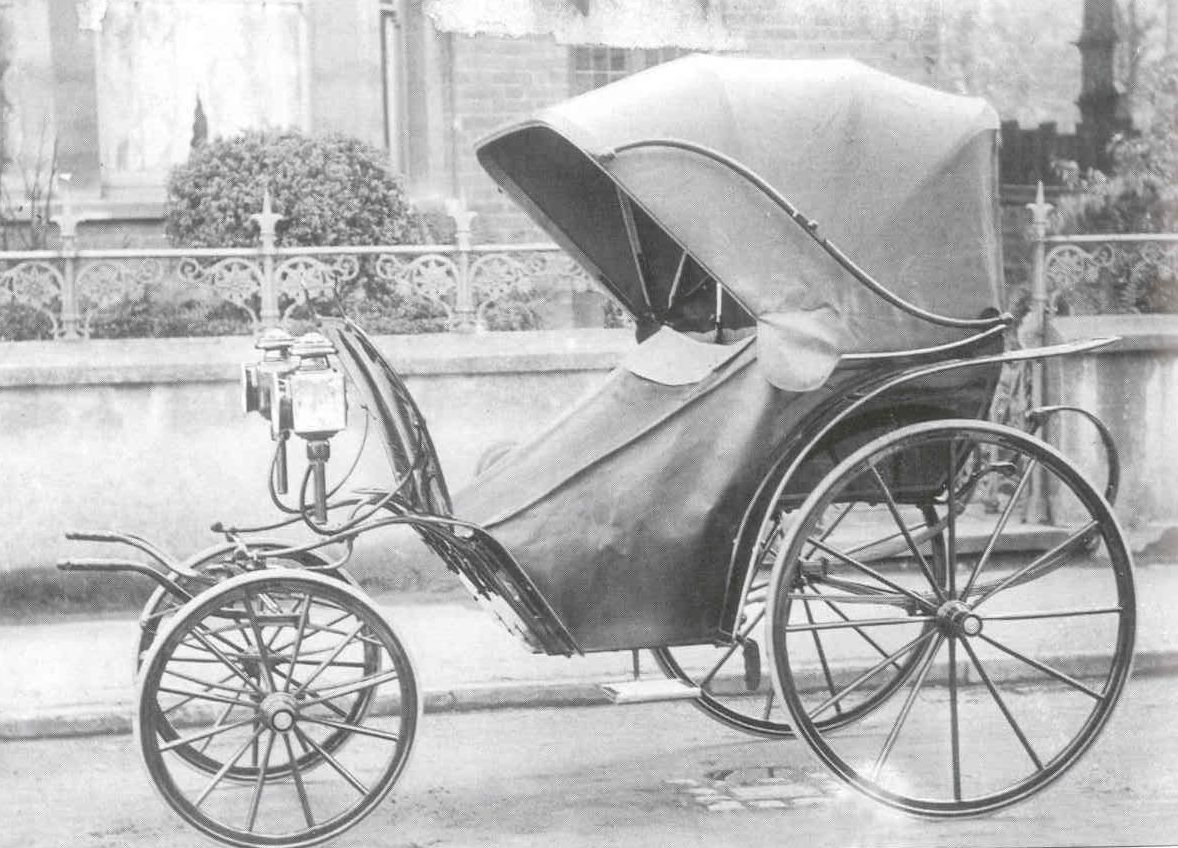
Pony phaeton (Source)

Then "a little pony phaeton" carrying Hortense and Rosa arrives. Lady Dedlock had sent for it, asking her maid to come -- meaning Rosa, though Hortense had apparently insisted that she was the one sent for.  "The Frenchwoman stood unnoticed, looking on with her lips tightly set," as Lady Dedlock offers to send the carriage back for Ada and Esther. Jarndyce declines, and Lady Dedlock "took a graceful leave of Ada -- none of me," Esther notes, and bids Rosa get into the carriage with her. As for Hortense,
She remained perfectly still until the carriage had turned into the drive, and then, without the least discomposure of countenance, slipped off her shoes, left them on the ground, and walked deliberately in the same direction, through the wettest of the wet grass.
"'Is that young woman mad?' said my guardian." The keeper says that she's just "mortal high and passionate -- powerful high and passionate; and what with having notice to leave, and having others put above her, she don't take kindly to it." And as Jarndyce, Ada and Esther return home, they see Hortense still striding through the wet grass.

In London, the omniscient narrator tells us, the courts have shut down for the long vacation, leaving all of the clerks idle, as well as the businesses that support the law, such as Mr Snagsby, the stationer. He and Mrs Snagsby are entertaining the Chadbands. Mr Chadband is a minister "attached to no particular denomination," who includes among his followers Mrs Snagsby. "'My little woman,' says Mr Snagsby to the sparrows in Staple Inn, 'like to have her religion rather sharp, you see!'"
Mr Chadband is a large yellow man, with a fat smile, and a general appearance of having a good deal of train oil in his system. Mrs Chadband is a stern, severe-looking, silent woman. Mr Chadband moves softly and cumbrously, not unlike a bear who has been taught to walk upright. He is very much embarrassed about the arms, as if they were inconvenient to him, and he wanted to grovel; is very much in a perspiration about the head; and never speaks without first putting up his great hand, as delivering a token to his hearers that he is going to edify them.
Chadband's "edification," however, typically consists of platitudes delivered in the most pompous and verbose manner possible. Still, as the narrator observes, "the Chadband style of oratory is widely received and much admired."

As the Snagsbys are entertaining the Chadbands, however, the servant, Guster, informs Mr Snagsby that he is wanted in the shop downstairs, where he finds a constable with Jo in his custody. The constable has ordered Jo to "move on," and Jo insists that there's nowhere for him to move on to. Jo has apparently indicated to the constable that Mr Snagsby can vouch for him, and although Mrs Snagsby has appeared at the top of the stairs to proclaim that he doesn't know the boy, Snagsby admits that he does.

Then Mr Guppy appears, and confirms Snagsby's acquaintance with Jo. The constable is still convinced that Jo is up to no good, partly because he lives in Tom-all-Alone's.  Moreover, Jo has money upon him, which is enough to convince the constable that Jo has been stealing. So Jo tells the story of being approached "by a lady in a wale" (i.e., veil) who gave him a sovereign to show her where Nemo lived, died, and was buried. The constable agrees to leave Snagsby in charge of Jo's moving on -- over Mrs Snagsby's protests -- and departs.

Intrigued by Jo's story of the veiled lady, Guppy begins asking questions, raising the curiosity of the others, so that Guppy and Jo are ushered upstairs to continue the interrogation. Guppy opines that "there is something out of the common here that beats anything that ever came into my way at Kenge and Carboy's," which is enough to have Mrs Chadband eager to hear more: She happens to be acquainted with Kenge and Carboy's. Before she married the Rev. Mr Chadband, she says, she "was left in charge of a child named Esther Summerson, who was put out in life by Messrs Kenge and Carboy's."

It's Guppy's turn to be astonished, though when he gasps, "Miss Summerson, ma'am!" he is rebuked by Mrs Chadband, who is apparently the Mrs Rachael who was servant to Esther's godmother/aunt. "'I call her Esther Summerson,' says Mrs Chadband, with austerity. 'There was no Miss-ing of the girl in my time. It was Esther. "Esther, do this! Esther, do that!" and she was made to do it.'"


The Rev. Chadband seizes upon this moment of astonishment to take the floor and sermonize on the topic of ... Jo, who is bewildered by everything that's going on, and "whose immediate object seems to be to get away on any terms." Guppy gives him a penny and Mr Snagsby loads him up with some of the table leftovers, and off he goes into the night.

Guppy, of course, is not going to let all these revelations go. He has been vexed by the arrival in the offices of Kenge and Carboy of Richard Carstone, but gratified "to find the new comer constantly poring over the papers in Jarndyce and Jarndyce; for he well knows that nothing but confusion and failure can come of that." So he gathers his friends, fellow law-clerks Young Smallweed and Tony Jobling, and invites them to dine with him.
Hablot Knight Browne (Phiz), Mr Guppy's Entertainment (Source: David Perdue's Charles Dickens Page)
After much Dickensian business about these swaggering striplings, during which we learn that Jobling was the one who accompanied Guppy to Chesney Wold, Guppy announces "a plan I have lately thought of proposing." It may, he stammers, "have some reference to a subject, which may -- or may not -- have cast its shadow on my existence" -- that is, of course, his failed proposal to Esther. He tells Jobling that in his duties at Kenge and Carboy's he has been delivering a weekly allowance to Miss Flite at Krook's, and that Krook has a room to let. Krook "must be precious old, you know, and he has not a soul about him, and he is reported to be immensely rich; and whether he is a smuggler, or a receiver, or an unlicensed pawnbroker, or a money-lender -- all of which I have thought likely at different times -- it might pay you to knock up a sort of knowledge of him."

Jobling is game, even when he learns that the room is where Krook's last lodger died. So they proceed to Krook's, where he is dead drunk. They manage to get him awake, and after treating him to a better quality of gin than he is used to, "Mr Guppy presents his friend under the impromptu name of Mr Weevle, and states the object of their visit." The result is that Jobling/Weevle is installed in the second-floor room, which he adorns with "copper-plate impressions from that truly national work, The Divinities of Albion, or Galaxy Gallery of British Beauty, representing ladies of title and fashion in every variety of smirk that art, combined with capital, is capable of producing." And in time the neighbor ladies are gossiping, "don't you be surprised Lord bless you, if that young man comes in at last for old Krook's money!"
_____

The 2005 BBC/Masterpiece Theatre dramatization features Burn Gorman as Guppy, Patrick Kennedy as Richard Carstone, Denis Lawson as John Jarndyce, Anna Maxwell Martin as Esther Summerson, Sally Leonard as Polly, Warren Clarke as Boythorn, Timothy West as Sir Leicester Dedlock, Gillian Anderson as Lady Dedlock, Nathaniel Parker as Harold Skimpole, Carey Mulligan as Ada Clare, Emma Williams as Rosa, Lilo Baur as Hortense, Sean McGinley as Snagsby, Robert Pugh as Mr Chadband, Catherine Tate as Mrs Chadband, Michelle Tate as Guster, Harry Eden as Jo, Dominic Coleman as Policeman, Johnny Vegas as Krook, Charles Dance as Tulkinghorn, Tom Georgeson as Clamb.