JOURNAL OF A COMPULSIVE READER
By Charles Matthews
Showing posts with label Stagg. Show all posts

Sunday, April 10, 2011

16. Barnaby Rudge, by Charles Dickens, pp. 613-652

Barnaby Rudge (Penguin Classics)Chapters 68-72
_____
Barnaby and his father make their way to the edge of the crowd and free themselves from the shackles. They move on to less inhabited parts of the city and find a shed where they spend the rest of the night and the following day. The following night, Rudge sends Barnaby in search of Stagg, but the blind man's house is empty.

After his release and his reunion with his father, Barnaby's view of the riots has changed: The town now seems "peopled by a legion of devils," and since he is no longer playing a leading role in the rioting, he sees it from a different perspective. He comes upon the mob besieging Langdale's house, and "there, in the midst, towering above them all, close before the house they were attacking now, was Hugh on horseback, calling to the rest!" He forces his way through the mob "and in time was nearly up with Hugh, who was savagely threatening some one, but whom or what he said, he could not, in the great confusion, understand. At that moment the crowd forced their way into the house, and Hugh -- it was impossible to see by what means, in such a concourse -- fell headlong down."

Hugh gets to his feet, but the blow (delivered, as we know, by Edward Chester) has left him confused, and the horse has kicked him in the head while he was down. After a moment he recognizes Barnaby and asks him where Dennis is, then collapses, "already frantic with drinking and with the wound in his head." The casks in the vintner's house have been breached and the street is running with their contents, some of it on fire. Hugh "crawled to a stream of the burning spirit which was pouring down the kennel, and began to drink as if it were a brook of water." Barnaby gets him to his feet, but he is unable to stand or walk, and he climbs up on the back of the horse. Barnaby leads the horse, which is still festooned with chains, away from the scene.

Dickens's descriptions of the riots have become increasingly more lurid, and they reach a peak here, with an account of people literally drinking themselves to death:
The gutters of the street, and every crack and fissure in the stones, ran with scorching spirit, which being dammed up by busy hands, overflowed the road and pavement, and formed a great pool, into which the people dropped down dead by dozens. They lay in heaps all round this fearful pond, husbands and wives, fathers and sons, mothers and daughters, women with children in their arms and babies at their breasts, and drank until they died. While some stooped with their lips to the brink and never raised their heads again, others sprang up from their fiery draught, and danced, half in a mad triumph, and half in the agony of their suffocation, until they fell, and steeped their corpses in the spirit that had killed them.... From the burning cellars, where they drank out of hats, pails, buckets, tubs, and shoes, some men were drawn, alive, but all alight from head to foot; who, in their unendurable anguish and suffering, making for anything that had the look of water, rolled, hissing, in this hideous lake, and splashed up liquid fire which lapped in all it met with as it ran along the surface, and neither spared the living nor the dead.

Barnaby leads the horse toward the shed where his father is, but stops about half a mile from it and removes the chains from the horse and sets it loose in the fields. Then he helps Hugh to the shed where his father, in a paranoid fit, accuses Barnaby of meeting with Mrs. Rudge and betraying him. Barnaby assures him that nothing of the sort has happened, and tells him that he was unable to find Stagg. Finally Barnaby is able to bring Rudge to his senses -- almost. He explains that Hugh "would have been killed if I had left him over yonder. They were firing guns and shedding blood. Does the sight of blood turn you sick, father? I see it does, by your face. That's like me -- What are you looking at?" Rudge is looking over Barnaby's head, where presumably he sees the ghost of the man he murdered.

They settle the unconscious Hugh in the shed and fall asleep, but Barnaby awakes early and is reminded by the pleasantness of the morning of better times, though "He had no consciousness, God help him, of having done wrong, nor had he any new perception of the merits of the cause in which he had been engaged, or those of the men who advocated it." His father also awakes, and sends him back into the city to look for the blind man, insisting that he must stay until he finds him, no matter how long it takes.

At sundown, Barnaby returns with Stagg. Rudge sends Barnaby to talk to Hugh, who is finally emerging from his stupor, and takes Stagg aside to hear that Mrs. Rudge has been hospitalized since her separation from Barnaby, but that she refuses to come to terms with Rudge, saying "that Heaven would help her and her innocent son; and that to Heaven she appealed against us." He advises Rudge to take Barnaby and get as far away from London as possible. He assures him that Mrs. Rudge will eventually give in. When Rudge asks how they will support themselves, Stagg slaps his pocket and says "the streets are running money," then calls out for Hugh to share the flask he has brought.

Hugh appears, "Exhausted, unwashed, unshorn, begrimed with smoke and dust, his hair clotted with blood, his voice quite gone, so that he spoke in whispers; his skin parched up by fever, his whole body bruised and cut, and beaten about." As Hugh is drinking from Stagg's flask, Dennis darkens the door of the hut and greets Barnaby by name, though he doesn't seem to know Stagg or Rudge. He explains that he knew from the sound of the chains on the horse which direction Hugh had taken. This is the first they've seen of each other since their encounter at the prison when Dennis was trying to keep the condemned men from being freed. Hugh asks, "Where did you go when you left me in the jail? Why did you leave me? And what did you mean by rolling your eyes and shaking your fist at me, eh?" Hugh has suspected that Dennis deserted the rioters, but Dennis denies it.

But not for long: Barnaby sights the soldiers hiding behind a hedgerow. Dennis gives the signal and "the shed was filled with armed men; and a body of horse, galloping into the field, drew up before it." Dennis identifies Barnaby and Hugh as "them two young ones, gentlemen, that the proclamation puts a price on." And now he fingers Rudge, too, as "an escaped felon." Stagg, however, had heard the soldiers before Barnaby sighted them, and made his escape. He "was now seen running across the open meadow," and the soldiers fire and kill him. Dennis is disconsolate because here's someone he can't hang: "What's to become of the country if the military power's to go a superseding the ciwilians in this way?"

Barnaby and his father are marched off on foot, while Hugh is bound to a horse and guarded by cavalry. Hugh is certain that he'll be freed by the mob, but when they reach Fleet Market he sees that the military is in full control "and felt that he was riding to his death."
"Having taken up arms and resorted to deeds of violence, with the great main object of preserving the Old Baily in all its purity, and the gallows in all its pristine usefulness and moral grandeur," Dennis now goes to the house where Emma and Dolly -- and Miggs -- are being kept. Their abduction, he realizes, could still get him in trouble, and he needs to resolve that problem immediately. When he enters the room where the three women are confined, Miggs immediately makes a scene, while Dolly and Emma shrink into a corner. Dennis pays court to Miggs.
He asks when she saw Sim Tappertit last, and tells her that Sim had "meant all along to carry off" Dolly -- "And to hand you over to somebody else." So he hints that he will get Dolly "out of the way" if "you'll only be quiet and slip away at the right time." Then it occurs to him that he also has to deal with Emma, and that Gashford has designs on her. Miggs informs him that she had heard Hugh and Sim say that Emma "was to be removed alone (not by them, but by somebody else), to-morrow night." So he tells Miggs that he would find "some daring young fellow" among the rioters to carry off Dolly. "With regard to Dolly, the gentleman would exercise his own discretion. He would be bound to do nothing but to take her away, and keep her away. All other arrangements and dispositions would rest entirely with himself." Miggs is more than happy with this plan -- though she pretends not to have heard him at all -- and Dennis sets off to make his arrangements.

The next day, Emma, Dolly, and Miggs remain locked in the room, but they can hear coming and going in the outer room where the men guarding them had been stationed. The sounds are unusually subdued, however, in contrast to the boisterous noise that had been made while the riots were at their height. Then they hear moans, as if a sick man had been brought into the outer room. Dolly is particularly upset because she knows that both Hugh and Sim have their eyes on her, and the idea of having to yield to either of them is repugnant. Miggs becomes more annoying than ever when she decides that it is her duty to convert Emma to Protestantism.

When night comes, they are left in darkness -- before this, "their jailers had been regular in bringing food and candles"-- and they hear "now and then a moan which seemed to be wrung from a person in great pain, who made an effort to subdue it, but could not." Miggs's carrying-on provokes Dolly to tell her to hold her tongue, which instead unleashes from Miggs a wonderful Dickensian monologue:
"Ho yes! I am a abject slave, and a toiling, moiling, constant-working, always-being-found-fault-with, never-giving-satisfactions, nor-having-no-time-to-clean-oneself, potter's wessel -- an't I, miss! Ho yes! My situations is lowly, and my capacities is limited, and my duties is to humble myself afore the base degenerating daughters of their blessed mothers as is fit to keep companies with holy saints but is born to persecutions from wicked relations -- and to demean myself before them as is no better than Infidels -- an't it, miss! Ho yes! My only becoming occupations is to help young flaunting pagins to brush and comb and titiwate theirselves into whitening and seppulchres, and leave the young men to think that there an't a bit of padding in it nor no pinching ins nor fillings out nor pomatums nor deceits nor earthly wanities -- an't it, miss! Yes, to be sure it is -- ho yes!"
This diatribe is finally stilled by the sound of knocking at the house door, then a struggle in the outside room. Believing that someone has come to rescue them, Emma and Dolly cry out for help, and a man carrying a sword and a candle rushes into their room. He assures Dolly that her friends will be there soon, and tells Emma that her uncle "has succeeded where many of our creed have failed, and is safe -- has crossed the sea, and is out of Britain." But, he tells her, the soldiers have joined league with the rioters and the people are united against the Catholics, so that she will be unable to follow her uncle without his help. "I have the means of saving you; and in redemption of my sacred promise, made to him, I am here; pledged not to leave you until I have placed you in his arms."

Emma quite sensibly wants to make sure she can trust him and asks for "some note or token from my uncle." And Dolly is even more suspicious: "I am sure he doesn't. Don't go with him for the world!" The man calls her a "pretty fool" and says that he didn't bring anything in writing with him for fear it might lead to his capture, and that he never thought of some "other token, nor did Mr Haredale think of entrusting me with one -- possibly because he had good experience of my faith and honesty, and owed his life to me."

Dolly still isn't buying this, and begs Emma not to trust him. Emma suggests that Dolly go with them, and the man says transporting two women through the streets is impossible, and anyway, Dolly will be rescued shortly. Emma tells her, "I will trust to this gentleman," but Dolly clings to her in tears. The man then separates them and pulls Emma toward the door, calling out to someone outside, "are you ready?"

But the voice that answers his call isn't one that he expects to hear. "And in an instant he was felled like an ox in the butcher's shambles." Haredale and Mr. and Mrs. Varden rush into the room, and the women fall into their arms.
Behind them are Edward Chester and Joe Willet. Edward had knocked down the man (who is Gashford, of course) and Joe has his foot planted on his chest. Gashford tries to bargain with Haredale: He has incriminating information of all sorts about Lord George Gordon, but if he's ill-treated he won't reveal it. But Joe tells him to get up and leave: "you're waited for, outside." Gashford exits with "a baffled malevolence, yet with an air of despicable humility." 

As they leave through the outer room, they discover "Mr Dennis in safe keeping" and Sim Tappertit "burnt and bruised, and with a gun-shot wound in his body; and his legs -- his perfect legs, the pride and glory of his life, the comfort of his existence -- crushed into shapeless ugliness." 

They travel to the Black Lion tavern, where they are joined by John Willet, who is still not quite right in the head. Among other things, he is puzzled by his son's missing arm, "which he had never yet got himself thoroughly to believe, or comprehend." He stares at the empty sleeve and keeps finding ways of feeling it, until he concludes, "It's been took off!" The landlord of the Black Lion prompts Joe to tell his father where it happened: "At the defence of the Savannah, father," Joe says. (The siege of Savannah, Georgia, an attempt by American forces to take control of the city from the British, took place in September and October, 1779.)  Joe also explains that Savannah is "In America, where the war is." (We learn that "the same information had been conveyed to him in the same terms, at least fifty times before.") 

Finally, Dolly is left by herself and Joe comes to talk to her. After the night he came to see her, he tells her, "I have been abroad, fighting all the summer and frozen up all the winter, ever since. I have come back as poor in purse as I went, and crippled for life besides.... I did hope once ... that I might come back a rich man, and marry you. But I was a boy then, and have long known better than that.... It's a comfort to me to know that you'll talk to your husband about me; and I hope the time will come when I may be able to like him, and to shake hands with him, and to come and see you as a poor friend who knew you when you were a girl." And he leaves.  

Friday, April 8, 2011

14. Barnaby Rudge, by Charles Dickens, pp. 534-576

Barnaby Rudge (Penguin Classics)Chapters 59-63
_____
We now discover what has happened to Emma and Dolly: Hugh abducted them, and they are being kept in "an old post-chaise or chariot," guarded by Sim and Dennis. Ascertaining that the coast is clear, they now set off toward London, avoiding the main road.

"Miss Haredale, whose feelings were usually of a quieter kind than Dolly's, and no so much on the surface, was dreadfully alarmed, and indeed had only just recovered from a swoon." She is especially worried about her uncle, and "the idea that he had fallen in a general massacre of the Catholics that night -- no very wild or improbably supposition after what they had seen and undergone -- struck her dumb." Dolly is anything but dumb, but her thoughts now turn to Joe Willet.
When they reach London after midnight and stop in a lonely place, "Hugh suddenly opened the door, jumped in, and took his seat between them." They struggle as he tries to kiss them, and Emma faints, which pleases Dennis: "I always like 'em to faint, unless they're very tender and composed." They're taken into "a miserable cottage," where Dolly emits "a scream of joy" when Sim Tappertit enters, thinking that he has arrived with her father to rescue them. But when she realizes that Sim is one of their abductors, she "hid her face in her hands; and sobbed more bitterly than ever," and when he proclaims himself her husband, "Dolly, goaded to desperation, wound her hands in his hair, and crying out amidst her tears that he was a dreadful little wretch, and always had been, shook, and pulled, and beat him, until he was fain to call for help, most lustily. Hugh had never admired her half so much as at that moment."
They leave the two women there, warning them that the place is well-guarded, and that if they make any attempt to escape, passers-by and neighbors will be told that they're Catholics "and all the exertions our men can make, may not be able to save your lives." As they leave, Sim tells Hugh, "you shall have Miggs (her that I promised you, you know) within three days." The statement leaves Hugh helpless with laughter.

Hugh, Sim, and Dennis proceed to The Boot, but they are met by one of their company who has been warning everyone away from the inn because it has been occupied by soldiers. "He had not heard a word of Barnaby -- didn't even know his name -- but it had been said in his hearing that some man had been taken and carried off to Newgate." So they hurry to Fleet Market where they find some of their fellow rioters in a pub. While they are asking for information there, a man arrives asking for Hugh. It is "A one-armed man, with his head and face tied up with a bloody cloth, as though he had been severely beaten." He tells Hugh that Barnaby is in Newgate, and that he "was one of the few who tried to rescue him, and he called to me and told me to tell Hugh where he was." In the uproar that follows this news, the one-armed man, whose "face was nearly hidden by the bandage," is forgotten and disappears. There is a rush for the door by those who want to go lay siege to Newgate immediately, but Hugh and Dennis calm them down: It's broad daylight, they point out, and it would be best to wait for night and plan their attack. Then, Hugh says, they will burn "every jail in London."

In the meantime, Haredale and Solomon Daisy have taken their prisoner, Rudge, to Chigwell, hoping to find support in their efforts to take him to London and jail. But the townsfolk are too terrified of the rioters to help, saying that the rioters had told them that anyone who helped Haredale would be punished. Finally he locates a chaise and a pair of horses, and "the post-boy of the village -- a soft-hearted, good-for-nothing, vagabond kind of fellow -- was moved by his earnestness and passion, and, throwing down a pitchfork with which he was armed, swore that the rioters might cut him into mincemeat if they liked, but he would not stand by and see an honest gentleman who had done no wrong, reduced to such extremity." He accompanies them with their prisoner to London.

Along the way they encounter even more terrified people who refuse to assist them, and they are told that the magistrates are so intimidated that they probably won't "have the hardihood to commit a prisoner to jail, on his complaint." By dawn they reach the Mansion House, the residence of the Lord Mayor of London, where "a portly old man, with a very red, or rather purple face" is pleading for protection from the rioters, who have threatened to burn his house down. The Lord Mayor is refusing to help, arguing that "There are great people at the bottom of these riots" -- which the note tells us is a direct quote from the actual Lord Mayor of the time, Brackley Kennett, in response to an appeal from a Catholic for aid.

Haredale explains that he is not there because his house was burned down but because he had captured a murderer, and "The least delay may involve his being rescued by the rioters." This only produces more sputtering reluctance, and a reassertion of the "great people" excuse, from the Lord Mayor. Haredale persists, "Every second's delay on your part loosens this man's bloody hands again, and leads to his escape." When the Lord Mayor asks Haredale if he's a Catholic, and he says yes, "'God bless my soul, I believe people turn Catholics a'purpose to vex and worrit me,' cried the Lord Mayor. 'I wish you wouldn't come here; they'll be setting the Mansion House afire next, and we shall have you to thank for it." And he retreats to his bedroom and bolts the door. Before Haredale departs, the other man introduces himself as Langdale, a vintner and distiller, and invites him to stay at his house in Holborn Hill, if it's still standing.

Haredale then goes to Sir John Fielding's house, where he finally succeeds in having Rudge committed to Newgate. Three armed men then escort Rudge in the carriage to the prison, where Haredale sees him chained and locked in his cell. But now he is "tortured by anxiety for those he had left at home; and that home itself was but another bead in the long rosary of his regrets."
In his cell, Rudge is visited by Stagg, to whom he tells the story of how he was caught. He had gone to Chigwell because when he discovered that Haredale was staying on watch at Mrs. Rudge's house he knew he could never escape from him as long as Haredale was alive. So he decided to join the mob that planned to destroy the Warren. But the alarm bell had unnerved him, and he didn't reach the house until after the mob had dispersed and the damage had been done. When he heard Haredale arrive there too, he decided to hide in the ruins of the turret. But as Haerdale followed him into the ruins, Rudge had a vision of the gardener, who had witnessed his murder of Reuben Haredale. Rudge had murdered the gardener, dressed him in his own clothes, and thrown the body into the pond, all to cover up the first murder. In his vision, the gardener "raised above his head a bloody hand ... and fixed his eyes on me. I knew the chase would end there."

After the murders, Rudge told his wife, who called "on Heaven to witness that she and her unborn child renounced me from that hour." Stagg informs Rudge that his wife is in London, and that his son has joined the rioters. He proposes to visit Mrs. Rudge and tell her that he will persuade Barnaby to leave the rioters and return to her, if she will testify under oath that Rudge is dead and that the man imprisoned in Newgate is not him. Rudge finds a glimmer of hope in this plot, and Stagg takes his leave.

Rudge now goes out into the courtyard "and paced it to and fro; startling the echoes, as he went, with the harsh jangling of his fetters." Another cell near his has an open door, and Barnaby appears in it. He recognizes his son, and after a little reflection, Barnaby recognizes him as the man who robbed Edward Chester and attacks him. They struggle for a moment until Rudge says, "I am your father." Barnaby hesitates for a moment and hugs him. "Grip croaked loudly, and hopped about them, round and round, as if enclosing them in a magic circle, and invoking all the powers of mischief."
The military is still trying to persuade the magistrates, "and in particular the Lord Mayor, who was the faintest-hearted and most timid of them all," to give them the authority to crack down on the rioters. And the mob used their reluctance for propaganda, "boasting that even the civil authorities were opposed to the Papists, and could not find it in their hearts to molest those who were guilty of no other offence." The crowd has so intimidated the city that "If any man among them wanted money, he had but to knock at the door of a dwelling-house, or walk into a shop, and demand it in the rioters' name; and his demand was instantly complied with." 

Preparing for their assault on Newgate, Hugh, Dennis, and Sim lead a crowd to Varden's house, where they want his aid in opening the locks to the prison. The shop is closed and the door and shutters are closed and sturdy, and they are threatening to set fire to the house when Gabriel appears at an upstairs window and tells them, "Begone! and rob an undertaker's while you can! You'll want some coffins before long." Hugh orders someone to set fire to the door, but Gabriel shows them that he has a gun and points it at the man who is attempting to start the fire; he moves back. 

Hugh takes a torch and is about to set the fire himself, "when he was arrested by a shrill and piercing shriek." It's Miggs, in the attic. She calls for Sim, who reluctantly responds, and she tells them that Gabriel's gun is useless: "I poured a mug of table-beer right down the barrel." She goes on to proclaim that "my endeavours has always been, and always will be, to be on the right side -- the blessed side -- and to prenounce the Pope of Babylon, and all her inward and her outward workings, which is Pagin." Meanwhile, the crowd has raised a ladder to the window where Gabriel has been standing and they break their way into the room. 

Dennis is, as usual, all for hanging Gabriel, but Hugh tells the locksmith to do what they want him to do. "Gabriel was in imminent peril, and he knew it; but he preserved a steady silence; and would have done so, if they had been debating whether they should roast him at a slow fire." Someone calls out, "He has a grey head. He is an old man: Don't hurt him!" It's almost as if (hint, hint) Gabriel recognizes the voice: "The locksmith turned, with a start, towards the place from which the words had come, and looked hurriedly at the people who were hanging on the ladder and clinging to each other." But he responds by defying them, which angers them more, so that Hugh has to remind them that they need the locksmith's services. Sim tells Varden that they know he made the lock to the great door of the prison and now they need his help in opening it. Gabriel refuses, and Hugh tells Sim to gather the tools they'll need and he'll take charge of Gabriel. 

The mob roams through the house, "plundering and breaking, according to their custom, and carrying off such articles of value as happened to please their fancy." Meanwhile, Miggs has been screaming constantly, and a man asks if she should be released. Sim reluctantly says yes, and the man goes to the attic and comes back "with Miss Miggs, limp and doubled up, and very damp from much weeping." She comes back to life suddenly and hurls herself at Sim, who finally persuades one of the bystanders to carry her off. Gabriel is marched off by the crowd to Newgate.
 

Tuesday, April 5, 2011

11. Barnaby Rudge, by Charles Dickens, pp. 415-440

Barnaby Rudge (Penguin Classics)Chapters 45-47
_____
Barnaby and his mother have found "a small English country town" where they have been "living in a quiet poverty which knew no change, no pleasures, and few cares but that of struggling on from day to day in one great toil for bread." The hut in which they live is near the high road, but in a secluded area where few people came. Mrs. Rudge eagerly reads whatever newspapers she finds and listens to whatever talk about the outside world, but always with "the keenest anxiety and dread."
 Grip the raven is actually a source of income for them: People are amazed by his vocal tricks, and reward them with money. But Barnaby is restless and conscious of their poverty, though his mother warns him that gold "has brought such misery and suffering on your head and mine as few have known."

Then one day a man arrives at their hut, and Mrs. Rudge sees that he's blind. The reader knows that the odds of Dickens putting more than one ragged blind man in his novel are slim, and guesses that the man is Stagg, which means that his lodger, the sinister stranger, must be somewhere nearby. But Mrs. Rudge doesn't suspect anything at first, and offers him hospitality. He takes a few pence from his purse and sends Barnaby to buy some bread for him to take on his journey, but when Barnaby is gone, his manner changes, and he introduces himself as Stagg, and informs her, "A friend of mine who has desired the honour of meeting with you any time these five years past, has commissioned me to call upon you. I would be glad to whisper that gentleman's name in your ear." She realizes who the "friend" is, but allows him to tell her the name, after which "she paced up and down the room like one distracted."
"If you are very poor now, it's your own choice," he tells her. "You have friends who, in case of need are always ready to help you. My friend is in a more destitute and desolate situation than most men, and, you and he being linked together in a common cause, he naturally looks to you to assist him." He demands twenty pounds from her: "You, who can give up an annuity, can get that sum for him." He gives her twenty minutes to decide what to do, then sits down with his legs across the threshold to make sure no one enters or leaves without his knowledge.

Barnaby returns with the bread, and Stagg, who has bought along a jug of whiskey, gives some to him. Barnaby's eyes water and he coughs, but he says he likes it. And Stagg plays on Barnaby's desire to end their poverty, telling him that there are "A hundred ways" to get rich, but "not in solitary places like those you pass your time in, but in crowds, and where there's noise and rattle." Barnaby says that he and Grip like places like that.

Mrs. Rudge, overhearing this seduction of Barnaby, asks if she can talk to Stagg away from his hearing, and she asks if Stagg's "friend" has left London for good. Stagg says yes, "The truth is, widow, that hismaking a longer stay there might have had disagreeable consequences." She gives him six guineas, the savings, she says, of five years, and tells him that if he wants more -- which he does -- he will have to give her time to write for it. Stagg agrees to a week, and that he will meet her at the corner of the lane where they live "this day week at sunset." And he cautions her to think about Barnaby. She points him in the direction of the road, and he leaves.

When she returns to the hut, she tells Barnaby that he mustn't go out that night -- "There are ghosts and dreams abroad" -- and that they will leave tomorrow and go to London, to "lose ourselves in that wide place -- there would be some trace of us in any other town -- then travel on again, and find some new abode." The next morning they leave, though Barnaby sheds tears when he realizes he will have to leave behind the neighborhood dogs who have been his only friends there.

She has kept back a guinea from their savings. "Moreover they had Grip, in company; and when they must otherwise have changed the guinea, it was but to make him exhibit outside an alehouse door, or in a village street, or in the grounds or gardens of a mansion of the better sort, and scores who would have given nothing in charity, were ready to bargain for more amusement from the talking bird." One day they reach an estate where they decide to try to exhibit Grip, but the owner denounces them as "vagrants and vagabonds" and threatens to have them arrested. When Grip pipes up, the man's curiosity is piqued. "'Take the vermin out, scoundrel,' said the gentleman, 'and let me see him.'" He then orders them to accompany him to the house.

On the way, he terrifies Barnaby by his "proud and course manner," and when he threatens to horsewhip him for not answering a question, Mrs. Rudge tells him "that her son was of weak mind." He refuses to believe it, "not a bit of it. It's an excuse not to work. There's nothing like flogging to cure that disorder. I'd make a difference in him in ten minutes, I'll be bound." She protests that she's telling the truth, and he retorts, "Then why don't you shut him up? we pay enough for county institutions, damn 'em. But thou'd rather drag him about to excite charity -- of course. Ay, I know thee."
Now, this gentleman had various endearing appellations among his intimate friends. By some he was called "a country gentleman of the true school," by some "a fine old country gentleman," by some "a sporting gentleman," by some "a thorough-bred Englishman," by some "a genuine John Bull"; but they all agreed in one respect, and that was, that it was a pity there were not more like him, and that because there were not, the country was going to rack and ruin every day.... He mistrusted the honesty of all poor people who could read and write, and had a secret jealousy of his own wife (a young lady whom he had married for what his friends called "the good old English reason," that her father's property adjoined his own) for possessing those accomplishments in a greater degree than himself. In short, Barnaby being an idiot, and Grip a creature of mere brute instinct, it would be very hard to say what this gentleman was.
It's a fine characterization of a type that unfortunately hasn't vanished from the scene but appears to have moved to America and joined some current political movements.
In the house, we meet his wife, "a lady much younger than himself, who had the appearance of being in delicate health, and not too happy." But Grip amuses her with his performance and "so delighted her husband that he burst into a roar of laughter, and demanded his price." When they refuse to sell the raven, the man is outraged: "These peole, who go tramping about the county a-pilfering and vagabondising on all hands, prefer to keep a bird, when a landed proprietor and a justice asks his price!" He orders them out, threatening to turn the dogs on them, and they hurry away.

"When they had nearly reached the lodge, another servant, emerging from the shrubbery, feigned to be very active in ordering them off, but this man put a crown into the widow's hand, and whispering that his lady sent it, thrust them gently from the gate." Mrs. Rudge is surprised when that stop at an alehouse later on the way to hear the man praised. And then Dickens indulges in some awkwardly conventional foreshadowing: "She little thought then, that a circumstance so slight would ever influence their future fortunes; but time and experience enlightened her in this respect."

As they near London, Barnaby asks his mother if they will see the blind man there: "I wish that we may meet with him again. What was it that he said of crowds? That gold was to be found where people crowded, and not among the trees and in such quiet places." She is disturbed when he returns to the point again and again, "that the blind man's visit, and indeed his words, had taken strong possession of his mind."

On Friday, June 2, 1780, they reach London and stand alone at the foot of Westminster Bridge. (A note points out that Dickens had put Stagg's arrival at Mrs. Rudge's hut in June earlier, an obvious inconsistency.)

Thursday, March 31, 2011

5. Barnaby Rudge, by Charles Dickens, pp. 167-217

Barnaby Rudge (Penguin Classics)Chapters 15-20
_____
John Chester has returned home to the Temple -- "a room in Paper Buildings -- a row of goodly tenements, shaded in front by ancient trees, and looking, at the back, upon the Temple Gardens." From the window as he breakfasts he sees his son, Edward, sitting on a bench. He has been waiting, apparently, to confront his father, and finally makes his move. John greets him with his usual languid affectation, and Edward launches into the substance of his visit: "I know where you were last night -- from being on the spot, indeed -- and whom you saw, and what your purpose was."
He reproaches his father for what he has done, insisting that he loves Emma Haredale, but his father scoffs, "you do nothing of the kind. You don't know anything about it. There's no such thing, I assure you." Edward says, "From my childhood I have been accustomed to luxury and idleness, and have been bred as though my fortune were large, and my expectations almost without a limit.... I have been, as the phrase is, liberally educated, and am fit for nothing." He no longer wants to be dependent on his father and asks, "Will you give me the means of devoting such abilities and energies as I possess, to some worthy purpose?"

His father retorts that he has given him all that he can, which is "being of good family." He married Edward's mother for her money, which her father was willing to allow because the Chesters were socially superior ("I fear his father dealt in pork," John comments). "She stepped at once into the politest and best circles, and I stepped into a fortune which I assure you was very necessary to my comfort -- quite indispensable. Now, my good fellow, that fortune is among the things that have been. It is gone, Ned, and has been gone" for eighteen or nineteen years. He lives "upon an inconsiderable annuity and my past reputation." As for doing anything for Edward, he has given him an entree into society and now expects Edward to "provide for me in return" by marrying well.

Edward is indignant that his father wants him to be "A mere fortune-hunter!" But John shrugs it off as in the nature of things, and says he was amazed to find that Edward was unaware of it: "how you can ever have mistaken our positions and designs, I confess I cannot understand. I conceived, until I found your fancy for this girl, that all these points were tacitly agreed upon between us." Besides, "In a religious point of view alone, how could you ever think of uniting yourself to a Catholic, unless she was amazingly rich." Moreover, "The very idea of marrying a girl whose father was killed, like meat! Good God, Ned, how disagreeable! ... I really think the girl ought to have been put to death by the state to prevent its happening." Then he admits that he is "perhaps" teasing about this, but he leaves his son "in what appeared to be a kind of stupor."

Dickens then gives us a picture of London at night, where even "in the lightest thoroughfares, there was at every turn some obscure and dangerous spot whither a thief might fly or shelter, and few would care to follow; and the city being belted round by fields, green lanes, waste grounds, and lonely roads, dividing it at that time from the suburbs that have joined it since, escape, even when the pursuit was hot, was rendered easy."
This is a prelude to the reappearance of our mysterious stranger, who is a "man from whom many as uncouth and fierce as he, shrunk with an involuntary dread."
Directly it was dark, he was abroad -- never in company with any one, but always alone; never lingering or loitering, but always walking swiftly; and looking (so they said who had seen him) over his shoulder from time to time, and as he did so quickening his pace.
He has been noticed by others -- footpads, beggars, vagrants, grave-robbers -- and one of them ventured to tell him, "There are tales among us that you have sold yourself to the devil, and I know not what." The stranger replies, "We all have, have we not?" and warns him, "I carry arms which go off easily -- they have done so, before now -- and make it dangerous for strangers who don't know the trick of them, to lay hands upon me."

He makes his way over London Bridge and into Southwark where he sees Mrs. Rudge out shopping and follows her home, then makes his way inside with her. He demands food and drink, and she identifies him as "the robber on the Chigwell road ... And nearly a murderer then." He admits as much. He also tells her that he won't hurt her, "But I will not be taken alive; and so surely as you threaten me above your breath, I fall a dead man on this floor," and takes out a pistol. She brings him food and drink, "and he ate with the voracity of a famished hound." Then they hear a noise outside, and she tells him, "Hark to that foot upon the ground. Do you tremble to hear it! It is my son, my idiot son." The man tells her to let him in, "I fear him less than the dark, houseless night." But she refuses: "Evil will fall upon him, if you stand eye to eye."

It's clear, of course, that Mrs. Rudge recognizes him, and that he has more significance to her than Dickens is willing to let on at this point -- or willing to do more than hint at. The excessive melodrama of the scene -- the man's villainous poses, Mrs. Rudge's cries to heaven -- is a result of the evasiveness about the character's identity. As a mystery, it's a flimsy one, a weakness in the armature of the novel that makes Barnaby Rudge one of the less successful of Dickens's novels. But we have to play along with it for a while.

When Barnaby calls out to be let in, the man recognizes his voice: "It was he who grappled with me in the road." He grabs a knife from the table and hides in the closet just as Barnaby raises the window and climbs in.
Barnaby remains ignorant of the man hiding in the closet, but the raven, which he has carried in a basket on his back, doesn't: "Grip -- alive to everything his master was unconscious of -- had his head out of the basket, and in return was watching him with his glistening eye." Barnaby tells his mother that he has been doing something today but "it's a secret, mind, and only known to me, and Grip, and Hugh. We had the dog with us, but he's not like Grip, clever as he is, and doesn't guess it yet, I'll wager." Then he notices his mother's uneasiness, and grows frightened: "'There's -- there's none of this about, is there?" and he clasps the birthmark on his wrist. (See chapter 5.) She calms him, and he continues with his story: He and Hugh have been waiting in the forest with a dog that they plan to sic onto the man who attacked Edward Chester. Barnaby wraps an handkerchief around his head and pulls his coat around him "and stood up before her: so like the original he counterfeited, that the dark figure peering out behind him might have passed for his own shadow." Barnaby vows that they'll catch the man and bring him to London for trial and to be hanged "if we have luck. So Hugh says."

Mrs. Rudge is naturally even more upset by all of this, and she tries to get Barnaby to go to bed, but he says he prefers to lie by the fire and watch "the wild faces" in the coals. He has supper and asks his mother if it's his birthday because "I have always seen you -- I didn't let you know it, but I have -- on the evening of that day grow very sad. I have seen you cry when Grip and I were most glad; and look frightened with no reason; and I have touched your hand, and felt that it was cold -- as it is now."

Finally, Barnaby falls asleep by the fire. "The widow, scarcely venturing to breathe, rose from her seat. The man glided from the closet, and extinguished the candle. Grip begins to chatter noisily, but it doesn't wake Barnaby. The man looks at Barnaby and says, "In him, of whose existence I was ignorant until to-night, I have you in my power.... I am destitute and starving, and a wanderer upon the earth. I may take a sure and slow revenge." And he points at Barnaby as he leaves.

The man goes in search of a place to spend the night and "was passing down a mean street, when from an alley close at hand some shouts of revelry arose, and there came straggling forth a dozen madcaps, whooping and calling to each other." Thinking he can find a public house to spend the night in, he looks for the place they came from, and dodges into a doorway when he hears people talking and a man comes forward with a light.
It's "a young man of small stature and uncommon self-importance, dressed in an obsolete and very gaudy fashion." In other words, it's Sim Tappertit leaving a meeting of the 'Prentice Knights, having his way lighted by Stagg. From his hiding place, the man can see that Stagg is blind, but Stagg's hearing is sharp and he senses the man's presence. After Sim has left, the man approaches Stagg and asks for lodging, and being refused, begs him for it and offers payment. Stagg gives in and finds a room for him in the cellar, but after the man falls asleep, Stagg kneels down beside him and passes "his hand lightly but carefully over his face and person." Then he waits and listens by the man until daylight.
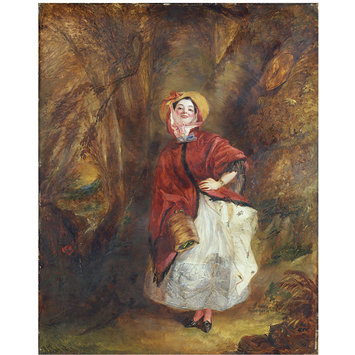
Dolly Varden, by William Powell Frith, 1842

It has been three days since Dolly disappointed Joe Willet by deserting him for a party, and she is still cherishing memories of it, including being flirted with by a young coachmaker. Edward Chester arrives at the Vardens as they are having breakfast, to ask if Dolly will take a message for him to the Warren. But Mrs. Varden associates the Warren with the Maypole and uses this occasion to throw a very funny fit. (Mrs. Varden's fit seems even funnier after the dreary melodrama at Mrs. Rudge's.) 
Mrs Varden wept, and laughed, and sobbed, and shivered, and hiccoughed, and choked; and said she knew it was very foolish but she couldn't help it; and that when she was dead and gone, perhaps they wouldn't be sorry for it -- which really under the circumstances did not appear quite so probable as she seemed to think -- with a great deal more to the same effect. In a word, she passed with great decency through all the ceremonies incidental to such occasions; and being supported upstairs, was deposited in a highly spasmodic state on her own bed, where Miss Miggs shortly afterwards flung herself upon the body.
The whole display takes place because Mrs. Varden really wants to accompany Dolly and her husband on the trip to the Warren, but she wants to be begged to do so. And finally, "the locksmith humbled himself, and the end was gained." And when she comes downstairs "decked out for the journey, she really looked as if nothing had happened, and appeared in the very best health imaginable." As for Dolly, she wears "a little straw hat trimmed with cherry-coloured ribbons, and worn the merest trifle on one side -- just enough in short to make it the wickedest and most provoking head-dress that ever malicious milliner devised." (The Dolly Varden style, including a flat straw hat trimmed with cherry-colored ribbons, became fashionable in the 1870s.)

On their way out of the city, the Vardens pass the young coachmaker on the street, and he is obviously smitten. The trip takes a long time because they make numerous stops at taverns along the way, and though Mrs. Varden is "all affability and delight," she is silently collecting evidence against her husband. Finally they reach the Maypole, where Joe Willet makes a dash to help the Vardens out of the coach, "to Mr Willet's mighty and inexpressible indignation." Joe gets "a glimpse of happiness" when he helps Dolly get out, having her in his arms "for a space of time no longer than you could count one in."

There follows a celebration of the Maypole's bar, another Dickensian tribute to snugness and coziness. "It is a poor heart that never rejoices -- it must have been the poorest, weakest, and most watery heart that ever beat, which would not have warmed towards the Maypole bar. Mrs Varden's did directly. She could no more have reproached John Willet among those household gods, the kegs and bottles, lemons, pipes, and cheese, than she could have stabbed him with his own bright carving-knife."

Dolly meanwhile heads for the Warren, with which she is familiar from her childhood friendship with Emma, though she holds her breath and tiptoes past the library on her way to Emma's room. There, Emma reads and rereads Edward's letter, while Dolly admires herself in a mirror and "could not help wondering whether the coachmaker suffered very much, and quite pitied the poor man."
Emma is upset by the contents of Edward's letter, but Dolly "set it down in her own mind that all this came from Miss Haredale's being so constant, and that if she would only take on with some other young gentleman -- just in the most innocent way possible, to keep her first lover up to the mark -- she would find herself inexpressibly comforted." Emma gives her a reply to take to Edward "and endowed her moreover with a pretty little bracelet as a keepsake."

On her way out, however, Dolly is met at the library door by Haredale, who forces her to confess that she had delivered a letter to Emma from Edward Chester. She bursts into tears when she confesses, but when he asks if she is carrying a reply for Edward, she says she won't part with it. He assures her that he doesn't want the letter, and then asks her if she would like to come stay at the Warren as a companion for Emma. She says she will have to ask her family. He tells her to do so and sends her on her way.

As she is crossing the grounds, she hears a rustling in the hedges and is frightened. Then "the bushes crackled and snapped, and a man came plunging through them, close before her."

Monday, March 28, 2011

3. Barnaby Rudge, by Charles Dickens, pp. 86-118

Barnaby Rudge (Penguin Classics)Chapters 5-8
_____
Varden goes to Mrs. Rudge's house in Southwark, near London Bridge, to check on the wounded Edward Chester. Mary Rudge is "about forty -- perhaps two or three years older -- with a cheerful aspect, and a face that had once been pretty." There is a family resemblance between her and Barnaby, "but where in his face there was wildness and vacancy, in hers there was the patient composure of long effort and quiet resignation." In addition, there is "the faintest, palest shadow of some look, to which an instant of intense and most unutterable horror only could have given birth." Those who knew her before her husband was murdered "recollected how the change had come, and could call to mind that when her son was born, upon the very day the deed was known, he bore upon his wrist what seemed a smear of blood but half washed out."

Varden learns that Edward's father has visited him. He also makes reference to "our other friend, ... sharpest and cunningest of all the sharp and cunning ones." This is Dickens being coy, just as he was coy about the identity of Edward Chester as the preoccupied young man at the Maypole. Varden is referring to Barnaby's raven, whom we meet in the next chapter. Mrs. Rudge tells him that the raven is in Barnaby's room.

They are interrupted by the sound of someone knocking at the shutter, and Varden offers to go check it out. But Mrs. Rudge insists on going to see by herself. As she does so, "the knocking came again, and a voice close to the window -- a voice the locksmith seemed to recollect, and to have some disagreeable association with -- whispered 'Make haste.'"
The wind rumbling in the chimney made it difficult to hear what passed, but he could tell that the door was opened, that there was the tread of a man upon the creaking boards, and then a moment's silence -- broken by a suppressed something which was not a shriek, or groan, or cry for help, and yet might have been either or all three; and the words "My God!" uttered in a voice it chilled him to hear. 
He rushes out and sees the horrified Mrs. Rudge staring at the man he had nearly collided with on the road, the stranger from the Maypole, who immediately runs away. Varden pursues him, but Mrs. Rudge calls him back: "Do not touch him on your life. I charge you, come back. He carries other lives besides his own. Come back!" She drags him back into the house where she bolts every door.

Although he begs her to tell him who the man is, she refuses, telling him that she doesn't dare say anything more about him and to swear not to "let a word or look between us, recall this circumstance." She leaves him alone, puzzling about the matter, and he finally persuades himself "it may be nothing." Then Barnaby enters to tell him "I dreamed just now that something -- it was in the shape of a man -- followed me -- came softly after me -- wouldn't let me be -- but was always hiding and crouching, like a cat in dark corners, waiting till I should pass.... Nearer, nearer, nearer -- I ran faster -- leaped -- sprung out of bed, and to the window -- and there, in the street below -- but he is waiting for us. Are you coming?"

Varden tries to figure out if there is a connection between Barnaby's dream and what has just happened, but Barnaby leads him upstairs to see Edward Chester. Varden asks Chester to tell him what happened after he left the Maypole: He says he was overtaken on the road by a rider who asked the way to London and then tried to run him down. The man's hat was blown off and Chester saw that the man's head was wrapped in a dark handkerchief. He hadn't seen the stranger at the Maypole clearly, "But, if he and the robber were two different persons, their voices were strangely and most remarkably alike; for directly the man addressed me in the road, I recognised his speech again." Varden realizes that this was the same man whom he had just seen downstairs.

But now they are interrupted by the raven, who has been listening to their conversation and begins to chatter and make noise. Varden asks Barnaby to call the raven, but Barnaby insists "He calls me, and makes me go where he will. He goes on before, and I follow. He's the master, and I'm the man. Is that the truth, Grip?" Mrs. Rudge enters the room, and Chester asks about the noise he heard earlier. Varden tells him it was a drunk who "mistook the house, and tried to force an entrance."

When Varden takes his leave, he tells Mrs. Rudge that he told a lie for her sake, and worries about leaving Chester there: "I doubt the safety of this roof, and am glad he leaves it so soon." And as he walks away, he hears the raven barking like a dog and thinks, "If there's any wickedness going on, that raven's in it, I'll be sworn."

At Varden's house, he is being awaited by his wife, "a lady of what is commonly called an uncertain temper -- a phrase which being interpreted signifies a temper tolerably certain to make everybody more or less uncomfortable.... [Her] chief aider and abettor, and at the same time her principal victim and object of wrath, was her single domestic servant, one Miss Miggs ... [who] held the male sex to be utterly contemptible and unworthy of notice." So he is not exactly greeted pleasantly when he gets home. Still, Varden reflects, "all of us have our faults. I'll not be hard upon hers. We have been man and wife too long for that."

Meanwhile, his apprentice, Sim Tappertit, has made a copy of the house key, so he can sneak out after Varden goes to bed. He goes to a street "of more than questionable character" and enters "a low-browed doorway [that] led into a blind court, or yard, profoundly dark, unpaved, and reeking with stagnant odours." He enters a house where he is greeted as "the captain" and goes to the cellar, a damp room where "the air was sickening, tainted, and offensive. It seemed, from one strong flavour which was uppermost among the various odours of the place, that it had, at no very distant period, been used as a storehouse for cheeses." The proprietor of the place, named Stagg, is blind.

It seems that Tappertit is the presiding figure of a group of apprentices known as the 'Prentice Knights. He is saluted by Stagg with "drink, noble governor. Death to all masters, life to all 'prentices, and love to all fair damsels. Drink, brave general, and warm your gallant heart!" Tappertit takes the glass and "Stagg then dropped on one knee, and gently smoothed the calves of [Tappertit's] legs, with an air of humble admiration." Tappertit is gratified by this appreciation of "his favourite limbs."

He then enters a room where the others are gathered and is handed a human thigh-bone, "a sceptre and staff of authority," and climbs up on "a large table, whereon a chair of state, cheerfully ornamented with a couple of skills, was placed ready for his reception." Another man enters with a large book and sits on a lower chair on the table.
A ceremony follows to induct a new apprentice in the organization:
"Mark Gilbert. Age, nineteen. Bound to Thomas Curzon, hosier, Golden Fleece, Aldgate. Loves Curzon's daughter. Cannot say that Curzon's daughter loves him. Should think it probable. Curzon pulled his ear last Tuesday week." 
Captain Tappertit orders a black mark put beside Curzon's name, and after additional information about the master's offenses, ups it to three black crosses, though he doesn't respond to Gilbert's specific request that the 'Prentice Knights burn Curzon's house down and help him carry off his daughter. He then leads the novice through oaths of fealty to the Constitution, Church, State "and everything established -- but the masters." And he describes "their general objects; which were briefly vengeance on their Tyrant Masters ... and the restoration ... of their ancient rights and holidays; for neither of which objects were they now quite ripe, being barely twenty strong, but which they pledged themselves to pursue with fire and sword when needful."

After the novice is welcomed to the society, Tappertit collects from him a wax impression of the novice's door-key, "for he had constructed secret door-keys for the whole society, and perhaps owed something of his influence to that mean and trivial circumstance -- on such slight accidents do even men of mind depend!" He also has the secretary of the group "write and post against the wall, a notice, proscribing one Joseph Willet (commonly known as Joe) of Chigwell; forbidding all 'Prentice Knights to succour, comfort, or hold communion with him; and requiring them, on pain of excommunication, to molest, hurt, wrong, annoy, and pick quarrels with the said Joseph, whensoever and wheresoever they, or any of them, should happen to encounter him."

After the group breaks up and heads for home as dawn is breaking, Stagg mutters, "Farewell, brave general. Bye, bye, illustrious commander. Good luck go with you for a -- conceited, bragging, empty-headed, duck-legged idiot."