JOURNAL OF A COMPULSIVE READER
By Charles Matthews
Showing posts with label Samuel Taylor Coleridge. Show all posts

Saturday, April 16, 2011

3. The Modern Tradition, edited by Richard Ellmann and Charles Feidelson Jr., pp. 34-53

Symbolism: Imagination and Nature; The Interaction of Imagination and Nature (Immanuel Kant, Samuel Taylor Coleridge, Rainer Maria Rilke, Hans Arp)
_____
Immanuel Kant: The Imaginative Faculty and the Function of Art

I readily admit that I'm not able to penetrate the thicket of abstractions and syntax to achieve full comprehension of the epistemological speculations in these excerpts from The Critique of Pure Reason (1781) and The Critique of Judgment (1790). So let's start with the summary in Ellmann and Feidelson's introduction:
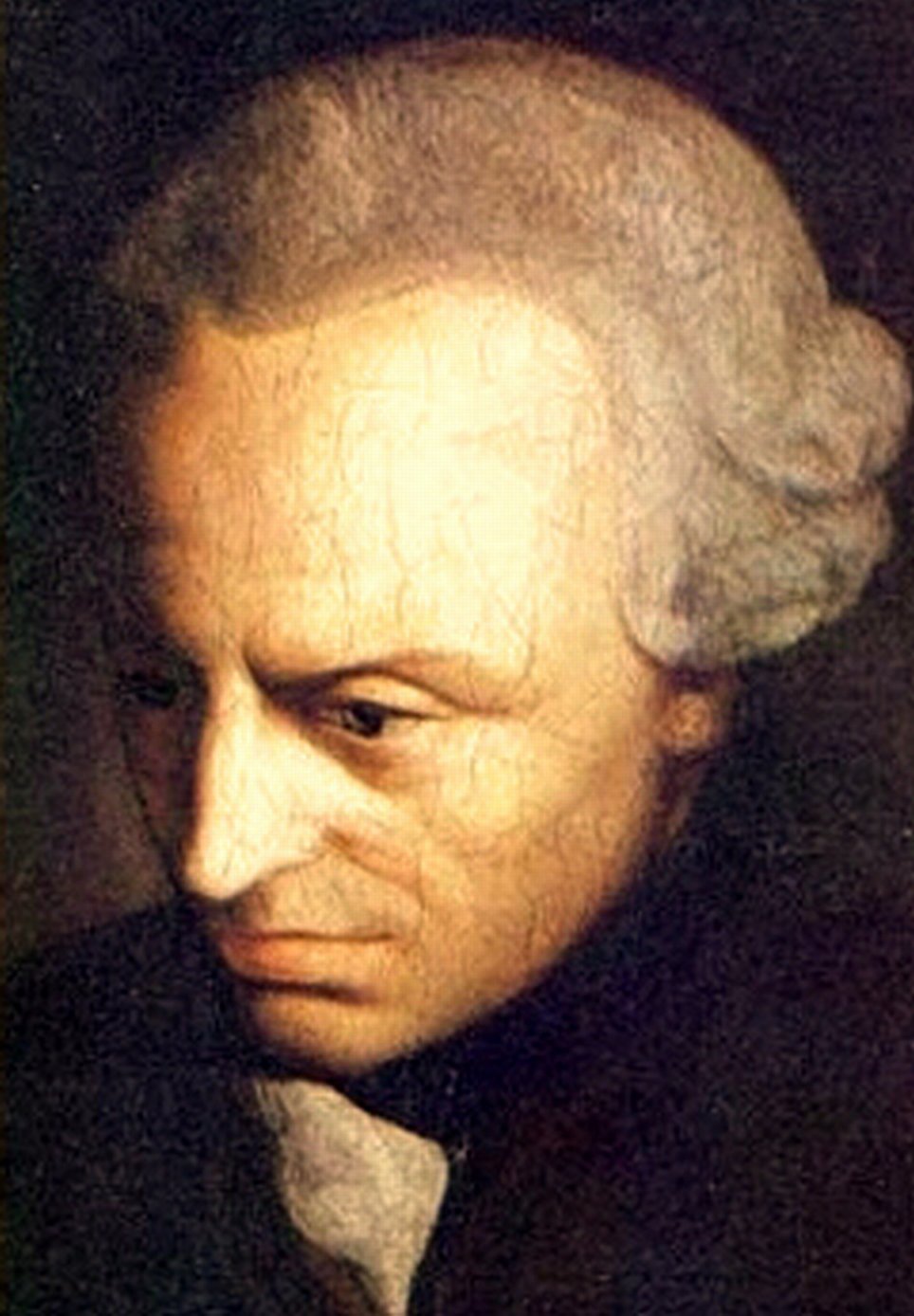
Immanuel Kant, date unknown

To distinguish between nature and imagination is often only a step toward reconciling the two. This rapprochement is apparent in Kantian idealism. Kant postulates a "transcendental faculty of imagination," an a priori unifying or "synthetic" power of the mind without which we could never reproduce the image of an object (its "representation"), just as we would never have possessed any image at all without an earlier "synthesis of apprehension." In effect, Kant regards aesthetic creation (or "genius") as a special case of the generic imagination. Unlike mere "taste," which is an apprehension of nature, genius is active and constructive. It is the "beautiful representation of a thing." The world of aesthetic ideas, the products of genius, is like a second nature built out of the first, the "actual nature" that we grasp through the synthesis of apprehension, and recall through the synthesis of reproduction. The aesthetic world also differs from the nature that is known through concepts. Though both are constructs, aesthetic nature has a richness of content that no abstract rational scheme can ever encompass. Yet the aesthetic world is truly a world of thought. It has the idea quality of intellectual forms and the intuitive, untranslatable immediacy of sensory perception.
Everybody clear on that now? Yeah, well, I'm getting there. At least I begin to understand the problem: How do we know the world outside of us, and how do we distinguish that "real" world from things we imagine? And then, what is the role of art in relation to these things?

Cinnabar
One of the things Kant deals with that's not included in this introductory summation is the association of ideas, the gathering-together of the familiar characteristics of an object. For once, mercifully, Kant gives us an example of what he's talking about (though the example itself depends on knowing what "cinnabar" is, namely, a red mineral, the ore of mercury):
If cinnabar were sometimes red and sometimes black, sometimes light and sometimes heavy, if a man could be changed now into this, now into another animal shape, if on the longest day the fields were sometimes covered with fruit, sometimes with ice and snow, the faculty of my empirical imagination would never be in a position, when representing red colour, to think of heavy cinnabar.
But thanks to the "synthesis of apprehension," we hold all the various attributes of an object together in the mind, and we can isolate any given characteristic, such as redness, to evoke the whole. Moreover, the coherence of attributes suggests that "There must therefore be something to make this reproduction of phenomena possible" -- that is, something out there, outside the mind, that is "the foundation a priori of a necessary synthetical unity." So the imagination works with these external materials -- otherwise experience itself would be impossible. "The synthesis of apprehension is therefore inseparably connected with the synthesis of reproduction.... We may therefore call this faculty the transcendental faculty of imagination."

Kant's distinction of taste from genius is similarly difficult to swim through, but the premise is clearly enough stated: "For estimating beautiful objects, as such, what is required is taste; but for fine art, i.e., the production of such objects, one needs genius." The distinction between Art and Nature, so central to modern ideas about both, is stated thus by Kant: "A beauty of nature is a beautiful thing; beauty of art is a beautiful representation of a thing." It should go without saying by now that Kant doesn't use words like taste and genius and beauty (or rather the German equivalents of these words) in our conventional senses, which tends to muddle our understanding of what he's getting at, especially when he tries to use examples: "where one says, for example, 'that is a beautiful woman,' what one in fact thinks is only this, that in her form nature excellently portrays the ends present in the female figure." I hope that clears things up for you; for me, not so much. He adds: "For one has to extend one's view beyond the mere form to a concept, to enable the object to be thought in such a manner by means of an aesthetic judgement logically conditioned." Okay, I give up.

But this is somewhat clearer, and more to the point of our investigation of the relationship between art and nature: "Where fine art evidences its superiority is in the beautiful descriptions it gives of things that in nature would be ugly or displeasing." Kant's examples are rather too vague, but let me suggest one of my own:
Rembrandt van Rijn, The Flayed Ox, 1655
Not to everybody's taste, to be sure, but rather a startling example of the way art can transform the stark and sordid into elements of form, color, light and shade, and then assemble them into a whole that can be judged, at least in some sense of the word, "beautiful." And speaking of "taste":
Taste is ... merely a critical, not a productive faculty; and what conforms to it is not, merely on that account, a work of fine art.... So we demand that table appointments, or even a moral dissertation, and, indeed, a sermon, must bear this form of fine art, yet without its appearing studied. But one would not call them on this account works of fine art. A poem, a musical composition, a picture-gallery, and so forth, would, however, be placed under this head; and so in a would-be work of fine art we may frequently recognize genius without taste, and in another taste without genius.
Of some works of art, Kant observes, "we say they are soulless; and this, although we find nothing to censure in them as far as taste goes. A poem may be very pretty and elegant, but is soulless." We mean by this, Kant asserts, that it lacks "the animating principle in the mind."
Now my proposition is that this principle is nothing else than the faculty of presenting aesthetic ideas. But, by an aesthetic idea I mean that representation of the imagination which induces much though, yet without the possibility of any definite thought whatever, i.e. concept, being adequate to it, and which language, consequently, can never get quite on level terms with or render completely intelligible.
I'm reminded here of Keats's embracing of uncertainty that he called "negative capability." It is also, in Kant's way of thinking, that which makes a work of art greater than any attempt to understand or describe or paraphrase its effect on us. (A lot of people today use the word "soul" in this way without ever even having heard of Kant.)

Kant also succeeds, I think, in defining that slippery word "imagination":  "The imagination (as a productive faculty of cognition) is a powerful agent for creating, as it were, a second nature out of the material supplied to it by actual nature." Notice here the lack of hierarchy in the use of the terms "actual nature" and "second nature." Wilde might have elevated "second nature" (Art) over "actual nature" (Nature). But then later Kant does too: Through the imagination "material can be borrowed by us from nature ... but be worked up by us into something else -- namely, what surpasses nature." These products of the imagination -- which, he says, "may be termed ideas" -- "at least strain after something lying out beyond the confines of experience" and the concepts they present have "the semblance of an objective reality." The products of the imagination are bodied "forth to sense with a completeness of which nature affords no parallel."


Samuel Taylor Coleridge: The Coalescence of Mind and Nature

Coleridge in 1814
Here too, in these excerpts from Biographia Literaria (1817) and the essays "On Poesy or Art" (1818) and "The Statesman's Manual" (1817), Coleridge gets so abstruse that I have to fall back on Ellmann and Feidelson's introduction for help:
Coleridge ... pictures art as an interaction or "coalescence" of mind and nature, a process in which the original terms are altered. Imagination is not a mere duplication of nature, nor is it a propounding of human thought; it is an activity or function that lies between, a union and reconcilement of nature with what is distinctively human. By means of this vital force, which "dissolves, diffuses, dissipates in order to re-create," man joins his mind (itself responsive to laws of nature) to the spirit of nature, and both are symbolically articulated in the form of the highest art. Since it is genuinely creative, imagination is quite distinct from "fancy," which does no more than shuffle the "fixities and definites" of practical experience. In the same way, Coleridge sharply distinguishes between allegorical art, which constructs a parallel between imagination and nature, and symbolical art, which makes one tune out of two. 
"All knowledge," Coleridge asserts, "rests on the coincidence of an object with a subject." What we have here is essentially a dialectic of mind and nature. This takes us back to the controversy surrounding the Berkeleyan premise, "esse est percipi" -- to be is to be perceived. If the object exists independently of the subject, "This desk, for instance would (according to our natural notions) be, though there should exist no sentient being to look at it." Thus "the natural philosopher ... avoids above all things the intermixture of the subjective in his knowledge," striving to acknowledge "things as they are." (See Wallace Stevens's "The Man With the Blue Guitar" for more on this aim.) But Descartes, by doubting all things, revealed that the one certitude was the existence of the subject.

The mediator between object and subject is the imagination, which Coleridge divides into primary and secondary;. "The primary Imagination I hold to be the living power and prime agent of all human perception, and as a repetition in the finite mind of the eternal act of creation in the infinite I AM." The secondary Imagination "dissolves, diffuses, dissipates, in order to recreate.... It is essentially vital, even as all objects (as objects) are essentially fixed and dead." That is, nothing outside the mind has any significant existence until the imagination shapes it and gives it significance. Fancy, on the other hand, "is a mode of memory emancipated from the order of time and space." Where Imagination is a mode of knowing, Fancy is mere play.

Under these terms, "Art, used collectively for painting, sculpture, architecture, and music, is the mediatress between, and reconciler of, nature and man. It is, therefore, the power of humanizing nature, of infusing the thoughts and passions of man into every thing which is the object of his contemplation: colour, form, motion, and sound, are the elements which it combines, and it stamps them into unity in the mould of a moral idea." For Coleridge, naturally, "The primary art is writing," which is "a translation of man into nature, ... a substitution of the visible for the audible." Poetry's "materials are from the mind, and all its products are for the mind ... and thus it elevates the mind by making its feelings the object of its reflexion." Poetry "avails itself of the forms of nature to recall, to express, and to modify the thoughts and feelings of the mind."

Nature "is to a religious observer the art of God," and by this token, "art itself might be defined as ... the union and reconciliation of that which is nature with that which is exclusively human." So does art imitate nature?  Coleridge suggests that "in all imitation two elements must coexist, and not only coexist, but must be perceived as coexisting." The elements that must coexist are "likeness and unlikeness, or sameness and difference, and in all genuine creations of art there must be a union of these disparates." If the work of art is too much like its correspondent in nature, it fails: "Why are such simulations of nature, as waxwork figures of men and women, so disagreeable? Because, not finding the motion and life which we expected, we are shocked as by a falsehood.... You set out with a supposed reality and are disappointed and disgusted with the deception."

So if the artist imitates nature, he or she should strive for nature in process (natura naturans) rather than for faithfulness to the external forms of nature (natura naturata); 
If the artist copies the mere nature, the natura naturata, what idle rivalry! If he proceeds only from a given form, which is supposed to answer to the notion of beauty, what an emptiness, what an unreality there always is in his productions.... Believe me, you must master the essence, the natura naturans, which presupposes a bond between nature in the higher sense and the soul of man.
This is pretty much what Kant was getting at in his discourse on "soul" in art. Coleridge is, however, not much better at pinpointing exactly what it means to "master the essence," but he makes a stab at it: "to make the external internal, the internal external, to make nature thought, and thought nature, -- this is the mystery of genius in the Fine Arts." I'm not sure we're much further along, however. He continues: "The artist must imitate that which is within the thing, that which is active through form and figure, and discourses to us by symbols -- the Natur-geist, or spirit of nature.... Hence a good portrait is the abstract of the personal; it is not the likeness for actual comparison, but for recollection. This explains why the likeness of a very good portrait is not always recognized." Remember Picasso's comments on the portraits of Philip IV by Velasquez and Van Rubens?

And there's that word "symbol," which is what we're supposedly dealing with here. For Coleridge, "a symbol ... is characterized by a translucence of the special in the individual, or of the general in the special or of the universal in the general; above all by the translucence of the eternal through and in the temporal. It always partakes of the reality which it renders intelligible; and while it enunciates the whole, abides itself as a living part in that unity of which it is the representative."


Rainer Maria Rilke: The Penetration of Things

In another letter to "Merline," Rilke speaks of the kind of intimacy that artists must feel with things external to themselves in order to incorporate them into their work.
If a thing is to speak to you, you must regard it for a certain time as the only one that exists, as the one and only phenomenon, which, thanks to your laborious and exclusive love, is now placed at the center of the Universe, and there, in that incomparable place, is this day attended by the Angels.
Baladine Klassowska's portrait of Rilke, 1922
In writing about Klassowska's pastels, Rilke wrote, "what astonishes me most is the unity of consciousness with which the object is always apprehended: a single violent gasp of feeling, a single gestrue of passion has dragged it in, close to the heart, as a single whole; there is never any sense of one thing having been grasped after another."


Hans Arp: Concrete Art

Hans Arp, 1926
These selections from Arp's On My Way, Poetry and Essays 1912-47, reflect not only Arp's participation in the movement known as Dadaism, with its urge to épater le bourgeois, but also his later reflections on the purity of art as distinct from nature. Arp quotes "Alexandre Partens" (which is probably a pseudonym for Arp and/or his fellow Dadaists Tristan Tzara and Walter Semer) on what Arp aimed for as an artist:
He wanted immediate and direct production, like a stone breaking away from a cliff, a bud bursting, an animal reproducing. He wanted objects impregnated with imagination and not museum pieces, he wanted animalesque objects with wild intensities and colors, he wanted a new body among us which would suffice unto itself, an object which would be just as well off squatting on the corners of tables as nestling in the depths of the garden, or staring at us from the wall.
Even as a child, Arp claims, he mocked what he calls the "useless crutches" on which art depends: the pedestal and the frame. "Sometimes I took our pictures out of their frames and looked with pleasure at these windows hanging on the wall. Another time I hung up a frame in a little wooden shack, and sawed a hole in the wall, behind the frame, disclosing a charming landscape animated by men and cattle." The aim of Dada, he says, was to be "senseless like nature."
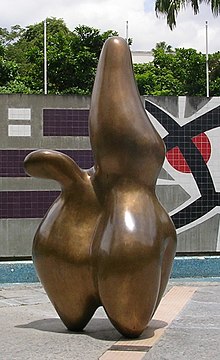
Hans Arp, Cloud Shepherd, 1953

This extended to a contempt for categories and absolutes: "Man declares red what he called green the day before and what in reality is black." Above all, the aim of Dada was to puncture human vanity: "Since the days of the caves, man has glorified and deified himself, and has brought about human catastrophe by his monstrous vanity."

But few things exasperated Arp more than the notion that art is an abstraction of nature. For Arp, art is a thing in itself, "a fruit that grows in man, like a fruit on a plant, or a child in its mother's womb.... I believe that nature is not in opposition to art. Art is of natural origin and is sublimated and spiritualized through the sublimation of man." Those who consider art a representation of nature love "what is vain or dead."

Arp asserts that "the human mind underwent a transformation about the year 1914." (Virginia Woolf put it a few years earlier: December 1910, to be exact.) The outbreak of World War I called into question the values that had persisted, Arp says, since "the renaissance puffed up human reason with pride. modern times with their science and technology have made man a megalomaniac. the atrocious confusion of our epoch is the consequence of this overestimation of reason." Hence the manifesto of concreteness: 
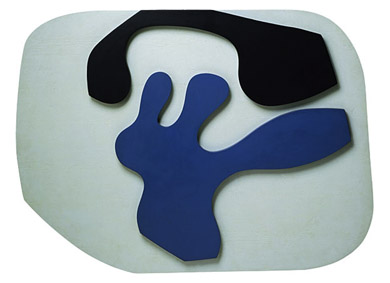
Hans Arp, Turned Blue Shoe With Two Heels Beneath Black Volt, 1925
we do not want to copy nature. we do not want to reproduce. we want to produce like a plant that produces a fruit and not to reproduce. we want to produce directly and not through interpretation. 

as there is not the slightest trace of abstraction in this art, we call it: concrete art. 
... 
concrete art aims to transform the world. it aims to make existence more bearable.... concrete art is an elemental, natural, healthy art, which causes the stars of peace, love and poetry to grow in the head and the heart, where concrete art enters, melancholy departs, dragging with it its gray suitcases full of black sighs.
Friday, October 8, 2010

14. The Age of Wonder, by Richard Holmes, pp. 405-469

The Age of Wonder: The Romantic Generation and the Discovery of the Beauty and Terror of Science (Vintage)Sorcerer and Apprentice, 6-8; Young Scientists; Epilogue
_____
John Herschel and Charles Babbage traveled in France and Italy in July through October 1821, meeting Alexander von Humboldt in Paris. Humboldt reported that John seemed to him "inferior to the originality of his father, who was astronomer, physicist and poetical cosmologist all at the same time." He treated them well, however, and told them of hearing Joseph Banks lecture in London soon after returning from his voyage of 1768-71. John returned to Slough, where William Herschel, now in his eighties, was no longer able to use the larger telescopes, and Caroline found it increasingly difficult to follow his instructions. John resumed work with the forty-foot telescope with Caroline as his devoted assistant. When he and Babbage formed the Royal Astronomical Society in 1820, John, "who had strong views about science being open to women," made her the first Honorary Member. The second was Mary Somerville, the mathematician after whom the first women's college at Oxford was named.

Caroline Herschel, by Martin François Tielemans, 1829
William grew increasingly infirm with arthritis, and Caroline came down with an eye infection that made her fear she would never do astronomical work again. She recovered, but was shaken by the experience. In August 1822, William died while John was abroad. His obituary in the Gentleman's Magazine noted "his excellent sister, Miss Caroline Herschel, whose indefatigable and unhesitating devotion in the performance of a task usually deemed incompatible with female habits, surpassed all eulogium." The same issue also noted the death by drowning of the "professed ... atheist" Percy Bysshe Shelley, the "unfortunately too well-known" author of "infamous novels and poems." Caroline, who was seventy-two, decided to return to Hanover, where she had not lived for nearly fifty years. She lived on for twenty-six years longer, corresponding regularly with John and writing her memoirs. She also compiled a new Star Catalogue, for which Herschel and Babbage saw to it that she was awarded the Astronomical Society's Gold Medal in 1828.

Humphry Davy was commissioned by the Royal Navy in 1823 to find a way to stop the corrosion of the copper hulls of the new steam warships. He analyzed the effects of salts on copper, and discovered that it could be neutralized by small iron plates along the hull that would oxidize more rapidly than the copper. Davy's remedy was put into effect quickly, and was hailed as yet another triumph. But the success was premature: after a few months it was discovered that the unoxidized copper was more subject to barnacles and weeds than before. "The navy was disgruntled, the Royal Society was embarrassed, and the press was derisive. Davy's reputation was tarnished, not to say barnacled, and his unpopularity at the Royal Society increased." Eventually, it was discovered that Davy had been right all along about the effect of the iron plates, and that a reconfiguration of their placement solved the problem, but the damage to Davy's reputation had been done. In 1824, the magazine John Bull proclaimed him one of the "Humbugs of the Age," largely because of his prominence as a socialite. Davy also managed to antagonize the younger generation of scientists by appointing John Herschel as one of the Royal Society's two secretaries in 1824, but refusing to appoint Charles Babbage to the other position.

Davy began to suffer from heart disease, and in December 1826 had a series of strokes that left him paralyzed on the right side. He was forty-eight, which was the age at which his father had died. In January, following his physician's advice, he left on a long holiday on the continent, accompanied by his brother, John, but not by his wife. He had continued to write poetry, and during his holiday he decided to write a book about fly-fishing that he called Salmonia, or Days of Fly-Fishing. It was structured as a series of dialogues among a group of friends, including a literary friend who may have been based on Coleridge and Walter Scott.

While he was writing the book, he returned to Laibach (now Ljubljana) where he took rooms at the inn owned by Josephine Dettela's father. She was now twenty-five.  In November 1827 he returned to London to resign the presidency of the Royal Society. But he went back to Laibach in the spring of 1828, again leaving Jane behind. In his letters to Jane he made frequent references to "the constant attention and kindness of my 'Illyrian maid,'" "my pretty Illyrian nurse," "my charming Illyrian nurse." He also wrote drafts of two love poems to her in his scientific notebook. That November he regretfully moved to Rome because of the weather.  

Salmonia was published in England in 1828, and he started work on expanding it, as well as beginning his last book, Consolations in Travel, or The Last Days of a Philosopher. It consists of six dialogues and an unfinished seventh, and "mixes philosophy and autobiography with highly original sections of science fiction, some visionary travel writing, various theories of history, race and society, and an important apologia for science. It also contains unexpected speculations about the nature of evolution, and the future of the human species." In one dialogue he takes issue with Coleridge, "who had said that the 'souls of 500 Newtons' had gone into the making of a single Shakespeare. Davy said emphatically that as benefactors of mankind, he held Bacon far above Shakespeare, and Newton far above Milton." In another dialogue he set forth his belief that science was a force for good, and had a positive effect on the mind, giving it "habits of accuracy, by obliging it to attend to facts.... It may be said of modern chemistry, that its beginning is pleasure, its progress knowledge, and its objects truth and utility."

In February 1829, still in Rome, he suffered another stroke, and sent for Jane. She arrived in April, and at the end of the month he decided that he wanted to travel north. John arranged for a slow journey, with many stops, and Jane went ahead to arrange for accommodations in Geneva. He arrived there on May 28, and died at 3 o'clock the next morning. He left an endowment for a Davy Medal  to be awarded by the Royal Society, and one for the maintenance of Penzance Grammar School. The rest of his estate went to Jane, except for a bequest of £150 to Josephine Dettela.

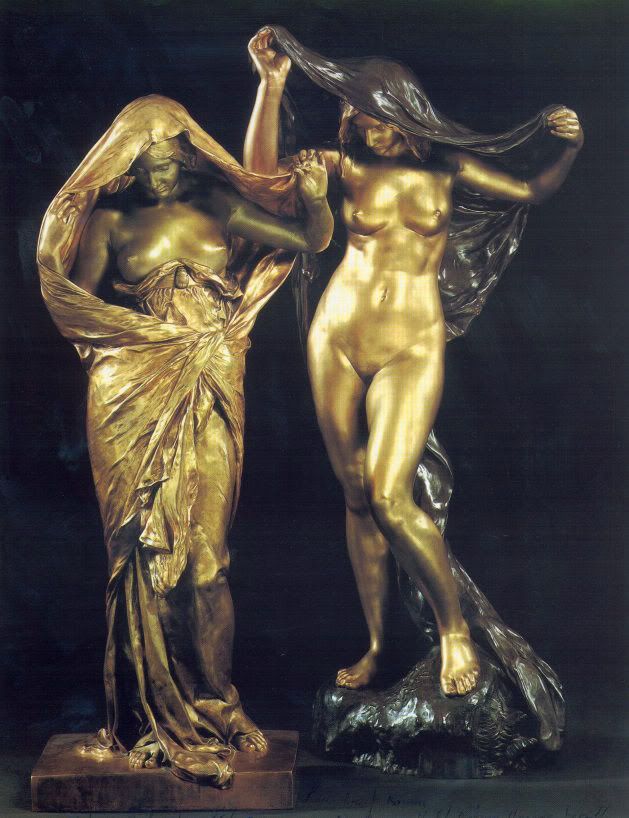
Nature Unveiling Herself Before Science, by Louis Ernest Barrias, 1890
The deaths of Banks in 1820, William Herschel in 1822, and Davy in 1829 seemed to mark the end of an era of British science and of the prestige of the Royal Society. Social critics like Thomas Carlyle began to question the role of science: "The Progress of Science ... is to destroy Wonder, and in its stead substitute Mensuration and Numeration." In a note, Holmes observes, "The troubling image of a shy, reluctant, persecuted female Nature who is crudely questioned and even physically assaulted by an exclusively male Science now begins to appear. It slowly replaces the older Romantic image of a mysterious and seductive Nature, at least a goddess, who is infinitely more powerful than her mere human petitioners and questioners."

Charles Babbage
In 1829, John Herschel was the candidate favored by young scientists to replace Davy as president of the Royal Society, but he was defeated by the Duke of Sussex, the brother of George IV, in a very close election, 119 to 111. Sussex was not a scientist, but he was obviously well-connected. As if to placate the younger scientists, Herschel was knighted soon afterward. But the supporters of Herschel, including Charles Babbage, were still outraged. In the spring of 1830, Babbage published a book, Reflections on the Decline of Science in England. Babbage was now Lucasian Professor of Mathematics at Cambridge, a chair that had been held by Isaac Newton. He was working on the first computer, the "Difference Engine No. 1," which would have used 25,000 brass cogs to perform its calculations. He had spent £17,000 of his own money on the device, so he was eager to obtain government funding for it. The one completed section of Difference Engine No. 1, with 2,000 cogs, still works as a calculator, and he had designed but never completed a more sophisticated version, using punch cards and 50,000 cogs that served as the machine's equivalent of RAM. In 1991, his design for Difference Engine No. 2, with 4,000 brass cogs, was actually constructed. It's capable of calculating to thirty-one decimal points. But Babbage was unable to persuade the funding sources that there would ever be applications for the Difference Engine.

Babbage's book suggested that the research culture in Britain was inferior to that on the continent, and that the universities were failing at the task of teaching science. The Royal Society was particularly to blame, having become more of a social institution than a scientific one: Of the 700 members, only ten percent had published two or more papers on science. He argued "that science must always be more than the simple observation of phenomena or data. It was simultaneously a subjective training in observational skills, self-criticism and interpretation: a complete education. This was of course precisely what William Herschel had said forty years before." He proposed that all the British scientific societies come together in an annual meeting to take place in a different city outside of London each year. This would be the model followed when the British Association for the Advancement of Science was formed in 1831. 

John Herschel published his own critique of science, A Preliminary Discourse on the Study of Natural Philosophy, which became hugely popular. It was cited by John Stuart Mill in his Autobiography as one of the books that helped him recover from his nervous breakdown. Herschel argued that all the sciences had the inductive method in common: the gathering of quantitative data, the formation of a hypothesis, and the testing of the hypothesis. Herschel's book was celebrated as the first book since Bacon's 1620 Novum Organum to explain to the public the nature of experimental science. It was fluently written and filled with imaginative explanations. He singled out chemistry as the central scientific discipline of the age, and prophesied that investigation of electricity and electromagnetism, which would be Faraday's field, would be the next great field of scientific endeavor. He spoke of science as a network of disciplines, coming together "to form a single philosophy or culture," and "argued that science, while often going against common sense or intuition, expanded the human imagination with previously inconceivable ideas of movement or magnitude." The book was enormously influential in shaping the thought of the Cambridge undergraduate Charles Darwin.

David Brewster, a physicist who specialized in optics and invented the kaleidoscope, picked up on Babbage's idea of forming an association of scientific organizations. Babbage and the geologist William Whewell joined him in organizing the British Association for the Advancement of Science, which held its first meeting in York in 1831. It was not particularly well attended and attracted little attention from the press. But the second meeting, at Oxford in 1832, began to attract more notice, although The Times referred to it as "a mere unexplained display of philosophical toys" and was shocked that William Buckland had delivered a talk about the courtship of reptiles "in the presence of ladies." It was the third meeting, in 1833 in Cambridge, that showed the British Association was beginning to make its mark: It was attended by Faraday, Herschel, Dalton, Babbage, Brewster, Whewell and Thomas Malthus, among other notables. Darwin, who was traveling on the Beagle, was unable to attend.

Another participant was Coleridge, now sixty and in poor health. At one meeting Coleridge weighed in on the question of what someone who worked in the sciences should be called. Whewell, who was the chairman of the meeting, noted that some proposed "philosopher," but that Coleridge was strongly against it. Someone else suggested "savant," which was rejected as too presumptuous and too French. Finally Whewell himself suggested "scientist," on the analogy with "artist," as well as "economist" and "atheist" -- though the latter was a strike against it. The geologist Adam Sedgwick rejected "scientist" as a "barbarism," but it caught on and entered the OED in 1840.

Behind all of this professionalizing of science "lay the whole question of whether the new generation of professional 'scientists' would promote safe religious belief or a dangerous secular materialism." Many saw no conflict between science and religion: "Science was a gift of God or Providence to mankind, and its purpose was to reveal the wonders' of His design." But many of the most prominent scientists dodged the question: Davy's writings "suggested a kind of science mysticism that certainly precluded a Christian God"; William Herschel's God was only a kind of "benign Creator somewhere distantly behind the great unfolding scheme of nature";  Caroline Herschel never mentioned God in her journals; and Joseph Banks's sister despaired at his lack of piety. The problem was that "science itself had yet to produce its own theory (or myth) of creation." And when one emerged, in Darwin's On the Origin of Species in 1859, it was devastating because it added to the damage already done to the book of Genesis by the geologists. "What it demonstrated was that there was no need for a divine creation at all."

From 1830 to 1836, the Earl of Bridgewater commissioned a series of books by eminent scientists that were intended to show how science reinforced Christian beliefs. But the Bridgewater Treatises were not well received by the scientific community. Mary Somerville remarked, after reading William Buckland's treatise on geology, that "facts are such stubborn things." Babbage considered writing a treatise of his own that would undermine the whole enterprise, but never finished it. And Faraday, though he was a member of the fundamentalist Sandemanian sect, just kept quiet. 

The Association continued to grow, holding its annual meetings in Edinburgh, Dublin, Bristol, Liverpool, Newcastle, Birmingham and Glasgow from 1834 to 1840, attracting 2,000 people to the meeting and an official membership of more than 1,000. There was still hostility from The Times and John Bull, and Charles Dickens lampooned the meeting with a series for Bentley's Miscellany, illustrated with cartoons by George Cruikshank, called "The Full report of the First Meeting of the Mudfog Association for the Advancement of Everything."

Faraday continued his work at the Royal Institution, and gave the Bakerian Lecture to the Royal Society in 1829.  He also accepted a professorship at the Royal Military Academy, Woolwich, and began his work on electromagnetism that would lead to the creation of the dynamo, as revolutionary as James Watt's steam engine had been. He proved to be a great science educator, and started the series of Christmas Lectures for Children that is still given today. One of them, "The Chemical History of a Candle," was so popular that Dickens reprinted it in Household Words in 1850. 

Charles Lyell's Principles of Geology in 1830 overthrew the biblical account of creation and introduced readers to a concept of "deep time" that corresponded to William Herschel's "deep space." It would form the background Darwin needed for his theory of evolution by natural selection. The publication of Humphry Davy's Consolations of Travel, or The Last Days of a Philosopher in an expanded popular edition in 1831 also introduced the public to speculations about human social evolution; Darwin wrote to his sister asking her to send him a copy. David Brewster's biography of Isaac Newton presented its subject "as a secular saint, 'the high priest of science' and a man of universal genius." And the republication, after the stage adaptations, of Mary Shelley's Frankenstein gave the public a glimpse of "terrible, blasphemous and irreversible scientific hubris."

Mary Somerville's On the Connexion of the Physical Sciences, in 1834, "was a significant attempt to bring together new developments in the fields of astronomy, physics, chemistry, botany and geology as a single, ongoing scientific process of discovery." Somerville's tone is conventionally pious, but on the other hand,
She quietly suggests that "not only man, but the globe he inhabits -- nay the whole system of which it forms so small a part -- might be annihilated, and its extinction be unperceived in the immensity of creation." The reader is left to ask -- Unperceived by God? Or without any God to perceive it?
Somerville also puts stress on the counterintuitiveness of science, on its ability to demonstrate that things are not as we see them or as common sense tells us.

John Herschel, 1846
In 1833 John Herschel fulfilled one of his dreams, to do an astronomical survey in the southern hemisphere. Independently wealthy, he turned down government sponsorship, and even a grant from the Royal Society, and sailed with his family for South Africa to set up an observatory. He shipped the twenty-foot telescope, and remained at Cape Town for four years, mapping the skies. He wrote to his aunt Caroline that "these were the happiest years of his whole life." The Herschels were visited at the Cape by Charles Darwin, on his way back from the Galapagos. "Herschel's expedition to the Cape came to represent for Darwin the important ideal of the independent working scientist, which inspired the rest of his life." Caroline Herschel, in her eighties, thought of joining John and his family at the Cape, but decided against it. She did serve as a kind of publicist for him, feeding stories to the Hanover papers that were picked up internationally. On his return in 1838, he was made a baronet and attended Queen Victoria's coronation.  He was also elected president of the Royal Society and awarded another Copley Medal. 

In 1840, the forty-foot telescope at Slough was dismantled, having been battered by winds until the scaffolding was no longer safe. On New Year's Eve, Herschel threw a party in the old tube.

Monday, October 4, 2010

11. The Age of Wonder, by Richard Holmes, pp. 295-325

The Age of Wonder: The Romantic Generation and the Discovery of the Beauty and Terror of Science (Vintage)Davy on the Gas, 11-12; Dr Frankenstein and the Soul, 1-3
_____
Davy's first Bakerian Lecture at the Royal Society, in November 1806, caused an international sensation. The topic was the revolutionary possibilities of the new field of electrochemical analysis. Challenging the notion that electricity was some kind of invisible fluid, he established that it was a form of bipolar energy, with positive and negative charges, and that it could be used to analyze substances into their components, which were entirely new elements. Surveying the scientific work going on elsewhere in Europe, he asserted that British chemistry now led the scientific world. The following November, he announced the discovery of two new elements, potassium and sodium, from his experiments using voltaic batteries to decompose soda and potash. Joseph Banks was so impressed with Davy's work that when he had his portrait painted the following year, he was shown holding a copy of Davy's Bakerian Lectures.

Joseph Banks in 1809, by Thomas Phillips
Banks fell seriously ill soon after these lectures. He had been working on a ventilation system for Newgate Prison and came down a form of typhus known as "jail fever" because it was so easily spread by lice in crowded prisons. He was away from his laboratory until April 1808. During his convalescence, he worked with Coleridge, who had been debilitated by opium, on the lecture series "Poetry and the Imagination," which Coleridge delivered at the Royal Institution in the spring of 1808. Davy also reported a hallucination of a beautiful woman who had nursed him at the height of his fever. He would later claim that he met her again in 1818 and in 1827-28, noting the ten-year cycle of recurrence that took place each time he started a new decade, turning thirty, then forty, then fifty. Holmes notes, "If there had been an earlier one, it would have been in 1798, when he turned twenty, and had just met Anna Beddoes. Anna had returned to her husband and was nursing him when he died in December 1808. After his death, she moved to Bath and then finally settled in Rome. Their son Thomas Lovell Beddoes became a poet, spending twenty-five years on a long poem called Death's Jest-Book, some of the imagery of which was drawn from his childhood memories of his father's laboratory. He committed suicide in 1849, at the age of forty-five.

In 1810 Davy went to Dublin for a series of hugely popular lectures, and he returned in 1811 to receive an honorary doctorate from Trinity College.
In these lectures he particularly stressed the importance of scientific knowledge for women's education, and for "the improvement of the female mind." Milton was wrong on the subject, and Mary Wollstonecraft was right. Among his attentive and admiring audiences was a strikingly pretty and vivacious Scottish widow called Jane Apreece. At a glittering reception afterwards, Jane Apreece told Humphry Davy that she loved fishing. 

In September 1811, Fanny Burney underwent a mastectomy in Paris without anesthetic. It was successful -- she lived twenty years longer -- but the pain was so excruciating that she wrote a 10,000-word letter to her sister about the ordeal, through which she had remained conscious except for "two total chasms in my memory." Even recalling the experience was so painful that it took her two months to write the letter, which is a remarkable glimpse at the the state of medical practice, especially surgery, at the time.

Although France was considered the leader in medicine at the time, England and Scotland were gaining renown, especially for the teaching hospitals of London and Edinburgh. Once again, Banks was concerned with promoting British prestige, and when Astley Cooper of Guy's Hospital perforated a patient's eardrum to treat a potentially fatal infection of the inner ear, Banks had it written up for the Royal Society's Philosophical Transactions. Cooper became a member of the Royal Society and was awarded the Copley Medal in 1814. One of Cooper's students was John Keats. Other Romantic poets also had medical connections: Coleridge was treated by John Abernethy of St. Bartholomew's for his opium addiction, and Joseph Henry Green of Guy's was his amanuensis in 1818. Byron's traveling companion was William Polidori, who had become a doctor at Edinburgh Hospital.

One of Banks's medical protégés was William Lawrence, a young surgeon who worked under John Abernethy at St. Bartholomew's. Lawrence was a specialist in comparative anatomy, and he was elected to the Royal Society at the age of thirty. Two years later, in 1815, he became professor of anatomy at the Royal College of Surgeons. In 1814, Lawrence's mentor, Abernethy, gave a series of lectures known as the Hunterian Orations in honor of John Hunter, who had accumulated a great collection of anatomical specimens. Hunter's collection demonstrated clearly the kinship between human beings and "lower species," leading to the conclusion that mankind had developed out of the animal kingdom. Abernethy had come across papers in Hunter's collection that speculated on the nature of life itself. From these speculations, "Abernethy proposed a theory of human life based on a semi-mystical concept of a universal, physiological life force" and even "suggested that this theory brought scientific evidence -- if not exactly proof -- to the theological notion of the soul." He also connected Davy's experiments with electricity to this theory of the life force.

But in 1816, it was Abernethy's student, Lawrence, who led a vociferous attack on the "life force" theory. Abernethy felt betrayed: Lawrence had been his assistant since the age of sixteen, and had even lodged with Abernethy for three years. Still, Lawrence had also studied anthropology with Johann Friedrich Blumenbach at the University of Göttingen and was well read in French medical literature. "If not an avowed atheist, he had little time for conventional pieties." Blumenbach had not gone so far as to deny the existence of the soul, but his work tended in the direction of a materialist view of life itself. He was also interested in the comparative study of "racial types," and Lawrence had translated Blumenbach's Comparative Anatomy into English in 1807.

Like Abernethy, Lawrence was also friends with a poet: Percy Bysshe Shelley, who consulted Lawrence in July 1815 on a variety of nervous disorders. Shelley, then twenty-two, was grateful for Lawrence's advice and treatment, and by September 1815 began his long poem Alastor, or The Spirit of Solitude about the search for self, wrote some essay on the nature of life and death, and his "Essay on a Future State." He continued seeing Lawrence until he and his wife, Mary, left England for Italy, whose climate Lawrence had recommended, in 1818. 

It was Lawrence who was tapped for the Hunterian Lectures in 1816, and instead of performing the usual courtesy toward the previous lecturer, he began by attacking Abernethy and the theory of the life force. The human body, he asserted, was just "a complex physical organisation. In a phrase that became notorious, he claimed that the development of this physiological organisation could be observed unbroken, 'from an oyster to a man.'" He moved from attacking Abernethy to arguing that science, as Holmes puts it, "had an autonomous right to express its views fearlessly and objectively, without interference from Church or state." In his own words,
It seems to me that this hypothesis or fiction of a subtle invisible matter, animating the visible textures of animal bodies, and directing their motions, is only an example of that propensity in the human mind, which had led men at all times to account for those phenomena, of which the causes are not obvious, by the mysterious aid of higher and imaginary beings.
In 1819, Lawrence continued his attack on Vitalism, as Abernethy's life force theory was called, in a book, Natural History of Man, sparking a debate that had political, social and theological implications, "a premonition of the debate over Darwin's theory of evolution by natural selection, exactly forty years later."

In fact, there was nothing really new about the Vitalism debate. It had been anticipated in the 1780s by the vogue for mesmerism, which had been debunked by a series of blind trials. (Among other things, the trials provided the first demonstration of the "placebo effect," in which patients grew better simply because they believed they were being cured. Vitalism, however, got a boost from the ideas of Friedrich Schelling, who posited that "the whole world was indeed replete with spiritual energy or soul, and all physical objects 'aspired' to become something higher." This theory of evolution by aspiration was eventually laughed into extinction.

In 1803, Giovanni Aldini, a professor of anatomy from Bologna, did a series of public experiments with electricity on corpses, including an attempt to revive a hanged murderer six hours after his execution. The press reported that the electrical charges caused the muscles of the corpse to contract, the left eye to open, the fists to clench, and even made the body blow out a candle several times. "That small, grotesque detail of the opening eye may well have caught a young novelist's imagination." Further experiments on dead animals and "another human corpse which was said to have laughed and walked," caused such an outrage that Aldini was forced to leave the country.

The political implications of this quarrel over Vitalism took their character from the Napoleonic era: "Here was humane, pious English science fighting against cruel, reductive, atheistical French science." The conservative Quarterly Review, which is best known today for its savage attacks on the younger Romantic poets, weighed in with a scathing denunciation of Lawrence: "Mr Lawrence strives with all his powers to prove that men have no souls!" it fumed.

The debate also spread among the poets, and some of their comments, taken out of context, seem to suggest that they came down on the anti-science side. In December 1817, the painter Benjamin Haydon hosted a dinner at which Wordsworth, Charles Lamb, and Keats were present to celebrate Haydon's completion of part of his huge painting of Christ's entry into Jerusalem. The painting included portraits of Wordsworth (representing "natural English piety), Newton ("analytical science")  and Voltaire ("godless French philosophical scepticism"). Keats also appears in profile. Haydon recorded that the conversation centered on a debate over reason versus imagination, with the poets coming down on the side of imagination. He reported that Keats said Newton had "destroyed all the poetry of the rainbow, by reducing it to a prism." But Haydon was a devout fundamentalist Christian who "believed that most science was inevitably godless," and he may have biased his account accordingly.

Wordsworth is often cited as anti-science because of his poem "The Tables Turned," in which he refers to the "meddling intellect" and charges that scientists "murder to dissect." But Wordsworth also regarded Newton as a hero, celebrating him in The Prelude. Shelley, who was not present at the dinner, had previously twitted Haydon for his "religious superstitions" and referred to "that most detestable religion, the Christian." Like Coleridge, Shelley always defended science. Coleridge continued to argue that the soul existed, but he also rejected the idea of a "life force" as a physical fluid of some sort. He wrangled with the notion of the soul, which he identified as "the moral conscience and the spiritual identity."

Keats, from his medical studies under Cooper and J.H. Green, "undoubtedly knew more about medical, chemical and dissection procedures -- as well as the Vitalism debate itself -- than anyone else at Haydon's dinner party. His witticism at Newton's expense could be seen as the typical knowing humor of a clever medical student." But he did express some ambivalence about science in his poetry, particularly in "Lamia."
... Do not all charms fly
At the mere touch of cold philosophy?
There was an awful rainbow once in heaven:
We know her woof, her texture; she is given
In the dull catalogue of common things.
Philosophy will clip an Angel's wings....
Unweave a rainbow, as it erstwhile made
The tender-personed Lamia melt into a shade.
But the poem shows Lamia, a serpent-woman, to be something other than "tender-personed." She is an alien life-form, "both sexually alluring and yet clearly menacing and 'demonic.'" She is unnatural, and a "scientific" approach to her would have unmasked that fact. "Lamia" is a richly ambiguous poem that eventually undermines the anti-scientific position expressed in the lines above. Holmes asserts that the poem "engages many of the moral issues surrounding Vitalism, the nature of life, and the notion of human consciousness. Above all, perhaps, it asks if the beautiful Lamia has a soul." 

Sunday, October 3, 2010

10. The Age of Wonder, by Richard Holmes, pp. 265-295

The Age of Wonder: The Romantic Generation and the Discovery of the Beauty and Terror of Science (Vintage)Davy on the Gas, 5-10
_____
Robert Southey became one of Davy's most influential friends in his Bristol years, encouraging him to continue writing poetry and eventually introducing him to a greater poet, Samuel Taylor Coleridge, whose indulgence in opium naturally led him to want to try nitrous oxide. Coleridge and Davy met in October 1799 and became great friends a month later when Davy visited Coleridge in London. Coleridge introduced David to Charles and Mary Lamb, with whom the poet was living, and to William Godwin, among other prominent literary and artistic figures. Coleridge proclaimed that science, "being necessarily performed with the passion of Hope ... was poetical." Davy enthusiastically agreed.

Davy's experiments with nitrous oxide continued in a portable gas chamber designed by James Watt. It was airtight and allowed for a much longer exposure to the gas. As usual, Davy tried it on himself first: His "pulse rose to 124, his temperature to 106, and his cheeks went bright purple." His assistant, Robert Kinglake, stood by to record Davy's reactions when he emerged from the device, but Davy also recorded the experience in his laboratory notebook, saying that he had been "almost completely intoxicated," that it had been "Inconceivably pleasurable," and the he had "seemed to be a sublime being, newly created and superior to other mortals." He also proclaimed, as Kinglake recorded, "Nothing exists, but Thoughts! -- the Universe is composed of impressions, ideas, pleasures and pains!" He also experimented with combining nitrous oxide with alcohol, drinking a whole bottle of wine along with inhaling the gas. The chief effect was that he got sick but had no hangover the next morning when his "appetite was almost canine." But he began to wonder if the experiments were going a little too far.

In 1800, he published his first book, Researches Chemical and Philosophical chiefly Concerning Nitrous Oxide or Dephlogisticated Nitrous Air, and its Respiration. The publisher was Joseph Johnson, a radical who had also published Godwin, Coleridge, Wordsworth, and Mary Wollstonecraft. In the book he reported on his experiments with live animals, which would later cause Davy some uneasiness, though none of the scientists who reviewed the book objected to this kind of research. In the preface to the book, Davy expressed some concern about his own methodology:
I have endeavoured to guard against sources of error; but I cannot flatter myself that I have altogether avoided them.... Early experience has taught me the folly of hasty generalization. We are ignorant of the laws of corpuscular motion.... Chemistry in its present state, is simply a partial history of phenomena, consisting of many series more or less extensive of accurately connected facts.
In addition to Davy's own self-criticism, there were also attacks on the nitrous oxide experiments from outside, including hints "that the Bristol laboratory witnessed scenes of intoxication, hysteria and even sexual debauchery." An anonymous pamphlet, The Sceptic, in 1800 attacked Beddoes and Davy in particular, suggesting that they used the experiments to seduce women and had even made one woman pregnant while she was under the influence of nitrous oxide.

Davy was himself beginning to doubt Beddoes's theories about the efficacy of inhaling gas, and his interests began to shift to galvanism and the new battery invented by Allesandro Volta. He communicated this interest in a letter to Coleridge, who was developing his ideas about the relationship of science and poetry. Coleridge urged Davy to move to the Lake District with him and Wordsworth, and to establish a laboratory there. For his part, Davy continued to write poetry, some of it about Anna Beddoes, though he never published any of the poems he wrote after 1800, confining them to his notebooks. He did, however, continue to compare the scientific and the poetic imagination in his lectures, and wrote in 1807 some words that suggest the ideas also expressed by Coleridge and Keats:
The perception of truth is almost as simple a feeling as the perception of beauty; and the genius of Newton, of Shakespeare, of Michael Angelo, and of Handel, are not very remote in character from each other. Imagination, as well as the reason, is necessary to perfection in the philosophic mind. A rapidity of combination, a power of perceiving analogies, and of comparing them by facts, is the creative source of discovery. Discrimination and delicacy of sensation, so important in physical research, are other words for taste; and love of nature is the same passion, as the love of the magnificent, the sublime, and the beautiful. 
Benjamin Thompson, Count Rumford, by Thomas Gainsborough, 1783
Davy had begun to attract attention in London, which he visited again in 1801. Banks introduced him to Benjamin Thompson, a Fellow of the Royal Society who had been born in America but fought for the Loyalists and was knighted by George III. In 1785 he moved to Bavaria, where he lived for eleven years and was given the title of Count Rumford by the Elector of Bavaria.

Davy's eagerness to move on from his work with Beddoes in Bristol may have been heightened by his involvement with Anna Beddoes. She was unhappy in her marriage, and he became a confidant in her miseries. They began writing poem to each other, expressing not only affection but also a deep discomfort with the impossibility of furthering their relationship, although hers are more demonstrative than his. The extent of what Holmes calls "this flirtation or frustrated love affair (or whatever it was)" remains unclear. After Davy left Bristol, Anna gave birth to a daughter, Anna Maria, in the spring of 1802, and shortly after that ran off with Davies Giddy, Davy's old friend and patron from Penzance. She returned to Beddoes after several months' absence.

After eighteen months of work with nitrous oxide, Davy finally told Beddoes that he no longer believed there were therapeutic uses for the gas. Unfortunately, Davy had overlooked the fact that nitrous oxide had real potential as an anesthetic. It's not that he was unaware of the fact that it blotted out pain: He had treated his own toothache, caused by impacted wisdom teeth, with nitrous oxide, but "he did not take the next logical step of having the offending teeth removed while under the influence of nitrous oxide." He did note in writing up his experiments that nitrous oxide might be used to ease pain in surgery where there was no great blood loss -- because he believed that the gas was absorbed only through the bloodstream, he thought it would be ineffective if there was a lot of hemorrhaging. He had discussed the problem of pain with Coleridge, who had wondered why childbirth was so painful for human beings since it was essential for the continuation of the species, but again overlooked the potential use of nitrous oxide during labor. Holmes comments, "It would seem that Davy missed the greatest medical opportunity of his early career." It would be more than forty years before surgical anesthesia, using ether, was attempted, and it wasn't finally accepted "until Queen Victoria admitted to having taken a whiff of chloroform during the birth of her son Prince Leopold in April 1853."

Davy left Bristol in March 1801 to become assistant lecturer in chemistry and director of the chemical laboratory at the Royal Institution in London. The Institution, which was founded by Count Rumford, was only two years old and hadn't attracted much notice yet. But Davy's inaugural lecture on April 25 was a sensation: He was a natural educator and showman, as well as a popularizer of science, and the press raved about his presentation, noting also his effect on the many "completely spellbound" young women in the audience. He also published his first paper, on a new form of voltaic battery, in the Royal Society's Philosophical Transactions later that year.

After Davy's departure, Beddoes turned the Pneumatic Institute into a charitable clinic and gave up research. Anna left him for Davies Giddy twice, in 1804 and 1806. Beddoes's protégé continued to attract audiences -- and young women -- to his lectures. Coleridge wrote, "I attended Davy's lectures to enlarge my stock of metaphors.... Every subject in Davy's mind has the principle of Vitality. Living thoughts spring up like Turf under his feet."

In his "Discourse Introductory to a Course of Lectures on Chemistry," Davy proclaimed chemistry's central role in the advancement of science, arguing that all the other sciences, from biology to astronomy, were based on a knowledge of chemical processes. For Davy, science was the only way out of ignorance and superstition, making humankind the master of its fate. But while his argument was revolutionary, Davy was careful not to antagonize the defenders of the established order, the wealthy men who supported the institution for which he worked. He argued that "we do not ... amuse ourselves with brilliant, though delusive dreams of the infinite improveability of man.... We consider only a state of human  progression arising out of its present condition. We look for a time that we may reasonably expect, for a bright day of which we already behold the dawn."

Coleridge was much influenced by Davy's view of science as "psychologically, even spiritually, therapeutic," as Holmes puts it. And Davy's explanation of the "carbon cycle" contributed to Coleridge's idea of harmony in nature. When he and Wordsworth wrote the preface to the third edition of Lyrical Ballads in 1802, they made explicit the analogy of scientific discovery to the poetic imagination.

Davy's success boosted support for the Institution, and apparently boosted his self-confidence. When Maria Edgeworth visited London with Anna Beddoes, Davy showed them around the Institution; Edgeworth commented that Davy "was much improved since I saw him last -- talking sound sense and has left off being the 'cosmology' man." His popularity with women was particularly noted by the caricaturists Rowlandson and Gillray. He was promoted from assistant to full lecturer in 1802, the following year to professor of chemistry. In 1804 he was elected a Fellow of the Royal Society, and his salary had quadrupled, to £400, in just three years. He was invited to give summer lectures at universities, including Dublin, tripling his income.

He was shaken, however, by the death from consumption of his friend Gregory Watt in 1804, and wrote to a frend, "We know very little; but, in my opinion, we know enough to hope for the immortality, the individual immortality of the better part of man." This hope is a far cry from the "certainty of the resurrection" proclaimed by the church's creed. And in the same letter he speculated, "We are masters of the earth, but perhaps we are the slaves of some great and unknown beings," which Holmes observes is "more like the extraterrestrial intelligences of science fiction" than like God, or gods.

In 1805 he lectured at the Royal Institution on geology and spent a summer in the Lake District with Wordsworth, Southey, and Walter Scott -- Coleridge was in Italy. He returned to London to receive the Copley Medal for work on agricultural chemistry. He still had no significant discovery to attach his name to, but "There seemed nothing that could now stop his career, and his meteoric rise to fame at the age of twenty-six."

Tuesday, September 28, 2010

4. The Age of Wonder, by Richard Holmes, pp. 76-113

The Age of Wonder: The Romantic Generation and the Discovery of the Beauty and Terror of Science (Vintage)Herschel on the Moon, 5-7
_____
In 1766 Herschel moved to Bath, where he was not only organist in the Octagon
Chapel but also played in the orchestra in the Pump Room. He got into an argument with the impresario of the orchestra, James Linley, over orchestral arrangements, and set up a rival orchestra for a season, but finally made up with Linley and combined forces with him. When Linley decided to move to London, Herschel became the sole director of the concerts. He also composed and gave music lessons.

In February 1766 he had begun his first Astronomical Observation Journal, while also reading books on astronomy and attending lectures by the astronomer James Ferguson in the Pump Room. He began collecting telescopes and studying their construction. He found that refractor telescopes -- the straight kind with lenses at each end of the tube -- were insufficient for observing the stars, and turned his attention toward the reflector telescope invented by Newton. The concave mirrors in reflector telescopes gather and concentrate more light and produce less distortion than refractors.

Before Herschel, astronomers treated the night sky as if it were "the interior surface of a decorated dome, inlaid with constellations.... But Herschel began to conceive of deep space. He began to imagine a telescope which might plunge deep down into the sky and explore it like a great unplumbed ocean of stars." But the kind of mirror he would need for a reflector telescope capable of the exploration Herschel envisioned was too expensive. So he decided he would make them himself, out of metal, not glass.

Herschel's brothers, Jacob, Dietrich, and Alexander, came to visit him in Bath, and in 1770 Alexander came to stay with William in a house he rented at 7 New King Street where he gave music and singing lessons. William was concerned about Caroline, who was now twenty-one, but her mother was reluctant to give up her free housemaid until he went to Hanover and promised to pay her for a maid to replace Caroline. She returned to England with him in August 1772. He began to give her lessons in English as well as singing and the harpsichord.

As in Hanover, Caroline found herself playing housekeeper, but with the addition of music lessons, English lessons, reading aloud from English novels, and talking about astronomy. "It took time for the full emotional rapport to renew itself between the tall, handsome thirty-four-year-old bachelor brother, driven and ambitious, and the shy, tiny, awkward twenty-two-year-old sister, who ... was bursting with unfulfilled dreams and longings."
For Caroline, William was initially the great  liberator who had taken her out of the German house of bondage. But later their roles would subtly change. As William would observe to Nevil Maskelyne, it was not always self-evident which was the planet and which was the moon. 
Herschel began work on the mirrors for his telescope, getting the tools he needed for grinding and polishing the metal from John Michel, a fellow astronomer in Bath who, like Herschel, had some unconventional ideas, "such as the existence of 'black holes' in space from which light itself could not escape."

The moulds for casting metal mirrors were formed from horse-dung, and after the molten metal was poured and cooled it had to be ground down into a concave shape. It then had to be polished continually for hours without stopping; otherwise the metal would harden and become useless. In addition, there was the danger that the furnace might explode. The house at 7 New King Street became "a pungent, chaotic workshop." Caroline would read aloud to William while he polished the mirrors: "Don Quixote, the Arabian Nights, Sterne's Tristram Shandy -- all tales of fantastic adventures or eccentric heroes." Sometimes she even had to feed him by hand while he worked as long as sixteen hours without a break.
A Victorian illustrator portrayed the collaboration of William and Caroline Herschel as "a comfortable domestic scene ... in an elegant drawing room.... In fact these epic polishing sessions took place [in] the unheated, stone-flagged basement [where they] were surrounded by tools and chemicals, and the distinct, pungent smell of the horse-dung moulds. It was dirty, monotonous and exhausting work."
Herschel's first five-foot reflector telescope, finished in 1774, had a six-inch diameter mirror and was mounted in "a beautiful octagonal case of gleaming mahogany." He used it to study the moon and the then-mysterious nebulae. "Even at this early stage Herschel has the notion of a changing universe, and that nebulae might hold some clue to this mystery." When he began studying nebulae, just under a hundred had been cataloged by the French astronomer Charles Messier. "Within a decade, by the mid-1780s, Herschel would have increased this tenfold, to over a thousand nebulae.... Herschel suspected that they were star clusters at immense distances, whose composition might hold a clue to an entirely new kind of universe."

Meanwhile, to assuage the uneasiness of Jacob and Anna about Caroline's living in England, he reported that she had a small millinery business that she was running successfully, as well as continuing her music lessons. She had begun to perform as a singer in his concerts at the Pump Room. In 1779, Jacob cut back on the number of music students he was teaching, and began to work on a project to compile a catalog of double stars. He had already discovered that the Pole Star, "the key to navigation, and the poet's traditional emblem of steadiness and singularity, for centuries," was in fact two stars. By facilitating the measurement of parallax, double stars, he thought, "might provide a method of gauging the earth's distance from the rest of the Milky Way."

Conventional ideas about the cosmos at the time was not only that it was only a few thousand years old, but that the universe was only a few million miles in extent. The "fixed stars" were thought to be in an unchanging pattern and their brightness to be "a function of their size, rather than their distance.... One of Herschel's most simple and radical ideas was to assume exactly the opposite." But people had begun to speculate that the universe was much larger and that there was a high probability of extraterrestrial life.

The interest in extraterrestrial life underlay Herschel's fascination with the moon, which he was studying when, in December 1779, William Watson Jr. came upon him looking through his telescope."This was Herschel's first really important scientific contact in England, one not made until he was forty-one. Watson was only thirty-three." They became friends quickly, and Caroline later recalled that Watson came home with Herschel that night and talked until the next morning. Watson arranged Herschel's election to the Bath Philosophical Society as "optical instrument maker and mathematician," and helped him with his mirror-making. He encouraged Herschel to submit thirty-one papers to the society. Some of them were so speculative that they would now be considered "thought experiments." Among the more outlandish of them featured Herschel's idea that the craters on the moon might be man-made and designed to provide solar power to the cities and towns contained within them.

In 1781, Caroline closed her millinery shop, but it took her some time to sell off the stock, so that she was away from the house at 19 New King Street when William made a momentous discovery. On March 13 he observed "a new and unidentified disc-like object moving through the constellation of Gemini. This discovery would change his entire career, and become one of the legends of Romantic science." In a footnote, Holmes makes this observation:
Romanticism introduced three important themes into science biography. First, the "Newton syndrome," the notion of "scientific genius," in which science is largely advanced by a small number of preternaturally gifted (and usually isolated) individuals. Second, the existence of the "Eureka moment," in which great discoveries are made without warning (or much preparation) in a sudden, blazing instant of revelation and synthesis. Third, the "Frankenstein nightmare," in which all scientific progress is really a disguised form of destruction.
But the sighting of the "disc-like object" was hardly a "Eureka moment." Herschel thought he had found a new comet, and the record in his observation book contains "no expression of excitement or anticipation." Gradually, however, he began to devote his attention to the object, first to prove that it was definitely in motion and therefore not a fixed star, and then to figure out whether it was really a comet, since comets typically had "a slightly blurred, fiery outline and a distinct tail or 'coma.'" This object had neither.

Even by April 6, he was still calling it a comet in his observation book, though "the sharp, round definition and the lack of any tail could only mean one thing: a new 'wanderer,' or planet. What in fact he had observed was the seventh planet in the solar system, beyond Jupiter and Saturn, and the first new planet to be discovered for over a thousand years (since Ptolemy)." When he finally decided it was a planet, he called it "Georgium Sidus" ("George's Star") after George III. It did not finally receive the name Uranus until the middle of the nineteenth century.

Herschel told William Watson about his "comet" on March 22, and Watson passed the word on to Nevil Maskelyne and Joseph Banks. Maskelyne still thought that Herschel was something of a crackpot, but he checked it out and reported to Watson that he thought it was a comet or a planet.
The Astronomer Royal was in a dilemma. He had no reason to accept Herschel as a reliable astronomer, and to declare a new planet prematurely might bring himself and the Royal Society into disrepute, and even ridicule. On the other hand, to reject what might be the greatest British astronomical find of the century, especially if the predatory French astronomers accepted it first (and even named it), would be even more damaging.... King George III was particularly fascinated by stars, and particularly keen to outdo the French.
Finally, Maskelyne wrote directly to Herschel on April 23, and called it a planet in his letter. Herschel responded with a paper called "An Account of a Comet" in which he outlined the process of his discovery, and made it clear that he, too, thought it must be a planet, though he didn't actually say so -- probably under Watson's advice.

In his report to Banks, Maskelyne referred to Herschel as "the musician of Bath" and as "lucky" for having "accidentally" discovered the planet. "This suggestion that the discovery had been 'accidental,' and that he had been 'lucky,' was to grow increasingly disturbing to Herschel," who knew that his patient and meticulous survey and careful measuring and recording had enabled him to identify the planet. Fortunately, the rivalry with the French played in Herschel's favor when Charles Messier wrote to congratulate him on his discovery and give "his opinion that this was very likely to be the seventh planet in the solar system.... As Maskelyne and Banks were only too aware, Messier's congratulations would soon carry the weight of the entire French Académie des Sciences." And astronomers in Germany, Italy , Sweden and Russia joined in confirming and praising Herschel's discovery.

In May, Watson took Herschel to London to meet his father and Maskelyne, and Banks "claimed it as a decisive British victory over French astronomy," and announced that Herschel was to be elected to the Royal Society and receive the Copley Gold Medal -- though it took another six months for the bureaucracy to process both honors. Banks also urged Herschel to name the planet "or our nimble neighbours, the French, will certainly save us the trouble of Baptizing it." It was then that Herschel proposed naming it after the king.

Herschel was, however, still irritated by the "continuing murmurs in some quarters of the Royal Society that his discovery had been in some sense 'accidental.'" He reiterated his contention that it was the result of "a regular review of the sky" in letters to European astronomers, and as late as 1809 he was insisting that it was no accident. But he also began to romanticize the discovery, claiming that it took place in a single night instead of being the result of "the critical nights of measuring between 21 March and 6 April 1781. The effect of this account was to present and engagingly romantic image of science at work; the solitary man of genius pursuing the mysterious moment of revelation."

The discovery sparked a new popular enthusiasm for astronomy, reflected by the bestseller of 1786, Introduction to Astronomy in Letters to His Pupil by John Bonnycastle, who pointed out the challenge that astronomers were making to the biblical chronology of the creation, and wrote:
"Astronomy has enlarged the sphere of our conceptions, and opened to us a a universe without bounds, where the human Imagination is lost. Surrounded by infinite space, and swallowed up in an immensity of being, man seems but as a drop of water in the ocean, mixed and confounded with the general mass. But from this situation, perplexing as it is, he endeavours to extricate himself; and by looking abroad into Nature, employs the powers she has bestowed upon him in investigating her works." 
Though the discovery of Uranus "became a symbol of the new, pioneering discoveries of Romantic science," and was even celebrated in verse by Erasmus Darwin in his poem The Botanic Garden, there were still skeptics about Herschel and his telescopes. So Herschel packed up his telescope and brought it to Greenwich, where Maskelyne was duly impressed by the quality and clarity of Herschel's mirrors and acknowledged that "they were far more powerful than any of the official observatory telescopes, and probably than any other telescope in Europe."

In May 1782 Herschel was presented to the king and appointed the King's Personal Astronomer at Windsor with a salary of £200 per year. William, Caroline and Alexander moved to Datchet, a village near Windsor, in July 1782. He brought his telescope to Windsor for a demonstration to the royal family. The teenage princesses, Charlotte, Augusta and Elizabeth, were particularly impressed by the astronomer, especially after, on a cloudy night, he rigged up cardboard models of Jupiter and Saturn, illuminated them with candles, and placed them on a distant wall, then focused down the seven-foot telescope so they could view them.

Stargazing became a pastime that especially impressed the young Coleridge, who never forgot that when he was eight, he was taken out into the fields by his father to look at the night sky. "His Romantic sensibility -- even at the age of eight -- already inhabited the infinite and the inexplicable." Keats remembered a time at school when "the boys whirled round the playground in a huge choreographed dance, trying to imitate the entire solar system, including all the known moons (to which Herschel had by then added considerably) ... a gloriously chaotic 'human orrery.'" Keats was awarded Bonnycastle's Introduction to Astronomy as a school prize in 1811. "Reading of Herschel, he enshrined the discovery of Uranus five years later in his great sonnet of 1816, 'On First Looking into Chapman's Homer.'"