Self-Consciousness: The Divided Self (Friedrich Schlegel, G.W.F. Hegel, Karl Marx, Søren Kierkegaard)
_____
Some heavy reading today. Friedrich Schlegel: The Ironic Consciousness
"Self-consciousness" implies a duality: something that knows and something called a "self." We're aware that we carry on dialogues with ourselves almost continuously. Who hasn't tried to talk the brain into shutting up so you can go back to sleep, or tried to persuade it to quit worrying about something that you can't deal with at that particular moment? In these selections from The Philosophy of Language (1829) and Lyceum of the Fine Arts (1797) Schlegel acknowledges this "intrinsic dualism," which is "so deeply ... rooted in our consciousness, that even when we are, or at least think ourselves alone, we still think as two, and are constrained as it were to recognise our inmost profoundest being as essentially dramatic." The religious portray aspects of this dialogue as that of "the soul with God. And in all religions, what properly is true prayer but a kind of dialogue, a confidential opening of the heart to the universal Father, or a filial solicitation of His benevolence?"
But approaching this "colloquy with self" or "internal dialogue" from the secular point of view, Schlegel finds it characterized by irony: "I am alluding to the characteristic distinction of the discourses and teaching of Socrates -- that peculiar irony, such as it is found in the Platonic dialogues." It is "a consciousness which, while it clearly perceives the secret contradictions which beset the mind, even in its most earnest pursuit of the highest aim of life, has attained nevertheless to perfect harmony with itself."
The word "irony," he notes, "is often ... taken ... to designate nothing more than a mere playful mockery." But Schlegel uses it in what he claims is "its original Socratic sense" to mean the "amazement of the thinking spirit at itself, which so often dissolves in a light, gentle laugh." In the Socratic dialogue, "each answer calls forth a new question, and the eddying stream of speech and counter-speech, or rather, of thought and counter-thought, moves lively onwards."
Socratic irony makes everything at once a joke and a serious matter, at once ingenuously open and deeply dissembled. It arise from a union of the art of life with the spirit of knowledge, from the encounter of a perfected philosophy of nature with a perfected philosophy of art. It comprises and evokes a sense of insoluble opposition between the absolute and the relative, between the impossibility and the simultaneous necessity of total communication.Through the ironic consciousness "one becomes superior to oneself; and yet it is also ... an unconditional necessity."
G.W.F. Hegel: The Contrite Consciousness
Heavy weather in this selection from The Phenomenology of Mind (1807), so let's start with the editors' introduction:
The very term "self-consciousness" ... implies an inner division between the self that is conscious and the self of which it is conscious.... Hegel interprets the intrinsic duality of self-consciousness as conflict between a "changing" or individual aspect of the self and a "changeless" or universal aspect. These parts pursue and undermine each other and produce a "negative" state of self-alienation; yet they are really parts of one undivided soul, and their war comes to an end when consciousness attains the recognition of its own unity in the synthesis of Spirit.Got that? Okay, let's wade in.
"The Contrite Consciousness is this awareness of the Self as the Divided Nature, wherein is only conflict." I wanted to make sure that I knew what "contrite" meant (regretful, penitent), but that doesn't help a lot. It suggests that consciousness itself feels regret for its division into two selves -- the changing and the changeless -- because it wants to be unified. "And accordingly it regards one of them, viz., the simple, the Changeless Consciousness, as the True Self, and calls itself the False Self." The Contrite Consciousness, then, judges itself to be "fickle," and wants to be true: It "knows the relation of the changeless to the fickle as a relation of truth to falsehood." But to eliminate the falseness, the fickleness, the changefulness, would be self-annihilation. Hence the feeling of contrition: "In aspiration it strives hence towards the Changeless. But this aspiration is itself the Contrite Consciousness" -- aspiring and regretting are integral to its nature, to its individuality.
But one thing the Contrite Consciousness thus learns, namely that individuality is made manifest in the Changeless, and that the Changeless is made manifest in individuality. It finds that in general individuality belongs to the changeless true Self, and that in fact its own individuality also belongs thereto. For the outcome of this process is precisely the unity of this twofold consciousness.Change cannot exist without changelessness, and vice versa, so "the Contrite Consciousness discovers itself to be the individual who dwells in the Changeless." And by this realization it "becomes aware that its individuality is reconciled with the Universal."
Or something like that.
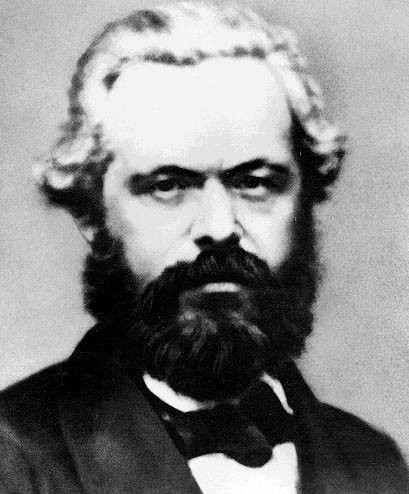
Karl Marx: Alienation
Hegel almost makes Marx seem crystal-clear. Almost. This excerpt from The Economic and Philosophic Manuscripts of 1844 still strikes a chord for everyone who has ever found himself or herself "working for the weekend." That Marx had the factory worker in mind doesn't limit its applicability to the office worker, the middle manager, the white-collar wage slave, or anyone else who has ever discovered "the fact that labour is external to the worker," that it consists of a good deal of self-denial, that he "does not feel content but unhappy, does not develop freely his physical and mental energy but mortifies his body and ruins his mind." In essence, "the external character of labour for the worker appears in the fact that it is not his own, but someone else's, that it does not belong to him, that in it he belongs, not to himself, but to another." And because "It belongs to another; it is the loss of his self."
Such a worker finds his self only in animal pleasures: "eating, drinking, procreating, etc." These are the things in which he is free to act. "Man is a species being ... because he treats himself as a universal and therefore a free being." All that is outside the human, i.e., nature, is inorganic to him. But nature is also that "with which he must remain in continuous interchange if he is not to die." Therefore, labor which estranges man from himself and from nature "estranges the species from man. It changes for him the life of the species into a means of individual life." For "free, conscious activity is man's species character."
The animal is immediately identical with its life activity. It does not distinguish itself from it. It is its life activity. Man makes his life activity itself the object of his will and of his consciousness. He has conscious life activity.... Conscious life activity distinguishes man immediately from animal life activity.... Estranged labour reverses this relationship, so that it is just because man is a conscious being that he makes his life activity, his essential being, a mere means to his existence.The true function of labor, of work, is to produce, to express, to allow man to contemplate "himself in a world that he has created. In tearing away from man the object of his production, therefore, estranged labour tears from him his species life, his real objectivity as a member of of the species and transforms his advantage over animals into the disadvantage that his inorganic body, nature, is taken away from him. Similarly, in degrading spontaneous, free activity, to a means, estranged labour makes man's species life a means to his physical existence." And when man is estranged from his work, the result is "the estrangement of man from man."
Søren Kierkegaard: Indirect Communication
 |
| Søren Kierkegaard, c. 1840 |
In these selections from Concluding Unscientific Postscript (1846) and The Point of View for My Work as an Author (1859), Kierkegaard proclaims the necessity of subjectivity:
While objective thought translates everything into results, and helps all mankind to cheat, by copying these off and reciting them by rote, subjective thought puts everything in process, and omits the result.Human beings are "constantly in process of coming to be," and thus the subjective view is truer than the objective. When two people communicate, and the one acknowledges agreement with what the other has said, a "double reflection" has taken place "in the process of communication." The speaker has reflected his subjective perception (itself a reflection) in the consciousness of the other. "Wherever the subjective is of importance in knowledge, and where appropriation thus constitutes the crux of the matter, the process of communication is a work of art, and doubly reflected."
Kierkegaard's position is that of the "negative" thinker:
Negative thinkers ... always have one advantage, in that they have something positive, being aware of the negative element in existence; the positive have nothing at all, since they are deceived. Precisely because the negative is present in existence, and present everywhere (for existence is a constant process of becoming), it is necessary to become aware of its presence continuously, as the only safeguard against it. In relying upon a positive security the subject is merely deceived."The infinite and eternal is the only certainty," Kierkegaard asserts, but this assertion contains a "tremendous contradiction, that the eternal becomes, that it comes into being." As infinite and eternal, it cannot be, it must forever become. And consequently, definite statements about existence are false by nature: "an elusive form of communication is the only adequate one; because a direct form of communication is based upon the security of social continuity, while the elusiveness of existence isolates me whenever I apprehend it."
Like Schlegel, Kierkegaard is aware of the ironic consciousness: "The irony of Socrates makes use ... of a form of speech which sounds in the first instance like the speech of a madman." Socrates constantly challenges the conventional, the commonsense, which is the habit of the mad. The "genuine subjective thinker ... is conscious of the negativity of the infinite in existence, and he constantly keeps the wound of the negative open, which in the bodily realm is sometimes the condition for a cure.... He is therefore never a teacher but a learner; and since he is always just as negative as he is positive, he is always striving."
An existing individual is constantly in process of becoming; the actual existing subjective thinker constantly reproduces this existential situation in his thoughts, and translates all his thinking into terms of process.... The incessant becoming generates the uncertainty of the earthly life, where everything is uncertain.So the subjective thinker "is as sensitive to the comic as to the pathetic.... The pathos which is not secured by the presence of the comic is illusion; the comic spirit that is not made secure by the presence of pathos is immature." This need to balance the comic and the pathetic in one's thought is a product of the uncertainty of existence. "The comic expression for worship is therefore just as reverent, religiously, as its pathetic expression."
This relation between the comic and the pathetic view of existence is expressed by one's point of view toward God, or the cosmos, or as Kierkegaard says there, "the Idea."
When viewed from a direction looking toward the Idea, the apprehension of the discrepancy [between the individual and the eternal] is pathos; when viewed with the Idea behind one, the apprehension is comic. When the subjective existing thinker turns his face toward the Idea, his apprehension of the discrepancy is pathetic; when he turns his back to the Idea and lets this through a light from behind over the same discrepancy, the apprehension is in terms of the comic.To view existence from the temporal point of view is to experience a sense of the great failure of human accomplishment. To view it from the point of view of eternity, is to recognize the comic in it.
Communication must be indirect and dialectic because life is a process, but even Socrates, whose method was dialectic, fell into the inconsistency of speaking at length to explain to his hearers some facts that he thought necessary for the discussion. Kierkegaard rejects this effort at accommodation: "To me it seems better to reach a true mutual understanding in inwardness separately, though this might take place slowly." Kierkegaard advocates "the indirect method, which, loving and serving the truth, arranges everything dialectically for the prospective captive, and then shyly withdraw."
He advocates this method, too, for promoting Christianity, admitting that a little deception is sometimes necessary for promoting the truth. He used it himself, he says, in his religious polemics, disguising himself under pseudonyms (and denying that he had done so).
A little end note: I'm not satisfied at all with these notes. All of these excerpts are dense and challenging. I just hope I've understood some of the key points and touched on some of the essentials.